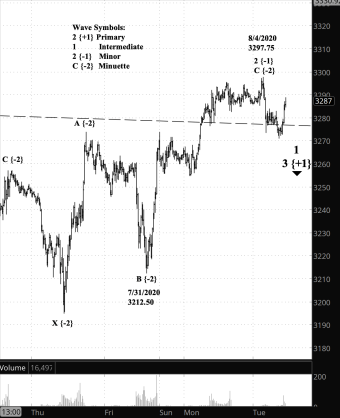
What’s happening now? The S&P 500 E-mini futures, in early morning trading, hit a peak of 3297.75, and then retreated, moving briefly below the upper boundary of the price channel before moving back above the boundary.
What does it mean? If the early morning high is indeed the end of the corrective rise that began July 31, then the ensuing decline will be significant enough to trade.
S&P 500 E-mini futures, 15-minute bars
What does Elliott wave theory say? See yesterday’s live post for a description of what lies ahead. The question isn’t where are we going but when are we going to start the downhill trip to the significant lows that are our destination.
The early morning peak today by my count completes wave C of Minuette degree within wave 2 of Minor degree. I base that on an internal count of wave C, which has completed five waves to the upside. By that count, the trip has begun. We’re on our way.
What is the alternative? It’s possible to count the wave C internals as having completed three waves, which leaves two waves to the upside before the Minor 2nd wave is complete. The car is packed, but we still have a few odds and ends to take care of before we hit the road.
I think my principle count fits the chart better, but a case can be made for the alternate.
What about my trades? A persistent drop below the upper boundary of the price channel is my signal to resume trading. We’re not there yet, but soon, soon.
The index dropped below the upper boundary of the price channel and I entered share positions of SDS, an exchange-traded fund that moves the opposite of the S&P 500. I.e., it’s a bear fund. My entry price was $17.09 per share. Shortly afterword, the price again moved above the channel boundary, so I halted my trading until the decline resumes.
9:35 a.m. New York time
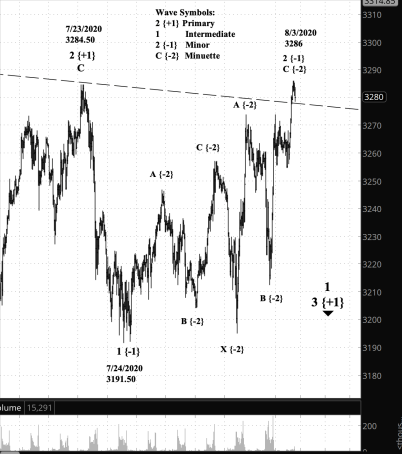
What’s happening now? The S&P 500 E-mini futures moved above the price channel of the decline that began in February, a movement known as a throw-over. The tip-off that a throw-over was likely came from the volume, which has been on the increase as the price approached the channel.
What does it mean? A throw-over is an exhaustion move, the last hoorah of a trend that will quickly reverse. I anticipate a decline that initially will move below 3200 and perhaps much lower as a the new trend kicks off.
S&P 500 E-mini futures, 30-minute bars
What does Elliott wave theory say? The channel at its upper boundary connects the starting points of Primary waves 1 and 3, with the width determined by the end point of Primary wave 2.
The throw-over at the upper boundary marks the end of a Minor wave 2 correction to the upside. It will be followed by a return to the dominant trend, to the downside, with Minor wave 3 within Intermediate wave 1 within Primary wave 3.
At the least Minor wave 3 will move below the starting point of the correction, 3191.50, attained on July 24, and will most likely move quite a bit lower.
It will be followed by Minor wave 4, most likely a sideways correction, and then Minor wave 5 to the downside, which will mark the end of Intermediate wave 1.
At that point things get interesting for traders. The next move will be Intermediate wave 2, an upward correction. Second waves often take back nearly all of the decline of the preceding wave of the same degree. This second wave will likely bring the price back to up to almost where it is today. The correction will be followed by Intermediate wave 3, which will carry the price down significantly, with the great energy that third waves tend to bring to the chart.
What is the alternative? I have seen cases where throw-overs move significantly beyond the channel boundary. Usually there’s a quick reversal. But not always, and that can be devastating for traders who jump in too soon. The upper limit of the correction is 3397.50, the start of wave 1. Under the Elliott rules, no second wave can move beyond the beginning of the first wave.
What about my trades? My signal to get in will be the cross below the upper boundary of the price channel. At that signal, I shall add to my bear positions on the S&P 500 (using the inverse exchange-traded fund SDS).
Minor wave 3 may well be a reasonable options play, and I shall consider entering bear call spread options positions at the cross back to within the channel. If I were to enter today, I would use the options expiring September 18 as a vehicle, with profitable positions to be exited no later than August 28 (“management day”). The entry period under my rules ends August 11, so there’s time to allow some caution in choosing my entry point.
 Tim Bovee, Private Trader
You must be logged in to post a comment.