3:30 p.m. New York time
Half an hour before the closing bell. The S&P 500 rose the latter half of the session but has not yet committed to the upside. My ad hoc rule-of-thumb is to consider a move above the October 26 high, 4206, to be enough to consider the final wave of the upward correction, the C wave, to be underway.
The lack of a strong trend today isn’t surprising, given what’s on the calendar the rest of the week: On Wednesday, the ADP sneak-preview of the employment numbers and a statement on interest rates closing out a meeting of the Federal Open Market Committee. And then on Friday the government’s Employment Situation Report. There will be much incentive for trader’s to buy in or exit as the week progresses.
I’ve updated the chart.
1:40 p.m. New York time
Exited 9DTE options trade on SPY. I’ve exited my bull put options spread on SPY, entered nine days to expiration (9DTE), for a loss and have updated the trade analysis with full results.
12:45 p.m. New York time
Exited 1DTE options trade on QQQ. I’ve exited my iron butterfly position on QQQ, minutes after the opening bell on expiration day, for 5.5% of maximum potential profit, and have updated the trade analysis with full results. I entered the trade with one day to expiration (1DTE).
11:45 a.m. New York time
Short-term options plays. On Friday I had declared my intention to write up a plan, with rules, for trading options with only a day or a few days to expiration (DTE). In experimenting with the concept, I’ve entered positions 9DTE and 1DTE. As I began to write it quickly became clear that trading that way was complex than I had realized.
I had no intention of abandoning the longer-term trades that have been my break-and-butter for more than a decade. So a plan and rules had to take into account positions with at least three potential life spans: 1DTE, 9DTE and 45DTE.
Moreover, the options calendar has grown since the days when all options expirations occurred one per month. Nowadays, SPY and QQQ have options that expire every trading day, and IWM, every other trading day. Mostly highly liquid options have fresh issues each week. And there are still some symbols with once-a-month options.
Moreover, the possibility of trading three options every day or two, with 1DTE, increases the risk of running afoul of the pattern day trader rules issued by the SEC, at least for accounts of less than $25,000. Any trading calendar and rule set would have to manage that risk. True, a violation of the SEC’s day-trading rule — no more than three day trades in five business days — will lead to temporary restrictions, I’m told that brokerages tend to have very long and unforgiving memories that work on this principle: One a pattern day trader, always a pattern day trader.
And then there are the economic reports, including big market movers like the employment situation report, GDP and the consumer price index, all of which are released before the market open. The effect on a 1DTE trade, brought late in the session before the report, could be devastating the next morning if the market responded with a major move.
And the trade-write-ups I do, with all their verbiage, are time-consuming — fine for a series of 45DTE trades, not so fine a rapid-fire succession of 1DTE trades. I need to rework them so that they’re a simple copy/paste from my Options Construction spreadsheet.
The project turned out not to be the work of a weekend. I’m making progress with it now, and plan — hope? — to post it next weekend or early next week. Meanwhile, I’m still doing cautious close-to-expiration trades to see what problems might be lurking.
9:35 a.m. New York time
What’s happening now? The S&P 500 E-mini futures gapped slightly higher overnight after trading resumed on Sunday, subsequently rising gently from the 4140s to almost 4170.
What does it mean? The ambiguity that beset the chart remains, with two analyses of equal probability.
- Either the middle wave of the three-wave upward correction that began on October 23 is still underway. This is the B-wave scenario.
- Or the middle wave ended on October 22 at 4122.25, and the final wave of the correction has begun. This is the C-wave scenario.
I chose to retain the B-wave scenario on the chart because the simplest of uptrend metrics — a series of higher highs — has not yet manifested itself.
The technical term for what we’ve been seeing the last few trading is is a process called “bottom fishing”, and at this point no fish has decisively taken the bait. On the chart the B wave is wave B{-10}, and the C wave will be labeled C{-10}.
The C wave will be the end of the upward correction, unless it takes a compound form, stringing two or three connective patterns together. Whether compound or simple, the upward correction, wave 4{-9}, will be followed by a downtrending 5th wave that typically will have little ambiguity and quite a bit of power.
What are the alternatives? In addition to the ambiguity described above, it’s possible that the degree labels on the chart are lower than the reality of the chart. For example, the degree {-8} waves on the chart ought to be labeled {-7} and the {-9} wave changed to {-8}.
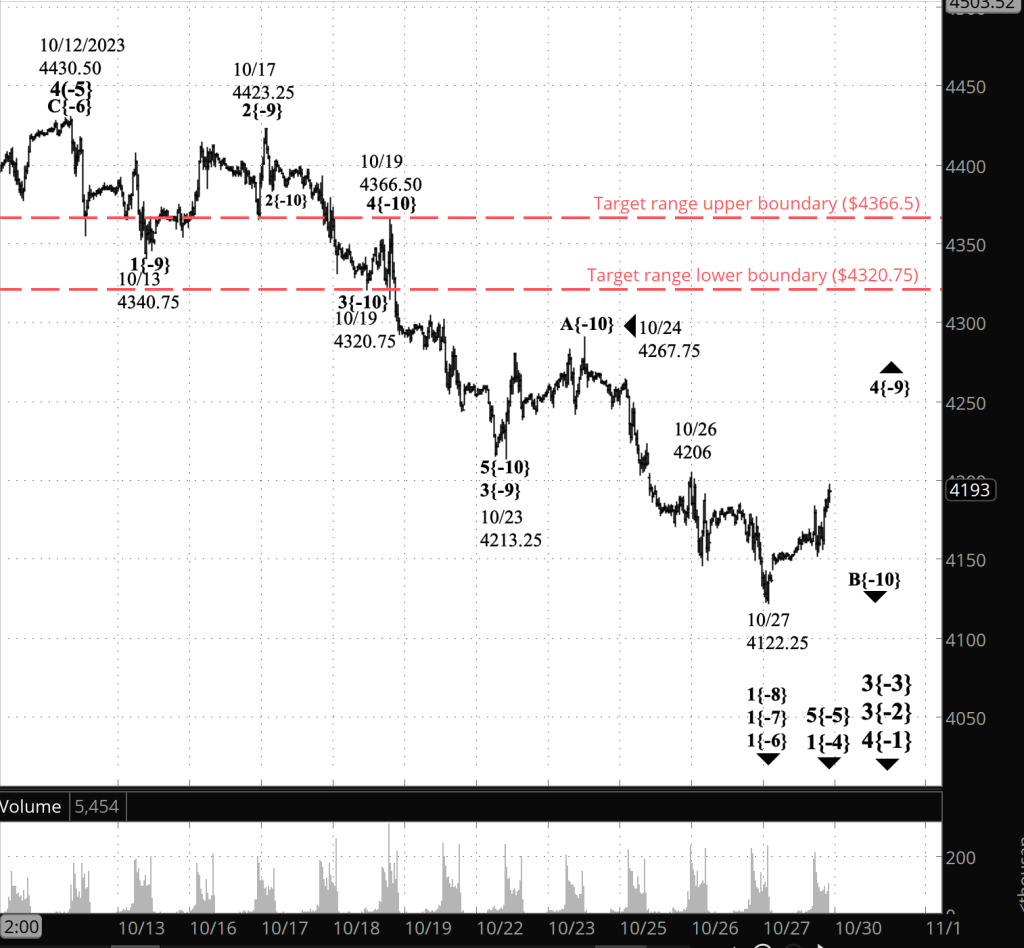
[S&P 500 E-mini futures at 3:30 p.m., 30-minute bars, with volume]
What does Elliott wave theory say? Here are the waves that underly the analyses.
Principal Analysis:
- A downtrend, wave 3{-2}, began on July 27 and is underway.
- Within wave 3{-2}, a smaller downtrend, wave 3{-3}, began on September 14 and is in its initial subwave, wave 1{-4}.
- With wave 1{-4}, subwave 5{-5}, an downtrend, is underway, having begun on October 12.
- Wave 5{-5} is in its first subwave, wave 1{-6}.
- Within wave 1{-6}, waves 1{-7} and 1{-8} are underway.
- Within 1{-8}, a downward correction ,wave 4{-9}, is underway and is in wave B{-10}, the middle of three subwaves.
- Of equal probability, within wave 4{-9}, wave C{-10}, the last of three subwaves, is underway.
Alternative Analysis
- The degrees in the principal analysis are lower than they will eventually turn out to be. The present downtrending wave 3{-9} is wave 3{-8} or perhaps even 3{-7}.
We Are Here.
These are the waves currently in progress under my principal analysis. Each line on the list shows the wave number, with the subscript in curly brackets, the traditional degree name, the starting date, the starting price of the S&P 500 E-mini futures, and the direction of the wave.
- S&P 500 Index:
- 5{+3} Supercycle, 7/8/1932, 4.40 (up)
- 5{+2} Cycle, 12/9/1974, 60.96 (up)
- 5{+1} Primary, 3/6/2009, 666.79 (up)
- 5{0} Intermediate, 12/26/2018, 2346.58 (up)
- S&P 500 Futures and index:
- 4{-1} Minor, 1/4/2022, 4953.25 (down) (futures), 4818.62 (down) (index)
- S&P 500 Futures:
- 3{-2} Minute, 7/27/2023, 3502 (down)
Reading the chart. Price movements — waves – – in Elliott wave analysis are labeled with numbers within trending waves and letters with corrective waves. The subscripts — numbers in curly brackets — designate the wave’s degree, which, in Elliott wave analysis, means the relative position of a wave within the larger and smaller structures that make up the chart. R.N. Elliott, who in the 1930s developed the form of analysis that bears his name, viewed the chart as a complex structure of smaller waves nested within larger waves, which in turn are nested within still larger waves. In mathematics it’s called a fractal structure, where at every scale the pattern is similar to the others.
Learning and other resources. Elliott wave analysis provides context, not prophecy. As the 20th century semanticist Alfred Korzybski put it in his book Science and Sanity (1933), “The map is not the territory … The only usefulness of a map depends on similarity of structure between the empirical world and the map.” And I would add, in the ever-changing markets, we can judge that similarity of structure only after the fact.
See the menu page Analytical Methods for a rundown on where to go for information on Elliott wave analysis.
By Tim Bovee, Portland, Oregon, October 30, 2023
Disclaimer
Tim Bovee, Private Trader tracks the analysis and trades of a private trader for his own accounts. Nothing in this blog constitutes a recommendation to buy or sell stocks, options or any other financial instrument. The only purpose of this blog is to provide education and entertainment.
No trader is ever 100 percent successful in his or her trades. Trading in the stock and option markets is risky and uncertain. Each trader must make trading decisions for his or her own account, and take responsibility for the consequences.
License
All content on Tim Bovee, Private Trader by Timothy K. Bovee is licensed under a Creative Commons Attribution-ShareAlike 4.0 International License.
Based on a work at www.timbovee.com.
 Tim Bovee, Private Trader
You must be logged in to post a comment.