3:30 p.m. New York time
Half an hour before the closing bell. The S&P 500 futures continued to rise, coming within 20 points of the upper boundary of the price target at 5125 (the dashed red line on the chart). The price target is a tendency, not a rule. The price could either reverse and drop or could push above that level, and it would remain within the rules of Elliott Wave Theory.
How far along is the present wave B{-3}? When a wave has this much energy, it’s hard to say where the counter-directional retrenchments have occurred. My best guess is that we’re still in subwave A{-4}.
At this point, I think it important to step back and gain some perspective.
This rise on the close-up chart, which works best for daily analysis, makes the wave B{-3} rise look like a thunderous event, one that will change the World as We Know It.
I’ve added a chart as contrast to this morning’s close-up chart of the wave 4{-2} downward correction that began on December 12, of the S&P 500 index showing the expanding Diagonal Triangle two degrees larger that encompasses all that has happened since the triangle began, on December 26, 2018, a bit more than five years ago.
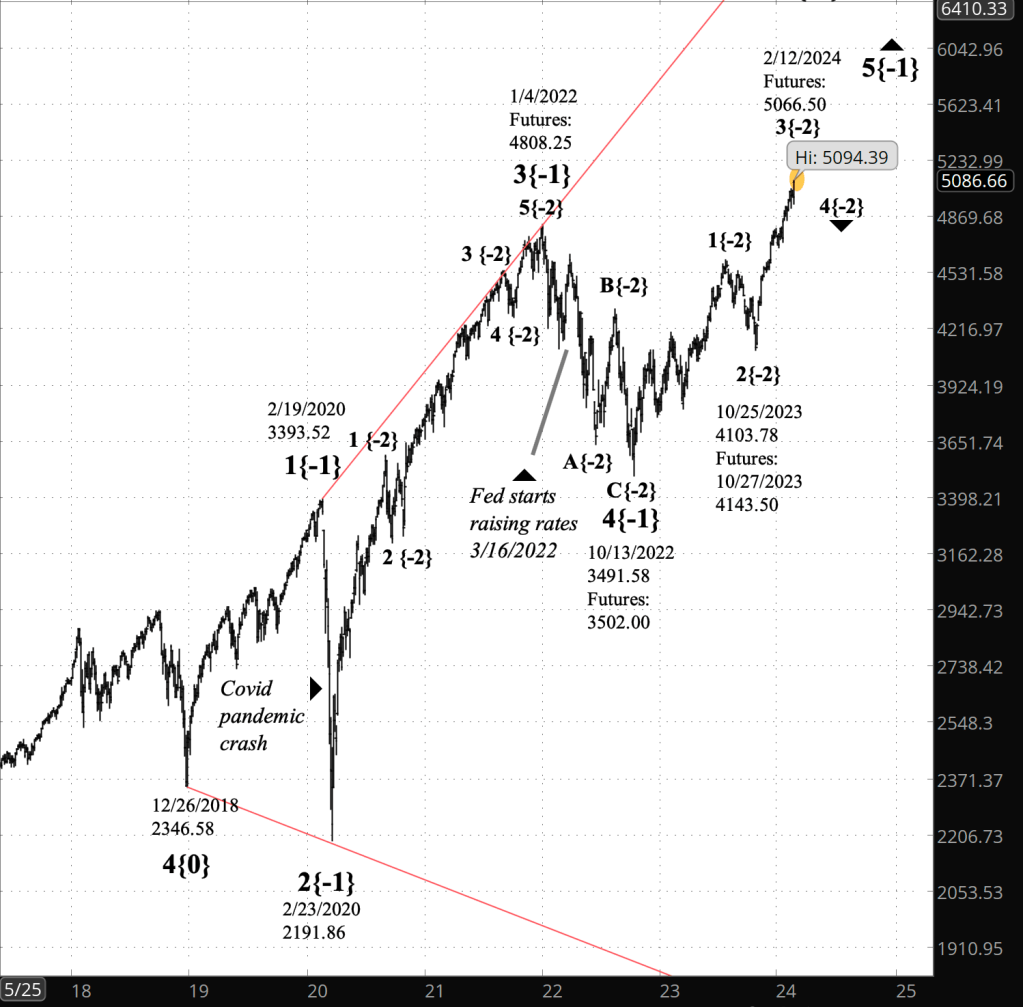
[S&P 500 index at 3:30 p.m., 3-day bars]
Look very carefully at the end of the price line, and you’ll see a tiny yellow circle. That 4th-wave upward correction that began on February 12 and is now in its middle subwave? It is contained entirely within that circle. So it’s a big deal detail. In the grander movements of the market, maybe not so much.
Here I’ll insert a caveat: I don’t ever give trading advice to anyone; go make your own mistakes, don’t echo mine.
Having said that, when trading options I look carefully at the close-up charts, at present basing my decisions on the {-4} degree and its {-5} subwaves on that close-up chart. I look to trade waves 3 and 5 within trends and waves A and C within corrections.
For stocks, I prefer to I stick with the larger degrees: The {-2} degree, for example, and its internal subwaves at degree {-3}. I trade any rising wave of those degrees, trying to jump during the earlier subwaves. When a long downward wave is underway — like now — I will on occasionally drop down to the smaller degrees and trade a rising 3rd or 5th wave.
Finally, the rise has pushed the price above the prior S&P 500 high, set on February 12. An expanding Diagonal Triangle, such as our present wave 5{0}, creates a price channel that grows wider every day. Today’s high is a bit more than 25 points above the prior high and around 1400 points below the upper boundary of the Diagonal Triangle’s price channel. So the “record high”, as some in the financial media describe it, is more an incremental bump up than an achievement of historical significance.
9:35 a.m. New York time
What’s happening now? The S&P 500 E-mini futures rose sharply as the closing bell approached in yesterday’s session, and kept shooting higher overnight.
What does it mean? Within the 4th-wave downward correction, wave 4, that began on February 12, the 1st subwave, an A wave, came to an end at 4959 and the middle subwave, a B wave, began. The B wave has so far reached into the 5060s, and it is within its first subwave.
As I did in yesterday’s Elliott Wave Analysis, for the rest of this discussion I’ll use the wave degrees as designated on the chart. The degrees are displayed just after each wave number, as subscripts within curly brackets, showing each degrees distance from the Intermediate degree, which is presently wave 5{0}, an expanding Diagonal Triangle that began in December 2018.
The largest wave included in this discussion is wave 4{-2}, a downward correction that began February 12. It’s first subwave, wave A{-3], ended late in yesterday’s session at 4959, and from that point rising wave B{-3} began, carrying the price up by more than 2%.
Whatever the form of a correction, a B wave has three subwaves. The first subwave is still underway, rising wave B{-4}.
A 4th-wave correction generally takes the from of a Flat, with three waves within the first subwave, although sometimes they take the form of a Zigzag, with five waves within the first subwave. The principal analysis considers it more likely that wave 4{-2} has taken the from of a Flat.
Whatever the form, the middle subwave — wave B{-3} in this case — will have three subwaves.
The B wave in a Flat always retraces 90% or more of the preceding A wave of the same degree, and usually retraces between 100% and 138%. These observations of Elliott Wave Theory tell us that wave B{-3} is far from having finished its rise.
Wave A{-3} covered 120 points during its nine-day existence. Wave B{-3}, an hour before the opening bell, has so far has covered 108.75 points during its existence, which is measured in hours, not days.
Wave B{-3} has in that brief time met the minimum requirement of a B wave in a Flat correction. It has retraced 90% of the preceding A wave. A retracement of 138% would carry the price up 166 points, to 5125. I’ve marked that point, the top of the wave B price target range, with a dashed line on the chart.
Like all waves the B wave will be built from a series of rises and falls. The B wave is highly unlikely to reach its end point without slides to the downside.
In other business, business as usual in the world of Elliott Wave Theory
What are the alternatives? Yesterday’s alternative — that wave 4{-2] is taking the form of a Zigzag, with all of its implications, such as a smaller retracement — is seeming increasingly unlikely, and I’m removing it from the mix. If it appears more viable later, I’ll restore it.
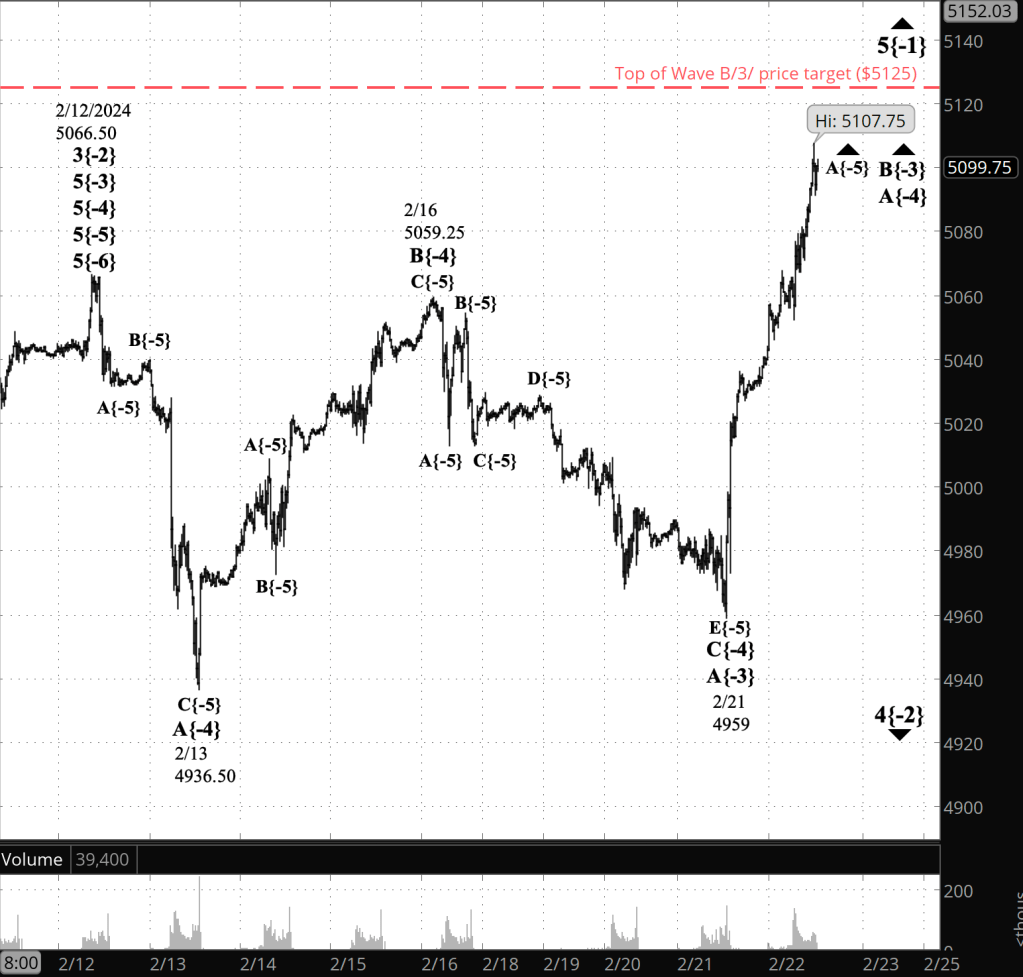
[S&P 500 E-mini futures at 3:30 p.m., 20-minute bars, with volume]
What does Elliott wave theory say? Here are the waves that underly the analyses.
Principal Analysis:
- Wave 5{0}, an expanding Diagonal Triangle, began on December 26, 2018.
- Within it, an uptrend, wave 5{-1}, began on October 13, 2022 and is underway.
- Wave 5{-1} is the parent wave of a downward correction, wave 4{-2}, that began on February 12, 2024.
- Wave 4{-2} is in its second subwave, wave B{-3}, which in turn is in wave A{-4}, its first subwave.
We Are Here.
These are the waves currently in progress under my principal analysis. Each line on the list shows the wave number, with the subscript in curly brackets, the traditional degree name, the starting date, the starting price of the S&P 500 E-mini futures, and the direction of the wave.
- S&P 500 Index:
- 5{+3} Supercycle, 7/8/1932, 4.40 (up)
- 5{+2} Cycle, 12/9/1974, 60.96 (up)
- 5{+1} Primary, 3/6/2009, 666.79 (up)
- 5{0} Intermediate, 12/26/2018, 2346.58 (up)
- S&P 500 Futures and index:
- 5{-1} Minor, 10/13/2022, 3502 (up) (futures), 3491.58 (up) (index)
- S&P 500 Futures:
- 4{-2} Minute, 2/12/2024, 5066.50 (down)
- B{-3} Minuette, 2/21/2024, 4959 (up)
Reading the chart. Price movements — waves – – in Elliott wave analysis are labeled with numbers within trending waves and letters with corrective waves. The subscripts — numbers in curly brackets — designate the wave’s degree, which, in Elliott wave analysis, means the relative position of a wave within the larger and smaller structures that make up the chart. R.N. Elliott, who in the 1930s developed the form of analysis that bears his name, viewed the chart as a complex structure of smaller waves nested within larger waves, which in turn are nested within still larger waves. In mathematics it’s called a fractal structure, where at every scale the pattern is similar to the others.
Learning and other resources. Elliott wave analysis provides context, not prophecy. As the 20th century semanticist Alfred Korzybski put it in his book Science and Sanity (1933), “The map is not the territory … The only usefulness of a map depends on similarity of structure between the empirical world and the map.” And I would add, in the ever-changing markets, we can judge that similarity of structure only after the fact.
See the menu page Analytical Methods for a rundown on where to go for information on Elliott wave analysis.
By Tim Bovee, Portland, Oregon, February 22, 2024
Disclaimer
Tim Bovee, Private Trader tracks the analysis and trades of a private trader for his own accounts. Nothing in this blog constitutes a recommendation to buy or sell stocks, options or any other financial instrument. The only purpose of this blog is to provide education and entertainment.
No trader is ever 100 percent successful in his or her trades. Trading in the stock and option markets is risky and uncertain. Each trader must make trading decisions for his or her own account, and take responsibility for the consequences.
License
All content on Tim Bovee, Private Trader by Timothy K. Bovee is licensed under a Creative Commons Attribution-ShareAlike 4.0 International License.
Based on a work at www.timbovee.com.
 Tim Bovee, Private Trader
You must be logged in to post a comment.