3:30 p.m. New York time
Half an hour before the closing bell. The S&P 500 futures have fallen during the session, so far reaching into the 5160s. The decline is a downward correction within a 3rd-wave uptrend that began on March 5. The small uptrend is part of a series of 3rd-wave uptrends of increasingly larger size, all subwaves of a 5th-wave uptrend that began on October 27, 2023.
I’ve updated the lower (close-up) chart.
9:35 a.m. New York time
What’s happening now? The S&P 500 E-mini futures rose to higher high overnight.
What does it mean? A low-degree 3rd wave that began on March 5 continues, a subwave buried three-degrees deep within a major uptrendng 3rd-wave that began on January 17.
That’s the close-up view. However, today’s Elliott Wave analysis will focus on the bigger picture. The Wednesday, March 13, afternoon analysis produced a problem in the close-up wave count: The low-degree B wave under discussion had five internal waves. B waves have three internal waves.
Indeed, the rise looked very much like a five-way uptrend.
A brief aside: Elliott Wave Theory is one of the most frustrating methods I’ve used for chart analysis. And yet, it has kept me focused directionally in my trading, with an eye to the big picture as well as the day’s price action.
Two major difficulties:
- Subjectivity: Different analysts can come up with different wave counts, reflecting conflicting interpretations and predictions.
- Hindsight Bias: It’s often easier to fit wave patterns to historical data than to accurately predict future waves.
I find Elliott Wave Theory to be fascinating and have used it for 40 years, but because of those two characteristics, I’m not a true believer. I approach any chart mark-up with a great deal of scepticism.
After all, in this Private Trader project, which is in its fourth year, time and time again the analysis has bumped up against a rule of Elliott Wave Theory and required a reanalysis.
That’s what has happened this week, yet again.
The goal of my reanalysis was to retain the rise that began on October 13, 2022 as an uptrend and to transform the rise that began on October 27, 2023 into a trending wave rather than an upward correction, all the while staying within the rules of Elliott Wave Theory.
To fix it, I had to go back to the January 4, 2022 high and find a way to analyze the subsequent fall and then rise into a three-subwave correction and then a five-subwave rising impulse wave.
In the process of doing so, the expanding Diagonal Triangle that began in December 2018, a wave that has long encompassed everything that is happening on the chart, had to be disgarded. With an expanding Diagonal Triangle, the 4th wave had to at least approach the triangle’s lower boundary. This 4th wave didn’t come close, so clearly something else was going wrong.
The top chart below is my reanalysis, from the January 4, 2022 peak to the present.
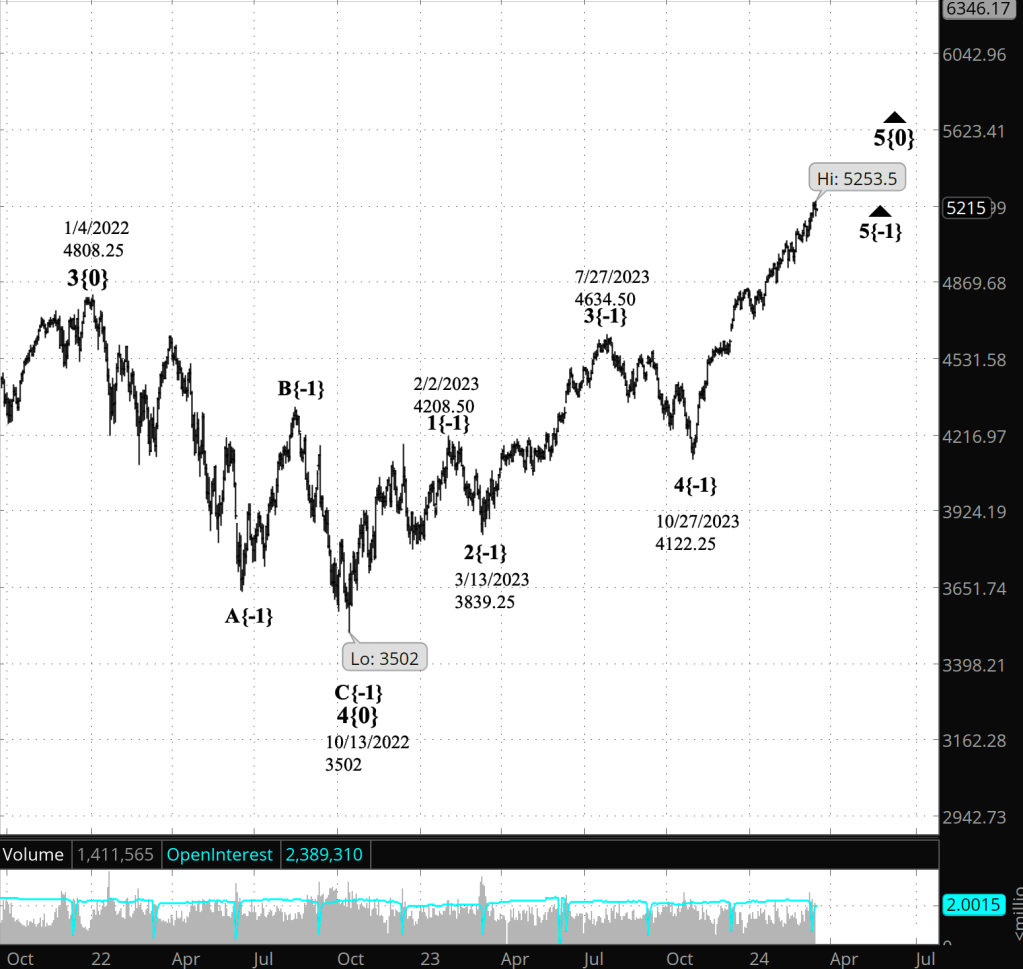
[S&P 500 E-mini futures at the prior day’s session close, daily bars, with volume]
Closer up, I’ve numbered four encompassing degrees of subwaves within the rise from October 27.
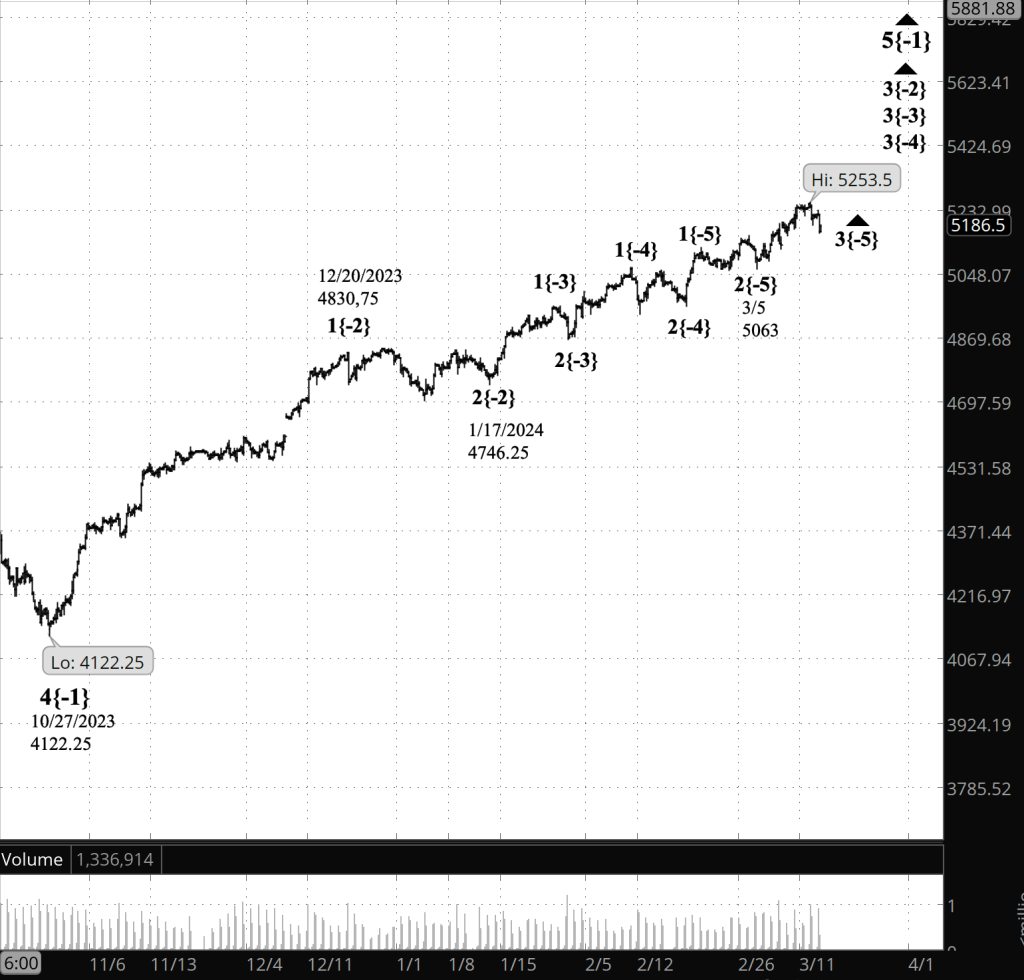
[S&P 500 E-mini futures at 3:30 p.m., 4-hour bars, with volume]
The low-degree 5th wave that began on March 5 — wave 3{-5} on the chart — will be followed by a 4th-wave downward correction and then a 5th-wave push to the upside. Across three degrees larger, the parent waves are all 3rd waves and so are far from their end.
On Monday I’ll discuss my revisions prior to the January 4, 2022 peak.
What are the alternatives? As usual, there is uncertainty over the proper place of the waves within the fractal structure of the chart. For example, should wave 4{0} really be listed as the {0} degree, or is it really a {-1} degree, pushing the later {-1} degree labels down to the {-2} degree. See the “Reading the chart” section below for more on degrees and their labeling,
What does Elliott wave theory say? Here are the waves that underly the analyses.
Principal Analysis:
- Rising wave 5{0} is underway.
- It is in its final subwave, wave 5{-1}
- Within wave 5{-1}, rising waves 3{-2}, 3{-3} and 3{-4} are underway, as is the smallest wave labeled on the chart, wave 3{-5}.
Reading the chart. Price movements — waves – – in Elliott wave analysis are labeled with numbers within trending waves and letters with corrective waves. The subscripts — numbers in curly brackets — designate the wave’s degree, which, in Elliott wave analysis, means the relative position of a wave within the larger and smaller structures that make up the chart. R.N. Elliott, who in the 1930s developed the form of analysis that bears his name, viewed the chart as a complex structure of smaller waves nested within larger waves, which in turn are nested within still larger waves. In mathematics it’s called a fractal structure, where at every scale the pattern is similar to the others.
Learning and other resources. Elliott wave analysis provides context, not prophecy. As the 20th century semanticist Alfred Korzybski put it in his book Science and Sanity (1933), “The map is not the territory … The only usefulness of a map depends on similarity of structure between the empirical world and the map.” And I would add, in the ever-changing markets, we can judge that similarity of structure only after the fact.
See the menu page Analytical Methods for a rundown on where to go for information on Elliott wave analysis.
By Tim Bovee, Portland, Oregon, March 15, 2024
Disclaimer
Tim Bovee, Private Trader tracks the analysis and trades of a private trader for his own accounts. Nothing in this blog constitutes a recommendation to buy or sell stocks, options or any other financial instrument. The only purpose of this blog is to provide education and entertainment.
No trader is ever 100 percent successful in his or her trades. Trading in the stock and option markets is risky and uncertain. Each trader must make trading decisions for his or her own account, and take responsibility for the consequences.
License
All content on Tim Bovee, Private Trader by Timothy K. Bovee is licensed under a Creative Commons Attribution-ShareAlike 4.0 International License.
Based on a work at www.timbovee.com.
 Tim Bovee, Private Trader
You must be logged in to post a comment.