3:30 p.m. New York time
Half an hour before the closing bell. The S&P 500 futures fell during the session, into the 5520s.
Applying Elliott Wave Theory, I find a lack of clarity in that small-wave decline. My best interpretation is that it is a downward correction within the 3rd subwave of the 5th wave uptrend that began on June 14. That 5th wave is labelled wave 5{-8} on the chart.
9:35 a.m. New York time
What’s happening now? The S&P 500 E-mini futures rose slightly after trading resumed overnight, reaching into the 5580s.
What does it mean? In Elliott Wave Theory, the rise is a continuation of a small 5th-wave uptrend that began on June 14, a subwave of a series of uptrending waves.
A 5th wave is the last of the subwaves within a trend, and when the smallest of the subwaves is complete, it will cascade up the fractal structure of the chart, bringing a nested series of waves of increasing size to an end.
Put more succinctly: It’s a small 5th wave with outsized consequences.
Waves on the chart are labeled with the wave number followed by a subscript within curly brackets that tells wave’s distance within the fractal structure from the parent wave of Intermediate degree, presently wave 5{0}, which began in December 2018. The small wave that began this discussion is wave 5{-8} — eight degrees lower than the Intermediate degree wave 5{0}.
When wave 5{-8} is complete, it will also be the end of wave 5{-7}, which began on June 11; wave 5{-6}, which began on May 31; and wave 5{-5}, which began on April 18.
The wave one degree higher is wave 3{-4}, which began on February 21, which traditional Elliott Wave nomenclature would label as a wave of Subminuette degree.
That uptrending 3rd wave will be followed by a 4th-wave downward correction, wave 4{-4}. A 4th wave tends to end within the range of the 4th wave within the preceding 3rd wave, or wave 4{-6}. That suggests a target range running from the 5250s to the 5160s. Note that the target range is a tendency, not a firm rule. Wave 4{-4} could come up short or fall further.
Here’s a portion of the chart showing the target range.,
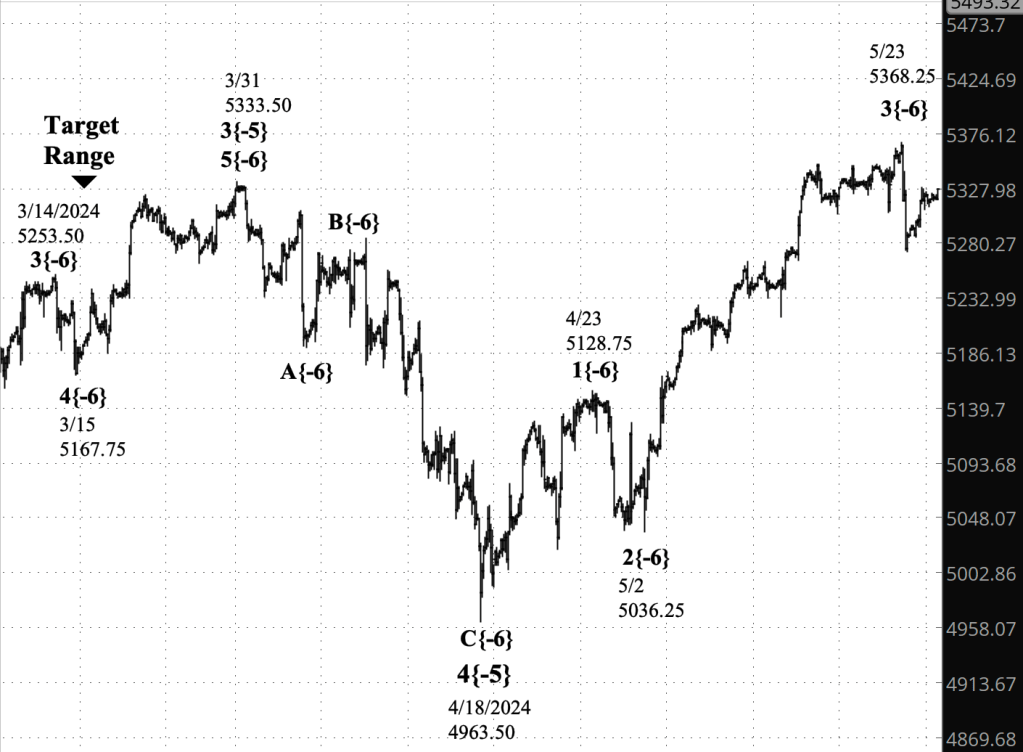
[S&P 500 E-mini futures, 2-hour bars, March to May 2024]
What are the alternatives? There may be a 1st wave on the chart, between wave 5{-6} and 5{-5}. If that’s the proper count, then it would delay the onset or the 4th-wave downward correction, wave 4{-4}. See the June 18 Trader’s Notebook for a more detailed discussion.
Today’s chart.
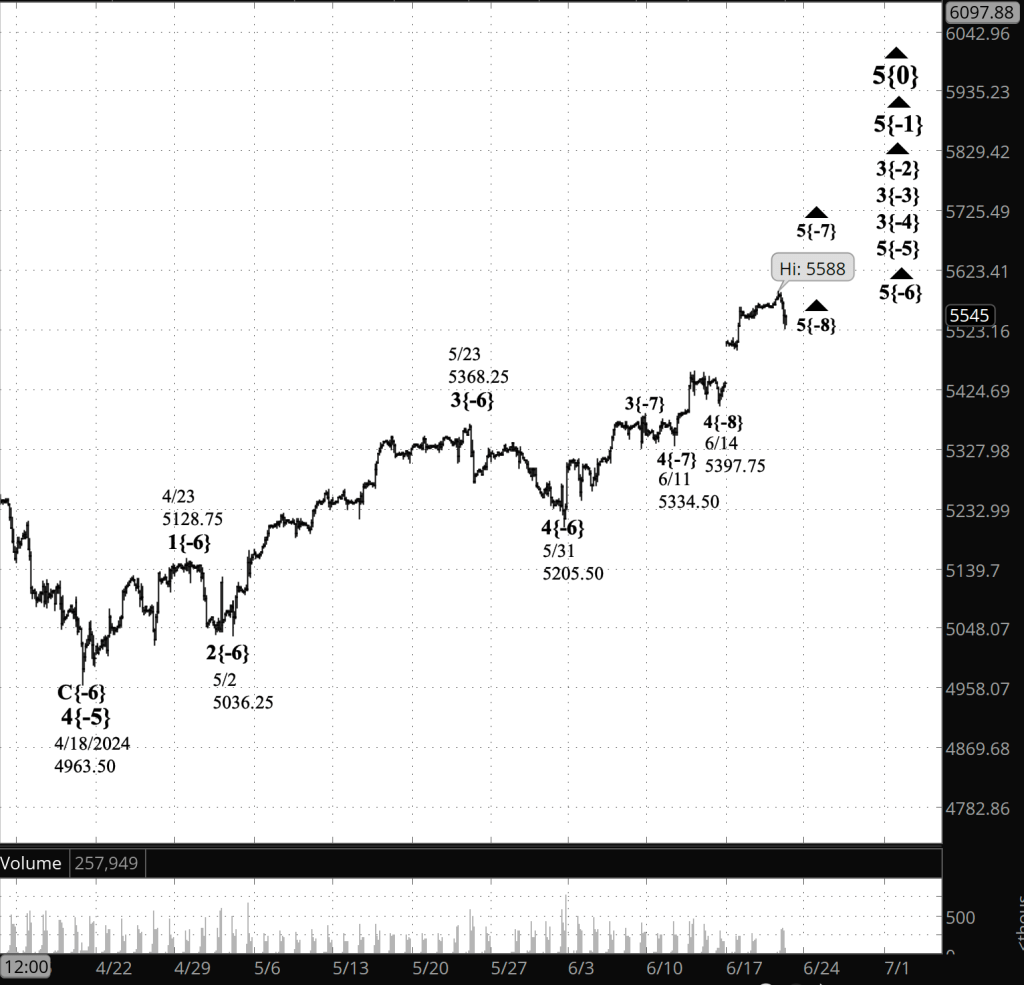
[S&P 500 E-mini futures at 3:30 p.m., 2-hour bars, with volume]
What does Elliott wave theory say? Here are the waves that underly the analyses.
Principal Analysis:
- Rising wave 5{0} is underway. It is a wave of Intermediate degree that began in December 2018.
- It is in its final subwave, wave 5{-1}.
- Within wave 5{-1}, rising waves 3{-2}, 3{-3} and 3{-4} are underway, as is wave 5{-5}.
- Wave 5{-6} is underway and is in its final subwave, uptrending wave 5{-7} and its subwave, uptrending wave 5{-8}.
Reading the chart. Price movements — waves – – in Elliott wave analysis are labeled with numbers within trending waves and letters with corrective waves. The subscripts — numbers in curly brackets — designate the wave’s degree, which, in Elliott wave analysis, means the relative position of a wave within the larger and smaller structures that make up the chart. R.N. Elliott, who in the 1930s developed the form of analysis that bears his name, viewed the chart as a complex structure of smaller waves nested within larger waves, which in turn are nested within still larger waves. In mathematics it’s called a fractal structure, where at every scale the pattern is similar to the others.
Learning and other resources. Elliott wave analysis provides context, not prophecy. As the 20th century semanticist Alfred Korzybski put it in his book Science and Sanity (1933), “The map is not the territory … The only usefulness of a map depends on similarity of structure between the empirical world and the map.” And I would add, in the ever-changing markets, we can judge that similarity of structure only after the fact.
See the menu page Analytical Methods for a rundown on where to go for information on Elliott wave analysis.
By Tim Bovee, Portland, Oregon, June 20, 2024
Disclaimer
Tim Bovee, Private Trader tracks the analysis and trades of a private trader for his own accounts. Nothing in this blog constitutes a recommendation to buy or sell stocks, options or any other financial instrument. The only purpose of this blog is to provide education and entertainment.
No trader is ever 100 percent successful in his or her trades. Trading in the stock and option markets is risky and uncertain. Each trader must make trading decisions for his or her own account, and take responsibility for the consequences.
License
All content on Tim Bovee, Private Trader by Timothy K. Bovee is licensed under a Creative Commons Attribution-ShareAlike 4.0 International License.
Based on a work at www.timbovee.com.
 Tim Bovee, Private Trader
[…] the June 22 Trader’s Notebook for a broader view of the chart, reaching back to the beginning of wave 5{-6} on May […]
LikeLike