3:30 p.m. New York time
Half an hour before the closing bell. The S&P 500 futures rose during the session, reaching into the 6080s.
Elliott Wave Theory: The rise was sufficient to knock out the scenario that the rising B-wave within a downward correction that began on January 31 had ended. It is still underway.
The wave is wave B{-19} on the chart, the B being the wave designation and the {-19} showing how many degrees the wave is below Intermediate degree. The Intermediate degree now underway is wave 5{0}, which began in December 2018. So wave B{-19} is tiny wave.
So why are such small fry important? Because they give an early signal when things are about to change. That’s good. Sometimes their signals are ambiguous. Not to so good.
It seems to me that wave B{-19} is in its final subwave, although that is not a certainty.
9:35 a.m. New York time
What’s happening now? The S&P 500 E-mini futures fell for much of overnight trading and then rose, retracing a portion of the decline.
What does it mean? Elliott Wave Theory sees the overnight ballet as the final wave of small downward correction that began on January 31 working through its endgame, with the repeated leaps and crouches (Grande Jeté and Plié) that are structural heart of a stock chart.
The entire performance is within a 4th-wave upward correction that began on January 13. It is now in its middle wave of three, wave B, which began on January 24 The middle wave is also following a three-wave corrective pattern and is now in the final subwave, wave C, which began on January 31. And within that C wave is yet another C wave, which began on February 2.
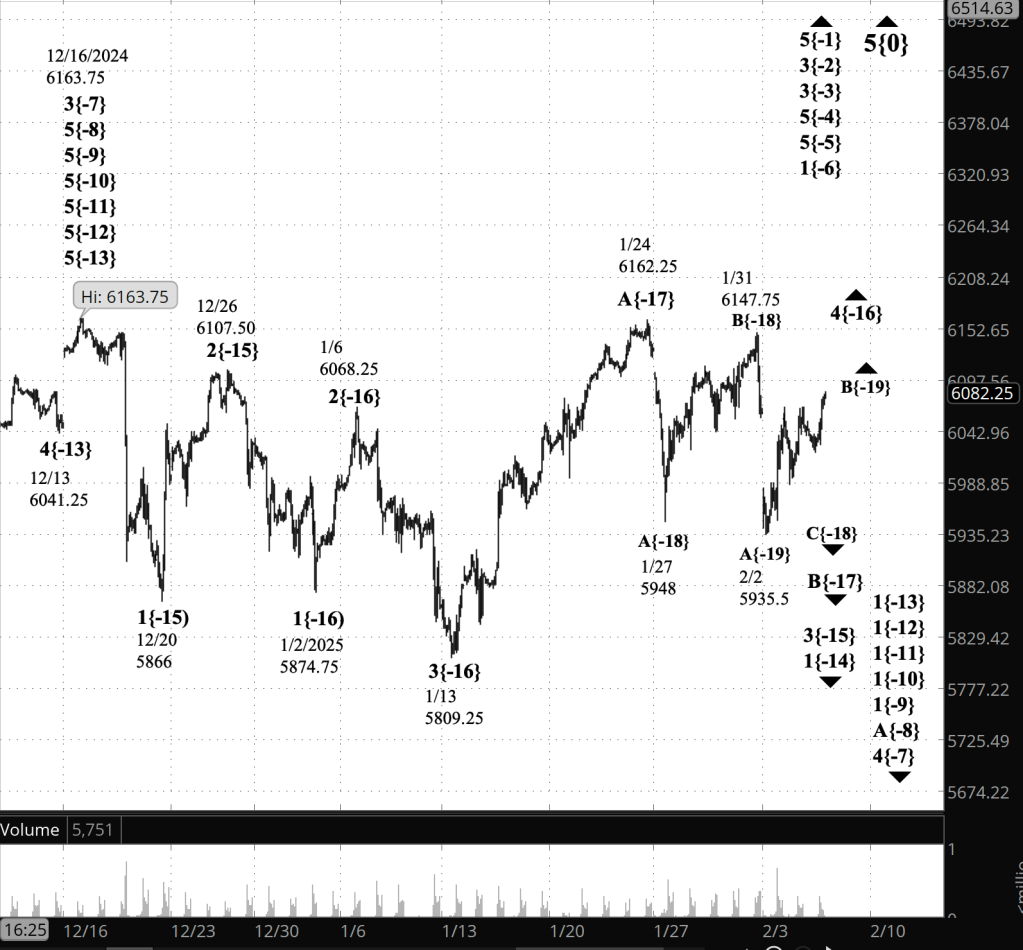
[S&P 500 E-mini futures at 3:30 p.m., 85-minute bars, with volume]
What are the alternatives? The pattern lacks obvious ambiguity. It’s quite clear. Where problems might arise is with the degree of the waves, where each one stands in the fractal structure of the price movements.
For most aspects of those movements Elott Wave Theory has a lot of pointers that help the analyst find the path. Sadly, the degree is not one of them: Is this wave one degree lower than the recent peak? Or is it two degrees lower? Or even three? The answer is, “Who knows?”, with a shrug.
The only indicator is the rule of proportionality, and it is subjective. What’s proportional to my eye may be wildly disproportionate in yours. And so it goes with every chart, that perpetual ambiguity in identifying each wave’s degree.
What does Elliott wave theory say? Here are the waves that underlie the analyses, updated with today’s reanalysis.
Principal Analysis:
- Rising wave 5{0} is underway. It is a wave of Intermediate degree that began in December 2018.
- It is in its final subwave, wave 5{-1}.
- Within wave 5{-1}, rising waves 5{-2}, 5{-3} and 5{-4} are underway, as is wave 5{-5}.
- Wave 5{-5} is in its initial subwave, wave 1{-6}, which in turn is in its middle subwave, wave 3{-7}.
- Wave 4{-7} is in its initial subwave, which is uptrending wave A{-8}, if wave 4{-7} is a Flat structure, with three subwaves, or wave 1{-8} if it is a Zigzag structure, with five subwaves. (I’ll assume Flat as the list continues, since that’s more common within 4th waves)
- Wave A{-8} is in its initial subwave, wave 1{-9}, as are waves 1{-10}, 1{-11}, 1{-12}, and 1{-13}.
- Wave 1{-14}, an upward correction and is in its first subwave, wave 3{-15}.
- Wave 3{-15} is in its second subwave, rising wave 4{-16}, an upward correction
- Wave 4{-16} is in its middle subwave, descending wave B{-17}, which is in its middle subwave, rising wave B{-18}
Long-term Waves.
These are the waves currently in progress under my principal analysis. Each line on the list shows the wave number, with the subscript in curly brackets, the traditional degree name, the starting date, the starting price of the S&P 500 E-mini futures, and the direction of the wave. (Updated with today’s reanalysis.)
- S&P 500 Index:
- 5{+3} Supercycle, 7/8/1932, 4.40 (up)
- 5{+2} Cycle, 12/9/1974, 60.96 (up)
- 5{+1} Primary, 3/6/2009, 666.79 (up)
- 5{0} Intermediate, 12/26/2018, 2346.58 (up)
- S&P 500 Futures
- 5{-1} Minor, 10/27/2023, 4127.25 (up)
- 3{-2} Minute, 10/27/23, 4127.75 (up)
- 3{-3} Minuette, 10/27/23, 4127.75 (up)
- 5{-4} Subminuette, 4/18/2024, 4963.50 (up)
- 5{-5} Micro, 8/5/2024, 5120 (up)
- 1{-6} Submicro, 8/5/2024, 5120 (up)
- 4{-7} Minuscule, 12/16/2024, 6163.75 (down)
- A{-8} (unnamed), 12/16/2024, 6163.75 (down)
- 1{-9} (unnamed), 12/16/2024, 6163.75 (down)
- 1{-10} (unnamed), 12/16/2024, 6163.75 (down)
- 1{-11} (unnamed), 12/16/2024, 6163.75 (down)
- 1{-12} (unnamed), 12/16/2024, 6163.75 (down)
- 1{-13} (unnamed), 12/16/2024, 6163.75 (down)
- 1{-14} (unnamed), 1/13/2025, 5809.25 (down)
- 3{-15} (unnamed), 1/13/2025, 5809.25 (down)
- 4{-16} (unnamed), 1/13/2025, 5809.25 (up)
- B{-17} (unnamed), 1/24/2025, 6162.25 (down)
- C{-18} (unnamed), 1/31/2025, 6147.75 (down)
- B{-18} (unnamed), 1/27/2025, 5948 (up)
Reading the chart. Price movements — waves – – in Elliott wave analysis are labeled with numbers within trending waves and letters with corrective waves. The subscripts — numbers in curly brackets — designate the wave’s degree, which, in Elliott wave analysis, means the relative position of a wave within the larger and smaller structures that make up the chart. R.N. Elliott, who in the 1930s developed the form of analysis that bears his name, viewed the chart as a complex structure of smaller waves nested within larger waves, which in turn are nested within still larger waves. In mathematics it’s called a fractal structure, where at every scale the pattern is similar to the others.
Learning and other resources. Elliott wave analysis provides context, not prophecy. As the 20th century semanticist Alfred Korzybski put it in his book Science and Sanity (1933), “The map is not the territory … The only usefulness of a map depends on similarity of structure between the empirical world and the map.” And I would add, in the ever-changing markets, we can judge that similarity of structure only after the fact.
See the menu page Analytical Methods for a rundown on where to go for information on Elliott wave analysis.
By Tim Bovee, Portland, Oregon, February 5, 2025
Disclaimer
Tim Bovee, Private Trader tracks the analysis and trades of a private trader for his own accounts. Nothing in this blog constitutes a recommendation to buy or sell stocks, options or any other financial instrument. The only purpose of this blog is to provide education and entertainment.
No trader is ever 100 percent successful in his or her trades. Trading in the stock and option markets is risky and uncertain. Each trader must make trading decisions for his or her own account, and take responsibility for the consequences.
All content on Tim Bovee, Private Trader by Timothy K. Bovee is licensed under a Creative Commons Attribution-ShareAlike 4.0 International License.
Based on a work at www.timbovee.com.
 Tim Bovee, Private Trader
You must be logged in to post a comment.