Trader’s Notebook: S&P 500

3:30 p.m. New York time

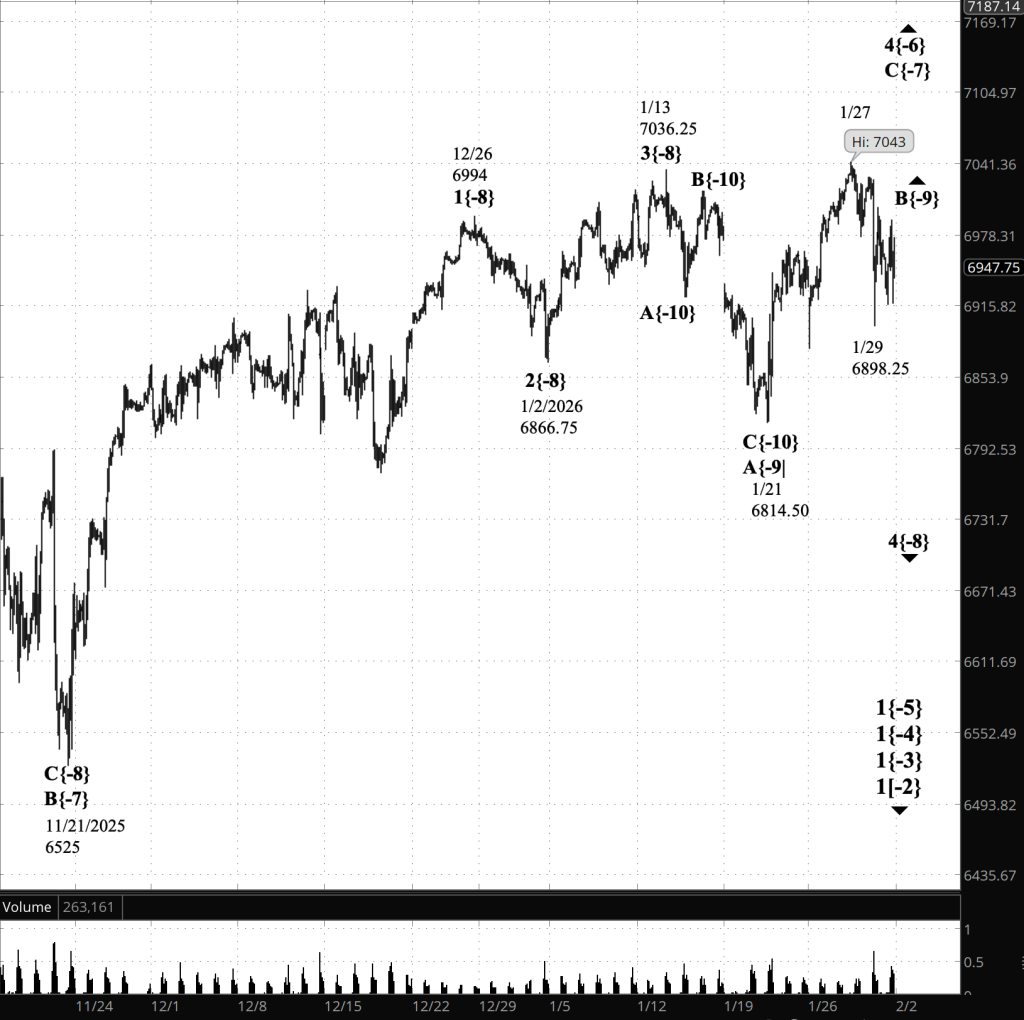
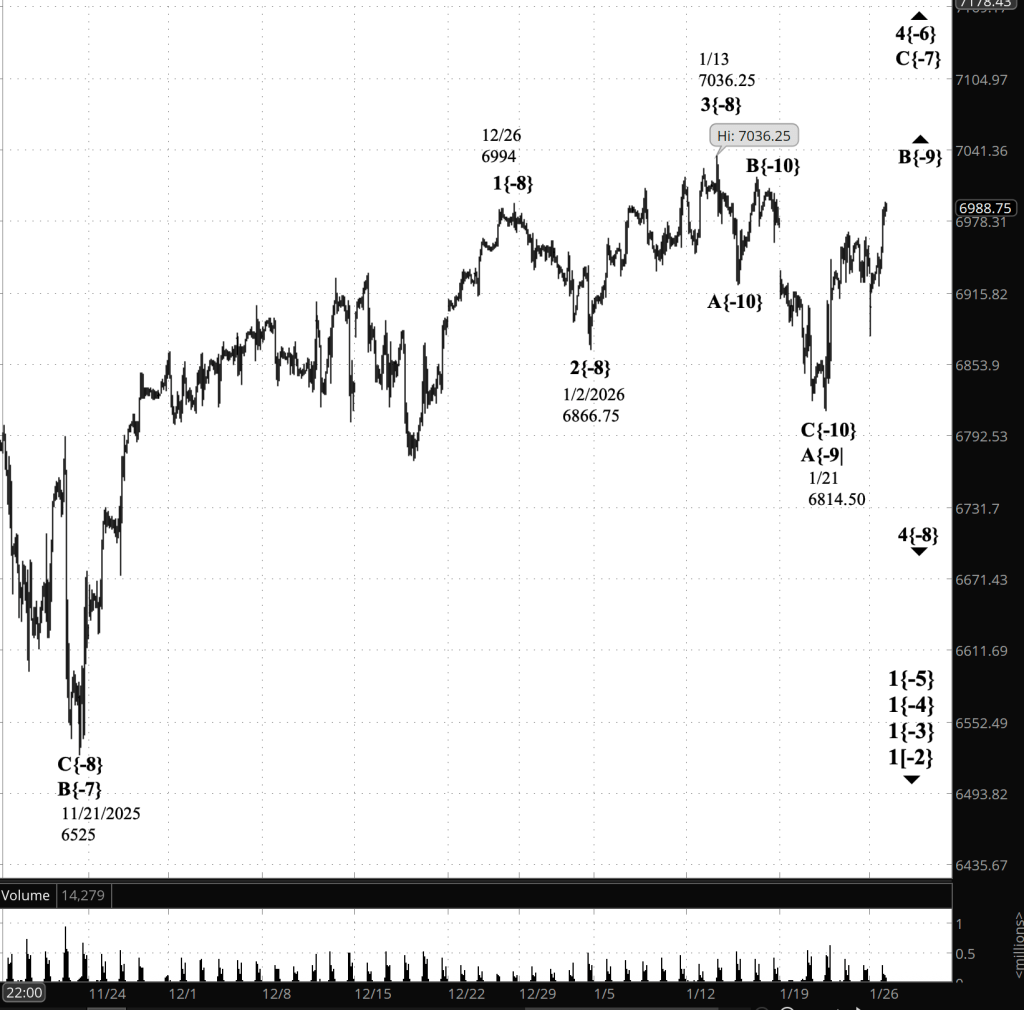
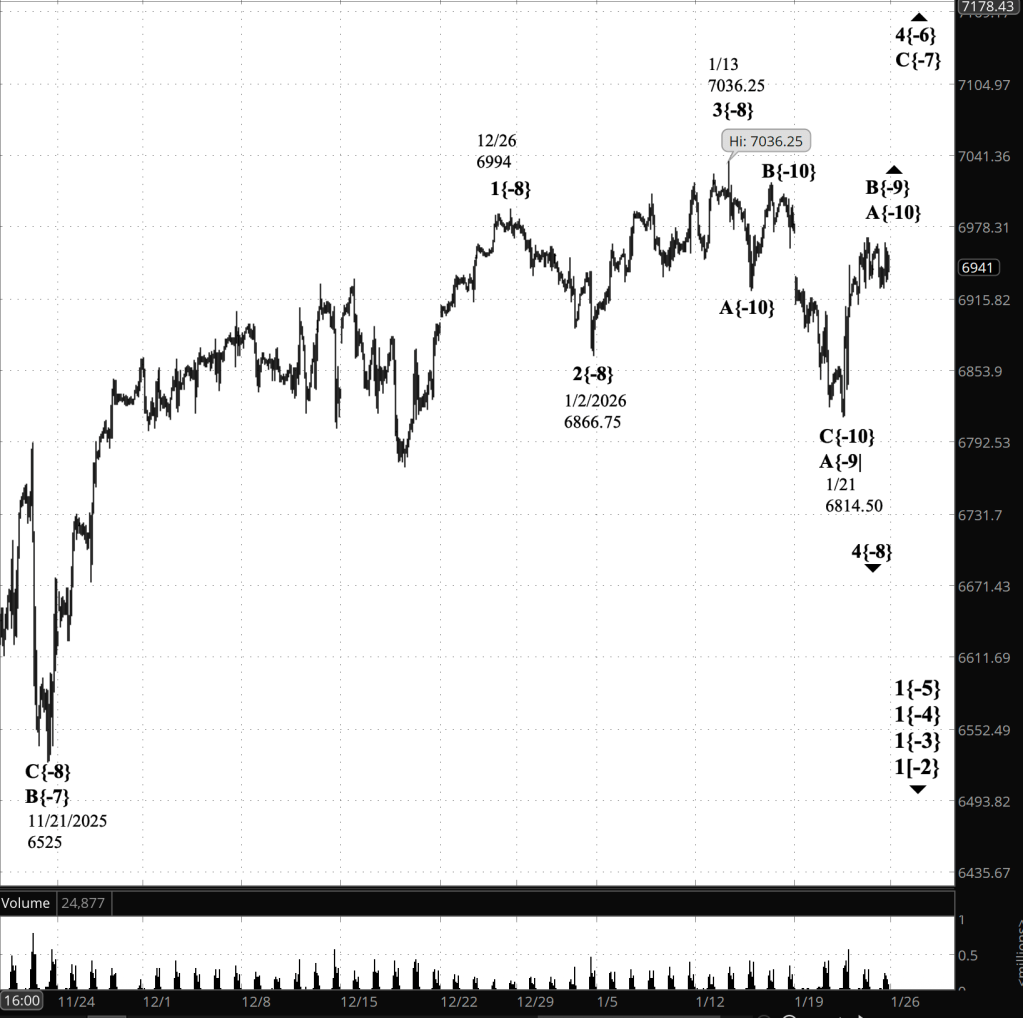
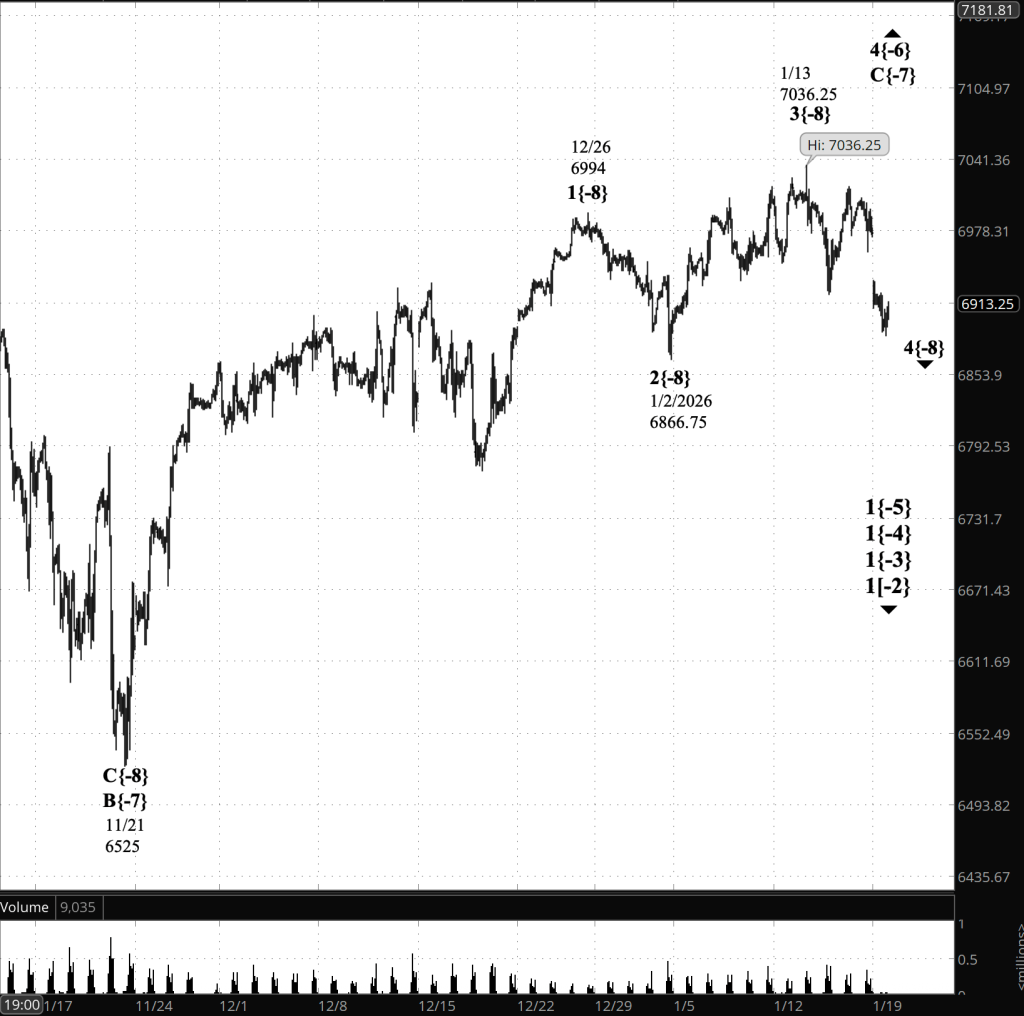
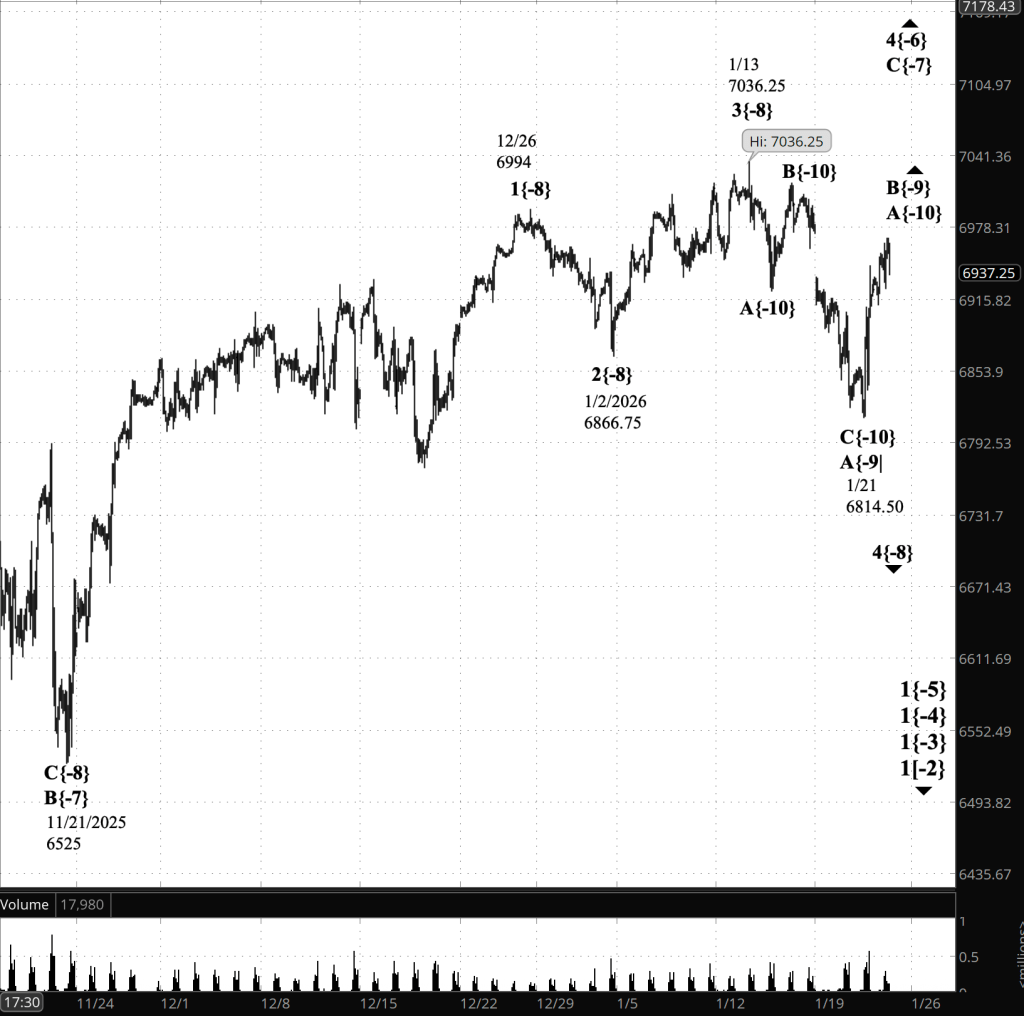
Half an hour before the closing bell. The S&P 500 E-mini futures continued to rise during the session, breaking above Wednesday’s peak and reaching a higher high of 7017.50 so far.

Elliott Wave Theory. The January 7 small downward correction has clearly ended. Rising wave 3{-8} continues, within rising wave C{-7}, within the upward correction, wave 4{-6}.

9:35 a.m. New York time.

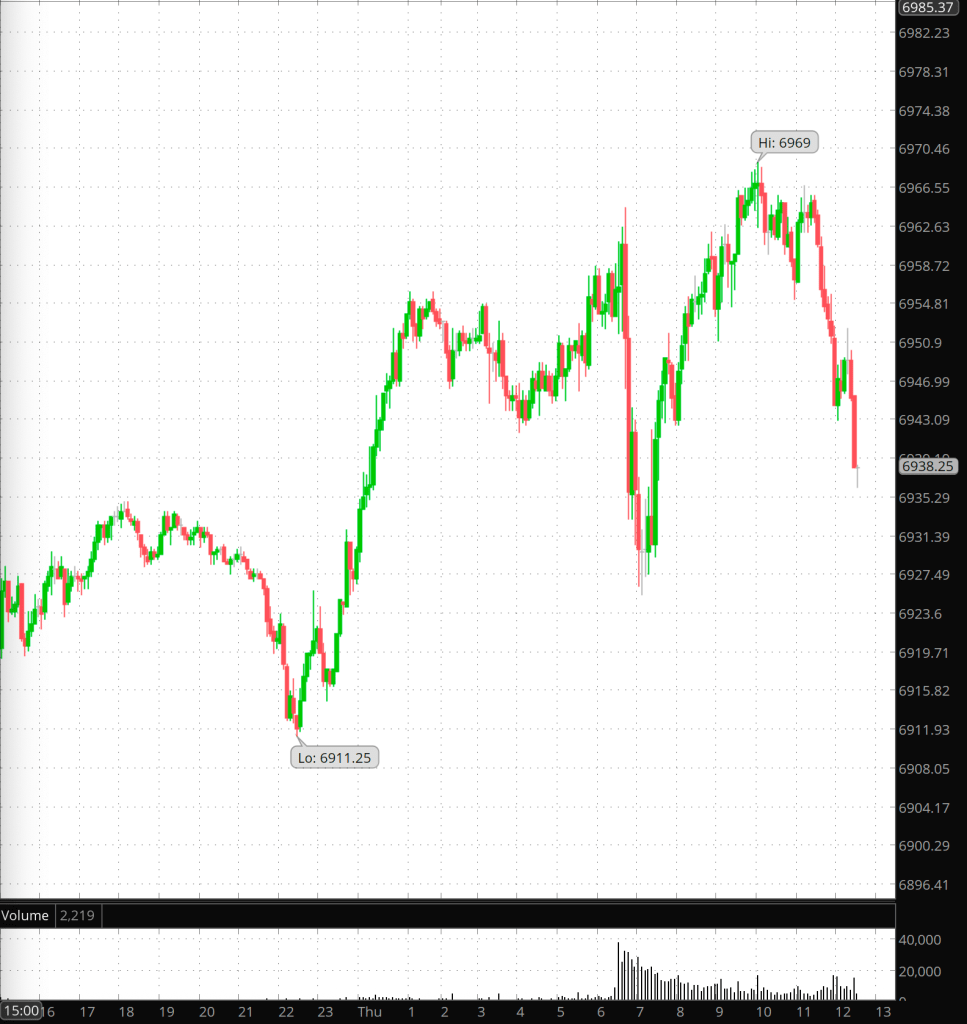
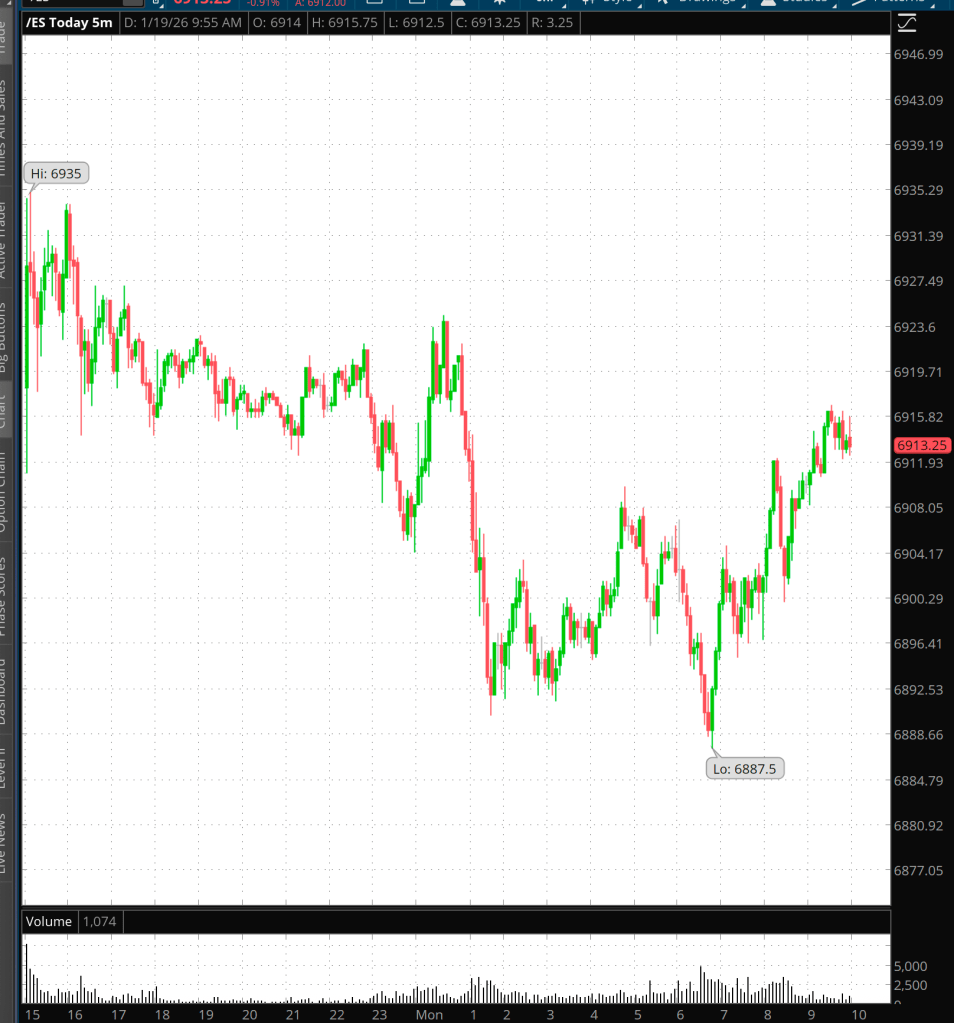
What’s happening now. The S&P 500 E-mini futures in early trading overnight dropped to 6954.75, rising swiftly into the 6980s with the release of the Employment Situation Report an hour before the opening bell. It is the first normal report since the end of the federal government spending shutdown in September and October 2025. The price then swiftly fell back into the 6960s as the opening bell sounded.

What does it mean? Notably, in terms of Elliott Wave Theory, the futures’ positive response to the jobs report fell short of the peak of wave 3{-8} so far, 7006.75 reached on January 7. The price might well reach that high point again, or perhaps exceed it. But that hasn’t happened yet, and the market response was a happy pop but not an overwhelming one.

The AI, ChatGPT, identifies the following levels as decision points:

  • Line in the sand for “just a news pop”: ~6966, then 6954.25. A drop back through those levels starts to look like a full post-news fade.
  • Immediate resistance / “did the spike hold?”: ~6988.5 (the post-report high). A clean push through and hold suggests continuation.
  • Near-term support (breakout area): ~6974–6976 (the last shelf before the vertical move). If price retests and holds, the spike looks real.

Wave 3{-8}, which began on January 2, is a subwave of wave C{-7}, which began on November 21, 2025 and is a subwave of an upward correction, wave 4{-6}, which began on October 10, 2025, from 6540.25.

[S&P 500 E-mini futures at 3:30 p.m., 150-minute bars, with volume]

Waves Now Underway

These are the waves currently in progress under my principal analysis. Each line on the list shows the wave number, with the subscript in curly brackets, the traditional degree name, the starting date, the starting price of the S&P 500 E-mini futures, and the direction of the wave.

Most of the waves began not long ago, on October 8, 2025. See my essay posted on October 12, 2025, “The End of the Rise from 1932? Elliott Wave Theory Says ‘Yes’”, for a discussion of how that happened.

The difficult problem of estimating when a wave change should be accept as real rather than a headfake is addressed by the essay titled, “Is This Reversal Real?: How to Tell Without Being Whipsawed”.

  • 1{+4} Supermillennium, (unknown start date or start price) {down}
    • A hypothetical wave one degree higher than Supercyle, needed to make the wave analysis complete.
  • S&P 500 Index:
    • 1{+3} Supercycle, 10/8/2025, 6812.25 (down}
    • 1{+2} Cycle, 10/8/2025, 6812.25 (down}
    • 1{+1} Primary, 10/8/2025, 6812.25 (down}
    • 1{0} Intermediate, 10/8/2025, 6812.25 (down}
    • 1{-1} Minor, 10/8/2025, 6812.25 (down}
    • 1{-2} Minute, 10/8/2025, 6812.25 (down}
  • S&P 500 Futures
    • 1{-3} Minuette 10/8/2025, 6812.25 (down}
    • 1{-4} Subminutte 10/8/2025, 6812.25 (down}
    • 1{-5} Micro, 10/8/2025, 6812.25 (down}
    • 4{-6} Submicro, 10/10/2025, 6540.25 (up)
    • C{-7} Minuscule, 11/21/2025, 6525 (up)
    • 3{-8} (none), 1/2/2026, 6866.75 (up)

Reading the chart. Price movements — waves – – in Elliott Wave Theory analysis are labeled with numbers within trending waves and letters with corrective waves. The subscripts — numbers in curly brackets — designate the wave’s degree, which, in Elliott Wave analysis, means the relative position of a wave within the larger and smaller structures that make up the chart. R.N. Elliott, who in the 1930s developed the form of analysis that bears his name, viewed the chart as a complex structure of smaller waves nested within larger waves, which in turn are nested within still larger waves. In mathematics it’s called a fractal structure, where at every scale the pattern is similar to the others.

Learning and other resources. Elliott Wave analysis provides context, not prophecy. As the 20th century semanticist Alfred Korzybski put it in his book Science and Sanity (1933), “The map is not the territory … The only usefulness of a map depends on similarity of structure between the empirical world and the map.” And I would add, in the ever-changing markets, we can judge that similarity of structure only after the fact.

See the menu page Analytical Methods for a rundown on where to go for information on Elliott Wave analysis.

By Tim Bovee, Portland, Oregon, January 9, 2026

Disclaimer

Tim Bovee, Private Trader tracks the analysis and trades of a private trader for his own accounts. Nothing in this blog constitutes a recommendation to buy or sell stocks, options or any other financial instrument. The only purpose of this blog is to provide education and entertainment.

No trader is ever 100 percent successful in his or her trades. Trading in the stock and option markets is risky and uncertain. Each trader must make trading decisions for his or her own account, and take responsibility for the consequences.

All content on Tim Bovee, Private Trader by Timothy K. Bovee is licensed under a Creative Commons Attribution-ShareAlike 4.0 International License.

License

Based on work at www.timbovee.com
Trader’s Notebook: S&P 500

3:30 p.m. New York time

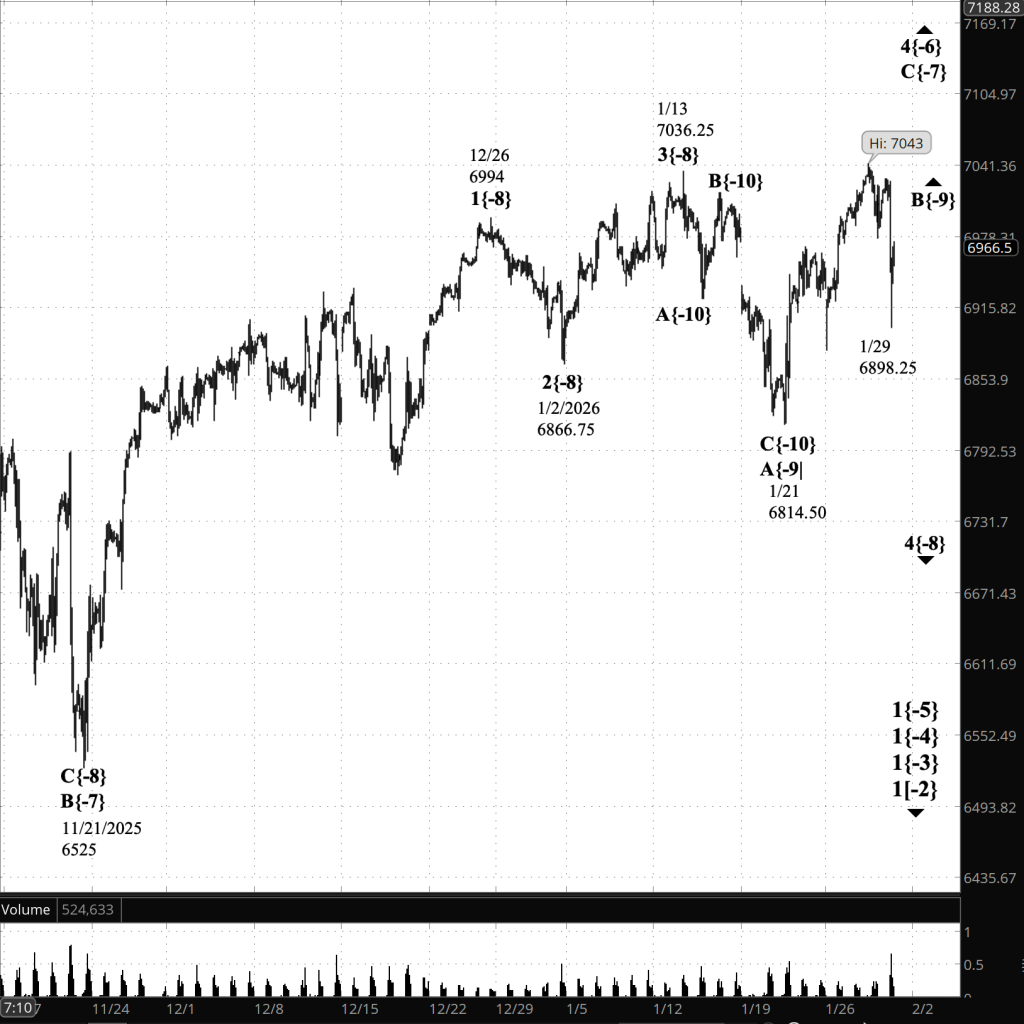
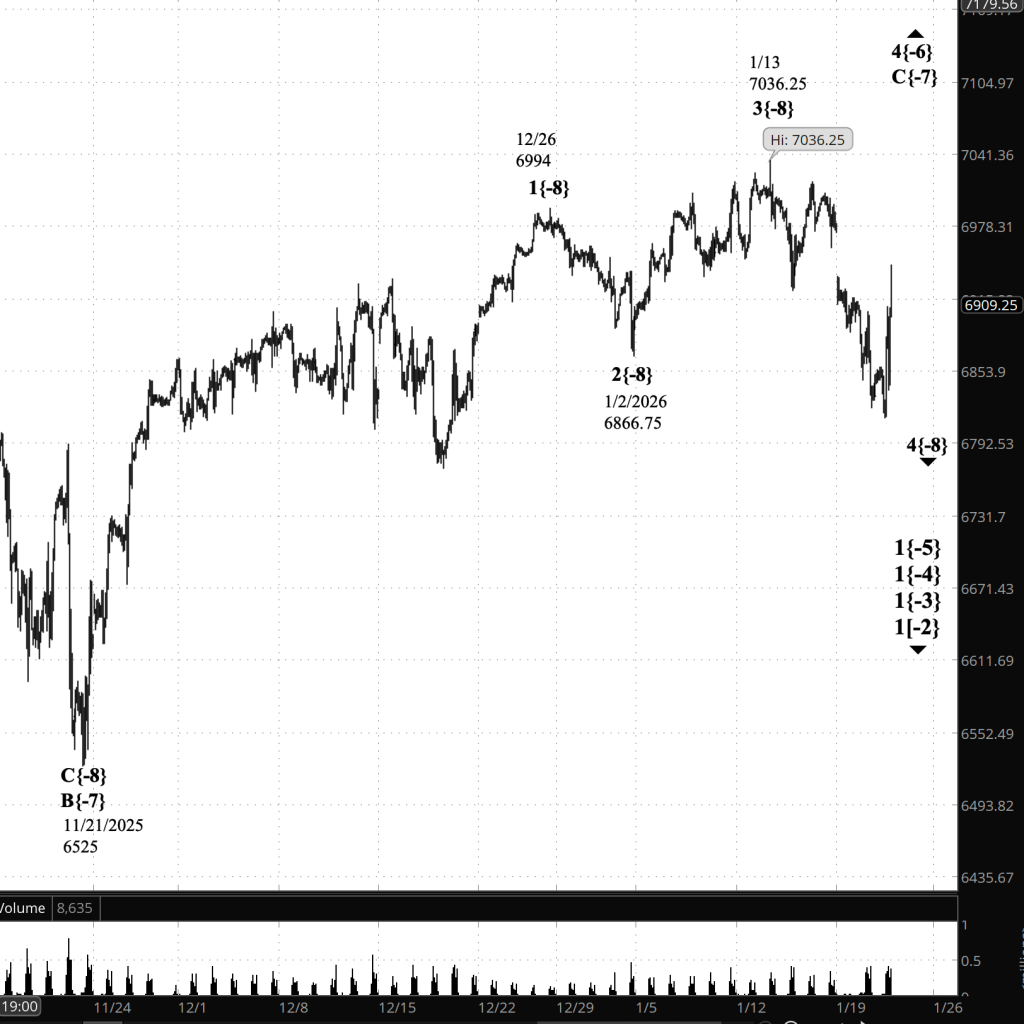
Half an hour before the closing bell. The S&P 500 futures rose to 6972.50 during the session and then dropped back into the 6950s.

Elliott Wave Theory. The drop-back is a downward correction subwave within rising wave 3{-8}, a subwave of rising wave C{-7} within a larger upward correction, wave 4{-6}, that began on October 10, 2025.

When wave 4{-6} is complete, downtrending wave 5{-6} will begin and is likely to carry the price below 6500, perhaps significantly lower.

9:35 a.m. New York time.

What’s happening now. The S&P 500 E-mini futures opened the overnight session at 6969.50, sold off to 6935.25, and then rebounded into the 6950s. The range stayed narrow, and price remains well below yesterday’s peak at 7006.75 (Wednesday, January 7).

What does it mean? Elliott Wave Theory continues to point to wave 3{-8} in progress. Wave 3{-8} began on January 2 from 6866.75, following the wave 2{-8} low. It is the central advancing subwave within wave C{-7}, which began on November 21, 2025.

As long as the price holds above 6866.75, the wave 3{-8} uptrend remains intact; a break below it would force a re-evaluation of the count.

The entire structure remains within rising wave 4{-6}, the upward correction that started on October 10, 2025 at 6540.25. Wave 4{-6} appears to be taking the form of an expanding diagonal triangle.

An expanding triangle in a 4th wave needs the swing points to grow (diverging trendlines):

  • A{-7} up: October 29 to 6953.75
  • B{-7} down: November 21 to 6525
  • C{-7} up: has now pushed above A{-7} to 7006.75

That “C exceeds A” behavior is exactly what you’d expect in an expanding triangle.

The structure requires the next two legs:

  • A D{-7} down that breaks below 6525, exceeding the B{-7} extreme
  • An E{-7} up that then breaks above 7006.75

If D does not take out 6525, then it’s not an expanding triangle by the textbook definition — it becomes some other corrective form (running/contracting, complex correction, etc.), or the degree labels need rework.

[S&P 500 E-mini futures at 3:30 p.m., 150-minute bars, with volume]

Waves Now Underway

These are the waves currently in progress under my principal analysis. Each line on the list shows the wave number, with the subscript in curly brackets, the traditional degree name, the starting date, the starting price of the S&P 500 E-mini futures, and the direction of the wave.

Most of the waves began not long ago, on October 8, 2025. See my essay posted on October 12, 2025, “The End of the Rise from 1932? Elliott Wave Theory Says ‘Yes’”, for a discussion of how that happened.

The difficult problem of estimating when a wave change should be accept as real rather than a headfake is addressed by the essay titled, “Is This Reversal Real?: How to Tell Without Being Whipsawed”.

  • 1{+4} Supermillennium, (unknown start date or start price) {down}
    • A hypothetical wave one degree higher than Supercyle, needed to make the wave analysis complete.
  • S&P 500 Index:
    • 1{+3} Supercycle, 10/8/2025, 6812.25 (down}
    • 1{+2} Cycle, 10/8/2025, 6812.25 (down}
    • 1{+1} Primary, 10/8/2025, 6812.25 (down}
    • 1{0} Intermediate, 10/8/2025, 6812.25 (down}
    • 1{-1} Minor, 10/8/2025, 6812.25 (down}
    • 1{-2} Minute, 10/8/2025, 6812.25 (down}
  • S&P 500 Futures
    • 1{-3} Minuette 10/8/2025, 6812.25 (down}
    • 1{-4} Subminutte 10/8/2025, 6812.25 (down}
    • 1{-5} Micro, 10/8/2025, 6812.25 (down}
    • 4{-6} Submicro, 10/10/2025, 6540.25 (up)
    • C{-7} Minuscule, 11/21/2025, 6525 (up)
    • 3{-8} (none), 1/2/2026, 6866.75 (up)

Reading the chart. Price movements — waves – – in Elliott Wave Theory analysis are labeled with numbers within trending waves and letters with corrective waves. The subscripts — numbers in curly brackets — designate the wave’s degree, which, in Elliott Wave analysis, means the relative position of a wave within the larger and smaller structures that make up the chart. R.N. Elliott, who in the 1930s developed the form of analysis that bears his name, viewed the chart as a complex structure of smaller waves nested within larger waves, which in turn are nested within still larger waves. In mathematics it’s called a fractal structure, where at every scale the pattern is similar to the others.

Learning and other resources. Elliott Wave analysis provides context, not prophecy. As the 20th century semanticist Alfred Korzybski put it in his book Science and Sanity (1933), “The map is not the territory … The only usefulness of a map depends on similarity of structure between the empirical world and the map.” And I would add, in the ever-changing markets, we can judge that similarity of structure only after the fact.

See the menu page Analytical Methods for a rundown on where to go for information on Elliott Wave analysis.

By Tim Bovee, Portland, Oregon, January 8, 2026

Disclaimer

Tim Bovee, Private Trader tracks the analysis and trades of a private trader for his own accounts. Nothing in this blog constitutes a recommendation to buy or sell stocks, options or any other financial instrument. The only purpose of this blog is to provide education and entertainment.

No trader is ever 100 percent successful in his or her trades. Trading in the stock and option markets is risky and uncertain. Each trader must make trading decisions for his or her own account, and take responsibility for the consequences.

All content on Tim Bovee, Private Trader by Timothy K. Bovee is licensed under a Creative Commons Attribution-ShareAlike 4.0 International License.

License

Based on work at www.timbovee.com
Trader’s Notebook: S&P 500

3:30 p.m. New York time

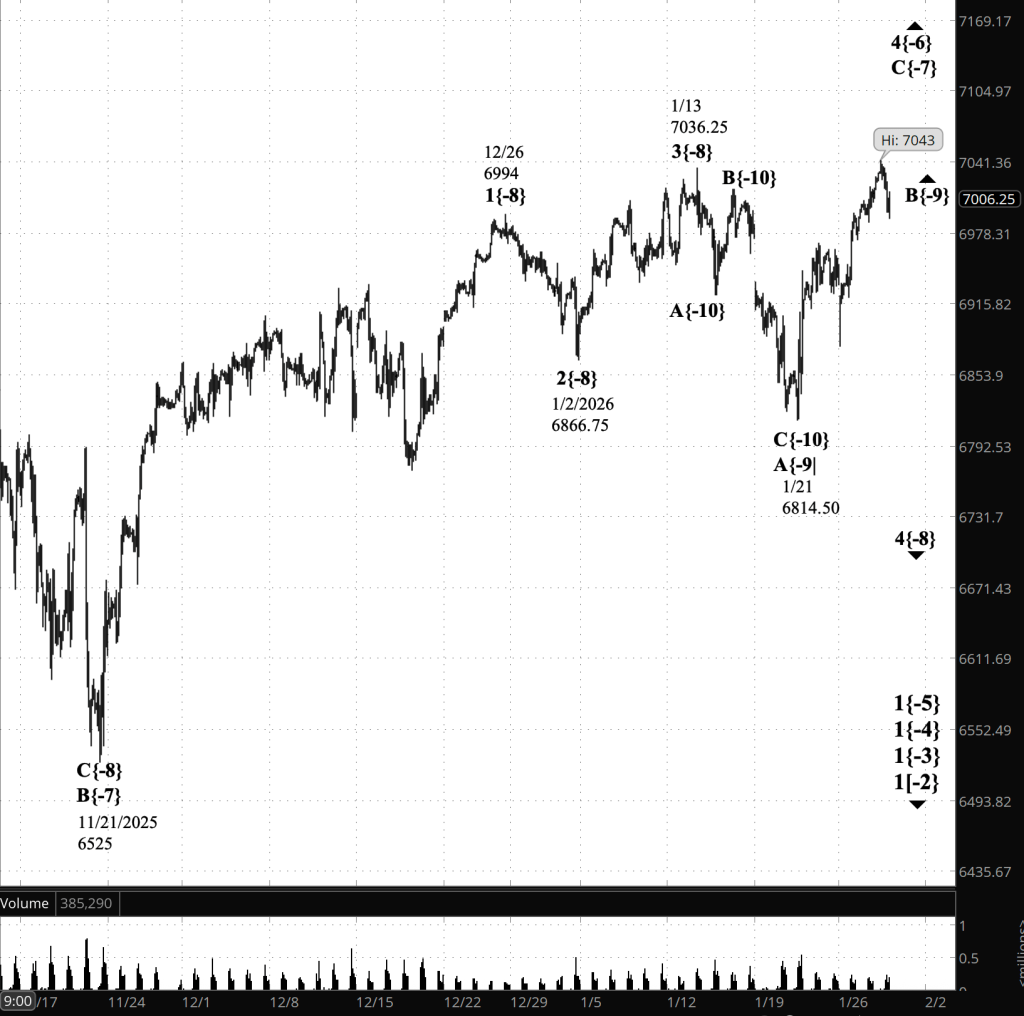
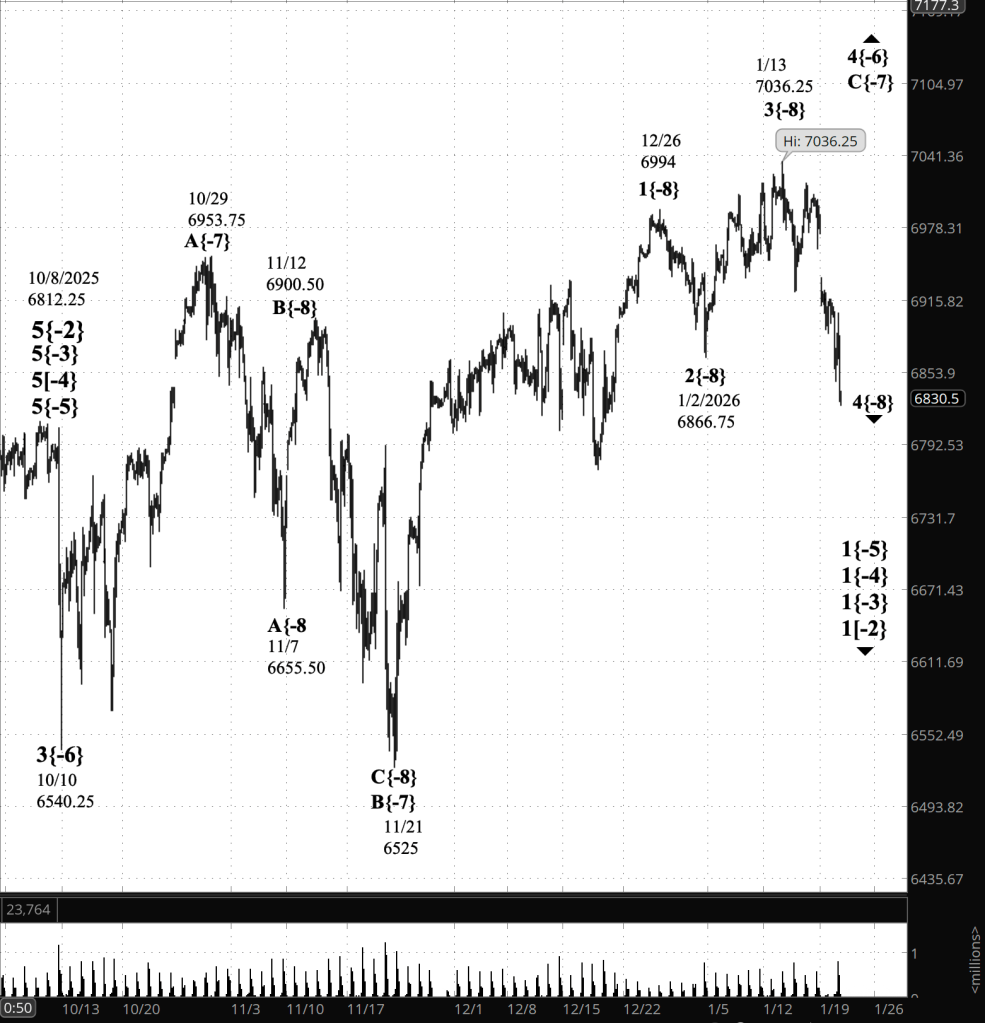
Half an hour before the closing bell. The S&P 500 futures traded in a mixed session, with a low in the 6970s and a late push to a new high of 7006.75. The move did not hold. As of now, price has pulled back to 6985.75.

Elliott Wave Theory. This morning’s revision remains in place. Rising wave 3{-8}, which began on January 2, continues to advance. It is the middle subwave of rising wave C{-7}, the final subwave of wave 4{-6}, an upward correction that began on October 10, 2025.

What to watch next. Today’s spike to 7006.75 looks like a test rather than a breakout. If price can return above 7006.75 and hold, the correction remains in force and may extend. If instead the rejection stands and price breaks down through 6975.25, the odds rise that the advance is stalling. The more meaningful downside break remains 6931. A break below 6866.75 would be the cleanest confirmation that the correction ended and a larger decline is underway.

10:45 a.m. New York time

A New Chart. The S&P 500 futures rose suddenly 15 minutes into the session, moving above the prior high, 6994 on December 26, to 6998.75. The price swiftly withdrew back to 6991.25. The move had no staying power, but the break itself is the key fact.

The specific Elliott Wave count I published this morning treated 6994 as the ceiling for wave 2{-7}. Since price exceeded that level, that version of the count is invalidated as written and must be adjusted. This does not automatically turn the market bullish. It simply means the upward corrective structure remains in force for now.

What to watch next. 6998.25 is now the immediate ceiling. If price returns above it and holds, the correction is still strengthening. If instead today’s spike proves to be a rejection and price rolls over, the first downside tell is 6975.25, and the more important confirmation remains a decisive break back below 6931.

As always, when the Elliott Wave analysis no longer matches the reality on the chart — when the map no longer matches the terrain — the chart must be redone in order to fix the mismatch.

The new map:

  • Rising wave 4{-6}, which began on October 10, 2025, continues.
  • It is presently in its final subwave, rising wave C{-7}.
  • The C wave is in the 3rd of five subwaves, wave 3{-8}, which began on January 2.

[S&P 500 E-mini futures at 3:30 p.m., 75-minute bars, with volume]

9:35 a.m. New York time.

What’s happening now. The S&P 500 E-mini futures fell overnight from 6991.50 to 6975.25 and then returned to 6990 and the 6980s. The price rose slightly with the openng bell, back to 6991.50, then pulled back.

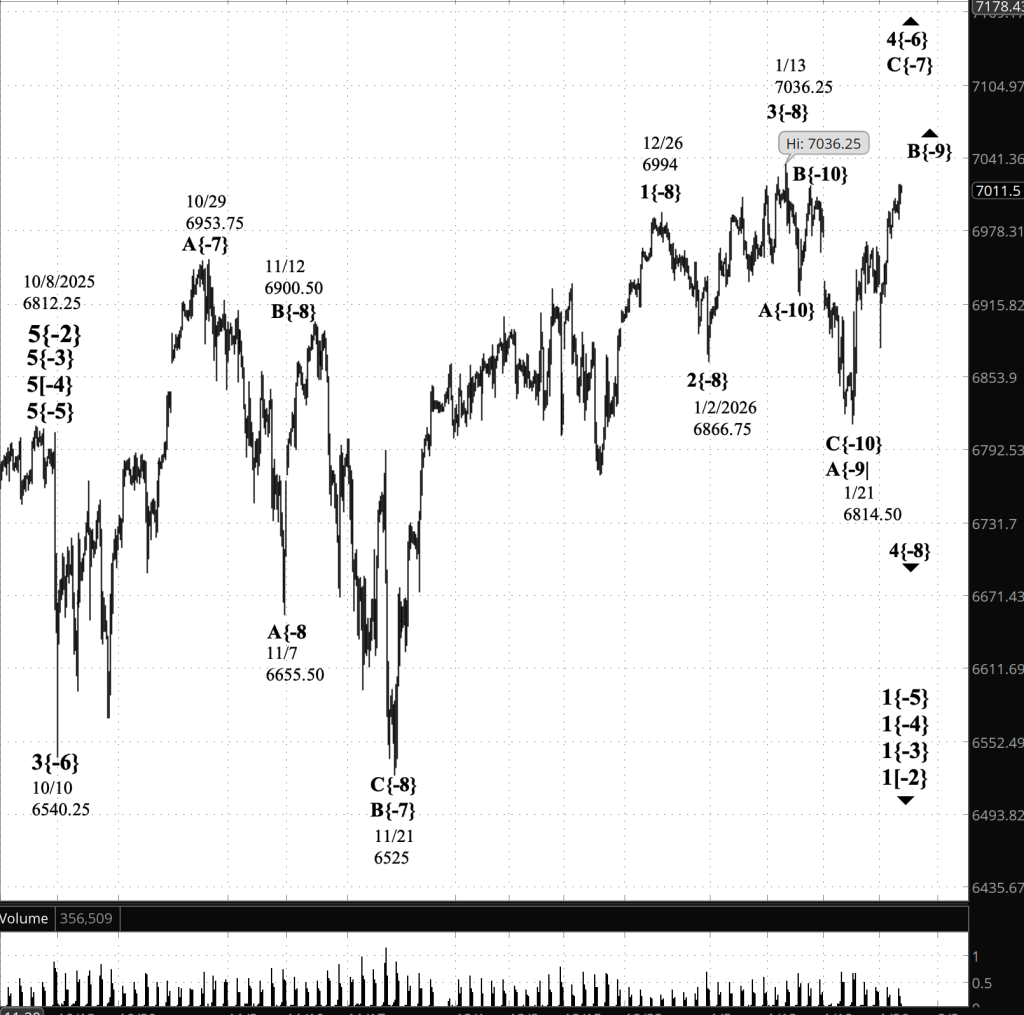
What does it mean? Elliott Wave Theory analysis sees wave C{-8}, the final subwave of a 2nd-wave upward correction, wave 2{-7}, as being underway.

The larger structure still reads as: The December 26 peak at 6994 ended wave 4{-6}, and the decline into 1/2 at 6866.75 was wave 1{-7} of the new downtrend, 5{-6}. Since then we’ve been in the corrective rebound, wave 2{-7}, which is now in its final leg, wave C{-8} (with A{-8} = 6963.50 on 1/5 and B{-8} = 6931 on 1/6 already in place).

What to watch now.

  • Ceiling / invalidation: A 2nd wave cannot exceed the start of the 1st wave. So a push above 6994 invalidates this count and forces a relabel.
  • The tell for completion: If this C{-8} rally stalls in the 6985–6994 zone and then breaks back down through 6931, that’s the cleanest confirmation that 2{-7} is over and the next impulsive decline is underway.
  • Near-term pivot: Overnight’s dip to 6975.25 held and snapped back. That’s typical “last push” behavior in a C-wave—bulls can still squeeze it higher, but the risk is that the next failure is sharp.

Trading posture (quick). Treat the current strength as corrective until proven otherwise. I’m watching for either (1) rejection under 6994, or (2) a clean break back below 6931 to signal that the downtrend has regained control.

[This chart is now updated and retained for reference. See above for the updated chart.]

[S&P 500 E-mini futures at 9:35 a.m., 35-minute bars, with volume]

Waves Now Underway

These are the waves currently in progress under my principal analysis. Each line on the list shows the wave number, with the subscript in curly brackets, the traditional degree name, the starting date, the starting price of the S&P 500 E-mini futures, and the direction of the wave.

Most of the waves began not long ago, on October 8, 2025. See my essay posted on October 12, 2025, “The End of the Rise from 1932? Elliott Wave Theory Says ‘Yes’”, for a discussion of how that happened.

The difficult problem of estimating when a wave change should be accept as real rather than a headfake is addressed by the essay titled, “Is This Reversal Real?: How to Tell Without Being Whipsawed”.

  • 1{+4} Supermillennium, (unknown start date or start price) {down}
    • A hypothetical wave one degree higher than Supercyle, needed to make the wave analysis complete.
  • S&P 500 Index:
    • 1{+3} Supercycle, 10/8/2025, 6812.25 (down}
    • 1{+2} Cycle, 10/8/2025, 6812.25 (down}
    • 1{+1} Primary, 10/8/2025, 6812.25 (down}
    • 1{0} Intermediate, 10/8/2025, 6812.25 (down}
    • 1{-1} Minor, 10/8/2025, 6812.25 (down}
    • 1{-2} Minute, 10/8/2025, 6812.25 (down}
  • S&P 500 Futures
    • 1{-3} Minuette 10/8/2025, 6812.25 (down}
    • 1{-4} Subminutte 10/8/2025, 6812.25 (down}
    • 1{-5} Micro, 10/8/2025, 6812.25 (down}
    • 4{-6} Submicro, 10/10/2025, 6540.25 (up)
    • C{-7} Minuscule, 11/21/2025, 6525 (up)
    • 3{-8} (none), 1/2/2026, 6866.75 (up)

Reading the chart. Price movements — waves – – in Elliott Wave Theory analysis are labeled with numbers within trending waves and letters with corrective waves. The subscripts — numbers in curly brackets — designate the wave’s degree, which, in Elliott Wave analysis, means the relative position of a wave within the larger and smaller structures that make up the chart. R.N. Elliott, who in the 1930s developed the form of analysis that bears his name, viewed the chart as a complex structure of smaller waves nested within larger waves, which in turn are nested within still larger waves. In mathematics it’s called a fractal structure, where at every scale the pattern is similar to the others.

Learning and other resources. Elliott Wave analysis provides context, not prophecy. As the 20th century semanticist Alfred Korzybski put it in his book Science and Sanity (1933), “The map is not the territory … The only usefulness of a map depends on similarity of structure between the empirical world and the map.” And I would add, in the ever-changing markets, we can judge that similarity of structure only after the fact.

See the menu page Analytical Methods for a rundown on where to go for information on Elliott Wave analysis.

By Tim Bovee, Portland, Oregon, January 7, 2026

Disclaimer

Tim Bovee, Private Trader tracks the analysis and trades of a private trader for his own accounts. Nothing in this blog constitutes a recommendation to buy or sell stocks, options or any other financial instrument. The only purpose of this blog is to provide education and entertainment.

No trader is ever 100 percent successful in his or her trades. Trading in the stock and option markets is risky and uncertain. Each trader must make trading decisions for his or her own account, and take responsibility for the consequences.

All content on Tim Bovee, Private Trader by Timothy K. Bovee is licensed under a Creative Commons Attribution-ShareAlike 4.0 International License.

License

Based on work at www.timbovee.com
Trader’s Notebook: S&P 500

3:30 p.m. New York time

Half an hour before the closing bell. The S&P 500 futures rose rapidly as the session progressed, so far reaching 6990.50, barely below the December 26 peak, 6994.

Elliott Wave Theory. At this point, as long as the price remains below 6994, the analysis sees wave B{-8} as having ended overnight at 6931 and rising wave C{-8} as having begun at that point.

However, if the price rises beyond 6994 and closes above that level, then a rule of Elliott Wave Theory will have been broken. The rule is that no 2nd wave can move beyond the start of the preceding 1st wave. If it doesn’t, the analysis no longer matches the chart — the map no longer matches the terrain — and a renalysis is required.

That renalysis would turn define wave 4{-6} as being underway rather than ending on December 26. Wave 5{-6} would not have begun and would lie in the future.

The decline from December 26 to January 2 would be a subwave within wave C{-7}, a part of wave 4{-6}.

9:35 a.m. New York time.

What’s happening now. The S&P 500 E-mini futures rose to 6958.75 early in the overnight trading and then, at 1:50 a.m. New York time, began to fall, reaching 6931, thereafter rising back into the 6940s.

What does it mean? Elliott Wave Theory analysis suggests that the second subwave, declining subwave B{-8}, is now underway, within an upward correction, wave 2{-7}, which is a subwave within declining subwave 5{-6}.

As always, there is ambiguity. I think wave B{-8} has begun, but it’s also possible that its predecessor, rising wave A{-8}, is still underway.

I’ve labeled the chart to show wave B{-8} is underway, my principal analysis. This is likely correct, in my opinion. However, we don’t “verify” B{-8} just because price dips. We verify it when the decline has staying power.

Here are the signal prices identified by the AI ChatGPT.

The key level is ~6926 (the 38% retrace of A{-8}).

Verification requirement: break below ~6926 and hold there long enough to prove it’s not a one-bar poke.

Next confirmation step: follow-through toward ~6915 (the 50% retrace). If price gets there, B{-8} is no longer a guess.

The alternative analysis — wave A{-8} continues — is still alive if the overnight drop proves to be noise and the market reasserts the uptrend.

The key level is 6963.50 (yesterday’s A{-8} high).

Verification requirement: reclaim 6963.50 and hold above it.

If price can hold above 6963.50, then the “B{-8} underway” call is not verified, and the market is telling us the up-leg is still in progress.

[S&P 500 E-mini futures at 9:35 a.m., 60-minute bars, with volume] 

Waves Now Underway

These are the waves currently in progress under my principal analysis. Each line on the list shows the wave number, with the subscript in curly brackets, the traditional degree name, the starting date, the starting price of the S&P 500 E-mini futures, and the direction of the wave.

Most of the waves began not long ago, on October 8, 2025. See my essay posted on October 12, 2025, “The End of the Rise from 1932? Elliott Wave Theory Says ‘Yes’”, for a discussion of how that happened.

The difficult problem of estimating when a wave change should be accept as real rather than a headfake is addressed by the essay titled, “Is This Reversal Real?: How to Tell Without Being Whipsawed”.

  • 1{+4} Supermillennium, (unknown start date or start price) {down}
    • A hypothetical wave one degree higher than Supercyle, needed to make the wave analysis complete.
  • S&P 500 Index:
    • 1{+3} Supercycle, 10/8/2025, 6812.25 (down}
    • 1{+2} Cycle, 10/8/2025, 6812.25 (down}
    • 1{+1} Primary, 10/8/2025, 6812.25 (down}
    • 1{0} Intermediate, 10/8/2025, 6812.25 (down}
    • 1{-1} Minor, 10/8/2025, 6812.25 (down}
    • 1{-2} Minute, 10/8/2025, 6812.25 (down}
  • S&P 500 Futures
    • 1{-3} Minuette 10/8/2025, 6812.25 (down}
    • 1{-4} Subminutte 10/8/2025, 6812.25 (down}
    • 1{-5} Micro, 10/8/2025, 6812.25 (down}
    • 4{-6} Submicro, 10/10/2025, 6540.25 (up)
    • 5[-6} Minuscule,12//26/2025, 6994 (down)
    • 2{-7} (none), 1/2/2026, 6866.75 (up)
    • C{-8} (none), 1/6/2026, 6931 (up)

Reading the chart. Price movements — waves – – in Elliott Wave Theory analysis are labeled with numbers within trending waves and letters with corrective waves. The subscripts — numbers in curly brackets — designate the wave’s degree, which, in Elliott Wave analysis, means the relative position of a wave within the larger and smaller structures that make up the chart. R.N. Elliott, who in the 1930s developed the form of analysis that bears his name, viewed the chart as a complex structure of smaller waves nested within larger waves, which in turn are nested within still larger waves. In mathematics it’s called a fractal structure, where at every scale the pattern is similar to the others.

Learning and other resources. Elliott Wave analysis provides context, not prophecy. As the 20th century semanticist Alfred Korzybski put it in his book Science and Sanity (1933), “The map is not the territory … The only usefulness of a map depends on similarity of structure between the empirical world and the map.” And I would add, in the ever-changing markets, we can judge that similarity of structure only after the fact.

See the menu page Analytical Methods for a rundown on where to go for information on Elliott Wave analysis.

By Tim Bovee, Portland, Oregon, January 6, 2026

Disclaimer

Tim Bovee, Private Trader tracks the analysis and trades of a private trader for his own accounts. Nothing in this blog constitutes a recommendation to buy or sell stocks, options or any other financial instrument. The only purpose of this blog is to provide education and entertainment.

No trader is ever 100 percent successful in his or her trades. Trading in the stock and option markets is risky and uncertain. Each trader must make trading decisions for his or her own account, and take responsibility for the consequences.

All content on Tim Bovee, Private Trader by Timothy K. Bovee is licensed under a Creative Commons Attribution-ShareAlike 4.0 International License.

License

Based on work at www.timbovee.com
Trader’s Notebook: S&P 500

3:30 p.m. New York time

Half an hour before the closing bell. The S&P 500 futures during the session reached a daily high of 6963.50, then pulled back slightly.

Elliiott Wave Theory: Downtrending wave 5{-6} is now underway and is in its second subwave. Wave 1{-7} began on December 26, 2025coincident with the start of wave 5{-6}, and ended on January 2, 2026, when the current wave 2{-7} began.

A 2nd wave almost always has three subwaves. The rise from January 2 is wave A{-8} within wave 2{-7} within wave 5{-6}. The price then dropped slightly into the afternoon session, which could mean that wave A{-8} ended at the peak, 6963.50, and decliing wave B{-8} has begun. That’s a tentative alternative, and I’ve retained wave A as the principal analysis.

9:35 a.m. New York time.

What’s happening now. The S&P 500 E-mini futures fell for 15 minutes after trading resumed overnight, reaching an overnight low of 6899.50, and then began to rise, at the opening bell reaching into the 6940s.

What does it mean? Applying Elliott Wave Theory, I am now treating the December 26 peak, 6994, as the end of wave 4{-6}, and the decline since then as the start of wave 5{-6}. This remains a call based on likelihood, not certainty. Below 6866.75 the 5th-wave case gains force, while a move above 6994 would invalidate it and require a return to the 4{-6} count.

Bottom line: I’m not betting the bank on either wave analysis. The ambiguity remains strong.

[S&P 500 E-mini futures at 3:30 p.m., 60-minute bars, with volume] 

Waves Now Underway

These are the waves currently in progress under my principal analysis. Each line on the list shows the wave number, with the subscript in curly brackets, the traditional degree name, the starting date, the starting price of the S&P 500 E-mini futures, and the direction of the wave.

Most of the waves began not long ago, on October 8, 2025. See my essay posted on October 12, 2025, “The End of the Rise from 1932? Elliott Wave Theory Says ‘Yes’”, for a discussion of how that happened.

The difficult problem of estimating when a wave change should be accept as real rather than a headfake is addressed by the essay titled, “Is This Reversal Real?: How to Tell Without Being Whipsawed”.

  • 1{+4} Supermillennium, (unknown start date or start price) {down}
    • A hypothetical wave one degree higher than Supercyle, needed to make the wave analysis complete.
  • S&P 500 Index:
    • 1{+3} Supercycle, 10/8/2025, 6812.25 (down}
    • 1{+2} Cycle, 10/8/2025, 6812.25 (down}
    • 1{+1} Primary, 10/8/2025, 6812.25 (down}
    • 1{0} Intermediate, 10/8/2025, 6812.25 (down}
    • 1{-1} Minor, 10/8/2025, 6812.25 (down}
    • 1{-2} Minute, 10/8/2025, 6812.25 (down}
  • S&P 500 Futures
    • 1{-3} Minuette 10/8/2025, 6812.25 (down}
    • 1{-4} Subminutte 10/8/2025, 6812.25 (down}
    • 1{-5} Micro, 10/8/2025, 6812.25 (down}
    • 4{-6} Submicro, 10/10/2025, 6540.25 (up)
    • 5[-6} Minuscule,12//26/2025, 6994 (down)
    • 2{-7} (none), 1/2/2026, 6866.75 (up)
    • A{-7} (none), 1/2/2026, 6866.75 (up)

Reading the chart. Price movements — waves – – in Elliott Wave Theory analysis are labeled with numbers within trending waves and letters with corrective waves. The subscripts — numbers in curly brackets — designate the wave’s degree, which, in Elliott Wave analysis, means the relative position of a wave within the larger and smaller structures that make up the chart. R.N. Elliott, who in the 1930s developed the form of analysis that bears his name, viewed the chart as a complex structure of smaller waves nested within larger waves, which in turn are nested within still larger waves. In mathematics it’s called a fractal structure, where at every scale the pattern is similar to the others.

Learning and other resources. Elliott Wave analysis provides context, not prophecy. As the 20th century semanticist Alfred Korzybski put it in his book Science and Sanity (1933), “The map is not the territory … The only usefulness of a map depends on similarity of structure between the empirical world and the map.” And I would add, in the ever-changing markets, we can judge that similarity of structure only after the fact.

See the menu page Analytical Methods for a rundown on where to go for information on Elliott Wave analysis.

By Tim Bovee, Portland, Oregon, January 5, 2026

Disclaimer

Tim Bovee, Private Trader tracks the analysis and trades of a private trader for his own accounts. Nothing in this blog constitutes a recommendation to buy or sell stocks, options or any other financial instrument. The only purpose of this blog is to provide education and entertainment.

No trader is ever 100 percent successful in his or her trades. Trading in the stock and option markets is risky and uncertain. Each trader must make trading decisions for his or her own account, and take responsibility for the consequences.

All content on Tim Bovee, Private Trader by Timothy K. Bovee is licensed under a Creative Commons Attribution-ShareAlike 4.0 International License.

License

Based on work at www.timbovee.com
Trader’s Notebook: S&P 500

3:30 p.m. New York tme

Half an hour beforee the closing bell. The S&P 500 futures fell during the session to 6886.75 and then rose to slightly above 6900.

Elliott Wave Theory: The session low tilts the balance toward the view that wave 5{-6} may be underway—but the chart still lacks decisive confirmation unless the decline extends below 6771.50. That number is where the present subwave, wave C{-8} within waves C{-7} and 4{-6} began. If C{-8} is complete, that completion cascades upward: it would also mark the end of C{-7} and therefore the end of wave 4{-6}.

The AI ChatGPT did the analysis, and I asked for a deeper dive into its reasoning. It seemed overly cautious to treat 6771.50 as a requirement before switching labels, since price action can justify a likelihood lean well before full confirmation arrives.

Here’s what ChatGPT wrote:

“There are two different standards we can use in real-time wave work: certainty and likelihood. Certainty is the ‘no-debate’ level — the price point that, once crossed, makes one interpretation impossible. On this chart, if 6771.50 is the start of wave C{-8}, then a decisive break below 6771.50 means C{-8} cannot still be the active up-wave. That doesn’t mean we must wait for that break to form an opinion; it means that below that line the alternative count is essentially dead.

Likelihood is the practical standard: ‘given what price is doing right now, which scenario is more probable?’ Here the evidence is mixed, so we’re weighting competing clues. The drop to 6871.50 increases the odds that wave 5{-6} is underway because it’s fresh downside progress rather than a tidy pullback, and because the rebounds that follow these declines have not been producing higher highs—a simple operational definition of a downtrend. But the rebound back to 6903.75 reminds us that this market is still capable of snap-backs and overlap typical of a correction, so we can’t call it high-confidence yet. That’s why I’ve treated the current state as more likely than not (above 50%) that wave 5{-6} has begun—while reserving full certainty for the “no-debate” break below 6771.50.”

True confession: I tend to lean toward likelihood rather than waiting for full certainty. But I also think that it’s worthwhile knowing both views, and the AI has provided that sort of analysis. I shall leave rising wave 4{-6} labeled as underway, especially since the price bounced back above 6900, but will continue to keep the likelihood analysis in mind.

So where do we stand? Two lenses, one chart: likelihood to stay nimble, certainty to stay honest.

9:35 a.m. New York time.

What’s happening now. The S&P 500 E-mini futures resumed trading in the evening, New Year’s Day, from 6897 and rose from that low point to 6938.50, then dropped back into the 6920s and into the 6910s as the opening bell sounded.

What does it mean? Elliott Wave Theory views the first trading day of 2026 in much the same way as the last week of 2025 — a choice between a scenario in which an upward correction, wave 4{-6}, continues to rise, with the usual pullbacks, and a scenario in which wave 4{-6} ended on December 26 at 6994 and downtrending wave 5{-6} immediate began.

And, as was the case in the final days of last year, the first day of this year gives little guidance as to which scenario is correct.

An analysis by the AI ChatGPT places the decision points as follows:

  • Bullish / favors wave 4{-6} continuing: a clean push that holds above ~6947, then reclaims ~6978, and especially a break above 6994 (that would strongly argue 4{-6} is still in progress).
  • Bearish / favors wave 5{-6} underway: a failure of this rebound followed by a break back under ~6885–6900, then downside follow-through toward 6854, with the big confirmation being a decisive break below 6771.50 (the December17 low).

“Bottom line,” ChatGPT writes, “the first session of 2026 doesn’t resolve the wave count. It’s still range behavior, and the next meaningful clue will come from whether the market can take out resistance toward 6994 or instead roll over and start making lower lows under 6885, then 6771.50.

[S&P 500 E-mini futures at 3:30 p.m., 60-minute bars, with volume] 

Waves Now Underway

These are the waves currently in progress under my principal analysis. Each line on the list shows the wave number, with the subscript in curly brackets, the traditional degree name, the starting date, the starting price of the S&P 500 E-mini futures, and the direction of the wave.

Most of the waves began not long ago, on October 8, 2025. See my essay posted on October 12, 2025, “The End of the Rise from 1932? Elliott Wave Theory Says ‘Yes’”, for a discussion of how that happened.

The difficult problem of estimating when a wave change should be accept as real rather than a headfake is addressed by the essay titled, “Is This Reversal Real?: How to Tell Without Being Whipsawed”.

  • 1{+4} Supermillennium, (unknown start date or start price) {down}
    • A hypothetical wave one degree higher than Supercyle, needed to make the wave analysis complete.
  • S&P 500 Index:
    • 1{+3} Supercycle, 10/8/2025, 6812.25 (down}
    • 1{+2} Cycle, 10/8/2025, 6812.25 (down}
    • 1{+1} Primary, 10/8/2025, 6812.25 (down}
    • 1{0} Intermediate, 10/8/2025, 6812.25 (down}
    • 1{-1} Minor, 10/8/2025, 6812.25 (down}
    • 1{-2} Minute, 10/8/2025, 6812.25 (down}
  • S&P 500 Futures
    • 1{-3} Minuette 10/8/2025, 6812.25 (down}
    • 1{-4} Subminutte 10/8/2025, 6812.25 (down}
    • 1{-5} Micro, 10/8/2025, 6812.25 (down}
    • 4{-6} Submicro, 10/10/2025, 6540.25 (up)
    • C{-7} (none), 11/21/2025, 6525 (up)
    • C{-8} (none), 12/17/2025, 6771.50 (up)

Reading the chart. Price movements — waves – – in Elliott Wave Theory analysis are labeled with numbers within trending waves and letters with corrective waves. The subscripts — numbers in curly brackets — designate the wave’s degree, which, in Elliott Wave analysis, means the relative position of a wave within the larger and smaller structures that make up the chart. R.N. Elliott, who in the 1930s developed the form of analysis that bears his name, viewed the chart as a complex structure of smaller waves nested within larger waves, which in turn are nested within still larger waves. In mathematics it’s called a fractal structure, where at every scale the pattern is similar to the others.

Learning and other resources. Elliott Wave analysis provides context, not prophecy. As the 20th century semanticist Alfred Korzybski put it in his book Science and Sanity (1933), “The map is not the territory … The only usefulness of a map depends on similarity of structure between the empirical world and the map.” And I would add, in the ever-changing markets, we can judge that similarity of structure only after the fact.

See the menu page Analytical Methods for a rundown on where to go for information on Elliott Wave analysis.

By Tim Bovee, Portland, Oregon, January 2, 2026

Disclaimer

Tim Bovee, Private Trader tracks the analysis and trades of a private trader for his own accounts. Nothing in this blog constitutes a recommendation to buy or sell stocks, options or any other financial instrument. The only purpose of this blog is to provide education and entertainment.

No trader is ever 100 percent successful in his or her trades. Trading in the stock and option markets is risky and uncertain. Each trader must make trading decisions for his or her own account, and take responsibility for the consequences.

All content on Tim Bovee, Private Trader by Timothy K. Bovee is licensed under a Creative Commons Attribution-ShareAlike 4.0 International License.

License

Based on work at www.timbovee.com