Trader’s Notebook: S&P 500

3:30 p.m. New York time

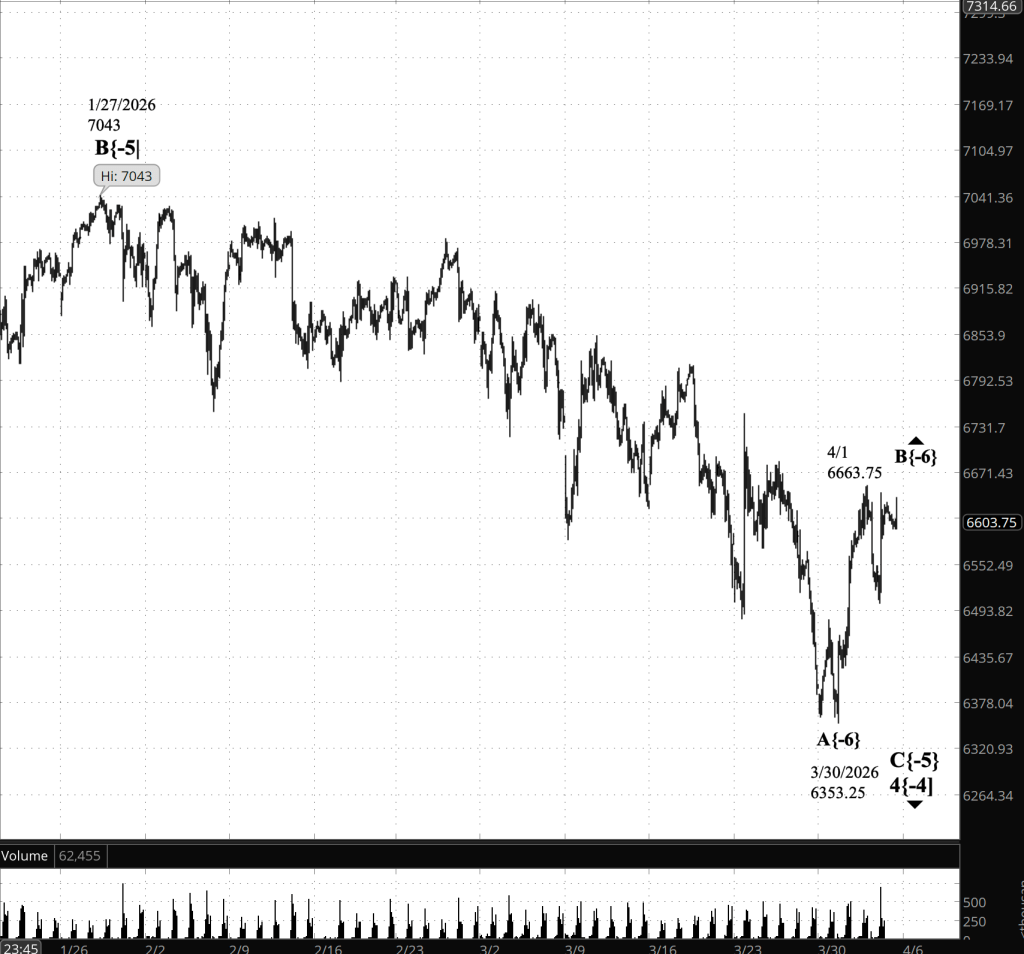
Half an hour before the closing bell. The S&P 500 futures have spent the session fluctuating within a narrow range, roughly from the 6630s down into the 6620s. Price action has been choppy and overlapping, with no sustained directional push.

Elliott Wave Theory. Rising wave B{-6} continues, but the advance has stalled into sideways movement. The session’s price action is best interpreted as a continuation of an internal consolidation rather than a completed reversal. The structure remains consistent with a developing corrective pattern within B{-6}, rather than the start of a new downward impulse.

There is no evidence at this stage of a decisive break either higher or lower. Instead, the market remains beneath the April 1 high at 6663.75.

Decision Points. The April 1 high at 6663.75 remains the immediate upside barrier. A sustained move above that level would confirm continuation of wave B{-6} and open the path toward the upper end of the 6620–6680 resistance zone, with the potential for a modest extension.

On the downside, the 6620–6630 area continues to serve as the near-term pivot. Holding above that zone supports the view that the market is consolidating within B{-6}. A break below 6600 would weaken that interpretation and suggest that the rally is losing structure.

The overnight low at 6567 remains the key near-term support. A move below that level would indicate that the current upward leg has likely completed and that a deeper correction is underway. The broader wave structure remains intact as long as price holds above 6353.25, the low of wave A{-6}.

9:35 a.m. New York time

What’s happening now. The S&P 500 E-mini futures resumed trading last night with a small opening gap to the downside. The price reached an overnight low of 6567 within the first 15 minutes, then turned higher, rising to a peak of 6651.25. It has since pulled back slightly in a shallow, orderly correction.

What does it mean? Elliott Wave Theory analysis interprets the rise as evidence that wave B{-6} continues to advance. So far, the rally remains below its prior high of 6663.75, set on April 1.

Wave B{-6} is a subwave within falling wave C{-5}, itself part of a larger corrective wave, 4{-4}. That correction continues to take the form of an expanding triangle.

The current pullback appears corrective rather than impulsive, suggesting that the rising structure of B{-6} remains intact for now.

Decision Points. The April 1 high at 6663.75 remains the immediate ceiling. A sustained move above that level would confirm continuation of wave B{-6}, with the next likely target in or slightly above the 6620–6680 resistance zone.

On the downside, the 6620–6630 area serves as a near-term pivot. Holding above that zone supports the view that the present pullback is a shallow internal correction. A break below 6600 would weaken the rising structure and suggest that the rally is losing momentum.

The overnight low at 6567 is the key near-term support. A move below that level would indicate that the current upward leg has likely completed and that a deeper correction is underway. The larger structure remains intact as long as price holds above 6353.25, the low of wave A{-6}.
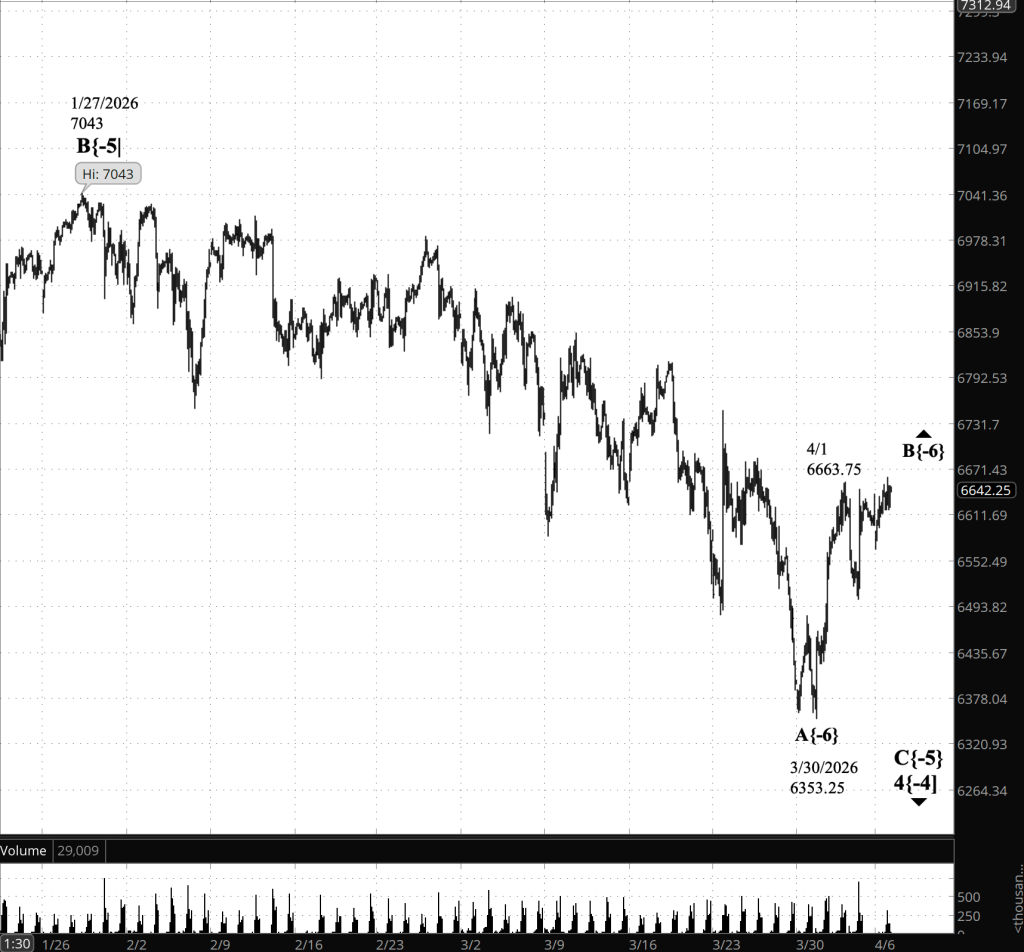
[S&P 500 E-mini futures at 3:30 p.m., 105-minute bars with volume]

Waves Now Underway

These are the waves currently in progress under my principal analysis. Each line on the list shows the wave number, with the subscript in curly brackets, the traditional degree name, the starting date, the starting price of the S&P 500 E-mini futures, and the direction of the wave.

  • S&P 500 Index:
  • 5{+3} Supercycle, 7/8/1932, 4.40 (up)
  • 5{+2} Cycle, 12/9/1974, 60.96 (up)
  • 5{+1} Primary, 3/6/2009, 666.79 (up)
  • 5{0} Intermediate, 2/11/2016, 1810.10 (up)
  • 3{-1} Minor, 3/23/2020, 2191.36 (up)
  • 1{-2} Minute, 7/31/2025, 6468.50 (down)
  • S&P 500 E-mini futures
  • 5{-3} Minuette 8/1/2025, 6239.50 (up}
  • 4{-4} Subminutte 10/29/2025, 6953.75 (down}
  • C{-5} Micro, 1/27/2026, 7043 (down}
  • B{-6} (none), 3/30/2026, 6353.25 (up}

Reading the chart. Price movements — waves – – in Elliott Wave Theory analysis are labeled with numbers within trending waves and letters with corrective waves. The subscripts — numbers in curly brackets — designate the wave’s degree, which, in Elliott Wave analysis, means the relative position of a wave within the larger and smaller structures that make up the chart. R.N. Elliott, who in the 1930s developed the form of analysis that bears his name, viewed the chart as a complex structure of smaller waves nested within larger waves, which in turn are nested within still larger waves. In mathematics it’s called a fractal structure, where at every scale the pattern is similar to the others.

Learning and other resources. Elliott Wave analysis provides context, not prophecy. As the 20th century semanticist Alfred Korzybski put it in his book Science and Sanity (1933), “The map is not the territory … The only usefulness of a map depends on similarity of structure between the empirical world and the map.” And I would add, in the ever-changing markets, we can judge that similarity of structure only after the fact.

See the menu page Analytical Methods for a rundown on where to go for information on Elliott Wave analysis.

By Tim Bovee, Portland, Oregon, April 6, 2026

Disclaimer

Tim Bovee, Private Trader tracks the analysis and trades of a private trader for his own accounts. Nothing in this blog constitutes a recommendation to buy or sell stocks, options or any other financial instrument. The only purpose of this blog is to provide education and entertainment.

No trader is ever 100 percent successful in his or her trades. Trading in the stock and option markets is risky and uncertain. Each trader must make trading decisions for his or her own account, and take responsibility for the consequences.

All content on Tim Bovee, Private Trader by Timothy K. Bovee is licensed under a Creative Commons Attribution-ShareAlike 4.0 International License.

License

Based on work at www.timbovee.com

Trader’s Notebook: S&P 500

12:05 p.m. New York time

What’s happening now. Despite the market holiday, and contrary to the usual last-day-of-the week practice, the S&P 500 E-mini futures continued trading until 9:10 Friday morning. The price declined overnight until the Employment Situation Report was released at 8:30 a.m. New York time, when it shot up 28 points to 6639, and immediately pulled back to 6598.75.

What does it mean? Elliott Wave Theory analysis: Rising wave B{-6} continues.

[S&P 500 E-mini futures at 12:05 p.m., 105-minute bars with volume]

Waves Now Underway

These are the waves currently in progress under my principal analysis. Each line on the list shows the wave number, with the subscript in curly brackets, the traditional degree name, the starting date, the starting price of the S&P 500 E-mini futures, and the direction of the wave.

  • S&P 500 Index:
  • 5{+3} Supercycle, 7/8/1932, 4.40 (up)
  • 5{+2} Cycle, 12/9/1974, 60.96 (up)
  • 5{+1} Primary, 3/6/2009, 666.79 (up)
  • 5{0} Intermediate, 2/11/2016, 1810.10 (up)
  • 3{-1} Minor, 3/23/2020, 2191.36 (up)
  • 1{-2} Minute, 7/31/2025, 6468.50 (down)
  • S&P 500 E-mini futures
  • 5{-3} Minuette 8/1/2025, 6239.50 (up}
  • 4{-4} Subminutte 10/29/2025, 6953.75 (down}
  • C{-5} Micro, 1/27/2026, 7043 (down}
  • B{-6} (none), 3/30/2026, 6353.25 (up}

Reading the chart. Price movements — waves – – in Elliott Wave Theory analysis are labeled with numbers within trending waves and letters with corrective waves. The subscripts — numbers in curly brackets — designate the wave’s degree, which, in Elliott Wave analysis, means the relative position of a wave within the larger and smaller structures that make up the chart. R.N. Elliott, who in the 1930s developed the form of analysis that bears his name, viewed the chart as a complex structure of smaller waves nested within larger waves, which in turn are nested within still larger waves. In mathematics it’s called a fractal structure, where at every scale the pattern is similar to the others.

Learning and other resources. Elliott Wave analysis provides context, not prophecy. As the 20th century semanticist Alfred Korzybski put it in his book Science and Sanity (1933), “The map is not the territory … The only usefulness of a map depends on similarity of structure between the empirical world and the map.” And I would add, in the ever-changing markets, we can judge that similarity of structure only after the fact.

See the menu page Analytical Methods for a rundown on where to go for information on Elliott Wave analysis.

By Tim Bovee, Portland, Oregon, April 3, 2026

Disclaimer

Tim Bovee, Private Trader tracks the analysis and trades of a private trader for his own accounts. Nothing in this blog constitutes a recommendation to buy or sell stocks, options or any other financial instrument. The only purpose of this blog is to provide education and entertainment.

No trader is ever 100 percent successful in his or her trades. Trading in the stock and option markets is risky and uncertain. Each trader must make trading decisions for his or her own account, and take responsibility for the consequences.

All content on Tim Bovee, Private Trader by Timothy K. Bovee is licensed under a Creative Commons Attribution-ShareAlike 4.0 International License.

License

Based on work at www.timbovee.com

Trader’s Notebook: S&P 500

Friday holiday. U.S. stock, options and futures markets will be closed on Friday, April 3, for Good Friday, a Christian holiday. Bonds will close early, at noon New York time. Trading will resume on Monday, April 6. The Employment Situation Report will be published on Friday, and when the S&P 500 E-mini futures resume trading Sunday, April 5, at 6 p.m. New York time, it will be the first opportunity to check for a market reaction, if any.

3:30 p.m. New York time

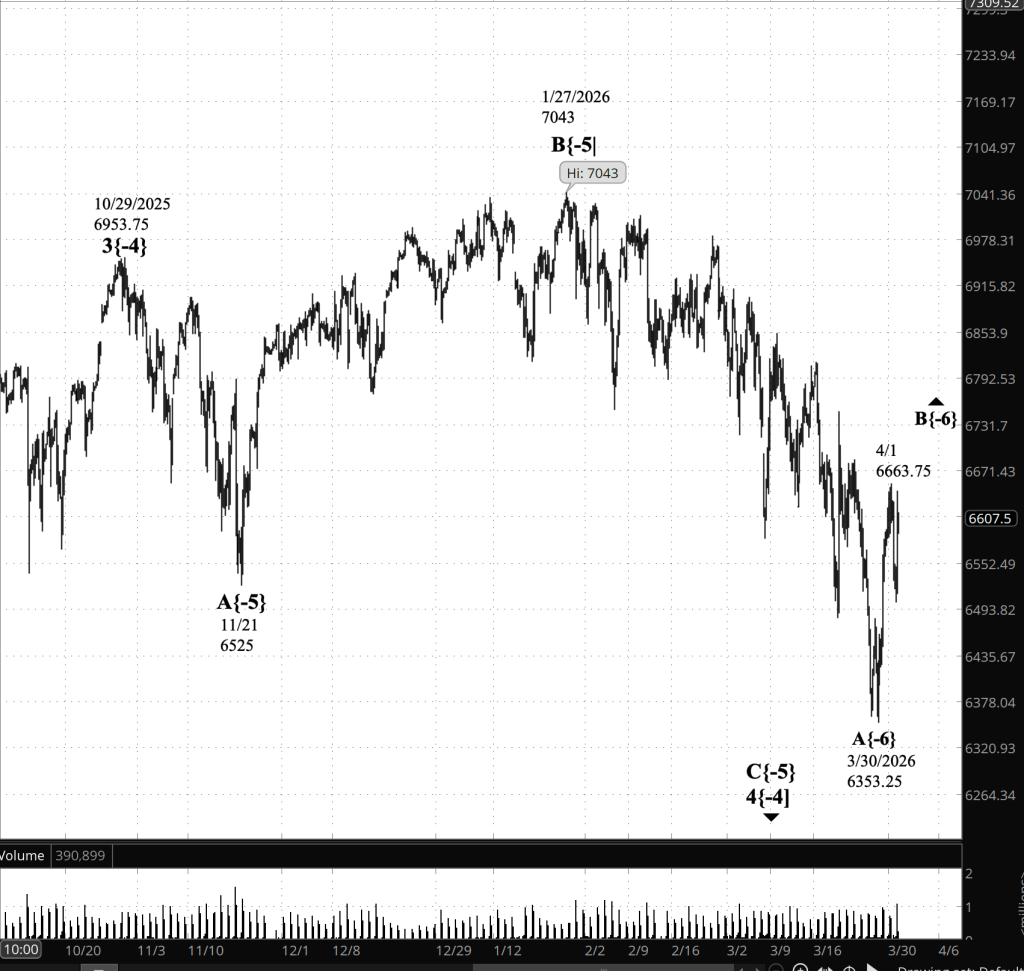
Half an hour before the closing bell. The S&P 500 futures began to rise overnight and continued to climb during the session, reaching 6644.50 before pulling back slightly.

Elliott Wave Theory: The rise bolsters the likelihood that rising wave B{-6} continues.

Decision Points.
A break above yesterday’s high at 6653.75 would confirm that wave B{-6} continues to extend higher. Failure below 6580 would weaken the bullish case and suggest that the current rise is corrective.A sustained move below 6500 would shift the interpretation toward the start of wave C{-6}.

9:35 a.m. New York time

What’s happening now.
The S&P 500 E-mini futures continued to fall overnight, extending the decline from Wednesday’s high at 6653.75.

The price rose modestly ahead of President Trump’s national address on the Iran War, then sold off sharply as the speech began, driving the market down to an overnight low of 6503.75 before a partial rebound.

Initial jobless claims, released at 8:30 a.m. ET, showed continued labor market stability, with claims falling to 202,000, a decrease of 9,000 from the prior week.

What does it mean? In Elliott Wave Theory terms, the decline is now testing the structure of rising wave B{-6}. The drop from 6653.75 to 6503.75 is sharp and has retraced roughly half of the wave’s advance, raising a legitimate question as to whether B{-6} has already ended and wave C{-6} has begun.

The decline creates a case for wave C, but it remains too limited in structure and follow-through to confirm that interpretation. The price action so far appears more consistent with a volatile internal correction than with the start of a sustained impulsive decline.

For the moment, I am maintaining the working assumption that wave B{-6} remains underway. Within the larger structure, B{-6} is a subwave of declining wave C{-5}, which in turn is part of wave 4{-4}, a downward correction taking the form of an expanding triangle.

Decision Points. Above 6560–6580, the corrective interpretation remains intact and B{-6} can resume higher. A break above 6653.75 would confirm that extension.

Between 6500 and 6560, the structure remains unresolved and likely to produce continued volatility.

Below 6500, the probability increases that B{-6} ended at Wednesday’s high. Acceleration below 6480 would confirm that wave C{-6} is underway.

Likelihood favors B{-6} still unfolding, while a sustained break below 6500 would shift the count to a developing C{-6} decline.

[S&P 500 E-mini futures at 3:30 p.m., 4-hour bars with volume]

Waves Now Underway

These are the waves currently in progress under my principal analysis. Each line on the list shows the wave number, with the subscript in curly brackets, the traditional degree name, the starting date, the starting price of the S&P 500 E-mini futures, and the direction of the wave.

  • S&P 500 Index:
  • 5{+3} Supercycle, 7/8/1932, 4.40 (up)
  • 5{+2} Cycle, 12/9/1974, 60.96 (up)
  • 5{+1} Primary, 3/6/2009, 666.79 (up)
  • 5{0} Intermediate, 2/11/2016, 1810.10 (up)
  • 3{-1} Minor, 3/23/2020, 2191.36 (up)
  • 1{-2} Minute, 7/31/2025, 6468.50 (down)
  • S&P 500 E-mini futures
  • 5{-3} Minuette 8/1/2025, 6239.50 (up}
  • 4{-4} Subminutte 10/29/2025, 6953.75 (down}
  • C{-5} Micro, 1/27/2026, 7043 (down}
  • B{-6} (none), 3/30/2026, 6353.25 (up}

Reading the chart. Price movements — waves – – in Elliott Wave Theory analysis are labeled with numbers within trending waves and letters with corrective waves. The subscripts — numbers in curly brackets — designate the wave’s degree, which, in Elliott Wave analysis, means the relative position of a wave within the larger and smaller structures that make up the chart. R.N. Elliott, who in the 1930s developed the form of analysis that bears his name, viewed the chart as a complex structure of smaller waves nested within larger waves, which in turn are nested within still larger waves. In mathematics it’s called a fractal structure, where at every scale the pattern is similar to the others.

Learning and other resources. Elliott Wave analysis provides context, not prophecy. As the 20th century semanticist Alfred Korzybski put it in his book Science and Sanity (1933), “The map is not the territory … The only usefulness of a map depends on similarity of structure between the empirical world and the map.” And I would add, in the ever-changing markets, we can judge that similarity of structure only after the fact.

See the menu page Analytical Methods for a rundown on where to go for information on Elliott Wave analysis.

By Tim Bovee, Portland, Oregon, April 2, 2026

Disclaimer

Tim Bovee, Private Trader tracks the analysis and trades of a private trader for his own accounts. Nothing in this blog constitutes a recommendation to buy or sell stocks, options or any other financial instrument. The only purpose of this blog is to provide education and entertainment.

No trader is ever 100 percent successful in his or her trades. Trading in the stock and option markets is risky and uncertain. Each trader must make trading decisions for his or her own account, and take responsibility for the consequences.

All content on Tim Bovee, Private Trader by Timothy K. Bovee is licensed under a Creative Commons Attribution-ShareAlike 4.0 International License.

License

Based on work at www.timbovee.com

Trader’s Notebook: S&P 500

3:30 p.m. New York time

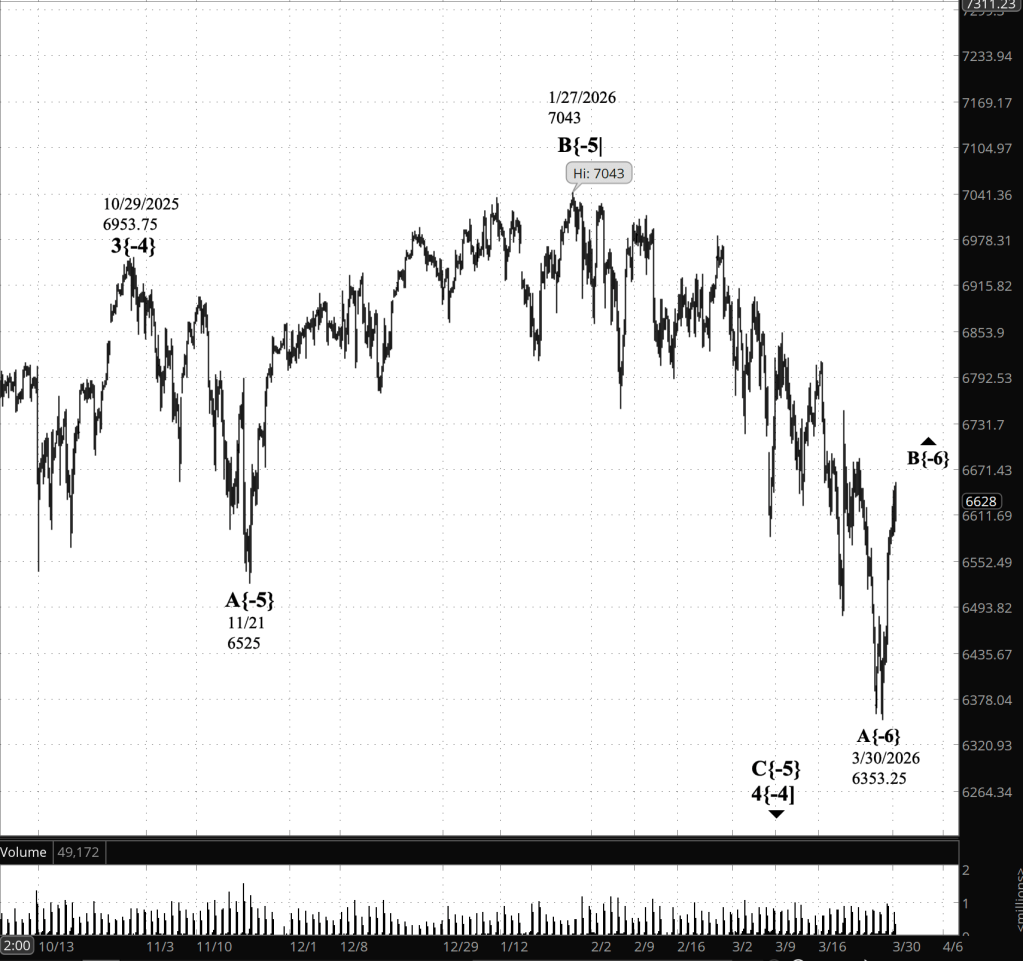
Half an hour before the closing bell. The S&P 500 futures reached a peak of 6653.75 during the session and then declined, approaching 6600 before bouncing back into the 6620s.

Elliott Wave Theory. Rising wave B{-6} continues. The pullback has so far remained well above the wave’s starting point at 6353.25. As long as the price remains above that level, the rising structure of B{-6} remains intact.

Decision Points. A move above 6653.75 would signal that rising wave B{-6} is still extending and could carry higher within the 6620–6680 target zone. A break below 6600 would suggest that the rally is losing momentum, though only a deeper decline would begin to call the B{-6} count into question.

9:35 a.m. New York time

What’s happening now. The S&P 500 E-mini futures rose overnight, spiking to a high of 6643.75 following the release of the ADP National Employment Report for March. The federal government’s Employment Situation Report will be released on Friday, when U.S. markets are closed. The price immediately retreated to 6590.

What does it mean? Elliott Wave Theory analysis sees the rise as further confirmation that wave B{-6} is underway. That wave is a subwave of declining wave C{-5}, which in turn is a subwave of wave 4{-4}, a downward correction that began on October 29, 2025 and is taking the form of an expanding triangle.

Decision Points. The overnight high pushed the price into the 6620–6680 target range, based on resistance levels within the Elliott Wave structure. However, the sharp rejection suggests that wave B{-6} is still unfolding and has not yet reached completion.

A sustained move back above 6620 would signal continuation toward the upper end of the range, while failure below 6560 would suggest the rally has stalled and call the B{-6} count into question.

[S&P 500 E-mini futures at 3:30 p.m., 4-hour bars with volume]

Waves Now Underway

These are the waves currently in progress under my principal analysis. Each line on the list shows the wave number, with the subscript in curly brackets, the traditional degree name, the starting date, the starting price of the S&P 500 E-mini futures, and the direction of the wave.

  • S&P 500 Index:
  • 5{+3} Supercycle, 7/8/1932, 4.40 (up)
  • 5{+2} Cycle, 12/9/1974, 60.96 (up)
  • 5{+1} Primary, 3/6/2009, 666.79 (up)
  • 5{0} Intermediate, 2/11/2016, 1810.10 (up)
  • 3{-1} Minor, 3/23/2020, 2191.36 (up)
  • 1{-2} Minute, 7/31/2025, 6468.50 (down)
  • S&P 500 E-mini futures
  • 5{-3} Minuette 8/1/2025, 6239.50 (up}
  • 4{-4} Subminutte 10/29/2025, 6953.75 (down}
  • C{-5} Micro, 1/27/2026, 7043 (down}
  • B{-6} (none), 3/30/2026, 6353.25 (up}

Reading the chart. Price movements — waves – – in Elliott Wave Theory analysis are labeled with numbers within trending waves and letters with corrective waves. The subscripts — numbers in curly brackets — designate the wave’s degree, which, in Elliott Wave analysis, means the relative position of a wave within the larger and smaller structures that make up the chart. R.N. Elliott, who in the 1930s developed the form of analysis that bears his name, viewed the chart as a complex structure of smaller waves nested within larger waves, which in turn are nested within still larger waves. In mathematics it’s called a fractal structure, where at every scale the pattern is similar to the others.

Learning and other resources. Elliott Wave analysis provides context, not prophecy. As the 20th century semanticist Alfred Korzybski put it in his book Science and Sanity (1933), “The map is not the territory … The only usefulness of a map depends on similarity of structure between the empirical world and the map.” And I would add, in the ever-changing markets, we can judge that similarity of structure only after the fact.

See the menu page Analytical Methods for a rundown on where to go for information on Elliott Wave analysis.

By Tim Bovee, Portland, Oregon, April 1, 2026

Disclaimer

Tim Bovee, Private Trader tracks the analysis and trades of a private trader for his own accounts. Nothing in this blog constitutes a recommendation to buy or sell stocks, options or any other financial instrument. The only purpose of this blog is to provide education and entertainment.

No trader is ever 100 percent successful in his or her trades. Trading in the stock and option markets is risky and uncertain. Each trader must make trading decisions for his or her own account, and take responsibility for the consequences.

All content on Tim Bovee, Private Trader by Timothy K. Bovee is licensed under a Creative Commons Attribution-ShareAlike 4.0 International License.

License

Based on work at www.timbovee.com