Trader’s Notebook: S&P 500

3:30 p.m. New York time

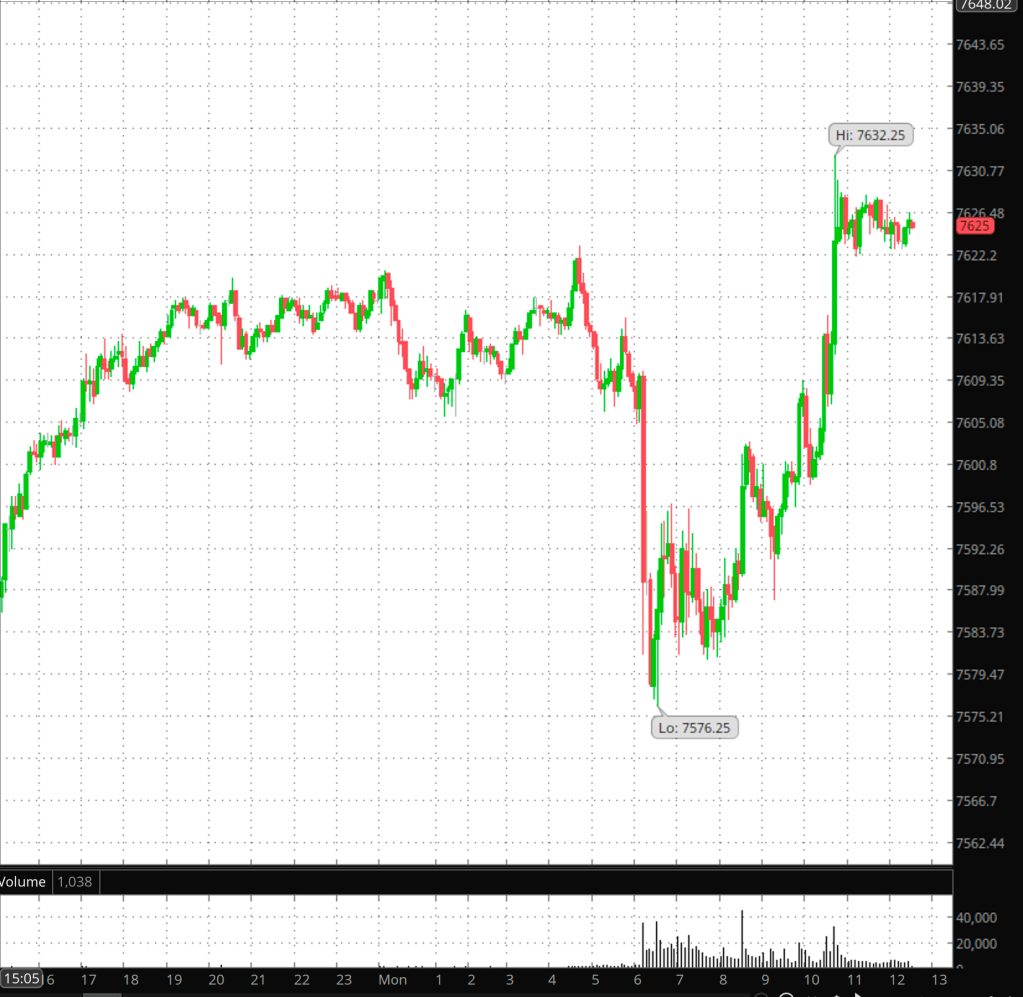
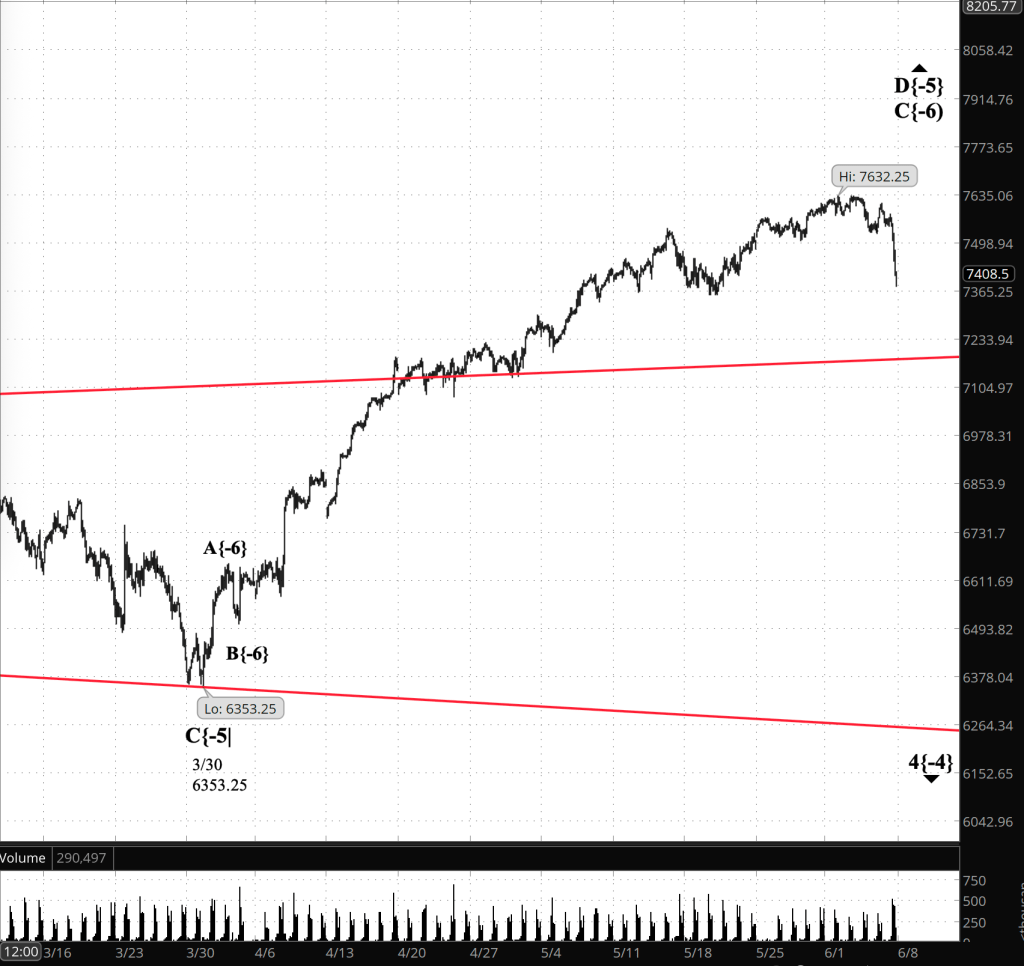
Half an hour before the closing bell. The S&P 500 futures fell with increasing force through the session, approaching 7400after peaking earlier in the week at 7632.25.

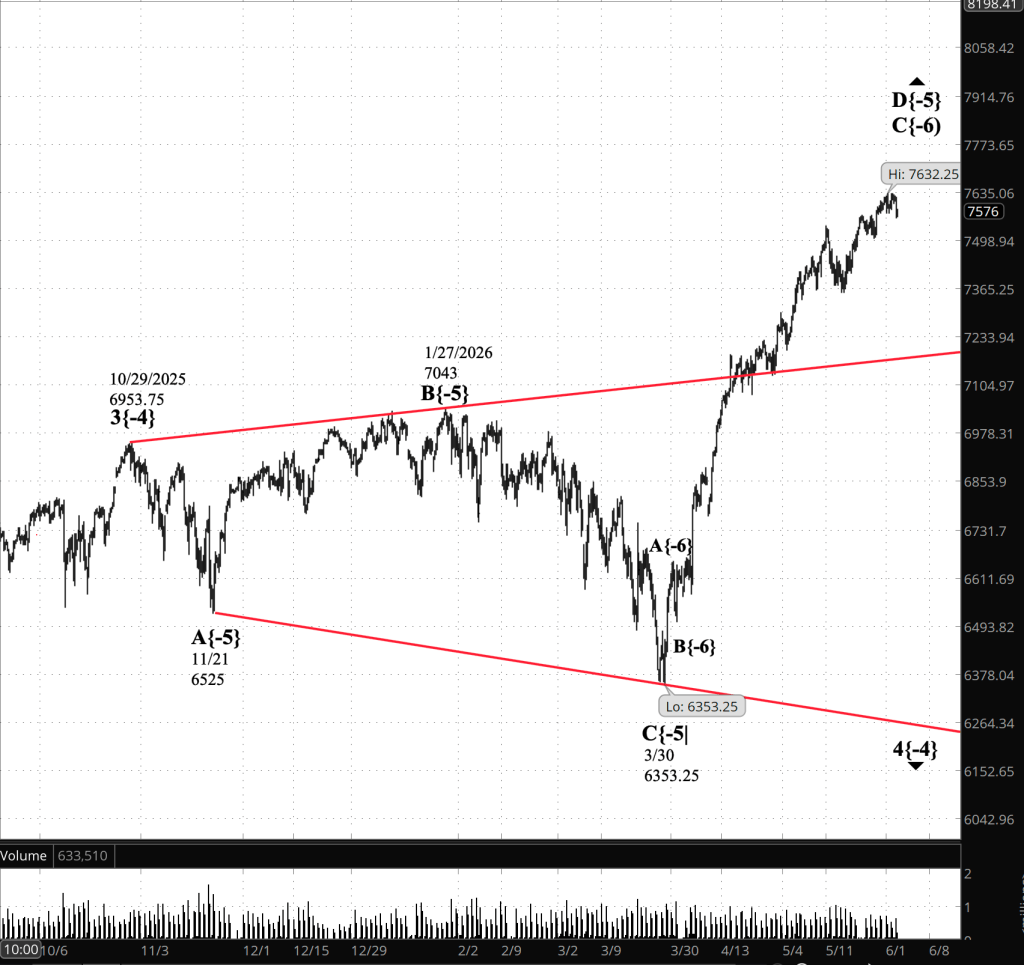
Elliott Wave Theory. The decline is the strongest evidence so far that rising wave D{-5} may have ended and that declining wave E{-5} may have begun. The distance covered is still small compared with the full rise of wave D{-5}, which began on March 30 at 6353.25, and the price remains well above the upper boundary of the Expanding Triangle. Even so, the speed and persistence of the decline make the question more urgent: Will the price turn back upward and challenge the 7630s and beyond, keeping D{-5} alive? Or will it continue lower, with each additional decline strengthening the argument that E{-5} is underway?

Decision Points. A recovery back toward the 7630s would keep rising wave D{-5} as the primary count. A continued decline would strengthen the case for declining wave E{-5}. The working confirmation remains a break back below the upper boundary of the Expanding Triangle; until then, E{-5} is a serious possibility, but not yet the confirmed primary count.

9:35 a.m. New York time

What’s happening now? The S&P 500 E-mini futures began to fall hours before the Employment Situation Report was released, declining from 7578.75. Immediately after the report’s release, the price spiked briefly and then resumed the pre-existing decline, appr.

What does it mean? Elliott Wave Theory leaves the analysis unchanged. The decline is a warning sign, but it is not yet deep enough to say that rising wave D{-5} has ended. Rising wave D{-5} remains the primary count.

Decision Points. A sustained recovery would support the view that D{-5} remains underway. A continued decline would increase the warning that D{-5} may be ending, but the working confirmation remains a break back below the upper boundary of the Expanding Triangle. Until that happens, declining wave E{-5} remains a possibility rather than the primary count.
[S&P 500 E-mini futures 3:30 p.m., 2-hour bars with volume]

Waves Now Underway

These are the waves currently in progress under my principal analysis. Each line on the list shows the wave number, with the subscript in curly brackets, the traditional degree name, the starting date, the starting price of the S&P 500 E-mini futures, and the direction of the wave.

  • S&P 500 Index:
  • 5{+3} Supercycle, 7/8/1932, 4.40 (up)
  • 5{+2} Cycle, 12/9/1974, 60.96 (up)
  • 5{+1} Primary, 3/6/2009, 666.79 (up)
  • 5{0} Intermediate, 2/11/2016, 1810.10 (up)
  • 3{-1} Minor, 3/23/2020, 2191.36 (up)
  • 1{-2} Minute, 7/31/2025, 6468.50 (down)
  • S&P 500 E-mini futures
  • 5{-3} Minuette 8/1/2025, 6239.50 (up}
  • 4{-4} Subminutte 10/29/2025, 6953.75 (down}
  • D{-5} Micro, 3/30/2026, 6353.25 (up}
  • C{-6} Submicro, 4/2/2026, 6503.75 (up)

Reading the chart. Price movements — waves – – in Elliott Wave Theory analysis are labeled with numbers within trending waves and letters with corrective waves. The subscripts — numbers in curly brackets — designate the wave’s degree, which, in Elliott Wave analysis, means the relative position of a wave within the larger and smaller structures that make up the chart.R.N. Elliott, who in the 1930s developed the form of analysis that bears his name, viewed the chart as a complex structure of smaller waves nested within larger waves, which in turn are nested within still larger waves. In mathematics it’s called a fractal structure, where at every scale the pattern is similar to the others.

Learning and other resources. Elliott Wave analysis provides context, not prophecy. As the 20th century semanticist Alfred Korzybski put it in his bookScience and Sanity(1933), “Themapis not theterritory… The only usefulness of a map depends on similarity of structure between the empirical world and the map.” And I would add, in the ever-changing markets, we can judge that similarity of structure only after the fact.

See the menu pageAnalytical Methodsfor a rundown on where to go for information on Elliott Wave analysis.

By Tim Bovee, Portland, Oregon, June 5, 2026

Disclaimer

Tim Bovee, Private Trader tracks the analysis and trades of a private trader managing his own accounts. The content reflects my interpretation of market structure, including Elliott Wave Theory and related tools.

Nothing in this blog constitutes a recommendation to buy or sell stocks, options, or any other financial instrument, or to pursue any particular strategy. The purpose of this blog is education and entertainment.

No trader is ever 100 percent successful. Trading in stock and options markets involves risk and uncertainty. Each trader must make decisions for his or her own account and accept full responsibility for the outcomes.

Charts and tools are used to support my personal analysis. Any data displayed is illustrative of that analytical process and is not presented as a source of market data for redistribution.

All content onTim Bovee, Private TraderbyTimothy K. Boveeis licensed under aCreative Commons Attribution-ShareAlike 4.0 International License.

License

Based on work atwww.timbovee.com
Trader’s Notebook: S&P 500

3:30 p.m. New York time

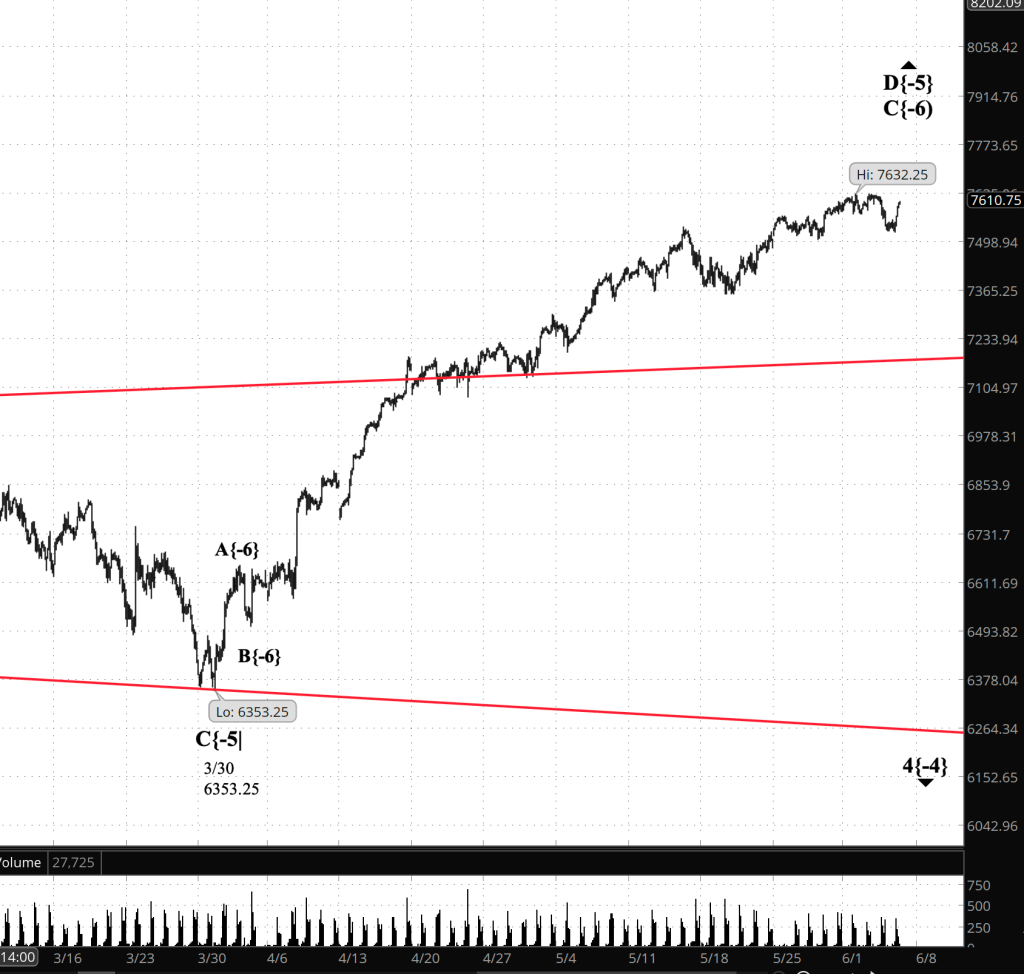
Half an hour before the closing bell. The S&P 500 futures continued to rise from the overnight low, 7524.50, and so far have reached the 7610s.

Elliott Wave Theory. The price remains below the peak of wave D{-5}, 7632.25, set on June 1. While the rise increases the likelihood that wave D{-5} is still underway, it still has not attained certainty. The alternative count remains that declining wave E{-5} has begun, although today’s rise has weakened that case for now.

Decision Points. A move above 7632.25 would confirm that rising wave D{-5} is still underway. A move below 7524.50 would return pressure to the downside, and a move below 7505.75 would strengthen the case that D{-5} has ended and E{-5} has begun. The stronger operational confirmation of E{-5} would remain a decline back below the upper boundary of the expanding triangle.

Chart. I’ve moved it to focus on the entirety of ongoing wave D{-5}. The red line is the upper boundary the parent wave 4{-4}, a downward correction that has taken the form of an Expanding Triangle.

[S&P 500 E-mini futures 3:30 p.m., 2-hour bars with volume]

9:45 a.m. New York time

What’s happening now? The S&P 500 E-mini futures followed yesterday’s decline with sideways movement in a narrow range, roughly from the 7550s down to the 7530s.

What does it mean? Elliott Wave Theory has moved into ambiguity: Is rising wave D{-5} still underway, or has falling wave E{-5} begun? Price remains above the prior low of 7505.75 on May 27, and the decline remains small compared with the full distance covered by D{-5} since it began on March 30.

Decision Points. A move above 7632.25 would confirm that rising wave D{-5} is still underway. A move below 7505.75 would strengthen the case that D{-5} has ended and E{-5} has begun, but the stronger operational confirmation would still be a decline back below the upper boundary of the expanding triangle. Until then, the market remains in the gray zone between a late-stage D{-5} pullback and the possible beginning of E{-5}.

Waves Now Underway

These are the waves currently in progress under my principal analysis. Each line on the list shows the wave number, with the subscript in curly brackets, the traditional degree name, the starting date, the starting price of the S&P 500 E-mini futures, and the direction of the wave.

  • S&P 500 Index:
  • 5{+3} Supercycle, 7/8/1932, 4.40 (up)
  • 5{+2} Cycle, 12/9/1974, 60.96 (up)
  • 5{+1} Primary, 3/6/2009, 666.79 (up)
  • 5{0} Intermediate, 2/11/2016, 1810.10 (up)
  • 3{-1} Minor, 3/23/2020, 2191.36 (up)
  • 1{-2} Minute, 7/31/2025, 6468.50 (down)
  • S&P 500 E-mini futures
  • 5{-3} Minuette 8/1/2025, 6239.50 (up}
  • 4{-4} Subminutte 10/29/2025, 6953.75 (down}
  • D{-5} Micro, 3/30/2026, 6353.25 (up}
  • C{-6} Submicro, 4/2/2026, 6503.75 (up)

Reading the chart. Price movements — waves – – in Elliott Wave Theory analysis are labeled with numbers within trending waves and letters with corrective waves. The subscripts — numbers in curly brackets — designate the wave’s degree, which, in Elliott Wave analysis, means the relative position of a wave within the larger and smaller structures that make up the chart. R.N. Elliott, who in the 1930s developed the form of analysis that bears his name, viewed the chart as a complex structure of smaller waves nested within larger waves, which in turn are nested within still larger waves. In mathematics it’s called a fractal structure, where at every scale the pattern is similar to the others.

Learning and other resources. Elliott Wave analysis provides context, not prophecy. As the 20th century semanticist Alfred Korzybski put it in his book Science and Sanity (1933), “The map is not the territory … The only usefulness of a map depends on similarity of structure between the empirical world and the map.” And I would add, in the ever-changing markets, we can judge that similarity of structure only after the fact.

See the menu page Analytical Methods for a rundown on where to go for information on Elliott Wave analysis.

By Tim Bovee, Portland, Oregon, June 4, 2026

Disclaimer

Tim Bovee, Private Trader tracks the analysis and trades of a private trader managing his own accounts. The content reflects my interpretation of market structure, including Elliott Wave Theory and related tools.

Nothing in this blog constitutes a recommendation to buy or sell stocks, options, or any other financial instrument, or to pursue any particular strategy. The purpose of this blog is education and entertainment.

No trader is ever 100 percent successful. Trading in stock and options markets involves risk and uncertainty. Each trader must make decisions for his or her own account and accept full responsibility for the outcomes.

Charts and tools are used to support my personal analysis. Any data displayed is illustrative of that analytical process and is not presented as a source of market data for redistribution.

All content on Tim Bovee, Private Trader by Timothy K. Bovee is licensed under a Creative Commons Attribution-ShareAlike 4.0 International License.

License

Based on work at www.timbovee.com

Trader’s Notebook: S&P 500

3:30 p.m. New York time

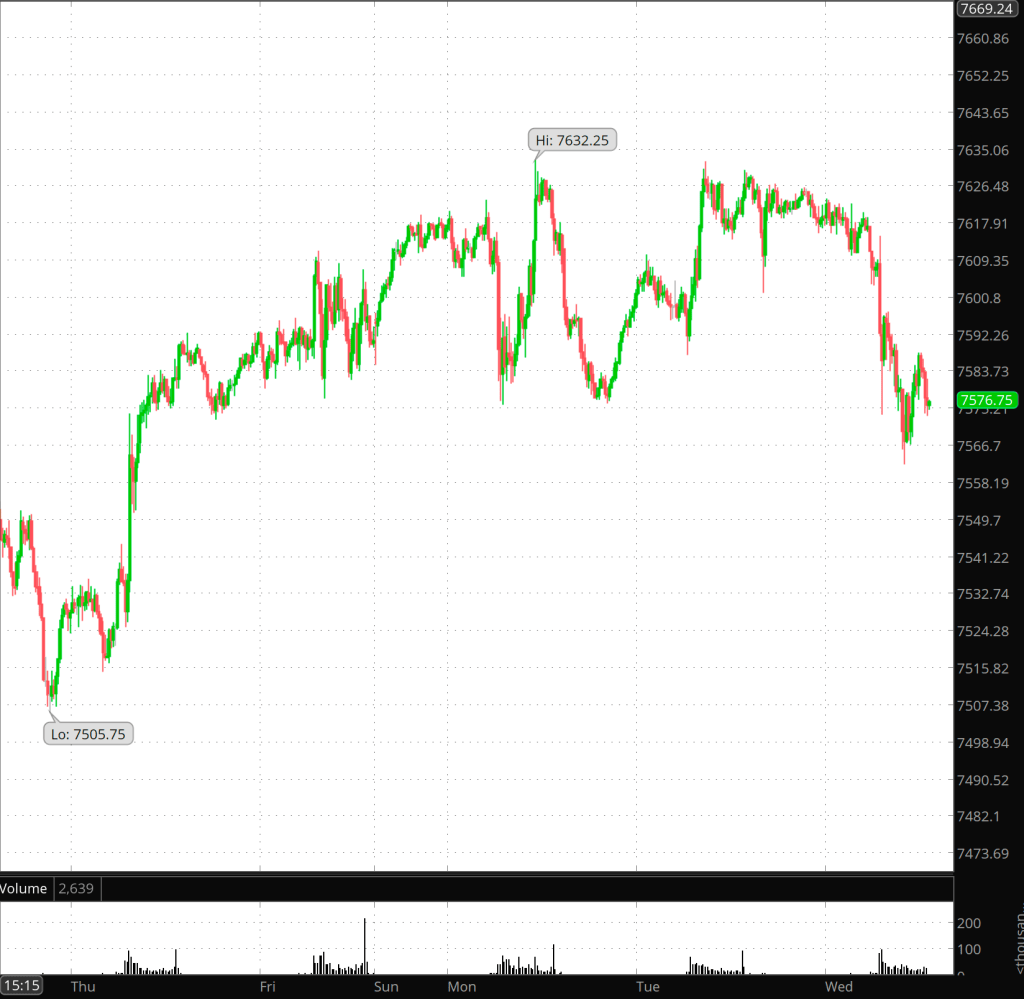
Half an hour before the closing bell. The S&P 500 futures continued the sideways fluctuation that has been underway since May 28. The range held mostly in the 7620s to 7590s, but during today’s session the futures broke lower into the 7560s before partially recovering.

Elliott Wave Theory. Rising wave D{-5} remains the primary count, as it has for more than two months. Today’s downside break is an early warning that wave D{-5} may be nearing or past its end, but it is not yet enough to confirm that falling wave E{-5} has begun.

Decision Points. A move above 7632.25 would confirm that wave D{-5} is still extending. A continued decline would increase the odds that wave E{-5} is underway, but the operational confirmation remains a break back below the upper boundary of the Expanding Triangle.

9:35 a.m. New York time

What’s happening now? The S&P 500 E-mini futures overnight continued the sideways fluctuation that began on May 28. The movement included a brief push to a new high on June 1 at 7632.25, but the futures have made little significant progress since then. In practical terms, the market has produced nearly a week of motion, but not much direction.

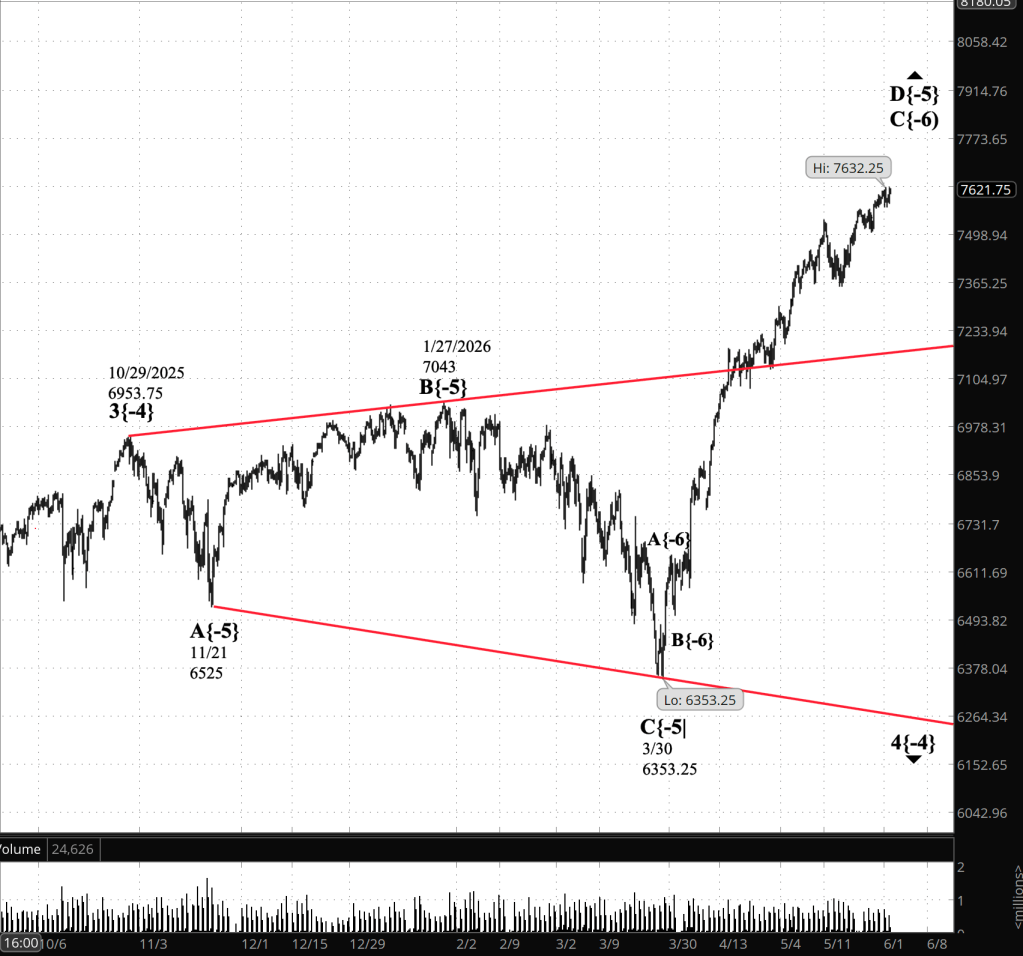
What does it mean? Elliott Wave Theory treats the fluctuation as part of rising wave D{-5}, which began on March 30. Wave D{-5} is the penultimate subwave of wave 4{-4}, a correction that began in October 2025 and has taken the form of an Expanding Triangle.

Rising wave D{-5} will be followed by falling wave E{-5}. When wave E{-5} is complete, wave 4{-4} will also be complete, clearing the way for rising wave 5{-4}, which should carry the futures to significant new highs.

Decision Points. A move above 7632.25 would confirm that wave D{-5} is still extending. A decline below the recent sideways range would be an early warning that wave D{-5} may have ended, but the operational confirmation that wave E{-5} has begun remains a break back below the upper boundary of the Expanding Triangle.

Charts. Above, a 6-hour bar chart showing the entirely of wave 4{-4} so far. Below, a 15-minute bar chart covering the sideways movements over the last four sessions and overnight movements,

[S&P 500 E-mini futures 3:30 p.m., 6-hour bars with volume]

[S&P 500 E-mini futures 3:30 p.m., 15-minute bars with volume]

Waves Now Underway

These are the waves currently in progress under my principal analysis. Each line on the list shows the wave number, with the subscript in curly brackets, the traditional degree name, the starting date, the starting price of the S&P 500 E-mini futures, and the direction of the wave.

  • S&P 500 Index:
  • 5{+3} Supercycle, 7/8/1932, 4.40 (up)
  • 5{+2} Cycle, 12/9/1974, 60.96 (up)
  • 5{+1} Primary, 3/6/2009, 666.79 (up)
  • 5{0} Intermediate, 2/11/2016, 1810.10 (up)
  • 3{-1} Minor, 3/23/2020, 2191.36 (up)
  • 1{-2} Minute, 7/31/2025, 6468.50 (down)
  • S&P 500 E-mini futures
  • 5{-3} Minuette 8/1/2025, 6239.50 (up}
  • 4{-4} Subminutte 10/29/2025, 6953.75 (down}
  • D{-5} Micro, 3/30/2026, 6353.25 (up}
  • C{-6} Submicro, 4/2/2026, 6503.75 (up)

Reading the chart. Price movements — waves – – in Elliott Wave Theory analysis are labeled with numbers within trending waves and letters with corrective waves. The subscripts — numbers in curly brackets — designate the wave’s degree, which, in Elliott Wave analysis, means the relative position of a wave within the larger and smaller structures that make up the chart. R.N. Elliott, who in the 1930s developed the form of analysis that bears his name, viewed the chart as a complex structure of smaller waves nested within larger waves, which in turn are nested within still larger waves. In mathematics it’s called a fractal structure, where at every scale the pattern is similar to the others.

Learning and other resources. Elliott Wave analysis provides context, not prophecy. As the 20th century semanticist Alfred Korzybski put it in his book Science and Sanity (1933), “The map is not the territory … The only usefulness of a map depends on similarity of structure between the empirical world and the map.” And I would add, in the ever-changing markets, we can judge that similarity of structure only after the fact.

See the menu page Analytical Methods for a rundown on where to go for information on Elliott Wave analysis.

By Tim Bovee, Portland, Oregon, June 3, 2026

Disclaimer

Tim Bovee, Private Trader tracks the analysis and trades of a private trader managing his own accounts. The content reflects my interpretation of market structure, including Elliott Wave Theory and related tools.

Nothing in this blog constitutes a recommendation to buy or sell stocks, options, or any other financial instrument, or to pursue any particular strategy. The purpose of this blog is education and entertainment.

No trader is ever 100 percent successful. Trading in stock and options markets involves risk and uncertainty. Each trader must make decisions for his or her own account and accept full responsibility for the outcomes.

Charts and tools are used to support my personal analysis. Any data displayed is illustrative of that analytical process and is not presented as a source of market data for redistribution.

All content on Tim Bovee, Private Trader by Timothy K. Bovee is licensed under a Creative Commons Attribution-ShareAlike 4.0 International License.

License

Based on work at www.timbovee.com

Trader’s Notebook: S&P 500

3:30 p.m. New York time

Half an hour before the closing bell. The S&P 500 futures rose to 7632, only 25 cents below Monday’s peak, and then declined into the 7610s.

Elliott Wave Theory. Rising wave D{-5} came within pennies of verification, but a near-breakout is not an actual breakout. The price tested the prior peak and failed the test, increasing the likelihood that Monday’s peak was the end of wave D{-5} and the beginning of declining wave E{-5}.

That remains a likelihood, not a certainty. I’ll retain the D{-5} label on the chart until the price verifies that wave D{-5} has ended.

Decision Points. A rise above 7632.25 will verify that wave D{-5} remains underway. A decline below 7576.25 will be an early warning that wave D{-5} may have ended. The operational confirmation that wave E{-5} has begun will come only with a break back below the upper boundary of the Expanding Triangle.

9:35 a.m. New York time

What’s happening now? The S&P 500 E-mini futures fell slightly after Monday’s new peak and continued to decline overnight. The overnight low so far is 7576.25, still not a great distance from the peak, 7632.25.

What does it mean? Elliott Wave Theory continues to label rising wave D{-5} as still underway. Each further decline weakens that scenario, and a significant rise strengthens it. At this point, however, the pullback remains small compared with the full rise from the March 30 low of 6353.25.

If the price falls far enough to break back below the upper boundary of the Expanding Triangle, then the working count will shift: Wave D{-5} will have ended, and downtrending wave E{-5} will be underway. Wave E{-5} is likely to fall into the 6250s and perhaps lower.

Wave E{-5} is the fifth and final wave of the parent wave 4{-4}, a downward correction that began in October 2025 and has taken the form of an Expanding Triangle, with ever higher highs and lower lows.

Decision Points. A rise above 7632.25 will confirm that wave D{-5} remains underway. A decline below 7576.25 will be an early warning that wave D{-5} may have ended, but not confirmation. The operational confirmation that wave E{-5} has begun will come only with a break back below the upper boundary of the Expanding Triangle.

[S&P 500 E-mini futures 3:30 p.m., 6-hour bars with volume]

Waves Now Underway

These are the waves currently in progress under my principal analysis. Each line on the list shows the wave number, with the subscript in curly brackets, the traditional degree name, the starting date, the starting price of the S&P 500 E-mini futures, and the direction of the wave.

  • S&P 500 Index:
  • 5{+3} Supercycle, 7/8/1932, 4.40 (up)
  • 5{+2} Cycle, 12/9/1974, 60.96 (up)
  • 5{+1} Primary, 3/6/2009, 666.79 (up)
  • 5{0} Intermediate, 2/11/2016, 1810.10 (up)
  • 3{-1} Minor, 3/23/2020, 2191.36 (up)
  • 1{-2} Minute, 7/31/2025, 6468.50 (down)
  • S&P 500 E-mini futures
  • 5{-3} Minuette 8/1/2025, 6239.50 (up}
  • 4{-4} Subminutte 10/29/2025, 6953.75 (down}
  • D{-5} Micro, 3/30/2026, 6353.25 (up}
  • C{-6} Submicro, 4/2/2026, 6503.75 (up)

Reading the chart. Price movements — waves – – in Elliott Wave Theory analysis are labeled with numbers within trending waves and letters with corrective waves. The subscripts — numbers in curly brackets — designate the wave’s degree, which, in Elliott Wave analysis, means the relative position of a wave within the larger and smaller structures that make up the chart. R.N. Elliott, who in the 1930s developed the form of analysis that bears his name, viewed the chart as a complex structure of smaller waves nested within larger waves, which in turn are nested within still larger waves. In mathematics it’s called a fractal structure, where at every scale the pattern is similar to the others.

Learning and other resources. Elliott Wave analysis provides context, not prophecy. As the 20th century semanticist Alfred Korzybski put it in his book Science and Sanity (1933), “The map is not the territory … The only usefulness of a map depends on similarity of structure between the empirical world and the map.” And I would add, in the ever-changing markets, we can judge that similarity of structure only after the fact.

See the menu page Analytical Methods for a rundown on where to go for information on Elliott Wave analysis.

By Tim Bovee, Portland, Oregon, June 2, 2026

Disclaimer

Tim Bovee, Private Trader tracks the analysis and trades of a private trader managing his own accounts. The content reflects my interpretation of market structure, including Elliott Wave Theory and related tools.

Nothing in this blog constitutes a recommendation to buy or sell stocks, options, or any other financial instrument, or to pursue any particular strategy. The purpose of this blog is education and entertainment.

No trader is ever 100 percent successful. Trading in stock and options markets involves risk and uncertainty. Each trader must make decisions for his or her own account and accept full responsibility for the outcomes.

Charts and tools are used to support my personal analysis. Any data displayed is illustrative of that analytical process and is not presented as a source of market data for redistribution.

All content on Tim Bovee, Private Trader by Timothy K. Bovee is licensed under a Creative Commons Attribution-ShareAlike 4.0 International License.

License

Based on work at www.timbovee.com

Trader’s Notebook: S&P 500

3:30 p.m. New York time

Half an hour before the closing bell. The S&P 500 futures reached a low of 7576.25 and then reversed, pushing up to a new peak of 7632.25, only a few points above the early-session peak.

Elliott Wave Theory. The distance may be short, but the implication is large. Despite the drama of the day, upward wave D{-5} is still underway. As always at this stage, the new peak could be the end of wave D{-5} and the beginning of downward wave E{-5}. Or not. The ambiguity remains.

Decision Points. Wave D{-5} remains the primary count. The new high confirms that the rise is still alive, but it does not remove the late-wave warning. A decline back below the upper boundary of the Expanding Triangle remains the operational confirmation that wave E{-5} has begun. Until then, reversals from new highs are warnings, not proof.

9:35 a.m. New York time

What’s happening now? The S&P 500 E-mini futures reached a new peak of 7623 after trading resumed overnight. It then reversed sharply, falling into the 7570s, as renewed U.S.–Iran military exchanges added to market uncertainty.

What does it mean? The Elliott Wave Theory analysis remains unchanged from where it has been for several months: Wave D{-5} is underway. It appears to be nearing its end. Each new peak has been followed by a reversal and decline, perhaps suggesting that the end has arrived. And yet, so far, each decline has reversed back to the upside and produced another new peak.

This time? No idea.

Wave D{-5}, which began on March 30, is the next-to-the-last subwave of wave 4{-4}, a downward corrective wave that has taken the form of an Expanding Triangle.

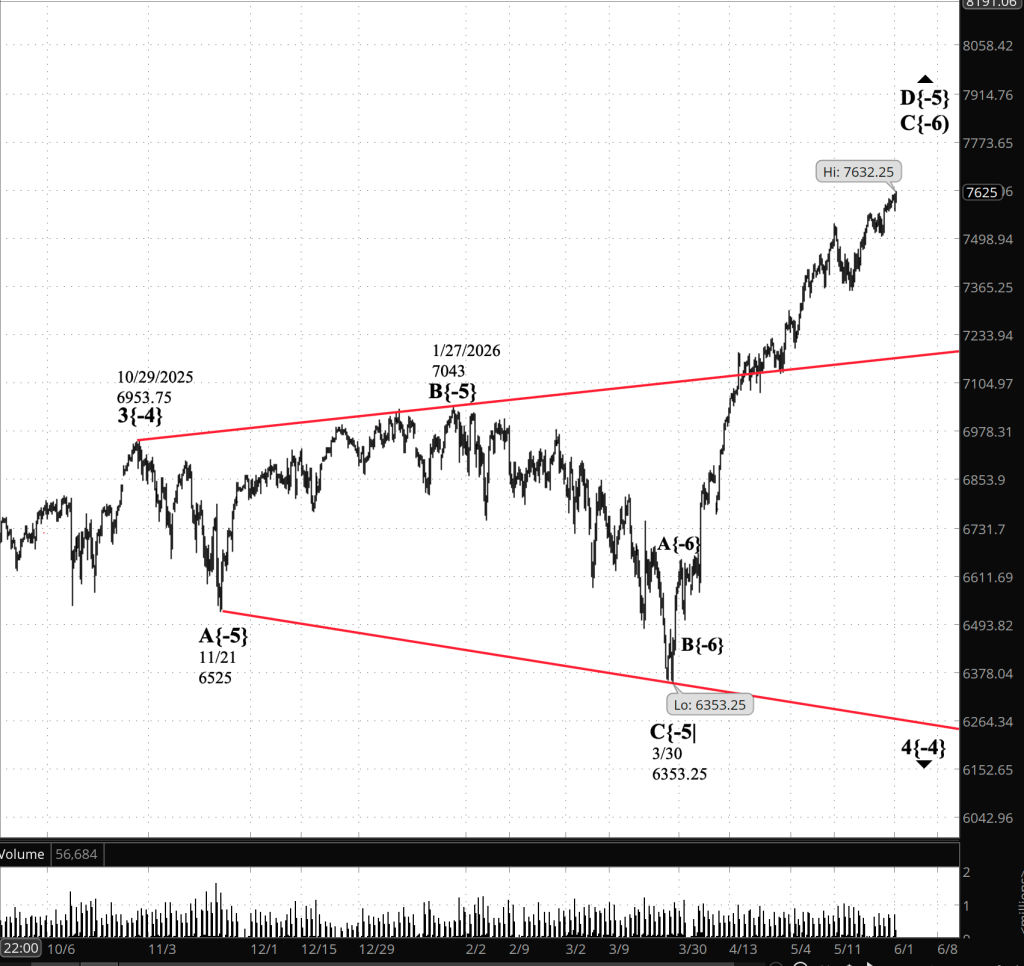
A common way in Elliott Wave Theory to estimate where a triangle may reverse is to draw boundary lines: one connecting the start of wave A with the start of wave C, and another connecting the end of wave A with the end of wave C. Those lines form the upper and lower boundaries of the triangle, although the boundaries are not always honored. The present wave D{-5} has overshot the upper boundary by a significant distance.

On the chart below, I have drawn the boundaries in red. Note that the farther into the future a boundary extends, the farther it moves in its direction: higher for the upper boundary and lower for the lower boundary.

Wave D{-5} will be followed by declining wave E{-5}, which should reach toward the lower boundary and may move beyond it, just as wave D{-5} has moved beyond the upper boundary.

The end of wave E{-5}, months in the future, will also be the end of wave 4{-4} and the beginning of uptrending wave 5{-5}. That wave is likely to rise above the end of wave D{-5}, perhaps significantly so. Sometimes, however, a 5th wave will fall short, a condition known as truncation. We will not know whether wave 5{-5} is truncated until the chart itself gives the answer.

Decision Points. Rising wave D{-5} remains the primary count until the price produces a decline large enough to matter at the D/E degree. The operational confirmation that wave E{-5} has begun would be a fall back below the red upper boundary of the Expanding Triangle. Until then, the overnight reversal is an important warning, but not yet proof that wave D{-5} has ended.

Charts. The upper chart shows the entirety of wave 4{-4}. The lower chart show wave D{-5}’s movements overnight and a few minutues into the session.

[S&P 500 E-mini futures 3:30 p.m., 6-hour bars with volume]

[S&P 500 E-mini futures 3:30 p.m., 5-minute bars with volume]

Waves Now Underway

These are the waves currently in progress under my principal analysis. Each line on the list shows the wave number, with the subscript in curly brackets, the traditional degree name, the starting date, the starting price of the S&P 500 E-mini futures, and the direction of the wave.

  • S&P 500 Index:
  • 5{+3} Supercycle, 7/8/1932, 4.40 (up)
  • 5{+2} Cycle, 12/9/1974, 60.96 (up)
  • 5{+1} Primary, 3/6/2009, 666.79 (up)
  • 5{0} Intermediate, 2/11/2016, 1810.10 (up)
  • 3{-1} Minor, 3/23/2020, 2191.36 (up)
  • 1{-2} Minute, 7/31/2025, 6468.50 (down)
  • S&P 500 E-mini futures
  • 5{-3} Minuette 8/1/2025, 6239.50 (up}
  • 4{-4} Subminutte 10/29/2025, 6953.75 (down}
  • D{-5} Micro, 3/30/2026, 6353.25 (up}
  • C{-6} Submicro, 4/2/2026, 6503.75 (up)

Reading the chart. Price movements — waves – – in Elliott Wave Theory analysis are labeled with numbers within trending waves and letters with corrective waves. The subscripts — numbers in curly brackets — designate the wave’s degree, which, in Elliott Wave analysis, means the relative position of a wave within the larger and smaller structures that make up the chart. R.N. Elliott, who in the 1930s developed the form of analysis that bears his name, viewed the chart as a complex structure of smaller waves nested within larger waves, which in turn are nested within still larger waves. In mathematics it’s called a fractal structure, where at every scale the pattern is similar to the others.

Learning and other resources. Elliott Wave analysis provides context, not prophecy. As the 20th century semanticist Alfred Korzybski put it in his book Science and Sanity (1933), “The map is not the territory … The only usefulness of a map depends on similarity of structure between the empirical world and the map.” And I would add, in the ever-changing markets, we can judge that similarity of structure only after the fact.

See the menu page Analytical Methods for a rundown on where to go for information on Elliott Wave analysis.

By Tim Bovee, Portland, Oregon, June 1, 2026

Disclaimer

Tim Bovee, Private Trader tracks the analysis and trades of a private trader managing his own accounts. The content reflects my interpretation of market structure, including Elliott Wave Theory and related tools.

Nothing in this blog constitutes a recommendation to buy or sell stocks, options, or any other financial instrument, or to pursue any particular strategy. The purpose of this blog is education and entertainment.

No trader is ever 100 percent successful. Trading in stock and options markets involves risk and uncertainty. Each trader must make decisions for his or her own account and accept full responsibility for the outcomes.

Charts and tools are used to support my personal analysis. Any data displayed is illustrative of that analytical process and is not presented as a source of market data for redistribution.

All content on Tim Bovee, Private Trader by Timothy K. Bovee is licensed under a Creative Commons Attribution-ShareAlike 4.0 International License.

License

Based on work at www.timbovee.com