Trader’s Notebook

3:30 p.m. New York time

Half an hour before the closing bell. The S&P 500 rose slightly during the day. The futures remained within the mid-3800s.

Wave 4{-12} is in its first subwave, A {-13}, and the upward A wave can be counted as being in its third and final wave. The middle segment of wave A{-13} seem a bit small for its position within the hierarchy of waves, but such oddities aren’t unheard of.

Wave A{-13} will be followed by a declining wave B{-13}, and then an upward wave C{-13}, which will complete the corrective pattern.

I’ve updated the chart.

2:15 p.m. New York time

One more earnings play exit. I exited my short put vertical spread on STT for a loss. The Zacks metric had predicted a negative earnings surprise. In fact, earnings exceeded analyst expectations. I’ve updated the trade analysis with full results.

1:35 p.m. New York time

Earnings plays: One exit, two entries. I’ve exited my short bull put vertical spread on C a day after entry for 53.9% of maximum potential profit and have updated the trade analysis with full results.

I’ve entered two bear call vertical spreads today, both using options that expire on August 19. I’ve posted a trade analysis on each: GS and SYF.

9:35 a.m. New York time

What’s happening now? The S&P 500 E-mini futures continued to rise overnight following yesterday’s low, 3723.75, reaching into the mid-3800s.

What does it mean? The low marked the end of the first leg of the downtrend that began on July 8 and the beginning of an upward correction that is in its early stage.

What are the alternatives? I have none at this point, as is common early in a trend.
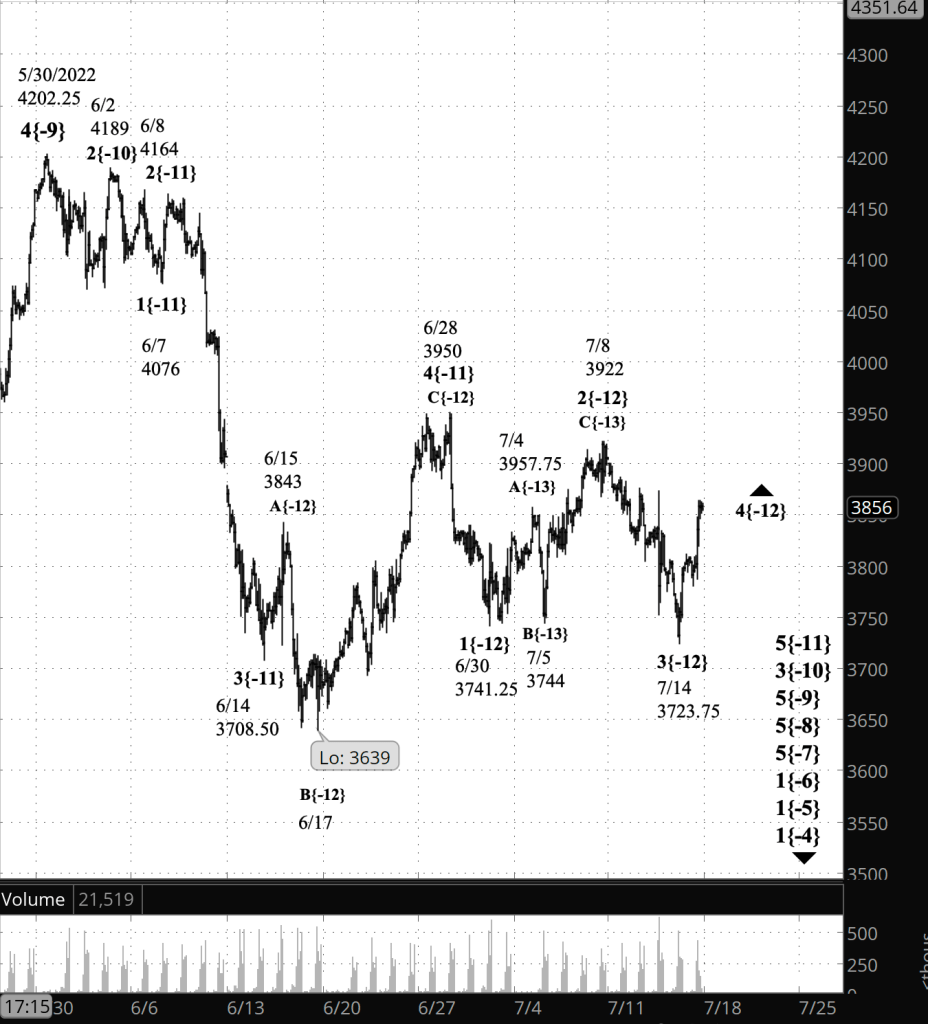
[S&P 500 E-mini futures at 3:30 p.m., 105-minute bars, with volume]

What does Elliott wave theory say? Under the principal analysis, the rise from yesterday’s low is wave 4{-12}, an upward correction within downtrending wave 5{-11}, which began on June 28. Fourth waves often take the form of a Flat with three internal waves. The A and B waves have three internal waves, and the C wave has five waves internally.

Wave 5{-11} parent, downtrending wave 3{-10}, began on June 2, and the 3rd wave’s parent, downtrending wave 5{-9}, began on May 30. The next wave higher is downtrending wave 5{-8}, and the still higher degrees are listed in the “We Are Here” section, below.

We Are Here.

These are the waves currently in progress under my principal analysis. Each line on the list shows the wave number, with the subscript in curly brackets, the traditional degree name, the starting date, the starting price of the S&P 500 E-mini futures, and the direction of the wave.

  • S&P 500 Index:
  • 5{+3} Supercycle, 7/8/1932, 4.40 (up)
  • 5{+2} Cycle, 12/9/1974, 60.96 (up)
  • 5{+1} Primary, 3/6/2009, 666.79 (up)
  • 5{0} Intermediate, 12/26/2018, 2346.58 (up)
  • 4{-1} Minor, 1/4/2022 4818.62 (down)
  • 1{-2} Minute, 1/4/2022 4818.62 (down)
  • S&P 500 Futures and index:
  • 1{-3} Minuette, 1/4/2022, 4808.25 (down) (futures), 4818.62 (down) (index)
  • S&P 500 Futures:
  • 1{-4} Subminuette, 1/4/2022, 4808.25 (down)
  • 1{-5} Micro, 1/4/2022, 4808.25 (down)
  • 1{-6} Submicro, 1/4/2022, 4808.25 (down)
  • 5{-7} Minuscule, 3/29/2022, 4631 (down)
  • 5{-8} Subminuscule, 4/21/2022, 4509, (down)

Learning and other resources. Elliott wave analysis provides context, not prophecy. As the 20th century semanticist Alfred Korzybski put it in his book Science and Sanity (1933), “The map is not the territory … The only usefulness of a map depends on similarity of structure between the empirical world and the map.” And I would add, in the ever-changing markets, we can judge that similarity of structure only after the fact.

See the menu page Analytical Methods for a rundown on where to go for information on Elliott wave analysis.

By Tim Bovee, Portland, Oregon, July 15, 2022

Disclaimer

Tim Bovee, Private Trader tracks the analysis and trades of a private trader for his own accounts. Nothing in this blog constitutes a recommendation to buy or sell stocks, options or any other financial instrument. The only purpose of this blog is to provide education and entertainment.

No trader is ever 100 percent successful in his or her trades. Trading in the stock and option markets is risky and uncertain. Each trader must make trading decisions for his or her own account, and take responsibility for the consequences.

License
Creative Commons License

All content on Tim Bovee, Private Trader by Timothy K. Bovee is licensed under a Creative Commons Attribution-ShareAlike 4.0 International License.

Based on a work at www.timbovee.com.

STT Trade

State Street Corp. (STT)

Update 7/15/2022: I exited my short bear call vertical spread on STT, 35 days before expiration, for a $3.08 debit per contract/share, a loss before fees of $189 per contract. Shares were trading at $63.33, up $4.25 from the entry level.

The Implied Volatility Rank at exit was 68.8%, down 30.4 points from the entry level.

I exited on the day after entry after the stock moved opposite my trade after earnings were published. I exited at 80.8% of maximum loss.

Shares rose by 7.2% over one day for a +2626% annual rate. The options position produced a 61.4% loss for a -22,398% annual rate.


I have entered a short bear call vertical spread on STT, using options that trade for the last time 36 days hence, on August 19. The premium is a $1.19 credit per contract share and the stock at the time of entry was priced at $59.08.

The Implied Volatility Ratio stood at 99.2%.

Premium:$1.19Expire OTM
STT-bear call spreadStrikeOddsDelta
Calls
Long62.5087.0%65
Break-even68.6978.5%50.5
Short67.5070.0%36

The premium is 47.6% of the width of the position’s short/long spread. The profit zone covers a 16.3% move to the downside and an unlimited move to the upside.

The risk/reward ratio is 3.2:1, with maximum risk of $238 and maximum reward of $119 per contract.

How I chose the trade. The trade was placed to coincide with STT’s earnings announcement, before the opening bell on the day after entry. The short strikes were set to coincide with the expected move of $2.42 either way, based on options pricing, which gives a price range of $56.66 to $61.50.

By Tim Bovee, Portland, Oregon, July 14, 2022

Disclaimer

Tim Bovee, Private Trader tracks the analysis and trades of a private trader for his own accounts. Nothing in this blog constitutes a recommendation to buy or sell stocks, options or any other financial instrument. The only purpose of this blog is to provide education and entertainment.

No trader is ever 100 percent successful in his or her trades. Trading in the stock and option markets is risky and uncertain. Each trader must make trading decisions for his or her own account, and take responsibility for the consequences.

License
Creative Commons License

All content on Tim Bovee, Private Trader by Timothy K. Bovee is licensed under a Creative Commons Attribution-ShareAlike 4.0 International License.

Based on a work at www.timbovee.com.

C Trade

Citigroup Inc. (C)

Lot 2022-2

Update 7/15/2022: I exited my short bull put vertical spread on C, 35 days before expiration, for a $0.59 debit per contract/share, a profit before fees of $69 per contract. Shares were trading at $46.92, up $3.36 from the entry level.

The Implied Volatility Rank at exit was 55.2%, down 17.2 points from the entry level.

I exited on the day after entry at 53.9% of maximum potential profit, well above my normal exit point for earnings plays, 25% of max.

Shares rose by 7.7% over one day for a +2,815% annual rate. The options position produced a 116.9% return for a +42,686% annual rate.


I have entered a short bull put vertical spread on C, using options that trade for the last time 36 days hence, on August 19. The premium is a $1.28 credit per contract share and the stock at the time of entry was priced at $43.56.

The Implied Volatility Ratio stood at 72.4%.

Premium:$1.28Expire OTM
C-bull put spreadStrikeOddsDelta
Puts
Long37.5081.0%15
Break-even43.5367.5%27
Short42.2554.0%39

The premium is 53.9% of the width of the position’s short/long spread. The profit zone covers a 0.1% move to the downside and an unlimited move to the upside.

The risk/reward ratio is 2.7:1, with maximum risk of $347 and maximum reward of $127 per contract.

How I chose the trade. The trade was placed to coincide with C’s earnings announcement, before the opening bell on the day after entry. The short strikes were set to coincide with the expected move of $1.57 either way, based on options pricing, which gives a price range of $41.99 to $45.13.

By Tim Bovee, Portland, Oregon, July 14, 2022

Disclaimer

Tim Bovee, Private Trader tracks the analysis and trades of a private trader for his own accounts. Nothing in this blog constitutes a recommendation to buy or sell stocks, options or any other financial instrument. The only purpose of this blog is to provide education and entertainment.

No trader is ever 100 percent successful in his or her trades. Trading in the stock and option markets is risky and uncertain. Each trader must make trading decisions for his or her own account, and take responsibility for the consequences.

License
Creative Commons License

All content on Tim Bovee, Private Trader by Timothy K. Bovee is licensed under a Creative Commons Attribution-ShareAlike 4.0 International License.

Based on a work at www.timbovee.com.
Trader’s Notebook

3:30 p.m. New York time

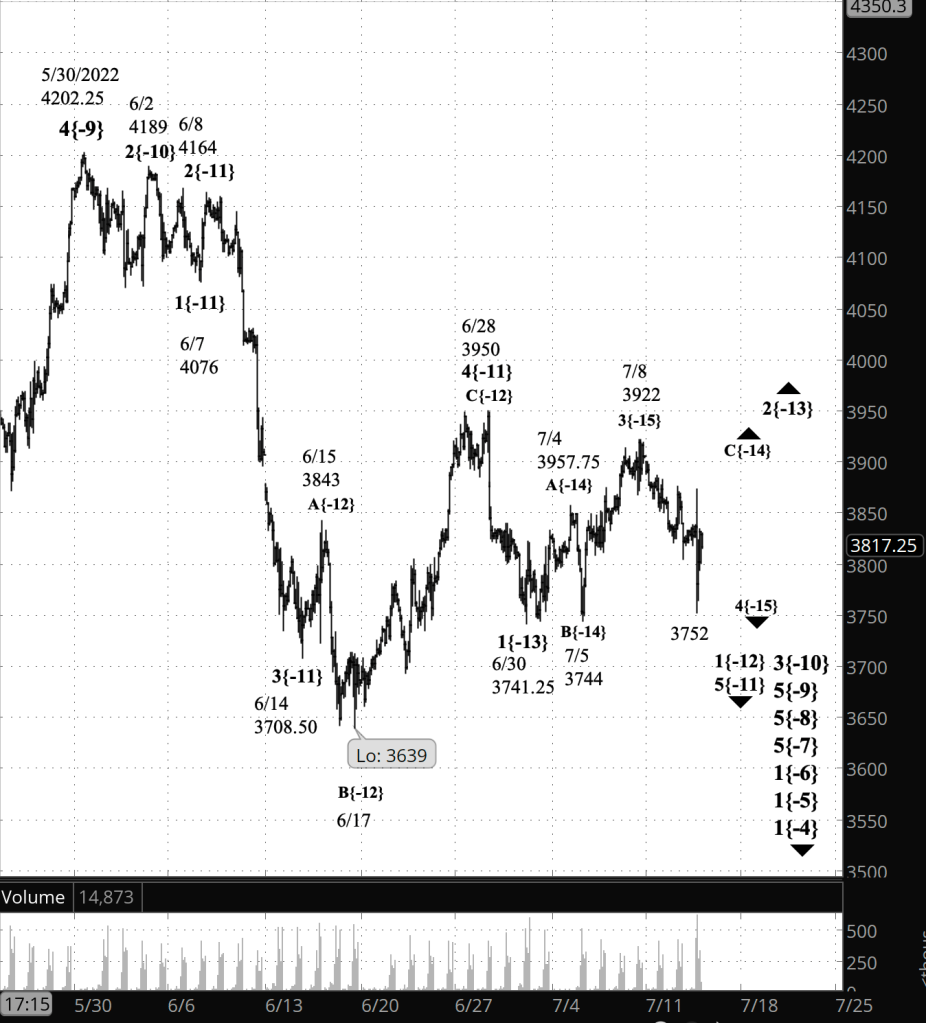
Half an hour before the closing bell. The S&P 500 futures rose during the session from the overnight low of 3723.75, which is 17.50 points below the June 30 low. The price then worked its way higher into the upper 3700s.

The present downtrend is wave 3{-12}, and the June 30 low was the end of wave 1{-12}. The lower low set overnight confirms the principal analysis: The downtrend that began on June 28, wave 5{-11}, has resumed.

No change in this morning’s analysis. I’ve updated the upper, near-term chart.

10:45 a.m. New York time

Earnings play: One exit, two entries. As the new earnings season kicks off, there are again more trading possibilities. Three trades today, all using options that complete their run on August 19.

I exited my position on MS, a day after entry, for 24.6% of maximum potential profit and have updated the analysis with results.

I entered a bull put vertical spread position on C and posted an analysis of the trade.

For the other new position, I entered a bear call vertical spread on STT, also posting an analysis of the trade.

9:35 a.m. New York time

What’s happening now? The S&P 500 E-mini futures fell in overnight trading, reaching into the mid-3700s.

What does it mean? The decline has gone sufficiently deep to suggest the need for a re-analysis of the chart. Under the new analysis (the former alternative #1), the upward correction ended at the July 8 peak and the downtrend that began on June 28 has resumed. It will carry the price further down by a significant amount.

What is the alternative? The price has not yet moved below the starting point of the upward correction that began on June 30. A move below that point, 3741.25, would confirm that the downtrend has resumed. And so the alternative is the former principal analysis: The decline from the July 8 peak is the next-to-the-last segment of final leg of an upward correction that began on June 30 from 3741.25.

The Charts. The upper chart is a shorter-term view of the S&P 500 futures, running from late May. The lower chart is a longer-term view of the S&P 500 index, running from late late December 2018, the starting point of an expanding Diagonal Triangle that is still underway.

[S&P 500 E-mini futures at 3:30 p.m., 105-minute bars, with volume]
[S&P 500 index at 9:34 a.m., 2-day bars]

What does Elliott wave theory say? The decline from July 8 is wave 3{-12}. Third waves tend to show a lot of energy and are almost the longest portion of a price trend. The preceding 1st wave was 208.75 points in length. A decline equal to that length would carry the price down to the lower 3700s; double the length, to mid 3400s; and triple the length, to the upper 3300s. None of those scenarios are unexpected, since 3rd waves have no limits under the rules of Elliott wave analysis.

Big picture: Wave 3{-12} is a subwave of wave 5{-11}, which began on June 28 from 3950, which in turn is a subwave of wave 3{-10}, which began on June 2 from 4189, and the larger wave 5{-9}, which began on May 30, from 4202.25. At this point the increasingly larger degrees pick up with wave 5{-8}, which began on April 21 from 4509, and the other parent waves listed in the “We Are Here” section below, which stretches back to wave 5{+3}, which began in 1932 and is still underway.

We Are Here.

These are the waves currently in progress under my principal analysis. Each line on the list shows the wave number, with the subscript in curly brackets, the traditional degree name, the starting date, the starting price of the S&P 500 E-mini futures, and the direction of the wave.

  • S&P 500 Index:
  • 5{+3} Supercycle, 7/8/1932, 4.40 (up)
  • 5{+2} Cycle, 12/9/1974, 60.96 (up)
  • 5{+1} Primary, 3/6/2009, 666.79 (up)
  • 5{0} Intermediate, 12/26/2018, 2346.58 (up)
  • 4{-1} Minor, 1/4/2022 4818.62 (down)
  • 1{-2} Minute, 1/4/2022 4818.62 (down)
  • S&P 500 Futures and index:
  • 1{-3} Minuette, 1/4/2022, 4808.25 (down) (futures), 4818.62 (down) (index)
  • S&P 500 Futures:
  • 1{-4} Subminuette, 1/4/2022, 4808.25 (down)
  • 1{-5} Micro, 1/4/2022, 4808.25 (down)
  • 1{-6} Submicro, 1/4/2022, 4808.25 (down)
  • 5{-7} Minuscule, 3/29/2022, 4631 (down)
  • 5{-8} Subminuscule, 4/21/2022, 4509, (down)

Learning and other resources. Elliott wave analysis provides context, not prophecy. As the 20th century semanticist Alfred Korzybski put it in his book Science and Sanity (1933), “The map is not the territory … The only usefulness of a map depends on similarity of structure between the empirical world and the map.” And I would add, in the ever-changing markets, we can judge that similarity of structure only after the fact.

See the menu page Analytical Methods for a rundown on where to go for information on Elliott wave analysis.

By Tim Bovee, Portland, Oregon, July 14, 2022

Disclaimer

Tim Bovee, Private Trader tracks the analysis and trades of a private trader for his own accounts. Nothing in this blog constitutes a recommendation to buy or sell stocks, options or any other financial instrument. The only purpose of this blog is to provide education and entertainment.

No trader is ever 100 percent successful in his or her trades. Trading in the stock and option markets is risky and uncertain. Each trader must make trading decisions for his or her own account, and take responsibility for the consequences.

License
Creative Commons License

All content on Tim Bovee, Private Trader by Timothy K. Bovee is licensed under a Creative Commons Attribution-ShareAlike 4.0 International License.

Based on a work at www.timbovee.com.
MS Trade

Lot 2022-2

Morgan Stanley (MS)

Update 7/14/2022: I exited my short bear call vertical spread on MS, 36 days before expiration, for a $1.04 debit per contract/share, a profit before fees of $34 per contract. Shares were trading at $73.10, down $1.65 from the entry level.

The Implied Volatility Rank at exit was 70.1%, up 33 points from the entry level.

I exited on the day after entry because the position reached 25% of maximum potential profit, my normal exit point for earnings plays.

Shares fell by 2.2% over one day for a -806% annual rate. The options position produced a 32.7% return for a +11,933% annual rate.


I have entered a short bear call vertical spread on MS, using options that trade for the last time 37 days hence, on August 19. The premium is a $1.38 credit per contract share and the stock at the time of entry was priced at $74.75.

The Implied Volatility Ratio stood at 37.1%.

Premium:$1.38Expire OTM
MS-bear call spreadStrikeOddsDelta
Calls
Long82.5084.0%20
Break-even78.8875.0%29.5
Short77.5066.0%39

The premium is 55.2% of the width of the position’s short/long spread. The profit zone covers a 5.5% move to the upside and an unlimited move to the downside.

The risk/reward ratio is 2.6:1, with maximum risk of $362 and maximum reward of $138 per contract.

How I chose the trade. The trade was placed to coincide with MS’s earnings announcement, before the opening bell on the day after entry. The short strikes were set to coincide with the expected move of $3.15 either way, based on options pricing, which gives a price range of $71.60 to $77.90.

By Tim Bovee, Portland, Oregon, July 13, 2022

Disclaimer

Tim Bovee, Private Trader tracks the analysis and trades of a private trader for his own accounts. Nothing in this blog constitutes a recommendation to buy or sell stocks, options or any other financial instrument. The only purpose of this blog is to provide education and entertainment.

No trader is ever 100 percent successful in his or her trades. Trading in the stock and option markets is risky and uncertain. Each trader must make trading decisions for his or her own account, and take responsibility for the consequences.

License
Creative Commons License

All content on Tim Bovee, Private Trader by Timothy K. Bovee is licensed under a Creative Commons Attribution-ShareAlike 4.0 International License.

Based on a work at www.timbovee.com.
Trader’s Notebook

3:30 p.m. New York time

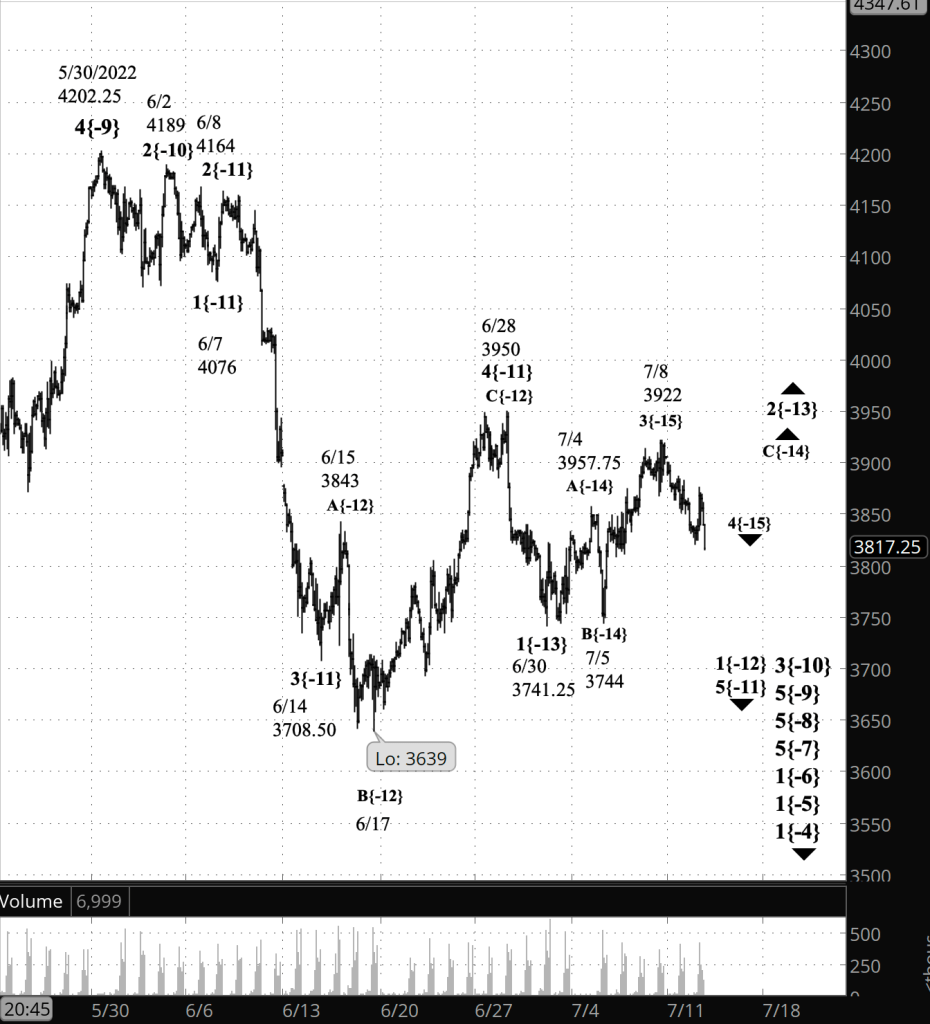
Half an hour before the closing bell. The S&P 500 futures spent most of the trading session in the lower 3800s, staying above the 3752 low reached overnight.

Elliott wave analysis shows that wave C{-14}, the final subwave within an upward correction, wave 2{-13}, is still underway.

No change in this morning’s analysis. I’ve updated the chart.

9:55 a.m. New York time

MS earnings play entry. I’ve entered a short bear call vertical spread on MS using options at trade for the last time on August 19 and have posted an analysis of the trade.

9:35 a.m. New York time

What’s happening now? The S&P 500 E-mini futures swung wildly as U.S. inflation numbers were released, rising to 3873 and falling to 3838.75 within the span of a minute. The price change slowed thereafter but continued to fall, reaching 3752 before rising back into the upper 3700s before the opening bell.

What does it mean? The pre-dawn swing is consistent with the declining, somewhat ambiguous five-wave pattern that has developed since the July 8 peak. Under my principal analysis, the decline from that peak is the next-to-the-last segment of final leg of an upward correction that began on June 30 from 3741.25.

What are the alternatives? There are two:

Alternative #1: The upward correction ended at the July 8 peak and the downtrend that began on June 28 resumed. A decline below 3741.25 would verify this alternative.

Alternative #2: The correction is forming a compound structure, linking two or three corrective patterns together. The July 8 peak was the end of the first corrective pattern, and the subsequent decline is connecting wave that will be followed by a second corrective pattern. For this scenario to be valid, the decline from July 8 must be counted as three subwaves, which is possible at this point, although not my preferred count.

[S&P 500 E-mini futures at 3:30 p.m., 105-minute bars, with volume]

What does Elliott wave theory say? Under the principal analysis, wave 4{-15} is underway, a three wave correction that will be followed by wave 5{-15}, a push to the upside that likely will exceed the July 8 high of 3922. The end of wave 5{-15} will also end its parent, wave C{-14}, which in turn will end the larger upward correction, wave 2{-13}.

Under Alternative #1, wave 2{-13} ended at the July 8 high, and wave 3{-13} is underway and will carry the price below 3741.25, the end point of the preceding 1st wave.

Under Alternative #2, the first corrective pattern within wave 2{-13} ended at the July 8 high, and the ensuing decline is wave X{-14}, a connector wave that will be followed by a second corrective pattern in a compound correction.

This is all happening within downtrending wave 1{-12} within wave 5{-11}, which began on June 28. The parent wave is wave 3{-10}, which began on June 2, within wave 5{-9}, which began on May 30 from 4202.25.

We Are Here.

These are the waves currently in progress under my principal analysis. Each line on the list shows the wave number, with the subscript in curly brackets, the traditional degree name, the starting date, the starting price of the S&P 500 E-mini futures, and the direction of the wave.

  • S&P 500 Index:
  • 5{+3} Supercycle, 7/8/1932, 4.40 (up)
  • 5{+2} Cycle, 12/9/1974, 60.96 (up)
  • 5{+1} Primary, 3/6/2009, 666.79 (up)
  • 5{0} Intermediate, 12/26/2018, 2346.58 (up)
  • 4{-1} Minor, 1/4/2022 4818.62 (down)
  • 1{-2} Minute, 1/4/2022 4818.62 (down)
  • S&P 500 Futures and index:
  • 1{-3} Minuette, 1/4/2022, 4808.25 (down) (futures), 4818.62 (down) (index)
  • S&P 500 Futures:
  • 1{-4} Subminuette, 1/4/2022, 4808.25 (down)
  • 1{-5} Micro, 1/4/2022, 4808.25 (down)
  • 1{-6} Submicro, 1/4/2022, 4808.25 (down)
  • 5{-7} Minuscule, 3/29/2022, 4631 (down)
  • 5{-8} Subminuscule, 4/21/2022, 4509, (down)

Learning and other resources. Elliott wave analysis provides context, not prophecy. As the 20th century semanticist Alfred Korzybski put it in his book Science and Sanity (1933), “The map is not the territory … The only usefulness of a map depends on similarity of structure between the empirical world and the map.” And I would add, in the ever-changing markets, we can judge that similarity of structure only after the fact.

See the menu page Analytical Methods for a rundown on where to go for information on Elliott wave analysis.

By Tim Bovee, Portland, Oregon, July 13, 2022

Disclaimer

Tim Bovee, Private Trader tracks the analysis and trades of a private trader for his own accounts. Nothing in this blog constitutes a recommendation to buy or sell stocks, options or any other financial instrument. The only purpose of this blog is to provide education and entertainment.

No trader is ever 100 percent successful in his or her trades. Trading in the stock and option markets is risky and uncertain. Each trader must make trading decisions for his or her own account, and take responsibility for the consequences.

License
Creative Commons License

All content on Tim Bovee, Private Trader by Timothy K. Bovee is licensed under a Creative Commons Attribution-ShareAlike 4.0 International License.

Based on a work at www.timbovee.com.
Trader’s Notebook

3:30 p.m. New York time

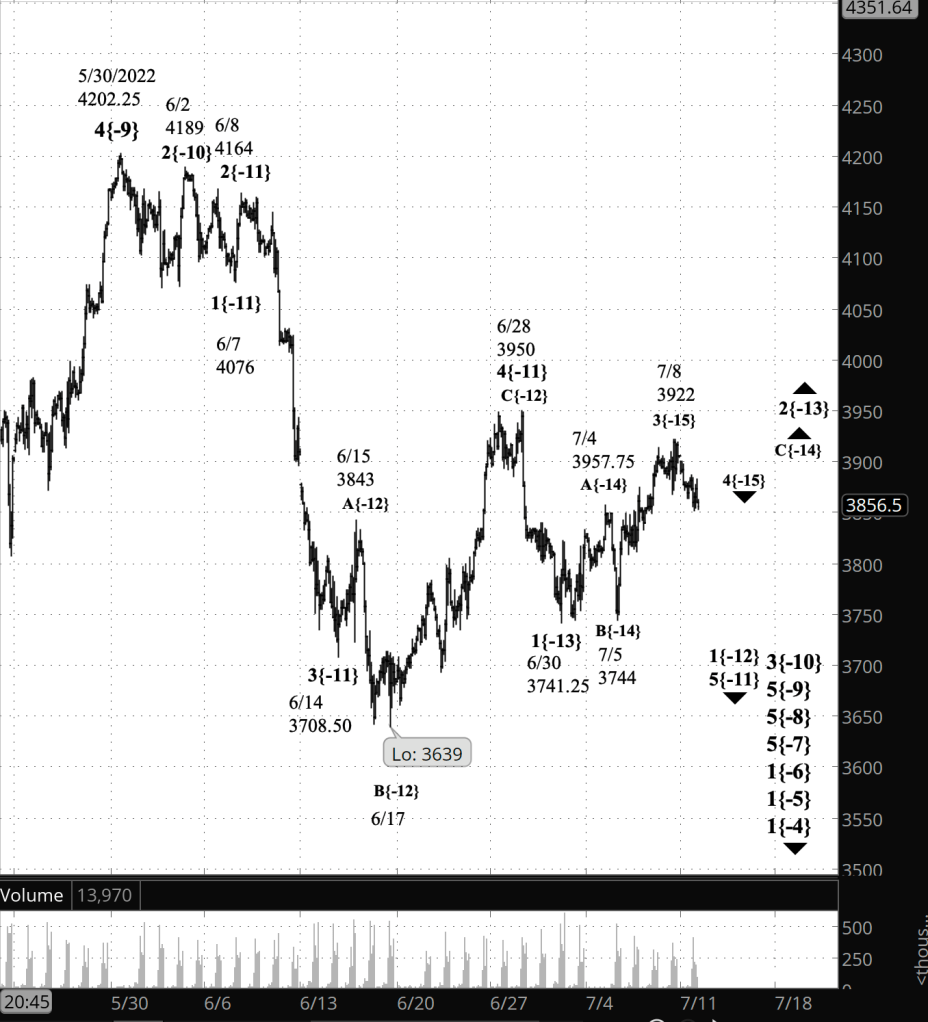
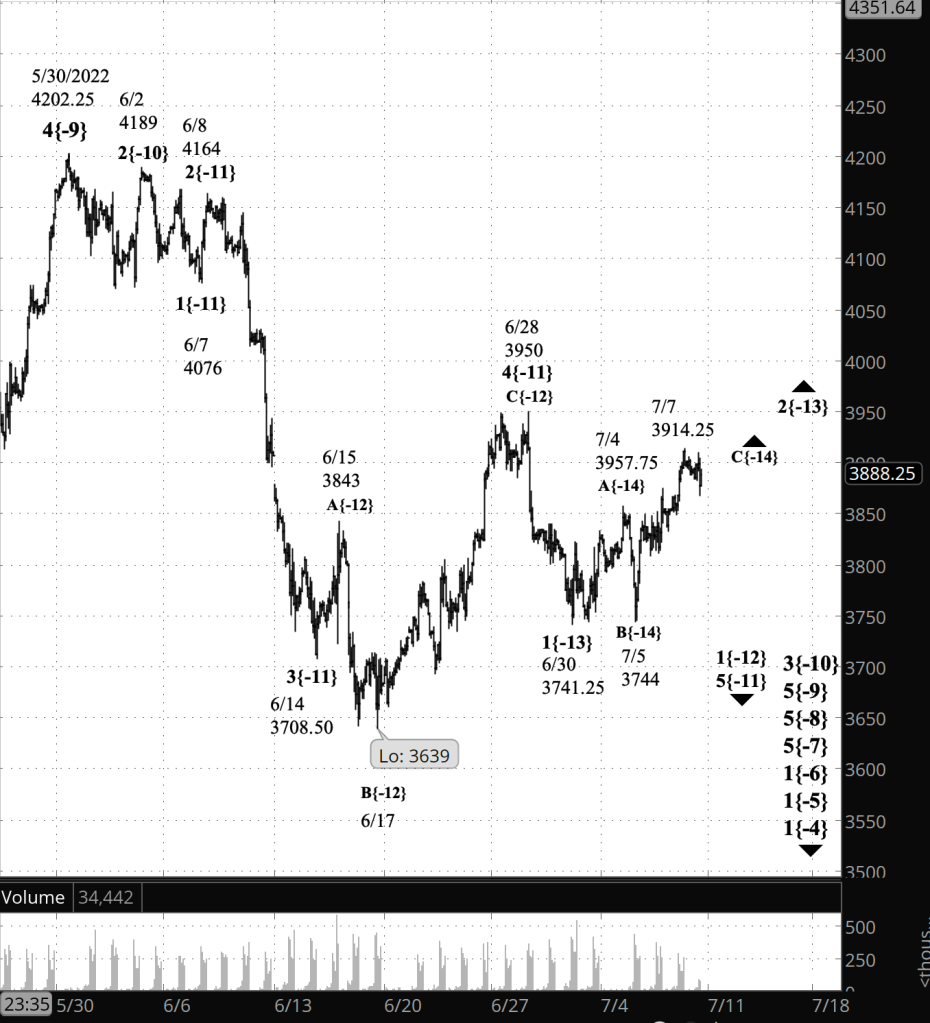
Half an hour before the closing bell. The S&P 500 zigzagged during the day, rising to 3876.50 on the futures and then falling below the overnight low, to 3819.50. The rise is consistent with a B wave, followed by a declining C wave, within wave 4{-15}. (See the Elliott wave analysis section below.) I’ve updated the chart.

9:35 a.m. New York time

What’s happening now? The S&P 500 E-mini futures continued to fall overnight, reaching into the lower 3800s before rising slightly.

What does it mean? The downward correction that began on June 30 continues to work through its end game. The 3rd and final leg of the correction is in its next-to-the-last segment, a small declining correction that will be followed by a final upward push and then a resumption of the downtrend that began on June 28,

What are the alternatives? There are two.

Alternative #1: The July 8 high was the end of the upward correction, and the downtrend has resumed.

Alternative #2: The 3rd leg will be the end of a corrective pattern but not the end of the upward correction. Instead, it will be connected to a second corrective pattern, and after that possibly to a third, significantly delaying completion of upward correction. When the compound correction is complete, then the downtrend will resume.

[S&P 500 E-mini futures at 3:30 p.m., 105-minute bars, with volume]

What does Elliott wave theory say? Under the principal analysis, the upward correction, wave 2{-13} is in its final wave, C{-14}, which in turn is in the 4th of 5 waves — wave 4{-15}.

Under alternative #1, the July 8 high, 3922, was the end of the upward correction, wave 2{-13}, and wave 3{-13} has begun. Like most 3rd waves, it will show a great deal of energy as it carries the price significantly below 3639, the lowest point reached since the January 4th peak triggered a large downtrend that is still in its early stages.

Under alternative #2, wave 2{-13} will form a compound correction. Wave C{-14} will be followed by a declining connector wave, X{-15}, which in turn will be followed by a second and then perhaps a third corrective pattern, forming a compound correction.

The January 4 peak I referred to above marked the end of rising wave 3{-1}, which began on February 23, 2020, from the low point of the early pandemic crash. Declining wave 4{-1} followed. Within it are a series of downtrending waves, the smaller nested within the larger. The smaller waves on the list are the upward correction, wave 2{-13}, its parent, wave 1{-12}, within wave 3{-10} within wave 5{-9}. From this point, the nested waves pick up with the “We Are Here” list below, from wave 5{-8} at the bottom and then working upward.

We Are Here.

These are the waves currently in progress under my principal analysis. Each line on the list shows the wave number, with the subscript in curly brackets, the traditional degree name, the starting date, the starting price of the S&P 500 E-mini futures, and the direction of the wave.

  • S&P 500 Index:
  • 5{+3} Supercycle, 7/8/1932, 4.40 (up)
  • 5{+2} Cycle, 12/9/1974, 60.96 (up)
  • 5{+1} Primary, 3/6/2009, 666.79 (up)
  • 5{0} Intermediate, 12/26/2018, 2346.58 (up)
  • 4{-1} Minor, 1/4/2022 4818.62 (down)
  • 1{-2} Minute, 1/4/2022 4818.62 (down)
  • S&P 500 Futures and index:
  • 1{-3} Minuette, 1/4/2022, 4808.25 (down) (futures), 4818.62 (down) (index)
  • S&P 500 Futures:
  • 1{-4} Subminuette, 1/4/2022, 4808.25 (down)
  • 1{-5} Micro, 1/4/2022, 4808.25 (down)
  • 1{-6} Submicro, 1/4/2022, 4808.25 (down)
  • 5{-7} Minuscule, 3/29/2022, 4631 (down)
  • 5{-8} Subminuscule, 4/21/2022, 4509, (down)

Learning and other resources. Elliott wave analysis provides context, not prophecy. As the 20th century semanticist Alfred Korzybski put it in his book Science and Sanity (1933), “The map is not the territory … The only usefulness of a map depends on similarity of structure between the empirical world and the map.” And I would add, in the ever-changing markets, we can judge that similarity of structure only after the fact.

See the menu page Analytical Methods for a rundown on where to go for information on Elliott wave analysis.

By Tim Bovee, Portland, Oregon, July 12, 2022

Disclaimer

Tim Bovee, Private Trader tracks the analysis and trades of a private trader for his own accounts. Nothing in this blog constitutes a recommendation to buy or sell stocks, options or any other financial instrument. The only purpose of this blog is to provide education and entertainment.

No trader is ever 100 percent successful in his or her trades. Trading in the stock and option markets is risky and uncertain. Each trader must make trading decisions for his or her own account, and take responsibility for the consequences.

License
Creative Commons License

All content on Tim Bovee, Private Trader by Timothy K. Bovee is licensed under a Creative Commons Attribution-ShareAlike 4.0 International License.

Based on a work at www.timbovee.com.
Trader’s Notebook

3:30 p.m. New York time

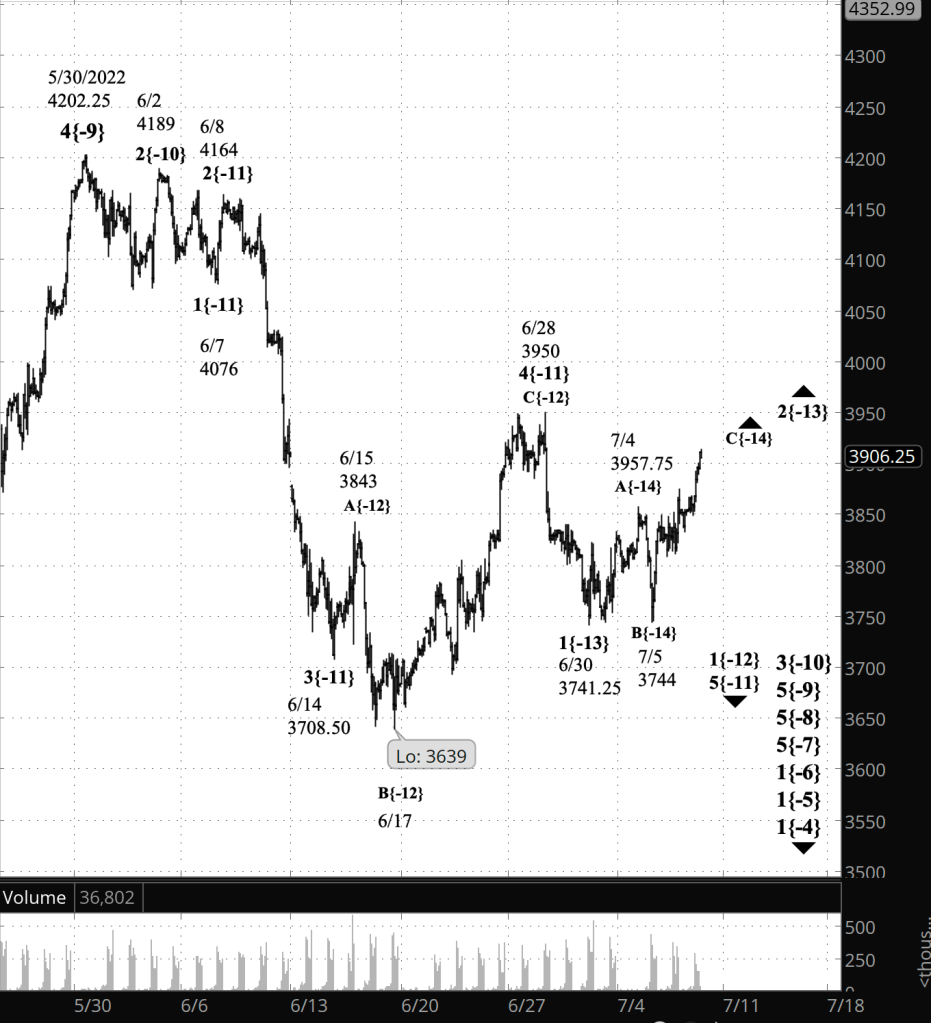
Half an hour before the closing bell. The S&P 500 has traded within a narrow range during the session. The principal analysis is unchanged: Wave 4{-15} within wave C{-14} within wave C{-13}, all within an upward correction, wave 2{-13}, are underway. I’ve updated the chart below.

9:35 a.m. New York time

What’s happening now? The S&P 500 E-mini futures declined when trading resumed overnight, reaching down into the mid-3800s, and then rising a little, reaching a high of 3881.50, well below Friday’s high of 3922.

What does it mean? Friday’s high was the end of the middle segment of the 3rd and final leg of an upward correction that began on June 30. The subsequent decline is a downward correction within that final leg. The overnight decline will be followed by a push upward that most likely will exceed Friday’s high and that will end the larger upward correction. Once the correction is over, the downtrend will resume, with the price reaching below 3709.50, the June 30 low, where the upward correction began.

What is the alternative? The upward correction from June 30 may form a compound structure, linking two or three corrective patterns together. Under this scenario, the 3rd leg within the upward correction will be followed by a connector wave to the downside, and then a second corrective pattern.

[S&P 500 E-mini futures at 3:30 p.m., 105-minute bars, with volume]

What does Elliott wave theory say? Under the principal analysis, Friday’s high is the end of wave 3{-15} within wave C{-14}, the third leg of wave 2{-13}, an upward correction that began on June 30 from 3708.50. The subsequent decline is wave 4{-15}, and it will be followed by wave 5{-15}, the final wave within wave 2{-13}.

What happens next is as yet unknown.

The most likely outcome is that wave C{-14} will be the final wave within wave 2{-13}, which will be followed by an energetic push downward, wave 3{-13}, which will move below the starting point of the wave 2{-13} correction, 3708.50, and perhaps significantly below that level, proportional to the scale of other waves at the {-13} degree, which is fairly small in the general scheme of things.

The alternative analysis acknowledges the possibility of a less common pattern: The compound correction, which links two or three corrective patterns together. I’ve seen compound corrections more often within 4th waves, but a compound 2nd wave correction isn’t unheard off. If wave 2{-13} forms a compound structure, then wave C{-14} will be followed by a downward connector wave, X{-14}, and then by a second corrective pattern. Once the compound correction is complete, then things will play out as described in the principal analysis, above: Wave 3{-13} will carry the price down below the starting point of the previous wave 2{-13}.

This is all happening within wave 1{-12}, the initial decline within its parent, downtrending wave 5{-11}, which is the final wave with its parent, wave 3{-10} — an energetic downtrending wave that began on June 2. It is the middle wave within downtrending wave 5{-9}, which began on May 30 from 4202.25.

Market price movements are fractal in nature — smaller waves within larger waves within still larger waves, each following the same patterns and rules no matter how large or small.

So wave 5{-9} has a parent, wave 5{-8}, which began on April 21, and it’s parent, wave 5{-7}, began on March 29. Another degree higher, wave 1{-6} began on January 4, a major turning point for the price structure reaching up to wave 4{-1}, which began on the same date, from 4818.62.

And the ancestor of them all is wave 5{0}, a huge uptrending wave that began on December 26, 2018, from 2346.58 and that is still underway. And wave 5{0} too has parent and grandparent waves, reaching up to wave 5{+3}, which began on Jul7 8, 1932 and has not yet reached its end.

We Are Here.

These are the waves currently in progress under my principal analysis. Each line on the list shows the wave number, with the subscript in curly brackets, the traditional degree name, the starting date, the starting price of the S&P 500 E-mini futures, and the direction of the wave.

  • S&P 500 Index:
  • 5{+3} Supercycle, 7/8/1932, 4.40 (up)
  • 5{+2} Cycle, 12/9/1974, 60.96 (up)
  • 5{+1} Primary, 3/6/2009, 666.79 (up)
  • 5{0} Intermediate, 12/26/2018, 2346.58 (up)
  • 4{-1} Minor, 1/4/2022 4818.62 (down)
  • 1{-2} Minute, 1/4/2022 4818.62 (down)
  • S&P 500 Futures and index:
  • 1{-3} Minuette, 1/4/2022, 4808.25 (down) (futures), 4818.62 (down) (index)
  • S&P 500 Futures:
  • 1{-4} Subminuette, 1/4/2022, 4808.25 (down)
  • 1{-5} Micro, 1/4/2022, 4808.25 (down)
  • 1{-6} Submicro, 1/4/2022, 4808.25 (down)
  • 5{-7} Minuscule, 3/29/2022, 4631 (down)
  • 5{-8} Subminuscule, 4/21/2022, 4509, (down)

Learning and other resources. Elliott wave analysis provides context, not prophecy. As the 20th century semanticist Alfred Korzybski put it in his book Science and Sanity (1933), “The map is not the territory … The only usefulness of a map depends on similarity of structure between the empirical world and the map.” And I would add, in the ever-changing markets, we can judge that similarity of structure only after the fact.

See the menu page Analytical Methods for a rundown on where to go for information on Elliott wave analysis.

By Tim Bovee, Portland, Oregon, July 11, 2022

Disclaimer

Tim Bovee, Private Trader tracks the analysis and trades of a private trader for his own accounts. Nothing in this blog constitutes a recommendation to buy or sell stocks, options or any other financial instrument. The only purpose of this blog is to provide education and entertainment.

No trader is ever 100 percent successful in his or her trades. Trading in the stock and option markets is risky and uncertain. Each trader must make trading decisions for his or her own account, and take responsibility for the consequences.

License
Creative Commons License

All content on Tim Bovee, Private Trader by Timothy K. Bovee is licensed under a Creative Commons Attribution-ShareAlike 4.0 International License.

Based on a work at www.timbovee.com.
Trader’s Notebook

3:30 p.m. New York time

Half an hour before the closing bell. The S&P 500 has traded narrowly during the session, remaining in the low 3900s while reaching above Thursday’s high, 3914.25, to 3922.

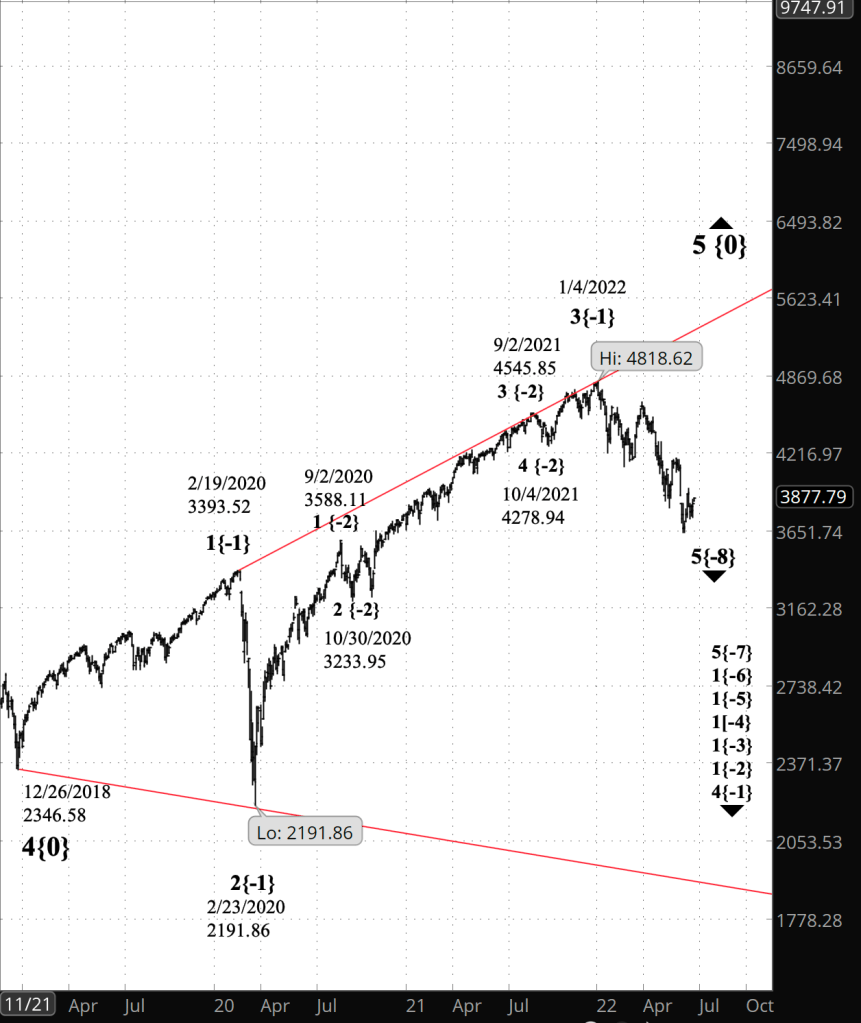
The higher high confirms this morning’s principal analysis: Wave C{-14} within an upward correction, wave 2{-13}, is still underway. Within wave C{-14}, I see today’s new high as being part of the final wave, 5{-16} within wave 5{-15}, which is also the final wave within wave C{-14}.

As the baseball great Yogi Berra said, “It ain’t over ’til it’s over.” By my count, it’s almost over. And, potentially, today’s high could be the end of wave C{-14} and its upward correction parent, wave 2{-13}. But its completion is not yet a certainty.

I’ve updated the chart.

9:35 a.m. New York time

What’s happening now? The S&P 500 E-mini futures traded sideways in overnight trading, dropping sharply with the release of the employment data for June, a 3.6% unemployment rate and 372,000 jobs gained.

What does it mean? Although external events can cause rapid movements in the markets, the patterns that emerge still adhere to the framework of Elliott wave theory.

Under the principal analysis, the final leg of an upward correction that began on June 30 is still underway, although it is nearing its end. When complete, the correction will be followed by an energetic downtrend that will carry the price below the correction’s starting point, 3741.25.

What are the alternatives? There are two.

Alternative #1: Thursday’s high, 3914.25, was the end of the upward correction, and the futures are taking the first tentative steps in the downtrend.

Alternative #2: The third leg of the corrective pattern that began on June 30 ended at Thursday’s high, but the correction is forming a compound structure, in which two or three corrective patterns are linked together. The price movement since yesterday’s high is the beginning of a connector that will link the completed first corrective pattern to a second corrective pattern.

[S&P 500 E-mini futures at 3:30 p.m., 95-minute bars, with volume]

What does Elliott wave theory say? Under the principal analysis, an upward correction, wave 2{-13}, is underway and is in its 3rd and final wave, C{-14}. Under the first alternative analysis, wave C{-14} and its parent, wave 2{-13}, ended at the July 7 peak, 3914.25. That was yesterday, on Thursday.

Distinguishing between the principal analysis and the alternative #1 depends upon the internal structure of wave C{-14}. The C wave will have five internal waves. I see the Thursday’s high as the end of wave 3{-16} within wave wave wave 5{-15}, the final wave within wave C{-14}. Wave 3{-16} will be followed by a downward 4th wave correction, now underway, and then a final upward push, wave 5{-16}, that normally will reach higher than Thursday’s peak, but it may fall short, a condition known as truncation. The end of wave 5{-16} will also be the end of waves 5{-15}, C{-14} and the full correction, 2{-13}. It will be the starting point of downtrending wave 3{-13}.

If instead the price continues to fall, reaching below 3741.25, then the alternative #1 is correct: Wave 5{-15} within wave C{-14} within wave 2{-13} ended Thursday at 3914.25 and wave 3{-13} is now underway.

Under alternative #2: Thursday’s peak marked the end of wave C{-14}, also ending the first corrective pattern in a compound correction. The subsequent decline is a connector wave, X{-14}, and it will be followed by a second corrective pattern within wave 2{-13}.

We Are Here.

These are the waves currently in progress under my principal analysis. Each line on the list shows the wave number, with the subscript in curly brackets, the traditional degree name, the starting date, the starting price of the S&P 500 E-mini futures, and the direction of the wave.

  • S&P 500 Index:
  • 5{+3} Supercycle, 7/8/1932, 4.40 (up)
  • 5{+2} Cycle, 12/9/1974, 60.96 (up)
  • 5{+1} Primary, 3/6/2009, 666.79 (up)
  • 5{0} Intermediate, 12/26/2018, 2346.58 (up)
  • 4{-1} Minor, 1/4/2022 4818.62 (down)
  • 1{-2} Minute, 1/4/2022 4818.62 (down)
  • S&P 500 Futures and index:
  • 1{-3} Minuette, 1/4/2022, 4808.25 (down) (futures), 4818.62 (down) (index)
  • S&P 500 Futures:
  • 1{-4} Subminuette, 1/4/2022, 4808.25 (down)
  • 1{-5} Micro, 1/4/2022, 4808.25 (down)
  • 1{-6} Submicro, 1/4/2022, 4808.25 (down)
  • 5{-7} Minuscule, 3/29/2022, 4631 (down)
  • 5{-8} Subminuscule, 4/21/2022, 4509, (down)

Learning and other resources. Elliott wave analysis provides context, not prophecy. As the 20th century semanticist Alfred Korzybski put it in his book Science and Sanity (1933), “The map is not the territory … The only usefulness of a map depends on similarity of structure between the empirical world and the map.” And I would add, in the ever-changing markets, we can judge that similarity of structure only after the fact.

See the menu page Analytical Methods for a rundown on where to go for information on Elliott wave analysis.

By Tim Bovee, Portland, Oregon, July 8, 2022

Disclaimer

Tim Bovee, Private Trader tracks the analysis and trades of a private trader for his own accounts. Nothing in this blog constitutes a recommendation to buy or sell stocks, options or any other financial instrument. The only purpose of this blog is to provide education and entertainment.

No trader is ever 100 percent successful in his or her trades. Trading in the stock and option markets is risky and uncertain. Each trader must make trading decisions for his or her own account, and take responsibility for the consequences.

License
Creative Commons License

All content on Tim Bovee, Private Trader by Timothy K. Bovee is licensed under a Creative Commons Attribution-ShareAlike 4.0 International License.

Based on a work at www.timbovee.com.

Trader’s Notebook

3:30 p.m. New York time

Half an hour before the closing bell. The S&P 500 rose during the session, reaching into the low 3900s on the futures. Wave C{-14} within an upward correction, wave 2{-13}, continues. Under the rules of Elliott wave analysis, a 2nd wave cannot move beyond the start of the preceding 1st wave. On the futures chart, wave 1{-13} began at 3950. If the present rise should exceed that level, then the analysis doesn’t match the chart — the map doesn’t match the territory — and I shall reanalyze.

At this point, the two alternatives are off the boards, and only the principal analysis remains. I’ve updated the upper chart.

9:35 a.m. New York time

What’s happening now? The S&P 500 E-mini futures traded narrowly overnight, exceeding Wednesday’s high of 3875 shortly after the opening bell after for the most part remaining the mid-3900s.

What does it mean? The upward correction that began on June 30 continues and is in its third and final segment. When the correction is complete, it will be followed by an energetic downtrend that will carry the price below the correction’s starting price, 3741.25, and perhaps significantly below that level.

What are the alternatives? There are two.

Alternative #1: Wednesday’s high was the end of the correction. The subsequent slip downward is the first tentative step in the downtrend.

Alternative #2: The correction forms a compound structure, linking two or three corrective patterns together, each connected by a declining segment.

The charts. The upper chart gives a view of the S&P 500 futures stretching back to late May. The lower chart shows the S&P 500 index stretching back to mid-November.

[S&P 500 E-mini futures at 3:30 p.m., 90-minute bars, with volume]
[S&P 500 index at 9:35 a.m., 2-day bars, with volume]

What does Elliott wave theory say? Under the principal analysis, wave C{-14}, the final wave of an upward correction, wave 2{-13}, is underway. When complete, wave 2{-13} will be followed by downtrending wave 3{-13}. Third waves tend to be energetic and to cover significant distances compared to other waves in a trend.

Under alternative #1, the July 6 high, 3875, was the end of wave C{-14} and its parent, wave 2{-13}. Downtrending wave 3{-13} has begun.

Under alternative #2, wave 2{-13} is forming a compound correction, linking two or three corrective patterns together. Each pattern is connected to the one that came before by an X wave — X{-14} in this case. If this alternative is correct and Wednesday’s high was the end of wave C{-14}, then the present slip downward is the start of wave X{-14} within wave 2{-13}. If wave C{-14} is not yet complete and this alternative is correct, then wave X{-14} lies in the future.

All of this is happening within a series of downtrending waves, each of increasing magnitude compared to the one that came before. The wave of lowest degree is wave 1{-12}, which began on June 28, and the series stretches up 10 degrees of magnitude to wave 1{-2}, which began on January 4. The parent of them all is wave 4{-1}, a downward movement of large degree that began on January 4 and part of an expanding Diagonal Triangle, wave 5{0}, that began on December 26, 2018.

We Are Here.

These are the waves currently in progress under my principal analysis. Each line on the list shows the wave number, with the subscript in curly brackets, the traditional degree name, the starting date, the starting price of the S&P 500 E-mini futures, and the direction of the wave.

  • S&P 500 Index:
  • 5{+3} Supercycle, 7/8/1932, 4.40 (up)
  • 5{+2} Cycle, 12/9/1974, 60.96 (up)
  • 5{+1} Primary, 3/6/2009, 666.79 (up)
  • 5{0} Intermediate, 12/26/2018, 2346.58 (up)
  • 4{-1} Minor, 1/4/2022 4818.62 (down)
  • 1{-2} Minute, 1/4/2022 4818.62 (down)
  • S&P 500 Futures and index:
  • 1{-3} Minuette, 1/4/2022, 4808.25 (down) (futures), 4818.62 (down) (index)
  • S&P 500 Futures:
  • 1{-4} Subminuette, 1/4/2022, 4808.25 (down)
  • 1{-5} Micro, 1/4/2022, 4808.25 (down)
  • 1{-6} Submicro, 1/4/2022, 4808.25 (down)
  • 5{-7} Minuscule, 3/29/2022, 4631 (down)
  • 5{-8} Subminuscule, 4/21/2022, 4509, (down)

Learning and other resources. Elliott wave analysis provides context, not prophecy. As the 20th century semanticist Alfred Korzybski put it in his book Science and Sanity (1933), “The map is not the territory … The only usefulness of a map depends on similarity of structure between the empirical world and the map.” And I would add, in the ever-changing markets, we can judge that similarity of structure only after the fact.

See the menu page Analytical Methods for a rundown on where to go for information on Elliott wave analysis.

By Tim Bovee, Portland, Oregon, July 7, 2022

Disclaimer

Tim Bovee, Private Trader tracks the analysis and trades of a private trader for his own accounts. Nothing in this blog constitutes a recommendation to buy or sell stocks, options or any other financial instrument. The only purpose of this blog is to provide education and entertainment.

No trader is ever 100 percent successful in his or her trades. Trading in the stock and option markets is risky and uncertain. Each trader must make trading decisions for his or her own account, and take responsibility for the consequences.

License
Creative Commons License

All content on Tim Bovee, Private Trader by Timothy K. Bovee is licensed under a Creative Commons Attribution-ShareAlike 4.0 International License.

Based on a work at www.timbovee.com.