Trader’s Notebook: S&P 500

3:30 p.m. New York time

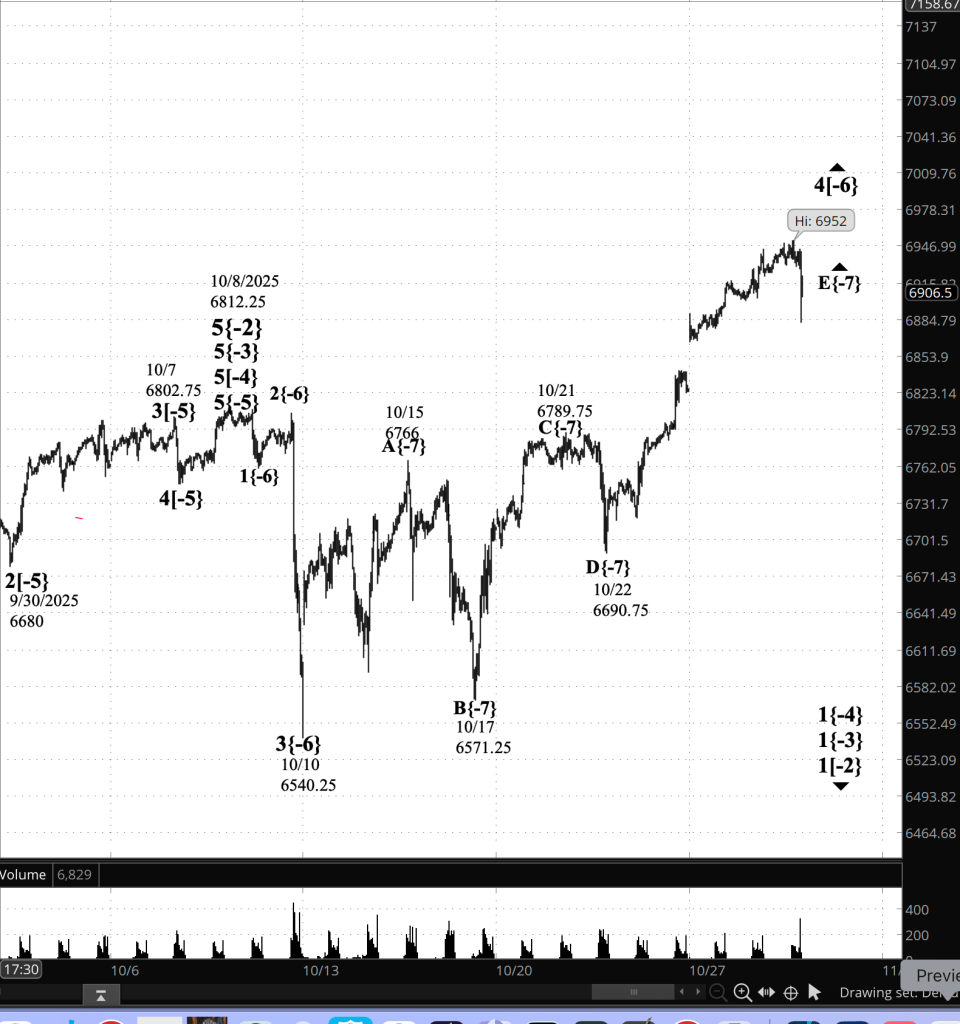
Half an hour before the closing bell. The S&P 500 futures continued to fall during the session, reaching a low so far of 6678.

Elliott Wave Theory: The decline is sufficient to change the analysis. The 4th wave upward correction that began on September 2 ended two days ago, on September 22, and at that point downtrending wave 5 began from 6756.75.

So what could go wrong? The usual ambiguities when a wave reaches its peak. Is it really the peak, or is there a bit more upward energy in its movement?

If wave 5 continue to drop, we know the new analysis is correct. If the decline reverses and the price moves beyond the peak, then we know that rising wave 4 is still underway.

9:35 a.m. New York time.

What’s happening now. The S&P 500 E-mini futures rose from the 6710s into the 6720s overnight. The rise kept the price well below the all-time high, 6756.75, set on September 22.

What does it mean?  Elliott Wave Theory analysis is at a turning point. It could be that wave 4, an upward correction that began on September 2, is still underway. Equally, it could be that wave 4 has ended and downtrending wave 5 has begun.

The further the price falls, the more likely it is that wave 5 is underway. Meanwhile, I’m keep the chart labelled to show wave 4 is underway, until the movement shows that to no longer be the case.

In some ways, Elliott Wave Theory analysis is a simple method.

[S&P 500 E-mini futures at 3:30 p.m…m., 70-minute bars, with volume] 

Waves Now Underway

Updated for the afternoon analysis, which shows wave 4{-11} having ended and wave 5{-11} having begun.

These are the waves currently in progress under my principal analysis. Each line on the list shows the wave number, with the subscript in curly brackets, the traditional degree name, the starting date, the starting price of the S&P 500 E-mini futures, and the direction of the wave.

  • S&P 500 Index:
  • 5{+3} Supercycle, 7/8/1932, 4.40 (up)
  • 5{+2} Cycle, 12/9/1974, 60.96 (up)
  • 5{+1} Primary, 3/6/2009, 666.79 (up)
  • 5{0} Intermediate, 2/11/2016, 1810.10 (up)
  • 3{-1} Minor, 3/23/2020, 2191.36 (up)
  • 1{-2} Minute, 7/31/2025, 6468.50 (down)
  • S&P 500 Futures
  • 1{-3} Minuette, 10/13/2022, 4603 (up)
  • 1{-4} Subminuette, 4/7/2025, 4832 (up)
  • 3{-5} Micro, 4/21/2025, 5127.25 (up)
  • 5{-6} Submicro, 8/1/2025, 6249.50 (up)
  • 1{-7} Minuscule, 8/1/2025, 6349.50 (up)
  • 3{-8} (unnamed), 8/5/2025, 6313.25 (up)
  • 4{-9} (unnamed), 8/14/2025, 6508.75 (down)
  • C{-10} (unnamed), 8/28/2025, 6523 (down)
  • 5{-11} (unnamed), 9/22/2025, 6371.75 (down)
  • 1{-12} (unnamed), 9/22/2025, 6371.75 (down)

Reading the chart. Price movements — waves – – in Elliott Wave Theory analysis are labeled with numbers within trending waves and letters with corrective waves. The subscripts — numbers in curly brackets — designate the wave’s degree, which, in Elliott Wave analysis, means the relative position of a wave within the larger and smaller structures that make up the chart. R.N. Elliott, who in the 1930s developed the form of analysis that bears his name, viewed the chart as a complex structure of smaller waves nested within larger waves, which in turn are nested within still larger waves. In mathematics it’s called a fractal structure, where at every scale the pattern is similar to the others.

Learning and other resources. Elliott Wave analysis provides context, not prophecy. As the 20th century semanticist Alfred Korzybski put it in his book Science and Sanity (1933), “The map is not the territory … The only usefulness of a map depends on similarity of structure between the empirical world and the map.” And I would add, in the ever-changing markets, we can judge that similarity of structure only after the fact.

See the menu page Analytical Methods for a rundown on where to go for information on Elliott Wave analysis.

By Tim Bovee, Portland, Oregon, September 24, 2025

Disclaimer

Tim Bovee, Private Trader tracks the analysis and trades of a private trader for his own accounts. Nothing in this blog constitutes a recommendation to buy or sell stocks, options or any other financial instrument. The only purpose of this blog is to provide education and entertainment.

No trader is ever 100 percent successful in his or her trades. Trading in the stock and option markets is risky and uncertain. Each trader must make trading decisions for his or her own account, and take responsibility for the consequences.

All content on Tim Bovee, Private Trader by Timothy K. Bovee is licensed under a Creative Commons Attribution-ShareAlike 4.0 International License.

License

Based on work at www.timbovee.com
Trader’s Notebook: S&P 500

3:30 p.m. New York time

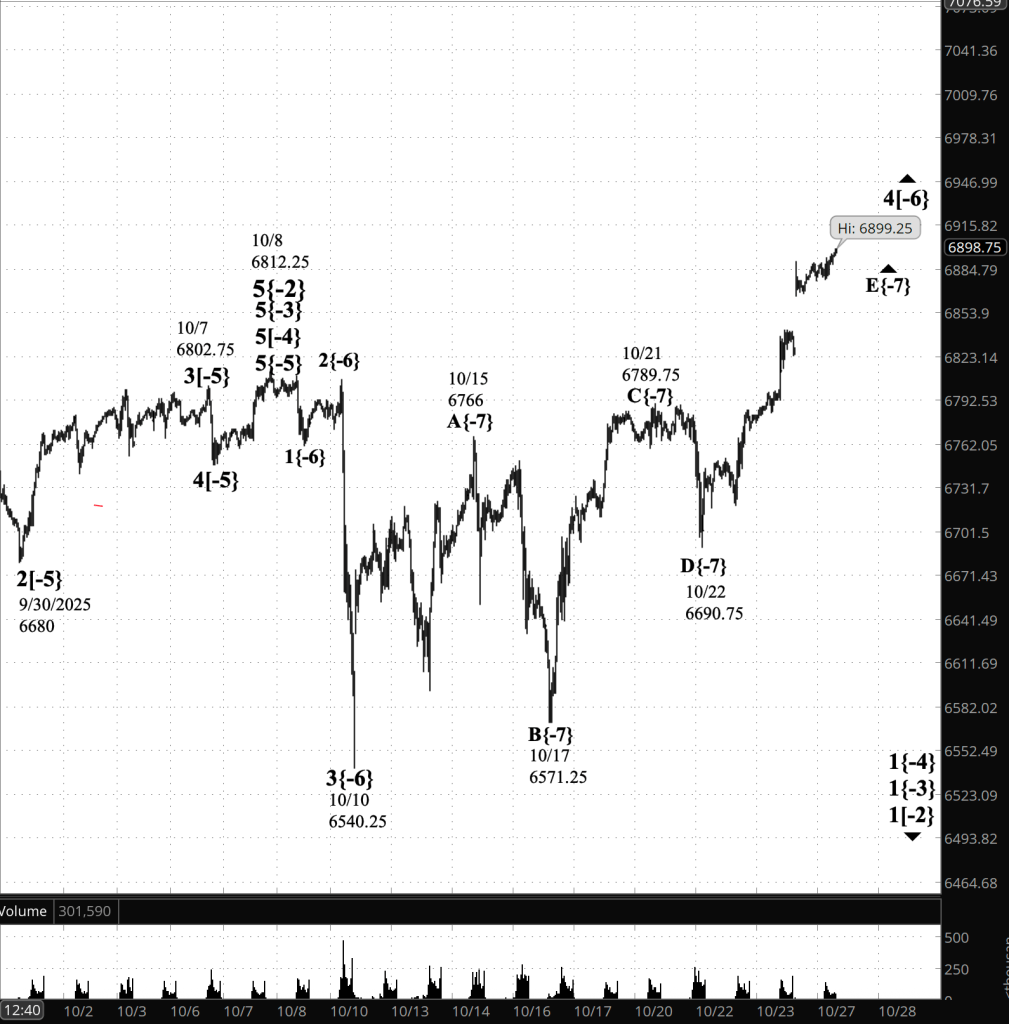
Half an hour before the closing bell. The S&P 500 futures began to fall early in the session, from the 6750s down so far to 6701.75.

Elliott Wave Theory. Long story short: The lower price falls, the more likely it is that the 4th-wave upward correction that began on September 9 ended at the September 22 high, 6756.75, and that downtrending wave 5 has begun. Conversely, if there’s a reversal and a price rise back into the 6740 and 6750s, or higher, the more likely it is that wave 4 is still underway and wave 5 lies in the future.

9:35 a.m. New York time.

What’s happening now. The S&P 500 E-mini futures traded sideways overnight in the 6740s and 6750s.

What does it mean?  They 6750s are the lower range of a key resistance zone, according to Elliott Wave Theory. The zone remains below the September 22 high, 6756.75, suggesting that the 6750s are a barrier, a point where the trader consensus says “this high and no higher”, at least while current conditions continue. If the conditions change, then so does the consensus.

Since September 2 the futures have been working its way through a 4th-wave upward correction. That correction is in its final subwave, wave C. The end of wave C, most lkely, will also be the end of the correction, unless it turns out to take a complex form, with two or three corrective patterns of three subwaves each.

The initial, and almost always the only, three-wave corrective pattern’s wave C is in its final subwave, wave 5. So we’re close to learning whether the trade consensus will serve up a simple correction or a complex correction.

The wave 4 correction will be followed by a wave 5 downtrend, the type of wave that almost always moves beyond the start of the preceding 4th wave — 6371.75.

[S&P 500 E-mini futures at 9:35 a..m., 70-minute bars, with volume] 

Waves Now Underway

These are the waves currently in progress under my principal analysis. Each line on the list shows the wave number, with the subscript in curly brackets, the traditional degree name, the starting date, the starting price of the S&P 500 E-mini futures, and the direction of the wave.

  • S&P 500 Index:
  • 5{+3} Supercycle, 7/8/1932, 4.40 (up)
  • 5{+2} Cycle, 12/9/1974, 60.96 (up)
  • 5{+1} Primary, 3/6/2009, 666.79 (up)
  • 5{0} Intermediate, 2/11/2016, 1810.10 (up)
  • 3{-1} Minor, 3/23/2020, 2191.36 (up)
  • 1{-2} Minute, 7/31/2025, 6468.50 (down)
  • S&P 500 Futures
  • 1{-3} Minuette, 10/13/2022, 4603 (up)
  • 1{-4} Subminuette, 4/7/2025, 4832 (up)
  • 3{-5} Micro, 4/21/2025, 5127.25 (up)
  • 5{-6} Submicro, 8/1/2025, 6249.50 (up)
  • 1{-7} Minuscule, 8/1/2025, 6349.50 (up)
  • 3{-8} (unnamed), 8/5/2025, 6313.25 (up)
  • 4{-9} (unnamed), 8/14/2025, 6508.75 (down)
  • C{-10} (unnamed), 8/28/2025, 6523 (down)
  • 4{-11} (unnamed), 9/2/2025, 6371.75 (up)
  • C{-12} (unnamed), 9/5/2025, 6452 (up)
  • 5{-13} (unnamed), 9/17/2025, 6611 (up)

Reading the chart. Price movements — waves – – in Elliott Wave Theory analysis are labeled with numbers within trending waves and letters with corrective waves. The subscripts — numbers in curly brackets — designate the wave’s degree, which, in Elliott Wave analysis, means the relative position of a wave within the larger and smaller structures that make up the chart. R.N. Elliott, who in the 1930s developed the form of analysis that bears his name, viewed the chart as a complex structure of smaller waves nested within larger waves, which in turn are nested within still larger waves. In mathematics it’s called a fractal structure, where at every scale the pattern is similar to the others.

Learning and other resources. Elliott Wave analysis provides context, not prophecy. As the 20th century semanticist Alfred Korzybski put it in his book Science and Sanity (1933), “The map is not the territory … The only usefulness of a map depends on similarity of structure between the empirical world and the map.” And I would add, in the ever-changing markets, we can judge that similarity of structure only after the fact.

See the menu page Analytical Methods for a rundown on where to go for information on Elliott Wave analysis.

By Tim Bovee, Portland, Oregon, September 23, 2025

Disclaimer

Tim Bovee, Private Trader tracks the analysis and trades of a private trader for his own accounts. Nothing in this blog constitutes a recommendation to buy or sell stocks, options or any other financial instrument. The only purpose of this blog is to provide education and entertainment.

No trader is ever 100 percent successful in his or her trades. Trading in the stock and option markets is risky and uncertain. Each trader must make trading decisions for his or her own account, and take responsibility for the consequences.

All content on Tim Bovee, Private Trader by Timothy K. Bovee is licensed under a Creative Commons Attribution-ShareAlike 4.0 International License.

License

Based on work at www.timbovee.com
Trader’s Notebook: S&P 500

3:30 p.m. New York time

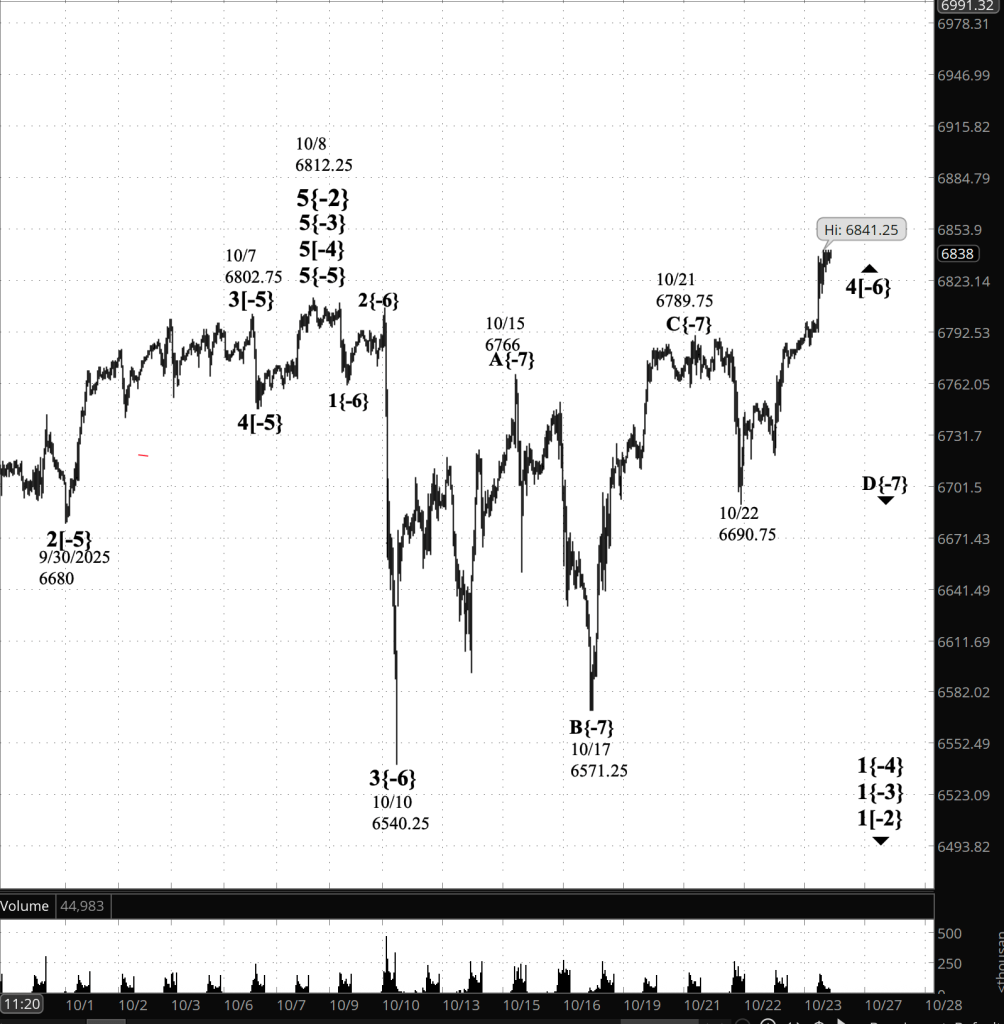
Half an hour before the closing bell. The S&P 500 futures resumed its rise with a sharp movement that tested the 6750s resistance level, with other resistance points reaching the 6780s and, at the extreme, perhaps the 6830s.

Elliott Wave Theory: The waves that have been with us for awhile continue to power the rise: Rising wave 5 within riing wave C within a 4th-wave upward correction.

9:35 a.m. New York time.

What’s happening now. The S&P 500 E-mini futures opened at 6721.25 when trading resumed overnight and began to fall, reaching a low so far of 6695.75.

What does it mean?  The decline continues the 4th wave upward correction that Elliott Wave Theory analysis sees as having begun on September 2. Wave 4 is presently in its 5th subwave — wave C — which in turn is in its 5th subwave. That 5th subwave is presently in a small downward correction.

[S&P 500 E-mini futures at 3:30 p..m., 70-minute bars, with volume] 

Waves Now Underway

These are the waves currently in progress under my principal analysis. Each line on the list shows the wave number, with the subscript in curly brackets, the traditional degree name, the starting date, the starting price of the S&P 500 E-mini futures, and the direction of the wave.

  • S&P 500 Index:
  • 5{+3} Supercycle, 7/8/1932, 4.40 (up)
  • 5{+2} Cycle, 12/9/1974, 60.96 (up)
  • 5{+1} Primary, 3/6/2009, 666.79 (up)
  • 5{0} Intermediate, 2/11/2016, 1810.10 (up)
  • 3{-1} Minor, 3/23/2020, 2191.36 (up)
  • 1{-2} Minute, 7/31/2025, 6468.50 (down)
  • S&P 500 Futures
  • 1{-3} Minuette, 10/13/2022, 4603 (up)
  • 1{-4} Subminuette, 4/7/2025, 4832 (up)
  • 3{-5} Micro, 4/21/2025, 5127.25 (up)
  • 5{-6} Submicro, 8/1/2025, 6249.50 (up)
  • 1{-7} Minuscule, 8/1/2025, 6349.50 (up)
  • 3{-8} (unnamed), 8/5/2025, 6313.25 (up)
  • 4{-9} (unnamed), 8/14/2025, 6508.75 (down)
  • C{-10} (unnamed), 8/28/2025, 6523 (down)
  • 4{-11} (unnamed), 9/2/2025, 6371.75 (up)
  • C{-12} (unnamed), 9/5/2025, 6452 (up)
  • 5{-13} (unnamed), 9/17/2025, 6611 (up)

Reading the chart. Price movements — waves – – in Elliott Wave Theory analysis are labeled with numbers within trending waves and letters with corrective waves. The subscripts — numbers in curly brackets — designate the wave’s degree, which, in Elliott Wave analysis, means the relative position of a wave within the larger and smaller structures that make up the chart. R.N. Elliott, who in the 1930s developed the form of analysis that bears his name, viewed the chart as a complex structure of smaller waves nested within larger waves, which in turn are nested within still larger waves. In mathematics it’s called a fractal structure, where at every scale the pattern is similar to the others.

Learning and other resources. Elliott Wave analysis provides context, not prophecy. As the 20th century semanticist Alfred Korzybski put it in his book Science and Sanity (1933), “The map is not the territory … The only usefulness of a map depends on similarity of structure between the empirical world and the map.” And I would add, in the ever-changing markets, we can judge that similarity of structure only after the fact.

See the menu page Analytical Methods for a rundown on where to go for information on Elliott Wave analysis.

By Tim Bovee, Portland, Oregon, September 22, 2025

Disclaimer

Tim Bovee, Private Trader tracks the analysis and trades of a private trader for his own accounts. Nothing in this blog constitutes a recommendation to buy or sell stocks, options or any other financial instrument. The only purpose of this blog is to provide education and entertainment.

No trader is ever 100 percent successful in his or her trades. Trading in the stock and option markets is risky and uncertain. Each trader must make trading decisions for his or her own account, and take responsibility for the consequences.

All content on Tim Bovee, Private Trader by Timothy K. Bovee is licensed under a Creative Commons Attribution-ShareAlike 4.0 International License.

License

Based on work at www.timbovee.com
Trader’s Notebook: S&P 500

3:30 p.m.New York time

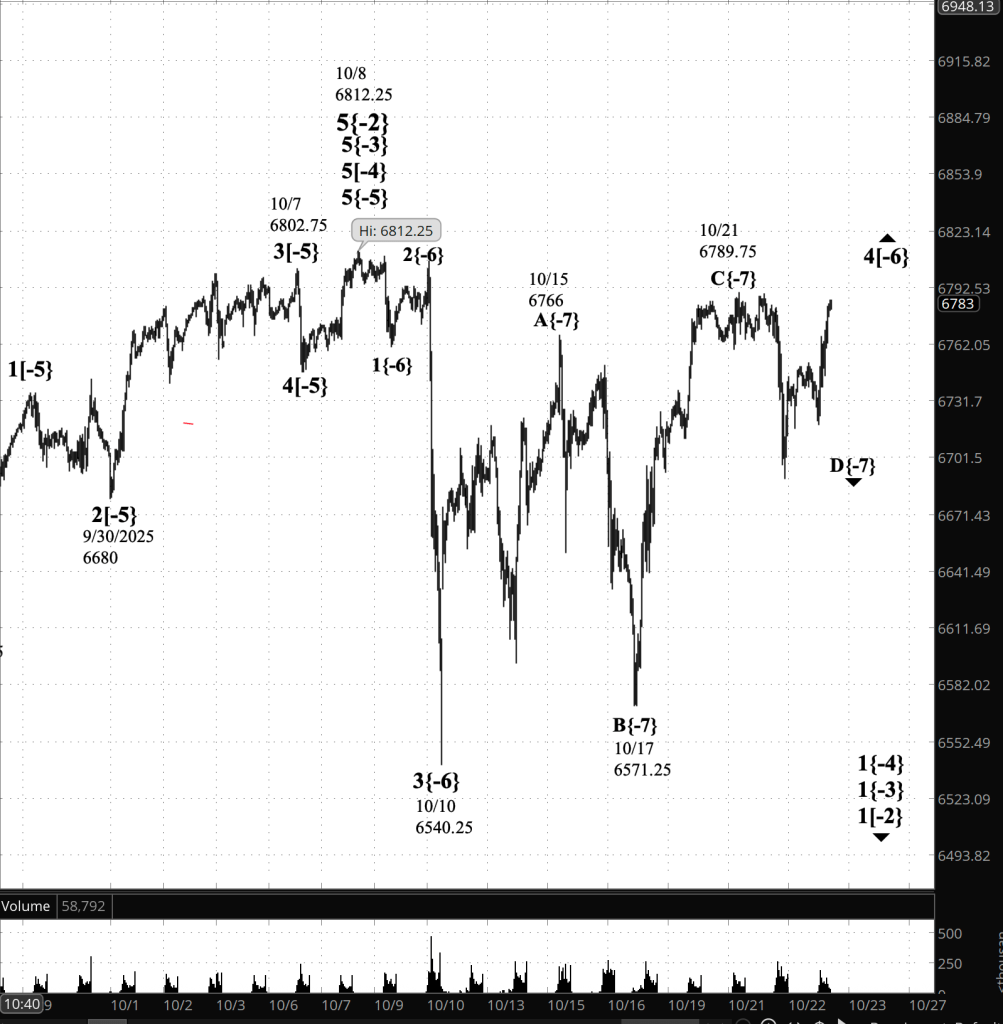
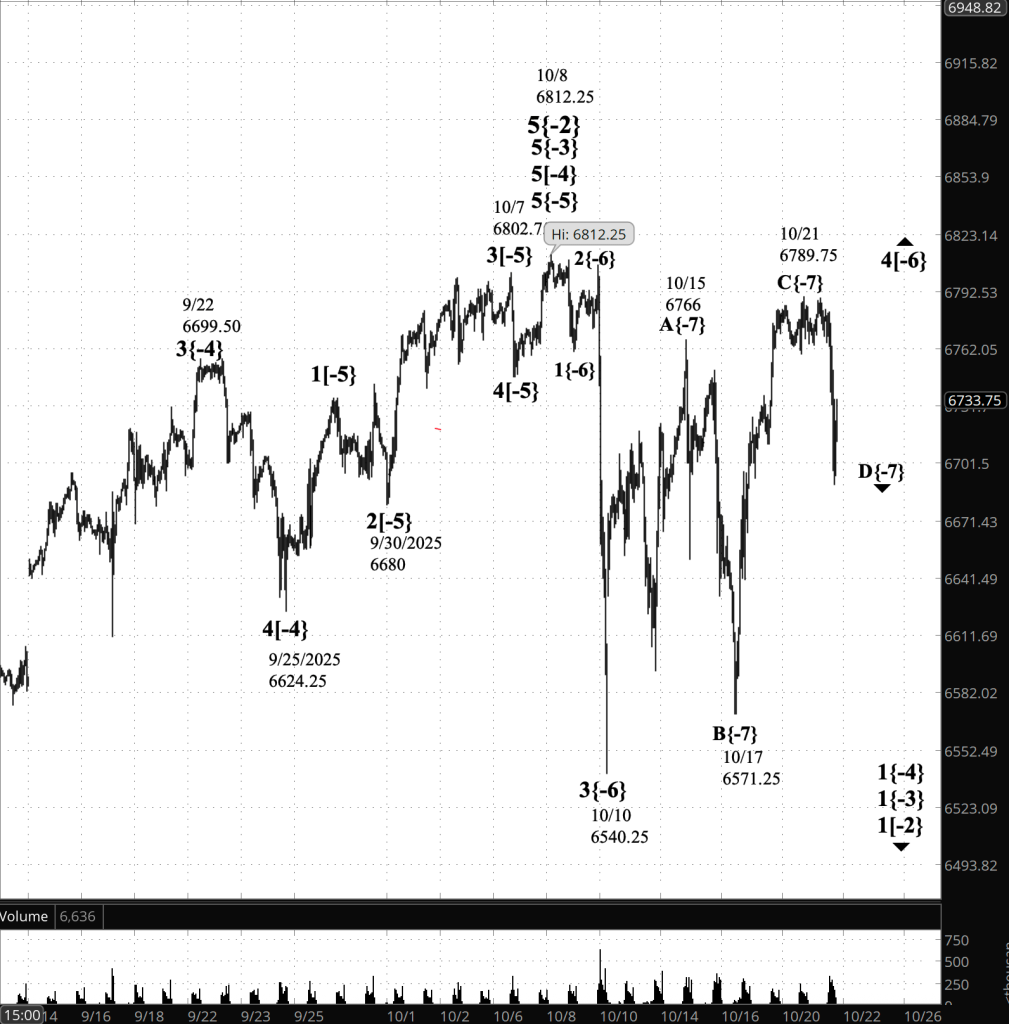
Half an hour before the closing bell. The S&P 500 futures moved to a fresh high during the session, reaching 6721.25.

The higher high leaves the Elliott Wave Theory structure unchanged; now underway, wave 5 within wave C within the 4th-wave upward correction that began on September 2.

9:35 a.m. New York time.

What’s happening now. The S&P 500 E-mini futures traded sideways overnight, remaining below yesterday’s high, 6719.75.

What does it mean?  Elliott Wave Theory analysis verified that rising wave C within the 4th-wave upward correction that began on September 2 from 6371.75. The C wave is in its final subwave, rising wave 5.

What this means is that wave C is nearing its and as is its parent wave 4. The end of the 4th-wave upward correction will mark the beginning of a downtrending 5th wave.

[S&P 500 E-mini futures at 3:30 p.m., 80-minute bars, with volume] 

Waves Now Underway

These are the waves currently in progress under my principal analysis. Each line on the list shows the wave number, with the subscript in curly brackets, the traditional degree name, the starting date, the starting price of the S&P 500 E-mini futures, and the direction of the wave.

  • S&P 500 Index:
  • 5{+3} Supercycle, 7/8/1932, 4.40 (up)
  • 5{+2} Cycle, 12/9/1974, 60.96 (up)
  • 5{+1} Primary, 3/6/2009, 666.79 (up)
  • 5{0} Intermediate, 2/11/2016, 1810.10 (up)
  • 3{-1} Minor, 3/23/2020, 2191.36 (up)
  • 1{-2} Minute, 7/31/2025, 6468.50 (down)
  • S&P 500 Futures
  • 1{-3} Minuette, 10/13/2022, 4603 (up)
  • 1{-4} Subminuette, 4/7/2025, 4832 (up)
  • 3{-5} Micro, 4/21/2025, 5127.25 (up)
  • 5{-6} Submicro, 8/1/2025, 6249.50 (up)
  • 1{-7} Minuscule, 8/1/2025, 6349.50 (up)
  • 3{-8} (unnamed), 8/5/2025, 6313.25 (up)
  • 4{-9} (unnamed), 8/14/2025, 6508.75 (down)
  • C{-10} (unnamed), 8/28/2025, 6523 (down)
  • 4{-11} (unnamed), 9/2/2025, 6371.75 (up)
  • C{-12} (unnamed), 9/5/2025, 6452 (up)
  • 5{-13} (unnamed), 9/17/2025, 6611 (up)

Reading the chart. Price movements — waves – – in Elliott Wave Theory analysis are labeled with numbers within trending waves and letters with corrective waves. The subscripts — numbers in curly brackets — designate the wave’s degree, which, in Elliott Wave analysis, means the relative position of a wave within the larger and smaller structures that make up the chart. R.N. Elliott, who in the 1930s developed the form of analysis that bears his name, viewed the chart as a complex structure of smaller waves nested within larger waves, which in turn are nested within still larger waves. In mathematics it’s called a fractal structure, where at every scale the pattern is similar to the others.

Learning and other resources. Elliott Wave analysis provides context, not prophecy. As the 20th century semanticist Alfred Korzybski put it in his book Science and Sanity (1933), “The map is not the territory … The only usefulness of a map depends on similarity of structure between the empirical world and the map.” And I would add, in the ever-changing markets, we can judge that similarity of structure only after the fact.

See the menu page Analytical Methods for a rundown on where to go for information on Elliott Wave analysis.

By Tim Bovee, Portland, Oregon, September 19, 2025

Disclaimer

Tim Bovee, Private Trader tracks the analysis and trades of a private trader for his own accounts. Nothing in this blog constitutes a recommendation to buy or sell stocks, options or any other financial instrument. The only purpose of this blog is to provide education and entertainment.

No trader is ever 100 percent successful in his or her trades. Trading in the stock and option markets is risky and uncertain. Each trader must make trading decisions for his or her own account, and take responsibility for the consequences.

All content on Tim Bovee, Private Trader by Timothy K. Bovee is licensed under a Creative Commons Attribution-ShareAlike 4.0 International License.

License

Based on work at www.timbovee.com
Trader’s Notebook: S&P 500

3:30 p.m. New York time

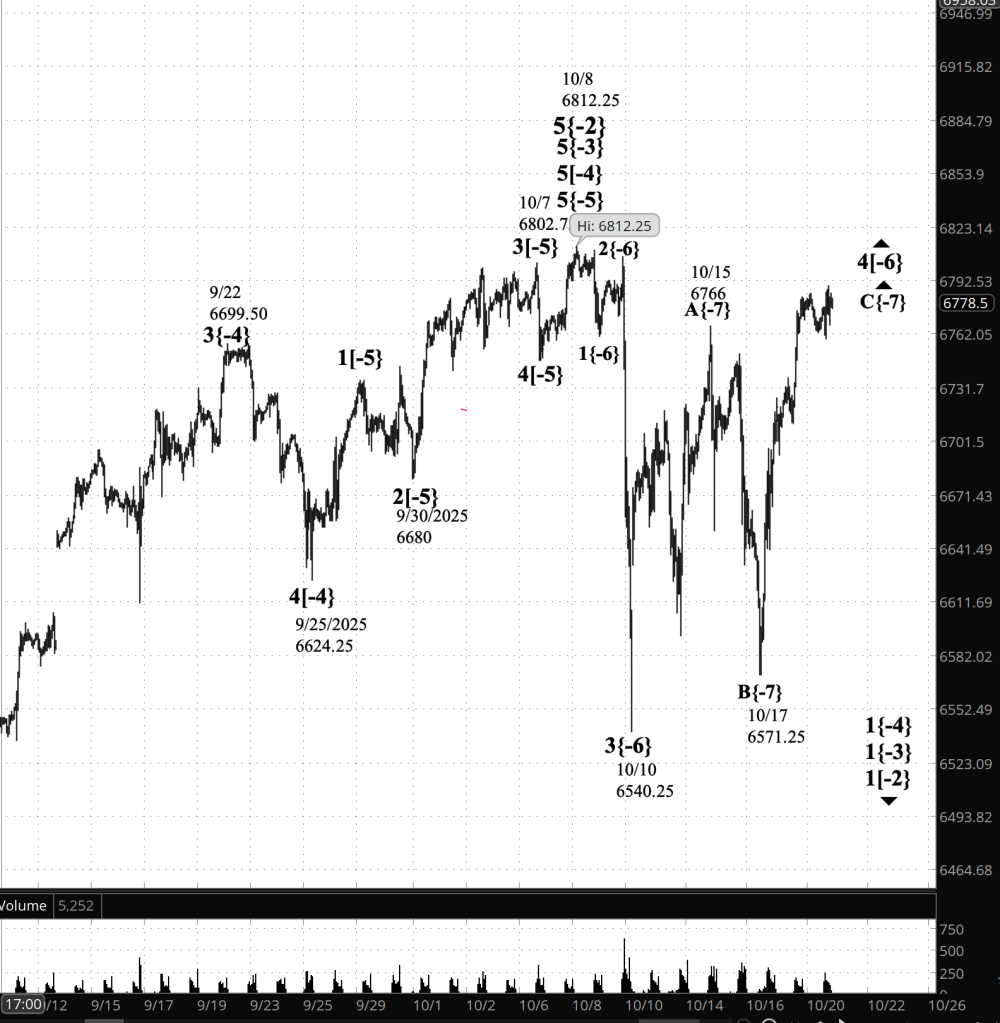
Half an hour before the closing bell. The S&P 500 futures fell from the overnight high, 6719.75, to the 6670s and then rose back into into the 6710s.

Elliott Wave Theory: Wave C within wave 4, an upward correction, continues and is in its final subwave, rising wave 4.

9:35 a.m. New York time.

What’s happening now. The S&P 500 E-mini futures rose overnight to a new high, 6917.75

What does it mean?  The higher high, in Elliott Wave Theory analysis, wipes out yesterday’s analysis. The 4th-wave upward correction that began on September 2 has not ended. The downtrending 5th wave that will follow has not yet begun. Within wave 4 wave C is still underway. Wave C is in its 5th and final subwave.

[S&P 500 E-mini futures at 3:30 p.m., 80-minute bars, with volume] 

Waves Now Underway

These are the waves currently in progress under my principal analysis. Each line on the list shows the wave number, with the subscript in curly brackets, the traditional degree name, the starting date, the starting price of the S&P 500 E-mini futures, and the direction of the wave.

  • S&P 500 Index:
  • 5{+3} Supercycle, 7/8/1932, 4.40 (up)
  • 5{+2} Cycle, 12/9/1974, 60.96 (up)
  • 5{+1} Primary, 3/6/2009, 666.79 (up)
  • 5{0} Intermediate, 2/11/2016, 1810.10 (up)
  • 3{-1} Minor, 3/23/2020, 2191.36 (up)
  • 1{-2} Minute, 7/31/2025, 6468.50 (down)
  • S&P 500 Futures
  • 1{-3} Minuette, 10/13/2022, 4603 (up)
  • 1{-4} Subminuette, 4/7/2025, 4832 (up)
  • 3{-5} Micro, 4/21/2025, 5127.25 (up)
  • 5{-6} Submicro, 8/1/2025, 6249.50 (up)
  • 1{-7} Minuscule, 8/1/2025, 6349.50 (up)
  • 3{-8} (unnamed), 8/5/2025, 6313.25 (up)
  • 4{-9} (unnamed), 8/14/2025, 6508.75 (down)
  • C{-10} (unnamed), 8/28/2025, 6523 (down)
  • 4{-11} (unnamed), 9/2/2025, 6371.75 (up)
  • C{-12} (unnamed), 9/5/2025, 6452 (up)
  • 5{-13} (unnamed), 9/17/2025, 6611 (up)

Reading the chart. Price movements — waves – – in Elliott Wave Theory analysis are labeled with numbers within trending waves and letters with corrective waves. The subscripts — numbers in curly brackets — designate the wave’s degree, which, in Elliott Wave analysis, means the relative position of a wave within the larger and smaller structures that make up the chart. R.N. Elliott, who in the 1930s developed the form of analysis that bears his name, viewed the chart as a complex structure of smaller waves nested within larger waves, which in turn are nested within still larger waves. In mathematics it’s called a fractal structure, where at every scale the pattern is similar to the others.

Learning and other resources. Elliott Wave analysis provides context, not prophecy. As the 20th century semanticist Alfred Korzybski put it in his book Science and Sanity (1933), “The map is not the territory … The only usefulness of a map depends on similarity of structure between the empirical world and the map.” And I would add, in the ever-changing markets, we can judge that similarity of structure only after the fact.

See the menu page Analytical Methods for a rundown on where to go for information on Elliott Wave analysis.

By Tim Bovee, Portland, Oregon, September 18, 2025

Disclaimer

Tim Bovee, Private Trader tracks the analysis and trades of a private trader for his own accounts. Nothing in this blog constitutes a recommendation to buy or sell stocks, options or any other financial instrument. The only purpose of this blog is to provide education and entertainment.

No trader is ever 100 percent successful in his or her trades. Trading in the stock and option markets is risky and uncertain. Each trader must make trading decisions for his or her own account, and take responsibility for the consequences.

All content on Tim Bovee, Private Trader by Timothy K. Bovee is licensed under a Creative Commons Attribution-ShareAlike 4.0 International License.

License

Based on work at www.timbovee.com

Trader’s Notebook: S&P 500

3:30 p.m. New York time

Half an hour before the closing bell. The S&P 500 futures whipsawed when the Federal Open Market Committee did as expected by raising the Fed Funds interest rate by 25 basis points.

Elliott Wave Theory: The price rose then fell after the announcement. The rise failed to exceed the peak in the rise that began on September 5, wave C within the 4th-wave upward correction. The fall has carried the price so far into the 6610s.

I’ve relabelled the chart to show wave C and wave 4 both ended, and downtrending wave 5 began. This wave 5 — 5{-11} on the chart — have a length pulled from a wide variety of possibilities. At this point an endpoint around of around 6350 seems likely, based on a wave 4 extension. But an endpoint around 6500 or around 6170 is possible. At this early point in wave 5 there’s not a lot of certainty.

9:35 a.m. New York time.

What’s happening now. The S&P 500 E-mini futures fell overnight from the 6670s into the 6650s and then retraced a portion of the decline, as though marking time until the Federal Open Market Committee announces its decision on interest rates. The decision will be announced at 2 p.m. New York time. Federal Reserve Chair Jerome Powell will hold a news conference beginning at 2:30 p.m.

What does it mean?  Elliott Wave Theory. On the chart I’ve moved closer in so as to get a better sense of the internal structure of wave C and its parent, a 4th-wave upward correction that began on September 2. The question this morning is whether or not wave 4 has ended at its latest peak, 6696.75 on September 16. In my view the present drop is ambiguous on the the matter. Perhaps the response to the FOMC announcement will clarify the chart.

[S&P 500 E-mini futures at 3:30 p.m., 80-minute bars, with volume] 

Waves Now Underway

These are the waves currently in progress under my principal analysis. Each line on the list shows the wave number, with the subscript in curly brackets, the traditional degree name, the starting date, the starting price of the S&P 500 E-mini futures, and the direction of the wave.

  • S&P 500 Index:
  • 5{+3} Supercycle, 7/8/1932, 4.40 (up)
  • 5{+2} Cycle, 12/9/1974, 60.96 (up)
  • 5{+1} Primary, 3/6/2009, 666.79 (up)
  • 5{0} Intermediate, 2/11/2016, 1810.10 (up)
  • 3{-1} Minor, 3/23/2020, 2191.36 (up)
  • 1{-2} Minute, 7/31/2025, 6468.50 (down)
  • S&P 500 Futures
  • 1{-3} Minuette, 10/13/2022, 4603 (up)
  • 1{-4} Subminuette, 4/7/2025, 4832 (up)
  • 3{-5} Micro, 4/21/2025, 5127.25 (up)
  • 5{-6} Submicro, 8/1/2025, 6249.50 (up)
  • 1{-7} Minuscule, 8/1/2025, 6349.50 (up)
  • 3{-8} (unnamed), 8/5/2025, 6313.25 (up)
  • 4{-9} (unnamed), 8/14/2025, 6508.75 (down)
  • C{-10} (unnamed), 8/28/2025, 6523 (down)
  • 5{-11} (unnamed), 9/16/2025, 6696.75 (down)
  • 1{-12} (unnamed), 9/16/2025, 6696.75 (down)

Reading the chart. Price movements — waves – – in Elliott Wave Theory analysis are labeled with numbers within trending waves and letters with corrective waves. The subscripts — numbers in curly brackets — designate the wave’s degree, which, in Elliott Wave analysis, means the relative position of a wave within the larger and smaller structures that make up the chart. R.N. Elliott, who in the 1930s developed the form of analysis that bears his name, viewed the chart as a complex structure of smaller waves nested within larger waves, which in turn are nested within still larger waves. In mathematics it’s called a fractal structure, where at every scale the pattern is similar to the others.

Learning and other resources. Elliott Wave analysis provides context, not prophecy. As the 20th century semanticist Alfred Korzybski put it in his book Science and Sanity (1933), “The map is not the territory … The only usefulness of a map depends on similarity of structure between the empirical world and the map.” And I would add, in the ever-changing markets, we can judge that similarity of structure only after the fact.

See the menu page Analytical Methods for a rundown on where to go for information on Elliott Wave analysis.

By Tim Bovee, Portland, Oregon, September 17, 2025

Disclaimer

Tim Bovee, Private Trader tracks the analysis and trades of a private trader for his own accounts. Nothing in this blog constitutes a recommendation to buy or sell stocks, options or any other financial instrument. The only purpose of this blog is to provide education and entertainment.

No trader is ever 100 percent successful in his or her trades. Trading in the stock and option markets is risky and uncertain. Each trader must make trading decisions for his or her own account, and take responsibility for the consequences.

All content on Tim Bovee, Private Trader by Timothy K. Bovee is licensed under a Creative Commons Attribution-ShareAlike 4.0 International License.

License

Based on work at www.timbovee.com

Trader’s Notebook: S&P 500

3:30 p.m. New York time

Half an hour before the closing bell. The S&P 500 futures continued to decline, from the overnight peak, 6696.76, so far reaching a low of 6661.25 during the session.

Elliott Wave Theory: The size of the decline is similar in size to other declning subwaves with wave C, itself a subwave within a 4th-wave downward correction. Long story short: It strengthen the possibility, by a little, that wave C ended at the overnight peak, but evidence is still quite weak.

Perhaps the Federal Open Market Committee’s interest-rate decision on Wednesday at 2 p.m. New York time will produce a market response that will clarify the chart.

9:35 a.m. New York time.

What’s happening now. Another day, another new high. The S&P 500 E-mini futures rose to a new high overnight, 6696.75.

What does it mean?  Elliott Wave Theory analysis sees rising wave C within a 4th-wave upward correction as still being under way, as it has been since September 5.

And within wave C, the ambiguity in the count remains. is wave C in its 3rd subwave or its 5th? I find it impossible to say for certain.

If it’s wave 3, then I would expect it to reach it’s end fairly soon, to be followed by a shallow 4th-wave downward correction and then by wave 5. If it’s wave 5 that’s now underway, then I would expect wave C and its parent 4th-wave upward correction to both end soon, to be followed by a larger downtrending 5th wave (to be numbered 5{-11} on the chart).

[S&P 500 E-mini futures at 3:30 p.m., 80-minute bars, with volume] 

Waves Now Underway

These are the waves currently in progress under my principal analysis. Each line on the list shows the wave number, with the subscript in curly brackets, the traditional degree name, the starting date, the starting price of the S&P 500 E-mini futures, and the direction of the wave.

  • S&P 500 Index:
  • 5{+3} Supercycle, 7/8/1932, 4.40 (up)
  • 5{+2} Cycle, 12/9/1974, 60.96 (up)
  • 5{+1} Primary, 3/6/2009, 666.79 (up)
  • 5{0} Intermediate, 2/11/2016, 1810.10 (up)
  • 3{-1} Minor, 3/23/2020, 2191.36 (up)
  • 1{-2} Minute, 7/31/2025, 6468.50 (down)
  • S&P 500 Futures
  • 1{-3} Minuette, 10/13/2022, 4603 (up)
  • 1{-4} Subminuette, 4/7/2025, 4832 (up)
  • 3{-5} Micro, 4/21/2025, 5127.25 (up)
  • 5{-6} Submicro, 8/1/2025, 6249.50 (up)
  • 1{-7} Minuscule, 8/1/2025, 6349.50 (up)
  • 3{-8} (unnamed), 8/5/2025, 6313.25 (up)
  • 4{-9} (unnamed), 8/14/2025, 6508.75 (down)
  • C{-10} (unnamed), 8/28/2025, 6523 (down)
  • 4{-11} (unnamed), 9/2/2025, 6371.75 (up)
  • C{-12} (unnamed), 9/5/2025, 6452 (up)

Reading the chart. Price movements — waves – – in Elliott Wave Theory analysis are labeled with numbers within trending waves and letters with corrective waves. The subscripts — numbers in curly brackets — designate the wave’s degree, which, in Elliott Wave analysis, means the relative position of a wave within the larger and smaller structures that make up the chart. R.N. Elliott, who in the 1930s developed the form of analysis that bears his name, viewed the chart as a complex structure of smaller waves nested within larger waves, which in turn are nested within still larger waves. In mathematics it’s called a fractal structure, where at every scale the pattern is similar to the others.

Learning and other resources. Elliott Wave analysis provides context, not prophecy. As the 20th century semanticist Alfred Korzybski put it in his book Science and Sanity (1933), “The map is not the territory … The only usefulness of a map depends on similarity of structure between the empirical world and the map.” And I would add, in the ever-changing markets, we can judge that similarity of structure only after the fact.

See the menu page Analytical Methods for a rundown on where to go for information on Elliott Wave analysis.

By Tim Bovee, Portland, Oregon, September 16, 2025

Disclaimer

Tim Bovee, Private Trader tracks the analysis and trades of a private trader for his own accounts. Nothing in this blog constitutes a recommendation to buy or sell stocks, options or any other financial instrument. The only purpose of this blog is to provide education and entertainment.

No trader is ever 100 percent successful in his or her trades. Trading in the stock and option markets is risky and uncertain. Each trader must make trading decisions for his or her own account, and take responsibility for the consequences.

All content on Tim Bovee, Private Trader by Timothy K. Bovee is licensed under a Creative Commons Attribution-ShareAlike 4.0 International License.

License

Based on work at www.timbovee.com

Trader’s Notebook: S&P 500

3:30 p.m. New York time

Half an hour before the closing bell. The S&P 500 continued to rise during the session, peaking at 6681 and then pulling back to the 6660s.

Elliott Wave Theory: The rise possibly still under way is a subwave of wave C, the final subwave of the 4th-wave uptrend that began on September 2.

Wave C has been in a fairly steady rise, occasionally interrupted by quick withdrawals. The decline from the peak of today’s session is of similar magnitude so far as the earlier mini-retracements. So there’s a great deal of uncertainty as to how close wave C is to a finish.

If the price reverses and tops the present peak, 668f1.25, then wave C and its parent wave 4 are still underway. If the price continues to fall, then the further it falls, more more likely wave 4 ended at the peak, and wave 5 began.

9:35 a.m. New York time.

What’s happening now. The S&P 500 E-mini futures closed on Friday at 6588.50. When trading resumed it opened at 6645, and then worked it’s way higher into the 6670s.

What does it mean?  When viewed through the lens of Elliott Wave Theory, wave C — the final subwave within the rising 4th-wave upward correction that began on September 2 — is underway and at an advanced stage. The internal structure of wave C has less clarity. I can see it as being in wave 3, but also possibly in wave 5.

[S&P 500 E-mini futures at 3:30 p.m., 75-minute bars, with volume] 

Waves Now Underway

These are the waves currently in progress under my principal analysis. Each line on the list shows the wave number, with the subscript in curly brackets, the traditional degree name, the starting date, the starting price of the S&P 500 E-mini futures, and the direction of the wave.

  • S&P 500 Index:
  • 5{+3} Supercycle, 7/8/1932, 4.40 (up)
  • 5{+2} Cycle, 12/9/1974, 60.96 (up)
  • 5{+1} Primary, 3/6/2009, 666.79 (up)
  • 5{0} Intermediate, 2/11/2016, 1810.10 (up)
  • 3{-1} Minor, 3/23/2020, 2191.36 (up)
  • 1{-2} Minute, 7/31/2025, 6468.50 (down)
  • S&P 500 Futures
  • 1{-3} Minuette, 10/13/2022, 4603 (up)
  • 1{-4} Subminuette, 4/7/2025, 4832 (up)
  • 3{-5} Micro, 4/21/2025, 5127.25 (up)
  • 5{-6} Submicro, 8/1/2025, 6249.50 (up)
  • 1{-7} Minuscule, 8/1/2025, 6349.50 (up)
  • 3{-8} (unnamed), 8/5/2025, 6313.25 (up)
  • 4{-9} (unnamed), 8/14/2025, 6508.75 (down)
  • C{-10} (unnamed), 8/28/2025, 6523 (down)
  • 4{-11} (unnamed), 9/2/2025, 6371.75 (up)
  • C{-12} (unnamed), 9/5/2025, 6452 (up)

Reading the chart. Price movements — waves – – in Elliott Wave Theory analysis are labeled with numbers within trending waves and letters with corrective waves. The subscripts — numbers in curly brackets — designate the wave’s degree, which, in Elliott Wave analysis, means the relative position of a wave within the larger and smaller structures that make up the chart. R.N. Elliott, who in the 1930s developed the form of analysis that bears his name, viewed the chart as a complex structure of smaller waves nested within larger waves, which in turn are nested within still larger waves. In mathematics it’s called a fractal structure, where at every scale the pattern is similar to the others.

Learning and other resources. Elliott Wave analysis provides context, not prophecy. As the 20th century semanticist Alfred Korzybski put it in his book Science and Sanity (1933), “The map is not the territory … The only usefulness of a map depends on similarity of structure between the empirical world and the map.” And I would add, in the ever-changing markets, we can judge that similarity of structure only after the fact.

See the menu page Analytical Methods for a rundown on where to go for information on Elliott Wave analysis.

By Tim Bovee, Portland, Oregon, September 15, 2025

Disclaimer

Tim Bovee, Private Trader tracks the analysis and trades of a private trader for his own accounts. Nothing in this blog constitutes a recommendation to buy or sell stocks, options or any other financial instrument. The only purpose of this blog is to provide education and entertainment.

No trader is ever 100 percent successful in his or her trades. Trading in the stock and option markets is risky and uncertain. Each trader must make trading decisions for his or her own account, and take responsibility for the consequences.

All content on Tim Bovee, Private Trader by Timothy K. Bovee is licensed under a Creative Commons Attribution-ShareAlike 4.0 International License.

License

Based on work at www.timbovee.com

Trader’s Notebook: S&P 500

3:30 p.m. New York time.

Half an hour before the closing bell. The S&P 500 futures rose during session, reaching a new high by a few dollars.

Elliott Wave Theory analysis sees more of the same, as wave C within the 4th-wave upward correction continues.

How much is too much? The length of a C wave when applying Elliott is usually compared to the length of the preceding A wave of the same degree. Wave A was 90 points in length. Wave C is already about 150 points long. And that works out to about 1.6 times the length of wave A, close to a common Fibonacci length (Wave A times 1.68).

9:35 a.m. New York time.

What’s happening now. The S&P 500 E-mini futures fell overnight to 6576 and then rose into the 6590s.

What does it mean?  In terms of Elliott Wave Theory analysis, the price remains below yesterday’s high, and so rising wave C with the 4th-wave upward correction continues. Wave 4 began on September 2 from 6371.75

[S&P 500 E-mini futures at 3:30 p.m., 75-minute bars, with volume] 

Waves Now Underway

These are the waves currently in progress under my principal analysis. Each line on the list shows the wave number, with the subscript in curly brackets, the traditional degree name, the starting date, the starting price of the S&P 500 E-mini futures, and the direction of the wave.

  • S&P 500 Index:
  • 5{+3} Supercycle, 7/8/1932, 4.40 (up)
  • 5{+2} Cycle, 12/9/1974, 60.96 (up)
  • 5{+1} Primary, 3/6/2009, 666.79 (up)
  • 5{0} Intermediate, 2/11/2016, 1810.10 (up)
  • 3{-1} Minor, 3/23/2020, 2191.36 (up)
  • 1{-2} Minute, 7/31/2025, 6468.50 (down)
  • S&P 500 Futures
  • 1{-3} Minuette, 10/13/2022, 4603 (up)
  • 1{-4} Subminuette, 4/7/2025, 4832 (up)
  • 3{-5} Micro, 4/21/2025, 5127.25 (up)
  • 5{-6} Submicro, 8/1/2025, 6249.50 (up)
  • 1{-7} Minuscule, 8/1/2025, 6349.50 (up)
  • 3{-8} (unnamed), 8/5/2025, 6313.25 (up)
  • 4{-9} (unnamed), 8/14/2025, 6508.75 (down)
  • C{-10} (unnamed), 8/28/2025, 6523 (down)
  • 4{-11} (unnamed), 9/2/2025, 6371.75 (up)
  • C{-12} (unnamed), 9/5/2025, 6452 (up)

Reading the chart. Price movements — waves – – in Elliott Wave Theory analysis are labeled with numbers within trending waves and letters with corrective waves. The subscripts — numbers in curly brackets — designate the wave’s degree, which, in Elliott Wave analysis, means the relative position of a wave within the larger and smaller structures that make up the chart. R.N. Elliott, who in the 1930s developed the form of analysis that bears his name, viewed the chart as a complex structure of smaller waves nested within larger waves, which in turn are nested within still larger waves. In mathematics it’s called a fractal structure, where at every scale the pattern is similar to the others.

Learning and other resources. Elliott Wave analysis provides context, not prophecy. As the 20th century semanticist Alfred Korzybski put it in his book Science and Sanity (1933), “The map is not the territory … The only usefulness of a map depends on similarity of structure between the empirical world and the map.” And I would add, in the ever-changing markets, we can judge that similarity of structure only after the fact.

See the menu page Analytical Methods for a rundown on where to go for information on Elliott Wave analysis.

By Tim Bovee, Portland, Oregon, September 12, 2025

Disclaimer

Tim Bovee, Private Trader tracks the analysis and trades of a private trader for his own accounts. Nothing in this blog constitutes a recommendation to buy or sell stocks, options or any other financial instrument. The only purpose of this blog is to provide education and entertainment.

No trader is ever 100 percent successful in his or her trades. Trading in the stock and option markets is risky and uncertain. Each trader must make trading decisions for his or her own account, and take responsibility for the consequences.

All content on Tim Bovee, Private Trader by Timothy K. Bovee is licensed under a Creative Commons Attribution-ShareAlike 4.0 International License.

License

Based on work at www.timbovee.com

Trader’s Notebook: S&P 500

3:30 p.m. New York time.

Half an hour before the closing bell. The S&P 500 futures continued to rise during the session, reaching a higher high of 6595 so far.

Elliott Wave Theory: Wave 4 continues, as does its final subwave, wave C.

9:35 a.m. New York time.

What’s happening now. The S&P 500 E-mini futures whipsawed across 27 points when the Consumer Price Index was released an hour before the opening bell. It then stabilized almost precisely where the whipsaw had begun, at 6555.

What does it mean?  In terms of Elliott Wave Theory analysis, nothing has changed. Rising wave C within upward correction wave 4 continues. The question is how will it go.

For that, we turn to Fibonnacci retracement levels relative to the first subwave of the correctiion, rising wave A. Based on that methodology, the endpoint for wave C will likely be around 6595 and 6600. The wave could show a burst of energy that will carry the price a bit higher, into the 6630s.

When wave 4 is complete, wave 5 will begin, most likely carrying the price below the 6370s, perhaps significantly so.

[S&P 500 E-mini futures at 3:30 p.m., 75-minute bars, with volume] 

Waves Now Underway

These are the waves currently in progress under my principal analysis. Each line on the list shows the wave number, with the subscript in curly brackets, the traditional degree name, the starting date, the starting price of the S&P 500 E-mini futures, and the direction of the wave.

  • S&P 500 Index:
  • 5{+3} Supercycle, 7/8/1932, 4.40 (up)
  • 5{+2} Cycle, 12/9/1974, 60.96 (up)
  • 5{+1} Primary, 3/6/2009, 666.79 (up)
  • 5{0} Intermediate, 2/11/2016, 1810.10 (up)
  • 3{-1} Minor, 3/23/2020, 2191.36 (up)
  • 1{-2} Minute, 7/31/2025, 6468.50 (down)
  • S&P 500 Futures
  • 1{-3} Minuette, 10/13/2022, 4603 (up)
  • 1{-4} Subminuette, 4/7/2025, 4832 (up)
  • 3{-5} Micro, 4/21/2025, 5127.25 (up)
  • 5{-6} Submicro, 8/1/2025, 6249.50 (up)
  • 1{-7} Minuscule, 8/1/2025, 6349.50 (up)
  • 3{-8} (unnamed), 8/5/2025, 6313.25 (up)
  • 4{-9} (unnamed), 8/14/2025, 6508.75 (down)
  • C{-10} (unnamed), 8/28/2025, 6523 (down)
  • 4{-11} (unnamed), 9/2/2025, 6371.75 (up)
  • C{-12} (unnamed), 9/5/2025, 6452 (up)

Reading the chart. Price movements — waves – – in Elliott Wave Theory analysis are labeled with numbers within trending waves and letters with corrective waves. The subscripts — numbers in curly brackets — designate the wave’s degree, which, in Elliott Wave analysis, means the relative position of a wave within the larger and smaller structures that make up the chart. R.N. Elliott, who in the 1930s developed the form of analysis that bears his name, viewed the chart as a complex structure of smaller waves nested within larger waves, which in turn are nested within still larger waves. In mathematics it’s called a fractal structure, where at every scale the pattern is similar to the others.

Learning and other resources. Elliott Wave analysis provides context, not prophecy. As the 20th century semanticist Alfred Korzybski put it in his book Science and Sanity (1933), “The map is not the territory … The only usefulness of a map depends on similarity of structure between the empirical world and the map.” And I would add, in the ever-changing markets, we can judge that similarity of structure only after the fact.

See the menu page Analytical Methods for a rundown on where to go for information on Elliott Wave analysis.

By Tim Bovee, Portland, Oregon, September 11, 2025

Disclaimer

Tim Bovee, Private Trader tracks the analysis and trades of a private trader for his own accounts. Nothing in this blog constitutes a recommendation to buy or sell stocks, options or any other financial instrument. The only purpose of this blog is to provide education and entertainment.

No trader is ever 100 percent successful in his or her trades. Trading in the stock and option markets is risky and uncertain. Each trader must make trading decisions for his or her own account, and take responsibility for the consequences.

All content on Tim Bovee, Private Trader by Timothy K. Bovee is licensed under a Creative Commons Attribution-ShareAlike 4.0 International License.

License

Based on work at www.timbovee.com