Trader’s Notebook: S&P 500

3:30 p.m. New York time

Half an hour before the closing bell. The S&P 500 futures fell during the session, coming close to 6530 as trading neared its end.

Elliott Wave Theory: The 4th-wave upward correction that began on September 4 continues and is in its final subwave, wave C.

9:35 a.m. New York time.

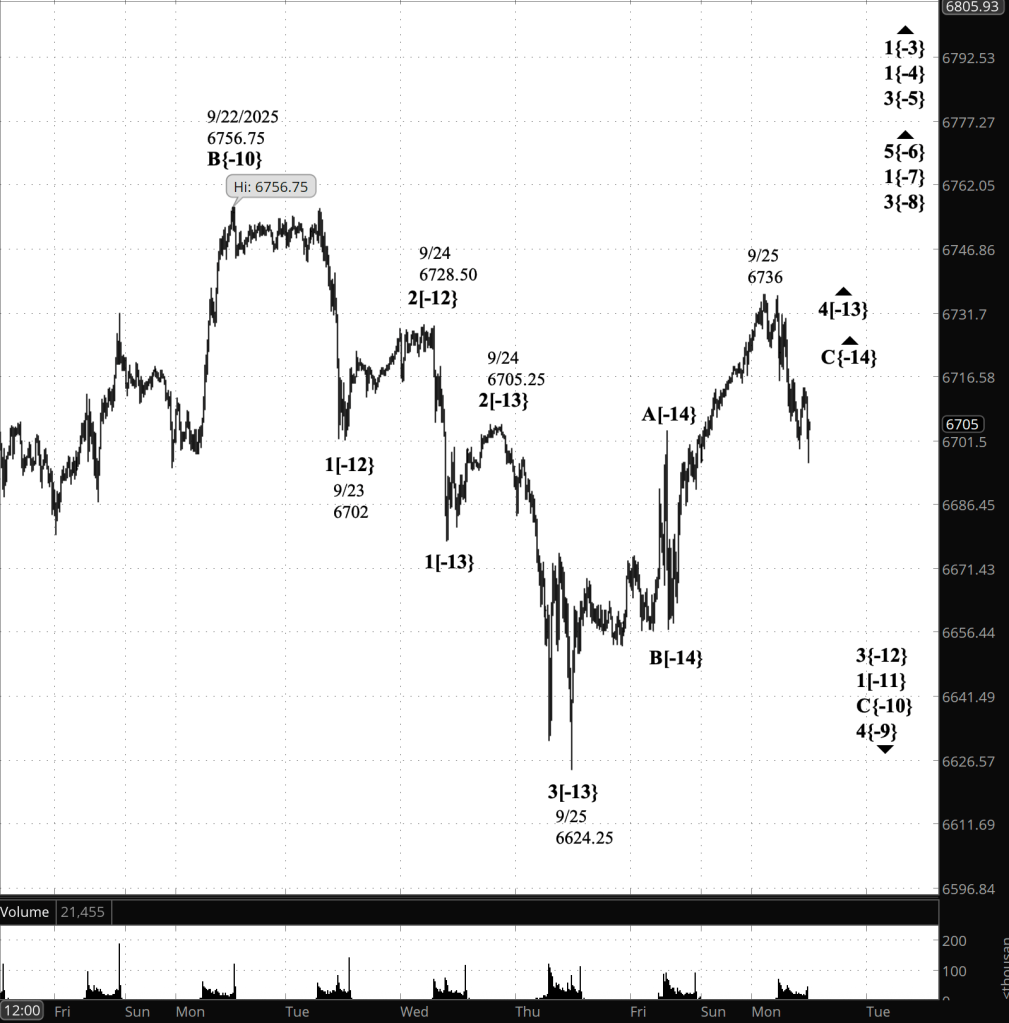
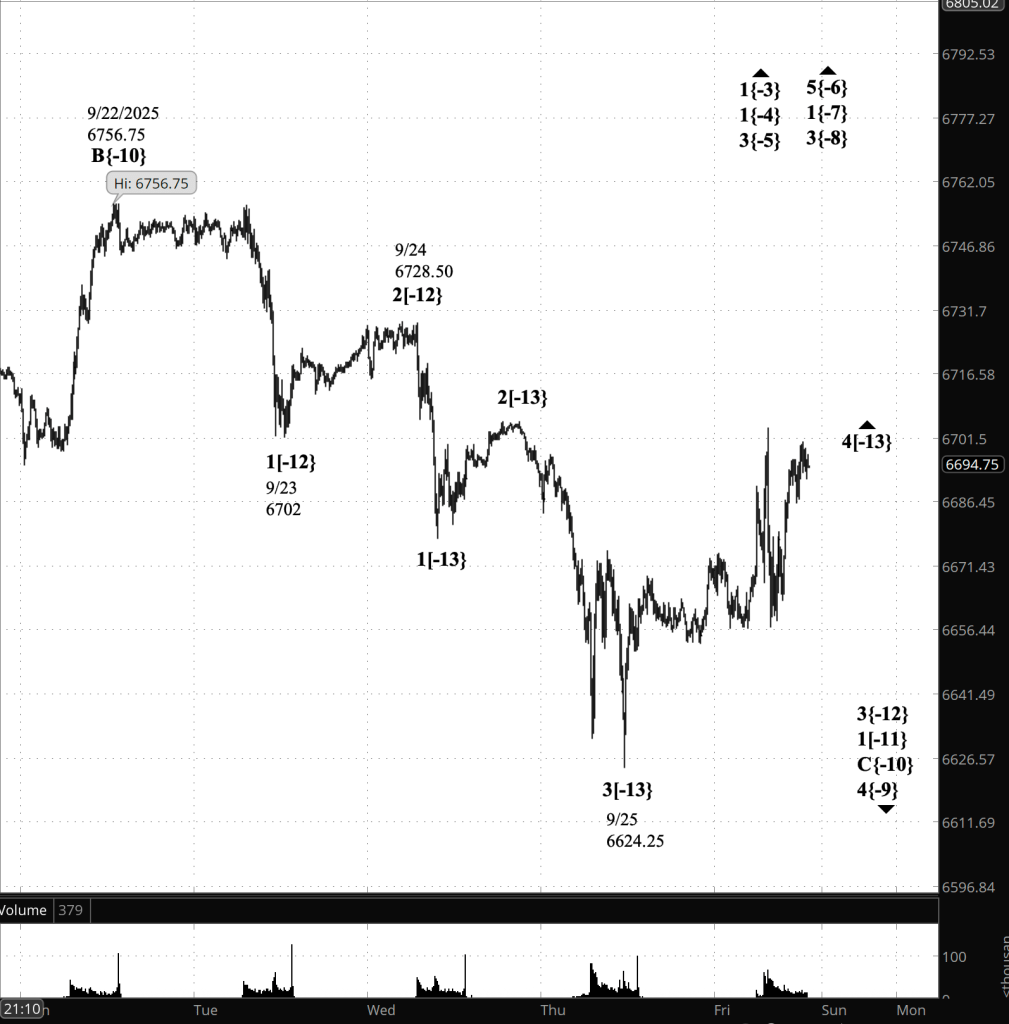
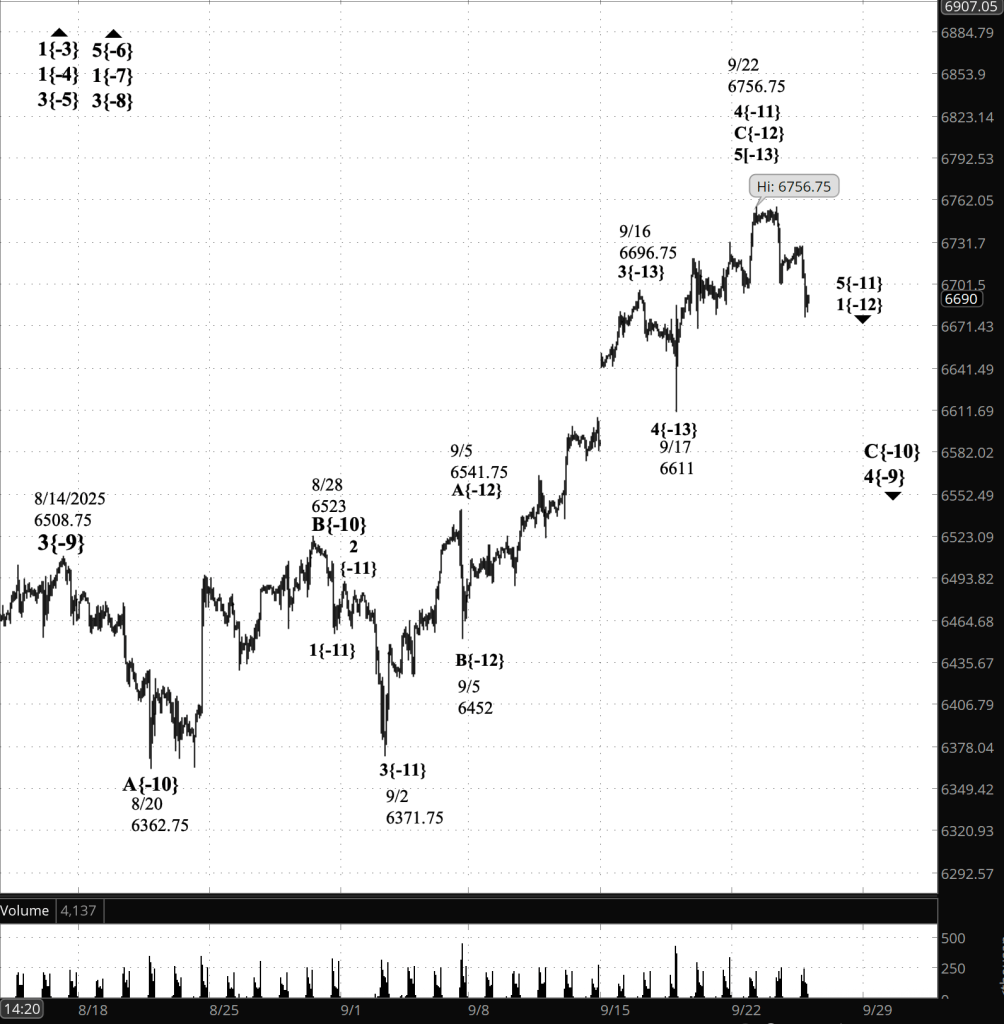
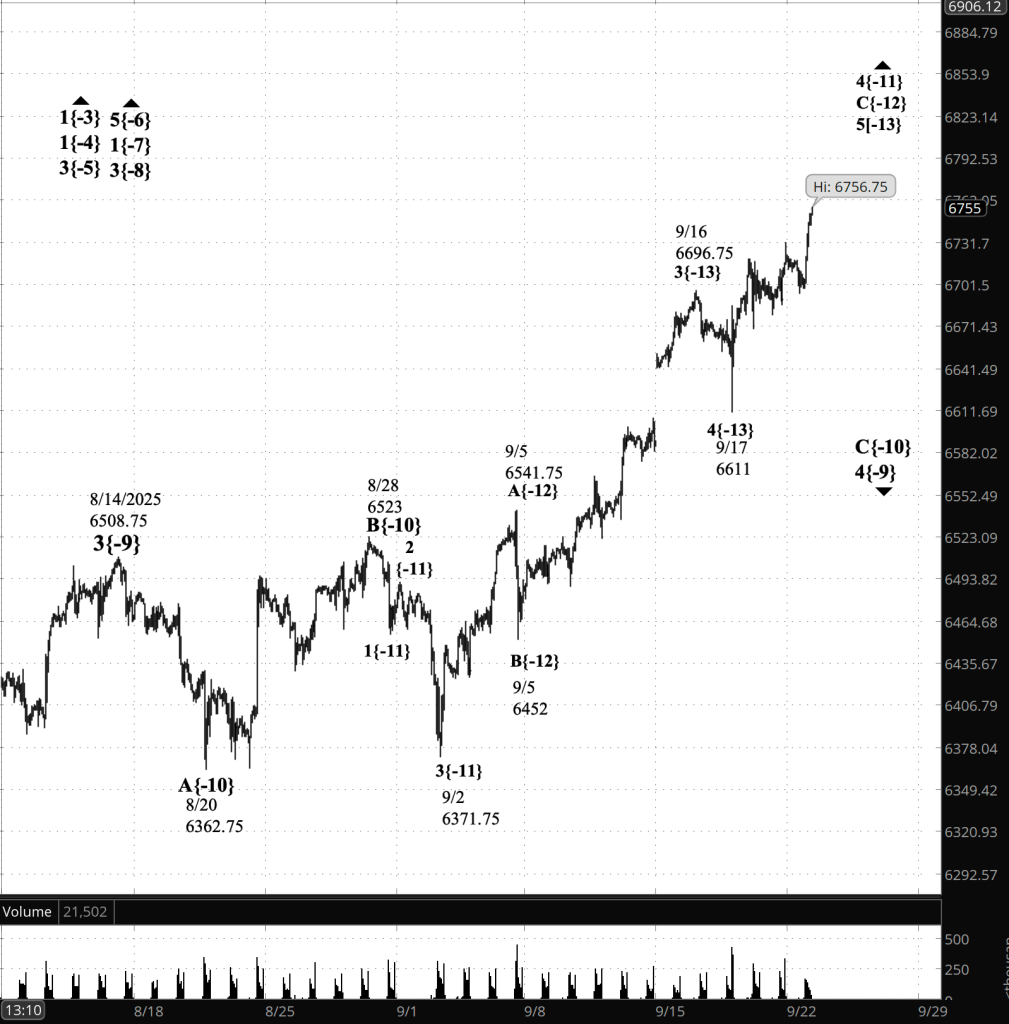
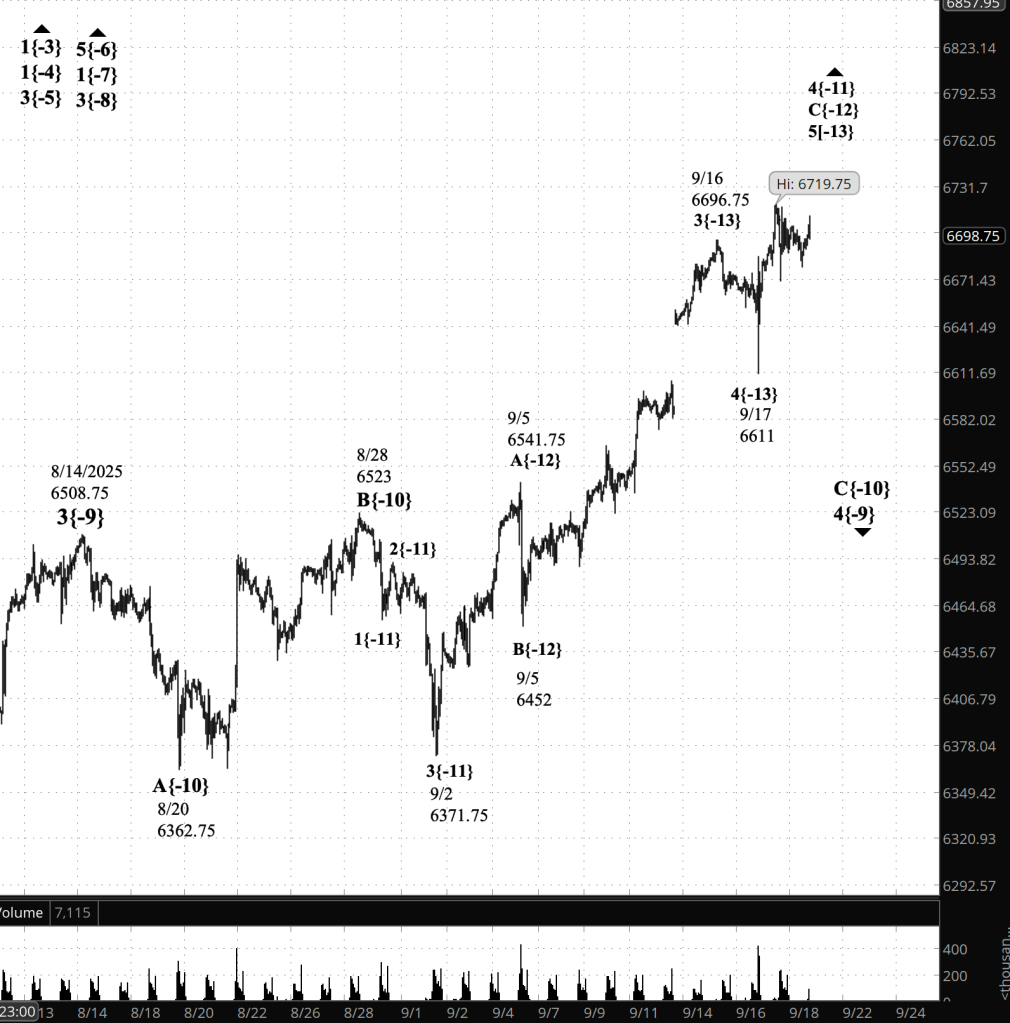
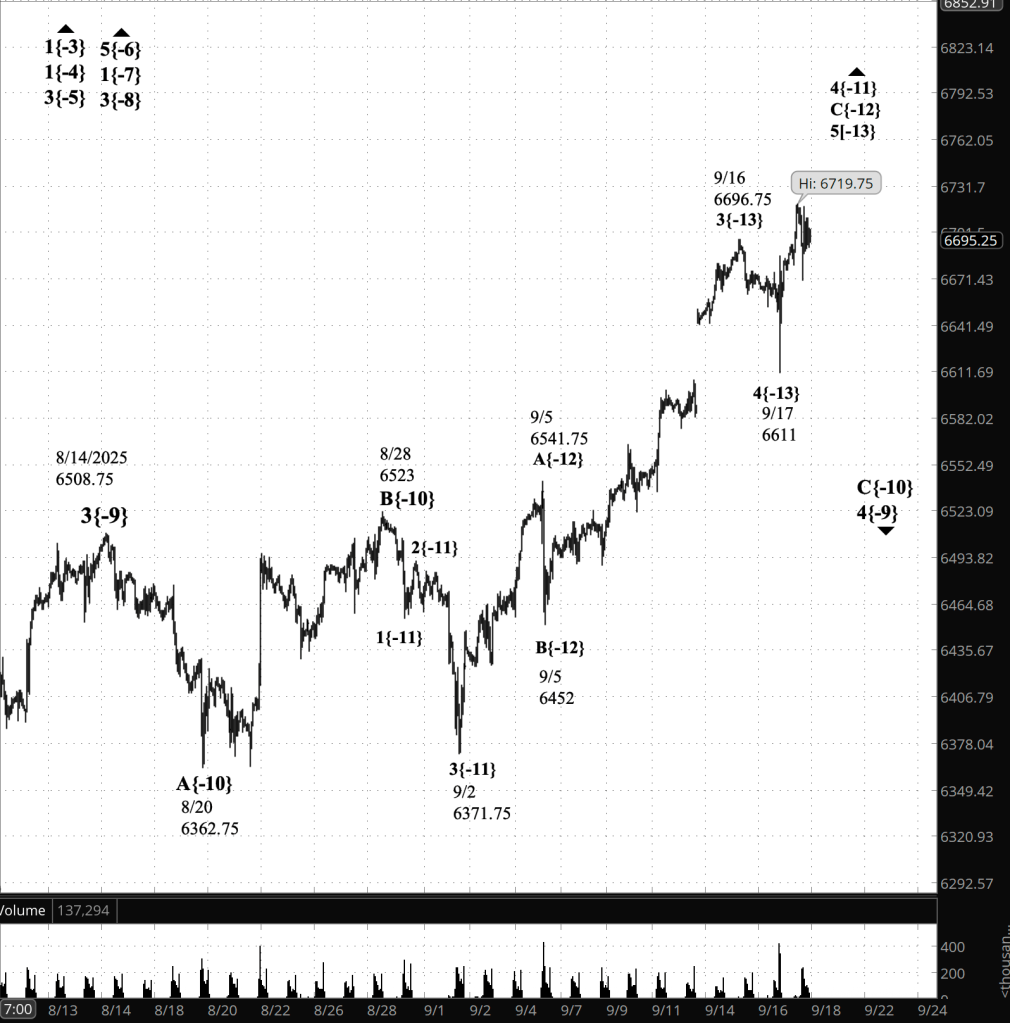
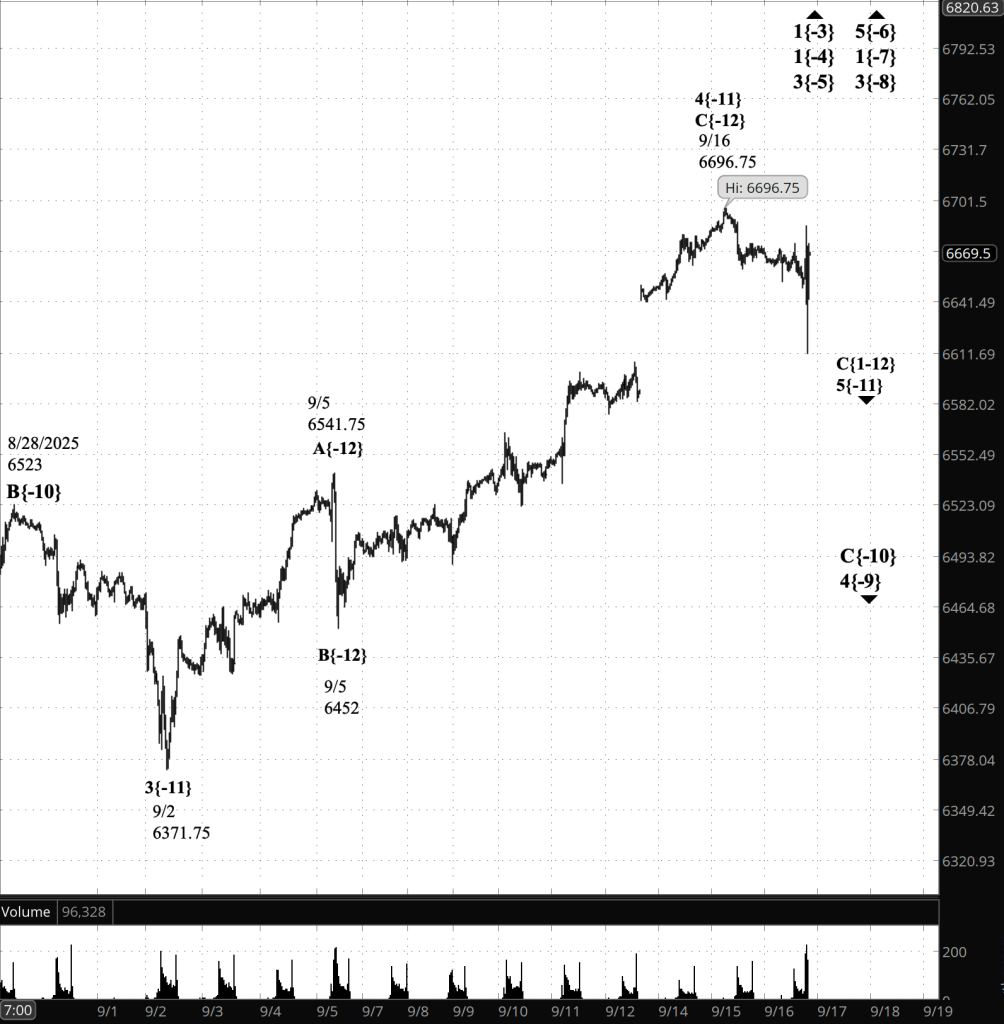
What’s happening now. The S&P 500 E-mini futures rose sharply after the Producer Price Index was released before the session began. The new high, 6565.25, eclipsed the prior high, 6541.75.

What does it mean?  I had labeled the rise as a corrective subwave within wave 5, placing the end of wave 4 at the September 5 high, and that point was the beginning of wave 5. The subsequent decline was the first subwave within downtrending wave 5, and the rise that followed was a 2nd-wave upward correction.

But this morning, under that labeling, wave 2 moved beyond the beginning of wave 1, violating a firm rule of Elliott Wave Theory. The chart is never wrong, and if the analysis no longer matches the chart, then it’s time to revise the analysis.

In the new principal analysis: Rising wave 4, a correction, is still underway and is in its final subwave, wave C, as seen the revised chart, below. For comparison with the former analysis — the wave 5 scenario — see the September 9 analysis.

[S&P 500 E-mini futures at 3:30 P.m., 70-minute bars, with volume] 

Waves Now Underway

These are the waves currently in progress under my principal analysis. Each line on the list shows the wave number, with the subscript in curly brackets, the traditional degree name, the starting date, the starting price of the S&P 500 E-mini futures, and the direction of the wave.

  • S&P 500 Index:
  • 5{+3} Supercycle, 7/8/1932, 4.40 (up)
  • 5{+2} Cycle, 12/9/1974, 60.96 (up)
  • 5{+1} Primary, 3/6/2009, 666.79 (up)
  • 5{0} Intermediate, 2/11/2016, 1810.10 (up)
  • 3{-1} Minor, 3/23/2020, 2191.36 (up)
  • 1{-2} Minute, 7/31/2025, 6468.50 (down)
  • S&P 500 Futures
  • 1{-3} Minuette, 10/13/2022, 4603 (up)
  • 1{-4} Subminuette, 4/7/2025, 4832 (up)
  • 3{-5} Micro, 4/21/2025, 5127.25 (up)
  • 5{-6} Submicro, 8/1/2025, 6249.50 (up)
  • 1{-7} Minuscule, 8/1/2025, 6349.50 (up)
  • 3{-8} (unnamed), 8/5/2025, 6313.25 (up)
  • 4{-9} (unnamed), 8/14/2025, 6508.75 (down)
  • C{-10} (unnamed), 8/28/2025, 6523 (down)
  • 4{-11} (unnamed), 9/2/2025, 6371.75 (up)
  • C{-12} (unnamed), 9/5/2025, 6452 (up)

Reading the chart. Price movements — waves – – in Elliott Wave Theory analysis are labeled with numbers within trending waves and letters with corrective waves. The subscripts — numbers in curly brackets — designate the wave’s degree, which, in Elliott Wave analysis, means the relative position of a wave within the larger and smaller structures that make up the chart. R.N. Elliott, who in the 1930s developed the form of analysis that bears his name, viewed the chart as a complex structure of smaller waves nested within larger waves, which in turn are nested within still larger waves. In mathematics it’s called a fractal structure, where at every scale the pattern is similar to the others.

Learning and other resources. Elliott Wave analysis provides context, not prophecy. As the 20th century semanticist Alfred Korzybski put it in his book Science and Sanity (1933), “The map is not the territory … The only usefulness of a map depends on similarity of structure between the empirical world and the map.” And I would add, in the ever-changing markets, we can judge that similarity of structure only after the fact.

See the menu page Analytical Methods for a rundown on where to go for information on Elliott Wave analysis.

By Tim Bovee, Portland, Oregon, September 10, 2025

Disclaimer

Tim Bovee, Private Trader tracks the analysis and trades of a private trader for his own accounts. Nothing in this blog constitutes a recommendation to buy or sell stocks, options or any other financial instrument. The only purpose of this blog is to provide education and entertainment.

No trader is ever 100 percent successful in his or her trades. Trading in the stock and option markets is risky and uncertain. Each trader must make trading decisions for his or her own account, and take responsibility for the consequences.

All content on Tim Bovee, Private Trader by Timothy K. Bovee is licensed under a Creative Commons Attribution-ShareAlike 4.0 International License.

License

Based on work at www.timbovee.com
Trader’s Notebook: S&P 500

3:30 p.m. New York time

Half an hour before the closing bell. The event of the day was Apple’s new-stuff presentation. AAPL dropped swiftly when the event came to an end. AAPL is 3rd in market cap within the S&P 500, but the AAPL response was small enough that I saw no spillover to the index.

Two tables showing AAPL and the S&P 500 futures, each with 5-minute bars, taken minutes after the end of the event. It vividly shows the specificity of the response to Apple’s event: As if the charts were saying, “AAPL, this is on you. The rest of us? Not our problem.”

Left: AAPL 5-minute bars Right: S&P 500 futures 5-minute bars

S&P 500 futures. Elliott Wave Theory clearly illustrates that the futures continued to show some ambiguity, a usual occurence when a movement is fishing for its end. Overnight the corrective pattern within downtrending wave 5 peaked at 6523.0 and then moved a bit lower.

The peak might have been the end of the correction, or not. If the price moves above the overnight peak, the correction is still underway. If it continues to drop, the further it goes the more likely it is that the correction has ended.

9:35 a.m. New York time.

What’s happening now. The S&P 500 E-mini futures zigzagged from slightly above 6500 to the 6520s and then back again, a little bit lower.

What does it mean?  Smaller to larger. Elliott Wave Theory analysis sees the downtrending 5th wave that began on September 5 continuing and working through an upward correction. The 5th wave itself is the final subwave within declining wave C, which began on August 28, the final subwave within a 4th-wave downward correction that began on August 14.

[S&P 500 E-mini futures at 3:30 p.m., 70-minute bars, with volume] 

Waves Now Underway

These are the waves currently in progress under my principal analysis. Each line on the list shows the wave number, with the subscript in curly brackets, the traditional degree name, the starting date, the starting price of the S&P 500 E-mini futures, and the direction of the wave.

  • S&P 500 Index:
  • 5{+3} Supercycle, 7/8/1932, 4.40 (up)
  • 5{+2} Cycle, 12/9/1974, 60.96 (up)
  • 5{+1} Primary, 3/6/2009, 666.79 (up)
  • 5{0} Intermediate, 2/11/2016, 1810.10 (up)
  • 3{-1} Minor, 3/23/2020, 2191.36 (up)
  • 1{-2} Minute, 7/31/2025, 6468.50 (down)
  • S&P 500 Futures
  • 1{-3} Minuette, 10/13/2022, 4603 (up)
  • 1{-4} Subminuette, 4/7/2025, 4832 (up)
  • 3{-5} Micro, 4/21/2025, 5127.25 (up)
  • 5{-6} Submicro, 8/1/2025, 6249.50 (up)
  • 1{-7} Minuscule, 8/1/2025, 6349.50 (up)
  • 3{-8} (unnamed), 8/5/2025, 6313.25 (up)
  • 4{-9} (unnamed), 8/14/2025, 6508.75 (down)
  • C{-10} (unnamed), 8/28/2025, 6523 (down)
  • 5{-11} (unnamed), 9/5/2025, 6541.75 (down)

Reading the chart. Price movements — waves – – in Elliott Wave Theory analysis are labeled with numbers within trending waves and letters with corrective waves. The subscripts — numbers in curly brackets — designate the wave’s degree, which, in Elliott Wave analysis, means the relative position of a wave within the larger and smaller structures that make up the chart. R.N. Elliott, who in the 1930s developed the form of analysis that bears his name, viewed the chart as a complex structure of smaller waves nested within larger waves, which in turn are nested within still larger waves. In mathematics it’s called a fractal structure, where at every scale the pattern is similar to the others.

Learning and other resources. Elliott Wave analysis provides context, not prophecy. As the 20th century semanticist Alfred Korzybski put it in his book Science and Sanity (1933), “The map is not the territory … The only usefulness of a map depends on similarity of structure between the empirical world and the map.” And I would add, in the ever-changing markets, we can judge that similarity of structure only after the fact.

See the menu page Analytical Methods for a rundown on where to go for information on Elliott Wave analysis.

By Tim Bovee, Portland, Oregon, September 9, 2025

Disclaimer

Tim Bovee, Private Trader tracks the analysis and trades of a private trader for his own accounts. Nothing in this blog constitutes a recommendation to buy or sell stocks, options or any other financial instrument. The only purpose of this blog is to provide education and entertainment.

No trader is ever 100 percent successful in his or her trades. Trading in the stock and option markets is risky and uncertain. Each trader must make trading decisions for his or her own account, and take responsibility for the consequences.

All content on Tim Bovee, Private Trader by Timothy K. Bovee is licensed under a Creative Commons Attribution-ShareAlike 4.0 International License.

License

Based on work at www.timbovee.com
Trader’s Notebook: S&P 500

3:30 p.m. New York time.

Half an hour before the closing bell. The S&P 500 futures rose to 6516.90 during the session and then declined back into the 5490s so far.

Elliott Wave Theory. The session peak may well be the end of a rising subwave within downtrending wave 5, itself the final subwave within wave C, the final wave of the wave 4 corrective pattern that began on August 28.

Or perhaps not. The chart will remain ambiguous until we get a clear rise or fall above or below the present levels. With econ reports focused on inflation scheduled for Wednesday and Thursday, odds are good that we will get that clarity soon.

9:35 a.m. New York time.

What’s happening now. When trading resumed overnight, the S&P 500 E-mini futures immediately fell to 6480.25 and then worked its way higher, forming a sideways pattern in the 6490s coming close to 6410.

What does it mean?  Elliott Wave Theory analysis sees the early overnight rise as a subwave within downtrending wave 5, which in turn is the fina subwave within wave C, the final subwave within wave 4, a downward correction that began on August 14.

When wave 4 reaches its end, it will be followed by an uptrending wave 5, two degrees larger than the smaller wave 5 now underway.

[S&P 500 E-mini futures at 3:30 p.m., 70-minute bars, with volume] 

Waves Now Underway

These are the waves currently in progress under my principal analysis. Each line on the list shows the wave number, with the subscript in curly brackets, the traditional degree name, the starting date, the starting price of the S&P 500 E-mini futures, and the direction of the wave.

  • S&P 500 Index:
  • 5{+3} Supercycle, 7/8/1932, 4.40 (up)
  • 5{+2} Cycle, 12/9/1974, 60.96 (up)
  • 5{+1} Primary, 3/6/2009, 666.79 (up)
  • 5{0} Intermediate, 2/11/2016, 1810.10 (up)
  • 3{-1} Minor, 3/23/2020, 2191.36 (up)
  • 1{-2} Minute, 7/31/2025, 6468.50 (down)
  • S&P 500 Futures
  • 1{-3} Minuette, 10/13/2022, 4603 (up)
  • 1{-4} Subminuette, 4/7/2025, 4832 (up)
  • 3{-5} Micro, 4/21/2025, 5127.25 (up)
  • 5{-6} Submicro, 8/1/2025, 6249.50 (up)
  • 1{-7} Minuscule, 8/1/2025, 6349.50 (up)
  • 3{-8} (unnamed), 8/5/2025, 6313.25 (up)
  • 4{-9} (unnamed), 8/14/2025, 6508.75 (down)
  • C{-10} (unnamed), 8/28/2025, 6523 (down)
  • 5{-11} (unnamed), 9/5/2025, 6541.75 (down)

Reading the chart. Price movements — waves – – in Elliott Wave Theory analysis are labeled with numbers within trending waves and letters with corrective waves. The subscripts — numbers in curly brackets — designate the wave’s degree, which, in Elliott Wave analysis, means the relative position of a wave within the larger and smaller structures that make up the chart. R.N. Elliott, who in the 1930s developed the form of analysis that bears his name, viewed the chart as a complex structure of smaller waves nested within larger waves, which in turn are nested within still larger waves. In mathematics it’s called a fractal structure, where at every scale the pattern is similar to the others.

Learning and other resources. Elliott Wave analysis provides context, not prophecy. As the 20th century semanticist Alfred Korzybski put it in his book Science and Sanity (1933), “The map is not the territory … The only usefulness of a map depends on similarity of structure between the empirical world and the map.” And I would add, in the ever-changing markets, we can judge that similarity of structure only after the fact.

See the menu page Analytical Methods for a rundown on where to go for information on Elliott Wave analysis.

By Tim Bovee, Portland, Oregon, September 8, 2025

Disclaimer

Tim Bovee, Private Trader tracks the analysis and trades of a private trader for his own accounts. Nothing in this blog constitutes a recommendation to buy or sell stocks, options or any other financial instrument. The only purpose of this blog is to provide education and entertainment.

No trader is ever 100 percent successful in his or her trades. Trading in the stock and option markets is risky and uncertain. Each trader must make trading decisions for his or her own account, and take responsibility for the consequences.

All content on Tim Bovee, Private Trader by Timothy K. Bovee is licensed under a Creative Commons Attribution-ShareAlike 4.0 International License.

License

Based on work at www.timbovee.com
Trader’s Notebook: S&P 500

3:30 p.m. New York time

Half an hour before the closing bell. The S&P 500 futures pulled back from its early session high, 6541.75, and then began to pick up speed as it fell further, reaching a low so far of 6452.

Elliott Wave Theory: The early session peak ended the 4th-wave upward correction, that began on September 2, and it was the beginning of the downtrending 5th wave, both subwaves within wave C{-10}, the final subwave of a larger 4th-wave downward correction, wave 4{-9}, which began on August 14 and which is still underway.

The end of wave 5{-11} will also be the end of wave C{-10} and most likely of wave 4{-9}. It will mark the start of a larger uptrending 5th wave that will carry the price back into the 6500s and most likely significantly higher.

Back to the present smaller downtrending 5th wave. How low can it go? One possible stopping point is roughly 6370 to 6380, which is a Fibonacci 1.618 retracement of the preceding 3rd wave, and it might also go as low as the neighborhood of 6330 to 6350.

It’s an estimate, not a hard-core forecast.

And of course, there’s always the surprise. It could turn out that today’s peak is a subwave buried in wave 4{-11}. A rise above 6541.75 would mean that wave 4{-11} is still underway, and wave 5{-11} still lies in the future.

9:35 a.m. New York time.

What’s happening now. When the Employment Situation Report was published an hour before the opening bell, the S&P 500 E-mini futures whipsawed across 32 points, down and then up, and then continued to rise into the 6540s.

What does it mean?  The Elliott Wave Theory analysis shows clearly the the final subwave, wave C, continues within the 4th-wave upward correction that began on September 2. When the C wave is complete, it will be the end of the corrective pattern as well as the 4th wave, and the beginning of a downtrending 5th wave.

[S&P 500 E-mini futures at 3:30 p.m.,40-minute bars, with volume] 

Waves Now Underway

These are the waves currently in progress under my principal analysis. Each line on the list shows the wave number, with the subscript in curly brackets, the traditional degree name, the starting date, the starting price of the S&P 500 E-mini futures, and the direction of the wave.

  • S&P 500 Index:
  • 5{+3} Supercycle, 7/8/1932, 4.40 (up)
  • 5{+2} Cycle, 12/9/1974, 60.96 (up)
  • 5{+1} Primary, 3/6/2009, 666.79 (up)
  • 5{0} Intermediate, 2/11/2016, 1810.10 (up)
  • 3{-1} Minor, 3/23/2020, 2191.36 (up)
  • 1{-2} Minute, 7/31/2025, 6468.50 (down)
  • S&P 500 Futures
  • 1{-3} Minuette, 10/13/2022, 4603 (up)
  • 1{-4} Subminuette, 4/7/2025, 4832 (up)
  • 3{-5} Micro, 4/21/2025, 5127.25 (up)
  • 5{-6} Submicro, 8/1/2025, 6249.50 (up)
  • 1{-7} Minuscule, 8/1/2025, 6349.50 (up)
  • 3{-8} (unnamed), 8/5/2025, 6313.25 (up)
  • 4{-9} (unnamed), 8/14/2025, 6508.75 (down)
  • C{-10} (unnamed), 8/28/2025, 6523 (down)
  • 5{-11} (unnamed), 9/5/2025, 6541.75 (down)

Reading the chart. Price movements — waves – – in Elliott Wave Theory analysis are labeled with numbers within trending waves and letters with corrective waves. The subscripts — numbers in curly brackets — designate the wave’s degree, which, in Elliott Wave analysis, means the relative position of a wave within the larger and smaller structures that make up the chart. R.N. Elliott, who in the 1930s developed the form of analysis that bears his name, viewed the chart as a complex structure of smaller waves nested within larger waves, which in turn are nested within still larger waves. In mathematics it’s called a fractal structure, where at every scale the pattern is similar to the others.

Learning and other resources. Elliott Wave analysis provides context, not prophecy. As the 20th century semanticist Alfred Korzybski put it in his book Science and Sanity (1933), “The map is not the territory … The only usefulness of a map depends on similarity of structure between the empirical world and the map.” And I would add, in the ever-changing markets, we can judge that similarity of structure only after the fact.

See the menu page Analytical Methods for a rundown on where to go for information on Elliott Wave analysis.

By Tim Bovee, Portland, Oregon, September 5, 2025

Disclaimer

Tim Bovee, Private Trader tracks the analysis and trades of a private trader for his own accounts. Nothing in this blog constitutes a recommendation to buy or sell stocks, options or any other financial instrument. The only purpose of this blog is to provide education and entertainment.

No trader is ever 100 percent successful in his or her trades. Trading in the stock and option markets is risky and uncertain. Each trader must make trading decisions for his or her own account, and take responsibility for the consequences.

All content on Tim Bovee, Private Trader by Timothy K. Bovee is licensed under a Creative Commons Attribution-ShareAlike 4.0 International License.

License

Based on work at www.timbovee.com
Trader’s Notebook: S&P 500

3:30 p.m. New York time

Half an hour until the closing bell. The S&P 500 futures continued to climb during the session, breaking past 7500.

Elliott Wave Theory: The waves continue as they did this morning: Wave C{-12} within wave 4{-11} — both rising — within wave C{-10} within wave 4{-9} — both falling — within wave 3{-8} within wave 1{-7} within wave 5[-6} — all rising.

9:35 a.m. New York time.

What’s happening now. The S&P 500 E-mini futures rose to 6473.75 overnight.

What does it mean?  Yesterday’s session closed with uncertainty over whether the rising wave that began on September 2 was complete or whether the declining wave had begun.

The overnight rise, when analyzed using Elliott Wave Theory, verifies that the next-to-the-last subwave within wave C{-10} is underway. The subwave is an upward corretion, wave 4{-11}, which began on September 2.

Internally, wave 4{-11} is in its final subwave, wave C{-12}, and when C{-12} and 4{-11}, are complete, downtrending wave 5{-11} will began, carrying the parent wave C{-10} and wave 4{-9} one degree higher to their end.

At that point wave 5{-9} will begin, an uptrending wave of significant size.

[S&P 500 E-mini futures at 3:30 p,m., 35-minute bars, with volume] 

Waves Now Underway

These are the waves currently in progress under my principal analysis. Each line on the list shows the wave number, with the subscript in curly brackets, the traditional degree name, the starting date, the starting price of the S&P 500 E-mini futures, and the direction of the wave.

  • S&P 500 Index:
  • 5{+3} Supercycle, 7/8/1932, 4.40 (up)
  • 5{+2} Cycle, 12/9/1974, 60.96 (up)
  • 5{+1} Primary, 3/6/2009, 666.79 (up)
  • 5{0} Intermediate, 2/11/2016, 1810.10 (up)
  • 3{-1} Minor, 3/23/2020, 2191.36 (up)
  • 1{-2} Minute, 7/31/2025, 6468.50 (down)
  • S&P 500 Futures
  • 1{-3} Minuette, 10/13/2022, 4603 (up)
  • 1{-4} Subminuette, 4/7/2025, 4832 (up)
  • 3{-5} Micro, 4/21/2025, 5127.25 (up)
  • 5{-6} Submicro, 8/1/2025, 6249.50 (up)
  • 1{-7} Minuscule, 8/1/2025, 6349.50 (up)
  • 3{-8} (unnamed), 8/5/2025, 6313.25 (up)
  • 4{-9} (unnamed), 8/14/2025, 6508.75 (down)
  • C{-10} (unnamed), 8/28/2025, 6523 (down)
  • 4{-11} (unnamed), 9/2/2025, 6371.75 (up)

Reading the chart. Price movements — waves – – in Elliott Wave Theory analysis are labeled with numbers within trending waves and letters with corrective waves. The subscripts — numbers in curly brackets — designate the wave’s degree, which, in Elliott Wave analysis, means the relative position of a wave within the larger and smaller structures that make up the chart. R.N. Elliott, who in the 1930s developed the form of analysis that bears his name, viewed the chart as a complex structure of smaller waves nested within larger waves, which in turn are nested within still larger waves. In mathematics it’s called a fractal structure, where at every scale the pattern is similar to the others.

Learning and other resources. Elliott Wave analysis provides context, not prophecy. As the 20th century semanticist Alfred Korzybski put it in his book Science and Sanity (1933), “The map is not the territory … The only usefulness of a map depends on similarity of structure between the empirical world and the map.” And I would add, in the ever-changing markets, we can judge that similarity of structure only after the fact.

See the menu page Analytical Methods for a rundown on where to go for information on Elliott Wave analysis.

By Tim Bovee, Portland, Oregon, September 4, 2025

Disclaimer

Tim Bovee, Private Trader tracks the analysis and trades of a private trader for his own accounts. Nothing in this blog constitutes a recommendation to buy or sell stocks, options or any other financial instrument. The only purpose of this blog is to provide education and entertainment.

No trader is ever 100 percent successful in his or her trades. Trading in the stock and option markets is risky and uncertain. Each trader must make trading decisions for his or her own account, and take responsibility for the consequences.

All content on Tim Bovee, Private Trader by Timothy K. Bovee is licensed under a Creative Commons Attribution-ShareAlike 4.0 International License.

License

Based on work at www.timbovee.com

Trader’s Notebook: S&P 500

3:30 p,m. New York time

Half an hour before the closing bell. The S&P 500 futures peaked at 6464.25 during the session and then pulled back, setting up a common sort of conundrum in Elliott Wave Theory: Is a wave’s peak a real peak for the wave, or it just a pause in a subwave?

If it is a false peak, then rising wave 4{-11} has some upside left. That’s the principal analysis.

If it’s the true peak, then wave 4{-11} has ended the the subsequent decline is wave 5{-11}, which is still underway.

9:35 a.m. New York time.

What’s happening now. The S&P 500 E-mini futures rose from the 6420s to the 6460s overnight, and then declined into the 6440s.

What does it mean? After applying Elliott Wave Theory analysism I’ve concluded that the decline is the next-to-the-last subwave, wave 4{-11}, within declining wave C{-10}, the final subwave within the 4th-wave downward correction that began on August 14.

The declining wave that follows will be the final subwave of the corrective pattern and most likely the end of wave 4{-9], which will be followed by a rising 5th wave. I’ve used the numbering system on the chart: A wave number followed by the number of degrees distance from Intermediate wave.

[S&P 500 E-mini futures at 3:30 p,m., 30-minute bars, with volume] 

Waves Now Underway

These are the waves currently in progress under my principal analysis. Each line on the list shows the wave number, with the subscript in curly brackets, the traditional degree name, the starting date, the starting price of the S&P 500 E-mini futures, and the direction of the wave.

  • S&P 500 Index:
  • 5{+3} Supercycle, 7/8/1932, 4.40 (up)
  • 5{+2} Cycle, 12/9/1974, 60.96 (up)
  • 5{+1} Primary, 3/6/2009, 666.79 (up)
  • 5{0} Intermediate, 2/11/2016, 1810.10 (up)
  • 3{-1} Minor, 3/23/2020, 2191.36 (up)
  • 1{-2} Minute, 7/31/2025, 6468.50 (down)
  • S&P 500 Futures
  • 1{-3} Minuette, 10/13/2022, 4603 (up)
  • 1{-4} Subminuette, 4/7/2025, 4832 (up)
  • 3{-5} Micro, 4/21/2025, 5127.25 (up)
  • 5{-6} Submicro, 8/1/2025, 6249.50 (up)
  • 1{-7} Minuscule, 8/1/2025, 6349.50 (up)
  • 3{-8} (unnamed), 8/5/2025, 6313.25 (up)
  • 4{-9} (unnamed), 8/14/2025, 6508.75 (down)
  • C{-10} (unnamed), 8/28/2025, 6523 (down)
  • 4{-11} (unnamed), 9/2/2025, 6371.75 (up)

Reading the chart. Price movements — waves – – in Elliott Wave Theory analysis are labeled with numbers within trending waves and letters with corrective waves. The subscripts — numbers in curly brackets — designate the wave’s degree, which, in Elliott Wave analysis, means the relative position of a wave within the larger and smaller structures that make up the chart. R.N. Elliott, who in the 1930s developed the form of analysis that bears his name, viewed the chart as a complex structure of smaller waves nested within larger waves, which in turn are nested within still larger waves. In mathematics it’s called a fractal structure, where at every scale the pattern is similar to the others.

Learning and other resources. Elliott Wave analysis provides context, not prophecy. As the 20th century semanticist Alfred Korzybski put it in his book Science and Sanity (1933), “The map is not the territory … The only usefulness of a map depends on similarity of structure between the empirical world and the map.” And I would add, in the ever-changing markets, we can judge that similarity of structure only after the fact.

See the menu page Analytical Methods for a rundown on where to go for information on Elliott Wave analysis.

By Tim Bovee, Portland, Oregon, September 3, 2025

Disclaimer

Tim Bovee, Private Trader tracks the analysis and trades of a private trader for his own accounts. Nothing in this blog constitutes a recommendation to buy or sell stocks, options or any other financial instrument. The only purpose of this blog is to provide education and entertainment.

No trader is ever 100 percent successful in his or her trades. Trading in the stock and option markets is risky and uncertain. Each trader must make trading decisions for his or her own account, and take responsibility for the consequences.

All content on Tim Bovee, Private Trader by Timothy K. Bovee is licensed under a Creative Commons Attribution-ShareAlike 4.0 International License.

License

Based on work at www.timbovee.com

Trader’s Notebook: S&P 500

3:30 p.m. New York time

Half an hour before the closing bell. The S&P 500 futures continued to fall during the session, reaching a low of 6371.75 and then reversed slightly.

Elliott Wave Theory. The decline is wave C of the 4th wave downward correction that began on August 15. Its session low point is 71.5 points above the 4th wave’s estimated end region.

9:35 a.m. New York time.

What’s happening now. The S&P 500 E-mini futures peaked at 6523 on August 28 and then began a decline, picking up pace today before the opening bell and reaching into the 6300s.

What does it mean? Elliott Wave Theory analysis shows that the peak was the end of rising wave B and the starting of declining wave C, both subwaves of the 4th-wave downward correction that began on August 14.

Most 4th waves have three subwaves, and if this 4th wave is typical, wave C when complete will be the end of wave 4.

How low can it go? C waves are often about the same length as the preceding A wave, which would mean a probable endpoint of 6300 to 6260. Some C-waves are extended, pushing the endpoint even lower, down to around 6200.

These are estimates, with a high degree of uncertainty.

The end of wave C will be the end of wave 4 and the beginning of uptrending wave 5, which will likely carry the price back into the 6500s and perhaps into the 6600s.

[S&P 500 E-mini futures at 3:30 p.m., 50-minute bars, with volume] 

Waves Now Underway

These are the waves currently in progress under my principal analysis. Each line on the list shows the wave number, with the subscript in curly brackets, the traditional degree name, the starting date, the starting price of the S&P 500 E-mini futures, and the direction of the wave.

  • S&P 500 Index:
  • 5{+3} Supercycle, 7/8/1932, 4.40 (up)
  • 5{+2} Cycle, 12/9/1974, 60.96 (up)
  • 5{+1} Primary, 3/6/2009, 666.79 (up)
  • 5{0} Intermediate, 2/11/2016, 1810.10 (up)
  • 3{-1} Minor, 3/23/2020, 2191.36 (up)
  • 1{-2} Minute, 7/31/2025, 6468.50 (down)
  • S&P 500 Futures
  • 1{-3} Minuette, 10/13/2022, 4603 (up)
  • 1{-4} Subminuette, 4/7/2025, 4832 (up)
  • 3{-5} Micro, 4/21/2025, 5127.25 (up)
  • 5{-6} Submicro, 8/1/2025, 6249.50 (up)
  • 1{-7} Minuscule, 8/1/2025, 6349.50 (up)
  • 3{-8} (unnamed), 8/5/2025, 6313.25 (up)
  • 4{-9} (unnamed), 8/14/2025, 6508.75 (down)
  • C{-10} (unnamed), 8/28/2025, 6523 (down)

Reading the chart. Price movements — waves – – in Elliott Wave Theory analysis are labeled with numbers within trending waves and letters with corrective waves. The subscripts — numbers in curly brackets — designate the wave’s degree, which, in Elliott Wave analysis, means the relative position of a wave within the larger and smaller structures that make up the chart. R.N. Elliott, who in the 1930s developed the form of analysis that bears his name, viewed the chart as a complex structure of smaller waves nested within larger waves, which in turn are nested within still larger waves. In mathematics it’s called a fractal structure, where at every scale the pattern is similar to the others.

Learning and other resources. Elliott Wave analysis provides context, not prophecy. As the 20th century semanticist Alfred Korzybski put it in his book Science and Sanity (1933), “The map is not the territory … The only usefulness of a map depends on similarity of structure between the empirical world and the map.” And I would add, in the ever-changing markets, we can judge that similarity of structure only after the fact.

See the menu page Analytical Methods for a rundown on where to go for information on Elliott Wave analysis.

By Tim Bovee, Portland, Oregon, September 2, 2025

Disclaimer

Tim Bovee, Private Trader tracks the analysis and trades of a private trader for his own accounts. Nothing in this blog constitutes a recommendation to buy or sell stocks, options or any other financial instrument. The only purpose of this blog is to provide education and entertainment.

No trader is ever 100 percent successful in his or her trades. Trading in the stock and option markets is risky and uncertain. Each trader must make trading decisions for his or her own account, and take responsibility for the consequences.

All content on Tim Bovee, Private Trader by Timothy K. Bovee is licensed under a Creative Commons Attribution-ShareAlike 4.0 International License.

License

Based on work at www.timbovee.com

Trader’s Notebook: S&P 500

Holiday ahead. U.S. markets will be closed on Monday, August 1, for the Labor Day holiday. Trading will resume Monday evening for some futures, such as the S&P 500 E-mini futures that are analyzed here. The markets will begin their trading sessions on Tuesday, September 2.

3:30 p.m. New York time

Half an hour before the closing bell. The S&P 500 E-mini futures fell during the session reaching 6455.50 before entering a sideways fluctuation covering the 6450s to the 6470s.

Basically, there’s very little difference from what we saw after of the opening bell. Wave 4 is still underway, and within it, wave B is still underway — probably.

If the decline continues after the Labor Day holiday, then we can with confidence conclude that wave B ended on August 28, at 6523, and declining wave C, the final subwave of the 4th-wave correction, began from that point.

It’s a close call, but we’re not quite there yet.

9:35 a.m. New York time.

What’s happening now. The S&P 500 E-mini futures fell from 6518 at yesterday’s closing bell down to 6486.75 durng the overnight session, and then resumed its rise, sharply spiking and retreating in the span of 2 minutes after the Personal Consumption Expenditures report showed inflation reaching 2.9%. The increase for some suggested that the Federal Open Market Committee was even more likely to reduce interest rates in the September meeting.

What does it mean? Elliott Wave Theory analysis sees the 4th-wave downward correction that began on August 14. The correction is in its 2nd subwave, wave B.

It’s possible that wave B ended at the August 28 peak, 6523. But it’s uncertain, and until there is a greater downward movement, I’m keeping rising wave B as my principle analysis and falling wave C as my alternative analysis.

[S&P 500 E-mini futures at 3:30 p.m., 50-minute bars, with volume] 

Waves Now Underway

These are the waves currently in progress under my principal analysis. Each line on the list shows the wave number, with the subscript in curly brackets, the traditional degree name, the starting date, the starting price of the S&P 500 E-mini futures, and the direction of the wave.

  • S&P 500 Index:
  • 5{+3} Supercycle, 7/8/1932, 4.40 (up)
  • 5{+2} Cycle, 12/9/1974, 60.96 (up)
  • 5{+1} Primary, 3/6/2009, 666.79 (up)
  • 5{0} Intermediate, 2/11/2016, 1810.10 (up)
  • 3{-1} Minor, 3/23/2020, 2191.36 (up)
  • 1{-2} Minute, 7/31/2025, 6468.50 (down)
  • S&P 500 Futures
  • 1{-3} Minuette, 10/13/2022, 4603 (up)
  • 1{-4} Subminuette, 4/7/2025, 4832 (up)
  • 3{-5} Micro, 4/21/2025, 5127.25 (up)
  • 5{-6} Submicro, 8/1/2025, 6249.50 (up)
  • 1{-7} Minuscule, 8/1/2025, 6349.50 (up)
  • 3{-8} (unnamed), 8/5/2025, 6313.25 (up)
  • 4{-9} (unnamed), 8/14/2025, 6508.75 (down)
  • B{-10} (unnamed), 8/20/2025, 6162.75 (down)

Reading the chart. Price movements — waves – – in Elliott Wave Theory analysis are labeled with numbers within trending waves and letters with corrective waves. The subscripts — numbers in curly brackets — designate the wave’s degree, which, in Elliott Wave analysis, means the relative position of a wave within the larger and smaller structures that make up the chart. R.N. Elliott, who in the 1930s developed the form of analysis that bears his name, viewed the chart as a complex structure of smaller waves nested within larger waves, which in turn are nested within still larger waves. In mathematics it’s called a fractal structure, where at every scale the pattern is similar to the others.

Learning and other resources. Elliott Wave analysis provides context, not prophecy. As the 20th century semanticist Alfred Korzybski put it in his book Science and Sanity (1933), “The map is not the territory … The only usefulness of a map depends on similarity of structure between the empirical world and the map.” And I would add, in the ever-changing markets, we can judge that similarity of structure only after the fact.

See the menu page Analytical Methods for a rundown on where to go for information on Elliott Wave analysis.

By Tim Bovee, Portland, Oregon, August 29, 2025

Disclaimer

Tim Bovee, Private Trader tracks the analysis and trades of a private trader for his own accounts. Nothing in this blog constitutes a recommendation to buy or sell stocks, options or any other financial instrument. The only purpose of this blog is to provide education and entertainment.

No trader is ever 100 percent successful in his or her trades. Trading in the stock and option markets is risky and uncertain. Each trader must make trading decisions for his or her own account, and take responsibility for the consequences.

All content on Tim Bovee, Private Trader by Timothy K. Bovee is licensed under a Creative Commons Attribution-ShareAlike 4.0 International License.

License

Based on work at www.timbovee.com

Trader’s Notebook: S&P 500

3:30 p.m. New York time

Half an hour before the closing bell. The S&P 500 futures continued to rise during the session, reaching 6519.50.

Elliott Wave Theory: Wave B within a 4th-wave downward correction is underway. Wave B has continued further beyond the starting point of the preceding A wave., 6508.75. That’s OK according to the rules of Elliott Wave Theory if the correction is taking the form of a Flat. And that’s where the ambiguity lies.

A correction is a Flat when the A-wave has three subwaves. Days ago I labeled this A wave as having three subwaves. But as is so often the case, the subwaves structure lacks clarity, and if I squint, it could be labeled as having five subwaves.

If wave A has five subwaves, then the correction is taking the form of a Zigzag. And under the rules of Elliott Wave Theory, no Zigzag can move beyond the starting point of Wave A. If it does, the analysis no longer matches the reality and must be redone.d

In some ways deciding how to label the correction — a necessity–is operating backwards, with the acts of wave B dictating to us what happened in the past, the nature of wave A. Rather than the past defining the future, the future is defining the past.

It’s like H.G. Wells’ time-travel book, proving that Elliott Wave Theory has a magnificant taste for literary excellence.

9:35 a.m. New York time.

What’s happening now. The S&P 500 E-mini futures rose from 6471 to 6506.75 overnight.

What does it mean? In terms of Elliott Wave Theory analysis, the overnight high so far is close to the August 14 peak, 6508.75, which was the starting point of a 4th-wave downward correction that is still underway.

The overnight peak is part of a rising B wave, the middle subwave of the correction. When wave B is complete, it will also be the beginning of the final subwave, wave C, which likely will carry the price down to the 6350s.

[S&P 500 E-mini futures at 3:30 p.m., 50-minute bars, with volume] 

Waves Now Underway

These are the waves currently in progress under my principal analysis. Each line on the list shows the wave number, with the subscript in curly brackets, the traditional degree name, the starting date, the starting price of the S&P 500 E-mini futures, and the direction of the wave.

  • S&P 500 Index:
  • 5{+3} Supercycle, 7/8/1932, 4.40 (up)
  • 5{+2} Cycle, 12/9/1974, 60.96 (up)
  • 5{+1} Primary, 3/6/2009, 666.79 (up)
  • 5{0} Intermediate, 2/11/2016, 1810.10 (up)
  • 3{-1} Minor, 3/23/2020, 2191.36 (up)
  • 1{-2} Minute, 7/31/2025, 6468.50 (down)
  • S&P 500 Futures
  • 1{-3} Minuette, 10/13/2022, 4603 (up)
  • 1{-4} Subminuette, 4/7/2025, 4832 (up)
  • 3{-5} Micro, 4/21/2025, 5127.25 (up)
  • 5{-6} Submicro, 8/1/2025, 6249.50 (up)
  • 1{-7} Minuscule, 8/1/2025, 6349.50 (up)
  • 3{-8} (unnamed), 8/5/2025, 6313.25 (up)
  • 4{-9} (unnamed), 8/14/2025, 6508.75 (down)
  • B{-10} (unnamed), 8/20/2025, 6162.75 (down)

Reading the chart. Price movements — waves – – in Elliott Wave Theory analysis are labeled with numbers within trending waves and letters with corrective waves. The subscripts — numbers in curly brackets — designate the wave’s degree, which, in Elliott Wave analysis, means the relative position of a wave within the larger and smaller structures that make up the chart. R.N. Elliott, who in the 1930s developed the form of analysis that bears his name, viewed the chart as a complex structure of smaller waves nested within larger waves, which in turn are nested within still larger waves. In mathematics it’s called a fractal structure, where at every scale the pattern is similar to the others.

Learning and other resources. Elliott Wave analysis provides context, not prophecy. As the 20th century semanticist Alfred Korzybski put it in his book Science and Sanity (1933), “The map is not the territory … The only usefulness of a map depends on similarity of structure between the empirical world and the map.” And I would add, in the ever-changing markets, we can judge that similarity of structure only after the fact.

See the menu page Analytical Methods for a rundown on where to go for information on Elliott Wave analysis.

By Tim Bovee, Portland, Oregon, August 28, 2025

Disclaimer

Tim Bovee, Private Trader tracks the analysis and trades of a private trader for his own accounts. Nothing in this blog constitutes a recommendation to buy or sell stocks, options or any other financial instrument. The only purpose of this blog is to provide education and entertainment.

No trader is ever 100 percent successful in his or her trades. Trading in the stock and option markets is risky and uncertain. Each trader must make trading decisions for his or her own account, and take responsibility for the consequences.

All content on Tim Bovee, Private Trader by Timothy K. Bovee is licensed under a Creative Commons Attribution-ShareAlike 4.0 International License.

License

Based on work at www.timbovee.com

Trader’s Notebook: S&P 500

3:30 p.m. New York time

Half an hour before the closing bell. The S&P 500 futures reversed during the session, rising from a session low of 6472.25 to a high so far of 6502.25.

Elliott Wave Theory: This morning I discussed the risks of top calling, and the futures movement durng the session provided a fine example of such risks. The high reached during the renewed upward movement was higher than the reversal point I had labelled as the end of wave B, 6496.25, and yet remained below the starting point of wave A, 6508.75.

Assuming the 4th-wave correction is a Flat, then wave B ought to retrace nearly all of the preceding A wave, and indeed it has. In a Flat, the B wave can move beyond the start of the preceding A wave. Wave A in a Flat has three subwaves. The pattern is less tan clear.

If itt’s a Zigzag, which is less common in 4th waves, then wave A has 5 subwaves, wave B never moves beyond the start of wave A, and it tends to retrace less of the A wave than it would if the correction were a Flat.

9:35 a.m. New York time.

What’s happening now. The S&P 500 E-mini futures worked their way lower from the 6480s to the 6470s overnight.

What does it mean? The rise from thee 6430s to the 6480s was the econ subwave within wave C, which is the final subwave of the 4th-wave downward correction that began on August 14. Elliott Wave Theory analysis sees wave C as having five subwaves altogether. The decline now begininng is declining wave 3.

Calling tops is one of the more risky activities of trading. After all, it only take a quick reversal to a new high to prove the analysis to be wrong. So the top-calling in today’s analysis has the same caveat added: But maybe not quite yet.

[S&P 500 E-mini futures at 3:30 p.m., 50-minute bars, with volume] 

Waves Now Underway

These are the waves currently in progress under my principal analysis. Each line on the list shows the wave number, with the subscript in curly brackets, the traditional degree name, the starting date, the starting price of the S&P 500 E-mini futures, and the direction of the wave.

  • S&P 500 Index:
  • 5{+3} Supercycle, 7/8/1932, 4.40 (up)
  • 5{+2} Cycle, 12/9/1974, 60.96 (up)
  • 5{+1} Primary, 3/6/2009, 666.79 (up)
  • 5{0} Intermediate, 2/11/2016, 1810.10 (up)
  • 3{-1} Minor, 3/23/2020, 2191.36 (up)
  • 1{-2} Minute, 7/31/2025, 6468.50 (down)
  • S&P 500 Futures
  • 1{-3} Minuette, 10/13/2022, 4603 (up)
  • 1{-4} Subminuette, 4/7/2025, 4832 (up)
  • 3{-5} Micro, 4/21/2025, 5127.25 (up)
  • 5{-6} Submicro, 8/1/2025, 6249.50 (up)
  • 1{-7} Minuscule, 8/1/2025, 6349.50 (up)
  • 3{-8} (unnamed), 8/5/2025, 6313.25 (up)
  • 4{-9} (unnamed), 8/14/2025, 6508.75 (down)
  • B{-10} (unnamed), 8/20/2025, 6162.75 (down)

Reading the chart. Price movements — waves – – in Elliott Wave Theory analysis are labeled with numbers within trending waves and letters with corrective waves. The subscripts — numbers in curly brackets — designate the wave’s degree, which, in Elliott Wave analysis, means the relative position of a wave within the larger and smaller structures that make up the chart. R.N. Elliott, who in the 1930s developed the form of analysis that bears his name, viewed the chart as a complex structure of smaller waves nested within larger waves, which in turn are nested within still larger waves. In mathematics it’s called a fractal structure, where at every scale the pattern is similar to the others.

Learning and other resources. Elliott Wave analysis provides context, not prophecy. As the 20th century semanticist Alfred Korzybski put it in his book Science and Sanity (1933), “The map is not the territory … The only usefulness of a map depends on similarity of structure between the empirical world and the map.” And I would add, in the ever-changing markets, we can judge that similarity of structure only after the fact.

See the menu page Analytical Methods for a rundown on where to go for information on Elliott Wave analysis.

By Tim Bovee, Portland, Oregon, August 27, 2025

Disclaimer

Tim Bovee, Private Trader tracks the analysis and trades of a private trader for his own accounts. Nothing in this blog constitutes a recommendation to buy or sell stocks, options or any other financial instrument. The only purpose of this blog is to provide education and entertainment.

No trader is ever 100 percent successful in his or her trades. Trading in the stock and option markets is risky and uncertain. Each trader must make trading decisions for his or her own account, and take responsibility for the consequences.

All content on Tim Bovee, Private Trader by Timothy K. Bovee is licensed under a Creative Commons Attribution-ShareAlike 4.0 International License.

License

Based on work at www.timbovee.com