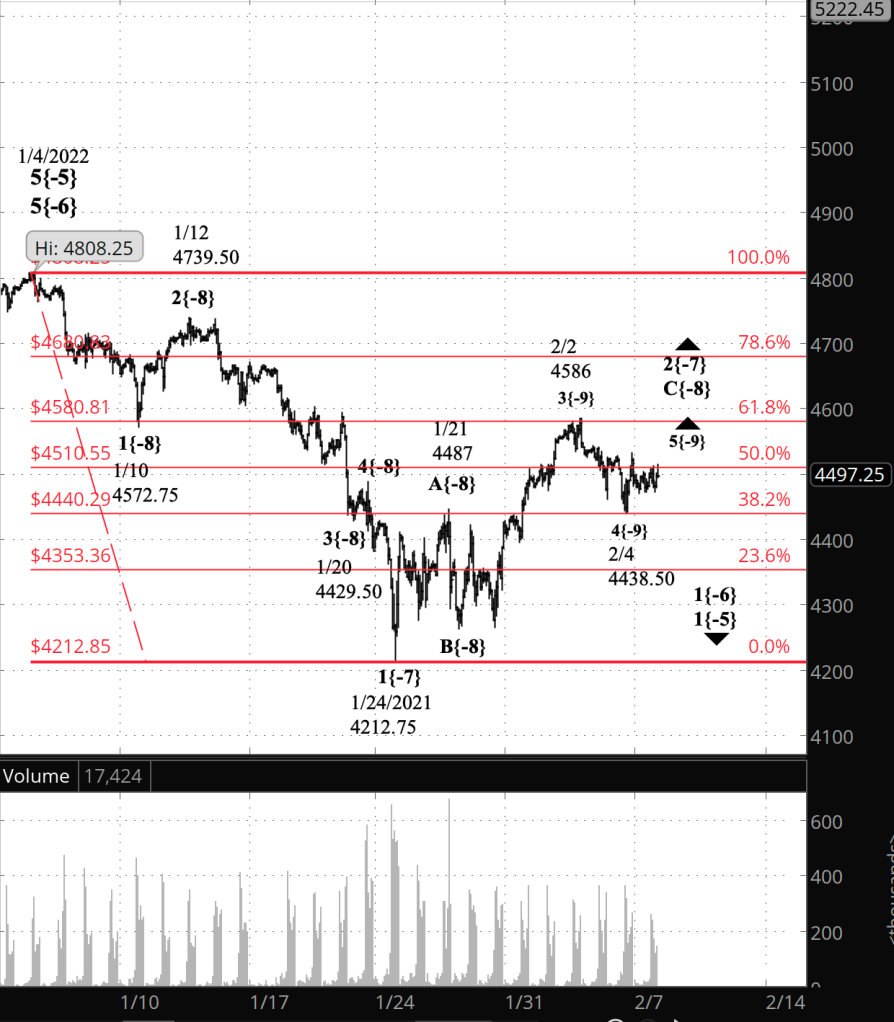
Half an hour before the closing bell. The S&P 500 futures traded within a narrow range during the session, so far less than 45 points wide. No change in the analysis. I’ve updated the chart.
10:10 a.m. New York time
PFE earnings play entry. I’ve entered short bull put options spread on PFE timed to coincide with the company’s earnings announcement Tuesday before the opening bell. I’ve posted an analysis of the trade.
9:35 a.m. New York time
What’s happening now? The S&P 500 E-mini futures have hovered just below the 50% retracement level since trading resumed Sunday afternoon.
What does it mean? By my principal analysis, the third and likely final leg of the upward correction that began on January 24 has internally entered its final rise, which will likely carry the price above the February 2 high, 4586, and higher. The price will remain below the January 4 starting point of the downtrend, 4808.25. The correction will be followed by a resumption of the downtrend that will carry the price below the January 24 start of the correction, 4212.75, and perhaps significantly below that level.
What’s the alternative? There are two alternatives.
Alternative #1: It remains possible that the February 2 high marked the end of the correction and that the downtrend has resumed. A move below 4212.75 would verify this analysis.
Alternative #2: The end of the final leg of the correction will be followed by a declining wave and then a second corrective pattern, in a compound pattern. Compound corrections can string together as many as three corrective patterns.
[S&P 500 E-mini futures at 9:35 a.m., 80-minute bars, with volume]
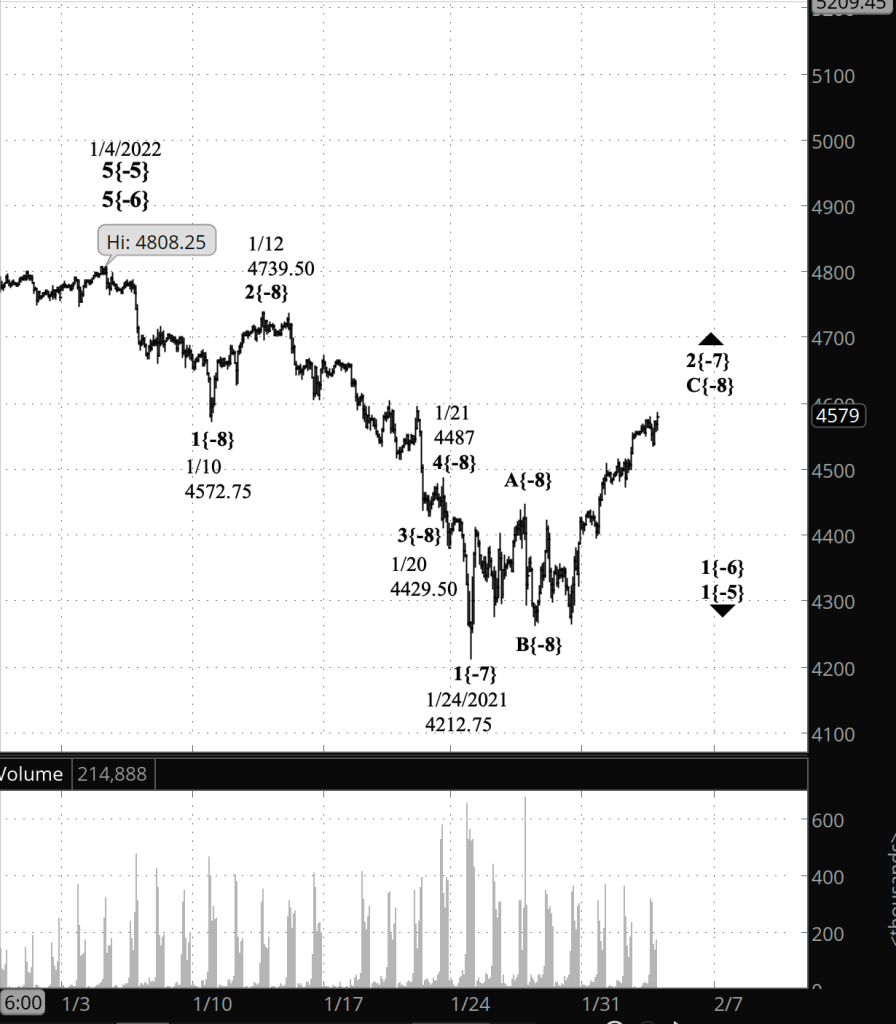
What does Elliott wave theory say? The correction, wave 2{-7}, is internally in its third and final wave, C{-8}. The C wave has five waves within it, and by my principal analysis began wave 5{-9} from the February 4 low. The resumption of the downtrend following wave 2{-7} will be wave 3{-8}, an energetic decline that will carry the price below 4212.75 and perhaps shockingly lower.
Alternative #1: Wave 2{-7} ended with the February 2 high and wave 3{-7} is taking its first tentative steps.
Alternative #2: Wave C{-8} will be followed by wave X{-8} to the downside and then by wave A{-8} of a second, three-wave corrective pattern. The X{-8} wave will remain above 4212.75, the January 24 low.
We Are Here.
These are the waves currently in progress under my principal analysis. Each line on the list shows the wave number, with the subscript in curly brackets, the traditional degree name, the starting date, the starting price of the S&P 500 E-mini futures, and the direction of the wave.
5{0} Intermediate, 12/21/2018, 2316.75 (up)
3{1} Minor, 3/23/2018 2174 (up)
5{-2} Minute, 10/4/2020, 4267.50 (up)
4{-3} Minuette, 1/4/2022, 4808.25 (down)
A{-4} Subminuette, 1/4/2022, 4808.25 (down)
1{-5} Micro, 1/4/2022, 4808.25 (down)
1{-6} Submicro, 1/4/2022, 4808.25 (down)
2{-7} Minuscule, 1/24/2022, 4212.75 (up)
C{-8} Subminuscule, 1/26/2022, 4263.75 (up)
5{-9} Bitsy, 2/4/2022, 4438.50 (up)
Learning and other resources. Elliott wave analysis provides context, not prophecy. As the 20th century semanticist Alfred Korzybski put it this way in his book Science and Sanity (1933), “The map is not the territory … The only usefulness of a map depends on similarity of structure between the empirical world and the map.” And I would add, in the ever-changing markets, we can judge that similarity of structure only after the fact.
See the menu page Analytical Methods for a rundown on where to go for information on Elliott wave analysis.
By Tim Bovee, Portland, Oregon, February 7, 2022
Disclaimer
Tim Bovee, Private Trader tracks the analysis and trades of a private trader for his own accounts. Nothing in this blog constitutes a recommendation to buy or sell stocks, options or any other financial instrument. The only purpose of this blog is to provide education and entertainment.
No trader is ever 100 percent successful in his or her trades. Trading in the stock and option markets is risky and uncertain. Each trader must make trading decisions for his or her own account, and take responsibility for the consequences.
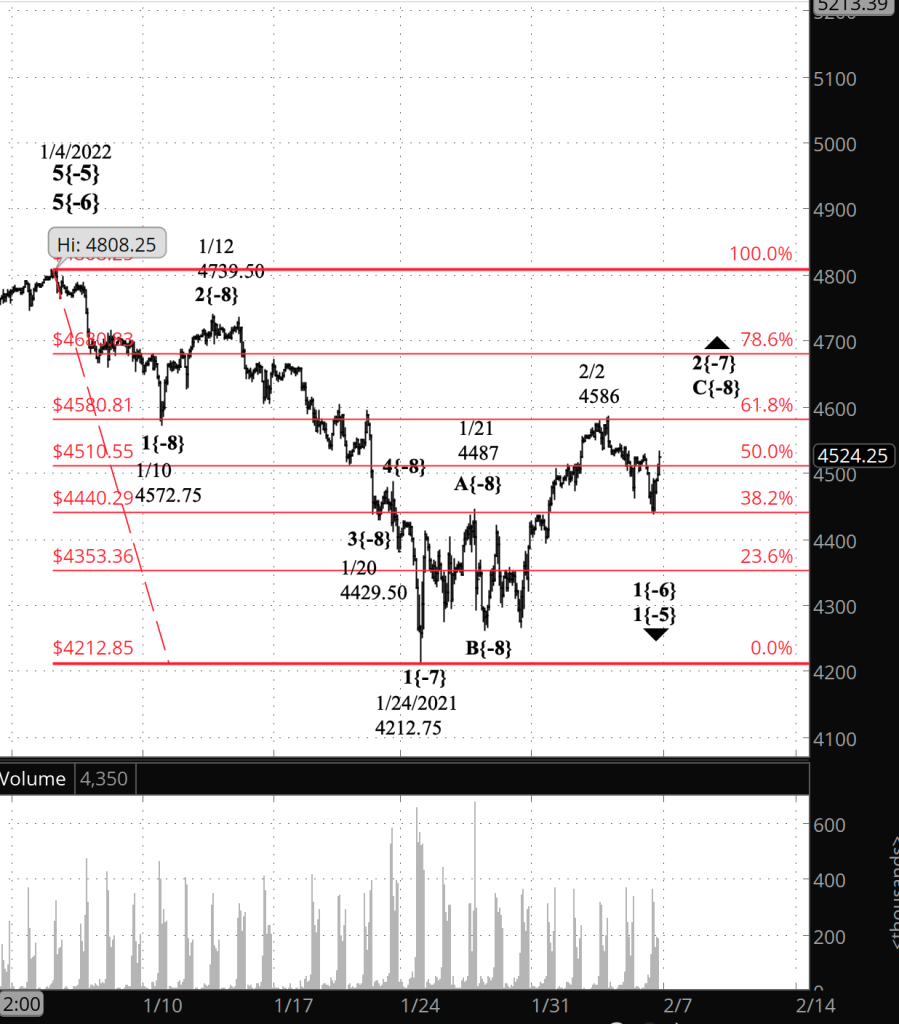
Half an hour before the closing bell. The S&P 500 declined during the session to the 38.25 retracement level and then reversed, again reaching above the 50% retracement as the session approached its end. No change to this morning’s somewhat tentative analysis. I’ve updated the upper chart.
2 p.m. New York time
PRU earnings play exit. I’ve exited my bull put spread on PRU for a 32.5% profit one day after entry and have updated the trade analysis with full results.
9:35 a.m. New York time
What’s happening now? The S&P 500 E-mini futures continued to decline in overnight trading, reaching the 38.2% Fibonacci retracement level.
What does it mean? I’m sticking with yesterday’s principal analysis, but with declining confidence: The upward correction that began on January 24 from 4212.75 continues. It is in its last leg, and when it is complete, the downtrend that began on January 4 from 4808.25 will resume.
What’s the alternative? The greater the decline from the February 2 high, 4586, the greater the likelihood that upward correction is over, having ended at that peak. Under this scenario, the downtrend resumed two days ago and will quickly pick up momentum as it declines below 4212.75.
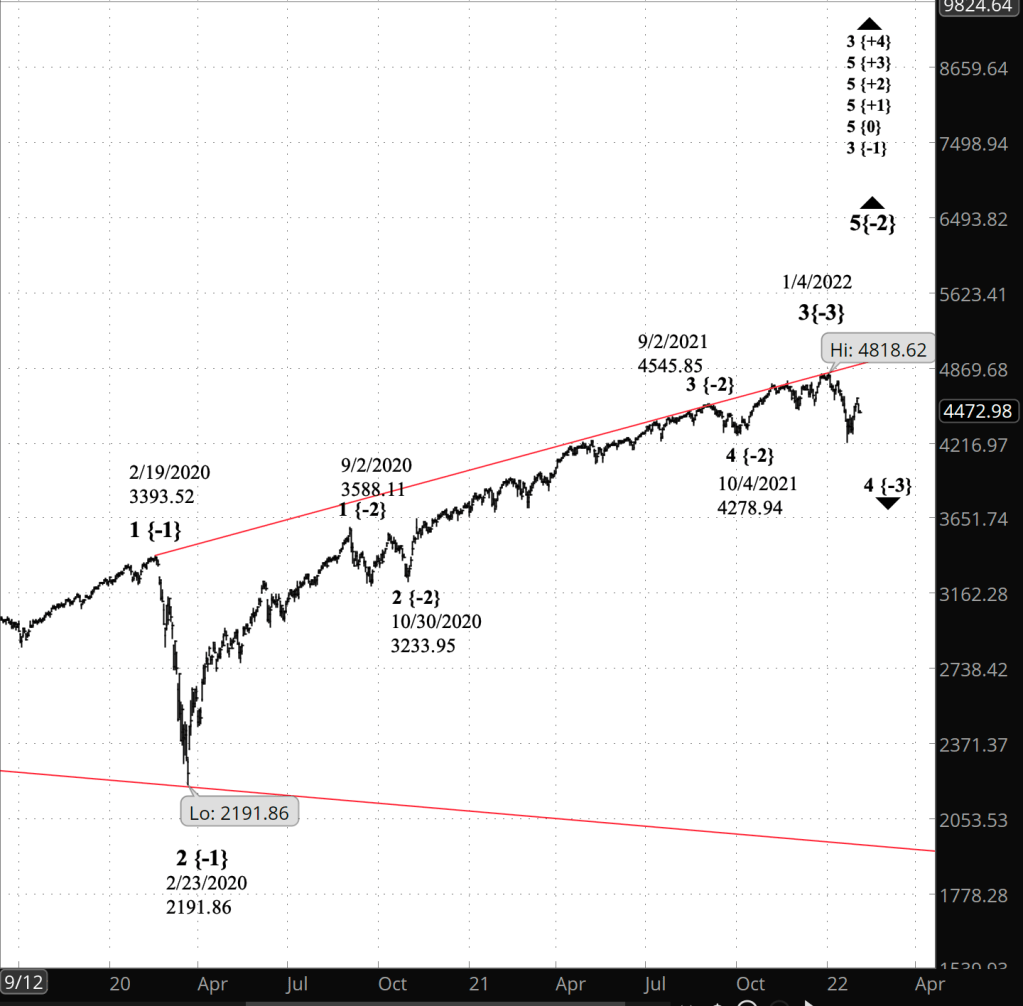
Charts. The upper chart offers a close-up view of the S&P 500 futures, tracking the decline that began January 4. The lower chart offers a longer-term view of the S&P 500 index, tracking the early pandemic crash and the subsequent rise. The red lines on the lower chart are the boundaries of an expanding Diagonal Triangle that began in December 2018.
[S&P 500 E-mini futures at 3:30 p.m., 80-minute bars, with volume]
[S&P 500 index at 9:33 a.m., daily bars]
What does Elliott wave theory say? Under my increasingly less probable principal analysis, wave 2{-7} continues its rise. Internally, I find that the best count is that wave 3{-9} within wave C{-8} ended on February 2 at 4586, and declining wave 4{-9} within C{-8} is underway.
Under my increasingly more probable alternative analysis, wave 2{-7} ended on February 2 and wave 3{-7} has begun its downward journey. Third waves are powerful, generally the longest of the three waves in the direction of a trend, and wave 3{-7} is likely to carry the price below the ending price — 4212.75 — of the preceding wave 1{-7}.
So what will it take to resolve the difficult choice between the two scenarios? The principal analysis will be proven if the price reverses and moves above 4586, the end of wave 3{-9}. The alternative analysis will be proven if the price moves below 4212.75, the endpoint of wave 1{-7}.
We Are Here.
These are the waves currently in progress under the principal analysis. Each line on the list shows the wave number, with the subscript in curly brackets, the traditional degree name, the starting date, the starting price of the S&P 500 E-mini futures, and the direction of the wave.
5{0} Intermediate, 12/21/2018, 2316.75 (up)
3{-1} Minor, 3/23/2018 2174 (up)
5{-2} Minute, 10/4/2020, 4267.50 (up)
4{-3} Minuette, 1/4/2022, 4808.25 (down)
A{-4} Subminuette, 1/4/2022, 4808.25 (down)
1{-5} Micro, 1/4/2022, 4808.25 (down)
1{-6} Submicro, 1/4/2022, 4808.25 (down)
2{-7} Minuscule, 1/24/2022, 4212.75 (up)
C{-8} Subminuscule, 1/26/2022, 4263.75 (up)
Under the alternative analysis, the last two lines would be changed to:
Learning and other resources. Elliott wave analysis provides context, not prophecy. As the 20th century semanticist Alfred Korzybski put it this way in his book Science and Sanity (1933), “The map is not the territory … The only usefulness of a map depends on similarity of structure between the empirical world and the map.” And I would add, in the ever-changing markets, we can judge that similarity of structure only after the fact.
See the menu page Analytical Methods for a rundown on where to go for information on Elliott wave analysis.
By Tim Bovee, Portland, Oregon, February 4, 2022
Disclaimer
Tim Bovee, Private Trader tracks the analysis and trades of a private trader for his own accounts. Nothing in this blog constitutes a recommendation to buy or sell stocks, options or any other financial instrument. The only purpose of this blog is to provide education and entertainment.
No trader is ever 100 percent successful in his or her trades. Trading in the stock and option markets is risky and uncertain. Each trader must make trading decisions for his or her own account, and take responsibility for the consequences.
Update 2/4/2022: I exited my short bull put spread position on PRU, 42 days before expiration, for an $0.83 debit per contract/share, a profit before fees of $27 per contract. Shares were trading at $117.97, up $2.44 from the entry level.
The Implied Volatility Rank at exit was 58.8%, down 21.7 points from the entry level.
I exited because the position reached 25% of maximum potential profit, my normal exit point for earnings plays.
Shares rose by 2.1% over one day for a +771% annual rate. The options position produced a 32.5% return for a +11,874% annual rate.
I have entered a short bull put options spread on PRU, using options that trade for the last time 43 days hence, on March 18. The premium is a $1.10 credit per contract share and the stock at the time of entry was priced at $115.53.
The Implied Volatility Ratio stood at 80.5%.
Premium:
$1.10
Expire OTM
PRU-bull put spread
Strike
Odds
Delta
Puts
Long
105.00
72.0%
24
Break-even
111.10
66.5%
29
Short
110.00
61.0%
34
The premium is 44% of the width of the position’s short/long spread. The profit zone covers a 3.8% move to the downside and an unlimited move to the upside.
The risk/reward ratio is 3.5:1, with maximum risk of $390 and maximum reward of $110 per contract.
How I chose the trade. The trade was placed to coincide with PRU’s earnings announcement, after the closing bell on the day of entry. The short strikes were set to coincide with the expected move of $1.47 either way, based on options pricing, which gives a price range of $114.06 to $117.00.
By Tim Bovee, Portland, Oregon, February 3, 2022
Disclaimer
Tim Bovee, Private Trader tracks the analysis and trades of a private trader for his own accounts. Nothing in this blog constitutes a recommendation to buy or sell stocks, options or any other financial instrument. The only purpose of this blog is to provide education and entertainment.
No trader is ever 100 percent successful in his or her trades. Trading in the stock and option markets is risky and uncertain. Each trader must make trading decisions for his or her own account, and take responsibility for the consequences.
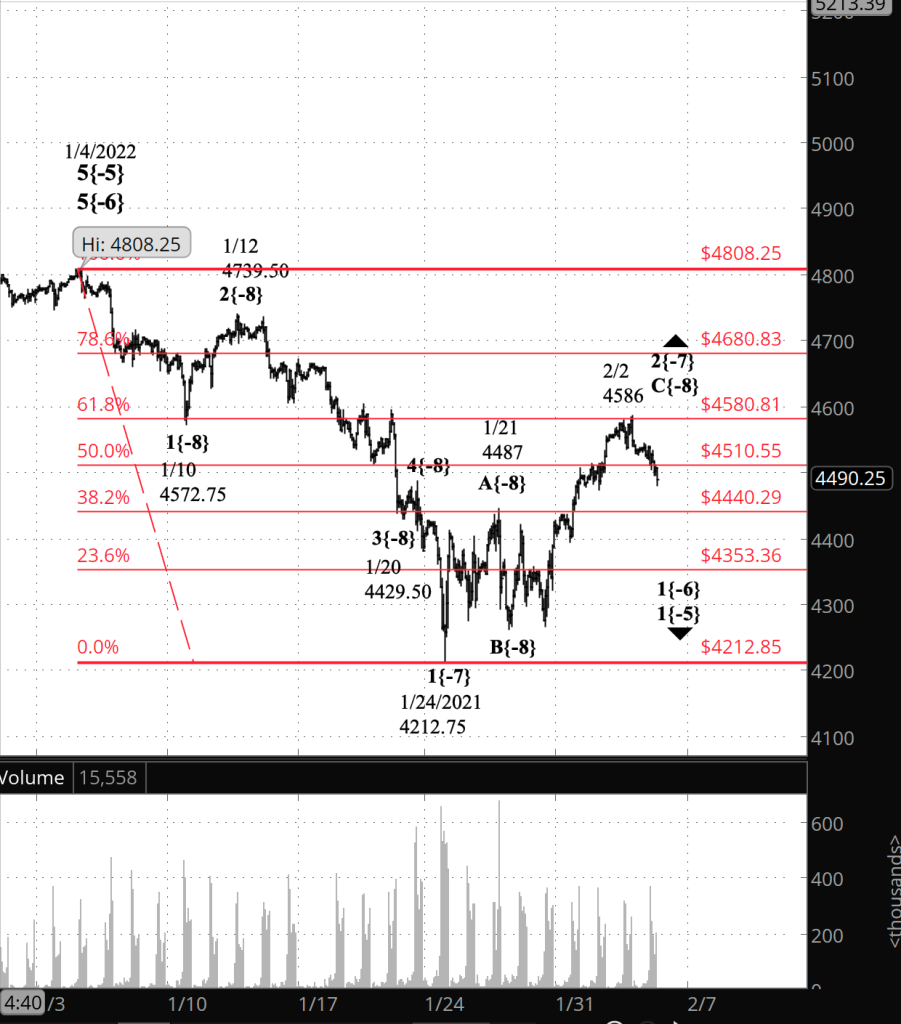
Half an hour before the closing bell. The S&P 500 fell below the 50% retracement level and remained there for much of the trading session. I’m adding another alternative analysis to the mix: That wave C{-8} ended on February 2 at 4586 on the futures chart and that downtrending wave 5{-7} has begun. Otherwise, no change in my analysis. I’ve updated the chart.
10:55 a.m. New York time
PRU earnings play entry. I’ve entered a short bull put options spread on PRU, coinciding with the company’s earnings announcement after the closing bell. I’ve posted an analysis of the trade.
9:35 a.m. New York time
What’s happening now? The S&P 500 E-mini futures fell in overnight trading from Wednesday’s peak, 4586, which is close to the 61.8% Fibonacci retracement level. The decline has reached the 50% retracement level.
What does it mean? The upward correction that began on January 24 is underway. It is in its third and possibly final leg. Internally, that third leg is near completion, with one more upward movement remaining, which will carry the price above 4586. Once the correction is complete, the downtrend that began January 4 will resume, carrying the price below the correction’s starting point, 4212.75.
What’s the alternative? Although a corrective pattern has three waves, it is possible that the correction will extend in a compound structure that links two corrective patterns together, delaying resumption of the downtrend.
[S&P 500 E-mini futures at 3:30 p.m., 80-minute bars, with volume]
What does Elliott wave theory say? Under my principal analysis, the upward correction, wave 2{-7} is underway and is most likely in its final wave, C{-8}. Internally, the drop off from yesterday’s high is wave 4{-9]. and it will be followed by wave 5{-9} to the upside, which will complete the corrective pattern that began on January 24. Wave 4{-9} will be followed by wave 5{-9}, which will carry the price below 4212.75. Third waves tend to have a lot energy and so I would expect this 3rd wave to move significantly below that level.
Under the alternative analysis, wave 2{-7} will extend in a compound correction. Upward wave C{-8} will be followed by upward wave X{-8}, which will connect the first corrective pattern with a second corrective pattern. I’ve seen such compound corrections most often withinin 4th waves, but they do sometimes occur in 2nd waves.
We Are Here.
These are the wave currently in progress. Each line on the list shows the wave number, with the subscript in curly brackets, the traditional degree name, the starting date, the starting price of the S&P 500 E-mini futures, and the direction of the wave.
5{0} Intermediate, 12/21/2018, 2316.75 (up)
3{1} Minor, 3/23/2018 2174 (up)
5{-2} Minute, 10/4/2020, 4267.50 (up)
4{-3} Minuette, 1/4/2022, 4808.25 (down)
A{-4} Subminuette, 1/4/2022, 4808.25 (down)
1{-5} Micro, 1/4/2022, 4808.25 (down)
1{-6} Submicro, 1/4/2022, 4808.25 (down)
4{-7} Minuscule, 1/24/2022, 4212.75 (up)
C{-8} Subminuscule, 1/26/2022, 4263.75 (up)
Learning and other resources. Elliott wave analysis provides context, not prophecy. As the 20th century semanticist Alfred Korzybski put it this way in his book Science and Sanity (1933), “The map is not the territory … The only usefulness of a map depends on similarity of structure between the empirical world and the map.” And I would add, in the ever-changing markets, we can judge that similarity of structure only after the fact.
See the menu page Analytical Methods for a rundown on where to go for information on Elliott wave analysis.
By Tim Bovee, Portland, Oregon, February 3, 2022
Disclaimer
Tim Bovee, Private Trader tracks the analysis and trades of a private trader for his own accounts. Nothing in this blog constitutes a recommendation to buy or sell stocks, options or any other financial instrument. The only purpose of this blog is to provide education and entertainment.
No trader is ever 100 percent successful in his or her trades. Trading in the stock and option markets is risky and uncertain. Each trader must make trading decisions for his or her own account, and take responsibility for the consequences.
Update 3/15/2022: The short puts in my bull put vertical options spread on FB were assigned, three days before expiration. There was no debit on the options. I retained the $8.20 per contract share entry credit and received 100 long shares of FB stock per options contract at the $300 per share strike price, which I sold for $188.43 per share.
That left my long puts in place. I exited them the same day as the assignment, for a $101.97 credit per contract/share, a profit before fees of $10,107 per contract. Shares were trading at $188.03, down $135.08 from the entry level.
Altogther, the result — options and shares combined — was a $1.12 loss before fees per contract share.
The Implied Volatility Rank at exit was 71.7, up 15.1 points from the entry level.
The results that follow are for the options combined with the shares that resulted from the assignment.
The share price declined by 41.8% over 41 days for a +372% annual rate. The options position and the shares resulting from assignment combined produced a 37.2% loss for a -331% annual rate.
I have entered a short bull put options spread on FB, using options that trade for the last time 44 days hence, on March 18. The premium is a $2.40 credit per contract share and the stock at the time of entry was priced at $323.51.
The Implied Volatility Ratio stood at 56.6%.
Premium:
$2.40
Expire OTM
FB-bull put spread
Strike
Odds
Delta
Puts
Long
290.00
76.0%
21
Break-even
302.40
72.0%
24
Short
300.00
68.0%
27
The premium is 48% of the width of the position’s short/long spread. The profit zone covers a 6.5% move to the downside and an unlimited move to the upside.
The risk/reward ratio is 3.2:1, with maximum risk of $760 and maximum reward of $240 per contract.
How I chose the trade. The trade was placed to coincide with FB’s earnings announcement, after the closing bell on the day of entry. The short strikes were set to coincide with the expected move of $19.29 either way, based on options pricing, which gives a price range of $304.23 to $342.8-.
By Tim Bovee, Portland, Oregon, February 2, 2022
Disclaimer
Tim Bovee, Private Trader tracks the analysis and trades of a private trader for his own accounts. Nothing in this blog constitutes a recommendation to buy or sell stocks, options or any other financial instrument. The only purpose of this blog is to provide education and entertainment.
No trader is ever 100 percent successful in his or her trades. Trading in the stock and option markets is risky and uncertain. Each trader must make trading decisions for his or her own account, and take responsibility for the consequences.
Half an hour before the closing bell. No change from the re-analysis that I posted an hour and 10 minutes ago. Wave 2{-7}, an upward correction, continues and now internally is in wave C{-8}, it’s final wave, unless it extends in a complex correction. Wave C{-8} will have five waves total within it and by my count is now on it’s middle leg, upward wave 3{-9}. I’ve updated the chart.
2:20 p.m. New York time
The new principal analysis. The old principal analysis from this morning having been invalidated when it bumped into a firm rule of Elliott wave theory, I’ve been looking at the chart to find a re-analysis that would be true to the rules.
One approach that I try to take with any reanalysis is that of Minimum Necessary Change, a term borrowed from Isaac Asimov’s 1955 time-travel novel The End of Eternity. In it, the guardians of the future make small changes in the past — moving a box from one shelf to another — in order safeguard the timeline that leads to them. They make the Minimum Necessary Change.
In the case of the S&P 500, the Minimum Necessary Change would keep the 4th wave rule from being broken (see the discussion below) while preserving the January 4 peak as a significant reversal in the trend.
The way to do that is to make the rise that began on January 24 into something other than a 4th wave. Which I’ve done, by taking some waves that had been at degree {-7} in the earlier count and demoting them to degree {-8}, which makes the low of January 24 the end of wave 1{-7} and the subsequent rise an upward correction, wave 2{-7}, which is still underway and internally is in its 3rd wave, wave C{-8}.
The rule for 2nd waves is this: Wave 2 cannot move above the beginning of the preceding wave 1. That 1st wave began at the January 4 peak, 2808.25, leaving ample room for wave 2{-7} to complete its rise before the downtrend continues with wave 3{-7} to the downside.
Yesterday I entered a bear position on SPY based on the old principal analysis. The reasoning behind the trade remains valid under the new analysis.
1:05 p.m. New York time
S&P 500 index invalidates 4th-wave count. The S&P 500 index has moved above the low of January 10. In terms of Elliott wave theory, that low point, 4582.84, was then end of wave 1{-7}. This morning’s principal count had labelled the rise from January 24 as wave 4{-7}. if a 4th wave moves beyond the end of the prior 1st wave, then it’s not a 4th wave, and something else is going on. I’ll post a fresh analysis half an hour before the closing bell.
12:55 p.m. New York time
SPY breaks the 4th wave rule. The exchange-traded fund SPY, based on the S&P 500, joined the S&P 500 futures in moving above the end of the preceding 1st wave, which beaks a rule of Elliott wave theory. See my extensive discussion of the question from this morning. The S&P 500 index, the decider in case of conflicting signals, remains below the end of the preceding 1st wave. The 1st wave terminus for SPY was $456.60, and the price has moved above that level, so far, by 8 cents.
10:20 a.m. New York time
FB earnings play entry. I’ve entered a short bull put options spread on FB timed to coincide with its earnings announcement after the closing bell today. I’ve posted an analysis of the trade.
9:35 a.m. New York time
What’s happening now? The S&P 500 E-mini futures rose overnight to 4580 and then fell back, remaining above the 61.8% Fibonacci retracement level.
What does it mean? The futures high exceeds the end of the first leg of the downtrend that began on January 4, violating a rule of Elliott wave analysis. If that violation is confirmed by the index, then the principal count will be replaced by the alternative count. More on the discrepancy in the Elliott wave theory section.
What’s the alternative? The downward movement from the January 4 peak, 4808.25, was a correction within an ongoing uptrend, which has now resumed and will reach new heights.
[S&P 500 E-mini futures at 3:30 p.m., 80-minute bars, with volume]
What does Elliott wave theory say? The rules and tendencies governing market behavior described by R.N. Elliott are heavy on the tendency side. The markets are too complex and unruly to march to the beat of a single drummer. Rather, the more accurate comparison is to the unruly Feast of Fools in medieval France However, there are a few rules. One is that the 3rd wave of a trend can’t be the shortest of the three waves in the direction of the trend. Either wave 1 or wave 3 must be shorter. Another rule, applicable in this case, is that the 4th wave can’t move beyond the end of the preceding 1st wave. If it does, then it’s not a 4th wave, and something else is going on.
When Elliott created his theory, there was no S&P 500. He used the Dow Jones Industrial Average. Moreover, there were no index futures and no index-based exchange-traded funds (ETFs) such as SPY. He lived in a market world having far less ambiguity than ours does.
The S&P 500 futures wave 4{-7} moved above the end the wave 1{-7} first during the London market session, and again during the Tokyo market session. The U.S. markets were closed, and the S&P 500 index only tracks prices during the U.S. market session.
There’s also the problem of granularity. The index moves in penny increments with, while the futures move in 25-cent increments, both with prices in the four figures. SPY, the S&P 500 ETF, moves in penny increments with prices in the three figures, meaning its granularity is far less than that of the index.
So, if the futures have violated the 4th wave rule, but the index and ETFs have not, how do we analyze the chart? An expert wise in the ways in Elliott wave analysis once told me that they are separate products and must be analyzed separately. And yet, the futures and the ETFs are clones of the index, closely following it while operating under separate rules and separate platforms.
We’ve been here before. In the run-up of wave 3{-1} after the early pandemic crash, several times the three platforms diverged, and within a few days regained their unanimity. My practice then, when the futures broke a rule but the index did not, was to analyze the futures as though the rule hadn’t been broken. I designated the index as the rule-keeper and required that it also break the rule before changing the analysis.
And that’s what I’ll do today.
Under my principal analysis, wave C{-8} continues it’s rise, trading in the area between the 61.8% and the 78.6% Fibonacci retracement levels. The upward correction parent, wave 4{-7}, continues its upward movement.
Under the alternative analysis, the downward correction that began on January 4 ended on January 24, and wave 5{-7} within wave 5{-6} has resumed its upward course.
At the opening bell the S&P 500 index and SPY remain below the end of wave 1{-7}, which is4582.24 on the index and 456.60 on SPY.
We Are Here.
These are the waves currently in progress according to my principal analysis. Each line on the list shows the wave number, with the subscript in curly brackets, the traditional degree name, the starting date, the starting price of the S&P 500 E-mini futures, and the direction of the wave.
5{0} Intermediate, 12/21/2018, 2316.75 (up)
3{1} Minor, 3/23/2018 2174 (up)
5{-2} Minute, 10/4/2020, 4267.50 (up)
4{-3} Minuette, 1/4/2022, 4808.25 (down)
A{-4} Subminuette, 1/4/2022, 4808.25 (down)
1{-5} Micro, 1/4/2022, 4808.25 (down)
1{-6} Submicro, 1/4/2022, 4808.25 (down)
2{-7} Minuscule, 1/24/2022, 4212.75 (up)
C{-8} Subminuscule, 1/26/2022, 4263.75 (up)
Learning and other resources. Elliott wave analysis provides context, not prophecy. As the 20th century semanticist Alfred Korzybski put it this way in his book Science and Sanity (1933), “The map is not the territory … The only usefulness of a map depends on similarity of structure between the empirical world and the map.” And I would add, in the ever-changing markets, we can judge that similarity of structure only after the fact.
See the menu page Analytical Methods for a rundown on where to go for information on Elliott wave analysis.
By Tim Bovee, Portland, Oregon, February 2, 2022
Disclaimer
Tim Bovee, Private Trader tracks the analysis and trades of a private trader for his own accounts. Nothing in this blog constitutes a recommendation to buy or sell stocks, options or any other financial instrument. The only purpose of this blog is to provide education and entertainment.
No trader is ever 100 percent successful in his or her trades. Trading in the stock and option markets is risky and uncertain. Each trader must make trading decisions for his or her own account, and take responsibility for the consequences.
Update 2/14/2022: I exited my short bear call options spread on SPY, 32 days before expiration, for a $1.40 debit per contract/share, a profit before fees of $2.04 per contract. Shares were trading at $437.54, down $12.98 from the entry level.
The Implied Volatility Rank at exit was 66.1%, up 25.3 points from the entry level.
I exited because the position reached 50% of maximum potential profit, the exit goal under my rules for short option trades.
Shares declined by 2.9% over 13 days for a -81% annual rate. The options position produced an 85.0% return for a +2,387% annual rate.
(I erred in entering the trade and created an iron condor rather than a bear call vertical spread. I’m treating the calls as a separate trade, and have adjusted some figures on this analysis to conform to the lower premium.)
I have entered a short bear call options spread on SPY, using options that trade for the last time 456 days hence, on March 18. The premium is a $4.44 credit per contract share and the exchange-traded fund at the time of entry was priced at $450.52.
The Implied Volatility Ratio stood at 40.8%.
Premium:
$4.44
Expire OTM
SPY-bear call spread
Strike
Odds
Delta
Calls
Long
466.00
74.0%
29
Break-even
460.80
67.0%
36.5
Short
456.00
60.0%
44
The premium is 44.4% of the width of the position’s short/long spread. The profit zone covers a 2.2% move to the upside and an unlimited move to the downside.
The risk/reward ratio is 1.3:1, with maximum risk of $546 and maximum reward of $444 per contract.
How I chose the trade. My Elliott wave analysis shows that an upward correction that began on January 24 on the S&P 500 is nearing an end. Under the results of Elliott, the price of the index and it’s deritives must remain below the end of the first wave of the downtrend that began on January 4. For SPY, the first wave ended at 456.60, and I placed the short strike at 456, which is as close to that level as the strike prices allowed.
By Tim Bovee, Portland, Oregon, February 1, 2022
Disclaimer
Tim Bovee, Private Trader tracks the analysis and trades of a private trader for his own accounts. Nothing in this blog constitutes a recommendation to buy or sell stocks, options or any other financial instrument. The only purpose of this blog is to provide education and entertainment.
No trader is ever 100 percent successful in his or her trades. Trading in the stock and option markets is risky and uncertain. Each trader must make trading decisions for his or her own account, and take responsibility for the consequences.
Update 3/15/2022: I exited my bull put vertical options spread on GM, three days before expiration, for a $4.90 debit per contract/share, a loss before fees of $379 per contract. Shares were trading at $41.96, down $11.54 from the entry level.
The Implied Volatility Rank at exit was 75.2, up 18.2 points from the entry level.
I exited because the position was in the money as it neared expiration.
Shares declined by 21.6% over 42 days for a -188% annual rate. The options position produced a 77.3% loss for a -672% annual rate.
I have entered a short bull put options spread on GM, using options that trade for the last time 45 days hence, on March 18. The premium is a $1.11 credit per contract share and the stock at the time of entry was priced at $53.50.
The Implied Volatility Ratio stood at 57.0%.
Premium:
$1.11
Expire OTM
GM-bull put spread
Strike
Odds
Delta
Puts
Long
45.00
81.0%
15
Break-even
51.11
72.0%
23
Short
50.00
63.0%
31
The premium is 44.4% of the width of the position’s short/long spread. The profit zone covers a 4.5% move to the downside and an unlimited move to the upside.
The risk/reward ratio is 3.5:1, with maximum risk of $389 and maximum reward of $111 per contract.
How I chose the trade. The trade was placed to coincide with GM’s earnings announcement, after the closing bell on the day of entry. The short strikes were set to coincide with the expected move of $2.50 either way, based on options pricing, which gives a price range of $51.08 to $56.08.
By Tim Bovee, Portland, Oregon, February 1, 2022
Disclaimer
Tim Bovee, Private Trader tracks the analysis and trades of a private trader for his own accounts. Nothing in this blog constitutes a recommendation to buy or sell stocks, options or any other financial instrument. The only purpose of this blog is to provide education and entertainment.
No trader is ever 100 percent successful in his or her trades. Trading in the stock and option markets is risky and uncertain. Each trader must make trading decisions for his or her own account, and take responsibility for the consequences.
Half an hour before the closing bell. The S&P 500 futures rose during the session, approaching to within 53 points of the highest point this 4th wave upward correction can reach without violating the rules of Elliott wave analysis. As I put it in my cheatsheet: “If the wave moves beyond the end of wave 1, then it’s not wave 4”. No change in the analysis. I’ve updated the chart.
3:15 p.m. New York time
SPY options spread entry. I’ve entered a short bear call options spread on SPY, based on Elliott wave analysis, in an attempt to capture the 5th wave decline that will follow the end of the present 4th wave correction to the upside. I’ve posted an analysis of the trade.
2:25 p.m. New York time
UNP earnings play exit. I’ve exited my short iron condor spread on UNP for an 8.2% return and have updated the trade analysis with full results.
2 p.m. New York time
XOM earnings play exit. I’ve exited my short bull put spread on XOM for a 44.1% return and have updated the trade analysis with full results.
1:45 p.m. New York time
C earnings play exit. I’ve exited my short iron condor spread on C for a 40% return and have updated the trade analysis with full results.
1:15 p.m. New York time
GM earnings play entry. I’ve entered a short bull put options spread on GM timed to coincide with the company’s earnings announcement after the closing bell today. I’ve posted an analysis of the trade.
9:35 a.m. New York time
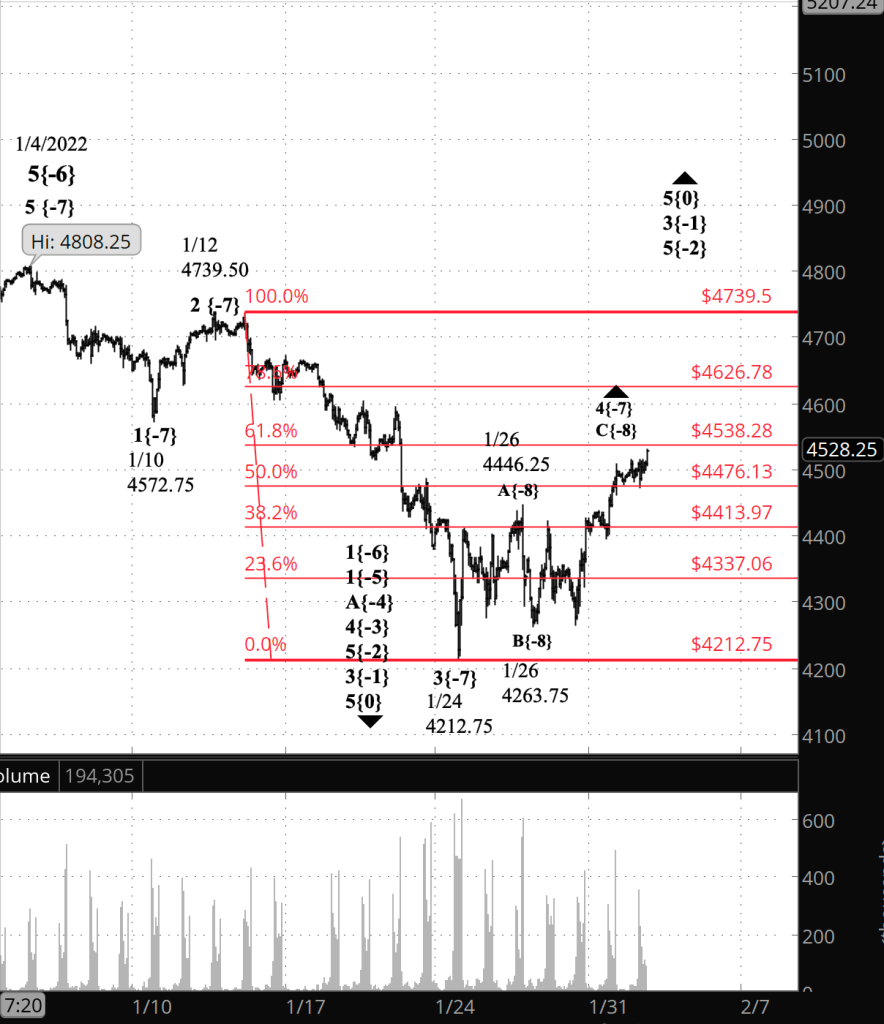
What’s happening now? The S&P 500 E-mini futures traded sideways overnight in the space between the 50% and 61.8% Fibonacci retracement levels.
What does it mean? The upward correction that began on January 24 is nearing an end. It may well rise further but will remain below 2572.75. It will be followed by a resumption of the downtrend that began on January 4.
What are the alternatives? There are 2. Both rely on the chart being analyzed as showing that the corrective pattern is complete.
The downtrend following the correction is taking the first tentative steps of its resumption.
The downtrend within the correction is the beginning of will be followed by a second corrective pattern in a complex correction.
[S&P 500 E-mini futures at 3:30 p.m., 70-minute bars, with volume]
What does Elliott wave theory say? Wave 5{-9} within rising wave C{-8} is underway, as the parent wave 4{-7} nears it’s end. Under the rules of Elliott wave analysis, a rising 4th wave must remain below the end of the preceding 1st wave. Wave 1{-7} ended on January 10 at 4572.75. Wave 5{-9} has almost reached its end but could rise a bit more, perhaps to the 61.8% retracement level, 4538.28, which is 35 points below the end of wave 1{-7} and so is within the rules.
Under the first alternative, wave C{-8} is complete, along with its parent, wave 4{-7}. Downtrending wave 5{-7} has begun and will carry the price below 4212.75, the end of wave 3{-7}.
Under the second alternative, wave C{-8} is complete and will be followed by downward wave X{-8}, which marks the end of the first corrective pattern and the beginning of a second corrective pattern within a compound structure. Wave X will remain above 4212.75.
We Are Here.
These are the wave currently in progress. Each line on the list shows the wave number, with the subscript in curly brackets, the traditional degree name, the starting date, the starting price of the S&P 500 E-mini futures, and the direction of the wave.
5{0} Intermediate, 12/21/2018, 2316.75 (up)
3{1} Minor, 3/23/2018 2174 (up)
5{-2} Minute, 10/4/2020, 4267.50 (up)
4{-3} Minuette, 1/4/2022, 4808.25 (down)
A{-4} Subminuette, 1/4/2022, 4808.25 (down)
1{-5} Micro, 1/4/2022, 4808.25 (down)
1{-6} Submicro, 1/4/2022, 4808.25 (down)
4{-7} Minuscule, 1/24/2022, 4212.75 (up)
C{-8} Subminuscule, 1/26/2022, 4263.75 (up)
Learning and other resources. Elliott wave analysis provides context, not prophecy. As the 20th century semanticist Alfred Korzybski put it this way in his book Science and Sanity (1933), “The map is not the territory … The only usefulness of a map depends on similarity of structure between the empirical world and the map.” And I would add, in the ever-changing markets, we can judge that similarity of structure only after the fact.
See the menu page Analytical Methods for a rundown on where to go for information on Elliott wave analysis.
By Tim Bovee, Portland, Oregon, February 1, 2022
Disclaimer
Tim Bovee, Private Trader tracks the analysis and trades of a private trader for his own accounts. Nothing in this blog constitutes a recommendation to buy or sell stocks, options or any other financial instrument. The only purpose of this blog is to provide education and entertainment.
No trader is ever 100 percent successful in his or her trades. Trading in the stock and option markets is risky and uncertain. Each trader must make trading decisions for his or her own account, and take responsibility for the consequences.
Update 2/1/2022: I exited my short bull put spread position on XOM, 45 days before expiration, for a $0.93 debit per contract/share, a profit before fees of $41.00 per contract. Shares were trading at $77.59, up $2.22 from the entry level.
The Implied Volatility Rank at exit was 29.3%, down 9 points from the entry level.
I exited because the position exceeded 25% of maximum potential profit, my normal exit point for earnings plays.
Shares rose by 2.9% in one day for a +1,075% annual rate. The options position produced a 44.1% return for a +16,091% annual rate.
I have entered a short bull put vertical spread on XOM, using options that trade for the last time 46 days hence, on March 18. The premium is a $1.34 credit per contract share and the stock at the time of entry was priced at $75.37.
The Implied Volatility Ratio stood at 38.3%.
Premium:
$1.34
Expire OTM
XOM-bull put spread
Strike
Odds
Delta
Puts
Long
67.50
78.0%
18
Break-even
73.84
68.5%
26.5
Short
72.50
59.0%
35
The premium is 53.6% of the width of the positions short/long spread. The profit zone covers a 2% move to the downside and an unlimited move to the upside.
The risk/reward ratio is 2.7:1, with maximum risk of $366 and maximum reward of $134 per contract.
How I chose the trade. The trade was placed to coincide with XOM’S earnings announcement, before the opening bell on the day of entry. The short strikes were set to coincide with the expected move of $2.06 either way, based on options pricing, which gives a price range of $73.22 to $77.34.
By Tim Bovee, Portland, Oregon, January 31, 2022
Disclaimer
Tim Bovee, Private Trader tracks the analysis and trades of a private trader for his own accounts. Nothing in this blog constitutes a recommendation to buy or sell stocks, options or any other financial instrument. The only purpose of this blog is to provide education and entertainment.
No trader is ever 100 percent successful in his or her trades. Trading in the stock and option markets is risky and uncertain. Each trader must make trading decisions for his or her own account, and take responsibility for the consequences.

 Tim Bovee, Private Trader
You must be logged in to post a comment.