Trader’s Notebook: Gold

11:30 a.m. New York time

What’s happening now. The exchange-traded fund GLD peaked at 318.32 on May 6 and then declined

What does it mean? Elliott Wave Theory analysis concludes that the peak was the end of the final subwave within a larger rising B wave, the 2nd of three subwaves within a downward 4th wave correction that began on April 21, 2025. It also marks the beginning of the final subwave, declining wave C, with in the 4th-wave correction.

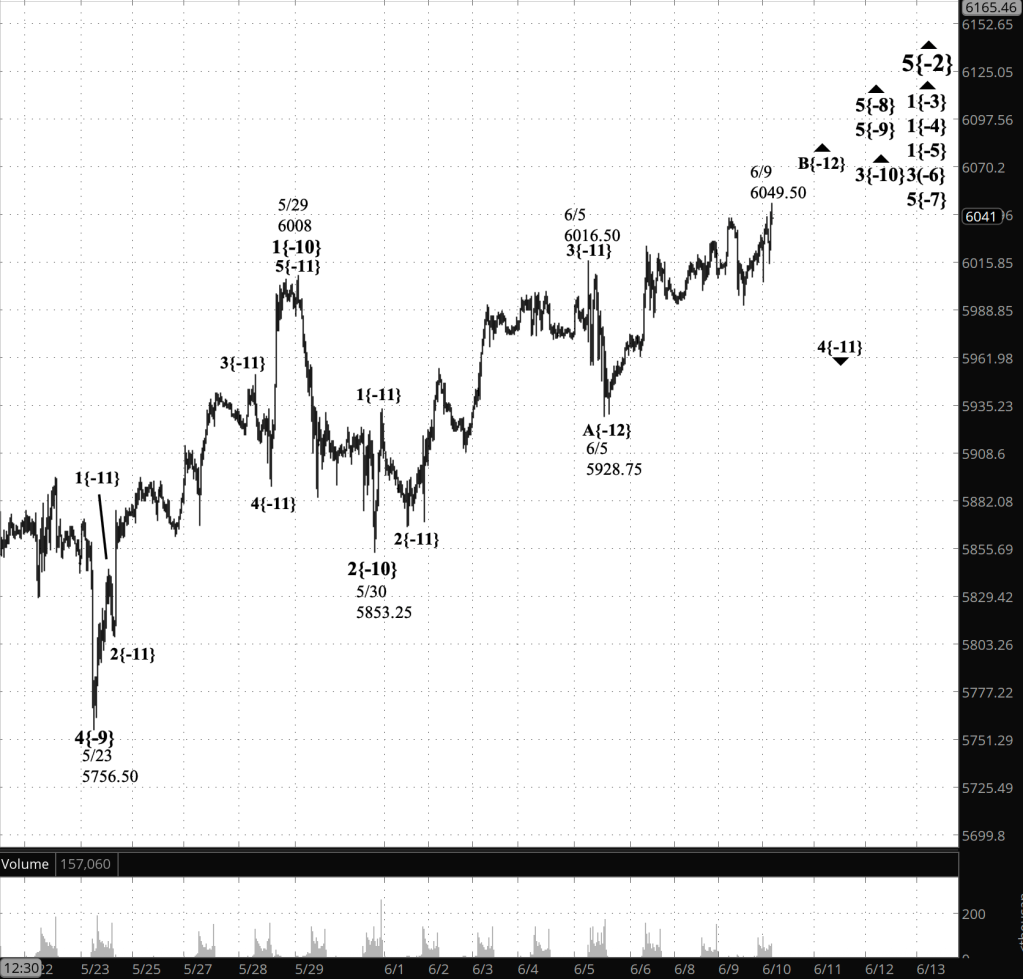
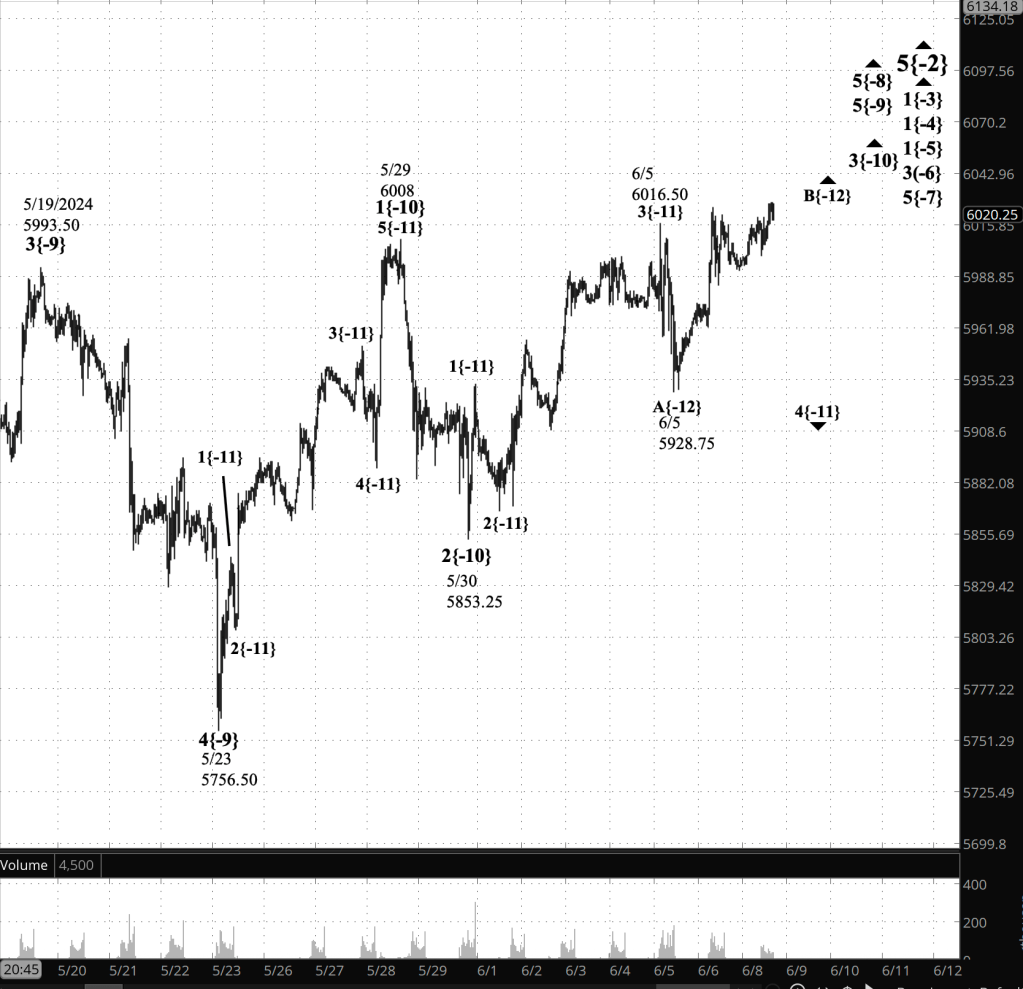
[GLD, 11:30 a.m., 55-minute bars, with volume]

Elliott Wave Theory wave labels. Each wave listed on the charts has two components: A wave number, and a subscript in curly brackets that place the wave’s position in the fractal strucutre in relationship to Intermediate degree. The present Intermediate degree, GLD wave 3{0}, began its rise on November 3, 2022 from 150.57 and is still underway.

The waves referred to above are as follows:

Declining wave C{-4} paused for a small upward correction before continuing its decline. ended on April 24 at 310.93 and declining wave C{-4} began and is underway. C4 is a subwave of declining wave A{-3}.

When wave C{-4} is complete, it will also be the end of wave A{-3} and the beginning of rising wave B{-3}, which typically retraces 38% to 79% of the preceding decline, wave A{-3}.

Long-term Waves

These are the waves currently in progress under my principal analysis. Each line on the list shows the wave number, with the subscript in curly brackets, the traditional degree name, the starting date, the starting price of the S&P 500 E-mini futures, and the direction of the wave.

  • GLD exchange-traded fund:
  • 3{+1} Primary, 12/17/2015, 100.23 (up)
  • 4{0} Intermediate, 4/21/2025, 322.52 (down)
  • A{−1} Minor, 4/21/2025, 322.52 (down)
  • A{−2} Minute, 4/21/2025, 322.52 (down)
  • C{−3} Minuette, 5/6/2025, 318.32 (down)

Reading the chart. Price movements — waves – – in Elliott Wave Theory analysis are labeled with numbers within trending waves and letters with corrective waves. The subscripts — numbers in curly brackets — designate the wave’s degree, which, in Elliott Wave analysis, means the relative position of a wave within the larger and smaller structures that make up the chart. R.N. Elliott, who in the 1930s developed the form of analysis that bears his name, viewed the chart as a complex structure of smaller waves nested within larger waves, which in turn are nested within still larger waves. In mathematics it’s called a fractal structure, where at every scale the pattern is similar to the others.

Learning and other resources. Elliott Wave analysis provides context, not prophecy. As the 20th century semanticist Alfred Korzybski put it in his book Science and Sanity (1933), “The map is not the territory … The only usefulness of a map depends on similarity of structure between the empirical world and the map.” And I would add, in the ever-changing markets, we can judge that similarity of structure only after the fact.

See the menu page Analytical Methods for a rundown on where to go for information on Elliott Wave analysis.

By Tim Bovee, Portland, Oregon, May 7, 2025

Disclaimer

Tim Bovee, Private Trader tracks the analysis and trades of a private trader for his own accounts. Nothing in this blog constitutes a recommendation to buy or sell stocks, options or any other financial instrument. The only purpose of this blog is to provide education and entertainment.

No trader is ever 100 percent successful in his or her trades. Trading in the stock and option markets is risky and uncertain. Each trader must make trading decisions for his or her own account, and take responsibility for the consequences.

License

All content on Tim Bovee, Private Trader by Timothy K. Bovee is licensed under a Creative Commons Attribution-ShareAlike 4.0 International License.

Based on a work at www.timbovee.com

Trader’s Notebook: S&P 500

3:30 p.m. New York time

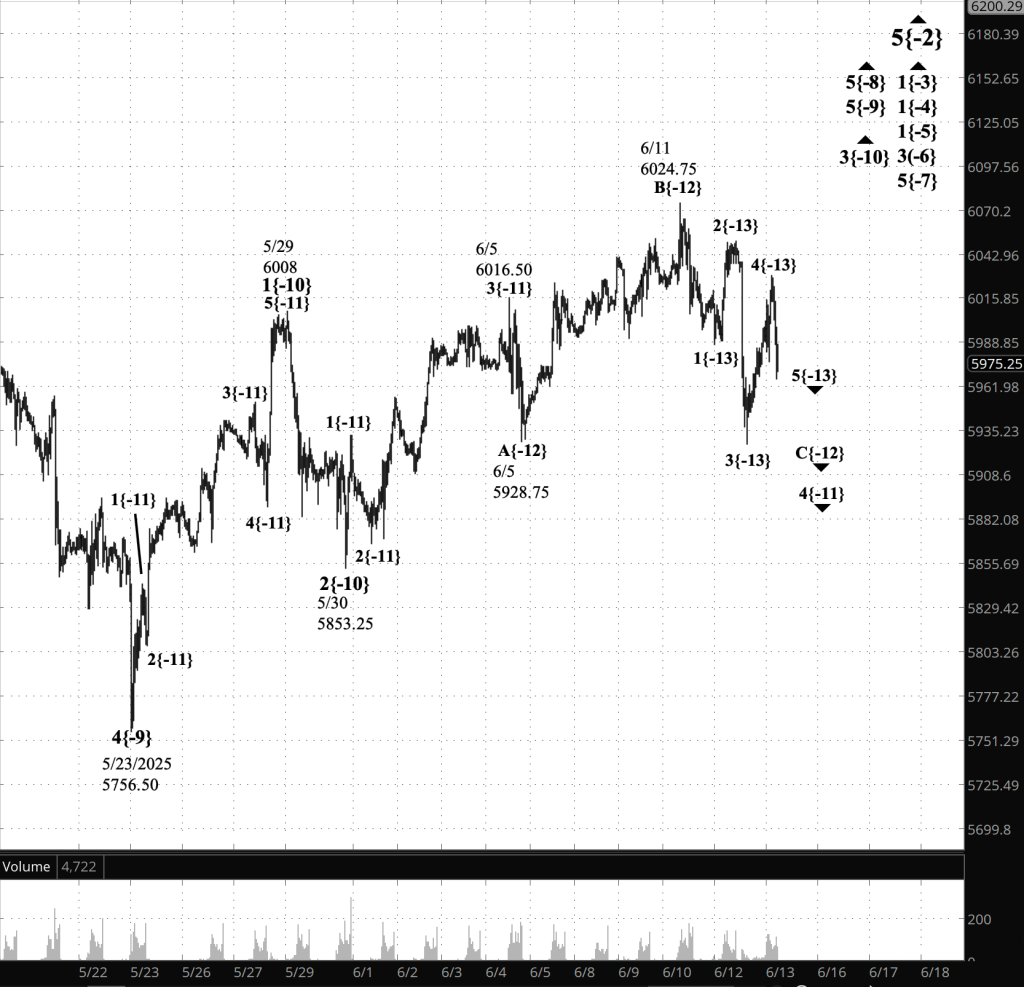
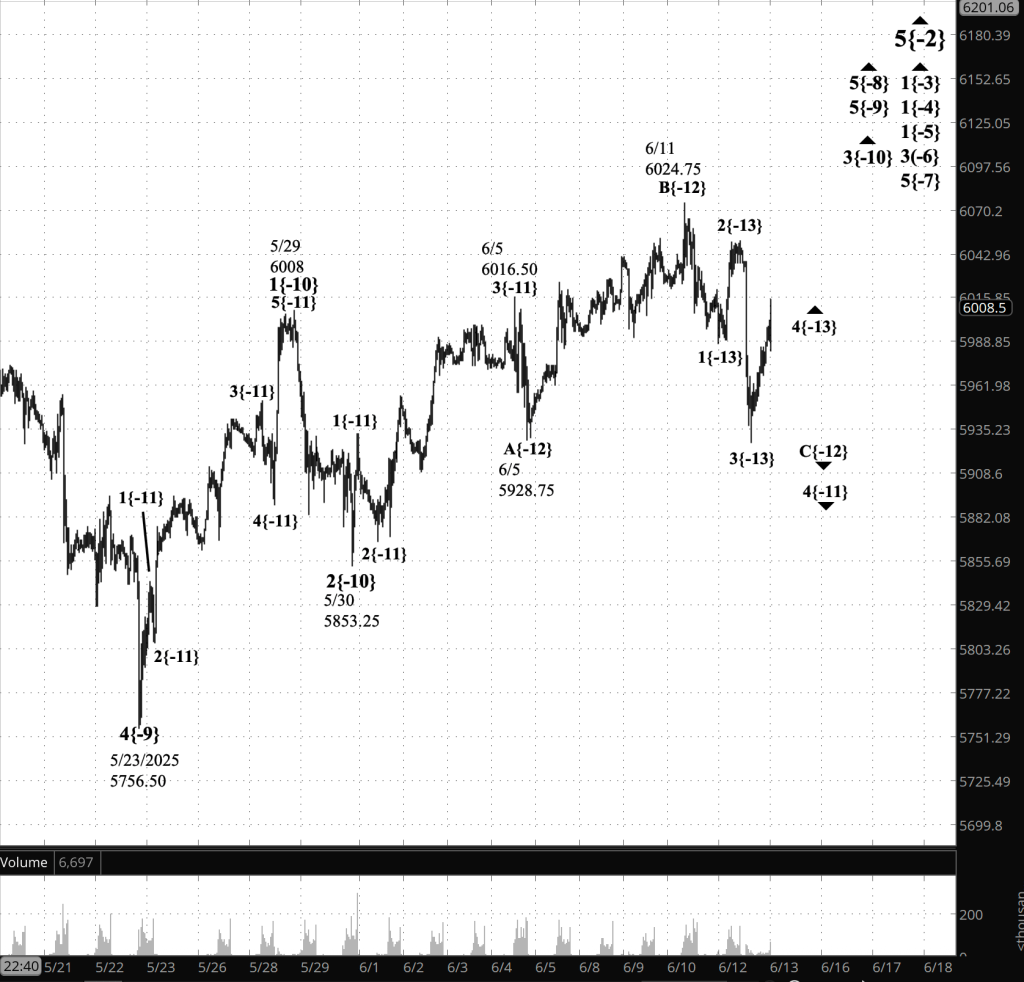
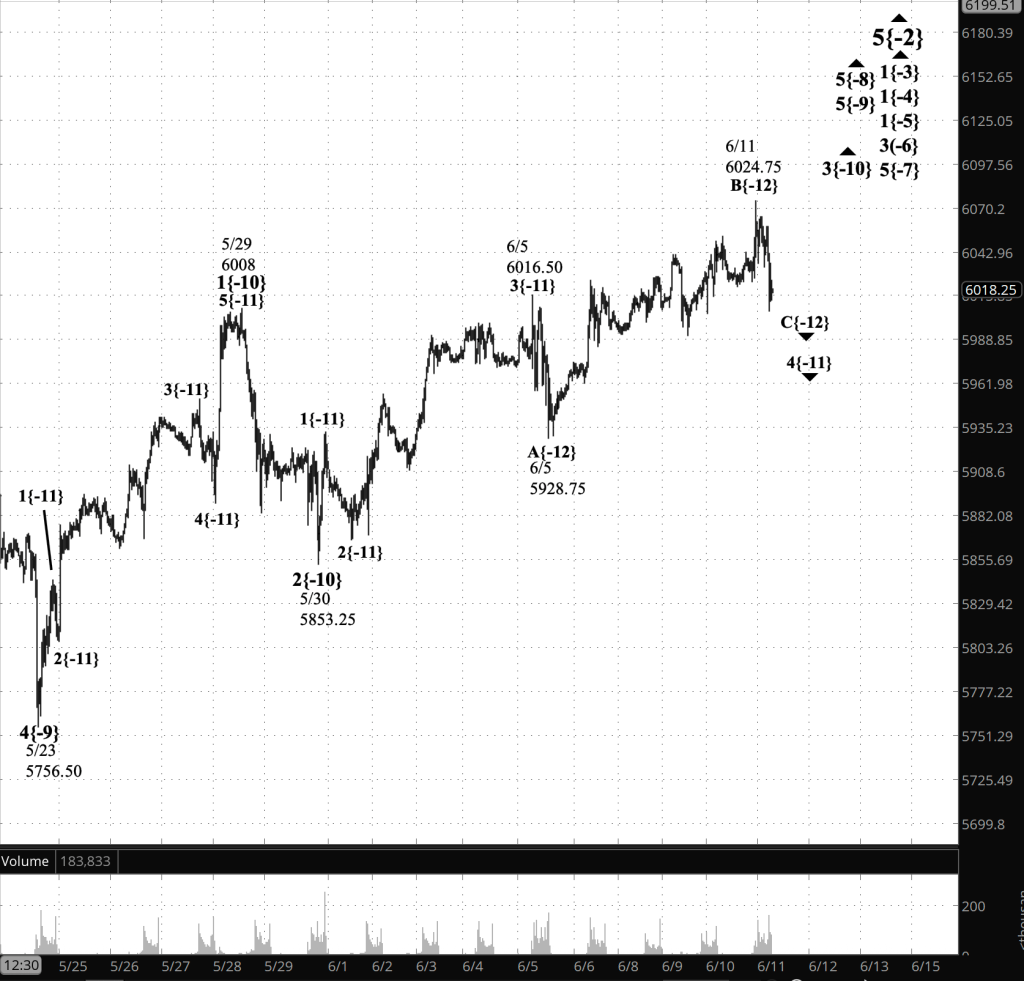
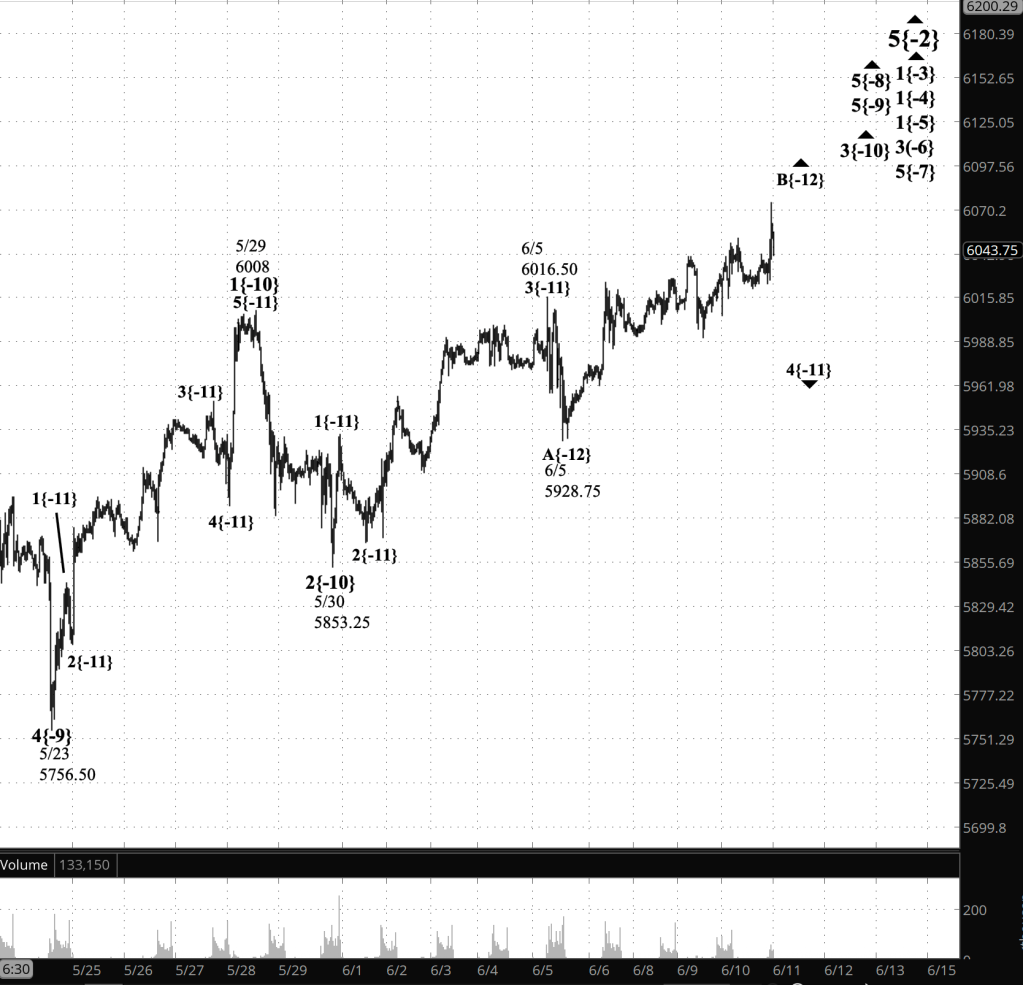
Half an hour before the closing bell. The S&P 500 futures fell sharply after the Fed decided to hold interest rates steady. It then retraced the decline.

Elliott Wave Theory: The decline matched this morning’s analysis: The 4th-wave downward correction continues.

9:35 a.m. New York time

What’s happening now. The S&P 500 E-mini futures drifted slightly lower overnight, as the markets awaited the Federal Open Market Committee’s decision on interest rates. The announcement will be made at 2 p.m. New York time, two hours before the session close, and will be followed at 2:30 p.m. by Federal Reserve Chairman Jerome Powell’s news conference.

What does it mean?  Elliott Wave Theory analysis leans toward a continuation of the 4th-wave downward correction that began on May 2. That’s a very tentative conclusion. It’s also possible that the May 6 low was the end of the low-degree correction and the subsequent small rise was the tentative early steps in a 5th-wave uptrend.

Which is it? We’ll likely find out around the time of the FOMC announcement.

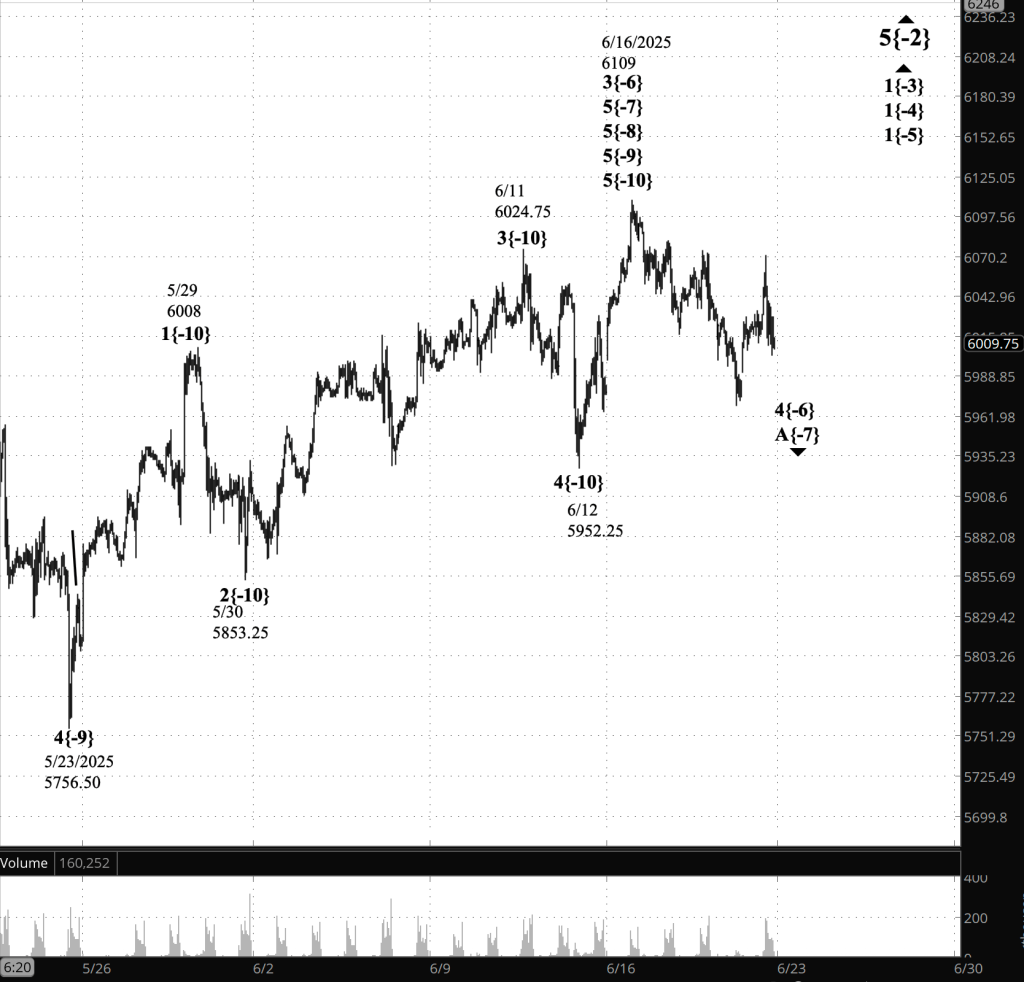
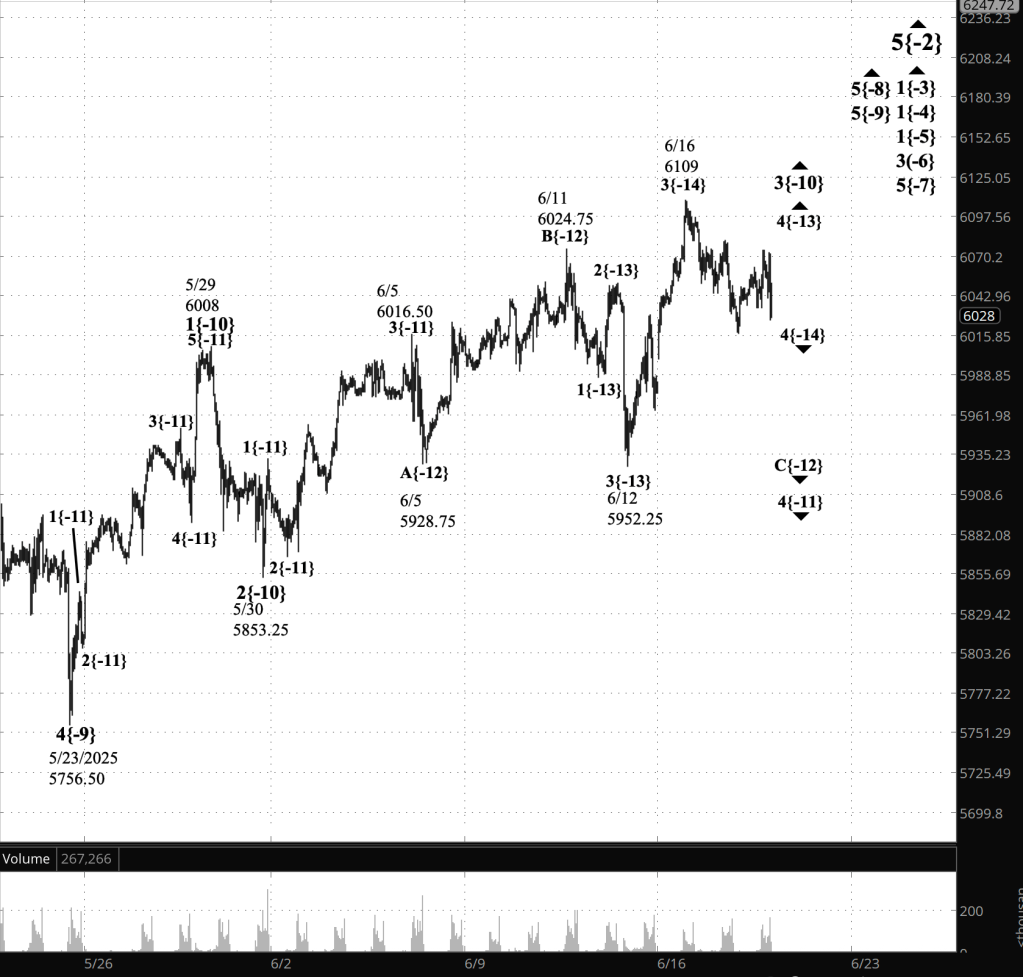
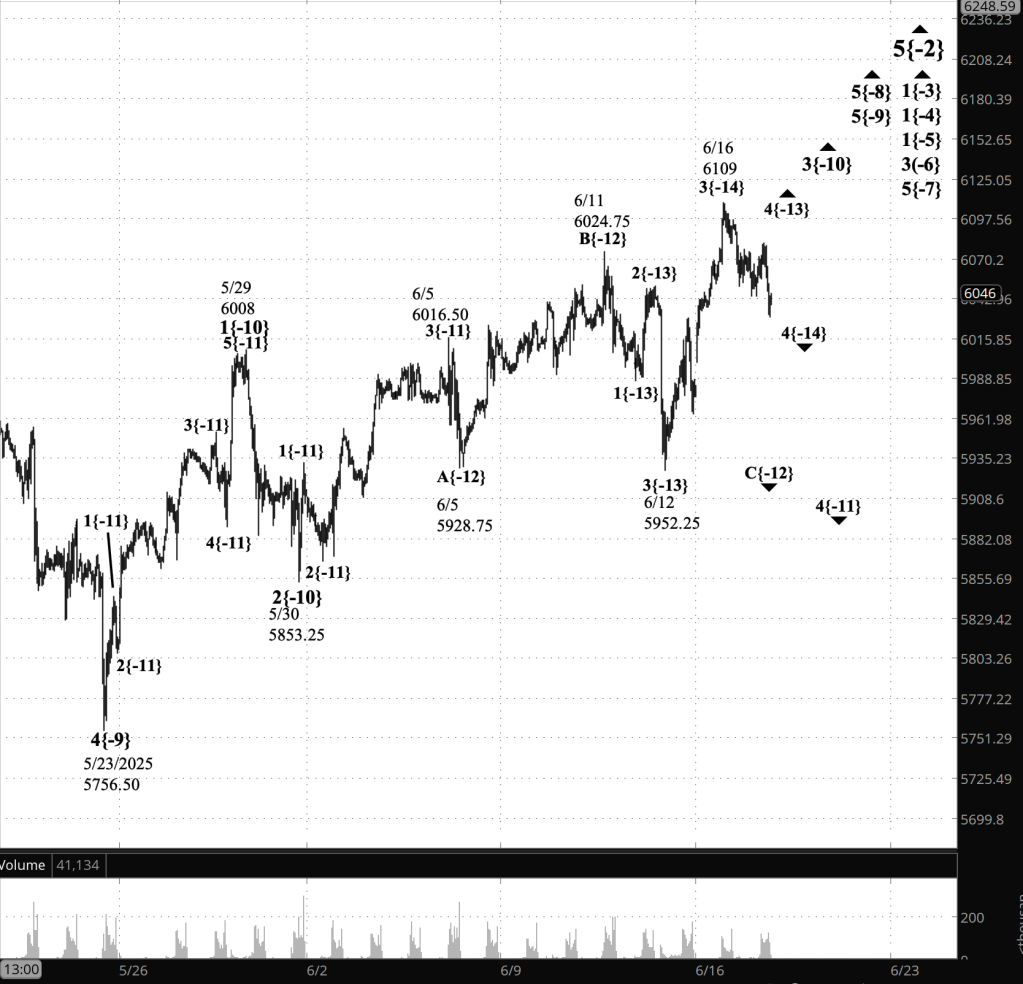
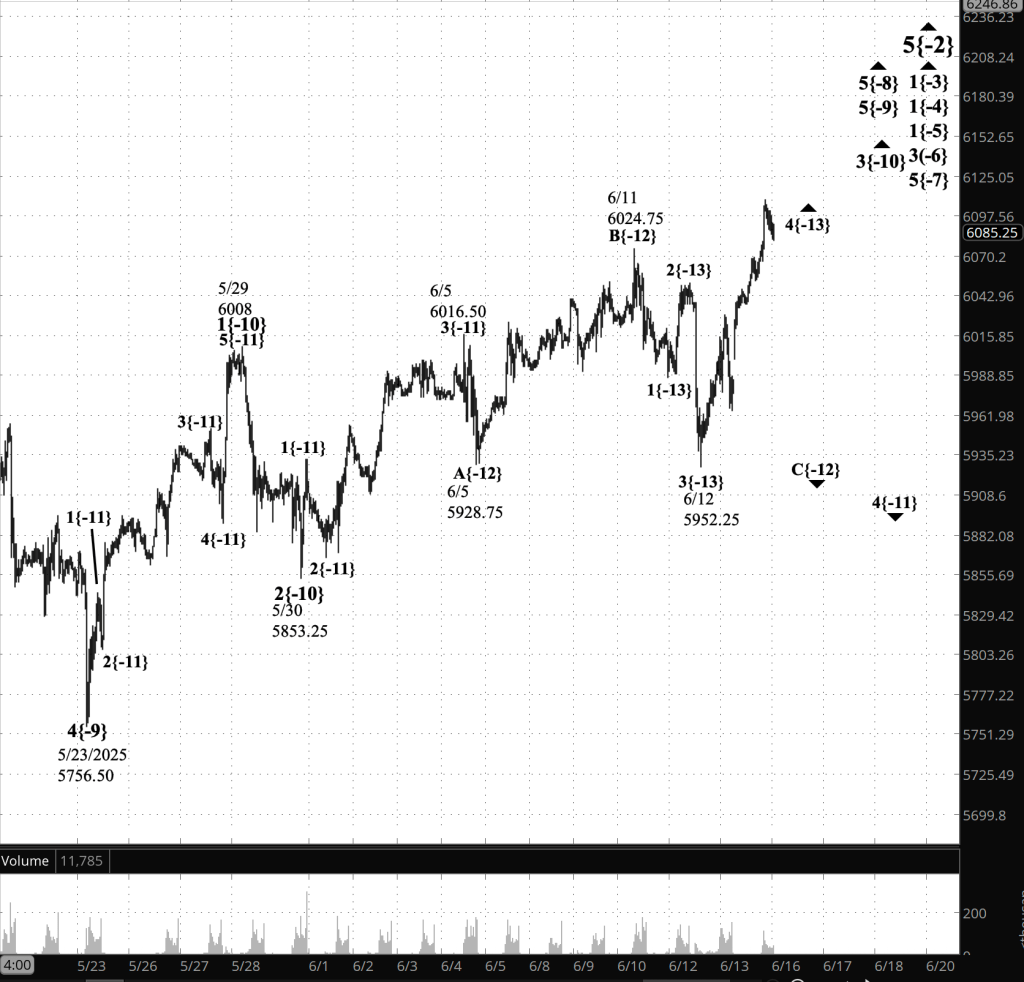
[S&P 500 E-mini futures at 3:30 p.m, 50-minute bars, with volume] 

Elliott Wave Theory wave labels. Each wave listed on the charts has two components: A wave number, and a subscript in curly brackets that place the wave’s position in the fractal strucutre in relationship to Intermediate degree. The present Intermediate degree, wave 5{0}, began its rise on February 11, 2016 from 1810.10 and is still underway.

The waves referred to on the chart are as follows.

Principal analysis: Upward correction wave 5{-2} is underway and within it is working through a nested series of initial subwaves, wave 1{-3} down to wave 1{-5}. One degree lower, rising wave 3{-6} is underway and is in its final subwave, wave 5{-7},

Within wave 5{-7}, wave 4{-8}, a downward correction, is in its final subwave, wave C{-9}. The end of wave C{-9} will coincide with the end of wave 4{-8} and the begining of uptrending wave 5{-8}, which will, when finished, complete uptending wave 5{-7}, which began on April 29 from 5550 and uptrending wave 3{-8}, which began on April 21 from 5127.25.,

Waves Now Underway

These are the waves currently in progress under my principal analysis. Each line on the list shows the wave number, with the subscript in curly brackets, the traditional degree name, the starting date, the starting price of the S&P 500 E-mini futures, and the direction of the wave.

  • S&P 500 Index:
  • 5{+3} Supercycle, 7/8/1932, 4.40 (up)
  • 5{+2} Cycle, 12/9/1974, 60.96 (up)
  • 5{+1} Primary, 3/6/2009, 666.79 (up)
  • 5{0} Intermediate, 2/11/2016, 1810.10 (up)
  • 3{-1} Minor, 3/23/2020, 2191.36 (up)
  • 5{-2} Minute, 4/7/2025, 4832 (up)
  • S&P 500 Futures
  • 1{-3} Minuette, 4/7/2025, 4832 (up)
  • 1{-4} Subminuette, 4/7/2025, 4832 (up)
  • 1{-5} Micro, 4/7/2025, 4832 (up)
  • 3{-6} Submicro, 4/21/2025, 4832 (up)

Reading the chart. Price movements — waves – – in Elliott Wave Theory analysis are labeled with numbers within trending waves and letters with corrective waves. The subscripts — numbers in curly brackets — designate the wave’s degree, which, in Elliott Wave analysis, means the relative position of a wave within the larger and smaller structures that make up the chart. R.N. Elliott, who in the 1930s developed the form of analysis that bears his name, viewed the chart as a complex structure of smaller waves nested within larger waves, which in turn are nested within still larger waves. In mathematics it’s called a fractal structure, where at every scale the pattern is similar to the others.

Learning and other resources. Elliott Wave analysis provides context, not prophecy. As the 20th century semanticist Alfred Korzybski put it in his book Science and Sanity (1933), “The map is not the territory … The only usefulness of a map depends on similarity of structure between the empirical world and the map.” And I would add, in the ever-changing markets, we can judge that similarity of structure only after the fact.

See the menu page Analytical Methods for a rundown on where to go for information on Elliott Wave analysis.

By Tim Bovee, Portland, Oregon, May 7, 2025

Disclaimer

Tim Bovee, Private Trader tracks the analysis and trades of a private trader for his own accounts. Nothing in this blog constitutes a recommendation to buy or sell stocks, options or any other financial instrument. The only purpose of this blog is to provide education and entertainment.

No trader is ever 100 percent successful in his or her trades. Trading in the stock and option markets is risky and uncertain. Each trader must make trading decisions for his or her own account, and take responsibility for the consequences.

License

All content on Tim Bovee, Private Trader by Timothy K. Bovee is licensed under a Creative Commons Attribution-ShareAlike 4.0 International License.

Based on a work at www.timbovee.com

Trader’s Notebook: S&P 500

3:30 p.m. New York time

Half an hour before the closing bell. The S&P 500 futures rose from slightly below 5610 at the session open to back into the 5670s and then declined again.

Elliott Wave Theory: The meandering is part of a low-degree 4th-wave downward correction that began on May 2 and that is now in its final subwave, declining wave C.

9:35 a.m. New York time

What’s happening now. The S&P 500 E-mini futures continued to fall overnight, from the 5670s to the 5610s.

What does it mean?  Elliott Wave Theory, when applied to the chart, sees the futures working through the final subwave, wave C, of a 4th-wave downward correction. The completion of wave C and the parent wave 4 will also be the beginning wave uptrending wave 5, which will carry its parent wave 5 to completion.

[S&P 500 E-mini futures at 3:30 p.m, 50-minute bars, with volume] 

Elliott Wave Theory wave labels. Each wave listed on the charts has two components: A wave number, and a subscript in curly brackets that place the wave’s position in the fractal strucutre in relationship to Intermediate degree. The present Intermediate degree, wave 5{0}, began its rise on February 11, 2016 from 1810.10 and is still underway.

The waves referred to on the chart are as follows.

Principal analysis: Upward correction wave 5{-2} is underway and within it is working through a nested series of initial subwaves, wave 1{-3} down to wave 1{-5}. One degree lower, rising wave 3{-6} is underway and is in its final subwave, wave 5{-7},

Within wave 5{-7}, wave 4{-8}, a downward correction, is in its final subwave, wave C{-9}. The end of wave C{-9} will coincide with the end of wave 4{-8} and the begining of uptrending wave 5{-8}, which will, when finished, complete uptending wave 5{-7}, which began on April 29 from 5550 and uptrending wave 3{-8}, which began on April 21 from 5127.25.,

Waves Now Underway

These are the waves currently in progress under my principal analysis. Each line on the list shows the wave number, with the subscript in curly brackets, the traditional degree name, the starting date, the starting price of the S&P 500 E-mini futures, and the direction of the wave.

  • S&P 500 Index:
  • 5{+3} Supercycle, 7/8/1932, 4.40 (up)
  • 5{+2} Cycle, 12/9/1974, 60.96 (up)
  • 5{+1} Primary, 3/6/2009, 666.79 (up)
  • 5{0} Intermediate, 2/11/2016, 1810.10 (up)
  • 3{-1} Minor, 3/23/2020, 2191.36 (up)
  • 5{-2} Minute, 4/7/2025, 4832 (up)
  • S&P 500 Futures
  • 1{-3} Minuette, 4/7/2025, 4832 (up)
  • 1{-4} Subminuette, 4/7/2025, 4832 (up)
  • 1{-5} Micro, 4/7/2025, 4832 (up)
  • 3{-6} Submicro, 4/21/2025, 4832 (up)

Reading the chart. Price movements — waves – – in Elliott Wave Theory analysis are labeled with numbers within trending waves and letters with corrective waves. The subscripts — numbers in curly brackets — designate the wave’s degree, which, in Elliott Wave analysis, means the relative position of a wave within the larger and smaller structures that make up the chart. R.N. Elliott, who in the 1930s developed the form of analysis that bears his name, viewed the chart as a complex structure of smaller waves nested within larger waves, which in turn are nested within still larger waves. In mathematics it’s called a fractal structure, where at every scale the pattern is similar to the others.

Learning and other resources. Elliott Wave analysis provides context, not prophecy. As the 20th century semanticist Alfred Korzybski put it in his book Science and Sanity (1933), “The map is not the territory … The only usefulness of a map depends on similarity of structure between the empirical world and the map.” And I would add, in the ever-changing markets, we can judge that similarity of structure only after the fact.

See the menu page Analytical Methods for a rundown on where to go for information on Elliott Wave analysis.

By Tim Bovee, Portland, Oregon, May 6, 2025

Disclaimer

Tim Bovee, Private Trader tracks the analysis and trades of a private trader for his own accounts. Nothing in this blog constitutes a recommendation to buy or sell stocks, options or any other financial instrument. The only purpose of this blog is to provide education and entertainment.

No trader is ever 100 percent successful in his or her trades. Trading in the stock and option markets is risky and uncertain. Each trader must make trading decisions for his or her own account, and take responsibility for the consequences.

License

All content on Tim Bovee, Private Trader by Timothy K. Bovee is licensed under a Creative Commons Attribution-ShareAlike 4.0 International License.

Based on a work at www.timbovee.com

Trader’s Notebook: S&P 500

3:30 p.m. New York time

Half an hour before the closing bell. The S&P 500 futures reversed its decline with the opening bell and began to climb, again reaching above 5700.

The small Elliott Wave Theory downward correction may be completed, or it may still be working through its three subwaves. A reach above 5724.75 — last week’s high — would suggest that the corrected has ended; continued zigzagging, that it is still underway.

9:35 a.m. New York time

What’s happening now. The S&P 500 E-mini futures reopened trading Sunday evening New York time at 5705.25 and immediately began to decline. So far the price has reached into the 5650s.

What does it mean?  Friday afternoon’s analysis, after the chart broke a rule of Elliott Wave Theory, has changed the mood of the chart. From a series of upward corrections within a series of larger downtrendsit has become a series of nested uptrends.

The switch proves yet again (as if more proof were needed) that far from being a tool for predicting the future, Elliott Wave Theory is one of those “if this then that” propositions. EWT has rules, and when the public mood switches and the price violates one of those rules, then occasionally the world (the chart) is turned upside down.

The New World That’s what happened last week. Here’s what the new world looks like.

A high degree rising 5th wave began on April 7 from 4832. The preceding rise, wave 3, began on October 13, 2022, from 3502, and worked its way higher for few years until it reached its peak, 6166.50, on February 19, 2025.

Wave 4 began at that point and quickly carried the price down to 4832 on April 7, and at that point the present wave 5 began.

Wave 5 is still underway and is in its 1st subwave. The chart below traces the movements of subwaves of the 1st subwave four or five degrees lower in the fractal structure of the chart.

So wave 5 will be the nature of the market for awhile. The preceding 3rd wave covered $2,664.50 on the futures. It took wave 3 two years and four months to complete its journey. The new journey, wave 5, began almost a month ago, just two days shy of a full month.

And that’s the new world that we’re tracking. Within the first subwave of wave 5, a low-degree rising wave 3 is underway, having begun on April 21, and is its final subwave, an even smaller wave 5.

The overnight decline is a correction within the smaller wave 5.

[S&P 500 E-mini futures at 3:30 p.m, 50-minute bars, with volume] 

Elliott Wave Theory wave labels. Each wave listed on the charts has two components: A wave number, and a subscript in curly brackets that place the wave’s position in the fractal strucutre in relationship to Intermediate degree. The present Intermediate degree, wave 5{0}, began its rise on February 11, 2016 from 1810.10 and is still underway.

The waves referred to on the chart are as follows.

Principal analysis: Upward correction wave 5{-2} is underway and within it is working through a nested series of initial subwaves, wave 1{-3} down to wave 1{-5}. One degree lower, rising wave 3{-6} is underway and is in its final subwave, wave 5{-7}

Waves Now Underway

These are the waves currently in progress under my principal analysis. Each line on the list shows the wave number, with the subscript in curly brackets, the traditional degree name, the starting date, the starting price of the S&P 500 E-mini futures, and the direction of the wave.

  • S&P 500 Index:
  • 5{+3} Supercycle, 7/8/1932, 4.40 (up)
  • 5{+2} Cycle, 12/9/1974, 60.96 (up)
  • 5{+1} Primary, 3/6/2009, 666.79 (up)
  • 5{0} Intermediate, 2/11/2016, 1810.10 (up)
  • 3{-1} Minor, 3/23/2020, 2191.36 (up)
  • 5{-2} Minute, 4/7/2025, 4832 (up)
  • S&P 500 Futures
  • 1{-3} Minuette, 4/7/2025, 4832 (up)
  • 1{-4} Subminuette, 4/7/2025, 4832 (up)
  • 1{-5} Micro, 4/7/2025, 4832 (up)
  • 3{-6} Submicro, 4/21/2025, 4832 (up)

Reading the chart. Price movements — waves – – in Elliott Wave Theory analysis are labeled with numbers within trending waves and letters with corrective waves. The subscripts — numbers in curly brackets — designate the wave’s degree, which, in Elliott Wave analysis, means the relative position of a wave within the larger and smaller structures that make up the chart. R.N. Elliott, who in the 1930s developed the form of analysis that bears his name, viewed the chart as a complex structure of smaller waves nested within larger waves, which in turn are nested within still larger waves. In mathematics it’s called a fractal structure, where at every scale the pattern is similar to the others.

Learning and other resources. Elliott Wave analysis provides context, not prophecy. As the 20th century semanticist Alfred Korzybski put it in his book Science and Sanity (1933), “The map is not the territory … The only usefulness of a map depends on similarity of structure between the empirical world and the map.” And I would add, in the ever-changing markets, we can judge that similarity of structure only after the fact.

See the menu page Analytical Methods for a rundown on where to go for information on Elliott Wave analysis.

By Tim Bovee, Portland, Oregon, May 5, 2025

Disclaimer

Tim Bovee, Private Trader tracks the analysis and trades of a private trader for his own accounts. Nothing in this blog constitutes a recommendation to buy or sell stocks, options or any other financial instrument. The only purpose of this blog is to provide education and entertainment.

No trader is ever 100 percent successful in his or her trades. Trading in the stock and option markets is risky and uncertain. Each trader must make trading decisions for his or her own account, and take responsibility for the consequences.

License

All content on Tim Bovee, Private Trader by Timothy K. Bovee is licensed under a Creative Commons Attribution-ShareAlike 4.0 International License.

Based on a work at www.timbovee.com

Trader’s Notebook: Gold

2:45 p.m. New York time

What’s happening now. The exchange-traded fund GLD continued to fall today.

What does it mean? Yesterday’s Elliott Wave Theory analysis continues. The declining 3rd wave within a declining C wave continues, all contained within a declining A wave that began on April 21.

[Gold futures, 2:45 p.m., 50-minute bars, with volume]

Elliott Wave Theory wave labels. Each wave listed on the charts has two components: A wave number, and a subscript in curly brackets that place the wave’s position in the fractal strucutre in relationship to Intermediate degree. The present Intermediate degree, GLD wave 3{0}, began its rise on November 3, 2022 from 150.57 and is still underway.

The waves referred to above are as follows:

Declining wave C{-4} paused for a small upward correction before continuing its decline. ended on April 24 at 310.93 and declining wave C{-4} began and is underway. C4 is a subwave of declining wave A{-3}.

When wave C{-4} is complete, it will also be the end of wave A{-3} and the beginning of rising wave B{-3}, which typically retraces 38% to 79% of the preceding decline, wave A{-3}.

Long-term Waves

These are the waves currently in progress under my principal analysis. Each line on the list shows the wave number, with the subscript in curly brackets, the traditional degree name, the starting date, the starting price of the S&P 500 E-mini futures, and the direction of the wave.

  • GLD exchange-traded fund:
  • 3{+1} Primary, 12/17/2015, 100.23 (up)
  • 4{0} Intermediate, 4/21/2025, 322.52 (down)
  • A{−1} Minor, 4/21/2025, 322.52 (down)
  • A{−2} Minute, 4/21/2025, 322.52 (down)
  • A{−3} Minuette, 4/21/2025, 322.52 (down)
  • C{−4} Subminuette, 4/24/2025, 310.93 (down)
  • 3{-5} Micro, 4/28/2025, 309.07 (down)

Reading the chart. Price movements — waves – – in Elliott Wave Theory analysis are labeled with numbers within trending waves and letters with corrective waves. The subscripts — numbers in curly brackets — designate the wave’s degree, which, in Elliott Wave analysis, means the relative position of a wave within the larger and smaller structures that make up the chart. R.N. Elliott, who in the 1930s developed the form of analysis that bears his name, viewed the chart as a complex structure of smaller waves nested within larger waves, which in turn are nested within still larger waves. In mathematics it’s called a fractal structure, where at every scale the pattern is similar to the others.

Learning and other resources. Elliott Wave analysis provides context, not prophecy. As the 20th century semanticist Alfred Korzybski put it in his book Science and Sanity (1933), “The map is not the territory … The only usefulness of a map depends on similarity of structure between the empirical world and the map.” And I would add, in the ever-changing markets, we can judge that similarity of structure only after the fact.

See the menu page Analytical Methods for a rundown on where to go for information on Elliott Wave analysis.

By Tim Bovee, Portland, Oregon, May 2, 2025

Disclaimer

Tim Bovee, Private Trader tracks the analysis and trades of a private trader for his own accounts. Nothing in this blog constitutes a recommendation to buy or sell stocks, options or any other financial instrument. The only purpose of this blog is to provide education and entertainment.

No trader is ever 100 percent successful in his or her trades. Trading in the stock and option markets is risky and uncertain. Each trader must make trading decisions for his or her own account, and take responsibility for the consequences.

License

All content on Tim Bovee, Private Trader by Timothy K. Bovee is licensed under a Creative Commons Attribution-ShareAlike 4.0 International License.

Based on a work at www.timbovee.com

Trader’s Notebook: S&P 500

3:30 p.m. New York time

Chart Revision: Final Version (for now). I went back in the history of the S&P 500’s movements to build a robust revision of the Elliott Wave Theory analysis of the S&P 500 futures.

The unresolved problem was uncertainty over the labeling of the April 2 high. I new from prior work that the price had gone higher still long before April.

To figure it out, my guide was this S&P 500 index chart that I’ve worked on for years. This version stretches from October 13, 2022 — deep in the pandemic — to the present — amid the trade wars.

[S&P 500 index at 3:00 p.m, daily bars] 

The starting point for this morning’s incomplete revision, on April 2, was far from being a turning point of significance. The turning point that counts was on February 19, 2025, when a 3rd wave of Minute degree came to end and a declining 4th-wave correction began. Correction ended on April 7 at 4832 and the present 5th wave began.

[S&P 500 E-mini futures at 3:30 p.m, 2-hour bars, with volume] 

We know that we’re in the 1st subwave of that wave 5, but there’s no way know how deep in wave 1 the present movements are. I took a guess, Submicro degree, but it could be off by a degree or two in either direction.

Or it’s possible that the 4th wave that began on February 19 is still underway, that the April 7 low, rather than being the end of the correction, is instead the ended of the corrections A wave.

9:35 a.m. New York time

What’s happening now. The S&P 500 E-mini futures began the overnight session from 5601, rose sharply on Thursday and rose sharply a second time on Friday, into the 5690s, coinciding with the release of the Employment Situation Report, in which the unemployment rate remained unchanged and jobs were more than economists had expected.

What does it mean?  The rise reached a new high for the final subwave, wave C, of the upward correction identified by Elliott Wave Theory. That means that what had been labelled wave 4 has broken a rule of Elliott Wave Theory by moving beyond the end of the preceding 1st wave.

I have changed the location of the beginning of wave 1, which turns the present upward correction into wave 2. The subwaves within wave 2 remain unchanged from the discarded wave 4 analysis. It’s a work in progress, and I’ll update the chart as soon as I’ve completed the reanalysis.

[S&P 500 E-mini futures at 9:35 a.m, 50-minute bars, with volume] 

Elliott Wave Theory wave labels. Each wave listed on the charts has two components: A wave number, and a subscript in curly brackets that place the wave’s position in the fractal strucutre in relationship to Intermediate degree. The present Intermediate degree, wave 5{0}, began its rise on February 11, 2016 from 1810.10 and is still underway.

The waves referred to on the chart are as follows.

Principal analysis: Upward correction wave 2{-8} is underway and is in its final subwave, wave C{-9},

More on the New Analysis. Wave April 2 peak was a major endpoint covering three degrees, waves C{-7}, C{-6} and 4{-5}. Wave 5{-5} follows, and waves 1{-6} and 1{-7} are now underway, as is wave 2{-8} and its subwaves.

There is still some work to be done t ensure that April 2 is truly the peak; it might be earlier, and that will be a job for the weekend. [The work is done.]

Long-term Waves

These are the waves currently in progress under my principal analysis. Each line on the list shows the wave number, with the subscript in curly brackets, the traditional degree name, the starting date, the starting price of the S&P 500 E-mini futures, and the direction of the wave.

[Revised version from the afternoon posting.]

  • S&P 500 Index:
  • 5{+3} Supercycle, 7/8/1932, 4.40 (up)
  • 5{+2} Cycle, 12/9/1974, 60.96 (up)
  • 5{+1} Primary, 3/6/2009, 666.79 (up)
  • 5{0} Intermediate, 2/11/2016, 1810.10 (up)
  • 3{-1} Minor, 3/23/2020, 2191.36 (up)
  • 5{-2} Minute, 4/7/2025, 4832 (up)
  • S&P 500 Futures
  • 1{-3} Minuette, 4/7/2025, 4832 (up)
  • 1{-4} Subminuette, 4/7/2025, 4832 (up)
  • 1{-5} Micro, 4/7/2025, 4832 (up)
  • 3{-6} Submicro, 4/21/2025, 4832 (up)

Reading the chart. Price movements — waves – – in Elliott Wave Theory analysis are labeled with numbers within trending waves and letters with corrective waves. The subscripts — numbers in curly brackets — designate the wave’s degree, which, in Elliott Wave analysis, means the relative position of a wave within the larger and smaller structures that make up the chart. R.N. Elliott, who in the 1930s developed the form of analysis that bears his name, viewed the chart as a complex structure of smaller waves nested within larger waves, which in turn are nested within still larger waves. In mathematics it’s called a fractal structure, where at every scale the pattern is similar to the others.

Learning and other resources. Elliott Wave analysis provides context, not prophecy. As the 20th century semanticist Alfred Korzybski put it in his book Science and Sanity (1933), “The map is not the territory … The only usefulness of a map depends on similarity of structure between the empirical world and the map.” And I would add, in the ever-changing markets, we can judge that similarity of structure only after the fact.

See the menu page Analytical Methods for a rundown on where to go for information on Elliott Wave analysis.

By Tim Bovee, Portland, Oregon, May 2, 2025

Disclaimer

Tim Bovee, Private Trader tracks the analysis and trades of a private trader for his own accounts. Nothing in this blog constitutes a recommendation to buy or sell stocks, options or any other financial instrument. The only purpose of this blog is to provide education and entertainment.

No trader is ever 100 percent successful in his or her trades. Trading in the stock and option markets is risky and uncertain. Each trader must make trading decisions for his or her own account, and take responsibility for the consequences.

License

All content on Tim Bovee, Private Trader by Timothy K. Bovee is licensed under a Creative Commons Attribution-ShareAlike 4.0 International License.

Based on a work at www.timbovee.com

Trader’s Notebook: Gold

1:00 p.m. New York time

What’s happening now. Gold futures fell overnight, stabilizing as the opening bell approached and remaining stable after the exchange-traded funds GLD began trading.

What does it mean? Elliott Wave Theory analysis find that the C wave that began on Apri 24 continues and is in its 3rd subwave. It’s parent, wave A, began on April 21 a major top for GLD.

[Gold futures, 1:00 p.m., 50-minute bars, with volume]

Elliott Wave Theory wave labels. Each wave listed on the charts has two components: A wave number, and a subscript in curly brackets that place the wave’s position in the fractal strucutre in relationship to Intermediate degree. The present Intermediate degree, GLD wave 3{0}, began its rise on November 3, 2022 from 150.57 and is still underway.

The waves referred to above are as follows:

Declining wave C{-4} paused for a small upward correction before continuing its decline. ended on April 24 at 310.93 and declining wave C{-4} began and is underway. C4 is a subwave of declining wave A{-3}.

When wave C{-4} is complete, it will also be the end of wave A{-3} and the beginning of rising wave B{-3}, which typically retraces 38% to 79% of the preceding decline, wave A{-3}.

Long-term Waves

These are the waves currently in progress under my principal analysis. Each line on the list shows the wave number, with the subscript in curly brackets, the traditional degree name, the starting date, the starting price of the S&P 500 E-mini futures, and the direction of the wave.

  • GLD exchange-traded fund:
  • 3{+1} Primary, 12/17/2015, 100.23 (up)
  • 4{0} Intermediate, 4/21/2025, 322.52 (down)
  • A{−1} Minor, 4/21/2025, 322.52 (down)
  • A{−2} Minute, 4/21/2025, 322.52 (down)
  • A{−3} Minuette, 4/21/2025, 322.52 (down)
  • C{−4} Subminuette, 4/24/2025, 310.93 (down)
  • 3{-5} Micro, 4/28/2025, 309.07 (down)

Reading the chart. Price movements — waves – – in Elliott Wave Theory analysis are labeled with numbers within trending waves and letters with corrective waves. The subscripts — numbers in curly brackets — designate the wave’s degree, which, in Elliott Wave analysis, means the relative position of a wave within the larger and smaller structures that make up the chart. R.N. Elliott, who in the 1930s developed the form of analysis that bears his name, viewed the chart as a complex structure of smaller waves nested within larger waves, which in turn are nested within still larger waves. In mathematics it’s called a fractal structure, where at every scale the pattern is similar to the others.

Learning and other resources. Elliott Wave analysis provides context, not prophecy. As the 20th century semanticist Alfred Korzybski put it in his book Science and Sanity (1933), “The map is not the territory … The only usefulness of a map depends on similarity of structure between the empirical world and the map.” And I would add, in the ever-changing markets, we can judge that similarity of structure only after the fact.

See the menu page Analytical Methods for a rundown on where to go for information on Elliott Wave analysis.

By Tim Bovee, Portland, Oregon, April 30, 2025

Disclaimer

Tim Bovee, Private Trader tracks the analysis and trades of a private trader for his own accounts. Nothing in this blog constitutes a recommendation to buy or sell stocks, options or any other financial instrument. The only purpose of this blog is to provide education and entertainment.

No trader is ever 100 percent successful in his or her trades. Trading in the stock and option markets is risky and uncertain. Each trader must make trading decisions for his or her own account, and take responsibility for the consequences.

License

All content on Tim Bovee, Private Trader by Timothy K. Bovee is licensed under a Creative Commons Attribution-ShareAlike 4.0 International License.

Based on a work at www.timbovee.com

Trader’s Notebook: S&P 500

3:30 p.m. New York time

Half an hour before the closing bell. The S&P 500 futures fluctuated from the 5620s to the 5680s during the session.

Elliott Wave Theory: This morning’s analysis is unchanged: Wave C within the 4th-wave upward correction continues.

9:35 a.m. New York time

What’s happening now. The S&P 500 E-mini futures rose overnight from the 5610s to the 5660s and then fell back to the 5630s.

What does it mean?  As a result of the rise, yesterday’s Elliott Wave Theory analysis no longer matches the chart. The analysis concluded that declining wave 5 had begun. That turns out not to be the case, and I’ve changed the principal analysis back to what it was prior to yesterday: The 4th wave upward correction that began on April 7 continues and is in its final subwave, wave C.

[S&P 500 E-mini futures at 3:30 p.m, 50-minute bars, with volume] 

Elliott Wave Theory wave labels. Each wave listed on the charts has two components: A wave number, and a subscript in curly brackets that place the wave’s position in the fractal strucutre in relationship to Intermediate degree. The present Intermediate degree, wave 5{0}, began its rise on February 11, 2016 from 1810.10 and is still underway.

The waves referred to on the chart are as follows.

Principal analysis: Upward correction wave 4{-8} is underway and is in its final subwave, wave C{-9},

Long-term Waves

These are the waves currently in progress under my principal analysis. Each line on the list shows the wave number, with the subscript in curly brackets, the traditional degree name, the starting date, the starting price of the S&P 500 E-mini futures, and the direction of the wave.

  • S&P 500 Index:
  • 5{+3} Supercycle, 7/8/1932, 4.40 (up)
  • 5{+2} Cycle, 12/9/1974, 60.96 (up)
  • 5{+1} Primary, 3/6/2009, 666.79 (up)
  • 5{0} Intermediate, 2/11/2016, 1810.10 (up)
  • 3{-1} Minor, 3/23/2020, 2191.36 (up)
  • 3{-2} Minute, 10/13/2022, 3491.58 (up)
  • S&P 500 Futures
  • 5{-3} Minuette, 4/18/2024, 4963.50 (up)
  • 3{-4} Subminuette, 8/7/2024, 5182 (up)
  • 4{-5} Micro, 12/16/2024, 6163.75 (down)
  • C{-6} Submicro, 2/19/2025, 6166.50 (down)
  • C{-7} Minuscule, 3/25/2025, 5835 (down)
  • 4{-8} (no name), 3/7/2025, 48322 (up)
  • C{-9} (no name), 4/21/2025, 5127.25 (up)

Reading the chart. Price movements — waves – – in Elliott Wave Theory analysis are labeled with numbers within trending waves and letters with corrective waves. The subscripts — numbers in curly brackets — designate the wave’s degree, which, in Elliott Wave analysis, means the relative position of a wave within the larger and smaller structures that make up the chart. R.N. Elliott, who in the 1930s developed the form of analysis that bears his name, viewed the chart as a complex structure of smaller waves nested within larger waves, which in turn are nested within still larger waves. In mathematics it’s called a fractal structure, where at every scale the pattern is similar to the others.

Learning and other resources. Elliott Wave analysis provides context, not prophecy. As the 20th century semanticist Alfred Korzybski put it in his book Science and Sanity (1933), “The map is not the territory … The only usefulness of a map depends on similarity of structure between the empirical world and the map.” And I would add, in the ever-changing markets, we can judge that similarity of structure only after the fact.

See the menu page Analytical Methods for a rundown on where to go for information on Elliott Wave analysis.

By Tim Bovee, Portland, Oregon, May 1, 2025

Disclaimer

Tim Bovee, Private Trader tracks the analysis and trades of a private trader for his own accounts. Nothing in this blog constitutes a recommendation to buy or sell stocks, options or any other financial instrument. The only purpose of this blog is to provide education and entertainment.

No trader is ever 100 percent successful in his or her trades. Trading in the stock and option markets is risky and uncertain. Each trader must make trading decisions for his or her own account, and take responsibility for the consequences.

License

All content on Tim Bovee, Private Trader by Timothy K. Bovee is licensed under a Creative Commons Attribution-ShareAlike 4.0 International License.

Based on a work at www.timbovee.com

Trader’s Notebook: Gold

1:45 p.m. New York time

What’s happening now. Gold futures began rising before two major economic reports were released before the session began and halted after a moderate upward movement. The two reports were GDP for the 1st quarter and the ADP employment study. The exchange-traded fund GLD also rose as the opening bell sounded.

What does it mean? GLD’s present wave is declining wave C, the final subwave of a larger declining A wave.

I applied Elliott Wave Theory to the C wave. Internally, it is in the 3rd of its five subwaves. The smallness of the present rise suggests it is a subwave of that wave 3, suggesting that the wave has more downside ahead of it.

The end of the final subwave, wave 5, within wave C will also end the C wave and its parent A wave, which began on April 21. Rising wave B will then begin, retracing part of the prior A wave’s decline.

[Gold futures, 1:45 p.m., 50-minute bars, with volume]

Elliott Wave Theory wave labels. Each wave listed on the charts has two components: A wave number, and a subscript in curly brackets that place the wave’s position in the fractal strucutre in relationship to Intermediate degree. The present Intermediate degree, GLD wave 3{0}, began its rise on November 3, 2022 from 150.57 and is still underway.

The waves referred to above are as follows:

Declining wave C{-4} paused for a small upward correction before continuing its decline. ended on April 24 at 310.93 and declining wave C{-4} began and is underway. C4 is a subwave of declining wave A{-3}.

When wave C{-4} is complete, it will also be the end of wave A{-3} and the beginning of rising wave B{-3}, which typically retraces 38% to 79% of the preceding decline, wave A{-3}.

Long-term Waves

These are the waves currently in progress under my principal analysis. Each line on the list shows the wave number, with the subscript in curly brackets, the traditional degree name, the starting date, the starting price of the S&P 500 E-mini futures, and the direction of the wave.

  • GLD exchange-traded fund:
  • 3{+1} Primary, 12/17/2015, 100.23 (up)
  • 4{0} Intermediate, 4/21/2025, 322.52 (down)
  • A{−1} Minor, 4/21/2025, 322.52 (down)
  • A{−2} Minute, 4/21/2025, 322.52 (down)
  • A{−3} Minuette, 4/21/2025, 322.52 (down)
  • C{−4} Subminuette, 4/24/2025, 310.93 (down)
  • 3{-5} Micro, 4/28/2025, 309.07 (down)

Reading the chart. Price movements — waves – – in Elliott Wave Theory analysis are labeled with numbers within trending waves and letters with corrective waves. The subscripts — numbers in curly brackets — designate the wave’s degree, which, in Elliott Wave analysis, means the relative position of a wave within the larger and smaller structures that make up the chart. R.N. Elliott, who in the 1930s developed the form of analysis that bears his name, viewed the chart as a complex structure of smaller waves nested within larger waves, which in turn are nested within still larger waves. In mathematics it’s called a fractal structure, where at every scale the pattern is similar to the others.

Learning and other resources. Elliott Wave analysis provides context, not prophecy. As the 20th century semanticist Alfred Korzybski put it in his book Science and Sanity (1933), “The map is not the territory … The only usefulness of a map depends on similarity of structure between the empirical world and the map.” And I would add, in the ever-changing markets, we can judge that similarity of structure only after the fact.

See the menu page Analytical Methods for a rundown on where to go for information on Elliott Wave analysis.

By Tim Bovee, Portland, Oregon, April 30, 2025

Disclaimer

Tim Bovee, Private Trader tracks the analysis and trades of a private trader for his own accounts. Nothing in this blog constitutes a recommendation to buy or sell stocks, options or any other financial instrument. The only purpose of this blog is to provide education and entertainment.

No trader is ever 100 percent successful in his or her trades. Trading in the stock and option markets is risky and uncertain. Each trader must make trading decisions for his or her own account, and take responsibility for the consequences.

License

All content on Tim Bovee, Private Trader by Timothy K. Bovee is licensed under a Creative Commons Attribution-ShareAlike 4.0 International License.

Based on a work at www.timbovee.com

Trader’s Notebook: S&P 500

3:30 p.m. New York time

Half an hour before the closing bell. The S&P 500 futures hit a low for the day of 5455.50 early in the session, and then climbed back into the 5570s.

Elliott Wave Theory: The small upward correction within the downtrending 5th wave that began on April 29 continues.

9:35 a.m. New York time

What’s happening now. The S&P 500 E-mini futures dropped sharply when the 1st quarter GDP was published, the steepest decline since 2022. So far the low point is 5497.50.

What does it mean?  Filtered through the lens of Elliott Wave Theory, the decline, which began on April 29, before the GDP release, appears to be the end of wave 4 and the early stage of wave 5. I’ve adopted the wave 5 scenario as my principal analysis.

It is quite possible that an alternative analysis is the how the chart will play out. Under this scenario, the 4th wave upward correction that began on April 7 continues and is in its final subwave, wave C,

Often when major economic data is released, the price will whipsaw: Drop or rise sharply and then work its back almost immediately to the price level from which the movement began.

One argument in favor of the 5th-wave scenario is that the price hasn’t whipsawed. It fell, and so far at least, has remained at the lower level.

[S&P 500 E-mini futures at 3:00 p.m, 45-minute bars, with volume]

 Elliott Wave Theory wave labels. Each wave listed on the charts has two components: A wave number, and a subscript in curly brackets that place the wave’s position in the fractal strucutre in relationship to Intermediate degree. The present Intermediate degree, wave 5{0}, began its rise on February 11, 2016 from 1810.10 and is still underway.

The waves referred to on the chart are as follows:

Principal analysis: Upward correction wave 4{-8} and its final subwave, wave C{-9}., ended on April 29. Downtrending wave 5{-9} has begun.

Long-term Waves

These are the waves currently in progress under my principal analysis. Each line on the list shows the wave number, with the subscript in curly brackets, the traditional degree name, the starting date, the starting price of the S&P 500 E-mini futures, and the direction of the wave.

  • S&P 500 Index:
  • 5{+3} Supercycle, 7/8/1932, 4.40 (up)
  • 5{+2} Cycle, 12/9/1974, 60.96 (up)
  • 5{+1} Primary, 3/6/2009, 666.79 (up)
  • 5{0} Intermediate, 2/11/2016, 1810.10 (up)
  • 3{-1} Minor, 3/23/2020, 2191.36 (up)
  • 3{-2} Minute, 10/13/2022, 3491.58 (up)
  • S&P 500 Futures
  • 5{-3} Minuette, 4/18/2024, 4963.50 (up)
  • 3{-4} Subminuette, 8/7/2024, 5182 (up)
  • 4{-5} Micro, 12/16/2024, 6163.75 (down)
  • C{-6} Submicro, 2/19/2025, 6166.50 (down)
  • C{-7} Minuscule, 3/25/2025, 5835 (down)
  • 5{-8} (no name), 4/29/2025, 5597.25 (down)
  • 1{-9} (no name), 4/29/2025, 5597.25 (down)

Reading the chart. Price movements — waves – – in Elliott Wave Theory analysis are labeled with numbers within trending waves and letters with corrective waves. The subscripts — numbers in curly brackets — designate the wave’s degree, which, in Elliott Wave analysis, means the relative position of a wave within the larger and smaller structures that make up the chart. R.N. Elliott, who in the 1930s developed the form of analysis that bears his name, viewed the chart as a complex structure of smaller waves nested within larger waves, which in turn are nested within still larger waves. In mathematics it’s called a fractal structure, where at every scale the pattern is similar to the others.

Learning and other resources. Elliott Wave analysis provides context, not prophecy. As the 20th century semanticist Alfred Korzybski put it in his book Science and Sanity (1933), “The map is not the territory … The only usefulness of a map depends on similarity of structure between the empirical world and the map.” And I would add, in the ever-changing markets, we can judge that similarity of structure only after the fact.

See the menu page Analytical Methods for a rundown on where to go for information on Elliott Wave analysis.

By Tim Bovee, Portland, Oregon, April 30, 2025

Disclaimer

Tim Bovee, Private Trader tracks the analysis and trades of a private trader for his own accounts. Nothing in this blog constitutes a recommendation to buy or sell stocks, options or any other financial instrument. The only purpose of this blog is to provide education and entertainment.

No trader is ever 100 percent successful in his or her trades. Trading in the stock and option markets is risky and uncertain. Each trader must make trading decisions for his or her own account, and take responsibility for the consequences.

License

All content on Tim Bovee, Private Trader by Timothy K. Bovee is licensed under a Creative Commons Attribution-ShareAlike 4.0 International License.

Based on a work at www.timbovee.com