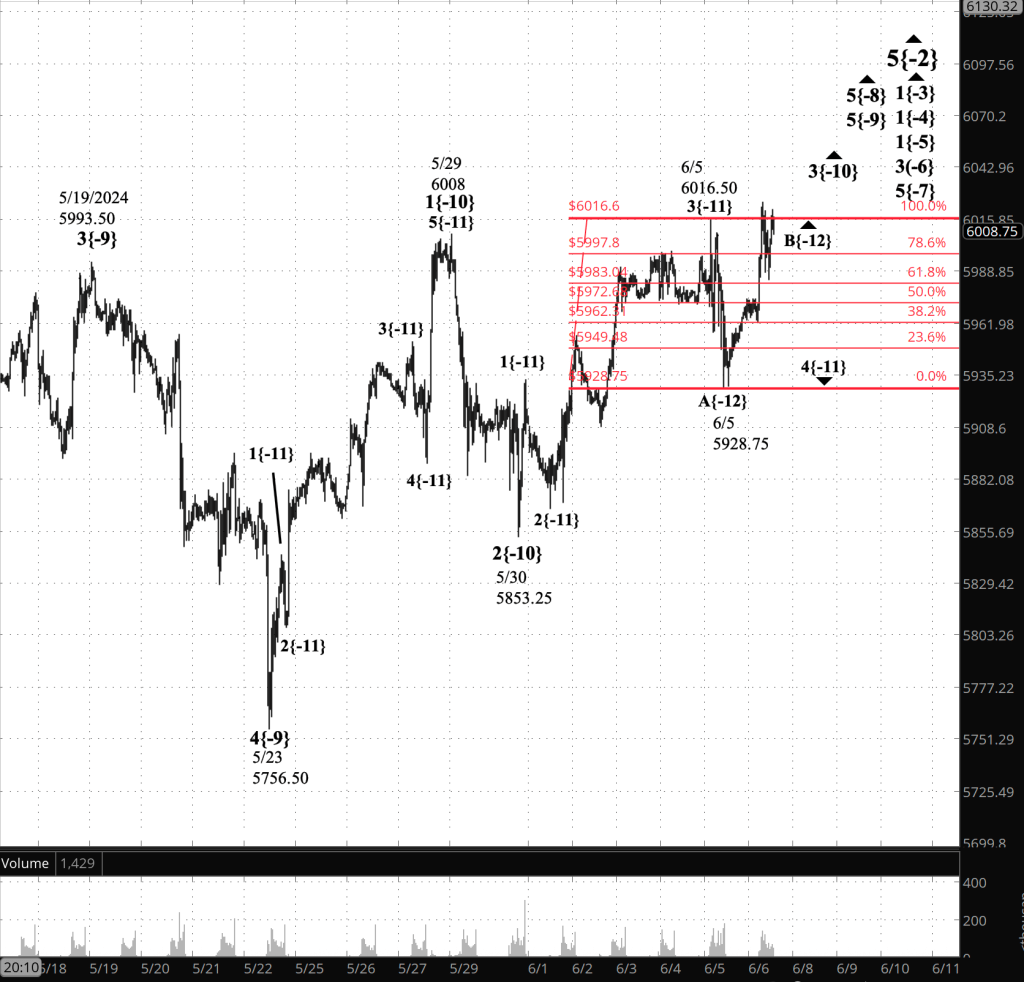
Trader’s Notebook: Gold

2:05 p.m. New York time

What’s happening now. Gold future worked their way lower overnight, along with the GLD exchange-traded fund beginning to rise at the opening bell.

What does it mean? Elliott Wave Theory analysis sees the rise as a corrective subwave within the larger falling C wave that began on October 24. Wave C in turn is a subwave of a declining A wave that began on April 21.

The end of wave C will also be the end of the larger declining wave A and the beginning of rising wave B. Typically, a be wave will retrace 38% to 79% of the preceding A wave.

[Gold futures, 2:05 p.m., 35-minute bars, with volume]

Elliott Wave Theory wave labels. Each wave listed on the charts has two components: A wave number, and a subscript in curly brackets that place the wave’s position in the fractal strucutre in relationship to Intermediate degree. The present Intermediate degree, GLD wave 3{0}, began its rise on November 3, 2022 from 150.57 and is still underway.

The waves referred to above are as follows:

Declining wave C{-4} paused for a small upward correction before continuing its decline. ended on April 24 at 310.93 and declining wave C{-4} began and is underway. C4 is a subwave of declining wave A{-3}.

When wave C{-4} is complete, it will also be te end of wave A{-3} and the beginning of rising wave B{-3}, which typically retraces 38% to 79% of the preceding decline, wave A{-3}.

Long-term Waves

These are the waves currently in progress under my principal analysis. Each line on the list shows the wave number, with the subscript in curly brackets, the traditional degree name, the starting date, the starting price of the S&P 500 E-mini futures, and the direction of the wave.

  • GLD exchange-traded fund:
  • 3{+1} Primary, 12/17/2015, 100.23 (up)
  • 4{0} Intermediate, 4/21/2025, 322.52 (down)
  • A{−1} Minor, 4/21/2025, 322.52 (down)
  • A{−2} Minute, 4/21/2025, 322.52 (down)
  • A{−3} Minuette, 4/21/2025, 322.52 (down)
  • C{−4} Micro, 4/24/2025, 310.93 (down)

Reading the chart. Price movements — waves – – in Elliott Wave Theory analysis are labeled with numbers within trending waves and letters with corrective waves. The subscripts — numbers in curly brackets — designate the wave’s degree, which, in Elliott Wave analysis, means the relative position of a wave within the larger and smaller structures that make up the chart. R.N. Elliott, who in the 1930s developed the form of analysis that bears his name, viewed the chart as a complex structure of smaller waves nested within larger waves, which in turn are nested within still larger waves. In mathematics it’s called a fractal structure, where at every scale the pattern is similar to the others.

Learning and other resources. Elliott Wave analysis provides context, not prophecy. As the 20th century semanticist Alfred Korzybski put it in his book Science and Sanity (1933), “The map is not the territory … The only usefulness of a map depends on similarity of structure between the empirical world and the map.” And I would add, in the ever-changing markets, we can judge that similarity of structure only after the fact.

See the menu page Analytical Methods for a rundown on where to go for information on Elliott Wave analysis.

By Tim Bovee, Portland, Oregon, April 29, 2025

Disclaimer

Tim Bovee, Private Trader tracks the analysis and trades of a private trader for his own accounts. Nothing in this blog constitutes a recommendation to buy or sell stocks, options or any other financial instrument. The only purpose of this blog is to provide education and entertainment.

No trader is ever 100 percent successful in his or her trades. Trading in the stock and option markets is risky and uncertain. Each trader must make trading decisions for his or her own account, and take responsibility for the consequences.

License

All content on Tim Bovee, Private Trader by Timothy K. Bovee is licensed under a Creative Commons Attribution-ShareAlike 4.0 International License.

Based on a work at www.timbovee.com

Trader’s Notebook: S&P 500

3:30 p.m. New York time

Half an hour before the closing bell. The rise of the S&P 500 futures that began shortly before the opening bell from 5521.50 has continued during the session, so far reaching a high of 5597.25

Elliott Wave Theory: The rising C wave that began on April 21 continues, albeit at a snail’s pace.

The end of the C wave will also be the end of the parent 4th-wave upward correction, and the beginning of a 5th wave that will produce a significant decline.

9:35 a.m. New York time

What’s happening now. The S&P 500 E-mini futures fluctuated mainly between the 5540s and the 5560s overnnight, with occasional forays beyond in either direction. In other words, more of the same.

The price dropped into the 5520s in the minutes before the opening bell sounded.

What does it mean?  The Elliott Wave Theory analysis remains unchanged. The final subwave — wave C — within the 4th-wave upward correction that began on April 7 continues.

Elliott waves reflect the hopes and fears — the mood — of people. And this week and the two weeks that follow it will have plenty to trigger a change of mood.

So far we haven’t had major economic reports that track the economy in April. President Trump after the market close on April 7 announced his extensive tariffs policy, the market fell dramatically, amid fears of inflation and stagflation and other negative impacts.

On Wednesday, April 30, we’ll start to get economic data that tells us what the true impact of the policy was in the month it was announced. Here’s a list (times are New York time).

  • The ADP employment report, Wednesday, April. 30, 8:15 a.m.
    • A sneak preview of the government’s employment report,
  • Gross Domestic Product for the first quarter, Wednesday, April 30, 8:30 a.m.
    • How’s the economy doing overall? Making money, or losing it?
  • The government’s Employment Situation Report, Friday, May 2, 8:30 a.m.
    • This triggers the Sahm Rule, which gives an early warning of whether we are in a recession or not.
  • Federal Open Market Committee statement, Wednesday, May 7, 2 p.m.
    • Announces whether interest rates will be lowered.
  • Consumer Price Index (inflation), Tuesday, May 13, 8:30 p.m.
    • Inflation.

That should be enough to keep traders hopping as they respond to events.

In terms of Elliott Wave Theory, the chart will reflect the social mood before each announcement. Presently, the S&P 500 futures are rising, although tentatively, which to me looks very much like worried optimism with a dash of skepticism.

[S&P 500 E-mini futures at 3:30 p.m, 45-minute bars, with volume]

 Elliott Wave Theory wave labels. Each wave listed on the charts has two components: A wave number, and a subscript in curly brackets that place the wave’s position in the fractal strucutre in relationship to Intermediate degree. The present Intermediate degree, wave 5{0}, began its rise on February 11, 2016 from 1810.10 and is still underway.

The waves referred to on the chart are as follows.

Principal analysis: Upward correction wave 4{-8} is underway and is in its final subwave, wave C{-9}., having paused for corrective wave 4{-10}. Wave 5{-10} has begun.

Long-term Waves

These are the waves currently in progress under my principal analysis. Each line on the list shows the wave number, with the subscript in curly brackets, the traditional degree name, the starting date, the starting price of the S&P 500 E-mini futures, and the direction of the wave.

  • S&P 500 Index:
  • 5{+3} Supercycle, 7/8/1932, 4.40 (up)
  • 5{+2} Cycle, 12/9/1974, 60.96 (up)
  • 5{+1} Primary, 3/6/2009, 666.79 (up)
  • 5{0} Intermediate, 2/11/2016, 1810.10 (up)
  • 3{-1} Minor, 3/23/2020, 2191.36 (up)
  • 3{-2} Minute, 10/13/2022, 3491.58 (up)
  • S&P 500 Futures
  • 5{-3} Minuette, 4/18/2024, 4963.50 (up)
  • 3{-4} Subminuette, 8/7/2024, 5182 (up)
  • 4{-5} Micro, 12/16/2024, 6163.75 (down)
  • C{-6} Submicro, 2/19/2025, 6166.50 (down)
  • C{-7} Minuscule, 3/25/2025, 5835 (down)
  • 4{-8} (no name), 3/7/2025, 48322 (up)
  • C{-9} (no name), 4/21/2025, 5127.25 (up)

Reading the chart. Price movements — waves – – in Elliott Wave Theory analysis are labeled with numbers within trending waves and letters with corrective waves. The subscripts — numbers in curly brackets — designate the wave’s degree, which, in Elliott Wave analysis, means the relative position of a wave within the larger and smaller structures that make up the chart. R.N. Elliott, who in the 1930s developed the form of analysis that bears his name, viewed the chart as a complex structure of smaller waves nested within larger waves, which in turn are nested within still larger waves. In mathematics it’s called a fractal structure, where at every scale the pattern is similar to the others.

Learning and other resources. Elliott Wave analysis provides context, not prophecy. As the 20th century semanticist Alfred Korzybski put it in his book Science and Sanity (1933), “The map is not the territory … The only usefulness of a map depends on similarity of structure between the empirical world and the map.” And I would add, in the ever-changing markets, we can judge that similarity of structure only after the fact.

See the menu page Analytical Methods for a rundown on where to go for information on Elliott Wave analysis.

By Tim Bovee, Portland, Oregon, April 29, 2025

Disclaimer

Tim Bovee, Private Trader tracks the analysis and trades of a private trader for his own accounts. Nothing in this blog constitutes a recommendation to buy or sell stocks, options or any other financial instrument. The only purpose of this blog is to provide education and entertainment.

No trader is ever 100 percent successful in his or her trades. Trading in the stock and option markets is risky and uncertain. Each trader must make trading decisions for his or her own account, and take responsibility for the consequences.

License

All content on Tim Bovee, Private Trader by Timothy K. Bovee is licensed under a Creative Commons Attribution-ShareAlike 4.0 International License.

Based on a work at www.timbovee.com
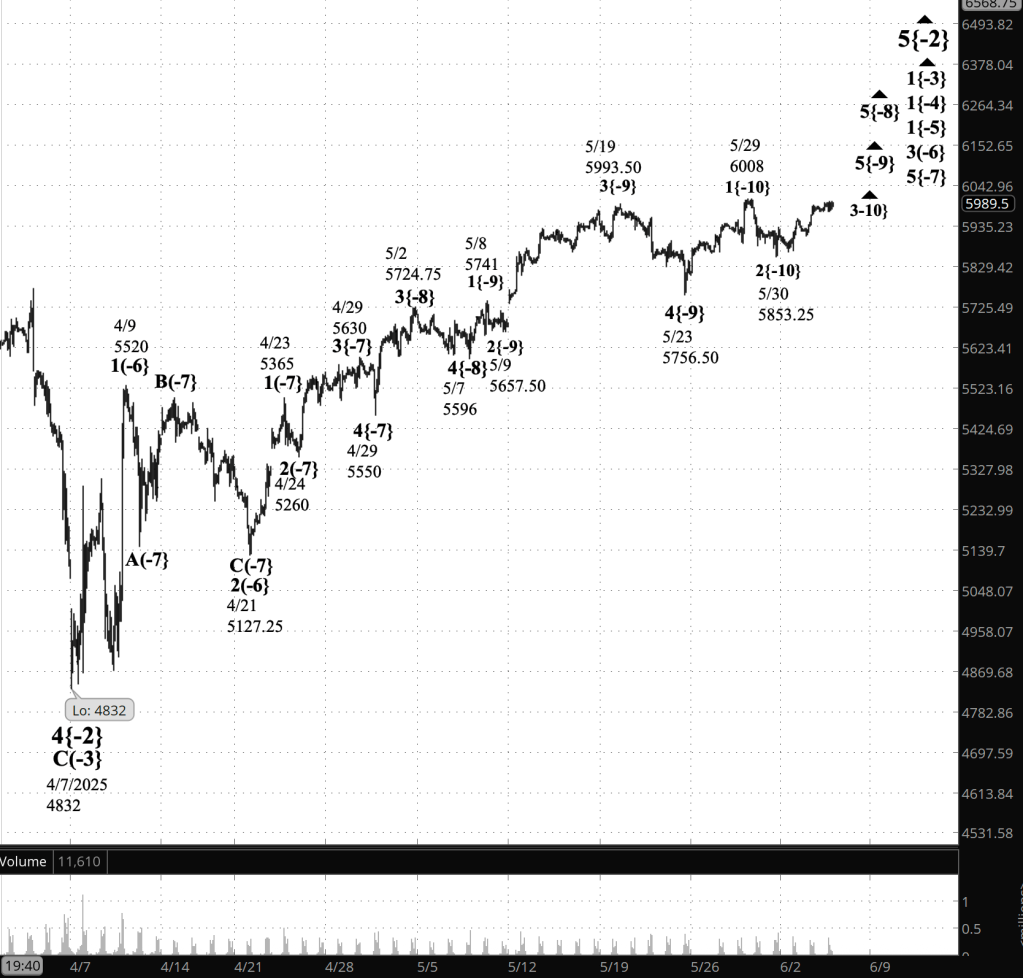
Trader’s Notebook: Gold

1:20 p.m. New York time

What’s happening now. The GLD exchange-traded fund has risen during the session, reaching 307 so far.

What does it mean? The decline that began on April 24 is the final subwave, wave C, within the downward correction that began on April 21.

The rise creates a bit of ambiguity:

The question, using wave labels as they appear on the chart, Is whether declining wave C{-4} is still under way, or does the upward movement mean that wave C{-4} ended at on April 25 at 301.01, completing the parent A wave, wave A{-3},one degree higher, and beginning the rising B{3} wave?

My favorite metrics, Ehlers Stochastic and RSI, don’t indicate much energy for a rise. The Ehler’s is signaling a decline, and RSI is moving sideways, a neutral stance.

So I shall follow my long-held preference and will wait for evidence before declaring declining wave C{-4} to be at an end.

[Gold futures, 1:25 p.m., 35-minute bars, with volume]

Elliott Wave Theory wave labels. Each wave listed on the charts has two components: A wave number, and a subscript in curly brackets that place the wave’s position in the fractal strucutre in relationship to Intermediate degree. The present Intermediate degree, GLD wave 3{0}, began its rise on November 3, 2022 from 150.57 and is still underway.

The waves referred to above are as follows:

Rising wave B{-4} ended on April 24 at 310.93 and declining wave C{-4} began and is underway. Both are subwaves of declining wave A{-3}.

Long-term Waves

These are the waves currently in progress under my principal analysis. Each line on the list shows the wave number, with the subscript in curly brackets, the traditional degree name, the starting date, the starting price of the S&P 500 E-mini futures, and the direction of the wave.

  • GLD exchange-traded fund:
  • 3{+1} Primary, 12/17/2015, 100.23 (up)
  • 4{0} Intermediate, 4/21/2025, 322.52 (down)
  • A{−1} Minor, 4/21/2025, 322.52 (down)
  • A{−2} Minute, 4/21/2025, 322.52 (down)
  • A{−3} Minuette, 4/21/2025, 322.52 (down)
  • C{−4} Micro, 4/24/2025, 310.93 (down)

Reading the chart. Price movements — waves – – in Elliott Wave Theory analysis are labeled with numbers within trending waves and letters with corrective waves. The subscripts — numbers in curly brackets — designate the wave’s degree, which, in Elliott Wave analysis, means the relative position of a wave within the larger and smaller structures that make up the chart. R.N. Elliott, who in the 1930s developed the form of analysis that bears his name, viewed the chart as a complex structure of smaller waves nested within larger waves, which in turn are nested within still larger waves. In mathematics it’s called a fractal structure, where at every scale the pattern is similar to the others.

Learning and other resources. Elliott Wave analysis provides context, not prophecy. As the 20th century semanticist Alfred Korzybski put it in his book Science and Sanity (1933), “The map is not the territory … The only usefulness of a map depends on similarity of structure between the empirical world and the map.” And I would add, in the ever-changing markets, we can judge that similarity of structure only after the fact.

See the menu page Analytical Methods for a rundown on where to go for information on Elliott Wave analysis.

By Tim Bovee, Portland, Oregon, April 28, 2025

Disclaimer

Tim Bovee, Private Trader tracks the analysis and trades of a private trader for his own accounts. Nothing in this blog constitutes a recommendation to buy or sell stocks, options or any other financial instrument. The only purpose of this blog is to provide education and entertainment.

No trader is ever 100 percent successful in his or her trades. Trading in the stock and option markets is risky and uncertain. Each trader must make trading decisions for his or her own account, and take responsibility for the consequences.

License

All content on Tim Bovee, Private Trader by Timothy K. Bovee is licensed under a Creative Commons Attribution-ShareAlike 4.0 International License.

Based on a work at www.timbovee.com

Trader’s Notebook: S&P 500

3:30 p.m. New York time

Half an hour before the closing bell. The S&P 500 futures continued meandering between the 5560s and the 5540s in a correction, Elliott Wave Theory says, within rising wave C, the final subwave of the 4th-wave upward correction that began on April 7 from 4832. The waves involved are labeled wave C{-9} within wave 4{-8}.

9:35 a.m. New York time

What’s happening now. The S&P 500 E-mini futures fell overnight to 5516.25 and then rose, reaching into the 5550s as the opening bell approached. It then, at the opening bell, rose higher, to 5569.50

What does it mean?  The opening high exceeded the April 25 high, clarifying what had been an ambiguous Elliott Wave Theory analysis. The 4th-wave upward correction continues and is in its final subwave, wave C.

[S&P 500 E-mini futures at 3:30 p.m, 45-minute bars, with volume]

 Elliott Wave Theory wave labels. Each wave listed on the charts has two components: A wave number, and a subscript in curly brackets that place the wave’s position in the fractal strucutre in relationship to Intermediate degree. The present Intermediate degree, wave 5{0}, began its rise on February 11, 2016 from 1810.10 and is still underway.

The waves referred to on the chart are as follows.

Principal analysis: Upward correction wave 4{-8} is underway and is in its final subwave, wave C{-9}., having paused for corrective wave 4{-10}. Wave 5{-10} has begun.

Long-term Waves

These are the waves currently in progress under my principal analysis. Each line on the list shows the wave number, with the subscript in curly brackets, the traditional degree name, the starting date, the starting price of the S&P 500 E-mini futures, and the direction of the wave.

  • S&P 500 Index:
  • 5{+3} Supercycle, 7/8/1932, 4.40 (up)
  • 5{+2} Cycle, 12/9/1974, 60.96 (up)
  • 5{+1} Primary, 3/6/2009, 666.79 (up)
  • 5{0} Intermediate, 2/11/2016, 1810.10 (up)
  • 3{-1} Minor, 3/23/2020, 2191.36 (up)
  • 3{-2} Minute, 10/13/2022, 3491.58 (up)
  • S&P 500 Futures
  • 5{-3} Minuette, 4/18/2024, 4963.50 (up)
  • 3{-4} Subminuette, 8/7/2024, 5182 (up)
  • 4{-5} Micro, 12/16/2024, 6163.75 (down)
  • C{-6} Submicro, 2/19/2025, 6166.50 (down)
  • C{-7} Minuscule, 3/25/2025, 5835 (down)
  • 4{-8} (no name), 3/7/2025, 48322 (up)
  • C{-9} (no name), 4/21/2025, 5127.25 (up)

Reading the chart. Price movements — waves – – in Elliott Wave Theory analysis are labeled with numbers within trending waves and letters with corrective waves. The subscripts — numbers in curly brackets — designate the wave’s degree, which, in Elliott Wave analysis, means the relative position of a wave within the larger and smaller structures that make up the chart. R.N. Elliott, who in the 1930s developed the form of analysis that bears his name, viewed the chart as a complex structure of smaller waves nested within larger waves, which in turn are nested within still larger waves. In mathematics it’s called a fractal structure, where at every scale the pattern is similar to the others.

Learning and other resources. Elliott Wave analysis provides context, not prophecy. As the 20th century semanticist Alfred Korzybski put it in his book Science and Sanity (1933), “The map is not the territory … The only usefulness of a map depends on similarity of structure between the empirical world and the map.” And I would add, in the ever-changing markets, we can judge that similarity of structure only after the fact.

See the menu page Analytical Methods for a rundown on where to go for information on Elliott Wave analysis.

By Tim Bovee, Portland, Oregon, April 28, 2025

Disclaimer

Tim Bovee, Private Trader tracks the analysis and trades of a private trader for his own accounts. Nothing in this blog constitutes a recommendation to buy or sell stocks, options or any other financial instrument. The only purpose of this blog is to provide education and entertainment.

No trader is ever 100 percent successful in his or her trades. Trading in the stock and option markets is risky and uncertain. Each trader must make trading decisions for his or her own account, and take responsibility for the consequences.

License

All content on Tim Bovee, Private Trader by Timothy K. Bovee is licensed under a Creative Commons Attribution-ShareAlike 4.0 International License.

Based on a work at www.timbovee.com

Trader’s Notebook: Gold

12:25 p.m. New York time

What’s happening now. The GLD exchange-traded fund has fallen during the session, adding on to the decline that began on April 24

What does it mean? The decline is the final subwave, wave C, within the downward correction that began on April 21. The rising B wave ended on April 24 at 310.93.

An alternative is possible. Waves A through C could be subwaves of wave. If a Zigzag, then they would be waves 1 and 2 completed, with wave 3 now underway.

[Gold futures, 12:25 p.m., 35-minute bars, with volume]

Elliott Wave Theory wave labels. Each wave listed on the charts has two components: A wave number, and a subscript in curly brackets that place the wave’s position in the fractal strucutre in relationship to Intermediate degree. The present Intermediate degree, GLD wave 3{0}, began its rise on November 3, 2022 from 150.57 and is still underway.

The waves referred to above are as follows:

Rising wave B{-4} ended on April 24 at 310.93 and declining wave C{-4} began and is underway. Both are subwaves of declining wave A{-3}.

Under the alternative analysis, waves A{-4}, B{-4} and C{-4} are moved down a degree to waves A{-5}, B{-5} and C{-5} within declining wave A{-4}.

Long-term Waves

These are the waves currently in progress under my principal analysis. Each line on the list shows the wave number, with the subscript in curly brackets, the traditional degree name, the starting date, the starting price of the S&P 500 E-mini futures, and the direction of the wave.

  • GLD exchange-traded fund:
  • 3{+1} Primary, 12/17/2015, 100.23 (up)
  • 4{0} Intermediate, 4/21/2025, 322.52 (down)
  • A{−1} Minor, 4/21/2025, 322.52 (down)
  • A{−2} Minute, 4/21/2025, 322.52 (down)
  • A{−3} Minuette, 4/21/2025, 322.52 (down)
  • C{−4} Micro, 4/24/2025, 310.93 (down)

Reading the chart. Price movements — waves – – in Elliott Wave Theory analysis are labeled with numbers within trending waves and letters with corrective waves. The subscripts — numbers in curly brackets — designate the wave’s degree, which, in Elliott Wave analysis, means the relative position of a wave within the larger and smaller structures that make up the chart. R.N. Elliott, who in the 1930s developed the form of analysis that bears his name, viewed the chart as a complex structure of smaller waves nested within larger waves, which in turn are nested within still larger waves. In mathematics it’s called a fractal structure, where at every scale the pattern is similar to the others.

Learning and other resources. Elliott Wave analysis provides context, not prophecy. As the 20th century semanticist Alfred Korzybski put it in his book Science and Sanity (1933), “The map is not the territory … The only usefulness of a map depends on similarity of structure between the empirical world and the map.” And I would add, in the ever-changing markets, we can judge that similarity of structure only after the fact.

See the menu page Analytical Methods for a rundown on where to go for information on Elliott Wave analysis.

By Tim Bovee, Portland, Oregon, April 25, 2025

Disclaimer

Tim Bovee, Private Trader tracks the analysis and trades of a private trader for his own accounts. Nothing in this blog constitutes a recommendation to buy or sell stocks, options or any other financial instrument. The only purpose of this blog is to provide education and entertainment.

No trader is ever 100 percent successful in his or her trades. Trading in the stock and option markets is risky and uncertain. Each trader must make trading decisions for his or her own account, and take responsibility for the consequences.

License

All content on Tim Bovee, Private Trader by Timothy K. Bovee is licensed under a Creative Commons Attribution-ShareAlike 4.0 International License.

Based on a work at www.timbovee.com
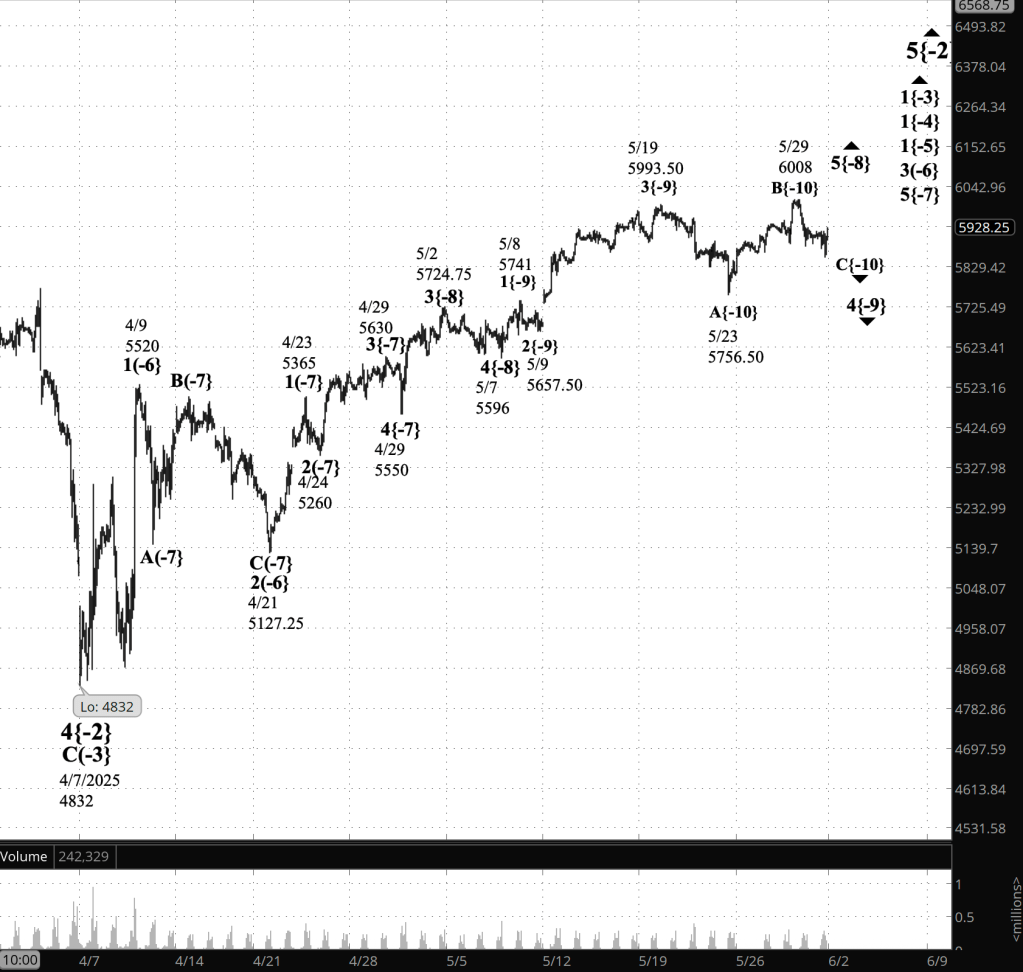
Trader’s Notebook: S&P 500

3:30 p.m. New York time

Half an hour before the closing bell. The S&P 500 futures resumed its rise, reaching 5554.50.

Elliott Wave Theory: Rising wave C within a 4th-wave upward correction continues. I’ve updated the chart in the Revised Analysis section.

9:57 a.m. New York time

The Revised Analysis I’ve revised the analysis of the chart, changing everything from April 7 to the present as subwaves of a rising 4th-wave correction (wave 4{-8} on the chart). Present wave C{-9} within wave 4{-8} is underwqy.,

I’ve retained the earlier chart to allow easy comparison.

[S&P 500 E-mini futures at 3:30 p.m, 35-minute bars, with volume]

9:35 a.m. New York time

What’s happening now. The S&P 500 E-mini futures peaked at 5553 overnight and then retreated back to the 5480s.

What does it mean?  I’ve attempted to apply Elliott Wave Theory to the subwaves of the present rising wave C within the 2nd-wave upward correction that began on April 10.

C waves have five subwaves. The difficuty with the pattern is that there is little to distinguish the 1st subwave from the 3rd. Another way of saying it is that threre is no clear 2nd wave. The 4th wave, by contrast, has great clarity.

So, now underway, wave 5 within the C wave. The upward correction is in its final wave, unless it forms a complex pattern, with two or three A-B-C patterns.

And yet, there’s a problem. A firm rule of Elliott Wave Theory declares that a 2nd wave never moves beyond the beginning of the preceding 1st wave. The 1st wave began on April 9 from 5528.75. The 2nd wave peaked at 5553 overnight. The rule has been broken, and It’s back to the drawing board to reanalyze everythng that has happened since April 9.

No time for the work before postng. I will post an update when the work is complete.

Revised: See new chart above.

[S&P 500 E-mini futures at 9:35 a.m, 35-minute bars, with volume]

 Elliott Wave Theory wave labels. Each wave listed on the charts has two components: A wave number, and a subscript in curly brackets that place the wave’s position in the fractal strucutre in relationship to Intermediate degree. The present Intermediate degree, wave 5{0}, began its rise on February 11, 2016 from 1810.10 and is still underway.

The waves referred to on the revised chart are as follows.

Principal analysis: Upward correction wave 4{-8} is underway and is in its final subwave, wave C{-9}., having paused for corrective wave 4{-10}. Wave 5{-10} has begun.

Long-term Waves

These are the waves currently in progress under my principal analysis. Each line on the list shows the wave number, with the subscript in curly brackets, the traditional degree name, the starting date, the starting price of the S&P 500 E-mini futures, and the direction of the wave.

Note: This list has been revised based on the chart analysis revision.

  • S&P 500 Index:
  • 5{+3} Supercycle, 7/8/1932, 4.40 (up)
  • 5{+2} Cycle, 12/9/1974, 60.96 (up)
  • 5{+1} Primary, 3/6/2009, 666.79 (up)
  • 5{0} Intermediate, 2/11/2016, 1810.10 (up)
  • 3{-1} Minor, 3/23/2020, 2191.36 (up)
  • 3{-2} Minute, 10/13/2022, 3491.58 (up)
  • S&P 500 Futures
  • 5{-3} Minuette, 4/18/2024, 4963.50 (up)
  • 3{-4} Subminuette, 8/7/2024, 5182 (up)
  • 4{-5} Micro, 12/16/2024, 6163.75 (down)
  • C{-6} Submicro, 2/19/2025, 6166.50 (down)
  • C{-7} Minuscule, 3/25/2025, 5835 (down)
  • 4{-8} (no name), 3/7/2025, 48322 (up)
  • C{-9} (no name), 4/21/2025, 5127.25 (up)

Reading the chart. Price movements — waves – – in Elliott Wave Theory analysis are labeled with numbers within trending waves and letters with corrective waves. The subscripts — numbers in curly brackets — designate the wave’s degree, which, in Elliott Wave analysis, means the relative position of a wave within the larger and smaller structures that make up the chart. R.N. Elliott, who in the 1930s developed the form of analysis that bears his name, viewed the chart as a complex structure of smaller waves nested within larger waves, which in turn are nested within still larger waves. In mathematics it’s called a fractal structure, where at every scale the pattern is similar to the others.

Learning and other resources. Elliott Wave analysis provides context, not prophecy. As the 20th century semanticist Alfred Korzybski put it in his book Science and Sanity (1933), “The map is not the territory … The only usefulness of a map depends on similarity of structure between the empirical world and the map.” And I would add, in the ever-changing markets, we can judge that similarity of structure only after the fact.

See the menu page Analytical Methods for a rundown on where to go for information on Elliott Wave analysis.

By Tim Bovee, Portland, Oregon, April 25, 2025

Disclaimer

Tim Bovee, Private Trader tracks the analysis and trades of a private trader for his own accounts. Nothing in this blog constitutes a recommendation to buy or sell stocks, options or any other financial instrument. The only purpose of this blog is to provide education and entertainment.

No trader is ever 100 percent successful in his or her trades. Trading in the stock and option markets is risky and uncertain. Each trader must make trading decisions for his or her own account, and take responsibility for the consequences.

License

All content on Tim Bovee, Private Trader by Timothy K. Bovee is licensed under a Creative Commons Attribution-ShareAlike 4.0 International License.

Based on a work at www.timbovee.com
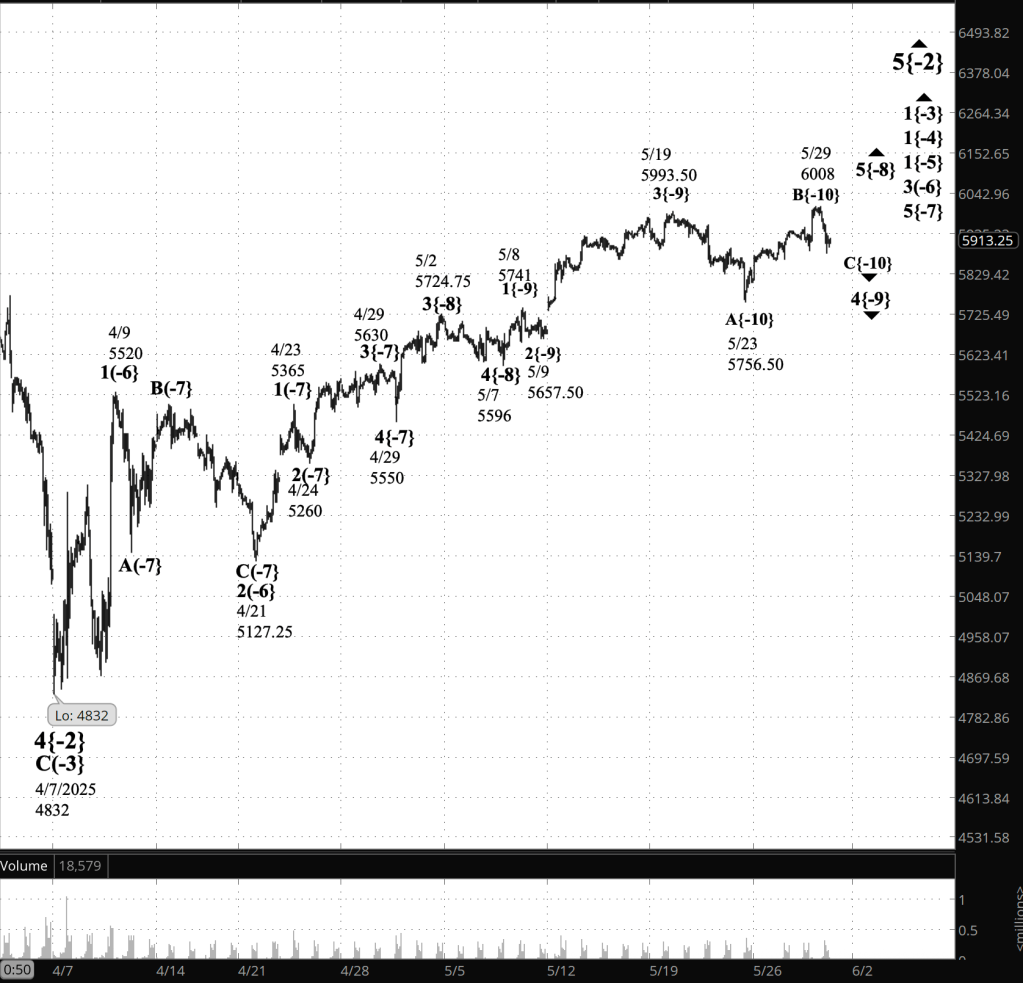
Trader’s Notebook: Gold

12:50 p.m. New York time

What’s happening now. The GLD exchange-traded fund slipped from 307.44 at the opening bell down to 304.71

What does it mean? The pattern seem through the lens of Elliott Wave Theory is compatible with wave A ending on April 23, two days after the Apri 21 peak put an end to a number of rising impulse waves. Under this, my principle analysis, rising wave B is underway.

Bottom fishing on a stock chart often results in multiple possibilities. If the price reverses and falls below 300.59, then an alternative analysis comes into play: Wave A is still underway.

All of this is happening within a series of downward corrective waves that began on April 21.

[Gold futures, 2:35 p.m., 10-minute bars, with volume]

Reading the chart. Price movements — waves – – in Elliott Wave Theory analysis are labeled with numbers within trending waves and letters with corrective waves. The subscripts — numbers in curly brackets — designate the wave’s degree, which, in Elliott Wave analysis, means the relative position of a wave within the larger and smaller structures that make up the chart. R.N. Elliott, who in the 1930s developed the form of analysis that bears his name, viewed the chart as a complex structure of smaller waves nested within larger waves, which in turn are nested within still larger waves. In mathematics it’s called a fractal structure, where at every scale the pattern is similar to the others.

Learning and other resources. Elliott Wave analysis provides context, not prophecy. As the 20th century semanticist Alfred Korzybski put it in his book Science and Sanity (1933), “The map is not the territory … The only usefulness of a map depends on similarity of structure between the empirical world and the map.” And I would add, in the ever-changing markets, we can judge that similarity of structure only after the fact.

See the menu page Analytical Methods for a rundown on where to go for information on Elliott Wave analysis.

By Tim Bovee, Portland, Oregon, April 23, 2025

Disclaimer

Tim Bovee, Private Trader tracks the analysis and trades of a private trader for his own accounts. Nothing in this blog constitutes a recommendation to buy or sell stocks, options or any other financial instrument. The only purpose of this blog is to provide education and entertainment.

No trader is ever 100 percent successful in his or her trades. Trading in the stock and option markets is risky and uncertain. Each trader must make trading decisions for his or her own account, and take responsibility for the consequences.

License

All content on Tim Bovee, Private Trader by Timothy K. Bovee is licensed under a Creative Commons Attribution-ShareAlike 4.0 International License.

Based on a work at www.timbovee.com
Trader’s Notebook: S&P 500

3:30 p.m. New York time

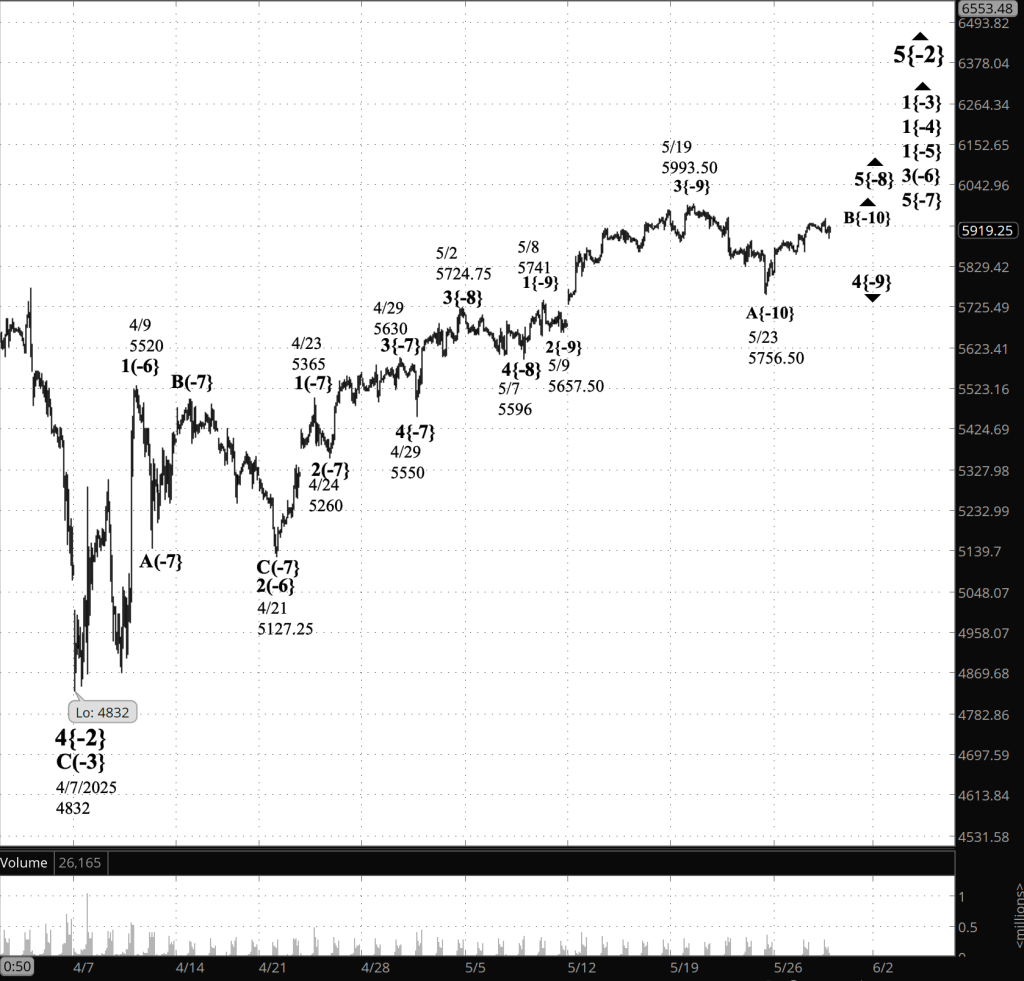
Half an hour before the closing bell. The S&P 500 futures rose during the session, reaching beyond the April 23 high, 5499.75, reaching 5514.75 before dropping back.

The break above yesterday’s high confirmed the principal analysis: Rising wave C, the final subwave of the wave 2 upward correction, is underway. The alternative analysis posted this morning? Not happening.

9:35 a.m. New York time

What’s happening now. The S&P 500 E-mini futures declined overnight and thern rose, retracing a Fibonacci 78.6% of the decline.

What does it mean? The rise, analyzed using Elliott Wave Theory, leaves unanswered whether yesterday’s analysis was correct: The decline was a correction contained with the 2nd-wave upward correction that began on April 10.

I intend to stick with that analysis until I see greater evidence to the contrary. For the present, the principal analysis is the ongoing wave 2 scenario, and the alternative analysis has wave 2 ending on April 23 at 5499.75 and wave 3 beginning.

Under the principal analysis, look for a quick reversal to the downside as downtrending wave 3 picks up energy. Under the alternative analysis, look for a rapid push against 5499.75.

[S&P 500 E-mini futures at 3:30 p.m, 35-minute bars, with volume]

 Elliott Wave Theory wave labels. Each wave listed on the charts has two components: A wave number, and a subscript in curly brackets that place the wave’s position in the fractal strucutre in relationship to Intermediate degree. The present Intermediate degree, wave 5{0}, began its rise on February 11, 2016 from 1810.10 and is still underway.

The waves referred to above are as follows.

Principal analysis: Upward correction wave 2{-9} is underway, having paused for corrective wave of the {-10} degree.

Alternative analysis: Upward correction wave 2{-9} ended on April 23 and downtrending wave 3{-9} is underway.

Long-term Waves

These are the waves currently in progress under my principal analysis. Each line on the list shows the wave number, with the subscript in curly brackets, the traditional degree name, the starting date, the starting price of the S&P 500 E-mini futures, and the direction of the wave.

  • S&P 500 Index:
  • 5{+3} Supercycle, 7/8/1932, 4.40 (up)
  • 5{+2} Cycle, 12/9/1974, 60.96 (up)
  • 5{+1} Primary, 3/6/2009, 666.79 (up)
  • 5{0} Intermediate, 2/11/2016, 1810.10 (up)
  • 3{-1} Minor, 3/23/2020, 2191.36 (up)
  • 3{-2} Minute, 10/13/2022, 3491.58 (up)
  • S&P 500 Futures
  • 5{-3} Minuette, 4/18/2024, 4963.50 (up)
  • 3{-4} Subminuette, 8/7/2024, 5182 (up)
  • 4{-5} Micro, 12/16/2024, 6163.75 (down)
  • C{-6} Submicro, 2/19/2025, 6166.50 (down)
  • C{-7} Minuscule, 3/25/2025, 5835 (down)
  • 5{-8} (no name), 3/9/2025, 5528.75 (down)
  • 2{-9} (no name), 4/10/2025, 5146.75 (up)

Reading the chart. Price movements — waves – – in Elliott Wave Theory analysis are labeled with numbers within trending waves and letters with corrective waves. The subscripts — numbers in curly brackets — designate the wave’s degree, which, in Elliott Wave analysis, means the relative position of a wave within the larger and smaller structures that make up the chart. R.N. Elliott, who in the 1930s developed the form of analysis that bears his name, viewed the chart as a complex structure of smaller waves nested within larger waves, which in turn are nested within still larger waves. In mathematics it’s called a fractal structure, where at every scale the pattern is similar to the others.

Learning and other resources. Elliott Wave analysis provides context, not prophecy. As the 20th century semanticist Alfred Korzybski put it in his book Science and Sanity (1933), “The map is not the territory … The only usefulness of a map depends on similarity of structure between the empirical world and the map.” And I would add, in the ever-changing markets, we can judge that similarity of structure only after the fact.

See the menu page Analytical Methods for a rundown on where to go for information on Elliott Wave analysis.

By Tim Bovee, Portland, Oregon, April 24, 2025

Disclaimer

Tim Bovee, Private Trader tracks the analysis and trades of a private trader for his own accounts. Nothing in this blog constitutes a recommendation to buy or sell stocks, options or any other financial instrument. The only purpose of this blog is to provide education and entertainment.

No trader is ever 100 percent successful in his or her trades. Trading in the stock and option markets is risky and uncertain. Each trader must make trading decisions for his or her own account, and take responsibility for the consequences.

License

All content on Tim Bovee, Private Trader by Timothy K. Bovee is licensed under a Creative Commons Attribution-ShareAlike 4.0 International License.

Based on a work at www.timbovee.com

Trader’s Notebook: Gold

2:35 p.m. New York time

What’s happening now. The GLD exchange-traded fund continued to fall during the session, reaching a low of 300.59.

What does it mean? Elliott Wave Theory sees the decline as wave within a series of A waves, each larger than the one before, all the way up to a 4th wave. All of the waves began on April 21 from 322.52 after a smaller 5th wave reached its end, triggering the end of all the other in the fractal ladder, all encompassed by a 3rd wave that began on November 3, 2022 from 150.57.

The smaller wave A — labeled wave A{-4} — will be followed by a rising B wave and then a falling C wave.

The end of the 5th wave that began on April 17, wave 5{-5} triggers a series wave endings all the way up to wave 3{0}, which began on November 3, 2022 from 150.57.

Wave 3{0} has now begun wave 4{0}, a downward correction, which is now in its first subwave, wave A{-1}. All the waves smaller that wave. And at this point, every former 5th wave from wave 5{-1} to wave 5{-6} is now an A wave with the same degree.

I’ve seen cascades happen before when applying Elliott Wave Theory. This one stands among the larger.

My initial reaction was a heartfelt “No way!” The political and economic forces that coincided with GLD’s race to the top are still with us: Ever-changing tariff policies that are likely to raise prices and make shipping less certain, along with President Trump’s expressed wishes that the Federal Reserve Chair Jerome Powell eave the Fed before his term expires next year.

I then stepped back and recalled a key tennant of Elliott Wave Theory: Events don’t steer markets. Neither does policy. Markets are steered by the mass psychology of crowds. And sometimes the crowds do what’s expected, and sometimes their combined judgment takes another past.

Where we stand. If the crowd wills it, a months long downward correction phase will ensue, as each degree works through its corrective waves. And for traders, there will be ups and downs, providing opportunity. Each correction usually has three subwaves (some have more). My personal favorite waves to trade are waves 3, 5, and C.

The waves in the vast fractal field will have plenty of each.

Aternative. Or, the price might turn around and move higher, erasing all of the above. All will return to wave 3{0} encompassing a series of 5th waves. Could happen. Elliott Wave Theory doesn’t read the future, only the possibilities.

[Gold futures, 2:35 p.m., 10-minute bars, with volume]

Elliott Wave Theory wave labels. Each wave listed on the charts has two components: A wave number, and a subscript in curly brackets that place the wave’s position in the fractal strucutre in relationship to Intermediate degree. The present Intermediate degree, GLD wave 3{0}, began its rise on November 3, 2022 from 150.57 and is still underway.

Reading the chart. Price movements — waves – – in Elliott Wave Theory analysis are labeled with numbers within trending waves and letters with corrective waves. The subscripts — numbers in curly brackets — designate the wave’s degree, which, in Elliott Wave analysis, means the relative position of a wave within the larger and smaller structures that make up the chart. R.N. Elliott, who in the 1930s developed the form of analysis that bears his name, viewed the chart as a complex structure of smaller waves nested within larger waves, which in turn are nested within still larger waves. In mathematics it’s called a fractal structure, where at every scale the pattern is similar to the others.

Learning and other resources. Elliott Wave analysis provides context, not prophecy. As the 20th century semanticist Alfred Korzybski put it in his book Science and Sanity (1933), “The map is not the territory … The only usefulness of a map depends on similarity of structure between the empirical world and the map.” And I would add, in the ever-changing markets, we can judge that similarity of structure only after the fact.

See the menu page Analytical Methods for a rundown on where to go for information on Elliott Wave analysis.

By Tim Bovee, Portland, Oregon, April 23, 2025

Disclaimer

Tim Bovee, Private Trader tracks the analysis and trades of a private trader for his own accounts. Nothing in this blog constitutes a recommendation to buy or sell stocks, options or any other financial instrument. The only purpose of this blog is to provide education and entertainment.

No trader is ever 100 percent successful in his or her trades. Trading in the stock and option markets is risky and uncertain. Each trader must make trading decisions for his or her own account, and take responsibility for the consequences.

License

All content on Tim Bovee, Private Trader by Timothy K. Bovee is licensed under a Creative Commons Attribution-ShareAlike 4.0 International License.

Based on a work at www.timbovee.com
Trader’s Notebook: S&P 500

3:30 p.m. New York time

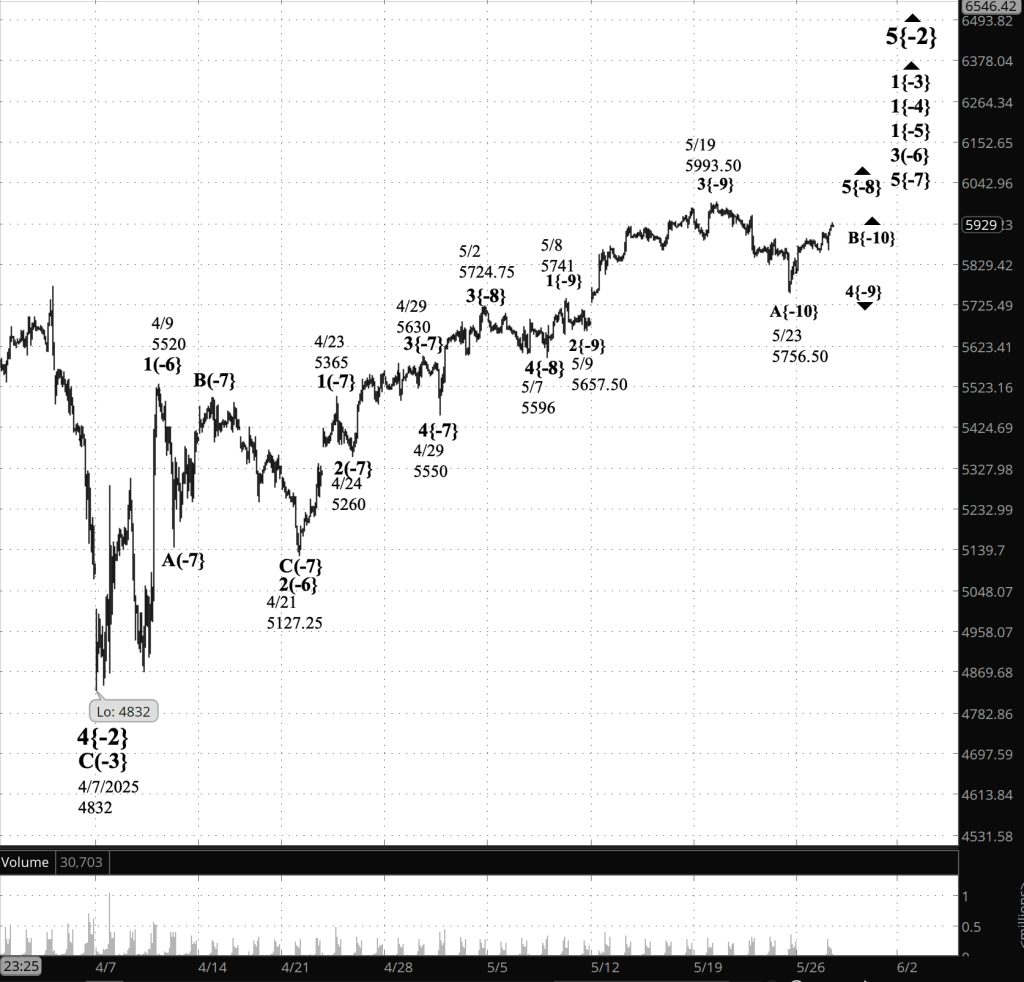
Half an hour before the closing bell. The S&P 500 futures stalled its decline in the 5380s, rising slightly and then fall slightly but making no progress in either direction.

Elliott Wave Theory: The decline is a downward correction within wave C, the final subwave of the 2nd-wave upward correction that began on April 10. Or, an alternative, the high before the deline was the end of wave C and the correction.

9:35 a.m. New York time

What’s happening now. The S&P 500 E-mini futures rose overnight, from the 5370s to the 5450s.

What does it mean? In light of Elliott Wave Theory analysis, the 2nd-wave upward correction that began on April 20 continues to work its way through what is likely its final subwave, wave C.

All of this is encompassed within wave 5{-8}, a downtrending impulse wave that began on April 9.

I say “likely the final subwave” because some corrections take a complex form, with one A-B-C subwave pattern being followed by a second three-wave pattern, separated from the first by an X-wave. And in some cases, the complex form will have a third three-subwave pattern.

A 2nd wave, such as the rise now underway, cannot move beyond the starting point of the preceding 1st wave. If it does, then the analysis must be changed. In the present case, the preceding 1st wave began on April 9 from 5528.75.

As can be seen by the present price — the 5450s — the 2nd wave correction is coming close to its upper limit.

[S&P 500 E-mini futures at 3:30 p.m, 35-minute bars, with volume]

 Elliott Wave Theory wave labels. Each wave listed on the charts has two components: A wave number, and a subscript in curly brackets that place the wave’s position in the fractal strucutre in relationship to Intermediate degree. The present Intermediate degree, wave 5{0}, began its rise on February 11, 2016 from 1810.10 and is still underway.

The waves referred to above are as follows. Downtrending wave 5{-8} is underway, a subwave of wave C{-7}, also declining, which in turn is a subwave of declining wave C{-6}, with both C waves encompassed by declining wave 4{-5}, which began on December 16, 2024.

All of this is happening four-steps deep and more with wave within uptrending wave 3{-4}, which began on August 7, 2024 from 5182.

Long-term Waves

These are the waves currently in progress under my principal analysis. Each line on the list shows the wave number, with the subscript in curly brackets, the traditional degree name, the starting date, the starting price of the S&P 500 E-mini futures, and the direction of the wave.

  • S&P 500 Index:
  • 5{+3} Supercycle, 7/8/1932, 4.40 (up)
  • 5{+2} Cycle, 12/9/1974, 60.96 (up)
  • 5{+1} Primary, 3/6/2009, 666.79 (up)
  • 5{0} Intermediate, 2/11/2016, 1810.10 (up)
  • 3{-1} Minor, 3/23/2020, 2191.36 (up)
  • 3{-2} Minute, 10/13/2022, 3491.58 (up)
  • S&P 500 Futures
  • 5{-3} Minuette, 4/18/2024, 4963.50 (up)
  • 3{-4} Subminuette, 8/7/2024, 5182 (up)
  • 4{-5} Micro, 12/16/2024, 6163.75 (down)
  • C{-6} Submicro, 2/19/2025, 6166.50 (down)
  • C{-7} Minuscule, 3/25/2025, 5835 (down)
  • 5{-8} (no name), 3/9/2025, 5528.75 (down)
  • 2{-9} (no name), 4/10/2025, 5146.75 (up)

Reading the chart. Price movements — waves – – in Elliott Wave Theory analysis are labeled with numbers within trending waves and letters with corrective waves. The subscripts — numbers in curly brackets — designate the wave’s degree, which, in Elliott Wave analysis, means the relative position of a wave within the larger and smaller structures that make up the chart. R.N. Elliott, who in the 1930s developed the form of analysis that bears his name, viewed the chart as a complex structure of smaller waves nested within larger waves, which in turn are nested within still larger waves. In mathematics it’s called a fractal structure, where at every scale the pattern is similar to the others.

Learning and other resources. Elliott Wave analysis provides context, not prophecy. As the 20th century semanticist Alfred Korzybski put it in his book Science and Sanity (1933), “The map is not the territory … The only usefulness of a map depends on similarity of structure between the empirical world and the map.” And I would add, in the ever-changing markets, we can judge that similarity of structure only after the fact.

See the menu page Analytical Methods for a rundown on where to go for information on Elliott Wave analysis.

By Tim Bovee, Portland, Oregon, April 23, 2025

Disclaimer

Tim Bovee, Private Trader tracks the analysis and trades of a private trader for his own accounts. Nothing in this blog constitutes a recommendation to buy or sell stocks, options or any other financial instrument. The only purpose of this blog is to provide education and entertainment.

No trader is ever 100 percent successful in his or her trades. Trading in the stock and option markets is risky and uncertain. Each trader must make trading decisions for his or her own account, and take responsibility for the consequences.

License

All content on Tim Bovee, Private Trader by Timothy K. Bovee is licensed under a Creative Commons Attribution-ShareAlike 4.0 International License.

Based on a work at www.timbovee.com