Trader’s Notebook

3:30 p.m. New York time

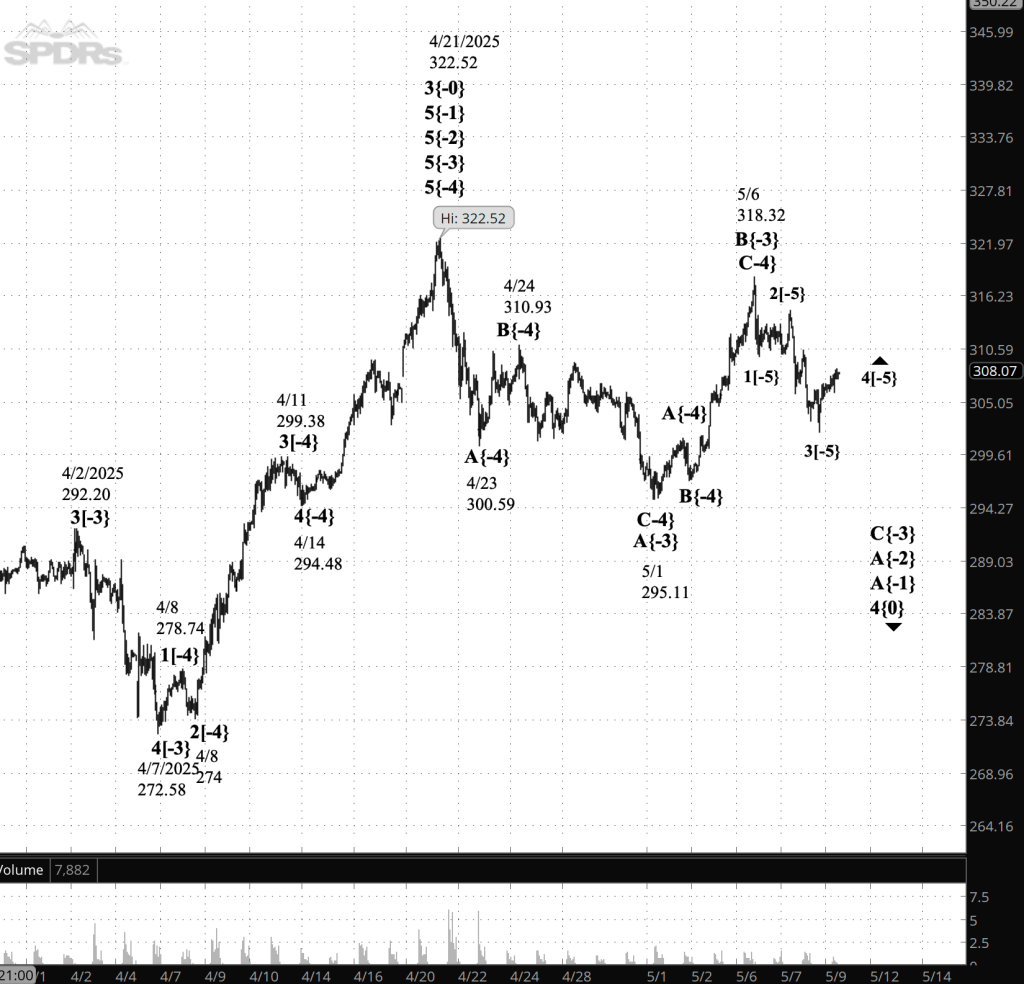
Half an hour before the closing bell. The S&P 500 futures rose during the session, reaching 5418.25 and then pulling back slightly.

Map of a corretion. The movement is part of a 2nd wave upward correction that began on March 10 from 5146.75. The price today has so far risen to a peak, 5418.25.

Elliott Wave Theory maps it like this:

  • The first subwave of the correction, rising wave A, is nearing completion.
  • Wave A is on its 5th subwave, meaning it is taking the form of a Zigzag.
  • When wave 5 is complete, wave A will also be complete, and declining wave B will begin.
  • It is possible that wave A ended at today’s peak. If so, the subsequent decline is the initial subwave of falling wave B.

Here is a chart showing the upward correction and its subwaves.

[S&P 500 E-mini futures at 3:20 p.m, 3-minute bars, with volume]

9:35 a.m. New York time

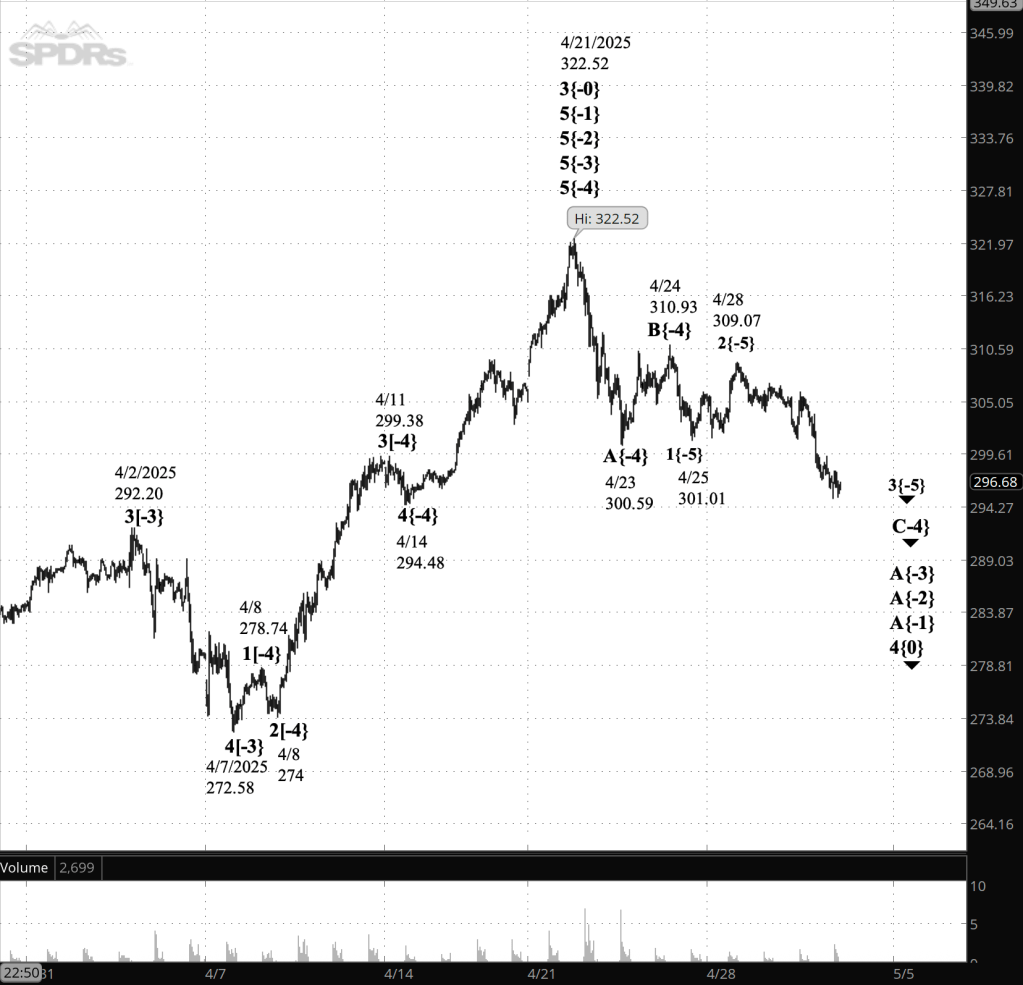
What’s happening now. The S&P 500 E-mini futures rose overnight. amid a larger downtrend that began on April 9.

What does it mean? The downtrend, in Elliott Wave Theory, is a 5th wave, the final wave within two C waves, one larger than the other, all working through their journeys within a 4th-wave downward correction that began on December 16, 2024.

The 5th wave has completed its first subwave and is now in its 2nd-wave upward correction. Afterward, it will resume its decline in subwave 3, typically the most powerful wae in a trend.

The rule of Elliott Wave Theory governing 2nd waves states that wave 2 cannot move beyond the start of the preceding wave 1. The 1st wave within wave 5 began on April 9 from 5528.75, and that’s the upper limit for the present wave 2. If it moves higher than that, then it’s back the drawing board for a fresh analysis.

[S&P 500 E-mini futures at 3:30 p.m, 30-minute bars, with volume]

 Elliott Wave Theory wave labels. Each wave listed on the charts has two components: A wave number, and a subscript in curly brackets that place the wave’s position in the fractal strucutre in relationship to Intermediate degree. The present Intermediate degree, wave 5{0}, began its rise on February 11, 2016 from 1810.10 and is still underway.

The waves referred to above are as follows. Downtrending wave 5{-8} is underway, a subwave of wave C{-7}, also declining, which in turn is a subwave of declining wave C{-6}, with both C waves encompassed by declining wave 4{-5}, which began on December 16, 2024.

Within wave 5{-8}, the second subwave, rising wave 2{-9} is underway.

Long-term Waves

These are the waves currently in progress under my principal analysis. Each line on the list shows the wave number, with the subscript in curly brackets, the traditional degree name, the starting date, the starting price of the S&P 500 E-mini futures, and the direction of the wave.

  • S&P 500 Index:
  • 5{+3} Supercycle, 7/8/1932, 4.40 (up)
  • 5{+2} Cycle, 12/9/1974, 60.96 (up)
  • 5{+1} Primary, 3/6/2009, 666.79 (up)
  • 5{0} Intermediate, 2/11/2016, 1810.10 (up)
  • 3{-1} Minor, 3/23/2020, 2191.36 (up)
  • 3{-2} Minute, 10/13/2022, 3491.58 (up)
  • S&P 500 Futures
  • 5{-3} Minuette, 4/18/2024, 4963.50 (up)
  • 3{-4} Subminuette, 8/7/2024, 5182 (up)
  • 4{-5} Micro, 12/16/2024, 6163.75 (down)
  • C{-6} Submicro, 2/19/2025, 6166.50 (down)
  • C{-7} Minuscule, 3/25/2025, 5835 (down)
  • 5{-8} (no name), 3/9/2025, 5528.75 (down)

Reading the chart. Price movements — waves – – in Elliott Wave Theory analysis are labeled with numbers within trending waves and letters with corrective waves. The subscripts — numbers in curly brackets — designate the wave’s degree, which, in Elliott Wave analysis, means the relative position of a wave within the larger and smaller structures that make up the chart. R.N. Elliott, who in the 1930s developed the form of analysis that bears his name, viewed the chart as a complex structure of smaller waves nested within larger waves, which in turn are nested within still larger waves. In mathematics it’s called a fractal structure, where at every scale the pattern is similar to the others.

Learning and other resources. Elliott Wave analysis provides context, not prophecy. As the 20th century semanticist Alfred Korzybski put it in his book Science and Sanity (1933), “The map is not the territory … The only usefulness of a map depends on similarity of structure between the empirical world and the map.” And I would add, in the ever-changing markets, we can judge that similarity of structure only after the fact.

See the menu page Analytical Methods for a rundown on where to go for information on Elliott Wave analysis.

By Tim Bovee, Portland, Oregon, April 11, 2025

Disclaimer

Tim Bovee, Private Trader tracks the analysis and trades of a private trader for his own accounts. Nothing in this blog constitutes a recommendation to buy or sell stocks, options or any other financial instrument. The only purpose of this blog is to provide education and entertainment.

No trader is ever 100 percent successful in his or her trades. Trading in the stock and option markets is risky and uncertain. Each trader must make trading decisions for his or her own account, and take responsibility for the consequences.

License

All content on Tim Bovee, Private Trader by Timothy K. Bovee is licensed under a Creative Commons Attribution-ShareAlike 4.0 International License.

Based on a work at www.timbovee.com

Trader’s Notebook

3:30 p.m. New York time

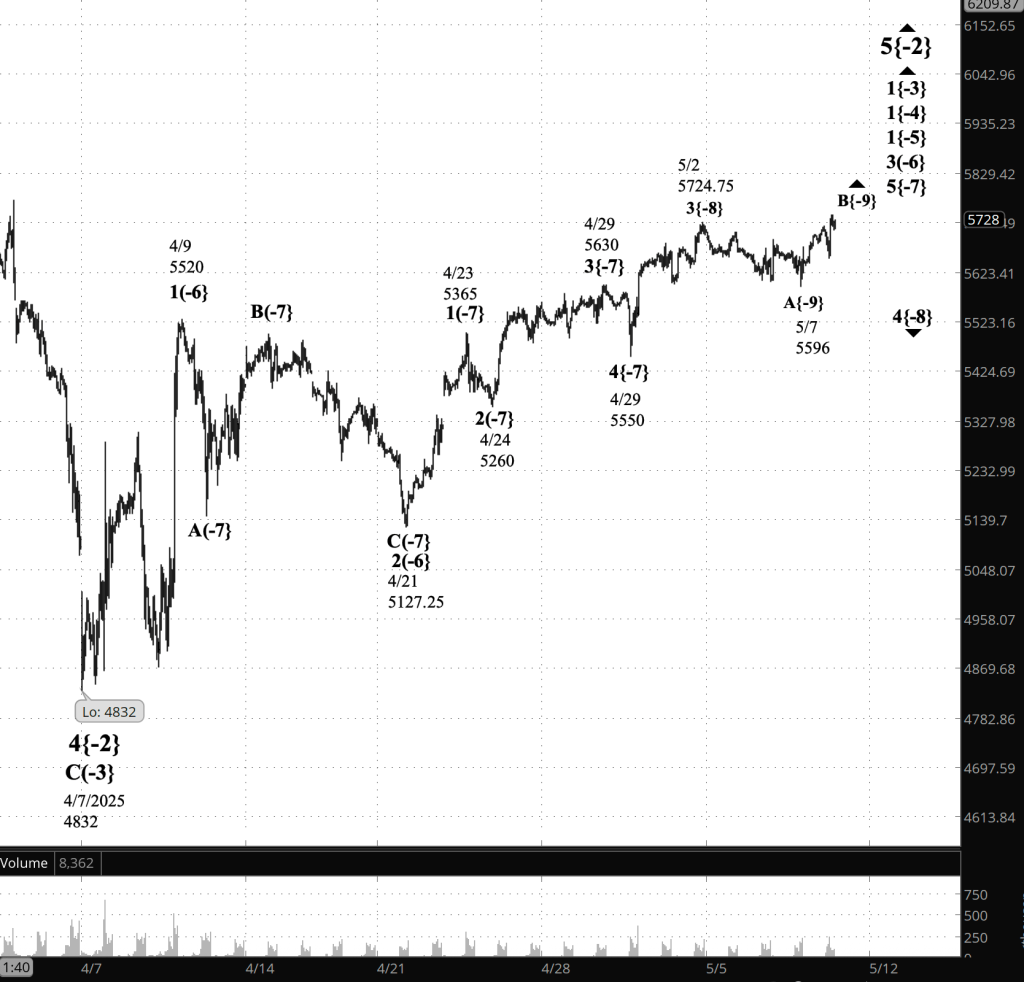
Half an hour before the closing bell. The S&P 500 futures fell into the 5140s during the session and then began to rise.

Elliott Wave Theory. The 5-wave decline is the initial subwave, wave 1, within the downtrending wave 5 that began on April 9. The subsequent rise, still underway, is wave 2.

9:35 a.m. New York time

What’s happening now. The S&P 500 E-mini futures fell overnight, momentarily rising slightly following release of the Consumer Price Index data for March. The declne rapidly resumed.

What does it mean? My analysis using Elliott Wave Theory sees the decline as marking the end of the 4th-wave upward correction that began on April 7. A downtrending 5th wave began on April 9 from 5528.75.

No one will be surprised when I say that there are ambiguities. The 4th wave within the rise lacks clarity, such is is the power of the upward push. However, it is consistent with a 4th wave, and that means the final subwave, wave 5, must follow under the rules of Elliott Wave Theory. Nonetheless, if the price reduces and moved abovr 5528.75, then the 4th-wave upward correction is still underway.

[S&P 500 E-mini futures at 3:30 p.m, 30-minute bars, with volume]

 Elliott Wave Theory wave labels. Each wave listed on the charts has two components: A wave number, and a subscript in curly brackets that place the wave’s position in the fractal strucutre in relationship to Intermediate degree. The present Intermediate degree, wave 5{0}, began its rise on February 11, 2016 from 1810.10 and is still underway.

The waves referred to above are as follows. Downtrending wave 5{-8} is underway, a subwave of wave C{-7}, also declining, which in turn is a subwave of declining wave C{-6}, with both C waves encompassed by declining wave 4{-5}, which began on December 16, 2024.

Within wave C{-9}, the final subwave within wave 4{-8}, I count a clear corrective wave, wave 4{-10}, which means that the subsequent rise is wave 5{-10}, the final wave within wave C{-9}.

Long-term Waves

These are the waves currently in progress under my principal analysis. Each line on the list shows the wave number, with the subscript in curly brackets, the traditional degree name, the starting date, the starting price of the S&P 500 E-mini futures, and the direction of the wave.

  • S&P 500 Index:
  • 5{+3} Supercycle, 7/8/1932, 4.40 (up)
  • 5{+2} Cycle, 12/9/1974, 60.96 (up)
  • 5{+1} Primary, 3/6/2009, 666.79 (up)
  • 5{0} Intermediate, 2/11/2016, 1810.10 (up)
  • 3{-1} Minor, 3/23/2020, 2191.36 (up)
  • 3{-2} Minute, 10/13/2022, 3491.58 (up)
  • S&P 500 Futures
  • 5{-3} Minuette, 4/18/2024, 4963.50 (up)
  • 3{-4} Subminuette, 8/7/2024, 5182 (up)
  • 4{-5} Micro, 12/16/2024, 6163.75 (down)
  • C{-6} Submicro, 2/19/2025, 6166.50 (down)
  • C{-7} Minuscule, 3/25/2025, 5835 (down)

Reading the chart. Price movements — waves – – in Elliott Wave Theory analysis are labeled with numbers within trending waves and letters with corrective waves. The subscripts — numbers in curly brackets — designate the wave’s degree, which, in Elliott Wave analysis, means the relative position of a wave within the larger and smaller structures that make up the chart. R.N. Elliott, who in the 1930s developed the form of analysis that bears his name, viewed the chart as a complex structure of smaller waves nested within larger waves, which in turn are nested within still larger waves. In mathematics it’s called a fractal structure, where at every scale the pattern is similar to the others.

Learning and other resources. Elliott Wave analysis provides context, not prophecy. As the 20th century semanticist Alfred Korzybski put it in his book Science and Sanity (1933), “The map is not the territory … The only usefulness of a map depends on similarity of structure between the empirical world and the map.” And I would add, in the ever-changing markets, we can judge that similarity of structure only after the fact.

See the menu page Analytical Methods for a rundown on where to go for information on Elliott Wave analysis.

By Tim Bovee, Portland, Oregon, April 10, 2025

Disclaimer

Tim Bovee, Private Trader tracks the analysis and trades of a private trader for his own accounts. Nothing in this blog constitutes a recommendation to buy or sell stocks, options or any other financial instrument. The only purpose of this blog is to provide education and entertainment.

No trader is ever 100 percent successful in his or her trades. Trading in the stock and option markets is risky and uncertain. Each trader must make trading decisions for his or her own account, and take responsibility for the consequences.

License

All content on Tim Bovee, Private Trader by Timothy K. Bovee is licensed under a Creative Commons Attribution-ShareAlike 4.0 International License.

Based on a work at www.timbovee.com
Trader’s Notebook

3:30 p.m. New York time

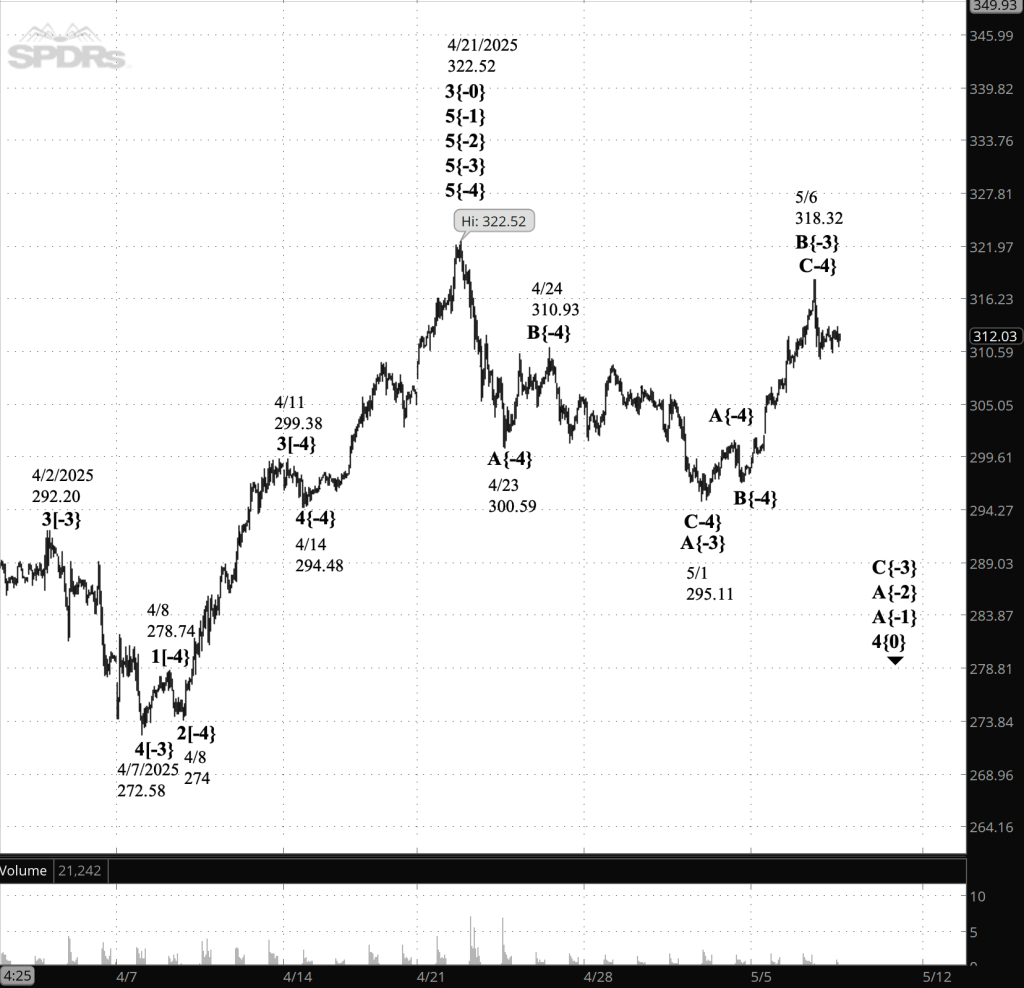
Half an hour before the closing bell. The S&P 500 futures rose sharply during the session as President Trump lowered the reciprocal tariffs levied against many nations in the world from 25% to 10%, a temporary move lasting 90 days. He also raised the tariffs levied on China from 104% to 125%

Elliott Wave Theory. The sudden rise marked the end of declining wave B, the middle subwave a 4th-wave rising correction, and the beginning of the final subwave, wave C. The C wave rapidly rose from 5025 and so far as reached into the 5450s.

When the C wave is complete, it will also be the end of the parent 4th-wave upward correction. A downtrending 5th-wave will follow. Fifth waves are quirky, but it could well reach down into the 4640s or 4650s, below the April 7 low, 4832, that ended the preceding 3rd wave.

The waves as numbered in the chart: Wave C{-9} began its rise today and will complete rising wave 4{-8}. Downtrending wave 5{-8} wil following, moving below the endpoint of wave 3{-8}, on April 7.

9:35 a.m. New York time

What’s happening now. The S&P 500 E-mini futures rose back to the 23.6% Fibonacci retracement level as the upward correction that began on April 7 continues.

What does it mean? Elliott Wave Theory sees the correction as a 4th wave, a break in the downward movement that began on March 25. That decline is a subwave within an even larger correction, wave C within wave 4. That larger 4th wave began on December 16, 2024 from 6163.75.

Returning to the smaller upward correction, the 4th wave that began on March 25. The first subwave, rising wave A, had three subwaves. That tells us that the correction is taking the form of a Flat.

That has implications for Wave B, which in a Flat must retrace at least 90% of wave A, which covered 473.25 beginning to end. Wave B began its decline from 5305.25, the end of wave A, and has reached a low point so far of 4871.75, having covered 433.50. The calculation is the length of wave B so far divided by the length of wave A, total: 433.50 / 473.25 = 0.91.

So wave B has met its requirement, having covered 91% of wave A. It might go farther, it might even go below the start of wave A. Or it might fall short. No matter. It has met the 90% rule and is a proper B wave in a Flat.

[S&P 500 E-mini futures at 3:30 p.m, 25-minute bars, with volume]

 Elliott Wave Theory wave labels. Each wave listed on the charts has two components: A wave number, and a subscript in curly brackets that place the wave’s position in the fractal strucutre in relationship to Intermediate degree. The present Intermediate degree, wave 5{0}, began its rise on February 11, 2016 from 1810.10 and is still underway.

The waves referred to above are as follows. Rising wave 4{-8} is underway, a subwave of wave C{-7}, also declining, which in turn is a subwave of declining wave C{-6}, with both C waves encompassed by declining wave 4{-5}, which began on December 16, 2024.

Within wave 4{-8}, wave B{-9} is underway and has retraced more than 90% of wave A{-9}.

Long-term Waves

These are the waves currently in progress under my principal analysis. Each line on the list shows the wave number, with the subscript in curly brackets, the traditional degree name, the starting date, the starting price of the S&P 500 E-mini futures, and the direction of the wave.

  • S&P 500 Index:
  • 5{+3} Supercycle, 7/8/1932, 4.40 (up)
  • 5{+2} Cycle, 12/9/1974, 60.96 (up)
  • 5{+1} Primary, 3/6/2009, 666.79 (up)
  • 5{0} Intermediate, 2/11/2016, 1810.10 (up)
  • 3{-1} Minor, 3/23/2020, 2191.36 (up)
  • 3{-2} Minute, 10/13/2022, 3491.58 (up)
  • S&P 500 Futures
  • 5{-3} Minuette, 4/18/2024, 4963.50 (up)
  • 3{-4} Subminuette, 8/7/2024, 5182 (up)
  • 4{-5} Micro, 12/16/2024, 6163.75 (down)
  • C{-6} Submicro, 2/19/2025, 6166.50 (down)
  • C{-7} Minuscule, 3/25/2025, 5835 (down)

Reading the chart. Price movements — waves – – in Elliott Wave Theory analysis are labeled with numbers within trending waves and letters with corrective waves. The subscripts — numbers in curly brackets — designate the wave’s degree, which, in Elliott Wave analysis, means the relative position of a wave within the larger and smaller structures that make up the chart. R.N. Elliott, who in the 1930s developed the form of analysis that bears his name, viewed the chart as a complex structure of smaller waves nested within larger waves, which in turn are nested within still larger waves. In mathematics it’s called a fractal structure, where at every scale the pattern is similar to the others.

Learning and other resources. Elliott Wave analysis provides context, not prophecy. As the 20th century semanticist Alfred Korzybski put it in his book Science and Sanity (1933), “The map is not the territory … The only usefulness of a map depends on similarity of structure between the empirical world and the map.” And I would add, in the ever-changing markets, we can judge that similarity of structure only after the fact.

See the menu page Analytical Methods for a rundown on where to go for information on Elliott Wave analysis.

By Tim Bovee, Portland, Oregon, April 9, 2025

Disclaimer

Tim Bovee, Private Trader tracks the analysis and trades of a private trader for his own accounts. Nothing in this blog constitutes a recommendation to buy or sell stocks, options or any other financial instrument. The only purpose of this blog is to provide education and entertainment.

No trader is ever 100 percent successful in his or her trades. Trading in the stock and option markets is risky and uncertain. Each trader must make trading decisions for his or her own account, and take responsibility for the consequences.

License

All content on Tim Bovee, Private Trader by Timothy K. Bovee is licensed under a Creative Commons Attribution-ShareAlike 4.0 International License.

Based on a work at www.timbovee.com
Trader’s Notebook

3:30 p.m. New York time

Half an hour before the closing bell. The S&P 500 futures fell sharply during the session. The new analytical revisions under Elliott Wave Theory are as follows:

  • Wave A within the 4th-wave upward correction that began on April 7 turns out to have three subwaves, making a Flat corrective pattern.
  • The immediate and rapid fall form the A-wave peak is wave B, now underway.
  • Wave B, when complete, will be followed by rising wave C.
  • When wave C is complete, it will also be the end of wave A, one degree higher in the fractal structure.
  • The chart labels are: Corrective wave 4{-8}, larger wave A{-9}, subwaves A(-10) (complete), B{-10} (underway) and C{-10} (in the future).

9:35 a.m. New York time

What’s happening now. The S&P 500 E-mini futures began overnight trading from 5115 and has risen so far to the 5250s. The decline that began on April 2 from 5773.25 ended on April 7 at 4832, for a total drop of 16.3%

What does it mean? Elliott Wave Theory sees the decline from April 2 as a downtrending 3rd wave. The rise that followed is the start of a 4th-wave upward correction and its initial subwave, risng wave
A. Within wave A, a rising smaller 3rd wave is in progress.

I’ve placed a Fibonacci retracement ladder on the chart, in read, to trace thr 4th-wave’s retracement of the preceding 3rd wave, the sharp decline that began on April 2. The first subwave, rising wave 1, almost reached the 50% retracement level before reversing and falling. The middle subwave, rising wave 3, so far has breezed past the 32.6% retracement level and is approaching the 50% level.

[S&P 500 E-mini futures at 9:35 a.m, 20-minute bars, with volume]

 Elliott Wave Theory wave labels. Each wave listed on the charts has two components: A wave number, and a subscript in curly brackets that place the wave’s position in the fractal strucutre in relationship to Intermediate degree. The present Intermediate degree, wave 5{0}, began its rise on February 11, 2016 from 1810.10 and is still underway.

The waves referred to above are as follows. Rising wave 4{-8} is underway, a subwave of wave C{-7}, also declining, which in turn is a subwave of declining wave C{-6}, with both C waves encompassed by declining wave 4{-5}, which began on December 16, 2024.

Within wave 4{-8}, wave A{-9} is underway and within it, wave 3{-10} is in progress.

Long-term Waves

These are the waves currently in progress under my principal analysis. Each line on the list shows the wave number, with the subscript in curly brackets, the traditional degree name, the starting date, the starting price of the S&P 500 E-mini futures, and the direction of the wave. [Updated to match the 7:08 p.m. analysis.)

  • S&P 500 Index:
  • 5{+3} Supercycle, 7/8/1932, 4.40 (up)
  • 5{+2} Cycle, 12/9/1974, 60.96 (up)
  • 5{+1} Primary, 3/6/2009, 666.79 (up)
  • 5{0} Intermediate, 2/11/2016, 1810.10 (up)
  • 3{-1} Minor, 3/23/2020, 2191.36 (up)
  • 3{-2} Minute, 10/13/2022, 3491.58 (up)
  • S&P 500 Futures
  • 5{-3} Minuette, 4/18/2024, 4963.50 (up)
  • 3{-4} Subminuette, 8/7/2024, 5182 (up)
  • 4{-5} Micro, 12/16/2024, 6163.75 (down)
  • C{-6} Submicro, 2/19/2025, 6166.50 (down)
  • C{-7} Minuscule, 3/25/2025, 5835 (down)

Reading the chart. Price movements — waves – – in Elliott Wave Theory analysis are labeled with numbers within trending waves and letters with corrective waves. The subscripts — numbers in curly brackets — designate the wave’s degree, which, in Elliott Wave analysis, means the relative position of a wave within the larger and smaller structures that make up the chart. R.N. Elliott, who in the 1930s developed the form of analysis that bears his name, viewed the chart as a complex structure of smaller waves nested within larger waves, which in turn are nested within still larger waves. In mathematics it’s called a fractal structure, where at every scale the pattern is similar to the others.

Learning and other resources. Elliott Wave analysis provides context, not prophecy. As the 20th century semanticist Alfred Korzybski put it in his book Science and Sanity (1933), “The map is not the territory … The only usefulness of a map depends on similarity of structure between the empirical world and the map.” And I would add, in the ever-changing markets, we can judge that similarity of structure only after the fact.

See the menu page Analytical Methods for a rundown on where to go for information on Elliott Wave analysis.

By Tim Bovee, Portland, Oregon, April 8 2025

Disclaimer

Tim Bovee, Private Trader tracks the analysis and trades of a private trader for his own accounts. Nothing in this blog constitutes a recommendation to buy or sell stocks, options or any other financial instrument. The only purpose of this blog is to provide education and entertainment.

No trader is ever 100 percent successful in his or her trades. Trading in the stock and option markets is risky and uncertain. Each trader must make trading decisions for his or her own account, and take responsibility for the consequences.

License

All content on Tim Bovee, Private Trader by Timothy K. Bovee is licensed under a Creative Commons Attribution-ShareAlike 4.0 International License.

Based on a work at www.timbovee.com

Trader’s Notebook

3:30 p.m. New York time.

Half an hour before the closing bell. The S&P 500 futures rose during the session as Elliott Wave A peaked at 5286.50, just below the 50% Fibonacci retracement level. The price rapidly began to fall and so far, as wave B, has retreated to the 5050s, just above the 23.6% retracement level. All of this is happening within a 4th-wave upward correction.

What comes next? Wave C, which will rise almost certainly beyond the end of wave A.

In terms of the chart labels, rising wave A{-9} peaked, declining wave B{-9) is underway and rising wave C{-9} will follow, all within wave 4{-8}, an upward correction.

9:35 a.m. New York time

What’s happening now. The S&P 500 E-mini futures opened low at 4832 and immediately began to rise, so far reaching a high in the 5040s. That peak marked the end of wave A within the 4th-wave upward correction that began on

What does it mean? Elliott Wave Theory sees the low as the of the downtrending 3rd wave that began on April 2. The rise after trading resumed, with three subwaves, is a classic corrective pattern, an uptrending 4th wave that began from the April 6 low.

How could the analysis go wrong? The corrective pattern is small but perhaps too small to be proportional within the 3rd wave that encompasses it. The three-wave corrective pattern could be subwaves of wave A, itself a subwave of the 4th-wave correction.

I expect the ambiguity to be resolved fairly quickly. If the rising three-wave pattern is pattern is followed by two more waves — one down, one still higher — then the pattern is wave A of wave 4, which is taking a Zigzag pattern. If the three waves are followed by a three wave declining pattern — down, up, down — then wave B of wave 4 is underway, and the 4th wave is taking the form of a Flat.

But afterward… The 4th-wave correction is but a pause in the downtrend that began on March 25 from 5835. The declining wave is wave C of a larger C wave, and above that, a 4th wave. The C waves, in their 5th subwaves, will carry the price lower, perhaps significantly so.

It is all likely to happen fairly quickly. The 3rd wave that covers period after President Trump announced a wide series of large tariffs began on April 2 and has lasted four trading days.

When complete, that larger 5th wave will mark the end of both larger wave Cs and its parent 4th wave, which began on December 16, 2024, from 6163.75

[S&P 500 E-mini futures at 3:30 p.m, 20-minute bars, with volume]

 Elliott Wave Theory wave labels. Each wave listed on the charts has two components: A wave number, and a subscript in curly brackets that place the wave’s position in the fractal strucutre in relationship to Intermediate degree. The present Intermediate degree, wave 5{0}, began its rise on February 11, 2016 from 1810.10 and is still underway.

The waves referred to above are as follows. Rising wave 4{-8} is underway, a subwave of wave C{-7}, also declining, which in turn is a subwave of declining wave C{-6}, with both C waves encompassed by declining wave 4{-5}, which began on December 16, 2024.

Long-term Waves

These are the waves currently in progress under my principal analysis. Each line on the list shows the wave number, with the subscript in curly brackets, the traditional degree name, the starting date, the starting price of the S&P 500 E-mini futures, and the direction of the wave. [Updated to match the 7:08 p.m. analysis.)

  • S&P 500 Index:
  • 5{+3} Supercycle, 7/8/1932, 4.40 (up)
  • 5{+2} Cycle, 12/9/1974, 60.96 (up)
  • 5{+1} Primary, 3/6/2009, 666.79 (up)
  • 5{0} Intermediate, 2/11/2016, 1810.10 (up)
  • 3{-1} Minor, 3/23/2020, 2191.36 (up)
  • 3{-2} Minute, 10/13/2022, 3491.58 (up)
  • S&P 500 Futures
  • 5{-3} Minuette, 4/18/2024, 4963.50 (up)
  • 3{-4} Subminuette, 8/7/2024, 5182 (up)
  • 4{-5} Micro, 12/16/2024, 6163.75 (down)
  • C{-6} Submicro, 2/19/2025, 6166.50 (down)
  • C{-7} Minuscule, 3/25/2025, 5835 (down)

Reading the chart. Price movements — waves – – in Elliott Wave Theory analysis are labeled with numbers within trending waves and letters with corrective waves. The subscripts — numbers in curly brackets — designate the wave’s degree, which, in Elliott Wave analysis, means the relative position of a wave within the larger and smaller structures that make up the chart. R.N. Elliott, who in the 1930s developed the form of analysis that bears his name, viewed the chart as a complex structure of smaller waves nested within larger waves, which in turn are nested within still larger waves. In mathematics it’s called a fractal structure, where at every scale the pattern is similar to the others.

Learning and other resources. Elliott Wave analysis provides context, not prophecy. As the 20th century semanticist Alfred Korzybski put it in his book Science and Sanity (1933), “The map is not the territory … The only usefulness of a map depends on similarity of structure between the empirical world and the map.” And I would add, in the ever-changing markets, we can judge that similarity of structure only after the fact.

See the menu page Analytical Methods for a rundown on where to go for information on Elliott Wave analysis.

By Tim Bovee, Portland, Oregon, April 7, 2025

Disclaimer

Tim Bovee, Private Trader tracks the analysis and trades of a private trader for his own accounts. Nothing in this blog constitutes a recommendation to buy or sell stocks, options or any other financial instrument. The only purpose of this blog is to provide education and entertainment.

No trader is ever 100 percent successful in his or her trades. Trading in the stock and option markets is risky and uncertain. Each trader must make trading decisions for his or her own account, and take responsibility for the consequences.

License

All content on Tim Bovee, Private Trader by Timothy K. Bovee is licensed under a Creative Commons Attribution-ShareAlike 4.0 International License.

Based on a work at www.timbovee.com
Trader’s Notebook

3:30 p.m. New York time

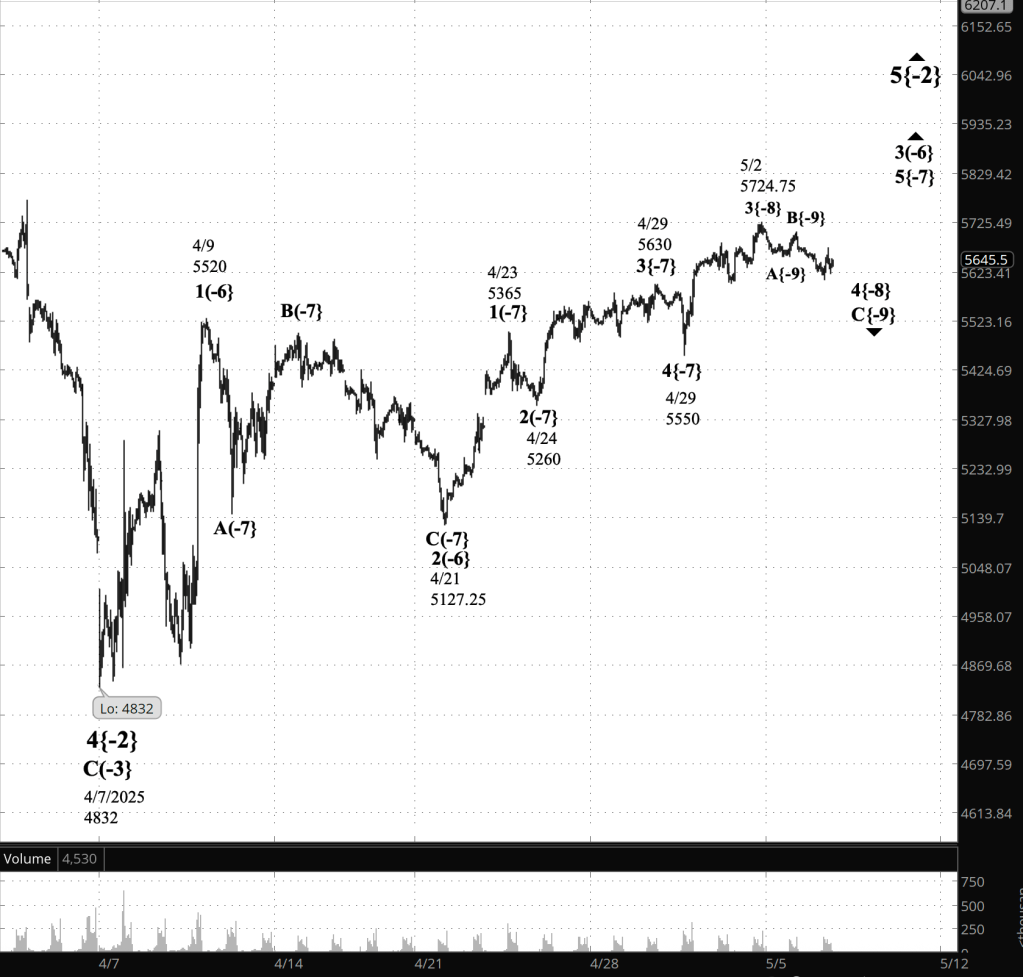
Half an hour before the cosing bell. The S&P 500 futures continued to fall during the session, reaching a low of 5107.50 as the closing bell approached.

Elliott Wave Theory. The present decline is a downtrending 3rd wave that began from 5773.25 on April 2, shortly before President Tump announced heavy tariffs on goods made in a number of countries around the world.

So far the 3rd wave has fallen by 11.5%, which is about a third of the length of the Covid-19 Pandemic Crash of 2020.

Roll back to the 2008 crash that announceed the Great Recession. The S&P 500 index lost about half of its value.

So what we’ve experienced yesterday and today is painful but not unusual. Also note: The ongoing 3rd wave that encompasses the market’s tariff response began to fall before the president’s announcement. In the world of Elliott Wave Theory, we knew long before that we would have a decline that tends to be on the long side. Since Elliott Waves track the public mood, it would be fair to say that the markets were poised for a fall before president Trump had figured out what he was going to say on April 2.

9:35 a.m. New York time

What’s happening now. The S&P 500 E-mini futures continued to fall overnight, reaching 5210.50 and then rising back into the 5310s as new employment data was released and the opening bell approached.

[S&P 500 E-mini futures at 3:30 p.m, 20-minute bars, with volume]

What does it mean? Elliott Wave Theory sees the decline that began on April 2 as the middle subwave, wave 3, within the final subwave, wave C, which began on March 25 which in turn is the final subwave, also wave C, that began on February 19. The entire structure exists with a 4th-wave downward correction that began on December 16, 2024.

The 3rd wave that began on April coincided with President Trump’s announcement of a wide range of new tariffs. The decline has been characterized as the worst one-day crash since the Covid-19 pandemic crash of 2020. But that’s a bit misleading. First, the two aren’t comparable in magnitude. The Covid crash produced a 33.5% loss; the Tariffs Crash, a 12.3% loss so far.

The long-term S&P 500 index chart below, running from February 2016 to the present, tells the tale.

[S&P 500 E-mini futures at 9:33 a.m, weekluy bars, with volume]

What does Elliott Wave Theory say? Each wave listed on the charts has two components: A wave number, and a subscript in curly brackets that place the wave’s position in the fractal strucutre in relationship to Intermediate degree. The present Intermediate degree, wave 5{0}, began its rise on February 11, 2016 from 1810.10 and is still underway.

The waves referred to above are as follows. Declining wave 3{-9} is underway, a subwave of wave 3{-8}, also declining, which in turn is a subwave of declining wave C{-7}.

Long-term Waves

These are the waves currently in progress under my principal analysis. Each line on the list shows the wave number, with the subscript in curly brackets, the traditional degree name, the starting date, the starting price of the S&P 500 E-mini futures, and the direction of the wave. [Updated to match the 7:08 p.m. analysis.)

  • S&P 500 Index:
  • 5{+3} Supercycle, 7/8/1932, 4.40 (up)
  • 5{+2} Cycle, 12/9/1974, 60.96 (up)
  • 5{+1} Primary, 3/6/2009, 666.79 (up)
  • 5{0} Intermediate, 2/11/2016, 1810.10 (up)
  • 3{-1} Minor, 3/23/2020, 2191.36 (up)
  • 3{-2} Minute, 10/13/2022, 3491.58 (up)
  • S&P 500 Futures
  • 5{-3} Minuette, 4/18/2024, 4963.50 (up)
  • 3{-4} Subminuette, 8/7/2024, 5182 (up)
  • 4{-5} Micro, 12/16/2024, 6163.75 (down)
  • C{-6} Submicro, 2/19/2025, 6166.50 (down)
  • C{-7} Minuscule, 3/25/2025, 5835 (down)

Reading the chart. Price movements — waves – – in Elliott Wave Theory analysis are labeled with numbers within trending waves and letters with corrective waves. The subscripts — numbers in curly brackets — designate the wave’s degree, which, in Elliott Wave analysis, means the relative position of a wave within the larger and smaller structures that make up the chart. R.N. Elliott, who in the 1930s developed the form of analysis that bears his name, viewed the chart as a complex structure of smaller waves nested within larger waves, which in turn are nested within still larger waves. In mathematics it’s called a fractal structure, where at every scale the pattern is similar to the others.

Learning and other resources. Elliott Wave analysis provides context, not prophecy. As the 20th century semanticist Alfred Korzybski put it in his book Science and Sanity (1933), “The map is not the territory … The only usefulness of a map depends on similarity of structure between the empirical world and the map.” And I would add, in the ever-changing markets, we can judge that similarity of structure only after the fact.

See the menu page Analytical Methods for a rundown on where to go for information on Elliott Wave analysis.

By Tim Bovee, Portland, Oregon, April 4, 2025

Disclaimer

Tim Bovee, Private Trader tracks the analysis and trades of a private trader for his own accounts. Nothing in this blog constitutes a recommendation to buy or sell stocks, options or any other financial instrument. The only purpose of this blog is to provide education and entertainment.

No trader is ever 100 percent successful in his or her trades. Trading in the stock and option markets is risky and uncertain. Each trader must make trading decisions for his or her own account, and take responsibility for the consequences.

License

All content on Tim Bovee, Private Trader by Timothy K. Bovee is licensed under a Creative Commons Attribution-ShareAlike 4.0 International License.

Based on a work at www.timbovee.com
Trader’s Notebook

3:30 p.m. New York time

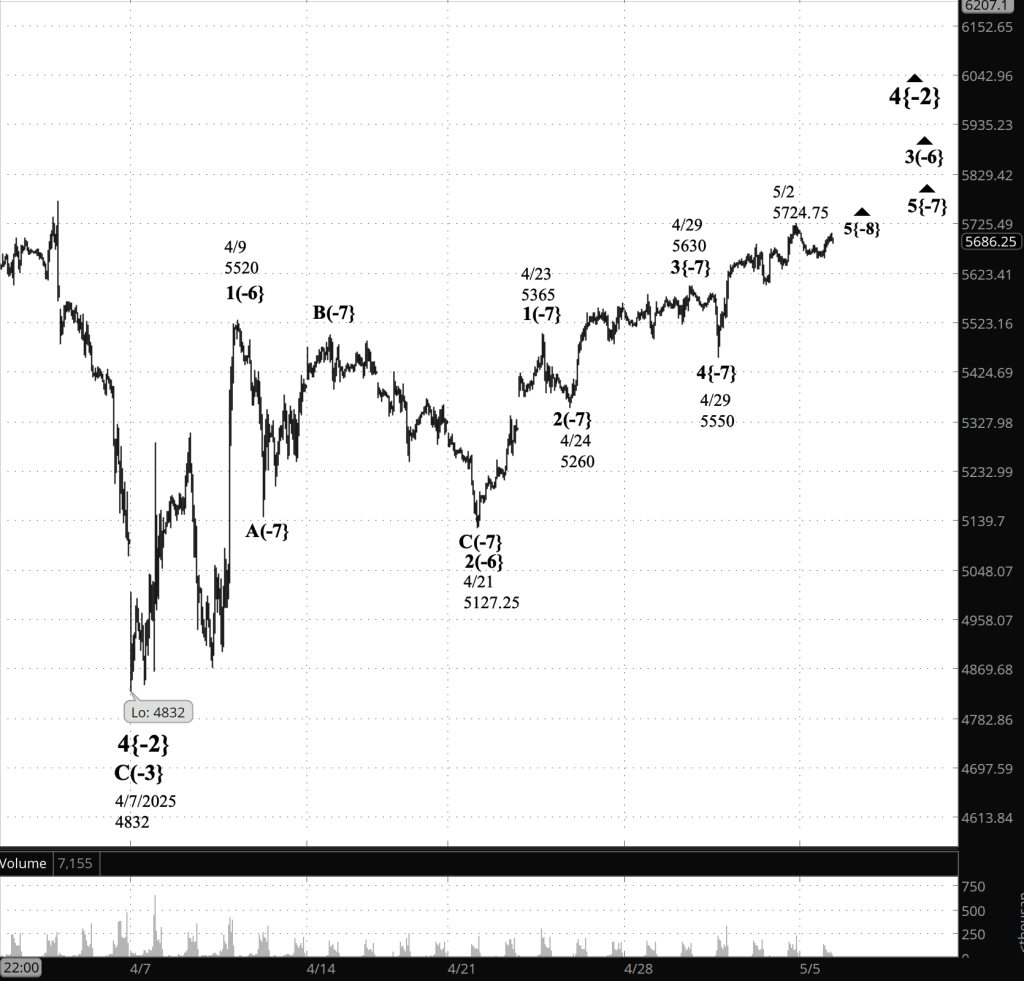
Half an hour before the closing bell. The S&P 500 futures traded narrowly during the session, as though exhausted by yesterday’s hard fall.

The fall itself, looked at through a magnifying lens, had five subwaves. Arguably, the end of the dramatic fall following President Trump’s new tariffs announcement, at 5481, was the end of wave 3{-8}, and what follows is a very weak wave 4{-8}.

Or not. There’s no certainty here. I’ve kept the wave-3-underway scenario as my principal analysis keeping in mind the need to look for evidence of wave 4 having begun.

9:35 a.m. New York time

What’s happening now. After rapidly falling 5.1% after the closing bell, as overnight trading began, the S&P 500 E-mini futures traced a sideways pattern, fluctuating between the 5480s and the 5560s. The decline from the April 2 high, 5773.25, occurred as President Trump announced, after the closing bell, substantial new tariffs in response to existing tariffs.

What does it mean? The decline was sufficiently deep to require an Elliott Wave Theory re-analysis of the chart, which I have did for a late post-close analysis last night.

In the discussion that follows, I shall use the numbering system that appears on the chart. Each wave has a number or a letter followed by a subscript, in curly brackets, that shows the wave’s distance from Intermediate degree in the fractal structure of the chart. The present Intermediate wave is wave 5{0}, which began in February 2016.

And so to the new chart. The declining wave that began from 6166.50, on February 9 at the upper left-hand corner of the chart, is wave C{-6}, the final subwave of a downward correction, wave 4{-5}, that began on December 16, 2024 from 6163.75 and which is still underway.

Wave C{-6} is in its final subwave, wave C{-7}, which began on March 25 from 5835, and wave C{-7} is in its middle subwave, wave 3{-8}, which began on April 2 from 5773.25

Declining Wave C{-6} within declining wave 4{-5} continues, as it has since last February 19. The March 13 low, 5509.25, marked the end of Wave A{-7}. The March 25 high was the end of wave B{-7} and the decline that began on April 2, including the tariff drop, is wave C{-7} and is still underway. I count today’s decline as being wave 3{-8} within the parent C wave.

Wave C{-7} has two more subwaves remaining after its 3rd subwave: Wave 4{-8}, an upward correction, and wave 5{-8}, a downtrending wave that will complete wave C{-7}, and also its parent, wave C{-6}.

[S&P 500 E-mini futures at 3:30 p.m, hourly bars, with volume]

What does Elliott Wave Theory say? See the “What does it mean” section, above.

Long-term Waves

These are the waves currently in progress under my principal analysis. Each line on the list shows the wave number, with the subscript in curly brackets, the traditional degree name, the starting date, the starting price of the S&P 500 E-mini futures, and the direction of the wave. [Updated to match the 7:08 p.m. analysis.)

  • S&P 500 Index:
  • 5{+3} Supercycle, 7/8/1932, 4.40 (up)
  • 5{+2} Cycle, 12/9/1974, 60.96 (up)
  • 5{+1} Primary, 3/6/2009, 666.79 (up)
  • 5{0} Intermediate, 2/11/2016, 1810.10 (up)
  • 3{-1} Minor, 3/23/2020, 2191.36 (up)
  • 3{-2} Minute, 10/13/2022, 3491.58 (up)
  • S&P 500 Futures
  • 5{-3} Minuette, 4/18/2024, 4963.50 (up)
  • 3{-4} Subminuette, 8/7/2024, 5182 (up)
  • 4{-5} Micro, 12/16/2024, 6163.75 (down)
  • C{-6} Submicro, 2/19/2025, 6166.50 (down)

Reading the chart. Price movements — waves – – in Elliott Wave Theory analysis are labeled with numbers within trending waves and letters with corrective waves. The subscripts — numbers in curly brackets — designate the wave’s degree, which, in Elliott Wave analysis, means the relative position of a wave within the larger and smaller structures that make up the chart. R.N. Elliott, who in the 1930s developed the form of analysis that bears his name, viewed the chart as a complex structure of smaller waves nested within larger waves, which in turn are nested within still larger waves. In mathematics it’s called a fractal structure, where at every scale the pattern is similar to the others.

Learning and other resources. Elliott Wave analysis provides context, not prophecy. As the 20th century semanticist Alfred Korzybski put it in his book Science and Sanity (1933), “The map is not the territory … The only usefulness of a map depends on similarity of structure between the empirical world and the map.” And I would add, in the ever-changing markets, we can judge that similarity of structure only after the fact.

See the menu page Analytical Methods for a rundown on where to go for information on Elliott Wave analysis.

By Tim Bovee, Portland, Oregon, April 3, 2025

Disclaimer

Tim Bovee, Private Trader tracks the analysis and trades of a private trader for his own accounts. Nothing in this blog constitutes a recommendation to buy or sell stocks, options or any other financial instrument. The only purpose of this blog is to provide education and entertainment.

No trader is ever 100 percent successful in his or her trades. Trading in the stock and option markets is risky and uncertain. Each trader must make trading decisions for his or her own account, and take responsibility for the consequences.

License

All content on Tim Bovee, Private Trader by Timothy K. Bovee is licensed under a Creative Commons Attribution-ShareAlike 4.0 International License.

Based on a work at www.timbovee.com

Trader’s Notebook

7:08 p.m. New York time

Tariff Shock. President Trump announced quid-pro-quo tariffs after the closing bell, and the S&P 500 futures responded with a drop from 5773.25 to 5481.

The magnitude of the drop required an Elliott Wave Theory re-analysis of the chart, which I have done.

In this discussion I shall use the numbering system that appears on the chart. Each wave has a number or a letter followed by a subscript, in curly brackets, that shows the wave’s distance from Intermediate degree in the fractal structure of the chart. The present Intermediate wave is wave 5{0}, which began in February 2016.

Declining Wave C{-6} within declining wave 4{-5} continues, as it has since last February 19. The March 13 low, 5509.25, marked the end of Wave A{-7}. The March 25 high was the end of wave B{-7} and the decline that began on April 2, including the tariff drop, is wave C{-7} and is still underway. I count today’s decline as being wave 3{-8} within the parent C wave.

Here’s a post-announcement chart showing the revised analysis, and I’ve retained the earlier session-close analysis below for comparison.

[S&P 500 E-mini futures at 6:42 p.m, 70-minute bars, with volume]

3:30 p.m. New York time

Half an hour before the closing bell. The S&P 500 futures peaked at 5759.25 during the session and then reversed, so far reaching into the 5670s. Today’s session was a waiting game for President Trump’s announcement of new tariffs just after the closing bell sounds.

Meanwhile, the morning Elliott Wave Theory analysis is unchanged.

Since the S&P 500 futures we all follow trade after the closing bell and throughout the night, I’ll be checking the chart after hours and, if there’s anything of interest, I’ll do an additional update.

9:35 a.m. New York time

What’s happening now? The S&P 500 E-mini futures fell overnight, from the 5690s to the 5610s.

What does it mean? The decline in Elliott Wave Theory is a counter-movement within a rising wave that began on March 31 from 5533.25. The rise is part of the final subwave, wave C, within a 4th-wave downward correction.

[S&P 500 E-mini futures at 3:30 p.m, hourly bars, with volume]

What does Elliott Wave Theory say? Here are the waves that underlie the morning’s analyses as they appeared on the chart.

Principal Analysis

  • To be updated on the April 3 morning post.

Long-term Waves

These are the waves currently in progress under my principal analysis. Each line on the list shows the wave number, with the subscript in curly brackets, the traditional degree name, the starting date, the starting price of the S&P 500 E-mini futures, and the direction of the wave. [Updated to match the 7:08 p.m. analysis.)

  • S&P 500 Index:
  • 5{+3} Supercycle, 7/8/1932, 4.40 (up)
  • 5{+2} Cycle, 12/9/1974, 60.96 (up)
  • 5{+1} Primary, 3/6/2009, 666.79 (up)
  • 5{0} Intermediate, 2/11/2016, 1810.10 (up)
  • 3{-1} Minor, 3/23/2020, 2191.36 (up)
  • 3{-2} Minute, 10/13/2022, 3491.58 (up)
  • S&P 500 Futures
  • 5{-3} Minuette, 4/18/2024, 4963.50 (up)
  • 3{-4} Subminuette, 8/7/2024, 5182 (up)
  • 4{-5} Micro, 12/16/2024, 6163.75 (down)
  • C{-6} Submicro, 2/19/2025, 6166.50 (down)

Reading the chart. Price movements — waves – – in Elliott Wave Theory analysis are labeled with numbers within trending waves and letters with corrective waves. The subscripts — numbers in curly brackets — designate the wave’s degree, which, in Elliott Wave analysis, means the relative position of a wave within the larger and smaller structures that make up the chart. R.N. Elliott, who in the 1930s developed the form of analysis that bears his name, viewed the chart as a complex structure of smaller waves nested within larger waves, which in turn are nested within still larger waves. In mathematics it’s called a fractal structure, where at every scale the pattern is similar to the others.

Learning and other resources. Elliott Wave analysis provides context, not prophecy. As the 20th century semanticist Alfred Korzybski put it in his book Science and Sanity (1933), “The map is not the territory … The only usefulness of a map depends on similarity of structure between the empirical world and the map.” And I would add, in the ever-changing markets, we can judge that similarity of structure only after the fact.

See the menu page Analytical Methods for a rundown on where to go for information on Elliott Wave analysis.

By Tim Bovee, Portland, Oregon, April 2, 2025

Disclaimer

Tim Bovee, Private Trader tracks the analysis and trades of a private trader for his own accounts. Nothing in this blog constitutes a recommendation to buy or sell stocks, options or any other financial instrument. The only purpose of this blog is to provide education and entertainment.

No trader is ever 100 percent successful in his or her trades. Trading in the stock and option markets is risky and uncertain. Each trader must make trading decisions for his or her own account, and take responsibility for the consequences.

License

All content on Tim Bovee, Private Trader by Timothy K. Bovee is licensed under a Creative Commons Attribution-ShareAlike 4.0 International License.

Based on a work at www.timbovee.com

Trader’s Notebook

3:30 p.m. New York time

Half an hour before the closing bell. The S&P 500 futures reached a session high of 5694.75, the highest price so far in the rise that began on March 31, and then declined into the 5620s.

Elliott Wave Theory: So far since yesterday the price has traced three waves, consistent with a 4th-wave upward correction, although it is uncertain whether those three waves are subwaves of wave 4, and further down the fractal structure — subwaves of larger subwaves. It’s an ambiguity that should be sorted out fairly quickly.

9:35 a.m. New York time

What’s happening now? The S&P 500 E-mini futures bounced narrowly between the 5660s and the 5610s.

What does it mean? The Elliott Wave Theory analysis is unchanged from yesterday. The rise that began on March 31 is a small 4th-wave upward correction within the final subwave, wave C, of a 4th-wave downward correction that began on March 25.

[S&P 500 E-mini futures at 3:30 p.m., hourly bars, with volume]

What does Elliott Wave Theory say? Here are the waves that underlie the morning’s analyses as they appeared on the chart.

Principal Analysis

  • Rising wave 4{-9} is underway and internally is in rising wave C{-10}.
  • Wave C{-10} is in its final subwave, wave 5{-11}, which in turn is within wave 4{-12}.
  • Wave 4{-12} is in wave C{-13}.
  • When wave 5{-11} is complete, it will also be the end of wave C{-10} and most likely the end of the 4th wave upward correction, wave 4{-9}.
  • When wave 4{-9} is complete, downtrending wave 5{-9} will begin, carrying the price back to the 5530s and most likely lower.

Long-term Waves

These are the waves currently in progress under my principal analysis. Each line on the list shows the wave number, with the subscript in curly brackets, the traditional degree name, the starting date, the starting price of the S&P 500 E-mini futures, and the direction of the wave.

  • S&P 500 Index:
  • 5{+3} Supercycle, 7/8/1932, 4.40 (up)
  • 5{+2} Cycle, 12/9/1974, 60.96 (up)
  • 5{+1} Primary, 3/6/2009, 666.79 (up)
  • 5{0} Intermediate, 2/11/2016, 1810.10 (up)
  • 3{-1} Minor, 3/23/2020, 2191.36 (up)
  • 3{-2} Minute, 10/13/2022, 3491.58 (up)
  • S&P 500 Futures
  • 5{-3} Minuette, 4/18/2024, 4963.50 (up)
  • 3{-4} Subminuette, 8/7/2024, 5182 (up)
  • 4{-5} Micro, 12/16/2024, 6163.75 (down)
  • C{-6} Submicro, 2/19/2025, 6166.50 (down)
  • 5{-7} (no name), 3/3/2025, 6000.50 (down)
  • 3{-8} (no name), 3/5/2025, 5869.40 (down)
  • 4{-9} (no name), 3/11/2025, 5534 (up)

Reading the chart. Price movements — waves – – in Elliott Wave Theory analysis are labeled with numbers within trending waves and letters with corrective waves. The subscripts — numbers in curly brackets — designate the wave’s degree, which, in Elliott Wave analysis, means the relative position of a wave within the larger and smaller structures that make up the chart. R.N. Elliott, who in the 1930s developed the form of analysis that bears his name, viewed the chart as a complex structure of smaller waves nested within larger waves, which in turn are nested within still larger waves. In mathematics it’s called a fractal structure, where at every scale the pattern is similar to the others.

Learning and other resources. Elliott Wave analysis provides context, not prophecy. As the 20th century semanticist Alfred Korzybski put it in his book Science and Sanity (1933), “The map is not the territory … The only usefulness of a map depends on similarity of structure between the empirical world and the map.” And I would add, in the ever-changing markets, we can judge that similarity of structure only after the fact.

See the menu page Analytical Methods for a rundown on where to go for information on Elliott Wave analysis.

By Tim Bovee, Portland, Oregon, April 1, 2025

Disclaimer

Tim Bovee, Private Trader tracks the analysis and trades of a private trader for his own accounts. Nothing in this blog constitutes a recommendation to buy or sell stocks, options or any other financial instrument. The only purpose of this blog is to provide education and entertainment.

No trader is ever 100 percent successful in his or her trades. Trading in the stock and option markets is risky and uncertain. Each trader must make trading decisions for his or her own account, and take responsibility for the consequences.

License

All content on Tim Bovee, Private Trader by Timothy K. Bovee is licensed under a Creative Commons Attribution-ShareAlike 4.0 International License.

Based on a work at www.timbovee.com

Trader’s Notebook

3:30 p.m. New York time

Half an hour before the closing bell. The S&P 500 futures reached a low of 5533.75 during the session and then rose back into the 5650s as the closing bell approached.

Applying Elliott Wave Theory analysis, I see the see the reversal as, potentially, the end of the middle subwave, wave 3, within the C wave that is the final subwave of a 4th-wave downward correction, labeled as wave 4{-12} on the chart. If the 4th wave correction isn’t taking a compound form, then the correction has ended and a 5th-wave uptrend has begun.

It’s still early in the deveopment of the rise that began this session, so it’s still possible for the downward 4th wave to still be underway.

9:35 a.m. New York time

What’s happening now? The S&P 500 E-mini futures fell slightly, from 5600 to the 5550sm after trading resumed overnight.

What does it mean? Elliott Wave Theory sees the decline that began on March 25 from 5734.25 as a 4th-wave downward correction within a rising 5th wave, which in turn is the final subwave, wave C, within a 4th-wave upward correction that began in mid-February.

The smaller 4th-wave downward correction is its final subwave, wave C, which, when complete, will have five subwaves. I count it as being in wave 3 — that would include last week’s dramatic.

Coming next, a 4th-wave upward correction, and then a declining 5th wave that will be the end of downward wave C, and up the fractal structure of the waves by one degree, making the upward movement a 5th wave within a parent 5th wave.

[S&P 500 E-mini futures at 3:30 p.m., hourly bars, with volume]

What does Elliott Wave Theory say? Here are the waves that underlie the morning’s analyses as they appeared on the chart.

Principal Analysis

  • Rising wave 4{-9} is underway and internally is in rising wave C{-10}.
  • Wave C{-10} is in its final subwave, wave 5{-11}, which in turn is within wave 4{-12}.
  • Wave 4{-12} is in wave C{-13}.
  • When wave 5{-11} is complete, it will also be the end of wave C{-10} and most likely the end of the 4th wave upward correction, wave 4{-9}.
  • When wave 4{-9} is complete, downtrending wave 5{-9} will begin, carrying the price back to the 5530s and most likely lower.

Long-term Waves

These are the waves currently in progress under my principal analysis. Each line on the list shows the wave number, with the subscript in curly brackets, the traditional degree name, the starting date, the starting price of the S&P 500 E-mini futures, and the direction of the wave.

  • S&P 500 Index:
  • 5{+3} Supercycle, 7/8/1932, 4.40 (up)
  • 5{+2} Cycle, 12/9/1974, 60.96 (up)
  • 5{+1} Primary, 3/6/2009, 666.79 (up)
  • 5{0} Intermediate, 2/11/2016, 1810.10 (up)
  • 3{-1} Minor, 3/23/2020, 2191.36 (up)
  • 3{-2} Minute, 10/13/2022, 3491.58 (up)
  • S&P 500 Futures
  • 5{-3} Minuette, 4/18/2024, 4963.50 (up)
  • 3{-4} Subminuette, 8/7/2024, 5182 (up)
  • 4{-5} Micro, 12/16/2024, 6163.75 (down)
  • C{-6} Submicro, 2/19/2025, 6166.50 (down)
  • 5{-7} (no name), 3/3/2025, 6000.50 (down)
  • 3{-8} (no name), 3/5/2025, 5869.40 (down)
  • 4{-9} (no name), 3/11/2025, 5534 (up)

Reading the chart. Price movements — waves – – in Elliott Wave Theory analysis are labeled with numbers within trending waves and letters with corrective waves. The subscripts — numbers in curly brackets — designate the wave’s degree, which, in Elliott Wave analysis, means the relative position of a wave within the larger and smaller structures that make up the chart. R.N. Elliott, who in the 1930s developed the form of analysis that bears his name, viewed the chart as a complex structure of smaller waves nested within larger waves, which in turn are nested within still larger waves. In mathematics it’s called a fractal structure, where at every scale the pattern is similar to the others.

Learning and other resources. Elliott Wave analysis provides context, not prophecy. As the 20th century semanticist Alfred Korzybski put it in his book Science and Sanity (1933), “The map is not the territory … The only usefulness of a map depends on similarity of structure between the empirical world and the map.” And I would add, in the ever-changing markets, we can judge that similarity of structure only after the fact.

See the menu page Analytical Methods for a rundown on where to go for information on Elliott Wave analysis.

By Tim Bovee, Portland, Oregon, March 31, 2025

Disclaimer

Tim Bovee, Private Trader tracks the analysis and trades of a private trader for his own accounts. Nothing in this blog constitutes a recommendation to buy or sell stocks, options or any other financial instrument. The only purpose of this blog is to provide education and entertainment.

No trader is ever 100 percent successful in his or her trades. Trading in the stock and option markets is risky and uncertain. Each trader must make trading decisions for his or her own account, and take responsibility for the consequences.

License

All content on Tim Bovee, Private Trader by Timothy K. Bovee is licensed under a Creative Commons Attribution-ShareAlike 4.0 International License.

Based on a work at www.timbovee.com