Trader’s Notebook

3:30 p.m. New York time

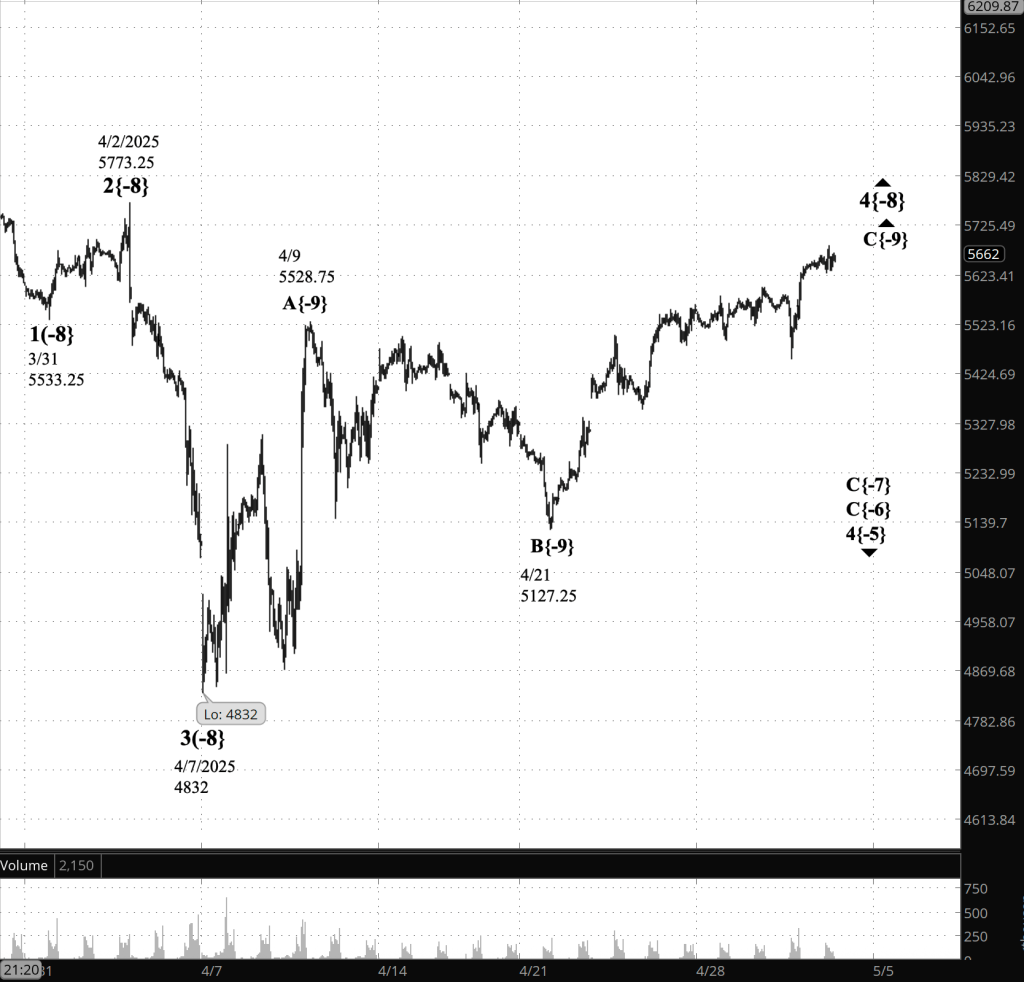
Half an hour before the losing bell. The S&P 500 futures fell sharply during the session, from the overnight peak of 5747.75 down to 5618.75 as the closing bell drew near. For context, that’s 2.2%, dramatic because of the speed of the decline but not the end of the world as we know it.,

As as the world moves on, so does this morning’s Elliott Wave Theory analysis: The final wave of the small downward 4th wave within the final wave of the larger upward 4th wave (three degrees larger) continues.

9:35 a.m. New York time

What’s happening now? The S&P 500 E-mini futures fell during the the night, from the 5470s down to just shy of 5710. From that point the price climbed sharply into the 5730s.

The Elliott Wave Theory analysis is unchanged from yesterday afternoon. The action is all occurring within a 4th-wave upward correction that began on March 11. The correction is in its rising final subwave, wave C, which in turn is in its final subwave, rising wave 5.

That rising 5th wave is in a 4th-wave downward correction, which in turn is in its C wave.

[S&P 500 E-mini futures at 3:30 p.m., hourly bars, with volume]

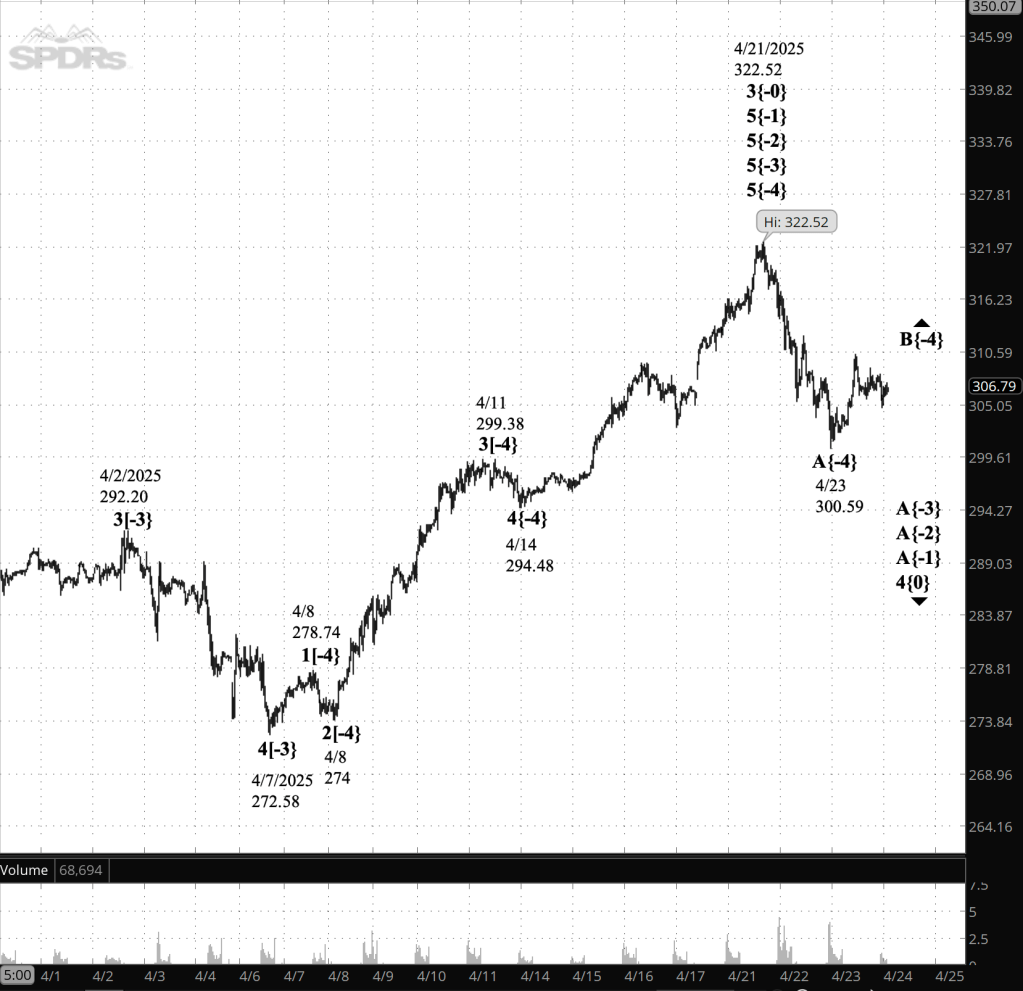
What does Elliott Wave Theory say? Here are the waves that underlie the morning’s analyses as they appeared on the chart.

Principal Analysis

  • Rising wave 4{-9} is underway and internally is in rising wave C{-10}.
  • Wave C{-10} is in its final subwave, wave 5{-11}, which in turn is within wave 4{-12}.
  • Wave 4{-12} is in wave C{-13}.
  • When wave 5{-11} is complete, it will also be the end of wave C{-10} and most likely the end of the 4th wave upward correction, wave 4{-9}.
  • When wave 4{-9} is complete, downtrending wave 5{-9} will begin, carrying the price back to the 5530s and most likely lower.

Long-term Waves

These are the waves currently in progress under my principal analysis. Each line on the list shows the wave number, with the subscript in curly brackets, the traditional degree name, the starting date, the starting price of the S&P 500 E-mini futures, and the direction of the wave.

  • S&P 500 Index:
  • 5{+3} Supercycle, 7/8/1932, 4.40 (up)
  • 5{+2} Cycle, 12/9/1974, 60.96 (up)
  • 5{+1} Primary, 3/6/2009, 666.79 (up)
  • 5{0} Intermediate, 2/11/2016, 1810.10 (up)
  • 3{-1} Minor, 3/23/2020, 2191.36 (up)
  • 3{-2} Minute, 10/13/2022, 3491.58 (up)
  • S&P 500 Futures
  • 5{-3} Minuette, 4/18/2024, 4963.50 (up)
  • 3{-4} Subminuette, 8/7/2024, 5182 (up)
  • 4{-5} Micro, 12/16/2024, 6163.75 (down)
  • C{-6} Submicro, 2/19/2025, 6166.50 (down)
  • 5{-7} (no name), 3/3/2025, 6000.50 (down)
  • 3{-8} (no name), 3/5/2025, 5869.40 (down)
  • 4{-9} (no name), 3/11/2025, 5534 (up)

Reading the chart. Price movements — waves – – in Elliott Wave Theory analysis are labeled with numbers within trending waves and letters with corrective waves. The subscripts — numbers in curly brackets — designate the wave’s degree, which, in Elliott Wave analysis, means the relative position of a wave within the larger and smaller structures that make up the chart. R.N. Elliott, who in the 1930s developed the form of analysis that bears his name, viewed the chart as a complex structure of smaller waves nested within larger waves, which in turn are nested within still larger waves. In mathematics it’s called a fractal structure, where at every scale the pattern is similar to the others.

Learning and other resources. Elliott Wave analysis provides context, not prophecy. As the 20th century semanticist Alfred Korzybski put it in his book Science and Sanity (1933), “The map is not the territory … The only usefulness of a map depends on similarity of structure between the empirical world and the map.” And I would add, in the ever-changing markets, we can judge that similarity of structure only after the fact.

See the menu page Analytical Methods for a rundown on where to go for information on Elliott Wave analysis.

By Tim Bovee, Portland, Oregon, March 28, 2025

Disclaimer

Tim Bovee, Private Trader tracks the analysis and trades of a private trader for his own accounts. Nothing in this blog constitutes a recommendation to buy or sell stocks, options or any other financial instrument. The only purpose of this blog is to provide education and entertainment.

No trader is ever 100 percent successful in his or her trades. Trading in the stock and option markets is risky and uncertain. Each trader must make trading decisions for his or her own account, and take responsibility for the consequences.

License

All content on Tim Bovee, Private Trader by Timothy K. Bovee is licensed under a Creative Commons Attribution-ShareAlike 4.0 International License.

Based on a work at www.timbovee.com
Trader’s Notebook

3:30 p.m. New York time

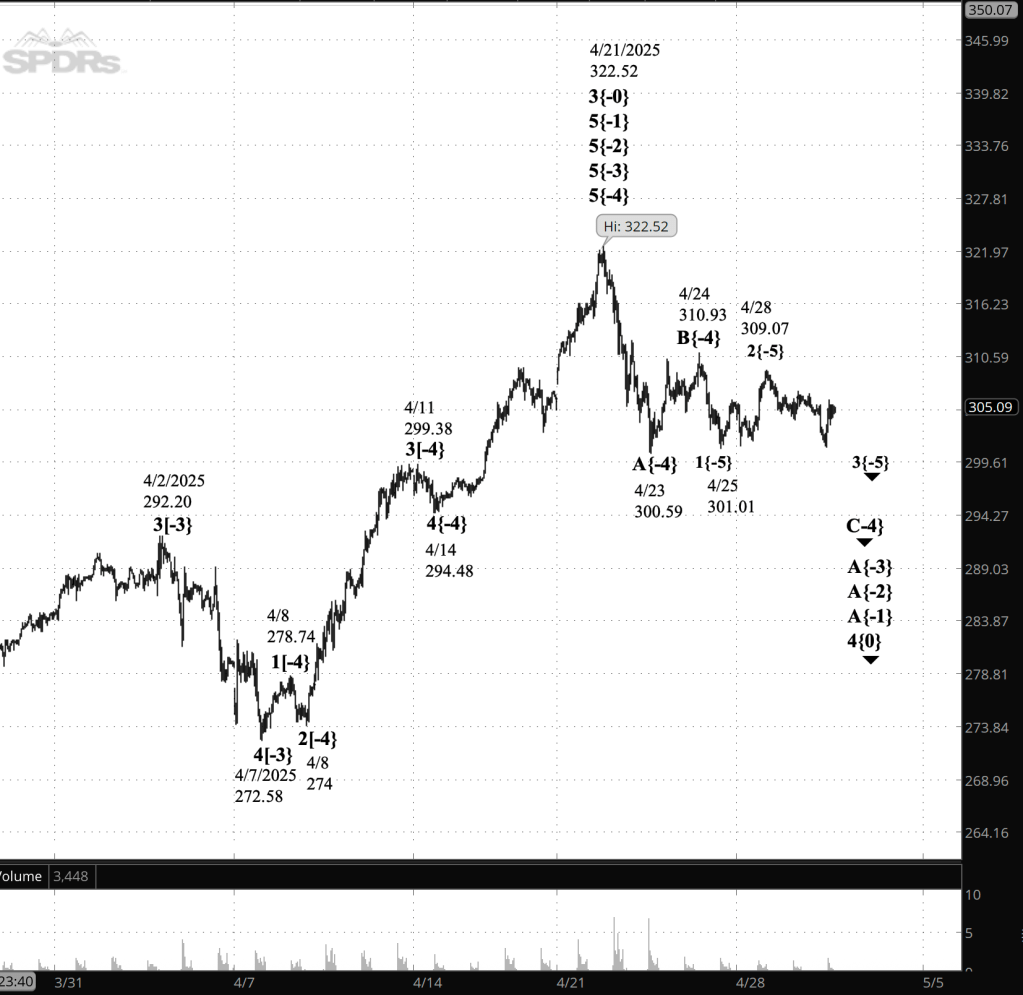
Half an hour before the closing bell. The S&P 500 futures gained clarity in today’s session, and the Elliott Wave pattern worked through a 4th-wave downward correction within an uptrending 5th wave.

The correction is now in wave C, nearly always the 3rd and final subwave of a correction. How can it go? The A wave dropped by about 100 points. If the C wave does that, too, then we’re looking in the neighborhood of 5700 or a bit below.

A reminder. There are never guarantees in Elliott Wave Theory analysis. Ambiguity rules on an EWT chart. Which is what makes it challenging.

9:35 a.m. New York time

What’s happening now? The S&P 500 E-mini futures zigzagged overnight, ending up about midway between the night’s extremes.

What does it mean? If the zigging and zagging ends up forming a three-subwave correction — that’s where it is now — then the decline will be followed by a continuation of the 5th-wave rise. If the subwaves form a five-way pattern, then wave 5 has ended and a new downtrend has begun.

A change in the report. I’m eliminating the alternative analysis section. I usually end up discussing it in the “What does it mean section”, making the alternative section redundant.

[S&P 500 E-mini futures at 3:30 p.m., hourly bars, with volume]

What does Elliott Wave Theory say? Here are the waves that underlie the morning’s analyses as they appeared on the chart.

Principal Analysis

  • Rising wave 4{-9} is underway and internally is in rising wave C{-10}.
  • Wave C{-10} is in its final subwave, wave 5{-11}.
  • When wave 5{-11} is complete, it will also be the end of wave C{-10} and most likely the end of the 4th wave upward correction, wave 4{-9}.
  • When wave 4{-9} is complete, downtrending wave 5{-9} will begin, carrying the price back to the 5530s and most likely lower.

Long-term Waves

These are the waves currently in progress under my principal analysis. Each line on the list shows the wave number, with the subscript in curly brackets, the traditional degree name, the starting date, the starting price of the S&P 500 E-mini futures, and the direction of the wave.

  • S&P 500 Index:
  • 5{+3} Supercycle, 7/8/1932, 4.40 (up)
  • 5{+2} Cycle, 12/9/1974, 60.96 (up)
  • 5{+1} Primary, 3/6/2009, 666.79 (up)
  • 5{0} Intermediate, 2/11/2016, 1810.10 (up)
  • 3{-1} Minor, 3/23/2020, 2191.36 (up)
  • 3{-2} Minute, 10/13/2022, 3491.58 (up)
  • S&P 500 Futures
  • 5{-3} Minuette, 4/18/2024, 4963.50 (up)
  • 3{-4} Subminuette, 8/7/2024, 5182 (up)
  • 4{-5} Micro, 12/16/2024, 6163.75 (down)
  • C{-6} Submicro, 2/19/2025, 6166.50 (down)
  • 5{-7} (no name), 3/3/2025, 6000.50 (down)
  • 3{-8} (no name), 3/5/2025, 5869.40 (down)
  • 4{-9} (no name), 3/11/2025, 5534 (up)

Reading the chart. Price movements — waves – – in Elliott Wave Theory analysis are labeled with numbers within trending waves and letters with corrective waves. The subscripts — numbers in curly brackets — designate the wave’s degree, which, in Elliott Wave analysis, means the relative position of a wave within the larger and smaller structures that make up the chart. R.N. Elliott, who in the 1930s developed the form of analysis that bears his name, viewed the chart as a complex structure of smaller waves nested within larger waves, which in turn are nested within still larger waves. In mathematics it’s called a fractal structure, where at every scale the pattern is similar to the others.

Learning and other resources. Elliott Wave analysis provides context, not prophecy. As the 20th century semanticist Alfred Korzybski put it in his book Science and Sanity (1933), “The map is not the territory … The only usefulness of a map depends on similarity of structure between the empirical world and the map.” And I would add, in the ever-changing markets, we can judge that similarity of structure only after the fact.

See the menu page Analytical Methods for a rundown on where to go for information on Elliott Wave analysis.

By Tim Bovee, Portland, Oregon, March 27, 2025

Disclaimer

Tim Bovee, Private Trader tracks the analysis and trades of a private trader for his own accounts. Nothing in this blog constitutes a recommendation to buy or sell stocks, options or any other financial instrument. The only purpose of this blog is to provide education and entertainment.

No trader is ever 100 percent successful in his or her trades. Trading in the stock and option markets is risky and uncertain. Each trader must make trading decisions for his or her own account, and take responsibility for the consequences.

License

All content on Tim Bovee, Private Trader by Timothy K. Bovee is licensed under a Creative Commons Attribution-ShareAlike 4.0 International License.

Based on a work at www.timbovee.com
Trader’s Notebook

3:30 p.m. New York time

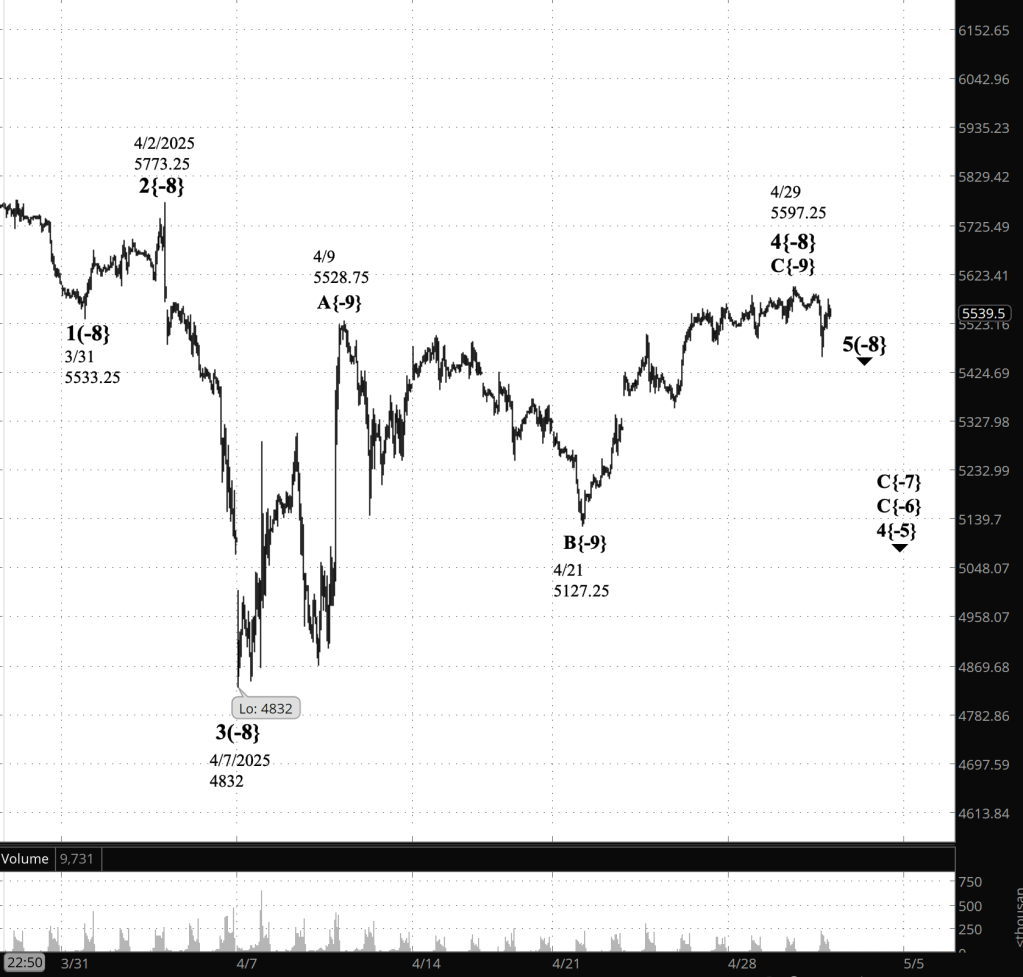
Half an hour before the closing bell. The S&P 500 futures fell during most of the session, returning to the 5740s. Elliott Wave Theory: A case may be made that the rising 5th wave that began on March 24 ended on March 25 at 5837.25. Or, prhaps, everything since March 24 have been small subwaves of wave 5, which has been in its 1st subwave, and today’s decline has been wave 2 within wave 5.

For the moment I’m going to hold making a decision, although I’m leaning tward the wave 2 scenario.

Here’s a close-up chart:

[S&P 500 E-mini futures at 3:13 p.m., 15-minute bars]

The low point at 5852.25 was the start of rising wave 5. The peak at 5837.25 was either the end of the 5th wave or the end of the 1st subwave within the 5th wave.

9:35 a.m. New York time

What’s happening now? The S&P 500 E-mini futures fell overnight from the 5830s to the 5810s and then worked its way back to the 5830s.

What does it mean? Elliott Wave Theory interprets the pause as a low-degree correction within the larger uptrendng 5th wave that began on March 24. The 5th wave is a subwave, wave C, within a stilll larger 4th-wave upward correction that began in mid-March.

Three degees high in the fractal structure of the chart, the peak of February 19 was the start of wave C{-6}, the final subwave of a 4th-wave downward correction that began on December 16, 2024.

[S&P 500 E-mini futures at 3:30 p.m., hourly bars, with volume]

What does Elliott Wave Theory say? Here are the waves that underlie the morning’s analyses as they appeared on the chart.

Principal Analysis

  • Rising wave 4{-9} is underway and internally is in rising wave C{-10}.
  • Wave C{-10} is in its final subwave, wave 5{-11}.
  • When wave 5{-11} is complete, it will also be the end of wave C{-10} and most likely the end of the 4th wave upward correction, wave 4{-9}.
  • When wave 4{-9} is complete, downtrending wave 5{-9} will begin, carrying the price back to the 5530s and most likely lower.

Long-term Waves

These are the waves currently in progress under my principal analysis. Each line on the list shows the wave number, with the subscript in curly brackets, the traditional degree name, the starting date, the starting price of the S&P 500 E-mini futures, and the direction of the wave.

  • S&P 500 Index:
  • 5{+3} Supercycle, 7/8/1932, 4.40 (up)
  • 5{+2} Cycle, 12/9/1974, 60.96 (up)
  • 5{+1} Primary, 3/6/2009, 666.79 (up)
  • 5{0} Intermediate, 2/11/2016, 1810.10 (up)
  • 3{-1} Minor, 3/23/2020, 2191.36 (up)
  • 3{-2} Minute, 10/13/2022, 3491.58 (up)
  • S&P 500 Futures
  • 5{-3} Minuette, 4/18/2024, 4963.50 (up)
  • 3{-4} Subminuette, 8/7/2024, 5182 (up)
  • 4{-5} Micro, 12/16/2024, 6163.75 (down)
  • C{-6} Submicro, 2/19/2025, 6166.50 (down)
  • 5{-7} (no name), 3/3/2025, 6000.50 (down)
  • 3{-8} (no name), 3/5/2025, 5869.40 (down)
  • 4{-9} (no name), 3/11/2025, 5534 (up)

Reading the chart. Price movements — waves – – in Elliott Wave Theory analysis are labeled with numbers within trending waves and letters with corrective waves. The subscripts — numbers in curly brackets — designate the wave’s degree, which, in Elliott Wave analysis, means the relative position of a wave within the larger and smaller structures that make up the chart. R.N. Elliott, who in the 1930s developed the form of analysis that bears his name, viewed the chart as a complex structure of smaller waves nested within larger waves, which in turn are nested within still larger waves. In mathematics it’s called a fractal structure, where at every scale the pattern is similar to the others.

Learning and other resources. Elliott Wave analysis provides context, not prophecy. As the 20th century semanticist Alfred Korzybski put it in his book Science and Sanity (1933), “The map is not the territory … The only usefulness of a map depends on similarity of structure between the empirical world and the map.” And I would add, in the ever-changing markets, we can judge that similarity of structure only after the fact.

See the menu page Analytical Methods for a rundown on where to go for information on Elliott Wave analysis.

By Tim Bovee, Portland, Oregon, March 26, 2025

Disclaimer

Tim Bovee, Private Trader tracks the analysis and trades of a private trader for his own accounts. Nothing in this blog constitutes a recommendation to buy or sell stocks, options or any other financial instrument. The only purpose of this blog is to provide education and entertainment.

No trader is ever 100 percent successful in his or her trades. Trading in the stock and option markets is risky and uncertain. Each trader must make trading decisions for his or her own account, and take responsibility for the consequences.

License

All content on Tim Bovee, Private Trader by Timothy K. Bovee is licensed under a Creative Commons Attribution-ShareAlike 4.0 International License.

Based on a work at www.timbovee.com
Trader’s Notebook

3:30 p,m. New York time

Half an hour before the closing bell. The S&P 500 futures declined from the session peak, 5837.25, closing in on 5800. Elliott Wave Theory: The decline formed three subwaves, an indictor that it’s a correction. The uptrending 5th wave will resume after the correction is complete.

9:35 a.m. New York time

What’s happening now? The S&P 500 E-mini futures resumed its rise overnight after falling to a low of 5802.25. The price then shot up quickly, so far reaching into the 5830s.

What does it mean? The rise, decline and resumed rise, in the terminology of Elliott Wave Theory, are all subwaves of an uptrending 5th wave that began on March 24. It is the final subwave within a rising C wave that began on March 13, which in turn is the final subwave of a 4th-wave upward correction that began on March 11.

How high will wave 5 fly? It is already proportional to waves of the same degree that came before. Of course, proportionality in Elliott Wave Theory is, often enough more of an ideal than a reality.

[S&P 500 E-mini futures at 3:30 p.m., 40-minute bars, with volume]

What is the alternative? There are some wave proportion and overlaps that require a closer look.

What does Elliott Wave Theory say? Here are the waves that underlie the morning’s analyses as they appeared on the chart.

Principal Analysis

  • Rising wave 4{-9} is underway and internally is in rising wave C{-10}.
  • Wave C{-10} is in its final subwave, wave 5{-11}.
  • When wave 5{-11} is complete, it will also be the end of wave C{-10} and most likely the end of the 4th wave upward correction, wave 4{-9}.
  • When wave 4{-9} is complete, downtrending wave 5{-9} will begin, carrying the price back to the 5530s and most likely lower.

Long-term Waves

These are the waves currently in progress under my principal analysis. Each line on the list shows the wave number, with the subscript in curly brackets, the traditional degree name, the starting date, the starting price of the S&P 500 E-mini futures, and the direction of the wave.

  • S&P 500 Index:
  • 5{+3} Supercycle, 7/8/1932, 4.40 (up)
  • 5{+2} Cycle, 12/9/1974, 60.96 (up)
  • 5{+1} Primary, 3/6/2009, 666.79 (up)
  • 5{0} Intermediate, 2/11/2016, 1810.10 (up)
  • 3{-1} Minor, 3/23/2020, 2191.36 (up)
  • 3{-2} Minute, 10/13/2022, 3491.58 (up)
  • S&P 500 Futures
  • 5{-3} Minuette, 4/18/2024, 4963.50 (up)
  • 3{-4} Subminuette, 8/7/2024, 5182 (up)
  • 4{-5} Micro, 12/16/2024, 6163.75 (down)
  • C{-6} Submicro, 2/19/2025, 6166.50 (down)
  • 5{-7} (no name), 3/3/2025, 6000.50 (down)
  • 3{-8} (no name), 3/5/2025, 5869.40 (down)
  • 4{-9} (no name), 3/11/2025, 5534 (up)

Reading the chart. Price movements — waves – – in Elliott Wave Theory analysis are labeled with numbers within trending waves and letters with corrective waves. The subscripts — numbers in curly brackets — designate the wave’s degree, which, in Elliott Wave analysis, means the relative position of a wave within the larger and smaller structures that make up the chart. R.N. Elliott, who in the 1930s developed the form of analysis that bears his name, viewed the chart as a complex structure of smaller waves nested within larger waves, which in turn are nested within still larger waves. In mathematics it’s called a fractal structure, where at every scale the pattern is similar to the others.

Learning and other resources. Elliott Wave analysis provides context, not prophecy. As the 20th century semanticist Alfred Korzybski put it in his book Science and Sanity (1933), “The map is not the territory … The only usefulness of a map depends on similarity of structure between the empirical world and the map.” And I would add, in the ever-changing markets, we can judge that similarity of structure only after the fact.

See the menu page Analytical Methods for a rundown on where to go for information on Elliott Wave analysis.

By Tim Bovee, Portland, Oregon, March 25, 2025

Disclaimer

Tim Bovee, Private Trader tracks the analysis and trades of a private trader for his own accounts. Nothing in this blog constitutes a recommendation to buy or sell stocks, options or any other financial instrument. The only purpose of this blog is to provide education and entertainment.

No trader is ever 100 percent successful in his or her trades. Trading in the stock and option markets is risky and uncertain. Each trader must make trading decisions for his or her own account, and take responsibility for the consequences.

License

All content on Tim Bovee, Private Trader by Timothy K. Bovee is licensed under a Creative Commons Attribution-ShareAlike 4.0 International License.

Based on a work at www.timbovee.com
Trader’s Notebook

3:30 p.m. New York time

Half an hour before the closing bell. The S&P 500 futures rose during the session, reaching a peak, so far, of 5819.25. The price then fell, tracing an Elliott Wave Theory pattern with five subwaves, a typical Zigzag structure for, in this case, a falling A wave within an uptrending 5th wave that began on today. A 2nd wave tends to retrace the prior wave deeply, although in a proportionate way. All of which is quite subjective. Are we truly seeing wave 2 within the larger wave 5? Or is the fall a smaller structure buried a few degrees deeper in the fractal structure? Time will tell.

9:35 a.m. New York time

What’s happening now? The S&P 500 E-mini futures rose after trading resumed overnight, so far reaching from the 5730s into the 5780s.

What does it mean? The rise, by reaching above the March 19 high, 5770, confirmed that the 5th and final Elliott Wave within rising wave C had begun. Wave C began on March 13 from 5509.29.

Moving up four degrees within the fractal strucuture, the entirety of the chart is a downtrending C wave that began on February 19.

[S&P 500 E-mini futures at 3:30 p.m., 40-minute bars, with volume]

What is the alternative? There are some wave proportion and overlaps that require a closer look.

What does Elliott Wave Theory say? Here are the waves that underlie the morning’s analyses as they appeared on the chart.

Principal Analysis

  • Rising wave 4{-9} is underway and internally is in rising wave C{-10}.
  • Wave C{-10} is in its final subwave, wave 5{-11}.
  • When wave 5{-11} is complete, it will also be the end of wave C{-10} and most likely the end of the 4th wave upward correction, wave 4{-9}.
  • When wave 4{-9} is complete, downtrending wave 5{-9} will begin, carrying the price back to the 5530s and most likely lower.

Long-term Waves

These are the waves currently in progress under my principal analysis. Each line on the list shows the wave number, with the subscript in curly brackets, the traditional degree name, the starting date, the starting price of the S&P 500 E-mini futures, and the direction of the wave.

  • S&P 500 Index:
  • 5{+3} Supercycle, 7/8/1932, 4.40 (up)
  • 5{+2} Cycle, 12/9/1974, 60.96 (up)
  • 5{+1} Primary, 3/6/2009, 666.79 (up)
  • 5{0} Intermediate, 2/11/2016, 1810.10 (up)
  • 3{-1} Minor, 3/23/2020, 2191.36 (up)
  • 3{-2} Minute, 10/13/2022, 3491.58 (up)
  • S&P 500 Futures
  • 5{-3} Minuette, 4/18/2024, 4963.50 (up)
  • 3{-4} Subminuette, 8/7/2024, 5182 (up)
  • 4{-5} Micro, 12/16/2024, 6163.75 (down)
  • C{-6} Submicro, 2/19/2025, 6166.50 (down)
  • 5{-7} (no name), 3/3/2025, 6000.50 (down)
  • 3{-8} (no name), 3/5/2025, 5869.40 (down)
  • 4{-9} (no name), 3/11/2025, 5534 (up)

Reading the chart. Price movements — waves – – in Elliott Wave Theory analysis are labeled with numbers within trending waves and letters with corrective waves. The subscripts — numbers in curly brackets — designate the wave’s degree, which, in Elliott Wave analysis, means the relative position of a wave within the larger and smaller structures that make up the chart. R.N. Elliott, who in the 1930s developed the form of analysis that bears his name, viewed the chart as a complex structure of smaller waves nested within larger waves, which in turn are nested within still larger waves. In mathematics it’s called a fractal structure, where at every scale the pattern is similar to the others.

Learning and other resources. Elliott Wave analysis provides context, not prophecy. As the 20th century semanticist Alfred Korzybski put it in his book Science and Sanity (1933), “The map is not the territory … The only usefulness of a map depends on similarity of structure between the empirical world and the map.” And I would add, in the ever-changing markets, we can judge that similarity of structure only after the fact.

See the menu page Analytical Methods for a rundown on where to go for information on Elliott Wave analysis.

By Tim Bovee, Portland, Oregon, March 24, 2025

Disclaimer

Tim Bovee, Private Trader tracks the analysis and trades of a private trader for his own accounts. Nothing in this blog constitutes a recommendation to buy or sell stocks, options or any other financial instrument. The only purpose of this blog is to provide education and entertainment.

No trader is ever 100 percent successful in his or her trades. Trading in the stock and option markets is risky and uncertain. Each trader must make trading decisions for his or her own account, and take responsibility for the consequences.

License

All content on Tim Bovee, Private Trader by Timothy K. Bovee is licensed under a Creative Commons Attribution-ShareAlike 4.0 International License.

Based on a work at www.timbovee.com

Trader’s Notebook

3:30 p.m. New York time

Half an hour before the closing bell. The S&P 500 futures rose during the session, reaching into the 5710s. This morning’s Elliott Wave Theory analysis is unchanged.

9:35 a.m. New York time

What’s happening now? The S&P 500 E-mini futures fell overnight, from the 5730s so far to the 5650s.

What does it mean? The usual top-fishing ambiguity remains. In Elliiott Wave theory terminology, it could be that the March 19 high is the end of a low-degree 3rd wave and the start of a 4th wave downward correction.

Or perhaps the March 19 high is the end of a low-degree 5th wave, and also the end of the parent C wave and of the 4th-wave upward correction that began in mid-March.

[S&P 500 E-mini futures at 3:30 p.m., 40-minute bars, with volume]

What is the alternative? There are some wave proportion and overlaps that require a closer look.

What does Elliott Wave Theory say? Here are the waves that underlie the morning’s analyses as they appeared on the chart.

Principal Analysis

  • Falling wave 4{-9} is underway and internally is in wave C{-10}.
  • Downtrending wave 5{-9} will follow the end of wave 4{-9}.

Long-term Waves

These are the waves currently in progress under my principal analysis. Each line on the list shows the wave number, with the subscript in curly brackets, the traditional degree name, the starting date, the starting price of the S&P 500 E-mini futures, and the direction of the wave.

  • S&P 500 Index:
  • 5{+3} Supercycle, 7/8/1932, 4.40 (up)
  • 5{+2} Cycle, 12/9/1974, 60.96 (up)
  • 5{+1} Primary, 3/6/2009, 666.79 (up)
  • 5{0} Intermediate, 2/11/2016, 1810.10 (up)
  • 3{-1} Minor, 3/23/2020, 2191.36 (up)
  • 3{-2} Minute, 10/13/2022, 3491.58 (up)
  • S&P 500 Futures
  • 5{-3} Minuette, 4/18/2024, 4963.50 (up)
  • 3{-4} Subminuette, 8/7/2024, 5182 (up)
  • 4{-5} Micro, 12/16/2024, 6163.75 (down)
  • C{-6} Submicro, 2/19/2025, 6166.50 (down)
  • 5{-7} (no name), 3/3/2025, 6000.50 (down)
  • 3{-8} (no name), 3/5/2025, 5869.40 (down)
  • 4{-9} (no name), 3/11/2025, 5534 (up)

Reading the chart. Price movements — waves – – in Elliott Wave Theory analysis are labeled with numbers within trending waves and letters with corrective waves. The subscripts — numbers in curly brackets — designate the wave’s degree, which, in Elliott Wave analysis, means the relative position of a wave within the larger and smaller structures that make up the chart. R.N. Elliott, who in the 1930s developed the form of analysis that bears his name, viewed the chart as a complex structure of smaller waves nested within larger waves, which in turn are nested within still larger waves. In mathematics it’s called a fractal structure, where at every scale the pattern is similar to the others.

Learning and other resources. Elliott Wave analysis provides context, not prophecy. As the 20th century semanticist Alfred Korzybski put it in his book Science and Sanity (1933), “The map is not the territory … The only usefulness of a map depends on similarity of structure between the empirical world and the map.” And I would add, in the ever-changing markets, we can judge that similarity of structure only after the fact.

See the menu page Analytical Methods for a rundown on where to go for information on Elliott Wave analysis.

By Tim Bovee, Portland, Oregon, March 21, 2025

Disclaimer

Tim Bovee, Private Trader tracks the analysis and trades of a private trader for his own accounts. Nothing in this blog constitutes a recommendation to buy or sell stocks, options or any other financial instrument. The only purpose of this blog is to provide education and entertainment.

No trader is ever 100 percent successful in his or her trades. Trading in the stock and option markets is risky and uncertain. Each trader must make trading decisions for his or her own account, and take responsibility for the consequences.

License

All content on Tim Bovee, Private Trader by Timothy K. Bovee is licensed under a Creative Commons Attribution-ShareAlike 4.0 International License.

Based on a work at www.timbovee.com
Trader’s Notebook

3:30 p.m. New York time

Half an hour before the closing bell. The S&P 500 futures bounced between the 5680s and the 5760s during the session.

Elliott Wave Theory: the bounce appears to be a 4th-wave downward correction within a rising C wave, the final subwave of a 4th-wave upward correction that began about a week ago.

On the chart the structure is wave 4{-11} within rising wave C{-10} within rising wave 4{-9}.

9:35 a.m. New York time

What’s happening now? The S&P 500 E-mini futures fell overnight, part of a decline that began on March 19 from 5770.50. The low in the decline, so far, is 5682.50.

What does it mean? In applying Elliott Wave Theory, we face the same conundrum we faced a day ago, with a different end point: Did the 4th-wave upward correction end at 5750.50 on March 19, and did the downtrending 5th-wave that we’ve been expecting begin at that point?

Yesterday morning I concluded that wave 5 had begun its decline. That conclusion was quickly disproven. As the proverb has it, “Once burned, twice shy.” For the moment I’ll have the Principal Analysis follow the 4th-wave-continues scenario. Perhaps the session will provide us with some clarity..

[S&P 500 E-mini futures at 3:30 p..m., 40-minute bars, with volume]

What is the alternative? There are some wave proportion and overlaps that require a closer look.

What does Elliott Wave Theory say? Here are the waves that underlie the morning’s analyses as they appeared on the chart.

Principal Analysis

  • Falling wave 4{-9} is underway and internally is in wave C{-10}.
  • Downtrending wave 5{-9} will follow the end of wave 4{-9}.

Long-term Waves

These are the waves currently in progress under my principal analysis. Each line on the list shows the wave number, with the subscript in curly brackets, the traditional degree name, the starting date, the starting price of the S&P 500 E-mini futures, and the direction of the wave.

  • S&P 500 Index:
  • 5{+3} Supercycle, 7/8/1932, 4.40 (up)
  • 5{+2} Cycle, 12/9/1974, 60.96 (up)
  • 5{+1} Primary, 3/6/2009, 666.79 (up)
  • 5{0} Intermediate, 2/11/2016, 1810.10 (up)
  • 3{-1} Minor, 3/23/2020, 2191.36 (up)
  • 3{-2} Minute, 10/13/2022, 3491.58 (up)
  • S&P 500 Futures
  • 5{-3} Minuette, 4/18/2024, 4963.50 (up)
  • 3{-4} Subminuette, 8/7/2024, 5182 (up)
  • 4{-5} Micro, 12/16/2024, 6163.75 (down)
  • C{-6} Submicro, 2/19/2025, 6166.50 (down)
  • 5{-7} (no name), 3/3/2025, 6000.50 (down)
  • 3{-8} (no name), 3/5/2025, 5869.40 (down)
  • 4{-9} (no name), 3/11/2025, 5534 (up)

Reading the chart. Price movements — waves – – in Elliott Wave Theory analysis are labeled with numbers within trending waves and letters with corrective waves. The subscripts — numbers in curly brackets — designate the wave’s degree, which, in Elliott Wave analysis, means the relative position of a wave within the larger and smaller structures that make up the chart. R.N. Elliott, who in the 1930s developed the form of analysis that bears his name, viewed the chart as a complex structure of smaller waves nested within larger waves, which in turn are nested within still larger waves. In mathematics it’s called a fractal structure, where at every scale the pattern is similar to the others.

Learning and other resources. Elliott Wave analysis provides context, not prophecy. As the 20th century semanticist Alfred Korzybski put it in his book Science and Sanity (1933), “The map is not the territory … The only usefulness of a map depends on similarity of structure between the empirical world and the map.” And I would add, in the ever-changing markets, we can judge that similarity of structure only after the fact.

See the menu page Analytical Methods for a rundown on where to go for information on Elliott Wave analysis.

By Tim Bovee, Portland, Oregon, March 20, 2025

Disclaimer

Tim Bovee, Private Trader tracks the analysis and trades of a private trader for his own accounts. Nothing in this blog constitutes a recommendation to buy or sell stocks, options or any other financial instrument. The only purpose of this blog is to provide education and entertainment.

No trader is ever 100 percent successful in his or her trades. Trading in the stock and option markets is risky and uncertain. Each trader must make trading decisions for his or her own account, and take responsibility for the consequences.

License

All content on Tim Bovee, Private Trader by Timothy K. Bovee is licensed under a Creative Commons Attribution-ShareAlike 4.0 International License.

Based on a work at www.timbovee.com
Trader’s Notebook

3:30 p.m. New York time

Half an hour before the closing bell. The S&P 500 futures rose after the Federal Open Market Committee said it was keeping rates unchanged.

Elliott Wave Theory: The high so far is in the 5770s, above the price I set as the end of the 4th-wave upward correction. I’ve adjusted the chart to reflect the present reality: Rising wave 4, which began in mid-March continues and is in its 3rd and final subwave, wave C.

9:35 a.m. New York time

What’s happening now? The S&P 500 E-mini futures meandered sideway overnight, moving between the 5680s and the 5660s, reaching into the 5690s as the opening bell sounded..

What does it mean? The movement’s pattern in Elliott Wave Theory appears most likely to be either the final stages of the 1st subwave — wave A — or the beginning of the 2nd subwave — wave B — within a 4th-wave upward correction, all happening within the wave 1 of the downtrending 5th wave that began on March 17 from 5759.75.

Most commonly 5th wave will move beyond the end of the preceding 3rd wave, which on this chart occurred on March 11 at 5534., or perhaps March 13 at 5509.25, one of thee ambiguities on the chart.

That’s the norm, but some 5th waves come up short, known as runcation, and some are disproportionally long — extension. There’s no way to tell at this point which sort of 5th wave this one is.

[S&P 500 E-mini futures at 3:30 p..m., 40-minute bars, with volume]

What is the alternative? There are some wave proportion and overlaps that require a closer look; I’ll be working on them today.

What does Elliott Wave Theory say? Here are the waves that underlie the morning’s analyses as they appeared on the chart.

Principal Analysis [Updated for the afternoon post.]

  • Falling wave 4{-9} is underway and internally is in wave C{-10}.

Long-term Waves. [Updated for the afternoon post.]

These are the waves currently in progress under my principal analysis. Each line on the list shows the wave number, with the subscript in curly brackets, the traditional degree name, the starting date, the starting price of the S&P 500 E-mini futures, and the direction of the wave.

  • S&P 500 Index:
  • 5{+3} Supercycle, 7/8/1932, 4.40 (up)
  • 5{+2} Cycle, 12/9/1974, 60.96 (up)
  • 5{+1} Primary, 3/6/2009, 666.79 (up)
  • 5{0} Intermediate, 2/11/2016, 1810.10 (up)
  • 3{-1} Minor, 3/23/2020, 2191.36 (up)
  • 3{-2} Minute, 10/13/2022, 3491.58 (up)
  • S&P 500 Futures
  • 5{-3} Minuette, 4/18/2024, 4963.50 (up)
  • 3{-4} Subminuette, 8/7/2024, 5182 (up)
  • 4{-5} Micro, 12/16/2024, 6163.75 (down)
  • C{-6} Submicro, 2/19/2025, 6166.50 (down)
  • 5{-7} (no name), 3/3/2025, 6000.50 (down)
  • 3{-8} (no name), 3/5/2025, 5869.40 (down)
  • 4{-9} (no name), 3/11/2025, 5534 (up)

Reading the chart. Price movements — waves – – in Elliott Wave Theory analysis are labeled with numbers within trending waves and letters with corrective waves. The subscripts — numbers in curly brackets — designate the wave’s degree, which, in Elliott Wave analysis, means the relative position of a wave within the larger and smaller structures that make up the chart. R.N. Elliott, who in the 1930s developed the form of analysis that bears his name, viewed the chart as a complex structure of smaller waves nested within larger waves, which in turn are nested within still larger waves. In mathematics it’s called a fractal structure, where at every scale the pattern is similar to the others.

Learning and other resources. Elliott Wave analysis provides context, not prophecy. As the 20th century semanticist Alfred Korzybski put it in his book Science and Sanity (1933), “The map is not the territory … The only usefulness of a map depends on similarity of structure between the empirical world and the map.” And I would add, in the ever-changing markets, we can judge that similarity of structure only after the fact.

See the menu page Analytical Methods for a rundown on where to go for information on Elliott Wave analysis.

By Tim Bovee, Portland, Oregon, March 19, 2025

Disclaimer

Tim Bovee, Private Trader tracks the analysis and trades of a private trader for his own accounts. Nothing in this blog constitutes a recommendation to buy or sell stocks, options or any other financial instrument. The only purpose of this blog is to provide education and entertainment.

No trader is ever 100 percent successful in his or her trades. Trading in the stock and option markets is risky and uncertain. Each trader must make trading decisions for his or her own account, and take responsibility for the consequences.

License

All content on Tim Bovee, Private Trader by Timothy K. Bovee is licensed under a Creative Commons Attribution-ShareAlike 4.0 International License.

Based on a work at www.timbovee.com
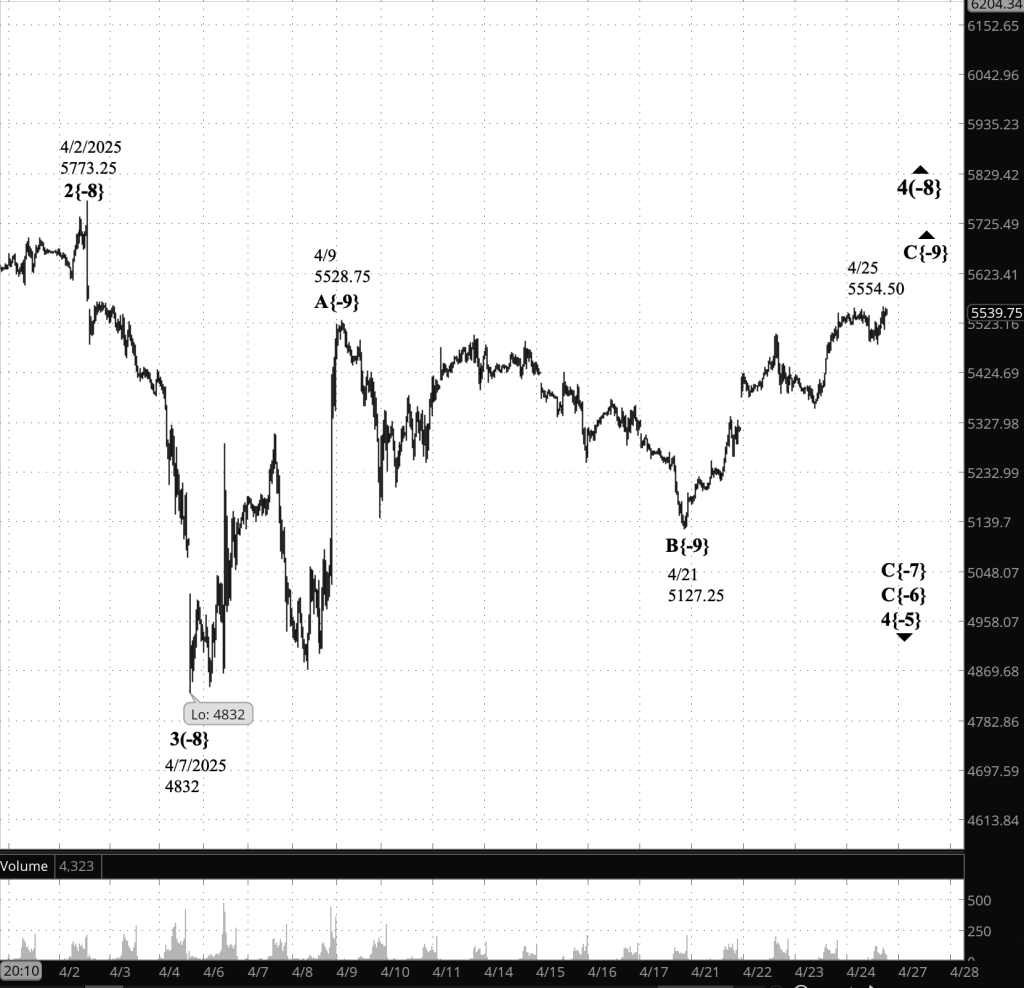
Trader’s Notebook

3:30 p.m. New York timw

Half an hour before the closing bell. The S&P 500 futures continued to fall during the session, reaching a low of 5650.75. The decline began on March 17 from 5759.75.

Elliott Wave Theory. In this morning’s post I was unwilling to declare the 4th-wave upward correction over. Given the size the decline, I’m convinced the my Principal Analysis has been overtaken by events.

So it’s farewell, rising wave 4, and welcome, declining wave 5. In Elliott Wave terminology, wave 4{-9} has ended and declining wave 5{-9} has begun.

A 5th wave typically will move beyond the end of the preceding 3rd wave, which 5534 reached on March 11. Or it could be 5509.25, reached on March 13 — there’s a possible rule problem with the structure, and I’m working on figuring that out. No all 5th waves moves beyond the preceding 3rd. Some come up short, a condition known as truncation.

When wave 5 is complete, it will also be the end of its parent C wave (C{-8}), which began on February 19 from 6166.40,and its grandparent 3rd wave (3{-7}).

9:35 a.m. New York time

What’s happening now? The S&P 500 E-mini futures fell overnight, from the 5730s to slight above 5700.

What does it mean? Elliott Wave Theory, when applied to the chart, sees two possibiities: Either the present rising wave 5 ended at yesterday’s peak, 5759.75, or the decline now underway is a subwave within wave 5.

The decline is in its 3rd and possibly final subwave. If the price switches up with further well-defined waves, then it was a correction within wave 5. If it traces a 4th and 5th wave, then wave 5 ended at the March 17 peak.

For now, my principal analysis will stay with the wave-5-continues scenario.

The drama now unfolding is wave C, a subwave of a 4th-wave upward correction that began on March 13. That correction, in turn, is part of two declining 3rd waves, a smaller one nested with a larger one.

The whole structure is within a declining C wave that began on February 19, 2025. It’s parent wave is a declining 4th wave that began on December 16, 2024.

The end of wave C will also be theend of the 4th-wave correction.

[S&P 500 E-mini futures at 3:30 p..m., 40-minute bars, with volume]

What is the alternative? There are some wave proportion and overlaps that require a closer look; I’ll be working on them today.

What does Elliott Wave Theory say? Here are the waves that underlie the morning’s analyses as they appeared on the chart.

Principal Analysis

  • Rising wave 4{-9} is underway and internally is in wave C{-10}.
  • Wave C{-10} is in wave 5{-11}, the final subwave.
  • It’s possible but not yet certain that wave 5{-11} ended on March 18.
  • If it did, wave {-10} and wave 4{-9} also ended

Long-term Waves.

These are the waves currently in progress under my principal analysis. Each line on the list shows the wave number, with the subscript in curly brackets, the traditional degree name, the starting date, the starting price of the S&P 500 E-mini futures, and the direction of the wave.

  • S&P 500 Index:
  • 5{+3} Supercycle, 7/8/1932, 4.40 (up)
  • 5{+2} Cycle, 12/9/1974, 60.96 (up)
  • 5{+1} Primary, 3/6/2009, 666.79 (up)
  • 5{0} Intermediate, 2/11/2016, 1810.10 (up)
  • 3{-1} Minor, 3/23/2020, 2191.36 (up)
  • 3{-2} Minute, 10/13/2022, 3491.58 (up)
  • S&P 500 Futures
  • 5{-3} Minuette, 4/18/2024, 4963.50 (up)
  • 3{-4} Subminuette, 8/7/2024, 5182 (up)
  • 4{-5} Micro, 12/16/2024, 6163.75 (down)
  • C{-6} Submicro, 2/19/2025, 6166.50 (down)
  • 5{-7} (no name), 3/3/2025, 6000.50 (down)
  • 3{-8} (no name), 3/5/2025, 5869.40 (down)
  • 4{-9} (no name), 3/11/2025, 5534 (up)

Reading the chart. Price movements — waves – – in Elliott Wave Theory analysis are labeled with numbers within trending waves and letters with corrective waves. The subscripts — numbers in curly brackets — designate the wave’s degree, which, in Elliott Wave analysis, means the relative position of a wave within the larger and smaller structures that make up the chart. R.N. Elliott, who in the 1930s developed the form of analysis that bears his name, viewed the chart as a complex structure of smaller waves nested within larger waves, which in turn are nested within still larger waves. In mathematics it’s called a fractal structure, where at every scale the pattern is similar to the others.

Learning and other resources. Elliott Wave analysis provides context, not prophecy. As the 20th century semanticist Alfred Korzybski put it in his book Science and Sanity (1933), “The map is not the territory … The only usefulness of a map depends on similarity of structure between the empirical world and the map.” And I would add, in the ever-changing markets, we can judge that similarity of structure only after the fact.

See the menu page Analytical Methods for a rundown on where to go for information on Elliott Wave analysis.

By Tim Bovee, Portland, Oregon, March 18, 2025

Disclaimer

Tim Bovee, Private Trader tracks the analysis and trades of a private trader for his own accounts. Nothing in this blog constitutes a recommendation to buy or sell stocks, options or any other financial instrument. The only purpose of this blog is to provide education and entertainment.

No trader is ever 100 percent successful in his or her trades. Trading in the stock and option markets is risky and uncertain. Each trader must make trading decisions for his or her own account, and take responsibility for the consequences.

License

All content on Tim Bovee, Private Trader by Timothy K. Bovee is licensed under a Creative Commons Attribution-ShareAlike 4.0 International License.

Based on a work at www.timbovee.com

Trader’s Notebook

3:30 p.m. New York time

Half an hour before the closing bell. The S&P 500 futures continued to rise during the session, reaching the 5760 region.

Elliott Wave Theory: For this part I’ll use the wave labels as they appear on the chart: A wave number followed by a subscript in curly brackets locating the wave within the fractal structure of the chart. The subscript shows the number of degrees the wave is from Intermediate degree.

Corrective wave 4{-9} and its subwave, C{-10}, continue to rise. I’ve made a change to my understanding of the 4th wave’s internal structure. I had labeled the March 16 turning point, from 5683.75, as the end of wave 3{-12}, a subwave of wave 3{-11}, the middle subwave of wave C{-10}.

Given the pace of the rise, it seems increasingly likely that 5683.75 marks the end wave 3{-11}, and wave 5{-11} is currently underway.

When wave 5{-11} ends, it will also be the end of the parent wave C{-10} and the grandparent wave 4{-9}. A downtrending impulse movement, wave 5{-9}, will commence, carrying the price down for a significant distance.

Hang on! It might be a bumpy ride.

9:35 a.m. New York time

What’s happening now? The S&P 500 E-mini futures rose after trading resumed overnight, from a low point of 5651.50 to above 5700, picking up the pace after the 8:30 a.m. New York time release of the U.S. Retail Sales report.

What does it mean? Elliott Wave Theory analysis shows that the 4th-wave upward correction continues and is in its 3rd subwave, wave C. Internally, things get a bit more complex. Rather than a standard three-wave correction — a Zigzag or a Flat — it could be one of the rarer variants, such as an Extended Flat or a Triangle.

[S&P 500 E-mini futures at 3:30 p.m., 40-minute bars, with volume]

What is the alternative? There are some wave proportion and overlaps that require a closer look; I’ll be working on them today.

What does Elliott Wave Theory say? Here are the waves that underlie the morning’s analyses as they appeared on the chart.

Principal Analysis

  • Rising wave 4{-9} is underway and internally is in wave C{-10}.
  • Wave C{-10} is in wave 3{-11}, the middle subwave.
  • Wave 3{-11} appears to be in its final subwave, wave 5{-12}.

Long-term Waves.

These are the waves currently in progress under my principal analysis. Each line on the list shows the wave number, with the subscript in curly brackets, the traditional degree name, the starting date, the starting price of the S&P 500 E-mini futures, and the direction of the wave.

  • S&P 500 Index:
  • 5{+3} Supercycle, 7/8/1932, 4.40 (up)
  • 5{+2} Cycle, 12/9/1974, 60.96 (up)
  • 5{+1} Primary, 3/6/2009, 666.79 (up)
  • 5{0} Intermediate, 2/11/2016, 1810.10 (up)
  • 3{-1} Minor, 3/23/2020, 2191.36 (up)
  • 3{-2} Minute, 10/13/2022, 3491.58 (up)
  • S&P 500 Futures
  • 5{-3} Minuette, 4/18/2024, 4963.50 (up)
  • 3{-4} Subminuette, 8/7/2024, 5182 (up)
  • 4{-5} Micro, 12/16/2025, 6163.75 (down)
  • C{-6} Submicro, 2/19/2025, 6166.50 (down)
  • 5{-7} (no name), 3/3/2025, 6000.50 (down)
  • 3{-8} (no name), 3/5/2025, 5869.40 (down)
  • 4{-9} (no name), 3/11/2025, 5534 (up)

Reading the chart. Price movements — waves – – in Elliott Wave Theory analysis are labeled with numbers within trending waves and letters with corrective waves. The subscripts — numbers in curly brackets — designate the wave’s degree, which, in Elliott Wave analysis, means the relative position of a wave within the larger and smaller structures that make up the chart. R.N. Elliott, who in the 1930s developed the form of analysis that bears his name, viewed the chart as a complex structure of smaller waves nested within larger waves, which in turn are nested within still larger waves. In mathematics it’s called a fractal structure, where at every scale the pattern is similar to the others.

Learning and other resources. Elliott Wave analysis provides context, not prophecy. As the 20th century semanticist Alfred Korzybski put it in his book Science and Sanity (1933), “The map is not the territory … The only usefulness of a map depends on similarity of structure between the empirical world and the map.” And I would add, in the ever-changing markets, we can judge that similarity of structure only after the fact.

See the menu page Analytical Methods for a rundown on where to go for information on Elliott Wave analysis.

By Tim Bovee, Portland, Oregon, March 17, 2025

Disclaimer

Tim Bovee, Private Trader tracks the analysis and trades of a private trader for his own accounts. Nothing in this blog constitutes a recommendation to buy or sell stocks, options or any other financial instrument. The only purpose of this blog is to provide education and entertainment.

No trader is ever 100 percent successful in his or her trades. Trading in the stock and option markets is risky and uncertain. Each trader must make trading decisions for his or her own account, and take responsibility for the consequences.

License

All content on Tim Bovee, Private Trader by Timothy K. Bovee is licensed under a Creative Commons Attribution-ShareAlike 4.0 International License.

Based on a work at www.timbovee.com