Trader’s Notebook

3:30 p.m. New York time

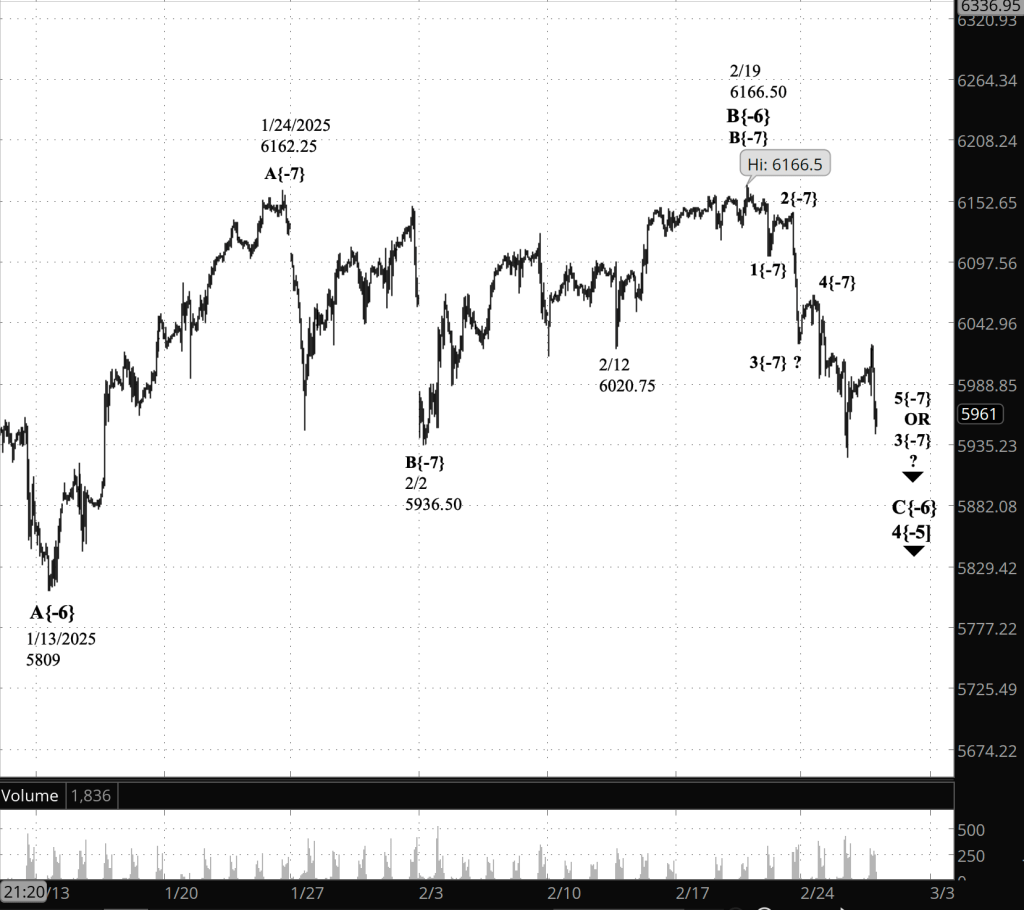
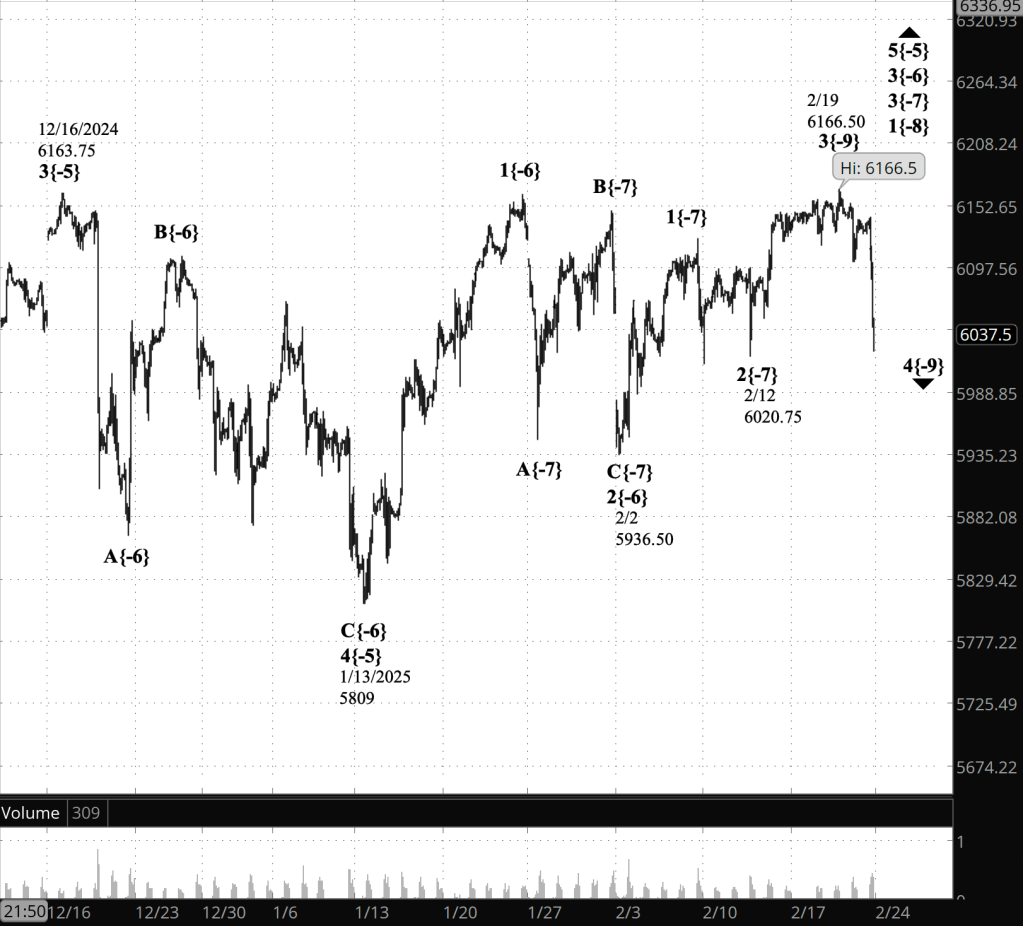
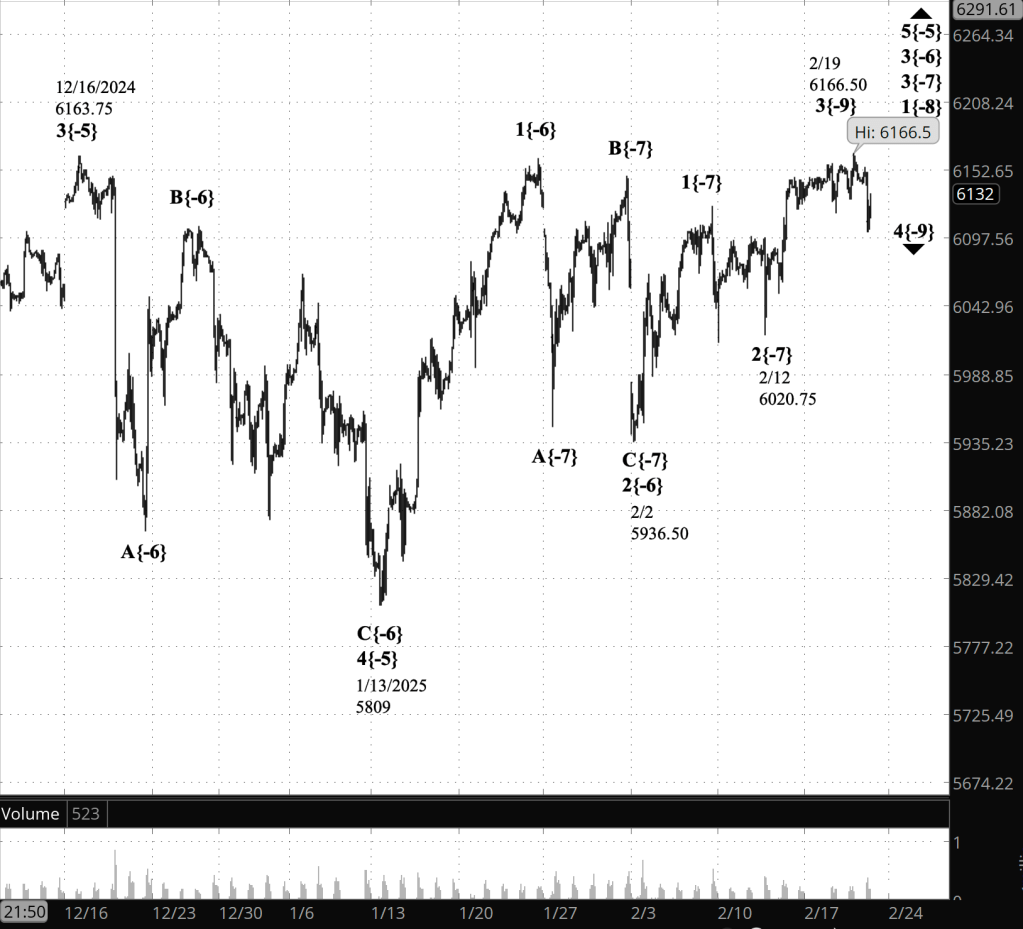
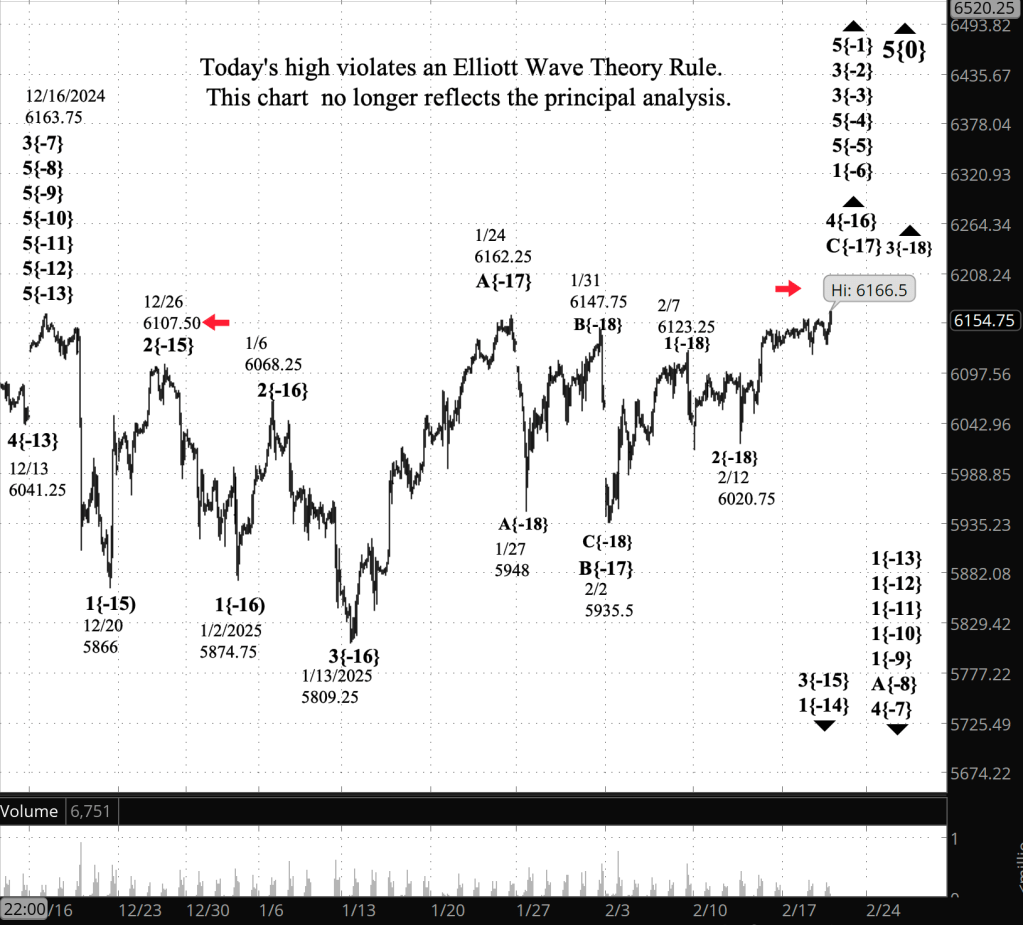
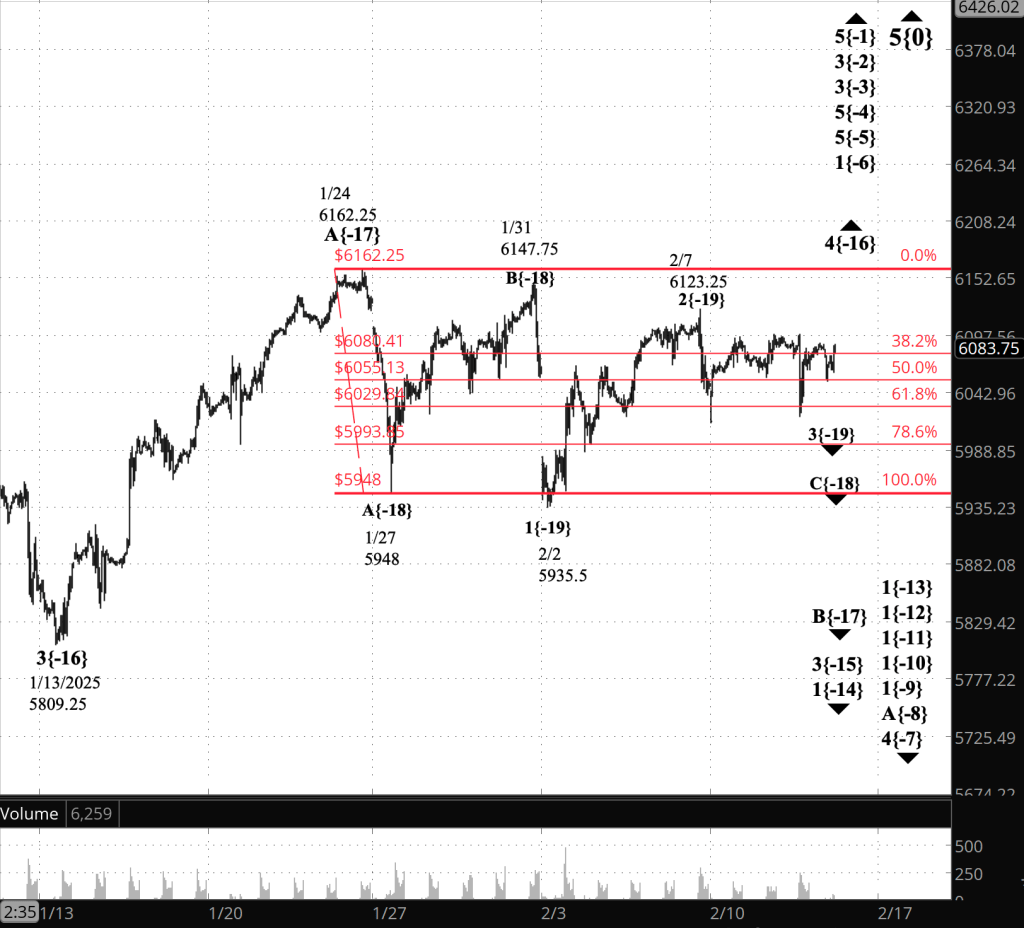
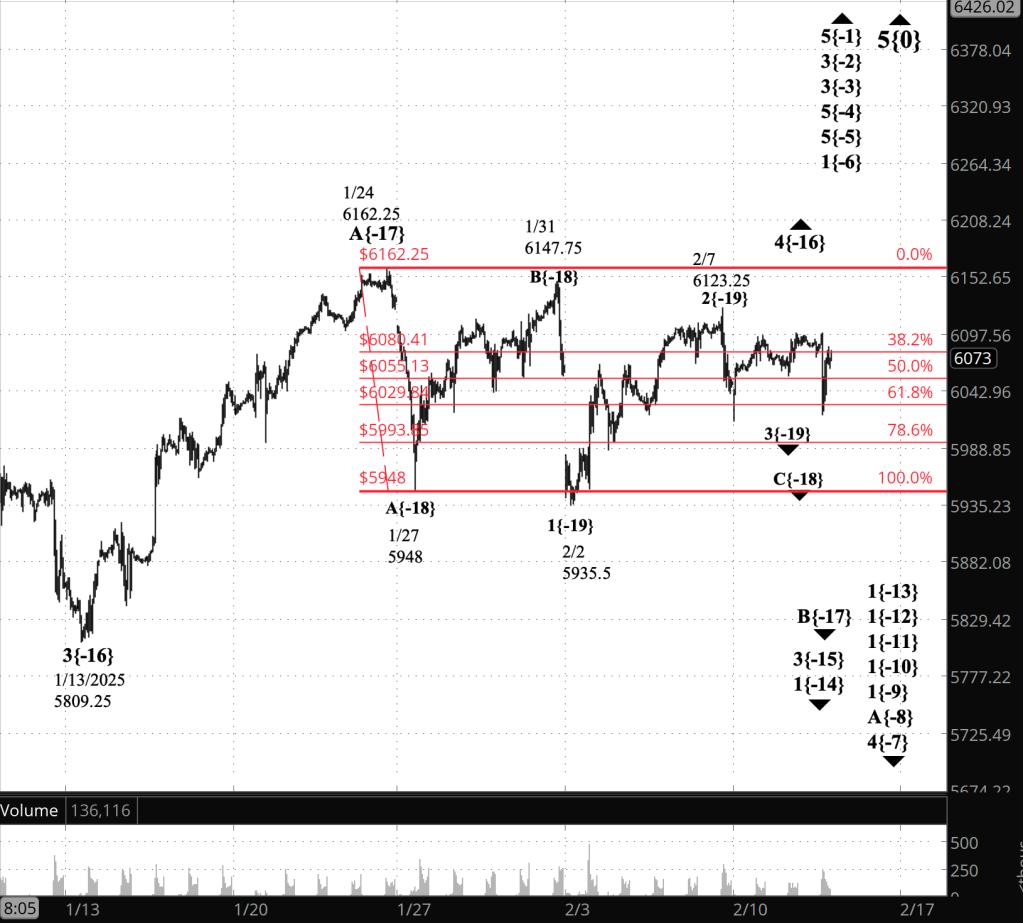
Half an hour before the closing bell. The S&P 500 futures rose during the session, to 6147.75. The rise in Elliott Wave Theory is wave B within a 4th-wave correction. From that point the price fell swiftly to the 6060s.

This morning I discussed the Elliott Wave Theory rules limiting B waves. B waves in a Flat, which this 4th wave is, must retrace at least 90% of wave A. The B wave beat that requirement by 7 points and then headed south.

I’ve updated the chart to show wave B{-18} ending at 6147.75 and labeled the decline as wave C{-18}.

9:35 a.m. New York time

What’s happening now? The S&P 500 E-mini futures rose overnight, from the 6090s to 6130. The high point is 32.25 below the January 24 peak, 6162.25.

What does it mean? Elliott Wave Theory counts the January 24 peak as being the end of the A wave that began on January 13, labeled A{-17} on the chart, and the beginning of the first subwave within wave B{-17}. That first subwave, labeled A{-18}, ended on January 27, and wave B{-18} began from that point.

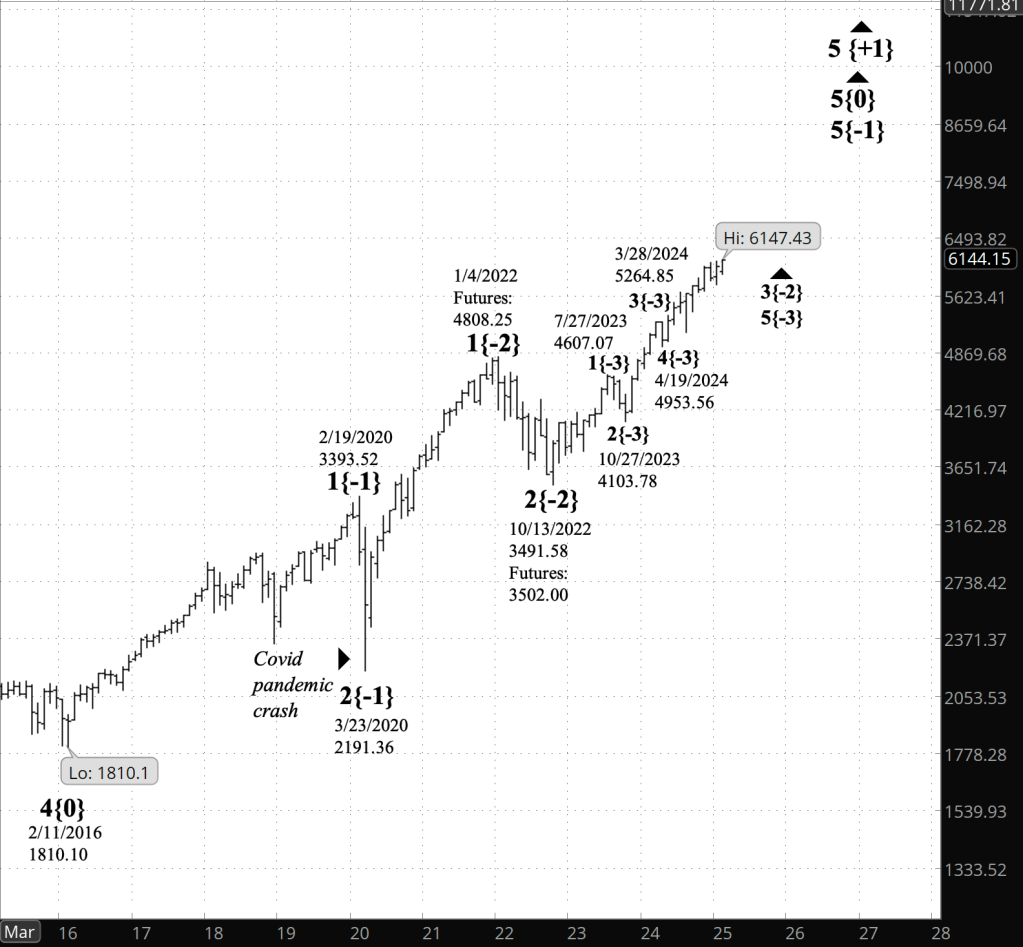
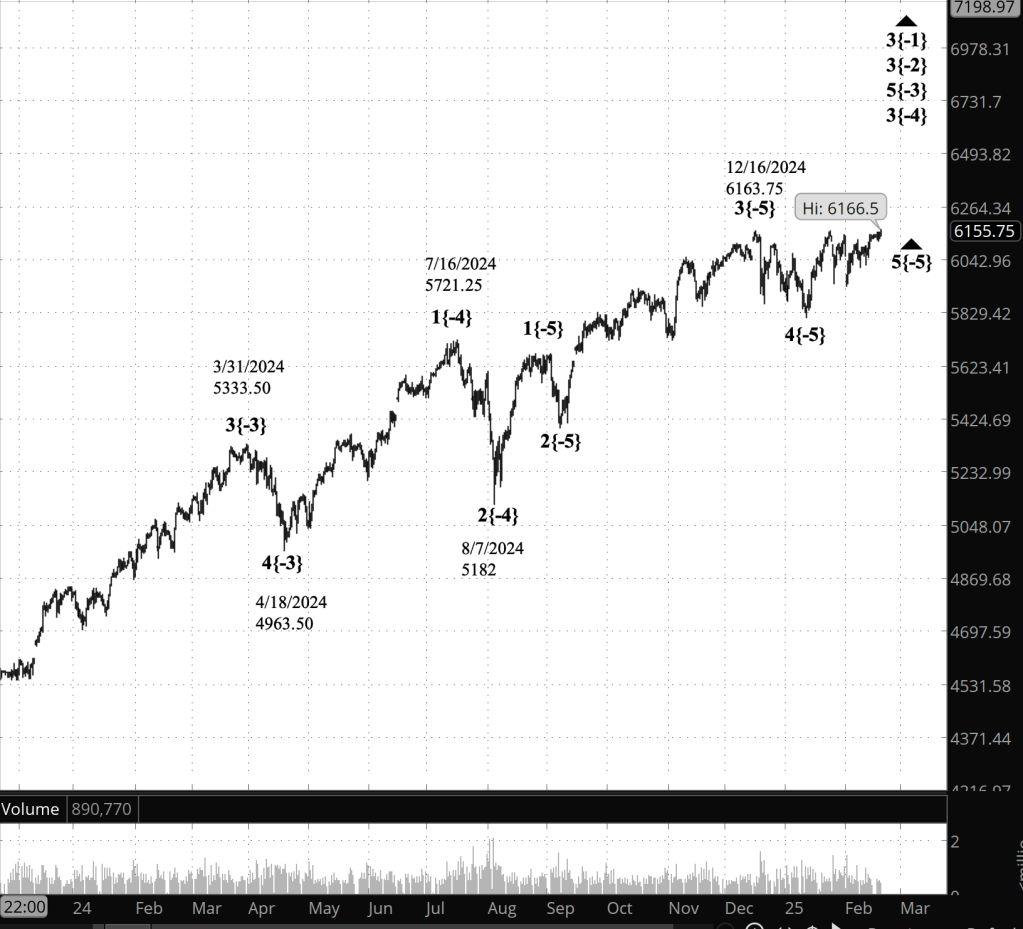
The subscripts, contained within curly brackets, are the wave’s distance from Intermediate degree n the fractal structure of the chart. The current intermediate degree, wave 5{0}, began in December 2018.

B waves are subject to a rule in Elliott Wave Theory.

If the A wave has five subwaves, then the correction is a Zigzag and never moves beyond the start of the prior A wave, which is 6162.25. If it does, then it’s not a B wave and something else is going on. I.e., time to do a reanalysis.

If the A wave has three subwaves, then the correction is a Flat, and the B-wave must retrace 90% of wave A, which would be 6140.75 in this case.

So which type of correction is this one? The A{18} wave had a lot of energy and is almost a straight line. The internal wave count lacks clarity. However, EWT also has a rule of alternation. If the wave 2 correction is a Zigzag, then the wave 4 correction is a Flat, and vice-versa.

The wave 2{-16} correction, from January 2 to January 6, has three clear subwaves, so based on that, I’m considering wave 4{-16} to be a Flat, meaning that it must reach 6140.75 and can go higher, even beyond the starting point of the preceding A{-18} wave.

[S&P 500 E-mini futures at 3:30 p.m., 75-minute bars, with volume]

What are the alternatives? This is word-for-word from yesterday, and may be with us for a while longer. What I’ve labeled as wave A{-18} may in fact turn out to be a subwave of that wave, one degree lower.. If I squint real hard, wave A{-18} appears to have five subwaves, making it the Zig-zag type of correction. But the rising corrective wavesw ithin it are extremely small, so they don’t really match the size of the parent wave. So for now I’m sticking with the chart as labeled. Time will tell if that was the correct choice.

What does Elliott wave theory say? Here are the waves that underly the analyses, updated with the today’s reanalysis.

Principal Analysis:

  • Rising wave 5{0} is underway. It is a wave of Intermediate degree that began in December 2018.
  • It is in its final subwave, wave 5{-1}.
  • Within wave 5{-1}, rising waves 5{-2}, 5{-3} and 5{-4} are underway, as is wave 5{-5}.
  • Wave 5{-5} is in its initial subwave, wave 1{-6}, which in turn is in its middle subwave, wave 3{-7}.
  • Wave 4{-7} is in its initial; subwave, which is uptrending wave A{-8}, if wave 4{-7} is a Flat structure, with three subwaves, or wave 1{-8} if it is a Zigzag structure, with five subwaves. (I’ll assume Flat as the list continues, since that’s more common within 4th waves)
  • Wave A{-8} is in its initial subwave, wave 1{-9}, as are waves 1{-10}, 1{-11}, 1{-12}, and 1{-13}.
  • Wave 1{-14}, an upward correction and is in its first subwave, wave 3{-15}.
  • Wave 3{-15] is in its second subwave, rising wave 4{-16}, an upward correction
  • Wave 4{-16} is in its middle subwave, descendng wave B{-17}, which is in its middle subwave, rising wave B{-18}

Long-term Waves.

These are the waves currently in progress under my principal analysis. Each line on the list shows the wave number, with the subscript in curly brackets, the traditional degree name, the starting date, the starting price of the S&P 500 E-mini futures, and the direction of the wave. (Updated with today’s reanalysis.)

  • S&P 500 Index:
  • 5{+3} Supercycle, 7/8/1932, 4.40 (up)
  • 5{+2} Cycle, 12/9/1974, 60.96 (up)
  • 5{+1} Primary, 3/6/2009, 666.79 (up)
  • 5{0} Intermediate, 12/26/2018, 2346.58 (up)
  • S&P 500 Futures
  • 5{-1} Minor, 10/27/2023, 4127.25 (up)
  • 3{-2} Minute, 10/27/23, 4127.75 (up)
  • 3{-3} Minuette, 10/27/23, 4127.75 (up)
  • 5{-4} Subminuette, 4/18/2024, 4963.50 (up)
  • 5{-5} Micro, 8/5/2024, 5120 (up)
  • 1{-6} Submicro, 8/5/2024, 5120 (up)
  • 4{-7} Minuscule, 12/16/2024, 6163.75 (down)
  • A{-8} (unnamed), 12/16/2024, 6163.75 (down)
  • 1{-9} (unnamed), 12/16/2024, 6163.75 (down)
  • 1{-10} (unnamed), 12/16/2024, 6163.75 (down)
  • 1{-11} (unnamed), 12/16/2024, 6163.75 (down)
  • 1{-12} (unnamed), 12/16/2024, 6163.75 (down)
  • 1{-13} (unnamed), 12/16/2024, 6163.75 (down)
  • 1{-14} (unnamed), 1/13/2025, 5809.25 (down)
  • 3{-15} (unnamed), 1/13/2025, 5809.25 (down)
  • 4{-16} (unnamed), 1/13/2025, 5809.25 (up)
  • B{-17} (unnamed), 1/24/2025, 6162.25 (down)
  • B{-18} (unnamed), 1/27/2025, 5948 (up)

Reading the chart. Price movements — waves – – in Elliott wave analysis are labeled with numbers within trending waves and letters with corrective waves. The subscripts — numbers in curly brackets — designate the wave’s degree, which, in Elliott wave analysis, means the relative position of a wave within the larger and smaller structures that make up the chart. R.N. Elliott, who in the 1930s developed the form of analysis that bears his name, viewed the chart as a complex structure of smaller waves nested within larger waves, which in turn are nested within still larger waves. In mathematics it’s called a fractal structure, where at every scale the pattern is similar to the others.

Learning and other resources. Elliott wave analysis provides context, not prophecy. As the 20th century semanticist Alfred Korzybski put it in his book Science and Sanity (1933), “The map is not the territory … The only usefulness of a map depends on similarity of structure between the empirical world and the map.” And I would add, in the ever-changing markets, we can judge that similarity of structure only after the fact.

See the menu page Analytical Methods for a rundown on where to go for information on Elliott wave analysis.

By Tim Bovee, Portland, Oregon, January 31, 2025

Disclaimer

Tim Bovee, Private Trader tracks the analysis and trades of a private trader for his own accounts. Nothing in this blog constitutes a recommendation to buy or sell stocks, options or any other financial instrument. The only purpose of this blog is to provide education and entertainment.

No trader is ever 100 percent successful in his or her trades. Trading in the stock and option markets is risky and uncertain. Each trader must make trading decisions for his or her own account, and take responsibility for the consequences.

License

All content on Tim Bovee, Private Trader by Timothy K. Bovee is licensed under a Creative Commons Attribution-ShareAlike 4.0 International License.

Based on a work at www.timbovee.com.

Trader’s Notebook

3:30 p.m. New York time

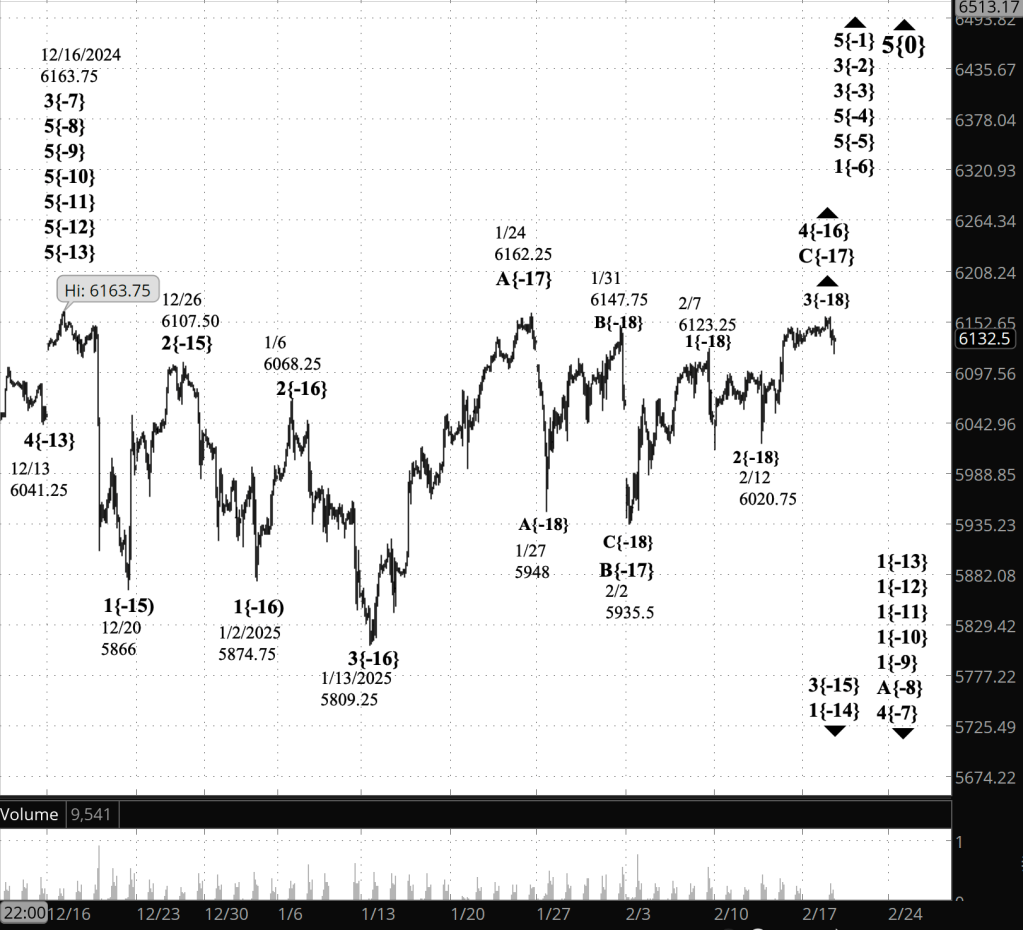
Half an hour before the closing bell. That smaller rising B-wave that appeared to have ended on January 28 now appears to be ongoing. The wave reversed from its decline and reached into the 6110s, slightly above the top attained earlier in the week.

Otherwise, no change. The 4th-wave upward correction that began on January 13 continues and is in its middle wave, a declining B wave that began on January 24.

9:35 a.m. New York time

What’s happening now? The S&P 500 E-mini futures rose after yesterday’s session close, from the 6060s to slilghtly above 6100, and then withdrew slightly.

What does it mean? The price remained slightly below the January 28 peak, 6111.50, which Elliiott Wav Theory analysis sees as the wave of wave B and the beginning of declining wave C within a larger declining B-wave, one degree higher with a 4th-wave rising correction that began on January 13.

So at the daily level we’re dealing with two corrections, a smaller declining C wave, labeleld C{-18} subscript on the chart, and a declining larger B wave, labeled B{-17}. The subscripts, in curly brackets, are the number of degrees the wave is from Intermediate degree, presently wave 5{0}, which began in December 2018.

The end of the small declining C wave will be the end of the larger declining B wave and the start of the larger rising C wave, which, when complete, will also be the end of the rising 4th-wave correction and the start of a 5th-wave decline, wave 5{-16}, which likely will carry the price down below 6000, perhaps siginificantly so. Or perhaps not. A 5th wave tends to be quirky.

Also, sometimes corrections take a complex form. Normally they have three subwaves — A, B and C — and that’s the end of the correction. But from time to time, wave C is followed by a connector X wave, and then another three-wave corrective pattern, and occasionally by a second connevctor and a third corrective pattern.

Complex corrections are unpredivctable. We know them when we see them.

[S&P 500 E-mini futures at 3:30 p.m., 75-minute bars, with volume]

What are the alternatives? This is word-for-word from yesterday, and may be with us for a while longer. What I’ve labeled as wave A{-18} may in fact turn out to be a subwave of that wave, one degree lower.. If I squint real hard, wave A{-18} appears to have five subwaves, making it the Zig-zag type of correction. But the rising corrective wavesw ithin it are extremely small, so they don’t really match the size of the parent wave. So for now I’m sticking with the chart as labeled. Time will tell if that was the correct choice.

What does Elliott wave theory say? Here are the waves that underly the analyses, updated with the today’s reanalysis.

Principal Analysis:

  • Rising wave 5{0} is underway. It is a wave of Intermediate degree that began in December 2018.
  • It is in its final subwave, wave 5{-1}.
  • Within wave 5{-1}, rising waves 5{-2}, 5{-3} and 5{-4} are underway, as is wave 5{-5}.
  • Wave 5{-5} is in its initial subwave, wave 1{-6}, which in turn is in its middle subwave, wave 3{-7}.
  • Wave 4{-7} is in its initial; subwave, which is uptrending wave A{-8}, if wave 4{-7} is a Flat structure, with three subwaves, or wave 1{-8} if it is a Zigzag structure, with five subwaves. (I’ll assume Flat as the list continues, since that’s more common within 4th waves)
  • Wave A{-8} is in its initial subwave, wave 1{-9}, as are waves 1{-10}, 1{-11}, 1{-12}, and 1{-13}.
  • Wave 1{-14}, an upward correction and is in its first subwave, wave 3{-15}.
  • Wave 3{-15] is in its second subwave, rising wave 4{-16}, an upward correction
  • Wave 4{-16} is in its middle subwave, descendng wave B{-17}, which is in its middle subwave, rising wave B{-18}

Long-term Waves.

These are the waves currently in progress under my principal analysis. Each line on the list shows the wave number, with the subscript in curly brackets, the traditional degree name, the starting date, the starting price of the S&P 500 E-mini futures, and the direction of the wave. (Updated with today’s reanalysis.)

  • S&P 500 Index:
  • 5{+3} Supercycle, 7/8/1932, 4.40 (up)
  • 5{+2} Cycle, 12/9/1974, 60.96 (up)
  • 5{+1} Primary, 3/6/2009, 666.79 (up)
  • 5{0} Intermediate, 12/26/2018, 2346.58 (up)
  • S&P 500 Futures
  • 5{-1} Minor, 10/27/2023, 4127.25 (up)
  • 3{-2} Minute, 10/27/23, 4127.75 (up)
  • 3{-3} Minuette, 10/27/23, 4127.75 (up)
  • 5{-4} Subminuette, 4/18/2024, 4963.50 (up)
  • 5{-5} Micro, 8/5/2024, 5120 (up)
  • 1{-6} Submicro, 8/5/2024, 5120 (up)
  • 4{-7} Minuscule, 12/16/2024, 6163.75 (down)
  • A{-8} (unnamed), 12/16/2024, 6163.75 (down)
  • 1{-9} (unnamed), 12/16/2024, 6163.75 (down)
  • 1{-10} (unnamed), 12/16/2024, 6163.75 (down)
  • 1{-11} (unnamed), 12/16/2024, 6163.75 (down)
  • 1{-12} (unnamed), 12/16/2024, 6163.75 (down)
  • 1{-13} (unnamed), 12/16/2024, 6163.75 (down)
  • 1{-14} (unnamed), 1/13/2025, 5809.25 (down)
  • 3{-15} (unnamed), 1/13/2025, 5809.25 (down)
  • 4{-16} (unnamed), 1/13/2025, 5809.25 (up)
  • B{-17} (unnamed), 1/24/2025, 6162.25 (down)
  • B{-18} (unnamed), 1/27/2025, 5948 (up)

Reading the chart. Price movements — waves – – in Elliott wave analysis are labeled with numbers within trending waves and letters with corrective waves. The subscripts — numbers in curly brackets — designate the wave’s degree, which, in Elliott wave analysis, means the relative position of a wave within the larger and smaller structures that make up the chart. R.N. Elliott, who in the 1930s developed the form of analysis that bears his name, viewed the chart as a complex structure of smaller waves nested within larger waves, which in turn are nested within still larger waves. In mathematics it’s called a fractal structure, where at every scale the pattern is similar to the others.

Learning and other resources. Elliott wave analysis provides context, not prophecy. As the 20th century semanticist Alfred Korzybski put it in his book Science and Sanity (1933), “The map is not the territory … The only usefulness of a map depends on similarity of structure between the empirical world and the map.” And I would add, in the ever-changing markets, we can judge that similarity of structure only after the fact.

See the menu page Analytical Methods for a rundown on where to go for information on Elliott wave analysis.

By Tim Bovee, Portland, Oregon, January 30, 2025

Disclaimer

Tim Bovee, Private Trader tracks the analysis and trades of a private trader for his own accounts. Nothing in this blog constitutes a recommendation to buy or sell stocks, options or any other financial instrument. The only purpose of this blog is to provide education and entertainment.

No trader is ever 100 percent successful in his or her trades. Trading in the stock and option markets is risky and uncertain. Each trader must make trading decisions for his or her own account, and take responsibility for the consequences.

License

All content on Tim Bovee, Private Trader by Timothy K. Bovee is licensed under a Creative Commons Attribution-ShareAlike 4.0 International License.

Based on a work at www.timbovee.com.

Trader’s Notebook

3:30 p.m. New York time

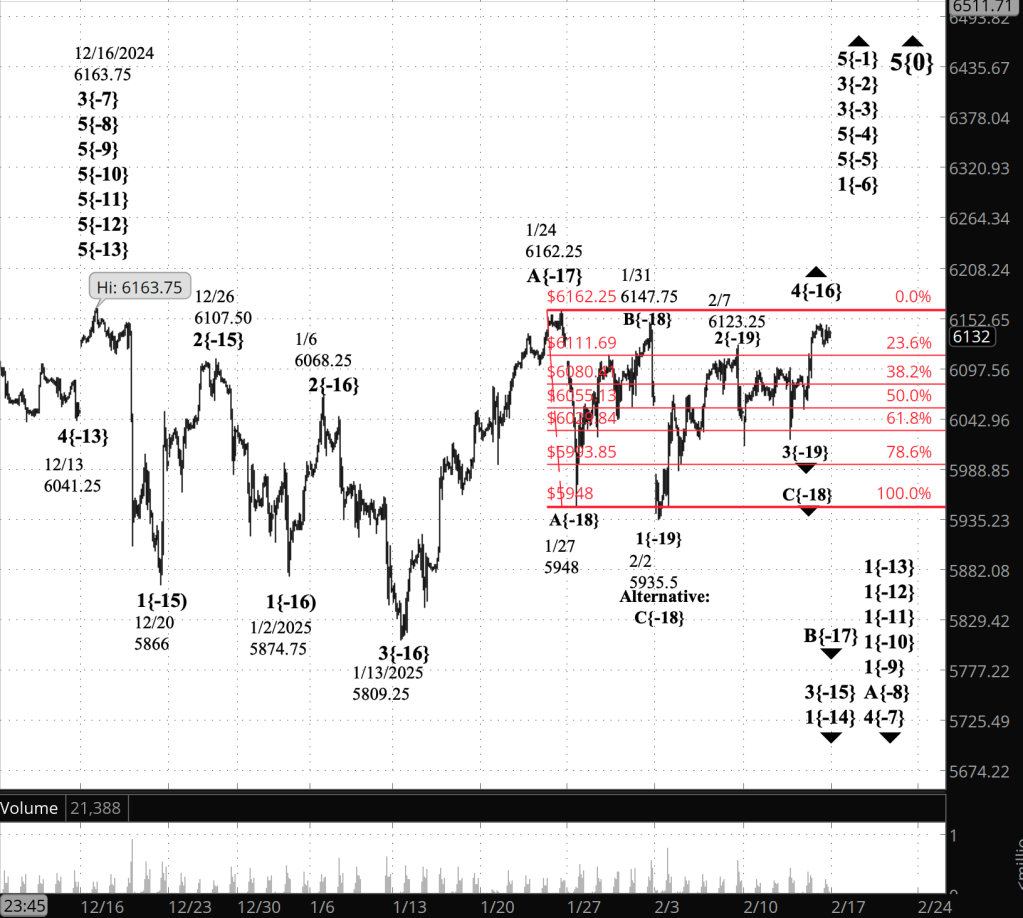
Half an hour before the closing bell. The S&P 500 futures continued to decline during the session, reaching into the 6040s.

Elliott Wave Theory: The 4th-wave upward correction continues and is in its middle wave, falling wave B. Within wave B, a smaller rising wave reached completion on January 28, and falling wave C began.

Labelling error. I mislabeled the larger wave B – wave B{-17} — on this morning’s chart. I showed it as a rising wave. It’s actually a declining wave.

9:35 a.m. New York time

What’s happening now? The S&P 500 E-mini futures peaked early overnight, at 6111.50, and then fell the rest of the night, into the 6070s.

What does it mean? Applying Elliott Wave Theory, I find the overnight decline to be too shallow to be one of the numbered waves on the chart and will continue to see wave B{-18} within B{-17} within rising wave 4{-16} as being underway.

On the labels, the number in curly brackets are the wave’s distance from Intermediate degree within the fractal structure of the chart. For example, wave B{-18} is 18 degrees down from the present Intermediate wave, numbered 5{0}, which ended in December 2018.

[S&P 500 E-mini futures at 3:30 p.m., 75-minute bars, with volume]

What are the alternatives? This is word-for-word from yesterday, and may be with us for a while longer. What I’ve labeled as wave A{-18} may in fact turn out to be a subwave of that wave, one degree lower.. If I squint real hard, wave A{-18} appears to have five subwaves, making it the Zig-zag type of correction. But the rising corrective wavesw ithin it are extremely small, so they don’t really match the size of the parent wave. So for now I’m sticking with the chart as labeled. Time will tell if that was the correct choice.

What does Elliott wave theory say? Here are the waves that underly the analyses, updated with the today’s reanalysis.

Principal Analysis:

  • Rising wave 5{0} is underway. It is a wave of Intermediate degree that began in December 2018.
  • It is in its final subwave, wave 5{-1}.
  • Within wave 5{-1}, rising waves 5{-2}, 5{-3} and 5{-4} are underway, as is wave 5{-5}.
  • Wave 5{-5} is in its initial subwave, wave 1{-6}, which in turn is in its middle subwave, wave 3{-7}.
  • Wave 4{-7} is in its initial; subwave, which is uptrending wave A{-8}, if wave 4{-7} is a Flat structure, with three subwaves, or wave 1{-8} if it is a Zigzag structure, with five subwaves. (I’ll assume Flat as the list continues, since that’s more common within 4th waves)
  • Wave A{-8} is in its initial subwave, wave 1{-9}, as are waves 1{-10}, 1{-11}, 1{-12}, and 1{-13}.
  • Wave 1{-14}, an upward correction and is in its first subwave, wave 3{-15}.
  • Wave 3{-15] is in its second subwave, rising wave 4{-16}, an upward correction
  • Wave 4{-16} is in its middle subwave, descendng wave B{-17}, which is in its middle subwave, rising wave B{-18}

Long-term Waves.

These are the waves currently in progress under my principal analysis. Each line on the list shows the wave number, with the subscript in curly brackets, the traditional degree name, the starting date, the starting price of the S&P 500 E-mini futures, and the direction of the wave. (Updated with today’s reanalysis.)

  • S&P 500 Index:
  • 5{+3} Supercycle, 7/8/1932, 4.40 (up)
  • 5{+2} Cycle, 12/9/1974, 60.96 (up)
  • 5{+1} Primary, 3/6/2009, 666.79 (up)
  • 5{0} Intermediate, 12/26/2018, 2346.58 (up)
  • S&P 500 Futures
  • 5{-1} Minor, 10/27/2023, 4127.25 (up)
  • 3{-2} Minute, 10/27/23, 4127.75 (up)
  • 3{-3} Minuette, 10/27/23, 4127.75 (up)
  • 5{-4} Subminuette, 4/18/2024, 4963.50 (up)
  • 5{-5} Micro, 8/5/2024, 5120 (up)
  • 1{-6} Submicro, 8/5/2024, 5120 (up)
  • 4{-7} Minuscule, 12/16/2024, 6163.75 (down)
  • A{-8} (unnamed), 12/16/2024, 6163.75 (down)
  • 1{-9} (unnamed), 12/16/2024, 6163.75 (down)
  • 1{-10} (unnamed), 12/16/2024, 6163.75 (down)
  • 1{-11} (unnamed), 12/16/2024, 6163.75 (down)
  • 1{-12} (unnamed), 12/16/2024, 6163.75 (down)
  • 1{-13} (unnamed), 12/16/2024, 6163.75 (down)
  • 1{-14} (unnamed), 1/13/2025, 5809.25 (down)
  • 3{-15} (unnamed), 1/13/2025, 5809.25 (down)
  • 4{-16} (unnamed), 1/13/2025, 5809.25 (up)
  • B{-17} (unnamed), 1/24/2025, 6162.25 (down)
  • B{-18} (unnamed), 1/27/2025, 5948 (up)

Reading the chart. Price movements — waves – – in Elliott wave analysis are labeled with numbers within trending waves and letters with corrective waves. The subscripts — numbers in curly brackets — designate the wave’s degree, which, in Elliott wave analysis, means the relative position of a wave within the larger and smaller structures that make up the chart. R.N. Elliott, who in the 1930s developed the form of analysis that bears his name, viewed the chart as a complex structure of smaller waves nested within larger waves, which in turn are nested within still larger waves. In mathematics it’s called a fractal structure, where at every scale the pattern is similar to the others.

Learning and other resources. Elliott wave analysis provides context, not prophecy. As the 20th century semanticist Alfred Korzybski put it in his book Science and Sanity (1933), “The map is not the territory … The only usefulness of a map depends on similarity of structure between the empirical world and the map.” And I would add, in the ever-changing markets, we can judge that similarity of structure only after the fact.

See the menu page Analytical Methods for a rundown on where to go for information on Elliott wave analysis.

By Tim Bovee, Portland, Oregon, January 29, 2025

Disclaimer

Tim Bovee, Private Trader tracks the analysis and trades of a private trader for his own accounts. Nothing in this blog constitutes a recommendation to buy or sell stocks, options or any other financial instrument. The only purpose of this blog is to provide education and entertainment.

No trader is ever 100 percent successful in his or her trades. Trading in the stock and option markets is risky and uncertain. Each trader must make trading decisions for his or her own account, and take responsibility for the consequences.

License

All content on Tim Bovee, Private Trader by Timothy K. Bovee is licensed under a Creative Commons Attribution-ShareAlike 4.0 International License.

Based on a work at www.timbovee.com.

Trader’s Notebook

3:30 p.m. New York time

Half an hour before the closing bell. The S&P 500 futures continued to move higher during the session, reaching above 6100.

Elliott Wave Theory says we are here: Wave B with a bigger wave B within a 4th-wave correction — all three waves rising as they continue on their way.

9:35 a.m. New York time

What’s happening now? The S&P 500 E-mini futures continued to rise overnight, from the 6030s to the 6070s.

What does it mean? Elliott Wave Theory analysis sees the rise as the second of three subwaves within the 4th-wave upward correction that began on January 13.

At the moment we’re seeing a correction within a correction, one of a larger degree than the other. To keep things undeerstandable on the chart, I label each wave with its number, followed by a subscript within curly brackets that says how many degrees distant the wave is from Intermediate degree within the fractal structure of the chart..

The present Intermediate degree, rising wave 5{0}, began on December 26, 2018. The upward correction that began on January 13 is wave 4{-16}. The rise is the correction’s first subwave, wave A{-17}, which ended on January 24 at 6162.25.

At that point, the price reversed as the middle subwave, wave B{-17}, began. Like the larger correction of which it is a part, wave B{-17} will also have three subwaves. The decline that ended on January 27 at 5948 is wave A{-18} — the first of the three subwaves — and the rise that began from that pont is wave B{-18}, which is still underway.

[S&P 500 E-mini futures at 3:30 p.m., 70-minute bars, with volume]

What are the alternatives? What I’ve labeled as wave A{-18} may in fact turn out to be a subwave of that wave, one degree lower.. If I squint real hard, wave A{-18} appears to have five subwaves, making it the Zig-zag type of correction. But the rising corrective wavesw ithin it are extremely small, so they don’t really match the size of the parent wave. So for now I’m sticking with the chart as labeled. Time will tell if that was the correct choice.

What does Elliott wave theory say? Here are the waves that underly the analyses, updated with the today’s reanalysis.

Principal Analysis:

  • Rising wave 5{0} is underway. It is a wave of Intermediate degree that began in December 2018.
  • It is in its final subwave, wave 5{-1}.
  • Within wave 5{-1}, rising waves 5{-2}, 5{-3} and 5{-4} are underway, as is wave 5{-5}.
  • Wave 5{-5} is in its initial subwave, wave 1{-6}, which in turn is in its middle subwave, wave 3{-7}.
  • Wave 4{-7} is in its initial; subwave, which is uptrending wave A{-8}, if wave 4{-7} is a Flat structure, with three subwaves, or wave 1{-8} if it is a Zigzag structure, with five subwaves. (I’ll assume Flat as the list continues, since that’s more common within 4th waves)
  • Wave A{-8} is in its initial subwave, wave 1{-9}, as are waves 1{-10}, 1{-11}, 1{-12}, and 1{-13}.
  • Wave 1{-14}, an upward correction and is in its first subwave, wave 3{-15}.
  • Wave 3{-15] is in its second subwave, rising wave 4{-16}, an upward correction
  • Wave 4{-16} is in its middle subwave, descendng wave B{-17}, which is in its middle subwave, rising wave B{-18}

Long-term Waves.

These are the waves currently in progress under my principal analysis. Each line on the list shows the wave number, with the subscript in curly brackets, the traditional degree name, the starting date, the starting price of the S&P 500 E-mini futures, and the direction of the wave. (Updated with today’s reanalysis.)

  • S&P 500 Index:
  • 5{+3} Supercycle, 7/8/1932, 4.40 (up)
  • 5{+2} Cycle, 12/9/1974, 60.96 (up)
  • 5{+1} Primary, 3/6/2009, 666.79 (up)
  • 5{0} Intermediate, 12/26/2018, 2346.58 (up)
  • S&P 500 Futures
  • 5{-1} Minor, 10/27/2023, 4127.25 (up)
  • 3{-2} Minute, 10/27/23, 4127.75 (up)
  • 3{-3} Minuette, 10/27/23, 4127.75 (up)
  • 5{-4} Subminuette, 4/18/2024, 4963.50 (up)
  • 5{-5} Micro, 8/5/2024, 5120 (up)
  • 1{-6} Submicro, 8/5/2024, 5120 (up)
  • 4{-7} Minuscule, 12/16/2024, 6163.75 (down)
  • A{-8} (unnamed), 12/16/2024, 6163.75 (down)
  • 1{-9} (unnamed), 12/16/2024, 6163.75 (down)
  • 1{-10} (unnamed), 12/16/2024, 6163.75 (down)
  • 1{-11} (unnamed), 12/16/2024, 6163.75 (down)
  • 1{-12} (unnamed), 12/16/2024, 6163.75 (down)
  • 1{-13} (unnamed), 12/16/2024, 6163.75 (down)
  • 1{-14} (unnamed), 1/13/2025, 5809.25 (down)
  • 3{-15} (unnamed), 1/13/2025, 5809.25 (down)
  • 4{-16} (unnamed), 1/13/2025, 5809.25 (up)
  • B{-17} (unnamed), 1/24/2025, 6162.25 (down)
  • B{-18} (unnamed), 1/27/2025, 5948 (up)

Reading the chart. Price movements — waves – – in Elliott wave analysis are labeled with numbers within trending waves and letters with corrective waves. The subscripts — numbers in curly brackets — designate the wave’s degree, which, in Elliott wave analysis, means the relative position of a wave within the larger and smaller structures that make up the chart. R.N. Elliott, who in the 1930s developed the form of analysis that bears his name, viewed the chart as a complex structure of smaller waves nested within larger waves, which in turn are nested within still larger waves. In mathematics it’s called a fractal structure, where at every scale the pattern is similar to the others.

Learning and other resources. Elliott wave analysis provides context, not prophecy. As the 20th century semanticist Alfred Korzybski put it in his book Science and Sanity (1933), “The map is not the territory … The only usefulness of a map depends on similarity of structure between the empirical world and the map.” And I would add, in the ever-changing markets, we can judge that similarity of structure only after the fact.

See the menu page Analytical Methods for a rundown on where to go for information on Elliott wave analysis.

By Tim Bovee, Portland, Oregon, January 28, 2025

Disclaimer

Tim Bovee, Private Trader tracks the analysis and trades of a private trader for his own accounts. Nothing in this blog constitutes a recommendation to buy or sell stocks, options or any other financial instrument. The only purpose of this blog is to provide education and entertainment.

No trader is ever 100 percent successful in his or her trades. Trading in the stock and option markets is risky and uncertain. Each trader must make trading decisions for his or her own account, and take responsibility for the consequences.

License

All content on Tim Bovee, Private Trader by Timothy K. Bovee is licensed under a Creative Commons Attribution-ShareAlike 4.0 International License.

Based on a work at www.timbovee.com.

Trader’s Notebook

3:30 p.m. New York time

Half an hour before the closing bell. The S&P 500 futures rose during the session, spending much of the time bouncing between the 6020s and the 6040s.

Elliott Wave Theory: The sharp decline from January 24 reversed today before the opening bell, beginning a somewhat halting retracement of a small portion of the decline.

9:35 a.m. New York time

What’s happening now? The S&P 500 E-mini futures fell overnight, reaching into the 5940s before rising slightly.

What does it mean? The continuing decline erased any ambiguity from the Elliott Wave Theory analysis. As the upward correction that began on January 13 continues, its middle subwave, wave B, began on January 24.

In a correction, wave B always has three subwaves and Internally is in wave A, one degree down from its larger parent wave, wave B, which began on January 24.

The larger B wave has a rule of Elliott Wave Theory that it cannot break. It can’t move beyond the start of the preceding A wave. The A wave within the correction began on January 13. If it does, then the chart must be fixed through a reanalysis, for the B wave isn’t a B wave, despite appearances, but something elsse entirely.

[S&P 500 E-mini futures at 3:30 p.m., 70-minute bars, with volume]

What are the alternatives? None at present..

What does Elliott wave theory say? Here are the waves that underly the analyses, updated with the today’s reanalysis.

Principal Analysis:

  • Rising wave 5{0} is underway. It is a wave of Intermediate degree that began in December 2018.
  • It is in its final subwave, wave 5{-1}.
  • Within wave 5{-1}, rising waves 5{-2}, 5{-3} and 5{-4} are underway, as is wave 5{-5}.
  • Wave 5{-5} is in its initial subwave, wave 1{-6}, which in turn is in its middle subwave, wave 3{-7}.
  • Wave 4{-7} is in its initial; subwave, which is uptrending wave A{-8}, if wave 4{-7} is a Flat structure, with three subwaves, or wave 1{-8} if it is a Zigzag structure, with five subwaves. (I’ll assume Flat as the list continues, since that’s more common within 4th waves)
  • Wave A{-8} is in its initial subwave, wave 1{-9}, as are waves 1{-10}, 1{-11}, 1{-12}, and 1{-13}.
  • Wave 1{-14}, an upward correction and is in its first subwave, wave 3{-15}.
  • Wave 3{-15] is in its second subwave, rising wave 4{-16}.
  • Wave 4{-16} is in its middle subwave, descendng wave B{-17}.

Long-term Waves.

These are the waves currently in progress under my principal analysis. Each line on the list shows the wave number, with the subscript in curly brackets, the traditional degree name, the starting date, the starting price of the S&P 500 E-mini futures, and the direction of the wave. (Updated with today’s reanalysis.)

  • S&P 500 Index:
  • 5{+3} Supercycle, 7/8/1932, 4.40 (up)
  • 5{+2} Cycle, 12/9/1974, 60.96 (up)
  • 5{+1} Primary, 3/6/2009, 666.79 (up)
  • 5{0} Intermediate, 12/26/2018, 2346.58 (up)
  • S&P 500 Futures
  • 5{-1} Minor, 10/27/2023, 4127.25 (up)
  • 3{-2} Minute, 10/27/23, 4127.75 (up)
  • 3{-3} Minuette, 10/27/23, 4127.75 (up)
  • 5{-4} Subminuette, 4/18/2024, 4963.50 (up)
  • 5{-5} Micro, 8/5/2024, 5120 (up)
  • 1{-6} Submicro, 8/5/2024, 5120 (up)
  • 4{-7} Minuscule, 12/16/2024, 6163.75 (down)
  • A{-8} (unnamed), 12/16/2024, 6163.75 (down)
  • 1{-9} (unnamed), 12/16/2024, 6163.75 (down)
  • 1{-10} (unnamed), 12/16/2024, 6163.75 (down)
  • 1{-11} (unnamed), 12/16/2024, 6163.75 (down)
  • 1{-12} (unnamed), 12/16/2024, 6163.75 (down)
  • 1{-13} (unnamed), 12/16/2024, 6163.75 (down)
  • 1{-14} (unnamed), 1/13/2025, 5809.25 (down)
  • 3{-15} (unnamed), 1/13/2025, 5809.25 (down)
  • 4{-16} (unnamed), 1/13/2025, 5809.25 (up)
  • B{-17} (unnamed), 1/24/2025, 6162.25 (down)

Reading the chart. Price movements — waves – – in Elliott wave analysis are labeled with numbers within trending waves and letters with corrective waves. The subscripts — numbers in curly brackets — designate the wave’s degree, which, in Elliott wave analysis, means the relative position of a wave within the larger and smaller structures that make up the chart. R.N. Elliott, who in the 1930s developed the form of analysis that bears his name, viewed the chart as a complex structure of smaller waves nested within larger waves, which in turn are nested within still larger waves. In mathematics it’s called a fractal structure, where at every scale the pattern is similar to the others.

Learning and other resources. Elliott wave analysis provides context, not prophecy. As the 20th century semanticist Alfred Korzybski put it in his book Science and Sanity (1933), “The map is not the territory … The only usefulness of a map depends on similarity of structure between the empirical world and the map.” And I would add, in the ever-changing markets, we can judge that similarity of structure only after the fact.

See the menu page Analytical Methods for a rundown on where to go for information on Elliott wave analysis.

By Tim Bovee, Portland, Oregon, January 27, 2025

Disclaimer

Tim Bovee, Private Trader tracks the analysis and trades of a private trader for his own accounts. Nothing in this blog constitutes a recommendation to buy or sell stocks, options or any other financial instrument. The only purpose of this blog is to provide education and entertainment.

No trader is ever 100 percent successful in his or her trades. Trading in the stock and option markets is risky and uncertain. Each trader must make trading decisions for his or her own account, and take responsibility for the consequences.

License

All content on Tim Bovee, Private Trader by Timothy K. Bovee is licensed under a Creative Commons Attribution-ShareAlike 4.0 International License.

Based on a work at www.timbovee.com.

Trader’s Notebook

3:30 p.m. New York time

Half an hour before the closing bell. The S&P 500 futures reahed a peak of 6162.25 during the session and then declined, so far into the 6120s.

In terms of Elliott Wave Theory, the pattern is ambiguous. The A-wave within an upward correction, wave 4, has been in its end game for more than a week. Was the peak the end of wave A, and the decline the initial decline of wave B? Time will tell. Given the ambiguity, I’ve marked both possibilities on the chart.

12:38 p.m. New York time

A new analysis. The S&P500 index, in a rising wave that began on January 15, has broken above the peak set on December 6. The S&P 500 futures are close but haven’t yet crossed the line.

The index was believed to be a 2nd wave, and when it broke above the starting point of wave 1, it forced the following reanalysis:

  • The rise that began on January 15 is an uptrending 4th-wave correction, which is allowed under the rules to break above the preceding 1st wave.
  • The futures remained $1.50 below breakout. In this case, I’m going with the index as being correct.
  • To eliminate the rule-breaking 2nd wave., I had to move the last three subwaves of the large 1st wave that began decline, down one degree in the fractal structure of the chart, and the same with the rise that followed.
  • By doing that, the low point became the end of wave 3 and the following rise, the start of wave 4.

Observation: I’ve learned trough difficult experience that the placement of a subwave in the fracture structure of a wave early in its journey is a guess. The reason: There are fewer waves to give it contrext.

Anyhow, I’m closing now with this. Put in a new chart with the new wave labels, showing the reanalysis. I’ve retained this morning’s chart, with the prior analysis, for comparison. I shall update wave lists below in time for the closing post tis afternoon.

[S&P 500 E-mini futures at 3:30 p.m., hourly bars, with volume]

11:30 a.m. New York time

Elliott Wave Theory rule broken. Corrected version: The S&P 500 index has broken a rule of Elliott Wave Theory. The 2nd wave upward correction that began on January 6 has risen beyond that level. The S&P 500 E-mini futures remain $1.50 below the breakout level.

As noted this morning, the S&P 500 futures are derivative of the index. When there’ a difference between the two, the index tend to be correct.

The Elliott Wave Theory ruled says that a 2nd wave never moves beyond the start of the preceding 1st wave. It has moved beyond that point. Time to re-analyze the chart.

New analysis, new chart, new waves lists, coming soon.

9:35 a.m. New York time

What’s happening now? The S&P 500 E-mini futures continued to rise overnight, coming ever closer the peak, 6163.75, attained on December 16.

What does it mean? In terms of Elliott Wave Theory, that peak was a major turning point, ending a nested series of increasingly larger 5th waves and beginning a series of declining 1st waves.

Within the smaller 1st wave that I’m tracking in my analysis, a 2nd-wave upward correction is underway. The preceding 1st wave began from the December 16 peak.

And this is where things get interesting. Elliott Wave Theory has rules, intended to let the analyst know when the chart no longer matches the analysis. We are approaching one of those triggering of a rule now. We’ve come very close, to within $7.75, to the trigger point.

The rule says that a 2nd wave can’t move beyond the start of the 1st wave. If it does, then what the analysis labels as a 2nd wave isn’t a 2nd wave but is something else. Essentially, all of the analysis since January 13, the start of wave 2, gets tossed, and possibly all of the analysis since the peak.

Wave 2 is in its first subwave, wave A, and has two more subwaves to go after wave A s complete.

Adding to the complication, the S&P 500 E-mini futures move in 25-cent increments. It is based on the S&P 500 index, which moves in increments of one cent. So it’s possible that the 2nd wave in the futures would break the rule but the index would not. Which is fairly illogical.

My practice has been to give priority to the index, and to not do a massve reworking of the analysis until the rule is broken by the index as well as by the futures.

Bottom line: Interesting days on the chart may lie ahead.

What might a new analysis look like? Just guessing at the moment, but I think the low of January 13 is the key. If that is the end of wave 3 rather than wave 5, as the chart now has it, then then the upward move that followed is a 4th wave. And 4th waves break no rule by moving beyond the start of the preceding 1st wave.

[S&P 500 E-mini futures at 9:35 a.m., hourly bars, with volume]

[Invalidated with today’s reanalysis. See current charts higher up.]

What are the alternatives? Wave 4 or wave 5., see above in the closing analysis.

What does Elliott wave theory say? Here are the waves that underly the analyses, updated with the today’s reanalysis.

Principal Analysis:

  • Rising wave 5{0} is underway. It is a wave of Intermediate degree that began in December 2018.
  • It is in its final subwave, wave 5{-1}.
  • Within wave 5{-1}, rising waves 5{-2}, 5{-3} and 5{-4} are underway, as is wave 5{-5}.
  • Wave 5{-5} is in its initial subwave, wave 1{-6}, which in turn is in its middle subwave, wave 3{-7}.
  • Wave 4{-7} is in its initial; subwave, which is uptrending wave A{-8}, if wave 4{-7} is a Flat structure, with three subwaves, or wave 1{-8} if it is a Zigzag structure, with five subwaves. (I’ll assume Flat as the list continues, since that’s more common within 4th waves)
  • Wave A{-8} is in its initial subwave, wave 1{-9}, as are waves 1{-10}, 1{-11}, 1{-12}, and 1{-13}.
  • Wave 1{-14}, an upward correction and is in its first subwave, wave 3{-15}.
  • Wave 3{-15] is in its second subwave, rising wave 4{-16}.

Long-term Waves.

These are the waves currently in progress under my principal analysis. Each line on the list shows the wave number, with the subscript in curly brackets, the traditional degree name, the starting date, the starting price of the S&P 500 E-mini futures, and the direction of the wave. (Updated with today’s reanalysis.)

  • S&P 500 Index:
  • 5{+3} Supercycle, 7/8/1932, 4.40 (up)
  • 5{+2} Cycle, 12/9/1974, 60.96 (up)
  • 5{+1} Primary, 3/6/2009, 666.79 (up)
  • 5{0} Intermediate, 12/26/2018, 2346.58 (up)
  • S&P 500 Futures
  • 5{-1} Minor, 10/27/2023, 4127.25 (up)
  • 3{-2} Minute, 10/27/23, 4127.75 (up)
  • 3{-3} Minuette, 10/27/23, 4127.75 (up)
  • 5{-4} Subminuette, 4/18/2024, 4963.50 (up)
  • 5{-5} Micro, 8/5/2024, 5120 (up)
  • 1{-6} Submicro, 8/5/2024, 5120 (up)
  • 4{-7} Minuscule, 12/16/2024, 6163.75 (down)
  • A{-8} (unnamed), 12/16/2024, 6163.75 (down)
  • 1{-9} (unnamed), 12/16/2024, 6163.75 (down)
  • 1{-10} (unnamed), 12/16/2024, 6163.75 (down)
  • 1{-11} (unnamed), 12/16/2024, 6163.75 (down)
  • 1{-12} (unnamed), 12/16/2024, 6163.75 (down)
  • 1{-13} (unnamed), 12/16/2024, 6163.75 (down)
  • 1{-14} (unnamed), 1/13/2025, 5809.25 (down)
  • 3{-15} (unnamed), 1/13/2025, 5809.25 (down)
  • 4{-16} (unnamed), 1/13/2025, 5809.25 (up)

Reading the chart. Price movements — waves – – in Elliott wave analysis are labeled with numbers within trending waves and letters with corrective waves. The subscripts — numbers in curly brackets — designate the wave’s degree, which, in Elliott wave analysis, means the relative position of a wave within the larger and smaller structures that make up the chart. R.N. Elliott, who in the 1930s developed the form of analysis that bears his name, viewed the chart as a complex structure of smaller waves nested within larger waves, which in turn are nested within still larger waves. In mathematics it’s called a fractal structure, where at every scale the pattern is similar to the others.

Learning and other resources. Elliott wave analysis provides context, not prophecy. As the 20th century semanticist Alfred Korzybski put it in his book Science and Sanity (1933), “The map is not the territory … The only usefulness of a map depends on similarity of structure between the empirical world and the map.” And I would add, in the ever-changing markets, we can judge that similarity of structure only after the fact.

See the menu page Analytical Methods for a rundown on where to go for information on Elliott wave analysis.

By Tim Bovee, Portland, Oregon, January 24, 2025

Disclaimer

Tim Bovee, Private Trader tracks the analysis and trades of a private trader for his own accounts. Nothing in this blog constitutes a recommendation to buy or sell stocks, options or any other financial instrument. The only purpose of this blog is to provide education and entertainment.

No trader is ever 100 percent successful in his or her trades. Trading in the stock and option markets is risky and uncertain. Each trader must make trading decisions for his or her own account, and take responsibility for the consequences.

License

All content on Tim Bovee, Private Trader by Timothy K. Bovee is licensed under a Creative Commons Attribution-ShareAlike 4.0 International License.

Based on a work at www.timbovee.com.

Trader’s Notebook

3:30 p.m. New York time

Half an hour before the closing bell. The S&P 500 futures attained a new high, 6139, in the rise that began on January 13. The rise brings the rise, a 2nd-wave upward correction, $4 closer to the starting point of the preceding 1st wave. If wave 2 crosses that point, 6163.75, then the present analysis will be redone.

9:35 a.m. New York time

What’s happening now? The S&P 500 E-mini futurs fell overnight from 6120 down to 6101.50 and then rose, taking back some of the decline.

What does it mean? The decline carried the 2nd-wave upward correction back to the 78.6% Fibonacci retracement level. Under the rules of the Elliott Wave Theory, had the price risen beyond 6163.75 — the starting point of the preceding 1st wave — then the analysis would have no longer matched the reality on the chart, and a new analysis would have been applied.

[S&P 500 E-mini futures at 3:30 p.m., hourly bars, with volume]

What are the alternatives? None at present. As always, they will develop.

What does Elliott wave theory say? Here are the waves that underly the analyses.

Principal Analysis:

  • Rising wave 5{0} is underway. It is a wave of Intermediate degree that began in December 2018.
  • It is in its final subwave, wave 5{-1}.
  • Within wave 5{-1}, rising waves 5{-2}, 5{-3} and 5{-4} are underway, as is wave 5{-5}.
  • Wave 5{-5} is in its initial subwave, wave 1{-6}, which in turn is in its middle subwave, wave 3{-7}.
  • Wave 4{-7} is in its initial; subwave, which is uptrending wave A{-8}, if wave 4{-7} is a Flat structure, with three subwaves, or wave 1{-8} if it is a Zigzag structure, with five subwaves. (I’ll assume Flat as the list continues, since that’s more common within 4th waves)
  • Wave A{-8} is in its intial subwave, wave 1{-9}, as are waves 1{-10}, 1{-11}, 1{-12}, and 1{-13}.
  • Wave 2{-14}, an upward correction and is in its first subwave, wave A{-15}.
  • Wave A{-15] is in its final subwave, wave 5{-16}.

Long-term Waves.

These are the waves currently in progress under my principal analysis. Each line on the list shows the wave number, with the subscript in curly brackets, the traditional degree name, the starting date, the starting price of the S&P 500 E-mini futures, and the direction of the wave.

  • S&P 500 Index:
  • 5{+3} Supercycle, 7/8/1932, 4.40 (up)
  • 5{+2} Cycle, 12/9/1974, 60.96 (up)
  • 5{+1} Primary, 3/6/2009, 666.79 (up)
  • 5{0} Intermediate, 12/26/2018, 2346.58 (up)
  • S&P 500 Futures
  • 5{-1} Minor, 10/27/2023, 4127.25 (up)
  • 3{-2} Minute, 10/27/23, 4127.75 (up)
  • 3{-3} Minuette, 10/27/23, 4127.75 (up)
  • 5{-4} Subminuette, 4/18/2024, 4963.50 (up)
  • 5{-5} Micro, 8/5/2024, 5120 (up)
  • 1{-6} Submicro, 8/5/2024, 5120 (up)
  • 4{-7} Minuscule, 12/16/2024, 6163.75 (down)
  • A{-8} (unnamed), 12/16/2024, 6163.75 (down)
  • 1{-9} (unnamed), 12/16/2024, 6163.75 (down)
  • 1{-10} (unnamed), 12/16/2024, 6163.75 (down)
  • 1{-11} (unnamed), 12/16/2024, 6163.75 (down)
  • 1{-12} (unnamed), 12/16/2024, 6163.75 (down)
  • 1{-13} (unnamed), 12/16/2024, 6163.75 (down)
  • 2{-14} (unnamed), 1/13/2025, 5809.25 (up)
  • A{-15} (unnamed), 1/13/2025, 5809.25 (up)

Reading the chart. Price movements — waves – – in Elliott wave analysis are labeled with numbers within trending waves and letters with corrective waves. The subscripts — numbers in curly brackets — designate the wave’s degree, which, in Elliott wave analysis, means the relative position of a wave within the larger and smaller structures that make up the chart. R.N. Elliott, who in the 1930s developed the form of analysis that bears his name, viewed the chart as a complex structure of smaller waves nested within larger waves, which in turn are nested within still larger waves. In mathematics it’s called a fractal structure, where at every scale the pattern is similar to the others.

Learning and other resources. Elliott wave analysis provides context, not prophecy. As the 20th century semanticist Alfred Korzybski put it in his book Science and Sanity (1933), “The map is not the territory … The only usefulness of a map depends on similarity of structure between the empirical world and the map.” And I would add, in the ever-changing markets, we can judge that similarity of structure only after the fact.

See the menu page Analytical Methods for a rundown on where to go for information on Elliott wave analysis.

By Tim Bovee, Portland, Oregon, January 23, 2025

Disclaimer

Tim Bovee, Private Trader tracks the analysis and trades of a private trader for his own accounts. Nothing in this blog constitutes a recommendation to buy or sell stocks, options or any other financial instrument. The only purpose of this blog is to provide education and entertainment.

No trader is ever 100 percent successful in his or her trades. Trading in the stock and option markets is risky and uncertain. Each trader must make trading decisions for his or her own account, and take responsibility for the consequences.

License

All content on Tim Bovee, Private Trader by Timothy K. Bovee is licensed under a Creative Commons Attribution-ShareAlike 4.0 International License.

Based on a work at www.timbovee.com.

Trader’s Notebook

3:30 p.m. New York time

Half an hour before the closing bell. The S&P 500 futures reached a high of 6135.75 during the session, trading sideways thereafter. Elliott Wave theory: The price is 38 points below the wave 1 starting point. If it goes beyond that, it has broken a rule of Elliott Wave Theory and the analysis will be redone.

The wave 2 upward correction that began on January 13 continues.

9:35 a.m. New York time

What’s happening now? The S&P 500 E-mini futures rose gently overnight, from the 6080s to the 6110s.

What does it mean? The rise carried the price above the 78.6% Fibonacci retracement level as the 2nd wave upward correction that began on January 13 continues to work through its initial wave. The Fibonacci ladder is shown on the chart in red.

Under the rules of Elliott Wave Theory, no 2nd wave can move past the starting point of the preceding 1st wave of the same degree. If it does, then the analysis no longer matches the reality of the chart and will be redone.

In this case, wave 1 began from 6163.75, meaning wave 2 can rise only about $44 before triggering a re-analysis.

Assuming that the analysis endures, rising wave A will be followed a declining B and wave then by a rising C wave that will complete the correction, if it follows the typical pattern. Corrections sometimes take more complex forms.

It is important to note that wave C has the same upper limit that wave A is testing now, 6163.75. C waves almost always move beyond the A waves that preceded them. So we can expect wave C to move higher, although given the narrowness of the limit, it will be higher by inches, not yards.

Wave 2 will be followed by a 3rd-wave downtrend which, if will move beyond the end of the preceding 1st wave, 5809.25, and perhaps significantly lower.

[S&P 500 E-mini futures at 3:30 p.m., hourly bars, with volume]

What are the alternatives? None at present. As always, they will develop.

What does Elliott wave theory say? Here are the waves that underly the analyses.

Principal Analysis:

  • Rising wave 5{0} is underway. It is a wave of Intermediate degree that began in December 2018.
  • It is in its final subwave, wave 5{-1}.
  • Within wave 5{-1}, rising waves 5{-2}, 5{-3} and 5{-4} are underway, as is wave 5{-5}.
  • Wave 5{-5} is in its initial subwave, wave 1{-6}, which in turn is in its middle subwave, wave 3{-7}.
  • Wave 4{-7} is in its initial; subwave, which is uptrending wave A{-8}, if wave 4{-7} is a Flat structure, with three subwaves, or wave 1{-8} if it is a Zigzag structure, with five subwaves. (I’ll assume Flat as the list continues, since that’s more common within 4th waves)
  • Wave A{-8} is in its intial subwave, wave 1{-9}, as are waves 1{-10}, 1{-11}, 1{-12}, and 1{-13}.
  • Wave 2{-14}, an upward correction and is in its first subwave, wave A{-15}.
  • Wave A{-15] is in its final subwave, wave 5{-16}.

Long-term Waves.

These are the waves currently in progress under my principal analysis. Each line on the list shows the wave number, with the subscript in curly brackets, the traditional degree name, the starting date, the starting price of the S&P 500 E-mini futures, and the direction of the wave.

  • S&P 500 Index:
  • 5{+3} Supercycle, 7/8/1932, 4.40 (up)
  • 5{+2} Cycle, 12/9/1974, 60.96 (up)
  • 5{+1} Primary, 3/6/2009, 666.79 (up)
  • 5{0} Intermediate, 12/26/2018, 2346.58 (up)
  • S&P 500 Futures
  • 5{-1} Minor, 10/27/2023, 4127.25 (up)
  • 3{-2} Minute, 10/27/23, 4127.75 (up)
  • 3{-3} Minuette, 10/27/23, 4127.75 (up)
  • 5{-4} Subminuette, 4/18/2024, 4963.50 (up)
  • 5{-5} Micro, 8/5/2024, 5120 (up)
  • 1{-6} Submicro, 8/5/2024, 5120 (up)
  • 4{-7} Minuscule, 12/16/2024, 6163.75 (down)
  • A{-8} (unnamed), 12/16/2024, 6163.75 (down)
  • 1{-9} (unnamed), 12/16/2024, 6163.75 (down)
  • 1{-10} (unnamed), 12/16/2024, 6163.75 (down)
  • 1{-11} (unnamed), 12/16/2024, 6163.75 (down)
  • 1{-12} (unnamed), 12/16/2024, 6163.75 (down)
  • 1{-13} (unnamed), 12/16/2024, 6163.75 (down)
  • 2{-14} (unnamed), 1/13/2025, 5809.25 (up)
  • A{-15} (unnamed), 1/13/2025, 5809.25 (up)

Reading the chart. Price movements — waves – – in Elliott wave analysis are labeled with numbers within trending waves and letters with corrective waves. The subscripts — numbers in curly brackets — designate the wave’s degree, which, in Elliott wave analysis, means the relative position of a wave within the larger and smaller structures that make up the chart. R.N. Elliott, who in the 1930s developed the form of analysis that bears his name, viewed the chart as a complex structure of smaller waves nested within larger waves, which in turn are nested within still larger waves. In mathematics it’s called a fractal structure, where at every scale the pattern is similar to the others.

Learning and other resources. Elliott wave analysis provides context, not prophecy. As the 20th century semanticist Alfred Korzybski put it in his book Science and Sanity (1933), “The map is not the territory … The only usefulness of a map depends on similarity of structure between the empirical world and the map.” And I would add, in the ever-changing markets, we can judge that similarity of structure only after the fact.

See the menu page Analytical Methods for a rundown on where to go for information on Elliott wave analysis.

By Tim Bovee, Portland, Oregon, January 22, 2025

Disclaimer

Tim Bovee, Private Trader tracks the analysis and trades of a private trader for his own accounts. Nothing in this blog constitutes a recommendation to buy or sell stocks, options or any other financial instrument. The only purpose of this blog is to provide education and entertainment.

No trader is ever 100 percent successful in his or her trades. Trading in the stock and option markets is risky and uncertain. Each trader must make trading decisions for his or her own account, and take responsibility for the consequences.

License

All content on Tim Bovee, Private Trader by Timothy K. Bovee is licensed under a Creative Commons Attribution-ShareAlike 4.0 International License.

Based on a work at www.timbovee.com.

Trader’s Notebook

3:30 p.m. New York time

Half an hour before the closing bell. The S&P 500 futures worked their way up into the 6080s. continuing to traced a narrow trading range between the 61.8% and the 78.6% Fibonacci retracement levels.

The 2nd wave upward correction that began on January 13 continues. It is in its initial subwave, wave A, which in turn is in its final subwave, wave 5.

9:35 a.m. New York time

What’s happening now? The S&P 500 E-mini futures zigzagged between the 6070s and the 5990s shortly after trading resumed overnight and then settled into narrow range about midway between the extremes.

What does it mean? The movement, as analyzed using Elliott Wave Theory, was part of wave 5, the final subwave of wave A, the initial subwave of the 2nd-wave upward correction that began on January 13.

How high wave 2 can go depends upon the starting point of wave 1. In this case, it was a major peak at 6163.75 on December 16, 2024.

The Fibonacci retracement ladder, which I’ve overlaid on the chart in read, shows that wave 2 is presently about $100 below the wave 1 starting point. There’s space for more upside, but not a lot.

That level is at the 61.8 Fibonacci level, a place where prices often pause or end.

[S&P 500 E-mini futures at 3:30 p.m., hourly bars, with volume]

What are the alternatives? None at present. As always, they will develop.

What does Elliott wave theory say? Here are the waves that underly the analyses.

Principal Analysis:

  • Rising wave 5{0} is underway. It is a wave of Intermediate degree that began in December 2018.
  • It is in its final subwave, wave 5{-1}.
  • Within wave 5{-1}, rising waves 5{-2}, 5{-3} and 5{-4} are underway, as is wave 5{-5}.
  • Wave 5{-5} is in its initial subwave, wave 1{-6}, which in turn is in its middle subwave, wave 3{-7}.
  • Wave 4{-7} is in its initial; subwave, which is uptrending wave A{-8}, if wave 4{-7} is a Flat structure, with three subwaves, or wave 1{-8} if it is a Zigzag structure, with five subwaves. (I’ll assume Flat as the list continues, since that’s more common within 4th waves)
  • Wave A{-8} is in its intial subwave, wave 1{-9}, as are waves 1{-10}, 1{-11}, 1{-12}, and 1{-13}.
  • Wave 2{-14}, an upward correction and is in its first subwave, wave A{-15}.
  • Wave A{-15] is in its final subwave, wave 5{-16}.

Long-term Waves.

These are the waves currently in progress under my principal analysis. Each line on the list shows the wave number, with the subscript in curly brackets, the traditional degree name, the starting date, the starting price of the S&P 500 E-mini futures, and the direction of the wave.

  • S&P 500 Index:
  • 5{+3} Supercycle, 7/8/1932, 4.40 (up)
  • 5{+2} Cycle, 12/9/1974, 60.96 (up)
  • 5{+1} Primary, 3/6/2009, 666.79 (up)
  • 5{0} Intermediate, 12/26/2018, 2346.58 (up)
  • S&P 500 Futures
  • 5{-1} Minor, 10/27/2023, 4127.25 (up)
  • 3{-2} Minute, 10/27/23, 4127.75 (up)
  • 3{-3} Minuette, 10/27/23, 4127.75 (up)
  • 5{-4} Subminuette, 4/18/2024, 4963.50 (up)
  • 5{-5} Micro, 8/5/2024, 5120 (up)
  • 1{-6} Submicro, 8/5/2024, 5120 (up)
  • 4{-7} Minuscule, 12/16/2024, 6163.75 (down)
  • A{-8} (unnamed), 12/16/2024, 6163.75 (down)
  • 1{-9} (unnamed), 12/16/2024, 6163.75 (down)
  • 1{-10} (unnamed), 12/16/2024, 6163.75 (down)
  • 1{-11} (unnamed), 12/16/2024, 6163.75 (down)
  • 1{-12} (unnamed), 12/16/2024, 6163.75 (down)
  • 1{-13} (unnamed), 12/16/2024, 6163.75 (down)
  • 2{-14} (unnamed), 1/13/2025, 5809.25 (up)
  • A{-15} (unnamed), 1/13/2025, 5809.25 (up)

Reading the chart. Price movements — waves – – in Elliott wave analysis are labeled with numbers within trending waves and letters with corrective waves. The subscripts — numbers in curly brackets — designate the wave’s degree, which, in Elliott wave analysis, means the relative position of a wave within the larger and smaller structures that make up the chart. R.N. Elliott, who in the 1930s developed the form of analysis that bears his name, viewed the chart as a complex structure of smaller waves nested within larger waves, which in turn are nested within still larger waves. In mathematics it’s called a fractal structure, where at every scale the pattern is similar to the others.

Learning and other resources. Elliott wave analysis provides context, not prophecy. As the 20th century semanticist Alfred Korzybski put it in his book Science and Sanity (1933), “The map is not the territory … The only usefulness of a map depends on similarity of structure between the empirical world and the map.” And I would add, in the ever-changing markets, we can judge that similarity of structure only after the fact.

See the menu page Analytical Methods for a rundown on where to go for information on Elliott wave analysis.

By Tim Bovee, Portland, Oregon, January 21, 2025

Disclaimer

Tim Bovee, Private Trader tracks the analysis and trades of a private trader for his own accounts. Nothing in this blog constitutes a recommendation to buy or sell stocks, options or any other financial instrument. The only purpose of this blog is to provide education and entertainment.

No trader is ever 100 percent successful in his or her trades. Trading in the stock and option markets is risky and uncertain. Each trader must make trading decisions for his or her own account, and take responsibility for the consequences.

License

All content on Tim Bovee, Private Trader by Timothy K. Bovee is licensed under a Creative Commons Attribution-ShareAlike 4.0 International License.

Based on a work at www.timbovee.com.

Trader’s Notebook

Market holiday. U.S. makets will be closed today in observance of the Martin Luther King holiday. Trading will resume on its regular schedule on Tuesday.

9:40 a.m. New York time

What’s happening now? The S&P 500 E-mini futures traded overnight, spending most of the day fluctuating in a narrow range until an hour before the overnight session ended, when the price swiftly rose from 6018 into the the 6060s.

What does it mean? Elliott Wave Theory analysis see the overnight movements — both sideways and rising — as being subwaves within wave A, the initial leg of the 2nd wave upward correction that began on January 13. If the corruption takes its usual form, then rising wave A will be followed by declining wave B. The correction will be complete when wave C reaches its end. There are, of course, other patterns that may become important later.

[S&P 500 E-mini futures at 9:40 a.m., 30-minute bars, with volume]

What are the alternatives? None at present. As always, they will develop.

What does Elliott wave theory say? Here are the waves that underly the analyses.

Principal Analysis:

  • Rising wave 5{0} is underway. It is a wave of Intermediate degree that began in December 2018.
  • It is in its final subwave, wave 5{-1}.
  • Within wave 5{-1}, rising waves 5{-2}, 5{-3} and 5{-4} are underway, as is wave 5{-5}.
  • Wave 5{-5} is in its initial subwave, wave 1{-6}, which in turn is in its middle subwave, wave 3{-7}.
  • Wave 4{-7} is in its initial; subwave, which is uptrending wave A{-8}, if wave 4{-7} is a Flat structure, with three subwaves, or wave 1{-8} if it is a Zigzag structure, with five subwaves. (I’ll assume Flat as the list continues, since that’s more common within 4th waves)
  • Wave A{-8} is in its intial subwave, wave 1{-9}, as are waves 1{-10}, 1{-11}, 1{-12}, and 1{-13}.
  • Wave 2{-14}, an upward correction and is in its first subwave, wave A{-15}.
  • Wave A{-15] is in its final subwave, wave 5{-16}.

Long-term Waves.

These are the waves currently in progress under my principal analysis. Each line on the list shows the wave number, with the subscript in curly brackets, the traditional degree name, the starting date, the starting price of the S&P 500 E-mini futures, and the direction of the wave.

  • S&P 500 Index:
  • 5{+3} Supercycle, 7/8/1932, 4.40 (up)
  • 5{+2} Cycle, 12/9/1974, 60.96 (up)
  • 5{+1} Primary, 3/6/2009, 666.79 (up)
  • 5{0} Intermediate, 12/26/2018, 2346.58 (up)
  • S&P 500 Futures
  • 5{-1} Minor, 10/27/2023, 4127.25 (up)
  • 3{-2} Minute, 10/27/23, 4127.75 (up)
  • 3{-3} Minuette, 10/27/23, 4127.75 (up)
  • 5{-4} Subminuette, 4/18/2024, 4963.50 (up)
  • 5{-5} Micro, 8/5/2024, 5120 (up)
  • 1{-6} Submicro, 8/5/2024, 5120 (up)
  • 4{-7} Minuscule, 12/16/2024, 6163.75 (down)
  • A{-8} (unnamed), 12/16/2024, 6163.75 (down)
  • 1{-9} (unnamed), 12/16/2024, 6163.75 (down)
  • 1{-10} (unnamed), 12/16/2024, 6163.75 (down)
  • 1{-11} (unnamed), 12/16/2024, 6163.75 (down)
  • 1{-12} (unnamed), 12/16/2024, 6163.75 (down)
  • 1{-13} (unnamed), 12/16/2024, 6163.75 (down)
  • 2{-14} (unnamed), 1/13/2025, 5809.25 (up)
  • A{-15} (unnamed), 1/13/2025, 5809.25 (up)

Reading the chart. Price movements — waves – – in Elliott wave analysis are labeled with numbers within trending waves and letters with corrective waves. The subscripts — numbers in curly brackets — designate the wave’s degree, which, in Elliott wave analysis, means the relative position of a wave within the larger and smaller structures that make up the chart. R.N. Elliott, who in the 1930s developed the form of analysis that bears his name, viewed the chart as a complex structure of smaller waves nested within larger waves, which in turn are nested within still larger waves. In mathematics it’s called a fractal structure, where at every scale the pattern is similar to the others.

Learning and other resources. Elliott wave analysis provides context, not prophecy. As the 20th century semanticist Alfred Korzybski put it in his book Science and Sanity (1933), “The map is not the territory … The only usefulness of a map depends on similarity of structure between the empirical world and the map.” And I would add, in the ever-changing markets, we can judge that similarity of structure only after the fact.

See the menu page Analytical Methods for a rundown on where to go for information on Elliott wave analysis.

By Tim Bovee, Portland, Oregon, January 20, 2025

Disclaimer

Tim Bovee, Private Trader tracks the analysis and trades of a private trader for his own accounts. Nothing in this blog constitutes a recommendation to buy or sell stocks, options or any other financial instrument. The only purpose of this blog is to provide education and entertainment.

No trader is ever 100 percent successful in his or her trades. Trading in the stock and option markets is risky and uncertain. Each trader must make trading decisions for his or her own account, and take responsibility for the consequences.

License
Creative Commons License

All content on Tim Bovee, Private Trader by Timothy K. Bovee is licensed under a Creative Commons Attribution-ShareAlike 4.0 International License.

Based on a work at www.timbovee.com.