Trader’s Notebook

3:30 p.m. New York time

Half an hour before the closing bell. The S&P 500 futures rose after the Federal Open Market Committee said it was keeping rates unchanged.

Elliott Wave Theory: The high so far is in the 5770s, above the price I set as the end of the 4th-wave upward correction. I’ve adjusted the chart to reflect the present reality: Rising wave 4, which began in mid-March continues and is in its 3rd and final subwave, wave C.

9:35 a.m. New York time

What’s happening now? The S&P 500 E-mini futures meandered sideway overnight, moving between the 5680s and the 5660s, reaching into the 5690s as the opening bell sounded..

What does it mean? The movement’s pattern in Elliott Wave Theory appears most likely to be either the final stages of the 1st subwave — wave A — or the beginning of the 2nd subwave — wave B — within a 4th-wave upward correction, all happening within the wave 1 of the downtrending 5th wave that began on March 17 from 5759.75.

Most commonly 5th wave will move beyond the end of the preceding 3rd wave, which on this chart occurred on March 11 at 5534., or perhaps March 13 at 5509.25, one of thee ambiguities on the chart.

That’s the norm, but some 5th waves come up short, known as runcation, and some are disproportionally long — extension. There’s no way to tell at this point which sort of 5th wave this one is.

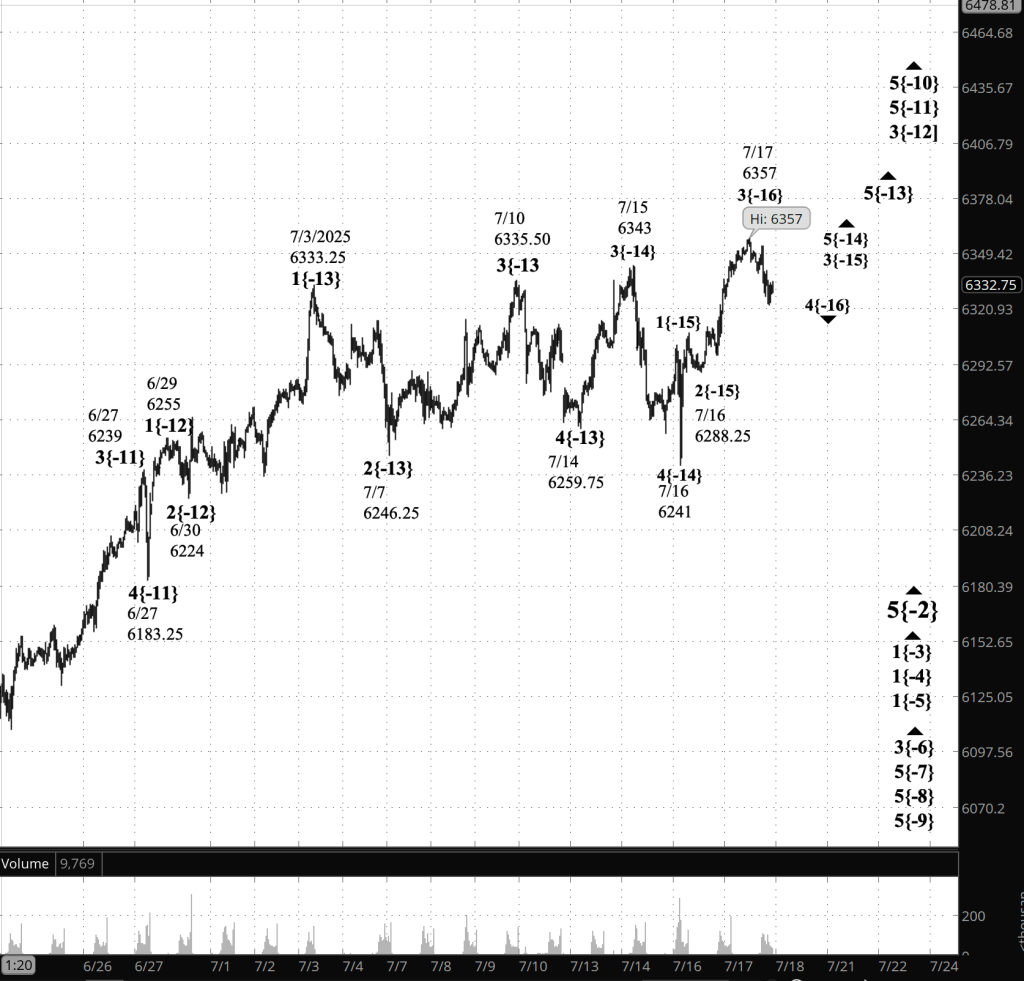
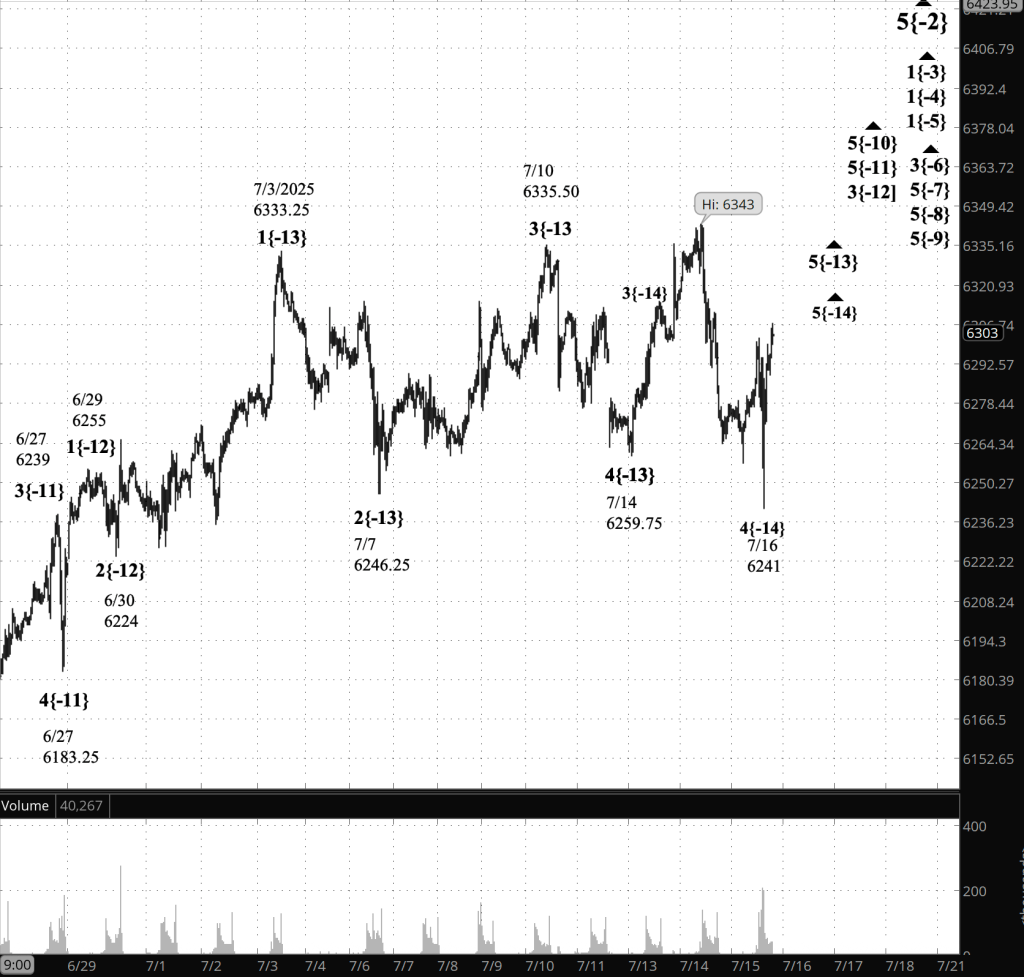
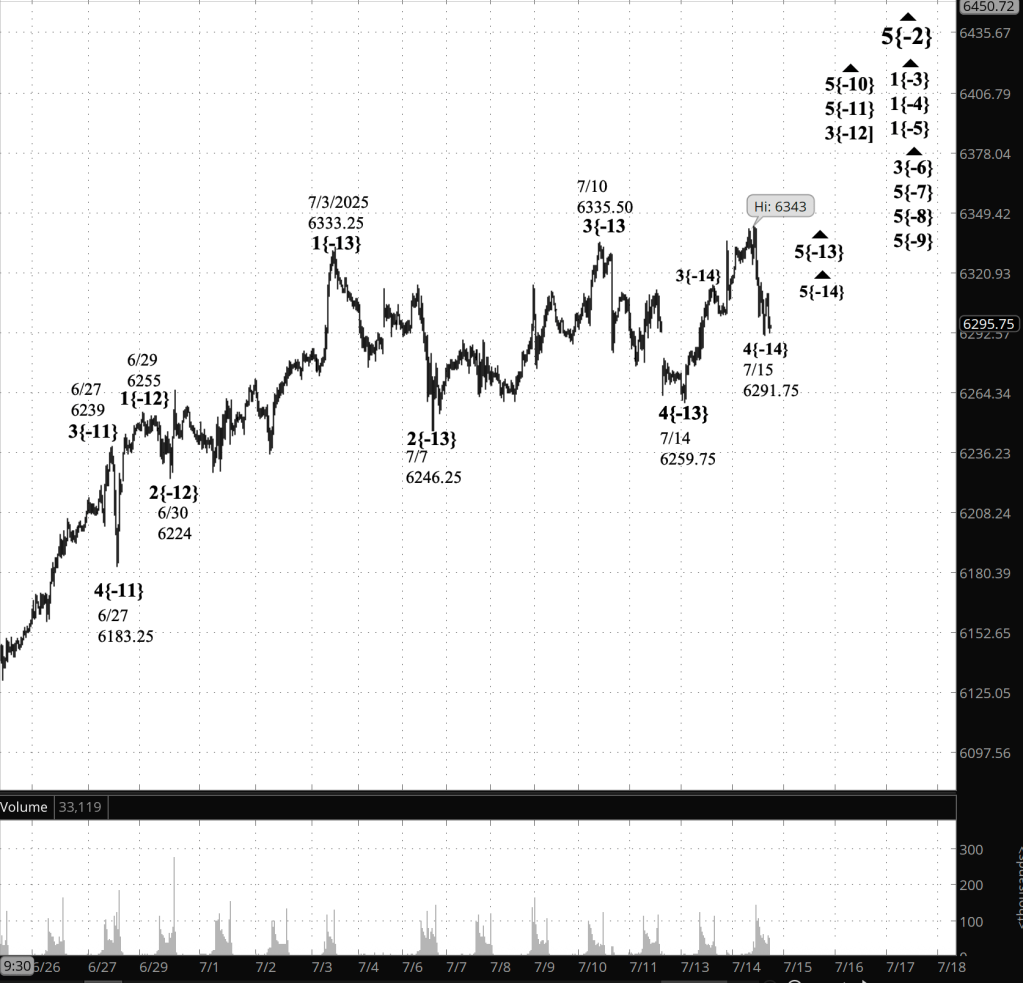
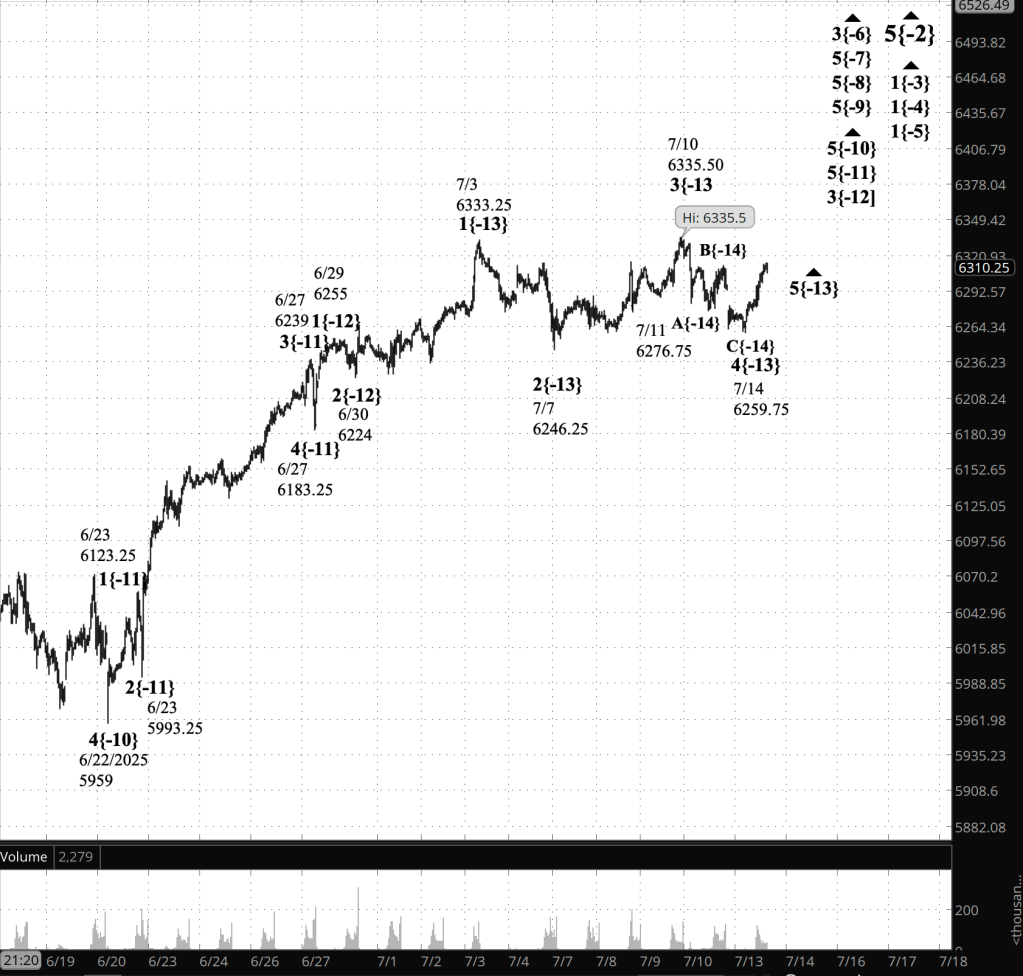
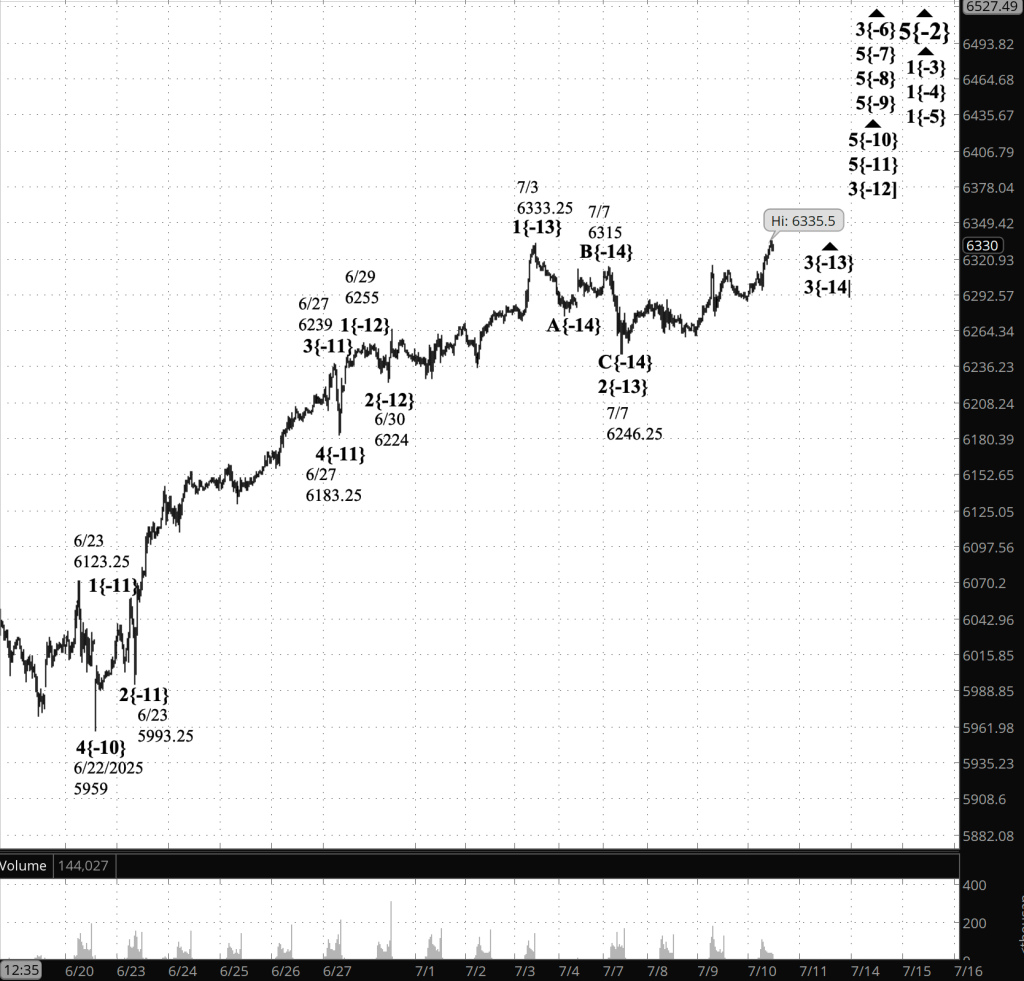
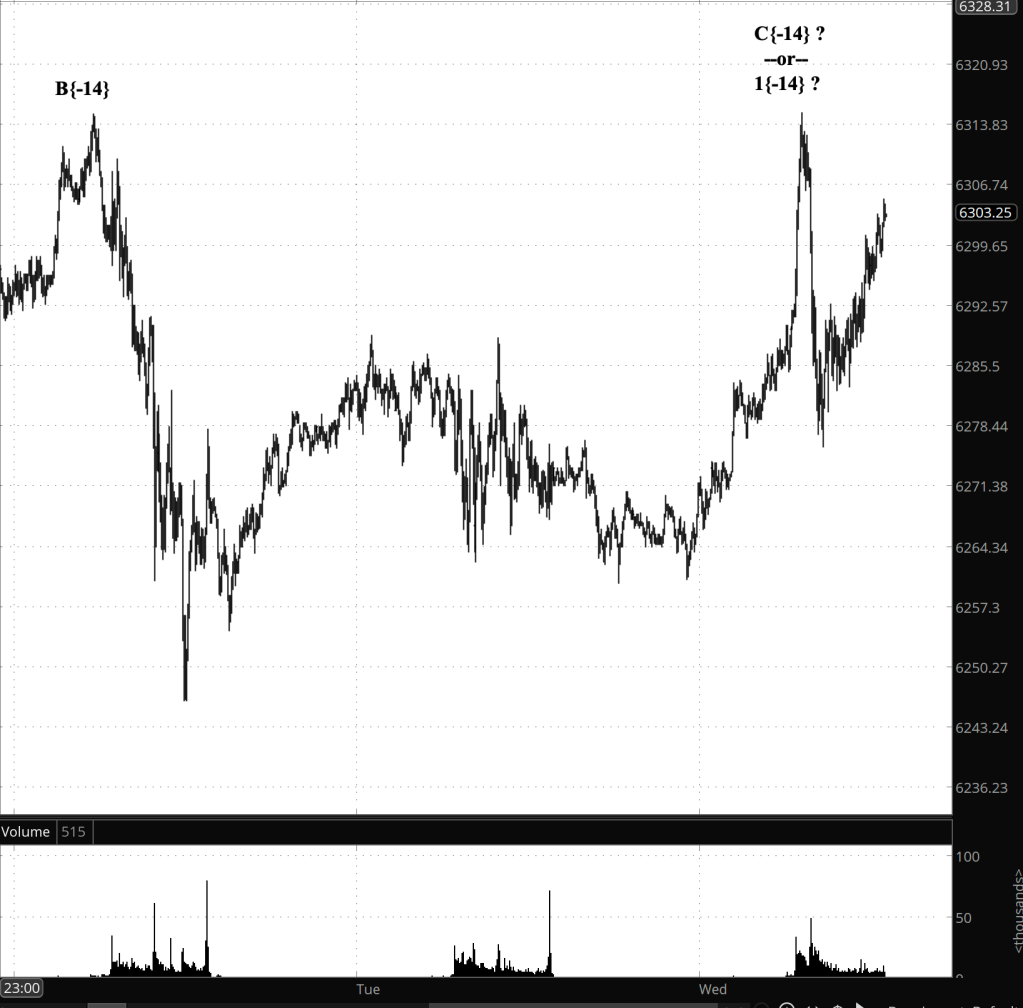
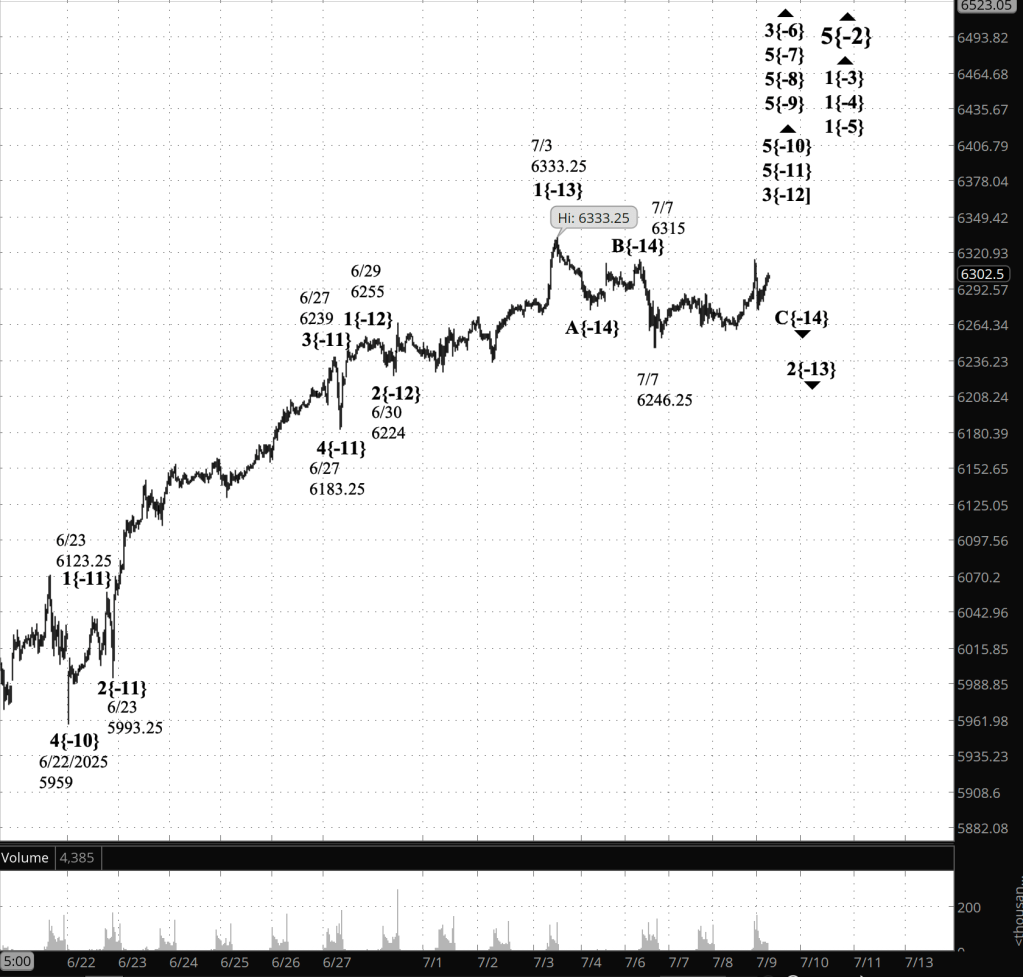
[S&P 500 E-mini futures at 3:30 p..m., 40-minute bars, with volume]

What is the alternative? There are some wave proportion and overlaps that require a closer look; I’ll be working on them today.

What does Elliott Wave Theory say? Here are the waves that underlie the morning’s analyses as they appeared on the chart.

Principal Analysis [Updated for the afternoon post.]

  • Falling wave 4{-9} is underway and internally is in wave C{-10}.

Long-term Waves. [Updated for the afternoon post.]

These are the waves currently in progress under my principal analysis. Each line on the list shows the wave number, with the subscript in curly brackets, the traditional degree name, the starting date, the starting price of the S&P 500 E-mini futures, and the direction of the wave.

  • S&P 500 Index:
  • 5{+3} Supercycle, 7/8/1932, 4.40 (up)
  • 5{+2} Cycle, 12/9/1974, 60.96 (up)
  • 5{+1} Primary, 3/6/2009, 666.79 (up)
  • 5{0} Intermediate, 2/11/2016, 1810.10 (up)
  • 3{-1} Minor, 3/23/2020, 2191.36 (up)
  • 3{-2} Minute, 10/13/2022, 3491.58 (up)
  • S&P 500 Futures
  • 5{-3} Minuette, 4/18/2024, 4963.50 (up)
  • 3{-4} Subminuette, 8/7/2024, 5182 (up)
  • 4{-5} Micro, 12/16/2024, 6163.75 (down)
  • C{-6} Submicro, 2/19/2025, 6166.50 (down)
  • 5{-7} (no name), 3/3/2025, 6000.50 (down)
  • 3{-8} (no name), 3/5/2025, 5869.40 (down)
  • 4{-9} (no name), 3/11/2025, 5534 (up)

Reading the chart. Price movements — waves – – in Elliott Wave Theory analysis are labeled with numbers within trending waves and letters with corrective waves. The subscripts — numbers in curly brackets — designate the wave’s degree, which, in Elliott Wave analysis, means the relative position of a wave within the larger and smaller structures that make up the chart. R.N. Elliott, who in the 1930s developed the form of analysis that bears his name, viewed the chart as a complex structure of smaller waves nested within larger waves, which in turn are nested within still larger waves. In mathematics it’s called a fractal structure, where at every scale the pattern is similar to the others.

Learning and other resources. Elliott Wave analysis provides context, not prophecy. As the 20th century semanticist Alfred Korzybski put it in his book Science and Sanity (1933), “The map is not the territory … The only usefulness of a map depends on similarity of structure between the empirical world and the map.” And I would add, in the ever-changing markets, we can judge that similarity of structure only after the fact.

See the menu page Analytical Methods for a rundown on where to go for information on Elliott Wave analysis.

By Tim Bovee, Portland, Oregon, March 19, 2025

Disclaimer

Tim Bovee, Private Trader tracks the analysis and trades of a private trader for his own accounts. Nothing in this blog constitutes a recommendation to buy or sell stocks, options or any other financial instrument. The only purpose of this blog is to provide education and entertainment.

No trader is ever 100 percent successful in his or her trades. Trading in the stock and option markets is risky and uncertain. Each trader must make trading decisions for his or her own account, and take responsibility for the consequences.

License

All content on Tim Bovee, Private Trader by Timothy K. Bovee is licensed under a Creative Commons Attribution-ShareAlike 4.0 International License.

Based on a work at www.timbovee.com

Trader’s Notebook

3:30 p.m. New York timw

Half an hour before the closing bell. The S&P 500 futures continued to fall during the session, reaching a low of 5650.75. The decline began on March 17 from 5759.75.

Elliott Wave Theory. In this morning’s post I was unwilling to declare the 4th-wave upward correction over. Given the size the decline, I’m convinced the my Principal Analysis has been overtaken by events.

So it’s farewell, rising wave 4, and welcome, declining wave 5. In Elliott Wave terminology, wave 4{-9} has ended and declining wave 5{-9} has begun.

A 5th wave typically will move beyond the end of the preceding 3rd wave, which 5534 reached on March 11. Or it could be 5509.25, reached on March 13 — there’s a possible rule problem with the structure, and I’m working on figuring that out. No all 5th waves moves beyond the preceding 3rd. Some come up short, a condition known as truncation.

When wave 5 is complete, it will also be the end of its parent C wave (C{-8}), which began on February 19 from 6166.40,and its grandparent 3rd wave (3{-7}).

9:35 a.m. New York time

What’s happening now? The S&P 500 E-mini futures fell overnight, from the 5730s to slight above 5700.

What does it mean? Elliott Wave Theory, when applied to the chart, sees two possibiities: Either the present rising wave 5 ended at yesterday’s peak, 5759.75, or the decline now underway is a subwave within wave 5.

The decline is in its 3rd and possibly final subwave. If the price switches up with further well-defined waves, then it was a correction within wave 5. If it traces a 4th and 5th wave, then wave 5 ended at the March 17 peak.

For now, my principal analysis will stay with the wave-5-continues scenario.

The drama now unfolding is wave C, a subwave of a 4th-wave upward correction that began on March 13. That correction, in turn, is part of two declining 3rd waves, a smaller one nested with a larger one.

The whole structure is within a declining C wave that began on February 19, 2025. It’s parent wave is a declining 4th wave that began on December 16, 2024.

The end of wave C will also be theend of the 4th-wave correction.

[S&P 500 E-mini futures at 3:30 p..m., 40-minute bars, with volume]

What is the alternative? There are some wave proportion and overlaps that require a closer look; I’ll be working on them today.

What does Elliott Wave Theory say? Here are the waves that underlie the morning’s analyses as they appeared on the chart.

Principal Analysis

  • Rising wave 4{-9} is underway and internally is in wave C{-10}.
  • Wave C{-10} is in wave 5{-11}, the final subwave.
  • It’s possible but not yet certain that wave 5{-11} ended on March 18.
  • If it did, wave {-10} and wave 4{-9} also ended

Long-term Waves.

These are the waves currently in progress under my principal analysis. Each line on the list shows the wave number, with the subscript in curly brackets, the traditional degree name, the starting date, the starting price of the S&P 500 E-mini futures, and the direction of the wave.

  • S&P 500 Index:
  • 5{+3} Supercycle, 7/8/1932, 4.40 (up)
  • 5{+2} Cycle, 12/9/1974, 60.96 (up)
  • 5{+1} Primary, 3/6/2009, 666.79 (up)
  • 5{0} Intermediate, 2/11/2016, 1810.10 (up)
  • 3{-1} Minor, 3/23/2020, 2191.36 (up)
  • 3{-2} Minute, 10/13/2022, 3491.58 (up)
  • S&P 500 Futures
  • 5{-3} Minuette, 4/18/2024, 4963.50 (up)
  • 3{-4} Subminuette, 8/7/2024, 5182 (up)
  • 4{-5} Micro, 12/16/2024, 6163.75 (down)
  • C{-6} Submicro, 2/19/2025, 6166.50 (down)
  • 5{-7} (no name), 3/3/2025, 6000.50 (down)
  • 3{-8} (no name), 3/5/2025, 5869.40 (down)
  • 4{-9} (no name), 3/11/2025, 5534 (up)

Reading the chart. Price movements — waves – – in Elliott Wave Theory analysis are labeled with numbers within trending waves and letters with corrective waves. The subscripts — numbers in curly brackets — designate the wave’s degree, which, in Elliott Wave analysis, means the relative position of a wave within the larger and smaller structures that make up the chart. R.N. Elliott, who in the 1930s developed the form of analysis that bears his name, viewed the chart as a complex structure of smaller waves nested within larger waves, which in turn are nested within still larger waves. In mathematics it’s called a fractal structure, where at every scale the pattern is similar to the others.

Learning and other resources. Elliott Wave analysis provides context, not prophecy. As the 20th century semanticist Alfred Korzybski put it in his book Science and Sanity (1933), “The map is not the territory … The only usefulness of a map depends on similarity of structure between the empirical world and the map.” And I would add, in the ever-changing markets, we can judge that similarity of structure only after the fact.

See the menu page Analytical Methods for a rundown on where to go for information on Elliott Wave analysis.

By Tim Bovee, Portland, Oregon, March 18, 2025

Disclaimer

Tim Bovee, Private Trader tracks the analysis and trades of a private trader for his own accounts. Nothing in this blog constitutes a recommendation to buy or sell stocks, options or any other financial instrument. The only purpose of this blog is to provide education and entertainment.

No trader is ever 100 percent successful in his or her trades. Trading in the stock and option markets is risky and uncertain. Each trader must make trading decisions for his or her own account, and take responsibility for the consequences.

License

All content on Tim Bovee, Private Trader by Timothy K. Bovee is licensed under a Creative Commons Attribution-ShareAlike 4.0 International License.

Based on a work at www.timbovee.com

Trader’s Notebook

3:30 p.m. New York time

Half an hour before the closing bell. The S&P 500 futures continued to rise during the session, reaching the 5760 region.

Elliott Wave Theory: For this part I’ll use the wave labels as they appear on the chart: A wave number followed by a subscript in curly brackets locating the wave within the fractal structure of the chart. The subscript shows the number of degrees the wave is from Intermediate degree.

Corrective wave 4{-9} and its subwave, C{-10}, continue to rise. I’ve made a change to my understanding of the 4th wave’s internal structure. I had labeled the March 16 turning point, from 5683.75, as the end of wave 3{-12}, a subwave of wave 3{-11}, the middle subwave of wave C{-10}.

Given the pace of the rise, it seems increasingly likely that 5683.75 marks the end wave 3{-11}, and wave 5{-11} is currently underway.

When wave 5{-11} ends, it will also be the end of the parent wave C{-10} and the grandparent wave 4{-9}. A downtrending impulse movement, wave 5{-9}, will commence, carrying the price down for a significant distance.

Hang on! It might be a bumpy ride.

9:35 a.m. New York time

What’s happening now? The S&P 500 E-mini futures rose after trading resumed overnight, from a low point of 5651.50 to above 5700, picking up the pace after the 8:30 a.m. New York time release of the U.S. Retail Sales report.

What does it mean? Elliott Wave Theory analysis shows that the 4th-wave upward correction continues and is in its 3rd subwave, wave C. Internally, things get a bit more complex. Rather than a standard three-wave correction — a Zigzag or a Flat — it could be one of the rarer variants, such as an Extended Flat or a Triangle.

[S&P 500 E-mini futures at 3:30 p.m., 40-minute bars, with volume]

What is the alternative? There are some wave proportion and overlaps that require a closer look; I’ll be working on them today.

What does Elliott Wave Theory say? Here are the waves that underlie the morning’s analyses as they appeared on the chart.

Principal Analysis

  • Rising wave 4{-9} is underway and internally is in wave C{-10}.
  • Wave C{-10} is in wave 3{-11}, the middle subwave.
  • Wave 3{-11} appears to be in its final subwave, wave 5{-12}.

Long-term Waves.

These are the waves currently in progress under my principal analysis. Each line on the list shows the wave number, with the subscript in curly brackets, the traditional degree name, the starting date, the starting price of the S&P 500 E-mini futures, and the direction of the wave.

  • S&P 500 Index:
  • 5{+3} Supercycle, 7/8/1932, 4.40 (up)
  • 5{+2} Cycle, 12/9/1974, 60.96 (up)
  • 5{+1} Primary, 3/6/2009, 666.79 (up)
  • 5{0} Intermediate, 2/11/2016, 1810.10 (up)
  • 3{-1} Minor, 3/23/2020, 2191.36 (up)
  • 3{-2} Minute, 10/13/2022, 3491.58 (up)
  • S&P 500 Futures
  • 5{-3} Minuette, 4/18/2024, 4963.50 (up)
  • 3{-4} Subminuette, 8/7/2024, 5182 (up)
  • 4{-5} Micro, 12/16/2025, 6163.75 (down)
  • C{-6} Submicro, 2/19/2025, 6166.50 (down)
  • 5{-7} (no name), 3/3/2025, 6000.50 (down)
  • 3{-8} (no name), 3/5/2025, 5869.40 (down)
  • 4{-9} (no name), 3/11/2025, 5534 (up)

Reading the chart. Price movements — waves – – in Elliott Wave Theory analysis are labeled with numbers within trending waves and letters with corrective waves. The subscripts — numbers in curly brackets — designate the wave’s degree, which, in Elliott Wave analysis, means the relative position of a wave within the larger and smaller structures that make up the chart. R.N. Elliott, who in the 1930s developed the form of analysis that bears his name, viewed the chart as a complex structure of smaller waves nested within larger waves, which in turn are nested within still larger waves. In mathematics it’s called a fractal structure, where at every scale the pattern is similar to the others.

Learning and other resources. Elliott Wave analysis provides context, not prophecy. As the 20th century semanticist Alfred Korzybski put it in his book Science and Sanity (1933), “The map is not the territory … The only usefulness of a map depends on similarity of structure between the empirical world and the map.” And I would add, in the ever-changing markets, we can judge that similarity of structure only after the fact.

See the menu page Analytical Methods for a rundown on where to go for information on Elliott Wave analysis.

By Tim Bovee, Portland, Oregon, March 17, 2025

Disclaimer

Tim Bovee, Private Trader tracks the analysis and trades of a private trader for his own accounts. Nothing in this blog constitutes a recommendation to buy or sell stocks, options or any other financial instrument. The only purpose of this blog is to provide education and entertainment.

No trader is ever 100 percent successful in his or her trades. Trading in the stock and option markets is risky and uncertain. Each trader must make trading decisions for his or her own account, and take responsibility for the consequences.

License

All content on Tim Bovee, Private Trader by Timothy K. Bovee is licensed under a Creative Commons Attribution-ShareAlike 4.0 International License.

Based on a work at www.timbovee.com

Trader’s Notebook

3:30 p.m. New York time

Half an hour before the closing bell. The S&P500 futures reached a high during the session of 5639 and the dropped back slightly.

Elliott Wave Theory. Wave B{-10} on the chart ended on March 13 at 5509.25. Wave C{-10} is underway.

Today’s slight pullback from the session peak is a subwave within wave C, part of a 4th-wave upward correction that began on March 11. The correction appears to be taking the form of an expanded Flat, with each wave having five subwaves.

In my analysis I count wave C as being in its 3rd subwave. The pause during the session may mark the end of the C wave, or maybe not. Impossible to know for sure at this point. In either case, my analysis suggests that there’s still some upside left in wave C.

9:35 a.m. New York time

What’s happening now? The S&P 500 E-mini futures rose overnight, from the 5538.75 just after the closing bell to the 5580s, so far, as the opening bell drew near.

What does it mean? In Elliott Wave Theory, the decline that began on February 19 from 6166.50 is a declining C wave within a 4th-wave downward correction that began on December 16, 2024 from 6163.75.

The low point of the C-wave decline, which is not yet complete, occurred yesterday, March 13, at 5509.25. It is the end of the first subwave within a wave A, the rising first subwave within the 4th-wave upward correction that began on March 11. The falling 2nd subwave is now underway, and it will be followed by a rising 3rd subwave, ending the larger 4th subwave, which is labeled wave 4{-9} on the chart. A declining 5th subwave will follow, bringing the price still lower and the parent 3rd wave to an end.

[S&P 500 E-mini futures at 3:30 p.m., 35-minute bars, with volume]

What is the alternative? None at present.

What does Elliott Wave Theory say? Here are the waves that underlie the morning’s analyses as they appeared on the chart.

Principal Analysis

  • Falling wave C{-6} within falling wave 4{-5} continues.
  • Falling wave 5{-7} is underway.
  • When wave 5{-7} ends, it will also be the end of waves C{-6} and 4{-5}.
  • Rising wave 5{-5} will begin, likely carrying the price to new heights.

Long-term Waves.

These are the waves currently in progress under my principal analysis. Each line on the list shows the wave number, with the subscript in curly brackets, the traditional degree name, the starting date, the starting price of the S&P 500 E-mini futures, and the direction of the wave.

  • S&P 500 Index:
  • 5{+3} Supercycle, 7/8/1932, 4.40 (up)
  • 5{+2} Cycle, 12/9/1974, 60.96 (up)
  • 5{+1} Primary, 3/6/2009, 666.79 (up)
  • 5{0} Intermediate, 2/11/2016, 1810.10 (up)
  • 3{-1} Minor, 3/23/2020, 2191.36 (up)
  • 3{-2} Minute, 10/13/2022, 3491.58 (up)
  • S&P 500 Futures
  • 5{-3} Minuette, 4/18/2024, 4963.50 (up)
  • 3{-4} Subminuette, 8/7/2024, 5182 (up)
  • 4{-5} Micro, 12/16/2025, 6163.75 (down)
  • C{-6} Submicro, 2/19/2025, 6166.50 (down)
  • 5{-7} (no name), 3/3/2025, 6000.50 (down)
  • 3{-8} (no name), 3/5/2025, 5869.40 (down)

Reading the chart. Price movements — waves – – in Elliott Wave Theory analysis are labeled with numbers within trending waves and letters with corrective waves. The subscripts — numbers in curly brackets — designate the wave’s degree, which, in Elliott Wave analysis, means the relative position of a wave within the larger and smaller structures that make up the chart. R.N. Elliott, who in the 1930s developed the form of analysis that bears his name, viewed the chart as a complex structure of smaller waves nested within larger waves, which in turn are nested within still larger waves. In mathematics it’s called a fractal structure, where at every scale the pattern is similar to the others.

Learning and other resources. Elliott Wave analysis provides context, not prophecy. As the 20th century semanticist Alfred Korzybski put it in his book Science and Sanity (1933), “The map is not the territory … The only usefulness of a map depends on similarity of structure between the empirical world and the map.” And I would add, in the ever-changing markets, we can judge that similarity of structure only after the fact.

See the menu page Analytical Methods for a rundown on where to go for information on Elliott Wave analysis.

By Tim Bovee, Portland, Oregon, March 14, 2025

Disclaimer

Tim Bovee, Private Trader tracks the analysis and trades of a private trader for his own accounts. Nothing in this blog constitutes a recommendation to buy or sell stocks, options or any other financial instrument. The only purpose of this blog is to provide education and entertainment.

No trader is ever 100 percent successful in his or her trades. Trading in the stock and option markets is risky and uncertain. Each trader must make trading decisions for his or her own account, and take responsibility for the consequences.

License

All content on Tim Bovee, Private Trader by Timothy K. Bovee is licensed under a Creative Commons Attribution-ShareAlike 4.0 International License.

Based on a work at www.timbovee.com

Trader’s Notebook

3:30 p.m. New York time

Half an hour before the closing bell. The S&P 500 E-mini futures bounced off of its session low, 5509.25, so far coming close to 5560.

Elliott Wave Theory: A 4th wave upward correction began on March 11 from 5534. The first subwave, wave A, ended on March 12, and the declining second subwave, wave B, is nearing its end.

In terms of the chart labeling, where a wave number is followed by a number in curly brackets showing the wave’s position in the fractal structure relative to Intermediate degree, here’s the line-up.

Within rising wave 4{-9}, declining wave B{-10} is underway, and is in its final subwave, wave C{-11}, which in turn is in its final subwave, declining wave 5{-12}, which is in its next-to-the-last subwave, rising wave 4{-13}.

What’s next? Wave 5{-13} will follow, and when it is complete, it will also be the end of three larger waves, wave 5{-12}, wave C{-11} and wave B{-10}.

Rising wave C{-10} will follow and is likely to reach somewhere between 5630 and 5650, based on Fibonacci extensions, although it could go higher, perhaps even reaching 5700. As always with Elliott Wave Theory, time will tell.

I’m leaving this morning’s big-picture chart as it was this morning and here is this afternoon’s chart, a four-day closeup:

[S&P 500 E-mini futures at 3:30 p.m., 35-minute bars, with volume]

9:43 a.m. New York time

What’s happening now? The S&P 500 E-mini futures see-sawed between the 5650s and the 5530s overnight, shooting up once to 5675 at 5:30 a.m., upon the release of the Producer Price Index. The price quickly retreated.

What does it mean? In this discussion I’ll refer the waves in the form used on the chart: wave number plus location in the fractal structure. See the “Readng the chart” section below.

Through the lens of Elliott Wave theory, the pattern can be seen as two subwaves, waves A{-10} and B{-10}, within a 4th-wave rising correction. Wave 3{-9}, the decline that began on March 7, ended on March 11 at 5534.

Rising wave C{-10} will follow, completing the correction.

[S&P 500 E-mini futures at 9:37 a.m., 35-minute bars, with volume]

What is the alternative? If the price reverses and moves below 5534, my analysis will show wave 3{-9} still underway, and the upward correction will be demoted to a subwave of wave 3{-9}.

What does Elliott Wave Theory say? Here are the waves that underlie the morning’s analyses as they appeared on the chart.

Principal Analysis

  • Falling wave C{-6} within falling wave 4{-5} continues.
  • Falling wave 5{-7} is underway.
  • When wave 5{-7} ends, it will also be the end of waves C{-6} and 4{-5}.
  • Rising wave 5{-5} will begin, likely carrying the price to new heights.

Long-term Waves.

These are the waves currently in progress under my principal analysis. Each line on the list shows the wave number, with the subscript in curly brackets, the traditional degree name, the starting date, the starting price of the S&P 500 E-mini futures, and the direction of the wave.

  • S&P 500 Index:
  • 5{+3} Supercycle, 7/8/1932, 4.40 (up)
  • 5{+2} Cycle, 12/9/1974, 60.96 (up)
  • 5{+1} Primary, 3/6/2009, 666.79 (up)
  • 5{0} Intermediate, 2/11/2016, 1810.10 (up)
  • 3{-1} Minor, 3/23/2020, 2191.36 (up)
  • 3{-2} Minute, 10/13/2022, 3491.58 (up)
  • S&P 500 Futures
  • 5{-3} Minuette, 4/18/2024, 4963.50 (up)
  • 3{-4} Subminuette, 8/7/2024, 5182 (up)
  • 4{-5} Micro, 12/16/2025, 6163.75 (down)
  • C{-6} Submicro, 2/19/2025, 6166.50 (down)
  • 5{-7} (no name), 3/3/2025, 6000.50 (down)
  • 3{-8} (no name), 3/5/2025, 5869.40 (down)

Reading the chart. Price movements — waves – – in Elliott Wave Theory analysis are labeled with numbers within trending waves and letters with corrective waves. The subscripts — numbers in curly brackets — designate the wave’s degree, which, in Elliott Wave analysis, means the relative position of a wave within the larger and smaller structures that make up the chart. R.N. Elliott, who in the 1930s developed the form of analysis that bears his name, viewed the chart as a complex structure of smaller waves nested within larger waves, which in turn are nested within still larger waves. In mathematics it’s called a fractal structure, where at every scale the pattern is similar to the others.

Learning and other resources. Elliott Wave analysis provides context, not prophecy. As the 20th century semanticist Alfred Korzybski put it in his book Science and Sanity (1933), “The map is not the territory … The only usefulness of a map depends on similarity of structure between the empirical world and the map.” And I would add, in the ever-changing markets, we can judge that similarity of structure only after the fact.

See the menu page Analytical Methods for a rundown on where to go for information on Elliott Wave analysis.

By Tim Bovee, Portland, Oregon, March 13, 2025

Disclaimer

Tim Bovee, Private Trader tracks the analysis and trades of a private trader for his own accounts. Nothing in this blog constitutes a recommendation to buy or sell stocks, options or any other financial instrument. The only purpose of this blog is to provide education and entertainment.

No trader is ever 100 percent successful in his or her trades. Trading in the stock and option markets is risky and uncertain. Each trader must make trading decisions for his or her own account, and take responsibility for the consequences.

License

All content on Tim Bovee, Private Trader by Timothy K. Bovee is licensed under a Creative Commons Attribution-ShareAlike 4.0 International License.

Based on a work at www.timbovee.com

Trader’s Notebook

3:30 p.m. New York time

Half an hour before the closing bell. The S&P 500 futures declined during the session into the 5550s and then rose into the 5620s as the closing bell approached:

Elliott Wave Theory: The upward correction that began on March 11 continues. The ambiguity regarding its degree is unresolved.

9:35 a.m. New York time

What’s happening now? The S&P 500 E-mini futures rose overnight, reach 5675, the peak of the whipsaw that followed the release the Consumer Price Index.

What does it mean? As I mentioned yesterday, the chart is filled with ambiguities, not uncommon in a hot market. I’ve moved the chart closer in to focus on the present C-wave downtrend that began on February 19.

In discussing the revisions, I’ll use the labeling system used on the chart. Each wave has a number, followed by a subscript in curly brackets that indicates the waves position in the fractal structure of the waves. Specifically, the bracketed number is how many degrees distance the wave is from Intermediate degree.

Under the revision, wave C{-6}, which began on February 19, is still underway, as is wave 3{-7}, which began on March 3.

Wave 3{-8} continues, or perhaps is complete. There’s no certain way to tell. We do know that it has been in its 3rd subwave, wave 3{-9}. Is the March 11 low the end of 3{-9} and the beginning of wave 4{-9}? Or is the overnight rise a subwave of wave 3{-9}. Time will tell.

For the present, I will retain the wave 3{-9} continues scenario for my Principal Analysis and the wave 4{-9} has begun scenario as an alternative.

[S&P 500 E-mini futures at 3:30 p.m., 35-minute bars, with volume]

What is the alternative? Discussed above in the “What does it mean?” section.

What does Elliott Wave Theory say? Here are the waves that underlie the morning’s analyses as they appeared on the chart.

Principal Analysis

  • Falling wave C{-6} within falling wave 4{-5} continues.
  • Falling wave 5{-7} is underway.
  • When wave 5{-7} ends, it will also be the end of waves C{-6} and 4{-5}.
  • Rising wave 5{-5} will begin, likely carrying the price to new heights.

Long-term Waves.

These are the waves currently in progress under my principal analysis. Each line on the list shows the wave number, with the subscript in curly brackets, the traditional degree name, the starting date, the starting price of the S&P 500 E-mini futures, and the direction of the wave.

  • S&P 500 Index:
  • 5{+3} Supercycle, 7/8/1932, 4.40 (up)
  • 5{+2} Cycle, 12/9/1974, 60.96 (up)
  • 5{+1} Primary, 3/6/2009, 666.79 (up)
  • 5{0} Intermediate, 2/11/2016, 1810.10 (up)
  • 3{-1} Minor, 3/23/2020, 2191.36 (up)
  • 3{-2} Minute, 10/13/2022, 3491.58 (up)
  • S&P 500 Futures
  • 5{-3} Minuette, 4/18/2024, 4963.50 (up)
  • 3{-4} Subminuette, 8/7/2024, 5182 (up)
  • 4{-5} Micro, 12/16/2025, 6163.75 (down)
  • C{-6} Submicro, 2/19/2025, 6166.50 (down)
  • 5{-7} (no name), 3/3/2025, 6000.50 (down)
  • 3{-8} (no name), 3/5/2025, 5869.40 (down)

Reading the chart. Price movements — waves – – in Elliott Wave Theory analysis are labeled with numbers within trending waves and letters with corrective waves. The subscripts — numbers in curly brackets — designate the wave’s degree, which, in Elliott Wave analysis, means the relative position of a wave within the larger and smaller structures that make up the chart. R.N. Elliott, who in the 1930s developed the form of analysis that bears his name, viewed the chart as a complex structure of smaller waves nested within larger waves, which in turn are nested within still larger waves. In mathematics it’s called a fractal structure, where at every scale the pattern is similar to the others.

Learning and other resources. Elliott Wave analysis provides context, not prophecy. As the 20th century semanticist Alfred Korzybski put it in his book Science and Sanity (1933), “The map is not the territory … The only usefulness of a map depends on similarity of structure between the empirical world and the map.” And I would add, in the ever-changing markets, we can judge that similarity of structure only after the fact.

See the menu page Analytical Methods for a rundown on where to go for information on Elliott Wave analysis.

By Tim Bovee, Portland, Oregon, March 12, 2025

Disclaimer

Tim Bovee, Private Trader tracks the analysis and trades of a private trader for his own accounts. Nothing in this blog constitutes a recommendation to buy or sell stocks, options or any other financial instrument. The only purpose of this blog is to provide education and entertainment.

No trader is ever 100 percent successful in his or her trades. Trading in the stock and option markets is risky and uncertain. Each trader must make trading decisions for his or her own account, and take responsibility for the consequences.

License

All content on Tim Bovee, Private Trader by Timothy K. Bovee is licensed under a Creative Commons Attribution-ShareAlike 4.0 International License.

Based on a work at www.timbovee.com

Trader’s Notebook

3:30 p.m. New York time

Half an hour before the closing bell. The S&P 500 futures reached a low of 5534 during the session and then reversed sharply, heading back to the 5640s, slightly below the overnight high.

Elliott Wave Theory: It’s possible that the low was the end of the 3rd wave that began on March 5, the middle wave of a declining 5th wave that began on March 3. If it plays out that way, then we can expect a 4th-wave upward correction (to be labeled wave 4{-7} on the chart).

It’s also possible that the 3rd wave I’m discussing is actually one degree lower (it would be labeled wave 3{-9} on the chart).

At this point, I’m staying with labels I had this morning, waiting for the chart to gain some clarity.

9:35 a.m. New York time

What’s happening now? The S&P 500 E-mini futures reached a low of 5558 overnight, shortly after the closing bell, then rose into the 5650s.

What does it mean? The major question facing Elliott Wave Theory as the session begins is how close is wave 5 to completion. The answer, I think, is that it’s not yet nearing its end. Wave 5, which began on March 3, is in its middle range, the 3rd wave.

Each wave on the chart has a wave number followed by a subscript in curly backets showing the waves position in the fractal structure of the chart; in this case, its distance in degrees from Intermediate degree.

On the chart, the 5th wave is wave 5{-7} and its subwave in progress is wave 3{-8}. Both are subwaves of wave C{-6}, the downward corrective wave that kicked off the ongoing dramatic decline on February 19, from 6166.50.

Wave C{-6}, in turn, is a subwave of wave 4{-5}, a downward correction that began on December 16, 2024, from 6163.75.

Bottom line, if the futures pla out as the waves suggest, is that we have more downside. But when the future falling wave 5{-8} is complete, that endpoint will cascade up the fractal stucture, marking the end of waves 5{-7}, C{-6} and 4{-5}.

An uptrending 5th wave will then begin, wave 5{-5}, that will almost certainly carry the price back into the 6160s, and perhaps significantly higher than that level if the wave turns to be an extended 5th, or if it is a truncated 5th, it may come up short.

[S&P 500 E-mini futures at 3:30 p.m., 135-minute bars, with volume]

What is the alternative?  I’ve found the decline that began on February 19 form 6166.50 to be particularly difficult to puzzle out. For example, I can also imagine wave 3{-7} still being underway, with wave 4 not yet begun. There are some ambiguities still.

What does Elliott Wave Theory say? Here are the waves that underlie the morning’s analyses as they appeared on the chart.

Principal Analysis

  • Falling wave C{-6} within falling wave 4{-5} continues.
  • Falling wave 5{-7} is underway.
  • When wave 5{-7} ends, it will also be the end of waves C{-6} and 4{-5}.
  • Rising wave 5{-5} will begin, likely carrying the price to new heights.

Long-term Waves.

These are the waves currently in progress under my principal analysis. Each line on the list shows the wave number, with the subscript in curly brackets, the traditional degree name, the starting date, the starting price of the S&P 500 E-mini futures, and the direction of the wave.

  • S&P 500 Index:
  • 5{+3} Supercycle, 7/8/1932, 4.40 (up)
  • 5{+2} Cycle, 12/9/1974, 60.96 (up)
  • 5{+1} Primary, 3/6/2009, 666.79 (up)
  • 5{0} Intermediate, 2/11/2016, 1810.10 (up)
  • 3{-1} Minor, 3/23/2020, 2191.36 (up)
  • 3{-2} Minute, 10/13/2022, 3491.58 (up)
  • S&P 500 Futures
  • 5{-3} Minuette, 4/18/2024, 4963.50 (up)
  • 3{-4} Subminuette, 8/7/2024, 5182 (up)
  • 4{-5} Micro, 12/16/2025, 6163.75 (down)
  • C{-6} Submicro, 2/19/2025, 6166.50 (down)
  • 5{-7} (no name), 3/3/2025, 6000.50 (down)
  • 3{-8} (no name), 3/5/2025, 5869.40 (down)

Reading the chart. Price movements — waves – – in Elliott Wave Theory analysis are labeled with numbers within trending waves and letters with corrective waves. The subscripts — numbers in curly brackets — designate the wave’s degree, which, in Elliott Wave analysis, means the relative position of a wave within the larger and smaller structures that make up the chart. R.N. Elliott, who in the 1930s developed the form of analysis that bears his name, viewed the chart as a complex structure of smaller waves nested within larger waves, which in turn are nested within still larger waves. In mathematics it’s called a fractal structure, where at every scale the pattern is similar to the others.

Learning and other resources. Elliott Wave analysis provides context, not prophecy. As the 20th century semanticist Alfred Korzybski put it in his book Science and Sanity (1933), “The map is not the territory … The only usefulness of a map depends on similarity of structure between the empirical world and the map.” And I would add, in the ever-changing markets, we can judge that similarity of structure only after the fact.

See the menu page Analytical Methods for a rundown on where to go for information on Elliott Wave analysis.

By Tim Bovee, Portland, Oregon, March 11, 2025

Disclaimer

Tim Bovee, Private Trader tracks the analysis and trades of a private trader for his own accounts. Nothing in this blog constitutes a recommendation to buy or sell stocks, options or any other financial instrument. The only purpose of this blog is to provide education and entertainment.

No trader is ever 100 percent successful in his or her trades. Trading in the stock and option markets is risky and uncertain. Each trader must make trading decisions for his or her own account, and take responsibility for the consequences.

License

All content on Tim Bovee, Private Trader by Timothy K. Bovee is licensed under a Creative Commons Attribution-ShareAlike 4.0 International License.

Based on a work at www.timbovee.com

Trader’s Notebook

3:30 p.m. New York time

Half an hour before the closing bell. The S&P 500 futures fell during the session, reaching into the 5570s. Applying Elliott Wave Theory, the present decline is a C wave that began on February 19 from 6166.50. Altogether, the decline has cut 9.6% from the price.

Internally, wave C is in its final subwave, wave 5. When wave 5 is complete, wave C and the parent wave, a much larger declining 4th wave that began on December 16, 2024 will also be complete.

9:35 a.m. New York time

What’s happening now? The S&P 500 E-mini futures reached a high of 5757.75 after trading resumed overnight, and then fell, reaching the 5680s.

What does it mean? I adjusted the end of wave 3{-7} from March 4 to February 28, providing a more proportional wave 4{-7}, which ended on March 3 at 6000.50. Proportionality is an important tool in Elliott Wave Theory.

[S&P 500 E-mini futures at 3:30 p.m., 2-hour bars, with volume]

What is the alternative?  I’ve found the decline that began on February 19 form 6166.50 to be particularly difficult to puzzle out. In place of the wave 3 and 4 changes I made today, I can also imagine wave 3 still being underway, with wave 4 not yet begun. There are some ambiguities still.

What does Elliott Wave Theory say? Here are the waves that underlie the morning’s analyses as they appeared on the chart.

Principal Analysis

  • Falling wave C{-6} within falling wave 4{-5} continues.
  • Falling wave 5{-7} is underway.
  • When wave 5{-7} ends, it will also be the end of waves C{-6} and 4{-5}.
  • Rising wave 5{-5} will begin, likely carrying the price to new heights.

Long-term Waves.

These are the waves currently in progress under my principal analysis. Each line on the list shows the wave number, with the subscript in curly brackets, the traditional degree name, the starting date, the starting price of the S&P 500 E-mini futures, and the direction of the wave.

  • S&P 500 Index:
  • 5{+3} Supercycle, 7/8/1932, 4.40 (up)
  • 5{+2} Cycle, 12/9/1974, 60.96 (up)
  • 5{+1} Primary, 3/6/2009, 666.79 (up)
  • 5{0} Intermediate, 2/11/2016, 1810.10 (up)
  • 3{-1} Minor, 3/23/2020, 2191.36 (up)
  • 3{-2} Minute, 10/13/2022, 3491.58 (up)
  • S&P 500 Futures
  • 5{-3} Minuette, 4/18/2024, 4963.50 (up)
  • 3{-4} Subminuette, 8/7/2024, 5182 (up)
  • 4{-5} Micro, 12/16/2025, 6163.75 (down)
  • C{-6} Submicro, 2/19/2025, 6166.50 (down)
  • 5{-7} (no name), 3/3/2025, 6000.50 (down)

Reading the chart. Price movements — waves – – in Elliott Wave Theory analysis are labeled with numbers within trending waves and letters with corrective waves. The subscripts — numbers in curly brackets — designate the wave’s degree, which, in Elliott Wave analysis, means the relative position of a wave within the larger and smaller structures that make up the chart. R.N. Elliott, who in the 1930s developed the form of analysis that bears his name, viewed the chart as a complex structure of smaller waves nested within larger waves, which in turn are nested within still larger waves. In mathematics it’s called a fractal structure, where at every scale the pattern is similar to the others.

Learning and other resources. Elliott Wave analysis provides context, not prophecy. As the 20th century semanticist Alfred Korzybski put it in his book Science and Sanity (1933), “The map is not the territory … The only usefulness of a map depends on similarity of structure between the empirical world and the map.” And I would add, in the ever-changing markets, we can judge that similarity of structure only after the fact.

See the menu page Analytical Methods for a rundown on where to go for information on Elliott Wave analysis.

By Tim Bovee, Portland, Oregon, March 10, 2025

Disclaimer

Tim Bovee, Private Trader tracks the analysis and trades of a private trader for his own accounts. Nothing in this blog constitutes a recommendation to buy or sell stocks, options or any other financial instrument. The only purpose of this blog is to provide education and entertainment.

No trader is ever 100 percent successful in his or her trades. Trading in the stock and option markets is risky and uncertain. Each trader must make trading decisions for his or her own account, and take responsibility for the consequences.

License

All content on Tim Bovee, Private Trader by Timothy K. Bovee is licensed under a Creative Commons Attribution-ShareAlike 4.0 International License.

Based on a work at www.timbovee.com

Trader’s Notebook

3:15 p.m. New York time

45-minutes before the closing bell. Closing of early today.

The S&P 500 futures rose during the session, reaching into the 5790s. Elliott Wave Theory: The rise is a subwave within the falling 5th wave that began on March 5.

9:35 a.m. New York time

What’s happening now? The S&P 500 E-mini futures fluctuated narrowly from the 5750s to the 5770s in overnight trading, dropping a bit further as the time for a major economic announcement approached. When the employment situation report was released an hour before the opening bell, the futures whipsawed down to the 5730s and up to the 5780s before retreating to the narrow range where it had spent most of the night.

What does it mean? Elliott Wave Theory sees the whipsaw as a subwave one or two degrees down from its parent wave, the downtrending 5th wave that began on March 5 from 5869.50. That 5th wave, in turn, is the final subwave of a falling C wave that began on February 19, from 6166.50.

The parent wave of both is a 4th-wave downward correction that began on December 16, 2024, from 6163.75

That’s a long, detailed way of saying that the futures have had a net downward tilt since mid-December, and that will be with us until the present falling 5th wave comes to an end.

At that point, the end of wave 5 is also the end of wave C and, most likely, the end of wave 4, which encompasses the entire downward tilt that began on December 16, 2024.

I hedged when I said it would “likely” be the end of the 4th wave. Most corrective waves are built from a single corrective pattern, a simple form. But some take a compound form, containing two or three corrective patterns. There’s no way to predict a compound correction. We know it after it is underway.

Simple or compound, the end of wave 4 will be followed by an uptrending 5th wave that will likely return the price to the 6160s and perhaps once higher.

Note the hedge on how high wave 5 might reach. Most 5th waves will move beyond the starting point of the previous 4th wave. But not all. Some 5th waves are truncated, falling short of the 4th-wave’s endpoint. And some will move further, beyond a level that seems reasonable — an extended 5th wave.

[S&P 500 E-mini futures at 3:15 p.m., 2-hour bars, with volume]

What is the alternative?  The hedges in the previous section layout the alternatives to come. At present, I see no ambiguities.

What does Elliott Wave Theory say? Here are the waves that underlie the morning’s analyses as they appeared on the chart.

Principal Analysis

  • Falling wave C{-6} within falling wave 4{-5} continues.
  • Falling wave 5{-7} is underway.
  • When wave 5{-7} ends, it will also be the end of waves C{-6} and 4{-5}.
  • Rising wave 5{-5} will begin, likely carrying the price to new heights.

Long-term Waves.

These are the waves currently in progress under my principal analysis. Each line on the list shows the wave number, with the subscript in curly brackets, the traditional degree name, the starting date, the starting price of the S&P 500 E-mini futures, and the direction of the wave.

  • S&P 500 Index:
  • 5{+3} Supercycle, 7/8/1932, 4.40 (up)
  • 5{+2} Cycle, 12/9/1974, 60.96 (up)
  • 5{+1} Primary, 3/6/2009, 666.79 (up)
  • 5{0} Intermediate, 2/11/2016, 1810.10 (up)
  • 3{-1} Minor, 3/23/2020, 2191.36 (up)
  • 3{-2} Minute, 10/13/2022, 3491.58 (up)
  • S&P 500 Futures
  • 5{-3} Minuette, 4/18/2024, 4963.50 (up)
  • 3{-4} Subminuette, 8/7/2024, 5182 (up)
  • 4{-5} Micro, 12/16/2025, 6163.75 (down)
  • C{-6} Submicro, 2/19/2025, 6166.50 (down)
  • 5{-7} (no name), 3/5/2025, 5869.50 (down)

Reading the chart. Price movements — waves – – in Elliott Wave Theory analysis are labeled with numbers within trending waves and letters with corrective waves. The subscripts — numbers in curly brackets — designate the wave’s degree, which, in Elliott Wave analysis, means the relative position of a wave within the larger and smaller structures that make up the chart. R.N. Elliott, who in the 1930s developed the form of analysis that bears his name, viewed the chart as a complex structure of smaller waves nested within larger waves, which in turn are nested within still larger waves. In mathematics it’s called a fractal structure, where at every scale the pattern is similar to the others.

Learning and other resources. Elliott Wave analysis provides context, not prophecy. As the 20th century semanticist Alfred Korzybski put it in his book Science and Sanity (1933), “The map is not the territory … The only usefulness of a map depends on similarity of structure between the empirical world and the map.” And I would add, in the ever-changing markets, we can judge that similarity of structure only after the fact.

See the menu page Analytical Methods for a rundown on where to go for information on Elliott Wave analysis.

By Tim Bovee, Portland, Oregon, March 7, 2025

Disclaimer

Tim Bovee, Private Trader tracks the analysis and trades of a private trader for his own accounts. Nothing in this blog constitutes a recommendation to buy or sell stocks, options or any other financial instrument. The only purpose of this blog is to provide education and entertainment.

No trader is ever 100 percent successful in his or her trades. Trading in the stock and option markets is risky and uncertain. Each trader must make trading decisions for his or her own account, and take responsibility for the consequences.

License

All content on Tim Bovee, Private Trader by Timothy K. Bovee is licensed under a Creative Commons Attribution-ShareAlike 4.0 International License.

Based on a work at www.timbovee.com

Trader’s Notebook

3:30 p.m. New York time

Half an hour before the closing bell. The S&P 500 futures, after rising early in the session, began to fall, reaching into the 5720s.

That lower level is below the start of the 4th wave (wave 4{-7} on the chart), signalling that the 5th and final wave of the C wave within a larger downward correction, wave 4{-5), has begun.

9:35 a.m. New York time

What’s happening now? The S&P 500 E-mini futures fell overnight, from the 5850s to the 5760s.

What does it mean? The early subwaves of the 4th-wave upward correction that began on March 4 continues.

In Elliott Wave Theory, a 4th wave often reach completion within the 4th subwave of preceding 3rd wave. The 3rd wave in question is labeled wave 3{-7} on the chart, and I’ve indicated the upper and lower boundaries of wave 4{-8} — the 4th of 3rd — in red.

So the present 4th-wave upward correction is likely to end somewhere in the neighborhood of 5848 and 6000.50, with allowance made for the occasional breakout.

The upward correction is a subwave of the final subwave of of the larger downward correction, wave 4{-5} on the chart, which began on December 16, 2024, from 6163.75.

That larger 4th wave, when complete, will be followed by a rising 5th wave that will most likely move above the starting point of the 5th wave, perhaps significantly so.

[S&P 500 E-mini futures at 3:30 p.m., 2-hour bars, with volume]

What is the alternative?  If the present smaller 4th wave, wave 4{-7}, declines past 5744, then the numbering doesn’t match the chart. The wave would be a subwave of wave of declining wave 3{-7}, which would still be underway.

What does Elliott Wave Theory say? Here are the waves that underlie the morning’s analyses as they appeared on the chart.

Principal Analysis

  • Falling wave C{-6} within falling wave 4{-5} continues.
  • Rising wave 4{-7} is underway.

Alternative Analysis

  • Falling wave 3{-7} is underway.

Long-term Waves.

These are the waves currently in progress under my principal analysis. Each line on the list shows the wave number, with the subscript in curly brackets, the traditional degree name, the starting date, the starting price of the S&P 500 E-mini futures, and the direction of the wave.

  • S&P 500 Index:
  • 5{+3} Supercycle, 7/8/1932, 4.40 (up)
  • 5{+2} Cycle, 12/9/1974, 60.96 (up)
  • 5{+1} Primary, 3/6/2009, 666.79 (up)
  • 5{0} Intermediate, 2/11/2016, 1810.10 (up)
  • 3{-1} Minor, 3/23/2020, 2191.36 (up)
  • 3{-2} Minute, 10/13/2022, 3491.58 (up)
  • S&P 500 Futures
  • 5{-3} Minuette, 4/18/2024, 4963.50 (up)
  • 3{-4} Subminuette, 8/7/2024, 5182 (up)
  • 4{-5} Micro, 12/16/2025, 6163.75 (down)
  • C{-6} Submicro, 2/19/2025, 6166.50 (down)
  • 4{-7} (no name), 3/4/2025, 5744 (up)

Reading the chart. Price movements — waves – – in Elliott Wave Theory analysis are labeled with numbers within trending waves and letters with corrective waves. The subscripts — numbers in curly brackets — designate the wave’s degree, which, in Elliott Wave analysis, means the relative position of a wave within the larger and smaller structures that make up the chart. R.N. Elliott, who in the 1930s developed the form of analysis that bears his name, viewed the chart as a complex structure of smaller waves nested within larger waves, which in turn are nested within still larger waves. In mathematics it’s called a fractal structure, where at every scale the pattern is similar to the others.

Learning and other resources. Elliott Wave analysis provides context, not prophecy. As the 20th century semanticist Alfred Korzybski put it in his book Science and Sanity (1933), “The map is not the territory … The only usefulness of a map depends on similarity of structure between the empirical world and the map.” And I would add, in the ever-changing markets, we can judge that similarity of structure only after the fact.

See the menu page Analytical Methods for a rundown on where to go for information on Elliott Wave analysis.

By Tim Bovee, Portland, Oregon, March 6, 2025

Disclaimer

Tim Bovee, Private Trader tracks the analysis and trades of a private trader for his own accounts. Nothing in this blog constitutes a recommendation to buy or sell stocks, options or any other financial instrument. The only purpose of this blog is to provide education and entertainment.

No trader is ever 100 percent successful in his or her trades. Trading in the stock and option markets is risky and uncertain. Each trader must make trading decisions for his or her own account, and take responsibility for the consequences.

License

All content on Tim Bovee, Private Trader by Timothy K. Bovee is licensed under a Creative Commons Attribution-ShareAlike 4.0 International License.

Based on a work at www.timbovee.com