Trader’s Notebook

3:30 p.m. New York time

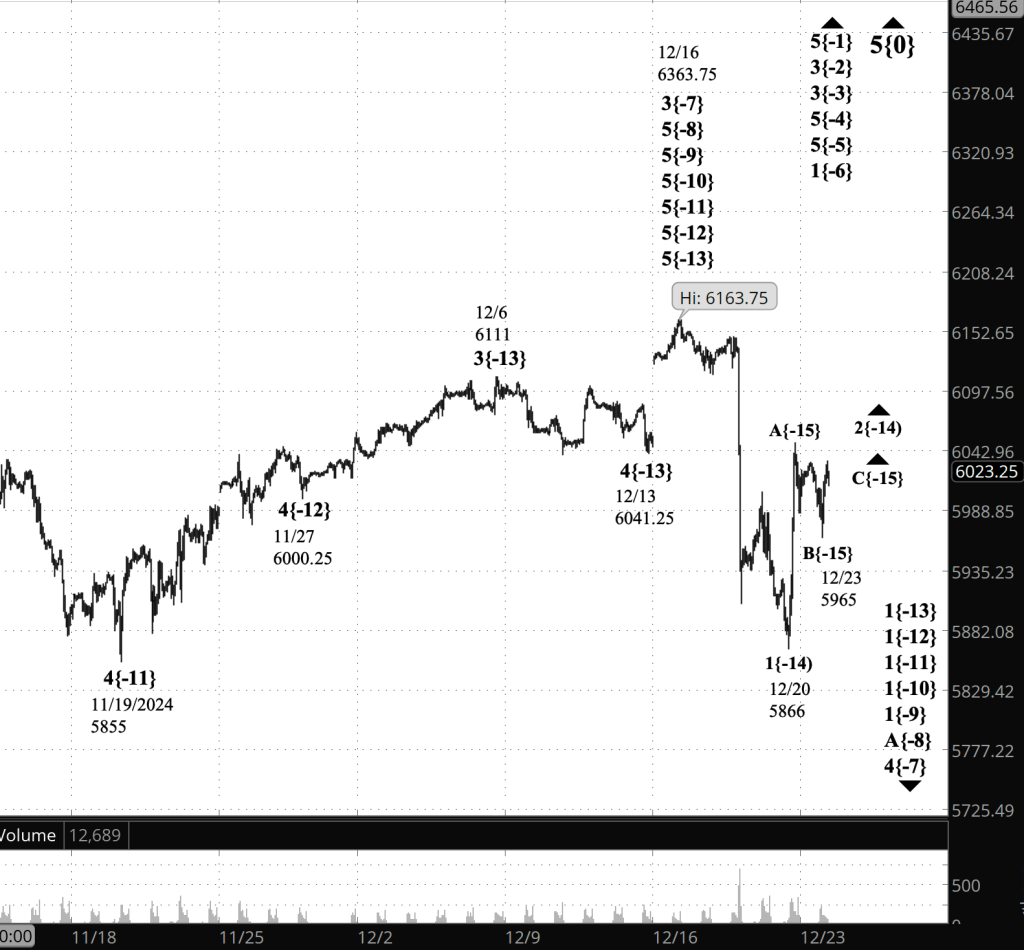
Half an hour before the closing bell. The S&P 500 futures continued to move higher during the session, although at a slower pace than during the prior day’s session and overnight.

Elliott Wave Theory: The 5th-wave uptrend that began on November 4 continues.

9:35 a.m. New York time

What’s happening now? The S&P 500 E-mini futures continued to rise overnight, reaching into the 5950s.

What does it mean? In yesterday’s analysis, I mentioned potential ambiguities arising from bottom fishing by the 4th-wave downward correction that began on October 17. As it turns out, the bottom fishing took the form of a mighty bounce, with the price rising sharply to a new high.

Today’s Elliott Wave Theory analysis: The 4th-wave correction that began on October 17 ended on November 4 at 5724.35. The 5th wave uptrend that followed began at that point and has so far risen more than 200 points.

This 5th wave has moved beyond the start of the preceding 3rd wave, so it isn’t a truncated wave. It hasn’t yet surged dramatically, and it isn’t extended—though it may or may not reach that status. There’s no way to tell at this point.

When complete, the 5th wave will also mark the end of two additional 5th waves, each a degree higher in the fractal structure of the chart, along with a larger 3rd wave, which began on August 7 from 5182.

A 4th-wave downtrend of significant size will follow, retracing a portion of the distance from the end of the previous 3rd wave back to its starting point at 5182. I’ll be bringing out the Fibonacci ladder to help make sense of that future 4th wave.

[S&P 500 E-mini futures at 3:30.m., 80-minute bars, with volume]

What are the alternatives? None at present.

What does Elliott wave theory say? Here are the waves that underly the analyses.

Principal Analysis:

  • Rising wave 5{0} is underway. It is a wave of Intermediate degree that began in December 2018.
  • It is in its final subwave, wave 5{-1}.
  • Within wave 5{-1}, rising waves 5{-2}, 5{-3} and 5{-4} are underway, as is wave 5{-5}.
  • Wave 5{-5} is in its initial subwave, wave 1{-6}, which in turn is in its middle subwave, wave 3{-7}.
  • Wave 3{-7} is in its final; subwave, uptrending wave 5{-8}.
  • Wave 5{-8} is in its final subwave, wave 5{-9}, which is in its final subwave, uptrending wave 5{-10}.

Long-term Waves.

These are the waves currently in progress under my principal analysis. Each line on the list shows the wave number, with the subscript in curly brackets, the traditional degree name, the starting date, the starting price of the S&P 500 E-mini futures, and the direction of the wave.

  • S&P 500 Index:
  • 5{+3} Supercycle, 7/8/1932, 4.40 (up)
  • 5{+2} Cycle, 12/9/1974, 60.96 (up)
  • 5{+1} Primary, 3/6/2009, 666.79 (up)
  • 5{0} Intermediate, 12/26/2018, 2346.58 (up)
  • S&P 500 Futures
  • 5{-1} Minor, 10/27/2023, 4127.25 (up)
  • 3{-2} Minute, 10/27/23, 4127.75 (up)
  • 3{-3} Minuette, 10/27/23, 4127.75 (up)
  • 5{-4} Subminuette, 4/18/2024, 4963.50 (up)
  • 5{-5} Micro, 8/5/2024, 5120 (up)
  • 1{-6} Submicro, 8/5/2024, 5120 (up)
  • 3{-7} Minuscule, 8/7/2024, 5182 (up)
  • 5{-8} (unnamed), 9/6/2024, 5394 (up)
  • 5{-9} (unnamed), 10/2/2024, 5724 (up)
  • 5{-10} (unnamed), 11/4/2024, 5824.25 (up)

Reading the chart. Price movements — waves – – in Elliott wave analysis are labeled with numbers within trending waves and letters with corrective waves. The subscripts — numbers in curly brackets — designate the wave’s degree, which, in Elliott wave analysis, means the relative position of a wave within the larger and smaller structures that make up the chart. R.N. Elliott, who in the 1930s developed the form of analysis that bears his name, viewed the chart as a complex structure of smaller waves nested within larger waves, which in turn are nested within still larger waves. In mathematics it’s called a fractal structure, where at every scale the pattern is similar to the others.

Learning and other resources. Elliott wave analysis provides context, not prophecy. As the 20th century semanticist Alfred Korzybski put it in his book Science and Sanity (1933), “The map is not the territory … The only usefulness of a map depends on similarity of structure between the empirical world and the map.” And I would add, in the ever-changing markets, we can judge that similarity of structure only after the fact.

See the menu page Analytical Methods for a rundown on where to go for information on Elliott wave analysis.

By Tim Bovee, Portland, Oregon, November 6, 2024

Disclaimer

Tim Bovee, Private Trader tracks the analysis and trades of a private trader for his own accounts. Nothing in this blog constitutes a recommendation to buy or sell stocks, options or any other financial instrument. The only purpose of this blog is to provide education and entertainment.

No trader is ever 100 percent successful in his or her trades. Trading in the stock and option markets is risky and uncertain. Each trader must make trading decisions for his or her own account, and take responsibility for the consequences.

License
Creative Commons License

All content on Tim Bovee, Private Trader by Timothy K. Bovee is licensed under a Creative Commons Attribution-ShareAlike 4.0 International License.

Based on a work at www.timbovee.com.

Trader’s Notebook

3:30 p.m. New York time

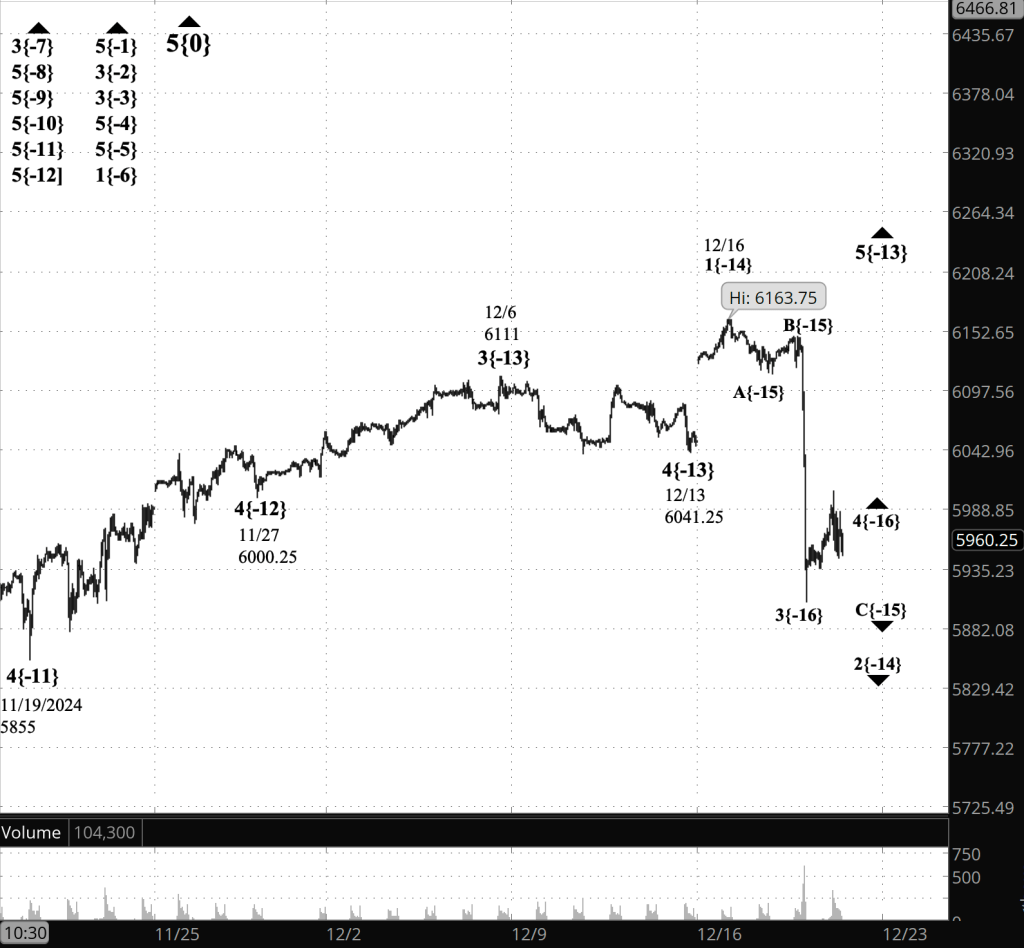
Half an hour before the closing bell. The S&P 500 futures reversed and rose sharply during the session, reaching slightly above 5800.

Elliott Wave Theory: The movement clarified the analysis of the 4th wave upward correction that began on October 31. It has not ended and is still underway.

I’ve updated the chart.

9:35 a.m. New York time

What’s happening now? The S&P 500 E-mini futures rose overnight, from the 5730s into the 5750s.

What does it mean? Elliott Wave Theory sees the rise as a small upward correction within a downtrending 5th wave, the final subwave within wave C, the final wave of the larger 4th-wave downward correction that began on October 17.

When the 5th wave is complete, it will also be the end of wave C and most likely, the end of the 4th-wave correction.

Most corrections have a single three-subwave corrective pattern. Occasionally, a subwave will take a compound form, containing two or three corrective patterns.

ln any case, when wave 4 that began in mid-October from 5927.25 will, at its end, will be followed by an uptrending 5th wave that, in many cases, will reach beyond that 4th wave’s starting point, sometimes coming up short — truncation — or moving further than expected — extension,

The end of the 5th wave will also be the end of two 5th waves, each one degree higher than the one before, and the end of the 3rd wave that encompasses them all. That wave 3 began on August 7 from 5182.

At that 3rd wave’s endpoint, a 4th-wave downward correction will begin, larger than the recent 4th waves we’ve seen.

[S&P 500 E-mini futures at 3:30 p.m., 90-minute bars, with volume]

What are the alternatives? None at present. The next ambiguity to sort through will likely being determining when the 5th wave that began on November 1 has ended, an exercise known as bottom fishing.

What does Elliott wave theory say? Here are the waves that underly the analyses.

Principal Analysis:

  • Rising wave 5{0} is underway. It is a wave of Intermediate degree that began in December 2018.
  • It is in its final subwave, wave 5{-1}.
  • Within wave 5{-1}, rising waves 5{-2}, 5{-3} and 5{-4} are underway, as is wave 5{-5}.
  • Wave 5{-5} is in its initial subwave, wave 1{-6}, which in turn is in its middle subwave, wave 3{-7}.
  • Wave 3{-7} is in its final; subwave, uptrending wave 5{-8}.
  • Wave 5{-8} is in its final subwave, wave 5{-9}, which is in its next-to-the-last subwave, corrective wave 4{-10}, which is in its final subwave, wave C{-11}.
  • Wave C{-11} is in its subwave, wave 5{-12}.

Long-term Waves.

These are the waves currently in progress under my principal analysis. Each line on the list shows the wave number, with the subscript in curly brackets, the traditional degree name, the starting date, the starting price of the S&P 500 E-mini futures, and the direction of the wave.

  • S&P 500 Index:
  • 5{+3} Supercycle, 7/8/1932, 4.40 (up)
  • 5{+2} Cycle, 12/9/1974, 60.96 (up)
  • 5{+1} Primary, 3/6/2009, 666.79 (up)
  • 5{0} Intermediate, 12/26/2018, 2346.58 (up)
  • S&P 500 Futures
  • 5{-1} Minor, 10/27/2023, 4127.25 (up)
  • 3{-2} Minute, 10/27/23, 4127.75 (up)
  • 3{-3} Minuette, 10/27/23, 4127.75 (up)
  • 5{-4} Subminuette, 4/18/2024, 4963.50 (up)
  • 5{-5} Micro, 8/5/2024, 5120 (up)
  • 1{-6} Submicro, 8/5/2024, 5120 (up)
  • 3{-7} Minuscule, 8/7/2024, 5182 (up)
  • 5{-8} (unnamed), 9/6/2024, 5394 (up)
  • 5{-9} (unnamed), 10/2/2024, 5724 (up)
  • 4{-10} (unnamed), 10/17/2024, 5927.25 (down)
  • C{-11} (unnamed), 10/9/2024, 5893 (down)
  • 5{-12} (unnamed), 11/1/2024, 5803.75 (down)

Reading the chart. Price movements — waves – – in Elliott wave analysis are labeled with numbers within trending waves and letters with corrective waves. The subscripts — numbers in curly brackets — designate the wave’s degree, which, in Elliott wave analysis, means the relative position of a wave within the larger and smaller structures that make up the chart. R.N. Elliott, who in the 1930s developed the form of analysis that bears his name, viewed the chart as a complex structure of smaller waves nested within larger waves, which in turn are nested within still larger waves. In mathematics it’s called a fractal structure, where at every scale the pattern is similar to the others.

Learning and other resources. Elliott wave analysis provides context, not prophecy. As the 20th century semanticist Alfred Korzybski put it in his book Science and Sanity (1933), “The map is not the territory … The only usefulness of a map depends on similarity of structure between the empirical world and the map.” And I would add, in the ever-changing markets, we can judge that similarity of structure only after the fact.

See the menu page Analytical Methods for a rundown on where to go for information on Elliott wave analysis.

By Tim Bovee, Portland, Oregon, November 5, 2024

Disclaimer

Tim Bovee, Private Trader tracks the analysis and trades of a private trader for his own accounts. Nothing in this blog constitutes a recommendation to buy or sell stocks, options or any other financial instrument. The only purpose of this blog is to provide education and entertainment.

No trader is ever 100 percent successful in his or her trades. Trading in the stock and option markets is risky and uncertain. Each trader must make trading decisions for his or her own account, and take responsibility for the consequences.

License
Creative Commons License

All content on Tim Bovee, Private Trader by Timothy K. Bovee is licensed under a Creative Commons Attribution-ShareAlike 4.0 International License.

Based on a work at www.timbovee.com.
Trader’s Notebook

3:30 p.m. New York time

Half an hour before the closing bell. In this morning’s analysis I discussed Elliott Wave Theory’s insights into the near-term possible market responses to the November 5 elections outcomes.

This afternoon, I’m going to broaden it out to a long-term analysis, continuing to use the S&P 500 E-mini futures.

At the smallest level this morning, the market has clarified that at rising 4th wave within the falling C wave ended on November 1, and the final subwave within wave C in now underway, a falling 5th wave. When the small 5th wave ends, so will the parent C wave and the 4th-wave downward correction that began on October 17 and contains them all.

So on election day, the S&P 500 and its derivatives will have a downward tendency, but it won’t last long.

At this point, I’m will be using the wave labels as they appear on the chart: A wave number followed by a subscript in curly bracks given the wave’s degree in the fractal , relative to the Intermediate degree 5th wave — wave 5{0} — that began in December 2018. See the ‘Reading the Chart” section below for more detail.

The small 5th wave discussed at the start of this post is wave 5{-12}, a subwave of wave C{-11}, the final subwave of wave 4{-10}. Wave 5{-10} will begin its rise at that point, and Elliott Wave conditions will change..

Afterward, the Elliott Wave conditions change. Wave 4{-10) now approaching its end is two degrees higher than the small wave 5{-12} close to bringing wave 4{-10} to a close. Uptrending wave 5{-10} will follow. The preceding wave 3{-10} ran from October 7 to October 17, covering around 200 points.

The end of wave 5{-10} will trigger a cascade that will cascade through two degrees, ending waves 5{-9} and 5{-8}, and also wave 3{-7}, which began on August 7 from 5182.

A 4th-wave downward correction taking back a portion of gains that covered 1,000 points or so. That’s a significant downtrending movement.

Elliott Wave Theory is filled with ambiguities. While realizing that weakness, I’ve also found that those waves provide some insight into what lies ahead.

I see short-term rising tendency immediately after the election, but it will be short-lived, followed by a significant downtrend.

9:35 a.m. New York time

What’s happening now? The S&P 500 E-mini futures resumed trading by stepping gently into a week that by it’s end had the potential to reveal the nature of the new American future. And also, as a sideshows, the Federal Reserve’s latest on interest rates.

What does it mean? The presidential election, on Tuesday, and the Federal Open Markets Committee’s new rates, on Thursday, both have the potential to be followed by large impact on the markets.

None of us can no for certain how that impact will play out. But with the help of Elliott Wave Theory, we can gain an understanding of the future course of the S&P 500 and its derivatives.

The S&P 500 E-mini futures continue to work through the 4th-wave downward correction that began on October 17. The present subwave is wave C, the final subwave, which in turn is in its next-to-the-subwave, rising wave 4, which is in its descending B wave.

So there’s leeway for a number of immediately directional responses, although the falling 4th-wave correction from mid-October is dominant. That 4th-wave is nearing its end, and a rising 5th-wave will follow, which will carry the price up by a significant amount, by at least around 200 points and most likely higher in the near-term aftermath of the election and Fed events.

But as always, each bullish Elliott Wave is followed by a bear wave, which in turn leads to another bull wave. And each wave has subwaves built by its own bull and bear subwaves.

So what’s future? For the near term it appears to me that an upward response is most likely, but it won’t a simple structure, and we really can’t tell from the chart whether a rise or any movement will be fast or slow, large or small.

[S&P 500 E-mini futures at 3:30 p.m., 70-minute bars, with volume]

What are the alternatives? None at present.

What does Elliott wave theory say? Here are the waves that underly the analyses.

Principal Analysis:

  • Rising wave 5{0} is underway. It is a wave of Intermediate degree that began in December 2018.
  • It is in its final subwave, wave 5{-1}.
  • Within wave 5{-1}, rising waves 5{-2}, 5{-3} and 5{-4} are underway, as is wave 5{-5}.
  • Wave 5{-5} is in its initial subwave, wave 1{-6}, which in turn is in its middle subwave, wave 3{-7}.
  • Wave 3{-7} is in its final; subwave, uptrending wave 5{-8}.
  • Wave 5{-8} is in its final subwave, wave 5{-9}, which is in its next-to-the-last subwave, corrective wave 4{-10}, which is in its final subwave, wave C{-11}.
  • Wave C{-11} is in its next-to-the-last subwave, wave 4{-12}.

Long-term Waves.

These are the waves currently in progress under my principal analysis. Each line on the list shows the wave number, with the subscript in curly brackets, the traditional degree name, the starting date, the starting price of the S&P 500 E-mini futures, and the direction of the wave.

  • S&P 500 Index:
  • 5{+3} Supercycle, 7/8/1932, 4.40 (up)
  • 5{+2} Cycle, 12/9/1974, 60.96 (up)
  • 5{+1} Primary, 3/6/2009, 666.79 (up)
  • 5{0} Intermediate, 12/26/2018, 2346.58 (up)
  • S&P 500 Futures
  • 5{-1} Minor, 10/27/2023, 4127.25 (up)
  • 3{-2} Minute, 10/27/23, 4127.75 (up)
  • 3{-3} Minuette, 10/27/23, 4127.75 (up)
  • 5{-4} Subminuette, 4/18/2024, 4963.50 (up)
  • 5{-5} Micro, 8/5/2024, 5120 (up)
  • 1{-6} Submicro, 8/5/2024, 5120 (up)
  • 3{-7} Minuscule, 8/7/2024, 5182 (up)
  • 5{-8} (unnamed), 9/6/2024, 5394 (up)
  • 5{-9} (unnamed), 10/2/2024, 5724 (up)
  • 4{-10} (unnamed), 10/17/2024, 5927.25 (down)

Reading the chart. Price movements — waves – – in Elliott wave analysis are labeled with numbers within trending waves and letters with corrective waves. The subscripts — numbers in curly brackets — designate the wave’s degree, which, in Elliott wave analysis, means the relative position of a wave within the larger and smaller structures that make up the chart. R.N. Elliott, who in the 1930s developed the form of analysis that bears his name, viewed the chart as a complex structure of smaller waves nested within larger waves, which in turn are nested within still larger waves. In mathematics it’s called a fractal structure, where at every scale the pattern is similar to the others.

Learning and other resources. Elliott wave analysis provides context, not prophecy. As the 20th century semanticist Alfred Korzybski put it in his book Science and Sanity (1933), “The map is not the territory … The only usefulness of a map depends on similarity of structure between the empirical world and the map.” And I would add, in the ever-changing markets, we can judge that similarity of structure only after the fact.

See the menu page Analytical Methods for a rundown on where to go for information on Elliott wave analysis.

By Tim Bovee, Portland, Oregon, November 4, 2024

Disclaimer

Tim Bovee, Private Trader tracks the analysis and trades of a private trader for his own accounts. Nothing in this blog constitutes a recommendation to buy or sell stocks, options or any other financial instrument. The only purpose of this blog is to provide education and entertainment.

No trader is ever 100 percent successful in his or her trades. Trading in the stock and option markets is risky and uncertain. Each trader must make trading decisions for his or her own account, and take responsibility for the consequences.

License
Creative Commons License

All content on Tim Bovee, Private Trader by Timothy K. Bovee is licensed under a Creative Commons Attribution-ShareAlike 4.0 International License.

Based on a work at www.timbovee.com.

Trader’s Notebook

3:30 p.m. New York time

Half an hour before the closing bell. The S&P 500 futures continued to rise during the session, reaching above 5800.

Elliott Wave Theory: Wave C within the 4th-wave downward correction that began on October 17 continues to work through its next-to-the-last subwave, rising wave 4, which will be followed by declining wave 5 and the end of wave C.

Wave 4 will have three subwaves. The first, a smaller degree rising wave A, appears to have ended during the session. If that proves the case, then a smaller degree falling wave B is underway.

9:35 a.m. New York time

What’s happening now? The S&P 500 E-mini futures rose overnight from the 5330s, peaking so far in the 5390s with the release of the unemployment figures for October, 4.1%, unchanged from the month before.

What does it mean? Applying Elliott Wave Theory: The 4th-wave downward correction that began on October 17 continues. If typical, it is in its final subwave, wave C, which in turn appears to be in its next-to-the-last subwave, rising wave 4.

[S&P 500 E-mini futures at 3:30 p.m., 70-minute bars, with volume]

What are the alternatives? None at present. As always, they will develop.

What does Elliott wave theory say? Here are the waves that underly the analyses.

Principal Analysis:

  • Rising wave 5{0} is underway. It is a wave of Intermediate degree that began in December 2018.
  • It is in its final subwave, wave 5{-1}.
  • Within wave 5{-1}, rising waves 5{-2}, 5{-3} and 5{-4} are underway, as is wave 5{-5}.
  • Wave 5{-5} is in its initial subwave, wave 1{-6}, which in turn is in its middle subwave, wave 3{-7}.
  • Wave 3{-7} is in its final; subwave, uptrending wave 5{-8}.
  • Wave 5{-8} is in its final subwave, wave 5{-9}, which is in its next-to-the-last subwave, corrective wave 4{-10}, which is in its final subwave, wave C{-11}.
  • Wave C{-11} is in its next-to-the-last subwave, wave 4{-12}.

Long-term Waves.

These are the waves currently in progress under my principal analysis. Each line on the list shows the wave number, with the subscript in curly brackets, the traditional degree name, the starting date, the starting price of the S&P 500 E-mini futures, and the direction of the wave.

  • S&P 500 Index:
  • 5{+3} Supercycle, 7/8/1932, 4.40 (up)
  • 5{+2} Cycle, 12/9/1974, 60.96 (up)
  • 5{+1} Primary, 3/6/2009, 666.79 (up)
  • 5{0} Intermediate, 12/26/2018, 2346.58 (up)
  • S&P 500 Futures
  • 5{-1} Minor, 10/27/2023, 4127.25 (up)
  • 3{-2} Minute, 10/27/23, 4127.75 (up)
  • 3{-3} Minuette, 10/27/23, 4127.75 (up)
  • 5{-4} Subminuette, 4/18/2024, 4963.50 (up)
  • 5{-5} Micro, 8/5/2024, 5120 (up)
  • 1{-6} Submicro, 8/5/2024, 5120 (up)
  • 3{-7} Minuscule, 8/7/2024, 5182 (up)
  • 5{-8} (unnamed), 9/6/2024, 5394 (up)
  • 5{-9} (unnamed), 10/2/2024, 5724 (up)
  • 4{-10} (unnamed), 10/17/2024, 5927.25 (down)

Reading the chart. Price movements — waves – – in Elliott wave analysis are labeled with numbers within trending waves and letters with corrective waves. The subscripts — numbers in curly brackets — designate the wave’s degree, which, in Elliott wave analysis, means the relative position of a wave within the larger and smaller structures that make up the chart. R.N. Elliott, who in the 1930s developed the form of analysis that bears his name, viewed the chart as a complex structure of smaller waves nested within larger waves, which in turn are nested within still larger waves. In mathematics it’s called a fractal structure, where at every scale the pattern is similar to the others.

Learning and other resources. Elliott wave analysis provides context, not prophecy. As the 20th century semanticist Alfred Korzybski put it in his book Science and Sanity (1933), “The map is not the territory … The only usefulness of a map depends on similarity of structure between the empirical world and the map.” And I would add, in the ever-changing markets, we can judge that similarity of structure only after the fact.

See the menu page Analytical Methods for a rundown on where to go for information on Elliott wave analysis.

By Tim Bovee, Portland, Oregon, November 1, 2024

Disclaimer

Tim Bovee, Private Trader tracks the analysis and trades of a private trader for his own accounts. Nothing in this blog constitutes a recommendation to buy or sell stocks, options or any other financial instrument. The only purpose of this blog is to provide education and entertainment.

No trader is ever 100 percent successful in his or her trades. Trading in the stock and option markets is risky and uncertain. Each trader must make trading decisions for his or her own account, and take responsibility for the consequences.

License
Creative Commons License

All content on Tim Bovee, Private Trader by Timothy K. Bovee is licensed under a Creative Commons Attribution-ShareAlike 4.0 International License.

Based on a work at www.timbovee.com.

Trader’s Notebook

3:30 p.m. New York time

Half an hour before the closing bell. The S&P 500 futures continued to fall during the session, so far reaching into the 5740s.

Elliott Wave Theory: The middle subwave, wave 3, within the final subwave, wave C, within the 4th-wave downward correction that began on October 17 continues.

Typically, a C wave will be about as long as the preceding A wave. With the 4th-wave correction, wave A was 126 points long, Wave C began at 5893. Therefore, the likely endpoint for wave C is 5767.

The price reached into the 5750s late it in the session. If this C wave is typical, I expect to end soon.

At that point, things interesting,

If the 4th-wave is typical, then the end of the C wave will be the end of 4th wave’s three-subwave corrective pattern and the beginning of an uptrending 5th-wave.

Sometimes, corrective waves take a complex form, containing two or three corrective patterns. If this is the case, then wave C will be followed by a rising connector — an X-wave — and then a declining A wave, the initial wave of the second corrective pattern.

Wave 5 will eventually begin, but a complex correction would delay its debut.,

9:35 a.m. New York time

What’s happening now? The S&P 500 E-mini futures fell overnight, dropping into the 5790s as the opening bell sounded.

What does it mean? Elliott Wave Theory sees the overnight decline as the final subwave, wave C, of a 4th-wave downward correction that began on October 17. The overnight low, 5801, is identical to the end point of a initial subwave wave A.

The downward reach confirms yesterday’s principal analysis, which concluded that wave C was underway.

The C wave will have five subwaves altogether. The decline that began during the October 30 session is the middle subwave, wave 3.

[S&P 500 E-mini futures at 3:30 p.m., 60-minute bars, with volume]

What are the alternatives? None at present. As always, they will develop.

What does Elliott wave theory say? Here are the waves that underly the analyses.

Principal Analysis:

  • Rising wave 5{0} is underway. It is a wave of Intermediate degree that began in December 2018.
  • It is in its final subwave, wave 5{-1}.
  • Within wave 5{-1}, rising waves 5{-2}, 5{-3} and 5{-4} are underway, as is wave 5{-5}.
  • Wave 5{-5} is in its initial subwave, wave 1{-6}, which in turn is in its middle subwave, wave 3{-7}.
  • Wave 3{-7} is in its final; subwave, uptrending wave 5{-8}.
  • Wave 5{-8} is in its final subwave, wave 5{-9}, which is in its next-to-the-last subwave, corrective wave 4{-10}, which is in its final subwave, wave C{-11}.
  • Wave C{-11} is in its middle subwave, wave 3{-12}.

Reading the chart. Price movements — waves – – in Elliott wave analysis are labeled with numbers within trending waves and letters with corrective waves. The subscripts — numbers in curly brackets — designate the wave’s degree, which, in Elliott wave analysis, means the relative position of a wave within the larger and smaller structures that make up the chart. R.N. Elliott, who in the 1930s developed the form of analysis that bears his name, viewed the chart as a complex structure of smaller waves nested within larger waves, which in turn are nested within still larger waves. In mathematics it’s called a fractal structure, where at every scale the pattern is similar to the others.

Learning and other resources. Elliott wave analysis provides context, not prophecy. As the 20th century semanticist Alfred Korzybski put it in his book Science and Sanity (1933), “The map is not the territory … The only usefulness of a map depends on similarity of structure between the empirical world and the map.” And I would add, in the ever-changing markets, we can judge that similarity of structure only after the fact.

See the menu page Analytical Methods for a rundown on where to go for information on Elliott wave analysis.

By Tim Bovee, Portland, Oregon, October 31, 2024

Disclaimer

Tim Bovee, Private Trader tracks the analysis and trades of a private trader for his own accounts. Nothing in this blog constitutes a recommendation to buy or sell stocks, options or any other financial instrument. The only purpose of this blog is to provide education and entertainment.

No trader is ever 100 percent successful in his or her trades. Trading in the stock and option markets is risky and uncertain. Each trader must make trading decisions for his or her own account, and take responsibility for the consequences.

License
Creative Commons License

All content on Tim Bovee, Private Trader by Timothy K. Bovee is licensed under a Creative Commons Attribution-ShareAlike 4.0 International License.

Based on a work at www.timbovee.com.

Trader’s Notebook

3:30 p.m. New York time

Half an hour before the closing bell. The S&P 500 futures recovered part of the overnight decline and then fell a bit further during the session. The range for both combined is from 5893 (overnight) to 5845.50 (session).

Elliott Wave Theory: The 4th-wave downward correction that began on October 17 continues. Within wave 4, the middle subwave, rising wave B, has completed three still smaller subwaves, as i the case within B waves. The decline suggests that declining wave C has begun.

I’ve updated the chart to conform.

9:35 a.m. New York time

What’s happening now? The S&P 500 E-mini futures fell overnight, from the 5890s to the 5860s.

What does it mean? The 4th-wave downward correction that began on October 17 continues to work through wave B, the correction’s middle subwave, which began on October 23 from 5801, according to Elliott Wave Theory analysis.

The correction has taken the form of a Zigzag, signaled by wave A having five subwaves.

Wave B, a rising wave, will remain above the starting point of wave A, at 5927.25. The B wave will be followed by a declining C wave that, if typical, will be about the same length as the preceding A wave, 126.25.

If the B-wave high so far, 5871.25, were to be the B-wave’s ending point, then wave C would carry the price down to 5745. No guarantee of course, that wave B will end at 5871.25 or that the C wave will be precisely as long as wave A. Those are tendencies, not rules.

Wherever it lands, the end of wave C will be the end of the downward correction if, as is typical, it contains a single corrective pattern. If instead it turns out to be a complex correction, then wave 4 will contain two or three corrective patterns, linked together with connecting waves.

In either case, the 4th-wave downward correction will be followed by a 5th-wave uptrend.

[S&P 500 E-mini futures at 3:30 p.m., 100-minute bars, with volume]

What are the alternatives? It still remains possible, although less likely, that wave 4 ended at the October 23 low and that a 5th-wave uptrend has begun.

What does Elliott wave theory say? Here are the waves that underly the analyses.

Principal Analysis:

  • Rising wave 5{0} is underway. It is a wave of Intermediate degree that began in December 2018.
  • It is in its final subwave, wave 5{-1}.
  • Within wave 5{-1}, rising waves 5{-2}, 5{-3} and 5{-4} are underway, as is wave 5{-5}.
  • Wave 5{-5} is in its initial subwave, wave 1{-6}, which in turn is in its middle subwave, wave 3{-7}.
  • Wave 3{-7} is in its final; subwave, uptrending wave 5{-8}.
  • Wave 5{-8} is in its final subwave, wave 5{-9}, which is in its next-to-the-last subwave, corrective wave 4{-10}, which has completed its first subwave, wave A{-11}

Alternative Analysis:

  • Wave 5{-8} is in its final subwave, wave 5{-9}, which is in its final subwave, rising wave 5{-10}.

Long-term Waves.

These are the waves currently in progress under my principal analysis. Each line on the list shows the wave number, with the subscript in curly brackets, the traditional degree name, the starting date, the starting price of the S&P 500 E-mini futures, and the direction of the wave.

  • S&P 500 Index:
  • 5{+3} Supercycle, 7/8/1932, 4.40 (up)
  • 5{+2} Cycle, 12/9/1974, 60.96 (up)
  • 5{+1} Primary, 3/6/2009, 666.79 (up)
  • 5{0} Intermediate, 12/26/2018, 2346.58 (up)
  • S&P 500 Futures
  • 5{-1} Minor, 10/27/2023, 4127.25 (up)
  • 3{-2} Minute, 10/27/23, 4127.75 (up)
  • 3{-3} Minuette, 10/27/23, 4127.75 (up)
  • 5{-4} Subminuette, 4/18/2024, 4963.50 (up)
  • 5{-5} Micro, 8/5/2024, 5120 (up)
  • 1{-6} Submicro, 8/5/2024, 5120 (up)
  • 3{-7} Minuscule, 8/7/2024, 5182 (up)
  • 5{-8} (unnamed), 9/6/2024, 5394 (up)
  • 5{-9} (unnamed), 10/2/2024, 5724 (up)
  • 4{-10} (unnamed), 10/17/2024, 5927.25 (down)

Reading the chart. Price movements — waves – – in Elliott wave analysis are labeled with numbers within trending waves and letters with corrective waves. The subscripts — numbers in curly brackets — designate the wave’s degree, which, in Elliott wave analysis, means the relative position of a wave within the larger and smaller structures that make up the chart. R.N. Elliott, who in the 1930s developed the form of analysis that bears his name, viewed the chart as a complex structure of smaller waves nested within larger waves, which in turn are nested within still larger waves. In mathematics it’s called a fractal structure, where at every scale the pattern is similar to the others.

Learning and other resources. Elliott wave analysis provides context, not prophecy. As the 20th century semanticist Alfred Korzybski put it in his book Science and Sanity (1933), “The map is not the territory … The only usefulness of a map depends on similarity of structure between the empirical world and the map.” And I would add, in the ever-changing markets, we can judge that similarity of structure only after the fact.

See the menu page Analytical Methods for a rundown on where to go for information on Elliott wave analysis.

By Tim Bovee, Portland, Oregon, October 30, 2024

Disclaimer

Tim Bovee, Private Trader tracks the analysis and trades of a private trader for his own accounts. Nothing in this blog constitutes a recommendation to buy or sell stocks, options or any other financial instrument. The only purpose of this blog is to provide education and entertainment.

No trader is ever 100 percent successful in his or her trades. Trading in the stock and option markets is risky and uncertain. Each trader must make trading decisions for his or her own account, and take responsibility for the consequences.

License
Creative Commons License

All content on Tim Bovee, Private Trader by Timothy K. Bovee is licensed under a Creative Commons Attribution-ShareAlike 4.0 International License.

Based on a work at www.timbovee.com.

Trader’s Notebook

3:30 p.m. New York time

Half an hour before the closing bell.The S&P 500 futures rose during the session, returning to the 5880s. Elliott Wave Theory: The 4th-wave downward correction that began on October 17 continues and is now in its middle subwave, rising wave B.

9:35 a.m. New York time

What’s happening now? The S&P 500 E-mini futures one again traded in a narrow range overnight, fluctuating between the 5860s and the 5840s.

What does it mean? The pattern in Elliott Wave Theory is looking more like a continuation of the 4th-wave downward correction that began on October 17, and I’ve relabelled the chart accordingly. The first subwave within the correction, declining wave A, ended on October 23 at 5801.

[S&P 500 E-mini futures at 3:30 p.m., 90-minute bars, with volume]

What are the alternatives? It still remains possible, although less likely, that wave 4 ended at the October 23 low and that a 5th-wave uptrend has begun.

What does Elliott wave theory say? Here are the waves that underly the analyses.

Principal Analysis:

  • Rising wave 5{0} is underway. It is a wave of Intermediate degree that began in December 2018.
  • It is in its final subwave, wave 5{-1}.
  • Within wave 5{-1}, rising waves 5{-2}, 5{-3} and 5{-4} are underway, as is wave 5{-5}.
  • Wave 5{-5} is in its initial subwave, wave 1{-6}, which in turn is in its middle subwave, wave 3{-7}.
  • Wave 3{-7} is in its final; subwave, uptrending wave 5{-8}.
  • Wave 5{-8} is in its final subwave, wave 5{-9}, which is in its next-to-the-last subwave, corrective wave 4{-10}, which has completed its first subwave, wave A{-11}

Alternative Analysis:

  • Wave 5{-8} is in its final subwave, wave 5{-9}, which is in its final subwave, rising wave 5{-10}.

Long-term Waves.

These are the waves currently in progress under my principal analysis. Each line on the list shows the wave number, with the subscript in curly brackets, the traditional degree name, the starting date, the starting price of the S&P 500 E-mini futures, and the direction of the wave.

  • S&P 500 Index:
  • 5{+3} Supercycle, 7/8/1932, 4.40 (up)
  • 5{+2} Cycle, 12/9/1974, 60.96 (up)
  • 5{+1} Primary, 3/6/2009, 666.79 (up)
  • 5{0} Intermediate, 12/26/2018, 2346.58 (up)
  • S&P 500 Futures
  • 5{-1} Minor, 10/27/2023, 4127.25 (up)
  • 3{-2} Minute, 10/27/23, 4127.75 (up)
  • 3{-3} Minuette, 10/27/23, 4127.75 (up)
  • 5{-4} Subminuette, 4/18/2024, 4963.50 (up)
  • 5{-5} Micro, 8/5/2024, 5120 (up)
  • 1{-6} Submicro, 8/5/2024, 5120 (up)
  • 3{-7} Minuscule, 8/7/2024, 5182 (up)
  • 5{-8} (unnamed), 9/6/2024, 5394 (up)
  • 5{-9} (unnamed), 10/2/2024, 5724 (up)
  • 4{-10} (unnamed), 10/17/2024, 5927.25 (down)

Reading the chart. Price movements — waves – – in Elliott wave analysis are labeled with numbers within trending waves and letters with corrective waves. The subscripts — numbers in curly brackets — designate the wave’s degree, which, in Elliott wave analysis, means the relative position of a wave within the larger and smaller structures that make up the chart. R.N. Elliott, who in the 1930s developed the form of analysis that bears his name, viewed the chart as a complex structure of smaller waves nested within larger waves, which in turn are nested within still larger waves. In mathematics it’s called a fractal structure, where at every scale the pattern is similar to the others.

Learning and other resources. Elliott wave analysis provides context, not prophecy. As the 20th century semanticist Alfred Korzybski put it in his book Science and Sanity (1933), “The map is not the territory … The only usefulness of a map depends on similarity of structure between the empirical world and the map.” And I would add, in the ever-changing markets, we can judge that similarity of structure only after the fact.

See the menu page Analytical Methods for a rundown on where to go for information on Elliott wave analysis.

By Tim Bovee, Portland, Oregon, October 29, 2024

Disclaimer

Tim Bovee, Private Trader tracks the analysis and trades of a private trader for his own accounts. Nothing in this blog constitutes a recommendation to buy or sell stocks, options or any other financial instrument. The only purpose of this blog is to provide education and entertainment.

No trader is ever 100 percent successful in his or her trades. Trading in the stock and option markets is risky and uncertain. Each trader must make trading decisions for his or her own account, and take responsibility for the consequences.

License
Creative Commons License

All content on Tim Bovee, Private Trader by Timothy K. Bovee is licensed under a Creative Commons Attribution-ShareAlike 4.0 International License.

Based on a work at www.timbovee.com.
Trader’s Notebook

3:30 p.m. New York time

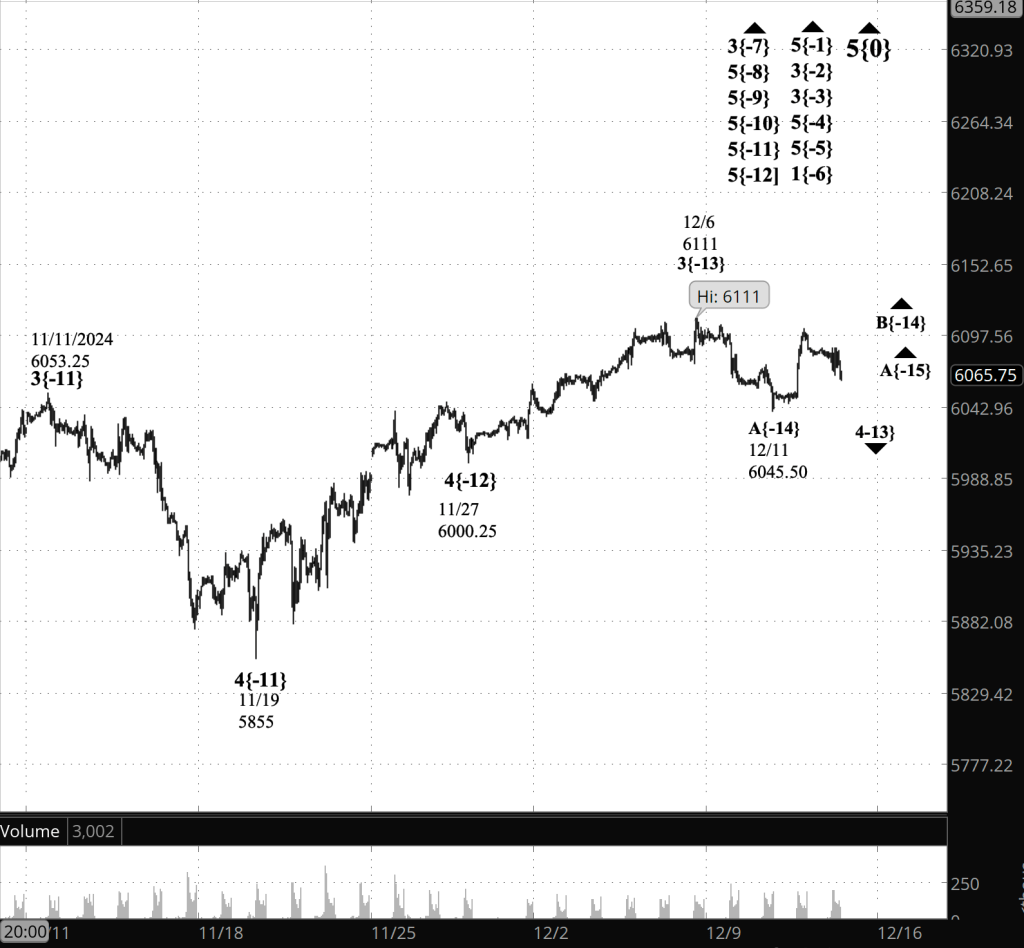
Half an hour before the closing bell. The S&P 500 futures has spent the session so far with the overnight range: from the 5860s to the 5880s. This morning’s analysis stands.

9:35 a.m. New York time

What’s happening now? The S&P 500 E-mini futures worked its way sideways after trading resumed overnight, beginning in the 5850s and thereafter fluctuating from the 5860s to the 5880s.

What does it mean? The structure of the chart, based on Elliott Wave Theory, little changed from the end of last week. That a 4th-wave downward correction began began on October 17 is clear. What’s unclear is whether that 4th wave has ended or is stil in progress.

As I have in the past few days, I’ve labeled the chart with both alternatives: Either the correction ended on October 27 at 5801, or that point was the end of the first subwave of the correction, wave A. There will be a lack of clarity until there’s a breakout above 5927.25 (wave 4 has ended) or below 5801 (wave 4 continues).

[S&P 500 E-mini futures at 3:30 p.m., 90-minute bars, with volume]

What are the alternatives? See the discussion above for the alternative analyses. There is no principal analysis.

What does Elliott wave theory say? Here are the waves that underly the analyses.

Principal Analysis:

  • None.

Alternative Analysis #1:

  • Rising wave 5{0} is underway. It is a wave of Intermediate degree that began in December 2018.
  • It is in its final subwave, wave 5{-1}.
  • Within wave 5{-1}, rising waves 5{-2}, 5{-3} and 5{-4} are underway, as is wave 5{-5}.
  • Wave 5{-5} is in its initial subwave, wave 1{-6}, which in turn is in its middle subwave, wave 3{-7}.
  • Wave 3{-7} is in its final; subwave, uptrending wave 5{-8}.
  • Wave 5{-8} is in its final subwave, wave 5{-9}, which is in its next-to-the-last subwave, corrective wave 4{-10}.

Alternative Analysis #2:

  • Wave 5{-8} is in its final subwave, wave 5{-9}, which is in its final subwave, rising wave 5{-10}.

Long-term Waves.

These are the waves currently in progress under my principal analysis. Each line on the list shows the wave number, with the subscript in curly brackets, the traditional degree name, the starting date, the starting price of the S&P 500 E-mini futures, and the direction of the wave.

  • S&P 500 Index:
  • 5{+3} Supercycle, 7/8/1932, 4.40 (up)
  • 5{+2} Cycle, 12/9/1974, 60.96 (up)
  • 5{+1} Primary, 3/6/2009, 666.79 (up)
  • 5{0} Intermediate, 12/26/2018, 2346.58 (up)
  • S&P 500 Futures
  • 5{-1} Minor, 10/27/2023, 4127.25 (up)
  • 3{-2} Minute, 10/27/23, 4127.75 (up)
  • 3{-3} Minuette, 10/27/23, 4127.75 (up)
  • 5{-4} Subminuette, 4/18/2024, 4963.50 (up)
  • 5{-5} Micro, 8/5/2024, 5120 (up)
  • 1{-6} Submicro, 8/5/2024, 5120 (up)
  • 3{-7} Minuscule, 8/7/2024, 5182 (up)
  • 5{-8} (unnamed), 9/6/2024, 5394 (up)
  • 5{-9} (unnamed), 10/2/2024, 5724 (up)
  • Two alternatives:
    • 4{-10} (unnamed), 10/17/2024, 5927.25 (down), or…
    • 5{-10} unnamed, 10/23/2024, 5801 (up)

Reading the chart. Price movements — waves – – in Elliott wave analysis are labeled with numbers within trending waves and letters with corrective waves. The subscripts — numbers in curly brackets — designate the wave’s degree, which, in Elliott wave analysis, means the relative position of a wave within the larger and smaller structures that make up the chart. R.N. Elliott, who in the 1930s developed the form of analysis that bears his name, viewed the chart as a complex structure of smaller waves nested within larger waves, which in turn are nested within still larger waves. In mathematics it’s called a fractal structure, where at every scale the pattern is similar to the others.

Learning and other resources. Elliott wave analysis provides context, not prophecy. As the 20th century semanticist Alfred Korzybski put it in his book Science and Sanity (1933), “The map is not the territory … The only usefulness of a map depends on similarity of structure between the empirical world and the map.” And I would add, in the ever-changing markets, we can judge that similarity of structure only after the fact.

See the menu page Analytical Methods for a rundown on where to go for information on Elliott wave analysis.

By Tim Bovee, Portland, Oregon, October x, 2024

Disclaimer

Tim Bovee, Private Trader tracks the analysis and trades of a private trader for his own accounts. Nothing in this blog constitutes a recommendation to buy or sell stocks, options or any other financial instrument. The only purpose of this blog is to provide education and entertainment.

No trader is ever 100 percent successful in his or her trades. Trading in the stock and option markets is risky and uncertain. Each trader must make trading decisions for his or her own account, and take responsibility for the consequences.

License
Creative Commons License

All content on Tim Bovee, Private Trader by Timothy K. Bovee is licensed under a Creative Commons Attribution-ShareAlike 4.0 International License.

Based on a work at www.timbovee.com.

Trader’s Notebook

3:30 p.m. New York time

Half an hour before the closing bell. The S&P 500 futures fell during the session, from 5900.75 at the opening bell, down to the 5830s. The price movement was too shallow to reconcile the uncertain Elliott Wave Theory analyses of the past several days.

So, the conundrum is unchanged:

  • The 4th-wave downward correction that began on October 17 continues.
  • Or the 4th-wave downward correction ended on October 23 and a 5th-wave uptrend has begun.

9:35 a.m. New York time

What’s happening now? The S&P 500 E-mini futures rose overnight, from the 5840s to the 5860s.

What does it mean? The chart has spent the week bottom fishing. In Elliott Wave Theory terminology, the 4th-wave downward correction that began on October 17 has reached a point where any lower low potentially means the correction is complete. The most recent lower low is 5801, on October 23.

Until there’s a breakout to the upside, it will be impossible to understand for sure whether wave 4 is continuing or complete. If continuing the price will fall below 5801. If complete, the price will rise, approaching and most likely exceeding the wave 4 starting point, 5927.25.

In my decades working with Elliott Wave Theory, I’ve found that it’s best to acknowledge that which I don’t know, and can’t know given the evidence.

On the chart, I’ve hedged my bet by not selecting one scenario or the other as the principal analysis but instead marking both possibilities as alternative analyses having equal likelihood, as was also the case yesterday.

[S&P 500 E-mini futures at 3:30 p.m., 120-minute bars, with volume]

What are the alternatives? As described above, there are two alternative analyses, without a clear principal analysis.

What does Elliott wave theory say? Here are the waves that underly the analyses.

Principal Analysis:

  • None.

Alternative Analysis #1:

  • Rising wave 5{0} is underway. It is a wave of Intermediate degree that began in December 2018.
  • It is in its final subwave, wave 5{-1}.
  • Within wave 5{-1}, rising waves 5{-2}, 5{-3} and 5{-4} are underway, as is wave 5{-5}.
  • Wave 5{-5} is in its initial subwave, wave 1{-6}, which in turn is in its middle subwave, wave 3{-7}.
  • Wave 3{-7} is in its final; subwave, uptrending wave 5{-8}.
  • Wave 5{-8} is in its final subwave, wave 5{-9}, which is in its next-to-the-last subwave, corrective wave 4{-10}.

Alternative Analysis #2:

  • Wave 5{-8} is in its final subwave, wave 5{-9}, which is in its final subwave, rising wave 5{-10}.

Long-term Waves.

These are the waves currently in progress under my principal analysis. Each line on the list shows the wave number, with the subscript in curly brackets, the traditional degree name, the starting date, the starting price of the S&P 500 E-mini futures, and the direction of the wave.

  • S&P 500 Index:
  • 5{+3} Supercycle, 7/8/1932, 4.40 (up)
  • 5{+2} Cycle, 12/9/1974, 60.96 (up)
  • 5{+1} Primary, 3/6/2009, 666.79 (up)
  • 5{0} Intermediate, 12/26/2018, 2346.58 (up)
  • S&P 500 Futures
  • 5{-1} Minor, 10/27/2023, 4127.25 (up)
  • 3{-2} Minute, 10/27/23, 4127.75 (up)
  • 3{-3} Minuette, 10/27/23, 4127.75 (up)
  • 5{-4} Subminuette, 4/18/2024, 4963.50 (up)
  • 5{-5} Micro, 8/5/2024, 5120 (up)
  • 1{-6} Submicro, 8/5/2024, 5120 (up)
  • 3{-7} Minuscule, 8/7/2024, 5182 (up)
  • 5{-8} (unnamed), 9/6/2024, 5394 (up)
  • 5{-9} (unnamed), 10/2/2024, 5724 (up)
  • Two alternatives:
    • 4{-10} (unnamed), 10/17/2024, 5927.25 (down), or…
    • 5{-10} unnamed, 10/23/2024, 5801 (up)

Reading the chart. Price movements — waves – – in Elliott wave analysis are labeled with numbers within trending waves and letters with corrective waves. The subscripts — numbers in curly brackets — designate the wave’s degree, which, in Elliott wave analysis, means the relative position of a wave within the larger and smaller structures that make up the chart. R.N. Elliott, who in the 1930s developed the form of analysis that bears his name, viewed the chart as a complex structure of smaller waves nested within larger waves, which in turn are nested within still larger waves. In mathematics it’s called a fractal structure, where at every scale the pattern is similar to the others.

Learning and other resources. Elliott wave analysis provides context, not prophecy. As the 20th century semanticist Alfred Korzybski put it in his book Science and Sanity (1933), “The map is not the territory … The only usefulness of a map depends on similarity of structure between the empirical world and the map.” And I would add, in the ever-changing markets, we can judge that similarity of structure only after the fact.

See the menu page Analytical Methods for a rundown on where to go for information on Elliott wave analysis.

By Tim Bovee, Portland, Oregon, October 25, 2024

Disclaimer

Tim Bovee, Private Trader tracks the analysis and trades of a private trader for his own accounts. Nothing in this blog constitutes a recommendation to buy or sell stocks, options or any other financial instrument. The only purpose of this blog is to provide education and entertainment.

No trader is ever 100 percent successful in his or her trades. Trading in the stock and option markets is risky and uncertain. Each trader must make trading decisions for his or her own account, and take responsibility for the consequences.

License
Creative Commons License

All content on Tim Bovee, Private Trader by Timothy K. Bovee is licensed under a Creative Commons Attribution-ShareAlike 4.0 International License.

Based on a work at www.timbovee.com.

Trader’s Notebook

3:30 p.m. New York time

Half an hour before the closing bell. The S&P 500 futures fell during the session, from 5870 down into the 5820s, and then took back some of the loss.

The price remained above the October 23 low, 5801, leaving the two alternative analyses from this morning intact, with no reason to chose one over the other as the principal analysis.

9:35 a.m. New York time

What’s happening now? The S&P 500 E-mini futures fell overnight, remaining above yesterday’s session low, 5801.

What does it mean? In terms of Elliott Wave Theory, the analysis is stuck precisely in the same dilemma as a was prior to yesterday’s opening bell:

  • A 4th-wave downward correction began on October 17.
  • Did it end with the most recent low, 5801?
  • Or is the downward correction still underway.

The downward movement since October 17 can be seen as having three clear sub waves: Waves A, B and C within wave 4, meaning the 4th wave may have ended and uptrending wave 5 has begun.. Or the decline can be seen as having five subwaves, as is by definition wave A of a Zigzag correction, meaning wave 4 continues.

Elliott Wave Theory is first and foremost a pattern recognition system, and the problem with pattern recognition is that the patterns are sometimes ambiguous. Time always resolves the ambiguities, but getting there can produce some interesting times.

I’ve marked the chart in a way to show both both possibilities, leaving the principal analysis uncertain.

[S&P 500 E-mini futures at 3:30 p.m., 115-minute bars, with volume]

What are the alternatives? There are two alternative analyses, without a clear principal analysis.

What does Elliott wave theory say? Here are the waves that underly the analyses.

Alternative Analysis #1:

  • Rising wave 5{0} is underway. It is a wave of Intermediate degree that began in December 2018.
  • It is in its final subwave, wave 5{-1}.
  • Within wave 5{-1}, rising waves 5{-2}, 5{-3} and 5{-4} are underway, as is wave 5{-5}.
  • Wave 5{-5} is in its initial subwave, wave 1{-6}, which in turn is in its middle subwave, wave 3{-7}.
  • Wave 3{-7} is in its final; subwave, uptrending wave 5{-8}.
  • Wave 5{-8} is in its final subwave, wave 5{-9}, which is in its next-to-the-last subwave, corrective wave 4{-10}.

Alternative Analysis #2:

  • Wave 5{-8} is in its final subwave, wave 5{-9}, which is in its final subwave, rising wave 5{-10}.

Long-term Waves.

These are the waves currently in progress under my principal analysis. Each line on the list shows the wave number, with the subscript in curly brackets, the traditional degree name, the starting date, the starting price of the S&P 500 E-mini futures, and the direction of the wave.

  • S&P 500 Index:
  • 5{+3} Supercycle, 7/8/1932, 4.40 (up)
  • 5{+2} Cycle, 12/9/1974, 60.96 (up)
  • 5{+1} Primary, 3/6/2009, 666.79 (up)
  • 5{0} Intermediate, 12/26/2018, 2346.58 (up)
  • S&P 500 Futures
  • 5{-1} Minor, 10/27/2023, 4127.25 (up)
  • 3{-2} Minute, 10/27/23, 4127.75 (up)
  • 3{-3} Minuette, 10/27/23, 4127.75 (up)
  • 5{-4} Subminuette, 4/18/2024, 4963.50 (up)
  • 5{-5} Micro, 8/5/2024, 5120 (up)
  • 1{-6} Submicro, 8/5/2024, 5120 (up)
  • 3{-7} Minuscule, 8/7/2024, 5182 (up)
  • 5{-8} (unnamed), 9/6/2024, 5394 (up)
  • 5{-9} (unnamed), 10/2/2024, 5724 (up)
  • Two alternatives:
    • 4{-10} (unnamed), 10/17/2024, 5927.25 (down), or…
    • 5{-10} unnamed, 10/23/2024, 5801 (up

Reading the chart. Price movements — waves – – in Elliott wave analysis are labeled with numbers within trending waves and letters with corrective waves. The subscripts — numbers in curly brackets — designate the wave’s degree, which, in Elliott wave analysis, means the relative position of a wave within the larger and smaller structures that make up the chart. R.N. Elliott, who in the 1930s developed the form of analysis that bears his name, viewed the chart as a complex structure of smaller waves nested within larger waves, which in turn are nested within still larger waves. In mathematics it’s called a fractal structure, where at every scale the pattern is similar to the others.

Learning and other resources. Elliott wave analysis provides context, not prophecy. As the 20th century semanticist Alfred Korzybski put it in his book Science and Sanity (1933), “The map is not the territory … The only usefulness of a map depends on similarity of structure between the empirical world and the map.” And I would add, in the ever-changing markets, we can judge that similarity of structure only after the fact.

See the menu page Analytical Methods for a rundown on where to go for information on Elliott wave analysis.

By Tim Bovee, Portland, Oregon, October 24, 2024

Disclaimer

Tim Bovee, Private Trader tracks the analysis and trades of a private trader for his own accounts. Nothing in this blog constitutes a recommendation to buy or sell stocks, options or any other financial instrument. The only purpose of this blog is to provide education and entertainment.

No trader is ever 100 percent successful in his or her trades. Trading in the stock and option markets is risky and uncertain. Each trader must make trading decisions for his or her own account, and take responsibility for the consequences.

License
Creative Commons License

All content on Tim Bovee, Private Trader by Timothy K. Bovee is licensed under a Creative Commons Attribution-ShareAlike 4.0 International License.

Based on a work at www.timbovee.com.