Trader’s Notebook

3:30 p.m. New York time

Half an hour before the closing bell. The S&P 500 futures has reached 5413.25 during and then reversed to the downside. The movement, in Elliott Wave Theory, is part of the final subwave, wave C, of the 4th-wave downward correction that began on May 16. Wave C will have five subwaves. The rise that began on May 31 and ended today is the first subwave, wave A, within the larger rising 4th wave that began on May 31. Today’s subsequent decline is a declining B wave within the rising 4th wave.

A rising C wave will complete the small 4th wave upward correction that started on May 31, ending the larger 4th-wave downward correction and beginning an uptrending 5th wave.

These are all small fluctuations in the general scheme of things. See this morning’s “What happens next” section, below, for a discussion of the larger implications.

9:35 a.m. New York time

What’s happening now? The S&P 500 E-mini futures stayed in a narrow sideways path after tradng resumed overnight, fluctuating from the 5290s to the 5310s.

What does it mean? The price rose sharply during the May 31 session, covering a bit more than 100 points. Elliott Wave Theory sees the rise as as a low-degree part of the 4th-wave downward correction that has been underway since May 16. The downward correction is in its declining C wave, the final subwave of the structure, and Friday’s rise is the 4th subwave of five within the C wave.

What happens next? The 4th subwave within wave C will be followed by a declining wave 5 which, when complete, will also be the end of wave C and the 4th-wave downward correction. An uptrending 5th-wave will follow and will, when complete, cascade up the fractal structure, putting an end to 5th waves one and two degrees larger, and a still larger 3rd wave. The 3rd wave began on May 7. A downtrending 4th wave will follow, three degrees larger than the one now underway.

What happened to the 1st wave? For weeks there has been an ambiguity one degree above the 3rd wave that began on May 7. Under my principal analysis, I had labeled that wave as the 1st subwave within a still larger 5th-wave uptrend, both of which began on April 18. But was there really a 1st wave, or are all of the subwaves I’ve placed within wave 1 actually one degree higher?

There is no 1st wave now underway, as it turns out. The 1st wave in question ended on April 19. I’ve made that scenario the new principal correvtion.

Waves on the chart are labeled with a wave number followed a subscript showing wave’s degree relative to what Elliott Wave Theory calls the Intermediate degree. The present Intermediate degree, wave 5{0}, began in December 20189.

The present 1st wave has grown out of proportion to prior 1st waves of similar degree, and I’ve eliminated it from the principal analysis. With no wave 1 underway, then the waves on the chart that had been labeled as labeled 4{-12}, C{-11}, 4{-10}, 5{-9}, 5{-8} and 3{-7} ought to be labeled 4{-11}, C{-10}, 4{-9}, 5{-8}, 5{-7} and 3{-6}.

Is there an alternative analysis? With the disappearance of an ongoing wave 1 from the analysis, there is no alternative at present. Alternatives will surely develop, as they tend to do in Elliott Wave Theory.

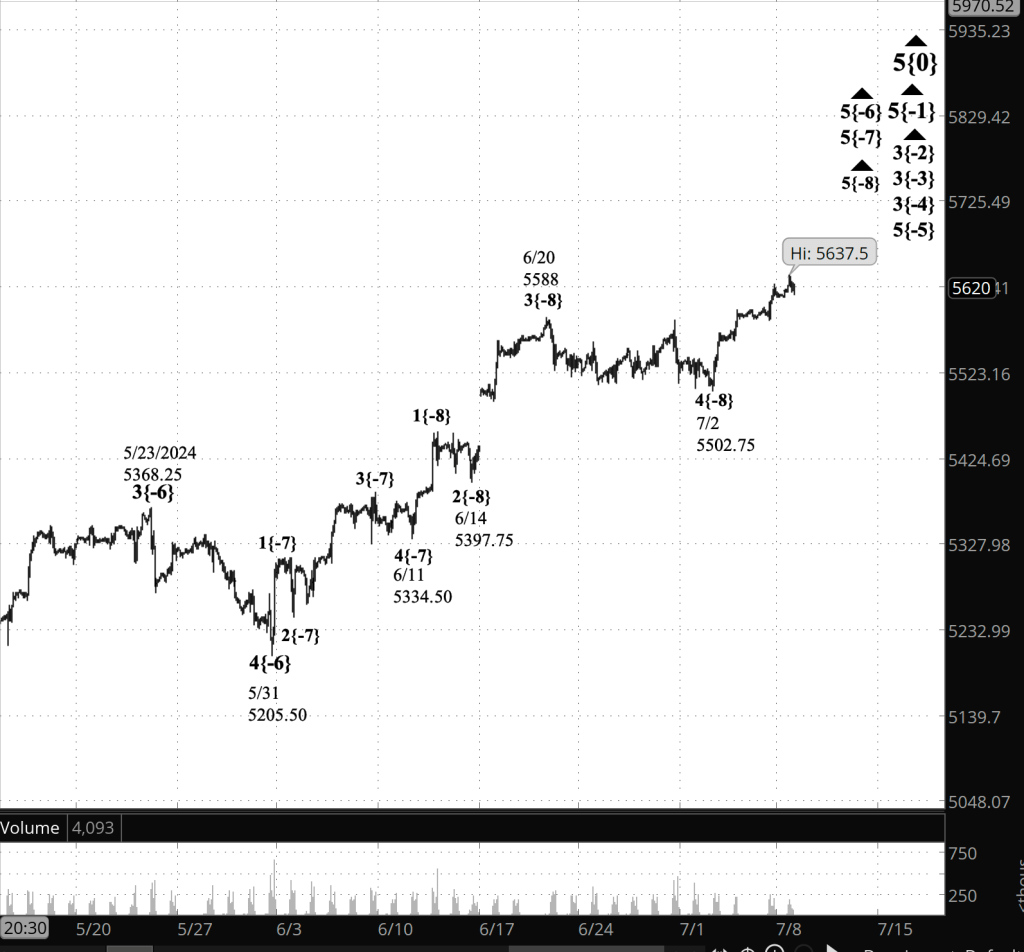
[S&P 500 E-mini futures at 3:30 p.m., 90-minute bars, with volume]

What does Elliott wave theory say? Here are the waves that underly the analyses.

Principal Analysis:

  • Rising wave 5{0} is underway. It is a wave of Intermediate degree that began in December 2018.
  • It is in its final subwave, wave 5{-1}.
  • Within wave 5{-1}, rising waves 3{-2}, 3{-3} and 3{-4} are underway, as is wave 5{-5}.
  • Wave 3{-6} is underway and is in its middle subwave, wave 5{-7}, which is in its final subwave, wave 5{-8}.
  • Wave 5{-8} is in its next-to-the-last subwave, wave 4{-9}, a downward correction.
  • Within wave 4{-9}, the final subwave, wave C{-10}, is underway and is in its nect-to-the-last subwave, wave 4{-11}.

Reading the chart. Price movements — waves – – in Elliott wave analysis are labeled with numbers within trending waves and letters with corrective waves. The subscripts — numbers in curly brackets — designate the wave’s degree, which, in Elliott wave analysis, means the relative position of a wave within the larger and smaller structures that make up the chart. R.N. Elliott, who in the 1930s developed the form of analysis that bears his name, viewed the chart as a complex structure of smaller waves nested within larger waves, which in turn are nested within still larger waves. In mathematics it’s called a fractal structure, where at every scale the pattern is similar to the others.

Learning and other resources. Elliott wave analysis provides context, not prophecy. As the 20th century semanticist Alfred Korzybski put it in his book Science and Sanity (1933), “The map is not the territory … The only usefulness of a map depends on similarity of structure between the empirical world and the map.” And I would add, in the ever-changing markets, we can judge that similarity of structure only after the fact.

See the menu page Analytical Methods for a rundown on where to go for information on Elliott wave analysis.

By Tim Bovee, Portland, Oregon, June 3, 2024

Disclaimer

Tim Bovee, Private Trader tracks the analysis and trades of a private trader for his own accounts. Nothing in this blog constitutes a recommendation to buy or sell stocks, options or any other financial instrument. The only purpose of this blog is to provide education and entertainment.

No trader is ever 100 percent successful in his or her trades. Trading in the stock and option markets is risky and uncertain. Each trader must make trading decisions for his or her own account, and take responsibility for the consequences.

License
Creative Commons License

All content on Tim Bovee, Private Trader by Timothy K. Bovee is licensed under a Creative Commons Attribution-ShareAlike 4.0 International License.

Based on a work at www.timbovee.com.
Trader’s Notebook

3:30 p.m. New York time

Half an hour before the closing bell. The S&P 500 futures fell during the session to within cents of 5205 and then rose again, retracing part of the decline. The 4th-wave downward correction that has defined the market since mid-May continues to work through its final wave.

I’ve updated the chart.

9:35 a.m. New York time

What’s happening now? The S&P 500 E-mini futures traded sideways overnight, in the 5230s and 5240s, rising quickly into the 5270s an hour before the opening bell, when the Personal Consumption Expenditures (PCE) Index for April was published.

Elliott Wave Theory. The rapid rise was a subwave two degrees deep within a relatively small 4th-wave downward correction that began on May 16. The correction is nearing its end. One degree deep, it is in its final subwave, wave C, and two degrees deep, it is in its middle subwave, wave 3. The rapid rise may well be the 4th subwave of five — an upward correction — within that low-degree 3rd wave.

Small waves? Why would anyone care? It is true that all of these waves are small waves buried deep within the fractal structure of the chart. Even so, a fractal structure implies that sometimes a small wave can trigger a tsunami of change. That’s the set-up here.`

From smaller to larger: The 4th subwave within wave C will be followed by a rising 5th subwave. When complete, that 5th subwave will be the end of wave C, and also the end of the 4th-wave downward correction that began on May 16. A 5th-wave uptrend will come next, and when it is done, it will be the end of a larger 5th-wave uptrend and also a still larger rising 5th wave that began on May 14 and May 8, respectively The end of those 5th waves will also be the end of a larger 3rd wave that began on May 7.

So that deeply buried subwave of wave C will trigger a series of endings across five degrees of the fractal structure.

What are the alternatives? There’s an ambiguity one degree above the 3rd wave that began on May 7. Under my principal analysis, I’ve labeled that wave as the 1st subwave within a still larger 5th-wave uptrend, both of which began on April 18. But is there really a 1st wave, or are all of the subwaves I’ve placed within wave 1 actually one degree higher?

The waves on the chart have the wave number followed by the degree, a subscript in curly brackets that shows the wave’s distance from Intermediate degree, a very large degree. The ongoing wave of Intermediate degree began in December 2018.

If there is no wave 1 still underway, then the waves on the chart labeled as labeled 3{-12}, C{-11}, 4{-10}, 5{-9}, 5{-8} and 3{-7} ought to be labeled 3{-11}, C{-10}, 4{-9}, 5{-8}, 5{-7} and 3{-6}. Under the alternative scenario, the 1st wave within wave 4{-5} ended on April 19.

At this point, the chart lacks the clarity needed to choose between the two scenarios. In the words of Valentine Michael Smith, a human foundling raised by Martians whose story was told in Robert Heinlein’s Stranger in a Strange Land, “Waiting is.”

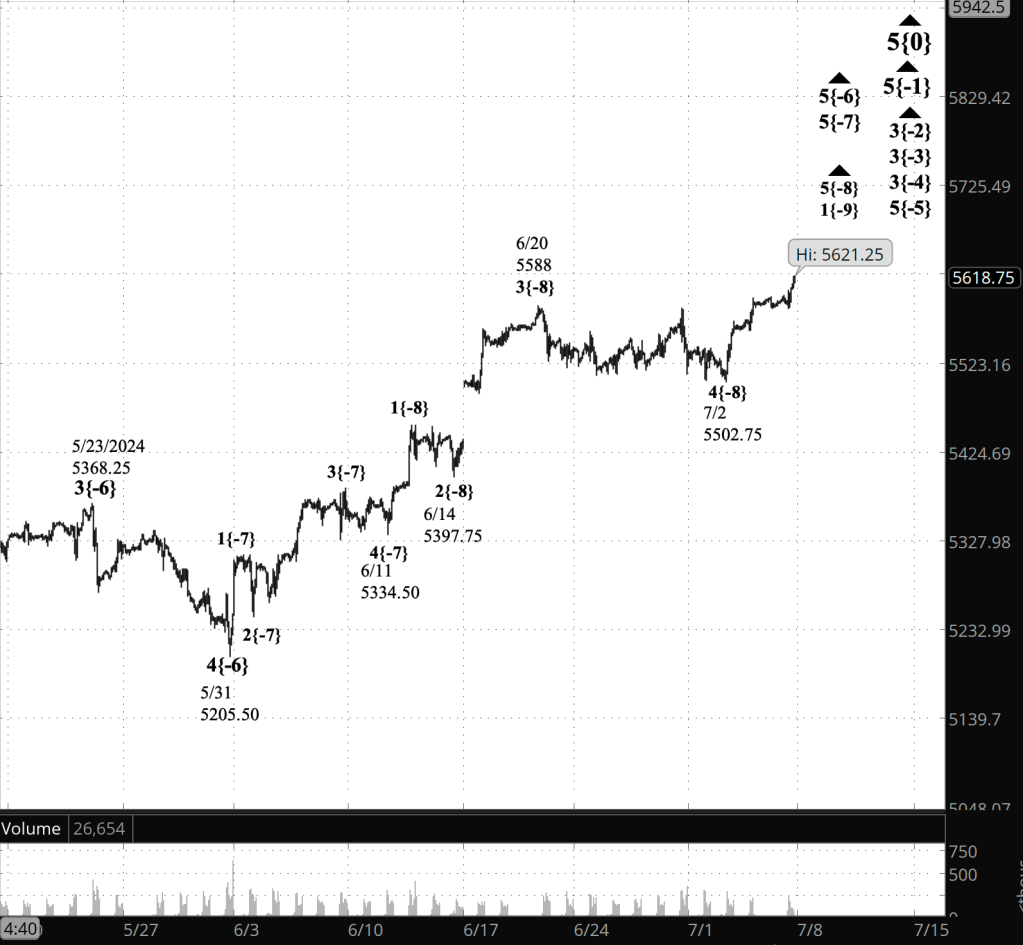
[S&P 500 E-mini futures at 3:30 p.m., 2-hour bars, with volume]

What does Elliott wave theory say? Here are the waves that underly the analyses.

Principal Analysis:

  • Rising wave 5{0} is underway. It is a wave of Intermediate degree that began in December 2018.
  • It is in its final subwave, wave 5{-1}.
  • Within wave 5{-1}, rising waves 3{-2}, 3{-3} and 3{-4} are underway, as is wave 5{-5}.
  • Wave 1{-6} is underway and is in its middle subwave, wave 3{-7}, which is in its final subwave, wave 5{-8}.
  • Wave 5{-8} is in its final subwave, wave 5{-9}, which is in its next-to-the-last subwave, wave 4{-10}.
  • Within wave 4{-10}, the final subwave, wave C{-11}, is underway and is in its middle subwave, wave 3{-12}.

Reading the chart. Price movements — waves – – in Elliott wave analysis are labeled with numbers within trending waves and letters with corrective waves. The subscripts — numbers in curly brackets — designate the wave’s degree, which, in Elliott wave analysis, means the relative position of a wave within the larger and smaller structures that make up the chart. R.N. Elliott, who in the 1930s developed the form of analysis that bears his name, viewed the chart as a complex structure of smaller waves nested within larger waves, which in turn are nested within still larger waves. In mathematics it’s called a fractal structure, where at every scale the pattern is similar to the others.

Learning and other resources. Elliott wave analysis provides context, not prophecy. As the 20th century semanticist Alfred Korzybski put it in his book Science and Sanity (1933), “The map is not the territory … The only usefulness of a map depends on similarity of structure between the empirical world and the map.” And I would add, in the ever-changing markets, we can judge that similarity of structure only after the fact.

See the menu page Analytical Methods for a rundown on where to go for information on Elliott wave analysis.

By Tim Bovee, Portland, Oregon, May 31, 2024

Disclaimer

Tim Bovee, Private Trader tracks the analysis and trades of a private trader for his own accounts. Nothing in this blog constitutes a recommendation to buy or sell stocks, options or any other financial instrument. The only purpose of this blog is to provide education and entertainment.

No trader is ever 100 percent successful in his or her trades. Trading in the stock and option markets is risky and uncertain. Each trader must make trading decisions for his or her own account, and take responsibility for the consequences.

License
Creative Commons License

All content on Tim Bovee, Private Trader by Timothy K. Bovee is licensed under a Creative Commons Attribution-ShareAlike 4.0 International License.

Based on a work at www.timbovee.com.
Trader’s Notebook

3:30 p.m. New York time

Half an hour before the closing bell. The S&P 500 futures has fluctuated between the 5250s and the 5270s during the session so far. Elliott Wave Theory: The C wave within the 4th-wave downward correction continues, with the analysis unchanged from this morning.

I’ve updated the chart.

9:35 a.m. New York time

What’s happening now? The S&P 500 E-mini futures fell overnight, from the 5270s to the 5250s, and then began to rise, returning to the 5270s in a rapid spike that coincided with the release of the second estimate of the Gross Deomestic Product for the initial three months of the year.

Elliott Wave Theory. The decline is part of the final subwave within the 4th-wave downward correction that began on on May 16. That subwave is wave C of the correction.

The C wave takes the form of what Elliott Wave Theory calls an impulse wave, five waves alternating in direction. Wave C is presently in its third subwave, often the longest of the five. Since its the C wave within a downward correction, both the C wave and the 3rd subwave will be trending lower.

What’s next? The 3rd subwave within wave C will be followed by a smaller 4th-wave upward correction and then a wave 5, a final push to the downside. Fifth waves tend to have a lot of variety. Sometimes they fail to make it beyond the end of the preceding 3rd wave. Sometimes they take on an extended form, moving far beyond where the wave 3 terminated. Sometimes they reach completion at the wave 3 end point.

The bigger picture. Although the 5th subwave within wave C is a small wave, it’s completion will have an outsized impact. Price movements on the chart have a fractal structure. Smaller waves are subwaves of larger waves which in turn are subwaves of still larger waves. And no matter how large or small, all of the waves create the same patterns: Impulse waves with five subwaves and corrective waves with three subwaves, with the occasional oddball triangle pattern that is seen less often. A wave’s position within the fractal structure is called its “degree”.

So the end of wave 5, a wave of small degree, will also be the end of wave C, one degree higher, and wave 4, two degrees higher, and wave 3, yet another degree higher. Wave 3 in this structure began on May 7, and when complete, it will be followed by a 4th-wave downward correction that is three degrees higher than the present 4th-wave that began on May 16 and that is nearing its end.

Encompassing all of this wave a 1st wave that began on April 18, according to my principal analysis. And there in lies an ambiguity.

What are the alternatives? I labeled the rise from April 18 as wave because its size seemed to match waves of similar degree that had come before. Like most attempts at pattern-recognition, there’s a subjective of element that means that the pattern may not be what it seems.

What if the degrees I’ve labeled as being subwaves of wave 1, stretching down six degrees, are really one degree higher? What if instead, the four smaller waves on the chart below wave 1 — labeled 4{-10}, 5{-9}, 5{-8} and 3{-7} — are one degree larger, eliminating the next higher degree. In that case, wave 1{-6} ended on April 23. See the Reading the Chart section below for an explanation of wave labeling, including the curly brackets.

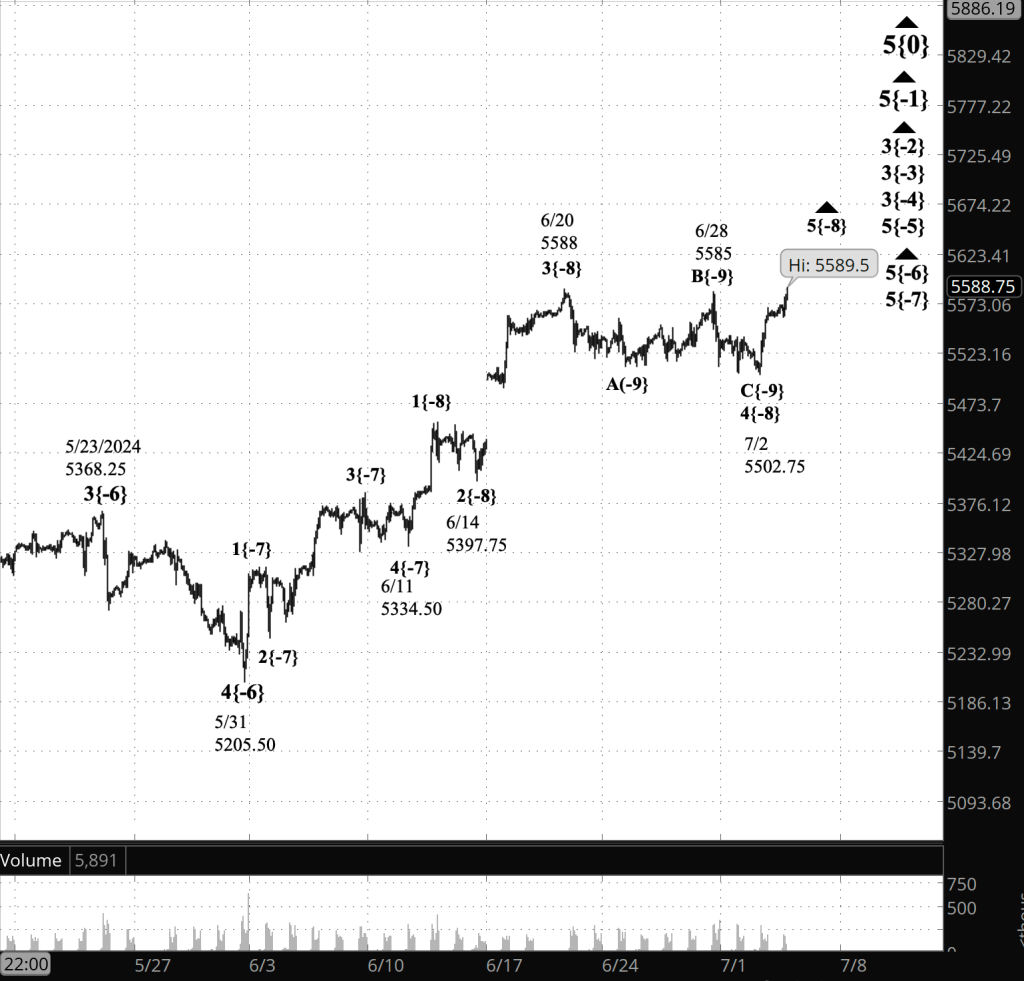
[S&P 500 E-mini futures at 3:30 p.m., 2-hour bars, with volume]

What does Elliott wave theory say? Here are the waves that underly the analyses.

Principal Analysis:

  • Rising wave 5{0} is underway. It is a wave of Intermediate degree that began in December 2018.
  • It is in its final subwave, wave 5{-1}.
  • Within wave 5{-1}, rising waves 3{-2}, 3{-3} and 3{-4} are underway, as is wave 5{-5}.
  • Wave 1{-6} is underway and is in its middle subwave, wave 3{-7}, which is in its final subwave, wave 5{-8}.
  • Wave 5{-8} is in its final subwave, wave 5{-9}, which is in its next-to-the-last subwave, wave 4{-10}.
  • Within wave 4{-10}, the final subwave, wave C{-11}, is underway and is in its middle subwave, wave 3{-12}.

Reading the chart. Price movements — waves – – in Elliott wave analysis are labeled with numbers within trending waves and letters with corrective waves. The subscripts — numbers in curly brackets — designate the wave’s degree, which, in Elliott wave analysis, means the relative position of a wave within the larger and smaller structures that make up the chart. R.N. Elliott, who in the 1930s developed the form of analysis that bears his name, viewed the chart as a complex structure of smaller waves nested within larger waves, which in turn are nested within still larger waves. In mathematics it’s called a fractal structure, where at every scale the pattern is similar to the others.

Learning and other resources. Elliott wave analysis provides context, not prophecy. As the 20th century semanticist Alfred Korzybski put it in his book Science and Sanity (1933), “The map is not the territory … The only usefulness of a map depends on similarity of structure between the empirical world and the map.” And I would add, in the ever-changing markets, we can judge that similarity of structure only after the fact.

See the menu page Analytical Methods for a rundown on where to go for information on Elliott wave analysis.

By Tim Bovee, Portland, Oregon, May 30, 2024

Disclaimer

Tim Bovee, Private Trader tracks the analysis and trades of a private trader for his own accounts. Nothing in this blog constitutes a recommendation to buy or sell stocks, options or any other financial instrument. The only purpose of this blog is to provide education and entertainment.

No trader is ever 100 percent successful in his or her trades. Trading in the stock and option markets is risky and uncertain. Each trader must make trading decisions for his or her own account, and take responsibility for the consequences.

License
Creative Commons License

All content on Tim Bovee, Private Trader by Timothy K. Bovee is licensed under a Creative Commons Attribution-ShareAlike 4.0 International License.

Based on a work at www.timbovee.com.
Trader’s Notebook

3:30 p.m. New York time

Half an hour before the closing bell. The S&P 500 futures went nowhere during the session, bouncing between the 5280s and the 5290s. Elliott Wave Theory sees the pattern as a small correction within the larger final subwave — wave C — of the 4th-wave downtrend that began on May 16.

I’ve updated the chart.

9:35 a.m. New York time

What’s happening now? The S&P 500 E-mini futures fell steadily overnight, from the 5320s to the 5270s.

Elliott Wave Theory. The final subwave of the 4th-wave downward correction that began on May 16 continues. The final subwave, wave C, began on May 23 and is in the 3rd of five still smaller subwaves. The correction is 10 degrees lower than Intermediate degree. The present Intermediate degree, a 5th wave within an uptrend, began in December 2018. So the correction is quite small, yet it’s end will echo up the fractal structure of the chart, causing larger changes.

Looking ahead. The completion of the 4th wave will also mark the end of two 5th waves uptrends of increasing size, and a still larger 3rd wave uptrend that began on May 2. Another 4th-wave downward correction will follow, three degrees larger than the correction now underway, with a correspondingly larger impact on the markets.

All of this is happening within a still larger 1st wave uptrend. Maybe…

What are the alternatives? That 1st wave, four degrees below Intermediate degree, began on April 18 according to the principal analysis. I inserted the 1st wave after comparing the length of time taken by previous similar waves of similar degree.

That’s suggestive, but not a certainty. It’s also possible that there is no 1st wave, and instead, that the four smaller waves on the chart below wave 1 — labeled 4{-10}, 5{-9}, 5{-8} and 3{-7} — are one degree larger, eliminating the next higher degree. In that case, wave 1{-6} ended on April 23. See the Reading the Chart section below for an explanation of wave labeling, including the curly brackets.

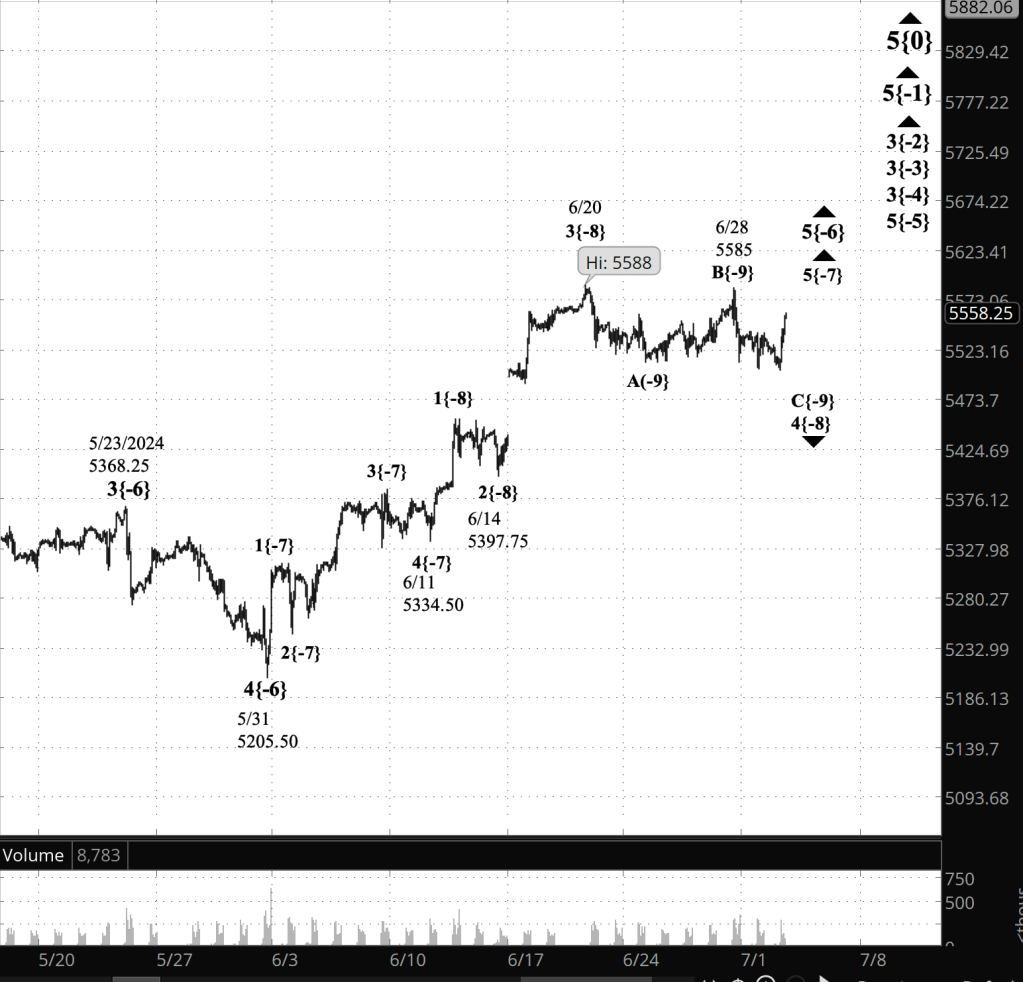
[S&P 500 E-mini futures at 3:30 p.m., 115-minute bars, with volume]

Waves on the chart. Here are the Elliott waves that underly the analyses.

Principal Analysis:

  • Rising wave 5{0} is underway. It is a wave of Intermediate degree that began in December 2018.
  • It is in its final subwave, wave 5{-1}.
  • Within wave 5{-1}, rising waves 3{-2}, 3{-3} and 3{-4} are underway, as is wave 5{-5}.
  • Wave 1{-6} is underway and is in its middle subwave, wave 3{-7}, which is in its final subwave, wave 5{-8}.
  • Wave 5{-8} is in its final subwave, wave 5{-9}, which is in its next-to-the-last subwave, wave 4{-10}.
  • Within wave 4{-10}, the final subwave, wave C{-11}, is underway.

Reading the chart. Price movements — waves – – in Elliott wave analysis are labeled with numbers within trending waves and letters with corrective waves. The subscripts — numbers in curly brackets — designate the wave’s degree, which, in Elliott wave analysis, means the relative position of a wave within the larger and smaller structures that make up the chart. R.N. Elliott, who in the 1930s developed the form of analysis that bears his name, viewed the chart as a complex structure of smaller waves nested within larger waves, which in turn are nested within still larger waves. In mathematics it’s called a fractal structure, where at every scale the pattern is similar to the others.

Learning and other resources. Elliott wave analysis provides context, not prophecy. As the 20th century semanticist Alfred Korzybski put it in his book Science and Sanity (1933), “The map is not the territory … The only usefulness of a map depends on similarity of structure between the empirical world and the map.” And I would add, in the ever-changing markets, we can judge that similarity of structure only after the fact.

See the menu page Analytical Methods for a rundown on where to go for information on Elliott wave analysis.

By Tim Bovee, Portland, Oregon, May 29, 2024

Disclaimer

Tim Bovee, Private Trader tracks the analysis and trades of a private trader for his own accounts. Nothing in this blog constitutes a recommendation to buy or sell stocks, options or any other financial instrument. The only purpose of this blog is to provide education and entertainment.

No trader is ever 100 percent successful in his or her trades. Trading in the stock and option markets is risky and uncertain. Each trader must make trading decisions for his or her own account, and take responsibility for the consequences.

License
Creative Commons License

All content on Tim Bovee, Private Trader by Timothy K. Bovee is licensed under a Creative Commons Attribution-ShareAlike 4.0 International License.

Based on a work at www.timbovee.com.
Trader’s Notebook

3:30 p.m. New York time

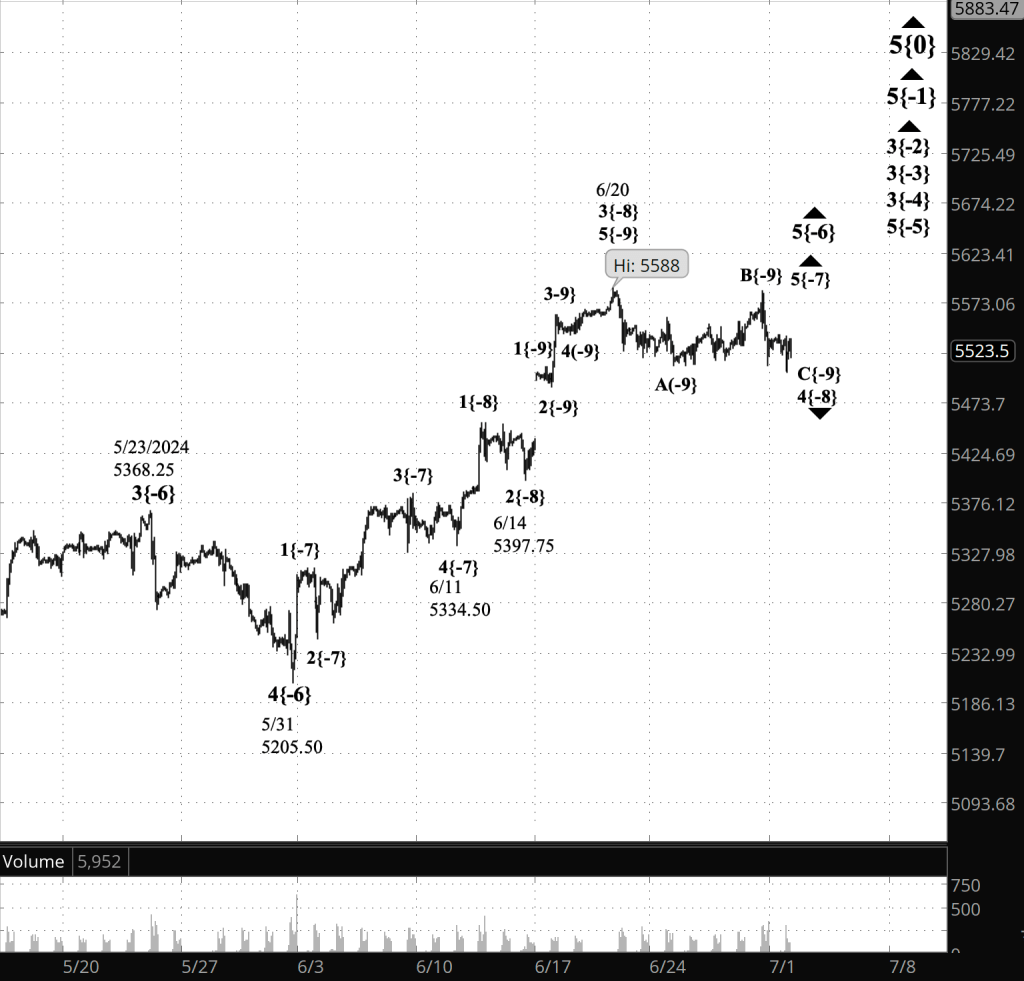
Half an hour before the closing bell. The S&P 500 futures fell during the session, reaching into the 5290s as the last subwave, wave C, of the 4th-wave downward correction continued. Wave 4 has been underway since May 16 and the C wave, since May 23.

I’ve updated the chart.

9:35 a.m. New York time

What’s happening now? The S&P 500 E-mini futures kept to a narrow range after trading resumed overnight following a long holiday weekend in the U.S, remaining in the 5320s and 5330s,

What does it mean? The 4th-wave downward correction continues and is in its final subwave — declining wave C. The correction began on May 16 and the C wave, on May 23.

Wave C remains below its starting point, 5368.25 and and its low point is in the neighborhood of the 4th subwave within the preceding 3rd wave — 5338 to 5328 — which is the range in which 4th-wave corrections usually end.

This correction is a small one, but like all 4th waves, it has large implications for the market’s future course.

A counter-trend 4th wave is the next-to-the-last wave within whatever larger trend it’s part of. It is followed by a 5th wave moving in the direction of the trend. When the 5th wave is complete, it’s also the end of the parent wave. And if the grandparent wave is also a 5th wave, it means the completion of that wave and its parent (calll it the great-grandparent).

The 5th wave that will follow the present 4th wave has a 5th wave parent and grandparent. The great-grandparent wave is a 3rd wave and will be followed by a 4th-wave downward correction three degrees higher than the present correction.

What are the alternatives? The principal analysis puts the 4th-wave correction and its subwaves within a still larger 1st wave that began on April 18. Maybe. It’s also possible that there is no still larger 1st wave, and instead, that the four smaller waves on the chart below wave 1 — labeled 4{-10}, 5{-9}, 5{-8} and 3{-7} — are one degree larger, eliminating the next higher degree. In that case, wave 1{-6} ended on April 23. See the Reading the Chart section below for an explanation of wave labeling, including the curly brackets.

[S&P 500 E-mini futures at 3:30 p.m., 115-minute bars, with volume]

What does Elliott wave theory say? Here are the waves that underly the analyses.

Principal Analysis:

  • Rising wave 5{0} is underway. It is a wave of Intermediate degree that began in December 2018.
  • It is in its final subwave, wave 5{-1}.
  • Within wave 5{-1}, rising waves 3{-2}, 3{-3} and 3{-4} are underway, as is wave 5{-5}.
  • Wave 1{-6} is underway and is in its middle subwave, wave 3{-7}, which is in its final subwave, wave 5{-8}.
  • Wave 5{-8} is in its final subwave, wave 5{-9}, which is in its next-to-the-last subwave, wave 4{-10}.
  • Within wave 4{-10}, the final subwave, wave C{-11}, is underway.

Reading the chart. Price movements — waves – – in Elliott wave analysis are labeled with numbers within trending waves and letters with corrective waves. The subscripts — numbers in curly brackets — designate the wave’s degree, which, in Elliott wave analysis, means the relative position of a wave within the larger and smaller structures that make up the chart. R.N. Elliott, who in the 1930s developed the form of analysis that bears his name, viewed the chart as a complex structure of smaller waves nested within larger waves, which in turn are nested within still larger waves. In mathematics it’s called a fractal structure, where at every scale the pattern is similar to the others.

Learning and other resources. Elliott wave analysis provides context, not prophecy. As the 20th century semanticist Alfred Korzybski put it in his book Science and Sanity (1933), “The map is not the territory … The only usefulness of a map depends on similarity of structure between the empirical world and the map.” And I would add, in the ever-changing markets, we can judge that similarity of structure only after the fact.

See the menu page Analytical Methods for a rundown on where to go for information on Elliott wave analysis.

By Tim Bovee, Portland, Oregon, May 28, 2024

Disclaimer

Tim Bovee, Private Trader tracks the analysis and trades of a private trader for his own accounts. Nothing in this blog constitutes a recommendation to buy or sell stocks, options or any other financial instrument. The only purpose of this blog is to provide education and entertainment.

No trader is ever 100 percent successful in his or her trades. Trading in the stock and option markets is risky and uncertain. Each trader must make trading decisions for his or her own account, and take responsibility for the consequences.

License
Creative Commons License

All content on Tim Bovee, Private Trader by Timothy K. Bovee is licensed under a Creative Commons Attribution-ShareAlike 4.0 International License.

Based on a work at www.timbovee.com.

Trader’s Notebook

Market Holiday. U.S. markets will be closed on Monday in observance of the Memorial Day holiday, which honors American military who died for their country. Trading of the S&P 500 futures will resume Monday night and the regular sessions will resume on Tuesday, May 28.

3:30 p.m. New York time

Half an hour before the closing bell. The S&P 500 futures climbed further, into the 5320s, and then dropped back slightly into the 5310s so far. Elliott Wave Theory: The session rise was the 4th subwave with wave C, the final subwave of the 4th-wave downward correction that began on May 16. The decline that followed is most likely the beginning of the 5th and final subwave within wave C. The 4th subwave of C is expected to have three subwaves, and that’s what shows on the chart. However, I’d like to see further decline to verify that wave C’s 5th subwave is underway.

I’ve updated the chart.

9:35 a.m. New York time

What’s happening now? The S&P 500 E-mini futures rose gently overnight, from the 5280s to above 5300.

What does it mean? Elliott Wave Theory sees the rise as part of the final subwave — wave C — of a 4th-wave downward correction that began on May 16. The C wave in a three-subwave correct has five subwaves, two degrees deep within the correction. The overnight rise is wave C’s 4th subwave.

A falling 5th subwave will follow, bringing wave C to a close and also ending the 4th-wave downward correction. A 5th-wave uptrend will follow. When it is complete, it will also be the end of two 5th waves, each larger than the one before, and a still larger 3rd wave that began on May 2.

What are the alternatives? All of that is happening within a still larger 1st wave that began on April 18. Maybe. It’s also possible that there is no still larger 1st wave, and instead, that the four smaller waves on the chart below wave 1 — labeled 4{-10}, 5{-9}, 5{-8} and 3{-7} — are one degree larger, eliminating the next higher degree. In that case, wave 1{-6} ended on April 23. See the Reading the Chart section below for an explanation of wave labeling, including the curly brackets.

[S&P 500 E-mini futures at 3:30 p.m., 110-minute bars, with volume]

What does Elliott wave theory say? Here are the waves that underly the analyses.

Principal Analysis:

  • Rising wave 5{0} is underway. It is a wave of Intermediate degree that began in December 2018.
  • It is in its final subwave, wave 5{-1}.
  • Within wave 5{-1}, rising waves 3{-2}, 3{-3} and 3{-4} are underway, as is wave 5{-5}.
  • Wave 1{-6} is underway and is in its middle subwave, wave 3{-7}, which is in its final subwave, wave 5{-8}.
  • Wave 5{-8} is in its final subwave, wave 5{-9}, which is in its next-to-the-last subwave, wave 4{-10}.
  • Within wave 4{-10}, the final subwave, wave C{-11}, is underway and likely is in its final subwave, wave 5{-12}.

Bigger Waves.

Of course, the fractal structure of the market isn’t limited to the smaller waves listed above. They are subwaves within a set of much bigger waves power enough to be rightly considered engines of history. Each line on the list shows the wave number, with the subscript in curly brackets, the traditional degree name, the starting date, the starting price of the S&P 500 E-mini futures, and the direction of the wave.

  • S&P 500 Index:
  • 5{+3} Supercycle, 7/8/1932, 4.40 (up)
  • 5{+2} Cycle, 12/9/1974, 60.96 (up)
  • 5{+1} Primary, 3/6/2009, 666.79 (up)
  • 5{0} Intermediate, 12/26/2018, 2346.58 (up)
  • S&P 500 Futures and index:
  • 5{-1} Minor, 10/13/2022, 3502 (up) (futures), 3491.58 (up) (index)

Reading the chart. Price movements — waves – – in Elliott wave analysis are labeled with numbers within trending waves and letters with corrective waves. The subscripts — numbers in curly brackets — designate the wave’s degree, which, in Elliott wave analysis, means the relative position of a wave within the larger and smaller structures that make up the chart. R.N. Elliott, who in the 1930s developed the form of analysis that bears his name, viewed the chart as a complex structure of smaller waves nested within larger waves, which in turn are nested within still larger waves. In mathematics it’s called a fractal structure, where at every scale the pattern is similar to the others.

Learning and other resources. Elliott wave analysis provides context, not prophecy. As the 20th century semanticist Alfred Korzybski put it in his book Science and Sanity (1933), “The map is not the territory … The only usefulness of a map depends on similarity of structure between the empirical world and the map.” And I would add, in the ever-changing markets, we can judge that similarity of structure only after the fact.

See the menu page Analytical Methods for a rundown on where to go for information on Elliott wave analysis.

By Tim Bovee, Portland, Oregon, May 24, 2024

Disclaimer

Tim Bovee, Private Trader tracks the analysis and trades of a private trader for his own accounts. Nothing in this blog constitutes a recommendation to buy or sell stocks, options or any other financial instrument. The only purpose of this blog is to provide education and entertainment.

No trader is ever 100 percent successful in his or her trades. Trading in the stock and option markets is risky and uncertain. Each trader must make trading decisions for his or her own account, and take responsibility for the consequences.

License
Creative Commons License

All content on Tim Bovee, Private Trader by Timothy K. Bovee is licensed under a Creative Commons Attribution-ShareAlike 4.0 International License.

Based on a work at www.timbovee.com.

Trader’s Notebook

3:30 p.m. New York time

Half an hour before the closing bell. The S&P 500 futures turned sharply downward during the session, moving rapidly from the overnight peak in the 5360s into the 5270s.

The decline invalidated this morning’s principal analysis. The 4th-wave downward correction that began on May 16 continues and is in its final subwave, wave C. When wave C is complete, it will also be the end of wave 4 and the beginning of a 5th-wave uptrend. But not yet.

I’ve updated the chart.

9:35 a.m. New York time

[Note that events on the chart have invalidated the analysis that follows.]

What’s happening now? The S&P 500 E-mini futures rose overnight, reaching into the 5360s.

What does it mean? Elliott Wave Theory sees the move to a new high as the first steps in a 5th-wave uptrend of low degree. The uptrend began on May 22 from 5306.75.

The preceding small 3rd-wave uptrend, usually the longest wave within a trend, took two days to complete. However, 5th waves tend to be on the quirky side. Sometimes they come up short, and sometimes they extend, moving beyond expectations.

This wave 5 has already moved beyond the end of the preceding 3rd wave and so by definition hasn’t come up short. It’s now in the as-expected territory.

The preceding 3rd wave rose 82.75 points. There’s no rule in Elliott Wave Theory that requires the 5th wave to be shorter or longer. If it covers a similar distance, it will reach into the 5380s.

In any case, wave 5 will have five subwaves. When complete, it will will also mark the end of two larger 5th waves in the fractal structure of the chart, and a still larger 3rd wave that began on May 7.

Waves are labeled on the chart with the wave number followed by a subscript, in curly brackets, that sow the wave’s distance from Intermediate degree in the fractal structure of the chart. The present Intermediate degree began in December 2018.

Here are the wave’s discussed above: Wave 4{-10} ended, wave 5{-10} has began, it has moved beyond the end of wave 3{-10}. When wave 5{-10} is complete, it will also mark the end of waves 5{-9} and 5{-9}, and also of their parent wave, 3{-8}. A downward correction, wave 4{-8}, will begin.

What are the alternatives? An ambiguity on the chart, regarding the 1st wave that began on April 18. The four smaller waves on the chart below wave 1 — labeled 4{-10}, 5{-9}, 5{-8} and 3{-7} — may in fact be one degree larger, eliminating the next higher degree, wave 1{-6}. See the Reading the Chart section below for an explanation of wave labeling, including the curly brackets.

[S&P 500 E-mini futures at 3:30 p.m., 110-minute bars, with volume]

Note that the above chart contains a major revidsion from this morning’s version]

What does Elliott wave theory say? Here are the waves that underly the analyses.

[Revised to account for events on the chart during the session]

Principal Analysis:

  • Rising wave 5{0} is underway. It is a wave of Intermediate degree that began in December 2018.
  • It is in its final subwave, wave 5{-1}.
  • Within wave 5{-1}, rising waves 3{-2}, 3{-3} and 3{-4} are underway, as is wave 5{-5}.
  • Wave 1{-6} is underway and is in its middle subwave, wave 3{-7}, which is in its final subwave, wave 5{-8}.
  • Wave 5{-8} is in its final subwave, wave 5{-9}, which is in its next-to-the-last subwave, wave 4{-10}.

We Are Here.

These are the waves currently in progress under my principal analysis. Each line on the list shows the wave number, with the subscript in curly brackets, the traditional degree name, the starting date, the starting price of the S&P 500 E-mini futures, and the direction of the wave.

  • S&P 500 Index:
  • 5{+3} Supercycle, 7/8/1932, 4.40 (up)
  • 5{+2} Cycle, 12/9/1974, 60.96 (up)
  • 5{+1} Primary, 3/6/2009, 666.79 (up)
  • 5{0} Intermediate, 12/26/2018, 2346.58 (up)
  • S&P 500 Futures and index:
  • 5{-1} Minor, 10/13/2022, 3502 (up) (futures), 3491.58 (up) (index)
  • S&P 500 Futures:

Reading the chart. Price movements — waves – – in Elliott wave analysis are labeled with numbers within trending waves and letters with corrective waves. The subscripts — numbers in curly brackets — designate the wave’s degree, which, in Elliott wave analysis, means the relative position of a wave within the larger and smaller structures that make up the chart. R.N. Elliott, who in the 1930s developed the form of analysis that bears his name, viewed the chart as a complex structure of smaller waves nested within larger waves, which in turn are nested within still larger waves. In mathematics it’s called a fractal structure, where at every scale the pattern is similar to the others.

Learning and other resources. Elliott wave analysis provides context, not prophecy. As the 20th century semanticist Alfred Korzybski put it in his book Science and Sanity (1933), “The map is not the territory … The only usefulness of a map depends on similarity of structure between the empirical world and the map.” And I would add, in the ever-changing markets, we can judge that similarity of structure only after the fact.

See the menu page Analytical Methods for a rundown on where to go for information on Elliott wave analysis.

By Tim Bovee, Portland, Oregon, May 23, 2024

Disclaimer

Tim Bovee, Private Trader tracks the analysis and trades of a private trader for his own accounts. Nothing in this blog constitutes a recommendation to buy or sell stocks, options or any other financial instrument. The only purpose of this blog is to provide education and entertainment.

No trader is ever 100 percent successful in his or her trades. Trading in the stock and option markets is risky and uncertain. Each trader must make trading decisions for his or her own account, and take responsibility for the consequences.

License
Creative Commons License

All content on Tim Bovee, Private Trader by Timothy K. Bovee is licensed under a Creative Commons Attribution-ShareAlike 4.0 International License.

Based on a work at www.timbovee.com.
Trader’s Notebook

3:30 p.m. New York time

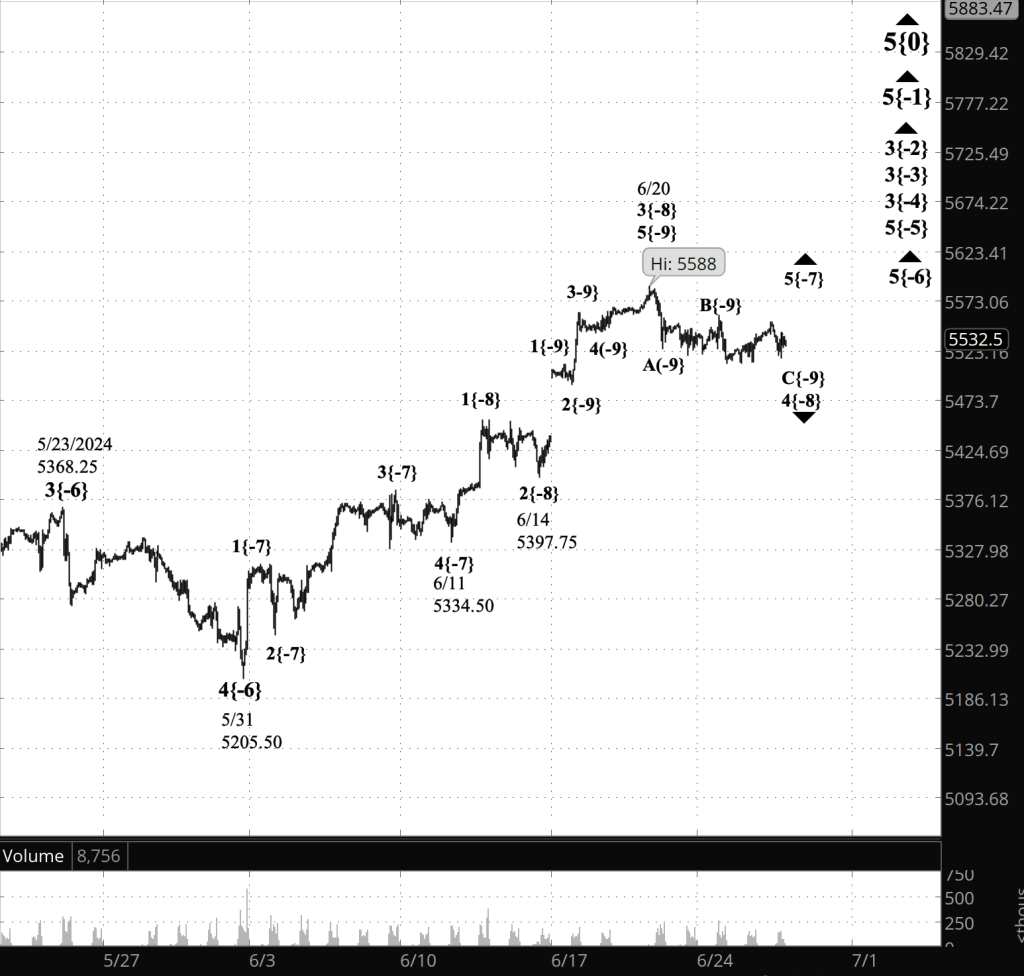
Half an hour before the closing bell. The S&P 500 futures fell sharply during the session, from the 5340s to below 5310. Elliott Wave Theory: The decline confirms this morning’s principal analysis, that declining wave C, the final subwave of the 4th-wave downward correction that began on May 16, is underway. It resolves the ambiguity discussed this morning over whether wave B had ended: It had.

I’ve updated the chart.

9:35 a.m. New York time

What’s happening now? The S&P 500 E-mini futures rose overnight to 25 cents above the starting point of the 4th-wave downward correction that began on May 16,

What does it mean? When applying the rules of Elliott Wave Theory, it becomes clear that the correction is taking the form of a Flat, which is common in 4th waves. This decline from May, wave A, had three subwaves, a sign of the Flat structure.

The rise that followed, wave B, is now underway, or may have ended at the overnight high, 5349.25. In labeling the chart, I’ve chosen the “still underway” scenario for my principal analysis but would be unsurprised if wave B rose still higher.

In any case, the B wave will be followed by declining wave C, the final subwave of the correction. An uptrending 5th wave will follow, completing the parent wave, a rising 5th wave that began on May 14, and triggering the end of two larger 5th waves, as well as the still larger 3rd wave that began on May 2.

The 3rd wave is a subwave within a larger 1st wave that began on April 18, along with its parent 5th wave. When the 3rd wave that began on May 2 is complete, it will be followed by a 4th-wave downward correction three degrees higher than the present 4th-degree correction within the fractal structure of the chart.

What are the alternatives? In addition to the ambiguity over whether wave B has ended, discussed above, there is a more significant ambiguity regarding the 1st wave that began on April 18. The four smaller waves on the chart below wave 1 — labeled 4{-10}, 5{-9}, 5{-8} and 3{-7} — may in fact be one degree larger, eliminating the next higher degree, wave 1{-6}. See the Reading the Chart section below for an explanation of wave labeling, including the curly brackets.

[S&P 500 E-mini futures at 3:30 p.m., 100-minute bars, with volume]

What does Elliott wave theory say? Here are the waves that underly the analyses, update with the afternoon analysis.

Principal Analysis:

  • Rising wave 5{0} is underway. It is a wave of Intermediate degree that began in December 2018.
  • It is in its final subwave, wave 5{-1}.
  • Within wave 5{-1}, rising waves 3{-2}, 3{-3} and 3{-4} are underway, as is wave 5{-5}.
  • Wave 1{-6} is underway and is in its middle subwave, wave 3{-7}, which is in its final subwave, wave 5{-8}.
  • Wave 5{-8} is in its final subwave, wave 5{-9}, which is in its next-to-the-last subwave, wave 4{-10}.
  • Wave 4{-10} is in its final subwave, wave C{-11}.

Reading the chart. Price movements — waves – – in Elliott wave analysis are labeled with numbers within trending waves and letters with corrective waves. The subscripts — numbers in curly brackets — designate the wave’s degree, which, in Elliott wave analysis, means the relative position of a wave within the larger and smaller structures that make up the chart. R.N. Elliott, who in the 1930s developed the form of analysis that bears his name, viewed the chart as a complex structure of smaller waves nested within larger waves, which in turn are nested within still larger waves. In mathematics it’s called a fractal structure, where at every scale the pattern is similar to the others.

Learning and other resources. Elliott wave analysis provides context, not prophecy. As the 20th century semanticist Alfred Korzybski put it in his book Science and Sanity (1933), “The map is not the territory … The only usefulness of a map depends on similarity of structure between the empirical world and the map.” And I would add, in the ever-changing markets, we can judge that similarity of structure only after the fact.

See the menu page Analytical Methods for a rundown on where to go for information on Elliott wave analysis.

By Tim Bovee, Portland, Oregon, May 22, 2024

Disclaimer

Tim Bovee, Private Trader tracks the analysis and trades of a private trader for his own accounts. Nothing in this blog constitutes a recommendation to buy or sell stocks, options or any other financial instrument. The only purpose of this blog is to provide education and entertainment.

No trader is ever 100 percent successful in his or her trades. Trading in the stock and option markets is risky and uncertain. Each trader must make trading decisions for his or her own account, and take responsibility for the consequences.

License
Creative Commons License

All content on Tim Bovee, Private Trader by Timothy K. Bovee is licensed under a Creative Commons Attribution-ShareAlike 4.0 International License.

Based on a work at www.timbovee.com.
Trader’s Notebook

3:30 p.m. New York time

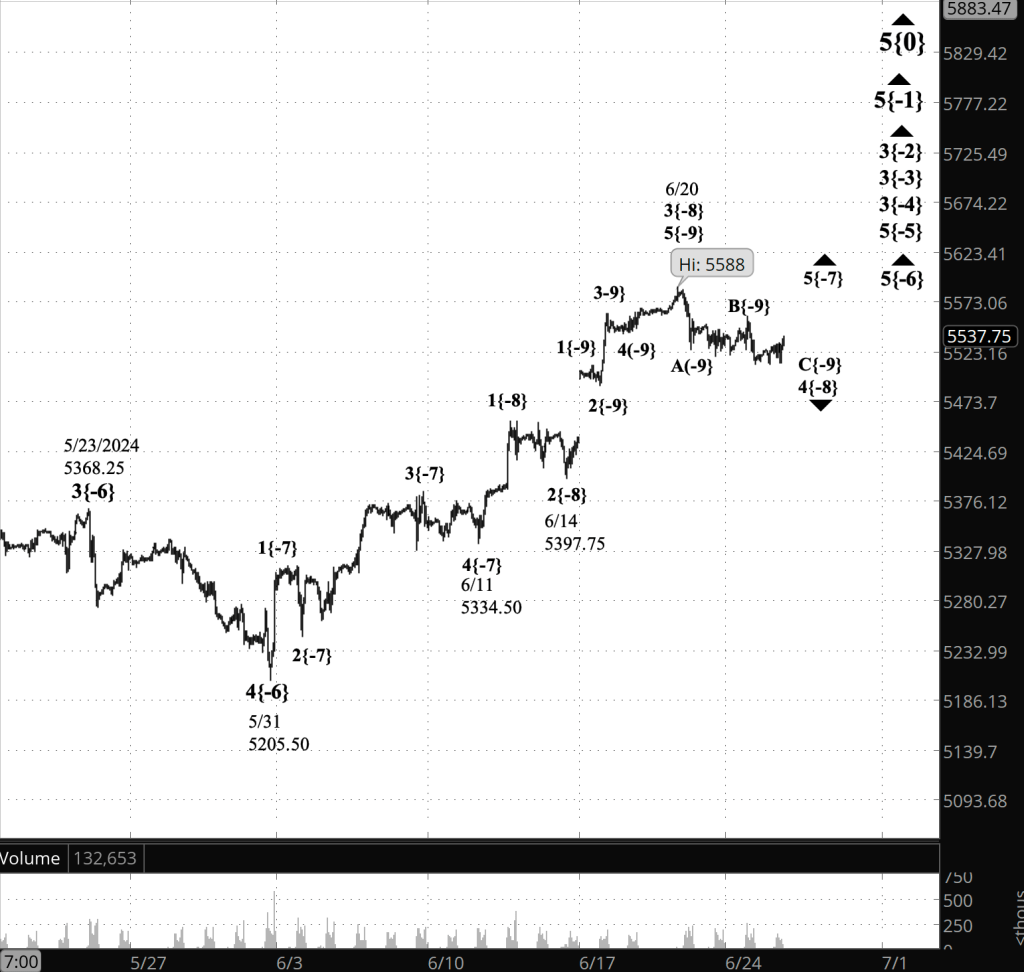
Half an hour before the closing bell. Elliott Wave Theory says: The S&P 500 futures continued to work their way through a 4th-wave downward correction of low degree. So far it has retraced 41% of the preceding 3rd wave. A 4th wave typically ends within the 4th subwave of the preceding 3rd wave. This small correction has moved bellow that level.

I focus on the correction because of what comes next: A rising 5th wave that will complete the smaller correction, which began on May 16, also that larger rising 5th wave that began on May 8, and the still larger 3rd wave that began on May 2, which will be followed by a larger downward correction.

I’ve updated the chart.

9:35 a.m. New York time

What’s happening now? The S&P 500 E-mini futures dropped back into the 5320s overnight.

What does it mean? Elliott Wave Theory reads the decline as a continuation of the 4th-wave downward correction of low degree that began on May 16. In other words, nothing in the analysis has really changed since yesterday.

Although the correction is small, two degrees below Minuscule degree in the traditional nomenclature, the fractal structure of the market’s price movements gives it significance far greater than its size.

Looking ahead, the end of the 4th-wave correction will also be the beginning of a 5th-wave uptrend. When the 5th wave is complete, it will also be completion of two nested 5th waves, each one degree higher in the fractal structure, the uptrending waves that began on May 14 and May 8. It will also mark the end of a 3rd-degree uptrend one degree higher, which began on May 2.

And so it goes. The English poet John Donne, in the beginning lines of a poem published in 1624, said it best: “No man is an island / entire of itself; / Every man is a piece of the continent, / A part of the main.”

In Elliott Wave Theory’s fractal structure, no wave stands alone.

What are the alternatives? Also unchanged. The four smallest waves on the chart — labeled 4{-10}, 5{-9}, 5{-8} and 3{-7} — may in fact be one degree larger, eliminating the next higher degree, wave 1{-6}. See the Reading the Chart section below for an explanation of wave labeling, including the curly brackets.

[S&P 500 E-mini futures at 3:30 p.m., 100-minute bars, with volume]

What does Elliott wave theory say? Here are the waves that underly the analyses.

Principal Analysis:

  • Rising wave 5{0} is underway. It is a wave of Intermediate degree that began in December 2018.
  • It is in its final subwave, wave 5{-1}.
  • Within wave 5{-1}, rising waves 3{-2}, 3{-3} and 3{-4} are underway, as is wave 5{-5}.
  • Wave 1{-6} is underway and is in its middle subwave, wave 3{-7}, which is in its final subwave, wave 5{-8}.
  • Wave 5{-8} is in its final subwave, wave 5{-9}, which is in its next-to-the-last subwave, wave 4{-10}.

Reading the chart. Price movements — waves – – in Elliott wave analysis are labeled with numbers within trending waves and letters with corrective waves. The subscripts — numbers in curly brackets — designate the wave’s degree, which, in Elliott wave analysis, means the relative position of a wave within the larger and smaller structures that make up the chart. R.N. Elliott, who in the 1930s developed the form of analysis that bears his name, viewed the chart as a complex structure of smaller waves nested within larger waves, which in turn are nested within still larger waves. In mathematics it’s called a fractal structure, where at every scale the pattern is similar to the others.

Learning and other resources. Elliott wave analysis provides context, not prophecy. As the 20th century semanticist Alfred Korzybski put it in his book Science and Sanity (1933), “The map is not the territory … The only usefulness of a map depends on similarity of structure between the empirical world and the map.” And I would add, in the ever-changing markets, we can judge that similarity of structure only after the fact.

See the menu page Analytical Methods for a rundown on where to go for information on Elliott wave analysis.

By Tim Bovee, Portland, Oregon, May 21, 2024

Disclaimer

Tim Bovee, Private Trader tracks the analysis and trades of a private trader for his own accounts. Nothing in this blog constitutes a recommendation to buy or sell stocks, options or any other financial instrument. The only purpose of this blog is to provide education and entertainment.

No trader is ever 100 percent successful in his or her trades. Trading in the stock and option markets is risky and uncertain. Each trader must make trading decisions for his or her own account, and take responsibility for the consequences.

License
Creative Commons License

All content on Tim Bovee, Private Trader by Timothy K. Bovee is licensed under a Creative Commons Attribution-ShareAlike 4.0 International License.

Based on a work at www.timbovee.com.

Trader’s Notebook

3:30 p.m. New York time

Half an hour before the closing bell. The S&P 500 futures swung up into the 5340s during the session and fell down into the 5320s, returning to the 5330s as the closing bell approached.

Were Shakespeare analyzing this session chart, he would pronounce it “full of sound and fury, signifying nothing.” Elliott Wave Theory, however, is far less skilled with words than the Bard, and pronounces the chart, “A continuation of the 4th-wave downward correction that began on May 16.”

I love Shakespeare for the beauty of his prose, but spend more time with Elliott Wave Theory for the clarity of its conclusions.

The session high, 5348.75, is likely the end of the second of three waves within the correction, the B wave, and the declining wave that followed is the final wave in the correction, a C wave. The B wave has three subwaves, so unless there’s a reversal above that peak, the B wave is history.

A 5th-wave uptrend of low degree will follow the C wave.

I’ve updated the chart.

9:35 a.m. New York time

What’s happening now? The S&P 500 E-mini futures traded narrowly after trading resumed overnight, rising into the 5330s in the first 5 minutes and staying within that range thereafter.

What does it mean? Elliott Wave Theory sees the overnight pattern as a continuation of the 4th-wave downward correction of low degree that began on May 16. The correction is part of a larger, although still low degree, 5th-wave uptrend that began on May 14.

From that point, as we climb the fractal structure of the chart, we encounter a nested series of uptrending waves that are underway: A 5th-wave uptrend that began on May 8; 3rd wave, May 2; 1st-wave, April 18th wave; 5th wave, April 18.

Each 5th wave, when complete, will signal the end of its parent wave. Each 3rd or 1st wave, when complete, will be followed by a downward correction.

The nested series of waves listed above will be followed by a series of nested 3rd waves of increasing size, covering 4 degrees.

All of this is happening within a 5th-wave uptrend that began on October 13, 2022 from 3502.

For my daily trading I follow the waves of lower degree. However, it’s important to remember that the waves of higher degree have the ability to upset the economy and indeed the wellbeing the nation.

When the 5th-wave uptrend that began on October 13, 2022 is complete, it will trigger the end of a nested series of 5th waves that began on March 6 2009, December 9, 1974 and July 8, 1932.

The downtrend that follows will be an event for the history books.

What are the alternatives? Returning to the more recent waves of low degree, the four smallest waves on the chart — labeled 4{-10}, 5{-9}, 5{-8} and 3{-7} — may in fact be one degree larger, eliminating the next higher degree, wave 1{-6}. See the Reading the Chart section below for an explanation of wave labeling, including the curly brackets.

[S&P 500 E-mini futures at 3:30 p.m., 100-minute bars, with volume]

What does Elliott wave theory say? Here are the waves that underly the analyses.

Principal Analysis:

  • Rising wave 5{0} is underway. It is a wave of Intermediate degree that began in December 2018.
  • It is in its final subwave, wave 5{-1}.
  • Within wave 5{-1}, rising waves 3{-2}, 3{-3} and 3{-4} are underway, as is wave 5{-5}.
  • Wave 1{-6} is underway and is in its middle subwave, wave 3{-7}, which is in its final subwave, wave 5{-8}.
  • Wave 5{-8} is in its final subwave, wave 5{-9}, which is in its next-to-the-last subwave, wave 4{-10}.

Big Picture.

These are the higher-degree waves currently in progress under my principal analysis. Each line on the list shows the wave number, with the subscript in curly brackets, the traditional degree name, the starting date, the starting price of the S&P 500 E-mini futures, and the direction of the wave.

  • S&P 500 Index:
  • 5{+3} Supercycle, 7/8/1932, 4.40 (up)
  • 5{+2} Cycle, 12/9/1974, 60.96 (up)
  • 5{+1} Primary, 3/6/2009, 666.79 (up)
  • 5{0} Intermediate, 12/26/2018, 2346.58 (up)
  • S&P 500 Futures and Index:
  • 5{-1} Minor, 10/13/2022, 3502 (up) (futures), 3491.58 (up) (index)

Reading the chart. Price movements — waves – – in Elliott wave analysis are labeled with numbers within trending waves and letters with corrective waves. The subscripts — numbers in curly brackets — designate the wave’s degree, which, in Elliott wave analysis, means the relative position of a wave within the larger and smaller structures that make up the chart. R.N. Elliott, who in the 1930s developed the form of analysis that bears his name, viewed the chart as a complex structure of smaller waves nested within larger waves, which in turn are nested within still larger waves. In mathematics it’s called a fractal structure, where at every scale the pattern is similar to the others.

Learning and other resources. Elliott wave analysis provides context, not prophecy. As the 20th century semanticist Alfred Korzybski put it in his book Science and Sanity (1933), “The map is not the territory … The only usefulness of a map depends on similarity of structure between the empirical world and the map.” And I would add, in the ever-changing markets, we can judge that similarity of structure only after the fact.

See the menu page Analytical Methods for a rundown on where to go for information on Elliott wave analysis.

By Tim Bovee, Portland, Oregon, May 20, 2024

Disclaimer

Tim Bovee, Private Trader tracks the analysis and trades of a private trader for his own accounts. Nothing in this blog constitutes a recommendation to buy or sell stocks, options or any other financial instrument. The only purpose of this blog is to provide education and entertainment.

No trader is ever 100 percent successful in his or her trades. Trading in the stock and option markets is risky and uncertain. Each trader must make trading decisions for his or her own account, and take responsibility for the consequences.

License
Creative Commons License

All content on Tim Bovee, Private Trader by Timothy K. Bovee is licensed under a Creative Commons Attribution-ShareAlike 4.0 International License.

Based on a work at www.timbovee.com.