Trader’s Notebook

3:30 p.m. New York time

Half an hour before the closing bell. The S&P 500 futures fluctuated sideways during the session, remaining between the 5540s and the 5510s. Elliott Wave Theory: The 4th-wave downward correction within a larger 5th-wave uptrend continues. The 5th wave began on June 11, and the 4th wave, on June 20.

I’ve updated the chart.

9:35 a.m. New York time

What’s happening now? The S&P 500 E-mini futures fell from the 5550s to the 5520s overnight.

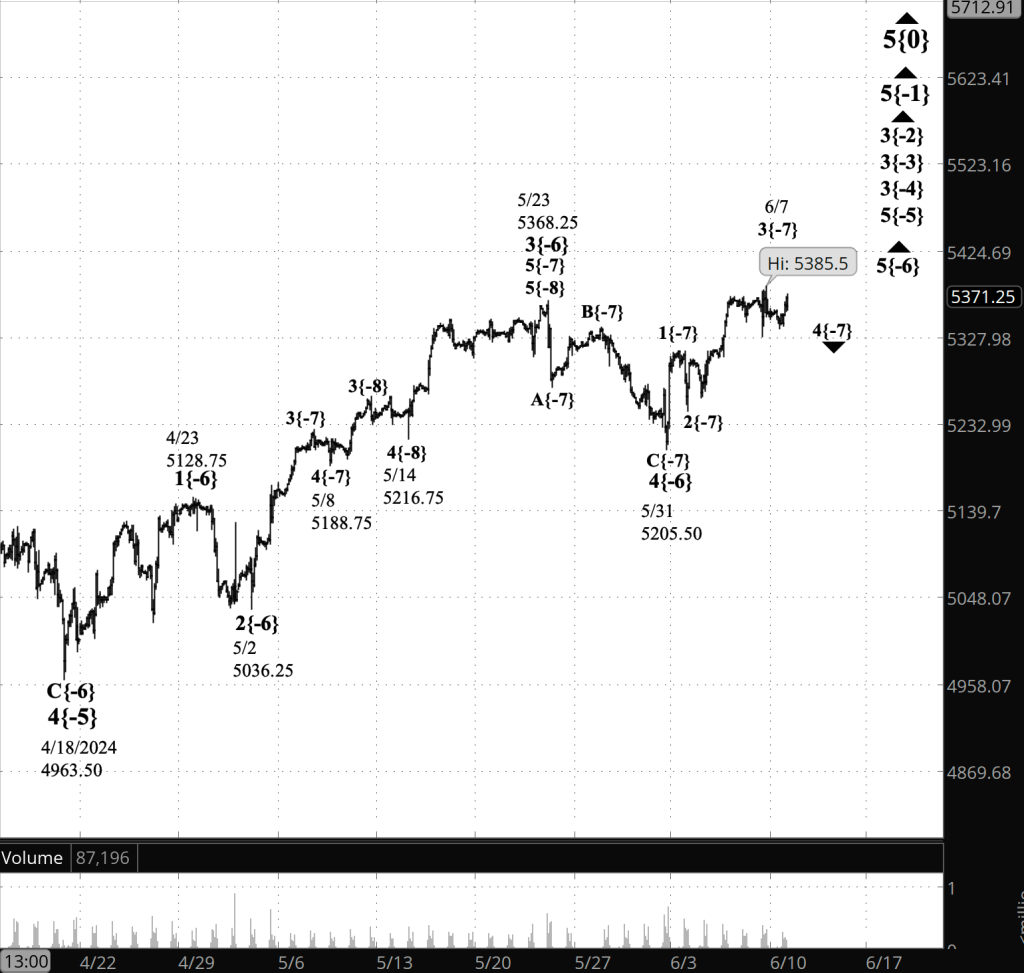
What does it mean? I’ve moved the chart in for a closer view, and it clarifies the Elliott Wave Theory analysis: The uptrend that began on June 11 has completed its 3rd subwave and is now in a low-degree 4th-wave downward correction.

When that correction is complete, a 5th wave will follow, completing the June 11 5th wave and cascading up the fractal structure of chart, also completing 5th waves three degrees higher and a 3rd wave four degrees higher.

That larger 3rd wave, which began on February 21 from 4959, will be followed by a 4th-wave downward correction of similar magnitude.

On the chart, each wave is marked with a wave number and a subscript in curly brackets showing the wave’s distance in fractal degrees from the Intermediate degree. The present Intermediate degree, wave 5{0}, began in December 2018.

Working down from the largest wave discussed in the analysis, from the 3rd-wave that began on February 21, the waves appear on the chart as waves 3{-4}, 5{-5}, 5{-6} and 5{-7}. Within wave 5{-7}, wave 4{-8}, a downward correction, is underway.

Seee the June 22 Trader’s Notebook for a broader view of the chart, reaching back to the beginning of wave 5{-6} on May 31.

What are the alternatives? Unchanged from the day before. There may be a 1st wave on the chart, between wave 5{-6} and 5{-5}. If that’s the proper count, then it would delay the onset or the 4th-wave downward correction, wave 4{-4}. See the June 18 Trader’s Notebook for a more detailed discussion.

[S&P 500 E-mini futures at 3:30 p.m., 1-hour bars, with volume]

What does Elliott wave theory say? Here are the waves that underly the analyses.

Principal Analysis:

  • Rising wave 5{0} is underway. It is a wave of Intermediate degree that began in December 2018.
  • It is in its final subwave, wave 5{-1}.
  • Within wave 5{-1}, rising waves 3{-2}, 3{-3} and 3{-4} are underway, as is wave 5{-5}.
  • Wave 5{-6} is underway and is in its final subwave, uptrending wave 5{-7} and its subwave, downtrending wave 4{-8}, a corrective wave.

Reading the chart. Price movements — waves – – in Elliott wave analysis are labeled with numbers within trending waves and letters with corrective waves. The subscripts — numbers in curly brackets — designate the wave’s degree, which, in Elliott wave analysis, means the relative position of a wave within the larger and smaller structures that make up the chart. R.N. Elliott, who in the 1930s developed the form of analysis that bears his name, viewed the chart as a complex structure of smaller waves nested within larger waves, which in turn are nested within still larger waves. In mathematics it’s called a fractal structure, where at every scale the pattern is similar to the others.

Learning and other resources. Elliott wave analysis provides context, not prophecy. As the 20th century semanticist Alfred Korzybski put it in his book Science and Sanity (1933), “The map is not the territory … The only usefulness of a map depends on similarity of structure between the empirical world and the map.” And I would add, in the ever-changing markets, we can judge that similarity of structure only after the fact.

See the menu page Analytical Methods for a rundown on where to go for information on Elliott wave analysis.

By Tim Bovee, Portland, Oregon, June 21, 2024

Disclaimer

Tim Bovee, Private Trader tracks the analysis and trades of a private trader for his own accounts. Nothing in this blog constitutes a recommendation to buy or sell stocks, options or any other financial instrument. The only purpose of this blog is to provide education and entertainment.

No trader is ever 100 percent successful in his or her trades. Trading in the stock and option markets is risky and uncertain. Each trader must make trading decisions for his or her own account, and take responsibility for the consequences.

License
Creative Commons License

All content on Tim Bovee, Private Trader by Timothy K. Bovee is licensed under a Creative Commons Attribution-ShareAlike 4.0 International License.

Based on a work at www.timbovee.com.

Trader’s Notebook

3:30 p.m. New York time

Half an hour before the closing bell. The S&P 500 futures fell during the session, into the 5520s.

Applying Elliott Wave Theory, I find a lack of clarity in that small-wave decline. My best interpretation is that it is a downward correction within the 3rd subwave of the 5th wave uptrend that began on June 14. That 5th wave is labelled wave 5{-8} on the chart.

9:35 a.m. New York time

What’s happening now? The S&P 500 E-mini futures rose slightly after trading resumed overnight, reaching into the 5580s.

What does it mean? In Elliott Wave Theory, the rise is a continuation of a small 5th-wave uptrend that began on June 14, a subwave of a series of uptrending waves.

A 5th wave is the last of the subwaves within a trend, and when the smallest of the subwaves is complete, it will cascade up the fractal structure of the chart, bringing a nested series of waves of increasing size to an end.

Put more succinctly: It’s a small 5th wave with outsized consequences.

Waves on the chart are labeled with the wave number followed by a subscript within curly brackets that tells wave’s distance within the fractal structure from the parent wave of Intermediate degree, presently wave 5{0}, which began in December 2018. The small wave that began this discussion is wave 5{-8} — eight degrees lower than the Intermediate degree wave 5{0}.

When wave 5{-8} is complete, it will also be the end of wave 5{-7}, which began on June 11; wave 5{-6}, which began on May 31; and wave 5{-5}, which began on April 18.

The wave one degree higher is wave 3{-4}, which began on February 21, which traditional Elliott Wave nomenclature would label as a wave of Subminuette degree.

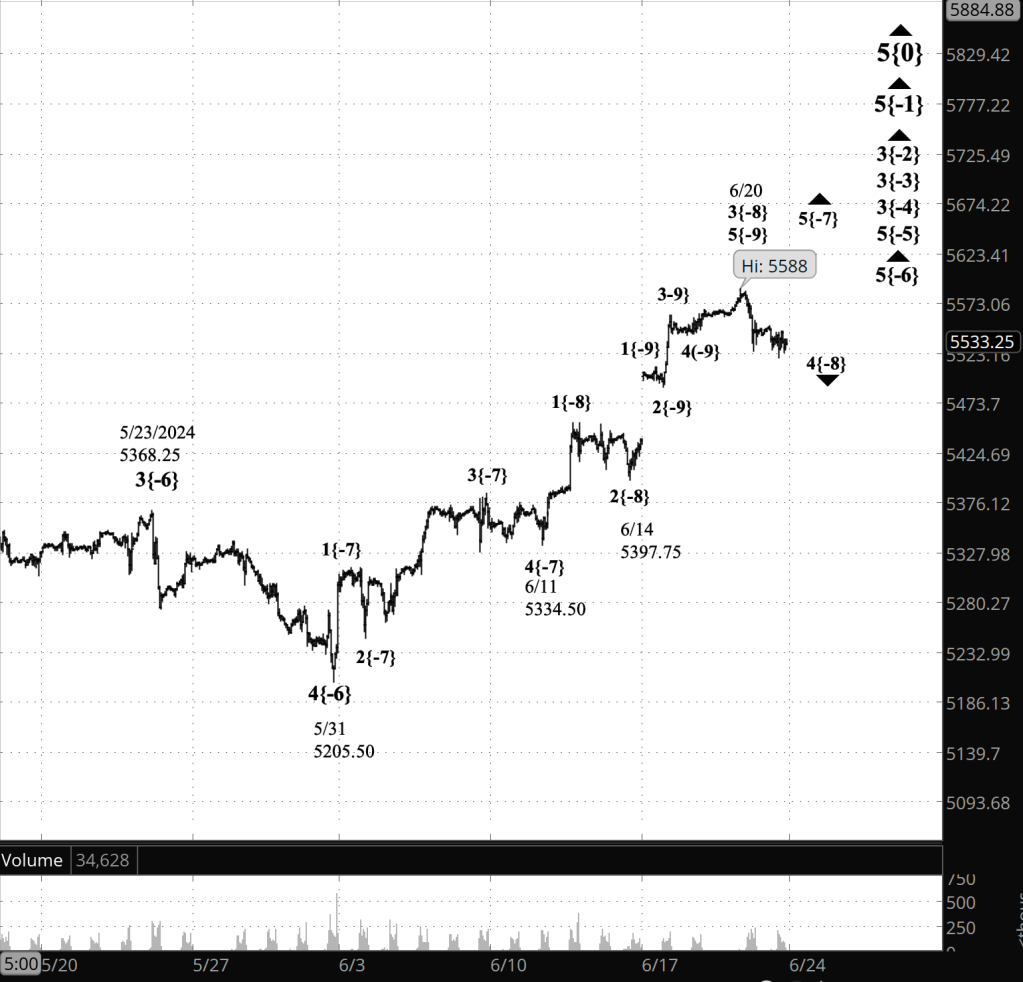
That uptrending 3rd wave will be followed by a 4th-wave downward correction, wave 4{-4}. A 4th wave tends to end within the range of the 4th wave within the preceding 3rd wave, or wave 4{-6}. That suggests a target range running from the 5250s to the 5160s. Note that the target range is a tendency, not a firm rule. Wave 4{-4} could come up short or fall further.

Here’s a portion of the chart showing the target range.,

[S&P 500 E-mini futures, 2-hour bars, March to May 2024]

What are the alternatives? There may be a 1st wave on the chart, between wave 5{-6} and 5{-5}. If that’s the proper count, then it would delay the onset or the 4th-wave downward correction, wave 4{-4}. See the June 18 Trader’s Notebook for a more detailed discussion.
Today’s chart.

[S&P 500 E-mini futures at 3:30 p.m., 2-hour bars, with volume]

What does Elliott wave theory say? Here are the waves that underly the analyses.

Principal Analysis:

  • Rising wave 5{0} is underway. It is a wave of Intermediate degree that began in December 2018.
  • It is in its final subwave, wave 5{-1}.
  • Within wave 5{-1}, rising waves 3{-2}, 3{-3} and 3{-4} are underway, as is wave 5{-5}.
  • Wave 5{-6} is underway and is in its final subwave, uptrending wave 5{-7} and its subwave, uptrending wave 5{-8}.

Reading the chart. Price movements — waves – – in Elliott wave analysis are labeled with numbers within trending waves and letters with corrective waves. The subscripts — numbers in curly brackets — designate the wave’s degree, which, in Elliott wave analysis, means the relative position of a wave within the larger and smaller structures that make up the chart. R.N. Elliott, who in the 1930s developed the form of analysis that bears his name, viewed the chart as a complex structure of smaller waves nested within larger waves, which in turn are nested within still larger waves. In mathematics it’s called a fractal structure, where at every scale the pattern is similar to the others.

Learning and other resources. Elliott wave analysis provides context, not prophecy. As the 20th century semanticist Alfred Korzybski put it in his book Science and Sanity (1933), “The map is not the territory … The only usefulness of a map depends on similarity of structure between the empirical world and the map.” And I would add, in the ever-changing markets, we can judge that similarity of structure only after the fact.

See the menu page Analytical Methods for a rundown on where to go for information on Elliott wave analysis.

By Tim Bovee, Portland, Oregon, June 20, 2024

Disclaimer

Tim Bovee, Private Trader tracks the analysis and trades of a private trader for his own accounts. Nothing in this blog constitutes a recommendation to buy or sell stocks, options or any other financial instrument. The only purpose of this blog is to provide education and entertainment.

No trader is ever 100 percent successful in his or her trades. Trading in the stock and option markets is risky and uncertain. Each trader must make trading decisions for his or her own account, and take responsibility for the consequences.

License
Creative Commons License

All content on Tim Bovee, Private Trader by Timothy K. Bovee is licensed under a Creative Commons Attribution-ShareAlike 4.0 International License.

Based on a work at www.timbovee.com.
Trader’s Notebook

Market holiday on Wednesday. U.S. markets will be closed on Wednesday, June 19, for Juneteenth, a holiday celebrating the ending of slavery after of the American Civil War.

3:30 p.m. New York time

Half an hour before the closing bell. The S&P 500 futures leaned slightly toward the upside, reaching into the 5560s before scurrying back into the trading range established overnight.

The 5th-wave uptrend that began on June 14 continues and is in its final subwave.

I’ve updated the chart.

9:35 a.m. New York time

What’s happening now? The S&P 500 E-mini futures traded sideways overnight, fluctuating in the 5540s and 5550s.

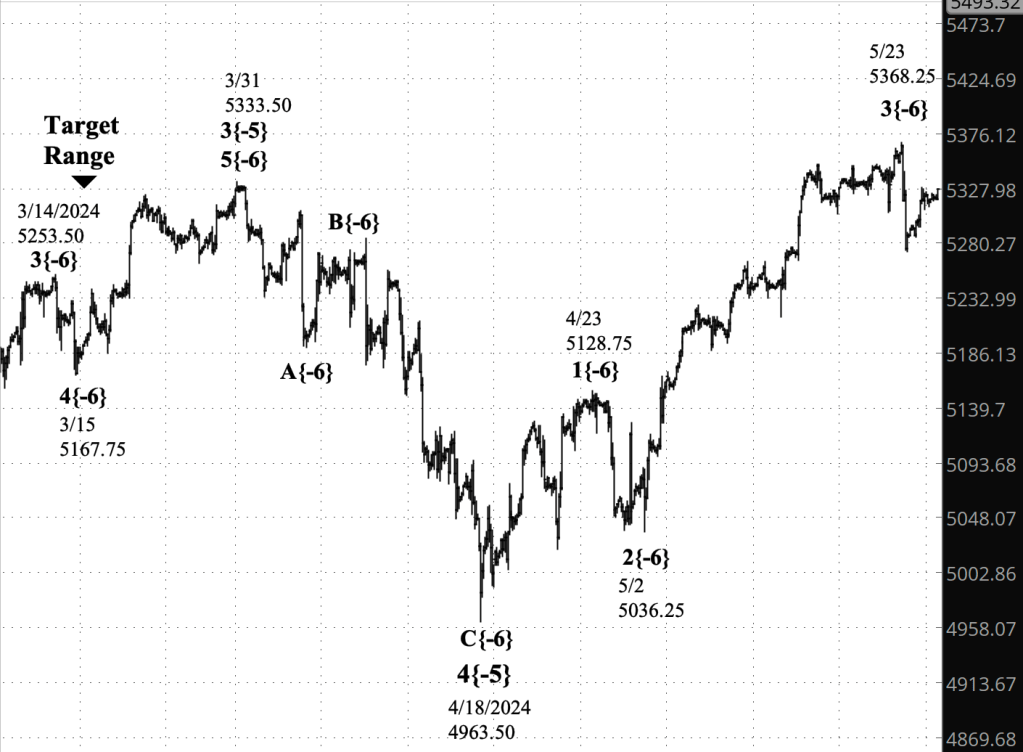
What does it mean? In my principal analysis, Elliott Wave Theory sees the pause as a very small corrective wave within the 5th-wave uptrend that began on June 14. It will be followed by a resumption of the uptrend.

Bigger picture. The 5th-wave uptrend is of relatively small degree — days rather than weeks. It is the final wave within a 5th wave one degree higher, a condition that hold true for two additional 5th waves of still higher degrees.

Encompassing the 5th waves is a 3rd wave that began on February 21. The end of the 5th wave of highest degree in the present set up will also be the end of that 3rd wave and the beginning of a 4th-wave downward correction.

That 3rd wave and the 4th wave that will follow are of relatively large degree — months not weeks — and the downward correction will be large enough to cast doubt on the uptrend — “bull market” — that has been underway since April 18.

What are the alternatives? There is always a degree of ambiguity in figuring out where a wave belongs in the fractal hierarchy of the chart. In this discussion I’ll use the wave labels as they appear on the chart: A wave number followed by a subscript in curly brackets showing how many degrees removed from Intermediate degree the wave is. The present intermediate degree is wave 5{0}, which began in December 2018.

It’s possible that wave 5{-6}, which began on May 31, is actually a degree smaller than its present label says, as are all of its subwaves, and that they are part of a 1st wave with a still larger 5th wave. On the chart, the larger 5th wave changes from 5{-6} to 5[-7}, wave 1{-6} is inserted into the line-up, They’re all subwaves if wave 5{-5}.

One major effect of this alternative, if in fact it proves to be accurate, would be to delay the large 4th-wave downward correction discussed in the principal analysis. The wave of that degree is presently 3{-4}, and the future downward correction will be wave 4{-4}. The alternative analysis means that the newly identified waves 1{-6} through 5{-6} will need to reach completion before wave 5{-5} is complete, triggering the wave 4{-4} downward correction. Before that, a 2nd wave downward correction, wave 2{-6}, will occur.

[S&P 500 E-mini futures at 3:30 p.m., 115-minute bars, with volume]

What does Elliott wave theory say? Here are the waves that underly the analyses.

Principal Analysis:

  • Rising wave 5{0} is underway. It is a wave of Intermediate degree that began in December 2018.
  • It is in its final subwave, wave 5{-1}.
  • Within wave 5{-1}, rising waves 3{-2}, 3{-3} and 3{-4} are underway, as is wave 5{-5}.
  • Wave 5{-6} is underway and is in its final subwave, uptrending wave 5{-7}.

Alternative Analysis

  • Within wave 5{-1}, rising waves 3{-2}, 3{-3} and 3{-4} are underway, as is wave 5{-5}.
  • Wave 1{-6} is underway, and is in its final subwave, uptrending wave 5{-7}.

Reading the chart. Price movements — waves – – in Elliott wave analysis are labeled with numbers within trending waves and letters with corrective waves. The subscripts — numbers in curly brackets — designate the wave’s degree, which, in Elliott wave analysis, means the relative position of a wave within the larger and smaller structures that make up the chart. R.N. Elliott, who in the 1930s developed the form of analysis that bears his name, viewed the chart as a complex structure of smaller waves nested within larger waves, which in turn are nested within still larger waves. In mathematics it’s called a fractal structure, where at every scale the pattern is similar to the others.

Learning and other resources. Elliott wave analysis provides context, not prophecy. As the 20th century semanticist Alfred Korzybski put it in his book Science and Sanity (1933), “The map is not the territory … The only usefulness of a map depends on similarity of structure between the empirical world and the map.” And I would add, in the ever-changing markets, we can judge that similarity of structure only after the fact.

See the menu page Analytical Methods for a rundown on where to go for information on Elliott wave analysis.

By Tim Bovee, Portland, Oregon, June 18, 2024

Disclaimer

Tim Bovee, Private Trader tracks the analysis and trades of a private trader for his own accounts. Nothing in this blog constitutes a recommendation to buy or sell stocks, options or any other financial instrument. The only purpose of this blog is to provide education and entertainment.

No trader is ever 100 percent successful in his or her trades. Trading in the stock and option markets is risky and uncertain. Each trader must make trading decisions for his or her own account, and take responsibility for the consequences.

License
Creative Commons License

All content on Tim Bovee, Private Trader by Timothy K. Bovee is licensed under a Creative Commons Attribution-ShareAlike 4.0 International License.

Based on a work at www.timbovee.com.
Trader’s Notebook

3:30 p.m. New York time

Half an hour before the closing bell. The S&P 500 futures rose durng the session, reaching into the 5500s. Elliott Wave Theory: The uptrending 5th-wave that began on June 14 continues and is in its 3rd of five subwaves. It’s 5th-wave of low degree, the sort of wave that’s here today and often gone within a week. However, it has large implications for the market’s journey through the next few months. See this morning’s discussion below.

I’ve updated the chart.

9:35 a.m. New York time

What’s happening now? The S&P 500 E-mini futures gapped up by more than 60 points as trading resumed overnight, reaching above 5500.

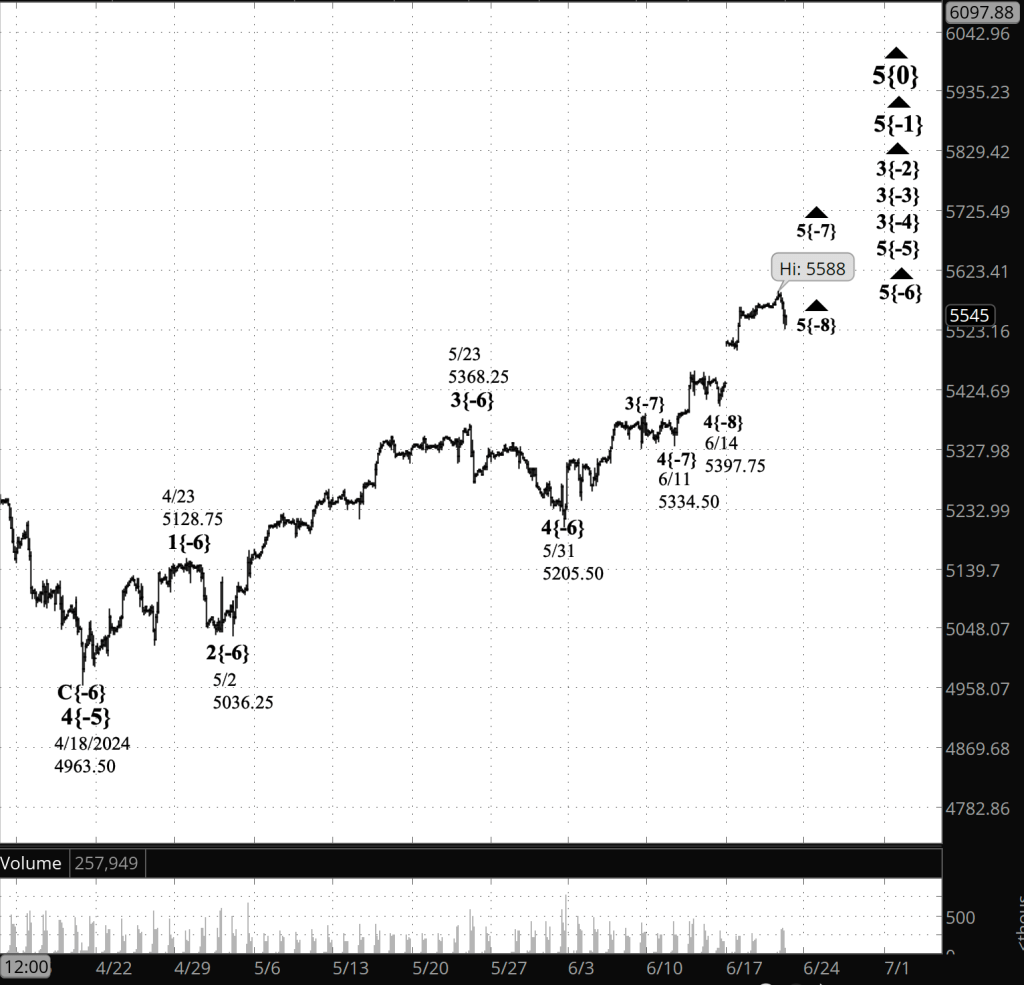
What does it mean? Elliott Wave Theory: The rise is the 5th and final subwave within a larger 5th wave that began on June 11, all part of a still larger 5th wave that began on May 31. And there is a still larger 5th wave encompassing the smaller ones, a wave that began on April 18.

The parade of the 5th waves. A 5th wave holds a special place in the fractal structure that underlies price movements in markets and that informs Elliott Wave Theory’s analysis. A 5th wave is an ending. When a 5th wave ends, the wave one degree larger also ends. And if that wave is a 5th wave, so does the next next higher wave.

On this chart we have a line-up of four uptrending 5th waves that we’re tracking. When the smallest, the 5th wave that began on April 18, reaches its end, it will also be the end of the increasingly larger 5th waves up to the one that began on April 18.

The next larger wave in the hierarchy is an uptrending 3rd wave that began on February 21 from 4959.

When the smallest of the 5th waves reaches its end, that event will cascade across the structure, putting the large 3rd wave to an end and beginning a 4th-wave downward correction that will retracement a portion — perhaps a large portion, perhaps not so large — of the 500-plus points of that uptrend.

How big is the smallest 5th wave? As I’ve noted before, 5th waves are quirky. Sometimes they extend for a barely imaginable distance. Sometimes they truncate, failing to move past the end of the preceding 4th wave.

What are the alternatives? I’ve listed an ongoing ambiguity in previous posts. I’m dropping it for now pending further analysis of the new line-up.

[S&P 500 E-mini futures at 3:30 p.m., 115-minute bars, with volume]

What does Elliott wave theory say? Here are the waves that underly the analyses.

Principal Analysis:

  • Rising wave 5{0} is underway. It is a wave of Intermediate degree that began in December 2018.
  • It is in its final subwave, wave 5{-1}.
  • Within wave 5{-1}, rising waves 3{-2}, 3{-3} and 3{-4} are underway, as is wave 5{-5}.
  • Wave 5{-6} is underway and is in its final subwave, uptrending wave 5{-7}, which is in wave 5{-8}, also an uptrend.

Reading the chart. Price movements — waves – – in Elliott wave analysis are labeled with numbers within trending waves and letters with corrective waves. The subscripts — numbers in curly brackets — designate the wave’s degree, which, in Elliott wave analysis, means the relative position of a wave within the larger and smaller structures that make up the chart. R.N. Elliott, who in the 1930s developed the form of analysis that bears his name, viewed the chart as a complex structure of smaller waves nested within larger waves, which in turn are nested within still larger waves. In mathematics it’s called a fractal structure, where at every scale the pattern is similar to the others.

Learning and other resources. Elliott wave analysis provides context, not prophecy. As the 20th century semanticist Alfred Korzybski put it in his book Science and Sanity (1933), “The map is not the territory … The only usefulness of a map depends on similarity of structure between the empirical world and the map.” And I would add, in the ever-changing markets, we can judge that similarity of structure only after the fact.

See the menu page Analytical Methods for a rundown on where to go for information on Elliott wave analysis.

By Tim Bovee, Portland, Oregon, June 17, 2024

Disclaimer

Tim Bovee, Private Trader tracks the analysis and trades of a private trader for his own accounts. Nothing in this blog constitutes a recommendation to buy or sell stocks, options or any other financial instrument. The only purpose of this blog is to provide education and entertainment.

No trader is ever 100 percent successful in his or her trades. Trading in the stock and option markets is risky and uncertain. Each trader must make trading decisions for his or her own account, and take responsibility for the consequences.

License
Creative Commons License

All content on Tim Bovee, Private Trader by Timothy K. Bovee is licensed under a Creative Commons Attribution-ShareAlike 4.0 International License.

Based on a work at www.timbovee.com.
Trader’s Notebook

3:30 p.m. New York time

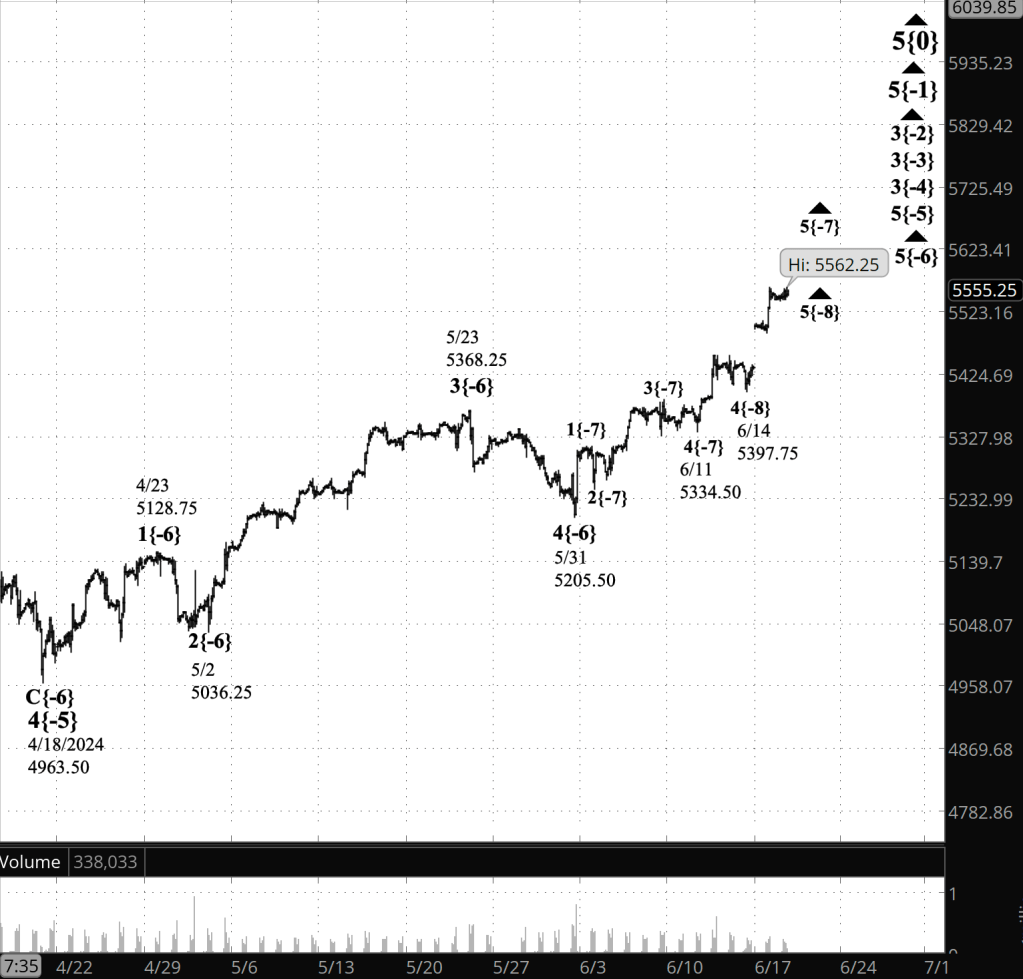
Half an hour before the closing bell. The S&P 500 futures have risen during the session, returning to the 5430s. Elliott Wave Theory: The 4th-wave downward correction that began on June 11 continues. See this morning’s post for details.

I’ve updated the chart.

9:35 a.m. New York time

What’s happening now? The S&P 500 E-mini futures fell overnight, from the 5440s to the 5390s.

What does it mean? The Elliott Wave Theory analysis sees the 4th-wave downward correction continuing within the 5th-wave uptrend that began on June 11. The correction is nearing its end.

When the correction is complete, the final wave within the 5th-wave uptrend will begin, likely carrying the price to new heights. The uptrend, when complete, will resonate through the fractal structure of the chart, signaling the end of two 5th waves of increasingly larger degree and of a 3rd wave an additional degree higher. A larger 4th-wave downward correction will then begin.

What are the alternatives? It’s possible that the larger 5th subwave is actually a degree smaller, as are all of its subwaves, and that they are part of a 1st wave with a still larger 5th wave.

[S&P 500 E-mini futures at 3:30 p.m., 115-minute bars, with volume]

What does Elliott wave theory say? Here are the waves that underly the analyses.

Principal Analysis:

  • Rising wave 5{0} is underway. It is a wave of Intermediate degree that began in December 2018.
  • It is in its final subwave, wave 5{-1}.
  • Within wave 5{-1}, rising waves 3{-2}, 3{-3} and 3{-4} are underway, as is wave 5{-5}.
  • Wave 5{-6} is underway and is in its final subwave, uptrending wave 5{-7}, which is in wave 4{-8}, a downtrending correction that is in its final subwave, wave C{-9}.

Reading the chart. Price movements — waves – – in Elliott wave analysis are labeled with numbers within trending waves and letters with corrective waves. The subscripts — numbers in curly brackets — designate the wave’s degree, which, in Elliott wave analysis, means the relative position of a wave within the larger and smaller structures that make up the chart. R.N. Elliott, who in the 1930s developed the form of analysis that bears his name, viewed the chart as a complex structure of smaller waves nested within larger waves, which in turn are nested within still larger waves. In mathematics it’s called a fractal structure, where at every scale the pattern is similar to the others.

Learning and other resources. Elliott wave analysis provides context, not prophecy. As the 20th century semanticist Alfred Korzybski put it in his book Science and Sanity (1933), “The map is not the territory … The only usefulness of a map depends on similarity of structure between the empirical world and the map.” And I would add, in the ever-changing markets, we can judge that similarity of structure only after the fact.

See the menu page Analytical Methods for a rundown on where to go for information on Elliott wave analysis.

By Tim Bovee, Portland, Oregon, June 14, 2024

Disclaimer

Tim Bovee, Private Trader tracks the analysis and trades of a private trader for his own accounts. Nothing in this blog constitutes a recommendation to buy or sell stocks, options or any other financial instrument. The only purpose of this blog is to provide education and entertainment.

No trader is ever 100 percent successful in his or her trades. Trading in the stock and option markets is risky and uncertain. Each trader must make trading decisions for his or her own account, and take responsibility for the consequences.

License
Creative Commons License

All content on Tim Bovee, Private Trader by Timothy K. Bovee is licensed under a Creative Commons Attribution-ShareAlike 4.0 International License.

Based on a work at www.timbovee.com.
Trader’s Notebook

3:30 p.m. New York time

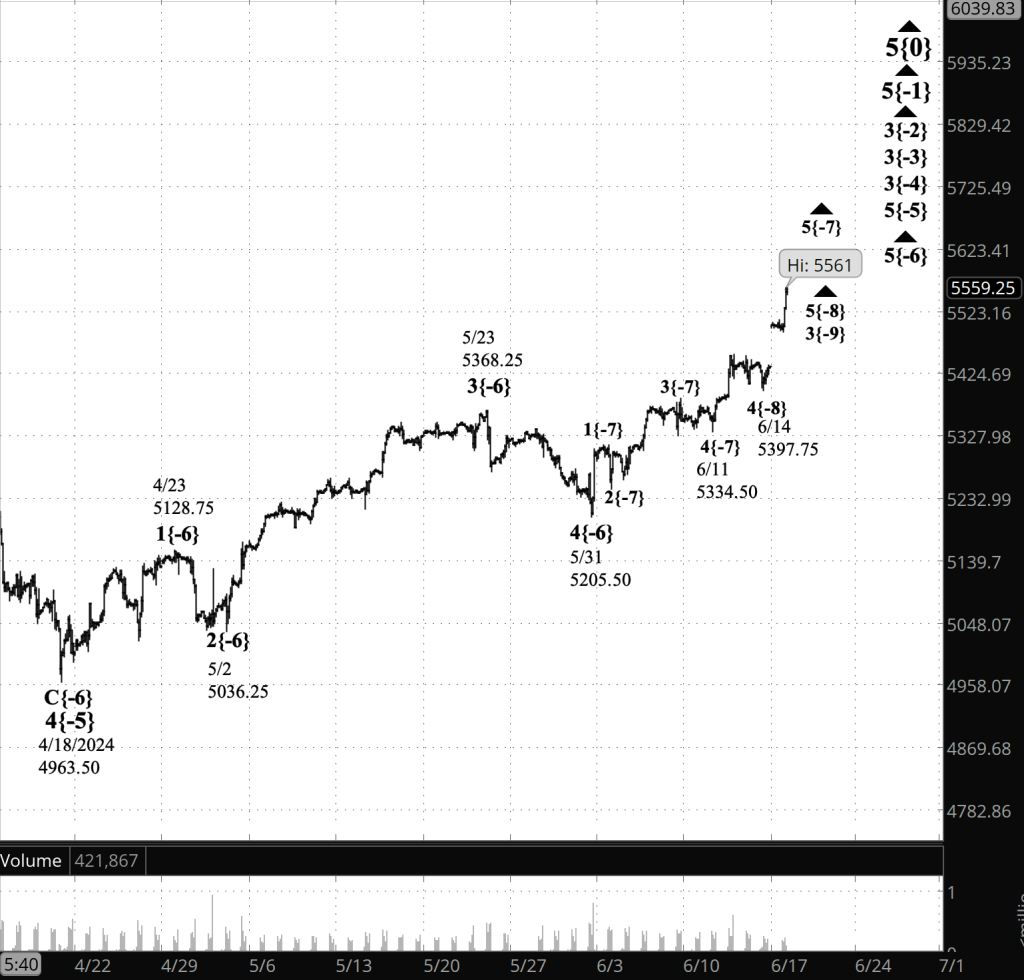
Half an hour before the closing bell.The S&P 500 futures worked their way lower during the session, coming close to 5400 before retracing a portion of the decline. Elliott Wave Theory: It’s all part of a small downward correction within the larger uptrending 5th wave that began on June 11. See this morning’s analysis for details.

I’ve updated the chart.

9:35 a.m. New York time

What’s happening now? The S&P 500 E-mini futures reached a low overnight in the 5420s and then rose sharply into the 5450s and retreated as the opening bell approached.

What does it mean? Elliott Wave Theory sees the overnight movement as part of a small uptrending 5th wave that began on June 11. Internally, that 5th wave is working through its middle subwave, wave 3.

Completion of the 5th wave will trigger the end of two other 5th waves of increasing size, and encompassing them all, 3rd wave that began on February 21. A 4th wave downward correction will follow.

A 4th wave typically typically ends within the range of the 4th subwave within the preceding 3rd wave, which in this case ran from the 5330s to the 4960s. The 3rd wave has lasted for four months, and the 4th wave downward correction will have a roughly consistent magnitude — likely lasting months, not weeks.

The target range and consistent magnitude are tendencies, not rules. There are many exceptions

What are the alternatives? It’s possible that the larger 5th subwave is actually a degree smaller, as are all of its subwaves, and that they are part of a 1st wave with a still larger 5th wave.

[S&P 500 E-mini futures at 3:30 p.m., 110-minute bars, with volume]

What does Elliott wave theory say? Here are the waves that underly the analyses.

Principal Analysis:

  • Rising wave 5{0} is underway. It is a wave of Intermediate degree that began in December 2018.
  • It is in its final subwave, wave 5{-1}.
  • Within wave 5{-1}, rising waves 3{-2}, 3{-3} and 3{-4} are underway, as is wave 5{-5}.
  • Wave 5{-6} is underway and is in its final subwave, uptrendng wave 5{-7}.

Reading the chart. Price movements — waves – – in Elliott wave analysis are labeled with numbers within trending waves and letters with corrective waves. The subscripts — numbers in curly brackets — designate the wave’s degree, which, in Elliott wave analysis, means the relative position of a wave within the larger and smaller structures that make up the chart. R.N. Elliott, who in the 1930s developed the form of analysis that bears his name, viewed the chart as a complex structure of smaller waves nested within larger waves, which in turn are nested within still larger waves. In mathematics it’s called a fractal structure, where at every scale the pattern is similar to the others.

Learning and other resources. Elliott wave analysis provides context, not prophecy. As the 20th century semanticist Alfred Korzybski put it in his book Science and Sanity (1933), “The map is not the territory … The only usefulness of a map depends on similarity of structure between the empirical world and the map.” And I would add, in the ever-changing markets, we can judge that similarity of structure only after the fact.

See the menu page Analytical Methods for a rundown on where to go for information on Elliott wave analysis.

By Tim Bovee, Portland, Oregon, June 13, 2024

Disclaimer

Tim Bovee, Private Trader tracks the analysis and trades of a private trader for his own accounts. Nothing in this blog constitutes a recommendation to buy or sell stocks, options or any other financial instrument. The only purpose of this blog is to provide education and entertainment.

No trader is ever 100 percent successful in his or her trades. Trading in the stock and option markets is risky and uncertain. Each trader must make trading decisions for his or her own account, and take responsibility for the consequences.

License
Creative Commons License

All content on Tim Bovee, Private Trader by Timothy K. Bovee is licensed under a Creative Commons Attribution-ShareAlike 4.0 International License.

Based on a work at www.timbovee.com.
Trader’s Notebook

3:30 p.m. New York time

Half an hour before the closing bell. The S&P 500 futures dropped slightly during the session, barely budging when the Federal Open Market Committee announced it was holding interest rates steady.

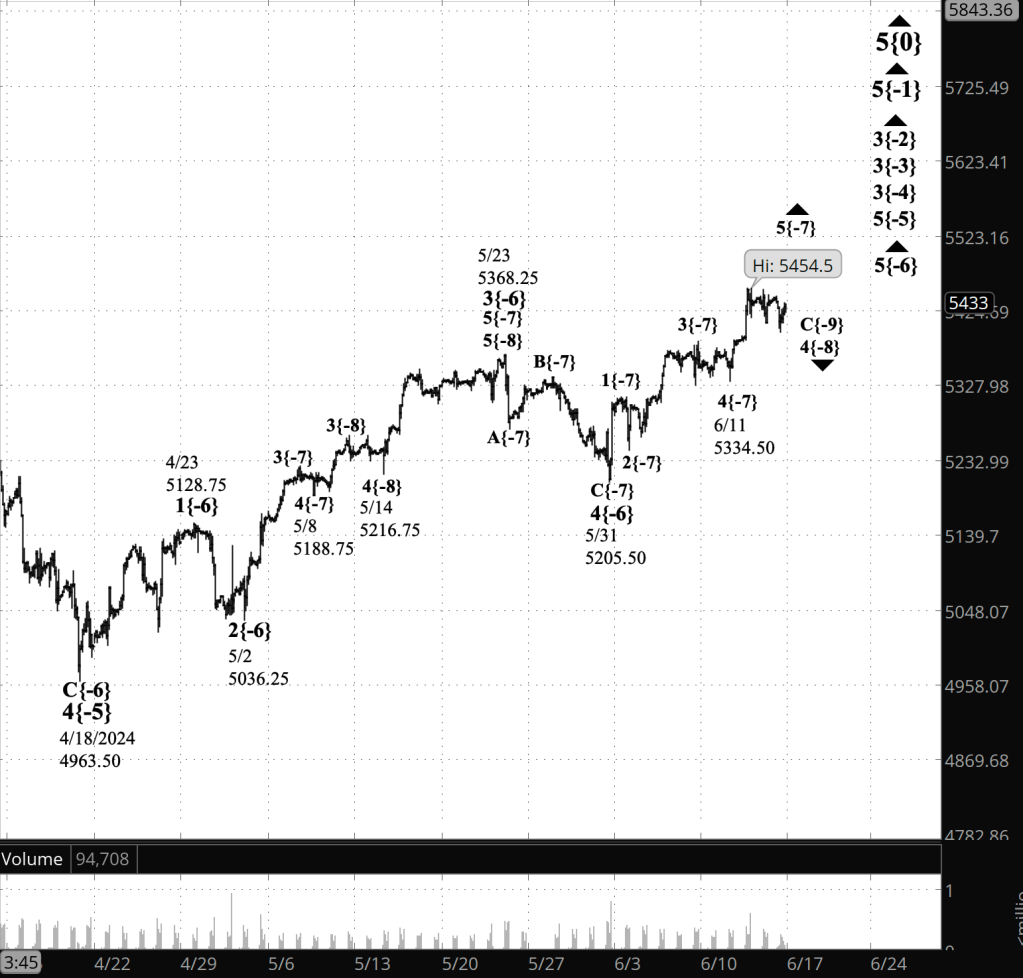
Applying Elliott Wave Theory: The decline is a downward correction of low degree within the uptrending 5th wave that began on June 11.

I’ve updated the chart.

9:35 a.m. New York time

What’s happening now? The S&P 500 E-mini futures rose sharply as the opening bell approached after new inflation data showed no change in prices overall in May compared to the prior month. The Federal Open Market Committee will announce its decision on interest rates during the session, at 2 p.m. New York time.

What does it mean? In Elliott Wave Theory, the rise confirms that the small 4th-wave downward correction that began on June 7 ended on July 11 at 5334.50 and a 5th-wave uptrend, also of a low degree, began on that date.

Fifth waves are the wayward children within a trend. Sometimes they continue to rise far beyond the end of the preceding 3rd wave. Sometimes they come up short and never reach a price equal to or above that end point. They’re essentially unpredictable.

Internally, the present 5th wave will have five subwaves. The power of the overnight rise suggests that the uptrending 5th is in its 3rd of five subwaves.

Looking further ahead. From this point I’ll be referring to wave labels as they appear on the chart. The subscript in curly brackets shows the waves distance, within the fractal structure of the chart, from Intermediate degree. The latest Intermediate wave is 5{0}, which began in December 2018.

When the present 5th wave, labeled wave 5{-7} on the chart, reaches its end, it will be the end of trends stretching two degrees higher within the fractal structure of the chart: Waves 5{-6} and 5{-5}. It will also mark the end of the 3rd wave one degree higher that began on February 21, wave 3{-4}, and the beginning of a 4th-wave downward correction, wave 4{-4}, considerably larger than the small wave 4{-7} wave that ended on June 11.

What are the alternatives? It’s possible that the larger 5th subwave is actually a degree smaller, as are all of its subwaves, and that they are part of a 1st wave with a still larger 5th wave. On the chart, the larger 5th wave changes from 5{-6} to 5[-7}, wave 1{-6} is inserted into the line-up, They’re all subwaves if wave 5{-5}.

[S&P 500 E-mini futures at 3:30 p.m., 110-minute bars, with volume]

What does Elliott wave theory say? Here are the waves that underly the analyses.

Principal Analysis:

  • Rising wave 5{0} is underway. It is a wave of Intermediate degree that began in December 2018.
  • It is in its final subwave, wave 5{-1}.
  • Within wave 5{-1}, rising waves 3{-2}, 3{-3} and 3{-4} are underway, as is wave 5{-5}.
  • Wave 5{-6} is underway and is in its final subwave, uptrendng wave 5{-7}.

Reading the chart. Price movements — waves – – in Elliott wave analysis are labeled with numbers within trending waves and letters with corrective waves. The subscripts — numbers in curly brackets — designate the wave’s degree, which, in Elliott wave analysis, means the relative position of a wave within the larger and smaller structures that make up the chart. R.N. Elliott, who in the 1930s developed the form of analysis that bears his name, viewed the chart as a complex structure of smaller waves nested within larger waves, which in turn are nested within still larger waves. In mathematics it’s called a fractal structure, where at every scale the pattern is similar to the others.

Learning and other resources. Elliott wave analysis provides context, not prophecy. As the 20th century semanticist Alfred Korzybski put it in his book Science and Sanity (1933), “The map is not the territory … The only usefulness of a map depends on similarity of structure between the empirical world and the map.” And I would add, in the ever-changing markets, we can judge that similarity of structure only after the fact.

See the menu page Analytical Methods for a rundown on where to go for information on Elliott wave analysis.

By Tim Bovee, Portland, Oregon, June 12, 2024

Disclaimer

Tim Bovee, Private Trader tracks the analysis and trades of a private trader for his own accounts. Nothing in this blog constitutes a recommendation to buy or sell stocks, options or any other financial instrument. The only purpose of this blog is to provide education and entertainment.

No trader is ever 100 percent successful in his or her trades. Trading in the stock and option markets is risky and uncertain. Each trader must make trading decisions for his or her own account, and take responsibility for the consequences.

License
Creative Commons License

All content on Tim Bovee, Private Trader by Timothy K. Bovee is licensed under a Creative Commons Attribution-ShareAlike 4.0 International License.

Based on a work at www.timbovee.com.
Trader’s Notebook

3:30 p.m. New York time

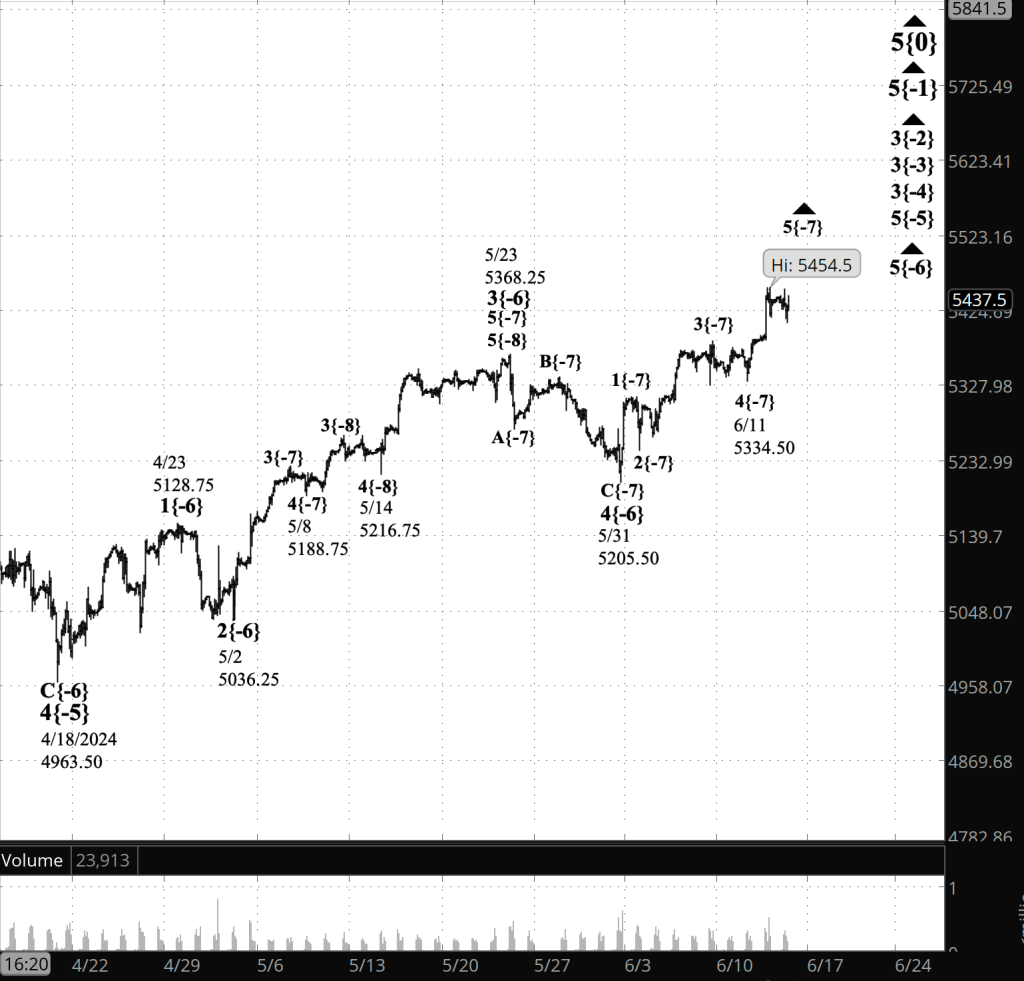
Half an hour before the closing bell. The S&P 500 futures rose during the session into the 5380s, remaining below the June 7 high of 5385.50. A rise above that level would suggest that the 4th-wave downward correction that began that high has ended, and that a 5th-wave uptrend has begun.

I’ve updated the chart.

9:35 a.m. New York time

What’s happening now? The S&P 500 E-mini futures drifted lower overnight, from the 5370s to the 5350s.

What does it mean? Elliott Wave Theory sees the decline as a small step within a 4th-wave downward correction that is a subwave of a 5th-wave uptrend that began on May 31. The 4th wave, which began on June 7, will have three subwaves and appears to be in the final subwave, declining wave C, although its possible that that the decline is a pullback within the preceding wave B, which is a rising wave.

It is the 5th-wave uptrend mentioned above that is the main driver of the chart. The 4th-wave downtrend, when complete, will be followed by a final wave that will complete the larger 5th-wave uptrend, and its parent wave, a larger 5th-wave uptrend that began on April 18. One degree high, and the end of the 5th waves will also be the end of a 3rd wave that began on February 21 and the beginning of a significant 4th-wave downward correction.

What is the alternatives? Its possible that the larger 5th subwave is actually a degree smaller, as are all of its subwaves, and that they are part of a 1st wave with a still larger 5th wave. On the chart, the larger 5th wave changes from 5{-6} to 5[-7}, wave 1{-6} is inserted into the line-up, They’re all subwaves if wave 5{-5}.

[S&P 500 E-mini futures at 3:30 p.m., 100-minute bars, with volume]

What does Elliott wave theory say? Here are the waves that underly the analyses.

Principal Analysis:

  • Rising wave 5{0} is underway. It is a wave of Intermediate degree that began in December 2018.
  • It is in its final subwave, wave 5{-1}.
  • Within wave 5{-1}, rising waves 3{-2}, 3{-3} and 3{-4} are underway, as is wave 5{-5}.
  • Wave 5{-6} is underway and is in its next-to-the-last subwave, corrective wave 4{-7}.

Reading the chart. Price movements — waves – – in Elliott wave analysis are labeled with numbers within trending waves and letters with corrective waves. The subscripts — numbers in curly brackets — designate the wave’s degree, which, in Elliott wave analysis, means the relative position of a wave within the larger and smaller structures that make up the chart. R.N. Elliott, who in the 1930s developed the form of analysis that bears his name, viewed the chart as a complex structure of smaller waves nested within larger waves, which in turn are nested within still larger waves. In mathematics it’s called a fractal structure, where at every scale the pattern is similar to the others.

Learning and other resources. Elliott wave analysis provides context, not prophecy. As the 20th century semanticist Alfred Korzybski put it in his book Science and Sanity (1933), “The map is not the territory … The only usefulness of a map depends on similarity of structure between the empirical world and the map.” And I would add, in the ever-changing markets, we can judge that similarity of structure only after the fact.

See the menu page Analytical Methods for a rundown on where to go for information on Elliott wave analysis.

By Tim Bovee, Portland, Oregon, June 11, 2024

Disclaimer

Tim Bovee, Private Trader tracks the analysis and trades of a private trader for his own accounts. Nothing in this blog constitutes a recommendation to buy or sell stocks, options or any other financial instrument. The only purpose of this blog is to provide education and entertainment.

No trader is ever 100 percent successful in his or her trades. Trading in the stock and option markets is risky and uncertain. Each trader must make trading decisions for his or her own account, and take responsibility for the consequences.

License
Creative Commons License

All content on Tim Bovee, Private Trader by Timothy K. Bovee is licensed under a Creative Commons Attribution-ShareAlike 4.0 International License.

Based on a work at www.timbovee.com.
Trader’s Notebook

3:30 p.m. New York time

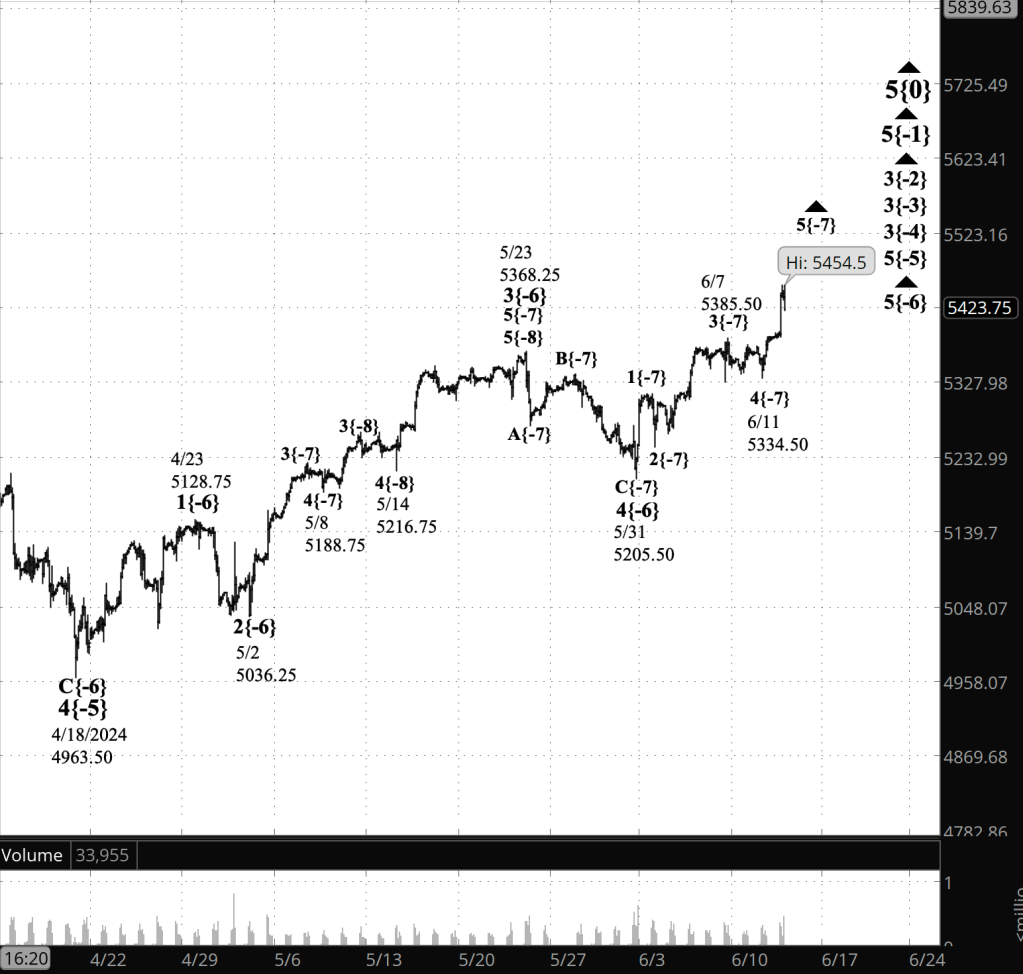
Half an hour before the closing bell. The S&P 500 futures rose into the 5370s during the session, remaining slightly below the overnight high — 5385.50 — as the closing bell approached. The small 4th-wave correction within the uptrending 5th wave that began on May 31 continues.

I’ve updated the chart.

9:35 a.m. New York time

What’s happening now? The S&P 500 E-mini futures declined slightly after trading resumed overnight, from the 5360s to the 5330s.

What does it mean? Applying Elliott Wave Theory to the chart, I’ve interpreted the June 6 peak, 5385.50, as being the end of the rising 3rd of five subwaves of an uptrending 5th wave that began on May 31. The 4th subwave, a small downward correction, is now underway. The waves are labeled on the chart: Wave 3{-7} ended, within wave 5{-6}. Wave 4{-7} underway.

When the 4th subwave is complete, it will be followed by a rising 5th subwave that will complete the larger 5th subwave that encompasses everything since May 31. A 4th-wave downward correction will follow.

What are the alternatives?

Alternative #1: Under the principal analysis, the 5th subwave within the 3rd subwave that just ended is unusually sort. It’s possible that the rise is a subwave within the 4th subwave, which is still underway.

Alternative #2: Also, its possible that the larger 5th subwave is actually a degree smaller, as are all of its subwaves, and that they are part of a 1st wave with a still larger 5th wave. On the chart, the larger 5th wave changes from 5{-6} to 5[-7}, wave 1{-6} is inserted into the line-up, They’re all subwaves if wave 5{-5}.

[S&P 500 E-mini futures at 3:30 p.m., 100-minute bars, with volume]

What does Elliott wave theory say? Here are the waves that underly the analyses.

Principal Analysis:

  • Rising wave 5{0} is underway. It is a wave of Intermediate degree that began in December 2018.
  • It is in its final subwave, wave 5{-1}.
  • Within wave 5{-1}, rising waves 3{-2}, 3{-3} and 3{-4} are underway, as is wave 5{-5}.
  • Wave 5{-6} is underway and is in its next-to-the-last subwave, corrective wave 4{-7}.

Reading the chart. Price movements — waves – – in Elliott wave analysis are labeled with numbers within trending waves and letters with corrective waves. The subscripts — numbers in curly brackets — designate the wave’s degree, which, in Elliott wave analysis, means the relative position of a wave within the larger and smaller structures that make up the chart. R.N. Elliott, who in the 1930s developed the form of analysis that bears his name, viewed the chart as a complex structure of smaller waves nested within larger waves, which in turn are nested within still larger waves. In mathematics it’s called a fractal structure, where at every scale the pattern is similar to the others.

Learning and other resources. Elliott wave analysis provides context, not prophecy. As the 20th century semanticist Alfred Korzybski put it in his book Science and Sanity (1933), “The map is not the territory … The only usefulness of a map depends on similarity of structure between the empirical world and the map.” And I would add, in the ever-changing markets, we can judge that similarity of structure only after the fact.

See the menu page Analytical Methods for a rundown on where to go for information on Elliott wave analysis.

By Tim Bovee, Portland, Oregon, June 10, 2024

Disclaimer

Tim Bovee, Private Trader tracks the analysis and trades of a private trader for his own accounts. Nothing in this blog constitutes a recommendation to buy or sell stocks, options or any other financial instrument. The only purpose of this blog is to provide education and entertainment.

No trader is ever 100 percent successful in his or her trades. Trading in the stock and option markets is risky and uncertain. Each trader must make trading decisions for his or her own account, and take responsibility for the consequences.

License
Creative Commons License

All content on Tim Bovee, Private Trader by Timothy K. Bovee is licensed under a Creative Commons Attribution-ShareAlike 4.0 International License.

Based on a work at www.timbovee.com.
Trader’s Notebook

3:30 p.m. New York time

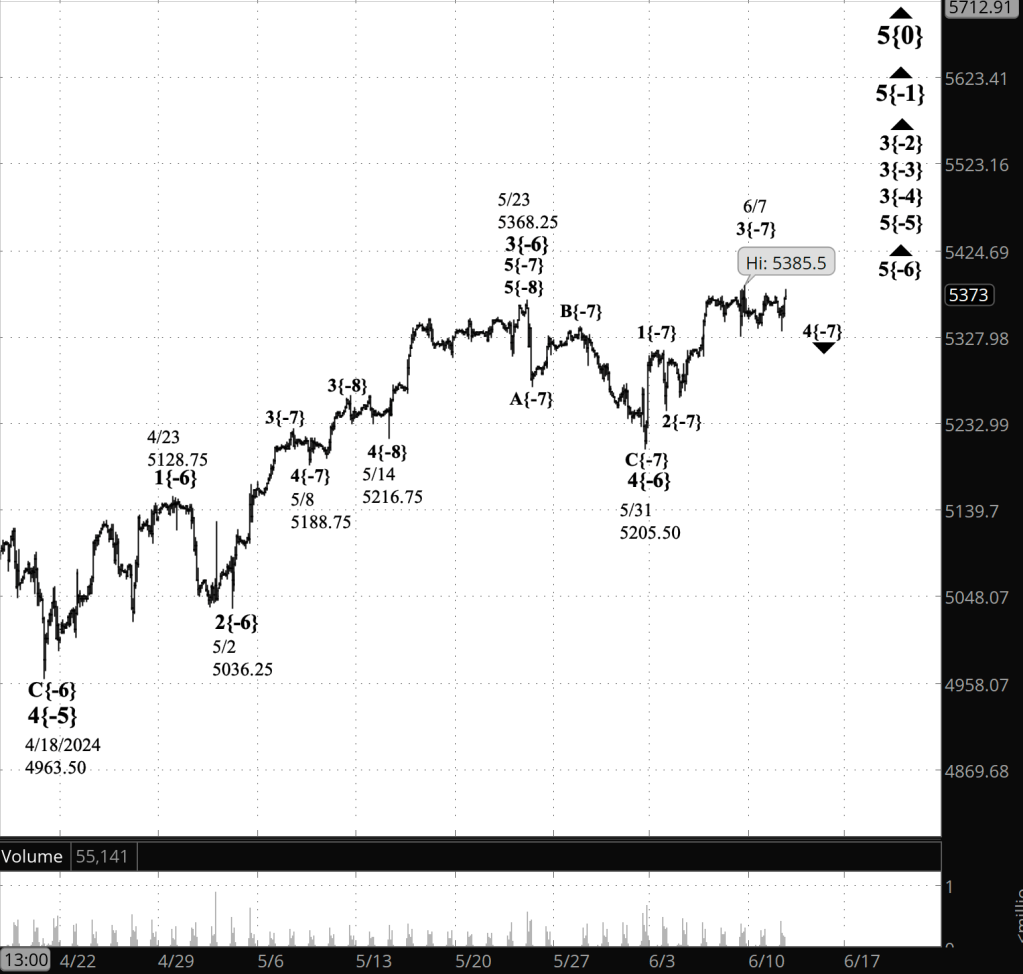
Half an hour before the closing bell. The S&P 500 futures fell to 5329 during the session and then rose to 5385.50, exceeding the overnight high. The higher triggered Alternative #1: The rising 3rd subwave within the larger 5th-wave uptrend that began on May 31 is underway, replacing this morning’s principal analysis that saw the 3rd subwave having ended and the 4th subwave having begun.

I’ve updated the lower chart, showing the larger 5th-wave uptrend it in its entirety, so far.

9:35 a.m. New York time

What’s happening now? The S&P 500 E-mini futures quickly rose to 5380 when the latest employment/unemployment data was published, and hour before the opening bell, and swiftly fell back into the 5330s.

[S&P 500 E-mini futures at 8:35 a.m., 133-tick bars]

What does it mean? The rise came first and then the fall, and that made a difference in application of Elliott Wave Theory to the chart. Under the principal analysis, the peak, 5380, is the end of the 3rd subwave within the 5th-wave uptrend that began on May 31. The subsequent decline is the beginning of the 4th subwave within the larger wave 5.

If the wave reverses quickly and moves above 5380, then Alternative #1 comes into play.

What are the alternatives?

Alternative #1: It’s possible to see the rise as part of the 4th subwave. In that case the peak at 5380 would be the end of the B subwave within the larger 4th wave correction, and the still larger 3rd wave is still underway. On the chart under this scenario, wave 3{-7} is changed to wave B{-9} within wave 4{-8} within ongoing wave 3{-7}.

Alternative #2: Also, its possible that the larger 5th subwave is actually a degree smaller, as are all of its subwaves, and that they are part of a 1st wave with a still larger 5th wave. On the chart, the larger 5th wave changes from 5{-6} to 5[-7}, wave 1{-6} is inserted into the line-up, They’re all subwaves if wave 5{-5}.

[S&P 500 E-mini futures at 3:30 p.m., 90-minute bars, with volume]

What does Elliott wave theory say? Here are the waves that underly the analyses.

Principal Analysis:

  • Rising wave 5{0} is underway. It is a wave of Intermediate degree that began in December 2018.
  • It is in its final subwave, wave 5{-1}.
  • Within wave 5{-1}, rising waves 3{-2}, 3{-3} and 3{-4} are underway, as is wave 5{-5}.
  • Wave 5{-6} is underway and is in its middle subwave, rising wave 3{-7}.

Reading the chart. Price movements — waves – – in Elliott wave analysis are labeled with numbers within trending waves and letters with corrective waves. The subscripts — numbers in curly brackets — designate the wave’s degree, which, in Elliott wave analysis, means the relative position of a wave within the larger and smaller structures that make up the chart. R.N. Elliott, who in the 1930s developed the form of analysis that bears his name, viewed the chart as a complex structure of smaller waves nested within larger waves, which in turn are nested within still larger waves. In mathematics it’s called a fractal structure, where at every scale the pattern is similar to the others.

Learning and other resources. Elliott wave analysis provides context, not prophecy. As the 20th century semanticist Alfred Korzybski put it in his book Science and Sanity (1933), “The map is not the territory … The only usefulness of a map depends on similarity of structure between the empirical world and the map.” And I would add, in the ever-changing markets, we can judge that similarity of structure only after the fact.

See the menu page Analytical Methods for a rundown on where to go for information on Elliott wave analysis.

By Tim Bovee, Portland, Oregon, June 7, 2024

Disclaimer

Tim Bovee, Private Trader tracks the analysis and trades of a private trader for his own accounts. Nothing in this blog constitutes a recommendation to buy or sell stocks, options or any other financial instrument. The only purpose of this blog is to provide education and entertainment.

No trader is ever 100 percent successful in his or her trades. Trading in the stock and option markets is risky and uncertain. Each trader must make trading decisions for his or her own account, and take responsibility for the consequences.

License
Creative Commons License

All content on Tim Bovee, Private Trader by Timothy K. Bovee is licensed under a Creative Commons Attribution-ShareAlike 4.0 International License.

Based on a work at www.timbovee.com.