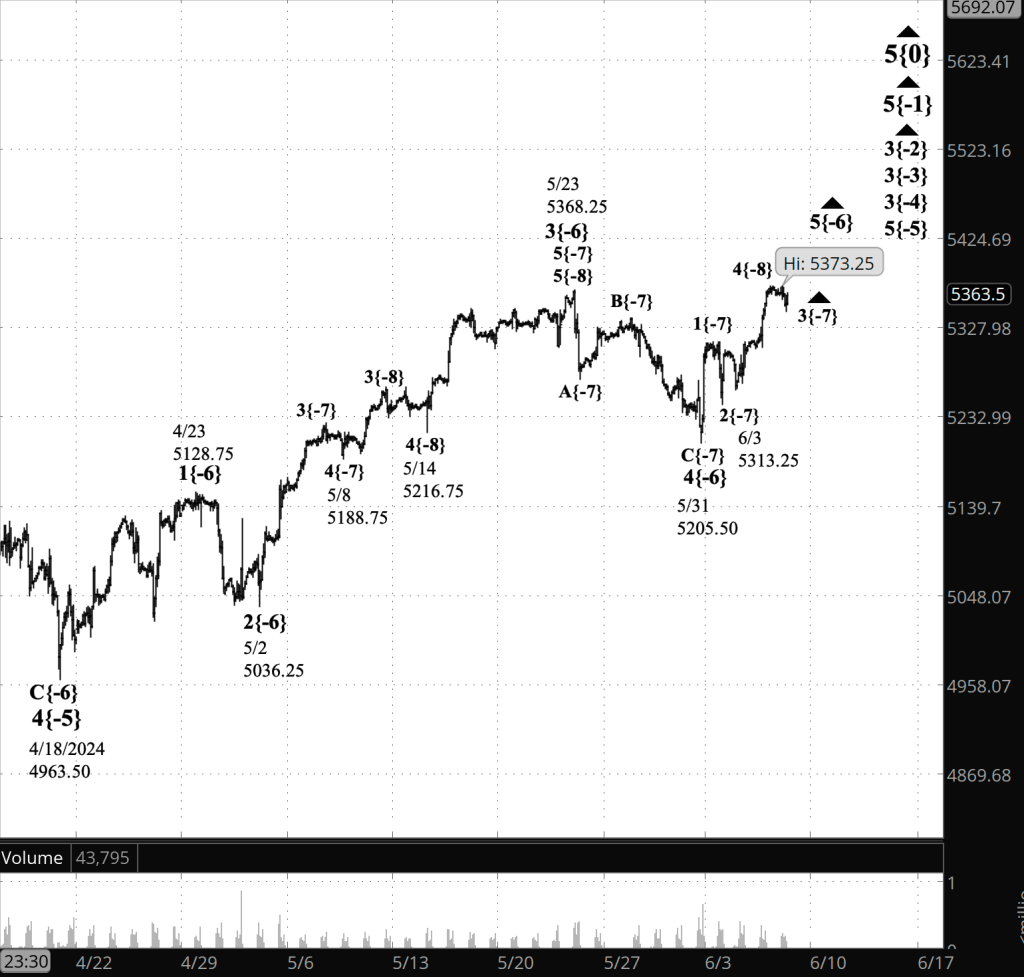
Trader’s Notebook

3:30 p.m. New York time

Half an hour before the closing bell. The S&P 500 futures remained slightly below the session peak, 5166.75, as the closing bell approached. The 5th-wave uptrend that began on May 2 continues. I’ve updated the chart.

9:35 a.m. New York time

What’s happening now? The S&P 500 E-mini futures rapidly rose by 50 points after the latest Employment Situation Report was published.

What does it mean? Applying Elliott Wave Theory, the rise carried the price above the prior high of the 4th-wave downward correction that began on April 23 and above the end of the preceding 3rd wave.

The power of the rise suggests that the downward correction ended at the May 2 low, 5036.25, and that a 5th-wave uptrend has begun.

Fifth waves have a lot of variation in their behavior. Not all make it above the end of the preceding 3rd wave. Some make it far past that point. This 5th has broken past the end of wave 3, suggesting that this 5th wave will be on the longer side.

What are the alternatives? I was head-faked by a rise Thursday morning, and today’s rise could be another. The higher the price rises, the more likely wave 5 is underway. If it reverses and falls below the start of the 5h wave — 5036.25 in this case — then the likelihood increases that the 4th wave correction is still underway.

[S&P 500 E-mini futures at 3:30 p.m., hourly bars, with volume]

What does Elliott wave theory say? Here are the waves that underly the analyses.

Principal Analysis:

  1. Rising wave 5{0} is underway. It is a wave of Intermediate Degree that began in December 2018.
  2. It is in its final subwave, wave 5{-1}
  3. Within wave 5{-1}, rising waves 3{-2}, 3{-3} and 3{-4} are underway, as is wave 5{-5}.
  4. Wave 1{-6} is underway and is in its final subwave, wave 5{-7}, which is in its initial subwave, wave 1{-8}.

We Are Here.

These are the waves currently in progress under my principal analysis. Each line on the list shows the wave number, with the subscript in curly brackets, the traditional degree name, the starting date, the starting price of the S&P 500 E-mini futures, and the direction of the wave.

  • S&P 500 Index:
  • 5{+3} Supercycle, 7/8/1932, 4.40 (up)
  • 5{+2} Cycle, 12/9/1974, 60.96 (up)
  • 5{+1} Primary, 3/6/2009, 666.79 (up)
  • 5{0} Intermediate, 12/26/2018, 2346.58 (up)
  • S&P 500 Futures and index:
  • 5{-1} Minor, 10/13/2022, 3502 (up) (futures), 3491.58 (up) (index)
  • S&P 500 Futures:

Reading the chart. Price movements — waves – – in Elliott wave analysis are labeled with numbers within trending waves and letters with corrective waves. The subscripts — numbers in curly brackets — designate the wave’s degree, which, in Elliott wave analysis, means the relative position of a wave within the larger and smaller structures that make up the chart. R.N. Elliott, who in the 1930s developed the form of analysis that bears his name, viewed the chart as a complex structure of smaller waves nested within larger waves, which in turn are nested within still larger waves. In mathematics it’s called a fractal structure, where at every scale the pattern is similar to the others.

Learning and other resources. Elliott wave analysis provides context, not prophecy. As the 20th century semanticist Alfred Korzybski put it in his book Science and Sanity (1933), “The map is not the territory … The only usefulness of a map depends on similarity of structure between the empirical world and the map.” And I would add, in the ever-changing markets, we can judge that similarity of structure only after the fact.

See the menu page Analytical Methods for a rundown on where to go for information on Elliott wave analysis.

By Tim Bovee, Portland, Oregon, May 3, 2024

Disclaimer

Tim Bovee, Private Trader tracks the analysis and trades of a private trader for his own accounts. Nothing in this blog constitutes a recommendation to buy or sell stocks, options or any other financial instrument. The only purpose of this blog is to provide education and entertainment.

No trader is ever 100 percent successful in his or her trades. Trading in the stock and option markets is risky and uncertain. Each trader must make trading decisions for his or her own account, and take responsibility for the consequences.

License
Creative Commons License

All content on Tim Bovee, Private Trader by Timothy K. Bovee is licensed under a Creative Commons Attribution-ShareAlike 4.0 International License.

Based on a work at www.timbovee.com.

Trader’s Notebook

3:30 p.m. New York time

Half an hour before the closing bell. Well, that was an interesting head-fake. Or was it a head-fake?

This morning’s analysis marked the May 1 low, 5037.75, as the end of the 4th-wave downward correction and the start of a 5th-wave uptrend. After a rise into the 5090s overnight, the S& P 500 futures fell, reaching below that low, to 5036.25, during today’s session.

If wave 5 is taking the form of an impulse wave, which nearly all of them do, then the lower low broke a rule of Elliott Wave Theory and wave 4 is still underway. And that’s how I’ve re-arranged the chart for this afternoon’s update.

There are a few exceptions to the rule, such as in the case of a truncated fifth wave or a diagonal triangle formation, but they are rare patterns. In most cases, a breach of the wave 4 low by wave 5 invalidates the impulse wave count.

So the principal analysis is back to having the 4th wave still underway, unless, of course, today’s session low is the end of the 4th wave. If it was, then the 5th wave has begun again.

I find Elliott Wave Theory to be useful, despite the ambiguities. But it’s not a very popular tool among analysts. Why might that be?

There are many reasons. Among them,

  1. Subjectivity: Elliott Wave analysis is often characterized as subjective, since different analysts can vary in how they interpret a chart.
  2. Complexity: The theory involves complex rules and guidelines, which can be challenging to understand and apply correctly.
  3. Hindsight bias: Critics argue that Elliott Wave Theory is prone to hindsight bias, where wave counts are often adjusted to fit the historical data. (To which I reply, “Duh. Of course. Historical data is all we have.”)
  4. Lack of a specific trading system: While Elliott Wave Theory can help identify market trends and potential reversal points, it does not provide a complete trading system with specific entry, exit, and risk management rules. Traders need to use other tools and strategies in conjunction with Elliott.
  5. Difficulty in application: Applying Elliott Wave Theory to real-time market conditions can be challenging, as the wave counts may not always be clear.

All true. And with that in mind, here’s this afternoon’s Elliott Wave Theory chart, revised after this morning’s analysis fell victim to Reason #5 in the list above:

[S&P 500 E-mini futures at 3:30 p.m., hourly bars, with volume]

9:35 a.m. New York time

What’s happening now? The S&P 500 E-mini futures rose overnight at a measured pace, so far reaching into the 5090s.

What does it mean? The price remained above the May 1 low, 5037.75, strengthening the Elliott Wave Theory analysis that the 4th-wave downward correction that began on April 25 ended at that point, and a 5th-wave uptrend began.

Fifth waves are, well, a bit flaky. The idea model of an uptrend tells us that they should move above the end of the preceding 3rd wave — 5128.75 in this case — but in the real world such uptrends sometimes fall short of that point, and sometimes they extend and rise far beyond expectations.

What we do know for certain is the impact the 5th wave will have when it ends. In terms of the degree of this wave five, it is seven steps below Intermediate degree. The present Intermediate degree is also a 5th wave, which began in December 2018 and is in its 5th subwave.

The end of the smaller 5th wave that just began will be the end of a 1st wave one degree larger, which work its way through four more waves after the 1st, waves 2 through 5.

The end of that 5th wave will mark the end of a 3rd wave, one degree higher, and the beginning of a 4th-wave downward correction followed by a 5th-wave rise.

That sequence will again be repeated, one degree higher, and then again, and then again, with the last 3rd-4th-5th waves pattern being five degrees larger than the 5th wave that just began.

It is in the next step, six degrees larger, that the pattern will break. the end of that 5th wave will also be the end of two more 5th waves of increasing size that will mark the end of the present Intermediate 5th wave that began in 2018, and also of three additional 5th waves, each one degree higher than the one before it.

I think of the 4th-wave / 5th-wave sequence now underway as the calm before the storm. And what a storm it will be.

Waves on the chart have a wave number followed by a subscript in curly brackets that denote the relationship of that wave to the Intermediate degree. Here is the sequence of waves now underway, described in that way, from smaller to larger: Waves 5{-7}, 1{-6}, 3{-5}, 3{-4}, 3{-3}, 3{-2}, {5{-1}, 5{0}, 5{+1}, 5(+2}, and 5{+3), the first (smallest) wave having begun on April 1, 2024 and the final (largest) wave having begun on July 8, 1932.

Needless to say, it will take a while for all of this to work itself out.

What are the alternatives? None at present. They will develop, without a doubt.

[Superceded by the afternoon analysis.]

[S&P 500 E-mini futures at 9:35 a.m., hourly bars, with volume]

What does Elliott wave theory say? Here are the waves that underly the analyses.

Principal Analysis:

  • Rising wave 5{0} is underway. It is a wave of Intermediate Degree that began in December 2018.
  • It is in its final subwave, wave 5{-1}
  • Within wave 5{-1}, rising waves 3{-2}, 3{-3} and 3{-4} are underway, as is wave 5{-5}.
  • Morning chart: Wave 5{-7} is in its initial subwave, wave 1{-8}.
  • Afternoon chart: Wave 4{-7} is in its final subwave, wave C{-8}.

And here are the waves of Intermediate degree and larger mentioned in the discussion, as recorded in the S&P 500 index.

  • 5{+3} Supercycle, 7/8/1932, 4.40 (up)
  • 5{+2} Cycle, 12/9/1974, 60.96 (up)
  • 5{+1} Primary, 3/6/2009, 666.79 (up)
  • 5{0} Intermediate, 12/26/2018, 2346.58 (up)

Reading the chart. Price movements — waves – – in Elliott wave analysis are labeled with numbers within trending waves and letters with corrective waves. The subscripts — numbers in curly brackets — designate the wave’s degree, which, in Elliott wave analysis, means the relative position of a wave within the larger and smaller structures that make up the chart. R.N. Elliott, who in the 1930s developed the form of analysis that bears his name, viewed the chart as a complex structure of smaller waves nested within larger waves, which in turn are nested within still larger waves. In mathematics it’s called a fractal structure, where at every scale the pattern is similar to the others.

Learning and other resources. Elliott wave analysis provides context, not prophecy. As the 20th century semanticist Alfred Korzybski put it in his book Science and Sanity (1933), “The map is not the territory … The only usefulness of a map depends on similarity of structure between the empirical world and the map.” And I would add, in the ever-changing markets, we can judge that similarity of structure only after the fact.

See the menu page Analytical Methods for a rundown on where to go for information on Elliott wave analysis.

By Tim Bovee, Portland, Oregon, May 2, 2024

Disclaimer

Tim Bovee, Private Trader tracks the analysis and trades of a private trader for his own accounts. Nothing in this blog constitutes a recommendation to buy or sell stocks, options or any other financial instrument. The only purpose of this blog is to provide education and entertainment.

No trader is ever 100 percent successful in his or her trades. Trading in the stock and option markets is risky and uncertain. Each trader must make trading decisions for his or her own account, and take responsibility for the consequences.

License
Creative Commons License

All content on Tim Bovee, Private Trader by Timothy K. Bovee is licensed under a Creative Commons Attribution-ShareAlike 4.0 International License.

Based on a work at www.timbovee.com.

Trader’s Notebook

3:30 p.m. New York time

Half an hour before the closing bell. The S&P 500 futures rose sharply as Federal Reserve Chair Jerome Powell began his news conference, which followed an FOMC decision to keep the Federal Funds Rate unchanged.

The count is ambiguous. The overnight low, 5037.75, could well be the end of the final subwave, wave C, of the 4th-wave downward correction that began on April 23, given the the distance travelled by the rise during the session. But that low can also be counted as the end of the middle subwave within the C wave.

I’ve retained this morning’s chart, showing the 4th wave still underway. And am including a new chart with this afternoon’s possible analysis, showing the 4th wave is complete and the 5th wave uptrend has begun.

A tentative analysis:

[S&P 500 E-mini futures at 3:30 p.m., hourly bars, with volume]

9:35 a.m. New York time

What’s happening now? The S&P 500 E-mini futures fell further overnight, reaching into the 5030s and then rising slightly.

What does it mean? The decline that began on April 29 from 5154.25 continues. Elliott Wave Theory sees it as a C wave, the final subwave within the 4th-wave downward correction that began on April 23.

The correction has taken the form of a Flat, and within that pattern, the C wave typically is at least as long as the preceding A wave and often as much as 1.65 times that size. Wave A covered 106.50 points, if typical, the present wave C, which began from 5154.25, will at a minimum reach around 5048, and could go as low as around 4979.

The C wave breached the upper boundary overnight. I’ve marked the upper and lower boundaries of the target range on the chart with red dashed lines.

The end of wave C will also be the end of the 4th wave correction and the beginning of a 5th-wave uptrend. Fifth waves are somewhat inconsistent. Sometimes that fail to move beyond the end of the preceding 3rd wave — 5128.75 in this case — and sometimes that extend in a lengthy rise that moves far higher. There’s no way to tell in advance what sort of 5th wave the next one will be.

The waves under discussion, as they appear on the chart, with subscripts in curly brackets indicating how far each wave is in degrees from Intermediate degree within the complex fractal structure of the chart: Wave C{-8} is underway within wave 4{-7}, a downward correction. The target range is in comparison to wave A{-8}. Wave 4{-7} will be followed by an uptrend, wave 5{-7}.

What are the alternatives? None at present. They will develop, as they always do in Elliott Wave Analysis.

Possibly outdated by the price movement within the session:

[S&P 500 E-mini futures at 9:35 a.m., hourly bars, with volume]

What does Elliott wave theory say? Here are the waves that underly the analyses.

Principal Analysis:

  • Rising wave 5{0} is underway. It is a wave of Intermediate Degree that began in December 2018.
  • It is in its final subwave, wave 5{-1}
  • Within wave 5{-1}, rising waves 3{-2}, 3{-3} and 3{-4} are underway, as is wave 5{-5}.
  • Uptrending wave 5{-5} is in its initial subwave, rising wave 1{-6}, which is in a declining subwave, wave 4{-7}.
  • Either wave 4{-7} is in its final subwave, wave C{-8} (the morning chart)
  • Or, based on the afternoon chart, wave 5{-7} is in its initial subwave, wave 1{-8}.

Reading the chart. Price movements — waves – – in Elliott wave analysis are labeled with numbers within trending waves and letters with corrective waves. The subscripts — numbers in curly brackets — designate the wave’s degree, which, in Elliott wave analysis, means the relative position of a wave within the larger and smaller structures that make up the chart. R.N. Elliott, who in the 1930s developed the form of analysis that bears his name, viewed the chart as a complex structure of smaller waves nested within larger waves, which in turn are nested within still larger waves. In mathematics it’s called a fractal structure, where at every scale the pattern is similar to the others.

Learning and other resources. Elliott wave analysis provides context, not prophecy. As the 20th century semanticist Alfred Korzybski put it in his book Science and Sanity (1933), “The map is not the territory … The only usefulness of a map depends on similarity of structure between the empirical world and the map.” And I would add, in the ever-changing markets, we can judge that similarity of structure only after the fact.

See the menu page Analytical Methods for a rundown on where to go for information on Elliott wave analysis.

By Tim Bovee, Portland, Oregon, May 1, 2024

Disclaimer

Tim Bovee, Private Trader tracks the analysis and trades of a private trader for his own accounts. Nothing in this blog constitutes a recommendation to buy or sell stocks, options or any other financial instrument. The only purpose of this blog is to provide education and entertainment.

No trader is ever 100 percent successful in his or her trades. Trading in the stock and option markets is risky and uncertain. Each trader must make trading decisions for his or her own account, and take responsibility for the consequences.

License
Creative Commons License

All content on Tim Bovee, Private Trader by Timothy K. Bovee is licensed under a Creative Commons Attribution-ShareAlike 4.0 International License.

Based on a work at www.timbovee.com.
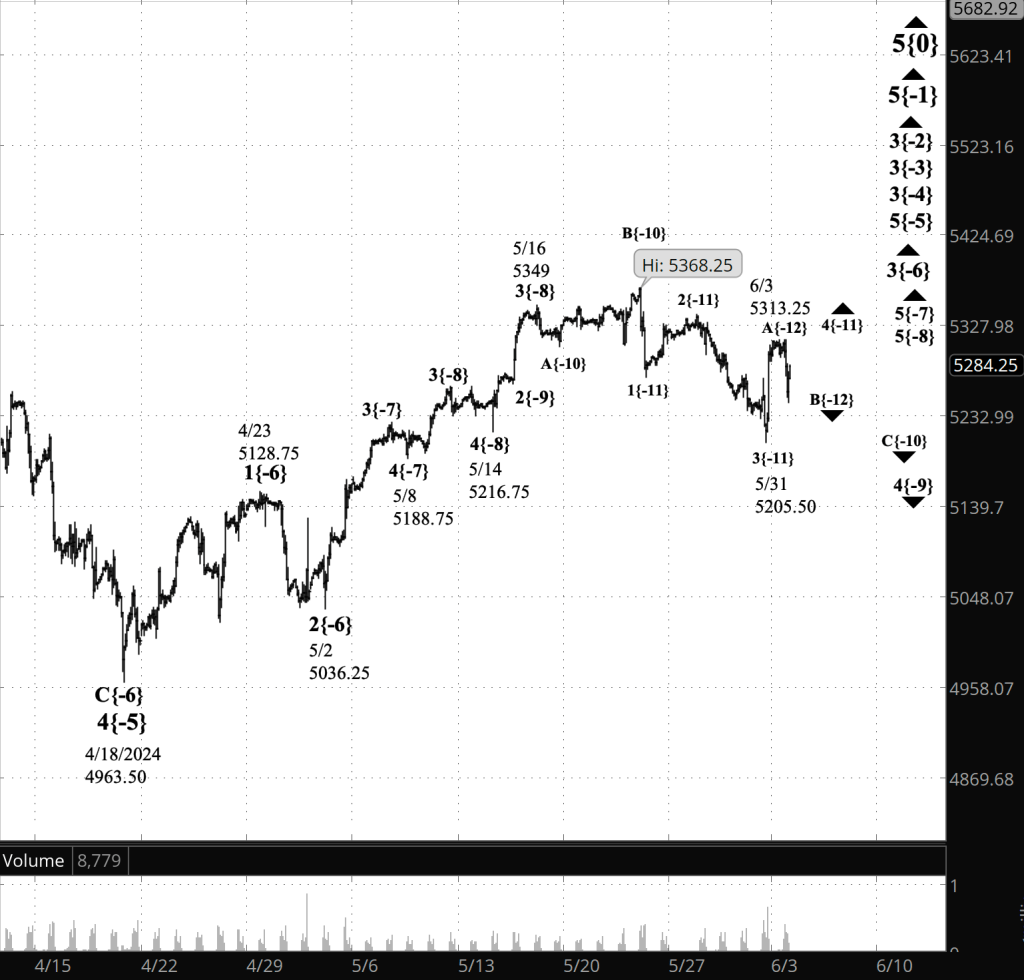
Trader’s Notebook

3:30 p.m. New York time

Half an hour before the closing bell. The S&P 500 futures fell during the session, so far reaching into the 5080s. In my mind, the decline is sufficient to justify labeling the April 29 peak, 5154.25, as the end of the B wave within the 4th-wave downward correction that began on April 23, and the beginning of the final subwave, wave C.

If the price reverses and moves above 5154.25, then my analysis doesn’t match the chart and wave B is still underway.

The further the price falls, the more likely it is that my analysis does match the chart, which I have udpated.

9:35 a.m. New York time

What’s happening now? The S&P 500 E-mini futures traded narrowly in the 5130s and 5140s overnight, dropping sharply into the 5120s as the closing bell approached. The drop coincided with the release of the Employment Cost Index for the 1st quarter.

What does it mean? Elliott Wave Theory sees the narrow trading range, Wave B, the middle subwave in a downward correction that began on April 23, as typical of a wave reaching its end. The B wave has retraced 124% of the preceding A wave. In a correction forming the Flat pattern, the B wave tends to correct somewhere between 100% and 169% of the preceding A wave. The B wave is within that retracement range.

When the B wave is complete, a declining C wave will begin, the final wave of the downward correction. When wave C is complete, along with wave 4, a 5th-wave uptrend will begin.

On the chart, the waves have a number followed by a subscript in curly brackets showing the wave’s distance from the Intermediate degree in the fractal structure of the price movements. The Intermediate wave is wave 5{0}, which began in December 2018.

Here is how the waves discussed above appear on the chart, small34 to larger: Wave B{-8} is underway within the correction, wave 4{-7}. The preceding A wave is wave A{-8} on the chart. Wave C{-8} will follow, and when it is complete, it will be the end of wave 4{-7} and start of wave 5{-7}.

What are the alternatives? The principal analysis, described above, depends upon the 4th-wave correction taking the form of a Flat. But the A-wave is a bit messy and can be counted, if I squint, as the first wave of a Zigzag, which would mean that the outsized retracement violates a rule of Elliott Wave Theory. If that were the case, then I would count the April 25 low as the end of wave 4 and the subsequent rise as the early portion of wave 5.

[S&P 500 E-mini futures at 3:30 p.m., hourly bars, with volume]

What does Elliott wave theory say? Here are the waves that underly the analyses.

Principal Analysis:

[Last item updated for the closing bell post.]

  • Rising wave 5{0} is underway. It is a wave of Intermediate Degree that began in December 2018.
  • It is in its final subwave, wave 5{-1}
  • Within wave 5{-1}, rising waves 3{-2}, 3{-3} and 3{-4} are underway, as is wave 5{-5}.
  • Uptrending wave 5{-5} is in its initial subwave, rising wave 1{-6}, which is in a declining subwave, wave 4{-7}.
  • Wave 4{-7} is in its final subwave, wave C{-8}

Reading the chart. Price movements — waves – – in Elliott wave analysis are labeled with numbers within trending waves and letters with corrective waves. The subscripts — numbers in curly brackets — designate the wave’s degree, which, in Elliott wave analysis, means the relative position of a wave within the larger and smaller structures that make up the chart. R.N. Elliott, who in the 1930s developed the form of analysis that bears his name, viewed the chart as a complex structure of smaller waves nested within larger waves, which in turn are nested within still larger waves. In mathematics it’s called a fractal structure, where at every scale the pattern is similar to the others.

Learning and other resources. Elliott wave analysis provides context, not prophecy. As the 20th century semanticist Alfred Korzybski put it in his book Science and Sanity (1933), “The map is not the territory … The only usefulness of a map depends on similarity of structure between the empirical world and the map.” And I would add, in the ever-changing markets, we can judge that similarity of structure only after the fact.

See the menu page Analytical Methods for a rundown on where to go for information on Elliott wave analysis.

By Tim Bovee, Portland, Oregon, April 30, 2024

Disclaimer

Tim Bovee, Private Trader tracks the analysis and trades of a private trader for his own accounts. Nothing in this blog constitutes a recommendation to buy or sell stocks, options or any other financial instrument. The only purpose of this blog is to provide education and entertainment.

No trader is ever 100 percent successful in his or her trades. Trading in the stock and option markets is risky and uncertain. Each trader must make trading decisions for his or her own account, and take responsibility for the consequences.

License
Creative Commons License

All content on Tim Bovee, Private Trader by Timothy K. Bovee is licensed under a Creative Commons Attribution-ShareAlike 4.0 International License.

Based on a work at www.timbovee.com.

Trader’s Notebook

3:30 p.m. New York time

Half an hour before the closing bell. The S&P 500 futures migrated between the 5140s and 5150s during the session, dropping below 5120 as the closing bell approached. The rising B wave — the middle subwave of the 4th-wave downward correction that began on April 23, continues.

I’ve updated the chart.

9:35 a.m. New York time

What’s happening now? The S&P 500 E-mini futures stuck to the 5130s and 5140s after trading resumed overnight, reaching into the 5150s as the opening bell rang.

What does it mean? The 4th-wave downward correction continues its middle subwave, wave B, which internally may be in its final subwave, wave C. I’m hedging with the “may be” because the subwave structure within wave B is unusually shallow and therefore lack clarity.

On the chart, the wave numbers are followed by the wave’s distance from the Intermediate degree within the fractal structure created by price movements over time. The waves discussed above, from lower degree to higher, are wave C{-9} within wave B{-8} within the downward correction, wave 4{-7}.

What are the alternatives? In Friday’s Trader’s Notebook, I discussed the main ambiguity on the chart: Is the downward correction taking the form of a Zigzag or a Flat. I’m leaning toward the Flat, and that’s my principal analysis. The Zigzag alternative analysis is still on the table, however.

[S&P 500 E-mini futures at 3:30 p.m., 55-minute bars, with volume]

What does Elliott wave theory say? Here are the waves that underly the analyses.

Principal Analysis:

  • Rising wave 5{0} is underway. It is a wave of Intermediate Degree that began in December 2018.
  • It is in its final subwave, wave 5{-1}
  • Within wave 5{-1}, rising waves 3{-2}, 3{-3} and 3{-4} are underway, as is wave 5{-5}.
  • Uptrending wave 5{-5} is in its initial subwave, rising wave 1{-6}, which is in a declining subwave, wave 4{-7}.
  • Wave 4{-7} is in its middle subwave, wave B{-8}

Alternative Analysis:

  • Uptrending wave 5{-5} is in its initial subwave, rising wave 1{-6}, which is in an uptrend, wave 5{-7}.

Reading the chart. Price movements — waves – – in Elliott wave analysis are labeled with numbers within trending waves and letters with corrective waves. The subscripts — numbers in curly brackets — designate the wave’s degree, which, in Elliott wave analysis, means the relative position of a wave within the larger and smaller structures that make up the chart. R.N. Elliott, who in the 1930s developed the form of analysis that bears his name, viewed the chart as a complex structure of smaller waves nested within larger waves, which in turn are nested within still larger waves. In mathematics it’s called a fractal structure, where at every scale the pattern is similar to the others.

Learning and other resources. Elliott wave analysis provides context, not prophecy. As the 20th century semanticist Alfred Korzybski put it in his book Science and Sanity (1933), “The map is not the territory … The only usefulness of a map depends on similarity of structure between the empirical world and the map.” And I would add, in the ever-changing markets, we can judge that similarity of structure only after the fact.

See the menu page Analytical Methods for a rundown on where to go for information on Elliott wave analysis.

By Tim Bovee, Portland, Oregon, April 29, 2024

Disclaimer

Tim Bovee, Private Trader tracks the analysis and trades of a private trader for his own accounts. Nothing in this blog constitutes a recommendation to buy or sell stocks, options or any other financial instrument. The only purpose of this blog is to provide education and entertainment.

No trader is ever 100 percent successful in his or her trades. Trading in the stock and option markets is risky and uncertain. Each trader must make trading decisions for his or her own account, and take responsibility for the consequences.

License
Creative Commons License

All content on Tim Bovee, Private Trader by Timothy K. Bovee is licensed under a Creative Commons Attribution-ShareAlike 4.0 International License.

Based on a work at www.timbovee.com.
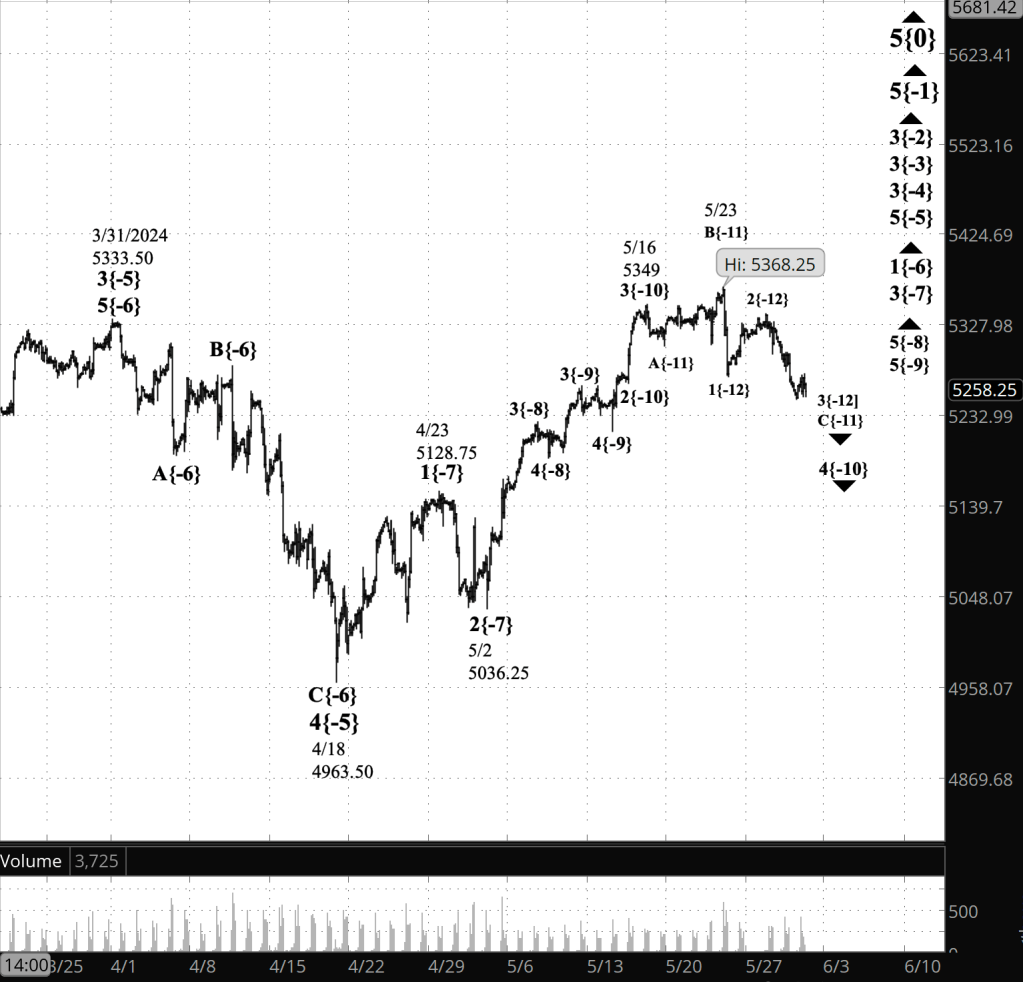
Trader’s Notebook

3:30 p.m. New York time

Half an hour before the closing bell. The S&P 500 futures continued to rise during the session, reaching into the 5140s. Elliott Wave Theory: The middle subwave — wave B — is continuing within the 4th-wave downward correction that began on April 23.

I’ve updated the chart.

9:35 a.m. New York time

What’s happening now? The S&P 500 E-mini futures traded sideways with a downward lean, reaching into the 5110s, until the PCE price index was released, and then shot up to the 5140s in the span of two minutes, subsequently retreating back to the 5120s.

What does it mean? In Elliott Wave Theory, the rise that began on April 25 is a B wave, the middle wave of a 4th-wave downward correction that began on April 23. What does the rapid rise mean?

It depends. If the A wave that began on April 23 has three subwaves, then the 4th-wave correction is taking the form of a Flat and the extent of the B wave’s retracement of the A wave is normal behavior. If it has five subwaves, the correction is taking the form of a Zigzag and the outsized retracement beyond the start of the A wave violates a rule of Elliott Wave Theory, requiring that the analysis be revised.

The table below provides a close-up of the correction so far,, with the two A-wave analyses, in green for the Flat scenario and red for the Zigzag scenario.

[S&P 500 E-mini futures at 9 a.m., 10-minute bars, with volume]

If the Flat scenario turns out to be the best match to the reality of the chart, then the principal analysis is unchanged from yesterday: Wave 4 is in its middle subwave, wave B. If the Zigzag scenario turns out to be the best match, then the new principal analysis will be that the 4th-wave downward correction ended on April 25 and a 5th-wave uptrend began.

For now I’m staying with the Flat correction scenario (the green marking on the chart). If the rising wave that began on April 25 turns out to have three subwaves, then that was the right call: Wave 4 is still underway. If rising wave has five subwaves, then Wave 4 ended on April 25 and wave 5 is underway.

What are the alternatives? The main ambiguity is covered in the discussion above.

[S&P 500 E-mini futures at 3:30 p.m., 50-minute bars, with volume]

What does Elliott wave theory say? Here are the waves that underly the analyses.

Principal Analysis:

  • Rising wave 5{0} is underway. It is a wave of Intermediate Degree that began in December 2018.
  • It is in its final subwave, wave 5{-1}
  • Within wave 5{-1}, rising waves 3{-2}, 3{-3} and 3{-4} are underway, as is wave 5{-5}.
  • Uptrending wave 5{-5} is in its initial subwave, rising wave 1{-6}, which is in a declining subwave, wave 4{-7}.
  • Wave 4{-7} is in its middle subwave, wave B{-8}

Alternative Analysis:

  • Uptrending wave 5{-5} is in its initial subwave, rising wave 1{-6}, which is in an uptrend, wave 5{-7}.

Reading the chart. Price movements — waves – – in Elliott wave analysis are labeled with numbers within trending waves and letters with corrective waves. The subscripts — numbers in curly brackets — designate the wave’s degree, which, in Elliott wave analysis, means the relative position of a wave within the larger and smaller structures that make up the chart. R.N. Elliott, who in the 1930s developed the form of analysis that bears his name, viewed the chart as a complex structure of smaller waves nested within larger waves, which in turn are nested within still larger waves. In mathematics it’s called a fractal structure, where at every scale the pattern is similar to the others.

Learning and other resources. Elliott wave analysis provides context, not prophecy. As the 20th century semanticist Alfred Korzybski put it in his book Science and Sanity (1933), “The map is not the territory … The only usefulness of a map depends on similarity of structure between the empirical world and the map.” And I would add, in the ever-changing markets, we can judge that similarity of structure only after the fact.

See the menu page Analytical Methods for a rundown on where to go for information on Elliott wave analysis.

By Tim Bovee, Portland, Oregon, April 26, 2024

Disclaimer

Tim Bovee, Private Trader tracks the analysis and trades of a private trader for his own accounts. Nothing in this blog constitutes a recommendation to buy or sell stocks, options or any other financial instrument. The only purpose of this blog is to provide education and entertainment.

No trader is ever 100 percent successful in his or her trades. Trading in the stock and option markets is risky and uncertain. Each trader must make trading decisions for his or her own account, and take responsibility for the consequences.

License
Creative Commons License

All content on Tim Bovee, Private Trader by Timothy K. Bovee is licensed under a Creative Commons Attribution-ShareAlike 4.0 International License.

Based on a work at www.timbovee.com.
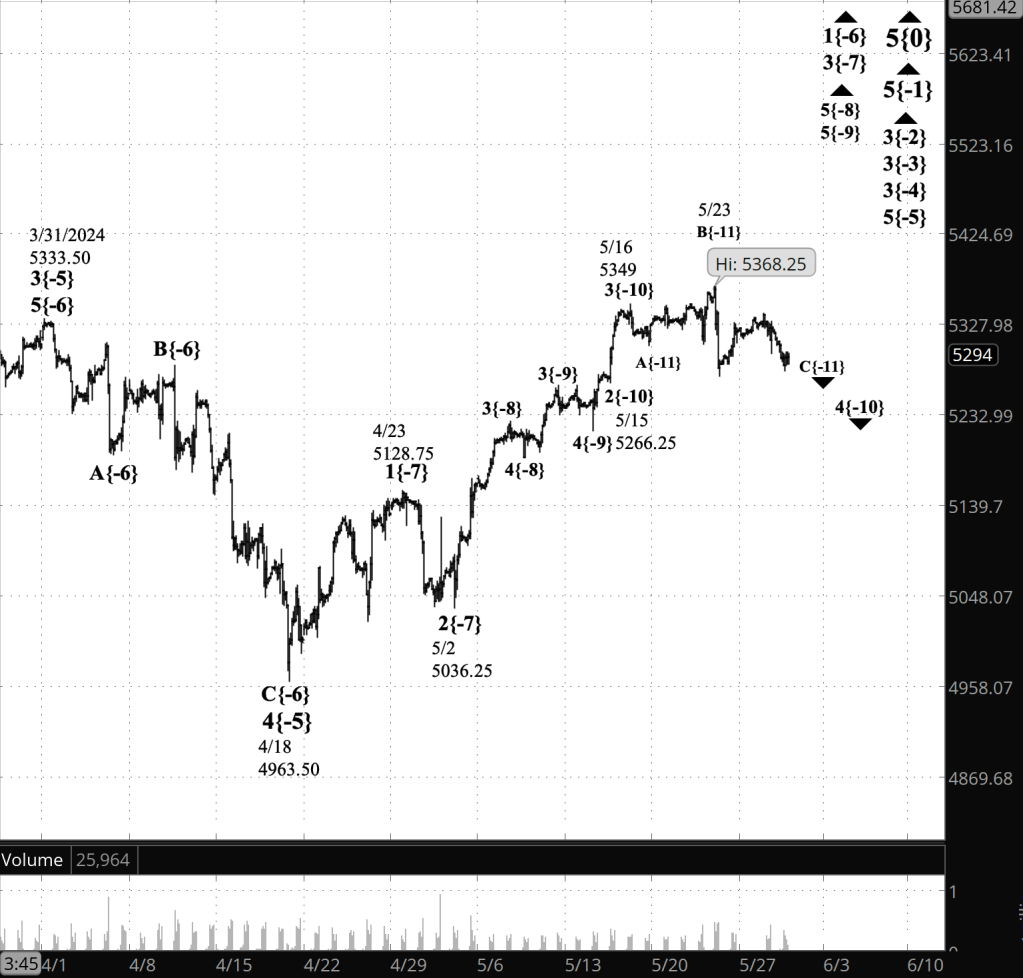
Trader’s Notebook

3:30 p.m. New York time

Half an hour before the closing bell. The S&P 500 futures rose back into the 5080s during the session. Applying Elliott Wave Theory to the chart pattern, I see two possible interpretations: Either the rise is the middle subwave — a B wave — of the 4th-wave downtrend that began on April 23 from 5128.75, or the 4th-wave downtrend ended today at the session low, 5022.25, and a low-degree 5th wave uptrend has begun. Whether it has begun or lies in the future, that 5th wave uptrend when complete will mark the end of the 1st subwave within the larger 5th-wave uptrend that began on April 18.

I’m going with the 4th-wave-continues interpretation because what might be read as a middle B-wave in the 5th-wave-began interpretation seems overly small and therefore less likely.

I’ve updated the chart.

9:35 a.m. New York time

What’s happening now? The S&P 500 E-mini futures traded sideways overnight, in the 5070s and 5080s, until the latest Gross Domestic Product advance estimate was released, sending the prices tumbling into the 5030s.

What does it mean? The magnitude of the decline compared to the prior rise, when Elliott Wave Theory is applied, suggests that the rise is a 3rd wave one degree larger than I had previously labeled it, and that the decline is a 4th wave of that same larger degree. On the chart the waves under discussion are labeled rising wave 3{-7} and falling wave 4{-7}, with the subscripts in curly brackets denoting the waves relationship to the Intermediate wave, which is presently wave 5{0} and which began in December 2018.

The waves of the {-7} degree are subwaves of a rising 1st subwave within a still larger 5th-wave uptrend that began on April 18. The 1st subwave will be followed by a 2nd wave downward correction as the larger 5th wave works its way higher.

What are the alternatives? The change in degree is an example of the ambiguity I discussed in yesterday’s post. Such ambiguity in the degree of subaves is always the case early in a wave’s progress. There may be further ambiguities that become apparent as the 5th-wave uptrend continues.

[S&P 500 E-mini futures at 3:30 p.m., 50-minute bars, with volume]

What does Elliott wave theory say? Here are the waves that underly the analyses.

Principal Analysis:

  • Rising wave 5{0} is underway. It is a wave of Intermediate Degree that began in December 2018.
  • It is in its final subwave, wave 5{-1}
  • Within wave 5{-1}, rising waves 3{-2}, 3{-3} and 3{-4} are underway, as is wave 5{-5}.
  • Uptrending wave 5{-5} is in its initial subwave, rising wave 1{-6}, which is in a declining subwave, wave 4{-7}.

Reading the chart. Price movements — waves – – in Elliott wave analysis are labeled with numbers within trending waves and letters with corrective waves. The subscripts — numbers in curly brackets — designate the wave’s degree, which, in Elliott wave analysis, means the relative position of a wave within the larger and smaller structures that make up the chart. R.N. Elliott, who in the 1930s developed the form of analysis that bears his name, viewed the chart as a complex structure of smaller waves nested within larger waves, which in turn are nested within still larger waves. In mathematics it’s called a fractal structure, where at every scale the pattern is similar to the others.

Learning and other resources. Elliott wave analysis provides context, not prophecy. As the 20th century semanticist Alfred Korzybski put it in his book Science and Sanity (1933), “The map is not the territory … The only usefulness of a map depends on similarity of structure between the empirical world and the map.” And I would add, in the ever-changing markets, we can judge that similarity of structure only after the fact.

See the menu page Analytical Methods for a rundown on where to go for information on Elliott wave analysis.

By Tim Bovee, Portland, Oregon, April 25, 2024

Disclaimer

Tim Bovee, Private Trader tracks the analysis and trades of a private trader for his own accounts. Nothing in this blog constitutes a recommendation to buy or sell stocks, options or any other financial instrument. The only purpose of this blog is to provide education and entertainment.

No trader is ever 100 percent successful in his or her trades. Trading in the stock and option markets is risky and uncertain. Each trader must make trading decisions for his or her own account, and take responsibility for the consequences.

License
Creative Commons License

All content on Tim Bovee, Private Trader by Timothy K. Bovee is licensed under a Creative Commons Attribution-ShareAlike 4.0 International License.

Based on a work at www.timbovee.com.
Trader’s Notebook

3:30 p.m. New York time

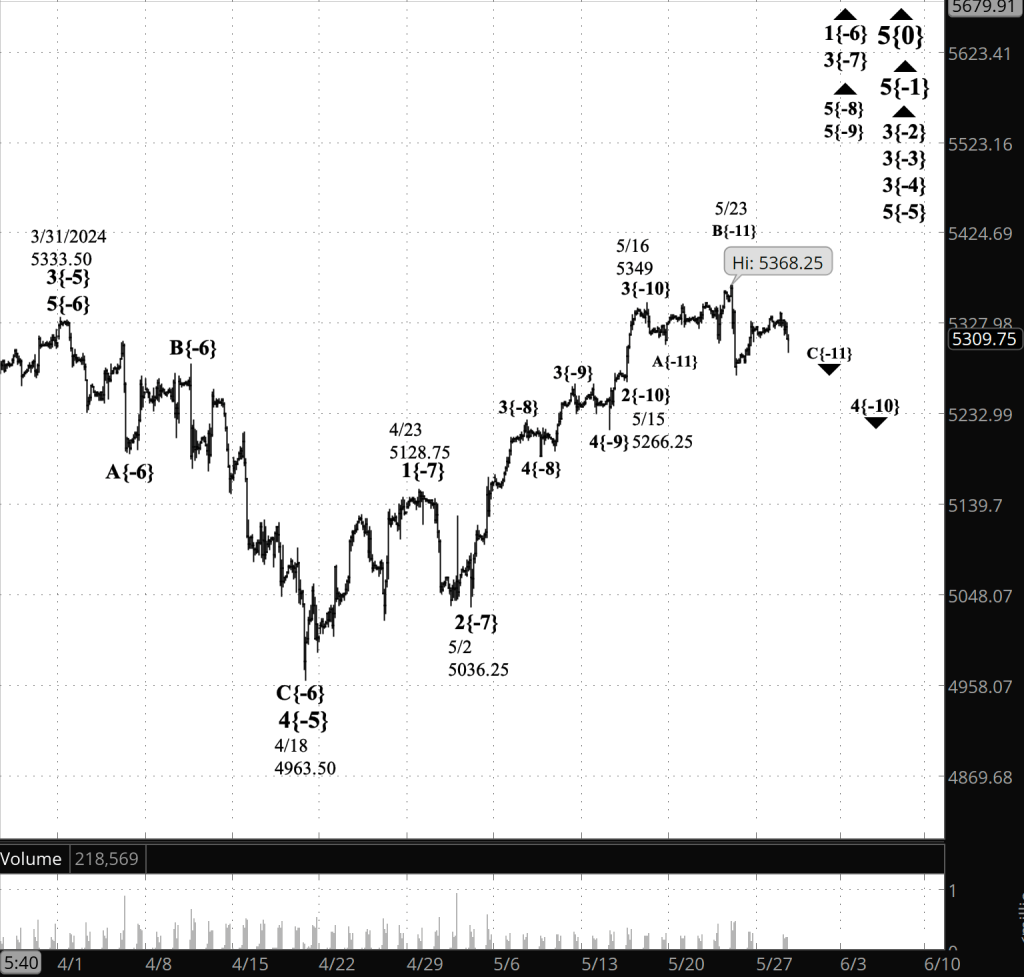
Half an hour before the closing bell. The S&P 500 futures declined during the session, reaching back into the 5080s. The decline is a subwave of the rising 1st wave within a 5th-wave uptrend that began on April 18. The declining subwave is wave 4{-8} on the chart and will soon be followed by a rising 5th wave.

9:35 a.m. New York time

What’s happening now? The S&P 500 E-mini futures the S&P 500 E-mini futures continued to rise overnight, reaching into the 5120s.

What does it mean? The rise carried the price of what had been labeled a low-degree 4th wave above the end of the preceding 1st wave. That breaks a rule of Elliott Wave Theory, and I’ve altered the analysis to match the reality of the chart.

Under the new principal analysis, the downward 4th-wave correction that began on March 31 ended on April 18, and a 5th-wave uptrend began. The 5th wave is in its 1st subwave, and that subwave is in its third of five waves.

Here are the waves under discussion as they appear on the chart, with the wave number followed by a subscript in curly brackets denoting how many degrees distant the wave is from Intermediate degree within the fractal structure of the chart. See the “Reading the chart” section below for more on the fractal structure.

From smaller to larger, under the new analysis the waves in progress are wave 3{-7} within wave 1{-6} within wave 5{-5}, all rising waves.

Fifth waves often carry the price beyond the end of the preceding 3rd wave — wave 3{-5} at 5333.50 in this case — and sometimes considerably beyond. And sometimes a 5th wave is truncated, ending below the end of the 3rd wave.

When wave 5{-5} is complete, it will also signal the end of its parent, wave 3{-4}, and the beginning of a 4th-wave downward correction one degree larger than the March 31 correction just ended.

What are the alternatives? The ambiguity, as is always the case early in a wave’s progress, is the degree of the subwaves. I’ve labeled the three subwaves of the uptrends initial wave as being seven degrees smaller — 3{-7} — than the Intermediate degree. But they could be a degree lower — 3{-8} — or a degree higher — 3{-6}. The course of the uptrend over time will resolve that ambiguity.

[S&P 500 E-mini futures at 3:30 p.m., 45-minute bars, with volume]

What does Elliott wave theory say? Here are the waves that underly the analyses.

Principal Analysis:

  • Rising wave 5{0} is underway. It is a wave of Intermediate Degree that began in December 2018.
  • It is in its final subwave, wave 5{-1}
  • Within wave 5{-1}, rising waves 3{-2}, 3{-3} and 3{-4} are underway, as is wave 5{-5}.
  • Uptrendng wave 5{-5} is in its initial subwave, rising wave 1{-6}, which is in its middle subwave, rising wave 3{-7}.

Reading the chart. Price movements — waves – – in Elliott wave analysis are labeled with numbers within trending waves and letters with corrective waves. The subscripts — numbers in curly brackets — designate the wave’s degree, which, in Elliott wave analysis, means the relative position of a wave within the larger and smaller structures that make up the chart. R.N. Elliott, who in the 1930s developed the form of analysis that bears his name, viewed the chart as a complex structure of smaller waves nested within larger waves, which in turn are nested within still larger waves. In mathematics it’s called a fractal structure, where at every scale the pattern is similar to the others.

Learning and other resources. Elliott wave analysis provides context, not prophecy. As the 20th century semanticist Alfred Korzybski put it in his book Science and Sanity (1933), “The map is not the territory … The only usefulness of a map depends on similarity of structure between the empirical world and the map.” And I would add, in the ever-changing markets, we can judge that similarity of structure only after the fact.

See the menu page Analytical Methods for a rundown on where to go for information on Elliott wave analysis.

By Tim Bovee, Portland, Oregon, April 24, 2024

Disclaimer

Tim Bovee, Private Trader tracks the analysis and trades of a private trader for his own accounts. Nothing in this blog constitutes a recommendation to buy or sell stocks, options or any other financial instrument. The only purpose of this blog is to provide education and entertainment.

No trader is ever 100 percent successful in his or her trades. Trading in the stock and option markets is risky and uncertain. Each trader must make trading decisions for his or her own account, and take responsibility for the consequences.

License
Creative Commons License

All content on Tim Bovee, Private Trader by Timothy K. Bovee is licensed under a Creative Commons Attribution-ShareAlike 4.0 International License.

Based on a work at www.timbovee.com.
Trader’s Notebook

3:30 p.m. New York time

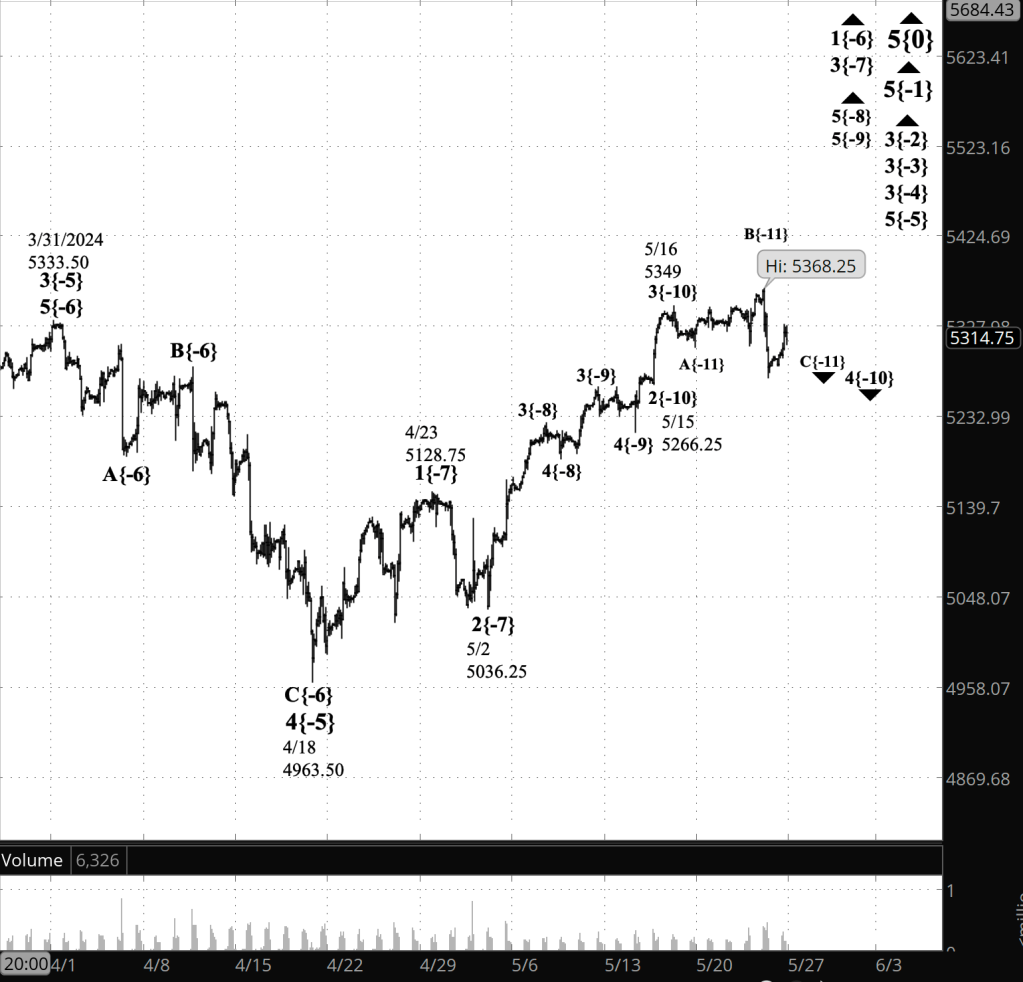
Half an hour before the closing bell. The S&P 500 futures continued to rise during the session, breaking above 5110. In Elliott Wave Theory, the 4th-wave upward correction that began on April 18 is working through its end game, as described below in this morning’s analysis.

I’ve updated the chart.

9:35 a.m. New York time

What’s happening now? The S&P 500 E-mini futures rose overnight, from the 5030s to the 5060s.

What does it mean? Elliott Wave Theory sees the rise as a the third and final subwave — wave C — of a 4th-wave upward correction of low degree that began on March 18. Wave C will have five subwaves total and is presently in its 5th subwave.

On the chart the present position, smaller to larger, is wave 5{-11} within wave C{-10} within wave 4{-9}, with each wave number being followed by a subscript in curly brackets showing how many degrees removed the wave is from the Intermediate degree, presently a 5th wave that began in December 2018.

The low-degree 4th wave is buried four degrees deep within a larger 4th-wave downward correction — wave 4{-5} on the chart — which began on March 31. The end of the low-degree 4th wave (wave 4{-10}) will travel up the fractal structure and signal the end of the larger degree 4th wave (wave 4{-5}).

The larger 4th-wave downward correction will be followed by a 5th-wave uptrend that will end the 3rd wave (wave 3{-4}) that encompasses it and will begin a larger 4th-wave downward correction.

What are the alternatives? Often Elliott Wave Analysis comes down to the question, “Does it look right?”. The low-degree 4th-wave correction is larger than the comparable wave one degree larger. There’s no rule against it in Elliott Wave Theory. But still…

[S&P 500 E-mini futures at 3:30 p.m., 40-minute bars, with volume]

What does Elliott wave theory say? Here are the waves that underly the analyses.

Principal Analysis:

  • Rising wave 5{0} is underway. It is a wave of Intermediate Degree that began in December 2018.
  • It is in its final subwave, wave 5{-1}
  • Within wave 5{-1}, rising waves 3{-2}, 3{-3} and 3{-4} are underway, as is the smallest wave labeled on the chart, wave 4{-5}.
  • Downtrending wave 4{-5} is in its final subwave, falling wave C{-6}, which is in its last subwave, falling wave 5{-7}.
  • Within wave 5{-7}, wave 5{-8} is underway and is in its next-to-the-last subwave, wave 4{-9}.
  • Wave 4{-9} is in its final subwave, wave C{-10}, which in turn is in its fifth and final subwave, wave 5{-11}.

Reading the chart. Price movements — waves – – in Elliott wave analysis are labeled with numbers within trending waves and letters with corrective waves. The subscripts — numbers in curly brackets — designate the wave’s degree, which, in Elliott wave analysis, means the relative position of a wave within the larger and smaller structures that make up the chart. R.N. Elliott, who in the 1930s developed the form of analysis that bears his name, viewed the chart as a complex structure of smaller waves nested within larger waves, which in turn are nested within still larger waves. In mathematics it’s called a fractal structure, where at every scale the pattern is similar to the others.

Learning and other resources. Elliott wave analysis provides context, not prophecy. As the 20th century semanticist Alfred Korzybski put it in his book Science and Sanity (1933), “The map is not the territory … The only usefulness of a map depends on similarity of structure between the empirical world and the map.” And I would add, in the ever-changing markets, we can judge that similarity of structure only after the fact.

See the menu page Analytical Methods for a rundown on where to go for information on Elliott wave analysis.

By Tim Bovee, Portland, Oregon, April 23, 2024

Disclaimer

Tim Bovee, Private Trader tracks the analysis and trades of a private trader for his own accounts. Nothing in this blog constitutes a recommendation to buy or sell stocks, options or any other financial instrument. The only purpose of this blog is to provide education and entertainment.

No trader is ever 100 percent successful in his or her trades. Trading in the stock and option markets is risky and uncertain. Each trader must make trading decisions for his or her own account, and take responsibility for the consequences.

License
Creative Commons License

All content on Tim Bovee, Private Trader by Timothy K. Bovee is licensed under a Creative Commons Attribution-ShareAlike 4.0 International License.

Based on a work at www.timbovee.com.
Trader’s Notebook

3:30 p.m. New York time

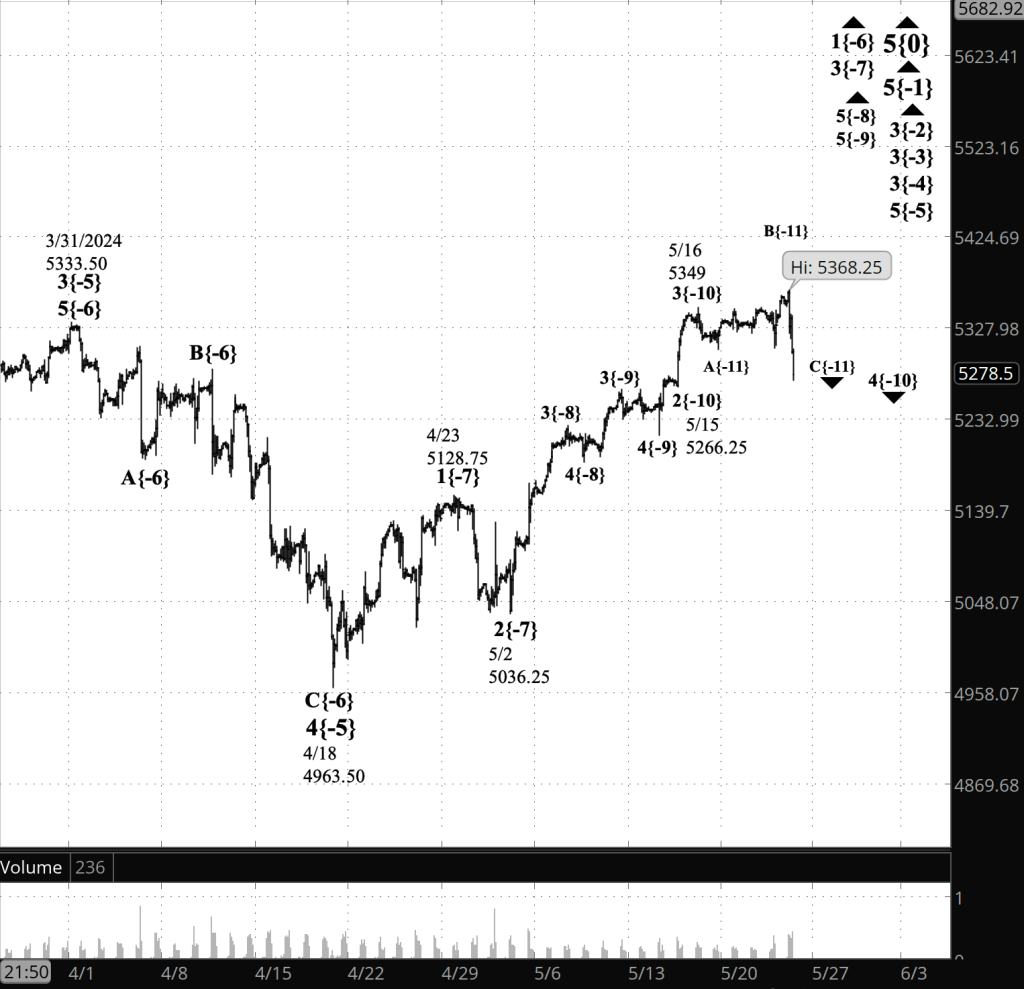
Half an hour before the closing bell. The S&P 500 futures continued to rise during the session, reaching into the 5270s. In Elliott Wave Theory, the rise is the third and final subwave, wave C{-10}, within the upward correction that began on April 18, wave 4{-9}, is underway. It may have ended at the session peak, or maybe not.

I’ve updated the chart.

9:35 a.m. New York time

What’s happening now? The S&P 500 E-mini futures rose gradually after trading resumed overnight, from just below 5010 into the 5030s.

What does it mean? Elliott Wave Theory views the rise is a low-degree 4th-wave upward correction buried deep within the final subwave, wave C, of a much larger downward correction that began on March 31. The smaller wave, which began on April 18, is in its 3rd of five subwaves. The smllert 4th wave will be followed by a downtrending 5th wave that will complete the correction and also two downtrending 5th degrees, each one degree higher.

Move one degree higher, the end of those 5th waves will also trigger the end of the final subwave of the larger correction. A 5th-wave uptrend will follow and likely will last for weeks before reaching its end, which will trigger a still larger 4th-wave downward correction.

That’s a long way of saying that all of those waves are interconnected, each a part of a complex fractal structure. When one wave reaches its end, even a relatively small one like the 4th wave that began on April 18, the event sends shockwaves up and down the fractal structure.

The fractal structure behaves like the Butterfly Effect in Chaos Theory — “When a butterfly flutters its wings in one part of the world, it can eventually cause a hurricane in another,” as the mathematician and meteorologist Edward Norton Lorenz put it.

See the “What does Elliott Wave Theory say?” section bellow for an inventory of waves now underway, with subscripts in curly brackets denoting the waves relation to Intermediate degree.

What are the alternatives? Friday’s alternative — that the low-degree 4th wave has ended and the rising 5th wave has begun — seems less likely, given the subwave structure, although I can’t rule it out entirely.

[S&P 500 E-mini futures at 3:30 p.m., 40-minute bars, with volume]

What does Elliott wave theory say? Here are the waves that underly the analyses.

Principal Analysis:

  • Rising wave 5{0} is underway. It is a wave of Intermediate Degree that began in December 2018.
  • It is in its final subwave, wave 5{-1}
  • Within wave 5{-1}, rising waves 3{-2}, 3{-3} and 3{-4} are underway, as is the smallest wave labeled on the chart, wave 4{-5}.
  • Downtrending wave 4{-5} is in its final subwave, falling wave C{-6}, which is in its last subwave, falling wave 5{-7}.
  • Within wave 5{-7}, wave 5{-8} is underway and is in its next-to-the-last subwave, wave 4{-9}.

We Are Here.

These are the waves currently in progress under my principal analysis. Each line on the list shows the wave number, with the subscript in curly brackets, the traditional degree name, the starting date, the starting price of the S&P 500 E-mini futures, and the direction of the wave.

  • S&P 500 Index:
  • 5{+3} Supercycle, 7/8/1932, 4.40 (up)
  • 5{+2} Cycle, 12/9/1974, 60.96 (up)
  • 5{+1} Primary, 3/6/2009, 666.79 (up)
  • 5{0} Intermediate, 12/26/2018, 2346.58 (up)
  • S&P 500 Futures and index:
  • 5{-1} Minor, 10/13/2022, 3502 (up) (futures), 3491.58 (up) (index)
  • S&P 500 Futures:

Reading the chart. Price movements — waves – – in Elliott wave analysis are labeled with numbers within trending waves and letters with corrective waves. The subscripts — numbers in curly brackets — designate the wave’s degree, which, in Elliott wave analysis, means the relative position of a wave within the larger and smaller structures that make up the chart. R.N. Elliott, who in the 1930s developed the form of analysis that bears his name, viewed the chart as a complex structure of smaller waves nested within larger waves, which in turn are nested within still larger waves. In mathematics it’s called a fractal structure, where at every scale the pattern is similar to the others.

Learning and other resources. Elliott wave analysis provides context, not prophecy. As the 20th century semanticist Alfred Korzybski put it in his book Science and Sanity (1933), “The map is not the territory … The only usefulness of a map depends on similarity of structure between the empirical world and the map.” And I would add, in the ever-changing markets, we can judge that similarity of structure only after the fact.

See the menu page Analytical Methods for a rundown on where to go for information on Elliott wave analysis.

By Tim Bovee, Portland, Oregon, April 22, 2024

Disclaimer

Tim Bovee, Private Trader tracks the analysis and trades of a private trader for his own accounts. Nothing in this blog constitutes a recommendation to buy or sell stocks, options or any other financial instrument. The only purpose of this blog is to provide education and entertainment.

No trader is ever 100 percent successful in his or her trades. Trading in the stock and option markets is risky and uncertain. Each trader must make trading decisions for his or her own account, and take responsibility for the consequences.

License
Creative Commons License

All content on Tim Bovee, Private Trader by Timothy K. Bovee is licensed under a Creative Commons Attribution-ShareAlike 4.0 International License.

Based on a work at www.timbovee.com.