Trader’s Notebook

3:30 p.m. New York time

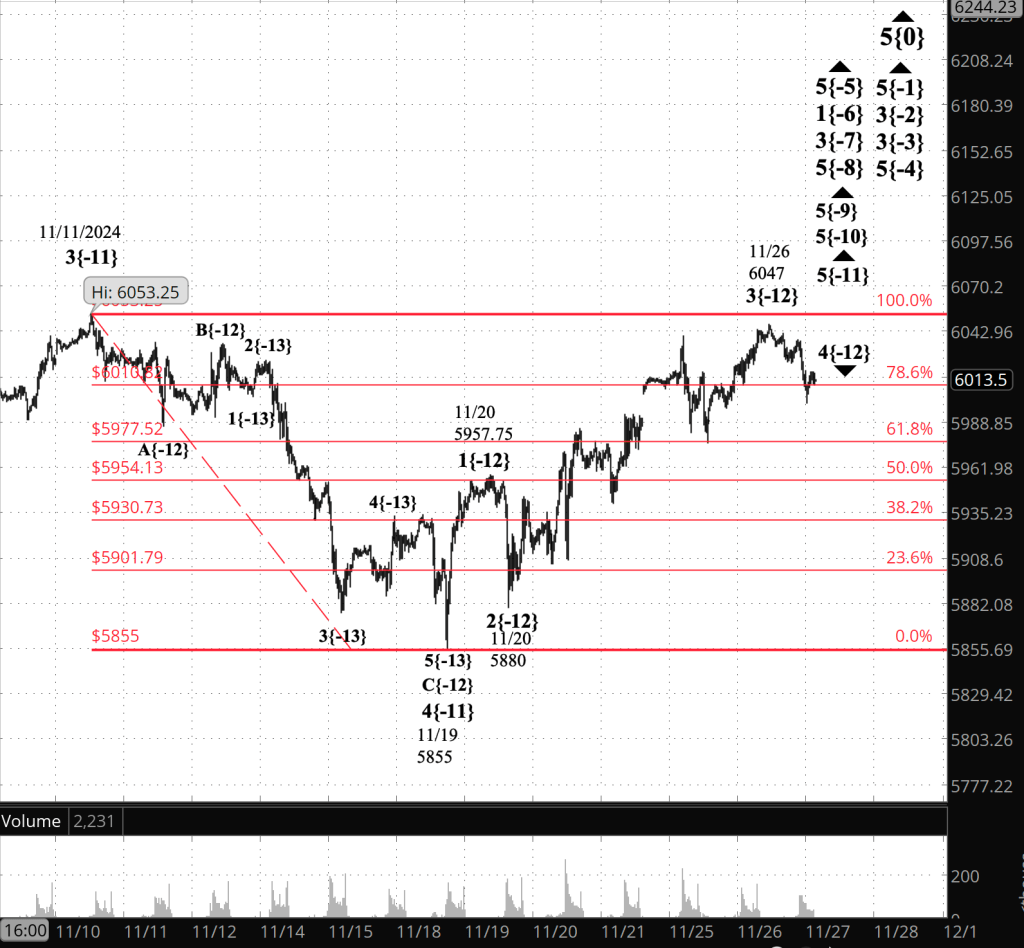
Half an hour before the closing bell. The S&P 500 futures rose during the session, reaching above the overnight high to 5621.25. Elliott Wave Analysis: The rise is a 5th-wave uptrend that began on July 2. the wave has traveled to the upside with sufficient clarity that I’m removing the alternative analysis that saw a possibility that the rise was a subwave of the preceding 4th-wave downward correction.

I’ve updated the chart.

9:35 a.m. New York time

What’s happening now? The S&P 500 E-mini futures fluctuated gently around 5590 after trading resumed overnight, until the release of the Employment Situation Report for June, when the price zigzagged in the span of a minute, down into the 5580s and up to a new high above 5600. Thereafter it swiftly returned to the 5590s, where it stayed as the opening bell approached.

What does it mean? Elliott Wave Theory sees the new high, 5605, as further evidence that a 5th-wave uptrend began on July 2. The subwaves within the early stages of a trend can be frustratingly ambiguous. I see the wave 5 uptrend as being in its 1st subwave, but would be unsurprised if the count turned out differently.

The 5th wave is relatively small, but it will have an outsized impact, as 5th waves tend to do. A 5th wave is about endings, and new beginnings. In the fractal structure of the chart, each wave is nested within a series of ongoing waves, each larger than the one before it, and in turn ecnompasses a series of nested series of smaller waves, each smaller than the one before it.

A small 5th wave gains power when it is nested within a series of larger 5th waves. The 5th wave that began on July 2 from 5502.75 is a subwave of three larger 5th waves, up to the wave that began on April 18 from 4963.50. That largest 5th wave in the series is a subwave of a still larger 3rd wave that began on February 21 from 4959.

The end of the present small subwave, the one that began three days ago, will also be the end of the three larger subwaves and of the third wave that began in the winter winds of February.

What comes next? A 4th-wave downward correction, four levels higher in the fractal structure than the small 4th-wave downward correction that ended three days ago.

What are the alternatives? It’s still possible, although it’s less likely by the day, that the new 5th wave is a head-fake and the 4th-wave downward correction is continuing. [Note: I’ve eliminated this alternative.]

There may be a 1st wave on the chart, between wave 5{-6} and 5{-5}. If that’s the proper count, then it would delay the onset or the 4th-wave downward correction, wave 4{-4}. See the June 18 Trader’s Notebook for a more detailed discussion.

[S&P 500 E-mini futures at 3:30 p.m., 80-minute bars, with volume]

What does Elliott wave theory say? Here are the waves that underly the analyses.

Principal Analysis:

  • Rising wave 5{0} is underway. It is a wave of Intermediate degree that began in December 2018.
  • It is in its final subwave, wave 5{-1}.
  • Within wave 5{-1}, rising waves 3{-2}, 3{-3} and 3{-4} are underway, as is wave 5{-5}.
  • Wave 5{-6} is underway and is in its final subwave, uptrending wave 5{-7}, which in turn is in its final subwave, uptrending wave 5{-8}.
  • Wave 5{-8} is in its initial subwave, wave 1{-9}. [Update for afternoon analysis.]

Reading the chart. Price movements — waves – – in Elliott wave analysis are labeled with numbers within trending waves and letters with corrective waves. The subscripts — numbers in curly brackets — designate the wave’s degree, which, in Elliott wave analysis, means the relative position of a wave within the larger and smaller structures that make up the chart. R.N. Elliott, who in the 1930s developed the form of analysis that bears his name, viewed the chart as a complex structure of smaller waves nested within larger waves, which in turn are nested within still larger waves. In mathematics it’s called a fractal structure, where at every scale the pattern is similar to the others.

Learning and other resources. Elliott wave analysis provides context, not prophecy. As the 20th century semanticist Alfred Korzybski put it in his book Science and Sanity (1933), “The map is not the territory … The only usefulness of a map depends on similarity of structure between the empirical world and the map.” And I would add, in the ever-changing markets, we can judge that similarity of structure only after the fact.

See the menu page Analytical Methods for a rundown on where to go for information on Elliott wave analysis.

By Tim Bovee, Portland, Oregon, July 5, 2024

Disclaimer

Tim Bovee, Private Trader tracks the analysis and trades of a private trader for his own accounts. Nothing in this blog constitutes a recommendation to buy or sell stocks, options or any other financial instrument. The only purpose of this blog is to provide education and entertainment.

No trader is ever 100 percent successful in his or her trades. Trading in the stock and option markets is risky and uncertain. Each trader must make trading decisions for his or her own account, and take responsibility for the consequences.

License
Creative Commons License

All content on Tim Bovee, Private Trader by Timothy K. Bovee is licensed under a Creative Commons Attribution-ShareAlike 4.0 International License.

Based on a work at www.timbovee.com.
Trader’s Notebook

12:30 p.m. New York time

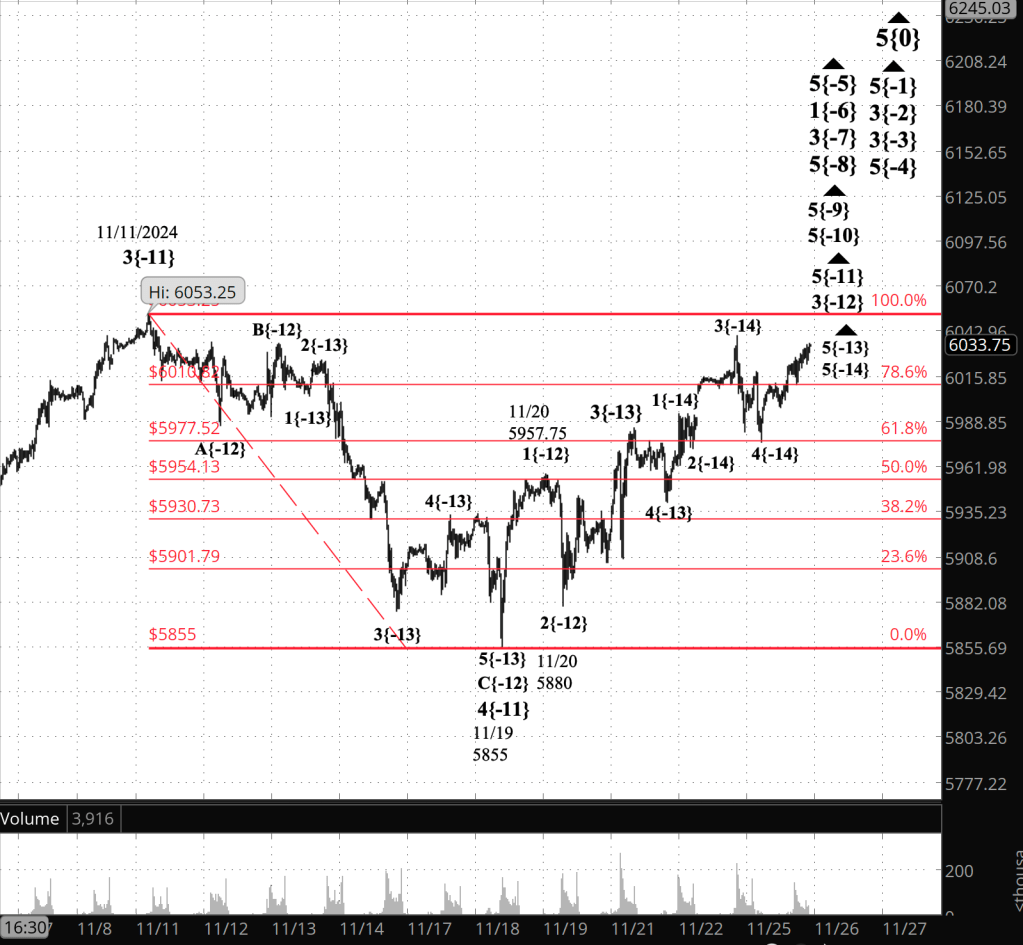
Half an hour before the closing bell. The S&P 500 futures rose during the session. In the terminology of Elliott Wave Theory, according to this morning’s analysis, a subwave of wave C broke past the C wave’s starting point, 5585.

This morning I said that a break above that level would increase the likelihood that wave C ended on on July 2 at 5502.5, completing the 4th-wave downward correction and beginning a 5th-wave uptrend. That has now occurred.

The next significant level is the starting point of the 4th-wave downward correction, 5588, on June 20. The price continued to rise after the first breakout and has broken above the starting point of the correction, so far reaching 5589.

There’s no rule that says a break past the wave 4 starting point means wave 4 has ended. But it’s a strong enough indicator for me to update the analysis.

An uptrend has begun. The 4th-wave downward correction that began on June 20 from 5588 ended on July 3 at 3502.75, and a 5th-wave uptrend has begun. A 5th wave can be quirky. Sometimes it ends quickly, and sometimes it extends for extraordinary gains. There’s no of telling which sort of 5th wave this is.

When the 5th wave is complete, it will also be the end of 5th waves three levels higher in the fractal structure of the chart, and a 3rd wave another level higher. A downward correction will follow.

9:35 a.m. New York time

Markets close early. U.S markets will close at 1 p.m. New York time today, three hours early, in anticipation of July 4th’s Independence Day celebration. Markets will be closed on Thursday and will return to the regular schedule on Friday.

I’ll post the closing Trader’s Notebook update today at 12:30 p.m. I’ll post no Trader’s Notebook on Thursday and will return to the regular schedule on Friday: A post five minutes after the opening bell, at 9:35 a.m. and an update half an hour before the closing bell, at 1 p.m. All times are New York time.

What’s happening now? The S&P 500 E-mini futures rose overnight from the 5550s to the 5570s and then fell, declining further with the release of the ADP Employment Report by the ADP Research Institute, a private-sector company that provides data about labor market and employee data research. The report serves as a sneak preview on the jobs portion of the government’s Employment Situation Report, which will be released on Friday before the opening bell. The ADP report has data on jobs but not on unemployment, the latter being the headline number of the government’s employment report.

The price rose back into the 5570s after the opening bell.

What does it mean? The rise and decline stayed within the range of the June 28 high and the July 2 low.

In applying Elliott Wave Theory to the analysis of charts, I prefer to have a positive reason to declare that one wave has ended and another one has begun. Absent a breakout in any direction, this analysis will be unchanged from yesterday’s: Wave C, which began on June 28, continues. It is the final subwave within a 4th-wave downward correction that began on June 20.

If the price breaks above the June 28 high, 5585, that will strengthen the case that wave C has ended and the following 5th-wave uptrend has begun. A break below the July 2 low, 5502.75, will strengthen the case that wave C is still underway.

What are the alternatives? It’s possible that the new 5th wave is a head-fake and the 4th-wave correction is continuing.

There may be a 1st wave on the chart, between wave 5{-6} and 5{-5}. If that’s the proper count, then it would delay the onset or the 4th-wave downward correction, wave 4{-4}. See the June 18 Trader’s Notebook for a more detailed discussion.

[S&P 500 E-mini futures at 12:30 a.m., 80-minute bars, with volume]

What does Elliott wave theory say? Here are the waves that underly the analyses.

Principal Analysis:

Updated with the afternoon analysis]

  • Rising wave 5{0} is underway. It is a wave of Intermediate degree that began in December 2018.
  • It is in its final subwave, wave 5{-1}.
  • Within wave 5{-1}, rising waves 3{-2}, 3{-3} and 3{-4} are underway, as is wave 5{-5}.
  • Wave 5{-6} is underway and is in its final subwave, uptrending wave 5{-7}, which in turn is in its final subwave, uptrending wave 5{-8}.

Reading the chart. Price movements — waves – – in Elliott wave analysis are labeled with numbers within trending waves and letters with corrective waves. The subscripts — numbers in curly brackets — designate the wave’s degree, which, in Elliott wave analysis, means the relative position of a wave within the larger and smaller structures that make up the chart. R.N. Elliott, who in the 1930s developed the form of analysis that bears his name, viewed the chart as a complex structure of smaller waves nested within larger waves, which in turn are nested within still larger waves. In mathematics it’s called a fractal structure, where at every scale the pattern is similar to the others.

Learning and other resources. Elliott wave analysis provides context, not prophecy. As the 20th century semanticist Alfred Korzybski put it in his book Science and Sanity (1933), “The map is not the territory … The only usefulness of a map depends on similarity of structure between the empirical world and the map.” And I would add, in the ever-changing markets, we can judge that similarity of structure only after the fact.

See the menu page Analytical Methods for a rundown on where to go for information on Elliott wave analysis.

By Tim Bovee, Portland, Oregon, July 3, 2024

Disclaimer

Tim Bovee, Private Trader tracks the analysis and trades of a private trader for his own accounts. Nothing in this blog constitutes a recommendation to buy or sell stocks, options or any other financial instrument. The only purpose of this blog is to provide education and entertainment.

No trader is ever 100 percent successful in his or her trades. Trading in the stock and option markets is risky and uncertain. Each trader must make trading decisions for his or her own account, and take responsibility for the consequences.

License
Creative Commons License

All content on Tim Bovee, Private Trader by Timothy K. Bovee is licensed under a Creative Commons Attribution-ShareAlike 4.0 International License.

Based on a work at www.timbovee.com.

Trader’s Notebook

3:30 p.m. New York time

Half an hour before the closing bell. The S&P 500 futures rose during the session, returning to the 5550s.

Applying Elliott Wave Theory, the analysis shows that rise is most likely part of the declining C wave that began on June 28. The session high so far has remained below the C-wave’s starting point. A move above that starting point would signal that the C wave and its parent 4th-wave downward correction, which began on June 20, have ended and a that a 5th-wave uptrend is underway.

Another approach: The C wave when complete will have five subwaves. I count it the present subwave as being the 2nd, although there are some ambiguities in the pattern on the chart. This argues for wave C still being underway.

I’ve retained the wave count from this morning’s analysis. The final subwave, wave C, of the 4th-wave downward correction continues.

9:35 a.m. New York time

What’s happening now? The S&P 500 E-mini futures fell overnight, from the 5530s to just above 5500, rising into the 5520s after the opening bell.

What does it mean? Elliott Wave Theory sees the overnight pattern as a continuation of the final subwave, wave C, within the 4th-wave downtrend that began on June 20. The C wave began on June 28.

The 4th wave will be complete when wave C reaches its end, and a 5th-wave uptrend will begin. the end of the 5th wave will trigger the end of three larger 5th waves, each larger than the one before it. The smaller 5th wave began on June 11, the next larger on May 31, and the largest on April 18.

Move up one degree higher within the fractal structure of the chart, and we’ll see that the end of those 5th waves is also the end of a 3rd-wave uptrend that began on February 21 from 4959.

A 4th-wave downtrend will follow that 3rd wave. A 4th wave tends to end within the 4th subwave of the preceding 3rd wave. Wave 4 within the 3rd-wave uptrend now underway began on March 14 and ended on March 15, ranging from 5253.50 down to 5167.75. That’s the target range for the future 4th-wave correction. However that reflects a tendency, not a firm rule, and the future 4th-wave could end above or below that range.

What are the alternatives? There may be a 1st wave on the chart, between wave 5{-6} and 5{-5}. If that’s the proper count, then it would delay the onset or the 4th-wave downward correction, wave 4{-4}. See the June 18 Trader’s Notebook for a more detailed discussion.

[S&P 500 E-mini futures at 3:30 p.m., 180-minute bars, with volume]

What does Elliott wave theory say? Here are the waves that underly the analyses.

Principal Analysis:

  • Rising wave 5{0} is underway. It is a wave of Intermediate degree that began in December 2018.
  • It is in its final subwave, wave 5{-1}.
  • Within wave 5{-1}, rising waves 3{-2}, 3{-3} and 3{-4} are underway, as is wave 5{-5}.
  • Wave 5{-6} is underway and is in its final subwave, uptrending wave 5{-7} and its subwave, downtrending wave 4{-8}, a corrective wave.
  • Wave 4{-8} is in its final subwave, declining wave C{-9}.

Reading the chart. Price movements — waves – – in Elliott wave analysis are labeled with numbers within trending waves and letters with corrective waves. The subscripts — numbers in curly brackets — designate the wave’s degree, which, in Elliott wave analysis, means the relative position of a wave within the larger and smaller structures that make up the chart. R.N. Elliott, who in the 1930s developed the form of analysis that bears his name, viewed the chart as a complex structure of smaller waves nested within larger waves, which in turn are nested within still larger waves. In mathematics it’s called a fractal structure, where at every scale the pattern is similar to the others.

Learning and other resources. Elliott wave analysis provides context, not prophecy. As the 20th century semanticist Alfred Korzybski put it in his book Science and Sanity (1933), “The map is not the territory … The only usefulness of a map depends on similarity of structure between the empirical world and the map.” And I would add, in the ever-changing markets, we can judge that similarity of structure only after the fact.

See the menu page Analytical Methods for a rundown on where to go for information on Elliott wave analysis.

By Tim Bovee, Portland, Oregon, July 2, 2024

Disclaimer

Tim Bovee, Private Trader tracks the analysis and trades of a private trader for his own accounts. Nothing in this blog constitutes a recommendation to buy or sell stocks, options or any other financial instrument. The only purpose of this blog is to provide education and entertainment.

No trader is ever 100 percent successful in his or her trades. Trading in the stock and option markets is risky and uncertain. Each trader must make trading decisions for his or her own account, and take responsibility for the consequences.

License
Creative Commons License

All content on Tim Bovee, Private Trader by Timothy K. Bovee is licensed under a Creative Commons Attribution-ShareAlike 4.0 International License.

Based on a work at www.timbovee.com.

Trader’s Notebook

3:30 p.m. New York time

Half an hour before the closing bell. The S&P 500 futures remained during the session within the narrow overnight range. This morning’s Elliott Wave Theory analysis is unchanged: The 4th-wave downward correction that began on June 20 continues and is in its final subwave, wave C.

I’ve updated the chart.

9:35 a.m. New York time

A complicated week. Thursday, July 4, is a holiday in the United States, celebrating independence from the British Empire, and U.S.. markets will be closed. Markets the previous day, Wednesday, July 5, will close at 1 p.m. New York time, three hours earlier than usual.

The complexity is Friday’s release of the jobs report, which often will trigger a somewhat dramatic response from the markets. So, big news, maybe, and little time to prep for it.

What’s happening now? The S&P 500 E-mini futures remained in a narrow range after trading resumed overnight, from the 5540s down to the 5520s.

What does it mean? The movement is part of the final leg of a downward correction that began on June 20. The Elliott Wave Theory labeling on the chart has it as wave C, the final subwave of declining wave 4, a downward correction of smaller magnitude that, when complete, will trigger the start of a far larger 4th-wave downward correction.

The smaller 4th wave now underway is important because of its position within the fractal hierarchy of the chart. It is subwave within a series of uptrending 5th waves of increasing size. When the smaller 4th-wave is complete, those 5th waves will also be complete, as will be the still larger 3rd wave that began on February 21.

What are the alternatives? There may be a 1st wave on the chart, between wave 5{-6} and 5{-5}. If that’s the proper count, then it would delay the onset or the 4th-wave downward correction, wave 4{-4}. See the June 18 Trader’s Notebook for a more detailed discussion.

[S&P 500 E-mini futures at 3:30 p.m., 80-minute bars, with volume]

What does Elliott wave theory say? Here are the waves that underly the analyses.

Principal Analysis:

  • Rising wave 5{0} is underway. It is a wave of Intermediate degree that began in December 2018.
  • It is in its final subwave, wave 5{-1}.
  • Within wave 5{-1}, rising waves 3{-2}, 3{-3} and 3{-4} are underway, as is wave 5{-5}.
  • Wave 5{-6} is underway and is in its final subwave, uptrending wave 5{-7} and its subwave, downtrending wave 4{-8}, a corrective wave.
  • Wave 4{-8} is in its final subwave, declining wave C{-9}.

Reading the chart. Price movements — waves – – in Elliott wave analysis are labeled with numbers within trending waves and letters with corrective waves. The subscripts — numbers in curly brackets — designate the wave’s degree, which, in Elliott wave analysis, means the relative position of a wave within the larger and smaller structures that make up the chart. R.N. Elliott, who in the 1930s developed the form of analysis that bears his name, viewed the chart as a complex structure of smaller waves nested within larger waves, which in turn are nested within still larger waves. In mathematics it’s called a fractal structure, where at every scale the pattern is similar to the others.

Learning and other resources. Elliott wave analysis provides context, not prophecy. As the 20th century semanticist Alfred Korzybski put it in his book Science and Sanity (1933), “The map is not the territory … The only usefulness of a map depends on similarity of structure between the empirical world and the map.” And I would add, in the ever-changing markets, we can judge that similarity of structure only after the fact.

See the menu page Analytical Methods for a rundown on where to go for information on Elliott wave analysis.

By Tim Bovee, Portland, Oregon, July 1, 2024

Disclaimer

Tim Bovee, Private Trader tracks the analysis and trades of a private trader for his own accounts. Nothing in this blog constitutes a recommendation to buy or sell stocks, options or any other financial instrument. The only purpose of this blog is to provide education and entertainment.

No trader is ever 100 percent successful in his or her trades. Trading in the stock and option markets is risky and uncertain. Each trader must make trading decisions for his or her own account, and take responsibility for the consequences.

License
Creative Commons License

All content on Tim Bovee, Private Trader by Timothy K. Bovee is licensed under a Creative Commons Attribution-ShareAlike 4.0 International License.

Based on a work at www.timbovee.com.
Trader’s Notebook

3:30 p.m. New York time

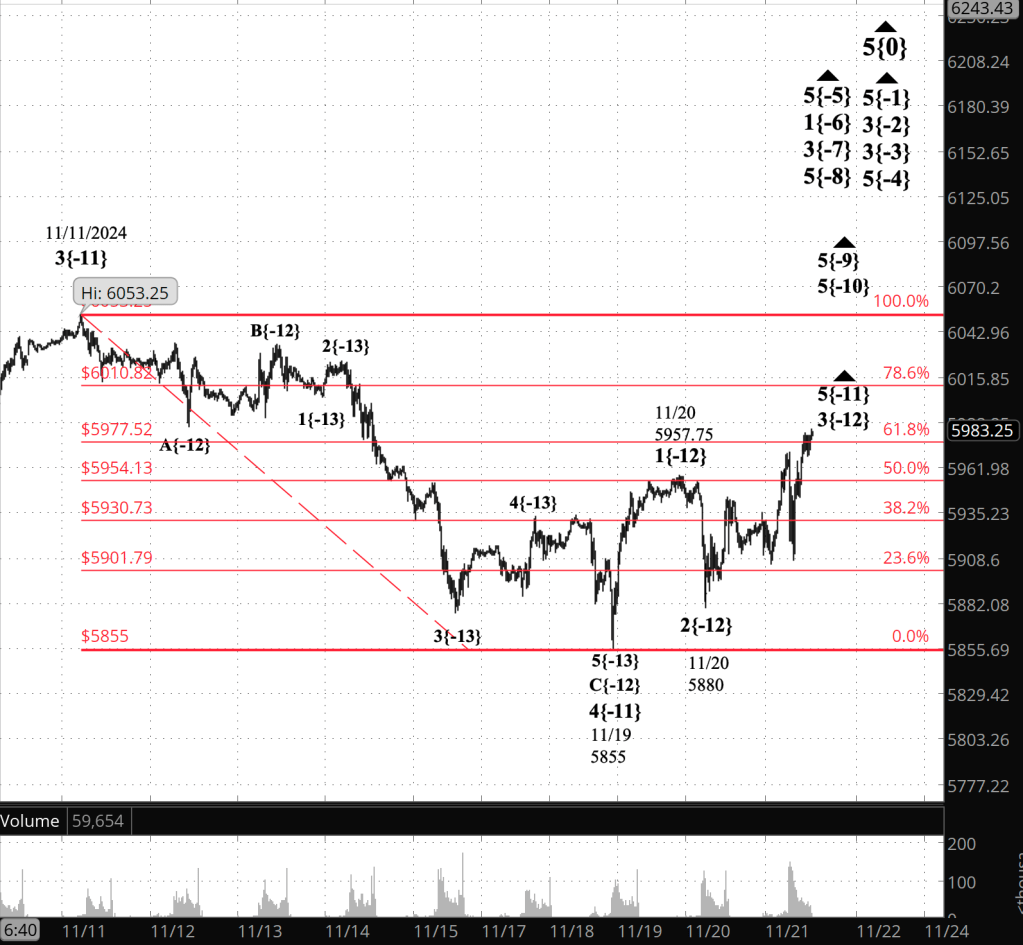
Half an hour before the closing bell. The S&P 500 futures rose into the 5580s during the session and then fell, reaching into the 5520s as the closing bell approached.

Elliott Wave Theory: The session high, 5585, marked the end of the middle subwave of a 4th-wave downward correction that began on June 20 and the beginning of the final subwave, declining wave C.

I’ve updated the chart.

9:35 a.m. New York time

What’s happening now? The S&P 500 E-mini futures rose from the 5540s to the 5570s overnight, peaking with the releasseof the Personal Consumption Expenditures (PCE) index, a measure of inflation, an hour before the opening bell. The price then swiftly reversed to the 5550s.

What does it mean? The rise bought a degree of clarity to the Elliott Wave Theory view of the chart, and I’ve adjusted the analysis accordingly. The 4th-wave downward correction that began on June 20 is in its 2nd of three subwaves, rising wave B. The B wave will bne followed by a declining C wave that will complete the correction. An uptrending 5th wave will follow.

All of this is happening within a larger uptrending 5th wave that began on June 11.

What are the alternatives? There may be a 1st wave on the chart, between wave 5{-6} and 5{-5}. If that’s the proper count, then it would delay the onset or the 4th-wave downward correction, wave 4{-4}. See the June 18 Trader’s Notebook for a more detailed discussion.

[S&P 500 E-mini futures at 3:30 p.m., 180-minute bars, with volume]

What does Elliott wave theory say? Here are the waves that underly the analyses.

Principal Analysis:

  • Rising wave 5{0} is underway. It is a wave of Intermediate degree that began in December 2018.
  • It is in its final subwave, wave 5{-1}.
  • Within wave 5{-1}, rising waves 3{-2}, 3{-3} and 3{-4} are underway, as is wave 5{-5}.
  • Wave 5{-6} is underway and is in its final subwave, uptrending wave 5{-7} and its subwave, downtrending wave 4{-8}, a corrective wave.
  • Wave 4{-8} is in its middle subwave, wave B{-9}.

Reading the chart. Price movements — waves – – in Elliott wave analysis are labeled with numbers within trending waves and letters with corrective waves. The subscripts — numbers in curly brackets — designate the wave’s degree, which, in Elliott wave analysis, means the relative position of a wave within the larger and smaller structures that make up the chart. R.N. Elliott, who in the 1930s developed the form of analysis that bears his name, viewed the chart as a complex structure of smaller waves nested within larger waves, which in turn are nested within still larger waves. In mathematics it’s called a fractal structure, where at every scale the pattern is similar to the others.

Learning and other resources. Elliott wave analysis provides context, not prophecy. As the 20th century semanticist Alfred Korzybski put it in his book Science and Sanity (1933), “The map is not the territory … The only usefulness of a map depends on similarity of structure between the empirical world and the map.” And I would add, in the ever-changing markets, we can judge that similarity of structure only after the fact.

See the menu page Analytical Methods for a rundown on where to go for information on Elliott wave analysis.

By Tim Bovee, Portland, Oregon, June 28, 2024

Disclaimer

Tim Bovee, Private Trader tracks the analysis and trades of a private trader for his own accounts. Nothing in this blog constitutes a recommendation to buy or sell stocks, options or any other financial instrument. The only purpose of this blog is to provide education and entertainment.

No trader is ever 100 percent successful in his or her trades. Trading in the stock and option markets is risky and uncertain. Each trader must make trading decisions for his or her own account, and take responsibility for the consequences.

License
Creative Commons License

All content on Tim Bovee, Private Trader by Timothy K. Bovee is licensed under a Creative Commons Attribution-ShareAlike 4.0 International License.

Based on a work at www.timbovee.com.

Trader’s Notebook

3:30 p.m. New York time

Half an hour before the closing bell. The S&P 500 futures fluctuated between the 5550s and the 5530s during the session, going nowhere. This morning’s Elliott Wave Theory analysis is unchanged: A 4th wave downward correction within a 5th-wave uptrend that began on June 11 continues.

I’ve updated the chart.

9:35 a.m. New York time

What’s happening now? The S&P 500 E-mini futures rose from the 5510s to the 5540s overnight.

What does it mean? The Elliott Wave Theory analysis remans unchanged. A 4th-wave downward correction within a 5th-wave uptrend continues. The correction is in its final segment, wave C.

When wave C is complete, it will also be the end of the correction and the beginning of the final subwave of the 5th-wave uptrend — wave 5.

The 5th-wave uptrend began on June 11. When it is complete, it will also be the end of two 5th waves of increasing size within the fractal structure of the chart, and of a still larger 3rd wave that began on February 21.

What comes next. A 4th-wave downward correction will follow, significantly larger than the small 4th wave now underway.

How large? The starting price of the 3rd wave that began on February 21 was 4959. A 4th wave typically ends somewhere within range covered by the 4th subwave within the 3rd wave. That gives a typical endpoint of the future larger 4th wave between 4959 and 5253.50.

Note that the typical endpoint is a tendency, not a firm rule.

What are the alternatives? There may be a 1st wave on the chart, between wave 5{-6} and 5{-5}. If that’s the proper count, then it would delay the onset or the 4th-wave downward correction, wave 4{-4}. See the June 18 Trader’s Notebook for a more detailed discussion.

[S&P 500 E-mini futures at 3:30 p.m., 70-minute bars, with volume]

What does Elliott wave theory say? Here are the waves that underly the analyses.

Principal Analysis:

  • Rising wave 5{0} is underway. It is a wave of Intermediate degree that began in December 2018.
  • It is in its final subwave, wave 5{-1}.
  • Within wave 5{-1}, rising waves 3{-2}, 3{-3} and 3{-4} are underway, as is wave 5{-5}.
  • Wave 5{-6} is underway and is in its final subwave, uptrending wave 5{-7} and its subwave, downtrending wave 4{-8}, a corrective wave.
  • Wave 4{-8} is in its final subwave, wave C{-9}.

Reading the chart. Price movements — waves – – in Elliott wave analysis are labeled with numbers within trending waves and letters with corrective waves. The subscripts — numbers in curly brackets — designate the wave’s degree, which, in Elliott wave analysis, means the relative position of a wave within the larger and smaller structures that make up the chart. R.N. Elliott, who in the 1930s developed the form of analysis that bears his name, viewed the chart as a complex structure of smaller waves nested within larger waves, which in turn are nested within still larger waves. In mathematics it’s called a fractal structure, where at every scale the pattern is similar to the others.

Learning and other resources. Elliott wave analysis provides context, not prophecy. As the 20th century semanticist Alfred Korzybski put it in his book Science and Sanity (1933), “The map is not the territory … The only usefulness of a map depends on similarity of structure between the empirical world and the map.” And I would add, in the ever-changing markets, we can judge that similarity of structure only after the fact.

See the menu page Analytical Methods for a rundown on where to go for information on Elliott wave analysis.

By Tim Bovee, Portland, Oregon, June 27, 2024

Disclaimer

Tim Bovee, Private Trader tracks the analysis and trades of a private trader for his own accounts. Nothing in this blog constitutes a recommendation to buy or sell stocks, options or any other financial instrument. The only purpose of this blog is to provide education and entertainment.

No trader is ever 100 percent successful in his or her trades. Trading in the stock and option markets is risky and uncertain. Each trader must make trading decisions for his or her own account, and take responsibility for the consequences.

License
Creative Commons License

All content on Tim Bovee, Private Trader by Timothy K. Bovee is licensed under a Creative Commons Attribution-ShareAlike 4.0 International License.

Based on a work at www.timbovee.com.
Trader’s Notebook

3:30 p.m. New York time

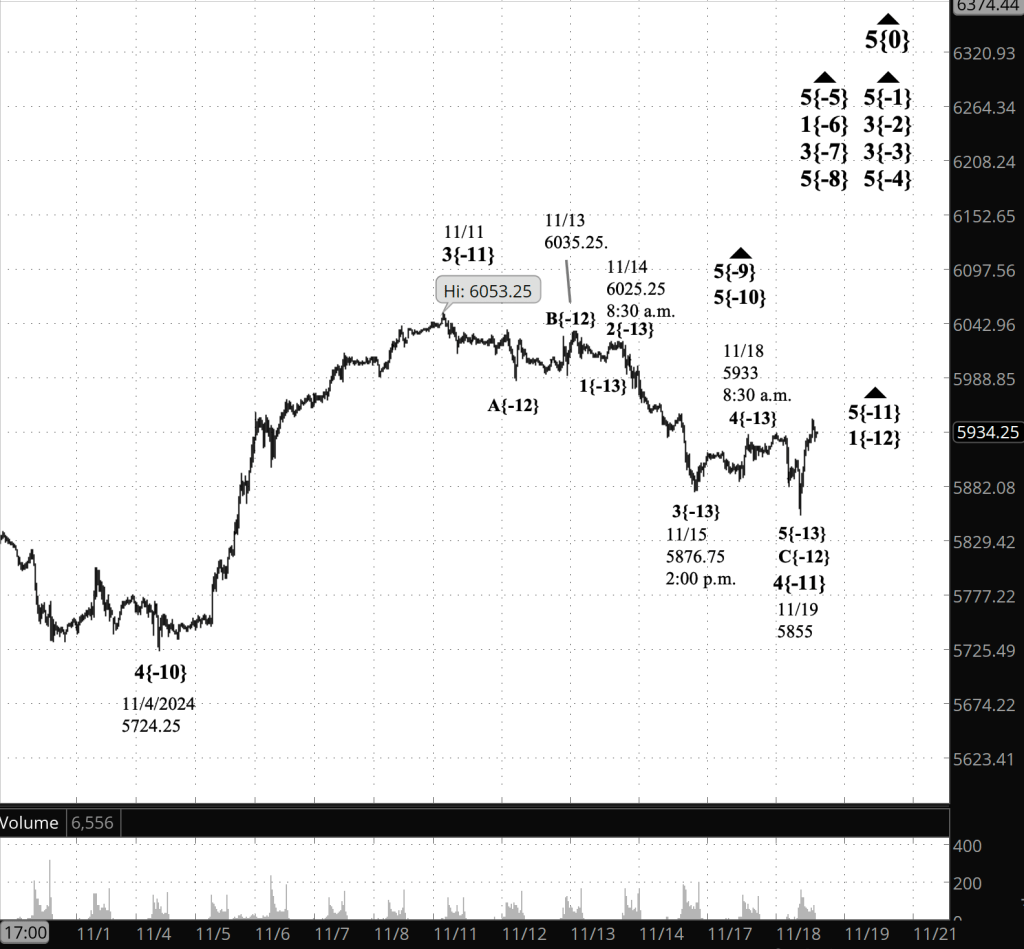
Half an hour before the closing bell. The S&P 500 futures traded in a narrow range during the session. No change from this morning’s analysis, which applied Elliott Wave Theory and concluded that a 4th-wave downward correction has been underway since June 20, with a larger 5th-wave uptrend.

I’ve updated the chart.

9:35 a.m. New York time

What’s happening now? The S&P 500 E-mini futures declined into the 5510s as the opening bell approached.

What does it mean? Elliott Wave Theory analyzes the decline as part of the final subwave within a 4th-wave downward correction that began on June 20, part of a larger 5th-wave uptrend that began on June 11.

What are the alternatives? There may be a 1st wave on the chart, between wave 5{-6} and 5{-5}. If that’s the proper count, then it would delay the onset or the 4th-wave downward correction, wave 4{-4}. See the June 18 Trader’s Notebook for a more detailed discussion.

[S&P 500 E-mini futures at 3:30 p.m., 1-hour bars, with volume]

What does Elliott wave theory say? Here are the waves that underly the analyses.

Principal Analysis:

  • Rising wave 5{0} is underway. It is a wave of Intermediate degree that began in December 2018.
  • It is in its final subwave, wave 5{-1}.
  • Within wave 5{-1}, rising waves 3{-2}, 3{-3} and 3{-4} are underway, as is wave 5{-5}.
  • Wave 5{-6} is underway and is in its final subwave, uptrending wave 5{-7} and its subwave, downtrending wave 4{-8}, a corrective wave.
  • Wave 4{-8} is in its final subwave, wave C{-9}.

Reading the chart. Price movements — waves – – in Elliott wave analysis are labeled with numbers within trending waves and letters with corrective waves. The subscripts — numbers in curly brackets — designate the wave’s degree, which, in Elliott wave analysis, means the relative position of a wave within the larger and smaller structures that make up the chart. R.N. Elliott, who in the 1930s developed the form of analysis that bears his name, viewed the chart as a complex structure of smaller waves nested within larger waves, which in turn are nested within still larger waves. In mathematics it’s called a fractal structure, where at every scale the pattern is similar to the others.

Learning and other resources. Elliott wave analysis provides context, not prophecy. As the 20th century semanticist Alfred Korzybski put it in his book Science and Sanity (1933), “The map is not the territory … The only usefulness of a map depends on similarity of structure between the empirical world and the map.” And I would add, in the ever-changing markets, we can judge that similarity of structure only after the fact.

See the menu page Analytical Methods for a rundown on where to go for information on Elliott wave analysis.

By Tim Bovee, Portland, Oregon, June 26, 2024

Disclaimer

Tim Bovee, Private Trader tracks the analysis and trades of a private trader for his own accounts. Nothing in this blog constitutes a recommendation to buy or sell stocks, options or any other financial instrument. The only purpose of this blog is to provide education and entertainment.

No trader is ever 100 percent successful in his or her trades. Trading in the stock and option markets is risky and uncertain. Each trader must make trading decisions for his or her own account, and take responsibility for the consequences.

License
Creative Commons License

All content on Tim Bovee, Private Trader by Timothy K. Bovee is licensed under a Creative Commons Attribution-ShareAlike 4.0 International License.

Based on a work at www.timbovee.com.

Trader’s Notebook

3:30 p.m New York time

Half an hour before the closing bell. The S&P 500 futures has swung between the 5510s and the 5530s during the session as what Elliott Wave Theory sees as a 4th-wave downward correction continues.

I’ve updated the chart.

9:35 a.m. New York time

What’s happening now? The S&P 500 E-mini futures continued to trade in a narrow range overnight, between the low 2010s and the high 2020s.

What does it mean? Unchanged from yesterday, and so I’ll be brief. Elliott Wave Theory sees the sideways movement as part of a 4th-wave downward correction, within a larger 5th-wave uptrend. The waves are labeled on the chart as wave 4{-8} and wave 5{-7}.

Internally, the 4th wave is in its third and final subwave, wave C, which is labelled wave C{-9} on the chart.

The labels show the wave numbered followed by a subscript, in curly brackets, showing the label’s position in the fractal structure of the chart relative to the Intermediate degree. The Intermediate wave now in progress is wave 5{0}. Under this labeling system, wave 4{-8} is eight degrees below Intermediate and wave 5{-7} is seven degrees below Intermediate.

What are the alternatives? Also unchanged. There may be a 1st wave on the chart, between wave 5{-6} and 5{-5}. If that’s the proper count, then it would delay the onset or the 4th-wave downward correction, wave 4{-4}. See the June 18 Trader’s Notebook for a more detailed discussion.

[S&P 500 E-mini futures at 9:35 a.m., 1-hour bars, with volume]

What does Elliott wave theory say? Here are the waves that underly the analyses.

Principal Analysis:

  • Rising wave 5{0} is underway. It is a wave of Intermediate degree that began in December 2018.
  • It is in its final subwave, wave 5{-1}.
  • Within wave 5{-1}, rising waves 3{-2}, 3{-3} and 3{-4} are underway, as is wave 5{-5}.
  • Wave 5{-6} is underway and is in its final subwave, uptrending wave 5{-7} and its subwave, downtrending wave 4{-8}, a corrective wave.
  • Wave 4{-8} is in its final subwave, wave C{-9}.

Reading the chart. Price movements — waves – – in Elliott wave analysis are labeled with numbers within trending waves and letters with corrective waves. The subscripts — numbers in curly brackets — designate the wave’s degree, which, in Elliott wave analysis, means the relative position of a wave within the larger and smaller structures that make up the chart. R.N. Elliott, who in the 1930s developed the form of analysis that bears his name, viewed the chart as a complex structure of smaller waves nested within larger waves, which in turn are nested within still larger waves. In mathematics it’s called a fractal structure, where at every scale the pattern is similar to the others.

Learning and other resources. Elliott wave analysis provides context, not prophecy. As the 20th century semanticist Alfred Korzybski put it in his book Science and Sanity (1933), “The map is not the territory … The only usefulness of a map depends on similarity of structure between the empirical world and the map.” And I would add, in the ever-changing markets, we can judge that similarity of structure only after the fact.

See the menu page Analytical Methods for a rundown on where to go for information on Elliott wave analysis.

By Tim Bovee, Portland, Oregon, June 25, 2024

Disclaimer

Tim Bovee, Private Trader tracks the analysis and trades of a private trader for his own accounts. Nothing in this blog constitutes a recommendation to buy or sell stocks, options or any other financial instrument. The only purpose of this blog is to provide education and entertainment.

No trader is ever 100 percent successful in his or her trades. Trading in the stock and option markets is risky and uncertain. Each trader must make trading decisions for his or her own account, and take responsibility for the consequences.

License
Creative Commons License

All content on Tim Bovee, Private Trader by Timothy K. Bovee is licensed under a Creative Commons Attribution-ShareAlike 4.0 International License.

Based on a work at www.timbovee.com.
Trader’s Notebook

3:30 p.m. New York time

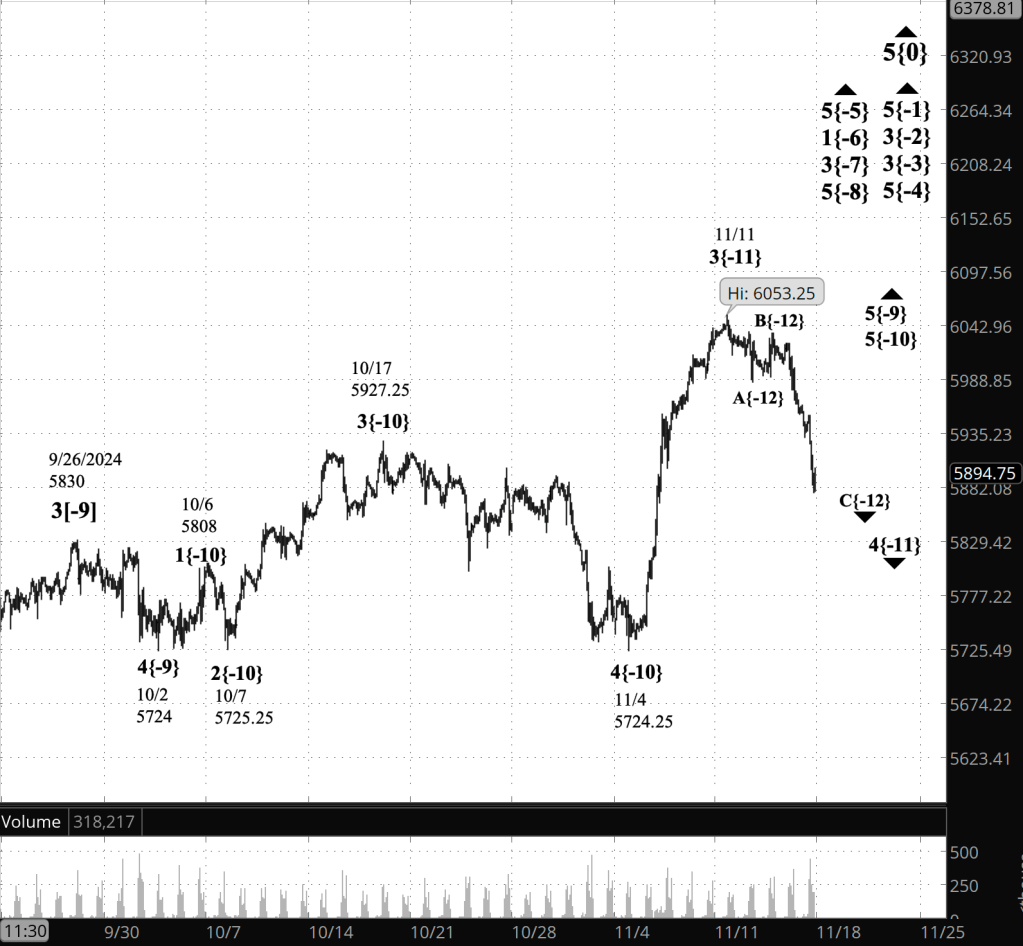
Half an hour before the closing bell. The S&P 500 futures continued to meander within a narrow range during the session, reaching into the 5550s, then quickly retreating into the 5520s.

The 4th-wave downward correction that began on June 20th continues.

I’ve updated the chart.

9:35 a.m. New York time

What’s happening now? The S&P 500 E-mini futures trended sideways after trading resumed overnight, zigzagging between the 5510s and the 5540s.

What does it mean? Elliott Wave Analysis sees the decline as a continuation of the 4th-wave correction that began on June 20, a subwave of the uptrending 5th wave that began on June 11.

The bigger picture is unchanged from last week. Within the fractal structue of the chart, the 5th wave from June 11 is embedded in three nested 5th waves, each larger than the one before. The whole structure is embedded in a 3rd wave that began on February 21.

When the smallest of the 5th waves noted above is complete, it will be the end of each of the three nested 5th waves and of the still larger 3rd wave. A 4th wave downward correction will follow. If it is typical, it will end within the range of the 4th wave within the preceding 3rd wave, a range running from the 5250s to the 5160s. A tendency isn’t a rule. It would be unsurprising if the 4th wave ended above or below that range.

What are the alternatives? Also unchanged from last week. There may be a 1st wave on the chart, between wave 5{-6} and 5{-5}. If that’s the proper count, then it would delay the onset or the 4th-wave downward correction, wave 4{-4}. See the June 18 Trader’s Notebook for a more detailed discussion.

[S&P 500 E-mini futures at 3:30 p.m., 1-hour bars, with volume]

What does Elliott wave theory say? Here are the waves that underly the analyses.

Principal Analysis:

  • Rising wave 5{0} is underway. It is a wave of Intermediate degree that began in December 2018.
  • It is in its final subwave, wave 5{-1}.
  • Within wave 5{-1}, rising waves 3{-2}, 3{-3} and 3{-4} are underway, as is wave 5{-5}.
  • Wave 5{-6} is underway and is in its final subwave, uptrending wave 5{-7} and its subwave, downtrending wave 4{-8}, a corrective wave.

Reading the chart. Price movements — waves – – in Elliott wave analysis are labeled with numbers within trending waves and letters with corrective waves. The subscripts — numbers in curly brackets — designate the wave’s degree, which, in Elliott wave analysis, means the relative position of a wave within the larger and smaller structures that make up the chart. R.N. Elliott, who in the 1930s developed the form of analysis that bears his name, viewed the chart as a complex structure of smaller waves nested within larger waves, which in turn are nested within still larger waves. In mathematics it’s called a fractal structure, where at every scale the pattern is similar to the others.

Learning and other resources. Elliott wave analysis provides context, not prophecy. As the 20th century semanticist Alfred Korzybski put it in his book Science and Sanity (1933), “The map is not the territory … The only usefulness of a map depends on similarity of structure between the empirical world and the map.” And I would add, in the ever-changing markets, we can judge that similarity of structure only after the fact.

See the menu page Analytical Methods for a rundown on where to go for information on Elliott wave analysis.

By Tim Bovee, Portland, Oregon, June 24, 2024

Disclaimer

Tim Bovee, Private Trader tracks the analysis and trades of a private trader for his own accounts. Nothing in this blog constitutes a recommendation to buy or sell stocks, options or any other financial instrument. The only purpose of this blog is to provide education and entertainment.

No trader is ever 100 percent successful in his or her trades. Trading in the stock and option markets is risky and uncertain. Each trader must make trading decisions for his or her own account, and take responsibility for the consequences.

License
Creative Commons License

All content on Tim Bovee, Private Trader by Timothy K. Bovee is licensed under a Creative Commons Attribution-ShareAlike 4.0 International License.

Based on a work at www.timbovee.com.

Trader’s Notebook

3:30 p.m. New York time

Half an hour before the closing bell. The S&P 500 futures fluctuated sideways during the session, remaining between the 5540s and the 5510s. Elliott Wave Theory: The 4th-wave downward correction within a larger 5th-wave uptrend continues. The 5th wave began on June 11, and the 4th wave, on June 20.

I’ve updated the chart.

9:35 a.m. New York time

What’s happening now? The S&P 500 E-mini futures fell from the 5550s to the 5520s overnight.

What does it mean? I’ve moved the chart in for a closer view, and it clarifies the Elliott Wave Theory analysis: The uptrend that began on June 11 has completed its 3rd subwave and is now in a low-degree 4th-wave downward correction.

When that correction is complete, a 5th wave will follow, completing the June 11 5th wave and cascading up the fractal structure of chart, also completing 5th waves three degrees higher and a 3rd wave four degrees higher.

That larger 3rd wave, which began on February 21 from 4959, will be followed by a 4th-wave downward correction of similar magnitude.

On the chart, each wave is marked with a wave number and a subscript in curly brackets showing the wave’s distance in fractal degrees from the Intermediate degree. The present Intermediate degree, wave 5{0}, began in December 2018.

Working down from the largest wave discussed in the analysis, from the 3rd-wave that began on February 21, the waves appear on the chart as waves 3{-4}, 5{-5}, 5{-6} and 5{-7}. Within wave 5{-7}, wave 4{-8}, a downward correction, is underway.

Seee the June 22 Trader’s Notebook for a broader view of the chart, reaching back to the beginning of wave 5{-6} on May 31.

What are the alternatives? Unchanged from the day before. There may be a 1st wave on the chart, between wave 5{-6} and 5{-5}. If that’s the proper count, then it would delay the onset or the 4th-wave downward correction, wave 4{-4}. See the June 18 Trader’s Notebook for a more detailed discussion.

[S&P 500 E-mini futures at 3:30 p.m., 1-hour bars, with volume]

What does Elliott wave theory say? Here are the waves that underly the analyses.

Principal Analysis:

  • Rising wave 5{0} is underway. It is a wave of Intermediate degree that began in December 2018.
  • It is in its final subwave, wave 5{-1}.
  • Within wave 5{-1}, rising waves 3{-2}, 3{-3} and 3{-4} are underway, as is wave 5{-5}.
  • Wave 5{-6} is underway and is in its final subwave, uptrending wave 5{-7} and its subwave, downtrending wave 4{-8}, a corrective wave.

Reading the chart. Price movements — waves – – in Elliott wave analysis are labeled with numbers within trending waves and letters with corrective waves. The subscripts — numbers in curly brackets — designate the wave’s degree, which, in Elliott wave analysis, means the relative position of a wave within the larger and smaller structures that make up the chart. R.N. Elliott, who in the 1930s developed the form of analysis that bears his name, viewed the chart as a complex structure of smaller waves nested within larger waves, which in turn are nested within still larger waves. In mathematics it’s called a fractal structure, where at every scale the pattern is similar to the others.

Learning and other resources. Elliott wave analysis provides context, not prophecy. As the 20th century semanticist Alfred Korzybski put it in his book Science and Sanity (1933), “The map is not the territory … The only usefulness of a map depends on similarity of structure between the empirical world and the map.” And I would add, in the ever-changing markets, we can judge that similarity of structure only after the fact.

See the menu page Analytical Methods for a rundown on where to go for information on Elliott wave analysis.

By Tim Bovee, Portland, Oregon, June 21, 2024

Disclaimer

Tim Bovee, Private Trader tracks the analysis and trades of a private trader for his own accounts. Nothing in this blog constitutes a recommendation to buy or sell stocks, options or any other financial instrument. The only purpose of this blog is to provide education and entertainment.

No trader is ever 100 percent successful in his or her trades. Trading in the stock and option markets is risky and uncertain. Each trader must make trading decisions for his or her own account, and take responsibility for the consequences.

License
Creative Commons License

All content on Tim Bovee, Private Trader by Timothy K. Bovee is licensed under a Creative Commons Attribution-ShareAlike 4.0 International License.

Based on a work at www.timbovee.com.