Options Trades 2/5/2024: XSP

Symbols traded: XSP (1DTE) short Iron Fly

I entered the short Iron Fly position a day before expiration, and exited on expiration day for a 21.7% profit.

XSP short Iron Fly

LOT:5ENTRY DATE:2/5/2024
EXIT DATE:2/6/2024
DAYS HELD:1

Entry and Exit

METRICCREDITDEBITCHANGECHANGE %ANNUALIZED CHANGE %
Options premium$ 1.91$ 1.57$ 0.3421.7%7861%
METRICENTRYEXITCHANGECHANGE %ANNUALIZED CHANGE %
Stock price$ 494.37$ 495.24$ (0.87)0.18%64%
Impllied Volatility Rate13.210.8-2.4
Days to expiration10

The structure of the position

STRUCTURESTRIKEODDS EXPIRE OTMDELTAIN PRICEOUT PRICENET PRICE
Calls
Long498.0086.0%14$ (0.22)$ 0.10$ (0.12)
Break-even496.9171.0%29
Short495.0056.0%44$ 1.02$ (0.99)$ 0.03
Puts
Short495.0056.0%44$ 1.60$ (0.79)$ 0.81
Break-even493.9166.0%34
Long492.0076.0%24$ (0.49)$ 0.11$ (0.38)
======
`NET TOTAL:$ 0.34

Risk and Reward

Per contract:
Reward191.00
Risk109.00
R/R Ratio (n:1)0.6

By Tim Bovee, Portland, Oregon, February 5-6, 2024

Disclaimer

Tim Bovee, Private Trader tracks the analysis and trades of a private trader for his own accounts. Nothing in this blog constitutes a recommendation to buy or sell stocks, options or any other financial instrument. The only purpose of this blog is to provide education and entertainment.

No trader is ever 100 percent successful in his or her trades. Trading in the stock and option markets is risky and uncertain. Each trader must make trading decisions for his or her own account, and take responsibility for the consequences.

License
Creative Commons License

All content on Tim Bovee, Private Trader by Timothy K. Bovee is licensed under a Creative Commons Attribution-ShareAlike 4.0 International License.

Based on a work at www.timbovee.com.

Trader’s Notebook

3:30 p.m. New York time

Half an hour before the closing bell. The S&P 500 futures fell into the 4930s during the session and then returned to the 4960s, within the range it had traded overnight.

The decline is a small subwave within the uptrending 5th wave that began on January 31.

This morning’s analysis is unchanged. I’ve updated the chart.

1:40 p.m. New York time

Trades. Two short-duration trades today on ETFs based on the S&P 500.

I exited my 3DTE over-the-weekend position on SPY for an 19.5% profit and updated the trade analysis with full results.

I entered a 1DTE position on XSP and will exit it on expiration day, February 6. I’ve posted a trade analysis.

Both positions were structured as a short Iron Fly — the same as a short Iron Condor except the two short options have the same strike price. It’s a low-risk, relatively low-reward strategy that does best with low volatility underlying symbols.

9:35 a.m. New York time

What’s happening now? The S&P 500 E-mini futures remained mainly in the 4960s and 4970s after trading resumed overnight. The price remained below the February 2 high, before the weekend, of 4997.75.

What does it mean? The uptrend that began on January 31 continues, a 5th-wave within a series of increasingly larger 5th waves stretching up two levels within the fractal structure of the chart, to a larger 3rd-wave uptrend within another, larger 5th wave uptrend.

The end of the January 31 5th-wave uptrend will also be the end of three of its parent waves. In incresing size, they are two 5th waves and a 3rd wave that began on October 31. The 3rd wave, when complete, will be followed by a significant 4th-wave downward correction.

On the chart the smallest movement I’m tracking is wave 5{-5} — the January 31 uptrend — up through wave 3{-2} to the largest, wave 5{-1}, which began on October 13, 2023. See the “Reading the Chart” section below for an explanation of the degree indicators in curly brackets. The future downward correction will show on the chart as wave 4{-2}.

What are the alternatives? I made an adjustment last week the relative placement of waves within the fractal structure of the price movements, It is possible that further degree adjustments will be needed. In Friday’s analysis I said that I would work over the weekend on the question of when wave 4{-1} ended and wave 5{-1} began. Still working on it.

[S&P 500 E-mini futures at 3:30 p.m., 210-minute bars, with volume]

What does Elliott wave theory say? Here are the waves that underly the analyses.

Principal Analysis:

  • Wave 5{0}, an expanding Diagonal Triangle, began on December 26, 2018.
  • Within it, an uptrend, wave 5{-1}, began on October 13, 2022 and is underway.
  • Wave 5{-1} is the parent wave of a uptrend, wave 3{-2}, that began on October 25, 2023 and is in wave 5{-3}, the last of five subwaves.
  • Wave 5{-3} is in turn in its last subwave, wave 5{-4}, which is also in its final subwave, wave 5{-5}.
  • When wave 5{-5} is complete, it will also be the end of waves 5{-4}, 5{-3} and 3{-2}, and a downward correction, wave 4{-2}, will begin.

We Are Here.

These are the waves currently in progress under my principal analysis. Each line on the list shows the wave number, with the subscript in curly brackets, the traditional degree name, the starting date, the starting price of the S&P 500 E-mini futures, and the direction of the wave.

  • S&P 500 Index:
  • 5{+3} Supercycle, 7/8/1932, 4.40 (up)
  • 5{+2} Cycle, 12/9/1974, 60.96 (up)
  • 5{+1} Primary, 3/6/2009, 666.79 (up)
  • 5{0} Intermediate, 12/26/2018, 2346.58 (up)
  • S&P 500 Futures and index:
  • 5{-1} Minor, 10/13/2022, 3502 (up) (futures), 3491.58 (up) (index)
  • S&P 500 Futures:
  • 3{-2} Minute, 10/27/2023, 4143.50 (up)
  • 5{-3} Minuette, 10/27/2023, 4143.50 (up)

Reading the chart. Price movements — waves – – in Elliott wave analysis are labeled with numbers within trending waves and letters with corrective waves. The subscripts — numbers in curly brackets — designate the wave’s degree, which, in Elliott wave analysis, means the relative position of a wave within the larger and smaller structures that make up the chart. R.N. Elliott, who in the 1930s developed the form of analysis that bears his name, viewed the chart as a complex structure of smaller waves nested within larger waves, which in turn are nested within still larger waves. In mathematics it’s called a fractal structure, where at every scale the pattern is similar to the others.

Learning and other resources. Elliott wave analysis provides context, not prophecy. As the 20th century semanticist Alfred Korzybski put it in his book Science and Sanity (1933), “The map is not the territory … The only usefulness of a map depends on similarity of structure between the empirical world and the map.” And I would add, in the ever-changing markets, we can judge that similarity of structure only after the fact.

See the menu page Analytical Methods for a rundown on where to go for information on Elliott wave analysis.

By Tim Bovee, Portland, Oregon, February 5, 2024

Disclaimer

Tim Bovee, Private Trader tracks the analysis and trades of a private trader for his own accounts. Nothing in this blog constitutes a recommendation to buy or sell stocks, options or any other financial instrument. The only purpose of this blog is to provide education and entertainment.

No trader is ever 100 percent successful in his or her trades. Trading in the stock and option markets is risky and uncertain. Each trader must make trading decisions for his or her own account, and take responsibility for the consequences.

License
Creative Commons License

All content on Tim Bovee, Private Trader by Timothy K. Bovee is licensed under a Creative Commons Attribution-ShareAlike 4.0 International License.

Based on a work at www.timbovee.com.

Options Trades 2/2/2024: SPY

Symbols traded: SPY (3DTE)

I’ve entered a short Iron Fly position on SPY with the intention of holding it over the weekend and exiting on Monday. I exited the position as planned, on February 5, for an 18.5% profit.

SPY short Iron Fly

LOT:6ENTRY DATE:2/2/2024
EXIT DATE:2/5/2024
DAYS HELD:3

Entry and Exit

METRICCREDITDEBITCHANGECHANGE %ANNUALIZED CHANGE %
Options premium$ 2.11$ 1.78$ 0.3318.5%2243%
METRICENTRYEXITCHANGECHANGE %ANNUALIZED CHANGE %
Stock price$ 495.18$ 493.12$ 2.06-0.42%-51%
Impllied Volatility Rate14.715.71.0
Days to expiration30

The structure of the position

STRUCTURESTRIKEODDS EXPIRE OTMDELTAIN PRICEOUT PRICENET PRICE
Calls
Long497.0077.0%22$ (0.79)$ 0.09$ (0.70)
Break-even496.1164.0%33.5
Short494.0051.0%45$ 2.24$ (0.65)$ 1.59
Puts
Short494.0050.0%56$ 1.00$ (1.56)$ (0.56)
Break-even493.1163.0%42.5
Long491.0076.0%29$ (0.34)$ 0.34$ –
======
`NET TOTAL:$ 0.33

Risk and Reward

Per contract:
Reward211.00
Risk89.00
R/R Ratio (n:1)0.4

By Tim Bovee, Portland, Oregon, February 2, February 5, 2024

Disclaimer

Tim Bovee, Private Trader tracks the analysis and trades of a private trader for his own accounts. Nothing in this blog constitutes a recommendation to buy or sell stocks, options or any other financial instrument. The only purpose of this blog is to provide education and entertainment.

No trader is ever 100 percent successful in his or her trades. Trading in the stock and option markets is risky and uncertain. Each trader must make trading decisions for his or her own account, and take responsibility for the consequences.

License
Creative Commons License

All content on Tim Bovee, Private Trader by Timothy K. Bovee is licensed under a Creative Commons Attribution-ShareAlike 4.0 International License.

Based on a work at www.timbovee.com.
Trader’s Notebook

3:30 p.m. New York time

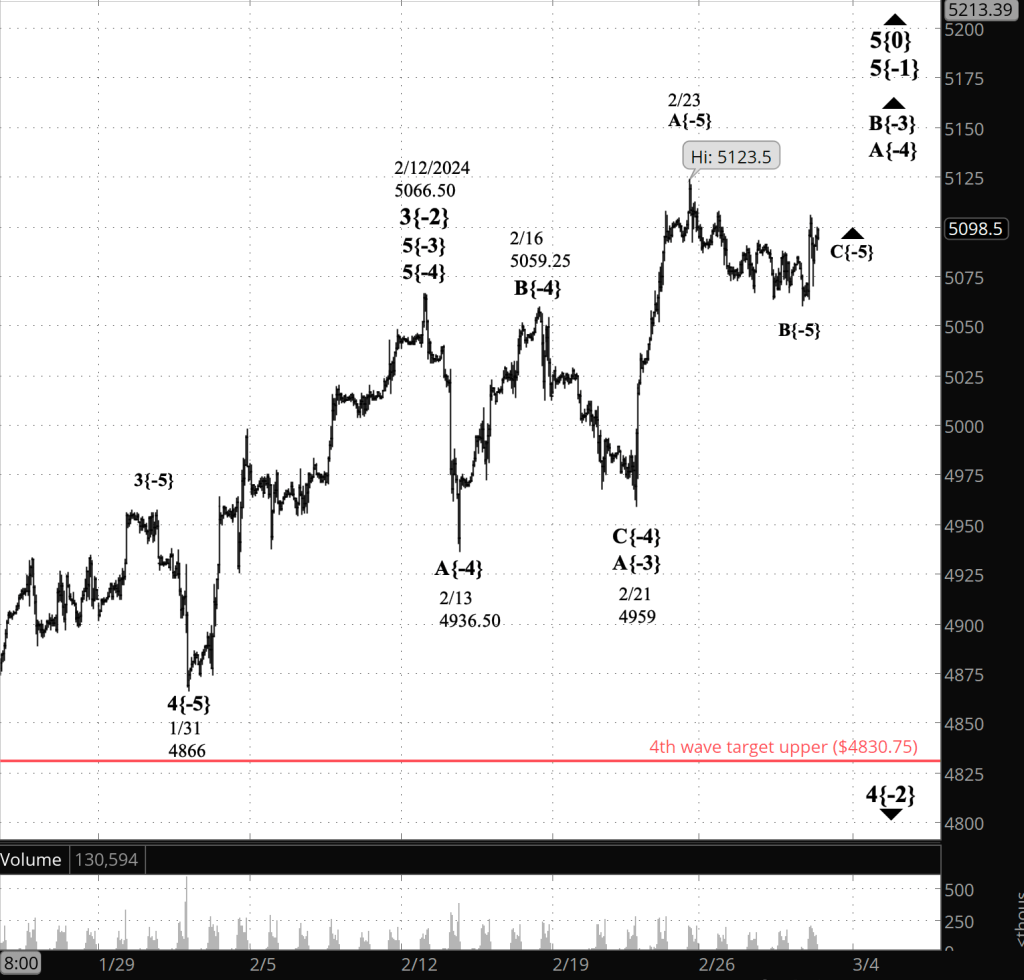
Half an hour before the closing bell. The S&P 500 futures rose still higher during the session, reaching into the 4990s. The uptrend continues. I’ve updated the charts. https://timbovee.com/2024/02/02/traders-notebook-538/

2:25 p.m. New York time

Trade. I’ve entered a 3DTE short Iron Fly options position on SPY, with the intent of holding it over the weekend and exiting on Monday, February 5, which is expiration day. I’ve posted an analysis of the trade.

9:35 a.m. New York time

What’s happening now? The S&P 500 E-mini futures rose to a higher high, 4964, overnight.

What does it mean? The new peak makes clear that a 4th-wave downward correction that began on January 30 ended the next day, and a 5th-wave uptrend began.

The waves, with their degree indicators , are wave 4{-5} and 5{-5}. I’ve raised the degrees, in line with alternative analyses over the past week or so, in order to better match the chart. See the “Reading the Chart” section below for an explanation of degree indicators.

Those 4th and 5th waves of relatively small degree are subwaves of uptrending wave 5{-4}, which is a subwave of wave 5{-3}, which in turn is a subwave of uptrending wave 3{-2}.

The end of wave 5{-5} will also be the end of its parent waves across two larger degrees, wave 5{-4} and 5{-3}, and of wave 3{-2}, which began on October 25, 2023 from 4143.50 on the futures. A large downward correction, wave 4{-2}, will follow.

All that is happening is part of an expanding Diagonal Triangle , wave 5{0}, that began on December 26, 2018.

What are the alternatives? It is possible that further degree adjustments will be needed, both in the smaller degrees shown in the upper chart and the larger degrees shown in the lower chart. In the lower chart, I show wave 4{-1} as having ended. That may not be the case, and I’ll be looking at that question over the weekend.

Charts. The upper chart shows a close-up of wave 5{-3}, which began on October 27, 2023. The lower chart shows the wave 5{0} expanding Diagonal Triangle that began in December 2018.

[S&P 500 E-mini futures at 3:30 p.m., 210-minute bars, with volume]

[S&P 500 index at 3:29 p.m., 3-day bars]

What does Elliott wave theory say? Here are the waves that underly the analyses.

Principal Analysis:

  • Wave 5{0}, an expanding Diagonal Triangle, began on December 26, 2018.
  • Within it, an uptrend, wave 5{-1}, began on October 13, 2022 and is underway.
  • Wave 5{-1} is the parent wave of a uptrend, wave 3{-2}, that began on October 25, 2023 and is in wave 5{-3}, the last of five subwaves.
  • Wave 5{-3} is in turn in its last subwave, wave 5{-4}, which is also in its final subwave, wave 5{-5}.
  • When wave 5{-5} is complete, it will also be the end of waves 5{-4}, 5{-3} and 3{-2}, and a downward correction, wave 4{-2}, will begin.

We Are Here.

These are the waves currently in progress under my principal analysis. Each line on the list shows the wave number, with the subscript in curly brackets, the traditional degree name, the starting date, the starting price of the S&P 500 E-mini futures, and the direction of the wave.

  • S&P 500 Index:
  • 5{+3} Supercycle, 7/8/1932, 4.40 (up)
  • 5{+2} Cycle, 12/9/1974, 60.96 (up)
  • 5{+1} Primary, 3/6/2009, 666.79 (up)
  • 5{0} Intermediate, 12/26/2018, 2346.58 (up)
  • S&P 500 Futures and index:
  • 5{-1} Minor, 10/13/2022, 3502 (up) (futures), 3491.58 (up) (index)
  • S&P 500 Futures:
  • 3{-2} Minute, 10/27/2023, 4143.50 (up)
  • 5{-3} Minuette, 10/27/2023, 4143.50 (up)

Reading the chart. Price movements — waves – – in Elliott wave analysis are labeled with numbers within trending waves and letters with corrective waves. The subscripts — numbers in curly brackets — designate the wave’s degree, which, in Elliott wave analysis, means the relative position of a wave within the larger and smaller structures that make up the chart. R.N. Elliott, who in the 1930s developed the form of analysis that bears his name, viewed the chart as a complex structure of smaller waves nested within larger waves, which in turn are nested within still larger waves. In mathematics it’s called a fractal structure, where at every scale the pattern is similar to the others.

Learning and other resources. Elliott wave analysis provides context, not prophecy. As the 20th century semanticist Alfred Korzybski put it in his book Science and Sanity (1933), “The map is not the territory … The only usefulness of a map depends on similarity of structure between the empirical world and the map.” And I would add, in the ever-changing markets, we can judge that similarity of structure only after the fact.

See the menu page Analytical Methods for a rundown on where to go for information on Elliott wave analysis.

By Tim Bovee, Portland, Oregon, February 2, 2024

Disclaimer

Tim Bovee, Private Trader tracks the analysis and trades of a private trader for his own accounts. Nothing in this blog constitutes a recommendation to buy or sell stocks, options or any other financial instrument. The only purpose of this blog is to provide education and entertainment.

No trader is ever 100 percent successful in his or her trades. Trading in the stock and option markets is risky and uncertain. Each trader must make trading decisions for his or her own account, and take responsibility for the consequences.

License
Creative Commons License

All content on Tim Bovee, Private Trader by Timothy K. Bovee is licensed under a Creative Commons Attribution-ShareAlike 4.0 International License.

Based on a work at www.timbovee.com.
Trader’s Notebook

3:30 p.m. New York time

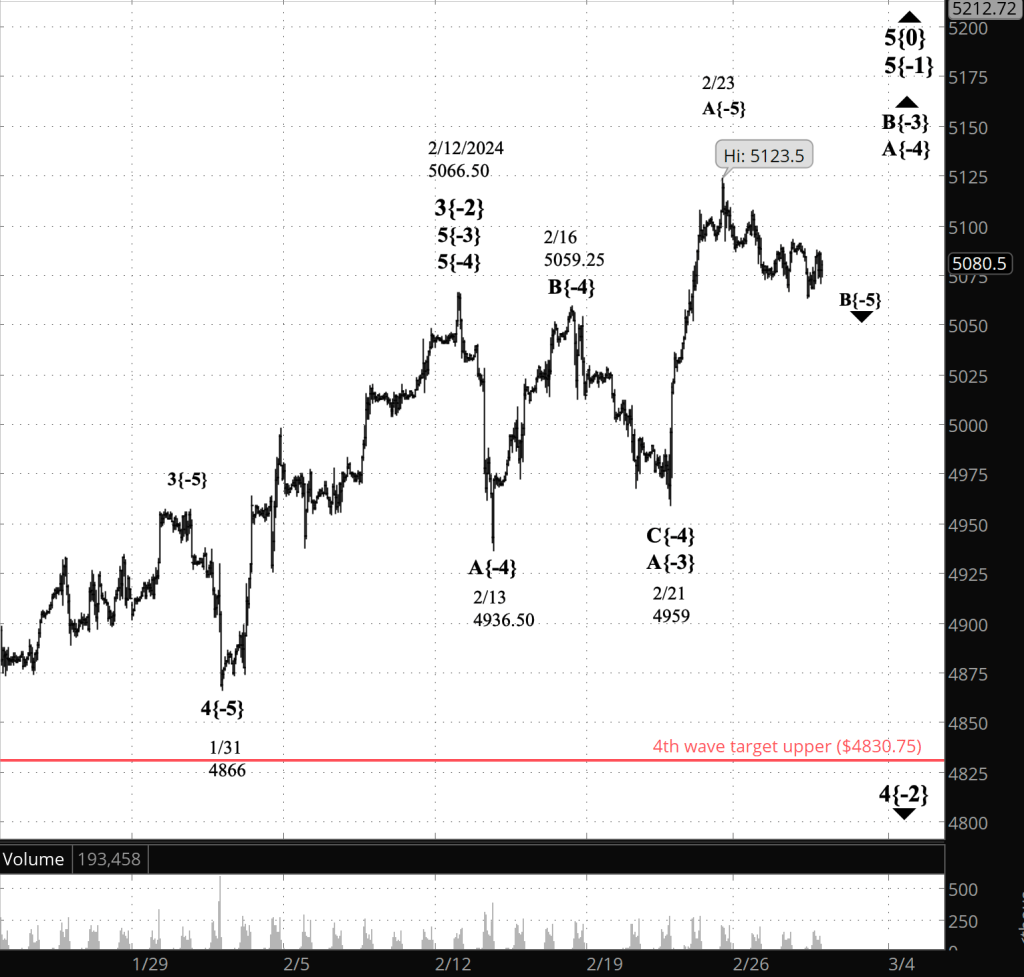
Half an hour before the closing bell. The middle subwave, wave B, of the 4th-wave downward correction that began on January 30 continues.

This morning’s analysis stands unchanged. I’ve updated the chart.

3:29 p.m. New York time

Trades. I exited my longer-term position short Iron Condor position on USO. It was unprofitable on management day, and I exited for a wash: No profit, no loss. I’ve updated the trade analysis with results.

9:35 a.m. New York time

What’s happening now? The S&P 500 E-mini futures rose overnight into the 4990s and then pulled back slightly.

What does it mean? The rise places the 4th-wave downward correction that began on January 30 in its middle subwave of three.

Yesterday’s sharp decline after the Federal Open Market Committee held interest-rates steady broke a rule of Elliott Wave Theory: A 4th wave can’t move beyond the end of the preceding 1st wave. If it does, then the map no longer matches the territory — the analysis no longer matches the chart — and must be redrawn.

In the following discussion I shall use degree designations along with the wave numbers. The degree shows a waves position in relation to other waves within the fractal structure of the chart. The developer of Elliott Wave Theory, R.N. Elliott, gave the degrees names. I find it more convenient to use numbers showing how many degrees distant a wave is from what Elliott called the Intermediate degree. A negative degree number, shown as a subscript within curly brackets, means the wave’s degree is smaller than Intermediate, positive means larger, and {0} is the Intermediate degree.

The new analysis relies on a truncated 5th, a slightly unusual construction at the end of wave 3{-7}. which began on January 25. A 5th wave normally covers significant distance beyond the end of the preceding 3rd wave, but occasionally a 5th wave will come up short, failing to move below the 3rd wave’s end point.

In this case, wave 5{-8}, a subwave of wave 3{-7}, ended exactly where wave 3{-8} had ended, at 4958.25, making it a truncated 5th. The end of wave 5{-8} was also the end of wave 3{-7}. Wave 4{-7}, a downard correction, began on January 30.

A 4th wave typically ends within the 4th subwave of the preceding 3rd wave of the same degree. Wave 4{-7} has blown completely past the level, and has done so with a somewhat ambiguous five-wave pattern. Which leads to the alternative analysis.

What is the alternative? An ongoing alternative has been that the degrees are different than what I considered to be the most likely structure in my analysis. Under the alternative, the January 30 peak was the end of wave 3{-5}. In that case, the decline that began on January 30 would be wave 4{-5} and would have reached the 4th subwave within wave 3{-5}.

I’ll be working with the two analyses to see which best matches the chart. Meanwhile, I’ll keep in mind that with both a principal analysis and the alternative analysis, a 4th-wave downward correction is underway. The unanswered question is how large — at what degree — the correction is.

[S&P 500 E-mini futures at 3:30 p.m., 50-minute bars, with volume]

What does Elliott wave theory say? Here are the waves that underly the analyses.

Principal Analysis:

  • Wave 5{0}, an expanding Diagonal Triangle, began on December 26, 2018.
  • Within it, an uptrend, wave 5{-1}, began on October 13, 2022 and is underway.
  • Wave 5{-1} is the parent wave of a uptrend, wave 3{-2}, that began on October 25, 2023 and is in wave 5{-3}, the last of five subwaves.
  • Wave 5{-3} is in turn in its last subwave, wave 5{-4}, which is also in its final subwave, wave 5{-5}.
  • When wave 5{-5} is complete, it will also be the end of waves 5{-4}, 5{-3} and 3{-2}, and a downward correction, wave 4{-2}, will begin.
  • At a very small degree — hours rather than days — wave 5{-6} is underway.
  • Within wave 5{-6}, wave 3{-7} ended on January 30 and wave 4{-7} began on that date.

Alternative Analysis:

  • Within wave 5{-4}, wave 3{-5} ended on January 30 and wave 4{-5} began on that date.

We Are Here.

These are the waves currently in progress under my principal analysis. Each line on the list shows the wave number, with the subscript in curly brackets, the traditional degree name, the starting date, the starting price of the S&P 500 E-mini futures, and the direction of the wave.

  • S&P 500 Index:
  • 5{+3} Supercycle, 7/8/1932, 4.40 (up)
  • 5{+2} Cycle, 12/9/1974, 60.96 (up)
  • 5{+1} Primary, 3/6/2009, 666.79 (up)
  • 5{0} Intermediate, 12/26/2018, 2346.58 (up)
  • S&P 500 Futures and index:
  • 5{-1} Minor, 10/13/2022, 3502 (up) (futures), 3491.58 (up) (index)
  • S&P 500 Futures:
  • 3{-2} Minute, 10/27/2023, 4143.50 (up)
  • 5{-3} Minuette, 10/27/2023, 4143.50 (up)

Reading the chart. Price movements — waves – – in Elliott wave analysis are labeled with numbers within trending waves and letters with corrective waves. The subscripts — numbers in curly brackets — designate the wave’s degree, which, in Elliott wave analysis, means the relative position of a wave within the larger and smaller structures that make up the chart. R.N. Elliott, who in the 1930s developed the form of analysis that bears his name, viewed the chart as a complex structure of smaller waves nested within larger waves, which in turn are nested within still larger waves. In mathematics it’s called a fractal structure, where at every scale the pattern is similar to the others.

Learning and other resources. Elliott wave analysis provides context, not prophecy. As the 20th century semanticist Alfred Korzybski put it in his book Science and Sanity (1933), “The map is not the territory … The only usefulness of a map depends on similarity of structure between the empirical world and the map.” And I would add, in the ever-changing markets, we can judge that similarity of structure only after the fact.

See the menu page Analytical Methods for a rundown on where to go for information on Elliott wave analysis.

By Tim Bovee, Portland, Oregon, February 1, 2024

Disclaimer

Tim Bovee, Private Trader tracks the analysis and trades of a private trader for his own accounts. Nothing in this blog constitutes a recommendation to buy or sell stocks, options or any other financial instrument. The only purpose of this blog is to provide education and entertainment.

No trader is ever 100 percent successful in his or her trades. Trading in the stock and option markets is risky and uncertain. Each trader must make trading decisions for his or her own account, and take responsibility for the consequences.

License
Creative Commons License

All content on Tim Bovee, Private Trader by Timothy K. Bovee is licensed under a Creative Commons Attribution-ShareAlike 4.0 International License.

Based on a work at www.timbovee.com.
Trader’s Notebook

3:30 p.m. New York time

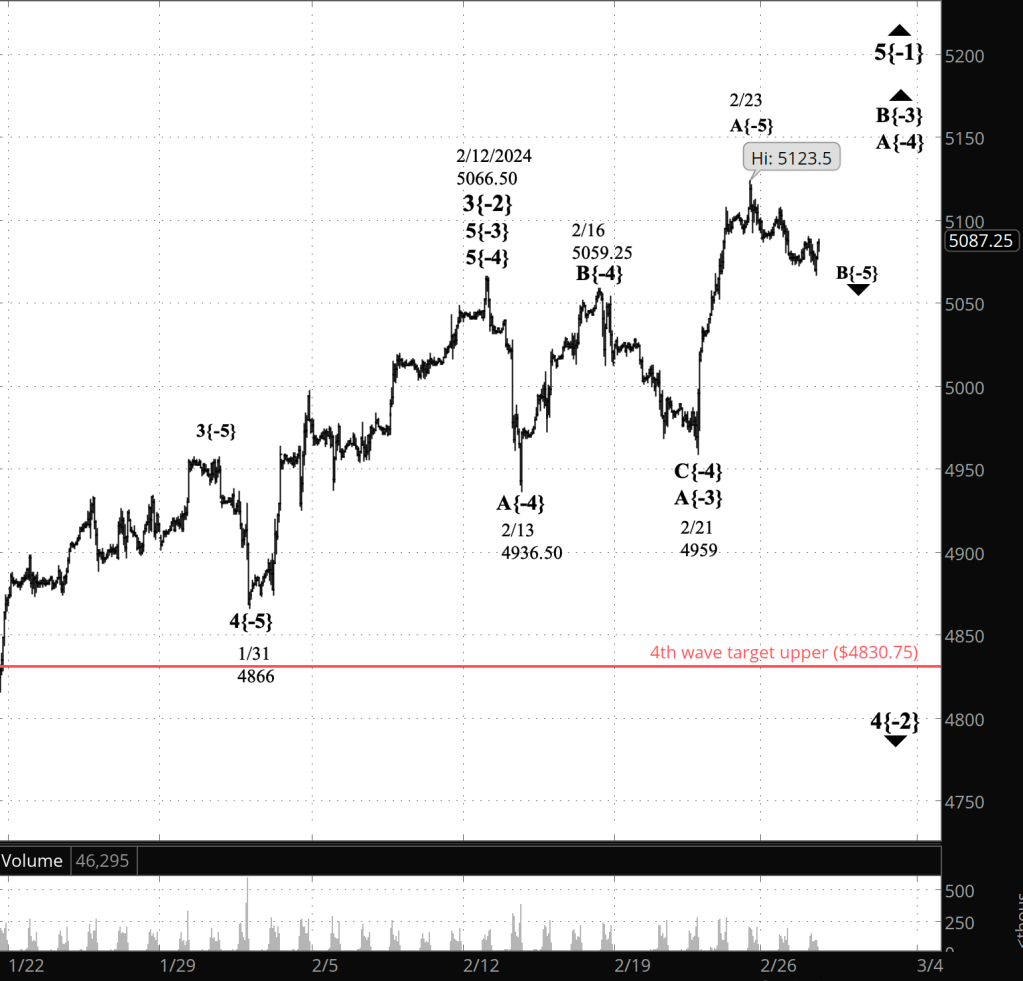
Half an hour before the closing bell. The small 4th-wave downward correction discussed this morning moved below the end of the preceding 1st wave, violating a rule of Elliott Wave Theory,

The movement makes it clear that a truncated wave 5{-8} ended on January 30 at 4957.25, the same price as the end of the preceding wave 3{-8}. The end of wave 5{-8} also marks the end of its parent wave — wave 3{-7} — and the beginning of a larger 4th-wave downward correction.

I’ve updated the chart.

3:29 p.m. New York time

Trade. With the end of uptrending wave 5{-8}, My bull put Vertical Spread position was no longer viable, and I exited for a 64.6% loss. I’ve updated the trade analysis with results.

9:35 a.m. New York time

What’s happening now? The S&P 500 E-mini futures traded sideways overnight, whipsawing as the ADP Employment Report was published.

What does it mean? A small 4th-wave downward correction continues, part of a series of uptrends of increasing size. The 4th wave will be followed by a 5th and final wave that will cascade up the fractal structure, ending the uptrend that began on October 27, 2023 and beginning a 4th-wave downward correction of major proportions.

What are the alternatives? It’s possible that the wave degrees on the chart, showing where the wave fits within the fractal structure of the chart, are off by one degrees for the smaller waves. For example, perhaps wave 4{-8} should be labeled 4{-7}. The degree is shown as a subscript within curly brackets.

Looking forward. The Federal Open Market Committee will release a statement at 2 p.m. New York time stating its intentions for interest rates: Lower them, raise them or leave them unchanged. Federal Reserve Chair Jerome Powell will hold news conference half an hour later, at 2:30 p.m.

[S&P 500 E-mini futures at 3:30 p.m., 45-minute bars, with volume]

What does Elliott wave theory say? Here are the waves that underly the analyses.

Principal Analysis:

  • Wave 5{0}, an expanding Diagonal Triangle, began on December 26, 2018.
  • Within it, an uptrend, wave 5{-1}, began on October 13, 2022 and is underway.
  • Wave 5{-1} is the parent wave of a uptrend, wave 3{-2}, that began on October 25, 2023 and is in wave 5{-3}, the last of five subwaves.
  • Wave 5{-3} is in turn in its last subwave, wave 5{-4}, which is also in its final subwave, wave 5{-5}.
  • When wave 5{-5} is complete, it will also be the end of waves 5{-4}, 5{-3} and 3{-2}, and a downward correction, wave 4{-2}, will begin.
  • At a very small degree — hours rather than days — wave 5{-6} is underway.
  • Within wave 5{-6}, wave 3{-7} is continuing its rise and has entered a downward correction, wave 4{-8}.
  • AFTERNOON UPDATE: Wave 3{-7} ended on January 30 and wave 4{-7} began on that date.

Alternative Analysis:

  • Within wave 5{-6}, a downward correction, wave 4{-7}, is underway.

We Are Here.

These are the waves currently in progress under my principal analysis. Each line on the list shows the wave number, with the subscript in curly brackets, the traditional degree name, the starting date, the starting price of the S&P 500 E-mini futures, and the direction of the wave.

  • S&P 500 Index:
  • 5{+3} Supercycle, 7/8/1932, 4.40 (up)
  • 5{+2} Cycle, 12/9/1974, 60.96 (up)
  • 5{+1} Primary, 3/6/2009, 666.79 (up)
  • 5{0} Intermediate, 12/26/2018, 2346.58 (up)
  • S&P 500 Futures and index:
  • 5{-1} Minor, 10/13/2022, 3502 (up) (futures), 3491.58 (up) (index)
  • S&P 500 Futures:
  • 3{-2} Minute, 10/27/2023, 4143.50 (up)
  • 5{-3} Minuette, 10/27/2023, 4143.50 (up)

Reading the chart. Price movements — waves – – in Elliott wave analysis are labeled with numbers within trending waves and letters with corrective waves. The subscripts — numbers in curly brackets — designate the wave’s degree, which, in Elliott wave analysis, means the relative position of a wave within the larger and smaller structures that make up the chart. R.N. Elliott, who in the 1930s developed the form of analysis that bears his name, viewed the chart as a complex structure of smaller waves nested within larger waves, which in turn are nested within still larger waves. In mathematics it’s called a fractal structure, where at every scale the pattern is similar to the others.

Learning and other resources. Elliott wave analysis provides context, not prophecy. As the 20th century semanticist Alfred Korzybski put it in his book Science and Sanity (1933), “The map is not the territory … The only usefulness of a map depends on similarity of structure between the empirical world and the map.” And I would add, in the ever-changing markets, we can judge that similarity of structure only after the fact.

See the menu page Analytical Methods for a rundown on where to go for information on Elliott wave analysis.

By Tim Bovee, Portland, Oregon, January 31, 2024

Disclaimer

Tim Bovee, Private Trader tracks the analysis and trades of a private trader for his own accounts. Nothing in this blog constitutes a recommendation to buy or sell stocks, options or any other financial instrument. The only purpose of this blog is to provide education and entertainment.

No trader is ever 100 percent successful in his or her trades. Trading in the stock and option markets is risky and uncertain. Each trader must make trading decisions for his or her own account, and take responsibility for the consequences.

License
Creative Commons License

All content on Tim Bovee, Private Trader by Timothy K. Bovee is licensed under a Creative Commons Attribution-ShareAlike 4.0 International License.

Based on a work at www.timbovee.com.
Trader’s Notebook

3:30 p.m. New York time

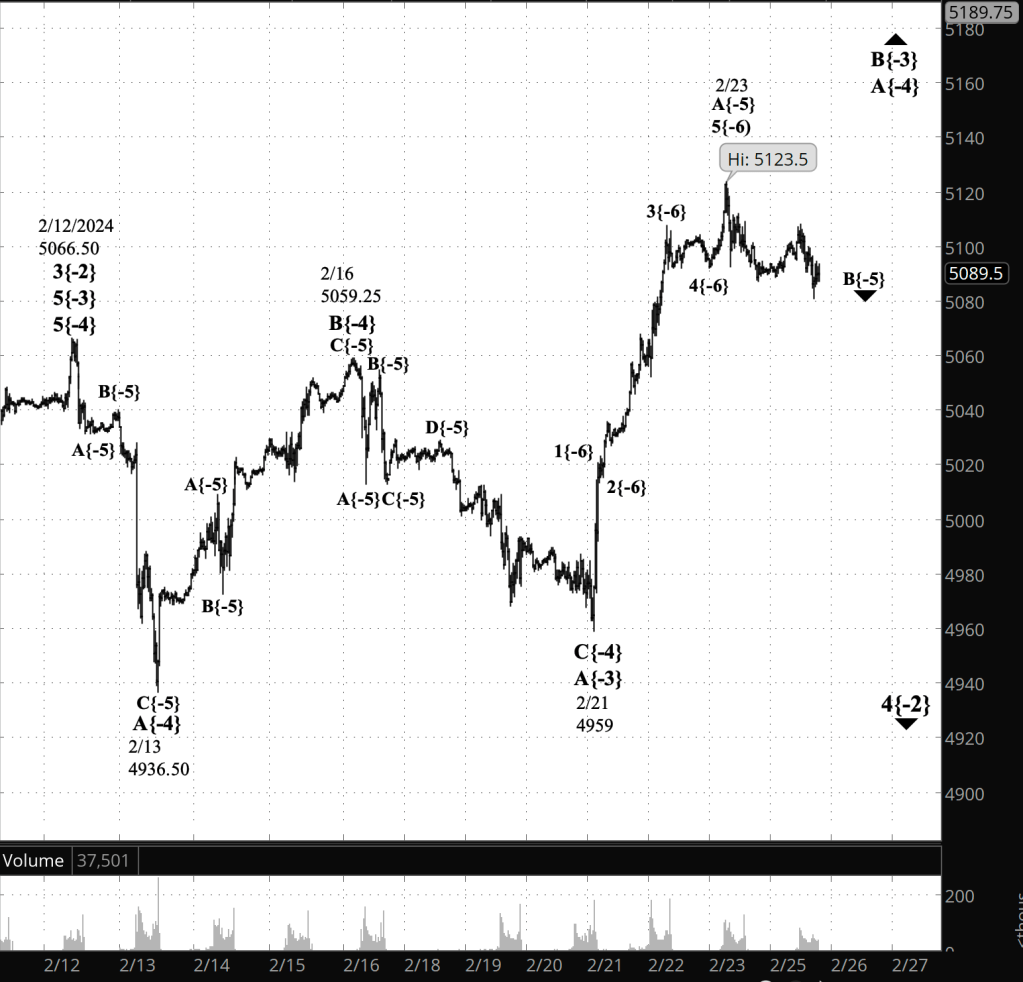
Half an hour before the closing bell. The S&P 500 futures continued a largely sideways journey through a small 4th-wave downward correction. This morning’s analysis is unchanged. I’ve updated the chart.

3:10 p.m. New York time

Trade. I’ve exited my short Iron Fly position on XSP, the day after entry and hours before expiration (it was a 1DTE trade). The trade produced a 15.5% loss. I’ve updated the trade analysis with full results.

I entered no new trades today because of uncertainty over how the markets will respond to whatever interest-rate decision the Federal Open Market Committee announces tomorrow.

9:35 a.m. New York time

What’s happening now? The S&P 500 E-mini futures rose sharply after yesterday’s session closed and then traded sideways overnight.

What does it mean? The rise was part of the middle subwave — wave 3 — of a small 5th-wave uptrend that began on January 24. The uptrend is a subwave of a much larger 3rd-wave uptrend that began on October 27, 2023.

At this point in the discussion I’ll refer to the waves not only by the Elliott Wave number but also by their position within the fractal structure of the chart. The fractal number, a subscript contained in curly brackets, tells where the wave stands within that structure in relation to what R.N. Elliott called the Intermediate degree. At present the Intermediate degree is wave 5{0}, which began on December 26, 2018.

The much larger 3rd wave uptrend that began in October is wave 3{-2}. Working down the fractal structure, wave 3{-2} contains a series of 5th waves of increasingly smaller degree, from wave 5{-3} down to wave 5{-6}.

Within wave 5{-6}, wave 3{-7} is rising, and within it, wave 3{-8} ended during yestereay’s session and 4{-8}, a downward correction, is underway.

Wave 4{-8} when complete, perhaps today, will be followed by rising wave 5{-8}, which will complete its parent, wave 3{-7}. A larger downward correction, wave 4{-7}, will follow, and then a push to the upside, wave 5{-7}, will complete the parent, wave 5{-6}.

At this point, things get interesting. Wave 5{-6} is the smallest of the series of 5th waves referred to earlier in this discussion. Its completion will also be the completion of waves 5{-5}, 5{-4}, 5{-3} and wave 3{-2}, the latter being the uptrend that began on October 27, 2023.

Wave 4{-2} will follow, a downward correction far larger than the mini-trends and corrections that have dominated thinking about the S&P 500 chart for the past few weeks.

What are the alternatives? It’s possible that what I’ve labeled wave 4{-8} is a degree larger and should be labeled wave 4{-7}.

[S&P 500 E-mini futures at 3:30 p.m., 45-minute bars, with volume]

What does Elliott wave theory say? Here are the waves that underly the analyses.

Principal Analysis:

  • Wave 5{0}, an expanding Diagonal Triangle, began on December 26, 2018.
  • Within it, an uptrend, wave 5{-1}, began on October 13, 2022 and is underway.
  • Wave 5{-1} is the parent wave of a uptrend, wave 3{-2}, that began on October 25, 2023 and is in wave 5{-3}, the last of five subwaves.
  • Wave 5{-3} is in turn in its last subwave, wave 5{-4}, which is also in its final subwave, wave 5{-5}.
  • When wave 5{-5} is complete, it will also be the end of waves 5{-4}, 5{-3} and 3{-2}, and a downward correction, wave 4{-2}, will begin.
  • At a very small degree — hours rather than days — wave 5{-6} is underway.
  • Within wave 5{-6}, wave 3{-7} is continuing its rise and has entered a downward correction, wave 4{-8}.

Alternative Analysis:

  • Within wave 5{-6}, a downward correction, wave 4{-7}, is underway.

We Are Here.

These are the waves currently in progress under my principal analysis. Each line on the list shows the wave number, with the subscript in curly brackets, the traditional degree name, the starting date, the starting price of the S&P 500 E-mini futures, and the direction of the wave.

  • S&P 500 Index:
  • 5{+3} Supercycle, 7/8/1932, 4.40 (up)
  • 5{+2} Cycle, 12/9/1974, 60.96 (up)
  • 5{+1} Primary, 3/6/2009, 666.79 (up)
  • 5{0} Intermediate, 12/26/2018, 2346.58 (up)
  • S&P 500 Futures and index:
  • 5{-1} Minor, 10/13/2022, 3502 (up) (futures), 3491.58 (up) (index)
  • S&P 500 Futures:
  • 3{-2} Minute, 10/27/2023, 4143.50 (up)
  • 5{-3} Minuette, 10/27/2023, 4143.50 (up)

Reading the chart. Price movements — waves – – in Elliott wave analysis are labeled with numbers within trending waves and letters with corrective waves. The subscripts — numbers in curly brackets — designate the wave’s degree, which, in Elliott wave analysis, means the relative position of a wave within the larger and smaller structures that make up the chart. R.N. Elliott, who in the 1930s developed the form of analysis that bears his name, viewed the chart as a complex structure of smaller waves nested within larger waves, which in turn are nested within still larger waves. In mathematics it’s called a fractal structure, where at every scale the pattern is similar to the others.

Learning and other resources. Elliott wave analysis provides context, not prophecy. As the 20th century semanticist Alfred Korzybski put it in his book Science and Sanity (1933), “The map is not the territory … The only usefulness of a map depends on similarity of structure between the empirical world and the map.” And I would add, in the ever-changing markets, we can judge that similarity of structure only after the fact.

See the menu page Analytical Methods for a rundown on where to go for information on Elliott wave analysis.

By Tim Bovee, Portland, Oregon, January 30, 2024

Disclaimer

Tim Bovee, Private Trader tracks the analysis and trades of a private trader for his own accounts. Nothing in this blog constitutes a recommendation to buy or sell stocks, options or any other financial instrument. The only purpose of this blog is to provide education and entertainment.

No trader is ever 100 percent successful in his or her trades. Trading in the stock and option markets is risky and uncertain. Each trader must make trading decisions for his or her own account, and take responsibility for the consequences.

License
Creative Commons License

All content on Tim Bovee, Private Trader by Timothy K. Bovee is licensed under a Creative Commons Attribution-ShareAlike 4.0 International License.

Based on a work at www.timbovee.com.
Options Trades 1/29/2024: XSP

Symbols traded: XSP (1DTE)

I entered a short Iron Fly position on XSP, one day prior to expiration, with the goal of exiting early on expiration day. I exited as planned, for a 15.5% loss, which wasn’t part of the plan.

XSP short Iron Fly

LOT:5ENTRY DATE:1/29/2024
EXIT DATE:1/30/2024
DAYS HELD:1

Entry and Exit

METRICCREDITDEBITCHANGECHANGE %ANNUALIZED CHANGE %
Options premium$ 1.74$ 2.06$ (0.32)-15.5%-5639%
METRICENTRYEXITCHANGECHANGE %ANNUALIZED CHANGE %
Stock price$ 489.98$ 492.02$ (2.04)0.42%152%
Impllied Volatility Rate10.212.11.9
Days to expiration10

The structure of the position

STRUCTURESTRIKEODDS EXPIRE OTMDELTAIN PRICEOUT PRICENET PRICE
Calls
Long493.0086.0%14$ (0.20)$ 0.49$ 0.29
Break-even491.7468.0%32
Short490.0050.0%50$ 1.12$ (2.40)$ (1.28)
Puts
Short490.0050.0%50$ 1.12$ (0.25)$ 0.87
Break-even488.7466.5%34
Long487.0083.0%18$ (0.29)$ 0.10$ (0.19)
======
`NET TOTAL:$ (0.31)

Risk and Reward

Per contract:
Reward174.00
Risk126.00
R/R Ratio (n:1)0.7

By Tim Bovee, Portland, Oregon, January 29-30, 2024

Disclaimer

Tim Bovee, Private Trader tracks the analysis and trades of a private trader for his own accounts. Nothing in this blog constitutes a recommendation to buy or sell stocks, options or any other financial instrument. The only purpose of this blog is to provide education and entertainment.

No trader is ever 100 percent successful in his or her trades. Trading in the stock and option markets is risky and uncertain. Each trader must make trading decisions for his or her own account, and take responsibility for the consequences.

License
Creative Commons License

All content on Tim Bovee, Private Trader by Timothy K. Bovee is licensed under a Creative Commons Attribution-ShareAlike 4.0 International License.

Based on a work at www.timbovee.com.
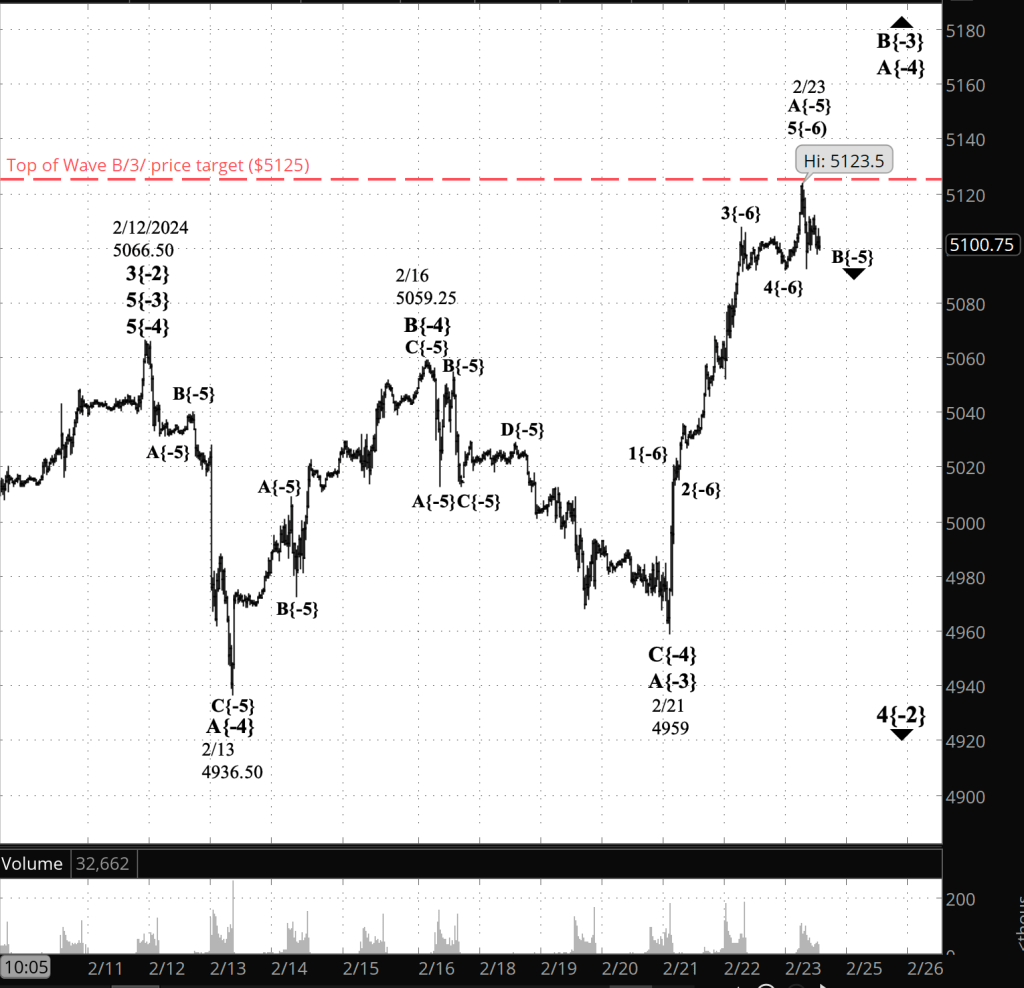
Trader’s Notebook

3:30 p.m. New York time

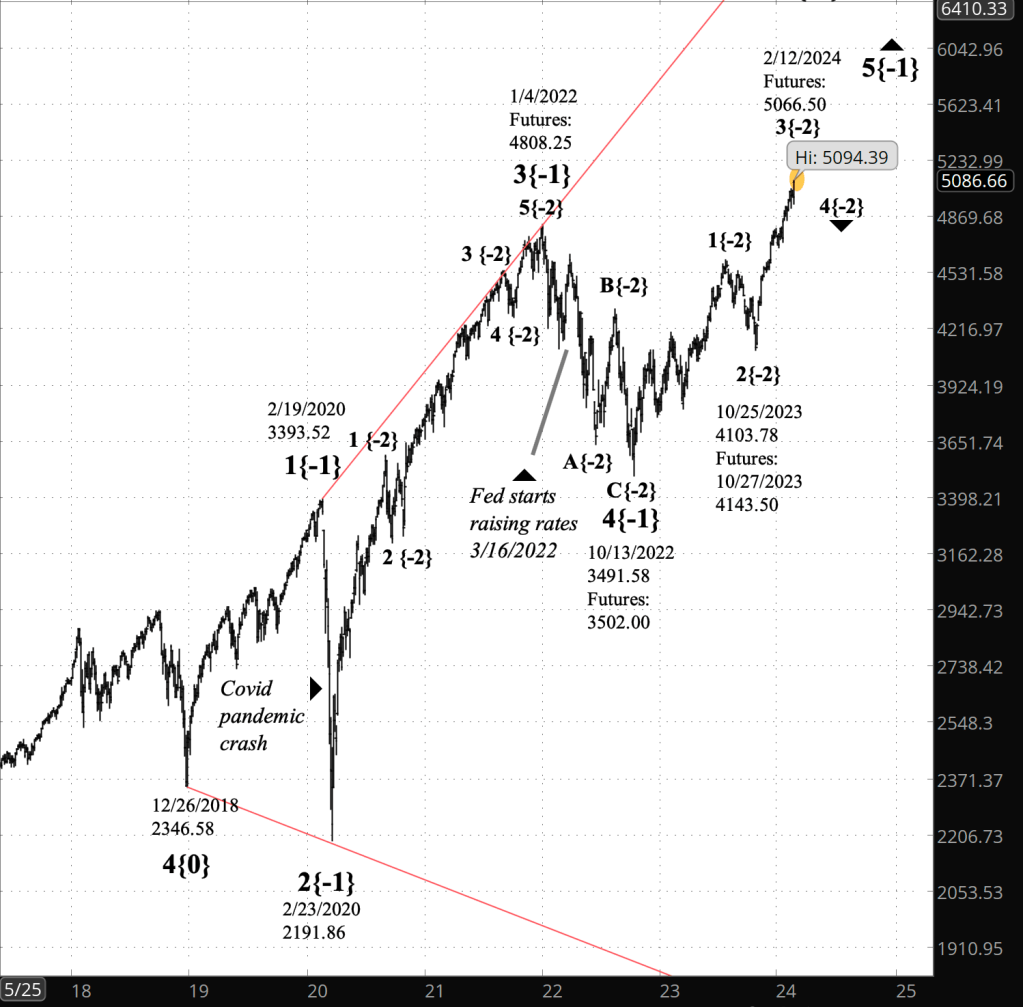
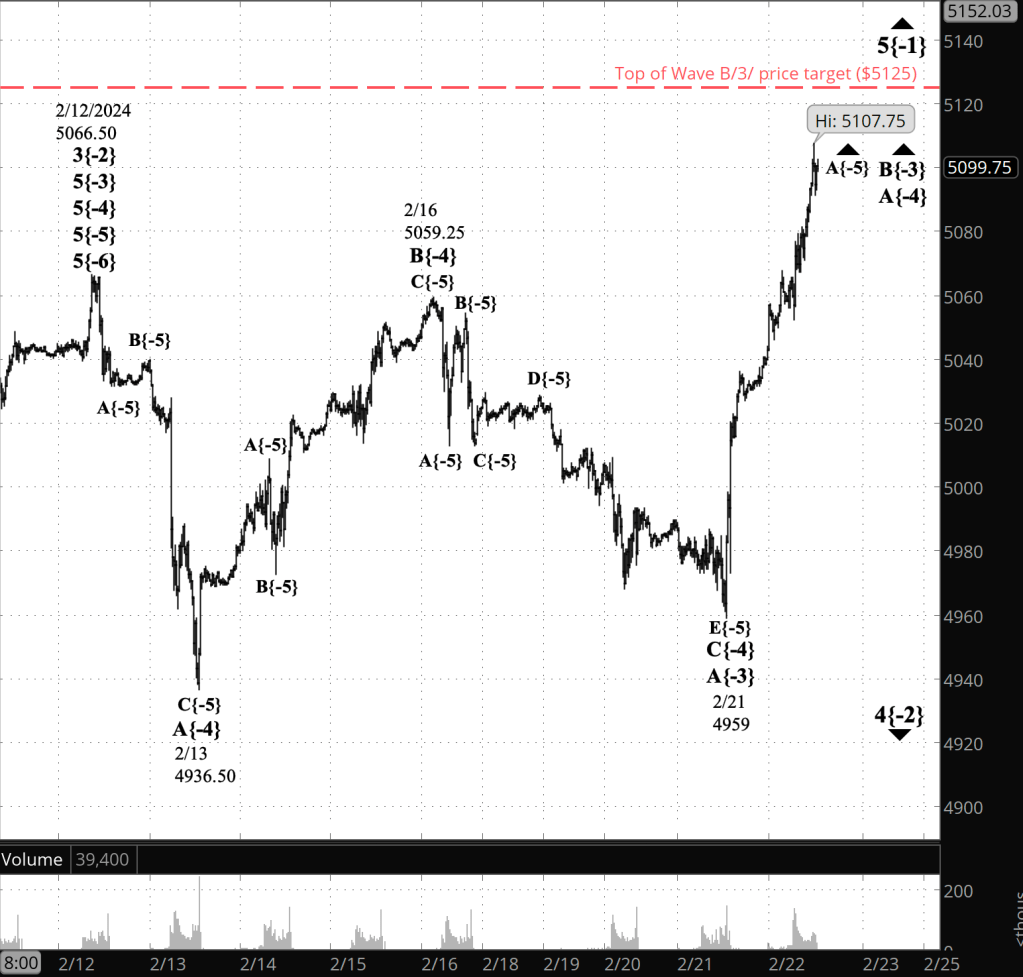
Half an hour before the closing bell. The S&P 500 rose to a new high during the session, in the 4950s so far, thereby confirming the principal analysis. A low degree 5th-wave uptrend that began on January 24 nearing its end.

When complete, it will cascade up the fractal structure, ending a series of progressively larger uptrends until it reaches a 3rd wave four degrees higher, which will end, and a 4th-wave downward correction of significant size will begin.

I’ve updated the chart.

3 p.m. New York time

Trades. One exit, one entry, both on derivatives of the S&P 500, both short-term trades designed to take advantage of volatility decline that is seen just prior to expiration.

I exited a 3DTE position on SPY, which included the weekend, for a 23.5% profit, and have updated the trade analysis with full data on the results.

I entered a 1DTE position on XSP, with the intention of exiting the next day, which is expiration day, and have posted a trade analysis.

9:35 a.m. New York time

What’s happening now? The S&P 500 E-mini futures traded sideways over night, with an initial decline followed by a recovery that together carried the price nowhere.

What does it mean? The low-degree 5th-wave uptrend that began on January 24 continues and is working through its 5th and final subwave. When that small subwave is complete, it will travel up the fractal structure of the chart, also ending three levels of waves of increasing size, and will also the the 3rd wave four degrees higher.

On the chart that 3rd wave is labeled as wave 3{-2}. The {-2} is a subscript showing the degree relative to others in the structure. Wave 3{-2} began on October 27, 2023. The small 5th-wave uptrend that will trigger it all it is wave 5{-6}.

Wave 3{-2} will be followed by a 4th-wave downward correction — wave 4{-2} — that will last for months.

What does the week ahead look like? In Elliott Wave Theory, the social mood drives the patterns waves make. Events are a small part — sometimes a large part — of that social mood. And the week will be rich with major events: On Wednesday, the Federal Open Market Committee will make a decision on interest rates: Lower them or leave them the same, or even raise them again. Wednesday will also see release of preview, the ADP report, of Friday’s Employment Situation Report, the latter being a major component when judging the state of the economy.

What are the alternatives? And the events of the week, as they impact the social mood, may well, at last clarify the great ambiguity that has been with us during the present low-degree uptrend. The alternative interpretation, also of high likelihood, sees the price movement from January 24 as a 4th wave, the next-to-the last subwave within the larger uptrending 5th wave. It will take a decisive move to the upside to resolve the ambiguity.

[S&P 500 E-mini futures at 3:30 p.m., 40-minute bars, with volume]

What does Elliott wave theory say? Here are the waves that underly the analyses.

Principal Analysis:

  • Wave 5{0}, an expanding Diagonal Triangle, began on December 26, 2018.
  • Within it, an uptrend, wave 5{-1}, began on October 13, 2022 and is underway.
  • Wave 5{-1} is the parent wave of a uptrend, wave 3{-2}, that began on October 25, 2023 and is in wave 5{-3}, the last of five subwaves.
  • Wave 5{-3} is in turn in its last subwave, wave 5{-4}, which is also in its final subwave, wave 5{-5}.
  • When wave 5{-5} is complete, it will also be the end of waves 5{-4}, 5{-3} and 3{-2}, and a downward correction, wave 4{-2}, will begin.
  • At a very small degree — hours rather than days — wave 5{-6} is underway.

Alternative Analysis:

  • At a very small degree, wave 4{-6}, a downward correction, has entered its middle subwave, rising wave B{-7}.

We Are Here.

These are the waves currently in progress under my principal analysis. Each line on the list shows the wave number, with the subscript in curly brackets, the traditional degree name, the starting date, the starting price of the S&P 500 E-mini futures, and the direction of the wave.

  • S&P 500 Index:
  • 5{+3} Supercycle, 7/8/1932, 4.40 (up)
  • 5{+2} Cycle, 12/9/1974, 60.96 (up)
  • 5{+1} Primary, 3/6/2009, 666.79 (up)
  • 5{0} Intermediate, 12/26/2018, 2346.58 (up)
  • S&P 500 Futures and index:
  • 5{-1} Minor, 10/13/2022, 3502 (up) (futures), 3491.58 (up) (index)
  • S&P 500 Futures:
  • 3{-2} Minute, 10/27/2023, 4143.50 (up)
  • 5{-3} Minuette, 10/27/2023, 4143.50 (up)

Reading the chart. Price movements — waves – – in Elliott wave analysis are labeled with numbers within trending waves and letters with corrective waves. The subscripts — numbers in curly brackets — designate the wave’s degree, which, in Elliott wave analysis, means the relative position of a wave within the larger and smaller structures that make up the chart. R.N. Elliott, who in the 1930s developed the form of analysis that bears his name, viewed the chart as a complex structure of smaller waves nested within larger waves, which in turn are nested within still larger waves. In mathematics it’s called a fractal structure, where at every scale the pattern is similar to the others.

Learning and other resources. Elliott wave analysis provides context, not prophecy. As the 20th century semanticist Alfred Korzybski put it in his book Science and Sanity (1933), “The map is not the territory … The only usefulness of a map depends on similarity of structure between the empirical world and the map.” And I would add, in the ever-changing markets, we can judge that similarity of structure only after the fact.

See the menu page Analytical Methods for a rundown on where to go for information on Elliott wave analysis.

By Tim Bovee, Portland, Oregon, January 29, 2024

Disclaimer

Tim Bovee, Private Trader tracks the analysis and trades of a private trader for his own accounts. Nothing in this blog constitutes a recommendation to buy or sell stocks, options or any other financial instrument. The only purpose of this blog is to provide education and entertainment.

No trader is ever 100 percent successful in his or her trades. Trading in the stock and option markets is risky and uncertain. Each trader must make trading decisions for his or her own account, and take responsibility for the consequences.

License
Creative Commons License

All content on Tim Bovee, Private Trader by Timothy K. Bovee is licensed under a Creative Commons Attribution-ShareAlike 4.0 International License.

Based on a work at www.timbovee.com.
Options Trades 1/26/2024: SPY

Symbols traded: A short Iron Fly on SPY (3DTE)

I entered the short-term position with the intent of holding it over the weekend and exiting on Monday, January 29, which expiration day. I exited on expiration day for a 23.5% profit.

SPY short Iron Fly

LOT:5ENTRY DATE:1/26/2024
EXIT DATE:1/29/2024
DAYS HELD:3

Entry and Exit

METRICCREDITDEBITCHANGECHANGE %ANNUALIZED CHANGE %
Options premium$ 2.00$ 1.62$ 0.3823.5%2838%
METRICENTRYEXITCHANGECHANGE %ANNUALIZED CHANGE %
Stock price$ 487.50$ 487.66$ (0.16)0.03%4%
Impllied Volatility Rate9.510.20.7
Days to expiration30

The structure of the position

STRUCTURESTRIKEODDS EXPIRE OTMDELTAIN PRICEOUT PRICENET PRICE
Calls
Long490.0077.0%22$ (0.45)$ 0.15$ (0.30)
Break-even489.0061.0%37.5
Short487.0045.0%53$ 1.65$ (1.24)$ 0.41
Puts
Short487.0047.0%56$ 1.09$ (0.61)$ 0.48
Break-even486.0066.0%36
Long484.0085.0%16$ (0.29)$ 0.08$ (0.21)
======
`NET TOTAL:$ 0.38

Risk and Reward

Per contract:
Reward200.00
Risk100.00
R/R Ratio (n:1)0.5

By Tim Bovee, Portland, Oregon, January 26-29, 2024

Disclaimer

Tim Bovee, Private Trader tracks the analysis and trades of a private trader for his own accounts. Nothing in this blog constitutes a recommendation to buy or sell stocks, options or any other financial instrument. The only purpose of this blog is to provide education and entertainment.

No trader is ever 100 percent successful in his or her trades. Trading in the stock and option markets is risky and uncertain. Each trader must make trading decisions for his or her own account, and take responsibility for the consequences.

License
Creative Commons License

All content on Tim Bovee, Private Trader by Timothy K. Bovee is licensed under a Creative Commons Attribution-ShareAlike 4.0 International License.

Based on a work at www.timbovee.com.