Trader’s Notebook

3:30 p.m. New York time

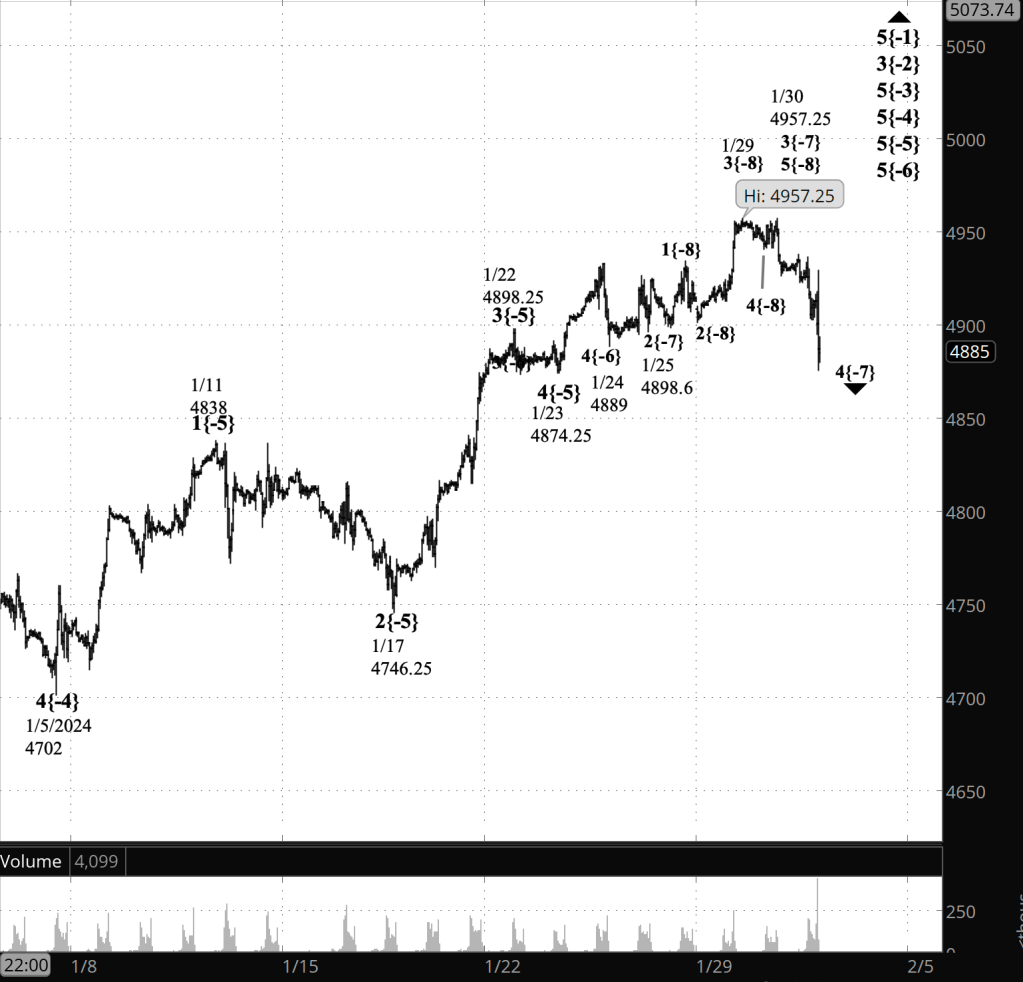
Half an hour before the closing bell.The S&P 500 futures rose during the session, pushing above 4800. as the C wave continues within the upward 2nd-wave correction that began on January 5. This morning’s analysis is unchanged. I’ve updated the chart.

2:35 p.m. New York time

Trades. I’ve entered short Iron Fly positions on JPM and NKE, each one day before expiration, and have posted analyses of the trades.

I attempted to structure short Iron Condor and a short Vertical bull put spread on JNJ, which poublishes earnings on January 23, but was unable to produce sufficient return to make the trade worthwhile. So I passed on it.

9:35 a.m. New York time

What’s happening now? The S&P 500 E-mini futures rose back into the 4790s overnight, reversing from the prior day’s session low, 4746.

What does it mean? The upward correction that began from January 5 continues and is in its final subwave, wave C., by what I consider the be the most likely interpretation of the chart. The decline that began on January 11, wave B, carried the price into that subwave’s target price range, and the present rise has risen to above the price range’s upper boundary.

However, as is often the case in Elliott Wave analysis, the are multiple ways of viewing the chart. See a discussion of alternatives below.

Meanwhile, the wave C scenario is my principal analysis, and the question is how high can we expect it to rise.

The wave 2 correction is taking the from of a Zigzag. In that corrective pattern, wave C often is about the same length as the preceding wave A. The A wave was 136 points long, running from 4702 to 4838. Wave C began from 4846.25. If it rises by 136 points, then that sets the price target at 4846.25.

But there’s a problem. It’s a firm rule of Elliott Wave Theory that a 2nd wave never moves beyond the starting point of the preceding 1st wave. Downtrending wave 1 on the chart began on December 27, 2023 from 4841.50, about five points below the wave C price target. So the highest wave C can rise is by by 95.25, to 4841.50.

C waves on occasion fall short of their price targets. That will be the case with this wave C.

On the chart, I’ve marked the wave C price target with a solid red line, and retained the wave B price target range as blue dotted lines.

The C wave in a Zigzag has five subwaves. I’ve leveled the present rise as the first subwave within wave C.

What are the alternatives?

Alternative #1: The 2nd wave rise (wave 2{-2} on the chart) that preceded the 3rd wave (wave 3{-2}) is still underway and is taking a compound form. The decline from January 11 was an X wave, which will link the first corrective pattern within wave 2 to a second corrective pattern. A compound correction contains up to three corrective patterns.

Alternative #2: This is more of a general observation. Assigning a degree to subwaves early in a correction is, frankly, little more than an educated guess. The degrees I’ve assigned may change over time as the downtrend progresses. So for example, wave 2{-7} on the chart could well be wave 2{-6} or 2{-5}.

Alternative #3: Wave B{-8} within wave 2 is not yet complete.

[S&P 500 E-mini futures at 3:30 p.m., 40-minute bars, with volume]

What does Elliott wave theory say? Here are the waves that underly the analyses.

Principal Analysis:

  • Wave 5{0}, an expanding Diagonal Triangle, began on December 26, 2018.
  • Within it, a downtrend, wave 4{-1}, began on January 4, 2022 and is underway.
  • Wave 4{-1} is the parent wave of a downtrend, wave 3{-2}, that began on January 2, 2024 and is in wave 1{-3}, the first of five subwaves.
  • Deep within that downtrend’s 1st wave, downtrending wave 5{-8} and its parent, wave 1{-7}, ended at the overnight low, 4702. Wave 2{-7} is now underway, an upward correction of low degree, and within it, rising wave C{-8} is underway and is within wave 1{-9}, the first of five subwaves.

Alternative #1:

  • Wave 2{-2}, an upward correction that began on October 13, 2022, continues and is taking a compound form.
  • Wave X{-3} is underway, connecting the now complete first corrective pattern and the not-yet-begun second corrective pattern.

Alternative #2:

The upward correction that began on January 5, labeled on the chart was wave 2{-7}, is actually wave 2{-6}, or perhaps wave 2{-5}, or maybe even larger.

Alternative #3:

  • Downward wave B{-8} is underway.

We Are Here.

These are the waves currently in progress under my principal analysis. Each line on the list shows the wave number, with the subscript in curly brackets, the traditional degree name, the starting date, the starting price of the S&P 500 E-mini futures, and the direction of the wave.

  • S&P 500 Index:
  • 5{+3} Supercycle, 7/8/1932, 4.40 (up)
  • 5{+2} Cycle, 12/9/1974, 60.96 (up)
  • 5{+1} Primary, 3/6/2009, 666.79 (up)
  • 5{0} Intermediate, 12/26/2018, 2346.58 (up)
  • S&P 500 Futures and index:
  • 4{-1} Minor, 1/4/2022, 4953.25 (down) (futures), 4818.62 (down) (index)
  • S&P 500 Futures:
  • 3{-2} Minute, 12/27/2023, 4841.50 (down)
  • 1{-3} Minuette, 12/27/2023, 4841.50 (down)
  • {1-4} Subminuette, 12/27/2023, 4841.50 (down)
  • 1{-5} Micro, 12/27/2023, 4841.50 (down)
  • 1{-6} Submicro, 12/27/2023, 4841.50 (down)
  • 2{-7} Minuscule, 1/5/2024, 4702 (up)

Reading the chart. Price movements — waves – – in Elliott wave analysis are labeled with numbers within trending waves and letters with corrective waves. The subscripts — numbers in curly brackets — designate the wave’s degree, which, in Elliott wave analysis, means the relative position of a wave within the larger and smaller structures that make up the chart. R.N. Elliott, who in the 1930s developed the form of analysis that bears his name, viewed the chart as a complex structure of smaller waves nested within larger waves, which in turn are nested within still larger waves. In mathematics it’s called a fractal structure, where at every scale the pattern is similar to the others.

Learning and other resources. Elliott wave analysis provides context, not prophecy. As the 20th century semanticist Alfred Korzybski put it in his book Science and Sanity (1933), “The map is not the territory … The only usefulness of a map depends on similarity of structure between the empirical world and the map.” And I would add, in the ever-changing markets, we can judge that similarity of structure only after the fact.

See the menu page Analytical Methods for a rundown on where to go for information on Elliott wave analysis.

By Tim Bovee, Portland, Oregon, January 18, 2024

Disclaimer

Tim Bovee, Private Trader tracks the analysis and trades of a private trader for his own accounts. Nothing in this blog constitutes a recommendation to buy or sell stocks, options or any other financial instrument. The only purpose of this blog is to provide education and entertainment.

No trader is ever 100 percent successful in his or her trades. Trading in the stock and option markets is risky and uncertain. Each trader must make trading decisions for his or her own account, and take responsibility for the consequences.

License
Creative Commons License

All content on Tim Bovee, Private Trader by Timothy K. Bovee is licensed under a Creative Commons Attribution-ShareAlike 4.0 International License.

Based on a work at www.timbovee.com.
Trader’s Notebook

3:30 p.m. New York time

Half an hour before the closing bell. The S&P 500 futures continued to fall during the session, reaching into the 4740s as the closing bell approached. This morning’s analysis is unchanged. I’ve updated the chart.

1:40 p.m. New York time

Trades. I exited my short Iron Fly 1DTE positions on XSP and QQQ, hour before expiration. Both positions showed a loss, XSP of 13.1% and QQQ of -25.3%. I’ve updated the trade analyses with full results.

The short Iron Fly strategy for 1DTE trades is based on declining volatility. For each of these symbols, the Implied Volatility Rate (IVR) rose sharply.

My rule of thumb for 1DTE trades using the short Iron Fly is that the IVR must be 20 or below. QQQ and XSP no longer qualify for the strategy. Neither does SPY, which now has an IVR above 26%.

So that brings what had been a productive strategy to a halt, for now at least. The longer term strategies, which rely on a high IVR for entry (roughly 25% or above) remain, as do earnings plays, and it could be that options with weekly expirations may be open for 1DTE trades. But 1DTE daily expiration symbols are now off the table.

9:35 a.m. New York time

What’s happening now? The S&P 500 E-mini futures drifted lower overnight, from 4800 plus change to the 4760s.

What does it mean? The 2nd-wave upward correction that began on January 5 is in its 2nd subwave, wave B, which is nearing its end.

In the discussion that follows I’ll need to use the wave numbers and degree numbers in order to cut through the complexity of the chart’s fractal structure. A fractal structure means that large waves encompass smaller waves, which in turn are built from still smaller waves, and whatever the level, the degree, the waves all follow the same rules and form the same patterns.

The degree number, a subscript in curly brackets, shows a wave’s position within the waves of various levels. The degree subscripts are negative because they are subwaves of wave 5{0}, the years-long 5th wave that began on December 26, 2018 and is taking the form of an expanding Diagonal Triangle. The triangle will have five subwaves and is presently in downward wave 4{-1}, its next-to-the-last subwave. And that sets the scene for what appears on the chart below.

The chart tracks wave 3{-2}, a downtrend that began on December 27, 2023 that is in its initial subwave, wave 1{-3}. Move four degrees lower, and we find the wave that has dominated the chart since it began on January 5: Wave 2{-7}, an upward correction that is taking the form of a Zigzag.

The Zigzag will have three subwaves and is presently in downward wave B{-8}, the middle subwave of the trio. Wave B{-8} will have three subwaves and is presently in the last of the three: Downward wave C{-9}. One degree smaller and we find that wave C{-9} is in the last of five subwaves, downtrending wave 5{-10}.

Wave 5{-10} has carried the price decisively into wave B{-8}’s target range. B waves in a Zigzag will typically retrace 38% to 79% of the preceding A wave. That gives wave B{-8} a likely endpoint between 4786 and 4730. I’ve marked those range boundaries on the chart in red, and the current price of wave B{-8} is within those boundaries.

So what happens next?

Wave B{-8}, when complete, will be followed by a rising final subwave — wave C{-8} — of the upward correction. Most likely the end of the C wave will also be the end of the parent wave 2{-7}. I say likely because corrective waves sometimes form a compound pattern, containing two or three corrective patterns. Such compound corrections are more in 4th waves, but they aren’t unheard of for 2nd waves. It’s not a high probability outcome, but it could happen.

Wave 2{-7} will be followed by a powerful downtrend, wave 3{-7}, that will carry the price at a minimum to wave 2{-7}’s starting point, 4702. Most likely, wave 3{-7} will move significantly below that level.

Eventually — after a corrective wave 4{-7} and a downtrending wave 5{-7} — the parent wave 1{-6} will reach its end, to be followed by four more waves at degree {-6} that will end the parent wave 1{-5}. And so it goes, the subwaves of each degree ending in turn until wave 3{-2} reaches its end, to be followed by an upward correction, wave 4{-2}.

And so it goes.

What are the alternatives? There are two.

Alternative #1: The 2nd wave rise (wave 2{-2} on the chart) that preceded the 3rd wave (wave 3{-2}) is still underway and is taking a compound form. The present decline is an X wave, which will link the first corrective pattern within wave 2 to a second corrective pattern. A compound correction contains up to three corrective patterns.

Alternative #2: This is more of a general observation. Assigning a degree to subwaves early in a correction is, frankly, little more than an educated guess. The degrees I’ve assigned may change over time as the downtrend progresses. So for example, wave 2{-7} on the chart could well be wave 2{-6} or 2{-5}.

[S&P 500 E-mini futures at 3:30 p.m., 35-minute bars, with volume]

What does Elliott wave theory say? Here are the waves that underly the analyses.

Principal Analysis:

  • Wave 5{0}, an expanding Diagonal Triangle, began on December 26, 2018.
  • Within it, a downtrend, wave 4{-1}, began on January 4, 2022 and is underway.
  • Wave 4{-1} is the parent wave of a downtrend, wave 3{-2}, that began on January 2, 2024 and is in wave 1{-3}, the first of five subwaves.
  • Deep within that downtrend’s 1st wave, downtrending wave 5{-8} and its parent, wave 1{-7}, ended at the overnight low, 4702. Wave 2{-7} is now underway, an upward correction of low degree, and within it, declining wave B{-8} is underway and is within wave C{-9}, the last of three subwaves.
  • Wave C{-9} is in its last of five subwaves, wave 5{-10}.

Alternative #1:

  • Wave 2{-2}, an upward correction that began on October 13, 2022, continues and is taking a compound form.
  • Wave X{-3} is underway, connecting the now complete first corrective pattern and the not-yet-begun second corrective pattern.

Alternative #2:

The upward correction that began on January 5, labeled on the chart was wave 2{-7}, is actually wave 2{-6}, or perhaps wave 2{-5}, or maybe even larger.

We Are Here.

These are the waves currently in progress under my principal analysis. Each line on the list shows the wave number, with the subscript in curly brackets, the traditional degree name, the starting date, the starting price of the S&P 500 E-mini futures, and the direction of the wave.

  • S&P 500 Index:
  • 5{+3} Supercycle, 7/8/1932, 4.40 (up)
  • 5{+2} Cycle, 12/9/1974, 60.96 (up)
  • 5{+1} Primary, 3/6/2009, 666.79 (up)
  • 5{0} Intermediate, 12/26/2018, 2346.58 (up)
  • S&P 500 Futures and index:
  • 4{-1} Minor, 1/4/2022, 4953.25 (down) (futures), 4818.62 (down) (index)
  • S&P 500 Futures:
  • 3{-2} Minute, 12/27/2023, 4841.50 (down)
  • 1{-3} Minuette, 12/27/2023, 4841.50 (down)
  • 1{-4} Subminuette, 12/27/2023, 4841.50 (down)
  • 1{-5} Micro, 12/27/2023, 4841.50 (down)
  • 1{-6} Submicro, 12/27/2023, 4841.50 (down)
  • 2{-7} Minuscule, 1/5/2024, 4702 (up)

Reading the chart. Price movements — waves – – in Elliott wave analysis are labeled with numbers within trending waves and letters with corrective waves. The subscripts — numbers in curly brackets — designate the wave’s degree, which, in Elliott wave analysis, means the relative position of a wave within the larger and smaller structures that make up the chart. R.N. Elliott, who in the 1930s developed the form of analysis that bears his name, viewed the chart as a complex structure of smaller waves nested within larger waves, which in turn are nested within still larger waves. In mathematics it’s called a fractal structure, where at every scale the pattern is similar to the others.

Learning and other resources. Elliott wave analysis provides context, not prophecy. As the 20th century semanticist Alfred Korzybski put it in his book Science and Sanity (1933), “The map is not the territory … The only usefulness of a map depends on similarity of structure between the empirical world and the map.” And I would add, in the ever-changing markets, we can judge that similarity of structure only after the fact.

See the menu page Analytical Methods for a rundown on where to go for information on Elliott wave analysis.

By Tim Bovee, Portland, Oregon, January 17, 2024

Disclaimer

Tim Bovee, Private Trader tracks the analysis and trades of a private trader for his own accounts. Nothing in this blog constitutes a recommendation to buy or sell stocks, options or any other financial instrument. The only purpose of this blog is to provide education and entertainment.

No trader is ever 100 percent successful in his or her trades. Trading in the stock and option markets is risky and uncertain. Each trader must make trading decisions for his or her own account, and take responsibility for the consequences.

License
Creative Commons License

All content on Tim Bovee, Private Trader by Timothy K. Bovee is licensed under a Creative Commons Attribution-ShareAlike 4.0 International License.

Based on a work at www.timbovee.com.
Options Trades 1/16/2024: QQQ XSP

Symbols traded today: Short Iron Fly positions QQQ and XSP, both 1DTE.

I entered the two positions a day before expiration as overnight trades. I exited each for a loss shortly after the opening bell on January 17. The short Iron Fly strategy for 1DTE trades is based on declining volatility. For each of these symbols, the Implied Volatility Rate (IVR) rose sharply. My rule of thumb for 1DTE trades using the short Iron Fly is that the IVR must be 20 or below. QQQ and XSP no longer qualify for the strategy

QQQ short Iron Fly

LOT:1ENTRY DATE:1/16/2024
EXIT DATE:1/17/2024
DAYS HELD:1

Entry and Exit

METRICCREDITDEBITCHANGECHANGE %ANNUALIZED CHANGE %
Options premium$ 2.27$ 3.04$ (0.77)-25.3%-9194%
METRICENTRYEXITCHANGECHANGE %ANNUALIZED CHANGE %
Stock price$ 408.28$ 404.97$ 3.31-0.81%-296%
Impllied Volatility Rate18.827.78.9
Days to expiration1

The structure of the position

STRUCTURESTRIKEODDS EXPIRE OTMDELTAIN PRICEOUT PRICECHANGE
Calls
Long412.0084%17$ (0.32)$ 0.03$ (0.29)
Break-even411.2764%36.5
Short409.0044%56$ 1.18$ (0.18)$ 1.00
Puts
Short409.0044%56$ 1.85$ (4.19)$ (2.34)
Break-even407.2762%37.5
Long405.0080%19$ (0.44)$ 1.30$ 0.86
======
NET TOTAL:$ (0.77)

Risk and Reward

Per contract:
Reward227.00
Risk123.00
R/R Ratio (n:1)0.5

XSP short Iron Fly

LOT:4ENTRY DATE:1/16/2024
EXIT DATE:1/17/2024
DAYS HELD:1

Entry and Exit

METRICCREDITDEBITCHANGECHANGE %ANNUALIZED CHANGE %
Options premium$ 1.92$ 2.21$ (0.29)-13.1%-4763%
METRICENTRYEXITCHANGECHANGE %ANNUALIZED CHANGE %
Stock price$ 476.24$ 473.26$ 2.98-0.63%-228%
Impllied Volatility Rate16.224.98.7
Days to expiration1

The structure of the position

STRUCTURESTRIKEODDS EXPIRE OTMDELTAIN PRICEOUT PRICECHANGE
Calls
Long479.0081%19$ (0.34)$ 0.02$ (0.32)
Break-even477.9265%36.5
Short476.0049%54$ 1.43$ (0.23)$ 1.20
Puts
Short476.0053%46$ 1.15$ (2.91)$ (1.76)
Break-even474.9268%32
Long473.0083%18$ (0.32)$ 0.91$ 0.59
======
NET TOTAL:$ (0.29)

Risk and Reward

Per contract:
Reward192.00
Risk108.00
R/R Ratio (n:1)0.6

By Tim Bovee, Portland, Oregon, January 16-17, 2024

Disclaimer

Tim Bovee, Private Trader tracks the analysis and trades of a private trader for his own accounts. Nothing in this blog constitutes a recommendation to buy or sell stocks, options or any other financial instrument. The only purpose of this blog is to provide education and entertainment.

No trader is ever 100 percent successful in his or her trades. Trading in the stock and option markets is risky and uncertain. Each trader must make trading decisions for his or her own account, and take responsibility for the consequences.

License
Creative Commons License

All content on Tim Bovee, Private Trader by Timothy K. Bovee is licensed under a Creative Commons Attribution-ShareAlike 4.0 International License.

Based on a work at www.timbovee.com.
Trader’s Notebook

3:40 p.m. New York time

Trades. I placed three short-term trades today, all of them structured as short Iron Fly positions.

I exited SPY for a 19% profit after holding over the long holiday weekend.

I entered QQQ and XSP one day before expiration (1DTE).

I’ve updated the SPY trade analysis with results and have also posted QQQ and XSP trade analyses.

3:30 p.m. New York time

Half an hour before the closing bell. During the session, the S&P 500 futures continued to bounce between the 4810s and the 4770s, moving below the wave B target price range three times so far. This morning’s analysis is unchanged. The middle subwave, wave B, of the 2nd-wave upward correction that began on January 5 continues.

I’ve updated the chart.

9:35 a.m. New York time

What’s happening now? The S&P 500 E-mini futures fell after trading resumed overnight, opening at 4813.50 and dropping to 4785.25, before recovering part of the decline.

What does it mean? The 2nd-wave upward correction that began on January 5 continues to work through its middle subwave — downward wave B. The rising C wave that follows will complete the three-wave corrective pattern — a Zigzag — and most likely the correction itself. A downtrending 3rd wave will follow, carrying the price lower by a significant distance.

The overnight low pierced the upper boundary of the B-wave’s target price range, the 3rd time that has happened. The range — 4786 to 4730 — is shown on the chart in red.

The correction is a small part of a much larger 3rd-wave downtrend that began on December 27, 2023. That larger downtrend will reach below 3502 — the end of the preceding 1st wave and the start of the 2nd-wave correction — and almost certainly a large distance below that level.

According to Elliott Wave Theory, the movements on a stock chart are of a fractal character, patterns within patterns, and whether small or large, the same sorts of patterns appear. On the chart, I use a subscript within curly brackets to show the level of a wave within the fractal structure, relative to a very large wave, 5{0}, that began on December 26, 2018 and that encompasses all that has impacted the market since: The Covid Crash of 2020, the inflation, the Federal Reserve’s decision to raise interest rates more quickly than anytime in the last 40 years — everything.

The 2nd-wave upward correction that began on January 5 is wave 2{-7}, meaning it is smaller than the large encompassing wave 5{0} by seven degrees. The 3rd wave downtrend that began on December 27, 2023, is wave 3{-2}, two waves smaller than the encompassing wave 5{0}.

Of course, the encompassing wave itself is a subwave of larger structures. Wave 5{0}, which is taking the form of an expanding Diagonal Triangle, is the final subwave of wave 5{1}, a larger uptrending 5th wave that began on March 6, 2009 at the end of the Great Recession. And wave 5{-1} is in its 4th of five subwaves, wave 4{-1}, a downward wave that will eventually reach the lower boundary of a price channel encompassing the expanding Diagonal Triangle that is wave 5{0}, presently below 1800 and falling further each day. (See the January 12 Trader’s Notebook for a chart of the S&P 500 index showing wave 5{0} in its entirety.)

Most commentary on the markets speaks in simple terms: Bull market, bear market. Up, down. New high, new low. Elliott Wave Theory sees market movements as being far more complex.

What are the alternatives? The lower the price travels, the more likely the principal analysis becomes. Nonetheless, each of the three alternatives now on the table have a greater-than-zero chance of being an accurate description of what’s happening on the chart.

Alternative #1: The 2nd wave rise (wave 2{-2} on the chart) that preceded the 3rd wave (wave 3{-2}) is still underway and is taking a compound form. The present decline is an X wave, which will link the first corrective pattern within wave 2 to a second corrective pattern. A compound correction contains up to three corrective patterns.

Alternative #2: This is more of a general observation. Assigning a degree to subwaves early in a correction is, frankly, little more than an educated guess. The degrees I’ve assigned may change over time as the downtrend progresses. So for example, wave 2{-7} on the chart could well be wave 2{-6} or 2{-5}.

Alternative #3: The low-degree B subwave — wave B{-8} — may in have have ended at the overnight low, and if so, then the rise that followed is part of wave C{-8}, the final subwave within wave 2{-7}.

[S&P 500 E-mini futures at 3:30 p.m., 30-minute bars, with volume]

What does Elliott wave theory say? Here are the waves that underly the analyses.

Principal Analysis:

  • Wave 5{0}, an expanding Diagonal Triangle, began on December 26, 2018.
  • Within it, a downtrend, wave 4{-1}, began on January 4, 2022 and is underway.
  • Wave 4{-1} is the parent wave of a downtrend, wave 3{-2}, that began on January 2, 2024 and is in wave 1{-3}, the first of five subwaves.
  • Deep within that downtrend’s 1st wave, downtrending wave 5{-8} and its parent, wave 1{-7}, ended at the overnight low, 4702. Wave 2{-7} is now underway, an upward correction of low degree, and within it, declining wave B{-8} is underway and is within the first, wave A{-9}, of three subwaves.

Alternative #1:

  • Wave 2{-2}, an upward correction that began on October 13, 2022, continues and is taking a compound form.
  • Wave X{-3} is underway, connecting the now complete first corrective pattern and the not-yet-begun second corrective pattern.

Alternative #2:

  • The upward correction that began on January 5, labeled on the chart was wave 2{-7}, is actually wave 2{-6}, or perhaps wave 2{-5}, or maybe even larger.

Alternative #3:

  • Wave B{-8} ended overnight and wave C{-8} is underway.

We Are Here.

These are the waves currently in progress under my principal analysis. Each line on the list shows the wave number, with the subscript in curly brackets, the traditional degree name, the starting date, the starting price of the S&P 500 E-mini futures, and the direction of the wave.

  • S&P 500 Index:
  • 5{+3} Supercycle, 7/8/1932, 4.40 (up)
  • 5{+2} Cycle, 12/9/1974, 60.96 (up)
  • 5{+1} Primary, 3/6/2009, 666.79 (up)
  • 5{0} Intermediate, 12/26/2018, 2346.58 (up)
  • S&P 500 Futures and index:
  • 4{-1} Minor, 1/4/2022, 4953.25 (down) (futures), 4818.62 (down) (index)
  • S&P 500 Futures:
  • 3{-2} Minute, 12/27/2023, 4841.50 (down)
  • 1{-3} Minuette, 12/27/2023, 4841.50 (down)

Reading the chart. Price movements — waves – – in Elliott wave analysis are labeled with numbers within trending waves and letters with corrective waves. The subscripts — numbers in curly brackets — designate the wave’s degree, which, in Elliott wave analysis, means the relative position of a wave within the larger and smaller structures that make up the chart. R.N. Elliott, who in the 1930s developed the form of analysis that bears his name, viewed the chart as a complex structure of smaller waves nested within larger waves, which in turn are nested within still larger waves. In mathematics it’s called a fractal structure, where at every scale the pattern is similar to the others.

Learning and other resources. Elliott wave analysis provides context, not prophecy. As the 20th century semanticist Alfred Korzybski put it in his book Science and Sanity (1933), “The map is not the territory … The only usefulness of a map depends on similarity of structure between the empirical world and the map.” And I would add, in the ever-changing markets, we can judge that similarity of structure only after the fact.

See the menu page Analytical Methods for a rundown on where to go for information on Elliott wave analysis.

By Tim Bovee, Portland, Oregon, January 16, 2024

Disclaimer

Tim Bovee, Private Trader tracks the analysis and trades of a private trader for his own accounts. Nothing in this blog constitutes a recommendation to buy or sell stocks, options or any other financial instrument. The only purpose of this blog is to provide education and entertainment.

No trader is ever 100 percent successful in his or her trades. Trading in the stock and option markets is risky and uncertain. Each trader must make trading decisions for his or her own account, and take responsibility for the consequences.

License
Creative Commons License

All content on Tim Bovee, Private Trader by Timothy K. Bovee is licensed under a Creative Commons Attribution-ShareAlike 4.0 International License.

Based on a work at www.timbovee.com.
Options Trades 1/12/2024: IWM SPY

Symbols traded today: IWM (35DTE), SPY (4DTE)

I entered two options positions today: A short Iron Condor on IWM that expires in 35 days on February 16, to be managed on January 26, and a short Iron Fly on SPY that expires on January 16, after a long holiday weekend.

I exited SPY has planned on January 16, for a 19% profit, and have updated the SPY section below with results.

And I exited IWM on management day, 21 days before expiration, for a 21.3% profit.

IWM short Iron Condor

LOT:2ENTRY DATE:1/12/2024
EXIT DATE:2/16/2024
DAYS HELD:35

Entry and Exit

METRICCREDITDEBITCHANGECHANGE %ANNUALIZED CHANGE %
Options premium$ 1.42$ 1.17$ 0.2521.4%222%
METRICENTRYEXITCHANGECHANGE %ANNUALIZED CHANGE %
Stock price$ 193.24$ 196.10$ (2.86)1.48%15%
Impllied Volatility Rate30.436.76.3
Days to expiration3521

The structure of the position

STRUCTURESTRIKEODDS EXPIRE OTMDELTAIN PRICEOUT PRICENET PRICE
Calls
Long212.0093.0%7$ (0.41)$ 0.42$ 0.01
Break-even206.4287.5%12.5
Short205.0082.0%18$ 1.16$ (1.29)$ (0.13)
Puts
Short183.0081.0%19$ 1.28$ (0.56)$ 0.72
Break-even178.4285.5%14.5
Long177.0090.0%10$ (0.61)$ 0.26$ (0.35)
======
`NET TOTAL:$ 0.25

Risk and Reward

Per contract:
Reward142.00
Risk508.00
R/R Ratio (n:1)3.6

SPY short Iron Fly

LOT:2ENTRY DATE:1/12/2024
EXIT DATE:1/16/2024
DAYS HELD:4

Entry and Exit

METRICCREDITDEBITCHANGECHANGE %ANNUALIZED CHANGE %
Options premium$ 2.19$ 1.84$ 0.3519.0%1726%
METRICENTRYEXITCHANGECHANGE %ANNUALIZED CHANGE %
Stock price$ 476.60$ 475.46$ 1.14-0.24%-22%
Impllied Volatility Rate5.515.510.0
Days to expiration4

The structure of the position

STRUCTURESTRIKEODDS EXPIRE OTMDELTAIN PRICEOUT PRICENET PRICE
Calls
Long479.0073.0%25$ (0.56)$ 0.08$ (0.48)
Break-even478.1957.5%40.5
Short476.0042.0%56$ 1.83$ (0.71)$ 1.12
Puts
Short476.005744$ 1.18$ (1.37)$ (0.19)
Break-even475.1928.9428.5
Long473.0088.0%13$ (0.26)$ 0.16$ (0.10)
======
`NET TOTAL:$ 0.35

Risk and Reward

Per contract:
Reward219.00
Risk81.00
R/R Ratio (n:1)0.4

By Tim Bovee, Portland, Oregon, January 12, January 16, January 26, 2024

Disclaimer

Tim Bovee, Private Trader tracks the analysis and trades of a private trader for his own accounts. Nothing in this blog constitutes a recommendation to buy or sell stocks, options or any other financial instrument. The only purpose of this blog is to provide education and entertainment.

No trader is ever 100 percent successful in his or her trades. Trading in the stock and option markets is risky and uncertain. Each trader must make trading decisions for his or her own account, and take responsibility for the consequences.

License
Creative Commons License

All content on Tim Bovee, Private Trader by Timothy K. Bovee is licensed under a Creative Commons Attribution-ShareAlike 4.0 International License.

Based on a work at www.timbovee.com.

Trader’s Notebook

3:30 p.m. New York time

Half an hour before the closing bell. The S&P 500 futures fluctuated sideways during the session, leaving unresolved the ambiguities identified by this morning’s alternatives.

The principal analysis remains unchanged: The middle subwave, a B wave, within the 2nd-wave upward correction that began on January 5 continues.

I’ve updated the upper chart, a close-up view of the correction as traced by the futures.

3:15 p.m. New York time

Markets on Monday. Markets in the U.S. will be closed on Monday for Martin Luther King Day, a holiday honoring the civil rights leader. The S&P 500 futures will resume trading Monday evening at 6:30 p.m., and my next Trader’s Notebook post will be Tuesday morning at 9:35 a.m., both New York time.

2:05 p.m. New York time

Trades. I’ve entered two options trades today: A short Iron Condor on IWM that expires on February 16 and a short Iron Fly on SPY that expires on January 16, after the long holiday weekend. I’ve added trade analyses for IWM and SPY

9:35 a.m. New York time

What’s happening now? The S&P 500 E-mini futures fluctuated between the 4820s and the 4790s overnight, rising into the 4830s as the opening bell sounded.

What does it mean? The relatively small 2nd-wave upward correction that began on January 5 continues to work through its middle subwave, wave B. The correction is part of a much larger 3rd-wave downtrend that began on December 27, 2023.

The red lines on the upper chart are the boundaries of wave B’s target range.

What are the alternatives? In the following discussion, indicate a wave’s position within the fractal hierarchy of the price movements with a subscript in curly brackets. The position indicator shows the number of degree away from what the developer of Elliott Wave Theory, R.N. Elliott, call the Intermediate Degree, which I designate as wave position {0}. Negative position indicators are smaller than position {0}, and positive indicators are larger.

There are three alternatives:

Alternative #1: The 2nd wave rise (wave 2{-2} on the chart) that preceded the 3rd wave (wave 3{-2}) is still underway and is taking a compound form. The present decline is an X wave, which will link the first corrective pattern within wave 2 to a second corrective pattern. A compound correction contains up to three corrective patterns.

Alternative #2: This is more of a general observation. Assigning a degree to subwaves early in a correction is, frankly, little more than an educated guess. The degrees I’ve assigned may change over time as the downtrend progresses. So for example, wave 2{-7} on the chart could well be wave 2{-6} or 2{-5}.

Alternative #3: The low-degree B subwave — wave B{-8} — may in have have ended at the overnight low, and if so, then the rise that followed is part of wave C{-8}, the final subwave within wave 2{-7}.

Charts. The upper chart, of the S&P 500 futures, shows the 3rd wave downtrend that began on December 27, wave 3{-2}. the lower chart, of the S&P 500 index, shows the 5th wave that began on December 26, 2018, wave 5{0}, which is taking the form of an expanding Diagonal Triangle.

[S&P 500 E-mini futures at 3:30 p.m., 30-minute bars, with volume]

[S&P 500 index at 9:34 a.m., 3-day bars]

What does Elliott wave theory say? Here are the waves that underly the analyses.

Principal Analysis:

  • Wave 5{0}, an expanding Diagonal Triangle, began on December 26, 2018.
  • Within it, a downtrend, wave 4{-1}, began on January 4, 2022 and is underway.
  • Wave 4{-1} is the parent wave of a downtrend, wave 3{-2}, that began on January 2, 2024 and is in wave 1{-3}, the first of five subwaves.
  • Deep within that downtrend’s 1st wave, downtrending wave 5{-8} and its parent, wave 1{-7}, ended at the overnight low, 4702. Wave 2{-7} is now underway, an upward correction of low degree, and within it, declining wave B{-8} is underway and is within the first, wave A{-9}, of three subwaves.

Alternative #1:

  • Wave 2{-2}, an upward correction that began on October 13, 2022, continues and is taking a compound form.
  • Wave X{-3} is underway, connecting the now complete first corrective pattern and the not-yet-begun second corrective pattern.

Alternative #2:

  • The upward correction that began on January 5, labeled on the chart was wave 2{-7}, is actually wave 2{-6}, or perhaps wave 2{-5}, or maybe even larger.

Alternative #3:

  • Wave B{-8} ended overnight and wave C{-8} is underway.

We Are Here.

These are the waves currently in progress under my principal analysis. Each line on the list shows the wave number, with the subscript in curly brackets, the traditional degree name, the starting date, the starting price of the S&P 500 E-mini futures, and the direction of the wave.

  • S&P 500 Index:
  • 5{+3} Supercycle, 7/8/1932, 4.40 (up)
  • 5{+2} Cycle, 12/9/1974, 60.96 (up)
  • 5{+1} Primary, 3/6/2009, 666.79 (up)
  • 5{0} Intermediate, 12/26/2018, 2346.58 (up)
  • S&P 500 Futures and index:
  • 4{-1} Minor, 1/4/2022, 4953.25 (down) (futures), 4818.62 (down) (index)
  • S&P 500 Futures:
  • 3{-2} Minute, 12/27/2023, 4841.50 (down)
  • 1{-3} Minuette, 12/27/2023, 4841.50 (down)

Reading the chart. Price movements — waves – – in Elliott wave analysis are labeled with numbers within trending waves and letters with corrective waves. The subscripts — numbers in curly brackets — designate the wave’s degree, which, in Elliott wave analysis, means the relative position of a wave within the larger and smaller structures that make up the chart. R.N. Elliott, who in the 1930s developed the form of analysis that bears his name, viewed the chart as a complex structure of smaller waves nested within larger waves, which in turn are nested within still larger waves. In mathematics it’s called a fractal structure, where at every scale the pattern is similar to the others.

Learning and other resources. Elliott wave analysis provides context, not prophecy. As the 20th century semanticist Alfred Korzybski put it in his book Science and Sanity (1933), “The map is not the territory … The only usefulness of a map depends on similarity of structure between the empirical world and the map.” And I would add, in the ever-changing markets, we can judge that similarity of structure only after the fact.

See the menu page Analytical Methods for a rundown on where to go for information on Elliott wave analysis.

By Tim Bovee, Portland, Oregon, January 12, 2024

Disclaimer

Tim Bovee, Private Trader tracks the analysis and trades of a private trader for his own accounts. Nothing in this blog constitutes a recommendation to buy or sell stocks, options or any other financial instrument. The only purpose of this blog is to provide education and entertainment.

No trader is ever 100 percent successful in his or her trades. Trading in the stock and option markets is risky and uncertain. Each trader must make trading decisions for his or her own account, and take responsibility for the consequences.

License
Creative Commons License

All content on Tim Bovee, Private Trader by Timothy K. Bovee is licensed under a Creative Commons Attribution-ShareAlike 4.0 International License.

Based on a work at www.timbovee.com.
Trader’s Notebook

3:30 p.m. New York time

Half an hour before the closing bell. The S&P 500 futures rose during the session, from the 4770s to the 4820s. The middle subwave, wave B, within the 2nd-wave upward correction that began on January 5 is in the second of three subwaves.

This morning’s analysis stands unchanged.

I’ve updated the chart.

9:35 a.m. New York time

What’s happening now? The S&P 500 E-mini futures whipsawed sharply after the latest Consumer Price Index showed that inflation rose in December. The futures price rose to 4837 and then fell to 4802.50 within a 2-minute span before settling in the 4820s.

What does it mean? The rise and subsequent fall brought the price of the ongoing 2nd-wave upward correction to within four points of the end of the preceding 1st wave. Under the rules of Elliott Wave Theory, a 2nd wave never moves beyond the endpoint of the 1st wave that came before.

On the chart, I’m treating the peak as the end of the first subwave of the correction, wave A, and the decline that followed as the early steps of the correction’s declining middle subwave, wave B.

The correction is taking the form of a Zigzag, with the A-wave having five subwaves, the B-wave three and the C-wave five. The B wave typically retraces 38% to 79% of the preceding A wave, giving a price target of roughly between 4786 and 4731.

I’ve marked the price target boundaries on the chart in red.

The fact that the A-wave came so close to the start of the upper boundary of the correction provides little room for the correction’s final subwave, wave C, to reach new highs. It sometimes happens that C waves fall short, a condition called “truncation” by Elliotticians.

The 2nd-wave correction discussed above is relatively small. Encompassing it in its entirely to a much larger declining 3rd wave that began on December 27, 2023 and that will carry the price below the start of the large 2nd wave that preceded it, from 3502, and most likely significantly below that level.

Within the fractal structure of the price movements, that larger 3rd wave is four degrees smaller than the small 2nd-wave upward correction now in progress.

What are the alternatives? There are two, unchanged from yesterday.

Alternative #1: The 2nd wave rise that preceded the 3rd wave is still underway and is taking a compound form. The present decline is an X wave, which will link the first corrective pattern within wave 2 to a second corrective pattern. A compound correction contains up to three corrective patterns.

Alternative #2: This is more of a general observation. Assigning a degree to subwaves early in a correction is, frankly, little more than an educated guess. The degrees I’ve assigned may change over time as the downtrend progresses.

[S&P 500 E-mini futures at 3:30 p.m., 25-minute bars, with volume]

What does Elliott wave theory say? Here are the waves that underly the analyses.

Principal Analysis:

  • Wave 5{0}, an expanding Diagonal Triangle, began on December 26, 2018.
  • Within it, a downtrend, wave 4{-1}, began on January 4, 2022 and is underway.
  • Wave 4{-1} is the parent wave of a downtrend, wave 3{-2}, that began on January 2, 2024 and is in wave 1{-3}, the first of five subwaves.
  • Deep within that downtrend’s 1st wave, downtrending wave 5{-8} and its parent, wave 1{-7}, ended at the overnight low, 4702. Wave 2{-7} is now underway, an upward correction of low degree, and within it, declining wave B{-8} is underway and is within the first, wave A{-9}, of three subwaves.

Alternative #1:

  • Wave 2{-2}, an upward correction that began on October 13, 2022, continues and is taking a compound form.
  • Wave X{-3} is underway, connecting the now complete first corrective pattern and the not-yet-begun second corrective pattern.

Alternative #2:

The upward correction that began on January 5, labeled on the chart was wave 2{-7}, is actually wave 2{-6}, or perhaps wave 2{-5}, or maybe even larger.

We Are Here.

These are the waves currently in progress under my principal analysis. Each line on the list shows the wave number, with the subscript in curly brackets, the traditional degree name, the starting date, the starting price of the S&P 500 E-mini futures, and the direction of the wave.

  • S&P 500 Index:
  • 5{+3} Supercycle, 7/8/1932, 4.40 (up)
  • 5{+2} Cycle, 12/9/1974, 60.96 (up)
  • 5{+1} Primary, 3/6/2009, 666.79 (up)
  • 5{0} Intermediate, 12/26/2018, 2346.58 (up)
  • S&P 500 Futures and index:
  • 4{-1} Minor, 1/4/2022, 4953.25 (down) (futures), 4818.62 (down) (index)
  • S&P 500 Futures:
  • 3{-2} Minute, 12/27/2023, 4841.50 (down)
  • 1{-3} Minuette, 12/27/2023, 4841.50 (down)

Reading the chart. Price movements — waves – – in Elliott wave analysis are labeled with numbers within trending waves and letters with corrective waves. The subscripts — numbers in curly brackets — designate the wave’s degree, which, in Elliott wave analysis, means the relative position of a wave within the larger and smaller structures that make up the chart. R.N. Elliott, who in the 1930s developed the form of analysis that bears his name, viewed the chart as a complex structure of smaller waves nested within larger waves, which in turn are nested within still larger waves. In mathematics it’s called a fractal structure, where at every scale the pattern is similar to the others.

Learning and other resources. Elliott wave analysis provides context, not prophecy. As the 20th century semanticist Alfred Korzybski put it in his book Science and Sanity (1933), “The map is not the territory … The only usefulness of a map depends on similarity of structure between the empirical world and the map.” And I would add, in the ever-changing markets, we can judge that similarity of structure only after the fact.

See the menu page Analytical Methods for a rundown on where to go for information on Elliott wave analysis.

By Tim Bovee, Portland, Oregon, January 11, 2024

Disclaimer

Tim Bovee, Private Trader tracks the analysis and trades of a private trader for his own accounts. Nothing in this blog constitutes a recommendation to buy or sell stocks, options or any other financial instrument. The only purpose of this blog is to provide education and entertainment.

No trader is ever 100 percent successful in his or her trades. Trading in the stock and option markets is risky and uncertain. Each trader must make trading decisions for his or her own account, and take responsibility for the consequences.

License
Creative Commons License

All content on Tim Bovee, Private Trader by Timothy K. Bovee is licensed under a Creative Commons Attribution-ShareAlike 4.0 International License.

Based on a work at www.timbovee.com.

Trader’s Notebook

3:30 p.m. New York time

Half an hour before the closing bell. The first subwave, wave A, of the upward correction that began on January 5, a 2nd wave of relatively low degree, has entered its 5th and final subwave. When the 5th subwave is complete, wave A will also be complete and will be followed by a declining B wave.

Changes from this morning: I’ve moved the endpoint of wave 4{-9}, a subwave of wave A{-8} within wave 2{-7} (the upward correction) to the January 9 reversal point, and labeled all that follows as part of wave 5{-9}.

I’ve updated the chart.

1:20 p.m. New York time

Trade. I’ve exited my short Iron Fly options position on XSP on expiration day, a day after entry, for a 13.3% profit and have updated the trade analysis with results.

9:35 a.m. New York time

What’s happening now? The S&P 500 E-mini futures rose overnight from the 4780s to 4804, again setting a slightly higher high in the upward correction that began on January 5, and then fell back.

What does it mean? The correction is a 2nd wave and internally is in its first subwave, wave A. The correction is taking the Zigzag form, which means tht the A wave has five subwaves. It is present in its next-to-the-last subwave, declining wave 4. A final rising wave will complete wave A and begin declining wave B, which under the rules of Elliott Wave Theory will remain above the starting point of the preceding A wave, 4702.

All of the wave 2 drama described above is contained within a much larger downtrending wave 3, which began on December 27, 2023. In Elliott Wave Theory, stock prices form a fractal structure, meaning the patterns larger waves contain smaller patterns of the same sort, a reality that works its way down from the very large, such as the 5th wave that began on July 8, 1932 and is still underway, to the individual tick, a single transaction and the movement it causes in the price.

I label a wave’s place in the fractical structure as a subscript within curly brackets showing the wave’s position as levels above or below the uptrending 5th wave that began on December 26, 2018 and is taking the form of an expanding Diagonal Triangle. That 5th wave — wave 5{0} — is at what Elliott Wave Theory calls the Intermediate degree within the fractal structure. The downtrending 3rd wave mentioned above is wave 3{-2} — two degrees below wave 5{0}. The small 2nd wave upward correction that began on January 5 is wave 2{-7} — seven degrees below wave 5{0}.

What are the alternatives? And that complex structure is a set up for two alternatives.

There are two, unchanged from yesterday.

Alternative #1: The 2nd wave rise that preceded the 3rd wave is still underway and is taking a compound form. The present decline is an X wave, which will link the first corrective pattern within wave 2 to a second corrective pattern. A compound correction contains up to three corrective patterns.

Alternative #2: This is more of a general observation. Assigning a degree to subwaves early in a correction is, frankly, little more than an educated guess. The degrees I’ve assigned may change over time as the downtrend progresses.

[S&P 500 E-mini futures at 3:30 p.m., 25-minute bars, with volume]

What does Elliott wave theory say? Here are the waves that underly the analyses.

Principal Analysis:

  • Wave 5{0}, an expanding Diagonal Triangle, began on December 26, 2018.
  • Within it, a downtrend, wave 4{-1}, began on January 4, 2022 and is underway.
  • Wave 4{-1} is the parent wave of a downtrend, wave 3{-2}, that began on January 2, 2024 and is in wave 1{-3}, the first of five subwaves.
  • Deep within that downtrend’s 1st wave, downtrending wave 5{-8} and its parent, wave 1{-7}, ended at the overnight low, 4702. Wave 2{-7} is now underway, an upward correction of low degree, and within it, wave A{-8} is underway.
  • The final subwave within wave A{-8} — wave 5{-9} — began on January 9.

Alternative #1:

  • Wave 2{-2}, an upward correction that began on October 13, 2022, continues and is taking a compound form.
  • Wave X{-3} is underway, connecting the now complete first corrective pattern and the not-yet-begun second corrective pattern.

Alternative #2:

  • The upward correction that began on January 5, labeled on the chart was wave 2{-7}, is actually wave 2{-6}, or perhaps wave 2{-5}, or maybe even larger.

We Are Here.

These are the waves currently in progress under my principal analysis. Each line on the list shows the wave number, with the subscript in curly brackets, the traditional degree name, the starting date, the starting price of the S&P 500 E-mini futures, and the direction of the wave.

  • S&P 500 Index:
  • 5{+3} Supercycle, 7/8/1932, 4.40 (up)
  • 5{+2} Cycle, 12/9/1974, 60.96 (up)
  • 5{+1} Primary, 3/6/2009, 666.79 (up)
  • 5{0} Intermediate, 12/26/2018, 2346.58 (up)
  • S&P 500 Futures and index:
  • 4{-1} Minor, 1/4/2022, 4953.25 (down) (futures), 4818.62 (down) (index)
  • S&P 500 Futures:
  • 2{-2} Minute, 10/13/2022, 3491.58 (up)

Reading the chart. Price movements — waves – – in Elliott wave analysis are labeled with numbers within trending waves and letters with corrective waves. The subscripts — numbers in curly brackets — designate the wave’s degree, which, in Elliott wave analysis, means the relative position of a wave within the larger and smaller structures that make up the chart. R.N. Elliott, who in the 1930s developed the form of analysis that bears his name, viewed the chart as a complex structure of smaller waves nested within larger waves, which in turn are nested within still larger waves. In mathematics it’s called a fractal structure, where at every scale the pattern is similar to the others.

Learning and other resources. Elliott wave analysis provides context, not prophecy. As the 20th century semanticist Alfred Korzybski put it in his book Science and Sanity (1933), “The map is not the territory … The only usefulness of a map depends on similarity of structure between the empirical world and the map.” And I would add, in the ever-changing markets, we can judge that similarity of structure only after the fact.

See the menu page Analytical Methods for a rundown on where to go for information on Elliott wave analysis.

By Tim Bovee, Portland, Oregon, January 10, 2024

Disclaimer

Tim Bovee, Private Trader tracks the analysis and trades of a private trader for his own accounts. Nothing in this blog constitutes a recommendation to buy or sell stocks, options or any other financial instrument. The only purpose of this blog is to provide education and entertainment.

No trader is ever 100 percent successful in his or her trades. Trading in the stock and option markets is risky and uncertain. Each trader must make trading decisions for his or her own account, and take responsibility for the consequences.

License
Creative Commons License

All content on Tim Bovee, Private Trader by Timothy K. Bovee is licensed under a Creative Commons Attribution-ShareAlike 4.0 International License.

Based on a work at www.timbovee.com.

Options Trades 1/9/2024: XSP

Symbols traded today: XSP (1DTE)

I entered a short Iron Fly position on XSP on January 9, exiting the next day, expiration day, for a 13.3% profit.

XSP short Iron Fly

LOT:3ENTRY DATE:1/9/2024
EXIT DATE:1/10/2024
DAYS HELD:1

Entry and Exit

METRICCREDITDEBITCHANGECHANGE %ANNUALIZED CHANGE %
Options premium$ 1.45$ 1.28$ 0.1713.3%4821%
METRICENTRYEXITCHANGECHANGE %ANNUALIZED CHANGE %
Stock price$ 476.22$ 476.11$ 0.11-0.02%-8%
Impllied Volatility Rate6.66.3-0.3
Days to expiration10

The structure of the position

STRUCTURESTRIKEODDS EXPIRE OTMDELTAIN PRICEOUT PRICECHANGE
Calls
Long478.0076%28$ (0.49)$ 0.19$ (0.30)
Break-even477.4562%41
Short476.0048%54$ 1.30$ (0.84)$ 0.46
Puts
Short476.0052%46$ 1.04$ (0.86)$ 0.18
Break-even475.4564%35.5
Long474.0075%25$ (0.40)$ 0.23$ (0.17)
======
NET TOTAL:$ 0.17

Risk and Reward

Per contract:
Reward149.00
Risk51.00
R/R Ratio (n:1)0.3

By Tim Bovee, Portland, Oregon, January 9-10, 2024

Disclaimer

Tim Bovee, Private Trader tracks the analysis and trades of a private trader for his own accounts. Nothing in this blog constitutes a recommendation to buy or sell stocks, options or any other financial instrument. The only purpose of this blog is to provide education and entertainment.

No trader is ever 100 percent successful in his or her trades. Trading in the stock and option markets is risky and uncertain. Each trader must make trading decisions for his or her own account, and take responsibility for the consequences.

License
Creative Commons License

All content on Tim Bovee, Private Trader by Timothy K. Bovee is licensed under a Creative Commons Attribution-ShareAlike 4.0 International License.

Based on a work at www.timbovee.com.

Trader’s Notebook

3:30 p.m. New York time

Half an hour before the closing bell. The S&P 500 futures moved above the overnight high to a higher high, 4804, and I’ve moved the label for the end of wave 3{-9} to that session high. Otherwise, no change from this morning’s analysis. The 2nd-wave upward correction that began on January 5 continues to work through its initial subwave, rising wave A{-8}.

I’ve updated the chart.

2:35 p.m. New York time

Trades. Two very routine 1DTE (days to expiration) short Iron Fly positions.

I exited my position on SPY for a 12.2% profit and updated the trade analysis with results.

I entered a new position on XSP and posted a trade analysis.

I plan no trades on Wednesday, the day before the Consumer Price Index is published, or Thursday, the day before the Producer Price Index comes out, with the intent of avoiding surprises.

The next potential trade coinciding with an earnings announcement is on DAL, with a trade on January 11 and the earnings announcement on January 12 before the opening bell.

The earnings announcement season takes off on January 12 and I combed through the schedule for the next week. I’m looking for two characteristics: High volatility, with an Implied Volatility Rank (IVR) of 30% and preferably higher, and a higher price for the underlying shares, $50 a share and preferably higher, along with high liquidity. With volatility so low at present, I anticipate that there won’t be a large number of potential trades during the season.

9:35 a.m. New York time

What’s happening now? The S&P 500 E-mini futures drifted lower overnight, from the 4790s to the 4770s.

What does it mean? A low-degree 2nd-wave upward correction began on January 5 and is in its rising initial subwave, an A wave, which in turn is in its declining 4th of five subwaves. All of this is happening within a 3rd-wave downtrend that began on December 27, 2023. The downtrend is five degrees larger than the 2nd wave correction and will eventually reach the low 3500s and most likely well below that level.

What are the alternatives? There are two, unchanged from yesterday.

Alternative #1: The 2nd wave rise that preceded the 3rd wave is still underway and is taking a compound form. The present decline is an X wave, which will link the first corrective pattern within wave 2 to a second corrective pattern. A compound correction contains up to three corrective patterns.

Alternative #2: This is more of a general observation. Assigning a degree to subwaves early in a correction is, frankly, little more than an educated guess. The degrees I’ve assigned may change over time as the downtrend progresses. The degrees on the chart labels are subscripts within curly brackets that follow the wave number. The degree number shows the wave’s position relative to wave 5{0}, an expanding Diagonal Triangle still underway that began on December 26, 2018. Wave 2{-7}, the present upward correction, is seven degrees lower than wave 5{0}.

[S&P 500 E-mini futures at 3:30 p.m., 80-minute bars, with volume]

What does Elliott wave theory say? Here are the waves that underly the analyses.

Principal Analysis:

  • Wave 5{0}, an expanding Diagonal Triangle, began on December 26, 2018.
  • Within it, a downtrend, wave 4{-1}, began on January 4, 2022 and is underway.
  • Wave 4{-1} is the parent wave of a downtrend, wave 3{-2}, that began on January 2, 2024 and is in wave 1{-3}, the first of five subwaves.
  • Deep within that downtrend’s 1st wave, downtrending wave 5{-8} and its parent, wave 1{-7}, ended at the overnight low, 4702. Wave 2{-7} is now underway, an upward correction of low degree, and within it, wave A{-8} is underway.
  • The next-to-the-last subwave within wave A{-8} — wave 4{-9} — is now underway.

Alternative #1:

  • Wave 2{-2}, an upward correction that began on October 13, 2022, continues and is taking a compound form.
  • Wave X{-3} is underway, connecting the now complete first corrective pattern and the not-yet-begun second corrective pattern.

Alternative #2:

  • The upward correction that began on January 5, labeled on the chart was wave 2{-7}, is actually wave 2{-6}, or perhaps wave 2{-5}, or maybe even larger.

We Are Here.

These are the waves currently in progress under my principal analysis. Each line on the list shows the wave number, with the subscript in curly brackets, the traditional degree name, the starting date, the starting price of the S&P 500 E-mini futures, and the direction of the wave.

  • S&P 500 Index:
  • 5{+3} Supercycle, 7/8/1932, 4.40 (up)
  • 5{+2} Cycle, 12/9/1974, 60.96 (up)
  • 5{+1} Primary, 3/6/2009, 666.79 (up)
  • 5{0} Intermediate, 12/26/2018, 2346.58 (up)
  • S&P 500 Futures and index:
  • 4{-1} Minor, 1/4/2022, 4953.25 (down) (futures), 4818.62 (down) (index)
  • S&P 500 Futures:
  • 2{-2} Minute, 10/13/2022, 3491.58 (up)

Reading the chart. Price movements — waves – – in Elliott wave analysis are labeled with numbers within trending waves and letters with corrective waves. The subscripts — numbers in curly brackets — designate the wave’s degree, which, in Elliott wave analysis, means the relative position of a wave within the larger and smaller structures that make up the chart. R.N. Elliott, who in the 1930s developed the form of analysis that bears his name, viewed the chart as a complex structure of smaller waves nested within larger waves, which in turn are nested within still larger waves. In mathematics it’s called a fractal structure, where at every scale the pattern is similar to the others.

Learning and other resources. Elliott wave analysis provides context, not prophecy. As the 20th century semanticist Alfred Korzybski put it in his book Science and Sanity (1933), “The map is not the territory … The only usefulness of a map depends on similarity of structure between the empirical world and the map.” And I would add, in the ever-changing markets, we can judge that similarity of structure only after the fact.

See the menu page Analytical Methods for a rundown on where to go for information on Elliott wave analysis.

By Tim Bovee, Portland, Oregon, January 9, 2024

Disclaimer

Tim Bovee, Private Trader tracks the analysis and trades of a private trader for his own accounts. Nothing in this blog constitutes a recommendation to buy or sell stocks, options or any other financial instrument. The only purpose of this blog is to provide education and entertainment.

No trader is ever 100 percent successful in his or her trades. Trading in the stock and option markets is risky and uncertain. Each trader must make trading decisions for his or her own account, and take responsibility for the consequences.

License
Creative Commons License

All content on Tim Bovee, Private Trader by Timothy K. Bovee is licensed under a Creative Commons Attribution-ShareAlike 4.0 International License.

Based on a work at www.timbovee.com.