Trader’s Notebook

3:30 p.m. New York time

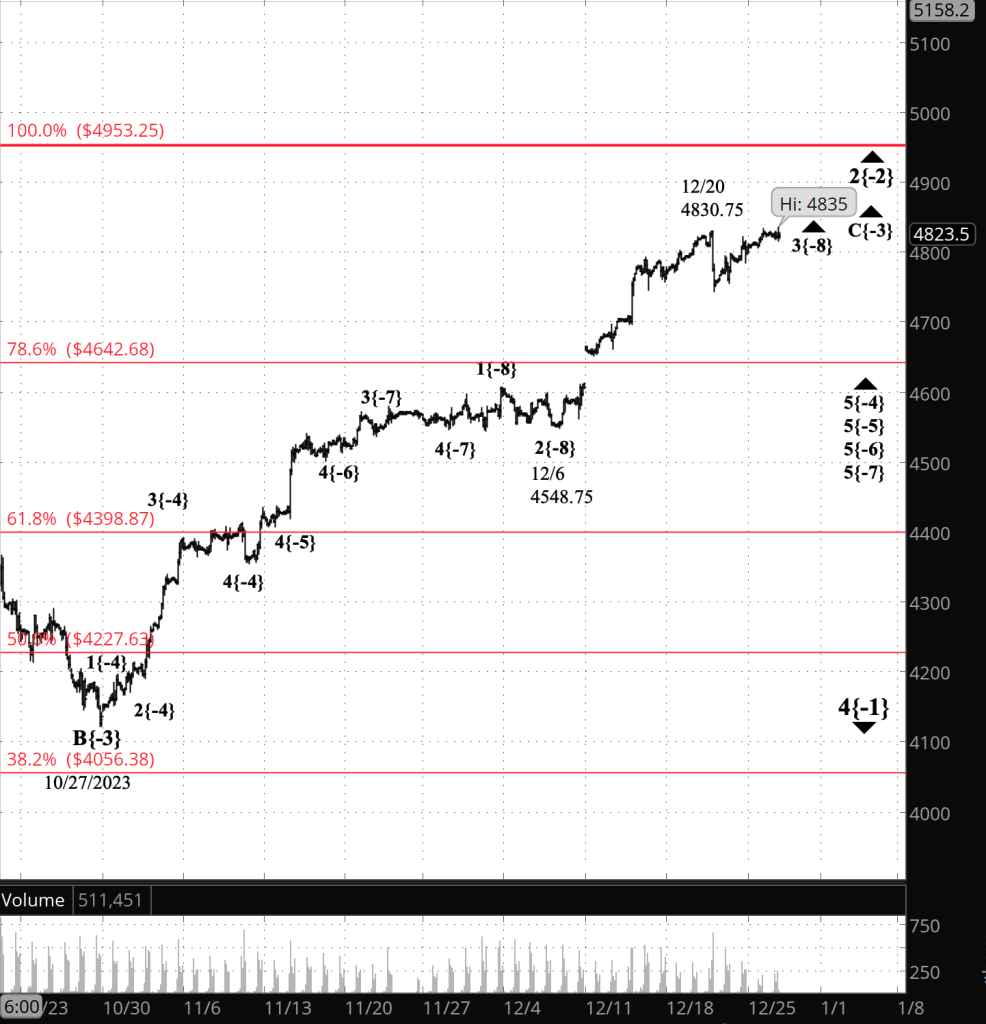
Half an hour before the closing bell. The S&P 500 futures remained below the overnight high, 4841.50, working its way down to the 4820s as the closing bell approached. No changes in this morning’s analysis, except to add an important note: The lower the price goes, the more likely the alternative analysis becomes. The alternative scenario says the 4th subwave of the low degree wave that I’m tracking began at the that high. I’ve updated the chart.

1:50 p.m. New York time

Trades. I exited a short Iron Fly options position on XSP for a 21.2% profit and entered short Iron Fly position on SPY that expires the next day. Both exchange-traded funds are based on the S&P 500 Index. I alternate between them on these very short-term positions to avoid triggering the SEC’s Pattern Day Trader sanctions.

I’ve updated the XSP trade analysis with results and posted an analysis of the SPY trade.

9:35 a.m. New York time

What’s happening now? The S&P 500 E-mini futures rose into the 4840s overnight.

What does it mean? The final subwave, wave C, of a 2nd-wave upward corrective pattern that has been underway for 14 months continues. Four levels of increasingly smaller subwaves are in their last legs, and the fifth level is the middle wave of five.

The overnight peak was a new high for the wave 2 correction.

What are the alternatives? When a price movement is close to its end, each new high is potentially the end of the 3rd subwave of low degree and the beginning of 4th subwave. I’ve chosen to mark wave the 3rd subwave as being underway. There’s an equal likelihood that the 4th subwave has begun its decline. In any case, wave 4 will be followed by rising wave 5, which will complete the much larger corrective pattern.

[S&P 500 E-mini futures at 3:30 p.m., 2-hour bars, with volume]

What does Elliott wave theory say? Here are the waves that underly the analyses.

Principal Analysis:

  • A downtrend, wave 4{-1}, began on January 4, 2022 and is underway.
  • Within wave 4{-1}, an upward correction, wave 2{-2}, began on October 13, 2022.
  • The third wave of the correction, wave C{-3}, is underway.
  • Wave C{-3} has reached its 5th and final subwave, wave 5{-4} and a series of smaller 5th waves, down to wave 5{-7}.
  • Within wave 5{-7}, the middle subwave is underway, wave 3{-8}, an uptrend, began with the December 6 low.

Alternative Analysis

  • Within wave 5{-7}, the next-to-the-last subwave is underway, wave 4{-8}, a downward correction, began with the December 27 high.

We Are Here.

These are the waves currently in progress under my principal analysis. Each line on the list shows the wave number, with the subscript in curly brackets, the traditional degree name, the starting date, the starting price of the S&P 500 E-mini futures, and the direction of the wave.

  • S&P 500 Index:
  • 5{+3} Supercycle, 7/8/1932, 4.40 (up)
  • 5{+2} Cycle, 12/9/1974, 60.96 (up)
  • 5{+1} Primary, 3/6/2009, 666.79 (up)
  • 5{0} Intermediate, 12/26/2018, 2346.58 (up)
  • S&P 500 Futures and index:
  • 4{-1} Minor, 1/4/2022, 4953.25 (down) (futures), 4818.62 (down) (index)
  • S&P 500 Futures:
  • 2{-2} Minute, 10/13/2022, 3491.58 (up)
  • C{-3} Minuette, 10/27/2023, 4122.25 (up)

Reading the chart. Price movements — waves – – in Elliott wave analysis are labeled with numbers within trending waves and letters with corrective waves. The subscripts — numbers in curly brackets — designate the wave’s degree, which, in Elliott wave analysis, means the relative position of a wave within the larger and smaller structures that make up the chart. R.N. Elliott, who in the 1930s developed the form of analysis that bears his name, viewed the chart as a complex structure of smaller waves nested within larger waves, which in turn are nested within still larger waves. In mathematics it’s called a fractal structure, where at every scale the pattern is similar to the others.

Learning and other resources. Elliott wave analysis provides context, not prophecy. As the 20th century semanticist Alfred Korzybski put it in his book Science and Sanity (1933), “The map is not the territory … The only usefulness of a map depends on similarity of structure between the empirical world and the map.” And I would add, in the ever-changing markets, we can judge that similarity of structure only after the fact.

See the menu page Analytical Methods for a rundown on where to go for information on Elliott wave analysis.

By Tim Bovee, Portland, Oregon, December 28, 2023

Disclaimer

Tim Bovee, Private Trader tracks the analysis and trades of a private trader for his own accounts. Nothing in this blog constitutes a recommendation to buy or sell stocks, options or any other financial instrument. The only purpose of this blog is to provide education and entertainment.

No trader is ever 100 percent successful in his or her trades. Trading in the stock and option markets is risky and uncertain. Each trader must make trading decisions for his or her own account, and take responsibility for the consequences.

License
Creative Commons License

All content on Tim Bovee, Private Trader by Timothy K. Bovee is licensed under a Creative Commons Attribution-ShareAlike 4.0 International License.

Based on a work at www.timbovee.com.
Options Trades 12/27/2023: XSP

Symbols traded: XSP

I entered a short Iron Fly position on XSP and exited the next day, expiration day, for a profit.

XSP short Iron Fly

LOT:4ENTRY DATE:12/27/2023
EXIT DATE:12/28/2023
DAYS HELD:1

Entry and Exit

METRICCREDITDEBITCHANGECHANGE %ANNUALIZED CHANGE %
Options premium$ 1.60$ 1.32$ 0.2821.2%7700%
METRICENTRYEXITCHANGECHANGE %ANNUALIZED CHANGE %
Stock price$ 478.18$ 478.91$ (0.73)0.15%56%
Impllied Volatility Rate4.64.3-0.3
Days to expiration10

The structure of the position

STRUCTURESTRIKEODDS EXPIRE OTMDELTAIN PRICEOUT PRICECHANGE
Calls
Long481.0085.0%17$ (0.24)$ 0.16$ (0.08)
Break-even480.6073.0%30
Short479.0061.00%43$ 0.85$ (0.82)$ 0.03
Puts
Short479.0039.0%57$ 1.28$ (0.75)$ 0.53
Break-even477.6059.0%37.5
Long476.0079.0%18$ (0.29)$ 0.09$ (0.20)
======
NET TOTAL:$ 0.28

Risk and Reward

Per contract:
Reward160.00
Risk90.00
R/R Ratio (n:1)0.6

By Tim Bovee, Portland, Oregon, December 27-28, 2023

Disclaimer

Tim Bovee, Private Trader tracks the analysis and trades of a private trader for his own accounts. Nothing in this blog constitutes a recommendation to buy or sell stocks, options or any other financial instrument. The only purpose of this blog is to provide education and entertainment.

No trader is ever 100 percent successful in his or her trades. Trading in the stock and option markets is risky and uncertain. Each trader must make trading decisions for his or her own account, and take responsibility for the consequences.

License
Creative Commons License

All content on Tim Bovee, Private Trader by Timothy K. Bovee is licensed under a Creative Commons Attribution-ShareAlike 4.0 International License.

Based on a work at www.timbovee.com.
Trader’s Notebook

3:30 p.m. New York time

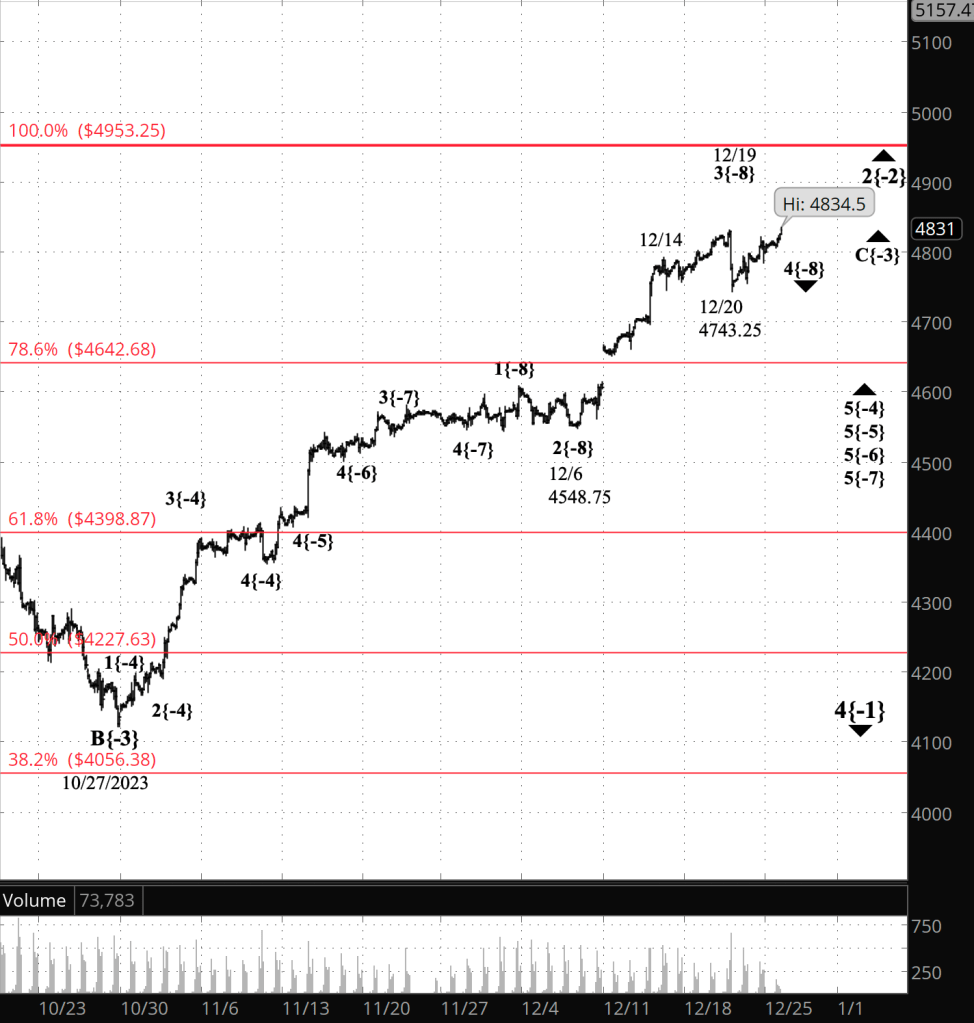
Half an hour before the closing bell. The S&P 500 futures fell from the session high, 4835, back to below 4820. Wave C, the final wave of a corrective pattern in wave 2, an upward correction, continues to play out its end game. I’ve updated the chart.

1:45 p.m. New York time

Trades. I exited my short Iron Fly positions on SPY and QQQ, on expiration day, one day after entry. The SPY position produced a 20.3% profit, and the QQQ position, a much less impressive 2.2% profit. I’ve updated the trade analysis with results.

I entered a short Iron Fly position on XSP, one day before expiration, with the intent of existing on expiration day, and have posted a trade analysis.

9:35 a.m. New York time

What’s happening now? The S&P 500 E-mini futures moved to a new high overnight, 4834.50, in the rise that began on October 27. The high forces a reassessment how which subwave is in progress within that rise.

What does it mean? The big picture is unchanged. A 2nd wave upward correction that began on October 13 continues and is in the 3rd and final subwave of the corrective pattern, wave C.

Wave C is almost complete, in 5th and final waves across four degrees lower. In the fifth degree lower, I had labeled declining wave 4 as having begun on December 20. The quick reversal to a new high confirms that rising wave 3 is still underway, and I have relabeled the chart accordingly, promoting the wave 3 alternative to principal analysis.

See the December 26 Trader’s Notebook for a chart showing the prior labeling.

What are the alternatives? As is always the case with a new high at this point in the C wave, each new high could be the end of the 3rd subwave and the beginning of 4th subwave.

[S&P 500 E-mini futures at 3:30 p.m., 2-hour bars, with volume]

What does Elliott wave theory say? Here are the waves that underly the analyses.

Principal Analysis:

  • A downtrend, wave 4{-1}, began on January 4, 2022 and is underway.
  • Within wave 4{-1}, an upward correction, wave 2{-2}, began on October 13, 2022.
  • The third wave of the correction, wave C{-3}, is underway.
  • Wave C{-3} has reached its 5th and final subwave, wave 5{-4} and a series of smaller 5th waves, down to wave 5{-7}.
  • Within wave 5{-7}, the middle subwave is underway, wave 3{-8}, an uptrend, began with the December 6 low.

Alternative Analysis

  • Within wave 5{-7}, the next-to-the-last subwave is underway, wave 4{-8}, a downward correction, began with the December 27 high.

We Are Here.

These are the waves currently in progress under my principal analysis. Each line on the list shows the wave number, with the subscript in curly brackets, the traditional degree name, the starting date, the starting price of the S&P 500 E-mini futures, and the direction of the wave.

  • S&P 500 Index:
  • 5{+3} Supercycle, 7/8/1932, 4.40 (up)
  • 5{+2} Cycle, 12/9/1974, 60.96 (up)
  • 5{+1} Primary, 3/6/2009, 666.79 (up)
  • 5{0} Intermediate, 12/26/2018, 2346.58 (up)
  • S&P 500 Futures and index:
  • 4{-1} Minor, 1/4/2022, 4953.25 (down) (futures), 4818.62 (down) (index)
  • S&P 500 Futures:
  • 2{-2} Minute, 10/13/2022, 3491.58 (up)
  • C{-3} Minuette, 10/27/2023, 4122.25 (up)

Reading the chart. Price movements — waves – – in Elliott wave analysis are labeled with numbers within trending waves and letters with corrective waves. The subscripts — numbers in curly brackets — designate the wave’s degree, which, in Elliott wave analysis, means the relative position of a wave within the larger and smaller structures that make up the chart. R.N. Elliott, who in the 1930s developed the form of analysis that bears his name, viewed the chart as a complex structure of smaller waves nested within larger waves, which in turn are nested within still larger waves. In mathematics it’s called a fractal structure, where at every scale the pattern is similar to the others.

Learning and other resources. Elliott wave analysis provides context, not prophecy. As the 20th century semanticist Alfred Korzybski put it in his book Science and Sanity (1933), “The map is not the territory … The only usefulness of a map depends on similarity of structure between the empirical world and the map.” And I would add, in the ever-changing markets, we can judge that similarity of structure only after the fact.

See the menu page Analytical Methods for a rundown on where to go for information on Elliott wave analysis.

By Tim Bovee, Portland, Oregon, December 27, 2023

Disclaimer

Tim Bovee, Private Trader tracks the analysis and trades of a private trader for his own accounts. Nothing in this blog constitutes a recommendation to buy or sell stocks, options or any other financial instrument. The only purpose of this blog is to provide education and entertainment.

No trader is ever 100 percent successful in his or her trades. Trading in the stock and option markets is risky and uncertain. Each trader must make trading decisions for his or her own account, and take responsibility for the consequences.

License
Creative Commons License

All content on Tim Bovee, Private Trader by Timothy K. Bovee is licensed under a Creative Commons Attribution-ShareAlike 4.0 International License.

Based on a work at www.timbovee.com.
Options Trades 12/26/2023: QQQ SPY

Symbols traded: QQQ SPY

I entered short Iron Fly positions on QQQ and SPY, one day prior to expiration, and exited a day later, each for a profit..

QQQ short Iron Fly

LOT:`12ENTRY DATE:12/26/2023
EXIT DATE:12/27/2023
DAYS HELD:1

Entry and Exit

METRICCREDITDEBITCHANGECHANGE %ANNUALIZED CHANGE %
Options premium$ 1.90$ 1.86$ 0.042.2%781%
METRICENTRYEXITCHANGECHANGE %ANNUALIZED CHANGE %
Stock price$ 410.38$ 411.30$ (0.92)0.22%82%
Impllied Volatility Rate13.18.3-4.8
Days to expiration10

The structure of the position

STRUCTURESTRIKEODDS EXPIRE OTMDELTAIN PRICEOUT PRICENET PRICE
Calls
Long413.0082.0%18$ (0.29)$ 0.29$ –
Break-even411.9063.5%36
Short410.0045.0%54$ 1.45$ (1.83)$ (0.38)
Puts
Short410.0056.0%46$ 1.03$ (0.36)$ 0.67
Break-even408.9070.0%31.5
Long407.0084.0%17$ (0.29)$ 0.04$ (0.25)
======
`NET TOTAL:$ 0.04

Risk and Reward

Per contract:
Reward190.00
Risk110.00
R/R Ratio (n:1)0.6

SPY short Iron Fly

LOT:22ENTRY DATE:12/26/2023
EXIT DATE:12/27/2023
DAYS HELD:1

Entry and Exit

METRICCREDITDEBITCHANGECHANGE %ANNUALIZED CHANGE %
Options premium$ 1.78$ 1.48$ 0.3020.3%7358%
METRICENTRYEXITCHANGECHANGE %ANNUALIZED CHANGE %
Stock price$ 475.20$ 475.50$ (0.30)0.06%23%
Impllied Volatility Rate10.09.5-0.5
Days to expiration10

The structure of the position

STRUCTURESTRIKEODDS EXPIRE OTMDELTAIN PRICEOUT PRICENET PRICE
Calls
Long478.0085.0%15$ (0.19)$ 0.08$ (0.11)
Break-even476.7865.5%34.5
Short475.0046.0%54$ 1.27$ (0.53)$ 0.74
Puts
Short475.0055.0%46$ 0.97$ (1.08)$ (0.11)
Break-even473.7870.0%30.5
Long472.0085.0%15$ (0.26)$ 0.05$ (0.21)
======
`NET TOTAL:$ 0.31

Risk and Reward

Per contract:
Reward178.00
Risk122.00
R/R Ratio (n:1)0.7

By Tim Bovee, Portland, Oregon, December 26-27, 2023

Disclaimer

Tim Bovee, Private Trader tracks the analysis and trades of a private trader for his own accounts. Nothing in this blog constitutes a recommendation to buy or sell stocks, options or any other financial instrument. The only purpose of this blog is to provide education and entertainment.

No trader is ever 100 percent successful in his or her trades. Trading in the stock and option markets is risky and uncertain. Each trader must make trading decisions for his or her own account, and take responsibility for the consequences.

License
Creative Commons License

All content on Tim Bovee, Private Trader by Timothy K. Bovee is licensed under a Creative Commons Attribution-ShareAlike 4.0 International License.

Based on a work at www.timbovee.com.
Trader’s Notebook

3:30 p.m. New York time

Half an hour before the closing bell. The S&P 500 futures rose during the session, from the 4810s into the 4830s. Wave C within the ongoing 2nd-wave upward correction continues and is in its end game. I’ve udpated the chart.

1:45 p.m. New York time

Trades. I exited my short Iron Condor position on XSP for a 20.9% profit. I entered the position on Friday, December 22, four days before expiration, and held until expiration day today, after the Christmas holiday, making it a 4DTE play. I’ve updated the trade analysis with results.

I entered two new positions, on QQQ and SPY, that will expire the next day, on Wednesday, December 27, making them 1DTE plays. I’ve posted an analysis of the trades.

9:35 a.m. New York time

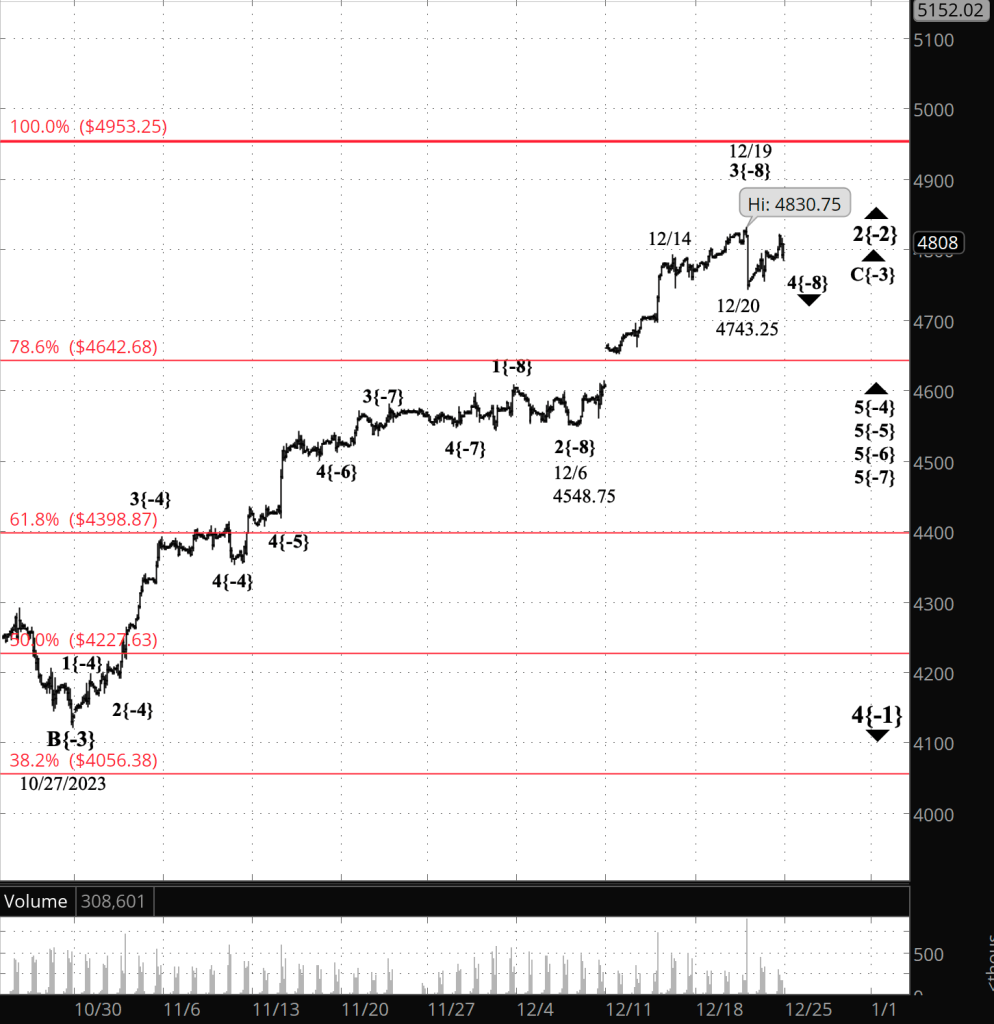
What’s happening now? The S&P 500 E-mini futures traded narrowly in the low 4800s after trading resumed overnight. The price remained below the December 19 high, 4830.75.

What does it mean? The C wave of a wave-2 upward correction has been underway since October 27 and in its final stages. At play is a small wave four degrees lower than the C wave. Within that small 5th wave, the next-to-the-last subwave, declining wave 4, is now underway.

That 4th wave began on December 19. It will be followed by a rising 5th wave that will complete its low degree parent 5th wave, and a series of 5th wave up to wave C, which will also be complete. Most often with 2nd waves, that C wave will also end the correction. Sometimes a correction will take a compound form, containing two or three corrective patterns. There’s no way to forecast whether a correction will take a simple or complex form. We can only note it when it happens and analyze the chart accordingly.

What are the alternatives? As is often the case with Elliott Wave Theory, there are several ways to analyze the chart.

One possibility is that the wave in play is still a rising 3rd wave. If this is the case, the price will reverse and rise above the December 19 high, 4830.75

It’s also possible to count the low degree wave 3 as having ended on December 14. If that proves to be the case, then the December 19 high was the end of the 5th subwave buried within the C wave of the correction, the correction may have ended along with that C wave, and the decline that followed is the early stage of a downtrending 3rd wave that will carry the price a great deal lower.

[S&P 500 E-mini futures at 3:30 p.m., 2-hour bars, with volume]

What does Elliott wave theory say? Here are the waves that underlie the analyses.

Principal Analysis:

  • A downtrend, wave 4{-1}, began on January 4, 2022 and is underway.
  • Within wave 4{-1}, an upward correction, wave 2{-2}, began on October 13, 2022.
  • The third wave of the correction, wave C{-3}, is underway.
  • Wave C{-3} has reached its 5th and final subwave, wave 5{-4} and a series of smaller 5th waves, down to wave 5{-7}.
  • Within wave 5{-7}, the next-to-the-last subwave is underway, wave 4{-8}, a downward correction, began with the December 19 high.

Alternative #1:

  • Within wave 5{-7}, the middle subwave, rising wave 3{-8}, is still underway.

Alternative #2:

  • Within wave 5{-7}, the final subwave, rising wave 5{-8}, ended on on December 19, also compketing wave C{-3} and most likely ending wave 2{-2}. Downtrending wave wave 3{-2} on December 19 began what will prove to be a robust decline.

We Are Here.

These are the waves currently in progress under my principal analysis. Each line on the list shows the wave number, with the subscript in curly brackets, the traditional degree name, the starting date, the starting price of the S&P 500 E-mini futures, and the direction of the wave.

  • S&P 500 Index:
  • 5{+3} Supercycle, 7/8/1932, 4.40 (up)
  • 5{+2} Cycle, 12/9/1974, 60.96 (up)
  • 5{+1} Primary, 3/6/2009, 666.79 (up)
  • 5{0} Intermediate, 12/26/2018, 2346.58 (up)
  • S&P 500 Futures and index:
  • 4{-1} Minor, 1/4/2022, 4953.25 (down) (futures), 4818.62 (down) (index)
  • S&P 500 Futures:
  • 2{-2} Minute, 10/13/2022, 3491.58 (up)
  • C{-3} Minuette, 10/27/2023, 4122.25 (up)

Reading the chart. Price movements — waves – – in Elliott wave analysis are labeled with numbers within trending waves and letters with corrective waves. The subscripts — numbers in curly brackets — designate the wave’s degree, which, in Elliott wave analysis, means the relative position of a wave within the larger and smaller structures that make up the chart. R.N. Elliott, who in the 1930s developed the form of analysis that bears his name, viewed the chart as a complex structure of smaller waves nested within larger waves, which in turn are nested within still larger waves. In mathematics it’s called a fractal structure, where at every scale the pattern is similar to the others.

Learning and other resources. Elliott wave analysis provides context, not prophecy. As the 20th century semanticist Alfred Korzybski put it in his book Science and Sanity (1933), “The map is not the territory … The only usefulness of a map depends on similarity of structure between the empirical world and the map.” And I would add, in the ever-changing markets, we can judge that similarity of structure only after the fact.

See the menu page Analytical Methods for a rundown on where to go for information on Elliott wave analysis.

By Tim Bovee, Portland, Oregon, December 26, 2023

Disclaimer

Tim Bovee, Private Trader tracks the analysis and trades of a private trader for his own accounts. Nothing in this blog constitutes a recommendation to buy or sell stocks, options or any other financial instrument. The only purpose of this blog is to provide education and entertainment.

No trader is ever 100 percent successful in his or her trades. Trading in the stock and option markets is risky and uncertain. Each trader must make trading decisions for his or her own account, and take responsibility for the consequences.

License
Creative Commons License

All content on Tim Bovee, Private Trader by Timothy K. Bovee is licensed under a Creative Commons Attribution-ShareAlike 4.0 International License.

Based on a work at www.timbovee.com.

Options Trades 12/22/2023: XSP

Symbols traded today: XSP (4DTE)

I entered a short Iron Fly position XSP and exited during the next trading session, on expiration day, the day after Christmas, December 26. The position produced a 20.9% profit.

Note that I’ve added in the prices of the individual options in the position structure session. This will accommodate positions that I must close partially (as happened today with another trade).

XSP short Iron Fly

LOT:3ENTRY DATE:12/22/2023
EXIT DATE:12/26/2023
DAYS HELD:4

Entry and Exit

METRICCREDITDEBITCHANGECHANGE %ANNUALIZED CHANGE %
Options premium$ 1.91$ 1.58$ 0.3320.9%1895%
METRICENTRYEXITCHANGECHANGE %ANNUALIZED CHANGE %
Stock price$ 476.20$ 476.23$ (0.03)0.01%1%
Impllied Volatility Rate11.513.62.1
Days to expiration40

The structure of the position

STRUCTURESTRIKEODDS EXPIRE OTMDELTAIN PRICEOUT PRICECHANGE
Calls
Long480.0083.0%15$ (0.19)$ 0.02$ (0.17)
Break-even478.9167.0%30.5
Short477.0051.00%46$ 0.94$ (0.45)$ 0.49
Puts
Short477.0049.0%54$ 1.63$ (1.34)$ 0.29
Break-even475.9165.0%37.5
Long474.0081.0%21$ (0.47)$ 0.19$ (0.28)
======
NET TOTAL:$ 0.33

Risk and Reward

Per contract:
Reward191.00
Risk109.00
R/R Ratio (n:1)0.6

By Tim Bovee, Portland, Oregon, December 22-26, 2023

Disclaimer

Tim Bovee, Private Trader tracks the analysis and trades of a private trader for his own accounts. Nothing in this blog constitutes a recommendation to buy or sell stocks, options or any other financial instrument. The only purpose of this blog is to provide education and entertainment.

No trader is ever 100 percent successful in his or her trades. Trading in the stock and option markets is risky and uncertain. Each trader must make trading decisions for his or her own account, and take responsibility for the consequences.

License
Creative Commons License

All content on Tim Bovee, Private Trader by Timothy K. Bovee is licensed under a Creative Commons Attribution-ShareAlike 4.0 International License.

Based on a work at www.timbovee.com.

Trader’s Notebook

3:30 p.m. New York time

Half an hour before the closing bell. The S&P 500 futures fell from the 4820s to the 4780s during the session and retraced a portion of that decline. This morning’s analysis stands unchanged. I’ve updated the chart.

The Christmas holiday is on Monday, December 25. My next Trader’s Notebook will be posted the morning of Tuesday, December 26.

3 p.m. New York time

Trades. I’ve exited my EWZ short Iron Fly position, one day after entry, for a loss. One option in the position, the short call, was out of the money and causing an overall loss. I bought that option and am allowing the rest to expire out of the money. I’ve updated the trade analysis with results.

I entered a short Iron Fly position on XSP that expires in four days, the day after Christmas, and have posted a trade analysis.

9:35 a.m. New York time

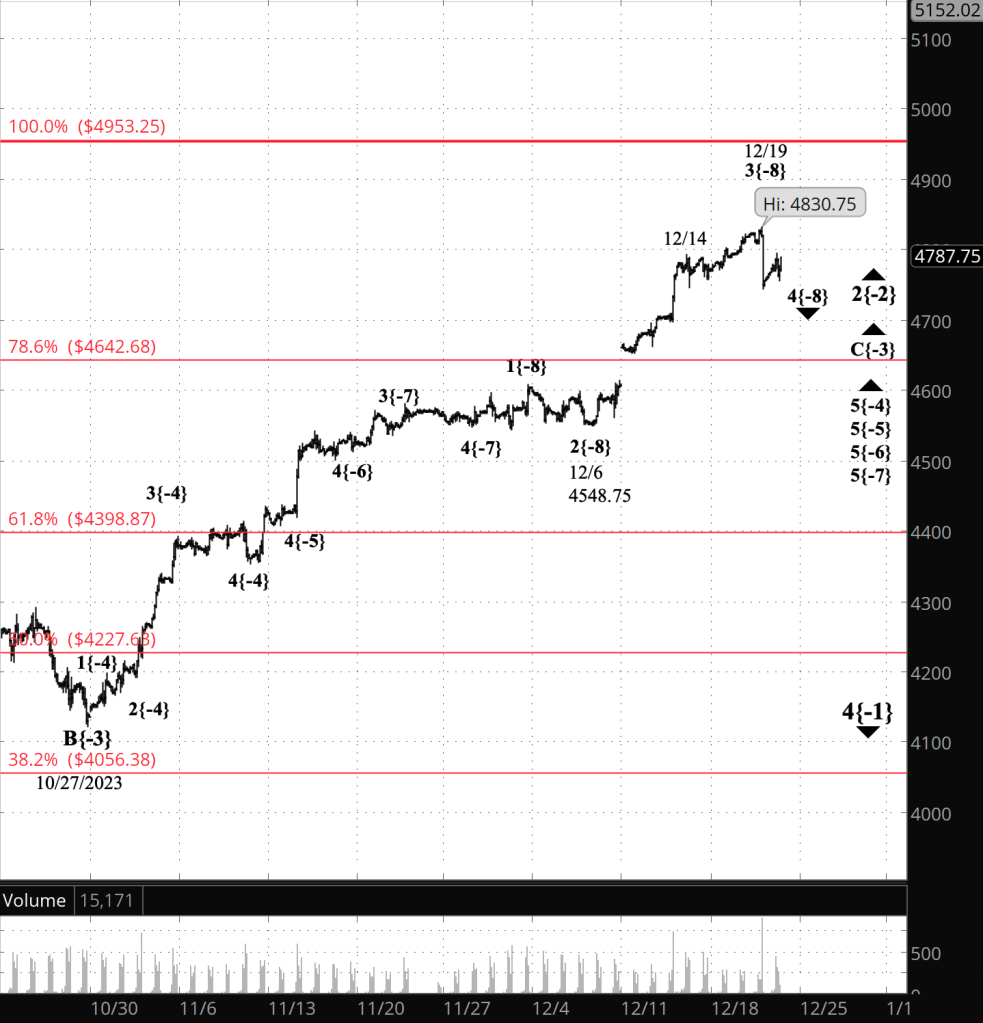
What’s happening now? The S&P 500 E-mini futures rose above 4800 after the Personal Consumption Expenditures Price Index (PCE), an inflation measure, was published. The price remained below the December 19 high, 4830.75.

What does it mean? At his point the low degree wave that is driving the the analysis is in its declining 4th wave. If the price moves above the December 19 high, then there are two possibilities of equal likelihood:

  • Either the prior analysis was a miscall and the rising 3rd wave is still underway and the 4th wave has not yet begun.
  • Or the 3rd wave ended on December 20 and the rising 5th wave has begun.

Begun unable to choose between the two, based on the evidence at hand, I’ve chosen to retain the earlier principal analysis: Declining wave 4 is underway.

The low-degree waves under discussion are subwaves of a larger wave C, the third wave of a 2nd-wave upward correction that began on October 13, 2022. The smaller 4th wave is five levels below the C wave, and upon it depends the end point of that wave C and possibly the entire correction.

What are the alternatives? Unchanged from Thursday. It’s possible to count the low degree wave 3 as having ended on December 14. If that proves to be the case, then the December 19 high was the end of the 5th subwave buried within the C wave of the correction, the correction may have ended along with that C wave, and the decline that followed is the early stage of a downtrending 3rd wave that will carry the price a great deal lower.

[S&P 500 E-mini futures at 3:30 p.m., 115-minute bars, with volume]

What does Elliott wave theory say? Here are the waves that underly the analyses.

Principal Analysis:

  • A downtrend, wave 4{-1}, began on January 4, 2022 and is underway.
  • Within wave 4{-1}, an upward correction, wave 2{-2}, began on October 13, 2022.
  • The third wave of the correction, wave C{-3}, is underway.
  • Wave C{-3} has reached its 5th and final subwave, wave 5{-4} and a series of smaller 5th waves, down to wave 5{-7}.
  • Wave 5{-7} internally contains two possiblilities of nearly equal likelihood. Either…
    • … the middle subwave, rising wave 3{-8}, is underway, or…
    • … the next-to-the-last subwave, a 4{-8}, a downward correction, began with the December 19 high.
    • I’ve chosen the 4th wave scenario as the principal analysis, and the the 3rd wave scenario as an alternative status, although the two have equal likelihood of describing what will eventually become clear.

Alternative Analysis

  • Wave 3{-8} ended on December 14.
  • Wave 5{-8}, along with wave C{-3} and possibly wave 2{-2} ended on December 19.
  • The present decline is wave 1{-3} within downtrending wave 3{-2}.

We Are Here.

These are the waves currently in progress under my principal analysis. Each line on the list shows the wave number, with the subscript in curly brackets, the traditional degree name, the starting date, the starting price of the S&P 500 E-mini futures, and the direction of the wave.

  • S&P 500 Index:
  • 5{+3} Supercycle, 7/8/1932, 4.40 (up)
  • 5{+2} Cycle, 12/9/1974, 60.96 (up)
  • 5{+1} Primary, 3/6/2009, 666.79 (up)
  • 5{0} Intermediate, 12/26/2018, 2346.58 (up)
  • S&P 500 Futures and index:
  • 4{-1} Minor, 1/4/2022, 4953.25 (down) (futures), 4818.62 (down) (index)
  • S&P 500 Futures:
  • 2{-2} Minute, 10/13/2022, 3491.58 (up)
  • C{-3} Minuette, 10/27/2023, 4122.25 (up)

Reading the chart. Price movements — waves – – in Elliott wave analysis are labeled with numbers within trending waves and letters with corrective waves. The subscripts — numbers in curly brackets — designate the wave’s degree, which, in Elliott wave analysis, means the relative position of a wave within the larger and smaller structures that make up the chart. R.N. Elliott, who in the 1930s developed the form of analysis that bears his name, viewed the chart as a complex structure of smaller waves nested within larger waves, which in turn are nested within still larger waves. In mathematics it’s called a fractal structure, where at every scale the pattern is similar to the others.

Learning and other resources. Elliott wave analysis provides context, not prophecy. As the 20th century semanticist Alfred Korzybski put it in his book Science and Sanity (1933), “The map is not the territory … The only usefulness of a map depends on similarity of structure between the empirical world and the map.” And I would add, in the ever-changing markets, we can judge that similarity of structure only after the fact.

See the menu page Analytical Methods for a rundown on where to go for information on Elliott wave analysis.

By Tim Bovee, Portland, Oregon, December 22, 2023

Disclaimer

Tim Bovee, Private Trader tracks the analysis and trades of a private trader for his own accounts. Nothing in this blog constitutes a recommendation to buy or sell stocks, options or any other financial instrument. The only purpose of this blog is to provide education and entertainment.

No trader is ever 100 percent successful in his or her trades. Trading in the stock and option markets is risky and uncertain. Each trader must make trading decisions for his or her own account, and take responsibility for the consequences.

License
Creative Commons License

All content on Tim Bovee, Private Trader by Timothy K. Bovee is licensed under a Creative Commons Attribution-ShareAlike 4.0 International License.

Based on a work at www.timbovee.com.

Options Trades 12/21/2023: EWZ

Symbols traded today: EWZ short Iron Fly (1DTE)

I entered a short Iron Fly position on EWZ, which tracks the Brazilian market. It expires the next day. I passed on my usual U.S. markets trades, tracking the S&P 500 and the Nasdaq Composite, because of the release Friday morning of inflation numbers in the Personal Consumption Expenditures Price Index. The Iron Fly position profits when the price remains stable, the PCE sometimes results in sudden price moves, and the Government of Brazil has no economic release of similar magnitude on Friday. So EWZ seemed to be more likely to produce a profit.

I exited one in-the-money option, the short call, to avoid exercise with additional fees, and allowed the other options to expire. Note that I’ve added individual option pricing to the position structure section in order to accommodate partial exits such as I did with this position.

EWZ short Iron Fly

LOT:1ENTRY DATE:12/21/2023
EXIT DATE:12/22/2023
DAYS HELD:1

Entry and Exit

METRICCREDITDEBITCHANGECHANGE %ANNUALIZED CHANGE %
Options premium$ 0.39$ 0.76$ (0.37)-48.7%-17672%
METRICENTRYEXITCHANGECHANGE %ANNUALIZED CHANGE %
Stock price$ 34.21$ 34.74$ (0.53)1.55%565%
Impllied Volatility Rate-2.0-6.8-4.8
Days to expiration10

The structure of the position

STRUCTURESTRIKEODDS EXPIRE OTMDELTAIN PRICEOUT PRICENET PRICE
Calls
Long35.0094.0%7$ (0.01)$ –$ (0.01)
Break-even34.3979.0%21.5
Short34.0064%36$ 0.31$ (0.76)$ (0.45)
Puts
Short34.0063.0%36$ 0.12$ –$ 0.12
Break-even33.8975.5%24
Long33.5088.0%12$ (0.03)$ –$ (0.03)
======
`NET TOTAL:$ (0.37)

Risk and Reward

Per contract:
Reward39.00
Risk36.00
R/R Ratio (n:1)0.9

By Tim Bovee, Portland, Oregon, December 21-22, 2023

Disclaimer

Tim Bovee, Private Trader tracks the analysis and trades of a private trader for his own accounts. Nothing in this blog constitutes a recommendation to buy or sell stocks, options or any other financial instrument. The only purpose of this blog is to provide education and entertainment.

No trader is ever 100 percent successful in his or her trades. Trading in the stock and option markets is risky and uncertain. Each trader must make trading decisions for his or her own account, and take responsibility for the consequences.

License
Creative Commons License

All content on Tim Bovee, Private Trader by Timothy K. Bovee is licensed under a Creative Commons Attribution-ShareAlike 4.0 International License.

Based on a work at www.timbovee.com.

Trader’s Notebook

3:30 p.m. New York time

Half an hour before the closing bell. The S&P 500 futures declined from its overnight high, 4794.75, into the 4750s. This morning’s analysis stands: Wave C within the 2nd-wave upward correction now underway is in its late stage, finishing off a wave of low degree before reaching an end. I’ve udpated the chart.

1:45 p.m. New York time

Trade. I’ve entered a short Iron Fly position on EWZ, the exchange-traded fund tracking markets in Brazil. It expires tomorrow, so it’s a 1DTE trade. I’ve posted an analysis of the trade.

9:35 a.m. New York time

What’s happening now? The S&P 500 E-mini futures rose in overnight trading, from yesterday’s session low, 4743.25, back into the 4790s. The price remained well below the high in the rise that began in October of last year, set on December 19 at 3830.75.

What does it mean? I take the sharp decline on December 20 to be evidence that the 3rd subwave within wave C, the final subwave of the 2nd-wave corrective pattern that began on October 13, 2023, ended at the December 19 peak.

Although I have changed the labeling on the chart to show the low-degree 3rd wave within wave C as having ended and the subsequent 4th wave having begun, there is still a significant chance that the 3rd wave is still underway. The energy of the decline suggests that wave 3 is over, but it’s not a certainty. The name of the game today is, “Wait and See”.

And there is yet another ambiguity, which I’ve listed as an alternative.

In any case, rising wave 3 is five levels below the C wave in the fractal structure of the chart, as is declining wave 4. The 4th wave will be followed by a rising subwave that will complete wave C and also, most likely, the 2nd wave upward correction. The end of the correction will be delayed if it takes a complex form, containing two or three corrective patterns.

What are the alternatives? It’s possible to count the low degree wave 3 as having ended on December 14. If that proves to be the case, then the December 19 high was the end of the 5th subwave buried within the C wave of the correction, the correction may have ended along with that C wave, and the decline that followed is the early stage of a downtrending 3rd wave that will carry the price a great deal lower.

The Chart. The Fibonacci retracement ladder appears on the chart in red. The shows the C wave’s retracement of the first subwave of the correction, the A wave.

[S&P 500 E-mini futures at 3:30 p.m., 115-minute bars, with volume]

What does Elliott wave theory say? Here are the waves that underly the analyses.

Principal Analysis:

  • A downtrend, wave 4{-1}, began on January 4, 2022 and is underway.
  • Within wave 4{-1}, an upward correction, wave 2{-2}, began on October 13, 2022.
  • The third wave of the correction, wave C{-3}, is underway.
  • Wave C{-3} has reached its 5th and final subwave, wave 5{-4} and a series of smaller 5th waves, down to wave 5{-7}.
  • Wave 5{-7} internally contains two possiblilities of nearly equal likelihood. Either…
    • … the middle subwave, rising wave 3{-8}, is underway, or…
    • … the next-to-the-last subwave, a 4{-8}, a downward correction, began with the December 19 high.
    • In the afternoon analysis today I switched the 4th wave scenario to the principal analysis slot, and relegated the 3rd wave scenario to alternative status.

Alternative Analysis

  • Wave 3{-8} ended on December 14.
  • Wave 5{-8}, along with wave C{-3} and possibly wave 2{-2} ended on December 19.
  • The present decline is wave 1{-3} within downtrending wave 3{-2}.

We Are Here.

These are the waves currently in progress under my principal analysis. Each line on the list shows the wave number, with the subscript in curly brackets, the traditional degree name, the starting date, the starting price of the S&P 500 E-mini futures, and the direction of the wave.

  • S&P 500 Index:
  • 5{+3} Supercycle, 7/8/1932, 4.40 (up)
  • 5{+2} Cycle, 12/9/1974, 60.96 (up)
  • 5{+1} Primary, 3/6/2009, 666.79 (up)
  • 5{0} Intermediate, 12/26/2018, 2346.58 (up)
  • S&P 500 Futures and index:
  • 4{-1} Minor, 1/4/2022, 4953.25 (down) (futures), 4818.62 (down) (index)
  • S&P 500 Futures:
  • 2{-2} Minute, 10/13/2022, 3491.58 (up)
  • C{-3} Minuette, 10/27/2023, 4122.25 (up)

Reading the chart. Price movements — waves – – in Elliott wave analysis are labeled with numbers within trending waves and letters with corrective waves. The subscripts — numbers in curly brackets — designate the wave’s degree, which, in Elliott wave analysis, means the relative position of a wave within the larger and smaller structures that make up the chart. R.N. Elliott, who in the 1930s developed the form of analysis that bears his name, viewed the chart as a complex structure of smaller waves nested within larger waves, which in turn are nested within still larger waves. In mathematics it’s called a fractal structure, where at every scale the pattern is similar to the others.

Learning and other resources. Elliott wave analysis provides context, not prophecy. As the 20th century semanticist Alfred Korzybski put it in his book Science and Sanity (1933), “The map is not the territory … The only usefulness of a map depends on similarity of structure between the empirical world and the map.” And I would add, in the ever-changing markets, we can judge that similarity of structure only after the fact.

See the menu page Analytical Methods for a rundown on where to go for information on Elliott wave analysis.

By Tim Bovee, Portland, Oregon, December 21, 2023

Disclaimer

Tim Bovee, Private Trader tracks the analysis and trades of a private trader for his own accounts. Nothing in this blog constitutes a recommendation to buy or sell stocks, options or any other financial instrument. The only purpose of this blog is to provide education and entertainment.

No trader is ever 100 percent successful in his or her trades. Trading in the stock and option markets is risky and uncertain. Each trader must make trading decisions for his or her own account, and take responsibility for the consequences.

License
Creative Commons License

All content on Tim Bovee, Private Trader by Timothy K. Bovee is licensed under a Creative Commons Attribution-ShareAlike 4.0 International License.

Based on a work at www.timbovee.com.

Options Trades 12/20/2023: IWM

Symbols traded today: IWM (37DTE)

I entered a longer term short iron condor position on IWM 37 days before expiration and exited with 22 days to go, for an 11.6% loss. The expectation for the position was that volatility would decline, boosting the return. Volatility rose instead. My method is to manage or exit a position 21 days before expiration. I exited a day early to avoid holding the position through the next release of employment numbers, on January 5 befor ethe opening bell.

IWM short Iron Condor

The position expires in 37 days, on January 26, 2024. My intent is to exit the position at 50% profit or at 21 days before expiration, on January 5, whatever the profit or loss. Also, I’ve penciled in two prices that may trigger an exit if they should be crossed, near the expected move based on options pricing. The trigger points are 209.97 to the upside and 192.71 to the downside.

One change that I’ve made to my prior practice for such trades is to tighten the long options, which limit my potential losses. This reduces the risk/reward ratio.

LOT:8ENTRY DATE:12/20/2023
EXIT DATE:1/4/2024
DAYS HELD:15

Entry and Exit

METRICCREDITDEBITCHANGECHANGE %ANNUALIZED CHANGE %
Options premium$ 0.76$ 0.86$ (0.10)-11.6%-281%
METRICENTRYEXITCHANGECHANGE %ANNUALIZED CHANGE %
Stock price$ 201.34$ 194.58$ 6.76-3.36%-82%
Impllied Volatility Rate31.846.514.7
Days to expiration3722

The structure of the position

STRUCTURESTRIKEODDS EXPIRE OTMDELTAIN PRICEOUT PRICENET PRICE
Calls
Long213.0080.0%20$ (1.61)$ 0.26$ (1.35)
Break-even211.7678.0%22
Short211.0076.0%24$ 2.01$ (0.38)$ 1.63
Puts
Short193.0080.0%20$ 1.69$ (3.22)$ (1.53)
Break-even191.7682.0%18
Long191.0084.0%16$ (1.33)$ 2.48$ 1.15
======
`NET TOTAL:$ (0.10)

Risk and Reward

Per contract:
Reward76.00
Risk124.00
R/R Ratio (n:1)1.6

By Tim Bovee, Portland, Oregon, December 20, 2023 / January 5, 2024

Disclaimer

Tim Bovee, Private Trader tracks the analysis and trades of a private trader for his own accounts. Nothing in this blog constitutes a recommendation to buy or sell stocks, options or any other financial instrument. The only purpose of this blog is to provide education and entertainment.

No trader is ever 100 percent successful in his or her trades. Trading in the stock and option markets is risky and uncertain. Each trader must make trading decisions for his or her own account, and take responsibility for the consequences.

License
Creative Commons License

All content on Tim Bovee, Private Trader by Timothy K. Bovee is licensed under a Creative Commons Attribution-ShareAlike 4.0 International License.

Based on a work at www.timbovee.com.