Trader’s Notebook

3:30 p.m. New York time

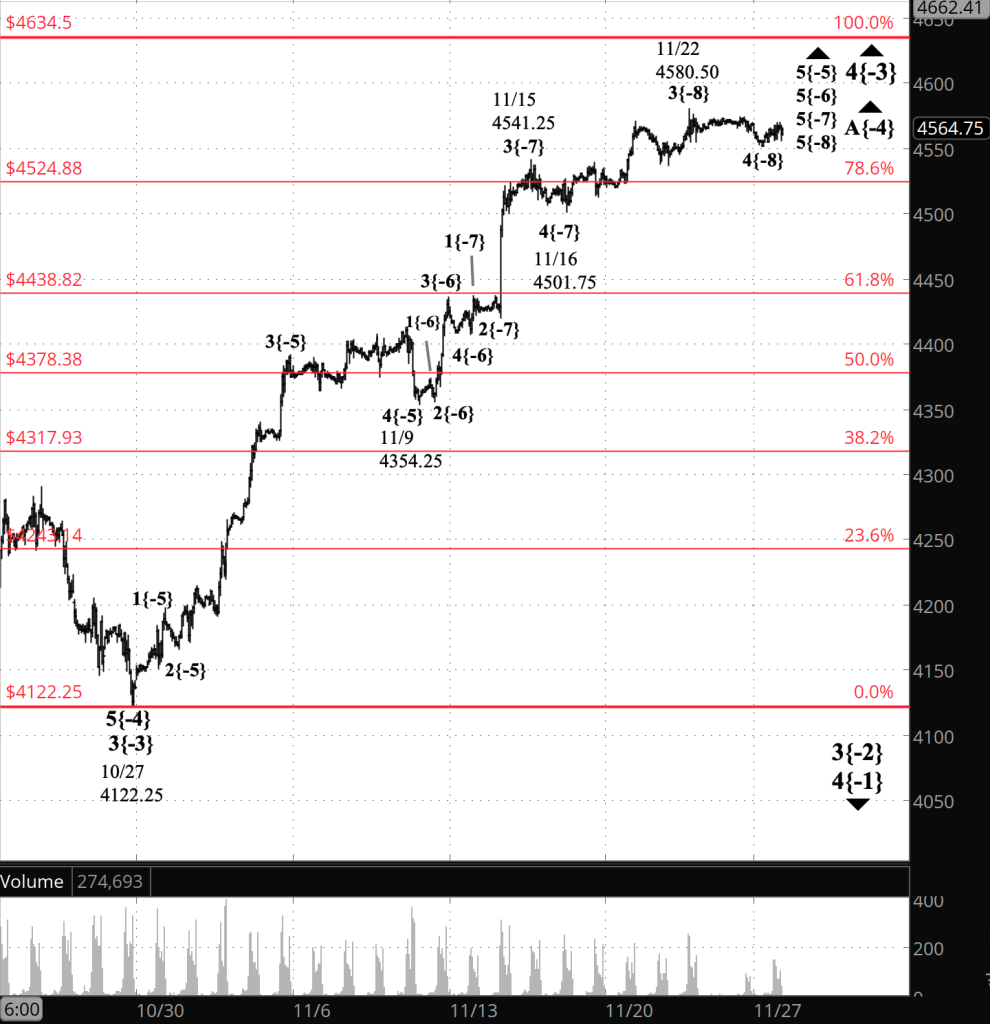
Half an hour before the closing bell. The S&P 500 futures fell rapidly during the session, from a high of 4577.25 back into the 4550s. The session high came to within four points of 4580.50, the peak on November 22 of the first subwave of the upward correction that began on October 27, but then pulled back.

The price remains above the 78.6% Fibonacci retracement level, which was a stalling point in the rise to the rise to the November 22 high.

This morning’s analysis still appllies: Two scenarios of equal likelihood.

  • Scenario #1: Rising wave A ended continues to work through it’s 5th and final wave, or
  • Scenario #2: Rising wave A ended on November 22 and falling wave B has begun.

For chart labels, I’m staying with Scenario #1 for now, in part because of the lack of a significant decline from the October 27 peak.

9:35 a.m. New York time

What’s happening now? The S&P 500 E-mini futures stair-stepped lower overnight, from the 4560s to the 4540s.

What does it mean? The initial subwave, wave A, within the 4th wave upward correction that began on October 27 is either nearing its end or has already ended. Those two equally likely scenarios have dominated the analysis since last week.

Under Scenario #1, Wave A is in its 4th subwave and will end with a push above the November 22 high, 4580.50, the high point of the correction so far. I lean toward Scenario #1 because the subwave count lacks a 5th wave, or so it seems to my eye. Also, the rather sleepy form of the movement more closely resembles 4th waves that I’ve analyzed than it does a 5th wave, which tends to be energetic. I’ve chose this scenario for my chart labeling.

Under Scenario #2, wave A ended the November 22 high and declining wave B began. Typically, since the correction is a Zigzag, wave B will retrace the 38% to 79% of the preceding A wave.

A firm rule of Elliott Wave Theory says that a 4th wave never moves above the start of the preceding 1st wave, 4634.50 in this case. That upper limit applies both to wave A in scenario #1 and the future wave C in both scenarios.

What are the alternatives? None aside of the two scenarios described above.

[S&P 500 E-mini futures at 3:30 p.m., hourly bars, with volume]

What does Elliott wave theory say? Here are the waves that underly the analyses.

  • A downtrend, wave 3{-2}, began on July 27 and is underway.
  • Within wave 3{-2}, an upward correction, wave 4{-3}, began on October 27.
  • Lower still, two scenarios of equal probability:
    • Scenario #1:
      • Within wave 4{-3}, wave A{-4} continues.
      • Further down the list, wave 5{-5}, 6{-5}, 7{-5} and 8{-5} are underway and nearing completion.
    • Scenario #2:
      • Wave A{-4} ended on November 22 and wave B{-4} began its downward journey.

We Are Here.

These are the waves currently in progress under my principal analysis. Each line on the list shows the wave number, with the subscript in curly brackets, the traditional degree name, the starting date, the starting price of the S&P 500 E-mini futures, and the direction of the wave.

  • S&P 500 Index:
  • 5{+3} Supercycle, 7/8/1932, 4.40 (up)
  • 5{+2} Cycle, 12/9/1974, 60.96 (up)
  • 5{+1} Primary, 3/6/2009, 666.79 (up)
  • 5{0} Intermediate, 12/26/2018, 2346.58 (up)
  • S&P 500 Futures and index:
  • 4{-1} Minor, 1/4/2022, 4953.25 (down) (futures), 4818.62 (down) (index)
  • S&P 500 Futures:
  • 3{-2} Minute, 7/27/2023, 3502 (down)
  • 4{-3} Minuette, 10/27/2023, 4122.25 (up)
  • A{-4} Subminuette, 10/27/2023, 4122.25 (up)

Reading the chart. Price movements — waves – – in Elliott wave analysis are labeled with numbers within trending waves and letters with corrective waves. The subscripts — numbers in curly brackets — designate the wave’s degree, which, in Elliott wave analysis, means the relative position of a wave within the larger and smaller structures that make up the chart. R.N. Elliott, who in the 1930s developed the form of analysis that bears his name, viewed the chart as a complex structure of smaller waves nested within larger waves, which in turn are nested within still larger waves. In mathematics it’s called a fractal structure, where at every scale the pattern is similar to the others.

Learning and other resources. Elliott wave analysis provides context, not prophecy. As the 20th century semanticist Alfred Korzybski put it in his book Science and Sanity (1933), “The map is not the territory … The only usefulness of a map depends on similarity of structure between the empirical world and the map.” And I would add, in the ever-changing markets, we can judge that similarity of structure only after the fact.

See the menu page Analytical Methods for a rundown on where to go for information on Elliott wave analysis.

By Tim Bovee, Portland, Oregon, November 28, 2023

Disclaimer

Tim Bovee, Private Trader tracks the analysis and trades of a private trader for his own accounts. Nothing in this blog constitutes a recommendation to buy or sell stocks, options or any other financial instrument. The only purpose of this blog is to provide education and entertainment.

No trader is ever 100 percent successful in his or her trades. Trading in the stock and option markets is risky and uncertain. Each trader must make trading decisions for his or her own account, and take responsibility for the consequences.

License
Creative Commons License

All content on Tim Bovee, Private Trader by Timothy K. Bovee is licensed under a Creative Commons Attribution-ShareAlike 4.0 International License.

Based on a work at www.timbovee.com.
Options Trades 11/27/2023: (1DTE) SPY QQQ

Symbols traded today: SPY, QQQ, both with one day remaining until expiration.

SPY short Iron Fly

LOT:15ENTRY DATE:11/27/2023
EXIT DATE:11/28/2023
DAYS HELD:1

Entry and Exit

METRICCREDITDEBITCHANGECHANGE %ANNUALIZED CHANGE %
Options premium$ 1.35$ 1.29$ 0.064.7%0%
METRICENTRYEXITCHANGECHANGE %ANNUALIZED CHANGE %
Stock price$ 455.16$ 453.92$ 1.24$0.00-99%
Impllied Volatility Rate7.88.8-1.01.0
Days to expiration10

The structure of the position

STRUCTURESTRIKEODDS EXPIRE OTMDELTA
Calls
Long457.0078.0%21
Break-even456.3564.0%35.5
Short455.0050.0%50
Puts
Short455.0050.0%50
Break-even454.3564.6%35.5
Long453.0079.2%21

Risk and Reward

Per contract:
Reward135.00
Risk65.00
R/R Ratio (n:1)0.5

QQQ short Iron Fly

LOT:7ENTRY DATE:11/27/2023
EXIT DATE:11/28/2023
DAYS HELD:1

Entry and Exit

METRICCREDITDEBITCHANGECHANGE %ANNUALIZED CHANGE %
Options premium$ 1.53$ 1.41$ 0.128.5%3106%
METRICCHANGECHANGE %ANNUALIZED CHANGE %
Stock price$ 390.64$ 388.75$ 1.89-0.48%-177%
Impllied Volatility Rate4.85.9-1.11.1
Days to expiration10

The structure of the position

STRUCTURESTRIKEODDS EXPIRE OTMDELTA
Calls
Long392.0070.0%31
Break-even391.5363.0%37.5
Short390.0056.0%44
Puts
Short390.0056.0%44
Break-even389.5367.0%33.5
Long388.0078.0%23

Risk and Reward

Per contract:
Reward153.00
Risk47.00
R/R Ratio (n:1)0.3

By Tim Bovee, Portland, Oregon, November 27, 2023

Disclaimer

Tim Bovee, Private Trader tracks the analysis and trades of a private trader for his own accounts. Nothing in this blog constitutes a recommendation to buy or sell stocks, options or any other financial instrument. The only purpose of this blog is to provide education and entertainment.

No trader is ever 100 percent successful in his or her trades. Trading in the stock and option markets is risky and uncertain. Each trader must make trading decisions for his or her own account, and take responsibility for the consequences.

License
Creative Commons License

All content on Tim Bovee, Private Trader by Timothy K. Bovee is licensed under a Creative Commons Attribution-ShareAlike 4.0 International License.

Based on a work at www.timbovee.com.
Trader’s Notebook

3:30 p.m. New York time

Half an hour before the closing bell. The S&P 500 stayed within the 4550s to 4570s, perhaps a result of traders waiting for the big early-morning report days of the week: A GDP revision on Tuesday and PCE inflation numbers, part of the GDP, on Wednesday, each at 8:30 a.m. New York time.

Meanwhile, this morning’s analysis stands. I’ve updated the lower, long-term chart.

1 p.m. New York time

SPY, QQQ entry 1DTE. I’ve entered very short term position positions on SPY and QQQ, one day before expiration, and have posted analyses of the trades.

9:35 a.m. New York time

What’s happening now? The S&P 500 E-mini futures opened in the 4560s when trading resumed overnight, fell into the 4550s, and then rose again into the 4560s. The price remained below the peak of the ongoing 4th-wave upward correction, 4580.50 on November 23.

What does it mean? The question, as always in the past week, is whether that most recent peak is the end of the first subwave of the correction, wave A, or whether their is a bit more upside left. Under the rules of Elliott Wave Theory, the correction has an upper limit of 4634.50, the end of the preceding 1st wave on July 27, so if there is more upside to the upward correction, it’s not a lot, especially when considering that the upper limit will apply also to the third and final subwave of the correction, wave C.

From this point I’ll use the Elliott wave nomenlature that appears on the chart: A wave number followed by a degree number showing the wave’s position within the fractal hierarchy of the chart as the number of degrees below (in this case) the intermediate degree, which is presently in wave 5{-0}, beginning in December 2018.

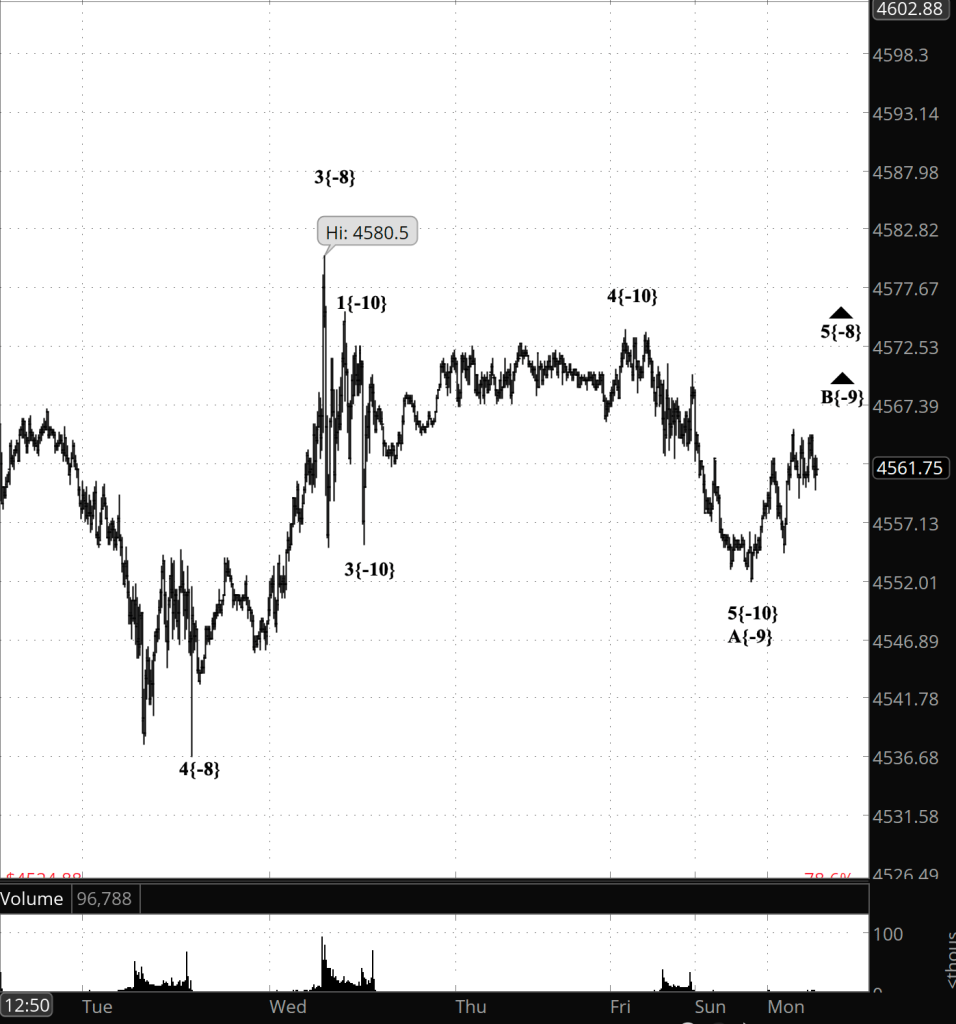
The November 23 peak was the end of wave 3{-8}, six degrees below wave 4{-3}, which is the correction, and A{-4}, the first subwave of the correction. A shallow correction wave 4{-8}, followed, bringing the price down to the end of wave A{-9}. Rising wave B{-9} is now underway and will be followed by falling wave C{-9}, the final subwave of wave 4{-8}.

Wave 5{-8} will follow. And this is where things get interesting. Wave 5{-8} is a subwave of a stack of 5th waves reaching up to wave 5{-5}, the final subwave of the A wave, which in turn is the first wave of the correction. So when wave 5{-8} reaches its end, it will also be the end of all of those 5th waves in the stack, and the end of wave A{-4}.

The declining middle wave of the correction will follow, wave B{-4}. Wave A{-4} will end up with five subwaves, and so is taking the form of a Zigzag. The B wave in a Zigzag typically retraces 38% to 79% of the preceding A wave, which began on October 27 from 4122.25 and when finished, will have taken more than a month to reach completion. We have some downward trending weeks ahead of us.

Here is a close-up chart showing wave 5{-8} a half an hour before the opening bell.

[S&P 500 E-mini futures at 9 a.m., 10-minute bars, with volume]

What are the alternatives? At the higher level, we have two alternatives, each of almost equal likelihood.

  • Scenario #1: Rising wave A ended continues to work through it’s 5th and final wave, or
  • Scenario #2: Rising wave A ended on November 22 and falling wave B has begun.

The small-wave count described above lends a bit more weight to Scenario #1, and that’s what I’ve used in the charts as my principal analysis.

The chart below shows wave A{-4} in its entirely so far.

[S&P 500 E-mini futures at 3:30 p.m., hourly bars, with volume]

What does Elliott wave theory say? Here are the waves that underly the analyses.

  • A downtrend, wave 3{-2}, began on July 27 and is underway.
  • Within wave 3{-2}, an upward correction, wave 4{-3}, began on October 27.
  • Lower still, two scenarios of equal probability:
    • Scenario #1:
      • Within wave 4{-3}, wave A{-4} continues.
      • Further down the list, wave 5{-5}, 6{-5}, 7{-5} and 8{-5} are underway and nearing completion.
    • Scenario #2:
      • Wave A{-4} ended on November 22 and wave B{-4} began its downward trek.

We Are Here.

These are the waves currently in progress under my principal analysis. Each line on the list shows the wave number, with the subscript in curly brackets, the traditional degree name, the starting date, the starting price of the S&P 500 E-mini futures, and the direction of the wave.

  • S&P 500 Index:
  • 5{+3} Supercycle, 7/8/1932, 4.40 (up)
  • 5{+2} Cycle, 12/9/1974, 60.96 (up)
  • 5{+1} Primary, 3/6/2009, 666.79 (up)
  • 5{0} Intermediate, 12/26/2018, 2346.58 (up)
  • S&P 500 Futures and index:
  • 4{-1} Minor, 1/4/2022, 4953.25 (down) (futures), 4818.62 (down) (index)
  • S&P 500 Futures:
  • 3{-2} Minute, 7/27/2023, 3502 (down)
  • 4{-3} Minuette, 10/27/2023, 4122.25 (up)
  • A{-4} Subminuette, 10/27/2023, 4122.25 (up)

Reading the chart. Price movements — waves – – in Elliott wave analysis are labeled with numbers within trending waves and letters with corrective waves. The subscripts — numbers in curly brackets — designate the wave’s degree, which, in Elliott wave analysis, means the relative position of a wave within the larger and smaller structures that make up the chart. R.N. Elliott, who in the 1930s developed the form of analysis that bears his name, viewed the chart as a complex structure of smaller waves nested within larger waves, which in turn are nested within still larger waves. In mathematics it’s called a fractal structure, where at every scale the pattern is similar to the others.

Learning and other resources. Elliott wave analysis provides context, not prophecy. As the 20th century semanticist Alfred Korzybski put it in his book Science and Sanity (1933), “The map is not the territory … The only usefulness of a map depends on similarity of structure between the empirical world and the map.” And I would add, in the ever-changing markets, we can judge that similarity of structure only after the fact.

See the menu page Analytical Methods for a rundown on where to go for information on Elliott wave analysis.

By Tim Bovee, Portland, Oregon, November 27, 2023

Disclaimer

Tim Bovee, Private Trader tracks the analysis and trades of a private trader for his own accounts. Nothing in this blog constitutes a recommendation to buy or sell stocks, options or any other financial instrument. The only purpose of this blog is to provide education and entertainment.

No trader is ever 100 percent successful in his or her trades. Trading in the stock and option markets is risky and uncertain. Each trader must make trading decisions for his or her own account, and take responsibility for the consequences.

License
Creative Commons License

All content on Tim Bovee, Private Trader by Timothy K. Bovee is licensed under a Creative Commons Attribution-ShareAlike 4.0 International License.

Based on a work at www.timbovee.com.
Trader’s Notebook

12:30 p.m. New York time

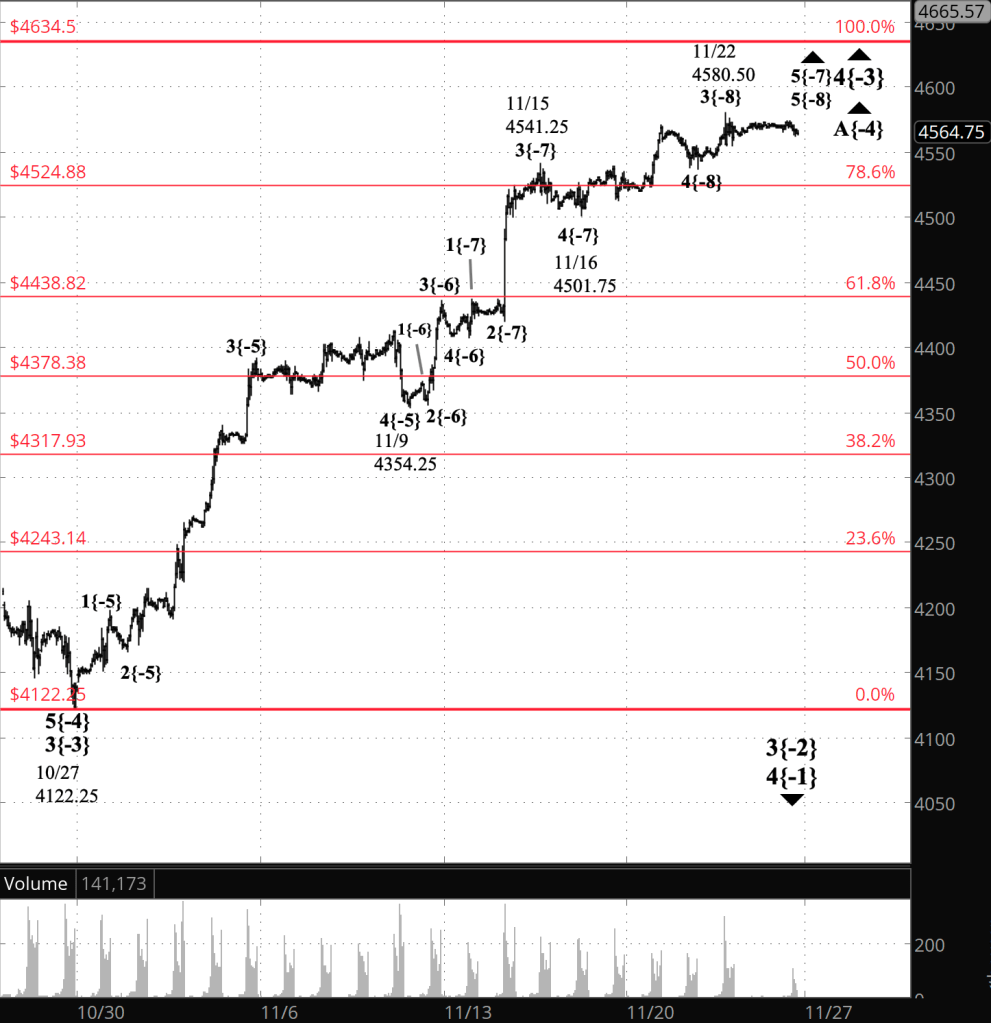
Half an hour before the closing bell. The S&P 500 futures fell a bit further during the session, into the 4560s. This morning’s analysis stands. I’ve updated the chart.

9:35 a.m. New York time

What’s happening now? The S&P 500 E-mini futures remained in a narrow range overnight, in the 4560s and 4570s, as trading resumed after the Thanksgiving Holiday in the United States. Today’s session will be shortened; the closing bell will sound at 1 p.m. New York time.

What does it mean? Prices in post-holiday shortened sessions tend to go nowhere, and so far today’s chart is no exception to that tendency.

The November 22 high, 4580.50, was the peak so far of the upward correction that began on October 27. It leaves in place the question that has been with us all week: Is the latest peak the end of the initial subwave, wave A, within the 4th wave upward correction that began on October 27? Or does the correction have bit higher to go?

In Elliott wave terms, the ambiguity cab be phrased as two scenarios, each of equal likelihood:

  • Scenario #1: Rising wave A ended continues to work through it’s 5th and final wave, or
  • Scenario #2: Rising wave A ended on November 22 and falling wave B has begun.

What are the alternatives? And those two scenarios encompass the principal analysis and the alternative. The problem is, we don’t yet know which is which.

[S&P 500 E-mini futures at 12:30 p.m., 55-minute bars, with volume]

What does Elliott wave theory say? Here are the waves that underly the analyses.

  • A downtrend, wave 3{-2}, began on July 27 and is underway.
  • Within wave 3{-2}, an upward correction, wave 4{-3}, began on October 27.
  • Lower still, two scenarios of equal probability:
    • Scenario #1:
      • Within wave 4{-3}, wave A{-4} continues.
      • Further down the list, wave 5{-5}, 6{-5}, 7{-5} and 8{-5} are underway and nearing completion.
    • Scenario #2:
      • Wave A{-4} ended on November 22 and wave B{-4} began its downward trek.

We Are Here.

These are the waves currently in progress under my principal analysis. Each line on the list shows the wave number, with the subscript in curly brackets, the traditional degree name, the starting date, the starting price of the S&P 500 E-mini futures, and the direction of the wave.

  • S&P 500 Index:
  • 5{+3} Supercycle, 7/8/1932, 4.40 (up)
  • 5{+2} Cycle, 12/9/1974, 60.96 (up)
  • 5{+1} Primary, 3/6/2009, 666.79 (up)
  • 5{0} Intermediate, 12/26/2018, 2346.58 (up)
  • S&P 500 Futures and index:
  • 4{-1} Minor, 1/4/2022, 4953.25 (down) (futures), 4818.62 (down) (index)
  • S&P 500 Futures:
  • 3{-2} Minute, 7/27/2023, 3502 (down)
  • 4{-3} Minuette, 10/27/2023, 4122.25 (up)
  • A{-4} Subminuette, 10/27/2023, 4122.25 (up)

Reading the chart. Price movements — waves – – in Elliott wave analysis are labeled with numbers within trending waves and letters with corrective waves. The subscripts — numbers in curly brackets — designate the wave’s degree, which, in Elliott wave analysis, means the relative position of a wave within the larger and smaller structures that make up the chart. R.N. Elliott, who in the 1930s developed the form of analysis that bears his name, viewed the chart as a complex structure of smaller waves nested within larger waves, which in turn are nested within still larger waves. In mathematics it’s called a fractal structure, where at every scale the pattern is similar to the others.

Learning and other resources. Elliott wave analysis provides context, not prophecy. As the 20th century semanticist Alfred Korzybski put it in his book Science and Sanity (1933), “The map is not the territory … The only usefulness of a map depends on similarity of structure between the empirical world and the map.” And I would add, in the ever-changing markets, we can judge that similarity of structure only after the fact.

See the menu page Analytical Methods for a rundown on where to go for information on Elliott wave analysis.

By Tim Bovee, Portland, Oregon, November 24, 2023

Disclaimer

Tim Bovee, Private Trader tracks the analysis and trades of a private trader for his own accounts. Nothing in this blog constitutes a recommendation to buy or sell stocks, options or any other financial instrument. The only purpose of this blog is to provide education and entertainment.

No trader is ever 100 percent successful in his or her trades. Trading in the stock and option markets is risky and uncertain. Each trader must make trading decisions for his or her own account, and take responsibility for the consequences.

License
Creative Commons License

All content on Tim Bovee, Private Trader by Timothy K. Bovee is licensed under a Creative Commons Attribution-ShareAlike 4.0 International License.

Based on a work at www.timbovee.com.

Trader’s Notebook

3:30 p.m. New York time

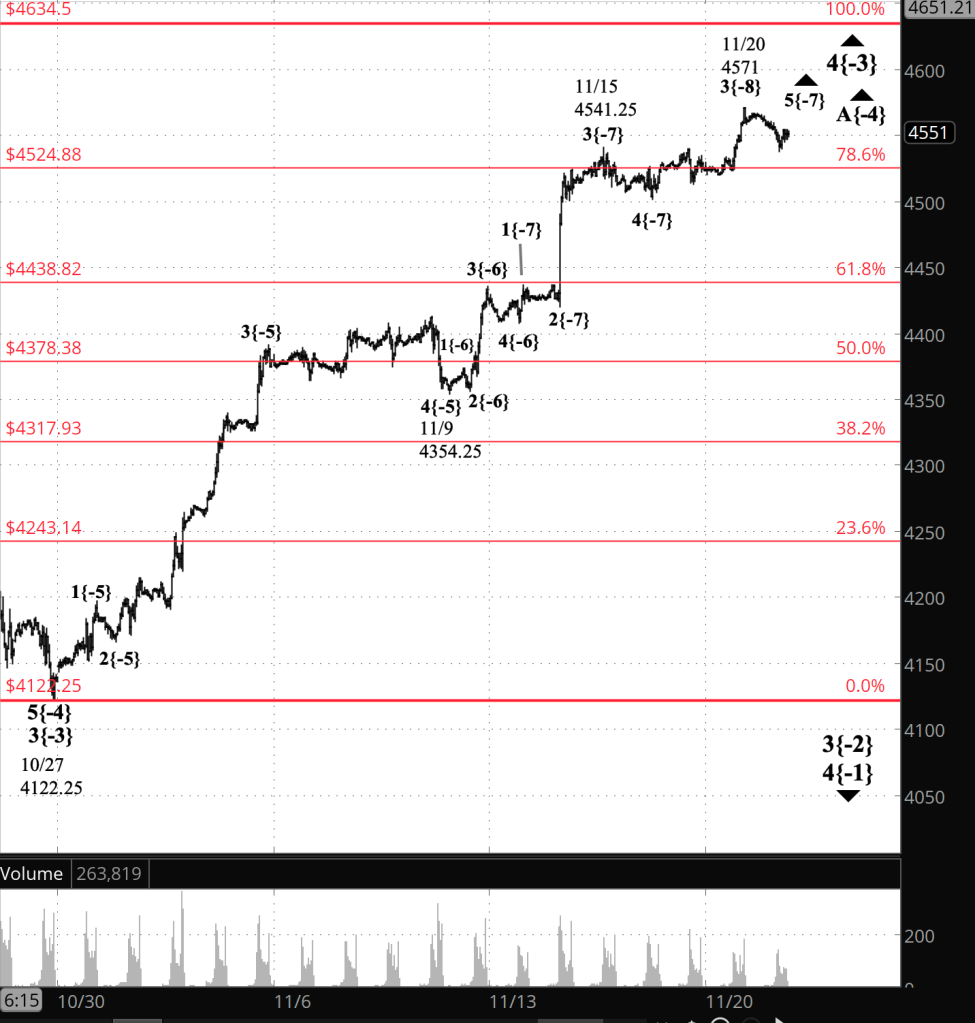
Half an hour before the closing bell. The S&P 500 futures reached a session high of 4580.50 and then retreated slightly, to the 4550s. The high meets all of the requirements of an end to the A wave within the upward correction that began on October 27. However, it’s not necessarily the end.

So we’re back to two scenarios of equal likelihood. Within the upward correction, either…

  • Scenario #1: Rising wave A ended continues to work through it’s 5th and final wave, or
  • Scenario #2: Rising wave A ended on November 22 and falling wave B has begun.

I’ve updated the chart, retaining Scenario #1 as the principal analysis.

12:20 p.m New York time

Trading the rest of the week. The QQQ position closed today will be my last trade of the week. I’m reluctant to hold the 1DTE positions longer than overnight, and certainly not through Thursday’s Thanksgiving Day market holiday. So my next in-trade will be on Monday, November 27.

12:10 p.m. New York time

QQQ Iron Fly exit. I’ve exited my Iron Fly position on QQQ for a 1.3% loss and have updated the trade analysis with full results.

9:35 a.m. New York time

What’s happening now? The S&P 500 E-mini futures rose overnight and reached into the 4570s as the opening bell sounded. The price moved beyond the November 20 high, 4571.

What does it mean? The overnight rise is the 5th and final wave of a low-degree movement that began on November 16. That small wave, 5{-8} on the chart, will when complete will also be the end of its parent 5th waves three levels higher in the fractal structure of the chart: Waves 5{-7}, 5{-6} and 5{-5} on the chart. And when those four levels of 5th waves are complete, then the first subwave of the upward correction, the A wave, will have reached its end, and the middle wave B will begin.

The upward correction is a 4th wave, wave 4{-3} on the chart, the next-to-the-last wave within a downtrending 3rd wave that began on July 27, wave 3{-2} on the chart.

Within the 4th wave correction, wave A has five subwaves, meaning that the correction is taking the form of a Zigzag. A constraint on 4th waves is that they never move beyond the start of the preceding 1st wave, 4634.50 in this case.

The B wave of a Zigzag will generally retrace 38% to 79% of the preceding A wave. We’ll be able to calculate that range once we know the endpoint of wave A.

What are the alternatives? None at present. The next ambiguity will come at the next peak: Is wave A complete, or is there a bit more upside remaining.

Afternoon addition: As indeed it did. See “Half an hour before the closing bell”, above.

[S&P 500 E-mini futures at 3:30 p.m., 50-minute bars, with volume]

What does Elliott wave theory say? Here are the waves that underly the analyses, updated to coincide with this afternoon’s analysis.

  • A downtrend, wave 3{-2}, began on July 27 and is underway.
  • Within wave 3{-2}, an upward correction, wave 4{-3}, began on October 27.
  • Lower still, two scenarios of equal probability:
    • Scenario #1:
      • Within wave 4{-3}, wave A{-4} continues.
      • Further down the list, wave 5{-5}, 6{-5}, 7{-5} and 8{-5} are underway and nearing completion.
    • Scenario #2:
      • Wave A{-4} ended on November 22 and wave B{-4} began its downward trek.

We Are Here.

These are the waves currently in progress under my principal analysis. Each line on the list shows the wave number, with the subscript in curly brackets, the traditional degree name, the starting date, the starting price of the S&P 500 E-mini futures, and the direction of the wave.

  • S&P 500 Index:
  • 5{+3} Supercycle, 7/8/1932, 4.40 (up)
  • 5{+2} Cycle, 12/9/1974, 60.96 (up)
  • 5{+1} Primary, 3/6/2009, 666.79 (up)
  • 5{0} Intermediate, 12/26/2018, 2346.58 (up)
  • S&P 500 Futures and index:
  • 4{-1} Minor, 1/4/2022, 4953.25 (down) (futures), 4818.62 (down) (index)
  • S&P 500 Futures:
  • 3{-2} Minute, 7/27/2023, 3502 (down)
  • 4{-3} Minuette, 10/27/2023, 4122.25 (up)

Reading the chart. Price movements — waves – – in Elliott wave analysis are labeled with numbers within trending waves and letters with corrective waves. The subscripts — numbers in curly brackets — designate the wave’s degree, which, in Elliott wave analysis, means the relative position of a wave within the larger and smaller structures that make up the chart. R.N. Elliott, who in the 1930s developed the form of analysis that bears his name, viewed the chart as a complex structure of smaller waves nested within larger waves, which in turn are nested within still larger waves. In mathematics it’s called a fractal structure, where at every scale the pattern is similar to the others.

Learning and other resources. Elliott wave analysis provides context, not prophecy. As the 20th century semanticist Alfred Korzybski put it in his book Science and Sanity (1933), “The map is not the territory … The only usefulness of a map depends on similarity of structure between the empirical world and the map.” And I would add, in the ever-changing markets, we can judge that similarity of structure only after the fact.

See the menu page Analytical Methods for a rundown on where to go for information on Elliott wave analysis.

By Tim Bovee, Portland, Oregon, November 22, 2023

Disclaimer

Tim Bovee, Private Trader tracks the analysis and trades of a private trader for his own accounts. Nothing in this blog constitutes a recommendation to buy or sell stocks, options or any other financial instrument. The only purpose of this blog is to provide education and entertainment.

No trader is ever 100 percent successful in his or her trades. Trading in the stock and option markets is risky and uncertain. Each trader must make trading decisions for his or her own account, and take responsibility for the consequences.

License
Creative Commons License

All content on Tim Bovee, Private Trader by Timothy K. Bovee is licensed under a Creative Commons Attribution-ShareAlike 4.0 International License.

Based on a work at www.timbovee.com.
Options Trades 11/21/2023: QQQ

Symbols traded today: QQQ (1DTE)

Exited November 22 for a small loss during the first minutes of the session. The underlying stock gapped up by a couple of points at the opening bell.

QQQ short Iron Fly

LOT:6ENTRY DATE:11/21/2023
EXIT DATE:11/22/2023
DAYS HELD:1

Entry and Exit

METRICCREDITDEBITCHANGECHANGE %ANNUALIZED CHANGE %
Options premium$ 2.29$ 2.32$ (0.03)-1.3%-472%
METRICENTRYEXITCHANGECHANGE %ANNUALIZED CHANGE %
Stock price$ 387.81$ 390.76$ (2.95)0.76%278%
Impllied Volatility Rate2.00.41.6-1.6
Days to expiration1

The structure of the position

STRUCTURESTRIKEODDS EXPIRE OTMDELTA
Calls
Long391.0073.0%27
Break-even390.2957.5%37.5
Short388.0042.0%48
Puts
Short388.0042.0%48
Break-even387.2957.0%38
Long385.0072.0%28

Risk and Reward

Per contract:
Reward229.00
Risk300.00
R/R Ratio (n:1)1.3

By Tim Bovee, Portland, Oregon, November 21, 2023

Disclaimer

Tim Bovee, Private Trader tracks the analysis and trades of a private trader for his own accounts. Nothing in this blog constitutes a recommendation to buy or sell stocks, options or any other financial instrument. The only purpose of this blog is to provide education and entertainment.

No trader is ever 100 percent successful in his or her trades. Trading in the stock and option markets is risky and uncertain. Each trader must make trading decisions for his or her own account, and take responsibility for the consequences.

License
Creative Commons License

All content on Tim Bovee, Private Trader by Timothy K. Bovee is licensed under a Creative Commons Attribution-ShareAlike 4.0 International License.

Based on a work at www.timbovee.com.
Trader’s Notebook

3:30 p.m. New York time

Half an hour before the closing bell. The S&P 500 futures fell during the session to the 4530s and then began to rise. I see the decline as part of a downward correction within a much larger upward correction.

In terms of Elliott Wave numbers, we’re seeing wave A of a very small degree falling 4th-wave correction buried several degrees deep within the rising A wave of a larger 4th-degree upward correction, and the subsequent rise as a very small degree B wave.

I’ve updated the chart but haven’t tried to label the small-degree waves. No room!

2:45 p.m. New York time

Entered short Iron Fly position on QQQ. I’ve entered a short Iron Fly position on QQQ, one day prior to expiration, and have posted an analysis of the trade.

2:15 p.m. New York time

Exited short Iron Fly position on SPY. I’ve exited my short Iron Fly position on SPY, one day after entry, for a 15.3% profit and have updated the trade analysis with full details of the outcome.

9:35 a.m. New York time

What’s happening now? The S&P 500 E-mini futures declined overnight, from yesterday’s session high, 4571, into the 4550s.

What does it mean? The decline brings us back to where we’ve been since the November 15 peak. Withi the 4th-wave upward correction that began on October 27, each peak is potentially the end of the first subwave, rising wave A, and and the beginning of the middle wave, declining wave B. Although not necessarily.

In the following discussion I’ll need to use Elliott Wave degree indicators, showing a wave’s place within the fractal structure of the chart. The degrees are denoted by a subscript in curly brackets showing the wave’s relation to the Intermediate degree, which has the subscript {0}. A negative degree indicator means the wave is of a smaller degree than Intermediate.

The present wave upward correction is wave 4{-3}. The ensuing discussion will involve subwaves of wave 4[-3}.

Many Elliott Wave structures can be counted in several different ways. The present rise, wave 5{-5}, began on November 9. The subsequent November 15 peak is clearly a 3rd wave, but of what degree? It’s tempting to label it wave 3{-6}, one degree down from wave 5{-5}, but that would ignore the initial wave up, wave 1{-6}, giving a distorted look to the chart.

The alternative is to treat the subwaves after the end of wave 4{-6} as being one degree lower. Doing so means that 5{-7} within wave 5{-6} is underway. When wave 5{-7} is complete, it will also be the end of wave 5{-6} and the first subwave in the correction, wave A{-5}.

And what of yesterday’s rise? I count it as having completed it’s 3rd subwave at the November 20 peak: Wave 3{-8}. The overnight dip is wave 4{-8}, and it will be followed by rising wave 5{-8}, whose end will cascade up the fractal structure to also be the end of waves 5{-7}, 5{-6}, and A{-4}.

What are the alternatives? That analysis resolves the larger ambiguity of the chart: Is wave A complete or not? By my analysis, it isn’t done yet. One more push to the upside, and that will be the end of wave A and the start of wave B.

[S&P 500 E-mini futures at 3:30 p.m., 45-minute bars, with volume]

What does Elliott wave theory say? Here are the waves that underly the analyses.

  • A downtrend, wave 3{-2}, began on July 27 and is underway.
  • Within wave 3{-2}, an upward correction, wave 4{-3}, began on October 27.
  • Within wave 4{-3}, wave A{-4} continues.

We Are Here.

These are the waves currently in progress under my principal analysis. Each line on the list shows the wave number, with the subscript in curly brackets, the traditional degree name, the starting date, the starting price of the S&P 500 E-mini futures, and the direction of the wave.

  • S&P 500 Index:
  • 5{+3} Supercycle, 7/8/1932, 4.40 (up)
  • 5{+2} Cycle, 12/9/1974, 60.96 (up)
  • 5{+1} Primary, 3/6/2009, 666.79 (up)
  • 5{0} Intermediate, 12/26/2018, 2346.58 (up)
  • S&P 500 Futures and index:
  • 4{-1} Minor, 1/4/2022, 4953.25 (down) (futures), 4818.62 (down) (index)
  • S&P 500 Futures:
  • 3{-2} Minute, 7/27/2023, 3502 (down)
  • 4{-3} Minuette, 10/27/2023, 4122.25 (up)
  • A{-4} Subminuette, 10/27/2023, 4122.25 (up)

Reading the chart. Price movements — waves – – in Elliott wave analysis are labeled with numbers within trending waves and letters with corrective waves. The subscripts — numbers in curly brackets — designate the wave’s degree, which, in Elliott wave analysis, means the relative position of a wave within the larger and smaller structures that make up the chart. R.N. Elliott, who in the 1930s developed the form of analysis that bears his name, viewed the chart as a complex structure of smaller waves nested within larger waves, which in turn are nested within still larger waves. In mathematics it’s called a fractal structure, where at every scale the pattern is similar to the others.

Learning and other resources. Elliott wave analysis provides context, not prophecy. As the 20th century semanticist Alfred Korzybski put it in his book Science and Sanity (1933), “The map is not the territory … The only usefulness of a map depends on similarity of structure between the empirical world and the map.” And I would add, in the ever-changing markets, we can judge that similarity of structure only after the fact.

See the menu page Analytical Methods for a rundown on where to go for information on Elliott wave analysis.

By Tim Bovee, Portland, Oregon, November 21, 2023

Disclaimer

Tim Bovee, Private Trader tracks the analysis and trades of a private trader for his own accounts. Nothing in this blog constitutes a recommendation to buy or sell stocks, options or any other financial instrument. The only purpose of this blog is to provide education and entertainment.

No trader is ever 100 percent successful in his or her trades. Trading in the stock and option markets is risky and uncertain. Each trader must make trading decisions for his or her own account, and take responsibility for the consequences.

License
Creative Commons License

All content on Tim Bovee, Private Trader by Timothy K. Bovee is licensed under a Creative Commons Attribution-ShareAlike 4.0 International License.

Based on a work at www.timbovee.com.

Options Trades 11/20/2023: SPY

Symbols traded today: SPY (1DTE)

I placed one trade today, on SPY, a day before expiration.

SPY short Iron Fly

LOT:14ENTRY DATE:11/20/2023
EXIT DATE:11/21/2023
DAYS HELD:1

Entry and Exit

METRICCREDITDEBITCHANGECHANGE %ANNUALIZED CHANGE %
Options premium$ 1.88$ 1.63$ 0.2515.3%5598%
METRICENTRYEXITCHANGECHANGE %ANNUALIZED CHANGE %
Stock price$ 452.63$ 453.14$ (0.51)$0.0041%
Impllied Volatility Rate10.610.8-0.20.2
Days to expiration1

The structure of the position

STRUCTURESTRIKEODDS EXPIRE OTMDELTA
Calls
Long456.0086.0%15
Break-even454.8870.0%30.5
Short453.0054.0%46
Puts
Short453.0046.0%54
Break-even451.8862.5%37.5
Long450.0079.0%21

Risk and Reward

Per contract:
Reward188.00
Risk200.00
R/R Ratio (n:1)1.1

By Tim Bovee, Portland, Oregon, November 20, 2023

Disclaimer

Tim Bovee, Private Trader tracks the analysis and trades of a private trader for his own accounts. Nothing in this blog constitutes a recommendation to buy or sell stocks, options or any other financial instrument. The only purpose of this blog is to provide education and entertainment.

No trader is ever 100 percent successful in his or her trades. Trading in the stock and option markets is risky and uncertain. Each trader must make trading decisions for his or her own account, and take responsibility for the consequences.

License
Creative Commons License

All content on Tim Bovee, Private Trader by Timothy K. Bovee is licensed under a Creative Commons Attribution-ShareAlike 4.0 International License.

Based on a work at www.timbovee.com.

Trader’s Notebook

3:30 p.m. New York time

Half an hour before the closing bell. The S&P 500 futures began to rise overnight and picked up the pace five minutes before the session began, in total traveling from the 4520s to the 4570s, in five waves.

So, at every peak, we’re back to where we have been time and time again within this correction, where the peak could be the end of wave A within the 4th-wave upward correction, or not.

My description of the choices this morning still hold true this afternoon:

  • Scenario 1: Wave A continues. The initial wave of the current 4th-wave upward correction is now underway and is nearing its end. The correction began on October 27.
  • Scenario 2: Wave B has begun. The middle wave of the correction continues and is in its early stages.

After the present rise peaks (it’s still underway), then either scenario will have an equal probability of correctly describing the state of the chart.

3:05 p.m. New York time

Entered 1DTE SPY Iron Fly. I’ve entered an short Iron Fly position on SPY, one day to expiration, and have posted an analysis of the trade.

11:20 a.m. New York time

Wave A continues. The S&P 500 futures and index, and the exchange-traded fund SPY all moved above the November 15 peak, resolving the question of which of two scenarios, each of equal likelihood, will win the match. The victor: Scenario 1. The first subwave, wave A, of the 4th-wave upward correction continues and is nearing its end. When complete, it will be followed by a downward B wave. I’ve updated the chart below.

9:35 a.m. New York time

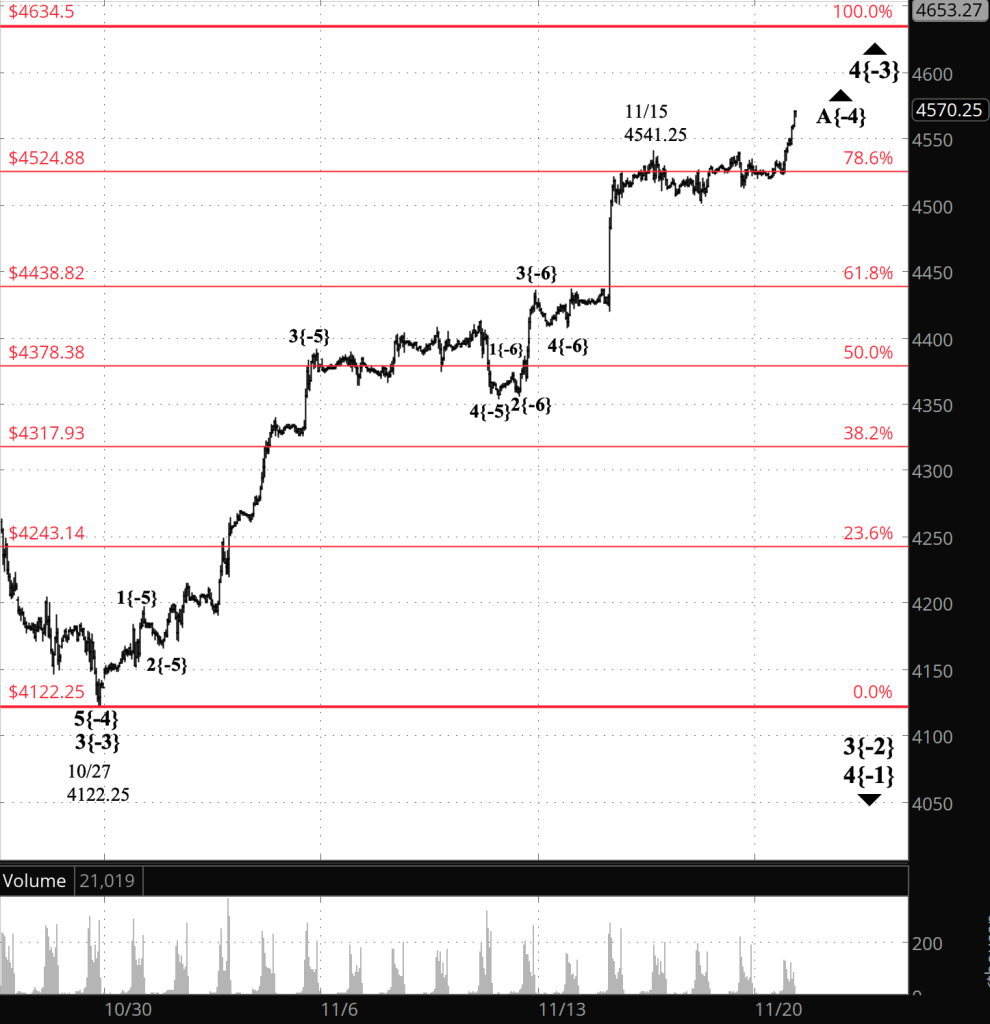
What’s happening now? The S&P 500 E-mini futures stayed close to the 78% Fibonacci retracement level, as it has since November 14.

What does it mean? The two scenarios on the chart at the end of last week remain as the new week begins. Each still has equal probability.

  • Scenario 1: Wave A continues. The initial wave of the current 4th-wave upward correction is now underway and is nearing its end. The correction began on October 27.
  • Scenario 2: Wave B has begun. The middle wave of the correction continues and is in its early stages.

Last week I switched the chart to Scenario 2 — Wave B has begun. If the price moves above 4541.25, the November 15 peak, then Scenario 1 is correct — wave A is still underway — and I’ll change the chart’s wave labeling. If the price takes a sharp turn to the downside, then Scenario B gains credibility and I’ll retain the present wave labeling.

What are the alternatives? None at this point, aside from the choice described above.

However, Thursday is a holiday for U.S. markets, and Friday will be a shortened trading session. Major holiday weeks like this generally take two forms, or so my observation tells me: Either the week is a total yawner, where nothing much happens. Or, less common, something totally unexpected and strange occurs. Such as, perhaps, a yet unknown third alternative.

We shall see.

[S&P 500 E-mini futures at 3:30 p.m., 45-minute bars, with volume]

What does Elliott wave theory say? Here are the waves that underly the analyses.

  • A downtrend, wave 3{-2}, began on July 27 and is underway.
  • Within wave 3{-2}, an upward correction, wave 4{-3}, began on October 27.
  • In this morning’s analysis, wave 4{-3} internally had two possibilities, each of equal likelihood:
    • Scenario 1: Either rising wave A{-4} continues and is nearing it’s end.
    • Scenario 2: Or wave A{-4} ended on November 10 at 4425.75 and wave B{-4} began from that point.
  • The price moved above the correction’s prior high, resolving the ambiguity.
  • Within wave 4{-3}, wave A{-4} continues.

We Are Here.

These are the waves currently in progress under my principal analysis. Each line on the list shows the wave number, with the subscript in curly brackets, the traditional degree name, the starting date, the starting price of the S&P 500 E-mini futures, and the direction of the wave.

  • S&P 500 Index:
  • 5{+3} Supercycle, 7/8/1932, 4.40 (up)
  • 5{+2} Cycle, 12/9/1974, 60.96 (up)
  • 5{+1} Primary, 3/6/2009, 666.79 (up)
  • 5{0} Intermediate, 12/26/2018, 2346.58 (up)
  • S&P 500 Futures and index:
  • 4{-1} Minor, 1/4/2022, 4953.25 (down) (futures), 4818.62 (down) (index)
  • S&P 500 Futures:
  • 3{-2} Minute, 7/27/2023, 3502 (down)
  • 4{-3} Minuette, 10/27/2023, 4122.25 (up)
  • A{-4} Subminuette, 10/27/2023, 4122.25 (up()

Reading the chart. Price movements — waves – – in Elliott wave analysis are labeled with numbers within trending waves and letters with corrective waves. The subscripts — numbers in curly brackets — designate the wave’s degree, which, in Elliott wave analysis, means the relative position of a wave within the larger and smaller structures that make up the chart. R.N. Elliott, who in the 1930s developed the form of analysis that bears his name, viewed the chart as a complex structure of smaller waves nested within larger waves, which in turn are nested within still larger waves. In mathematics it’s called a fractal structure, where at every scale the pattern is similar to the others.

Learning and other resources. Elliott wave analysis provides context, not prophecy. As the 20th century semanticist Alfred Korzybski put it in his book Science and Sanity (1933), “The map is not the territory … The only usefulness of a map depends on similarity of structure between the empirical world and the map.” And I would add, in the ever-changing markets, we can judge that similarity of structure only after the fact.

See the menu page Analytical Methods for a rundown on where to go for information on Elliott wave analysis.

By Tim Bovee, Portland, Oregon, November 20, 2023

Disclaimer

Tim Bovee, Private Trader tracks the analysis and trades of a private trader for his own accounts. Nothing in this blog constitutes a recommendation to buy or sell stocks, options or any other financial instrument. The only purpose of this blog is to provide education and entertainment.

No trader is ever 100 percent successful in his or her trades. Trading in the stock and option markets is risky and uncertain. Each trader must make trading decisions for his or her own account, and take responsibility for the consequences.

License
Creative Commons License

All content on Tim Bovee, Private Trader by Timothy K. Bovee is licensed under a Creative Commons Attribution-ShareAlike 4.0 International License.

Based on a work at www.timbovee.com.

Trader’s Notebook

3:30 p.m. New York time

Half an hour before the closing bell. The S&P 500 futures continued continued a sideways course, remaining below the November 15 high of the 4th-wave upward correction that began on October 27. But just barely below that peak, and so the chart continues to leave unresolved the question that dominated the week: Within the correction, did wave A end at that peak and downward wave B begin? Or is wave A still underway? Perhaps the week ahead will bring an answer. Until then, absent a rise above the November 15 high, 4541.25, I’ll continue to mark the chart as though wave B has begun.

I’ve updated the chart.

2 p.m. New York time

Exited short Iron Condor 1DTE positions on SPY, GLD. I closed my short Iron Condor positions on SPY and GLD, with mixed results. SPY had a 3.3% loss, and GLD a 26.2% profit. I’ve updated my analyses of the trades and discussed my take-away from the mixed results.

9:35 a.m. New York time

What’s happening now? The S&P 500 E-mini futures rose overnight, coming within two points of the correction high so far, 4541.25. The rising price covered less than 20 points and remains slightly above the 78.6% Fibonacci retracement level.

What does it mean? The 4th wave upward correction that began on October 27 continues.

A wise mentor in the art of trading often used the metaphor of war to describe what we’ve seen on the chart over the last few days. He would say that when the chart reaches a reversal level — high in an upward movement, low if the slope is down — and then stalls, it’s a visual representation of a battle between bulls and bears. A market battle, like most battles, will be resolved when one side or the other gains the upper hand, usually through numbers and power (for power in a markets context, think money). On the S&P 500 futures chart, this is the fourth day of fighting, with the 78.6% Fibonacci retracement level being the front line in the battle.

So when I look at this chart, I see a World War I scene, with the bulls charging out of their trenches overnight and making a valiant effort to overcome the bears.

In Elliott Wave Theory terminology, the chart retains yesterday’s principal analysis, which sees the first subwave, wave A, within the ongoing 4th wave upward correction having ended with the November 15 high, and declining wave B, the middle subwave, having begun.. Today, as yesterday, the alternative scenario, which sees wave A as still underway, is of equal likelihood.

And today it remains the case that the chart will decide which scenario is correct. If the price moves above 4541.25, then my switch to the second scenario was premature. If the price remains below that level, then in my mind that’s further evidence that the second scenario is playing out and wave B is underway.

So far wave B — the bears — are winning the battle, but the struggle continues.

After the opening bell, it appears that the bears are winning at this point of the battle, as the price drops from the 4530s to the 4520s.

What are the alternatives? As described above, either wave A has ended and wave B has begun, or wave A hasn’t ended and continues, a choice where both sides have an equal likelihood of being a correct description of the chart.

[S&P 500 E-mini futures at 3:30 p.m., 40-minute bars, with volume]

What does Elliott wave theory say? Here are the waves that underly the analyses.

  • A downtrend, wave 3{-2}, began on July 27 and is underway.
  • Within wave 3{-2}, an upward correction, wave 4{-3}, began on October 27.
  • Wave 4{-3} internally has two possibilities, each of equal likelihood:
    • Scenario 1: Either rising wave A{-4} continues and is nearing it’s end.
    • Scenario 2: Or wave A{-4} ended on November 10 at 4425.75 and wave B{-4} began from that point.
  • Under the first scenario, wave A{-4} is its final subwave, wave 5{-5}, which in turn is in its final subwave, wave 5{-6}.
  • Under the second scenario, declining wave B{-4} has begun and is in its initial subwave, wave A{-5}.
  • The second scenario is presently my principle analysis.

We Are Here.

These are the waves currently in progress under my principal analysis. Each line on the list shows the wave number, with the subscript in curly brackets, the traditional degree name, the starting date, the starting price of the S&P 500 E-mini futures, and the direction of the wave.

  • S&P 500 Index:
  • 5{+3} Supercycle, 7/8/1932, 4.40 (up)
  • 5{+2} Cycle, 12/9/1974, 60.96 (up)
  • 5{+1} Primary, 3/6/2009, 666.79 (up)
  • 5{0} Intermediate, 12/26/2018, 2346.58 (up)
  • S&P 500 Futures and index:
  • 4{-1} Minor, 1/4/2022, 4953.25 (down) (futures), 4818.62 (down) (index)
  • S&P 500 Futures:
  • 3{-2} Minute, 7/27/2023, 3502 (down)
  • 4{-3} Minuette, 10/27/2023, 4122.25 (up)
  • A{-4} Subminuette, 10/27/2023, 4122.25 (up)

Reading the chart. Price movements — waves – – in Elliott wave analysis are labeled with numbers within trending waves and letters with corrective waves. The subscripts — numbers in curly brackets — designate the wave’s degree, which, in Elliott wave analysis, means the relative position of a wave within the larger and smaller structures that make up the chart. R.N. Elliott, who in the 1930s developed the form of analysis that bears his name, viewed the chart as a complex structure of smaller waves nested within larger waves, which in turn are nested within still larger waves. In mathematics it’s called a fractal structure, where at every scale the pattern is similar to the others.

Learning and other resources. Elliott wave analysis provides context, not prophecy. As the 20th century semanticist Alfred Korzybski put it in his book Science and Sanity (1933), “The map is not the territory … The only usefulness of a map depends on similarity of structure between the empirical world and the map.” And I would add, in the ever-changing markets, we can judge that similarity of structure only after the fact.

See the menu page Analytical Methods for a rundown on where to go for information on Elliott wave analysis.

By Tim Bovee, Portland, Oregon, November 17, 2023

Disclaimer

Tim Bovee, Private Trader tracks the analysis and trades of a private trader for his own accounts. Nothing in this blog constitutes a recommendation to buy or sell stocks, options or any other financial instrument. The only purpose of this blog is to provide education and entertainment.

No trader is ever 100 percent successful in his or her trades. Trading in the stock and option markets is risky and uncertain. Each trader must make trading decisions for his or her own account, and take responsibility for the consequences.

License
Creative Commons License

All content on Tim Bovee, Private Trader by Timothy K. Bovee is licensed under a Creative Commons Attribution-ShareAlike 4.0 International License.

Based on a work at www.timbovee.com.