Trader’s Notebook

3:30 p.m. New York time

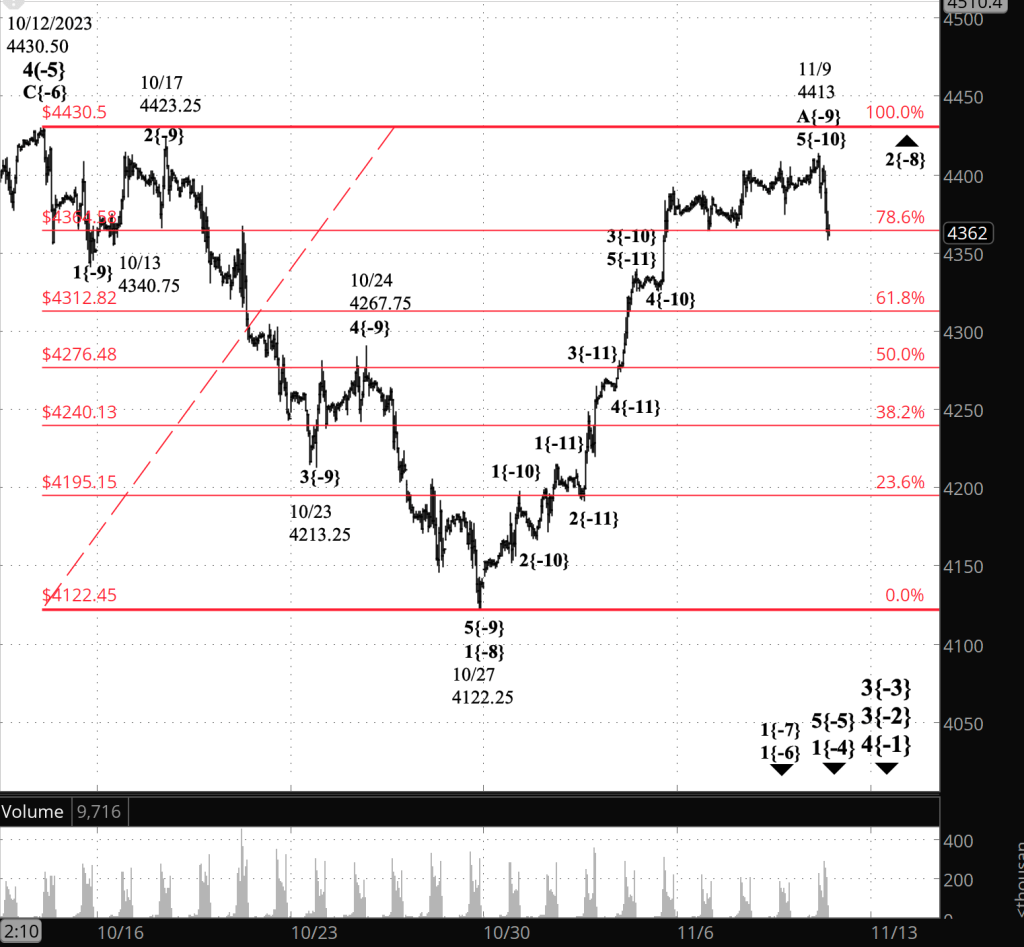
Half an hour before the closing bell. The S&P 500 futures fell during the session, reaching below the 78.6% Fibonacci retracement level as the closing bell approached.

The breach of that support point persuaded me to relabel the chart: The first subwave, wave A, within the present 2nd-wave upward correction ended today at 4413, and declining wave B has begun.

Having done that, the two scenarios of almost equal likelihood are still in play. The price could reverse to the upside and return to the level of today’s high. That could mean that wave A has not yet ended.

I’ve updated the chart and am awaiting further indications that the B wave is truly underway.

3:15 p.m. New York time

Entry SPY, XLE. I’ve posted an analysis of today’s two trades, short Iron Fly positions on SPY and XLE, each expiring the next day.

2:50 p.m. New York time

Exited short Bear Call Vertical Spread IWM. I’ve exited my position on IWM for a profit and have updated yesterday’s options trade analysis with results.

11:55 a.m. New York time

Exited short Iron Fly position on QQQ. I’ve updated yesterday’s options trades post with results of my short Iron Fly position on QQQ, entered one day before expiration and exited on expiration day for a profit.

9:35 a.m. New York time

What’s happening now? The S&P 500 E-mini futures rose overnight, reaching 4413, and then pulled back slightly at the opening bell.

What does it mean? The rise brought the first subwave of a 2nd wave upward correction to yet another peak. The correction began on October 22 from 4122.25.

The first subwave is an A wave, and will be followed by a declining B wave and then a rising C wave, which will complete the corrective pattern.

The 2nd wave was, of course, preceded by a downtrending 1st wave. The new high brings the A wave to fewer than 20 points of the start the 1st have. That’s important because one of the few firm rules of Elliott Wave Theory says that a 2nd wave never moves above the start of the 1st wave that came before it. See the “Reading the Chart” section below for more on the subject.

This 2nd wave, is cutting it very close. The 1st wave began from 4430.50.

If the 2nd wave does in fact move above that level, then the analysis doesn’t match the reality on the chart. The 2nd wave isn’t really a second wave. Something else is going on.

For what follows, I’ll need to use the degree indicators, which place each wave in relation to other waves within the complex fractal structure of the chart. The degree is labeled by a subscript, in curly brackets, that shows its relationship to a larger wave, called the Intermediate degree by R.N. Elliott, the developer of Elliott Wave Theory. The Intermediate wave is wave {0}. A degree of {-3} would be three degrees smaller than wave {0}.

Tentatively, the most likely scenario, if 4430.50 should be breached, goes like this:

  • The 1st wave began from 4566 on September 14, presently labeled as the start of wave 3{-3}.
  • The low on October 27, presently labeled the end of wave 1{-8} and the start of wave 2{-8}, is the end of wave 3{-4}.
  • The subsequent rise, rather than being a 2nd wave, is a 4th wave, wave 4{-4}

Under the rules of Elliott Wave Analysis, a 4th wave can move beyond the start of the preceding 1st wave — no rules broken, no harm, no foul.

But that’s all hypothetical. The A wave for now remains below the start of the preceding 1st wave, then the present principal analysis is intact. The 2nd wave is underway and is in its A subwave.

What are the alternatives? Under the principal analysis, the whole degree structure on the chart may be larger than the underlying reality. I’ll be giving that a closer look, in light of the 2nd wave’s close approach to the start of the 1st wave, and may renumber the subwaves.
[S&P 500 E-mini futures at 3:30 p.m., 50-minute bars, with volume]

What does Elliott wave theory say? Here are the waves that underly the analyses.

Principal Analysis:

  • A downtrend, wave 3{-2}, began on July 27 and is underway.
  • Within wave 3{-2}, a smaller downtrend, wave 3{-3}, began on September 14 and is in its initial subwave, wave 1{-4}.
  • With wave 1{-4}, subwave 5{-5}, an downtrend, is underway, having begun on October 12.
  • Wave 5{-5} is in its first subwave, wave 1{-6}.
  • Within waves 1{-6} and 1{-7} are underway.
  • Wave 1{-7} is in its 2nd subwave, an upward correction, wave 2{-8}.
  • Internally, wave 2{-8} is in its first subwave, rising wave A{-9}.
  • Within wave 2{-8} I see two possibilities of equal likelihood:
    • Wave A{-9} continues and is its 5th and final subwave.
    • Wave A{-9} ended on November 7 at 4403.25 and wave B{-9} began.

Alternative Analysis

  • The upward correction, wave 2{-8}, is a higher degree or a lower degree than is shown on the chart.

We Are Here.

These are the waves currently in progress under my principal analysis. Each line on the list shows the wave number, with the subscript in curly brackets, the traditional degree name, the starting date, the starting price of the S&P 500 E-mini futures, and the direction of the wave.

  • S&P 500 Index:
  • 5{+3} Supercycle, 7/8/1932, 4.40 (up)
  • 5{+2} Cycle, 12/9/1974, 60.96 (up)
  • 5{+1} Primary, 3/6/2009, 666.79 (up)
  • 5{0} Intermediate, 12/26/2018, 2346.58 (up)
  • S&P 500 Futures and index:
  • 4{-1} Minor, 1/4/2022, 4953.25 (down) (futures), 4818.62 (down) (index)
  • S&P 500 Futures:
  • 3{-2} Minute, 7/27/2023, 3502 (down)

Reading the chart. Price movements — waves – – in Elliott wave analysis are labeled with numbers within trending waves and letters with corrective waves. The subscripts — numbers in curly brackets — designate the wave’s degree, which, in Elliott wave analysis, means the relative position of a wave within the larger and smaller structures that make up the chart. R.N. Elliott, who in the 1930s developed the form of analysis that bears his name, viewed the chart as a complex structure of smaller waves nested within larger waves, which in turn are nested within still larger waves. In mathematics it’s called a fractal structure, where at every scale the pattern is similar to the others.

Learning and other resources. Elliott wave analysis provides context, not prophecy. As the 20th century semanticist Alfred Korzybski put it in his book Science and Sanity (1933), “The map is not the territory … The only usefulness of a map depends on similarity of structure between the empirical world and the map.” And I would add, in the ever-changing markets, we can judge that similarity of structure only after the fact.

See the menu page Analytical Methods for a rundown on where to go for information on Elliott wave analysis.

By Tim Bovee, Portland, Oregon, November 9, 2023

Disclaimer

Tim Bovee, Private Trader tracks the analysis and trades of a private trader for his own accounts. Nothing in this blog constitutes a recommendation to buy or sell stocks, options or any other financial instrument. The only purpose of this blog is to provide education and entertainment.

No trader is ever 100 percent successful in his or her trades. Trading in the stock and option markets is risky and uncertain. Each trader must make trading decisions for his or her own account, and take responsibility for the consequences.

License
Creative Commons License

All content on Tim Bovee, Private Trader by Timothy K. Bovee is licensed under a Creative Commons Attribution-ShareAlike 4.0 International License.

Based on a work at www.timbovee.com.
Options Trades 11/8/2023: IWM QQQ

Symbols traded today: IWM, QQQ

IWM short Bear Call Vertical Spread (9DTE)

LOT:3ENTRY DATE:11/8/2023
EXIT DATE:11/9/2023

Entry and Exit

CREDIT (ENTRY)DEBIT (EXIT)CHANGECHANGE %
Options premium$ 0.78$ 0.39$ 0.39100.0%
ENTRYEXITCHANGECHANGE %
Stock price$ 169.95$ 167.50$ (2.45)-1.4%
Implied Volatility Rate28.430.82.4
Days to expiration98-1

The structure of the position

STRUCTURESTRIKEODDS EXPIRE OTMDELTA
Calls
Long175.0081.0%19
Break-even172.7872.0%27.5
Short172.0063.0%36

Risk and Reward

Per contract:
Reward78.00
Risk222.00
R/R Ratio (n:1)2.8

QQQ short Iron Fly (1DTE)

LOT:4ENTRY DATE:11/8/2023
EXIT DATE:11/9/2023

Entry and Exit

METRICCREDITDEBITCHANGECHANGE %
Options premium$ 2.00$ 1.91$ 0.094.7%
METRICENTRYEXITCHANGECHANGE %
Stock price$ 372.85$ 373.56$ (0.71)$0.71
Impllied Volatility Rate8.58.6-0.10.1
Days to expiration10

The structure of the position

STRUCTURESTRIKEODDS EXPIRE OTMDELTA
Calls
Long376.0082.0%19
Break-even375.0067.0%33.5
Short373.0052.0%48
Puts
Short373.0048.0%52
Break-even372.0063.0%37
Long370.0078.0%22

Risk and Reward

Per contract:
Reward200.00
Risk100.00
R/R Ratio (n:1)0.5

By Tim Bovee, Portland, Oregon, November 8, 2023

Disclaimer

Tim Bovee, Private Trader tracks the analysis and trades of a private trader for his own accounts. Nothing in this blog constitutes a recommendation to buy or sell stocks, options or any other financial instrument. The only purpose of this blog is to provide education and entertainment.

No trader is ever 100 percent successful in his or her trades. Trading in the stock and option markets is risky and uncertain. Each trader must make trading decisions for his or her own account, and take responsibility for the consequences.

License
Creative Commons License

All content on Tim Bovee, Private Trader by Timothy K. Bovee is licensed under a Creative Commons Attribution-ShareAlike 4.0 International License.

Based on a work at www.timbovee.com.
Trader’s Notebook

3:30 p.m. New York time

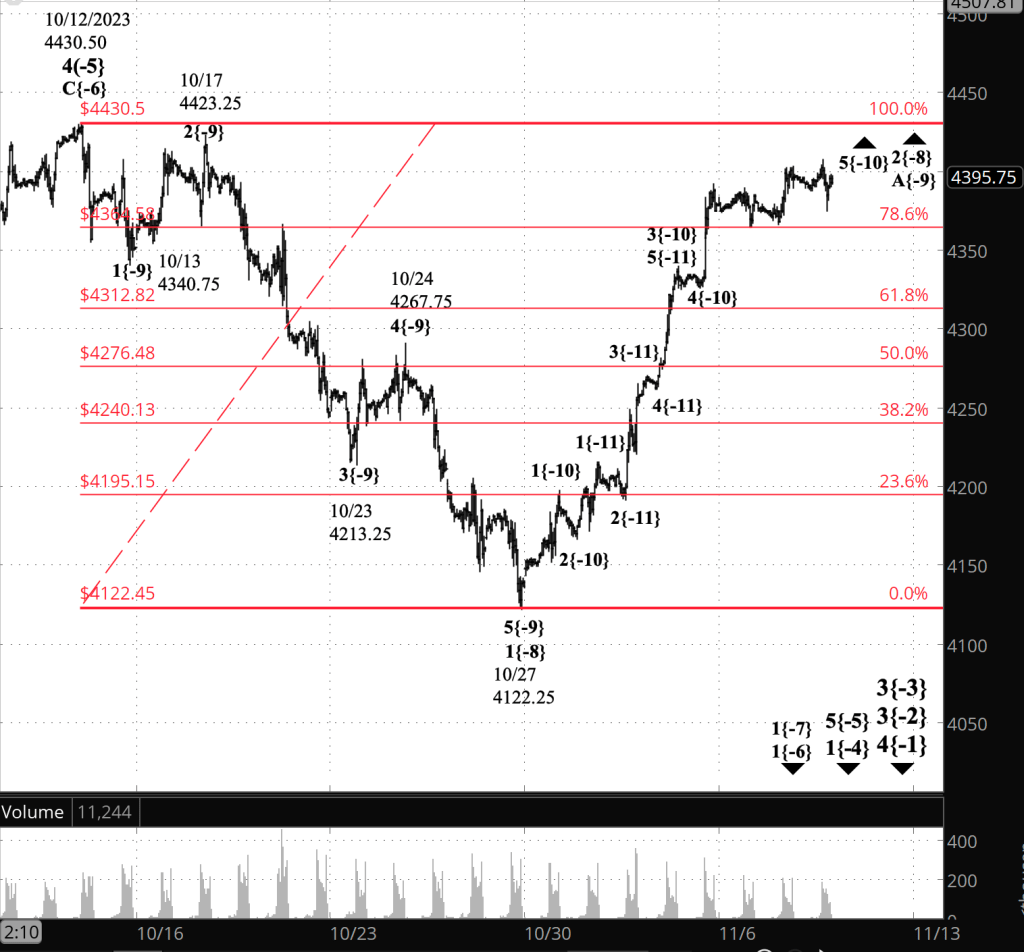
Half an hour before the market close. The S&P 500 futures fell to the 4370s during the session and then rose, remaining below the 2nd wave upward correction’s peak so far of 4407.75. This morning’s principal analysis continues with it’s uncertainty: Either the 4407.75 peak is a stopping point in the ongoing late stage of the initial subwave, the rising A wave, within the correction, or the correction ended at the peak and the falling B wave is underway.

I’ve updated the chart.

2:40 p.m. New York time

Entered SPY short Iron Fly, IWM short Bear Call Spread. I’ve entered two options positions today, one on IWM, at 9 days to expiration (DTE), and the other on SPY, at 1DTE, and have posted analyses of the trades.

11:05 a.m. New York time

Exited SPY short Iron Fly. I’ve exited the short Iron Fly options position on SPY, entered yesterday, and have updated the November 7 trades analysis with full results.

9:35 a.m. New York time

What’s happening now? The S&P 500 E-mini futures traded sideways overnight, rising above 4405 at the opening bell.

What does it mean? The first subwave, wave A, of the 2nd-wave upward correction that began on October 27 continues trying to find its endpoint. The price has moved decisively above a major Fibonacci turning point, a 78.6% retracement, and has come within 30 points of the start of the preceding 1st wave, 4430.50.

Under the rules of Elliott Wave Analysis, no 2nd wave can move above the 1st wave starting point.

All of that means that wave A within wave 2 is almost complete, according to one of two equally likely scenarios. Under the other scenario, wave A ended at yesterday’s peak.

Whenever wave A ends, it will be followed by a downtrending B wave, and then a C wave that will push up to complete the 2nd wave. An energetic 3rd wave downtrend will following, carrying the below the start of the 2nd wave correction, 4122.25, and likely a significant distance below that level.

On the chart, I’ve chosen to use the scenario that has wave A still underway.

What are the alternatives? There is one, unchanged from the past few days. The alternative scenario is this: The degree of the subwaves within the rise so far from October 27 are a bit up in the air. What we see is certainly part of wave 2{-8}. But is it really of the {-8} degree, or something lower or higher? It’s not yet clear on the chart. If the degree differs from what I have on the chart, then the subwaves would also be adjusted accordingly.

[S&P 500 E-mini futures at 3:30 p.m., 50-minute bars, with volume]

What does Elliott wave theory say? Here are the waves that underly the analyses.

Principal Analysis:

  • A downtrend, wave 3{-2}, began on July 27 and is underway.
  • Within wave 3{-2}, a smaller downtrend, wave 3{-3}, began on September 14 and is in its initial subwave, wave 1{-4}.
  • With wave 1{-4}, subwave 5{-5}, an downtrend, is underway, having begun on October 12.
  • Wave 5{-5} is in its first subwave, wave 1{-6}.
  • Within waves 1{-6} and 1{-7} are underway.
  • Wave 1{-7} is in its 2nd subwave, an upward correction, wave 2{-8}.
  • Internally, wave 2{-8} is in its first subwave, rising wave A{-9}.
  • Within wave 2{-8} I see two possibilities of equal likelihood:
    • Wave A{-9} continues and is its 5th and final subwave.
    • Wave A{-9} ended on November 7 at 4403.25 and wave B{-9} began.

Alternative Analysis

  • The upward correction, wave 2{-8}, is a higher degree or a lower degree than is shown on the chart.

We Are Here.

These are the waves currently in progress under my principal analysis. Each line on the list shows the wave number, with the subscript in curly brackets, the traditional degree name, the starting date, the starting price of the S&P 500 E-mini futures, and the direction of the wave.

  • S&P 500 Index:
  • 5{+3} Supercycle, 7/8/1932, 4.40 (up)
  • 5{+2} Cycle, 12/9/1974, 60.96 (up)
  • 5{+1} Primary, 3/6/2009, 666.79 (up)
  • 5{0} Intermediate, 12/26/2018, 2346.58 (up)
  • S&P 500 Futures and index:
  • 4{-1} Minor, 1/4/2022, 4953.25 (down) (futures), 4818.62 (down) (index)
  • S&P 500 Futures:
  • 3{-2} Minute, 7/27/2023, 3502 (down)

Reading the chart. Price movements — waves – – in Elliott wave analysis are labeled with numbers within trending waves and letters with corrective waves. The subscripts — numbers in curly brackets — designate the wave’s degree, which, in Elliott wave analysis, means the relative position of a wave within the larger and smaller structures that make up the chart. R.N. Elliott, who in the 1930s developed the form of analysis that bears his name, viewed the chart as a complex structure of smaller waves nested within larger waves, which in turn are nested within still larger waves. In mathematics it’s called a fractal structure, where at every scale the pattern is similar to the others.

Learning and other resources. Elliott wave analysis provides context, not prophecy. As the 20th century semanticist Alfred Korzybski put it in his book Science and Sanity (1933), “The map is not the territory … The only usefulness of a map depends on similarity of structure between the empirical world and the map.” And I would add, in the ever-changing markets, we can judge that similarity of structure only after the fact.

See the menu page Analytical Methods for a rundown on where to go for information on Elliott wave analysis.

By Tim Bovee, Portland, Oregon, November 8, 2023

Disclaimer

Tim Bovee, Private Trader tracks the analysis and trades of a private trader for his own accounts. Nothing in this blog constitutes a recommendation to buy or sell stocks, options or any other financial instrument. The only purpose of this blog is to provide education and entertainment.

No trader is ever 100 percent successful in his or her trades. Trading in the stock and option markets is risky and uncertain. Each trader must make trading decisions for his or her own account, and take responsibility for the consequences.

License
Creative Commons License

All content on Tim Bovee, Private Trader by Timothy K. Bovee is licensed under a Creative Commons Attribution-ShareAlike 4.0 International License.

Based on a work at www.timbovee.com.
Options Trades 11/7/2023: SPY

Symbol traded today: SPY (1DTE)

SPY Entry short Iron Fly

LOT:11ENTRY DATE:11/7/2023
EXIT DATE:11/8/2023

Entry and Exit

METRICCREDITDEBITCHANGECHANGE %
Options premium$ 1.61$ 1.44$ 0.1711.8%
METRICENTRYEXITCHANGECHANGE %
Stock price$ 437.22$ 437.43$ (0.21)$0.21
Impllied Volatility Rate18.116.71.4-1.4
Days to expiration10

The structure of the position

STRUCTURESTRIKEODDS EXPIRE OTMDELTA
Calls
Long439.0073.0%26
Break-even438.6160.0%39
Short437.0047.0%52
Puts
Short437.0054.0%47
Break-even435.6170.0%31
Long434.0086.0%15

Risk and Reward

Per contract:
Reward161.00
Risk89.00
R/R Ratio0.6:1

By Tim Bovee, Portland, Oregon, November 7, 2023

Disclaimer

Tim Bovee, Private Trader tracks the analysis and trades of a private trader for his own accounts. Nothing in this blog constitutes a recommendation to buy or sell stocks, options or any other financial instrument. The only purpose of this blog is to provide education and entertainment.

No trader is ever 100 percent successful in his or her trades. Trading in the stock and option markets is risky and uncertain. Each trader must make trading decisions for his or her own account, and take responsibility for the consequences.

License
Creative Commons License

All content on Tim Bovee, Private Trader by Timothy K. Bovee is licensed under a Creative Commons Attribution-ShareAlike 4.0 International License.

Based on a work at www.timbovee.com.
Trader’s Notebook

3:30 p.m. New York time

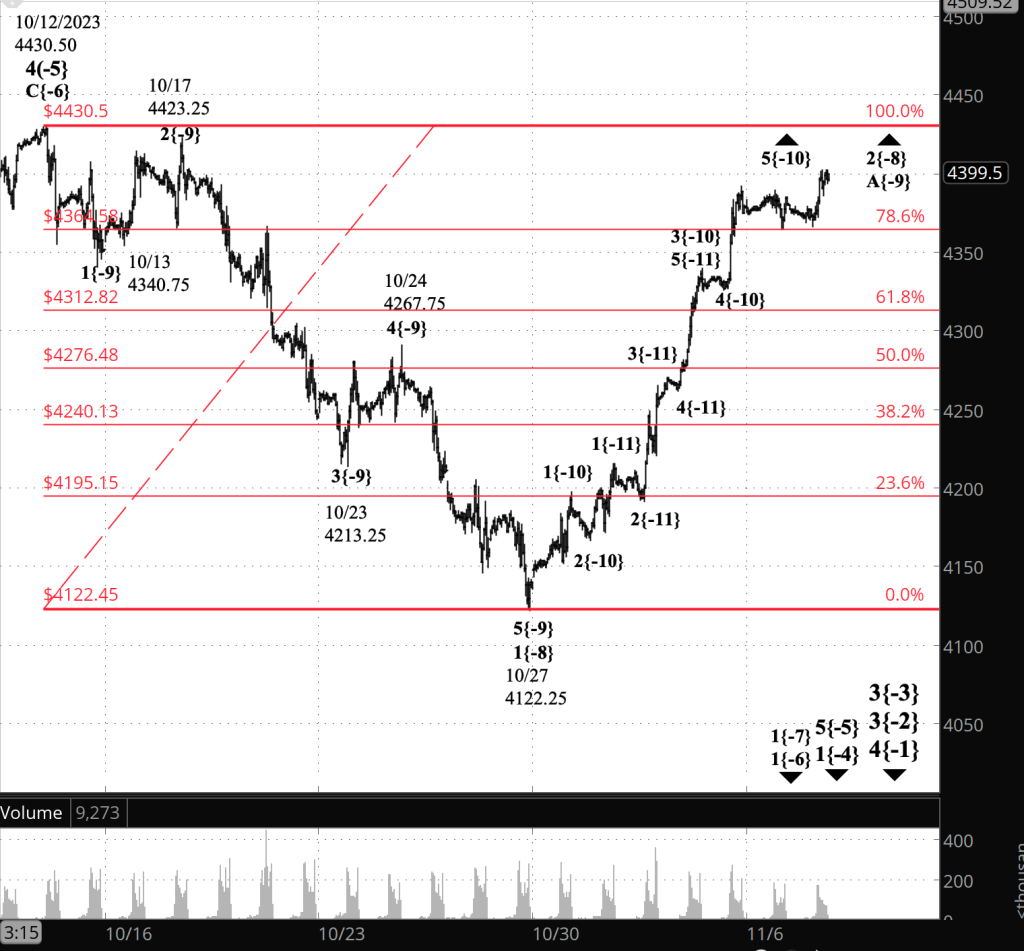
Half an hour before the closing bell. The S&P 500 futures rose above the overnight high during the session, reaching 4402.50.

The move resolved this morning’s choice between two scenarios in favor of wave A being underway, and wave B still lying in the future. This dilemma involves subwaves of the 2nd wave upward correction that began on October 27.

Nonetheless, the price is still near a peak, and any higher high triggers the same question: Is wave A over and wave B begun, or is wave A still underway.

A B wave typically retraces 38% to 79% of the preceding A wave. Based on the session high, the typical B wave would fall to between 4343.75 and 4228.75.

I’ve updated the chart, showing the A wave as still underway.

3:05 p.m. New York time

Today’s trade. I’ve entered a short iron fly position on SPY that expires tomorrow and have posted a trade analysis.

11:55 a.m. New York time

11/6 Trades Results. I’ve exited my positions on IWM and QQQ, and have updated the trade analyses with results.

9:35 a.m. New York time

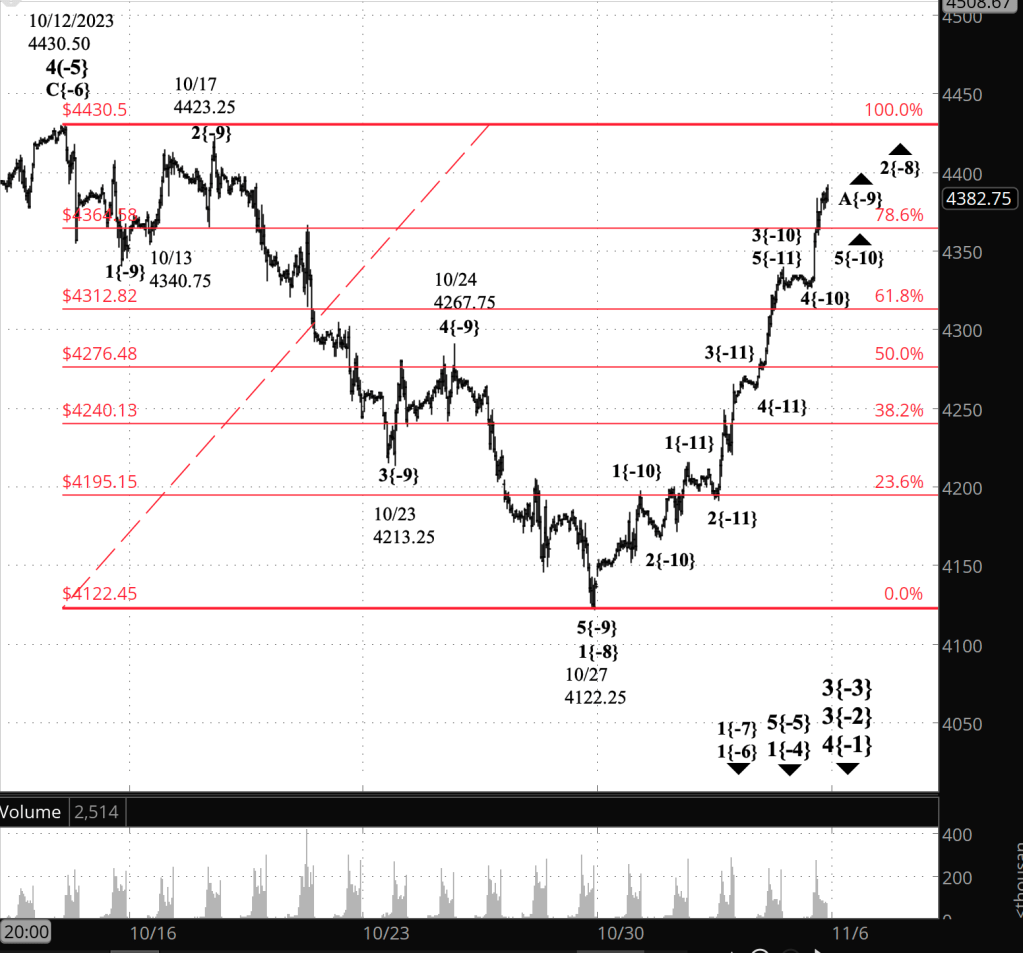
What’s happening now? The S&P 500 E-mini futures traded narrowly overnight, largely sticking to the region of the 78.6% Fibonacci retracement level. (The Fibonacci ladder is shown on the chart in red.)

What does it mean? The 2nd wave upward correction that began on October 27 continues. There are two possibilities of equal likelihood interpreting how far it has traveled in its three-subwave journey.

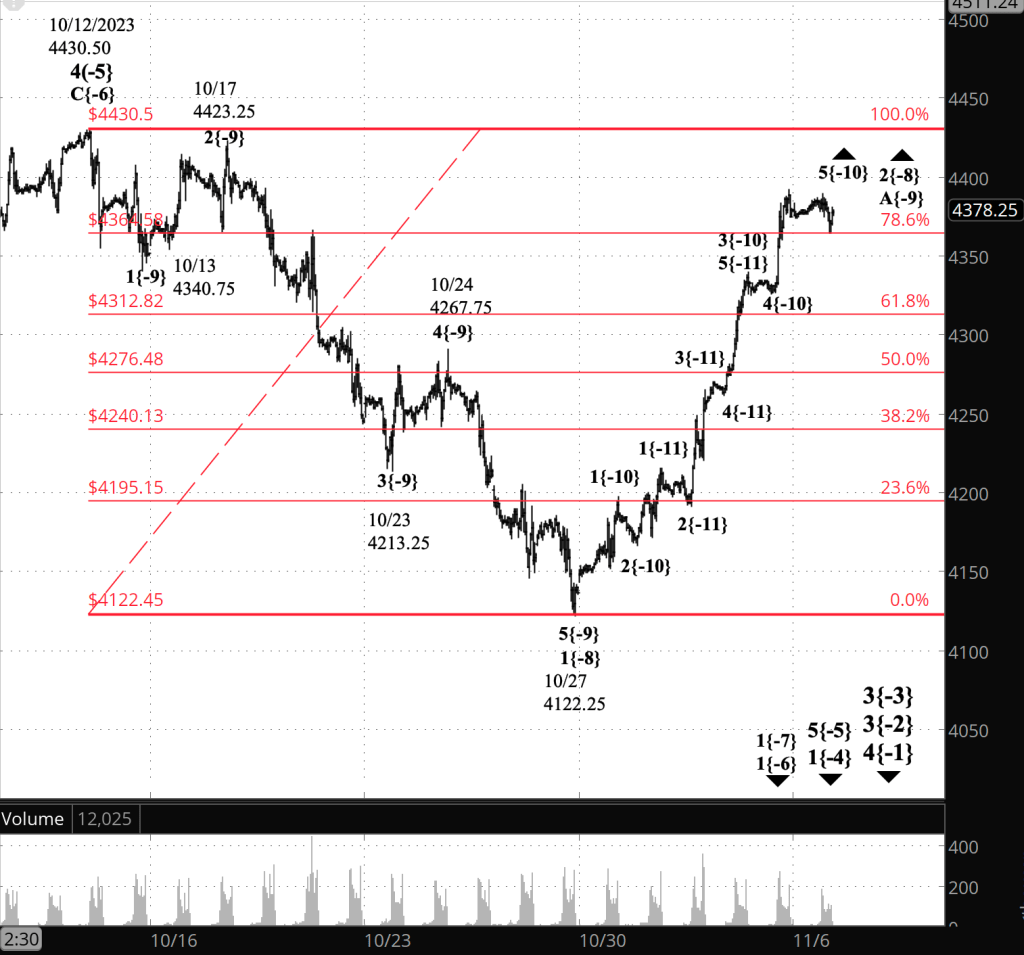
By one interpretation, the 1st subwave of the correction, the A wave, was completed by the November 3 high, 4391.75. That is the interpretation I’ve chosen for the chart. By the other interpretation, there is more upside left in the A wave and the shallow decline that followed the November 3 peak is just a pause to gather energy for a final upward push.

Elliott Wave Theory says that a 2nd wave can’t move beyond the starting point of the preceding 1st wave — 4430.50 in this case. If the A wave is in fact not yet complete, a final push upward can only have about 62 points remaining above the October 3 peak.

Under the scenario I chose for the chart, the second subwave of the correction, declining wave B, is now underway. The 2nd wave correction is taking the form of a Zigzag — Five subwaves in the A wave, three in the B and five in the C.

The B wave within a Zigzag typically retraces between 38% and 79% of the preceding A wave. As I calculated the Monday, November 6 post, that suggests the end point of wave B will be between 4289 and 4179.

What are the alternatives? There is one alternative. It has been with us for awhile and likely will stick around a while longer.

The alternative scenario is this: The degree of the subwaves within the rise so far from October 27 are a bit up in the air. What we see is certainly part of wave 2{-8}. But is it really of the {-8} degree, or something lower or higher? It’s not yet clear on the chart. If the degree differs from what I have on the chart, then the subwaves would also be adjusted accordingly.

[S&P 500 E-mini futures at 3:30.m., 45-minute bars, with volume]

What does Elliott wave theory say? Here are the waves that underly the analyses.

Principal Analysis:

  • A downtrend, wave 3{-2}, began on July 27 and is underway.
  • Within wave 3{-2}, a smaller downtrend, wave 3{-3}, began on September 14 and is in its initial subwave, wave 1{-4}.
  • With wave 1{-4}, subwave 5{-5}, an downtrend, is underway, having begun on October 12.
  • Wave 5{-5} is in its first subwave, wave 1{-6}.
  • Within waves 1{-6} and 1{-7} are underway.
  • Wave 1{-7} is in its 2nd subwave, an upward correction, wave 2{-8}.
  • Internally, wave 2{-8} is in its first subwave, rising wave A{-9}.
  • Within wave 2{-8} I see two possibilities of equal likelihood:
    • Wave A{-9} ended on November 3 at 4391.75 and wave B{-9} began
    • Wave A{-9} continues and is its 5th and final subwave.

Alternative Analysis

  • The upward correction, wave 2{-8}, is actually a higher degree or a lower degree than is shown on the chart.

We Are Here.

These are the waves currently in progress under my principal analysis. Each line on the list shows the wave number, with the subscript in curly brackets, the traditional degree name, the starting date, the starting price of the S&P 500 E-mini futures, and the direction of the wave.

  • S&P 500 Index:
  • 5{+3} Supercycle, 7/8/1932, 4.40 (up)
  • 5{+2} Cycle, 12/9/1974, 60.96 (up)
  • 5{+1} Primary, 3/6/2009, 666.79 (up)
  • 5{0} Intermediate, 12/26/2018, 2346.58 (up)
  • S&P 500 Futures and index:
  • 4{-1} Minor, 1/4/2022, 4953.25 (down) (futures), 4818.62 (down) (index)
  • S&P 500 Futures:
  • 3{-2} Minute, 7/27/2023, 3502 (down)

Reading the chart. Price movements — waves – – in Elliott wave analysis are labeled with numbers within trending waves and letters with corrective waves. The subscripts — numbers in curly brackets — designate the wave’s degree, which, in Elliott wave analysis, means the relative position of a wave within the larger and smaller structures that make up the chart. R.N. Elliott, who in the 1930s developed the form of analysis that bears his name, viewed the chart as a complex structure of smaller waves nested within larger waves, which in turn are nested within still larger waves. In mathematics it’s called a fractal structure, where at every scale the pattern is similar to the others.

Learning and other resources. Elliott wave analysis provides context, not prophecy. As the 20th century semanticist Alfred Korzybski put it in his book Science and Sanity (1933), “The map is not the territory … The only usefulness of a map depends on similarity of structure between the empirical world and the map.” And I would add, in the ever-changing markets, we can judge that similarity of structure only after the fact.

See the menu page Analytical Methods for a rundown on where to go for information on Elliott wave analysis.

By Tim Bovee, Portland, Oregon, November 7, 2023

Disclaimer

Tim Bovee, Private Trader tracks the analysis and trades of a private trader for his own accounts. Nothing in this blog constitutes a recommendation to buy or sell stocks, options or any other financial instrument. The only purpose of this blog is to provide education and entertainment.

No trader is ever 100 percent successful in his or her trades. Trading in the stock and option markets is risky and uncertain. Each trader must make trading decisions for his or her own account, and take responsibility for the consequences.

License
Creative Commons License

All content on Tim Bovee, Private Trader by Timothy K. Bovee is licensed under a Creative Commons Attribution-ShareAlike 4.0 International License.

Based on a work at www.timbovee.com.
Options Trades 11/6/2023: IWM QQQ

Symbols traded today: 1DTE: QQQ, 4DTE: IWM

IWM and QQQ have been updated with results.

IWM short Bear Call Vertical Spread 4DTE

IWM has higher volatility, defined as an IVR of 25% or higher, and I chose to use longer DTE (days to expiration) options. I had intended that it be a 9DTE trade, but I erred, and let’s see how it goes.

And the results. The IWM position produced a 63.6% profit before fees. So despite the DTE error, the position did quite well.

LOT:2ENTRY DATE:11/6/2023
EXIT DATE:11/7/2023

Entry and Exit

CREDIT (ENTRY)DEBIT (EXIT)CHANGECHANGE %
Options premium$ 0.54$ 0.33$ 0.2163.6%
ENTRYEXITCHANGECHANGE %
Stock price$ 172.45$ 171.10$ (1.35)-0.8%
Implied Volatility Rate31.230.1-1.1
Days to expiration43-1

The structure of the position

CALLS/PUTSSTRIKEODDS EXPIRE OTMDELTA
Long176.0079.0%22
Break-even174.5471.5%29.5
Short174.0064.0%37

Risk and Reward

PER CONTRACT
Reward54.00
Risk146.00
R/R Ratio (n:1)2.7

QQQ short Iron Fly

QQQ has meets my criteria for lower volatility, with an Implied Volatility Rank (IVR) of less than 25%, and so qualifies for a 1DTE trade.

The underlying share price rose by 0.8%, and that was enough to turn the position unprofitable.

LOT:3ENTRY DATE:11/6/2023
EXIT DATE:11/7/2023

Entry and Exit

CREDIT (ENTRY)DEBIT (EXIT)CHANGECHANGE %
Options premium$ 2.16$ 2.46$ (0.30)-12.2%
ENTRYEXITCHANGECHANGE %
Stock price$ 367.50$ 370.26$ 2.760.8%
Implied Volatility Rate16.012.1-3.9
Days to expiration10-1

The structure of the position

STRUCTURESTRIKEODDS EXPIRE OTMDELTA
Calls
Long370.0078.0%22
Break-even369.1667.0%33.5
Short367.0056.0%45
Puts
Short367.0054.0%46
Break-even365.1650.0%50
Long363.0046.0%54

Risk and Reward

Per contract:
Reward216.00
Risk134.00
R/R Ratio (n:1)0.6

By Tim Bovee, Portland, Oregon, November 6, 2023

Disclaimer

Tim Bovee, Private Trader tracks the analysis and trades of a private trader for his own accounts. Nothing in this blog constitutes a recommendation to buy or sell stocks, options or any other financial instrument. The only purpose of this blog is to provide education and entertainment.

No trader is ever 100 percent successful in his or her trades. Trading in the stock and option markets is risky and uncertain. Each trader must make trading decisions for his or her own account, and take responsibility for the consequences.

License
Creative Commons License

All content on Tim Bovee, Private Trader by Timothy K. Bovee is licensed under a Creative Commons Attribution-ShareAlike 4.0 International License.

Based on a work at www.timbovee.com.

Trader’s Notebook

3:30 p.m. New York time

Half an hour before the closing bell. The S&P 500 futures dropped during the session into the 4360s and then returned to the 4380s. The first subwave within the 2nd wave upward correction continues. I’ve updated the chart.

3:10 p.m. New York time

Trades report. I’ve posted a trade analysis for today’s trades. I entered positions on IWM (4 days to expiration) and QQQ (1DTE).

A new approach. I’m bringing my new options trading plan into play beginning today and have posted a description of how it works, titled “A New Approach to Options Trading“.

I’ve had wise mentors from time to time praise the “trade small, trade often” approach. I’ve always found the trade often part of the advice to be difficult to follow. Sometimes, perhaps most of the time, there just aren’t that many good trades available, at least not trades that I would care to risk my hard-earned trading funds on.

The changes in approach that I’m making today are in part an attempt to make it possible, and profitable, to trade more often.

9:35 a.m. New York time

What’s happening now? The S&P 500 E-mini futures rose gently after trading resumed overnight, working its way from the 4370s to the 4380s.

What does it mean? The initial subwave of the 2nd wave upward correction that began on October 27 is nearing its end. That final subwave is an A wave, the first of three subwaves that make up most corrective patterns identified by Elliott Wave Theory.

Wave A will be followed by a declining B wave. What can we expect from it?

First, wave 2, which is the parent wave, is taking the form of a Zigzag, with five subwaves within the A subwave. In a Zigzag, the B wave never moves below the starting point of the wave A, which was 4122.25 in this case. That sets a lower boundary.

Typically within a Zigzag, a B wave will retrace somewhere from 38% to 79% of wave A. That’s quite a large window.

This tells us a couple of things.

First, If we take the present wave A high, 4391.75, as its end point (it may not be, this is just a hypothetical), then the typical B-wave endpoint would be between 4289 and 4179. It’s not a huge decline, but there’s money to be made, even at the shallow end of the retracement range.

Second, the B wave is unlikely to reach its lower boundary, 4122.25.

What are the alternatives? There is one, unchanged from Friday. The degree of the subwaves within the rise so far from October 27 are a bit up in the air. What we see is certainly part of the A wave — Wave A{-9} within wave 2{-8}. But are they of the {-10} degree, or something lower — subwaves within subwaves? It’s not yet clear on the chart.

[S&P 500 E-mini futures at 3:30 p.m., 45-minute bars, with volume]

What does Elliott wave theory say? Here are the waves that underly the analyses.

Principal Analysis:

  • A downtrend, wave 3{-2}, began on July 27 and is underway.
  • Within wave 3{-2}, a smaller downtrend, wave 3{-3}, began on September 14 and is in its initial subwave, wave 1{-4}.
  • With wave 1{-4}, subwave 5{-5}, an downtrend, is underway, having begun on October 12.
  • Wave 5{-5} is in its first subwave, wave 1{-6}.
  • Within waves 1{-6} and 1{-7} are underway.
  • Wave 1{-7} is in its 2nd subwave, an upward correction, wave 2{-8}.
  • Internally, wave 2{-8} is in its first subwave, rising wave A{-9}.
  • Wave A{-9} is in its final subwave, wave 5{-10}, which perhaps has already ended.

We Are Here.

These are the waves currently in progress under my principal analysis. Each line on the list shows the wave number, with the subscript in curly brackets, the traditional degree name, the starting date, the starting price of the S&P 500 E-mini futures, and the direction of the wave.

  • S&P 500 Index:
  • 5{+3} Supercycle, 7/8/1932, 4.40 (up)
  • 5{+2} Cycle, 12/9/1974, 60.96 (up)
  • 5{+1} Primary, 3/6/2009, 666.79 (up)
  • 5{0} Intermediate, 12/26/2018, 2346.58 (up)
  • S&P 500 Futures and index:
  • 4{-1} Minor, 1/4/2022, 4953.25 (down) (futures), 4818.62 (down) (index)
  • S&P 500 Futures:
  • 3{-2} Minute, 7/27/2023, 3502 (down)

Reading the chart. Price movements — waves – – in Elliott wave analysis are labeled with numbers within trending waves and letters with corrective waves. The subscripts — numbers in curly brackets — designate the wave’s degree, which, in Elliott wave analysis, means the relative position of a wave within the larger and smaller structures that make up the chart. R.N. Elliott, who in the 1930s developed the form of analysis that bears his name, viewed the chart as a complex structure of smaller waves nested within larger waves, which in turn are nested within still larger waves. In mathematics it’s called a fractal structure, where at every scale the pattern is similar to the others.

Learning and other resources. Elliott wave analysis provides context, not prophecy. As the 20th century semanticist Alfred Korzybski put it in his book Science and Sanity (1933), “The map is not the territory … The only usefulness of a map depends on similarity of structure between the empirical world and the map.” And I would add, in the ever-changing markets, we can judge that similarity of structure only after the fact.

See the menu page Analytical Methods for a rundown on where to go for information on Elliott wave analysis.

By Tim Bovee, Portland, Oregon, November 6, 2023

Disclaimer

Tim Bovee, Private Trader tracks the analysis and trades of a private trader for his own accounts. Nothing in this blog constitutes a recommendation to buy or sell stocks, options or any other financial instrument. The only purpose of this blog is to provide education and entertainment.

No trader is ever 100 percent successful in his or her trades. Trading in the stock and option markets is risky and uncertain. Each trader must make trading decisions for his or her own account, and take responsibility for the consequences.

License
Creative Commons License

All content on Tim Bovee, Private Trader by Timothy K. Bovee is licensed under a Creative Commons Attribution-ShareAlike 4.0 International License.

Based on a work at www.timbovee.com.

A New Approach to Options Trading

True confession: When the Fed started raising interest rates at the fastest pace in a half a century, I behaved like a true groundhog: I dived into my burrow, put my trading funds in 3-month Treasury Bills, and watched the ever-increasing reward roll in with zero risk.

The reward isn’t increasing as much anymore. And I didn’t spend my months idly as I stuck to most boring investment possible. I’ve popped out on the surface with three options strategies and a trading calendar that will tend keep me trading every day, with quick turnover of my investment funds, which after months underground with T-bills, is definitely a plus.

The three strategies are identified by days to expiration at entry. Here’s a list and a discussion of each.

1DTE

This is the closest to day-trading that I come. I enter each position in the last hour before the closing bell, and exit within the first five minutes of the next day’s opening bell.

The structure is the iron fly. It’s a close cousin of the Iron Condor, but with the Iron Fly, the strike prices of the short call and short put are identical, both at-the-money.

I set the long call and put 30 deltas out from the shorts.

This works best with lower volatility symbols.

9DTE

This is the shortest directional trade that I’ll be doing. Nine days from expiration gives me some time to manage the trade — i.e., get out — if the underlying stock moves in the wrong direction.

I use Elliott Wave Theory to set by direction. That small DTE is perfect for trading the small wave degrees on a chart, such as a trending 3rd wave that lasts for a week. Close to expiration, a trade’s profit or loss tends to be greater than they when the options are further away from expiration.

As the structure, I use a short vertical spread — a bull put spread or a bear calls spread. I set the short option and long option strikes in a way that gives me a reasonable potential return and risk/reward ratio.

For verticals I tend to be OK with a risk/reward ratio no greater than 3.5:1. The nine days has some give. I might go 10DTE or 8DTE.

My goal to close out the trade four days prior to expiration.

This works best with higher volatility symbols.

45DTE

This has been my basic options trade for decades. It’s what I use when I want to trade larger Elliott Wave degrees.

The structure is the same as with the 9DTE strategy. The structure is a short vertical spread, with a risk/reward maximum of 3.5:1. I manage the trade 21 days before expiration.

This strategy also works best with higher volatility symbols.

When to trade?

That describes what to trade, which are standard options methods. When to trade is where the things get a bit more complex.

There’s the question of how often a symbol’s options can be traded.

1DTE: Three exchange-traded funds provide the greatest opportunity for the 1DTE strategy: SPY and QQQ, with options expiring daily, and IWM, with options expiring Monday, Wednesday and Friday. They will dominate the trading calendar for 1DTE positions because it allows five trading days a week for SPY and QQQ, and three trading days a week for IWM.

9DTE: Most highly liquid options, generally issued based on stock of high-capitalization companies, have expirations each week, on Friday. For for any given symbol, there’s one day a week that precisely matches the needs of a 9DTE strategy. As I wrote in the 9DTE section, there’s some give in the entry date, so this expiration schedule allows for trades three days a week, on Wednesday, Thursday and Friday.

45DTE: For this strategy I can trade any options issue I like with any strategy I prefer. I tend to use short vertical spreads with the occasional iron condor. Even with companies that issue new options each week, I tend to the use the monthly options because they have a small bid/ask spread. I have no set rule how much give there is either side of 45DTE as the entry point. I tend to use the week of 45DTE day (always a Tuesday) and the week prior to 45DTE week, giving a two-week window.

And there’s the question of what to do with major economic releases. There are three from the government that I think of as major market movers, potentially: The Employment Situation, the Consumer Price Index, and the Gross Domestic Product.

All three are released an hour before the opening bell, and that’s a surprise I’d rather not have on a new entry into a short-term trade with little recovery time — a 1DTE or 9DTE position. So on the day before those releases, I don’t trade those strategies.

I also tend not to trade the short-term strategies on Friday’s, just in case there’s a major market-devastating surprise over the weekend.

Having said all of that, here is my strategy for coming week. There are no major economic releases, so no days are blocked.


Trading Calendar, week 11/6-11/10 

45DTE entry 11/27/2023-12/8/2023

  • Monday
    • Enter 1DTE iron fly 1130U
      • IWM
      • QQQ
  • Tuesday
    • Exit IWM, QQQ 0630U
    • Enter 1DTE iron fly 1130U
      • SPY
  • Wednesday
    • Exit SPY 0630U
    • Enter 1DTE iron fly 1130U
      • IWM
      • QQQ
  • Thursday
    • Exit IWM, QQQ 0630U
    • Enter 1DTE iron fly 1130U
      • SPY
      • Low IVR stocks with weekly expirations
  • Friday
    • Exit SPY, other Thursday entries

Documentation

As long-time readers will know, I tend to share my options trades online. It is a way of keeping a trading diary, always a good practice, my mentors have told me. Also, some people might find it interesting. In learning about options over the years, I’ve always found it valuable to see how others were setting up their trades. And someone might come up with a good suggestion, always a plus because my primary ethic is to learn.

In the past I’ve posted a report for each trade. Under the new system, my trading volume will be greater, and I plan to consolidate each day’s trades into a single report, which will be posted after the market close. It will be called “Options Trades” followed by a date in numeric form: 11/6/2023, for example. My calendar tells me that I have trades to place today, so look for it after the market close.

Pattern Day Trader


And finally, the elephant in the room: Being declared a pattern day trader by the SEC. Anyone with less than $25,000 in a brokerage account will be designated as a pattern day trader if they day-trade more than three times in a week. This article in Investopedia has the details.

Day trading isn’t a problem with the 1DTE strategy, as along as I don’t sell a position in the morning and then buy back into options of that same symbol in the afternoon. So I alternate my two daily expiration symbols, SPY and QQQ, to avoid that sort of mischance.

Basically, the answer is to stay aware of the problem and avoid day-trading above the federal limit.

By Tim Bovee, Portland, Oregon, November 6, 2023

Disclaimer

Tim Bovee, Private Trader tracks the analysis and trades of a private trader for his own accounts. Nothing in this blog constitutes a recommendation to buy or sell stocks, options or any other financial instrument. The only purpose of this blog is to provide education and entertainment.

No trader is ever 100 percent successful in his or her trades. Trading in the stock and option markets is risky and uncertain. Each trader must make trading decisions for his or her own account, and take responsibility for the consequences.

License

All content on Tim Bovee, Private Trader by Timothy K. Bovee is licensed under a Creative Commons Attribution-ShareAlike 4.0 International License.

Based on a work at www.timbovee.com.

Trader’s Notebook

3:30 p.m. New York time

Half an hour before the closing bell. The S&P 500 futures continued rising during the session, reaching the 4390s. The first leg of the 2nd wave upward correction that began in late October continues. I’ve updated the chart.

9:35 a.m. New York time

What’s happening now? The S&P 500 E-mini futures traded sideways during most of overnight trading, rising sharply when the Employment Situation report was published as the opening bell approached.

What does it mean? The rise carried the price up to the 4360s, to the 78.6% Fibonacci retracement level. It is the final major retracement level shorter than a 100% retracement.

The 2nd wave upward correction that began on October 27 continues and is nearing the end of its first subwave, an A wave. Within the A wave, the final subwave, a 5th wave, is underway.

Under the rules of Elliott Wave theory, the 2nd wave correction and its current subwave, the A wave, have an upper boundary: It cannot move beyond the start of the preceding wave 1, which is 4430.50 in this case.

When the 5th wave is complete, it’s parent A wave will also be complete and a declining B wave will begin.

The A wave has five subwaves and so the correction is taking the form of a Zigzag, within which the B wave has a lower limit in Elliott Wave Theory: It never falls below the start of the preceding A wave, 4122.25 in this case.

The B wave will have three subwaves.

What are the alternatives? There is one at present. The degree of the subwaves within the rise so far from October 27 are a bit up in the air. What we see is certainly part of the A wave — Wave A{-9} within wave 2{-8}. But are they of the {-10} degree, or something lower — subwaves within subwaves? It’s not yet clear on the chart.

[S&P 500 E-mini futures at 3:30 p.m., 40-minute bars, with volume]

What does Elliott wave theory say? Here are the waves that underly the analyses.

Principal Analysis:

  • A downtrend, wave 3{-2}, began on July 27 and is underway.
  • Within wave 3{-2}, a smaller downtrend, wave 3{-3}, began on September 14 and is in its initial subwave, wave 1{-4}.
  • With wave 1{-4}, subwave 5{-5}, an downtrend, is underway, having begun on October 12.
  • Wave 5{-5} is in its first subwave, wave 1{-6}.
  • Within waves 1{-6} and 1{-7} are underway.
  • Wave 1{-7} is in its 2nd subwave, an upward correction, wave 2{-8}.
  • Internally, wave 2{-8} is in its first subwave, rising wave A{-9}.

We Are Here.

These are the waves currently in progress under my principal analysis. Each line on the list shows the wave number, with the subscript in curly brackets, the traditional degree name, the starting date, the starting price of the S&P 500 E-mini futures, and the direction of the wave.

  • S&P 500 Index:
  • 5{+3} Supercycle, 7/8/1932, 4.40 (up)
  • 5{+2} Cycle, 12/9/1974, 60.96 (up)
  • 5{+1} Primary, 3/6/2009, 666.79 (up)
  • 5{0} Intermediate, 12/26/2018, 2346.58 (up)
  • S&P 500 Futures and index:
  • 4{-1} Minor, 1/4/2022, 4953.25 (down) (futures), 4818.62 (down) (index)
  • S&P 500 Futures:
  • 3{-2} Minute, 7/27/2023, 3502 (down)

Reading the chart. Price movements — waves – – in Elliott wave analysis are labeled with numbers within trending waves and letters with corrective waves. The subscripts — numbers in curly brackets — designate the wave’s degree, which, in Elliott wave analysis, means the relative position of a wave within the larger and smaller structures that make up the chart. R.N. Elliott, who in the 1930s developed the form of analysis that bears his name, viewed the chart as a complex structure of smaller waves nested within larger waves, which in turn are nested within still larger waves. In mathematics it’s called a fractal structure, where at every scale the pattern is similar to the others.

Learning and other resources. Elliott wave analysis provides context, not prophecy. As the 20th century semanticist Alfred Korzybski put it in his book Science and Sanity (1933), “The map is not the territory … The only usefulness of a map depends on similarity of structure between the empirical world and the map.” And I would add, in the ever-changing markets, we can judge that similarity of structure only after the fact.

See the menu page Analytical Methods for a rundown on where to go for information on Elliott wave analysis.

By Tim Bovee, Portland, Oregon, November 3, 2023

Disclaimer

Tim Bovee, Private Trader tracks the analysis and trades of a private trader for his own accounts. Nothing in this blog constitutes a recommendation to buy or sell stocks, options or any other financial instrument. The only purpose of this blog is to provide education and entertainment.

No trader is ever 100 percent successful in his or her trades. Trading in the stock and option markets is risky and uncertain. Each trader must make trading decisions for his or her own account, and take responsibility for the consequences.

License
Creative Commons License

All content on Tim Bovee, Private Trader by Timothy K. Bovee is licensed under a Creative Commons Attribution-ShareAlike 4.0 International License.

Based on a work at www.timbovee.com.

Trader’s Notebook

3:30 p.m. New York time

Half an hour before the closing bell. The S&P 500 futures climbed during the session, pushing past the 61.8% Fibonacci retracement level into the 4330s.

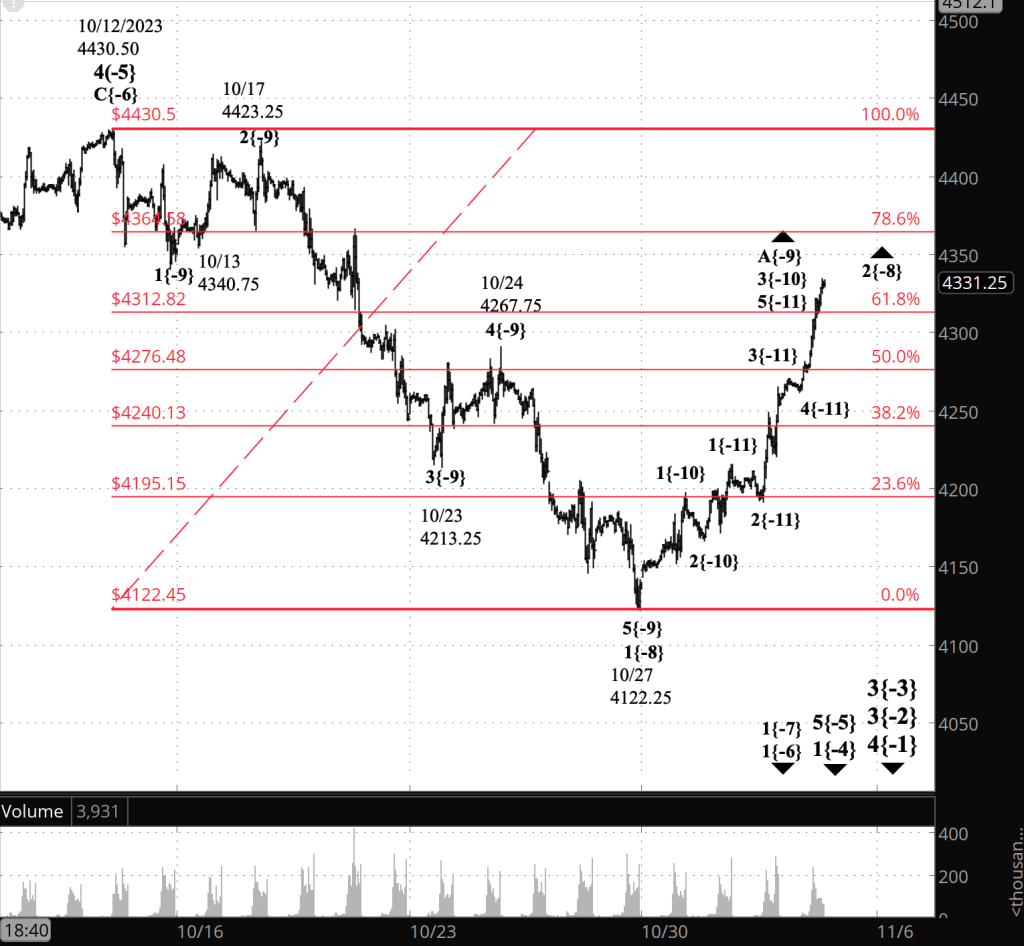
In order to pry apart the complex fractal structure of the chart, I’ll need to use my full Elliott wave notation: A wave number and a degree number in curly brackets. The degree is the relative placement of a wave compared to other waves, larger and smaller. A degree of {-8} is larger than degree {-9}, and degree{-10} is smaller than both. All of the negative degree numbers are smaller than degree {0}, which is the degree of the major downtrend, wave 4{0}, that began on January 4, 2022.

The rise from October 27, wave 2{-8}, an upward correction, is in wave A{-9}, the first subwave of the correction.

Internally, wave A{-9} is nearing the end of its middle subwave, wave 3{-10}, which in turn is in its final subwave, wave 5{-11}. Wave 3{-10} will be followed by a downward correction, wave 4{-10}, and then an uptrending wave 5{-10}, which will complete wave A{-9}. The middle wave of the correction, declining wave B{-9} will follow, and then rising wave C{-9} will complete the pattern.

The A wave has five subwaves, which means the correction is taking the form of a Zigzag. This will have implications for the limits of the future B and C waves. For the 2nd wave correction as a whole, the rule is that the price cannot move above the start of the preceding 1st wave, 4430.50.

11:10 a.m. New York time

SPY bull put spread exited. I’ve exited my bull put options spread on SPY on the day after entry, for a profit of 184.4%. I’ve updated the trade analysis with full results.

9:35 a.m. New York time

What’s happening now? The S&P 500 E-mini futures rose overnight, reaching above 4300.

What does it mean? The 2nd wave upward correction that began on October 27 continues and is in its first subwave, an A wave.

The price is now approaching the 61.8% retracement level in the 4310s, a common reversal point.

Reversal in this context means the end of wave A and the beginning of declining wave B, the second subwave in the correction. The B wave will be followed by a rising C wave that will complete the corrective pattern and most likely the correction itself. An exception to the common pattern would be for the correction to take a compound form, linking two or three corrective patterns together before reaching its end.

In any case, the end of the 2nd wave will be the start of a downtrending 3rd wave that will carry the price below the start of the upward correction, 4122.25, and most likely significantly below that level.

What are the alternatives? There is one, although it is in the nature of stock charts that new ambiguities will develop.

The present alternative: The degree of the subwaves within the rise so far from October 27 are a bit up in the air. What we see is certainly part of the A wave — Wave A{-9} within wave 2{-8}. But are they of the {-10} degree, or something lower — subwaves within subwaves? It’s not yet clear on the chart.

[S&P 500 E-mini futures at 3:30 p.m., 40-minute bars, with volume]

What does Elliott wave theory say? Here are the waves that underly the analyses.

Principal Analysis:

  • A downtrend, wave 3{-2}, began on July 27 and is underway.
  • Within wave 3{-2}, a smaller downtrend, wave 3{-3}, began on September 14 and is in its initial subwave, wave 1{-4}.
  • With wave 1{-4}, subwave 5{-5}, an downtrend, is underway, having begun on October 12.
  • Wave 5{-5} is in its first subwave, wave 1{-6}.
  • Within waves 1{-6} and 1{-7} are underway.
  • Wave 1{-7} is in its 2nd subwave, an upward correction, wave 2{-8}.
  • Internally, wave 2{-8} is in its first subwave, rising wave A{-9}.

We Are Here.

These are the waves currently in progress under my principal analysis. Each line on the list shows the wave number, with the subscript in curly brackets, the traditional degree name, the starting date, the starting price of the S&P 500 E-mini futures, and the direction of the wave.

  • S&P 500 Index:
  • 5{+3} Supercycle, 7/8/1932, 4.40 (up)
  • 5{+2} Cycle, 12/9/1974, 60.96 (up)
  • 5{+1} Primary, 3/6/2009, 666.79 (up)
  • 5{0} Intermediate, 12/26/2018, 2346.58 (up)
  • S&P 500 Futures and index:
  • 4{-1} Minor, 1/4/2022, 4953.25 (down) (futures), 4818.62 (down) (index)
  • S&P 500 Futures:
  • 3{-2} Minute, 7/27/2023, 3502 (down)

Reading the chart. Price movements — waves – – in Elliott wave analysis are labeled with numbers within trending waves and letters with corrective waves. The subscripts — numbers in curly brackets — designate the wave’s degree, which, in Elliott wave analysis, means the relative position of a wave within the larger and smaller structures that make up the chart. R.N. Elliott, who in the 1930s developed the form of analysis that bears his name, viewed the chart as a complex structure of smaller waves nested within larger waves, which in turn are nested within still larger waves. In mathematics it’s called a fractal structure, where at every scale the pattern is similar to the others.

Learning and other resources. Elliott wave analysis provides context, not prophecy. As the 20th century semanticist Alfred Korzybski put it in his book Science and Sanity (1933), “The map is not the territory … The only usefulness of a map depends on similarity of structure between the empirical world and the map.” And I would add, in the ever-changing markets, we can judge that similarity of structure only after the fact.

See the menu page Analytical Methods for a rundown on where to go for information on Elliott wave analysis.

By Tim Bovee, Portland, Oregon, November 2, 2023

Disclaimer

Tim Bovee, Private Trader tracks the analysis and trades of a private trader for his own accounts. Nothing in this blog constitutes a recommendation to buy or sell stocks, options or any other financial instrument. The only purpose of this blog is to provide education and entertainment.

No trader is ever 100 percent successful in his or her trades. Trading in the stock and option markets is risky and uncertain. Each trader must make trading decisions for his or her own account, and take responsibility for the consequences.

License
Creative Commons License

All content on Tim Bovee, Private Trader by Timothy K. Bovee is licensed under a Creative Commons Attribution-ShareAlike 4.0 International License.

Based on a work at www.timbovee.com.