Trader’s Notebook

3:30 p.m. New York time

Half an hour before the closing bell. The S&P 500 futures have entered an either/or pattern.

Either the wave 4 correction has taken the form of a Flat and the B wave has so far retraced nearly 130% of the preceding A wave…

…or the wave 4 correction ended on September 29 at 4371.25 and the wave 5 downtrend has begun.

First, the B-wave scenario: In a Flat pattern, the A wave will have three subwaves, as will the B wave, and the B wave will typically retrace between 100% and 138% of the A wave. In this scenario’s favor: The B wave is well within the guidelines of Elliott Wave Theory. Against it: The A wave of the pattern appears to have five subwaves, which makes it part of a Zigzag pattern. Also, Flats in my experience are more common in 4th waves than in 2nd waves.

Second, the 5th wave scenario. If I squint my eyes and whisper a wish, I can count three subwaves in wave A. It’s not unusual for waves occasionally to be ambiguous in the subwaves they trace. If the rise from September 27 has three subwaves, then there is no barrier to the ensuing decline being downtrending wave 5. I count it as being in its 3rd wave subwave, which in turn is in its 3rd wave. Wave 3 is in its third day. The last 3rd wave of the same degree was finished in a day. So its duration is proportional.

For me, the analysis hinges on the rise from September 27 to September 29. And the most reasonable subwave count for that rise five. Which is inconsistent both with this morning’s Principal Analysis and with Alternative #1.

Under such circumstances, I tend toward caution. I’ll retain my present analysis in marking the chart: Wave B within the upward correction, wave 4 is underway, while stressing the uncertinty of that decision.

If the price reverses and returns to the 4370s, that makes the B-wave scenario more likely: The C wave will be underway.

If the price continues falling and moves robustly below the 138% retracement level, 4206, then the 5th-wave scenario will be more likely: The 4th wave correction ended on September 29 and the 5th wave downtrend is underway.

1:10 p.m. New York time

QQQ options position entered. I’ve entered a short bear all vertical spread on QQQ, using options that will expire on November 14, and have posted an analysis of the trade.

12:30 p.m. New York time

SPY options position exited. I have exited my short bear call vertical spread on SPY, using options that will expire on November 17, for 49.8% of maximum potential profit. I’ve updated the trade analysis with full details.

9:35 a.m. New York time

What’s happening now? The S&P 500 E-mini futures declined overnight, from the 4330s to the 4290s.

What does it mean? The middle subwave of a three-wave downward correction, a 4th wave, continues. It is the declining B wave and will be followed by a C wave that will complete the corrective pattern, and the correction as a whole, unless it takes a compound form containing two or three corrective patterns.

The 4th wave will be followed by a downtrending 5th wave, which sometimes are the longest of the waves within a larger trend and sometimes are trunated, making them the shortest. No way to tell out this point how the future wave 5 will play out.

What are the alternatives? There are two.

It’s possible to count the rise from September 27, the A wave on the chart, as being the 4th wave in its entirety. The size is disproprotionate to prior waves of the same degree, but it’s still possible.

As always, there’s ambiguity in where the wave patterns are within the complex fractal structure of the chart. For the principal analysis I’ve labelled the upward correction as being two degrees below the 3rd wave. It’s possible that moving it up a degree, to one degree below the 3rd, will prove to be more accurate, or moving it down one degree, to three degrees below the 3rd, better describes what’s happening on the chart.
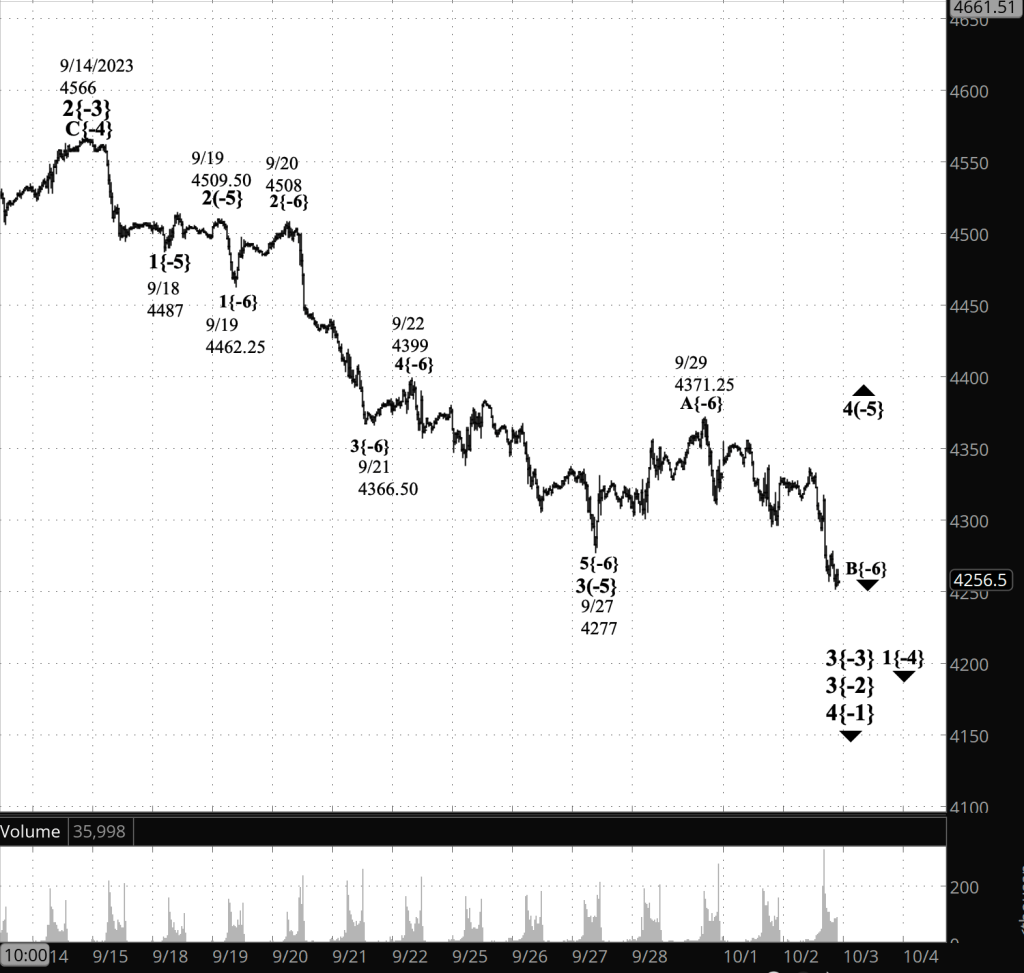
[S&P 500 E-mini futures at 3:30 p.m., 30-minute bars, with volume]

What does Elliott wave theory say? Here are the waves that underly the analyses.

Principal Analysis:

  • A downtrend, wave 3{-2}, began on July 27 and is underway.
  • Within wave 3{-2}, a smaller downtrend, wave 3{-3}, began on September 14 and is in its initial subwave, wave 1{-4}.
  • With wave 1{-4}, subwave 4{-5}, an upward correction, is underway, having begun on September 27 from 4277.
  • Wave 4{-5} is in its middle subwave, declining wave B{-6}.

Alternative Analysis #1

  • Downtrending wave 5{-5} is underway, having begun on September 29 from 4371.25

Alternative Analysis #2

  • Wave 4{-4} within downtrend 3{-3} is underway.

… or …

  • Wave 4{-6} within wave wave 1{-5} within wave 1{-4} is underway

Big picture:

  • The wave 3{-2} downtrend is a subwave of wave 4{-1}, a downtrend that began on January 4, 2022.
  • Wave 4{-1}, in turn, is a subwave of wave 5{0}, an expanding Diagonal Triangle that began on December 26, 2018.
  • Wave 4{-1} may eventually reach the lower boundary of wave 5{0}, presently slightly below 1800 and declining further each day.
  • Wave 4{-1} will be followed by rising wave 5{-1}, the final wave in the Triangle.

We Are Here.

These are the waves currently in progress under my principal analysis. Each line on the list shows the wave number, with the subscript in curly brackets, the traditional degree name, the starting date, the starting price of the S&P 500 E-mini futures, and the direction of the wave.

  • S&P 500 Index:
  • 5{+3} Supercycle, 7/8/1932, 4.40 (up)
  • 5{+2} Cycle, 12/9/1974, 60.96 (up)
  • 5{+1} Primary, 3/6/2009, 666.79 (up)
  • 5{0} Intermediate, 12/26/2018, 2346.58 (up)
  • S&P 500 Futures and index:
  • 4{-1} Minor, 1/4/2022, 4953.25 (down) (futures), 4818.62 (down) (index)
  • S&P 500 Futures:
  • 3{-2} Minute, 7/27/2023, 3502 (down)

Reading the chart. Price movements — waves – – in Elliott wave analysis are labeled with numbers within trending waves and letters with corrective waves. The subscripts — numbers in curly brackets — designate the wave’s degree, which, in Elliott wave analysis, means the relative position of a wave within the larger and smaller structures that make up the chart. R.N. Elliott, who in the 1930s developed the form of analysis that bears his name, viewed the chart as a complex structure of smaller waves nested within larger waves, which in turn are nested within still larger waves. In mathematics it’s called a fractal structure, where at every scale the pattern is similar to the others.

Learning and other resources. Elliott wave analysis provides context, not prophecy. As the 20th century semanticist Alfred Korzybski put it in his book Science and Sanity (1933), “The map is not the territory … The only usefulness of a map depends on similarity of structure between the empirical world and the map.” And I would add, in the ever-changing markets, we can judge that similarity of structure only after the fact.

See the menu page Analytical Methods for a rundown on where to go for information on Elliott wave analysis.

By Tim Bovee, Portland, Oregon, October 3, 2023

Disclaimer

Tim Bovee, Private Trader tracks the analysis and trades of a private trader for his own accounts. Nothing in this blog constitutes a recommendation to buy or sell stocks, options or any other financial instrument. The only purpose of this blog is to provide education and entertainment.

No trader is ever 100 percent successful in his or her trades. Trading in the stock and option markets is risky and uncertain. Each trader must make trading decisions for his or her own account, and take responsibility for the consequences.

License
Creative Commons License

All content on Tim Bovee, Private Trader by Timothy K. Bovee is licensed under a Creative Commons Attribution-ShareAlike 4.0 International License.

Based on a work at www.timbovee.com.
Trader’s Notebook

3:30 p.m. New York time

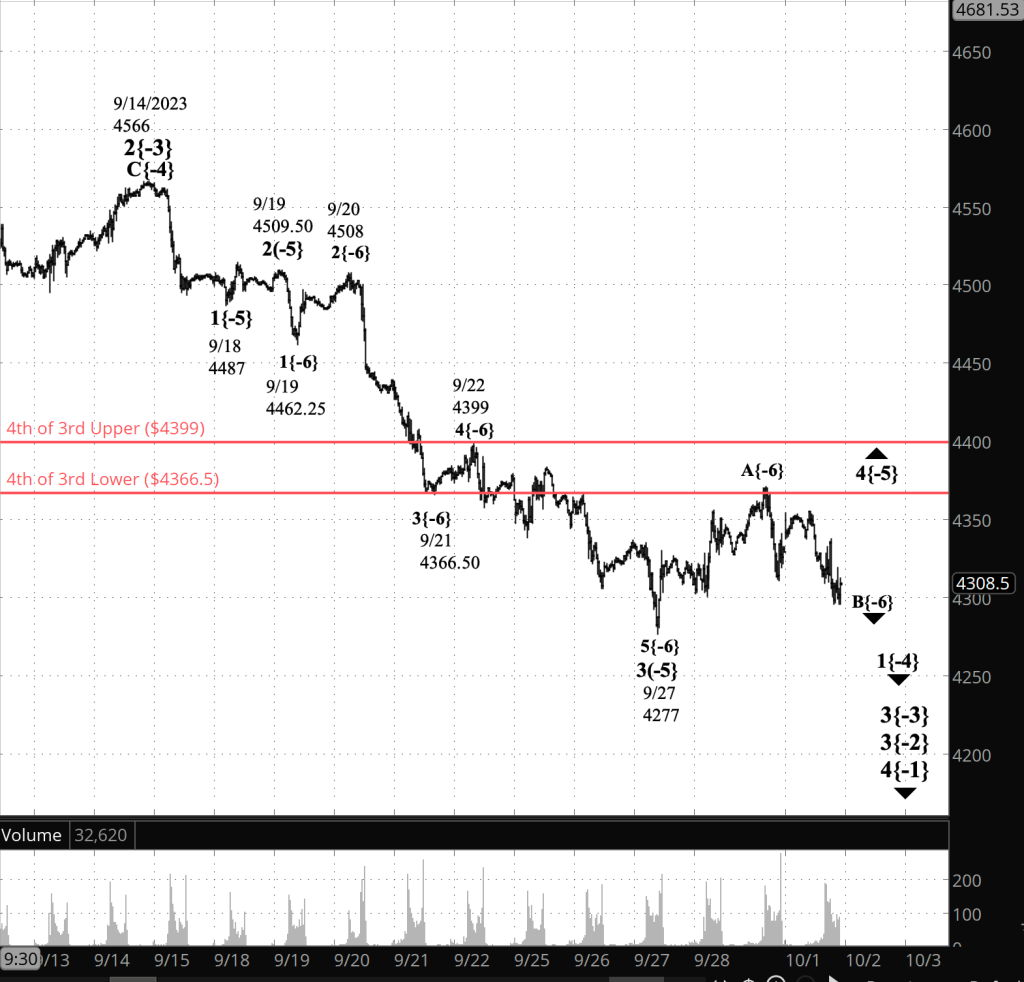
Half an hour before the closing bell. The S&P 500 futures fell further during the session, into the 4290s. The 2nd subwave, the B wave, of the 4th wave upward correction that began on September 27 continues and is in its final subwave. I’ve updated the chart.

9:35 a.m. New York time

What’s happening now? The S&P 500 E-mini futures declined overnight, from the 4350s to just below 4310.

What does it mean? The decline is part of the 3rd and final subwave of the B wave, the middle wave of the 4th wave upward correction that began on September 27. The rising C wave that will follow most likely will be the end of the correction, unless it takes a compound form, stringing together two or three corrective patterns.

The correction will be followed by a 5th wave downtrend which, when complete, will also be the end of the parent wave, a downtrending 1st wave that began on September 14. That 1st wave will be followed by a 2nd wave upward correction that will carry the price quite a distance upward, while remaining below the starting point of the preceding 1st wave, 4566.

This is all happening within a downtrending 3rd wave that began on September 14.

4th wave corrections tend to end within the range of the 4th subwave of the preceding 3rd wave. In this case that would be between 4366.50 and 4399. I’ve marked those price levels with red lines on the chart.

What are the alternatives? As always, there’s ambiguity in where the wave patterns are within the complex fractal structure of the chart. For the principal analysis I’ve labelled the upward correction as being two degrees below the 3rd wave. It’s possible that moving it up a degree, to one degree below the 3rd, will prove to be more accurate, or moving it down one degree, to three degrees below the 3rd, better describes what’s happening on the chart.

[S&P 500 E-mini futures at 3:30 p.m., 30-minute bars, with volume]

What does Elliott wave theory say? Here are the waves that underly the analyses.

Principal Analysis:

  • A downtrend, wave 3{-2}, began on July 27 and is underway.
  • Within wave 3{-2}, a smaller downtrend, wave 3{-3}, began on September 14 and is in its initial subwave, wave 1{-4}.
  • With wave 1{-4}, subwave 4{-5}, an upward correction, is underway, having begun on September 27 from 4277.
  • Wave 4{-5} is in its middle subwave, declining wave B{-6}.

Alternative Analysis

Two possibilities. Either…

  • Wave 4{-4} within downtrend 3{-3} is underway.

… or …

  • Wave 4{-6} within wave wave 1{-5} within wave 1{-4} is underway

Big picture:

  • The wave 3{-2} downtrend is a subwave of wave 4{-1}, a downtrend that began on January 4, 2022.
  • Wave 4{-1}, in turn, is a subwave of wave 5{0}, an expanding Diagonal Triangle that began on December 26, 2018.
  • Wave 4{-1} may eventually reach the lower boundary of wave 5{0}, presently slightly below 1800 and declining further each day.
  • Wave 4{-1} will be followed by rising wave 5{-1}, the final wave in the Triangle.

We Are Here.

These are the waves currently in progress under my principal analysis. Each line on the list shows the wave number, with the subscript in curly brackets, the traditional degree name, the starting date, the starting price of the S&P 500 E-mini futures, and the direction of the wave.

  • S&P 500 Index:
  • 5{+3} Supercycle, 7/8/1932, 4.40 (up)
  • 5{+2} Cycle, 12/9/1974, 60.96 (up)
  • 5{+1} Primary, 3/6/2009, 666.79 (up)
  • 5{0} Intermediate, 12/26/2018, 2346.58 (up)
  • S&P 500 Futures and index:
  • 4{-1} Minor, 1/4/2022, 4953.25 (down) (futures), 4818.62 (down) (index)
  • S&P 500 Futures:
  • 3{-2} Minute, 7/27/2023, 3502 (down)

Reading the chart. Price movements — waves – – in Elliott wave analysis are labeled with numbers within trending waves and letters with corrective waves. The subscripts — numbers in curly brackets — designate the wave’s degree, which, in Elliott wave analysis, means the relative position of a wave within the larger and smaller structures that make up the chart. R.N. Elliott, who in the 1930s developed the form of analysis that bears his name, viewed the chart as a complex structure of smaller waves nested within larger waves, which in turn are nested within still larger waves. In mathematics it’s called a fractal structure, where at every scale the pattern is similar to the others.

Learning and other resources. Elliott wave analysis provides context, not prophecy. As the 20th century semanticist Alfred Korzybski put it in his book Science and Sanity (1933), “The map is not the territory … The only usefulness of a map depends on similarity of structure between the empirical world and the map.” And I would add, in the ever-changing markets, we can judge that similarity of structure only after the fact.

See the menu page Analytical Methods for a rundown on where to go for information on Elliott wave analysis.

By Tim Bovee, Portland, Oregon, October 2, 2023

Disclaimer

Tim Bovee, Private Trader tracks the analysis and trades of a private trader for his own accounts. Nothing in this blog constitutes a recommendation to buy or sell stocks, options or any other financial instrument. The only purpose of this blog is to provide education and entertainment.

No trader is ever 100 percent successful in his or her trades. Trading in the stock and option markets is risky and uncertain. Each trader must make trading decisions for his or her own account, and take responsibility for the consequences.

License
Creative Commons License

All content on Tim Bovee, Private Trader by Timothy K. Bovee is licensed under a Creative Commons Attribution-ShareAlike 4.0 International License.

Based on a work at www.timbovee.com.
Trader’s Notebook

3:30 p.m. New York time

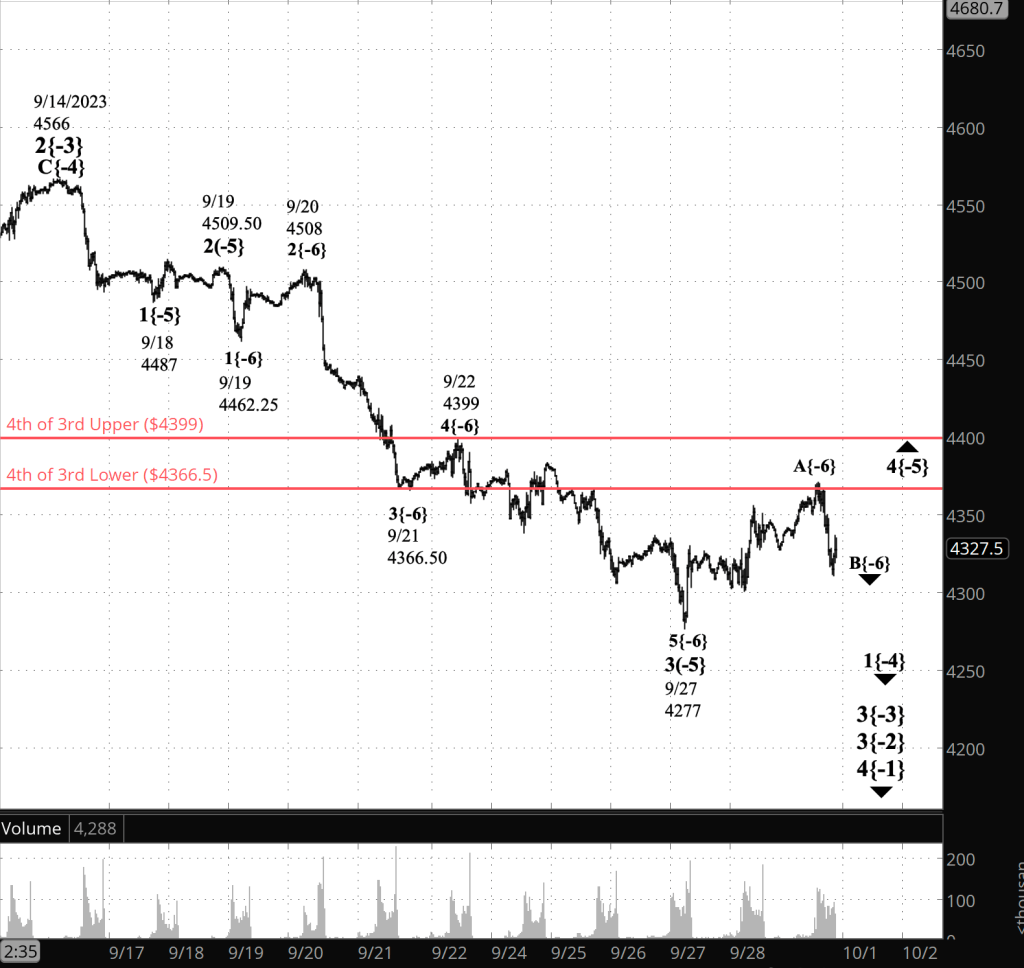
Half an hour before the closing bell. The S&P 500 futures reversed during the session, falling back to the 4310s.

The first subwave, the rising A wave, of the 4th wave upward correction is complete, and the falling B wave has begun. It will be followed by a rising C wave that will complete the correction, unless the correction takes a compound form.

The form of the correction is a Zigzag, since the A wave has five subwaves.

This morning’s alternative analysis has lost some of its credibility. See the note in the “What are the alternatives?” section bellow.

I’ve updated the chart.

9:35 a.m. New York time

What’s happening now? The S&P 500 E-mini futures rose overnight, into the 4370s.

What does it mean? The first leg of an upward correction that began on September 27 continues.

The correction is a 4th wave, and in Elliott Wave Theory, 4th waves have a tendency to end within the range of the 4th subwave within the preceding 3rd wave of the same degree.

That 4th subwave — labeled wave 4{-6} — rose from 4366.50 to 4399 in late September and can be considered the target of the rise. I’ve marked the upper and lower boundaries of that target in red on the chart.

The overnight rise moved slightly beyond the lower boundary. The tendency is the 4th wave to end at or below 4399, within the target range. However, that target reflects a tendency, not a firm rule, so the price could rise into the 4400s.

In any case, the rise will remain below the end of the preceding 1st wave of the same degree, wave 1{-5}, at 4487.

What are the alternatives? My analysis sees the rise so far as beng the first subwave of the correction, the A wave. It’s possible that the rise is a subwave of that A wave. As the cliche has it, Time will tell, and I’d add, only time can resolve the question.

Afternoon analysis. The reversal of the correction within the target range and the magnitude of the ensuing decline makes this alternative less likely, it seems to me.

[S&P 500 E-mini futures at 3:30 p.m., 25-minute bars, with volume]

What does Elliott wave theory say? Here are the waves that underly the analyses.

Principal Analysis:

  • A downtrend, wave 3{-2}, began on July 27 and is underway.
  • Within wave 3{-2}, a smaller downtrend, wave 3{-3}, began on September 14 and is in its initial subwave, wave 1{-4}.
  • With wave 1{-4}, subwave 4{-5}, an upward correction, is underway, having begun on September 27 from 4277.
  • Wave 4{-5} is in its middle subwave, declining wave B{-6}.

Alternative Analysis

  • Wave A{-5} is in its initial subwave, wave A{-6}, which in turn is in its first subwave.

Big picture:

  • The wave 3{-2} downtrend is a subwave of wave 4{-1}, a downtrend that began on January 4, 2022.
  • Wave 4{-1}, in turn, is a subwave of wave 5{0}, an expanding Diagonal Triangle that began on December 26, 2018.
  • Wave 4{-1} may eventually reach the lower boundary of wave 5{0}, presently slightly below 1800 and declining further each day.
  • Wave 4{-1} will be followed by rising wave 5{-1}, the final wave in the Triangle.

We Are Here.

These are the waves currently in progress under my principal analysis. Each line on the list shows the wave number, with the subscript in curly brackets, the traditional degree name, the starting date, the starting price of the S&P 500 E-mini futures, and the direction of the wave.

  • S&P 500 Index:
  • 5{+3} Supercycle, 7/8/1932, 4.40 (up)
  • 5{+2} Cycle, 12/9/1974, 60.96 (up)
  • 5{+1} Primary, 3/6/2009, 666.79 (up)
  • 5{0} Intermediate, 12/26/2018, 2346.58 (up)
  • S&P 500 Futures and index:
  • 4{-1} Minor, 1/4/2022, 4953.25 (down) (futures), 4818.62 (down) (index)
  • S&P 500 Futures:
  • 3{-2} Minute, 7/27/2023, 3502 (down)

Reading the chart. Price movements — waves – – in Elliott wave analysis are labeled with numbers within trending waves and letters with corrective waves. The subscripts — numbers in curly brackets — designate the wave’s degree, which, in Elliott wave analysis, means the relative position of a wave within the larger and smaller structures that make up the chart. R.N. Elliott, who in the 1930s developed the form of analysis that bears his name, viewed the chart as a complex structure of smaller waves nested within larger waves, which in turn are nested within still larger waves. In mathematics it’s called a fractal structure, where at every scale the pattern is similar to the others.

Learning and other resources. Elliott wave analysis provides context, not prophecy. As the 20th century semanticist Alfred Korzybski put it in his book Science and Sanity (1933), “The map is not the territory … The only usefulness of a map depends on similarity of structure between the empirical world and the map.” And I would add, in the ever-changing markets, we can judge that similarity of structure only after the fact.

See the menu page Analytical Methods for a rundown on where to go for information on Elliott wave analysis.

By Tim Bovee, Portland, Oregon, September 29, 2023

Disclaimer

Tim Bovee, Private Trader tracks the analysis and trades of a private trader for his own accounts. Nothing in this blog constitutes a recommendation to buy or sell stocks, options or any other financial instrument. The only purpose of this blog is to provide education and entertainment.

No trader is ever 100 percent successful in his or her trades. Trading in the stock and option markets is risky and uncertain. Each trader must make trading decisions for his or her own account, and take responsibility for the consequences.

License
Creative Commons License

All content on Tim Bovee, Private Trader by Timothy K. Bovee is licensed under a Creative Commons Attribution-ShareAlike 4.0 International License.

Based on a work at www.timbovee.com.
Trader’s Notebook

12:30 p.m. New York time

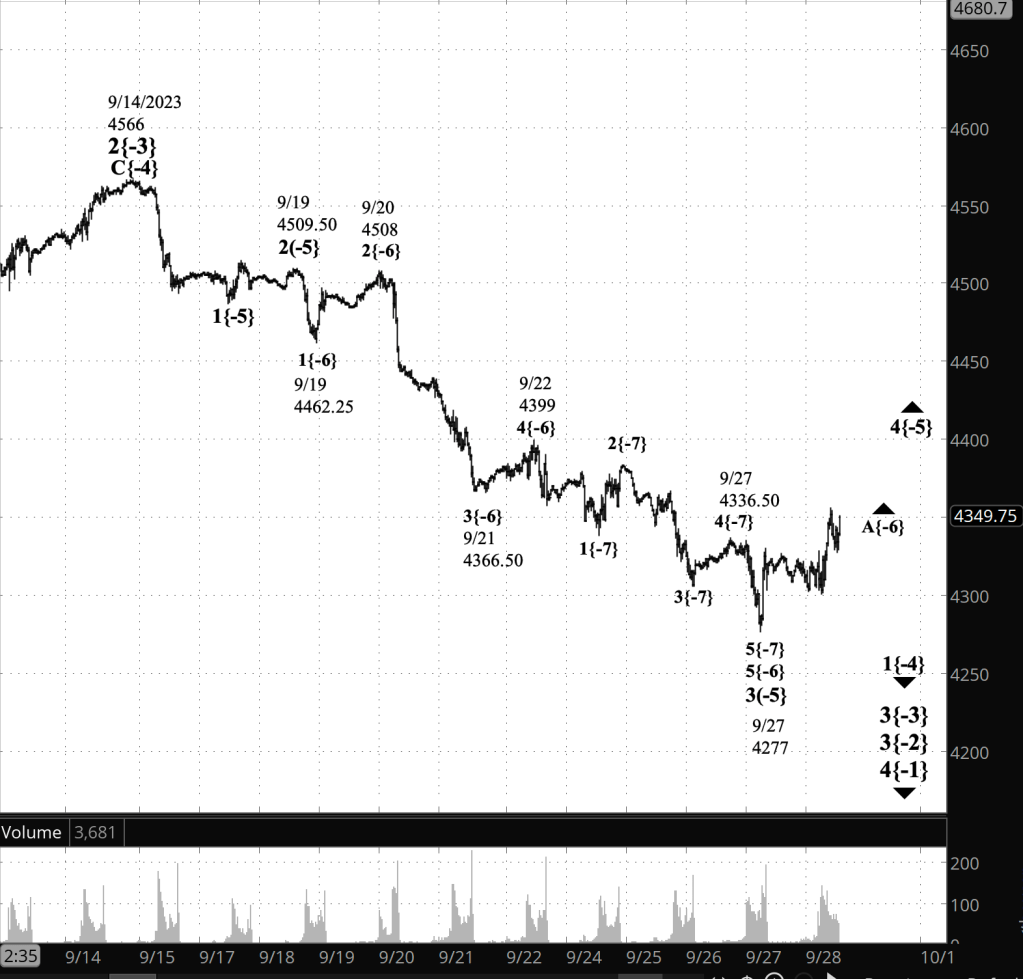
Half an hour before the closing bell. The S&P 500 futures moved above yesterday’s high, confirming that the downtrend that began on September 19 has ended and an upward correction has begun. The downtrend was wave 3{-5}, and the upward correction is wave 4{-5}.

Wave 3{-5} took eight days to reach completion, and the tendency toward proportionality within Elliott Wave Theory would suggest a similar span of time, give or take, for wave 4. That’s a tendency not a rule. Surprises sometimes happen.

A 4th wave usually has three subwaves. If it take the form of a Zigzag, the A subwave will contain five subwaves, and if a Flat, three subwaves. For both forms, the B wave has three subwaves and the C wave, five subwaves.

Under the rules of Elliott Wave Theory, a 4th wave cannot move beyond the end of the preceding 1st wave of the same degree. In this case, that’s wave 1{-5}, which ended on September 19 at 4462.25, and wave 4{-5} cannot move above that level.

I’ve updated the chart.

9:35 a.m. New York time

What’s happening now? The S&P 500 E-mini futures traded sideways overnight, swinging between slightly above 4300 and the 4320s.

What does it mean? A small upward correction is underway within the final subwave of a series of larger downtrends that, most importantly for understanding the market trend, is a 3rd wave decline that began on September 14 and is in its 1st subwave.

At a small level, the final subwave of the series, a 5th wave, will also complete a 5th wave one degree higher, and then a still larger 3rd wave that began on September 19 from 4509.50. That larger 3rd wave will be followed by a 4th-wave upward correction that likely will last for weeks and will be followed by a 5th wave downtrend that will carry the price into the 4200s and possibly lower.

What are the alternatives? The position of a wave within the vast fractal structure of a chart is ambiguous during the early stages of a trend.

I’ve chosen to treat the downtrend that began on September 14 as being in its 1st subwave, one degree lower. It’s possible that the count one degree lower is in fact be one degree higher, meaning that the downtrend is in its 3rd subwave. Or everything within 1st subwave could in fact be in its own 1st subwave, moving the smaller waves down a level.

[S&P 500 E-mini futures at 3:30 p.m., 25-minute bars, with volume]

What does Elliott wave theory say? Here are the waves that underly the analyses.

Principal Analysis:

  • A downtrend, wave 3{-2}, began on July 27 and is underway.
  • Within wave 3{-2}, a smaller downtrend, wave 3{-3}, began on September 14 and is in its initial subwave, wave 1{-4}.
  • With wave 1{-4}, subwave 4{-5}, an upward correction, is underway, having begun on September 27 from 4277.

Big picture:

  • The wave 3{-2} downtrend is a subwave of wave 4{-1}, a downtrend that began on January 4, 2022.
  • Wave 4{-1}, in turn, is a subwave of wave 5{0}, an expanding Diagonal Triangle that began on December 26, 2018.
  • Wave 4{-1} may eventually reach the lower boundary of wave 5{0}, presently slightly below 1800 and declining further each day.
  • Wave 4{-1} will be followed by rising wave 5{-1}, the final wave in the Triangle.

We Are Here.

These are the waves currently in progress under my principal analysis. Each line on the list shows the wave number, with the subscript in curly brackets, the traditional degree name, the starting date, the starting price of the S&P 500 E-mini futures, and the direction of the wave.

  • S&P 500 Index:
  • 5{+3} Supercycle, 7/8/1932, 4.40 (up)
  • 5{+2} Cycle, 12/9/1974, 60.96 (up)
  • 5{+1} Primary, 3/6/2009, 666.79 (up)
  • 5{0} Intermediate, 12/26/2018, 2346.58 (up)
  • S&P 500 Futures and index:
  • 4{-1} Minor, 1/4/2022, 4953.25 (down) (futures), 4818.62 (down) (index)
  • S&P 500 Futures:
  • 3{-2} Minute, 7/27/2023, 3502 (down)

Reading the chart. Price movements — waves – – in Elliott wave analysis are labeled with numbers within trending waves and letters with corrective waves. The subscripts — numbers in curly brackets — designate the wave’s degree, which, in Elliott wave analysis, means the relative position of a wave within the larger and smaller structures that make up the chart. R.N. Elliott, who in the 1930s developed the form of analysis that bears his name, viewed the chart as a complex structure of smaller waves nested within larger waves, which in turn are nested within still larger waves. In mathematics it’s called a fractal structure, where at every scale the pattern is similar to the others.

Learning and other resources. Elliott wave analysis provides context, not prophecy. As the 20th century semanticist Alfred Korzybski put it in his book Science and Sanity (1933), “The map is not the territory … The only usefulness of a map depends on similarity of structure between the empirical world and the map.” And I would add, in the ever-changing markets, we can judge that similarity of structure only after the fact.

See the menu page Analytical Methods for a rundown on where to go for information on Elliott wave analysis.

By Tim Bovee, Portland, Oregon, September 28, 2023

Disclaimer

Tim Bovee, Private Trader tracks the analysis and trades of a private trader for his own accounts. Nothing in this blog constitutes a recommendation to buy or sell stocks, options or any other financial instrument. The only purpose of this blog is to provide education and entertainment.

No trader is ever 100 percent successful in his or her trades. Trading in the stock and option markets is risky and uncertain. Each trader must make trading decisions for his or her own account, and take responsibility for the consequences.

License
Creative Commons License

All content on Tim Bovee, Private Trader by Timothy K. Bovee is licensed under a Creative Commons Attribution-ShareAlike 4.0 International License.

Based on a work at www.timbovee.com.

Trader’s Notebook

3:30 p.m. New York time

Half an hour before the closing bell. The S&P 500 futures fell during most of the session, reaching the 4270s before bouncing back a bit. I see the reversal, tentaytively, as being an upward correction within wave 5{-7}. A rise above 4336.50, the session high, would mean I need to revisit that view.

It’s also possible that wave 5{-7} ended at the session low, also completing waves 5{-6} and 3{-5}. and the initial wave within a larger upward correction, wave 4{-5}, has begun. I’ve updated the chart.

10:10 a.m. New York time

Limits to wave 4{-7}. The small upward correction now underway, wave 4{-7}, has a limit, like all 4th waves. In Elliott Wave Theory, a 4th wave cannot move beyond the end of the preceding 1st wave. If it does, then the chart must be re-analyzed.

In this case, wave 1{-7} ended on September 25 at 4338.25. If wave 4{-7} moves above that level. then I’ll redo the analysis.

9:35 a.m. New York time

What’s happening now? The S&P 500 E-mini futures rose overnight back into the 4330s.

What does it mean? In the following discussion I’ll be using the wave numbers and indicating the degree of a wave — it’s relative position within the fractal hierarchy that is a stock chart — with a subscript in curly brackets. The degree number is relative to the Intermediate degree, or degree {0}, in the nomenclature of Elliott Wave Theory.

The rise is a small 4th-wave upward correction within a series of increasingly larger downtrends. The largest began on January 4, 2022. The one most important for my trading is a 3rd wave, down two levels, that began on September 14, 2023, wave 3{-3} in the labeling system used on the chart.

Wave 3{-3} is presently in its 1st subwave, wave 1{-4}, which in turn is in its 3rd subwave, wave 3{-5}. Down one more degree, and the parent wave in its 5th subwave, wave 5{-6}, which means that wave 3{-5} is nearing its end. And the smallest degree that I’m tracking on the chart is down one more, the small 4th-wave upward correction mentioned above, wave 4{-7}.

Each downtrend will be followed by an upward correction and then another downtrend. Since the whole series of downtrends began nearly 21 months ago, we can expect repeated downtrends and upward corrections of varying degrees to be with us for quite some time.

What are the alternatives? The position of a wave within the vast fractal structure of a chart is ambiguous during the early stages of a trend. Labeling the degrees is a guess at best.

I’ve chosen to treat the downtrend that began on September 14 as being in its 1st subwave, one degree lower. It’s possible that the count one degree lower is in fact be one degree higher, meaning that the downtrend is in its 3rd subwave. Or everything within 1st subwave could in fact be in its own 1st subwave, moving the smaller waves down a level.

[S&P 500 E-mini futures at 3:30 p.m., 20-minute bars, with volume]

What does Elliott wave theory say? Here are the waves that underly the analyses.

Principal Analysis:

  • A downtrend, wave 3{-2}, began on July 27 and is underway.
  • Within wave 3{-2}, a smaller downtrend, wave 3{-3}, began on September 14 and is in its initial subwave, wave 1{-4}.
  • With wave 1{-4}, subwave 3{-5} is underway, having begun on September 1.
  • Wave 3{-5} is in its final subwave, wave 5{-6}.
  • Wave 5{-6} is in its next-to-the-last subwave, an upward correction, wave 4{-7}.

Alternative Analysis #1

  • Within wave 3{-3}, wave 3{-4} began on September 19.

Alternative Analysis #2

  • Within wave 3{-3}, wave 1{-4} began on September 19, and its subwave, wave 1{-5}, is underway.

Big picture:

  • The wave 3{-2} downtrend is a subwave of wave 4{-1}, a downtrend that began on January 4, 2022.
  • Wave 4{-1}, in turn, is a subwave of wave 5{0}, an expanding Diagonal Triangle that began on December 26, 2018.
  • Wave 4{-1} may eventually reach the lower boundary of wave 5{0}, presently slightly below 1800 and declining further each day.
  • Wave 4{-1} will be followed by rising wave 5{-1}, the final wave in the Triangle.

We Are Here.

These are the waves currently in progress under my principal analysis. Each line on the list shows the wave number, with the subscript in curly brackets, the traditional degree name, the starting date, the starting price of the S&P 500 E-mini futures, and the direction of the wave.

  • S&P 500 Index:
  • 5{+3} Supercycle, 7/8/1932, 4.40 (up)
  • 5{+2} Cycle, 12/9/1974, 60.96 (up)
  • 5{+1} Primary, 3/6/2009, 666.79 (up)
  • 5{0} Intermediate, 12/26/2018, 2346.58 (up)
  • S&P 500 Futures and index:
  • 4{-1} Minor, 1/4/2022, 4953.25 (down) (futures), 4818.62 (down) (index)
  • S&P 500 Futures:
  • 3{-2} Minute, 7/27/2023, 3502 (down)

Reading the chart. Price movements — waves – – in Elliott wave analysis are labeled with numbers within trending waves and letters with corrective waves. The subscripts — numbers in curly brackets — designate the wave’s degree, which, in Elliott wave analysis, means the relative position of a wave within the larger and smaller structures that make up the chart. R.N. Elliott, who in the 1930s developed the form of analysis that bears his name, viewed the chart as a complex structure of smaller waves nested within larger waves, which in turn are nested within still larger waves. In mathematics it’s called a fractal structure, where at every scale the pattern is similar to the others.

Learning and other resources. Elliott wave analysis provides context, not prophecy. As the 20th century semanticist Alfred Korzybski put it in his book Science and Sanity (1933), “The map is not the territory … The only usefulness of a map depends on similarity of structure between the empirical world and the map.” And I would add, in the ever-changing markets, we can judge that similarity of structure only after the fact.

See the menu page Analytical Methods for a rundown on where to go for information on Elliott wave analysis.

By Tim Bovee, Portland, Oregon, September 27, 2023

Disclaimer

Tim Bovee, Private Trader tracks the analysis and trades of a private trader for his own accounts. Nothing in this blog constitutes a recommendation to buy or sell stocks, options or any other financial instrument. The only purpose of this blog is to provide education and entertainment.

No trader is ever 100 percent successful in his or her trades. Trading in the stock and option markets is risky and uncertain. Each trader must make trading decisions for his or her own account, and take responsibility for the consequences.

License
Creative Commons License

All content on Tim Bovee, Private Trader by Timothy K. Bovee is licensed under a Creative Commons Attribution-ShareAlike 4.0 International License.

Based on a work at www.timbovee.com.
Trader’s Notebook

3:30 p.m. New York time

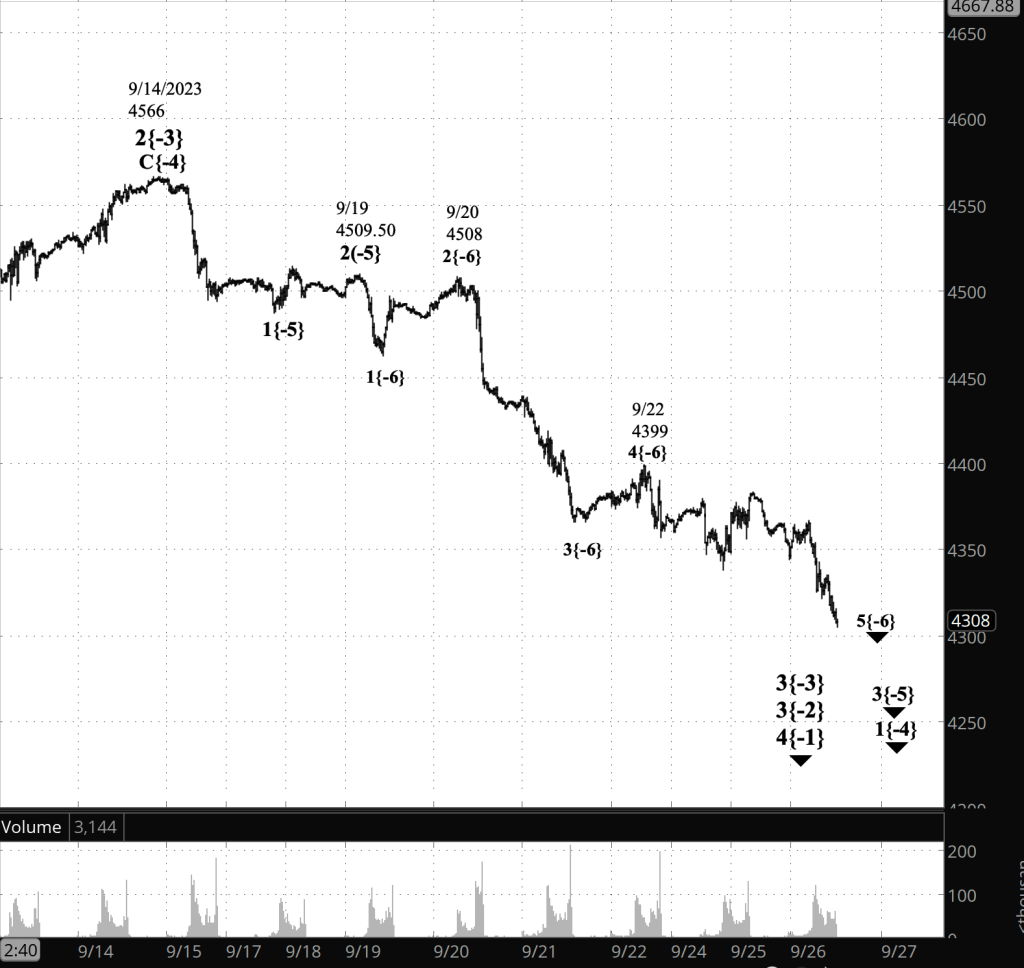
Half an hour before the closing bell. The S&P 500 futures fell during the session, reaching below 4310. A small downtrend that began on September 22 is nearing its end. It is a subwave within a much larger downtrend that began on September 14. I’ve tinkered a bit with the small-wave labeling, changing wave 3{-6} to 5{-6}, and have updated the chart.

9:35 a.m. New York time

What’s happening now? The S&P 500 E-mini futures fell from the 4380s to the 4340s in the early hours of overnight trading, and then traded narrowly in the 4350s and 4360s as the opening bell drew closer.

What does it mean? The pause is a 4th wave upward correction, part of a small downtrending subwave within the larger downtrend that began on September 14 from 4566. The larger downtrend is in its 1st wave, and internally, that 1st wave is in its 3rd subwave.

A trend has five subwaves, and 1st waves are often the shortest of the three internal waves moving in the direction of the trend. Also, 3rd waves are often the longest and — a firm rule — never the shortest.

What are the alternatives? This alternatives, identical to yesterday’s, will be with us for awhile.

Always when a trend is in its early stages, the position of a wave within the vast fractal structure of a chart is ambiguous. I’ve chosen to treat the downtrend that began on September 14 as being in its 1st subwave, one degree lower. It’s possible that the count one degree lower is in fact be one degree higher, meaning that the downtrend is in its 3rd subwave. Or everything within 1st subwave could in fact be in its own 1st subwave, moving the smaller waves down a level.

[S&P 500 E-mini futures at 3:30 p.m., 20-minute bars, with volume]

What does Elliott wave theory say? Here are the waves that underly the analyses.

Principal Analysis:

  • A downtrend, wave 3{-2}, began on July 27 and is underway.
  • Within wave 3{-2}, a smaller downtrend, wave 3{-3}, began on September 14 and is in its initial subwave, wave 1{-4}.
  • With wave 1{-4}, subwave 3{-5} is underway, having begun on September 1.
  • Wave 3{-5} is in its final subwave, wave 5{-6}.

Alternative Analysis #1

  • Within wave 3{-3}, wave 3{-4} began on September 19.

Alternative Analysis #2

  • Within wave 3{-3}, wave 1{-4} began on September 19, and its subwave, wave 1{-5}, is underway.

Big picture:

  • The wave 3{-2} downtrend is a subwave of wave 4{-1}, a downtrend that began on January 4, 2022.
  • Wave 4{-1}, in turn, is a subwave of wave 5{0}, an expanding Diagonal Triangle that began on December 26, 2018.
  • Wave 4{-1} may eventually reach the lower boundary of wave 5{0}, presently slightly below 1800 and declining further each day.
  • Wave 4{-1} will be followed by rising wave 5{-1}, the final wave in the Triangle.

We Are Here.

These are the waves currently in progress under my principal analysis. Each line on the list shows the wave number, with the subscript in curly brackets, the traditional degree name, the starting date, the starting price of the S&P 500 E-mini futures, and the direction of the wave.

  • S&P 500 Index:
  • 5{+3} Supercycle, 7/8/1932, 4.40 (up)
  • 5{+2} Cycle, 12/9/1974, 60.96 (up)
  • 5{+1} Primary, 3/6/2009, 666.79 (up)
  • 5{0} Intermediate, 12/26/2018, 2346.58 (up)
  • S&P 500 Futures and index:
  • 4{-1} Minor, 1/4/2022, 4953.25 (down) (futures), 4818.62 (down) (index)
  • S&P 500 Futures:
  • 3{-2} Minute, 7/27/2023, 3502 (down)

Reading the chart. Price movements — waves – – in Elliott wave analysis are labeled with numbers within trending waves and letters with corrective waves. The subscripts — numbers in curly brackets — designate the wave’s degree, which, in Elliott wave analysis, means the relative position of a wave within the larger and smaller structures that make up the chart. R.N. Elliott, who in the 1930s developed the form of analysis that bears his name, viewed the chart as a complex structure of smaller waves nested within larger waves, which in turn are nested within still larger waves. In mathematics it’s called a fractal structure, where at every scale the pattern is similar to the others.

Learning and other resources. Elliott wave analysis provides context, not prophecy. As the 20th century semanticist Alfred Korzybski put it in his book Science and Sanity (1933), “The map is not the territory … The only usefulness of a map depends on similarity of structure between the empirical world and the map.” And I would add, in the ever-changing markets, we can judge that similarity of structure only after the fact.

See the menu page Analytical Methods for a rundown on where to go for information on Elliott wave analysis.

By Tim Bovee, Portland, Oregon, September 26, 2023

Disclaimer

Tim Bovee, Private Trader tracks the analysis and trades of a private trader for his own accounts. Nothing in this blog constitutes a recommendation to buy or sell stocks, options or any other financial instrument. The only purpose of this blog is to provide education and entertainment.

No trader is ever 100 percent successful in his or her trades. Trading in the stock and option markets is risky and uncertain. Each trader must make trading decisions for his or her own account, and take responsibility for the consequences.

License
Creative Commons License

All content on Tim Bovee, Private Trader by Timothy K. Bovee is licensed under a Creative Commons Attribution-ShareAlike 4.0 International License.

Based on a work at www.timbovee.com.
SPY Trade

S&P 500 ETF Trust (SPY)

Lot 2023-4

Update 10/3/2023: I exited my short bear call vertical spread on SPY, 45 days before expiration, for a $1.13 debit per contract/share, a profit before fees of $112 per contract. Shares were trading at $421.42, down $9.14 from the entry level.

The Implied Volatility Rank at exit was 32.7%, up 9.2 points from the entry level.

I exited because the position reached 50% of maximum potential profit, my normal exit point for options positions.

Shares fell by 2.1% over eight days for a -97% annual rate. The options position produced a 99.1% return for a +4,522% annual rate.


I have entered a short bear call vertical spread on SPY, using options that trade for the last time 53 days hence, on November 17. The premium is a $2.25 credit per contract share and the stock at the time of entry was priced at $430.56.

The Implied Volatility Ratio stood at 23.6%.

Premium:$2.25Expire OTM
SPY-bear call spreadStrikeOddsDelta
Calls
Long458.0087.0%12
Break-even450.2580.5%18.5
Short448.0074.0%25

The premium is 45% of the width of the short/long spread. The profit zone covers a 4.6% move to the upside and an unlimited move to the downside.

The risk/reward ratio is 3.4 :1, with maximum risk of $775 and maximum reward of $225 per contract.

How I chose the trade. I chose the traded based on Elliott wave analysis, which concludes that a downtrend is underway. I selected the short strike price based on the expected range of the expiration close, based on the options pricing.

By Tim Bovee, Portland, Oregon, September 25, 2023

Disclaimer

Tim Bovee, Private Trader tracks the analysis and trades of a private trader for his own accounts. Nothing in this blog constitutes a recommendation to buy or sell stocks, options or any other financial instrument. The only purpose of this blog is to provide education and entertainment.

No trader is ever 100 percent successful in his or her trades. Trading in the stock and option markets is risky and uncertain. Each trader must make trading decisions for his or her own account, and take responsibility for the consequences.

License
Creative Commons License

All content on Tim Bovee, Private Trader by Timothy K. Bovee is licensed under a Creative Commons Attribution-ShareAlike 4.0 International License.

Based on a work at www.timbovee.com.
Trader’s Notebook

3:30 p.m. New York time

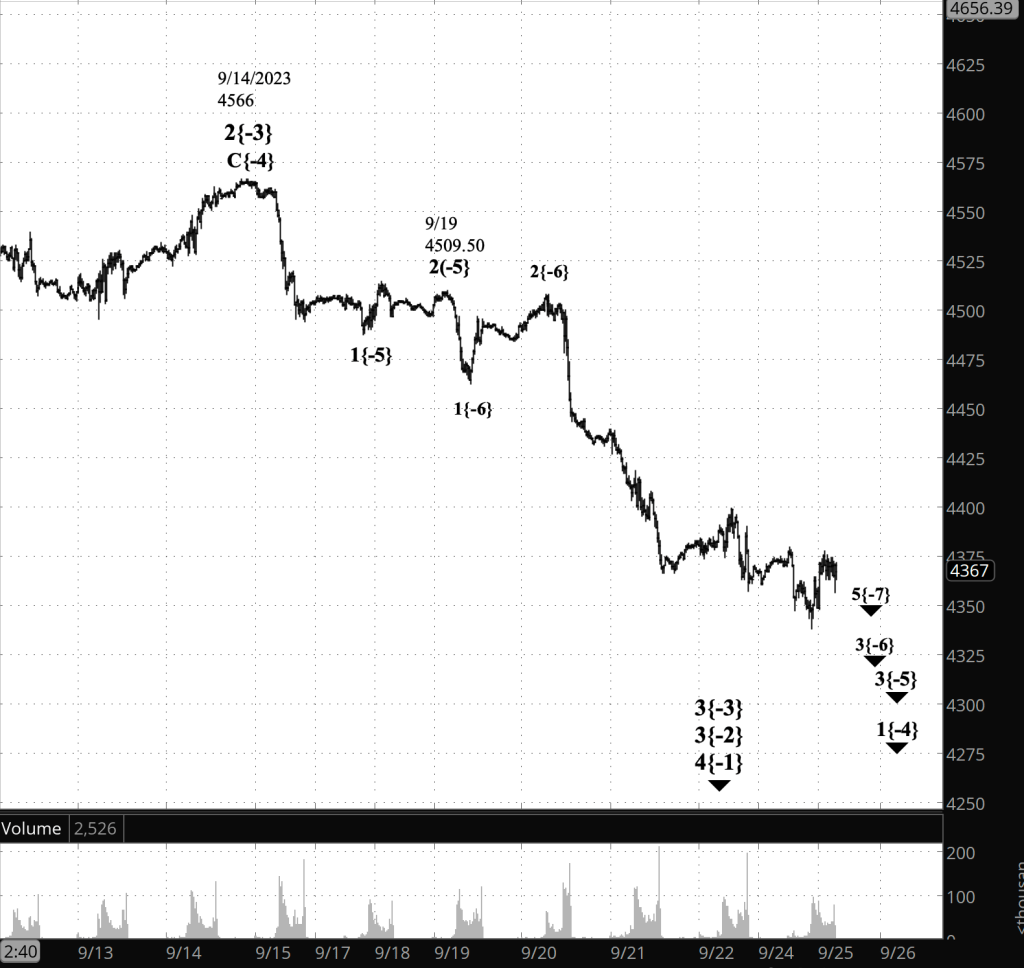
Half an hour before the closing bell. The S&P 500 futures traded narrowly during the session, staying between almost 4380 and almost 4340.

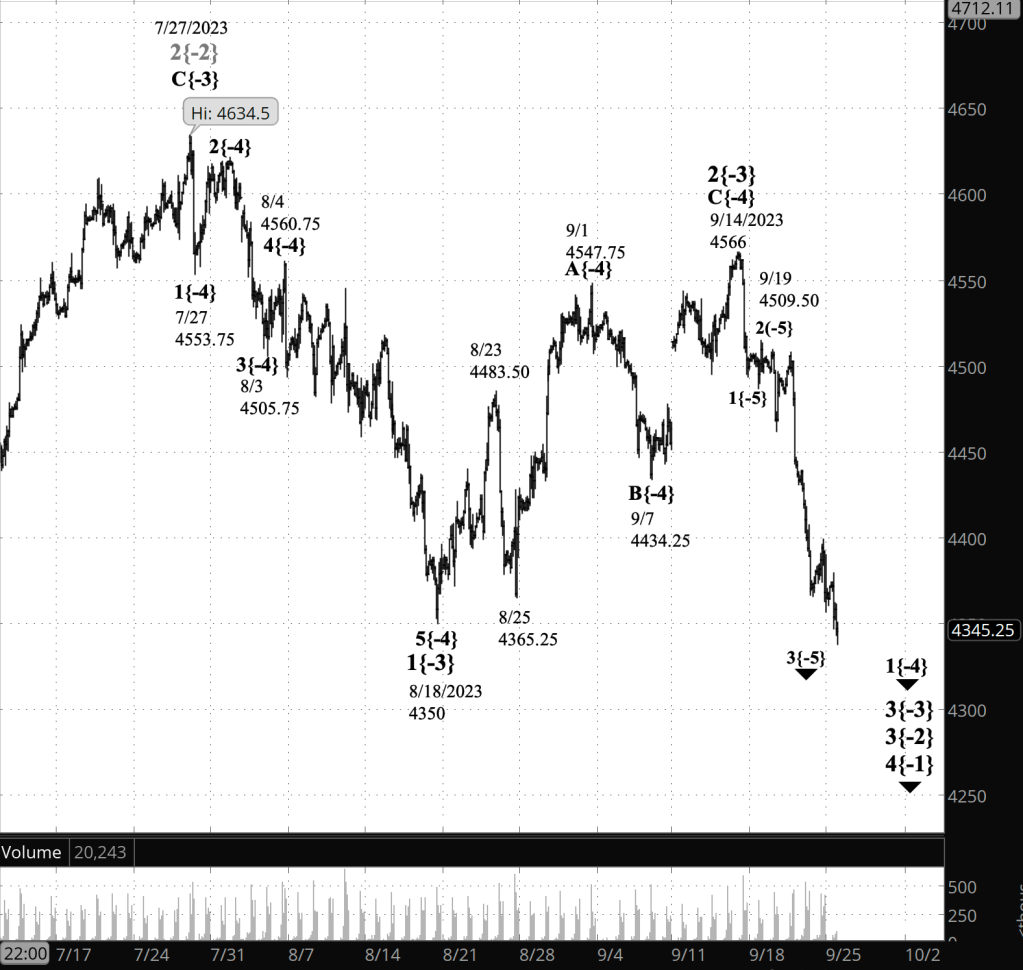
I’ve added a second chart focusing more closely on the 3rd wave downtrend that began on September 14. For comparison I’ve retained this morning’s chart, which has a longer view that includes the larger 3rd wave downtrend that began on July 27.

The close-up chart includes more detailed wave numberings one degree lower than the morning chart.

Long story short, the 3rd wave downtrend that began on September 14 internally is in its 1st subwave, which is in its 3rd subwave, which in turn is in its 3rd subwave. After the 1st wave one degree down from the September 14 trend as a whole, its 3rds down two more degrees.

This morning’s analysis is unchanged.

[S&P 500 E-mini futures at 12:30 p.m., 20-minute bars, with volume]

10:15 a.m. New York time

SPY bear call spread entry. I have entered a short bear call spread on SPY, using options that expire on November 17, and have posted an analysis of the trade.

9:35 a.m. New York time

What’s happening now? The S&P 500 futures fell below 4350, the start of the month-long upward correction. Elliott wave theory confirms that a powerful 3rd-wave decline is underway.

It joined both the S&P 500 index and the exchange-traded fund that tracks the index, SPY, in declining below the start of the 2nd-wave correction that began on August 18.

The break below that level redefined the game, and I have reanalyzed the chart.

What does it mean? The move below 4350 on the futures breaks a firm rule in Elliott Wave Theory. The correction took the form of a Zigzag (5 subaves the 1st subwave, 3 in the second, and 5 in the 3rd). A Zigzag correction cannot move beyond the end of the preceding 1st wave. If it does, then something else is going on.

All three of the three major measures of the S&P 500 have broken below the start of the 2nd wave correction.

Here’s the new map of the terrain: The 2nd wave upward correction that began on August 18 ended on September 14. A powerful 3rd wave downtrend began at that point and is presently in its 1st subwave. The 1st subwave, in turn, is in its 3rd subwave, the middle wave of five.

Friday’s Trader’s Notebook, like those all week, had the correction as still being underway, while acknowledging the ambiguity of the chart at that moment with a number of alternative possibilities. With the fall below the correction’s starting point, the ambiguity disappears. The downtrend is underway. The alternative analysis first posted on Monday, September 18, is the better match for the chart.

What are the alternatives? Always when a trend is in its early stages, the position of a wave within the vast fractal structure of a chart is ambiguous. I’ve chosen to treat the downtrend that began on September 14 as being in its 1st subwave, one degree lower. It’s possible that the count one degree lower is in fact be one degree higher, meaning that the downtrend is in its 3rd subwave. Or everything within 1st subwave could in fact be in its own 1st subwave, moving the smaller waves down a level.

The relative positioning will become clear as the trend develops.

[S&P 500 E-mini futures at 9:35 a.m., 2-hour bars, with volume]

What does Elliott wave theory say? Here are the waves that underly the analyses.

Principal Analysis:

  • A downtrend, wave 3{-2}, began on July 27 and is underway.
  • Within wave 3{-2}, a smaller downtrend, wave 3{-3}, began on September 14 and is in its initial subwave, wave 1{-4}.
  • With wave 1{-4}, subwave 3{-5} is underway, having begun on September 1.
  • Wave 3{-5} is in its middle subwave, wave 3{-6}.

Alternative Analysis #1

  • Within wave 3{-3}, wave 3{-4} began on September 19.

Alternative Analysis #2

  • Within wave 3{-3}, wave 1{-4} began on September 19, and its subwave, wave 1{-5}, is underway.

Big picture:

  • The wave 3{-2} downtrend is a subwave of wave 4{-1}, a downtrend that began on January 4, 2022.
  • Wave 4{-1}, in turn, is a subwave of wave 5{0}, an expanding Diagonal Triangle that began on December 26, 2018.
  • Wave 4{-1} may eventually reach the lower boundary of wave 5{0}, presently slightly below 1800 and declining further each day.
  • Wave 4{-1} will be followed by rising wave 5{-1}, the final wave in the Triangle.

We Are Here.

These are the waves currently in progress under my principal analysis. Each line on the list shows the wave number, with the subscript in curly brackets, the traditional degree name, the starting date, the starting price of the S&P 500 E-mini futures, and the direction of the wave.

  • S&P 500 Index:
  • 5{+3} Supercycle, 7/8/1932, 4.40 (up)
  • 5{+2} Cycle, 12/9/1974, 60.96 (up)
  • 5{+1} Primary, 3/6/2009, 666.79 (up)
  • 5{0} Intermediate, 12/26/2018, 2346.58 (up)
  • S&P 500 Futures and index:
  • 4{-1} Minor, 1/4/2022, 4953.25 (down) (futures), 4818.62 (down) (index)
  • S&P 500 Futures:
  • 3{-2} Minute, 7/27/2023, 3502 (down)

Reading the chart. Price movements — waves – – in Elliott wave analysis are labeled with numbers within trending waves and letters with corrective waves. The subscripts — numbers in curly brackets — designate the wave’s degree, which, in Elliott wave analysis, means the relative position of a wave within the larger and smaller structures that make up the chart. R.N. Elliott, who in the 1930s developed the form of analysis that bears his name, viewed the chart as a complex structure of smaller waves nested within larger waves, which in turn are nested within still larger waves. In mathematics it’s called a fractal structure, where at every scale the pattern is similar to the others.

Learning and other resources. Elliott wave analysis provides context, not prophecy. As the 20th century semanticist Alfred Korzybski put it in his book Science and Sanity (1933), “The map is not the territory … The only usefulness of a map depends on similarity of structure between the empirical world and the map.” And I would add, in the ever-changing markets, we can judge that similarity of structure only after the fact.

See the menu page Analytical Methods for a rundown on where to go for information on Elliott wave analysis.

By Tim Bovee, Portland, Oregon, September 25, 2023

Disclaimer

Tim Bovee, Private Trader tracks the analysis and trades of a private trader for his own accounts. Nothing in this blog constitutes a recommendation to buy or sell stocks, options or any other financial instrument. The only purpose of this blog is to provide education and entertainment.

No trader is ever 100 percent successful in his or her trades. Trading in the stock and option markets is risky and uncertain. Each trader must make trading decisions for his or her own account, and take responsibility for the consequences.

License
Creative Commons License

All content on Tim Bovee, Private Trader by Timothy K. Bovee is licensed under a Creative Commons Attribution-ShareAlike 4.0 International License.

Based on a work at www.timbovee.com.
Trader’s Notebook

3:30 p.m. New York time

Half an hour before the closing bell. The S&P 500 futures reached a few points below the overnight low during the session and then rose, reaching a session high so far of 4399.

The rise provides confirmation that the third leg of the upward correction, the C wave, is now underway.

I’ve updated the chart.

9:35 a.m. New York time

What’s happening now? The S&P 500 E-mini futures reached a low of 4366 overnight and then rose back into the 4390s.

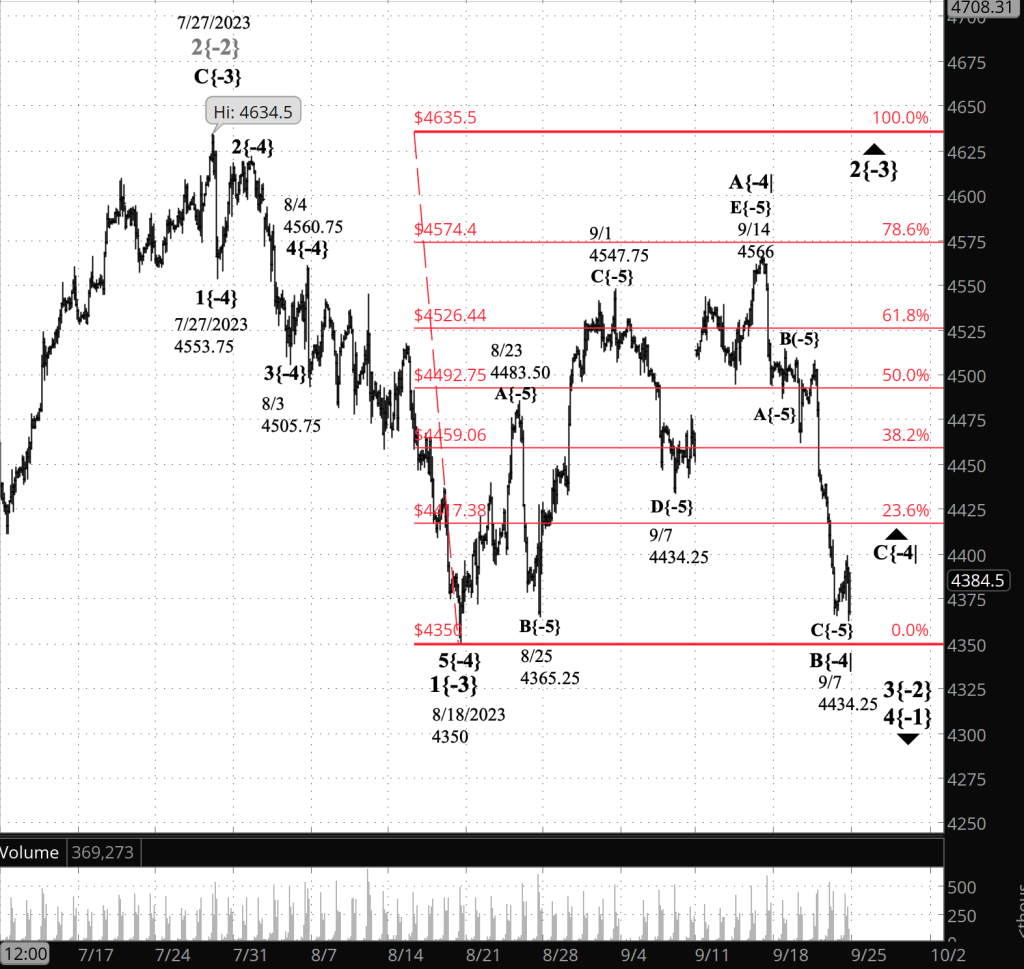
What does it mean? The decline brought the price to within $16 of starting point of the upward correction that began on August 18, from 4350. Had the price fallen below that level, it would have discredited the present Principal Analysis and replaced it with Alternative #1, a scenario that the 2nd wave upward correction ended on September 14 and a 3rd have downtrend has begun.

However, the line remained uncrossed, and the Principal Analysis scenario is that the 2nd wave continues, the corrective pattern is in its 3rd and final leg, a C wave, and the overnight low was the end of a wave B{-4}, the middle leg of the corrective pattern.

The rise that followed is the 3rd leg, wave C, and is still underway. It’s end will also be the completion of the corrective pattern.

At that point, one of two things will happen: Either the end of the corrective pattern will also be the end of the upward correction — the likeliest scenario — or the correction will take a compound form, in which the first corrective pattern will be followed by a declining connector wav and then by a second corrective pattern. Compound corrections can contain as many as three corrective patterns.

Whatever form the 2nd wave upward correction takes, it will be followed by a 3rd wave downtrend that will fall below 4350 and almost certainly far below that price.

I’ve overlaid the chart with the Fibonacci ladder, in red, the better to understand how much of the preceding 1st wave has been retraed by the correction. The A-wave peak, 4566, was close to a 78.6% Fibonacci retracement, and if wave C is typical, it wil reach or exceed that level;.

What are the alternatives? Two other interpretations are possible.

It’s possible that the entire corrective pattern within wave 2{-3} ended at the September 14 high. If so, then there are two possibilities.

Alternative #1

The upward correction ended on September 14 and a powerful 3rd wave downtrend has begun and is in its initial subwave. The downtrend will have five subwaves altogether. If the price goes below 4350, this scenario will become the Principal Analysis.

Alternative #2

The correction is taking a compound form, containing two or three corrective patterns. The present decline is a wave that will connect the now complete first corrective pattern with a second corrective pattern.

[S&P 500 E-mini futures at 3:30 p.m., 2-hour bars, with volume]

What does Elliott wave theory say? Here are the waves that underly the analyses.

Principal Analysis:

  • A downtrend wave 3{-2}, began on July 27 and is underway.
  • Within wave 3{-2}, wave 2{-3}, an upward correction, began on August 18 and is in its final subwave, rising wave C{-4}.
  • The corrective pattern is taking the form of a Zigzag, with five subwaves within wave A{-4}.

Alternative Analysis #1

  • Wave 2(-3} ended on September 14.
  • The decline that followed is downtrending wave wave 3{-3}.

Alternative Analysis #2

  • Wave 2(-3}’s first corrective pattern ended on September 14 and the upward correction continues, taking a compound form.
  • The decline that followed is wave X{-4}, connecting the completed first corrective with a future second corrective pattern.

Big picture:

  • The wave 3{-2} downtrend is a subwave of wave 4{-1}, a downtrend that began on January 4, 2022.
  • Wave 4{-1}, in turn, is a subwave of wave 5{0}, an expanding Diagonal Triangle that began on December 26, 2018.
  • Wave 4{-1} may eventually reach the lower boundary of wave 5{0}, presently slightly below 1800 and declining further each day.
  • Wave 4{-1} will be followed by rising wave 5{-1}, the final wave in the Triangle.

We Are Here.

These are the waves currently in progress under my principal analysis. Each line on the list shows the wave number, with the subscript in curly brackets, the traditional degree name, the starting date, the starting price of the S&P 500 E-mini futures, and the direction of the wave.

  • S&P 500 Index:
  • 5{+3} Supercycle, 7/8/1932, 4.40 (up)
  • 5{+2} Cycle, 12/9/1974, 60.96 (up)
  • 5{+1} Primary, 3/6/2009, 666.79 (up)
  • 5{0} Intermediate, 12/26/2018, 2346.58 (up)
  • S&P 500 Futures and index:
  • 4{-1} Minor, 1/4/2022, 4953.25 (down) (futures), 4818.62 (down) (index)
  • S&P 500 Futures:
  • 3{-2} Minute, 7/27/2023, 3502 (down)

Reading the chart. Price movements — waves – – in Elliott wave analysis are labeled with numbers within trending waves and letters with corrective waves. The subscripts — numbers in curly brackets — designate the wave’s degree, which, in Elliott wave analysis, means the relative position of a wave within the larger and smaller structures that make up the chart. R.N. Elliott, who in the 1930s developed the form of analysis that bears his name, viewed the chart as a complex structure of smaller waves nested within larger waves, which in turn are nested within still larger waves. In mathematics it’s called a fractal structure, where at every scale the pattern is similar to the others.

Learning and other resources. Elliott wave analysis provides context, not prophecy. As the 20th century semanticist Alfred Korzybski put it in his book Science and Sanity (1933), “The map is not the territory … The only usefulness of a map depends on similarity of structure between the empirical world and the map.” And I would add, in the ever-changing markets, we can judge that similarity of structure only after the fact.

See the menu page Analytical Methods for a rundown on where to go for information on Elliott wave analysis.

By Tim Bovee, Portland, Oregon, September 22, 2023

Disclaimer

Tim Bovee, Private Trader tracks the analysis and trades of a private trader for his own accounts. Nothing in this blog constitutes a recommendation to buy or sell stocks, options or any other financial instrument. The only purpose of this blog is to provide education and entertainment.

No trader is ever 100 percent successful in his or her trades. Trading in the stock and option markets is risky and uncertain. Each trader must make trading decisions for his or her own account, and take responsibility for the consequences.

License
Creative Commons License

All content on Tim Bovee, Private Trader by Timothy K. Bovee is licensed under a Creative Commons Attribution-ShareAlike 4.0 International License.

Based on a work at www.timbovee.com.

Trader’s Notebook

3:30 p.m. New York Time

Half an hour before the closing bell. The S&P 500 futures continue to fall during the session, reaching into the 4370s so far.

This morning’s analysis is unchanged. Wave C{-5} within wave B{-4} within the downward correction, wave 2{-3}, continues. I’ve updated the chart.

9:35 a.m. New York time

What’s happening now? The S&P 500 E-mini futures fell continually overnight, from the 4440s to just above 4400 so far.

What does it mean? There are three ways of interpreting the chart. The following discussion will require the use of wave labels as they appear on the chart. See the “Reading the chart” section below.

Under my principal analysis, wave 2{-3}, a downward correction that began on August 18, continues and is in its second subwave, falling wave B{-4}. The B wave in turn is in its 3rd and final subwave, wave C{-5}.

Wave B{-4} will be followed by rising wave C{-4}, the final wave in the corrective pattern, which will likely carry the price above the wave A{-4} end point, 4566.

This scenario implies a limit. The corrective pattern is taking the form of a Zigzag, and under the rules of Elliott Wave Theory, no B wave in a Zigzag can move below the start of the preceding A wave. That level is 4350 in this case, and if the price moves below that level, then the principal analysis will be invalidated and the chart will require reanalysis.

When wave 2{-3} is complete, it will be followed by a powerful downtrend, wave 3{-3}, which will carry the price below 4350, and likely significantly lower.

The Fibonacci retracement ladder is shown on the chart in red. It tracks wave 2{-3}’s percentage retracement of the preceding wave 1{-3}, which began its decline on July 27 from 4634.50. The decline has carried the price back below the 23.6% Fibonacci retracement level from a starting point close to the 78.6% Fib level.

What are the alternatives? Two other interpretations are possible.

It’s possible that the entire corrective pattern within wave 2{-3} ended at the September 14 high. If so, then there are two possibilities.

Alternative #1

Wave 2{-3} ended on September 14 and a powerful downtrend, wave 3{-3}, has begun and is in its initial subwave, wave 1{-4}. It will have five subwaves altogether.

Alternative #2

Wave 2{-3} is taking a compound form, containing two or three corrective patterns. The present decline is wave X{-4}, a wave that will connect the now complete first corrective pattern with a second corrective pattern.

[S&P 500 E-mini futures at 3:30 p.m., 2-hour bars, with volume]

What does Elliott wave theory say? Here are the waves that underly the analyses.

Principal Analysis:

  • A downtrend wave 3{-2}, began on July 27 and is underway.
  • Within wave 3{-2}, wave 2{-3}, an upward correction, began on August 18 and is in its middle subwave, declining wave B{-4}.
  • The corrective pattern is taking the form of a Zigzag, with five subwaves within wave A{-4}.

Alternative Analysis #1

  • Wave 2(-3} ended on September 14.
  • The decline that followed is downtrending wave wave 3{-3}.

Alternative Analysis #2

  • Wave 2(-3}’s first corrective pattern ended on September 14 and the upward correction continues, taking a compound form.
  • The decline that followed is wave X{-4}, connecting the completed first corrective with a future second corrective pattern.

Big picture:

  • The wave 3{-2} downtrend is a subwave of wave 4{-1}, a downtrend that began on January 4, 2022.
  • Wave 4{-1}, in turn, is a subwave of wave 5{0}, an expanding Diagonal Triangle that began on December 26, 2018.
  • Wave 4{-1} may eventually reach the lower boundary of wave 5{0}, presently slightly below 1800 and declining further each day.
  • Wave 4{-1} will be followed by rising wave 5{-1}, the final wave in the Triangle.

We Are Here.

These are the waves currently in progress under my principal analysis. Each line on the list shows the wave number, with the subscript in curly brackets, the traditional degree name, the starting date, the starting price of the S&P 500 E-mini futures, and the direction of the wave.

  • S&P 500 Index:
  • 5{+3} Supercycle, 7/8/1932, 4.40 (up)
  • 5{+2} Cycle, 12/9/1974, 60.96 (up)
  • 5{+1} Primary, 3/6/2009, 666.79 (up)
  • 5{0} Intermediate, 12/26/2018, 2346.58 (up)
  • S&P 500 Futures and index:
  • 4{-1} Minor, 1/4/2022, 4953.25 (down) (futures), 4818.62 (down) (index)
  • S&P 500 Futures:
  • 3{-2} Minute, 7/27/2023, 3502 (down)

Reading the chart. Price movements — waves – – in Elliott wave analysis are labeled with numbers within trending waves and letters with corrective waves. The subscripts — numbers in curly brackets — designate the wave’s degree, which, in Elliott wave analysis, means the relative position of a wave within the larger and smaller structures that make up the chart. R.N. Elliott, who in the 1930s developed the form of analysis that bears his name, viewed the chart as a complex structure of smaller waves nested within larger waves, which in turn are nested within still larger waves. In mathematics it’s called a fractal structure, where at every scale the pattern is similar to the others.

Learning and other resources. Elliott wave analysis provides context, not prophecy. As the 20th century semanticist Alfred Korzybski put it in his book Science and Sanity (1933), “The map is not the territory … The only usefulness of a map depends on similarity of structure between the empirical world and the map.” And I would add, in the ever-changing markets, we can judge that similarity of structure only after the fact.

See the menu page Analytical Methods for a rundown on where to go for information on Elliott wave analysis.

By Tim Bovee, Portland, Oregon, September 21, 2023

Disclaimer

Tim Bovee, Private Trader tracks the analysis and trades of a private trader for his own accounts. Nothing in this blog constitutes a recommendation to buy or sell stocks, options or any other financial instrument. The only purpose of this blog is to provide education and entertainment.

No trader is ever 100 percent successful in his or her trades. Trading in the stock and option markets is risky and uncertain. Each trader must make trading decisions for his or her own account, and take responsibility for the consequences.

License
Creative Commons License

All content on Tim Bovee, Private Trader by Timothy K. Bovee is licensed under a Creative Commons Attribution-ShareAlike 4.0 International License.

Based on a work at www.timbovee.com.