Trader’s Notebook

3:30 p.m. New York time

Half an hour before the closing bell. The S&P 500 futures fell during session, as the declining middle subwave, wave B{-4}, of an upward correction, wave 2{-3}, continues. The correction is taking the form of a Zigzag, and the B wave now underway will remain above the start of the preceding A wave, from 4350.

Wave B{-4} will be followed by rising wave C{-4}, the final wave in the corrective pattern,

I’ve updated the chart.

9:35 a.m. New York time

What’s happening now? Shortly after the closing bell, the S&P 500 E-mini futures moved above a limit imposed by the standards of Elliott wave analysis and continued to rise, reaching into the 4480s. What had been labelled a 4th wave upward correction moved above the end of the preceding 1st wave.

The limit was 4459 on the futures, crossed in overnight trading, and 4443.98 on the index, crossed as the opening bell sounded.

When the analysis and the chart no longer match, the analysis that must change. I’ve reanalyzed the chart, as described in the sections below.

What does it mean? The analytical changes are aimed at changing the degree — the relative size of the waves in relation to other waves within the fractal structure of the chart — and also changing the positioning with the larger trend of the August 18 low.

Under the prior analysis, that low had ended a 3rd wave on August 18 that had begun on August 14 within a larger downtrend that began on August 4. It now ends a 1st wave that began on July 27.

The rise that began on August under the prior analysis was a 4th wave upward correction. Under the revised analysis it is a 2nd wave upward correction. That 2nd wave correction, under the rules of Elliott wave analysis, cannot exceed the start of the preceding 1st wave, which for the futures was on July 27 from 4634.50.

What are the alternatives? None at present. I’m quite certain they will develop.

[S&P 500 E-mini futures at 3:30 p.m., 50-minute bars, with volume]

What does Elliott wave theory say? Here are the waves that underly the analyses.

Principal analysis:

  • A downtrend wave 3{-2}, began on July 27 is underway.
  • Internally, wave 3{-2} complete its first subwave, wave 1{-3}, on August 18, and wave 2{-3}, an upward correction, began..
  • Within wave 2{-3}, declining wave B{-4} is underway.

Big picture:

  • Both the wave 2{-2} correction and wave 3{-2} downtrend are subwaves of wave 4{-1}, a downtrend that began on January 4, 2022.
  • Wave 4{-1}, in turn, is a subwave of wave 5{0}, an expanding Diagonal Triangle that began on December 26, 2018.
  • Wave 4{-1} may eventually reach the lower boundary of wave 5{0}, presently slightly below 1800 and declining further each day.
  • Wave 4{-1} will be followed by rising wave 5{-1}, the final wave in the Triangle.

We Are Here.

These are the waves currently in progress under my principal analysis. Each line on the list shows the wave number, with the subscript in curly brackets, the traditional degree name, the starting date, the starting price of the S&P 500 E-mini futures, and the direction of the wave.

  • S&P 500 Index:
  • 5{+3} Supercycle, 7/8/1932, 4.40 (up)
  • 5{+2} Cycle, 12/9/1974, 60.96 (up)
  • 5{+1} Primary, 3/6/2009, 666.79 (up)
  • 5{0} Intermediate, 12/26/2018, 2346.58 (up)
  • S&P 500 Futures and index:
  • 4{-1} Minor, 1/4/2022, 4953.25 (down) (futures), 4818.62 (down) (index)
  • S&P 500 Futures:
  • 3{-2} Minute, 7/27/2023, 3502 (down)

Reading the chart. Price movements — waves – – in Elliott wave analysis are labeled with numbers within trending waves and letters with corrective waves. The subscripts — numbers in curly brackets — designate the wave’s degree, which, in Elliott wave analysis, means the relative position of a wave within the larger and smaller structures that make up the chart. R.N. Elliott, who in the 1930s developed the form of analysis that bears his name, viewed the chart as a complex structure of smaller waves nested within larger waves, which in turn are nested within still larger waves. In mathematics it’s called a fractal structure, where at every scale the pattern is similar to the others.

Learning and other resources. Elliott wave analysis provides context, not prophecy. As the 20th century semanticist Alfred Korzybski put it in his book Science and Sanity (1933), “The map is not the territory … The only usefulness of a map depends on similarity of structure between the empirical world and the map.” And I would add, in the ever-changing markets, we can judge that similarity of structure only after the fact.

See the menu page Analytical Methods for a rundown on where to go for information on Elliott wave analysis.

By Tim Bovee, Portland, Oregon, August 24, 2023

Disclaimer

Tim Bovee, Private Trader tracks the analysis and trades of a private trader for his own accounts. Nothing in this blog constitutes a recommendation to buy or sell stocks, options or any other financial instrument. The only purpose of this blog is to provide education and entertainment.

No trader is ever 100 percent successful in his or her trades. Trading in the stock and option markets is risky and uncertain. Each trader must make trading decisions for his or her own account, and take responsibility for the consequences.

License
Creative Commons License

All content on Tim Bovee, Private Trader by Timothy K. Bovee is licensed under a Creative Commons Attribution-ShareAlike 4.0 International License.

Based on a work at www.timbovee.com.

Trader’s Notebook

3:30 p.m. New York time

Half an hour before the closing bell. The S&P 500 futures so far has reached a high during the session of 4455.25. That’s 3.75 below the maximum high of the present upward correction, 4459, under the rules of Elliott wave theory.

A move above that level by the futures, but not the corresponding level on the index, will present an ambiguity. The futures move in 25-cent increments; the index, in 1-cent increments. So a move by the futures and not the index can be seen as a rounding error rather than a violation of the Elliott wave rule. for 4th waves.

The corresponding maximum high for the upward correction on the index is 4443.95.

I raised the end point of wave B{-8}. Otherwise, this morning’s analysis remains unchanged. I’ve updated the chart.

9:35 a.m. New York time

What’s happening now? The S&P 500 E-mini futures rose to 4425.25 overnight and then declined into the 4390s.

What does it mean? The overnight peak was the end of the 2nd subwave, rising wave B{-8}, within the 2nd of three waves, declining wave B{-7}, within a small upward correction that began on August 18, wave 4{-6}. The declining 3nd subwave, wave C{-8}, is now underway.

In this discussion I’ve used the wave designations of Elliott wave analysis: A wave number (for waves within a trend) or letter (for waves within a correction), followed by a subscript in curly brackets indicating the degree of the wave. By degree I mean the wave’s position within the complex fractal structure that is the price movements. Another way of thinking of it is the wave’s relative size in relation to other, larger or smaller, waves.

The upward correction is taking the Zigzag form, meaning that it’s first segment was composed of five smaller waves, its second segment, now underway, of three subwaves, and the third segment of five subwaves.

The second segment, wave B{-7}, will be followed by rising wave C{-7}, which will complete the corrective pattern within wave 4{-6}. One characteristic of 4th waves is that they never move beyond the end of the preceding 1st wave. So that end point, 4459 in this case, is a firm upper limit on the upward correction. If the price does move above that level, then the analysis no longer matches the chart; something else is going on.

Corrections, especially 4th wave corrections, will occasionally take a compound form, meaning the correction will contain two or three corrective patterns. So when the present corrective pattern ends with wave C{-7}, there are several possible wave forms that will follow:

  • If the correction takes a simple form, then the end of wave C{-7} is the end of the wave 4{-6} correction. Wave 5{-6}, the final wave within a larger downtrend, wave 3{-5}, will carry the price below the end of wave 3{-6}, at 4350, and most likely significantly below the level.
  • If the correction takes a complex form, then wave C{-7} will be followed by a connector, wave X{-7}, linking the just completed first corrective pattern with a second corrective pattern, most likely a three-wave pattern. That second pattern might be the end of the upward correction, or it might nbe followed by a third corrective pattern.

What are the alternatives? None at present. I’m quite certain that ambiguities will develop, as they always do.

[S&P 500 E-mini futures at 3:30 p.m., 45-minute bars, with volume]

What does Elliott wave theory say? Here are the waves that underly the analyses.

Principal analysis:

  • A downward correction, wave 3{-2}, began on July and is underway.
  • Internally, the correction is in its first subwave, wave 1{-3}.
  • Within wave 1{-3}, wave 5{-4} is underway.
  • Within wave 5{-4}, wave 3{-5} is underway, and one degree further down, an upward correction, wave 4{-6}, is in progress, having begun on August 18.
  • Wave 4{-6} completed its first subwave, rising wave A{-7}, on August 22, and began its second subwave, declining wave B{-7}.
  • Wave B{-7} is in its 3rd and final subwave, wave C{-8}.

Big picture:

  • Both the wave 2{-2} correction and wave 3{-2} downtrend are subwaves of wave 4{-1}, a downtrend that began on January 4, 2022.
  • Wave 4{-1}, in turn, is a subwave of wave 5{0}, an expanding Diagonal Triangle that began on December 26, 2018.
  • Wave 4{-1} may eventually reach the lower boundary of wave 5{0}, presently slightly below 1800 and declining further each day.
  • Wave 4{-1} will be followed by rising wave 5{-1}, the final wave in the Triangle.

We Are Here.

These are the waves currently in progress under my principal analysis. Each line on the list shows the wave number, with the subscript in curly brackets, the traditional degree name, the starting date, the starting price of the S&P 500 E-mini futures, and the direction of the wave.

  • S&P 500 Index:
  • 5{+3} Supercycle, 7/8/1932, 4.40 (up)
  • 5{+2} Cycle, 12/9/1974, 60.96 (up)
  • 5{+1} Primary, 3/6/2009, 666.79 (up)
  • 5{0} Intermediate, 12/26/2018, 2346.58 (up)
  • S&P 500 Futures and index:
  • 4{-1} Minor, 1/4/2022, 4953.25 (down) (futures), 4818.62 (down) (index)
  • S&P 500 Futures:
  • 3{-2} Minute, 7/27/2023, 3502 (down)

Reading the chart. Price movements — waves – – in Elliott wave analysis are labeled with numbers within trending waves and letters with corrective waves. The subscripts — numbers in curly brackets — designate the wave’s degree, which, in Elliott wave analysis, means the relative position of a wave within the larger and smaller structures that make up the chart. R.N. Elliott, who in the 1930s developed the form of analysis that bears his name, viewed the chart as a complex structure of smaller waves nested within larger waves, which in turn are nested within still larger waves. In mathematics it’s called a fractal structure, where at every scale the pattern is similar to the others.

Learning and other resources. Elliott wave analysis provides context, not prophecy. As the 20th century semanticist Alfred Korzybski put it in his book Science and Sanity (1933), “The map is not the territory … The only usefulness of a map depends on similarity of structure between the empirical world and the map.” And I would add, in the ever-changing markets, we can judge that similarity of structure only after the fact.

See the menu page Analytical Methods for a rundown on where to go for information on Elliott wave analysis.

By Tim Bovee, Portland, Oregon, August 23, 2023

Disclaimer

Tim Bovee, Private Trader tracks the analysis and trades of a private trader for his own accounts. Nothing in this blog constitutes a recommendation to buy or sell stocks, options or any other financial instrument. The only purpose of this blog is to provide education and entertainment.

No trader is ever 100 percent successful in his or her trades. Trading in the stock and option markets is risky and uncertain. Each trader must make trading decisions for his or her own account, and take responsibility for the consequences.

License
Creative Commons License

All content on Tim Bovee, Private Trader by Timothy K. Bovee is licensed under a Creative Commons Attribution-ShareAlike 4.0 International License.

Based on a work at www.timbovee.com.

Trader’s Notebook

3:30 p.m. New York time

Half an hour before the closing bell. The S&P 500 futures declined during the session from the overnight high of 4440. That peak was the end of the first subwave, rising wave A{-7}, within an upward correction, wave 4{-6}, that began on August 18. The second subwave, declining wave B{-7}, is now underway.

The correction is taking the form of a Zigzag, with five subwaves in the A wave, three in the B, and five in the C. In a Zigzag, a B wave never moves below the start of the previous A wave, which in this case began from 4350.

I’ve updated the chart, and also the “What does Elliott wave theory say?” section.

9:35 a.m. New York time

What’s happening now? The S&P 500 E-mini futures rose overnight, from a low of 4402.25 to a peak of 4440.

What does it mean? The April 18 low, 4350, marked the end of the downtrending 3rd wave within a larger downtrend that began on August 10, and the beginning of a 4th wave upward correction.

Typically a 4th wave will have three subwaves forming a corrective pattern, unless the wave takes a compound form, in which case it can contain two or three corrective patterns.

A 4th wave never moves beyond the end of the preceding 1st wave. In this case, the ending price price, 4459, attained on August 11, is a firm upward boundary that the 4th wave cannot exceed. If the price within the 4th does move above that level, then it’s not a true 4th wave and the analysis will need to be redone.

What are the alternatives? None at present. I’m quite certain that ambiguities will develop, as they always do.

[S&P 500 E-mini futures at 3:30 p.m., 30-minute bars, with volume]

What does Elliott wave theory say? Here are the waves that underly the analyses.

Principal analysis:

  • A downward correction, wave 3{-2}, began on July and is underway.
  • Internally, the correction is in its first subwave, wave 1{-3}.
  • Within wave 1{-3}, wave 5{-4} is underway.
  • Within wave 5{-4}, wave 3{-5} is underway, and one degree further down, an upward correction, wave 4{-6}, is in progress, having begun on August 18.
  • Wave 4{-6} completed its first subwave, rising wave A{-7}, on August 22, and began its second subwave, declining wave B{-7}.

Big picture:

  • Both the wave 2{-2} correction and wave 3{-2} downtrend are subwaves of wave 4{-1}, a downtrend that began on January 4, 2022.
  • Wave 4{-1}, in turn, is a subwave of wave 5{0}, an expanding Diagonal Triangle that began on December 26, 2018.
  • Wave 4{-1} may eventually reach the lower boundary of wave 5{0}, presently slightly below 1800 and declining further each day.
  • Wave 4{-1} will be followed by rising wave 5{-1}, the final wave in the Triangle.

We Are Here.

These are the waves currently in progress under my principal analysis. Each line on the list shows the wave number, with the subscript in curly brackets, the traditional degree name, the starting date, the starting price of the S&P 500 E-mini futures, and the direction of the wave.

  • S&P 500 Index:
  • 5{+3} Supercycle, 7/8/1932, 4.40 (up)
  • 5{+2} Cycle, 12/9/1974, 60.96 (up)
  • 5{+1} Primary, 3/6/2009, 666.79 (up)
  • 5{0} Intermediate, 12/26/2018, 2346.58 (up)
  • S&P 500 Futures and index:
  • 4{-1} Minor, 1/4/2022, 4953.25 (down) (futures), 4818.62 (down) (index)
  • S&P 500 Futures:
  • 3{-2} Minute, 7/27/2023, 3502 (down)

Reading the chart. Price movements — waves – – in Elliott wave analysis are labeled with numbers within trending waves and letters with corrective waves. The subscripts — numbers in curly brackets — designate the wave’s degree, which, in Elliott wave analysis, means the relative position of a wave within the larger and smaller structures that make up the chart. R.N. Elliott, who in the 1930s developed the form of analysis that bears his name, viewed the chart as a complex structure of smaller waves nested within larger waves, which in turn are nested within still larger waves. In mathematics it’s called a fractal structure, where at every scale the pattern is similar to the others.

Learning and other resources. Elliott wave analysis provides context, not prophecy. As the 20th century semanticist Alfred Korzybski put it in his book Science and Sanity (1933), “The map is not the territory … The only usefulness of a map depends on similarity of structure between the empirical world and the map.” And I would add, in the ever-changing markets, we can judge that similarity of structure only after the fact.

See the menu page Analytical Methods for a rundown on where to go for information on Elliott wave analysis.

By Tim Bovee, Portland, Oregon, August 22, 2023

Disclaimer

Tim Bovee, Private Trader tracks the analysis and trades of a private trader for his own accounts. Nothing in this blog constitutes a recommendation to buy or sell stocks, options or any other financial instrument. The only purpose of this blog is to provide education and entertainment.

No trader is ever 100 percent successful in his or her trades. Trading in the stock and option markets is risky and uncertain. Each trader must make trading decisions for his or her own account, and take responsibility for the consequences.

License
Creative Commons License

All content on Tim Bovee, Private Trader by Timothy K. Bovee is licensed under a Creative Commons Attribution-ShareAlike 4.0 International License.

Based on a work at www.timbovee.com.
BSX Trade

Boston Scientific Corp. (BSX)

Update 9/145/2023: I exited my short iron condor on BSX, 36 days before expiration, for a $0.52 debit per contract/share, a profit before fees of $52 per contract. Shares were trading at $52.79, up $2.26 from the entry level.

The Implied Volatility Rank at exit was 4.8%, down 41.3 points from the entry level.

I exited because the position reached 50% of maximum potential profit, my normal exit point for options positions. The profit mainly came from a collapse in implied volatility

Shares rose by 4.5% over 24 days for a 68% annual rate. The options position produced a 100% return for a 1,521% annual rate.


I have entered a short iron condor on BSX, using options that trade for the last time 60 days hence, on October 20. The premium is a $1.04 credit per contract share and the stock at the time of entry was priced at $50.53.

The Implied Volatility Ratio stood at 46.1%.

BSX-iron condorStrikeOddsDelta
Calls
Long60.0094.0%6
Break-even56.0486.5%13.5
Short55.0079.0%21
Puts
Short47.5074.0%25
Break-even43.5483.0%16
Long42.5092.0%7

The premium is 20.8% of the width of each of the short/long spreads. The profit zone covers a 10.9% move to the upside and a 16.1% move to the downside.

The risk/reward ratio is 3.8 :1, with maximum risk of $396 and maximum reward of $104 per contract.

How I chose the trade. I selected the short strike prices based on the expected range of the expiration close, based on the options pricing, and then adjust the strikes to coincide with the expected range based on Elliott Wave analysis.

By Tim Bovee, Portland, Oregon, August 21, 2023

Disclaimer

Tim Bovee, Private Trader tracks the analysis and trades of a private trader for his own accounts. Nothing in this blog constitutes a recommendation to buy or sell stocks, options or any other financial instrument. The only purpose of this blog is to provide education and entertainment.

No trader is ever 100 percent successful in his or her trades. Trading in the stock and option markets is risky and uncertain. Each trader must make trading decisions for his or her own account, and take responsibility for the consequences.

License
Creative Commons License

All content on Tim Bovee, Private Trader by Timothy K. Bovee is licensed under a Creative Commons Attribution-ShareAlike 4.0 International License.

Based on a work at www.timbovee.com.
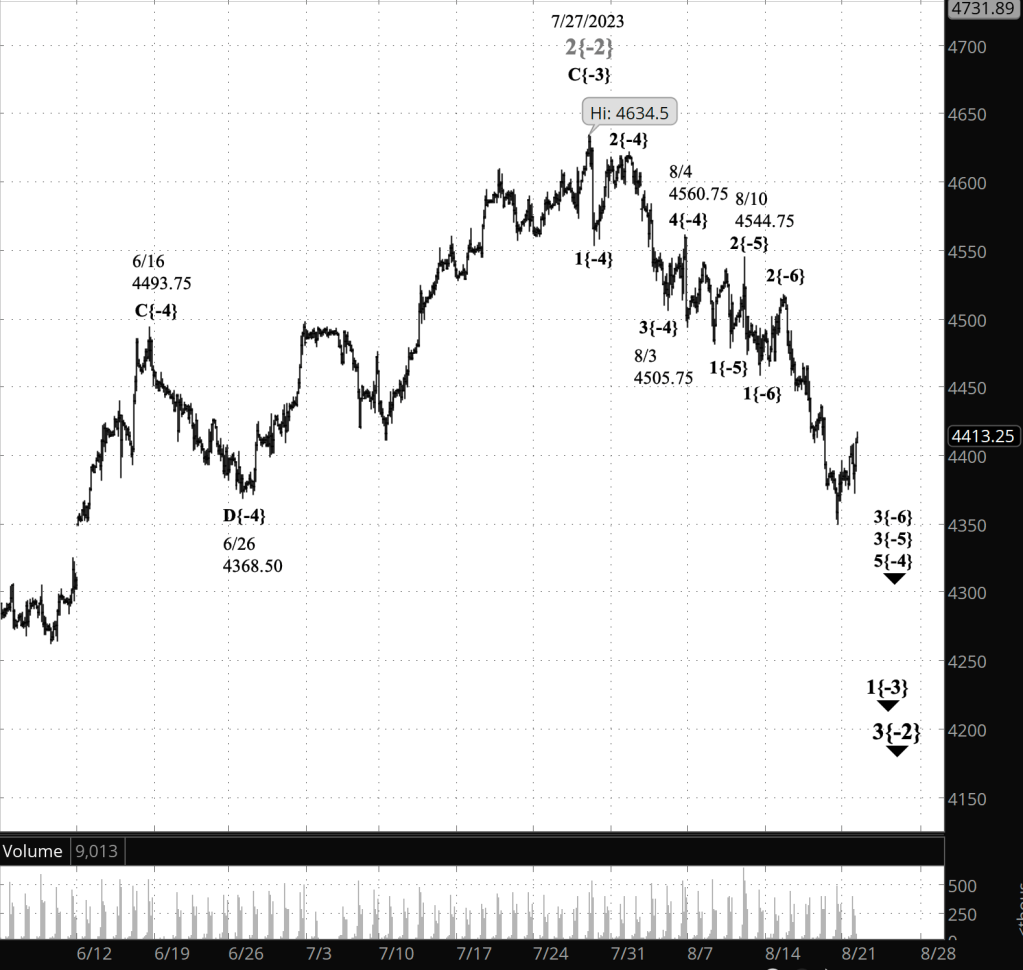
Trader’s Notebook

3:30 p,m, New York time

Half an hour before the closing bell. The S&P 500 futures fell during to the session to 4372.25, breaking past the overnight low by a few points. The price then rose steadily, reaching into the 4410s as the closing bell approached.

The movement is a small subwave upward correction within a downtrending parent wave.

This morning’s analysis remains unchanged. I’ve updated the chart.

2:30 p.m. New York time

BSX iron condor trade. I have entered an iron condor options position on BSX, based on the expected range within which the stock price will fall at expiration, based on options pricing, modified based on Elliott wave analysis. I’ve posted an analysis of the trade.

9:35 a.m. New York time

What’s happening now? The S&P 500 E-mini futures rose slightly after trading resumed overnight, from 4375.75 to 4407.50.

What does it mean? The middle subwave of a decline that began on August 10 continues, part of a larger downtrend three steps larger that began on July 27 from 4634.50.

The smaller middle wave and the larger downtrend are both 3rd waves. Each will be followed by a 4th wave upward correction, and then by a final decline that will complete each in turn.

I say “in turn” because it will take time for the various subwaves of the larger downtrend to travel their individual paths to completion. The larger downtrend, as a 3rd wave, can be expected to fall below the start of the preceding 2nd wave, which began on October 13, 2022 from 3622.75. Likely significantly below that price.

In other words, I expect the market to trace a net decline over the next months, with the usual ups and downs in the dance of the subwaves. The 2nd wave lasted for 9-1/2 months. The present 3rd wave downtrend could last longer or could be briefer, but the 2nd wave’s duration at the least gives a rough idea of the magnitude of the ongoing decline.

What are the alternatives? None at present. I’m quite certain that ambiguities will develop, as they always do.

[S&P 500 E-mini futures at 3:30 p.m., 30-minute bars, with volume]

What does Elliott wave theory say? Here are the waves that underly the analyses.

Principal analysis:

  • A downward correction, wave 3{-2}, began on July and is underway.
  • Internally, the correction is in its first subwave, wave 1{-3}.
  • Within wave 1{-3}, wave 5{-4} is underway.
  • Within wave 5{-4}, wave 3{-5} is underway, and one degree further down, wave 3{-6} is in progress.

Big picture:

  • Both the wave 2{-2} correction and wave 3{-2} downtrend are subwaves of wave 4{-1}, a downtrend that began on January 4, 2022.
  • Wave 4{-1}, in turn, is a subwave of wave 5{0}, an expanding Diagonal Triangle that began on December 26, 2018.
  • Wave 4{-1} may eventually reach the lower boundary of wave 5{0}, presently slightly below 1800 and declining further each day.
  • Wave 4{-1} will be followed by rising wave 5{-1}, the final wave in the Triangle.

We Are Here.

These are the waves currently in progress under my principal analysis. Each line on the list shows the wave number, with the subscript in curly brackets, the traditional degree name, the starting date, the starting price of the S&P 500 E-mini futures, and the direction of the wave.

  • S&P 500 Index:
  • 5{+3} Supercycle, 7/8/1932, 4.40 (up)
  • 5{+2} Cycle, 12/9/1974, 60.96 (up)
  • 5{+1} Primary, 3/6/2009, 666.79 (up)
  • 5{0} Intermediate, 12/26/2018, 2346.58 (up)
  • S&P 500 Futures and index:
  • 4{-1} Minor, 1/4/2022, 4953.25 (down) (futures), 4818.62 (down) (index)
  • S&P 500 Futures:
  • 3{-2} Minute, 7/27/2023, 3502 (down)

Reading the chart. Price movements — waves – – in Elliott wave analysis are labeled with numbers within trending waves and letters with corrective waves. The subscripts — numbers in curly brackets — designate the wave’s degree, which, in Elliott wave analysis, means the relative position of a wave within the larger and smaller structures that make up the chart. R.N. Elliott, who in the 1930s developed the form of analysis that bears his name, viewed the chart as a complex structure of smaller waves nested within larger waves, which in turn are nested within still larger waves. In mathematics it’s called a fractal structure, where at every scale the pattern is similar to the others.

Learning and other resources. Elliott wave analysis provides context, not prophecy. As the 20th century semanticist Alfred Korzybski put it in his book Science and Sanity (1933), “The map is not the territory … The only usefulness of a map depends on similarity of structure between the empirical world and the map.” And I would add, in the ever-changing markets, we can judge that similarity of structure only after the fact.

See the menu page Analytical Methods for a rundown on where to go for information on Elliott wave analysis.

By Tim Bovee, Portland, Oregon, August 21, 2023

Disclaimer

Tim Bovee, Private Trader tracks the analysis and trades of a private trader for his own accounts. Nothing in this blog constitutes a recommendation to buy or sell stocks, options or any other financial instrument. The only purpose of this blog is to provide education and entertainment.

No trader is ever 100 percent successful in his or her trades. Trading in the stock and option markets is risky and uncertain. Each trader must make trading decisions for his or her own account, and take responsibility for the consequences.

License
Creative Commons License

All content on Tim Bovee, Private Trader by Timothy K. Bovee is licensed under a Creative Commons Attribution-ShareAlike 4.0 International License.

Based on a work at www.timbovee.com.
Trader’s Notebook

3:30 p.m. New York time

Half an hour before the closing bell. The S&P 500 futures rose during the session into the 4380s, remaining below the overnight high, 4390.25.

This morning’s analysis is unchanged. I’ve updated the chart.

9:35 a.m. New York time

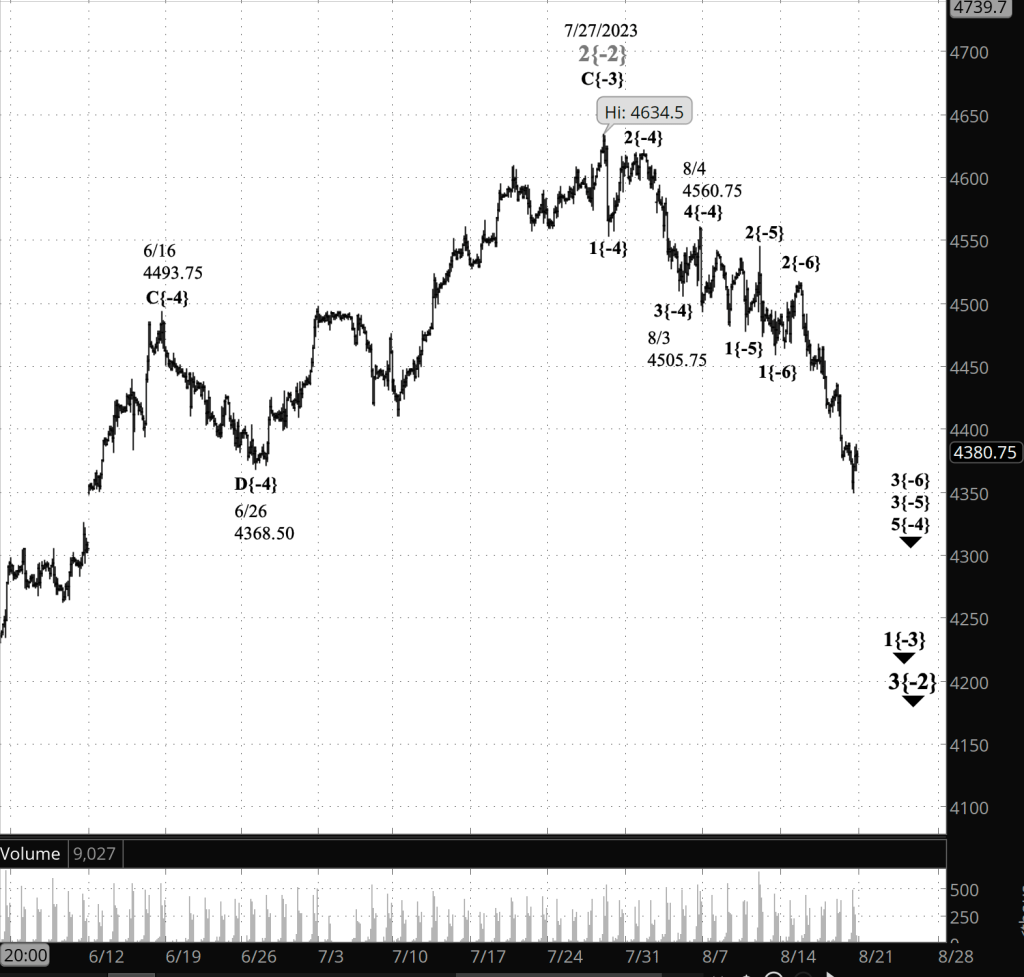
What’s happening now? The S&P 500 E-mini futures continued to fall overnight, reaching into the 4350s.

What does it mean? Today’s analysis has a bit of complexity, and I’ve had to use the Elliott wave nomenclature to describe it. In short the

The continuing decline has made the expanding Diagonal Triangle analysis increasingly untenable, and I’ve pulled back the chart to a wider view and done a re-analysis.

  • I’ve moved the {-5} degree up one to {-4}, as being more consistent with prior waves of that degree.
  • I’ve recounted the subwaves of wave 1{-3} to eliminate the expanding Diagonal Triangle..

Under the new principal analysis, the downtrend that began on July 27, wave 3{-2} continues and is in its 1st subwave, wave 1{-3}, which in turn is in its final subwave, wave 5{-4}.

Wave 5{-4} is in its middle subwave, wave 3{-5}, which is in its middle subwave, wave 3{-6}.l

When wave 5{-4} is complete, it will also be the end of wave 1{-3}, which will be followed by an upward correction that will retrace much of the decline since the July 27 peak, 4634.50. Under the rules of Elliott wave analysis, a 2nd wave never moves beyond the starting point of the preceding 1st wave, and so 4634.50 is the upper limit of the correction.

In other words, the chart shows an entirely straightforward downtrend.

What are the alternatives? None at present. I’m quite certain that ambiguities will develop.

[S&P 500 E-mini futures at 3:30 p.m., 2-hour bars, with volume]

What does Elliott wave theory say? Here are the waves that underly the analyses.

Principal analysis:

  • A downward correction, wave 3{-2}, began on July and is underway.
  • Internally, the correction is in its first subwave, wave 1{-3}.
  • Within wave 1{-3}, wave 5{-4} is underway.
  • Within wave 5{-4}, wave 3{-5} is underway, and one degree further down, wave 3{-6} is in progress.

Big picture:

  • Both the wave 2{-2} correction and wave 3{-2} downtrend are subwaves of wave 4{-1}, a downtrend that began on January 4, 2022.
  • Wave 4{-1}, in turn, is a subwave of wave 5{0}, an expanding Diagonal Triangle that began on December 26, 2018.
  • Wave 4{-1} may eventually reach the lower boundary of wave 5{0}, presently slightly below 1800 and declining further each day.
  • Wave 4{-1} will be followed by rising wave 5{-1}, the final wave in the Triangle.

We Are Here.

These are the waves currently in progress under my principal analysis. Each line on the list shows the wave number, with the subscript in curly brackets, the traditional degree name, the starting date, the starting price of the S&P 500 E-mini futures, and the direction of the wave.

  • S&P 500 Index:
  • 5{+3} Supercycle, 7/8/1932, 4.40 (up)
  • 5{+2} Cycle, 12/9/1974, 60.96 (up)
  • 5{+1} Primary, 3/6/2009, 666.79 (up)
  • 5{0} Intermediate, 12/26/2018, 2346.58 (up)
  • S&P 500 Futures and index:
  • 4{-1} Minor, 1/4/2022, 4953.25 (down) (futures), 4818.62 (down) (index)
  • S&P 500 Futures:
  • 3{-2} Minute, 7/27/2023, 3502 (down)

Reading the chart. Price movements — waves – – in Elliott wave analysis are labeled with numbers within trending waves and letters with corrective waves. The subscripts — numbers in curly brackets — designate the wave’s degree, which, in Elliott wave analysis, means the relative position of a wave within the larger and smaller structures that make up the chart. R.N. Elliott, who in the 1930s developed the form of analysis that bears his name, viewed the chart as a complex structure of smaller waves nested within larger waves, which in turn are nested within still larger waves. In mathematics it’s called a fractal structure, where at every scale the pattern is similar to the others.

Learning and other resources. Elliott wave analysis provides context, not prophecy. As the 20th century semanticist Alfred Korzybski put it in his book Science and Sanity (1933), “The map is not the territory … The only usefulness of a map depends on similarity of structure between the empirical world and the map.” And I would add, in the ever-changing markets, we can judge that similarity of structure only after the fact.

See the menu page Analytical Methods for a rundown on where to go for information on Elliott wave analysis.

By Tim Bovee, Portland, Oregon, August 18, 2023

Disclaimer

Tim Bovee, Private Trader tracks the analysis and trades of a private trader for his own accounts. Nothing in this blog constitutes a recommendation to buy or sell stocks, options or any other financial instrument. The only purpose of this blog is to provide education and entertainment.

No trader is ever 100 percent successful in his or her trades. Trading in the stock and option markets is risky and uncertain. Each trader must make trading decisions for his or her own account, and take responsibility for the consequences.

License
Creative Commons License

All content on Tim Bovee, Private Trader by Timothy K. Bovee is licensed under a Creative Commons Attribution-ShareAlike 4.0 International License.

Based on a work at www.timbovee.com.
Trader’s Notebook

3:30 p.m. New York time

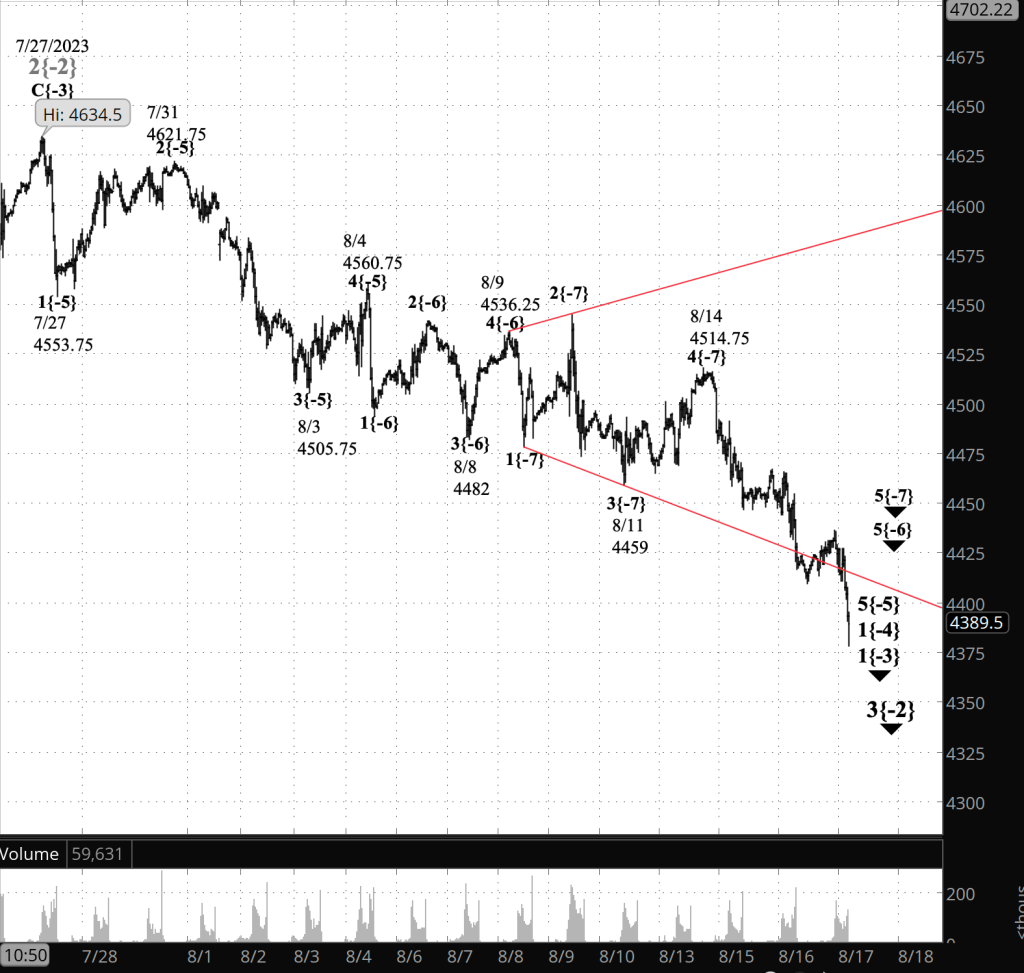
Half an hour before the closing bell. The S&P 500 futures fell further during the session, reaching into the 4370s. The decline lends credence to this morning’s second analysis, which sees the 5th and final subwave within the expanding Diagonal Triangle as being underway.

I’ve updated the chart.

9:35 a.m. New York time

What’s happening now? The S&P 500 E-mini futures declined overnight to 4409.50 and then rose back into the 4430s.

What does it mean? The low was yet another low within the expanding Diagonal Triangle that began on August 9.

At this point the chart points us toward two analyses of equal likelihood.

The triangle will have five subwaves when complete.

The first analysis, which was the principal analysis in yesterday’s Trader’s Notebook, sees the declining 4th wave of the triangle as being underway. Under this scenario,, the price will eventually rise to the triangle’s upper boundary, and then a declining 5th wave will complete the triangle.

The second analysis, which I’ve switched to today less out of confidence in its correctness and more with a goal of illustrating what it look like, sees the rise that ended on August 14 as being the completion of the 4th wave within the triangle, but in a truncated form. The set-up would have sent it climbing to the upper boundary, but the bullish sentiment simply wasn’t strong enough. The decline that has followed is the 5th and final wave of the triangle.

The triangle is the 5th subwave within a larger downtrend, a 1st wave that began on July 27, and will be followed by a 2nd-wave upward correction.

The ambiguity between the two scenarios won’t be resolved soon. If the price reverses and rises vigorously toward the upper boundary, then the decline from August 9 is over, but is it the 4th wave that’s over or the entire triangle? In other words, is the subsequent rise the 5th subwave within the triangle or the 2nd wave upward correction?

The answer won’t become clear until the price reaches the upper boundary of the triangle. If it moves past it and continues to climb, then the triangle has ended and the upward correction is underway. If it pauses and then declines to the region of the lower boundary, then the 5th subwave of the triangle is continuing.

Sufficiently confusing? I think so, too. Elliott wave analysis in my opinion provides the best context for understanding what the market is doing, but it’s a predictive tool only in the contextual sense: If this then that will happen in the futures.

[S&P 500 E-mini futures at 3:30 p.m., 30-minute bars, with volume]

What are the alternatives? In addition to the major ambiguity discussed above, there is another possibility. 

Connector wave scenario

The long-running upward correction, wave 2{-2}, that has dominated the chart since last autumn may still be underway. Wave 2{-2} ran from 3502 to 4634.50. The low so far in the subsequent decline is 4459. That means that the decline has retraced only 15.5% of the upward correction, meaning that the scenario seeing the present decline as connecting two corrective patterns within an ongoing upward correction remains plausible.

  • Wave 2{-2}, an upward compound correction that began on October 13, 2022 completed a second corrective pattern on July 27.
  • The subsequent decline is wave X{-3}, a downward connector between the second corrective pattern and the future third corrective pattern.
  • Once the third corrective pattern within wave 2{-2} has ended, a powerful downtrend, wave 3{-2}, will follow.

What does Elliott wave theory say? Here are the waves that underly the analyses.

Both principal analyses:

  • A downward correction, wave 3{-2}, began on July and is underway.
  • Internally, the correction is in its first subwave, wave 1{-3}.
  • Within wave 1{-3}, things become a bit more ambiguous, since the precise degree of the subwaves won’t become clear until the downtrend has progressed further.
  • I’ve chosen, as a guess, to label the subwave of wave 1{-3} as being in its first wave, 1{-4}, which in turn is in its final subwave, wave 5{-5}. And within wave 5{-5}, wave 5{-6} is underway.
  • Within wave 5{-6},
    • either the the truncated next-to-the-last subwave, wave 4{-7}, ended on August 9 and the final subwave, wave 5{-7}, began
    • or wave 4{-7} is stilll underway.

Alternative analysis:

  • Wave 2{-2}, and upward compound correction that began on October 13, 2022 completed a second corrective pattern on July 27.
  • The subsequent decline is wave X{-3}, a downward connector between the second corrective pattern and the future third corrective pattern.
  • Once the third corrective pattern within wave 2{-2} has ended, a powerful downtrend, wave 3{-2}, will follow

We Are Here.

These are the waves currently in progress under my principal analysis. Each line on the list shows the wave number, with the subscript in curly brackets, the traditional degree name, the starting date, the starting price of the S&P 500 E-mini futures, and the direction of the wave.

  • S&P 500 Index:
  • 5{+3} Supercycle, 7/8/1932, 4.40 (up)
  • 5{+2} Cycle, 12/9/1974, 60.96 (up)
  • 5{+1} Primary, 3/6/2009, 666.79 (up)
  • 5{0} Intermediate, 12/26/2018, 2346.58 (up)
  • S&P 500 Futures and index:
  • 4{-1} Minor, 1/4/2022, 4953.25 (down) (futures), 4818.62 (down) (index)
  • S&P 500 Futures:
  • 3{-2} Minute, 7/27/2023, 3502 (down)

Reading the chart. Price movements — waves – – in Elliott wave analysis are labeled with numbers within trending waves and letters with corrective waves. The subscripts — numbers in curly brackets — designate the wave’s degree, which, in Elliott wave analysis, means the relative position of a wave within the larger and smaller structures that make up the chart. R.N. Elliott, who in the 1930s developed the form of analysis that bears his name, viewed the chart as a complex structure of smaller waves nested within larger waves, which in turn are nested within still larger waves. In mathematics it’s called a fractal structure, where at every scale the pattern is similar to the others.

Learning and other resources. Elliott wave analysis provides context, not prophecy. As the 20th century semanticist Alfred Korzybski put it in his book Science and Sanity (1933), “The map is not the territory … The only usefulness of a map depends on similarity of structure between the empirical world and the map.” And I would add, in the ever-changing markets, we can judge that similarity of structure only after the fact.

See the menu page Analytical Methods for a rundown on where to go for information on Elliott wave analysis.

By Tim Bovee, Portland, Oregon, August 17, 2023

Disclaimer

Tim Bovee, Private Trader tracks the analysis and trades of a private trader for his own accounts. Nothing in this blog constitutes a recommendation to buy or sell stocks, options or any other financial instrument. The only purpose of this blog is to provide education and entertainment.

No trader is ever 100 percent successful in his or her trades. Trading in the stock and option markets is risky and uncertain. Each trader must make trading decisions for his or her own account, and take responsibility for the consequences.

License
Creative Commons License

All content on Tim Bovee, Private Trader by Timothy K. Bovee is licensed under a Creative Commons Attribution-ShareAlike 4.0 International License.

Based on a work at www.timbovee.com.
Trader’s Notebook

3:30 p.m. New York time

Half an hour before the closing bell. The S&P 500 futures fell into the 4420s after the Federal Open Market Commitee released the minutes of the July 25-26 meeting.

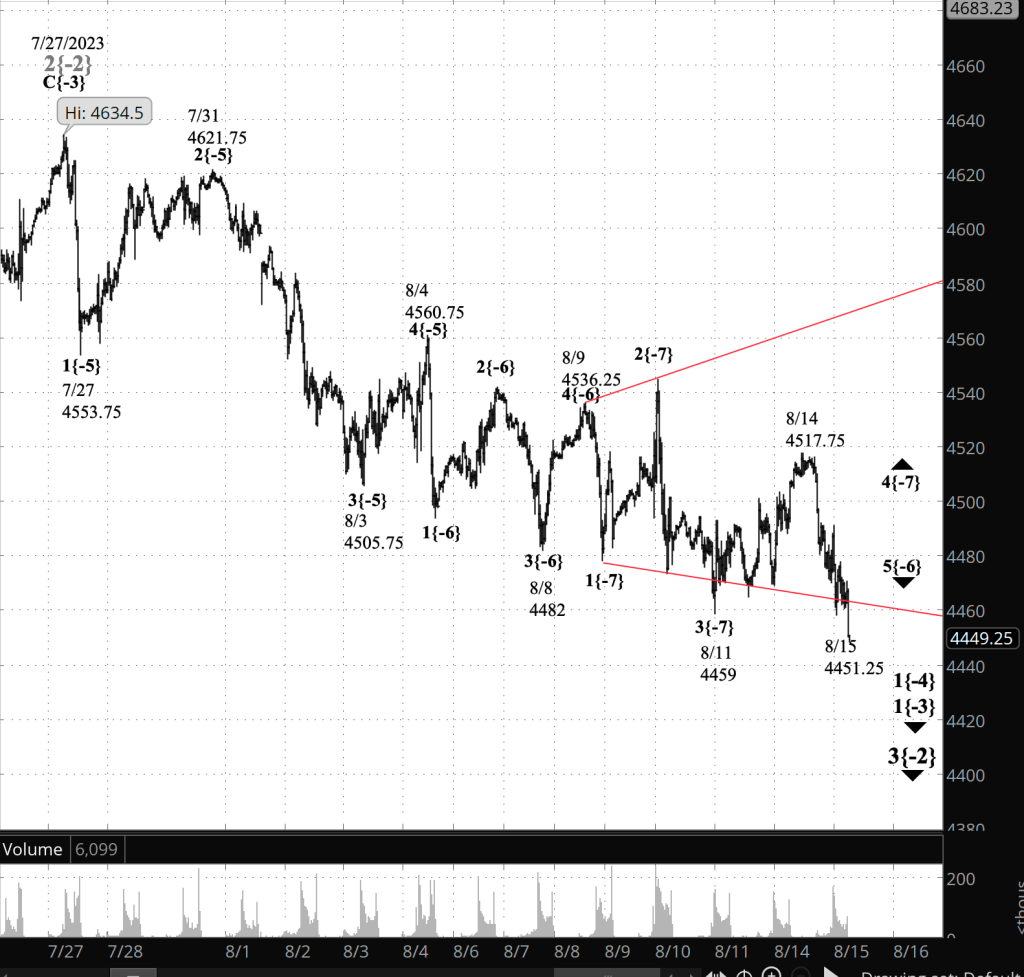
As is the practice when dealing with both price channels and triangles, I’ve redrawn the lower boundary to account for repositioning a few days back of the end of wave 3{-7} to the August 11 low. That adjustment brings most of what has happened since within the boundaries of the expanding Diagonal Triangle that began on August 9.

That needful repositioning lends credence to the this morning’s Principal Analysis, which sees the next to the last subwave of the triangle, wave 4{-7}, as still being underway. When it is complete, the final subwave, wave 5{-7}, will carry the price back to the upper boundary, which is presently in the 4570s and is rising every minute — that’s the “expanding” part of an expanding Diagonal Triangle.

Wave 5{-7} will end the triangle, which is wave 5{-6}, and will aso end the parent wave, 5{-5}, and the grandparent wave, 1{-4}.

An upward correction, wave 2{-4}, will follow. Under the rules discovered by R.N. Elliott, the developer of Elliott wave analysis, a 2nd wave must remain below the start of the preceding 1st wave of the same degree, which began on July 27 from 4634.50

9:35 a.m. New York time

What’s happening now? The S&P 500 E-mini futures tracked sideways overnight, remaining in the 4440s and 4450s, slightly below the lower boundary of the expanded Diagonal Triangle that began on August 9. Only once did it break from that range, rising to 4467.25, and then retreating.

What does it mean? The overnight pattern does nothing to resolve the ambiguities in the chart. The triangle will have five subwaves. Which subwave is in progress: The 4th, or a much-truncated 5th?

The normal form taken by a triangle is for the waves to bounce off of the price-channel boundaries. The 4th subwave so far has only gotten about halfway to the upper channel. So I’ve chosen a conservative analysis, marking the chart to show that the 4th subwave is underway.

Sometimes waves are truncated — they fall short of the boundary by a considerable amount. If that’s the case here, then the rising 4th wave ended at the August 14 high, 4517.25, and the declining 5th wave began.

[S&P 500 E-mini futures at 9:35 a.m., 35-minute bars, with volume]

What are the alternatives? There are three:

Alternative #1: Final wave scenario

I discussed Alternative #1 above. Here I add the Elliott wave numbers.

  • Rising wave 4{-7}, a subwave of wave 5{-6}, an expanding Diagonal Triangle, ended August 14, at 4517.75. Declining wave 5{-7}, the final subwave of the triangle, began from that point.

Alternative #2: Connector wave scenario

The long-running upward correction, wave 2{-2}, that has dominated the chart since last autumn may still be underway. Wave 2{-2} ran from 3502 to 4634.50. The low so far in the subsequent decline is 4459. That means that the decline has retraced only 15.5% of the upward correction, meaning that the scenario seeing the present decline as connecting two corrective patterns within an ongoing upward correction remains plausible.

  • Wave 2{-2}, an upward compound correction that began on October 13, 2022 completed a second corrective pattern on July 27.
  • The subsequent decline is wave X{-3}, a downward connector between the second corrective pattern and the future third corrective pattern.
  • Once the third corrective pattern within wave 2{-2} has ended, a powerful downtrend, wave 3{-2}, will follow.

Alternative #3: Choosing degree

  • I have listed the Triangle as being the from of wave 5{-6}. It’s still early days in the decline from July 27, and that wave’s degree could be higher — wave 5{-5} or wave 5{-4}.

What does Elliott wave theory say? Here are the waves that underly the analyses.

Principal analysis:

  • A downward correction, wave 3{-2}, began on July and is underway.
  • Internally, the correction is in its first subwave, wave 1{-3}.

Alternative analysis #1:

  • Rising wave 4{-7}, a subwave of wave 5{-6}, an expanding Diagonal Triangle, ended August 14, at 4517.75. Declining wave 5{-7}, the final subwave of the triangle, began from that point.

Alternative analysis #2:

  • Wave 2{-2}, and upward compound correction that began on October 13, 2022 completed a second corrective pattern on July 27.
  • The subsequent decline is wave X{-3}, a downward connector between the second corrective pattern and the future third corrective pattern.
  • Once the third corrective pattern within wave 2{-2} has ended, a powerful downtrend, wave 3{-2}, will follow

Alternative analysis #3:

  • Within wave 1{-3}, things become a bit more ambiguous, since the precise degree of the subwaves won’t become clear until the downtrend has progressed further.
  • I’ve chosen, as a guess, to label the subwave of wave 1{-3} as being in its first wave, 1{-4}, which in turn is in its final subwave, wave 5{-5}.
  • The final subwave within wave 5{-5} began overnight. Declining wave 5{-6} is now underway.
  • Wave 5{-6} is its 2nd of five subwaves, an upward correction designated wave 2{-7}.

Big picture:

  • Both the wave 2{-2} correction and wave 3{-2} downtrend are subwaves of wave 4{-1}, a downtrend that began on January 4, 2022.
  • Wave 4{-1}, in turn, is a subwave of wave 5{0}, an expanding Diagonal Triangle that began on December 26, 2018.
  • Wave 4{-1} may eventually reach the lower boundary of wave 5{0}, presently slightly below 1800 and declining further each day.
  • Wave 4{-1} will be followed by rising wave 5{-1}, the final wave in the Triangle.

We Are Here.

These are the waves currently in progress under my principal analysis. Each line on the list shows the wave number, with the subscript in curly brackets, the traditional degree name, the starting date, the starting price of the S&P 500 E-mini futures, and the direction of the wave.

  • S&P 500 Index:
  • 5{+3} Supercycle, 7/8/1932, 4.40 (up)
  • 5{+2} Cycle, 12/9/1974, 60.96 (up)
  • 5{+1} Primary, 3/6/2009, 666.79 (up)
  • 5{0} Intermediate, 12/26/2018, 2346.58 (up)
  • S&P 500 Futures and index:
  • 4{-1} Minor, 1/4/2022, 4953.25 (down) (futures), 4818.62 (down) (index)
  • S&P 500 Futures:
  • 3{-2} Minute, 7/27/2023, 3502 (down)

Reading the chart. Price movements — waves – – in Elliott wave analysis are labeled with numbers within trending waves and letters with corrective waves. The subscripts — numbers in curly brackets — designate the wave’s degree, which, in Elliott wave analysis, means the relative position of a wave within the larger and smaller structures that make up the chart. R.N. Elliott, who in the 1930s developed the form of analysis that bears his name, viewed the chart as a complex structure of smaller waves nested within larger waves, which in turn are nested within still larger waves. In mathematics it’s called a fractal structure, where at every scale the pattern is similar to the others.

Learning and other resources. Elliott wave analysis provides context, not prophecy. As the 20th century semanticist Alfred Korzybski put it in his book Science and Sanity (1933), “The map is not the territory … The only usefulness of a map depends on similarity of structure between the empirical world and the map.” And I would add, in the ever-changing markets, we can judge that similarity of structure only after the fact.

See the menu page Analytical Methods for a rundown on where to go for information on Elliott wave analysis.

By Tim Bovee, Portland, Oregon, August 16, 2023

Disclaimer

Tim Bovee, Private Trader tracks the analysis and trades of a private trader for his own accounts. Nothing in this blog constitutes a recommendation to buy or sell stocks, options or any other financial instrument. The only purpose of this blog is to provide education and entertainment.

No trader is ever 100 percent successful in his or her trades. Trading in the stock and option markets is risky and uncertain. Each trader must make trading decisions for his or her own account, and take responsibility for the consequences.

License
Creative Commons License

All content on Tim Bovee, Private Trader by Timothy K. Bovee is licensed under a Creative Commons Attribution-ShareAlike 4.0 International License.

Based on a work at www.timbovee.com.
Trader’s Notebook

3:30 p.m. New York time

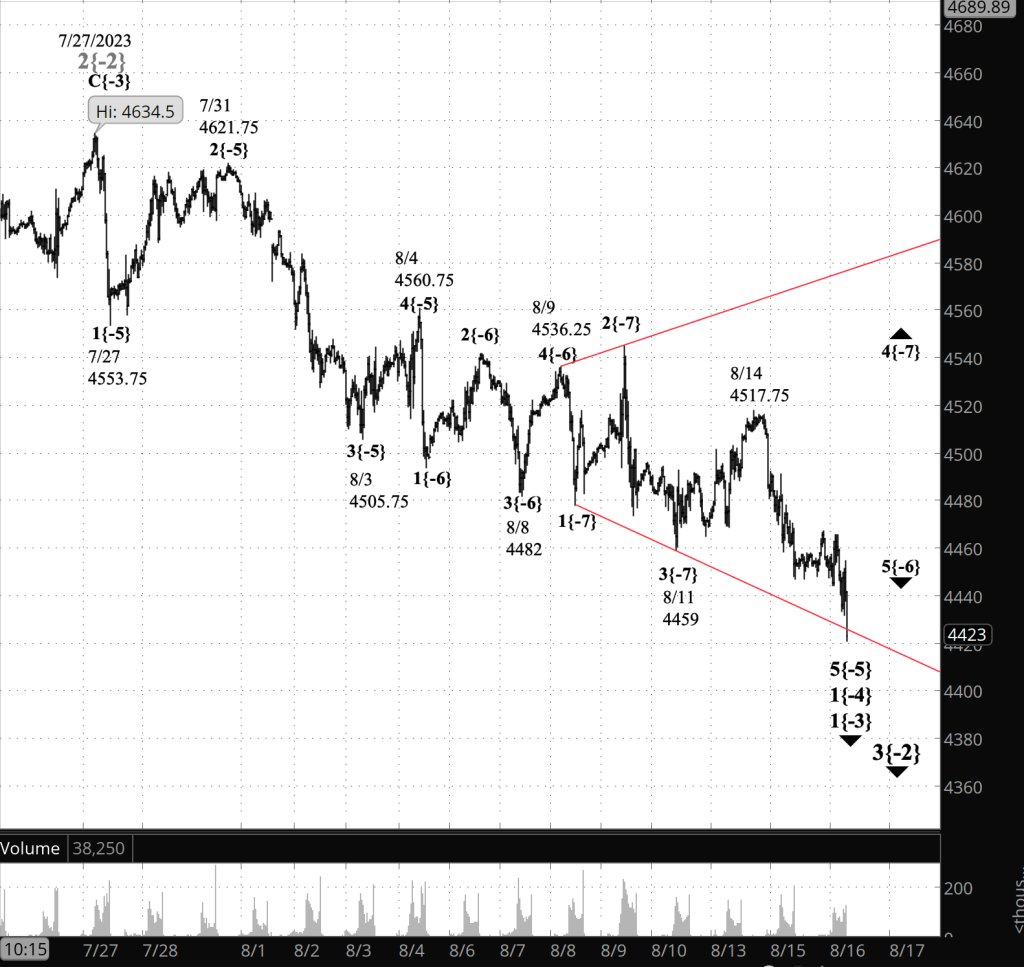
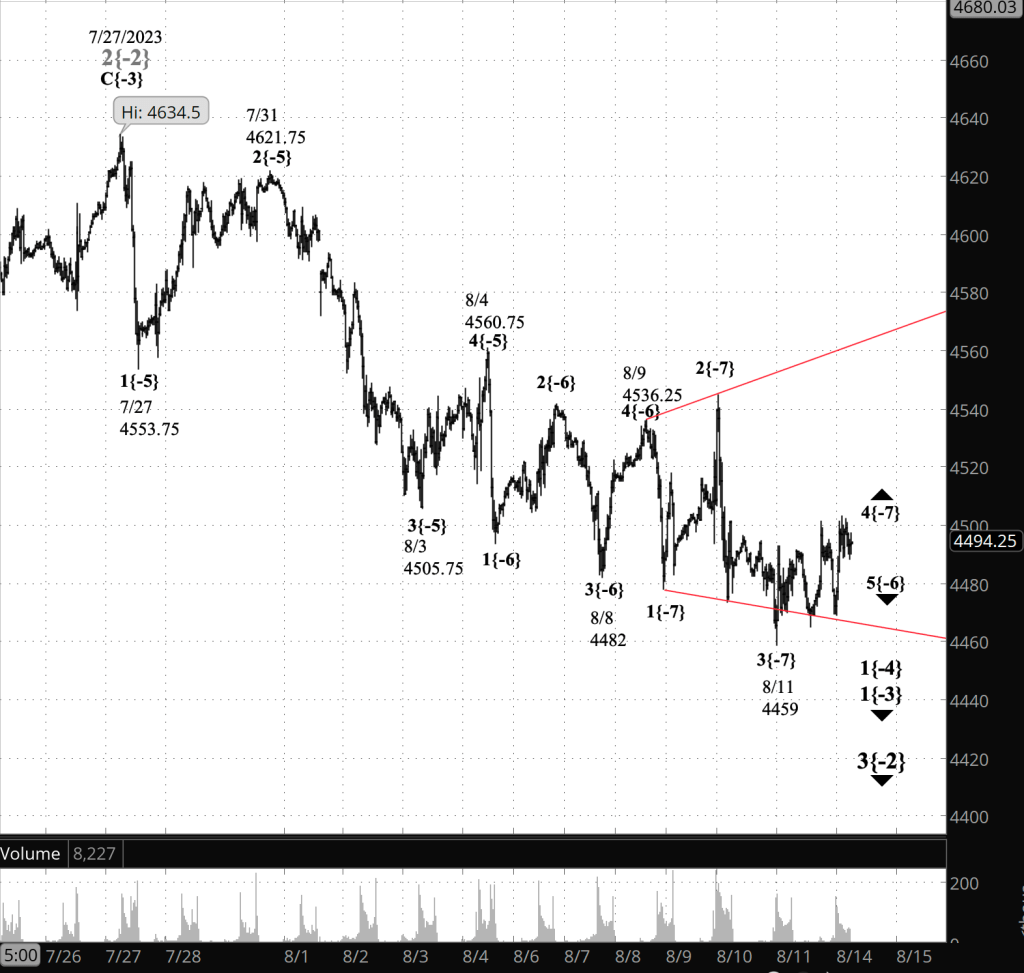
Half an hour before the closing bell. The S&P 500 futures has traded sideways during the session, ranging from the 4450s to the 4470s and then narrowing as it repeatedly crossed the lower boundary of the expanding Diagonal Triangle that has been underway since August 9.

As of the time I’m posting, the price dropped to new lows within the triangle, to 4151.25 when I produced the chart, and immediately thereafter down to 4448.25.

As was the case this morning, the triangle’s present rising subwave, wave 4{-7}, remains well below the upper boundary, it’s eventual target. The decline that began on August 14 hasn’t broken far enough below the lower boundary to justify declaring the August 9 peak to be the end of a truncated wave 4{-7} and the beginning of the final subwave, wave 5{-7}.

So for now, I’m sticking with this morning’s analysis. Wave 4{-7} continues. However, it is a close call between that scenario and this morning’s Alternative #1, the wave 5{-7} scenario.

I’ve updated the chart.

9:35 a.m. New York time

What’s happening now? The S&P 500 E-mini futures peaked overnight at 4517.85 and then fell back to the 4470s.

What does it mean? The rise carried the price about halfway to the upper boundary of an expanding Diagonal Triangle that began on August 9, and the subsequent decline has come close to the lower boundary. Based on the typical form taken by an expanding Diagonal Triangle, I expect a reversal with the rise carrying the price above the overnight high. (The triangle boundaries are marked on the chart n red.)

The rise that began on August 11 is the 4th of five subwaves of the Triangle, wave 4{-7}. Sometimes a 4th wave will fail to reach the triangle boundary, and if that is the case, then the overnight rise was the final leg of wave 4{-7} and the subsequent decline is part of the triangle’s final subwave, wave 5{-7}.

At this point I think it’s more likely that the 4th wave is still underway.

[S&P 500 E-mini futures at 3:30 p.m., 30-minute bars, with volume]

What are the alternatives? There are three:

Alternative #1: Final wave scenario

  • Rising wave 4{-7}, a subwave of wave 5{-6}, an expanding Diagonal Triangle, ended today, August 16, at 4517.75. Declining wave 5{-7}, the final subwave of the triangle, began from that point.

Alternative #2: Connector wave scenario

The long-running upward correction, wave 2{-2}, that has dominated the chart since last autumn may still be underway. Wave 2{-2} ran from 3502 to 4634.50. The low so far in the subsequent decline is 4459. That means that the decline has retraced only 15.5% of the upward correction, meaning that the scenario seeing the present decline as connecting two corrective patterns within an ongoing upward correction remains plausible.

  • Wave 2{-2}, an upward compound correction that began on October 13, 2022 completed a second corrective pattern on July 27.
  • The subsequent decline is wave X{-3}, a downward connector between the second corrective pattern and the future third corrective pattern.
  • Once the third corrective pattern within wave 2{-2} has ended, a powerful downtrend, wave 3{-2}, will follow.

Alternative #3:

  • I have listed the Triangle as being the from of wave 5{-6}. It’s still early days in the decline from July 27, and that wave’s degree could be higher — wave 5{-5} or wave 5{-4}.

What does Elliott wave theory say? Here are the waves that underly the analyses.

Principal analysis:

  • A downward correction, wave 3{-2}, began on July and is underway.
  • Internally, the correction is in its first subwave, wave 1{-3}.
  • Within wave 1{-3}, things become a bit more ambiguous, since the precise degree of the subwaves won’t become clear until the downtrend has progressed further.
  • I’ve chosen, as a guess, to label the subwave of wave 1{-3} as being in its first wave, 1{-4}, which in turn is in its final subwave, wave 5{-5}.
  • The final subwave within wave 5{-5} began overnight. Declining wave 5{-6} is now underway.
  • Wave 5{-6} is its 2nd of five subwaves, an upward correction designated wave 2{-7}.

Alternative analysis:

  • Wave 2{-2}, and upward compound correction that began on October 13, 2022 completed a second corrective pattern on July 27.
  • The subsequent decline is wave X{-3}, a downward connector between the second corrective pattern and the future third corrective pattern.
  • Once the third corrective pattern within wave 2{-2} has ended, a powerful downtrend, wave 3{-2}, will follow

We Are Here.

These are the waves currently in progress under my principal analysis. Each line on the list shows the wave number, with the subscript in curly brackets, the traditional degree name, the starting date, the starting price of the S&P 500 E-mini futures, and the direction of the wave.

  • S&P 500 Index:
  • 5{+3} Supercycle, 7/8/1932, 4.40 (up)
  • 5{+2} Cycle, 12/9/1974, 60.96 (up)
  • 5{+1} Primary, 3/6/2009, 666.79 (up)
  • 5{0} Intermediate, 12/26/2018, 2346.58 (up)
  • S&P 500 Futures and index:
  • 4{-1} Minor, 1/4/2022, 4953.25 (down) (futures), 4818.62 (down) (index)
  • S&P 500 Futures:
  • 3{-2} Minute, 7/27/2023, 4634.50 (down) [The beginning price was in error and has been corrected.]

Reading the chart. Price movements — waves – – in Elliott wave analysis are labeled with numbers within trending waves and letters with corrective waves. The subscripts — numbers in curly brackets — designate the wave’s degree, which, in Elliott wave analysis, means the relative position of a wave within the larger and smaller structures that make up the chart. R.N. Elliott, who in the 1930s developed the form of analysis that bears his name, viewed the chart as a complex structure of smaller waves nested within larger waves, which in turn are nested within still larger waves. In mathematics it’s called a fractal structure, where at every scale the pattern is similar to the others.

Learning and other resources. Elliott wave analysis provides context, not prophecy. As the 20th century semanticist Alfred Korzybski put it in his book Science and Sanity (1933), “The map is not the territory … The only usefulness of a map depends on similarity of structure between the empirical world and the map.” And I would add, in the ever-changing markets, we can judge that similarity of structure only after the fact.

See the menu page Analytical Methods for a rundown on where to go for information on Elliott wave analysis.

By Tim Bovee, Portland, Oregon, August 15, 2023

Disclaimer

Tim Bovee, Private Trader tracks the analysis and trades of a private trader for his own accounts. Nothing in this blog constitutes a recommendation to buy or sell stocks, options or any other financial instrument. The only purpose of this blog is to provide education and entertainment.

No trader is ever 100 percent successful in his or her trades. Trading in the stock and option markets is risky and uncertain. Each trader must make trading decisions for his or her own account, and take responsibility for the consequences.

License
Creative Commons License

All content on Tim Bovee, Private Trader by Timothy K. Bovee is licensed under a Creative Commons Attribution-ShareAlike 4.0 International License.

Based on a work at www.timbovee.com.

Trader’s Notebook

3:30 p.m. New York time

Half an hour before the closing bell. The S&P 500 futures began the session low, from 4469, rising as the day progressed to 4503.25, two points above the overnight peak.

The analysis remains unchanged from this morning. Rising wave 4{-7} continues. It is the next-to-the-last wave within wave 5{-6}, an expanding Diagonal Triangle.

I’ve updated the chart.

9:35 a.m. New York time

What’s happening now? The S&P 500 E-mini futures bounced between the 4460s and around 4500 overnight, continuing the sideways pattern that closed last week’s chart.

What does it mean? Under the principal analysis, the price has been bouncing off of the lower boundary of an Expanding Diagonal Triangle that began on August 9. The triangle, whose boundaries are marked n red on the chart, is the final leg of a downtrend that began on August 4, which itself is part of a larger downtrend that began on July 27 and of a still larger downtrend, that began on January 4, 2022.

The sideways movement that has dominated the last few days is atypical of an expanding Diagonal Triangle. The price should bounce off the lower boundary and head back to the still rising upper boundary, and then bounce and fall again. The present hugging of the lower boundary breaks no rules of Elliott wave analysis, but it’s a bit unusual.

To accomodate the sideways pattern, I’ve moved the endpoint of wave 3{-7} to Friday’s low, 4459.

What are the alternatives? There are two:

Alternative #1:

  • Wave 2{-2}, and upward compound correction that began on October 13, 2022 completed a second corrective pattern on July 27.
  • The subsequent decline is wave X{-3}, a downward connector between the second corrective pattern and the future third corrective pattern.
  • Once the third corrective pattern within wave 2{-2} has ended, a powerful downtrend, wave 3{-2}, will follow.

Alternative #2:

  • I have listed the Triangle as being the from of wave 5{-6}. It’s still early days in the decline from July 27, and that wave’s degree could be higher — wave 5{-5} or wave 5{-4}.

[S&P 500 E-mini futures at 3:30 p.m., 30-minute bars, with volume]

What does Elliott wave theory say? Here are the waves that underly the analyses.

Principal analysis:

  • A downward correction, wave 3{-2}, began on July and is underway.
  • Internally, the correction is in its first subwave, wave 1{-3}.
  • Within wave 1{-3}, things become a bit more ambiguous, since the precise degree of the subwaves won’t become clear until the downtrend has progressed further.
  • I’ve chosen, as a guess, to label the subwave of wave 1{-3} as being in its first wave, 1{-4}, which in turn is in its final subwave, wave 5{-5}.
  • The final subwave within wave 5{-5} began overnight. Declining wave 5{-6} is now underway.
  • Wave 5{-6} is its 2nd of five subwaves, an upward correction designated wave 2{-7}.

Alternative analysis:

  • Wave 2{-2}, and upward compound correction that began on October 13, 2022 completed a second corrective pattern on July 27.
  • The subsequent decline is wave X{-3}, a downward connector between the second corrective pattern and the future third corrective pattern.
  • Once the third corrective pattern within wave 2{-2} has ended, a powerful downtrend, wave 3{-2}, will follow

We Are Here.

These are the waves currently in progress under my principal analysis. Each line on the list shows the wave number, with the subscript in curly brackets, the traditional degree name, the starting date, the starting price of the S&P 500 E-mini futures, and the direction of the wave.

  • S&P 500 Index:
  • 5{+3} Supercycle, 7/8/1932, 4.40 (up)
  • 5{+2} Cycle, 12/9/1974, 60.96 (up)
  • 5{+1} Primary, 3/6/2009, 666.79 (up)
  • 5{0} Intermediate, 12/26/2018, 2346.58 (up)
  • S&P 500 Futures and index:
  • 4{-1} Minor, 1/4/2022, 4953.25 (down) (futures), 4818.62 (down) (index)
  • S&P 500 Futures:
  • 3{-2} Minute, 7/27/2023, 3502 (down)

Reading the chart. Price movements — waves – – in Elliott wave analysis are labeled with numbers within trending waves and letters with corrective waves. The subscripts — numbers in curly brackets — designate the wave’s degree, which, in Elliott wave analysis, means the relative position of a wave within the larger and smaller structures that make up the chart. R.N. Elliott, who in the 1930s developed the form of analysis that bears his name, viewed the chart as a complex structure of smaller waves nested within larger waves, which in turn are nested within still larger waves. In mathematics it’s called a fractal structure, where at every scale the pattern is similar to the others.

Learning and other resources. Elliott wave analysis provides context, not prophecy. As the 20th century semanticist Alfred Korzybski put it in his book Science and Sanity (1933), “The map is not the territory … The only usefulness of a map depends on similarity of structure between the empirical world and the map.” And I would add, in the ever-changing markets, we can judge that similarity of structure only after the fact.

See the menu page Analytical Methods for a rundown on where to go for information on Elliott wave analysis.

By Tim Bovee, Portland, Oregon, August 14, 2023

Disclaimer

Tim Bovee, Private Trader tracks the analysis and trades of a private trader for his own accounts. Nothing in this blog constitutes a recommendation to buy or sell stocks, options or any other financial instrument. The only purpose of this blog is to provide education and entertainment.

No trader is ever 100 percent successful in his or her trades. Trading in the stock and option markets is risky and uncertain. Each trader must make trading decisions for his or her own account, and take responsibility for the consequences.

License
Creative Commons License

All content on Tim Bovee, Private Trader by Timothy K. Bovee is licensed under a Creative Commons Attribution-ShareAlike 4.0 International License.

Based on a work at www.timbovee.com.