Trader’s Notebook

3:30 p.m. New York time

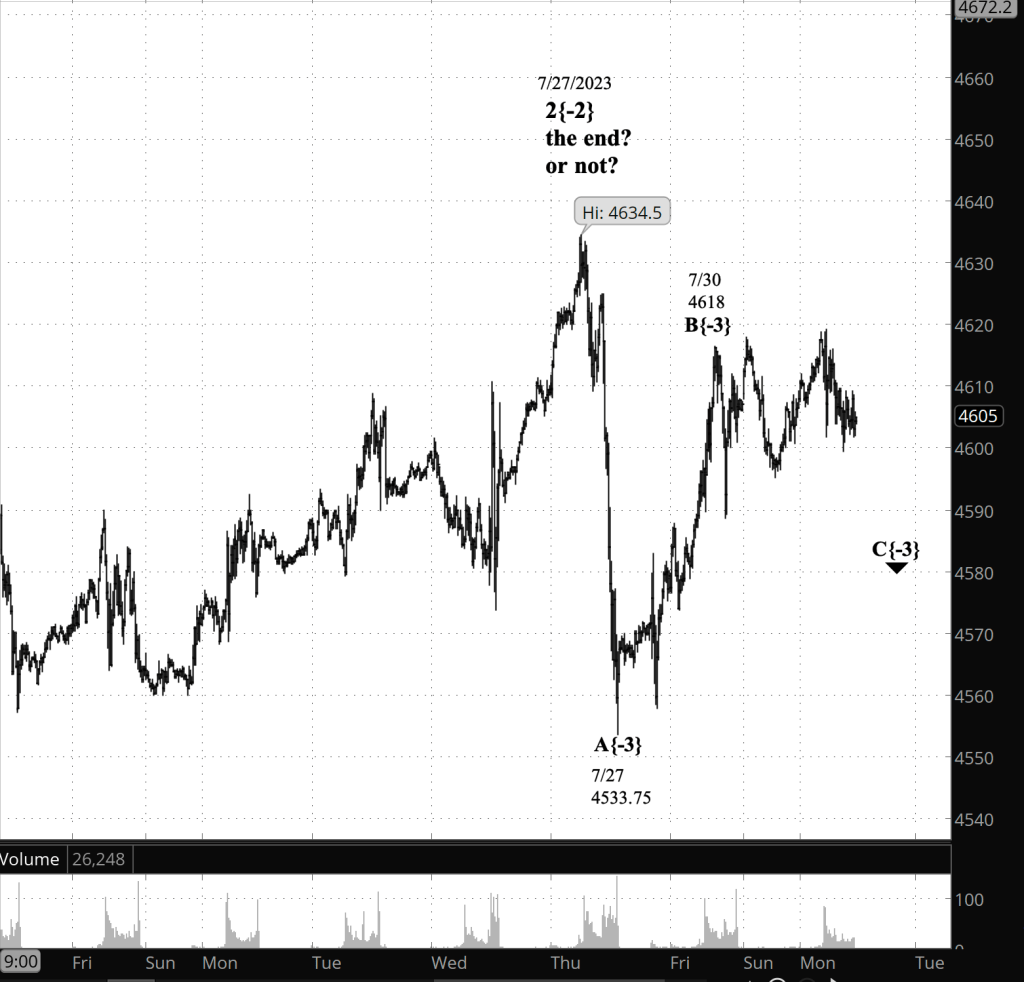
Half an hour before the closing bell. The S&P 500 futures meandered between the 4460s and the 4470s, repeatedly bouncing off the lower boundary of the expanding Diagonal Triangle that began on August 9. This morning’s analysis is unchanged. I’ve updated the chart.

9:35 a.m. New York time

What’s happening now? The S&P 500 E-mini futures hit a high in the 4490s early in overnight trading and then declined, dropping sharply by 15 points when the Producer Price Index was released an hour before the opening bell.

What does it mean? The price decline bounced off of the lower boundary of an expanding Diagonal Triangle that began on August 9. It is the final wave within a low-degree downtrend that began on August 4, which is part of a much larger 3rd wave downtrend that began on July 27 from 4634.50 and which will eventually carry the price below 3500, perhaps significantly below that level.

The Triangle’s boundaries are marked on the chart in red.

Internally, the Triangle has completed three subwaves and is now in its rising 4th subwave, which will end around the upper boundary of the Triangle, presently in the 4550s and rising every minute, and will reverse downward as the 5th and final subwave.

The larger downtrend is wave 3{-2}, and the present expanding Diagonal Triangle is wave 5{-6}, four degrees smaller from than the downtrend. Internally, the Triangle is in rising wave 4{-7}.

A larger upward correction will follow, a 2nd wave that will take back a portion of the decline since July 27 and that will remain below 4634.50.

What are the alternatives? Unchanged from the day before.

Alternative #1:

  • Wave 2{-2}, and upward compound correction that began on October 13, 2022 completed a second corrective pattern on July 27.
  • The subsequent decline is wave X{-3}, a downward connector between the second corrective pattern and the future third corrective pattern.
  • Once the third corrective pattern within wave 2{-2} has ended, a powerful downtrend, wave 3{-2}, will follow.

Alternative #2:

  • I have listed the Triangle as being the from of wave 5{-6}. It’s still early days in the decline from July 27, and that wave’s degree could be higher — wave 5{-5} or wave 5{-4}.
[S&P 500 E-mini futures at 9:35 a.m., 30-minute bars, with volume]

What does Elliott wave theory say? Here are the waves that underly the analyses.

Principal analysis:

  • A downward correction, wave 3{-2}, began on July and is underway.
  • Internally, the correction is in its first subwave, wave 1{-3}.
  • Within wave 1{-3}, things become a bit more ambiguous, since the precise degree of the subwaves won’t become clear until the downtrend has progressed further.
  • I’ve chosen, as a guess, to label the subwave of wave 1{-3} as being in its first wave, 1{-4}, which in turn is in its final subwave, wave 5{-5}.
  • The final subwave within wave 5{-5} began overnight. Declining wave 5{-6} is now underway.
  • Wave 5{-6} is its 2nd of five subwaves, an upward correction designated wave 2{-7}.

Alternative analysis #1:

  • Wave 2{-2}, and upward compound correction that began on October 13, 2022 completed a second corrective pattern on July 27.
  • The subsequent decline is wave X{-3}, a downward connector between the second corrective pattern and the future third corrective pattern.
  • Once the third corrective pattern within wave 2{-2} has ended, a powerful downtrend, wave 3{-2}, will follow.

Alternative analysis #2:

  • The Diagonal Triangle is wave 5{-5} within declining wave 1{-4} within wave 1{-3}, the first subwave within the downtrend, wave 3{-2}, that began on July 27.
  • Or it could be one degree higher, wave 5{-4} within wave 1{-3} within wave 3{-2}.

We Are Here.

These are the waves currently in progress under my principal analysis. Each line on the list shows the wave number, with the subscript in curly brackets, the traditional degree name, the starting date, the starting price of the S&P 500 E-mini futures, and the direction of the wave.

  • S&P 500 Index:
  • 5{+3} Supercycle, 7/8/1932, 4.40 (up)
  • 5{+2} Cycle, 12/9/1974, 60.96 (up)
  • 5{+1} Primary, 3/6/2009, 666.79 (up)
  • 5{0} Intermediate, 12/26/2018, 2346.58 (up)
  • S&P 500 Futures and index:
  • 4{-1} Minor, 1/4/2022, 4953.25 (down) (futures), 4818.62 (down) (index)
  • S&P 500 Futures:
  • 3{-2} Minute, 7/27/2023, 3502 (down)

Reading the chart. Price movements — waves – – in Elliott wave analysis are labeled with numbers within trending waves and letters with corrective waves. The subscripts — numbers in curly brackets — designate the wave’s degree, which, in Elliott wave analysis, means the relative position of a wave within the larger and smaller structures that make up the chart. R.N. Elliott, who in the 1930s developed the form of analysis that bears his name, viewed the chart as a complex structure of smaller waves nested within larger waves, which in turn are nested within still larger waves. In mathematics it’s called a fractal structure, where at every scale the pattern is similar to the others.

Learning and other resources. Elliott wave analysis provides context, not prophecy. As the 20th century semanticist Alfred Korzybski put it in his book Science and Sanity (1933), “The map is not the territory … The only usefulness of a map depends on similarity of structure between the empirical world and the map.” And I would add, in the ever-changing markets, we can judge that similarity of structure only after the fact.

See the menu page Analytical Methods for a rundown on where to go for information on Elliott wave analysis.

By Tim Bovee, Portland, Oregon, August 11, 2023

Disclaimer

Tim Bovee, Private Trader tracks the analysis and trades of a private trader for his own accounts. Nothing in this blog constitutes a recommendation to buy or sell stocks, options or any other financial instrument. The only purpose of this blog is to provide education and entertainment.

No trader is ever 100 percent successful in his or her trades. Trading in the stock and option markets is risky and uncertain. Each trader must make trading decisions for his or her own account, and take responsibility for the consequences.

License
Creative Commons License

All content on Tim Bovee, Private Trader by Timothy K. Bovee is licensed under a Creative Commons Attribution-ShareAlike 4.0 International License.

Based on a work at www.timbovee.com.

Trader’s Notebook

3:30 p.m. New York time

Half an hour before the closing bell. The S&P 500 reached a high of 4544.75 during the session and then fell back into the 4470s. The final wave of the decline that began on August 9, wave 5{-6}, appears to be taking the form of an expanding Diagonal Triangle. I’ve shown the triangle boundaries in red.

9:35 a.m. New York time

What’s happening now? The S&P 500 E-mini futures wandered between the 4490s and the 4510s until the latest inflation numbers were announced. At that point the price whipsawed, rocketing to 4525, plunging to 4494, and then returning to the 4510s, slightly above where it had been a minute before the announcement.

What does it mean? The whipsaw was part of a the 2nd of three subwaves within a small upward correction within a downtrend, one degree larger, that began on August 9. That downtrend is in turn the final subwave within a larger downtrend that began on August 4, the final wave of a series of nested downtrends within a major downtrend that began on July 27.

The July 27 downtrend, a 3rd wave, will carry the price below the starting point of the preceding 2nd wave correction, 3502, and most likely significantly below that level.

So whatever the daily ups and downs and occasional whipsaws, the trend of the market is down and main continue on that course for months.

What is the alternative?

  • Wave 2{-2}, and upward compound correction that began on October 13, 2022 completed a second corrective pattern on July 27.
  • The subsequent decline is wave X{-3}, a downward connector between the second corrective pattern and the future third corrective pattern.
  • Once the third corrective pattern within wave 2{-2} has ended, a powerful downtrend, wave 3{-2}, will follow

[S&P 500 E-mini futures at 3:30 p.m., 30-minute bars, with volume]

What does Elliott wave theory say? Here are the waves that underly the analyses.

Principal analysis:

  • A downward correction, wave 3{-2}, began on July and is underway.
  • Internally, the correction is in its first subwave, wave 1{-3}.
  • Within wave 1{-3}, things become a bit more ambiguous, since the precise degree of the subwaves won’t become clear until the downtrend has progressed further.
  • I’ve chosen, as a guess, to label the subwave of wave 1{-3} as being in its first wave, 1{-4}, which in turn is in its final subwave, wave 5{-5}.
  • The final subwave within wave 5{-5} began overnight. Declining wave 5{-6} is now underway.
  • Wave 5{-6} is its 2nd of five subwaves, an upward correction designated wave 2{-7}.

Alternative analysis:

  • Wave 2{-2}, and upward compound correction that began on October 13, 2022 completed a second corrective pattern on July 27.
  • The subsequent decline is wave X{-3}, a downward connector between the second corrective pattern and the future third corrective pattern.
  • Once the third corrective pattern within wave 2{-2} has ended, a powerful downtrend, wave 3{-2}, will follow

We Are Here.

These are the waves currently in progress under my principal analysis. Each line on the list shows the wave number, with the subscript in curly brackets, the traditional degree name, the starting date, the starting price of the S&P 500 E-mini futures, and the direction of the wave.

  • S&P 500 Index:
  • 5{+3} Supercycle, 7/8/1932, 4.40 (up)
  • 5{+2} Cycle, 12/9/1974, 60.96 (up)
  • 5{+1} Primary, 3/6/2009, 666.79 (up)
  • 5{0} Intermediate, 12/26/2018, 2346.58 (up)
  • S&P 500 Futures and index:
  • 4{-1} Minor, 1/4/2022, 4953.25 (down) (futures), 4818.62 (down) (index)
  • S&P 500 Futures:
  • 3{-2} Minute, 7/27/2023, 3502 (down)

Reading the chart. Price movements — waves – – in Elliott wave analysis are labeled with numbers within trending waves and letters with corrective waves. The subscripts — numbers in curly brackets — designate the wave’s degree, which, in Elliott wave analysis, means the relative position of a wave within the larger and smaller structures that make up the chart. R.N. Elliott, who in the 1930s developed the form of analysis that bears his name, viewed the chart as a complex structure of smaller waves nested within larger waves, which in turn are nested within still larger waves. In mathematics it’s called a fractal structure, where at every scale the pattern is similar to the others.

Learning and other resources. Elliott wave analysis provides context, not prophecy. As the 20th century semanticist Alfred Korzybski put it in his book Science and Sanity (1933), “The map is not the territory … The only usefulness of a map depends on similarity of structure between the empirical world and the map.” And I would add, in the ever-changing markets, we can judge that similarity of structure only after the fact.

See the menu page Analytical Methods for a rundown on where to go for information on Elliott wave analysis.

By Tim Bovee, Portland, Oregon, August 10, 2023

Disclaimer

Tim Bovee, Private Trader tracks the analysis and trades of a private trader for his own accounts. Nothing in this blog constitutes a recommendation to buy or sell stocks, options or any other financial instrument. The only purpose of this blog is to provide education and entertainment.

No trader is ever 100 percent successful in his or her trades. Trading in the stock and option markets is risky and uncertain. Each trader must make trading decisions for his or her own account, and take responsibility for the consequences.

License
Creative Commons License

All content on Tim Bovee, Private Trader by Timothy K. Bovee is licensed under a Creative Commons Attribution-ShareAlike 4.0 International License.

Based on a work at www.timbovee.com.

Trader’s Notebook

3:30 p.m. New York time

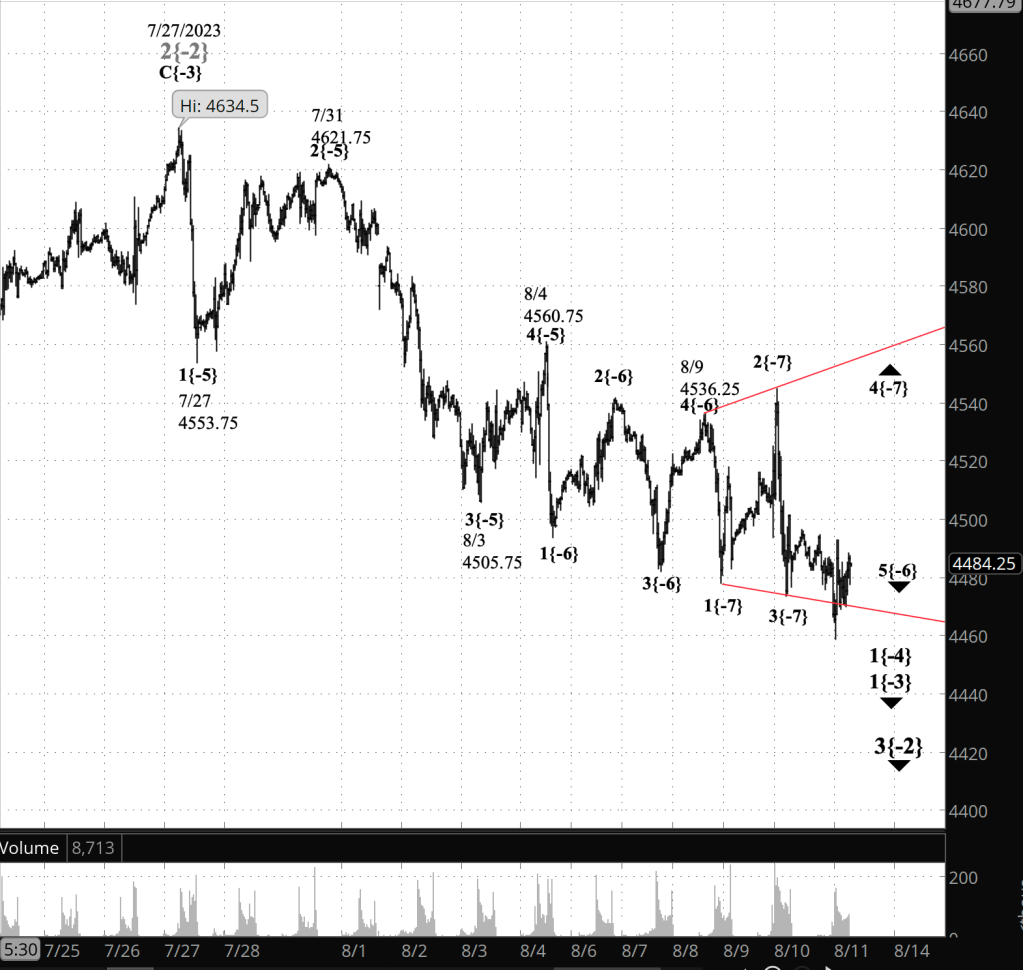
Half an hour before the closing bell. The S&P 500 futures reached a low of 4478.25 during the session and the b rose back into the 4510s, remaining below the overnight high, 4536.25.

The final wave of the low-degree downtrend that began on on August 4 continues. Alternative analysis #1 from this morning is no longer possible. Otherwise, the analysis is unchanged. I’ve updated the chart.

9:35 a.m. New York time

What’s happening now? The S&P 500 E-mini futures rose overnight from 4515.50 to 4536.25 and then pulled back.

What does it mean? The 4536.25 peak completes the 4th wave within a downtrend that began on August 4 and marks the start of the 5th and final wave.

The August 4 downtrend is a subwave within a nested series of subwaves of increasing size encompassed within the largest of the set, a significant 3rd-wave downtrend that began on July 27 from 4634.50.

What are the alternatives? There are two.

Alternative analysis #1:

It’s possible that the price will reverse, giving the 4th subwave a bit more distance to the upside before it reaches completion.

Note: The price movement during the session made this alternative impossible.

Alternative analysis #2:

At a larger scale, it’s possible that the 2nd-wave upward correction that preceded the 3rd-wave downtrend will add a third corrective pattern to the two that have already been completed. If this turns out to be the case, then the decline from July 27 is a wave connecting the second corrective pattern within the compound correction with a third and final pattern.

[S&P 500 E-mini futures at 3:30 p.m., 30-minute bars, with volume]

What does Elliott wave theory say? Here are the waves that underly the analyses.

Principal analysis:

  • A downward correction, wave 3{-2}, began on July and is underway.
  • Internally, the correction is in its first subwave, wave 1{-3}.
  • Within wave 1{-3}, things become a bit more ambiguous, since the precise degree of the subwaves won’t become clear until the downtrend has progressed further.
  • I’ve chosen, as a guess, to label the subwave of wave 1{-3} as being in its first wave, 1{-4}, which in turn is in its final subwave, wave 5{-5}.
  • The final subwave within wave 5{-5} began overnight. Declining wave 5{-6} is now underway.

Alternative analysis: #1:

  • Rising wave 4{-6} is still underway.

Alternative analysis #2:

  • Wave 2{-2}, and upward compound correction that began on October 13, 2022 completed a second corrective pattern on July 27.
  • The subsequent decline is wave X{-3}, a downward connector between the second corrective pattern and the future third corrective pattern.
  • Once the third corrective pattern within wave 2{-2} has ended, a powerful downtrend, wave 3{-2}, will follow

We Are Here.

These are the waves currently in progress under my principal analysis. Each line on the list shows the wave number, with the subscript in curly brackets, the traditional degree name, the starting date, the starting price of the S&P 500 E-mini futures, and the direction of the wave.

  • S&P 500 Index:
  • 5{+3} Supercycle, 7/8/1932, 4.40 (up)
  • 5{+2} Cycle, 12/9/1974, 60.96 (up)
  • 5{+1} Primary, 3/6/2009, 666.79 (up)
  • 5{0} Intermediate, 12/26/2018, 2346.58 (up)
  • S&P 500 Futures and index:
  • 4{-1} Minor, 1/4/2022, 4953.25 (down) (futures), 4818.62 (down) (index)
  • S&P 500 Futures:
  • 3{-2} Minute, 7/27/2023, 3502 (down)

Reading the chart. Price movements — waves – – in Elliott wave analysis are labeled with numbers within trending waves and letters with corrective waves. The subscripts — numbers in curly brackets — designate the wave’s degree, which, in Elliott wave analysis, means the relative position of a wave within the larger and smaller structures that make up the chart. R.N. Elliott, who in the 1930s developed the form of analysis that bears his name, viewed the chart as a complex structure of smaller waves nested within larger waves, which in turn are nested within still larger waves. In mathematics it’s called a fractal structure, where at every scale the pattern is similar to the others.

Learning and other resources. Elliott wave analysis provides context, not prophecy. As the 20th century semanticist Alfred Korzybski put it in his book Science and Sanity (1933), “The map is not the territory … The only usefulness of a map depends on similarity of structure between the empirical world and the map.” And I would add, in the ever-changing markets, we can judge that similarity of structure only after the fact.

See the menu page Analytical Methods for a rundown on where to go for information on Elliott wave analysis.

By Tim Bovee, Portland, Oregon, August 9, 2023

Disclaimer

Tim Bovee, Private Trader tracks the analysis and trades of a private trader for his own accounts. Nothing in this blog constitutes a recommendation to buy or sell stocks, options or any other financial instrument. The only purpose of this blog is to provide education and entertainment.

No trader is ever 100 percent successful in his or her trades. Trading in the stock and option markets is risky and uncertain. Each trader must make trading decisions for his or her own account, and take responsibility for the consequences.

License
Creative Commons License

All content on Tim Bovee, Private Trader by Timothy K. Bovee is licensed under a Creative Commons Attribution-ShareAlike 4.0 International License.

Based on a work at www.timbovee.com.
Trader’s Notebook

3:30 p.m. New York time

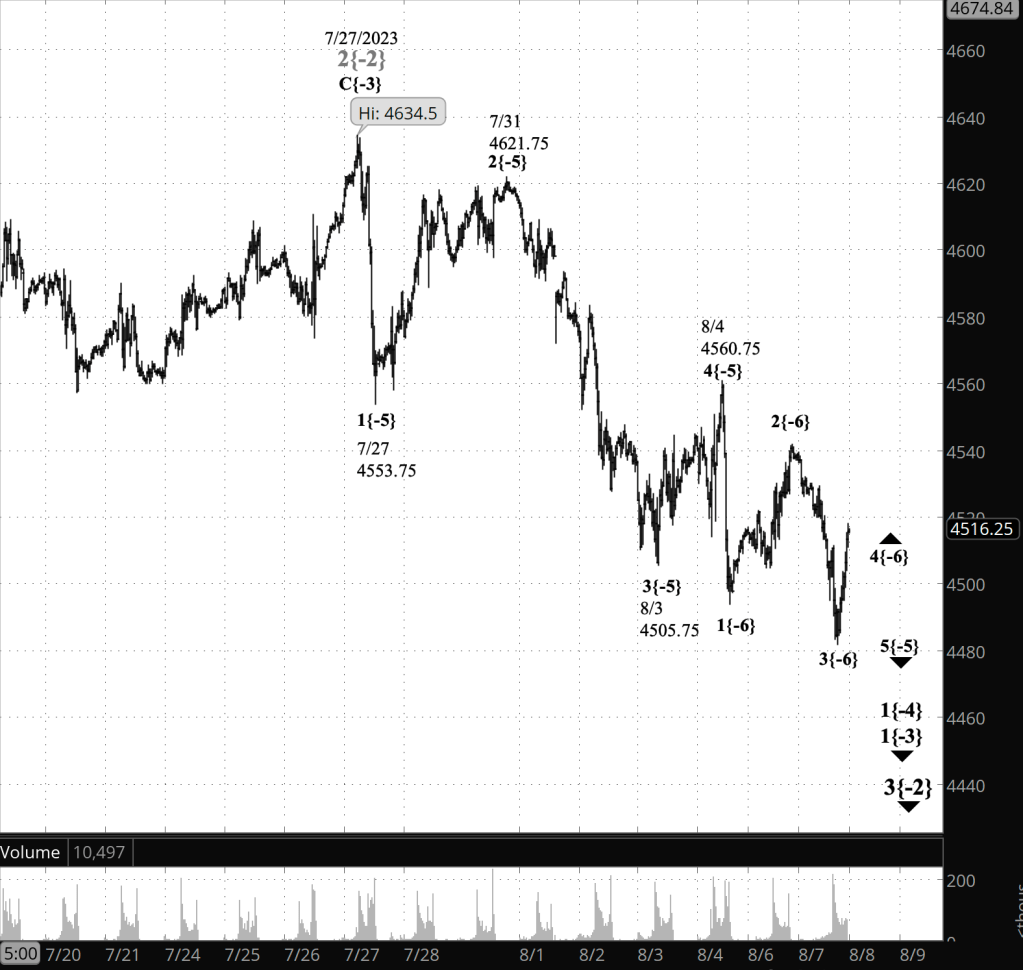
Half an hour before the closing bell. The S&P 500 futures fell during the session to a low of 4482 and then rose, returning to the 4510s.

The upward reversal is a subwave, wave 4{-6}, within the final leg, wave {5-5}, within the decline that began on July 27, wave 1{-4}, a downtrend within two progressively larger downtrends, wave 1{-3} and wave 3{-2}.

Wave 4{-6} will be followed by a further push downward, as wave 5{-6}, which, when complete, will also be the end of wave 5{-5} and its parent, wave 1{-4}.

The subscripts in curly brackets, showing the placement of the waves within the fractal structure of the chart — their degrees — are solid at the higher levels, and less certain at the smaller. For example, wave 5{-5} may in fact be one degree higher, {-4}, or it could be one degree lower, {-6}, pushing the subwaves down a degree to {-7}. The degrees will become clearer wave 3{-2} downtrend develops.

This morning’s analysis is unchanged. I’ve updated the chart.

9:35 a.m. New York time

What’s happening now? The S&P 500 E-mini futures fell overnight, from 4541 into the 4490s.

What does it mean? The rise from the August 7 low, 4493.75, was an upward correction within last leg of the larger downtrend that began on July 27. That last leg is itself a subwave of downtrends. each larger than the one within it, that all began on that date, which will appear on future charts as a major reversal point.

What are the alternatives? The downtrends, under the principal analysis, follow an upward correction that lasted nearly 10 months. The correction took a compound form and completed two corrective patterns.

Under the alternative analysis, it’s possible that the decline from July 27 is an X-wave, a connector linking the second corrective pattern with a third pattern that, when complete, will also be the end of the correction.

The further the price falls, the less likely this scenario becomes.

[S&P 500 E-mini futures at 3:30 p.m., 30-minute bars, with volume]

What does Elliott wave theory say? Here are the waves that underly the analysis.

Principal analysis:

  • An downward correction, wave 3{-2}, began on July and is underway.
  • Internally, the correction is in its first subwave, wave 1{-3}.
  • Within wave 1{-3}, things become a bit more ambiguous, since the precise degree of the subwaves won’t become clear until the downtrend has progressed further.
  • I’ve chosen, as a guess, to label the subwave of wave 1{-3} as being in its first wave, 1{-4}, which in turn is in its final subwave, wave 5{-5}.

Alternative analysis:

  • Wave 2{-2}, and upward compound correction that began on October 13, 2022 completed a second corrective pattern on July 27.
  • The subsequent decline is wave X{-3}, a downward connector between the second corrective pattern and the future third corrective pattern.
  • Once the third corrective pattern within wave 2{-2} has ended, a powerful downtrend, wave 3{-3}, will follow

We Are Here.

These are the waves currently in progress under my principal analysis. Each line on the list shows the wave number, with the subscript in curly brackets, the traditional degree name, the starting date, the starting price of the S&P 500 E-mini futures, and the direction of the wave.

  • S&P 500 Index:
  • 5{+3} Supercycle, 7/8/1932, 4.40 (up)
  • 5{+2} Cycle, 12/9/1974, 60.96 (up)
  • 5{+1} Primary, 3/6/2009, 666.79 (up)
  • 5{0} Intermediate, 12/26/2018, 2346.58 (up)
  • S&P 500 Futures and index:
  • 4{-1} Minor, 1/4/2022, 4953.25 (down) (futures), 4818.62 (down) (index)
  • S&P 500 Futures:
  • 3{-2} Minute, 7/27/2023, 3502 (down)

Reading the chart. Price movements — waves – – in Elliott wave analysis are labeled with numbers within trending waves and letters with corrective waves. The subscripts — numbers in curly brackets — designate the wave’s degree, which, in Elliott wave analysis, means the relative position of a wave within the larger and smaller structures that make up the chart. R.N. Elliott, who in the 1930s developed the form of analysis that bears his name, viewed the chart as a complex structure of smaller waves nested within larger waves, which in turn are nested within still larger waves. In mathematics it’s called a fractal structure, where at every scale the pattern is similar to the others.

Learning and other resources. Elliott wave analysis provides context, not prophecy. As the 20th century semanticist Alfred Korzybski put it in his book Science and Sanity (1933), “The map is not the territory … The only usefulness of a map depends on similarity of structure between the empirical world and the map.” And I would add, in the ever-changing markets, we can judge that similarity of structure only after the fact.

See the menu page Analytical Methods for a rundown on where to go for information on Elliott wave analysis.

By Tim Bovee, Portland, Oregon, August 8, 2023

Disclaimer

Tim Bovee, Private Trader tracks the analysis and trades of a private trader for his own accounts. Nothing in this blog constitutes a recommendation to buy or sell stocks, options or any other financial instrument. The only purpose of this blog is to provide education and entertainment.

No trader is ever 100 percent successful in his or her trades. Trading in the stock and option markets is risky and uncertain. Each trader must make trading decisions for his or her own account, and take responsibility for the consequences.

License
Creative Commons License

All content on Tim Bovee, Private Trader by Timothy K. Bovee is licensed under a Creative Commons Attribution-ShareAlike 4.0 International License.

Based on a work at www.timbovee.com.

Trader’s Notebook

3:30 p.m. New York time

Half an hour before the closing bell. The S&P 500 futures rose during the session, so far reaching into the 4530s. The small upward correction that began overnight, a subwave of downtrending wave 5{-5}, continues and is now in its third and possibly final leg. Wave 5{-5} is a subwave of wave 1{-4} within a large downtrend, wave 3{-3}, than began on June 27.

This morning’s analysis is unchanged. I’ve updated the upper chart, which is a close-up view of the futures. The lower chart, a big picture view of the S&P 500 index, is unchanged from this morning.

9:35 a.m. New York time

What’s happening now? The S&P 500 E-mini futures rose after trading resumed overnight, from 4500.50 into the 4520s.

What does it mean? The upward correction that began last October, wave 2{-2}, ended on July 27, and a downtrend that will last many months, wave 3{-2}, has begun.

The overnight rise is a small upward correction within the final wave of the earliest stage of the downtrend.

In Friday’s analysis I gave equal likelihood to the downtrend scenario and several alternatives. The clear five-wave pattern of the decline shifted the odds in favor of the downtrend, which is now the principal analysis.

The upward correction, now ended, began from 3502. The downtrend will carry the price below that level, and perhaps significantly below. The downtrend is a third wave, which is never the shortest of the three trending subwaves within a larger trend, and quite often, the third wave is the longest of them all.

The description most often associated with third waves is “powerful”.

All of this is happening within downtrending wave 4{-1}, which began on January 4, 2022. That wave is a subwave within an expanding Diagonal Triangle, wave 5{0}, that began on December 26, 2018.

What are the alternatives? It remains possible, although less likely, that the upward correction is still underway. The correction took a compound form and has completed two corrective patterns. Under this alternative scenario, the decline is a wave connecting the prior second corrective pattern to a third pattern that will complete the correction.

Reading the chart. The upper chart, of the S&P 500 futures, is a close-up focused on the decline that began on July 27. The lower chart, of the S&P 500 index, pulls back and shows the expanding Diagonal Triangle that began in 2018 and encompasses everything discussed in the analysis. The price-channel boundaries of the Triangle are shown in blue.

Price movements — waves – – in Elliott wave analysis are labeled with numbers within trending waves and letters with corrective waves. The subscripts — numbers in curly brackets — designate the wave’s degree, which, in Elliott wave analysis, means the relative position of a wave within the larger and smaller structures that make up the chart. R.N. Elliott, who in the 1930s developed the form of analysis that bears his name, viewed the chart as a complex structure of smaller waves nested within larger waves, which in turn are nested within still larger waves. In mathematics it’s called a fractal structure, where at every scale the pattern is similar to the others.

[S&P 500 E-mini futures at 3:30 p.m., 30-minute bars, with volume]

[S&P 500 index at 9:35 a.m., 3-day bars]

What does Elliott wave theory say? Here are the waves that underly the analysis.

Principal analysis:

  • An downward correction, wave 3{-2}, began on July and is underway.
  • Internally, the correction is in its first subwave, wave 1{-3}.
  • Within wave 1{-3}, things become a bit more ambiguous, since the precise degree of the subwaves won’t become clear until the downtrend has progressed further.
  • I’ve chosen, as a guess, to label the subwave of wave 1{-3} as being in its first wave, 1{-4}, wich in turn is in its final subwave, wave 5{-5}.

Alternative analysis:

  • Wave 2{-2}, and upward compound correction that began on October 13, 2022 completed a second corrective pattern on July 27.
  • The subsequent decline is wave X{-3}, a downward connector between the second corrective pattern and the future third corrective pattern.
  • Once the third corrective pattern within wave 2{-2} has ended, a powerful downtrend, wave 3{-3}, will follow.

Big picture:

  • Both the wave 2{-2} correction and wave 3{-2} downtrend are subwaves of wave 4{-1}, a downtrend that began on January 4, 2022.
  • Wave 4{-1}, in turn, is a subwave of wave 5{0}, an expanding Diagonal Triangle that began on December 26, 2018.
  • Wave 4{-1} may eventually reach the lower boundary of wave 5{0}, presently slightly below 1800 and declining further each day.
  • Wave 4{-1} will be followed by rising wave 5{-1}, the final wave in the Triangle.

We Are Here.

These are the waves currently in progress under my principal analysis. Each line on the list shows the wave number, with the subscript in curly brackets, the traditional degree name, the starting date, the starting price of the S&P 500 E-mini futures, and the direction of the wave.

  • S&P 500 Index:
  • 5{+3} Supercycle, 7/8/1932, 4.40 (up)
  • 5{+2} Cycle, 12/9/1974, 60.96 (up)
  • 5{+1} Primary, 3/6/2009, 666.79 (up)
  • 5{0} Intermediate, 12/26/2018, 2346.58 (up)
  • S&P 500 Futures and index:
  • 4{-1} Minor, 1/4/2022, 4953.25 (down) (futures), 4818.62 (down) (index)
  • S&P 500 Futures:
  • 3{-2} Minute, 7/27/2023, 3502 (down)

Learning and other resources. Elliott wave analysis provides context, not prophecy. As the 20th century semanticist Alfred Korzybski put it in his book Science and Sanity (1933), “The map is not the territory … The only usefulness of a map depends on similarity of structure between the empirical world and the map.” And I would add, in the ever-changing markets, we can judge that similarity of structure only after the fact.

See the menu page Analytical Methods for a rundown on where to go for information on Elliott wave analysis.

By Tim Bovee, Portland, Oregon, August 7, 2023

Disclaimer

Tim Bovee, Private Trader tracks the analysis and trades of a private trader for his own accounts. Nothing in this blog constitutes a recommendation to buy or sell stocks, options or any other financial instrument. The only purpose of this blog is to provide education and entertainment.

No trader is ever 100 percent successful in his or her trades. Trading in the stock and option markets is risky and uncertain. Each trader must make trading decisions for his or her own account, and take responsibility for the consequences.

License
Creative Commons License

All content on Tim Bovee, Private Trader by Timothy K. Bovee is licensed under a Creative Commons Attribution-ShareAlike 4.0 International License.

Based on a work at www.timbovee.com.

Trader’s Notebook

3:30 p.m. New York time

Half an hour before the closing bell. The S&P 500 futures rose during the session to 4560.75 and then reversed, falling into the 4490s. In the low-degree labels that I added this morning, the decline marked the end of a small upward correction, wave 4{-5}, and the beginning of the final wave of the series, wave 5{-5}.

Implications for two scenarios:

  • The scenario that sees today’s decline as a wave connecting the second corrective pattern with a third such pattern within the larger upward compound correction became less likely as a result of today’s fall. The decline is taking the form of five subwaves, and a connecting wave, wave X{-3}, would have three subwaves.
  • The scenario that declares the upward correction to have ended at the July 27 high and the downward movement to be the start of a downtrend, wave 3{-2}, became more likely as a result of today’s fall. A trending wave as five subwaves.

I’ve updated the chart.

9:35 a.m. New York time

What’s happening now? The S&P 500 E-mini futures rose during the earlier hours of the overnight trading, reaching 4547 and then reversed, reaching a low of 4514.25 a few minutes after the latest employment numbers were released. The price remained above yesterday’s low, 4505.75. Shortly after the opening bell. the price exceeded the overnight high, reaching 4548.

What does it mean? Absent new highs or lows, overnight trading did nothing to resolve the ambiguities created when the price retreated from last week’s peak, 4634.50.

What are the ambiguities? Unchanged from yesterday’s Trader’s Notebook. And the analysis that follows is largely unchanged from yesterday’s post.

An upward correction, wave 2{-2} that began on October 13, 2022 has taken a compound form. So far it has produced two corrective patterns.

Within that context, here is an inventory of the ambiguities:

  • The decline from July 27 is a subwave of the final wave of the second corrective pattern, which is still underway
    • The lower the price falls, the less likely this scenario becomes.
  • The second corrective pattern ended at the July 27 peak and the correction continues.
    • The decline is a wave that will connect the second corrective pattern with a third and final corrective pattern. This is called an X-wave in classical Elliott wave terminology.
  • The upward correction ended at the July 27 peak.
    • The decline is the early stage of what will become powerful downtrend that will carry the price below the start of the upward correction, from 3502, and most likely significantly below that level. This would be wave 3{-2}.

The chart below. The chart shows the final subwave, wave C{-3} of the second corrective pattern within the upward correction, wave 2{-2}.

The decline so far has completed three subwaves, which I’ve placed on the chart as waves 1{-5}, 2{-5} and 3{-5}. The degree subscript, {-5}, is only a guess. There’s not enough context to support anything more precise at this point. It’s probably not larger and might be smaller.

[S&P 500 E-mini futures at 3:30 p.m., 165-minute bars, with volume]

What does Elliott wave theory say? Here are the waves that underly the analysis.

Known facts:

  • An upward correction, a Zigzag, wave 2{-2}, began on October 13, 2022 and is underway.
  • The upward correction, wave 2{-2}, is taking a compound form, which can contain up to three corrective patterns.
  • The correction has completed its second corrective pattern.

Ambiguities

  • Is the July 27 peak the end of wave C{-3} within the correction, wave 2{-2}?
  • If wave C{-3} has ended, has wave 2{-2} also ended or will it produce a connector, wave X{-3}, and then move on to wave A{-3}, the first wave of a third corrective pattern?
  • If wave 2{-2} has ended, a powerful downtrend, wave 3{-3}, is taking its tentative 1st steps.

We Are Here.

These are the waves currently in progress under my principal analysis. Each line on the list shows the wave number, with the subscript in curly brackets, the traditional degree name, the starting date, the starting price of the S&P 500 E-mini futures, and the direction of the wave.

  • S&P 500 Index:
  • 5{+3} Supercycle, 7/8/1932, 4.40 (up)
  • 5{+2} Cycle, 12/9/1974, 60.96 (up)
  • 5{+1} Primary, 3/6/2009, 666.79 (up)
  • 5{0} Intermediate, 12/26/2018, 2346.58 (up)
  • S&P 500 Futures and index:
  • 4{-1} Minor, 1/4/2022, 4953.25 (down) (futures), 4818.62 (down) (index)
  • S&P 500 Futures:
  • 3{-2} Minute, 7/27/2023, 3502 (down) (tenatively)

Reading the chart. Price movements — waves – – in Elliott wave analysis are labeled with numbers within trending waves and letters with corrective waves. The subscripts — numbers in curly brackets — designate the wave’s degree, which, in Elliott wave analysis, means the relative position of a wave within the larger and smaller structures that make up the chart. R.N. Elliott, who in the 1930s developed the form of analysis that bears his name, viewed the chart as a complex structure of smaller waves nested within larger waves, which in turn are nested within still larger waves. In mathematics it’s called a fractal structure, where at every scale the pattern is similar to the others.

Learning and other resources. Elliott wave analysis provides context, not prophecy. As the 20th century semanticist Alfred Korzybski put it in his book Science and Sanity (1933), “The map is not the territory … The only usefulness of a map depends on similarity of structure between the empirical world and the map.” And I would add, in the ever-changing markets, we can judge that similarity of structure only after the fact.

See the menu page Analytical Methods for a rundown on where to go for information on Elliott wave analysis.

By Tim Bovee, Portland, Oregon, August 4, 2023

Disclaimer

Tim Bovee, Private Trader tracks the analysis and trades of a private trader for his own accounts. Nothing in this blog constitutes a recommendation to buy or sell stocks, options or any other financial instrument. The only purpose of this blog is to provide education and entertainment.

No trader is ever 100 percent successful in his or her trades. Trading in the stock and option markets is risky and uncertain. Each trader must make trading decisions for his or her own account, and take responsibility for the consequences.

License
Creative Commons License

All content on Tim Bovee, Private Trader by Timothy K. Bovee is licensed under a Creative Commons Attribution-ShareAlike 4.0 International License.

Based on a work at www.timbovee.com.

Trader’s Notebook

3:30 p.m. New York time

Half an hour before the closing bell. The S&P 500 futures has peeked above 4540 and then withdrawn, so far staying below the overnight high, 4547.50. This morning’s analysis is unchanged. I’ve updated the chart.

9:35 a.m. New York time

What’s happening now? The S&P 500 E-mini futures continued falling overnight, reaching below 4510 as the session began.

What does it mean? The ambiguities of the week remain in place, with multiple explanations of the meaning of the decline since July 27 peak, 4634.50. The interpretation is happening within the context of a rising upward correction that began on October 13, 2022 and has taken a compound form, so far containing two corrective patterns.

Here are the alternatives:

  • The decline is a subwave of the final wave of the second corrective pattern, which is still underway
    • The lower the price falls, the less likely this scenario becomes.
  • The second corrective pattern ended at the July 27 peak and the correction continues.
    • The decline is a wave that will connect the second corrective pattern with a third and final corrective pattern. This is called an X-wave in classical Elliott wave terminology.
  • The upward correction ended at the July 27 peak.
    • The decline is the early stage of what will become powerful downtrend that will carry the price below the start of the upward correction, from 3502, and most likely significantly below that level. This would be a 3rd wave

The chart below. The chart shows the final subwave, wave C{-3} of the second corrective pattern within the upward correction, wave 2{-2}.

[S&P 500 E-mini futures at 3:30 p.m., 165-minute bars, with volume]

What does Elliott wave theory say? Here are the waves that underly the analysis.

Known facts:

  • An upward correction, a Zigzag, wave 2{-2}, began on October 13, 2022 and is underway.
  • The upward correction, wave 2{-2}, is taking a compound form, which can contain up to three corrective patterns.
  • The correction has completed its second corrective pattern.

Ambiguities

  • Is the July 27 peak the end of wave C{-3} within the correction, wave 2{-2}?
  • If wave C{-3} has ended, has wave 2{-2} also ended or will it produce a connector, wave X{-3}, and then move on to wave A{-3}, the first wave of a third corrective pattern?
  • If wave 2{-2} has ended, a powerful downtrend, wave 3{-3}, is taking its tentative 1st steps.

We Are Here.

These are the waves currently in progress under my principal analysis. Each line on the list shows the wave number, with the subscript in curly brackets, the traditional degree name, the starting date, the starting price of the S&P 500 E-mini futures, and the direction of the wave.

  • S&P 500 Index:
  • 5{+3} Supercycle, 7/8/1932, 4.40 (up)
  • 5{+2} Cycle, 12/9/1974, 60.96 (up)
  • 5{+1} Primary, 3/6/2009, 666.79 (up)
  • 5{0} Intermediate, 12/26/2018, 2346.58 (up)
  • S&P 500 Futures and index:
  • 4{-1} Minor, 1/4/2022, 4953.25 (down) (futures), 4818.62 (down) (index)
  • S&P 500 Futures:
  • 3{-2} Minute, 7/27/2023, 3502 (down) (tenatively)

Reading the chart. Price movements — waves – – in Elliott wave analysis are labeled with numbers within trending waves and letters with corrective waves. The subscripts — numbers in curly brackets — designate the wave’s degree, which, in Elliott wave analysis, means the relative position of a wave within the larger and smaller structures that make up the chart. R.N. Elliott, who in the 1930s developed the form of analysis that bears his name, viewed the chart as a complex structure of smaller waves nested within larger waves, which in turn are nested within still larger waves. In mathematics it’s called a fractal structure, where at every scale the pattern is similar to the others.

Learning and other resources. Elliott wave analysis provides context, not prophecy. As the 20th century semanticist Alfred Korzybski put it in his book Science and Sanity (1933), “The map is not the territory … The only usefulness of a map depends on similarity of structure between the empirical world and the map.” And I would add, in the ever-changing markets, we can judge that similarity of structure only after the fact.

See the menu page Analytical Methods for a rundown on where to go for information on Elliott wave analysis.

By Tim Bovee, Portland, Oregon, August 3, 2023

Disclaimer

Tim Bovee, Private Trader tracks the analysis and trades of a private trader for his own accounts. Nothing in this blog constitutes a recommendation to buy or sell stocks, options or any other financial instrument. The only purpose of this blog is to provide education and entertainment.

No trader is ever 100 percent successful in his or her trades. Trading in the stock and option markets is risky and uncertain. Each trader must make trading decisions for his or her own account, and take responsibility for the consequences.

License
Creative Commons License

All content on Tim Bovee, Private Trader by Timothy K. Bovee is licensed under a Creative Commons Attribution-ShareAlike 4.0 International License.

Based on a work at www.timbovee.com.
Trader’s Notebook

3:30 p.m. New York time

Half an hour before the closing bell. The S&P 500 futures fell during the session, reaching into the 4530s. No change in this morning’s analysis. I’ve updated the upper chart.

9:35 a.m. New York time

What’s happening now? The S&P 500 E-mini futures fell from the 4590s into the 4550s overnight, rising back into the 4580s as the opening bell drew nearer.

What does it mean? The decline since last week so far has done nothing to answer the questions posed by the chart: Has the second corrective pattern within an upward compound correction that began in October reached its end, and if so, has a correction itself also ended, or will there there a third corrective pattern?

Each of the questions will have a major impact on the market’s directionality. As for myself, I’m being very cautious about how I place my bets.

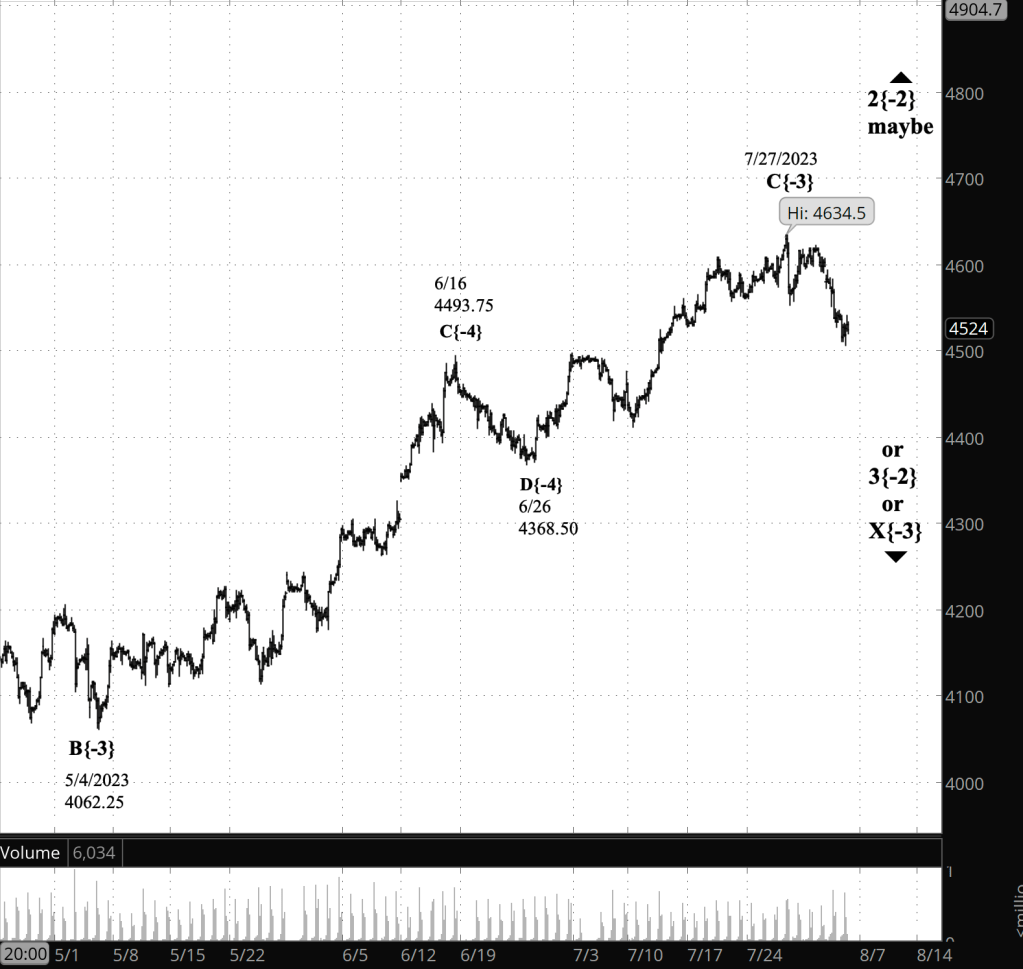
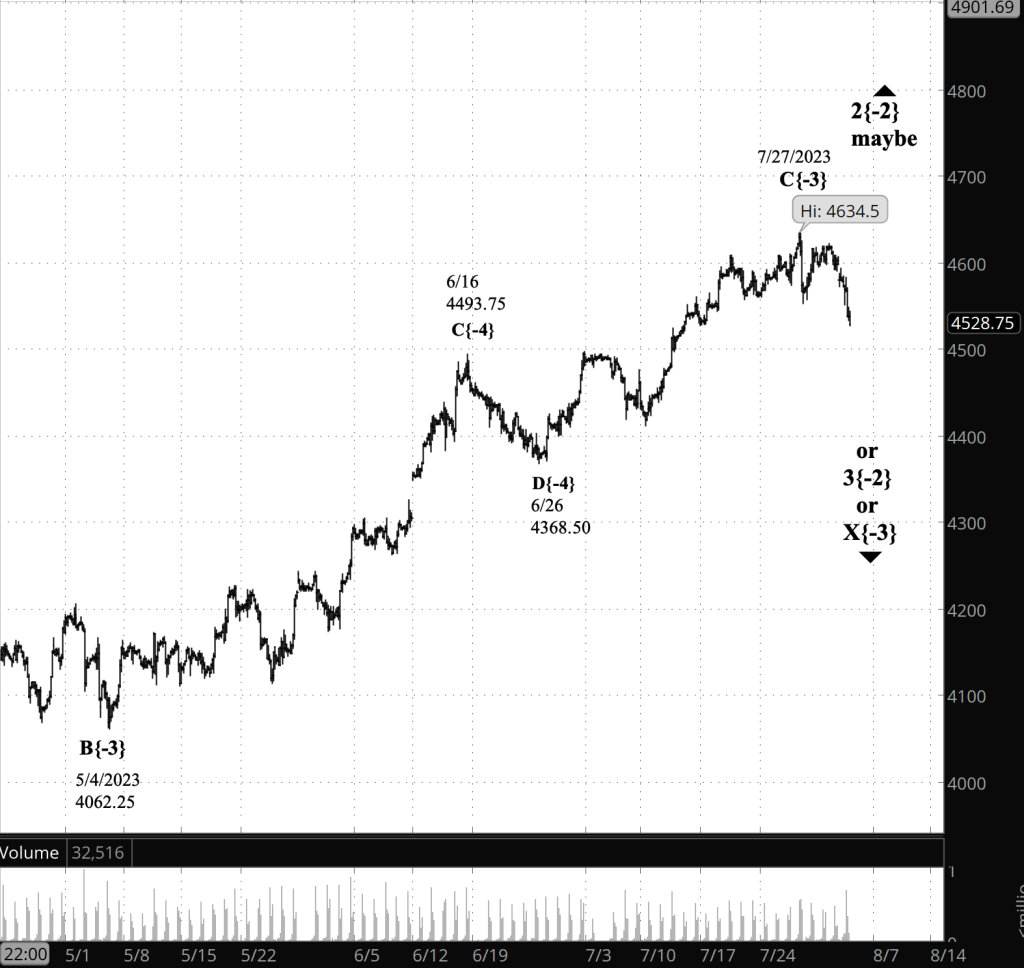
In the upper chart, I’ve pulled back for a broader look at the futures, showing the correction’s final subwave, which began on May 4.

The lower chart shows the entire downtrend that began on January 4, 2022 — the 1st wave that ended on October 13, and the 2nd wave, which may or may not have reached completion. (The blue line is the upper boundary of an expanding Diagonal Triangle that began in December 2018.)

At this point, I don’t have a principal analysis, only alternatives.

What are the alternatives? At issue is the meaning of the decline that began on June 27.

The June 27 peak may or may not be the end of the second corrective pattern within the upward correction, wave 2{-2}. Those are the first two alternatives upon which the analysis depends.

If the peak isn’t the end of the pattern, then the price will quickly reverse and the final way of the pattern, wave C{-3}, will continue its rise. Under the rules that govern 2nd-wave corrections, the price must remain below the start of the preceding 1st wave: 4953.25 on the futures and 4818.62 on the index.

If the peak is the end of the pattern, then there are two more alternatives.

A compound correction can contain two or three corrective patterns. If the second pattern is the final pattern, then the correction will have ended and a powerful downtrend, wave 3{-3}, will begin. If the correction moves on to a third corrective pattern, then the second pattern will be followed by a relatively small downtrending connector wave, X{-3}, and then the first wave of the third pattern, rising wave A{-3}.

Those are the five alternatives. As the charts show, the present decline so far is quite small on the futures chart and almost invisible on the larger index chart. It may be awhile before the ambiguities are resolved.

[S&P 500 E-mini futures at 3:30 p.m., 165-minute bars, with volume]

[S&P 500 index at 9:30 a.m., daily bars]

What does Elliott wave theory say? Here are the waves that underly the analysis.

Known facts:

  • An upward correction, a Zigzag, wave 2{-2}, began on October 13, 2022 and is underway.
  • The upward correction, wave 2{-2}, is taking a compound form, which can contain up to three corrective patterns.
  • The correction has completed its second corrective pattern.

Ambiguities

  • Is the July 27 peak the end of wave C{-3} within the correction, wave 2{-2}?
  • If wave C{-3} has ended, has wave 2{-2} also ended or will it produce a connector, wave X{-3}, and then move on to wave A{-3}, the first wave of a third corrective pattern?
  • If wave 2{-2} has ended, a powerful downtrend, wave 3{-3}, is taking its tentative 1st steps.

We Are Here.

These are the waves currently in progress under my principal analysis. Each line on the list shows the wave number, with the subscript in curly brackets, the traditional degree name, the starting date, the starting price of the S&P 500 E-mini futures, and the direction of the wave.

  • S&P 500 Index:
  • 5{+3} Supercycle, 7/8/1932, 4.40 (up)
  • 5{+2} Cycle, 12/9/1974, 60.96 (up)
  • 5{+1} Primary, 3/6/2009, 666.79 (up)
  • 5{0} Intermediate, 12/26/2018, 2346.58 (up)
  • S&P 500 Futures and index:
  • 4{-1} Minor, 1/4/2022, 4953.25 (down) (futures), 4818.62 (down) (index)
  • S&P 500 Futures:
  • Maybe 2{-2} Minute, 10/13/2022, 3502 (up) …
    • … or 3{-2} Minute, 7/27/2023, 4634.50 (down)

Reading the chart. Price movements — waves – – in Elliott wave analysis are labeled with numbers within trending waves and letters with corrective waves. The subscripts — numbers in curly brackets — designate the wave’s degree, which, in Elliott wave analysis, means the relative position of a wave within the larger and smaller structures that make up the chart. R.N. Elliott, who in the 1930s developed the form of analysis that bears his name, viewed the chart as a complex structure of smaller waves nested within larger waves, which in turn are nested within still larger waves. In mathematics it’s called a fractal structure, where at every scale the pattern is similar to the others.

Learning and other resources. Elliott wave analysis provides context, not prophecy. As the 20th century semanticist Alfred Korzybski put it in his book Science and Sanity (1933), “The map is not the territory … The only usefulness of a map depends on similarity of structure between the empirical world and the map.” And I would add, in the ever-changing markets, we can judge that similarity of structure only after the fact.

See the menu page Analytical Methods for a rundown on where to go for information on Elliott wave analysis.

By Tim Bovee, Portland, Oregon, August 2, 2023

Disclaimer

Tim Bovee, Private Trader tracks the analysis and trades of a private trader for his own accounts. Nothing in this blog constitutes a recommendation to buy or sell stocks, options or any other financial instrument. The only purpose of this blog is to provide education and entertainment.

No trader is ever 100 percent successful in his or her trades. Trading in the stock and option markets is risky and uncertain. Each trader must make trading decisions for his or her own account, and take responsibility for the consequences.

License
Creative Commons License

All content on Tim Bovee, Private Trader by Timothy K. Bovee is licensed under a Creative Commons Attribution-ShareAlike 4.0 International License.

Based on a work at www.timbovee.com.
Trader’s Notebook

3:30 p.m. New York time

Half an hour before the closing bell. The S&P 500 futures fell during much of the session, remaining above 4590 as the closing bell approached. Under the principal analysis, the second corrective pattern within the upward correction that began last October has ended, and a descending wave is under way to connect the second pattern with a third and final corrective pattern.

The connector is called an X wave, and its third and final subwave appears to be taking the form of a barrier triangle, with a flat lower price channel. I’ve put the triangle boundaries on the chart in red.

The principal analysis seems most likely to me, based on the chart. See below for the alternative described in this morning’ analysis.

I’ve updated the chart.

9:35 a.m. New York time

What’s happening now? The S&P 500 E-mini futures fell overnight, reaching into the 4590s.

What does it mean? The third wave down since the July 27 peak continues. The first wave had three subwaves, suggesting that the downward movement is a correction of some sort.

The late July peak may have marked the end of the second corrective pattern within a compound correction, wave 2{-2}, that began on September 13, 2023.

A compound correction can contain two or three corrective patterns. If wave 2{-2} is going for three patterns, then the present decline is a wave that will connect the now complete second pattern with a future third pattern.

Such connecting waves are call X waves in the classical nomenclature of Elliott wave analysis. An X-wave is built from three subwaves, meaning it is part of a corrective wave. The first wave down, which I’ve labeled as wave A{-4}, had three subwaves, and that suggests that the upward correction is continuing, the second corrective pattern ended on July 27, a connector wave is underway, and a third corrective pattern lies ahead.

What are the alternatives? It is possible that the decline since July 27 is a subwave of the ongoing final wave of the second corrective pattern. So far the decline has been quite small compared the waves of the second corrective pattern. The X-wave scenario raises the question of whether that principal analysis violates the tendency toward proportionality.

What I no longer think is an alternative at this point is the idea that the upward correction has ended entirely and a powerful downtrend, wave 3{-2}, is underway. The three-subwave structure of the first wave down from July 27 makes that impossible.

[S&P 500 E-mini futures at 3:30 p.m., 15-minute bars, with volume]

What does Elliott wave theory say? Here are the waves that underlie the analysis.

Principal analysis:

  • An upward correction, a Zigzag, wave 2{-2}, began on October 13, 2022 and is underway.
  • The upward correction, wave 2{-2}, is taking a compound form, which can contain up to three corrective patterns.
  • The correction has completed its second corrective pattern and has begun a connector wave, X{-3}, which will be followed by a third corrective pattern.
  • Wave X{-3} will have three subwaves and is at wave C{-4}, the final subwave.
  • Wave 2{-2}, when complete, will be followed by a powerful downtrend, wave 3{-2}.
  • Under the rules of Elliott wave analysis, wave 2{-2} cannot move beyond the beginning of wave 1{-2}, which was the January 4, 2022 peak at 4953.25

Alternative analysis:

  • The final wave, C{-3}, of the second corrective pattern is not yet complete. Within it, wave E{-4} is in its fourth of five subwaves, wave D{-5}, a falling wave that will be followed by a final rise to completion.

We Are Here.

These are the waves currently in progress under my principal analysis. Each line on the list shows the wave number, with the subscript in curly brackets, the traditional degree name, the starting date, the starting price of the S&P 500 E-mini futures, and the direction of the wave.

  • S&P 500 Index:
  • 5{+3} Supercycle, 7/8/1932, 4.40 (up)
  • 5{+2} Cycle, 12/9/1974, 60.96 (up)
  • 5{+1} Primary, 3/6/2009, 666.79 (up)
  • 5{0} Intermediate, 12/26/2018, 2346.58 (up)
  • S&P 500 Futures and index:
  • 4{-1} Minor, 1/4/2022, 4953.25 (down) (futures), 4818.62 (down) (index)
  • S&P 500 Futures:
  • 2{-2} Minute, 10/13/2022, 3502 (up)

Reading the chart. Price movements — waves – – in Elliott wave analysis are labeled with numbers within trending waves and letters with corrective waves. The subscripts — numbers in curly brackets — designate the wave’s degree, which, in Elliott wave analysis, means the relative position of a wave within the larger and smaller structures that make up the chart. R.N. Elliott, who in the 1930s developed the form of analysis that bears his name, viewed the chart as a complex structure of smaller waves nested within larger waves, which in turn are nested within still larger waves. In mathematics it’s called a fractal structure, where at every scale the pattern is similar to the others.

Learning and other resources. Elliott wave analysis provides context, not prophecy. As the 20th century semanticist Alfred Korzybski put it in his book Science and Sanity (1933), “The map is not the territory … The only usefulness of a map depends on similarity of structure between the empirical world and the map.” And I would add, in the ever-changing markets, we can judge that similarity of structure only after the fact.

See the menu page Analytical Methods for a rundown on where to go for information on Elliott wave analysis.

By Tim Bovee, Portland, Oregon, August 1, 2023

Disclaimer

Tim Bovee, Private Trader tracks the analysis and trades of a private trader for his own accounts. Nothing in this blog constitutes a recommendation to buy or sell stocks, options or any other financial instrument. The only purpose of this blog is to provide education and entertainment.

No trader is ever 100 percent successful in his or her trades. Trading in the stock and option markets is risky and uncertain. Each trader must make trading decisions for his or her own account, and take responsibility for the consequences.

License
Creative Commons License

All content on Tim Bovee, Private Trader by Timothy K. Bovee is licensed under a Creative Commons Attribution-ShareAlike 4.0 International License.

Based on a work at www.timbovee.com.

Trader’s Notebook

3:30 p.m. New York time

Half an hour before the closing bell. The S&P 500 futures rose early in the session to almost 4620 and the fell to just below 4600. The net movement has been sideways.

As the pattern has played out, it’s Elliott wave form has gained some clarity, and I’ve redone to analysis to conform. In relation to the peak on July 27, which may or may not have ended the long-running upward correction, wave 2{-2}, that began on October 13, 2022…

  • The decline from the peak has taken the form of a corrective pattern.
  • The first wave down, wave A{-6} on the chart, has three subwaves of a similar magnitude to meet the Elliott rule of proportionality. This is consistent with a connecting wave within a compound correction.
  • The rising second part, wave B{-6}, also have three subwaves, but with greater ambiguity.
  • The present sideways/declining movement, wave C{-6}, has yet to produce a clear subwave pattern.

Wave 2{-2} has taken the form of a compound correction, which means it can contain two or three corrective patterns. The July 27 peak was the end of the second corrective pattern. In question is whether there will be a third.

A connector wave, called an X-wave in earlier forms of Elliott wave analysis, has three subwaves, and that is what has played out so far on the chart. With the first subwave containing three still smaller subwaves, the decline is taking the form of a Flat (subwave counts = 3, 3, 5 for the three waves within it).

If it proves to be an X-wave, then it will be followed by third corrective pattern.

Proportionality is a bit of a problem. The final subwave, wave (C{-3}, of the final wave of the second corrective pattern, ran from March to July. This “X-wave” pattern, if that’s what it is, has reached its third subwave in two trading sessions. There’s no rule that would rule it out, but still…

I’ve udpated the chart.

9:35 a.m. New York time

What’s happening now? The S&P 500 E-mini futures fluctuated from the 4590s into the 4610s overnight, remaining below last week’s high, 4634.50.

What does it mean? Friday’s analysis gave an inventory of ambiguities on the chart. Those ambiguities will be resolved by what happens after the July 27 peak, and I’ve moved in the chart in closer to have a detailed view.

At this point the degrees — where the waves stand within the fractal hierarchy — are purely arbitrary. This early in the game, I haven’t the foggiest idea.

From the peak, the price declined in three waves down to 4553.75. It then rose to 4618 after trading resumed overnight, declined, and then rose again, remaining below the overnight high.

On the chart below, I counted three waves in the July 27 decline, with the 3rd wave being the longest, a classic trending pattern.

The rise that followed is less clear, although it can be counted as the first wave in a correction, an A wave, with five subwaves. This is what a Zigzag correction looks like. By this analysis, the correction is now in its second of three waves, the B wave.

The evidence so far is consistent with the upward correction that began on October 13, 2022 having ended on July 27, last Thursday.

What are the alternatives? However, there are other interpretations that might fit. There is no clear conclusion yet.

[S&P 500 E-mini futures at 3:30 p.m., 5-minute bars, with volume]

What does Elliott wave theory say? I’m still working this out. Tomorrow, maybe.

We Are Here.

These are the waves currently in progress under my principal analysis. Each line on the list shows the wave number, with the subscript in curly brackets, the traditional degree name, the starting date, the starting price of the S&P 500 E-mini futures, and the direction of the wave.

  • S&P 500 Index:
  • 5{+3} Supercycle, 7/8/1932, 4.40 (up)
  • 5{+2} Cycle, 12/9/1974, 60.96 (up)
  • 5{+1} Primary, 3/6/2009, 666.79 (up)
  • 5{0} Intermediate, 12/26/2018, 2346.58 (up)
  • S&P 500 Futures and index:
  • 4{-1} Minor, 1/4/2022, 4953.25 (down) (futures), 4818.62 (down) (index)
  • S&P 500 Futures:
  • 3{-2} Minute, 7/27/2023, 3502 (down) (tenatively)

Reading the chart. Price movements — waves – – in Elliott wave analysis are labeled with numbers within trending waves and letters with corrective waves. The subscripts — numbers in curly brackets — designate the wave’s degree, which, in Elliott wave analysis, means the relative position of a wave within the larger and smaller structures that make up the chart. R.N. Elliott, who in the 1930s developed the form of analysis that bears his name, viewed the chart as a complex structure of smaller waves nested within larger waves, which in turn are nested within still larger waves. In mathematics it’s called a fractal structure, where at every scale the pattern is similar to the others.

Learning and other resources. Elliott wave analysis provides context, not prophecy. As the 20th century semanticist Alfred Korzybski put it in his book Science and Sanity (1933), “The map is not the territory … The only usefulness of a map depends on similarity of structure between the empirical world and the map.” And I would add, in the ever-changing markets, we can judge that similarity of structure only after the fact.

See the menu page Analytical Methods for a rundown on where to go for information on Elliott wave analysis.

By Tim Bovee, Portland, Oregon, July 31, 2023

Disclaimer

Tim Bovee, Private Trader tracks the analysis and trades of a private trader for his own accounts. Nothing in this blog constitutes a recommendation to buy or sell stocks, options or any other financial instrument. The only purpose of this blog is to provide education and entertainment.

No trader is ever 100 percent successful in his or her trades. Trading in the stock and option markets is risky and uncertain. Each trader must make trading decisions for his or her own account, and take responsibility for the consequences.

License
Creative Commons License

All content on Tim Bovee, Private Trader by Timothy K. Bovee is licensed under a Creative Commons Attribution-ShareAlike 4.0 International License.

Based on a work at www.timbovee.com.