Trading Rules: Long Options

As long-time readers know, I’m a rule-based trader. I don’t put money at risk unless I have rules for constructing, rules for when to enter a position, and rules for when to exit. Back when I was new to trading, I kept losing money. I finally figured out that it was because I trading emotionally, based on hopes and fears.

Hope and fear, I concluded, are obstacles to be overcome if I hope to be a successful trader. My rule-based system is the best tool I’ve found to erase emotion from my trading decisions.

My present rule sets are in the Trading Rules pulldown on the menu bar at the top of each post. Today, for the first time in a few years, i’ve made a change, updating my rules for trading long options.

An options trader must make a fundamental choice before considering a trade: Long or short. Buy the options and sell them upon exit, or sell them and buy them back upon exit.

Each type has its pluses and minuses.

Short options: On the plus side, short options avoid time decay, wherein a position loses value with the passage of time. However, they require a high implied volatility rate, which can make it hard to find good trades. On the downside, short options, like any short trade, require that the trade have sufficient funds in the account — margin — to buy back the position in case it is unprofitable. And they tend to have a greater risk than the reward, a major downside for me. These positions are managed 20 days after entry.

Long options. On the plus side, there’s no margin requirement and no volatility rate restrictions. On the downside, time decay is a problem. In my revised rules, I’ve managed that by buy options that are far out of the money and that a far from expiration. And best of all, the reward is greater than the risk. These positions are managed 10 days after entry, and I may change that.

As always, I’ve found, trading goes best when I use a variety of strategies. I anticipate bringing this revised strategy into the mix as the market’s long-running upward correction ends and a downtrend begins.

Here are the revised rules:

Long Options

  • Upon receipt of a buy signal, a long call or long put position should be entered no fewer than 70 days prior to the position’s last day of trading.
    • The closer to the last day of trading an option is, the cheaper the option’s price will be.
  • The option traded should be out of the money with a strike price as close possible to 70% of the current market price.
  • The option must be sold upon receipt of an exit signal or upon reaching the goal set upon entry into the position.
  • A position must be managed no fewer than 40 days prior to the contract’s last day of trading.
    • Management consists of exiting the trade, whether it produces a profit or a loss.
    • If the stock is expected to continue to moving in a profitable direction for the option, then the position can be reestablished with a later expiration date.

By Tim Bovee, Portland, Oregon, July 16, 2023

Disclaimer

Tim Bovee, Private Trader tracks the analysis and trades of a private trader for his own accounts. Nothing in this blog constitutes a recommendation to buy or sell stocks, options or any other financial instrument. The only purpose of this blog is to provide education and entertainment.

No trader is ever 100 percent successful in his or her trades. Trading in the stock and option markets is risky and uncertain. Each trader must make trading decisions for his or her own account, and take responsibility for the consequences.

License
Creative Commons License

All content on Tim Bovee, Private Trader by Timothy K. Bovee is licensed under a Creative Commons Attribution-ShareAlike 4.0 International License.

Based on a work at www.timbovee.com.
Trader’s Notebook

3:30 p.m. New York time

Half an hour before the closing bell. The S&P 500 futures fell into the 4530s during the session. No change in this morning’s analysis. Chart updated.

9:35 a.m. New York time

What’s happening now? The S&P 500 E-mini futures rose overnight, so far reaching the 4550s.

What does it mean? The second corrective pattern within a rising compound correction that began last October continues and is in its final phases. It will be followed either by a third and final corrective pattern as the correction continues or by a powerful downtrend that will carry the price below the correction’s starting price, 3502, and most likely significantly below that level.

What are the alternatives? None at the present. I’m quite certain that ambiguities will develop over the days and weeks to come.

[S&P 500 E-mini futures at 3:30 p.m., 2-hour bars, with volume]

What does Elliott wave theory say? Here are the waves that underly the analysis.

  • An upward correction, a Zigzag, wave 2{-2}, began on October 13, 2022 and is underway.
  • The upward correction, wave 2{-2}, is taking a compound form, which can contain up to three corrective patterns.
  • The correction is in its second corrective pattern, which is in wave C{-3}, its final wave.
  • The end of the present wave C{-3} could also be the end of the wave 2{-2} correction if the compound structure contains two subwaves.
  • Or the present corrective pattern could be followed by a declining connector, wave X{-3}, and then a third corrective pattern.
  • Wave C{-3} will have five subwaves and is at wave E{-4}, the final subwave.
  • Wave E{-4} is in its third of five subwaves, wave C{-5}.
  • Wave 2{-2}, when complete, will be followed by a powerful downtrend, wave 3{-2}.
  • Under the rules of Elliott wave analysis, wave 2{-2} cannot move beyond the beginning of wave 1{-2}, which was the January 4, 2022 peak at 4953.25

We Are Here.

These are the waves currently in progress under my principal analysis. Each line on the list shows the wave number, with the subscript in curly brackets, the traditional degree name, the starting date, the starting price of the S&P 500 E-mini futures, and the direction of the wave.

  • S&P 500 Index:
  • 5{+3} Supercycle, 7/8/1932, 4.40 (up)
  • 5{+2} Cycle, 12/9/1974, 60.96 (up)
  • 5{+1} Primary, 3/6/2009, 666.79 (up)
  • 5{0} Intermediate, 12/26/2018, 2346.58 (up)
  • S&P 500 Futures and index:
  • 4{-1} Minor, 1/4/2022, 4953.25 (down) (futures), 4818.62 (down) (index)
  • S&P 500 Futures:
  • 2{-2} Minute, 10/13/2022, 3577.75 (up)

Reading the chart. Price movements — waves – – in Elliott wave analysis are labeled with numbers within trending waves and letters with corrective waves. The subscripts — numbers in curly brackets — designate the wave’s degree, which, in Elliott wave analysis, means the relative position of a wave within the larger and smaller structures that make up the chart. R.N. Elliott, who in the 1930s developed the form of analysis that bears his name, viewed the chart as a complex structure of smaller waves nested within larger waves, which in turn are nested within still larger waves. In mathematics it’s called a fractal structure, where at every scale the pattern is similar to the others.

Learning and other resources. Elliott wave analysis provides context, not prophecy. As the 20th century semanticist Alfred Korzybski put it in his book Science and Sanity (1933), “The map is not the territory … The only usefulness of a map depends on similarity of structure between the empirical world and the map.” And I would add, in the ever-changing markets, we can judge that similarity of structure only after the fact.

See the menu page Analytical Methods for a rundown on where to go for information on Elliott wave analysis.

By Tim Bovee, Portland, Oregon, July 14, 2023

Disclaimer

Tim Bovee, Private Trader tracks the analysis and trades of a private trader for his own accounts. Nothing in this blog constitutes a recommendation to buy or sell stocks, options or any other financial instrument. The only purpose of this blog is to provide education and entertainment.

No trader is ever 100 percent successful in his or her trades. Trading in the stock and option markets is risky and uncertain. Each trader must make trading decisions for his or her own account, and take responsibility for the consequences.

License
Creative Commons License

All content on Tim Bovee, Private Trader by Timothy K. Bovee is licensed under a Creative Commons Attribution-ShareAlike 4.0 International License.

Based on a work at www.timbovee.com.
Trader’s Notebook

3:30 p.m. New York time

Half an hour before the closing bell. The S&P 500 futures continued to rise during the session, reaching into the 4540s. No change in the analysis. I’ve updated the chart.

9:35 a.m. New York time

What’s happening now? The S&P 500 E-mini futures rose overnight, from just below 4510 into the 4520s.

What does it mean? The wave in play all week has been the third of five subwaves within the larger final wave within the last leg of the second corrective pattern within the upward correction that began nine months ago today.

That’s a complex structure of waves within waves, so let’s pick it apart. Each wave is numbered, with its degree indicated by a subscript in curly brackets. The smaller the degree number, the further down the hierarchy of waves that specific degree is.

The upward correction, wave 2{-2}, has taken a compound form and is nearing the end of its second corrective pattern.

That second pattern is in its rising third wave, C{-3}, which will be its last.

The rising third wave will have five subwaves and is now in the last subwave, rising wave E{-4}.

And that last wave is in its third of five subwaves, rising wave C{-5}.

So it’s the {-5} degree that’s in place. Wave C{-5} will be followed by declining wave D{-5} and then a final push to the upside with wave E{-5}.

The end of wave E{-5} will also be the end of three levels of increasingly larger waves: E{-4}, C{-3} and the corrective pattern within wave 2{-2}.

It might also be the end of the correction itself, but not necessarily. A compound correction can contain two or three corrective patterns.

If this correction is limited to two patterns, then the end of wave E{-5} will also be the end of the correction, and a powerful downtrend, wave 3{-2}, will begin.

If the correction moves on to a third corrective pattern, then the correction will continue for awhile longer. How much longer? The first pattern took 112 days to reach completion — a bit less than four months. The still incomplete second pattern so far has run for 123 days — a bit more than four months. So it’s possible, although not guaranteed, that a third pattern could carry the correction into winter.

There is an upper limit on how high the upward correction can rise. It is the starting point of the preceding first wave, 1{-2}, which began on January 4, 2022 from 4953.25. A move above that level would invalidate the present analysis and require a re-analysis.

What are the alternatives? None at the present. I’m quite certain that ambiguities will develop over the days and weeks to come.

[S&P 500 E-mini futures at 3:30 p.m., 2-hour bars, with volume]

What does Elliott wave theory say? Here are the waves that underly the analysis.

  • An upward correction, a Zigzag, wave 2{-2}, began on October 13, 2022 and is underway.
  • The upward correction, wave 2{-2}, is taking a compound form, which can contain up to three corrective patterns.
  • The correction is in its second corrective pattern, which is in wave C{-3}, its final wave.
  • The end of the present wave C{-3} could also be the end of the wave 2{-2} correction if the compound structure contains two subwaves.
  • Or the present corrective pattern could be followed by a declining connector, wave X{-3}, and then a third corrective pattern.
  • Wave C{-3} will have five subwaves and is at wave E{-4}, the final subwave.
  • Wave E{-4} is in its third of five subwaves, wave C{-5}.
  • Wave 2{-2}, when complete, will be followed by a powerful downtrend, wave 3{-2}.
  • Under the rules of Elliott wave analysis, wave 2{-2} cannot move beyond the beginning of wave 1{-2}, which was the January 4, 2022 peak at 4953.25

We Are Here.

These are the waves currently in progress under my principal analysis. Each line on the list shows the wave number, with the subscript in curly brackets, the traditional degree name, the starting date, the starting price of the S&P 500 E-mini futures, and the direction of the wave.

  • S&P 500 Index:
  • 5{+3} Supercycle, 7/8/1932, 4.40 (up)
  • 5{+2} Cycle, 12/9/1974, 60.96 (up)
  • 5{+1} Primary, 3/6/2009, 666.79 (up)
  • 5{0} Intermediate, 12/26/2018, 2346.58 (up)
  • S&P 500 Futures and index:
  • 4{-1} Minor, 1/4/2022, 4953.25 (down) (futures), 4818.62 (down) (index)
  • S&P 500 Futures:
  • 2{-2} Minute, 10/13/2022, 3577.75 (up)

Reading the chart. Price movements — waves – – in Elliott wave analysis are labeled with numbers within trending waves and letters with corrective waves. The subscripts — numbers in curly brackets — designate the wave’s degree, which, in Elliott wave analysis, means the relative position of a wave within the larger and smaller structures that make up the chart. R.N. Elliott, who in the 1930s developed the form of analysis that bears his name, viewed the chart as a complex structure of smaller waves nested within larger waves, which in turn are nested within still larger waves. In mathematics it’s called a fractal structure, where at every scale the pattern is similar to the others.

Learning and other resources. Elliott wave analysis provides context, not prophecy. As the 20th century semanticist Alfred Korzybski put it in his book Science and Sanity (1933), “The map is not the territory … The only usefulness of a map depends on similarity of structure between the empirical world and the map.” And I would add, in the ever-changing markets, we can judge that similarity of structure only after the fact.

See the menu page Analytical Methods for a rundown on where to go for information on Elliott wave analysis.

By Tim Bovee, Portland, Oregon, July 13, 2023

Disclaimer

Tim Bovee, Private Trader tracks the analysis and trades of a private trader for his own accounts. Nothing in this blog constitutes a recommendation to buy or sell stocks, options or any other financial instrument. The only purpose of this blog is to provide education and entertainment.

No trader is ever 100 percent successful in his or her trades. Trading in the stock and option markets is risky and uncertain. Each trader must make trading decisions for his or her own account, and take responsibility for the consequences.

License
Creative Commons License

All content on Tim Bovee, Private Trader by Timothy K. Bovee is licensed under a Creative Commons Attribution-ShareAlike 4.0 International License.

Based on a work at www.timbovee.com.
Trader’s Notebook

3:30 p.m. New York time

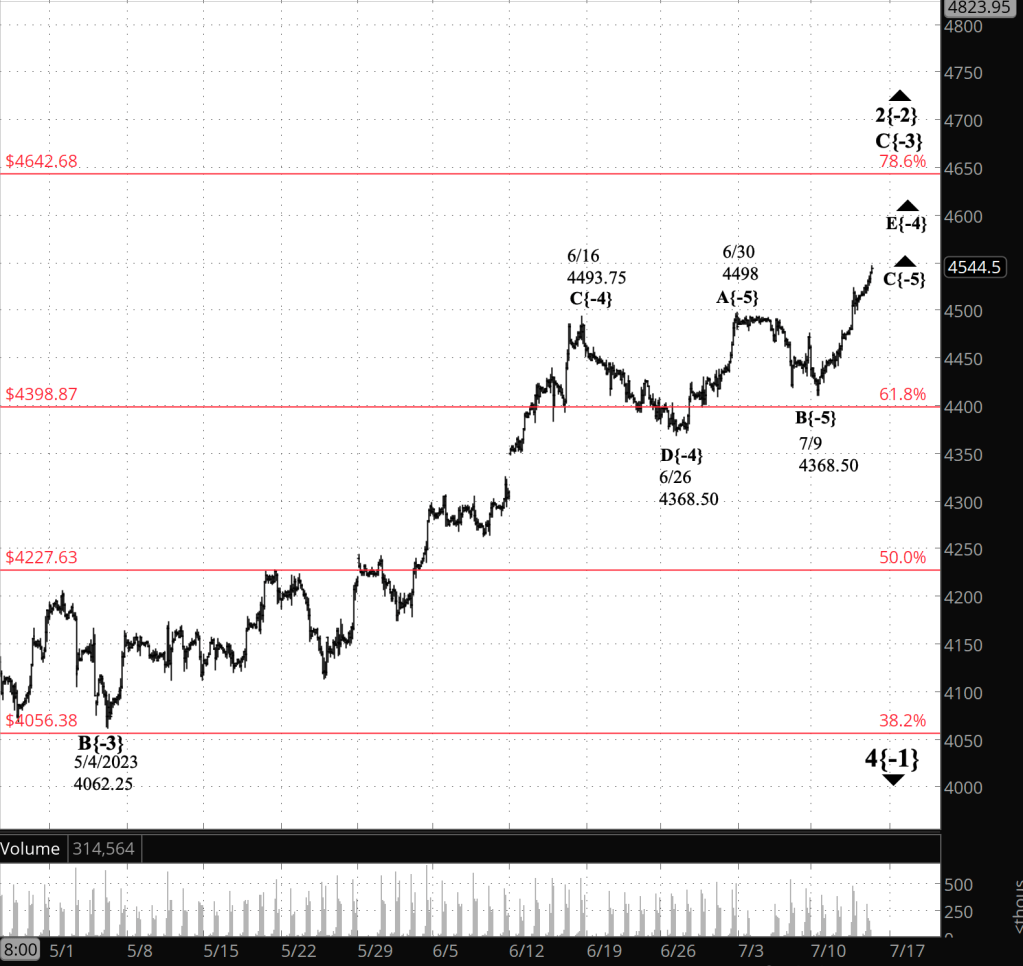
Half an hour before the closing bell. The S&P 500 futures has continued to rise during the session, reaching into the 4520s. No change in the analysis. I’ve updated the chart.

9:35 a.m. New York time

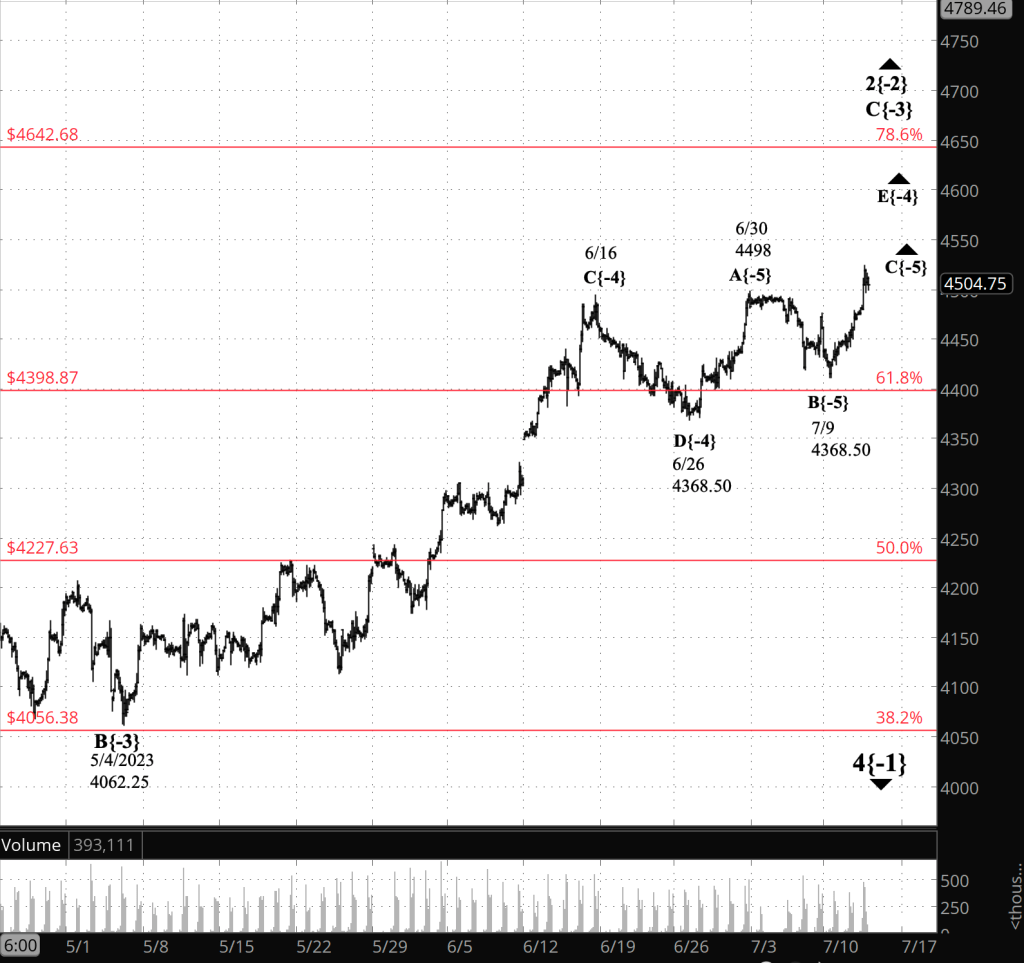
What’s happening now? The S&P 500 E-mini futures rose in a single minute from the 4480s to above 4500 after the latest inflation statistics were announced, and continued to rise, reaching a high of 4516.25 minutes into the session.

What does it mean? That high for the overnight session is also a new high for the second corrective pattern within the ongoing upward compound correction that began on October 13, 2022, and in, is a new high for the entire correction.

The correction, wave 2{-2}, is in its last leg, wave C{-3}, and one degree lower, wave E{-4}. The new high confirms that one degree lower still, the third of five subwaves, wave C{-5}, is also undersway.

Rising wave C{-5} will be followed by a falling wave, D{-5}, and then a final upward push, E{-5}. When that final upward push is complete, it will also be the end of the second corrective pattern within the compound correction.

At that point, there are two possible futures: Either the compound correction adds a third and corrective pattern, or the present second pattern is the end of the correction.

Under the three-patterns scenario, the present corrective pattern will be followed by a shallow downward connecting wave, and then another corrective pattern. Under the two-patterns scenario, the upward correction ends and a powerful downtrend, wave 3{-2} begins.

I’m not betting on either outcome. It’s simply impossible to know which will occur.

The chart shows the final leg of the second corrective pattern, wave C{-3} and its subwaves, with the Fibonacci retracement ladder overlaid, in red. The price has stayed between the 61.8% retracement and the 78.6% retracement of the preceding first wave, wave 1{-2} since late June.

What are the alternatives? There are none at the present. I’m quite certain that ambiguities will develop over the days and weeks to come.

[S&P 500 E-mini futures at 9:35 a.m., 2-hour bars, with volume]

What does Elliott wave theory say? Here are the waves that underly the analysis.

Principal Analysis:

  • An upward correction, a Zigzag, wave 2{-2}, began on October 13, 2022 and is underway.
  • The upward correction, wave 2{-2}, is taking a compound form, which can contain up to three corrective patterns.
  • The correction is in its second corrective pattern, which is in wave C{-3}, its final wave.
  • The end of the present wave C{-3} could also be the end of the wave 2{-2} correction if the compound structure contains two subwaves.
  • Or the present corrective pattern could be followed by a declining connector, wave X{-3}, and then a third corrective pattern.
  • Wave C{-3} will have five subwaves and is at wave E{-4}, the final subwave.
  • Wave E{-4} is in its third of five subwaves, wave C{-5}.
  • Wave 2{-2}, when complete, will be followed by a powerful downtrend, wave 3{-2}.
  • Under the rules of Elliott wave analysis, wave 2{-2} cannot move beyond the beginning of wave 1{-2}, which was the January 4, 2022 peak at 4953.25

We Are Here.

These are the waves currently in progress under my principal analysis. Each line on the list shows the wave number, with the subscript in curly brackets, the traditional degree name, the starting date, the starting price of the S&P 500 E-mini futures, and the direction of the wave.

  • S&P 500 Index:
  • 5{+3} Supercycle, 7/8/1932, 4.40 (up)
  • 5{+2} Cycle, 12/9/1974, 60.96 (up)
  • 5{+1} Primary, 3/6/2009, 666.79 (up)
  • 5{0} Intermediate, 12/26/2018, 2346.58 (up)
  • S&P 500 Futures and index:
  • 4{-1} Minor, 1/4/2022, 4953.25 (down) (futures), 4818.62 (down) (index)
  • S&P 500 Futures:
  • 2{-2} Minute, 10/13/2022, 3577.75 (up)

Reading the chart. Price movements — waves – – in Elliott wave analysis are labeled with numbers within trending waves and letters with corrective waves. The subscripts — numbers in curly brackets — designate the wave’s degree, which, in Elliott wave analysis, means the relative position of a wave within the larger and smaller structures that make up the chart. R.N. Elliott, who in the 1930s developed the form of analysis that bears his name, viewed the chart as a complex structure of smaller waves nested within larger waves, which in turn are nested within still larger waves. In mathematics it’s called a fractal structure, where at every scale the pattern is similar to the others.

Learning and other resources. Elliott wave analysis provides context, not prophecy. As the 20th century semanticist Alfred Korzybski put it in his book Science and Sanity (1933), “The map is not the territory … The only usefulness of a map depends on similarity of structure between the empirical world and the map.” And I would add, in the ever-changing markets, we can judge that similarity of structure only after the fact.

See the menu page Analytical Methods for a rundown on where to go for information on Elliott wave analysis.

By Tim Bovee, Portland, Oregon, July 12, 2023

Disclaimer

Tim Bovee, Private Trader tracks the analysis and trades of a private trader for his own accounts. Nothing in this blog constitutes a recommendation to buy or sell stocks, options or any other financial instrument. The only purpose of this blog is to provide education and entertainment.

No trader is ever 100 percent successful in his or her trades. Trading in the stock and option markets is risky and uncertain. Each trader must make trading decisions for his or her own account, and take responsibility for the consequences.

License
Creative Commons License

All content on Tim Bovee, Private Trader by Timothy K. Bovee is licensed under a Creative Commons Attribution-ShareAlike 4.0 International License.

Based on a work at www.timbovee.com.
Trader’s Notebook

3:30 p.m. New York time

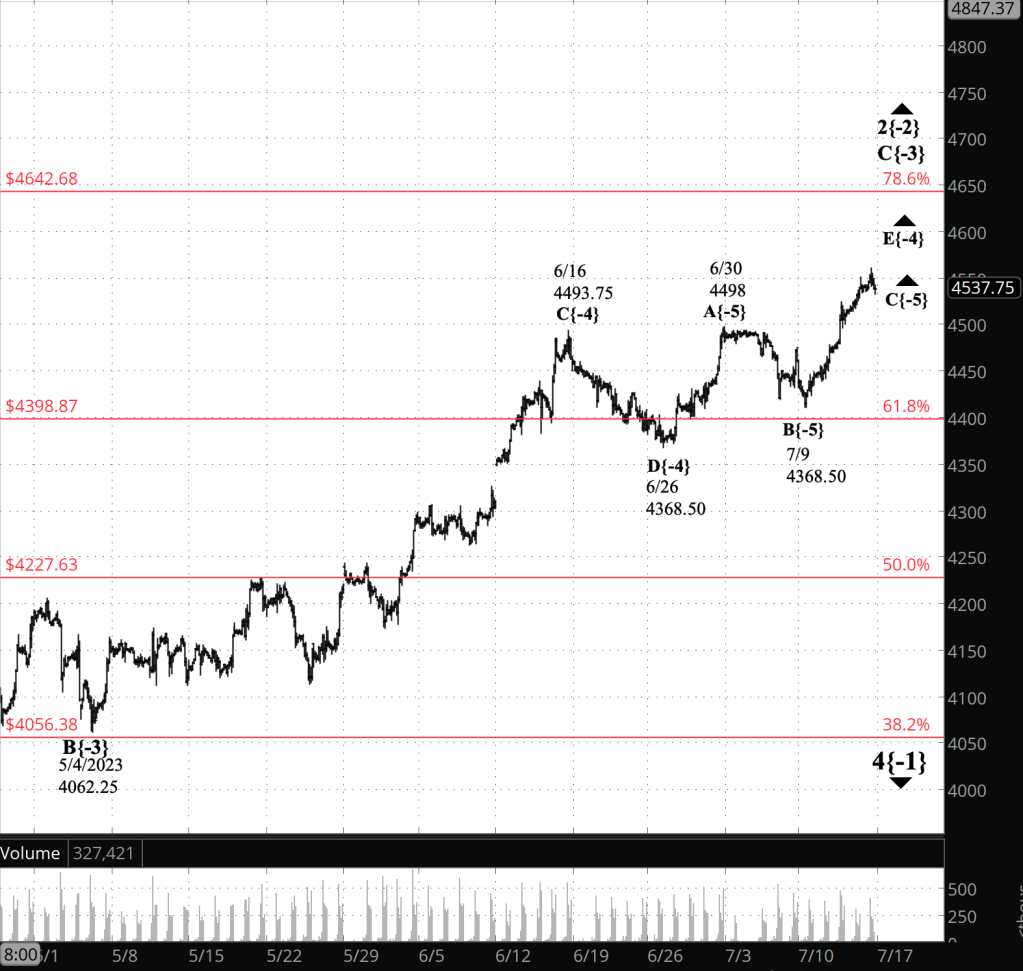
Half an hour before the closing bell. The S&P 500 traded narrowly during the session, from the 4440s to the 4460s on the futures. This morning’s analysis is unchanged. I’ve updated the chart.

9:35 a.m. New York time

What’s happening now? The S&P 500 E-mini futures traded from the 4430s to the 4450s overnight.

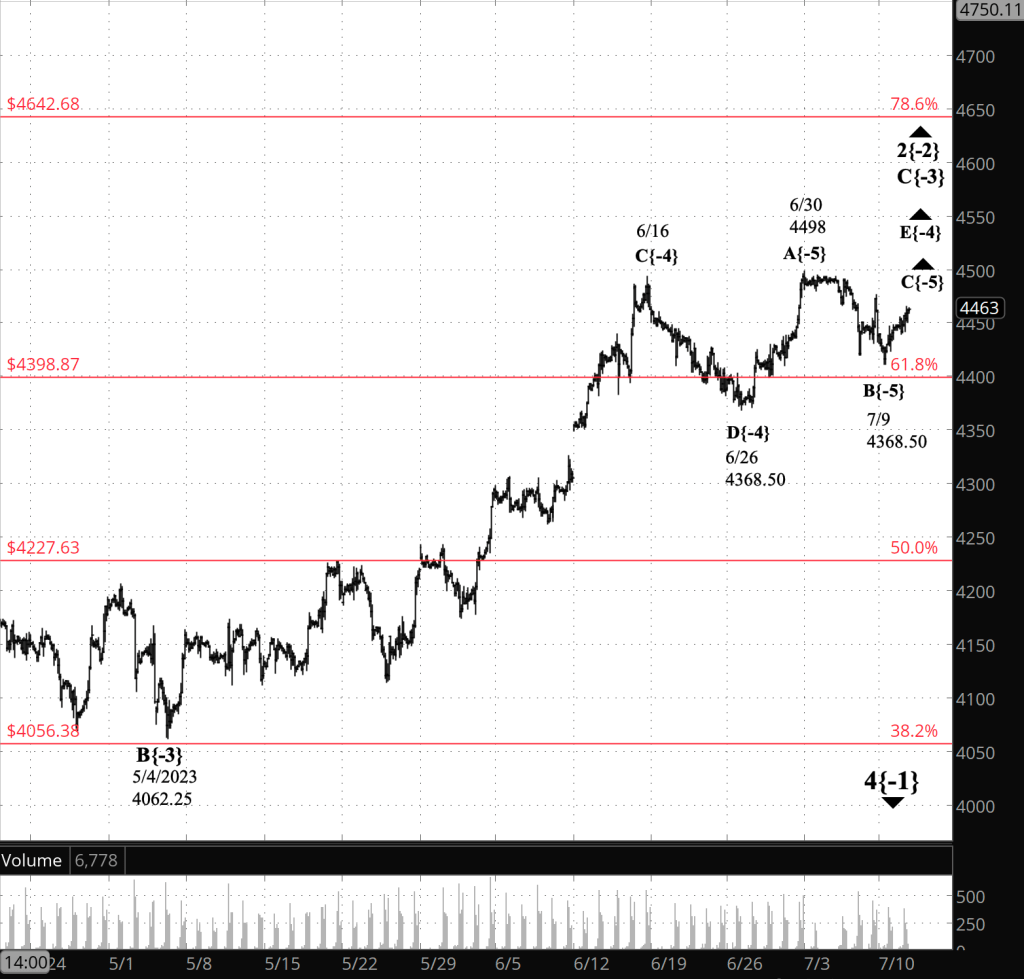
What does it mean? The second corrective pattern within an upward compound correction that began last October, wave 2{-2}, continues and is in its last leg, wave C{-3}. Internally, the final leg of the correction is in its last subwave, wave E{-4}, which in turn appears to be in its third of five subwaves, wave C{-5}.

What are the alternatives? Wave E{-4} may still be in its second, downward subwave, wave B{-5}. It’s hard to tell for sure. It depends entire upon whether the rise that began on July 9 is a new rising wave at the {-5} degree, as the principal analysis would have it, or a subwave of the {-6} degree within wave B{-5}, as this alternative analysis assumes.

Reading the chart. I’ve enlarged the chart to show the final subwave, C{-3}, which began on May 4, within the second corrective pattern of the compound correction, 2{-2}. This chart gives a more detailed view of how far along corrective pattern’s end game has progressed. See yesterday’s Trader’s Notebook for a broader view showing all of the second corrective pattern. I’ve overlaid the chart with the Fibonacci retracement ladder, in red, showing retracement of the prior, downtrending wave 1{-2}. The rise that began on July 9 came very close to being a bounce off of the 61.8% Fibonacci retracement level, a common reversal point.

Price movements — waves – – in Elliott wave analysis are labeled with numbers within trending waves and letters with corrective waves. The subscripts — numbers in curly brackets — designate the wave’s degree, which, in Elliott wave analysis, means the relative position of a wave within the larger and smaller structures that make up the chart. R.N. Elliott, who in the 1930s developed the form of analysis that bears his name, viewed the chart as a complex structure of smaller waves nested within larger waves, which in turn are nested within still larger waves. In mathematics it’s called a fractal structure, where at every scale the pattern is similar to the others.

[S&P 500 E-mini futures at 3:30 p.m., 2-hour bars, with volume]

What does Elliott wave theory say? Here are the waves that underly the analyses.

Principal Analysis:

  • An upward correction, a Zigzag, wave 2{-2}, began on October 13, 2022 and is underway.
  • The upward correction, wave 2{-2}, is taking a compound form, which can contain up to three corrective patterns.
  • The correction is in its second corrective pattern, which is in wave C{-3}, its final wave.
  • The end of the present wave C{-3} could also be the end of the wave 2{-2} correction if the compound structure contains two subwaves.
  • Or the present corrective pattern could be followed by a declining connector, wave X{-3}, and then a third corrective pattern.
  • Wave C{-3} will have five subwaves and is at wave E{-4}, the final subwave.
  • Wave E{-4} is in its third of five subwaves, wave C{-5}. Tentatively, See the Alternative analysis, below.
  • Wave 2{-2}, when complete, will be followed by a powerful downtrend, wave 3{-2}.
  • Under the rules of Elliott wave analysis, wave 2{-2} cannot move beyond the beginning of wave 1{-2}, which was the January 4, 2022 peak at 4953.25.

Alternative analysis:

  • Wave E{-4} continues to trace its second of five subwaves, wave B{-5}, which is in its third and final subwave, wave C{-6}.

We Are Here.

These are the waves currently in progress under my principal analysis. Each line on the list shows the wave number, with the subscript in curly brackets, the traditional degree name, the starting date, the starting price of the S&P 500 E-mini futures, and the direction of the wave.

  • S&P 500 Index:
  • 5{+3} Supercycle, 7/8/1932, 4.40 (up)
  • 5{+2} Cycle, 12/9/1974, 60.96 (up)
  • 5{+1} Primary, 3/6/2009, 666.79 (up)
  • 5{0} Intermediate, 12/26/2018, 2346.58 (up)
  • S&P 500 Futures and index:
  • 4{-1} Minor, 1/4/2022, 4953.25 (down) (futures), 4818.62 (down) (index)
  • S&P 500 Futures:
  • 2{-2} Minute, 10/13/2022, 3577.75 (up)

Learning and other resources. Elliott wave analysis provides context, not prophecy. As the 20th century semanticist Alfred Korzybski put it in his book Science and Sanity (1933), “The map is not the territory … The only usefulness of a map depends on similarity of structure between the empirical world and the map.” And I would add, in the ever-changing markets, we can judge that similarity of structure only after the fact.

See the menu page Analytical Methods for a rundown on where to go for information on Elliott wave analysis.

By Tim Bovee, Portland, Oregon, July 11, 2023

Disclaimer

Tim Bovee, Private Trader tracks the analysis and trades of a private trader for his own accounts. Nothing in this blog constitutes a recommendation to buy or sell stocks, options or any other financial instrument. The only purpose of this blog is to provide education and entertainment.

No trader is ever 100 percent successful in his or her trades. Trading in the stock and option markets is risky and uncertain. Each trader must make trading decisions for his or her own account, and take responsibility for the consequences.

License
Creative Commons License

All content on Tim Bovee, Private Trader by Timothy K. Bovee is licensed under a Creative Commons Attribution-ShareAlike 4.0 International License.

Based on a work at www.timbovee.com.

Trader’s Notebook

12:30 p.m. New York time

Half an hour before the closing bell. The S&P 500 futures traded in a range during the session, from the 4420s to the 4440s. This morning’s analysis remains unchanged. I’ve updated the chart.

9:40 a.m. New York time

What’s happening now? The S&P 500 E-mini futures peaked early after trading resumed overnight, at 4440, declined to 4410.25, and then rose at the opening bell, exceeding the overnight high.

What does it mean? No change in the analysis since Monday. The upward compound correction that began on October 13, 2022 is still underway and is nearing the end of the second corrective pattern. A third pattern may follow, or the second pattern may, when complete, be the end of the upward correction and the start of a powerful downtrend.

A major revision in the wave labeling. Over the weekend, as promised, I explored the question of my wave degree labeling. For some time the alternatives list has included the possibility that the degrees might be labeled as being smaller than they should be. The uncertainty of the degree applied to the upward correction and all other waves — larger and smaller — since a major downtrend began on January 4, 2022.

My conclusion, after two days work, was that the degrees were indeed lower than they should be, by four degrees. I posted a Trader’s Notebook on Sunday, July 9, titled “Trader’s Notebook: New Wave Degrees”. It describes the problem of degree setting, which is a major ambiguity endemic to Elliott wave analysis, the evidence that has led me to make the change, and what the change would look like on the chart. The post included two charts: One showing the present upward correction in its entirely, and the other showing the parent structure, an expanding Diagonal Triangle that began in December 2018.

The chart below uses the new degree levels. For a chart showing the old degrees of:

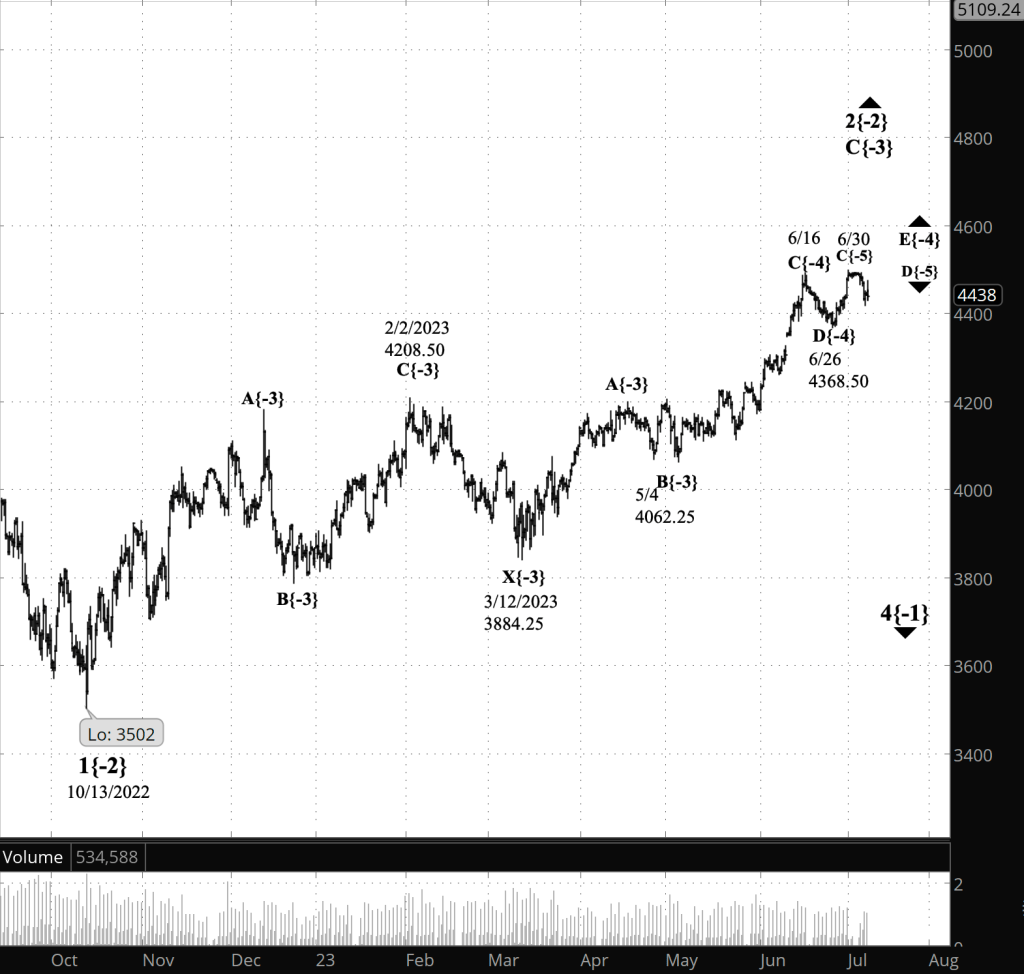
Under the new system, all degree labels since January 4 have been made larger by four degrees. The upward correction is now wave 2{-2}; before, it was wave 2{-6}. The same change has been made to all of its subwaves: The final leg of the second corrective pattern is wave C{-3}, which is in its final subwave, wave E{-4}.

A final caution: Nothing about wave degrees is set in stone, and events on the chart could at some date require a further change≥

[S&P 500 E-mini futures at 12:30 p.m., 230-minute bars, with volume]

What does Elliott wave theory say? Here are the waves that underly the analysis.

  • An upward correction, a Zigzag, wave 2{-2}, began on October 13, 2022 and is underway.
  • The upward correction, wave 2{-2}, is taking a compound form, which can contain up to three corrective patterns.
  • The correction is in its second corrective pattern, which is in wave C{-3}, its final wave.
  • The end of the present wave C{-3} could also be the end of the wave 2{-2} correction if the compound structure contains two subwaves.
  • Or the present corrective pattern could be followed by a declining connector, wave X{-3}, and then a third corrective pattern.
  • Wave C{-3} will have five subwaves and is in wave E{-4}, the final subwave.
  • Wave E{-4} will also have five subwaves.
  • Wave 2{-2}, when complete, will be followed by a powerful downtrend, wave 3{-2}.
  • Under the rules of Elliott wave analysis, wave 2{-2} cannot move beyond the beginning of wave 1{-2}, which was the January 4, 2022 peak at 4953.25.

We Are Here.

These are the waves currently in progress under my principal analysis. Each line on the list shows the wave number, with the subscript in curly brackets, the traditional degree name, the starting date, the starting price of the S&P 500 E-mini futures, and the direction of the wave.

  • S&P 500 Index:
  • 5{+3} Supercycle, 7/8/1932, 4.40 (up)
  • 5{+2} Cycle, 12/9/1974, 60.96 (up)
  • 5{+1} Primary, 3/6/2009, 666.79 (up)
  • 5{0} Intermediate, 12/26/2018, 2346.58 (up)
  • S&P 500 Futures and index:
  • 4{-1} Minor, 1/4/2022, 4953.25 (down) (futures), 4818.62 (down) (index)
  • S&P 500 Futures:
  • 2{-2} Minute, 10/13/2022, 3577.75 (up)

Reading the chart. Price movements — waves – – in Elliott wave analysis are labeled with numbers within trending waves and letters with corrective waves. The subscripts — numbers in curly brackets — designate the wave’s degree, which, in Elliott wave analysis, means the relative position of a wave within the larger and smaller structures that make up the chart. R.N. Elliott, who in the 1930s developed the form of analysis that bears his name, viewed the chart as a complex structure of smaller waves nested within larger waves, which in turn are nested within still larger waves. In mathematics it’s called a fractal structure, where at every scale the pattern is similar to the others.

Learning and other resources. Elliott wave analysis provides context, not prophecy. As the 20th century semanticist Alfred Korzybski put it in his book Science and Sanity (1933), “The map is not the territory … The only usefulness of a map depends on similarity of structure between the empirical world and the map.” And I would add, in the ever-changing markets, we can judge that similarity of structure only after the fact.

See the menu page Analytical Methods for a rundown on where to go for information on Elliott wave analysis.

By Tim Bovee, Portland, Oregon, July 10, 2023

Disclaimer

Tim Bovee, Private Trader tracks the analysis and trades of a private trader for his own accounts. Nothing in this blog constitutes a recommendation to buy or sell stocks, options or any other financial instrument. The only purpose of this blog is to provide education and entertainment.

No trader is ever 100 percent successful in his or her trades. Trading in the stock and option markets is risky and uncertain. Each trader must make trading decisions for his or her own account, and take responsibility for the consequences.

License
Creative Commons License

All content on Tim Bovee, Private Trader by Timothy K. Bovee is licensed under a Creative Commons Attribution-ShareAlike 4.0 International License.

Based on a work at www.timbovee.com.
Trader’s Notebook: New Wave Degrees

A Revision of the S&P 500 Wave Degrees: Wave 2{-6} Changed to Wave 2{-2}

The present wave 2 upward correction on the S&P 500 index and futures charts has been with us since October 13, 2022. And as the wave’s lifespan has extended, it has become increasingly clear my labeling of the subwaves considers them to be further down the complex wave structure than they have turned out to be. 

Every analysis I post contains a quote from the 20th century semanticist Alfred Korzybski. In his book Science and Sanity, published 90 years ago in 1933, he wrote “The map is not the territory … The only usefulness of a map depends on similarity of structure between the empirical world and the map.” 

And in every post I add, “… in the ever-changing markets, we can judge that similarity of structure only after the fact.”

After considering the evidence, I’ve concluded that the degree given to the wave 2 correction no longer matches the reality on the chart. The map no longer matches the territory, and when that happens, what do the explorers do? They redraw the map.

This essay describes the process by which I reached my conclusion and how I’ve redrawn the map.

Elliott Wave Theory is a technique for recognizing patterns in waves, the price movements of markets over time. 

Pattern recognition, as it turns out, is something the human brain is good at. Back in the days when our ancestors lived in small bands gathering wild plants and hunting wild animals for food, those pattern recognition skills enabled them to find the beneficial and avoid the dangerous as they spent their days navigating a very large landscape.

Applying numbers to those patterns, however, really didn’t do much to help our nomadic ancestors put food on the table.

In my four decades of working with Elliott Wave Theory, I’ve been helped and hindered by  those same strengths and weaknesses over and over again.

A wave on the chart has two aspects: One is its position in the pattern. The other is the relative size of the pattern compared to the larger and smaller structures that make up its chart. That relative size is the wave’s degree.

It only takes a glance at a chart to know that it is more than the simple ups and downs that are the focus of stock market news stories. The chart is a complex structure of smaller waves nested within larger waves, which in turn are nested within still larger waves. In mathematics it’s called a fractal structure, where at every scale the pattern is similar to the others.

When R.N. Elliott developed Elliott Wave Theory in the 1930s, he combined the two aspects of the wave in a single name, anticipating that traders using his method would quickly learn that an Intermediate wave pattern is contained within a Primary wave, or that a SuperCycle wave is home to an entire Cycle wave trend.

For my analysis, I choose to make the two aspects explicit. I use the wave number, followed by a numerical subscript, in curly brackets, showing the degree relative to the Intermediate degree, which is degree {0}.. For example, a long middle wave is clearly wave 3, and its parent wave has been identified as being of the Intermediate degree, so I label that middle wave 3{-1}, meaning it is one degree below the {0} parent wave.

By the time a trend has reached wave 3 its degree is fairly clear. But what about wave 1, in its first tentative weeks? It has no context within its pattern. Is wave 1 a child of the parent wave? Or a grandchild? Or a great-great-grandchild? There’s no way to know for sure.

There are two approaches to the problem.

The first approach  is to consistently label the subwave one degree lower than the parent wave. If that turns out to not match the reality of the chart, it can always be moved one degree lower. How does the trader know when the degree labeling is too large? Elliott said the wave degrees are proportional: An Intermediate degree {0} wave is similar to others the same size. But proportionate, I’ve found, contains a lot of variety. No doubt because of that variety, Elliott didn’t estimate the duration of each degree’s waves. Clearly, he concluded that it’s a subjective judgment call.

The second approach is to put some distance between the parent wave and the subwave, assuming that the wave in its early stages is several degrees removed from the parent wave. If degree labeling  proves to be too small, it can always be raised to a higher degree. 

For the second approach, unlike with the first approach, Elliott wave analysis provides a clear signal when a pattern’s degree is too small. If the 2nd wave a pattern moves beyond the starting point of the 1st wave, then the analysis is no longer valid –the map no longer matches the territory and must be redrawn. Usually the reanalysis takes the form of switching the labeling to a larger degree.

I tend to favor the second approach because it is associated with a clear signal when a reanalysis is needed. Long-time readers will recall that this has happened several times as our present long-running correction has progressed.

Even if there is no clear signal, the need for proportionality is still important. And that is what has happened to the present correction.

In the following discussion, I’ve used the dates from the S&P 500 E-mini futures chart, which I analyze daily. The dates from the S&P 500 index might vary by a day or so.

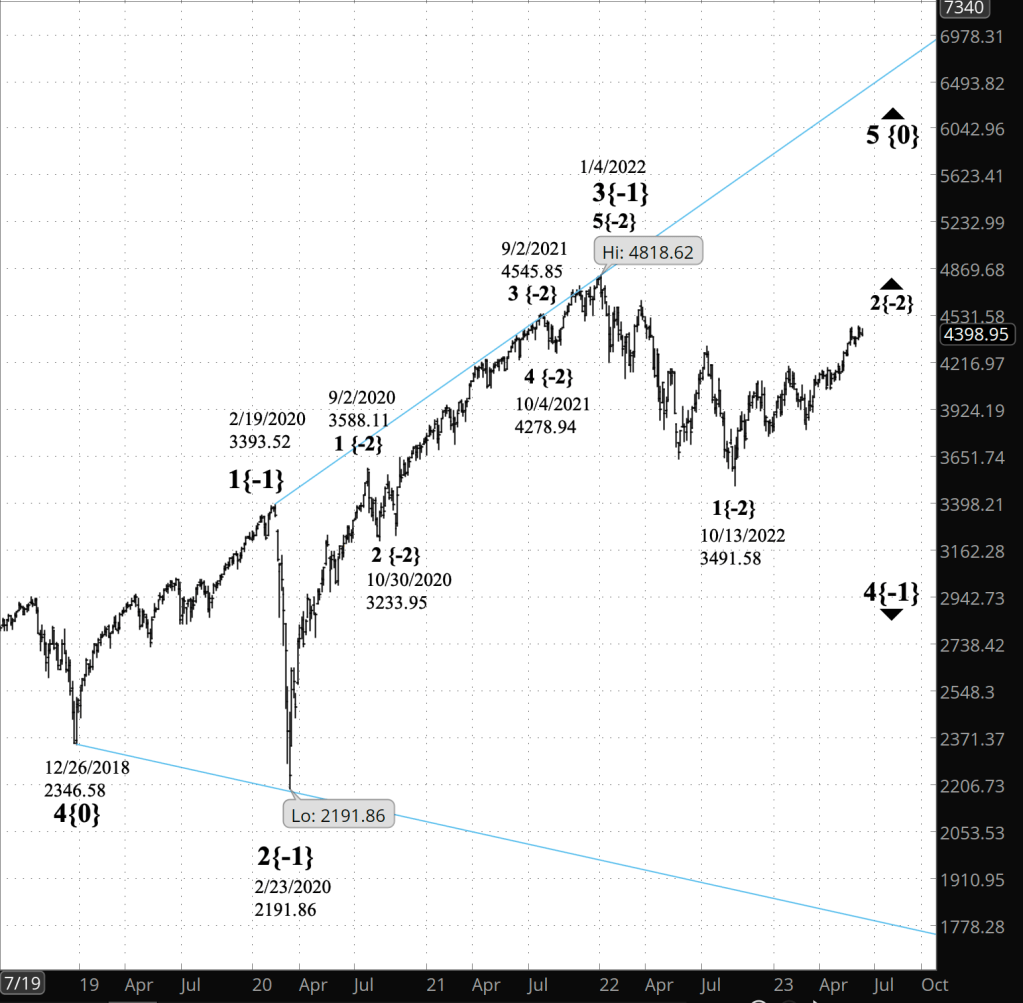
The present correction is wave 2{-6}, at what Elliott called the Minuscule degree. It is a subwave of wave 4{-1}, a downtrend that  began on January 4, 2022 and which is  in turn is a subwave of wave 5{0}, an expanding Diagonal Triangle that began in December 2018.

Within wave 4{-1}, wave 1{-6} had a duration of 0.8 years. The following wave  2{-6} has been underway for 0.7 years. Both 1st and 2nd waves tend to be on the short short side, as they set up for the longer-lasting 3rd wave to come.

By comparison, the corresponding subwaves within wave 3(-1}, the preceding uptrend, were 0.5 years for wave 1{-2} and 0.2 years for the following correction, wave 2{-2}. That’s shorter than the distances of the waves of the {-6} degree under my present analysis, but not by much. That suggests to me that raising the degree of subwaves of wave 4{-1} would bring the analysis more in line with the reality of the chart.

So, beginning Monday, wave 2{-6} becomes wave 2{-2}, with all of its subwave degrees also raised up four levels. Here’s a close-up chart of the S&P 500 futures showing the upward correction that began on October 13, 2022:

[S&P 500 E-mini futures, 7/7/2023 close , 9-hour bars, with volume]

And here’s a longer view showing the entirety of the Expanding Diagonal Triangle that began on December 26, 2018.

[S&P 500 index, 7/7/2023 close , 3-day bars]

We Are Here.

These are the waves currently in progress under my principal analysis. Each line on the list shows the wave number, with the subscript in curly brackets, the traditional degree name, the starting date, the starting price of the S&P 500 E-mini futures, and the direction of the wave.

  • S&P 500 Index:
  • 5{+3} Supercycle, 7/8/1932, 4.40 (up)
  • 5{+2} Cycle, 12/9/1974, 60.96 (up)
  • 5{+1} Primary, 3/6/2009, 666.79 (up)
  • 5{0} Intermediate, 12/26/2018, 2346.58 (up)
  • S&P 500 Futures and index:
  • 4{-1} Minor, 1/4/2022, 4953.25 (down) (futures), 4818.62 (down) (index)
  • S&P 500 Futures:
  • 2{-2} Minute, 10/13/2022, 3577.75 (up)

Learning and other resources. Elliott wave analysis provides context, not prophecy. As the 20th century semanticist Alfred Korzybski put it in his book Science and Sanity (1933), “The map is not the territory … The only usefulness of a map depends on similarity of structure between the empirical world and the map.” And I would add, in the ever-changing markets, we can judge that similarity of structure only after the fact.

See the menu page Analytical Methods for a rundown on where to go for information on Elliott wave analysis.

By Tim Bovee, Portland, Oregon, July 9, 2023

Disclaimer

Tim Bovee, Private Trader tracks the analysis and trades of a private trader for his own accounts. Nothing in this blog constitutes a recommendation to buy or sell stocks, options or any other financial instrument. The only purpose of this blog is to provide education and entertainment.

No trader is ever 100 percent successful in his or her trades. Trading in the stock and option markets is risky and uncertain. Each trader must make trading decisions for his or her own account, and take responsibility for the consequences.

License
Creative Commons License

All content on Tim Bovee, Private Trader by Timothy K. Bovee is licensed under a Creative Commons Attribution-ShareAlike 4.0 International License.

Based on a work at www.timbovee.com.
Trader’s Notebook

3:30 p.m. New York time

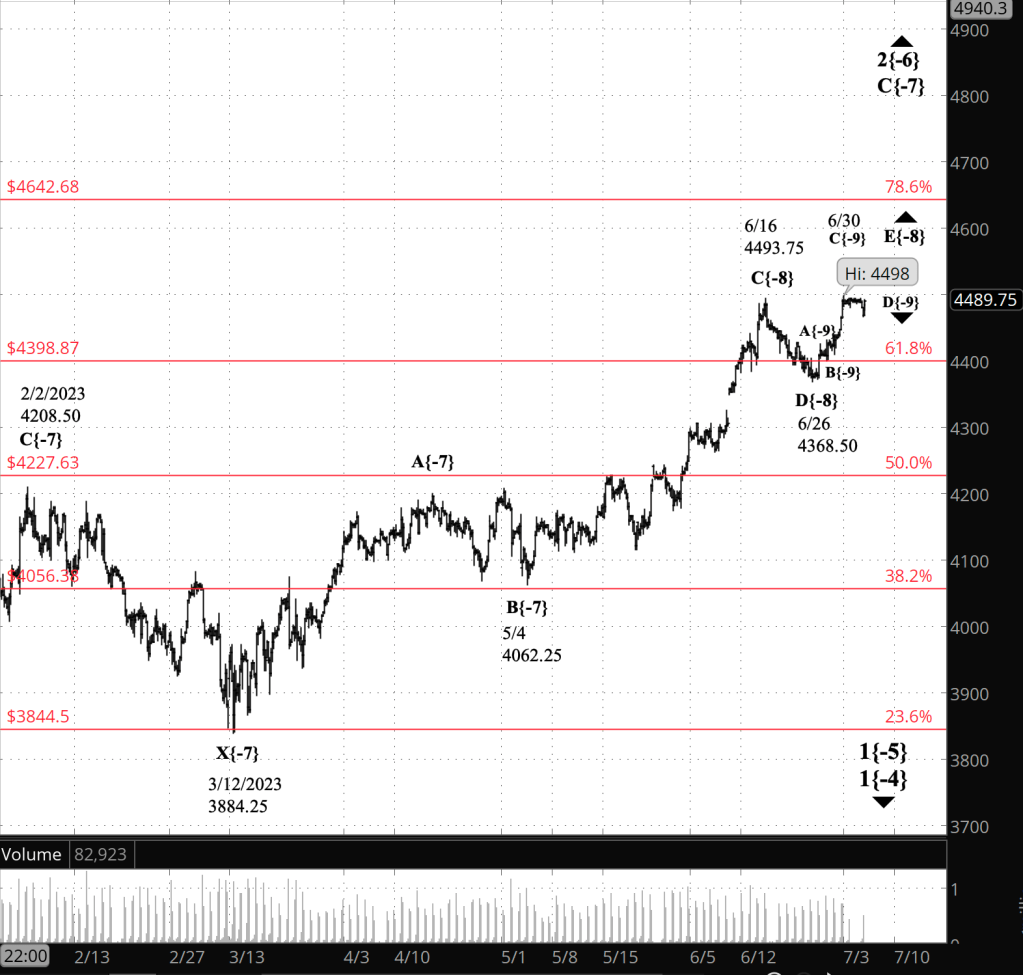
Half an hour before the closing bell. The S&P 500 futures rose during the session, into the 4470s, and then pulled back. A push into the 4480s would persuade that wave E{-8}, the final wave of the corrective pattern at that degree, has begun (see the “What does it mean?” section, below). Meanwhile, this morning’s analysis is unchanged. I’ve updated the chart.

9:35 a.m. New York time

What’s happening now? The S&P 500 E-mini futures fluctuated in the 4440s and 4430s overnight until the U.S. employment figures were released an hour before the opening bell. The price whipsawed up to the 4450s and down to the 4430s, remaining within the bounds that had defined the price movement since yesterday’s session closed.

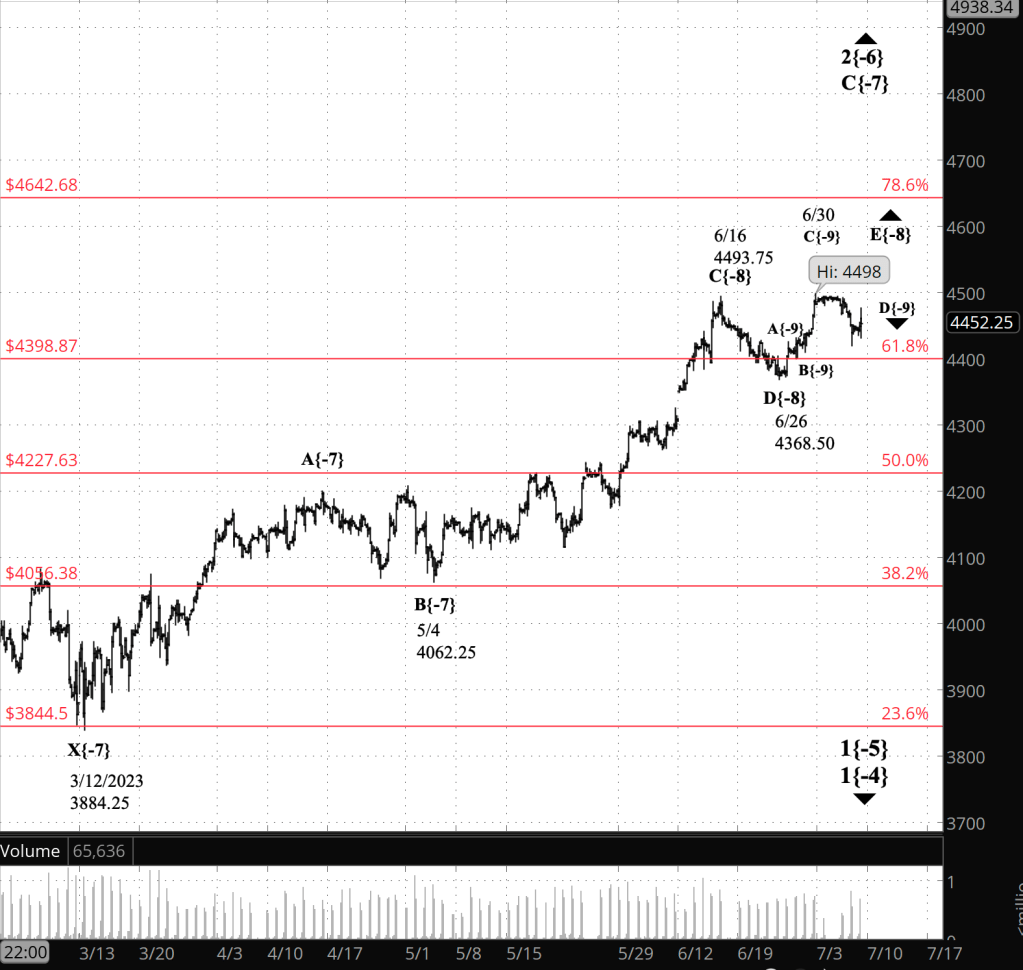
What does it mean? The upward compound correction, wave 2{-6}, that began in October is now in its second corrective pattern. That pattern is in its last leg, wave 3{-7}, which is in its final segment, wave E{-8}. The question is how far along that final segment has advanced, and nothing that happened in overnight trading provides an answer.

The final segment will have five subwaves. The fourth subwave, wave D{-9}, began on June 30, and can be counted as having completed three wave internally, meaning that it has reached its end point. As always with real-time Elliott wave analysis, there is ambiguity in the count, and I’m waiting for some upward movement with clarity to confirm that wave D{-9} has in fact ended and wave E{-9} has begun. I haven’t seen that clarity yet.

Wave E{-9} can be expected to exceed the wave C{-9} peak of 4493.75, attained on June 16, and may move significantly above that level. However, under the rules of Elliott Wave Theory, it will remain below 4953.75, the starting point on January 4, 2022, of wave 1{-6}, the downtrending wave that preceded the upward correction.

One reasonable expectation for an endpoint to wave E{-9} would be the next Fibonacci retracement level, at 4642.68, which is a 78.6% retracement of the preceding first save. The steps on the Fibonacci ladder, shown on the chart in red, are often reversal points, but not always. Also, the reversals often happen in the area of a retraxement level, not precisely at the level.

Wave E{-9}, when complete, will also be the end of the second corrective pattern in wave 2{-6}. Compound corrections can have up to three corrective patterns. The second corrective patten either will be followed by a powerful decline back to the starting point of the upward correction and likely much lower, or will have shallow declining wave that will link the second corrective pattern to a third corrective pattern.

What are the alternatives? In the July 6 Trader’s Notebook, I discussed evidence suggesting that placing the 2nd wave correction in the {-6} degree was disproportionately small compared to earlier waves. I’ll be working on the problem over the weekend and will post a decision on any degree changes by Monday, July 10.

[S&P 500 E-mini futures at 3:30 p.m., 230-minute bars, with volume]

Reading the chart. Price movements — waves – – in Elliott wave analysis are labeled with numbers within trending waves and letters with corrective waves. The subscripts — numbers in curly brackets — designate the wave’s degree, which, in Elliott wave analysis, means the relative position of a wave within the larger and smaller structures that make up the chart. R.N. Elliott, who in the 1930s developed the form of analysis that bears his name, viewed the chart as a complex structure of smaller waves nested within larger waves, which in turn are nested within still larger waves. In mathematics it’s called a fractal structure, where at every scale the pattern is similar to the others.

What does Elliott wave theory say? Here are the waves that underly the analysis.

  • An upward correction, a Zigzag, wave 2{-6}, began on October 13, 2022 and is underway.
  • The upward correction, wave 2{-6}, is taking a compound form, which can contain up to three corrective patterns.
  • The correction is in its second corrective pattern, which is in wave C{-7}, its final wave.
  • The end of the present wave C{-7} could also be the end of the wave 2{-6} correction if the compound structure contains two subwaves.
  • Or the present corrective pattern could be followed by a declining connector, wave X{-7}, and then a third corrective pattern.
  • Wave C{-7} will have five subwaves and is in wave E{-8}, the final subwave.
  • Wave E{-8} will also have five subwaves and is in wave D{-9}, the fourth of the set.
  • Wave 2{-6}, when complete, will be followed by a powerful downtrend, wave 3{-6}.
  • Under the rules of Elliott wave analysis, wave 2{-6} cannot move beyond the beginning of wave 1{-6}, which was the January 4, 2022 peak at 4953.25. (I’ve adjusted the January 4 peak.)

We Are Here.

These are the waves currently in progress under my principal analysis. Each line on the list shows the wave number, with the subscript in curly brackets, the traditional degree name, the starting date, the starting price of the S&P 500 E-mini futures, and the direction of the wave.

  • S&P 500 Index:
  • 5{+3} Supercycle, 7/8/1932, 4.40 (up)
  • 5{+2} Cycle, 12/9/1974, 60.96 (up)
  • 5{+1} Primary, 3/6/2009, 666.79 (up)
  • 5{0} Intermediate, 12/26/2018, 2346.58 (up)
  • S&P 500 Futures and index:
  • 4{-1} Minor, 1/4/2022, 4953.25 (down) (futures), 4818.62 (down) (index)
  • S&P 500 Futures:
  • 1{-2} Minute, 1/4/2022, 4953.25 (down)
  • 1{-3} Minuette, 1/4/2022, 4953.25 (down)
  • 1{-4} Subminuette, 1/4/2022, 4953.25 (down)
  • 1{-5} Micro, 1/4/2022, 4953.25 (down)
  • 2{-6} Minuscule, 10/13/2022, 3577.75 (up)

Learning and other resources. Elliott wave analysis provides context, not prophecy. As the 20th century semanticist Alfred Korzybski put it in his book Science and Sanity (1933), “The map is not the territory … The only usefulness of a map depends on similarity of structure between the empirical world and the map.” And I would add, in the ever-changing markets, we can judge that similarity of structure only after the fact.

See the menu page Analytical Methods for a rundown on where to go for information on Elliott wave analysis.

By Tim Bovee, Portland, Oregon, July 7, 2023

Disclaimer

Tim Bovee, Private Trader tracks the analysis and trades of a private trader for his own accounts. Nothing in this blog constitutes a recommendation to buy or sell stocks, options or any other financial instrument. The only purpose of this blog is to provide education and entertainment.

No trader is ever 100 percent successful in his or her trades. Trading in the stock and option markets is risky and uncertain. Each trader must make trading decisions for his or her own account, and take responsibility for the consequences.

License
Creative Commons License

All content on Tim Bovee, Private Trader by Timothy K. Bovee is licensed under a Creative Commons Attribution-ShareAlike 4.0 International License.

Based on a work at www.timbovee.com.
Trader’s Notebook

3:30 p.m. New York time

Half an hour before the closing bell. The S&P 500 futures fell during the session, from the 4480s to a low of 4419.50. It then reversed, reaching back into the 4450s. The smallest wave I’m tracking, wave D{-9}, is the next to the last wave within the fifth wave, E{-8}, of the last wave, C{-7}, within the second corrective pattern within the long-running upward correction, wave 2{-6}.

Wave D{-9} will have three subwaves, and by my count, the session low is the end of the third subwave, wave C{-10}. If that’s the case, wave D{-9} has ended and wave E{-9} is underway. However, it’s also possible that the rise following the session low is a subwave of wave D{-9}, which still has a bit more downside left.

Here’s a close-up chart showing the pattern.

[S&P 500 E-mini futures at 3:15 p.m., 20-minute bars]

For now, I’m leaving the analysis as it was this morning: Wave D{-9} is still underway. I’ll revisit the issue in tomorrow morning’s post, after seeing what the overnight trading and early session trading looks like. I’ve updated this morning’s chart, below.

9:35 a.m. New York time

What’s happening now? The S&P 500 E-mini futures declined overnight, beginning in the 4470s and reaching the 4435 shortly after the opening bell.

What does it mean? The upward compound correction that began on October 13, 2022 continues to work through the end game of its second corrective pattern.

The second corrective patten, when complete, will either be followed by a powerful decline back to the starting point of the upward correction and likely much lower, or will have shallow declining wave that will link the second corrective pattern to a third corrective pattern. A compound correction can have no more than three corrective patterns.

What are the alternatives? There is some ambiguity as to the relative degree of the correction — a not unusual situation. I’ve marked it as {-6} — Minuscule Degree in traditional Elliott wave terminology — but it could be larger. (See the “Reading the chart” section, below, for an explanation of how I designate wave degrees on the chart.)

How much larger? To get an idea of what’s “normal” in wave duration, I turned to the S&P 500 index chart and tracked the waves within the uptrend that has been underway since December 2018.

The present top wave of the movement is wave 5{0}, a downtrend that has so far lasted 4.5 years. The preceding 3rd wave, wave 3{0}, lasted about 3.8 years. The other waves are far shorter.

That makes a good case for my degree labeling to be far smaller than chart would imply. On the other hand, there is lot of variety in size and duration among waves of the same degree. So it’s a complex problem, and figuring it out will be a project for the weekend, and I’ll report back on Monday.

Reading the chart. Price movements — waves – – in Elliott wave analysis are labeled with numbers within trending waves and letters with corrective waves. The subscripts — numbers in curly brackets — designate the wave’s degree, which, in Elliott wave analysis, means the relative position of a wave within the larger and smaller structures that make up the chart. R.N. Elliott, who in the 1930s developed the form of analysis that bears his name, viewed the chart as a complex structure of smaller waves nested within larger waves, which in turn are nested within still larger waves. In mathematics it’s called a fractal structure, where at every scale the pattern is similar to the others.

[S&P 500 E-mini futures at 3:30 p.m., 4-hour bars, with volume]

What does Elliott wave theory say? Here are the waves that underly the analysis.

  • An upward correction, a Zigzag, wave 2{-6}, began on October 13, 2022 and is underway.
  • The upward correction, wave 2{-6}, is taking a compound form, which can contain up to three corrective patterns.
  • The correction is in its second corrective pattern, which is in wave C{-7}, its final wave.
  • The end of the present wave C{-7} could also be the end of the wave 2{-6} correction if the compound structure contains two subwaves.
  • Or the present corrective pattern could be followed by a declining connector, wave X{-7}, and then a third corrective pattern.
  • Wave C{-7} will have five subwaves and is in wave E{-8}, the final subwave.
  • Wave E{-8} will also have five subwaves and is in wave D{-9}, the fourth of the set.
  • Wave 2{-6}, when complete, will be followed by a powerful downtrend, wave 3{-6}.
  • Under the rules of Elliott wave analysis, wave 2{-6} cannot move beyond the beginning of wave 1{-6}, which was the January 4, 2022 peak at 4953.25. (I’ve adjusted the January 4 peak.)

We Are Here.

These are the waves currently in progress under my principal analysis. Each line on the list shows the wave number, with the subscript in curly brackets, the traditional degree name, the starting date, the starting price of the S&P 500 E-mini futures, and the direction of the wave.

  • S&P 500 Index:
  • 5{+3} Supercycle, 7/8/1932, 4.40 (up)
  • 5{+2} Cycle, 12/9/1974, 60.96 (up)
  • 5{+1} Primary, 3/6/2009, 666.79 (up)
  • 5{0} Intermediate, 12/26/2018, 2346.58 (up)
  • S&P 500 Futures and index:
  • 4{-1} Minor, 1/4/2022, 4953.25 (down) (futures), 4818.62 (down) (index)
  • S&P 500 Futures:
  • 1{-2} Minute, 1/4/2022, 4953.25 (down)
  • 1{-3} Minuette, 1/4/2022, 4953.25 (down)
  • 1{-4} Subminuette, 1/4/2022, 4953.25 (down)
  • 1{-5} Micro, 1/4/2022, 4953.25 (down)
  • 2{-6} Minuscule, 10/13/2022, 3577.75 (up)

Learning and other resources. Elliott wave analysis provides context, not prophecy. As the 20th century semanticist Alfred Korzybski put it in his book Science and Sanity (1933), “The map is not the territory … The only usefulness of a map depends on similarity of structure between the empirical world and the map.” And I would add, in the ever-changing markets, we can judge that similarity of structure only after the fact.

See the menu page Analytical Methods for a rundown on where to go for information on Elliott wave analysis.

By Tim Bovee, Portland, Oregon, July 6, 2023

Disclaimer

Tim Bovee, Private Trader tracks the analysis and trades of a private trader for his own accounts. Nothing in this blog constitutes a recommendation to buy or sell stocks, options or any other financial instrument. The only purpose of this blog is to provide education and entertainment.

No trader is ever 100 percent successful in his or her trades. Trading in the stock and option markets is risky and uncertain. Each trader must make trading decisions for his or her own account, and take responsibility for the consequences.

License
Creative Commons License

All content on Tim Bovee, Private Trader by Timothy K. Bovee is licensed under a Creative Commons Attribution-ShareAlike 4.0 International License.

Based on a work at www.timbovee.com.

Trader’s Notebook

9:35 a.m. New York time

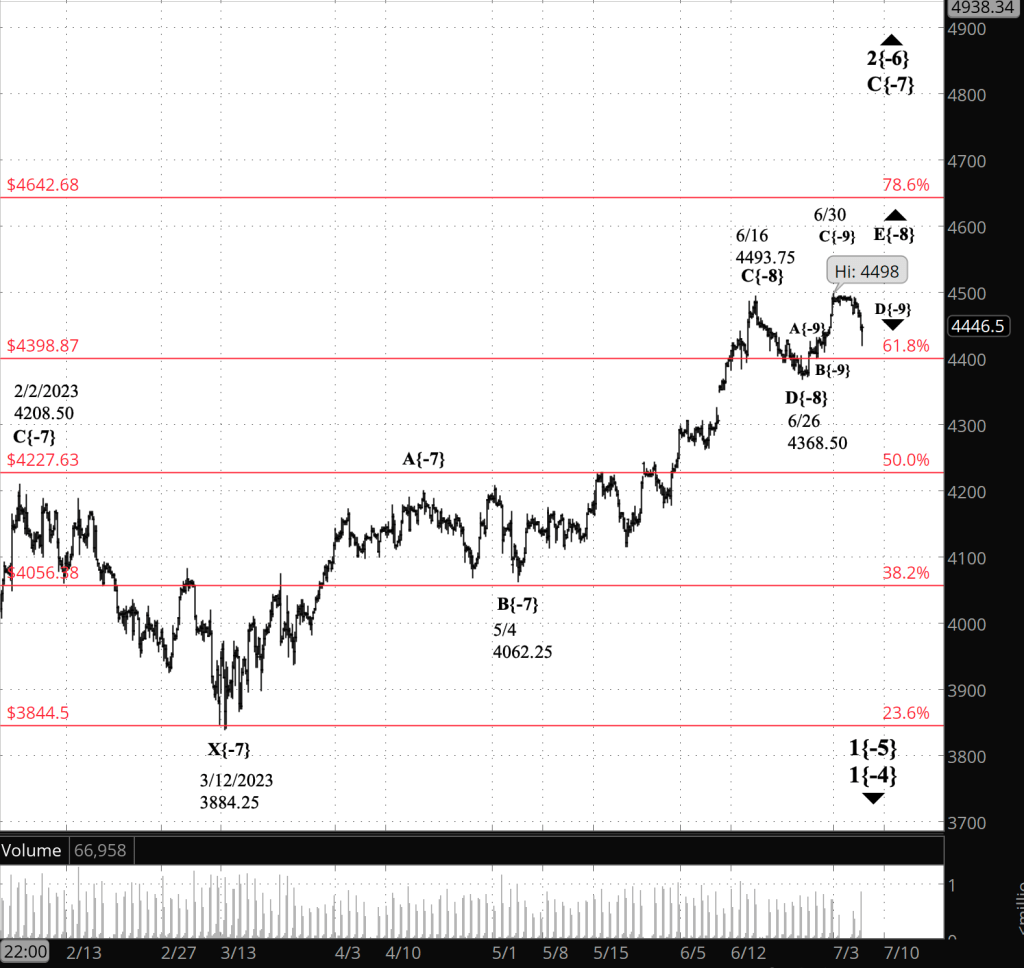
Half an hour before the closing bell. The S&P 500 futures have remained within their overnight range during the session. No change in the analysis. I’ve updated the chart.

What’s happening now? The S&P 500 E-mini futures declined from the 4490s overnight, reaching into the 4460s as the opening bell approached.

What does it mean? The decline marks an additional step toward completion of the corrective pattern that began on March 12 within an upward compound correction that began on October 13, 2022.

When the corrective pattern is complete, there are two possibilities for the next step:

  • Either the second corrective pattern is the final pattern within the compound correction, and a powerful downtrend follows…
  • Or the compound correction produces a third and final corrective pattern, connected to a second pattern by a connector wave.

On the chart, the upward correction is labeled wave 2{-6}, and its second corrective pattern is in its final subwave, wave C{-7}, which is in its still smaller final subwave, wave E{-8}. Within wave E{-8}, the middle subwave, wave C{-9}, ended on June 30. It was followed by a subwave pattern and then today’s overnight decline, which are wave D{-9}, the next to the last subwave of wave E{-8}.

Waves of this {-9} degree set tend to last for only a few days. Wave C{-9}, the longest wave so far within the set, took two days to reach completion. If that pattern holds, then waves E{-8} and C{-7} can be expected to reach completion by next week.

The chart shows only the second corrective pattern, our primary interest at this point in the analysis.

What are the alternatives? There is some ambiguity as to the relative degree of the correction — a not unusual situation. I’ve marked it as {-6} — Minuscule Degree in traditional Elliott wave terminology — but it could be larger.

[S&P 500 E-mini futures at 3:30 p.m., 4-hour bars, with volume]

What does Elliott wave theory say? Here are the waves that underly the analysis.

  • An upward correction, a Zigzag, wave 2{-6}, began on October 13, 2022 and is underway.
  • The upward correction, wave 2{-6}, is taking a compound form, which can contain up to three corrective patterns.
  • The correction is in its second corrective pattern, which is in wave C{-7}, its final wave.
  • The end of the present wave C{-7} could also be the end of the wave 2{-6} correction if the compound structure contains two subwaves.
  • Or the present corrective pattern could be followed by a declining connector, wave X{-7}, and then a third corrective pattern.
  • Wave C{-7} will have five subwaves and is in wave E{-8}, the final subwave.
  • Wave E{-8} will also have five subwaves and is in wave D{-9}, the fourth of the set.
  • Wave 2{-6}, when complete, will be followed by a powerful downtrend, wave 3{-6}.
  • Under the rules of Elliott wave analysis, wave 2{-6} cannot move beyond the beginning of wave 1{-6}, which was the January 4, 2022 peak at 4953.25. (I’ve adjusted the January 4 peak.)

Reading the chart. Price movements — waves – – in Elliott wave analysis are labeled with numbers within trending waves and letters with corrective waves. The subscripts — numbers in curly brackets — designate the wave’s degree, which, in Elliott wave analysis, means the relative position of a wave within the larger and smaller structures that make up the chart. R.N. Elliott, who in the 1930s developed the form of analysis that bears his name, viewed the chart as a complex structure of smaller waves nested within larger waves, which in turn are nested within still larger waves. In mathematics it’s called a fractal structure, where at every scale the pattern is similar to the others.

We Are Here.

These are the waves currently in progress under my principal analysis. Each line on the list shows the wave number, with the subscript in curly brackets, the traditional degree name, the starting date, the starting price of the S&P 500 E-mini futures, and the direction of the wave.

  • S&P 500 Index:
  • 5{+3} Supercycle, 7/8/1932, 4.40 (up)
  • 5{+2} Cycle, 12/9/1974, 60.96 (up)
  • 5{+1} Primary, 3/6/2009, 666.79 (up)
  • 5{0} Intermediate, 12/26/2018, 2346.58 (up)
  • S&P 500 Futures and index:
  • 4{-1} Minor, 1/4/2022, 4953.25 (down) (futures), 4818.62 (down) (index)
  • S&P 500 Futures:
  • 1{-2} Minute, 1/4/2022, 4953.25 (down)
  • 1{-3} Minuette, 1/4/2022, 4953.25 (down)
  • 1{-4} Subminuette, 1/4/2022, 4953.25 (down)
  • 1{-5} Micro, 1/4/2022, 4953.25 (down)
  • 2{-6} Minuscule, 10/13/2022, 3577.75 (up)

Learning and other resources. Elliott wave analysis provides context, not prophecy. As the 20th century semanticist Alfred Korzybski put it in his book Science and Sanity (1933), “The map is not the territory … The only usefulness of a map depends on similarity of structure between the empirical world and the map.” And I would add, in the ever-changing markets, we can judge that similarity of structure only after the fact.

See the menu page Analytical Methods for a rundown on where to go for information on Elliott wave analysis.

By Tim Bovee, Portland, Oregon, July 5, 2023

Disclaimer

Tim Bovee, Private Trader tracks the analysis and trades of a private trader for his own accounts. Nothing in this blog constitutes a recommendation to buy or sell stocks, options or any other financial instrument. The only purpose of this blog is to provide education and entertainment.

No trader is ever 100 percent successful in his or her trades. Trading in the stock and option markets is risky and uncertain. Each trader must make trading decisions for his or her own account, and take responsibility for the consequences.

License
Creative Commons License

All content on Tim Bovee, Private Trader by Timothy K. Bovee is licensed under a Creative Commons Attribution-ShareAlike 4.0 International License.

Based on a work at www.timbovee.com.