Trader’s Notebook

3:30 p.m. New York time

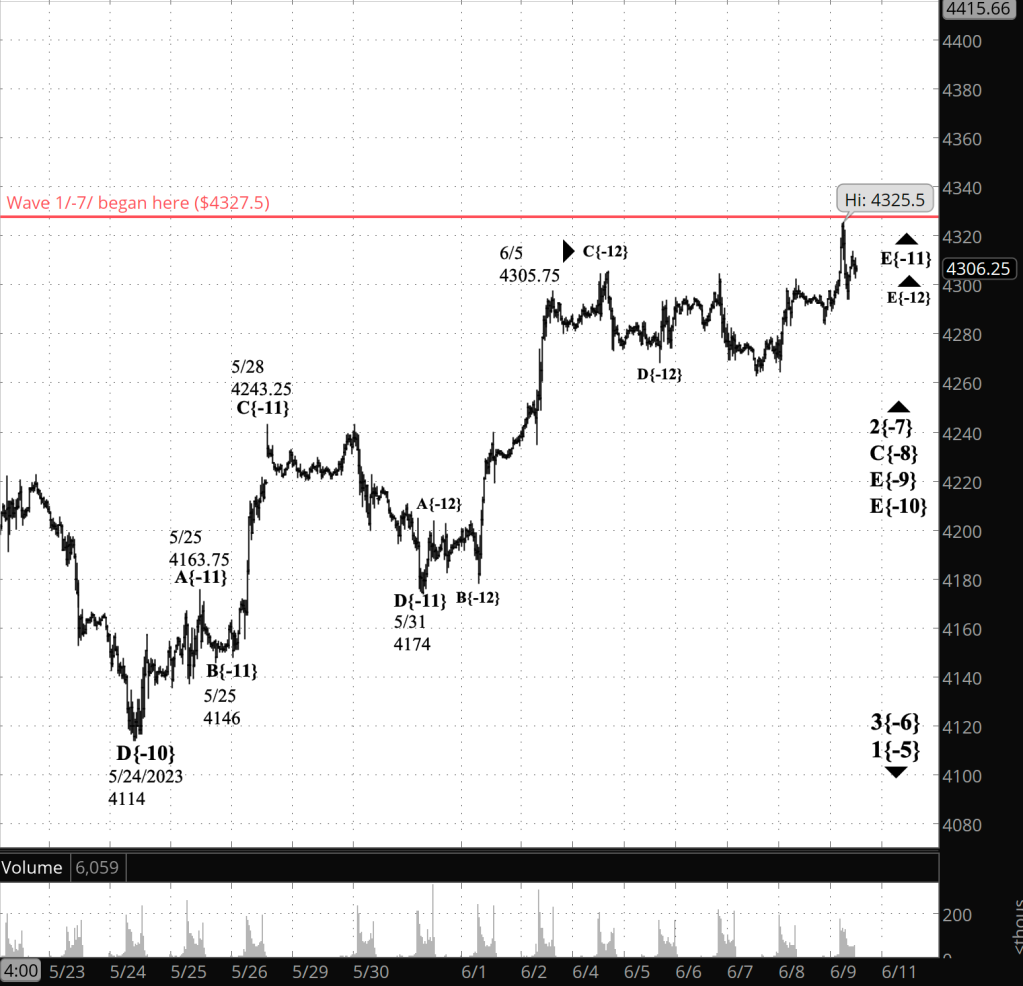
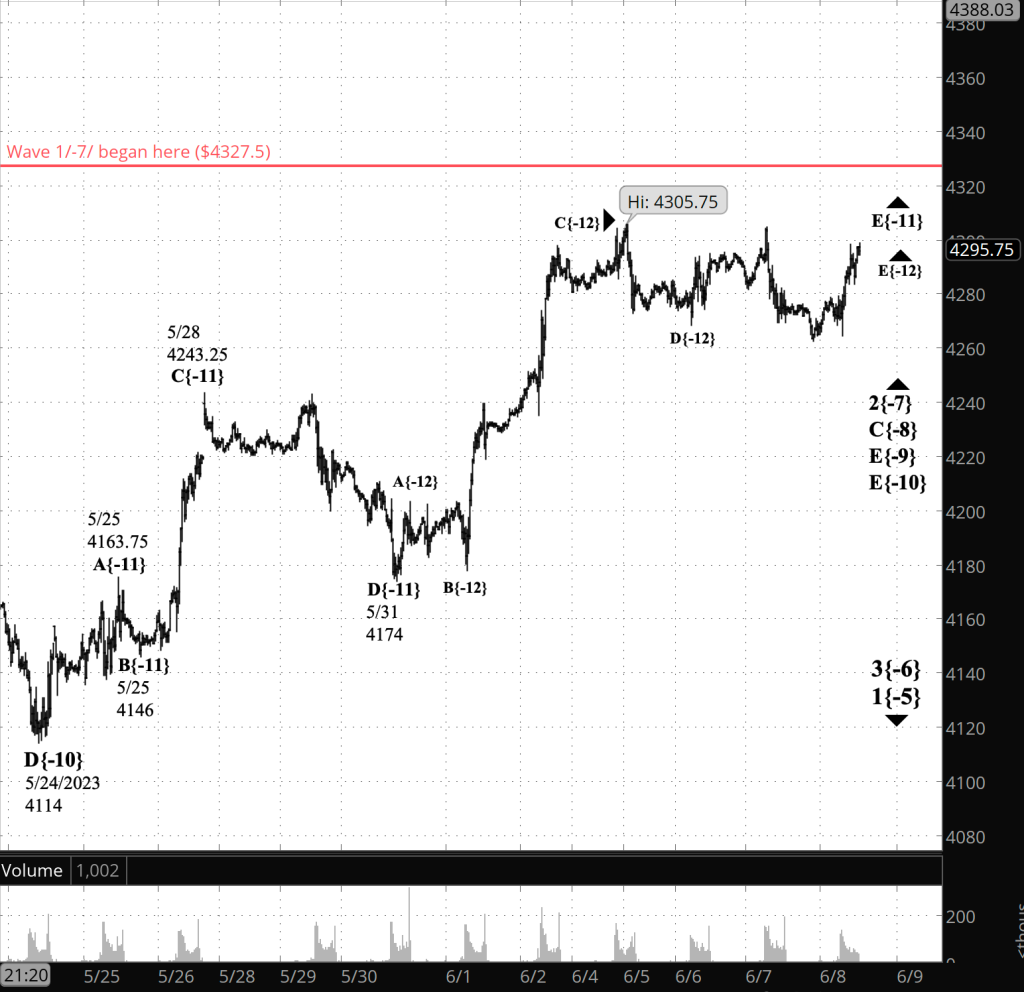
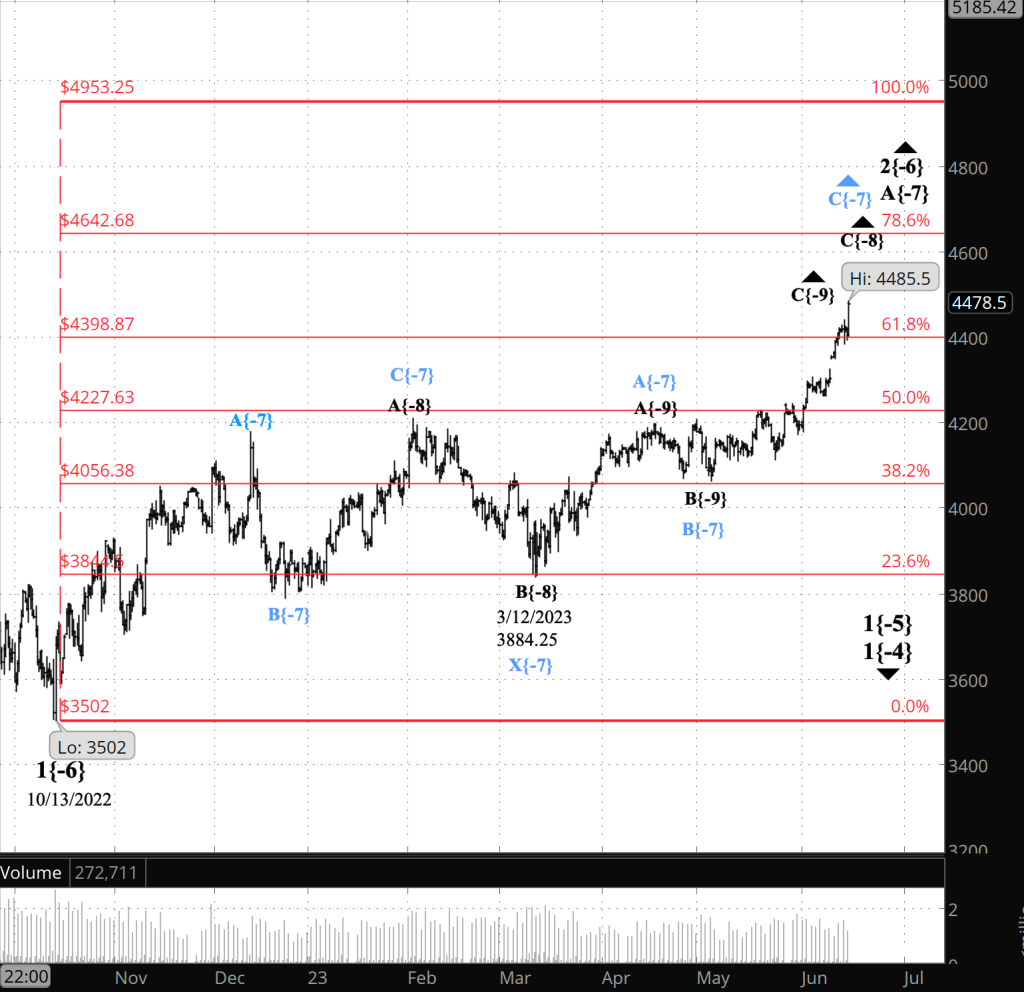
Half an hour before the closing bell. The S&P 500 futures has reached a low during the session of 4403.50, just a few dollars above the 61.8% Fibonacci retracement level, and then rose back into the 4430s. The indicator continues to go nowhere. This morning’s analysis stands unchanged. I’ve updated the chart.

9:35 a.m. New York time

What’s happening now? The S&P 500 E-mini futures fell overnight into the 4110s as an upward correction that began on October 13, 2022 continues.

What does it mean? The present rise began on May 4 from 4062.25. The S&P 500 has been limited to small movements since the recent correction peak, 4493.75, on June 16. The correction is a 2nd wave, and under the rules of Elliott wave analysis, the highest the correction’s price can rise is the starting point of the preceding 1st wave, 4953.25.

What are the choices? I’ve found two principal analyses of chart, both equally likely. One analysis is labeled on the chart in black and referred to as the Black Analysis. The other is labeled in blue and referred to as the Blue Analysis.

Black Analysis, A-wave scenario: The wave labels on the chart in black show a simple correction, with the first subwave, wave A{-7}, within the upward correction, wave 2{-6}, still underway and nearing its end.

Blue Analysis, C-wave scenario: The blue wave labels show the correction having taken a compound form. Compound corrections can contain up to three corrective patterns. The first pattern ended on February 2. The second pattern is now nearing completion. The end of the second pattern could be the end of the upward correction and the beginning of a powerful downtrend, or it could be followed by a relatively shallow declining connection wave, called an X-wave, and then a third corrective pattern.

[S&P 500 E-mini futures at 3:30 p.m., 8-hour bars, with volume]

Reading the chart. Price movements — waves – – in Elliott wave analysis are labeled with numbers within trending waves and letters with corrective waves. The subscripts — numbers in curly brackets — designate the wave’s degree, which, in Elliott wave analysis, means the relative position of a wave within the larger and smaller structures that make up the chart. R.N. Elliott, who in the 1930s developed the form of analysis that bears his name, viewed the chart as a complex structure of smaller waves nested within larger waves, which in turn are nested within still larger waves. In mathematics it’s called a fractal structure, where at every scale the pattern is similar to the others.

What does Elliott wave theory say? Here are the waves that underly the analyses.

Black Analysis, simple correction (black labeling on the chart):

  • An upward correction, a Zigzag, wave 2{-6}, began on October 13, 2022 and is underway.
  • The correction’s first subwave, wave A{-7}, is underway and will have five subwaves.
  • Wave A{-7} at present is in its 3rd subwave, wave C{-8}.
  • Wave C{-8} is in its 3rd subwave, wave C{-9}.
  • Wave 2{-6}, when complete, will be followed by a powerful downtrend, wave 3{-6}.
  • Under the rules of Elliott wave analysis, wave 2{-6} cannot move beyond the beginning of wave 1{-6}, which was the January 4, 2022 peak at 4953.25. (I’ve adjusted the January 4 peak.)

Blue Analysis, compound correction (blue labeling on the chart):

  • The upward correction, wave 2{-6}, is taking a compound form, which can contain up to three corrective patterns.
  • The correction is in its second corrective pattern, which is in wave C{-7}, its final wave.

Future Alternatives, an additional corrective pattern or the end of the correction?

  • In either scenario, wave C{-7}, when complete, will either be followed by a separator wave, X{-7}, and then an additional corrective pattern, or will be the end of the wave 2{-6} correction and will be followed by a powerful downtrend, wave 3{-6}.
  • Compound corrections can contain no more than three corrective patterns.

We Are Here.

These are the waves currently in progress under my principal analysis. Each line on the list shows the wave number, with the subscript in curly brackets, the traditional degree name, the starting date, the starting price of the S&P 500 E-mini futures, and the direction of the wave.

  • S&P 500 Index:
  • 5{+3} Supercycle, 7/8/1932, 4.40 (up)
  • 5{+2} Cycle, 12/9/1974, 60.96 (up)
  • 5{+1} Primary, 3/6/2009, 666.79 (up)
  • 5{0} Intermediate, 12/26/2018, 2346.58 (up)
  • S&P 500 Futures and index:
  • 4{-1} Minor, 1/4/2022, 4953.25 (down) (futures), 4818.62 (down) (index)
  • S&P 500 Futures:
  • 1{-2} Minute, 1/4/2022, 4953.25 (down)
  • 1{-3} Minuette, 1/4/2022, 4953.25 (down)
  • 1{-4} Subminuette, 1/4/2022, 4953.25 (down)
  • 1{-5} Micro, 1/4/2022, 4953.25 (down)
  • 2{-6} Minuscule, 10/13/2022, 3577.75 (up)

Learning and other resources. Elliott wave analysis provides context, not prophecy. As the 20th century semanticist Alfred Korzybski put it in his book Science and Sanity (1933), “The map is not the territory … The only usefulness of a map depends on similarity of structure between the empirical world and the map.” And I would add, in the ever-changing markets, we can judge that similarity of structure only after the fact.

See the menu page Analytical Methods for a rundown on where to go for information on Elliott wave analysis.

By Tim Bovee, Portland, Oregon, June 21, 2023

Disclaimer

Tim Bovee, Private Trader tracks the analysis and trades of a private trader for his own accounts. Nothing in this blog constitutes a recommendation to buy or sell stocks, options or any other financial instrument. The only purpose of this blog is to provide education and entertainment.

No trader is ever 100 percent successful in his or her trades. Trading in the stock and option markets is risky and uncertain. Each trader must make trading decisions for his or her own account, and take responsibility for the consequences.

License
Creative Commons License

All content on Tim Bovee, Private Trader by Timothy K. Bovee is licensed under a Creative Commons Attribution-ShareAlike 4.0 International License.

Based on a work at www.timbovee.com.
Trader’s Notebook

3:30 p.m. New York time

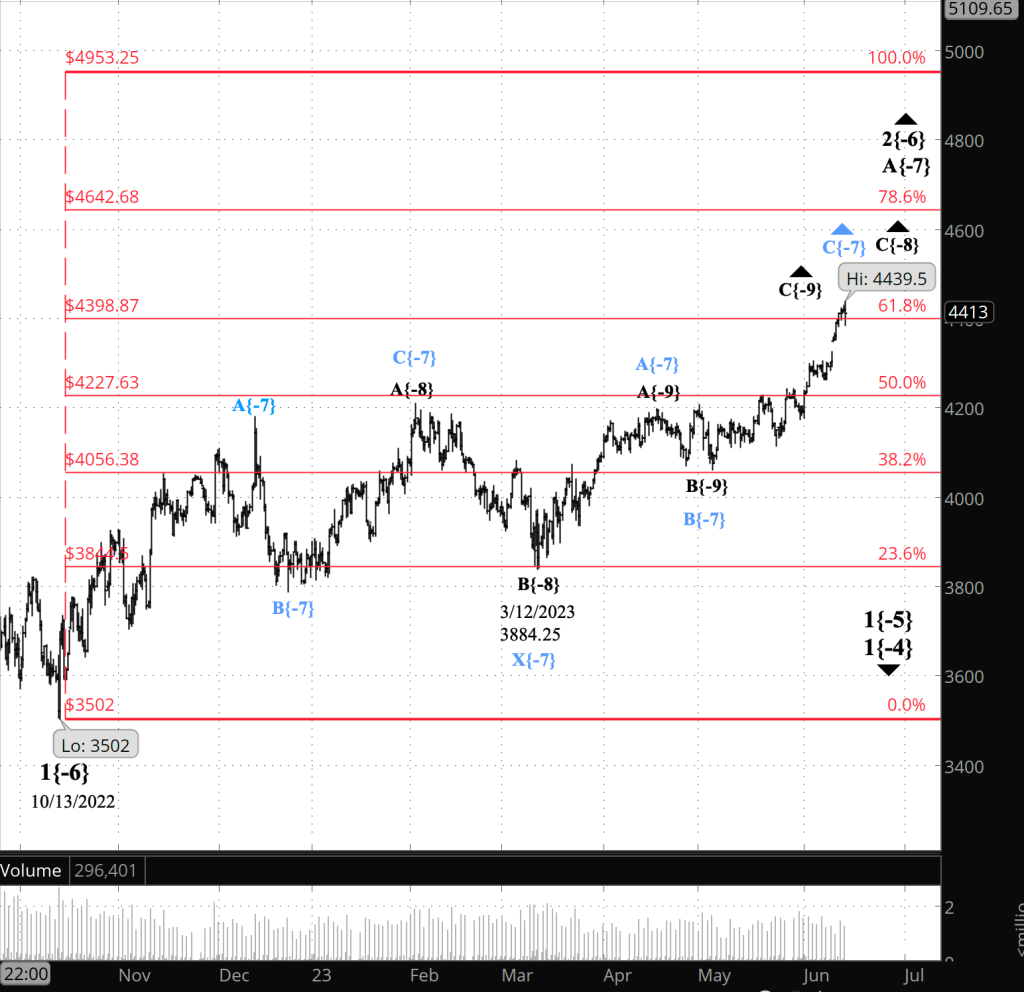
Half an hour before the closing bell. The S&P 500 futures fell during the session into the 4410s and then rose back into the 4430s. No change in this morning’s analysis. I’ve updated the chart.

9:35 a.m. New York time

What’s happening now? The S&P 500 E-mini futures traced a shallow decline overnight, from the 4450s to the 4430s.

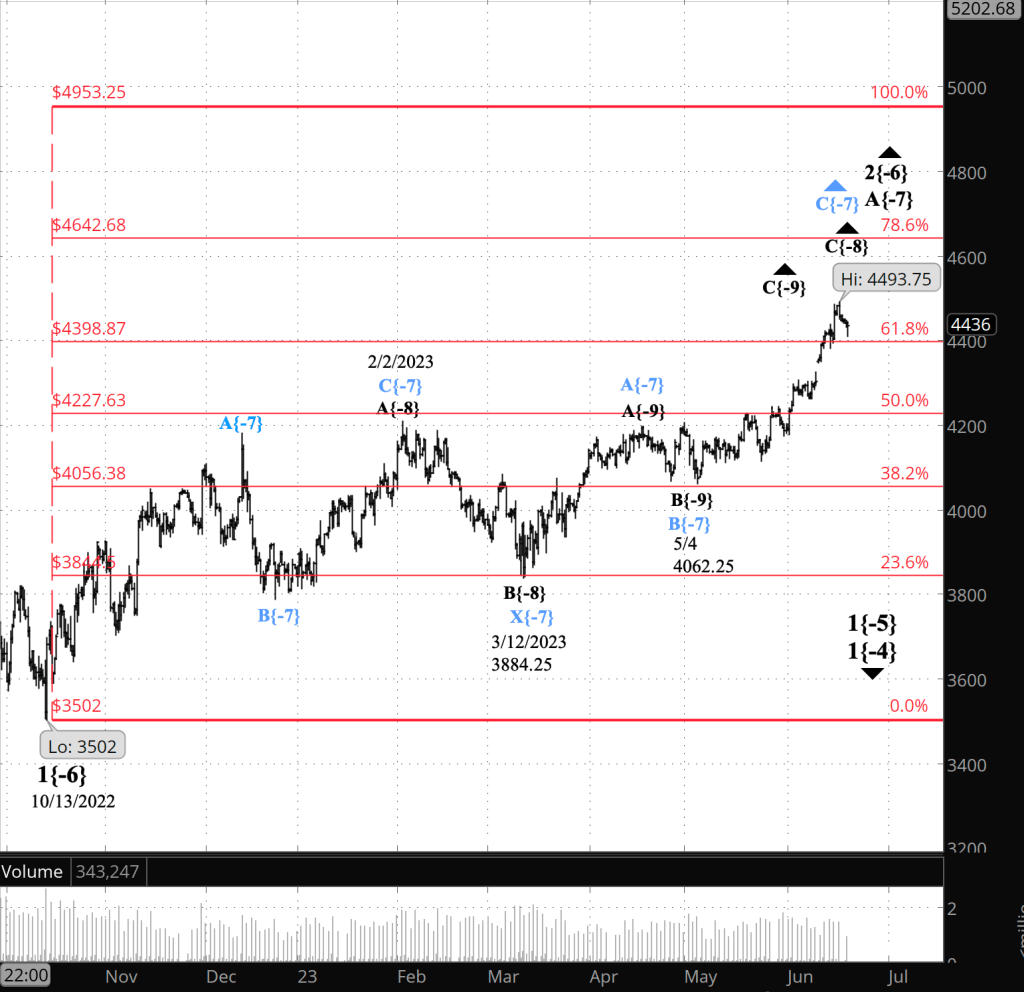
What does it mean? The price remained below the upward correction’s high so far, 4493.75 and above the 61.8% Fibonacci retracement level, 4398.87. That lack of the progress over the weekend and in trading during Monday’s U.S. markets holiday left the ambiguities in place: My principal analysis has two interpretations of the chart, each of equal likelihood. One scenario has the upward correction that began October 13, 2022 nearing its end. The other has the correction nearing the end of its first subwave, with two more to go.

Which will eventually match the reality of the chart?

What are the choices? The two interpretations are as follows:

Alternative #1, A-wave scenario: The wave labels on the chart in black show a simple correction, with the first subwave, wave A{-7}, within the upward correction, wave 2{-6}, still underway and nearing its end.

Alternative #2, C-wave scenario: The blue wave labels show the correction having taken a compound form. Compound corrections can contain up to three corrective patterns. The first pattern ended on February 2. The second pattern is now nearing completion. The end of the second pattern could be the end of the upward correction and the beginning of a powerful downtrend, or it could be followed by a relatively shallow declining connection wave, called an X-wave, and then a third corrective pattern.

Reading the chart. Price movements — waves – – in Elliott wave analysis are labeled with numbers within trending waves and letters with corrective waves. The subscripts — numbers in curly brackets — designate the wave’s degree, which, in Elliott wave analysis, means the relative position of a wave within the larger and smaller structures that make up the chart. R.N. Elliott, who in the 1930s developed the form of analysis that bears his name, viewed the chart as a complex structure of smaller waves nested within larger waves, which in turn are nested within still larger waves. In mathematics it’s called a fractal structure, where at every scale the pattern is similar to the others.

[S&P 500 E-mini futures at 3:30 p.m., 8-hour bars, with volume]

What does Elliott wave theory say? Here are the waves that underly the analyses.

Principal analysis, simple correction (black labeling on the chart):

  • An upward correction, a Zigzag, wave 2{-6}, began on October 13, 2022 and is underway.
  • The correction’s first subwave, wave A{-7}, is underway and will have five subwaves.
  • Wave A{-7} at present is in its 3rd subwave, wave C{-8}.
  • Wave C{-8} is in its 3rd subwave, wave C{-9}.
  • Wave 2{-6}, when complete, will be followed by a powerful downtrend, wave 3{-6}.
  • Under the rules of Elliott wave analysis, wave 2{-6} cannot move beyond the beginning of wave 1{-6}, which was the January 4, 2022 peak at 4953.25. (I’ve adjusted the January 4 peak.)

Principal analysis, compound correction (blue labeling on the chart):

  • The upward correction, wave 2{-6}, is taking a compound form, which can contain up to three corrective patterns.
  • The correction is in its second corrective pattern, which is in wave C{-7}, its final wave.

Future Alternatives, an additional corrective pattern or the end of the correction?

  • In either scenario, wave C{-7}, when complete, will either be followed by a separator wave, X{-7}, and then an additional corrective pattern, or will be the end of the wave 2{-6} correction and will be followed by a powerful downtrend, wave 3{-6}.
  • Compound corrections can contain no more than three corrective patterns.

We Are Here.

These are the waves currently in progress under my principal analysis. Each line on the list shows the wave number, with the subscript in curly brackets, the traditional degree name, the starting date, the starting price of the S&P 500 E-mini futures, and the direction of the wave.

  • S&P 500 Index:
  • 5{+3} Supercycle, 7/8/1932, 4.40 (up)
  • 5{+2} Cycle, 12/9/1974, 60.96 (up)
  • 5{+1} Primary, 3/6/2009, 666.79 (up)
  • 5{0} Intermediate, 12/26/2018, 2346.58 (up)
  • S&P 500 Futures and index:
  • 4{-1} Minor, 1/4/2022, 4953.25 (down) (futures), 4818.62 (down) (index)
  • S&P 500 Futures:
  • 1{-2} Minute, 1/4/2022, 4953.25 (down)
  • 1{-3} Minuette, 1/4/2022, 4953.25 (down)
  • 1{-4} Subminuette, 1/4/2022, 4953.25 (down)
  • 1{-5} Micro, 1/4/2022, 4953.25 (down)
  • 2{-6} Minuscule, 10/13/2022, 3577.75 (up)

Learning and other resources. Elliott wave analysis provides context, not prophecy. As the 20th century semanticist Alfred Korzybski put it in his book Science and Sanity (1933), “The map is not the territory … The only usefulness of a map depends on similarity of structure between the empirical world and the map.” And I would add, in the ever-changing markets, we can judge that similarity of structure only after the fact.

See the menu page Analytical Methods for a rundown on where to go for information on Elliott wave analysis.

By Tim Bovee, Portland, Oregon, June 20, 2023

Disclaimer

Tim Bovee, Private Trader tracks the analysis and trades of a private trader for his own accounts. Nothing in this blog constitutes a recommendation to buy or sell stocks, options or any other financial instrument. The only purpose of this blog is to provide education and entertainment.

No trader is ever 100 percent successful in his or her trades. Trading in the stock and option markets is risky and uncertain. Each trader must make trading decisions for his or her own account, and take responsibility for the consequences.

License
Creative Commons License

All content on Tim Bovee, Private Trader by Timothy K. Bovee is licensed under a Creative Commons Attribution-ShareAlike 4.0 International License.

Based on a work at www.timbovee.com.

Trader’s Notebook

9:35 a.m. New York time

U.S. markets closed. Today is the Juneteenth holiday in the United States, celebrating the emancipation from slavery of Black Americans. U.S. markets will remain closed today. The S&P 500 futures were traded overnight, and the London and Tokyo stock exchanges conducted their regular sessions. Trading will resume on U.S. exchanges at 9:30 a.m. Tuesday New York time

What’s happening now? The S&P 500 E-mini futures gently declined from the 4460s to the 4440s, remaining below the June 16 peak in the ongoing upward correction, 4493.75, and also below the 78.6% Fibonacci retracement level, the next common reversal point in the rise.

What does it mean? The lack of movement in the price leaves unresolved the ambiguities I described in Friday’s Trader’s Notebook, and I refer the reader to that post for the details, both of the principal analysis and the alternatives.

The upward correction began on October 13, 2022 from 3502 and has dominated the U.S. markets ever since. The financial media has declared a new bull market to be underway, using a rather simplistic method that calls any rise of 20% or greater over two months or longer to be a bull market. In Elliott wave analysis, such is not the case. The upward correction, wave 2{-6} in Elliott wave terminology, is still underway.

The question is, how far along is the correction?

Briefly, there are two was of analyzing the Elliott waves that make up the chart, and I consider them to be of equal likelihood until additional evidence tips the analysis one way or the other. On the chart, the wave numbers are in black for one way of counting and in blue for the other way of counting. The black wave count scenario has the first subwave, wave A{-7}, within the correction nearing its end. The blue wave count presents a scenario in which the upward correction is nearing its end and is in its final subwave, wave C{-7}.

Reading the chart. Price movements — waves – – in Elliott wave analysis are labeled with numbers within trending waves and letters with corrective waves. The subscripts — numbers in curly brackets — designate the wave’s degree, which, in Elliott wave analysis, means the relative position of a wave within the larger and smaller structures that make up the chart. R.N. Elliott, who in the 1930s developed the form of analysis that bears his name, viewed the chart as a complex structure of smaller waves nested within larger waves, which in turn are nested within still larger waves. In mathematics it’s called a fractal structure, where at every scale the pattern is similar to the others.

[S&P 500 E-mini futures at 9:35 a.m., 8-hour bars, with volume]

What does Elliott wave theory say? Here are the waves that underly the analyses.

Principal analysis, simple correction (black labeling on the chart):

  • An upward correction, a Zigzag, wave 2{-6}, began on October 13, 2022 and is underway.
  • The correction’s first subwave, wave A{-7}, is underway and will have five subwaves.
  • Wave A{-7} at present is in its 3rd subwave, wave C{-8}.
  • Wave C{-8} is in its 3rd subwave, wave C{-9}.
  • Wave 2{-6}, when complete, will be followed by a powerful downtrend, wave 3{-6}.
  • Under the rules of Elliott wave analysis, wave 2{-6} cannot move beyond the beginning of wave 1{-6}, which was the January 4, 2022 peak at 4953.25. (I’ve adjusted the January 4 peak.)

Principal analysis, compound correction (blue labeling on the chart):

  • The upward correction, wave 2{-6}, is taking a compound form, which can contain up to three corrective patterns.
  • The correction is in its second corrective pattern, which is in wave C{-7}, its final wave.

Alternatives, a 3rd corrective pattern or the end of the correction?

  • Wave C{-7}, when complete, will be followed by either (#1) a separator wave, X{-7}, and then a third corrective pattern, or (#2) will be the end of the wave 2{-6} correction and will be followed by a powerful downtrend, wave 3{-6}.
  • Compound corrections can contain no more than three corrective patterns.

We Are Here.

These are the waves currently in progress under my principal analysis. Each line on the list shows the wave number, with the subscript in curly brackets, the traditional degree name, the starting date, the starting price of the S&P 500 E-mini futures, and the direction of the wave.

  • S&P 500 Index:
  • 5{+3} Supercycle, 7/8/1932, 4.40 (up)
  • 5{+2} Cycle, 12/9/1974, 60.96 (up)
  • 5{+1} Primary, 3/6/2009, 666.79 (up)
  • 5{0} Intermediate, 12/26/2018, 2346.58 (up)
  • S&P 500 Futures and index:
  • 4{-1} Minor, 1/4/2022, 4953.25 (down) (futures), 4818.62 (down) (index)
  • S&P 500 Futures:
  • 1{-2} Minute, 1/4/2022, 4953.25 (down)
  • 1{-3} Minuette, 1/4/2022, 4953.25 (down)
  • 1{-4} Subminuette, 1/4/2022, 4953.25 (down)
  • 1{-5} Micro, 1/4/2022, 4953.25 (down)
  • 2{-6} Minuscule, 10/13/2022, 3577.75 (up)

Learning and other resources. Elliott wave analysis provides context, not prophecy. As the 20th century semanticist Alfred Korzybski put it in his book Science and Sanity (1933), “The map is not the territory … The only usefulness of a map depends on similarity of structure between the empirical world and the map.” And I would add, in the ever-changing markets, we can judge that similarity of structure only after the fact.

See the menu page Analytical Methods for a rundown on where to go for information on Elliott wave analysis.

By Tim Bovee, Portland, Oregon, June 19, 2023

Disclaimer

Tim Bovee, Private Trader tracks the analysis and trades of a private trader for his own accounts. Nothing in this blog constitutes a recommendation to buy or sell stocks, options or any other financial instrument. The only purpose of this blog is to provide education and entertainment.

No trader is ever 100 percent successful in his or her trades. Trading in the stock and option markets is risky and uncertain. Each trader must make trading decisions for his or her own account, and take responsibility for the consequences.

License
Creative Commons License

All content on Tim Bovee, Private Trader by Timothy K. Bovee is licensed under a Creative Commons Attribution-ShareAlike 4.0 International License.

Based on a work at www.timbovee.com.
Trader’s Notebook

3:30 p.m. New York time

Half an hour before the closing bell. The S&P 500 futures gradually fell back into the 4450s, a small move compared to the prior day’s rapid rise. No change in this morning’s analysis. I’ve updated the chart.

9:35 a.m. New York time

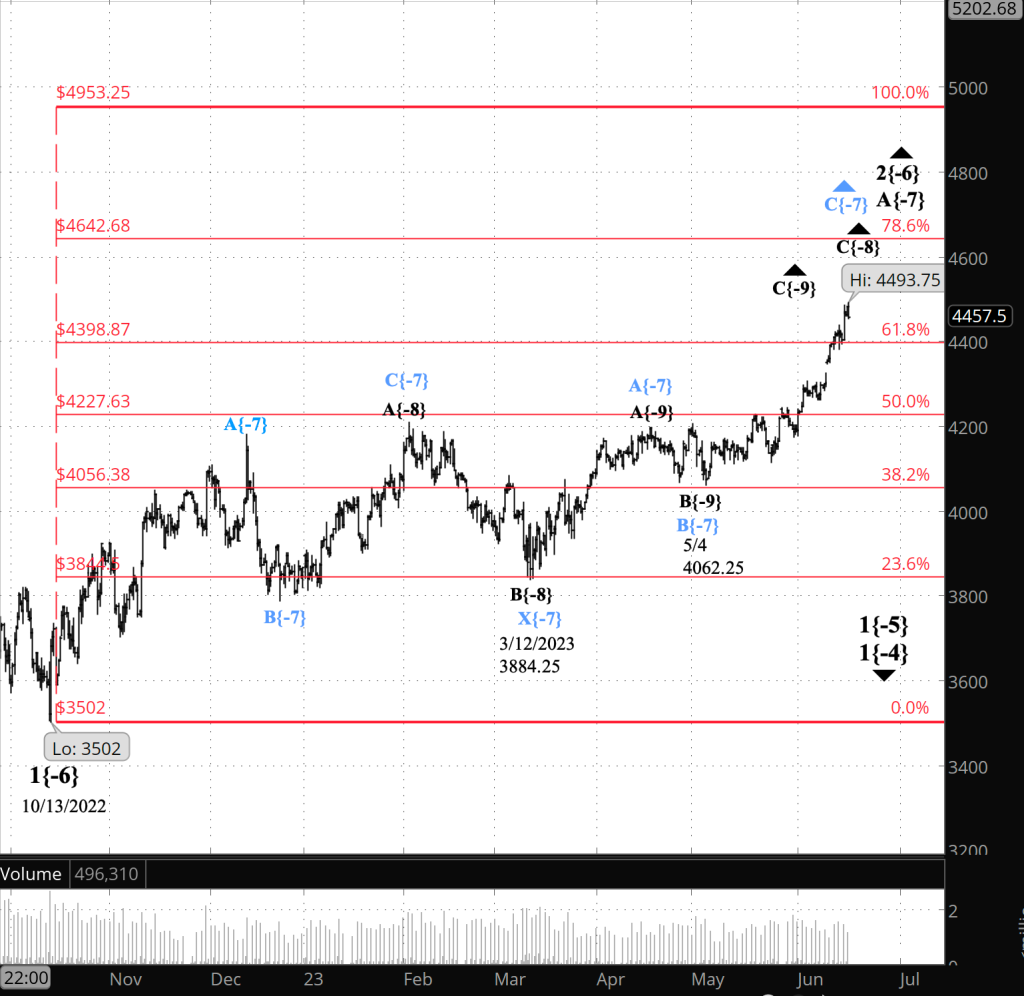
What’s happening now? The S&P 500 E-mini futures pushed higher overnight into the 4490s, while exceeding yesterday’s session high. The price is about halfway between two Fibonacci levels, the 61.8% retracement and the 78.6% retracement.

What does it mean? The present rise has been underway since May 4, within a much larger upward correction that began in October 2022. There are two ways of counting the waves within the correction, and the significance of the rise since May depends upon which method is used.

Corrections can take a simple form, with one corrective pattern a degree below the correction, or a compound form, with two or three corrective patterns.

Analyzing the correction as a simple form, the correction is nearing the end of its first subwave, to be followed by a decline and then a rise to new highs. Analyzing it as a compound form, the correction is nearing the end of its second corrective pattern and is approaching the end of that pattern.

There’s enough ambiguity in the chart that I consider the two possibilities equally likely. I’ve labeled the subwaves according to the simple correction scenario in black, and the subwaves according to the compound scenario in blue.

Breaking through the ambiguity. One component of Elliott wave theory is how a wave’s comparison in the time it takes to reach completion compared to other waves. The downtrending 1st wave preceding the present 2nd wave correction lasted a bit over 10 months. The present upward 2nd wave correction is now its 8th month. First waves in my experience have tended take a slightly longer time than 2nd waves, although not always. A longer time period for the correction suggests a compound form, a shorter time period, a simple form.

Take-away: The correction is likely almost over and has taken a compound form, since the A wave within the simple form has taken way to long a time to reach completion.

I’ll look into this aspect of the analysis further, but for now, I’m retailing the two wave counts as being equally probable.

What are the alternatives? Under the compound-correction scenario, any high could be the end of the present corrective pattern. The alternatives are either (#1) the high also marks the end of the correction, or (#2) a declining separator wave (X-wave) will be followed by a third corrective pattern.

[S&P 500 E-mini futures at 3:30 p\.m., 8-hour bars, with volume]

What does Elliott wave theory say? Here are the waves that underly the analyses.

Principal analysis, simple correction (black labeling on the chart):

  • An upward correction, a Zigzag, wave 2{-6}, began on October 13, 2022 and is underway.
  • The correction’s first subwave, wave A{-7}, is underway and will have five subwaves.
  • Wave A{-7} at present is in its 3rd subwave, wave C{-8}.
  • Wave C{-8} is in its 3rd subwave, wave C{-9}.
  • Wave 2{-6}, when complete, will be followed by a powerful downtrend, wave 3{-6}.
  • Under the rules of Elliott wave analysis, wave 2{-6} cannot move beyond the beginning of wave 1{-6}, which was the January 4, 2022 peak at 4953.25. (I’ve adjusted the January 4 peak.)

Principal analysis, compound correction (blue labeling on the chart):

  • The upward correction, wave 2{-6}, is taking a compound form, which can contain up to three corrective patterns.
  • The correction is in its second corrective pattern, which is in wave C{-7}, its final wave.

Alternatives, a 3rd corrective pattern or the end of the correction

  • Wave C{-7}, when complete, will be followed by either (#1) a separator wave, X{-7}, and then a third corrective pattern, or (#2) will be the end of the wave 2{-6} correction and will be followed by a powerful downtrend, wave 3{-6}.
  • Compound corrections can contain no more than three corrective patterns.

Reading the chart. Price movements — waves – – in Elliott wave analysis are labeled with numbers within trending waves and letters with corrective waves. The subscripts — numbers in curly brackets — designate the wave’s degree, which, in Elliott wave analysis, means the relative position of a wave within the larger and smaller structures that make up the chart. R.N. Elliott, who in the 1930s developed the form of analysis that bears his name, viewed the chart as a complex structure of smaller waves nested within larger waves, which in turn are nested within still larger waves. In mathematics it’s called a fractal structure, where at every scale the pattern is similar to the others.

We Are Here.

These are the waves currently in progress under my principal analysis. Each line on the list shows the wave number, with the subscript in curly brackets, the traditional degree name, the starting date, the starting price of the S&P 500 E-mini futures, and the direction of the wave.

  • S&P 500 Index:
  • 5{+3} Supercycle, 7/8/1932, 4.40 (up)
  • 5{+2} Cycle, 12/9/1974, 60.96 (up)
  • 5{+1} Primary, 3/6/2009, 666.79 (up)
  • 5{0} Intermediate, 12/26/2018, 2346.58 (up)
  • S&P 500 Futures and index:
  • 4{-1} Minor, 1/4/2022, 4953.25 (down) (futures), 4818.62 (down) (index)
  • S&P 500 Futures:
  • 1{-2} Minute, 1/4/2022, 4953.25 (down)
  • 1{-3} Minuette, 1/4/2022, 4953.25 (down)
  • 1{-4} Subminuette, 1/4/2022, 4953.25 (down)
  • 1{-5} Micro, 1/4/2022, 4953.25 (down)
  • 2{-6} Minuscule, 10/13/2022, 3577.75 (up)

Learning and other resources. Elliott wave analysis provides context, not prophecy. As the 20th century semanticist Alfred Korzybski put it in his book Science and Sanity (1933), “The map is not the territory … The only usefulness of a map depends on similarity of structure between the empirical world and the map.” And I would add, in the ever-changing markets, we can judge that similarity of structure only after the fact.

See the menu page Analytical Methods for a rundown on where to go for information on Elliott wave analysis.

By Tim Bovee, Portland, Oregon, June 16, 2023

Disclaimer

Tim Bovee, Private Trader tracks the analysis and trades of a private trader for his own accounts. Nothing in this blog constitutes a recommendation to buy or sell stocks, options or any other financial instrument. The only purpose of this blog is to provide education and entertainment.

No trader is ever 100 percent successful in his or her trades. Trading in the stock and option markets is risky and uncertain. Each trader must make trading decisions for his or her own account, and take responsibility for the consequences.

License
Creative Commons License

All content on Tim Bovee, Private Trader by Timothy K. Bovee is licensed under a Creative Commons Attribution-ShareAlike 4.0 International License.

Based on a work at www.timbovee.com.
Trader’s Notebook

3:30 p.m. New York time

Half an hour before the closing bell. The S&P 500 futures rose rapidly throughout the session, from a low of 4393.75 an hour before the opening bell reaching into the 4480s as the closing bell approached.

No change in the analysis. I’ve updated the chart.

9:35 a.m. New York time

What’s happening now? The S&P 500 E-mini futures pulled back overnight, dipping below the 61.8% Fibonacci retracement level for the second day in a row. The 61.8% retracement neighborhood is a common pause and reversal point in the markets.

What does it mean? The upward correction that began on October 13, 2022 continues. Internally, there are two possible scenarios of equal probability.

  • The correction is in its 1st subwave, an A wave, which is nearing its end. The wave labels for this analysis are shown on the chart in black. Under this scenario, the wave is taking the from of a Zigzag, with five subwaves in the A wave.
  • The correction is in its final subwave, a C wave within the second corrective pattern of a compound correction, which is nearing sits end. The wave labels for this analysis are in blue.

At this point, there’s no way to choose between them. The A-wave scenario seems to be the clearer count, although the time it has taken seems overly long for an A wave of this degree. The C-wave scenario better matches the time frame and is almost a reasonable reading of the chart patterns as is the A-wave scenario.

The falling wave that follows the present rise will tell us which is the best match for the chart. Under the A-wave scenario, the falling wave, as a B wave, will have three subwaves. Under the C-wave scenario, the falling wave will be the 1st subwave of a powerful downtrend and will have five subwaves.

What are the alternatives? There are two.

Alternative #1, a third corrective pattern. Under the C-wave scenario, the compound correction could add a third corrective pattern, separated from the second pattern by an X-wave having three subwaves.

Alternative #2, a Flat, not a Zigzag. Under the A-wave scenario, it’s possible that the correction is taking the form of a Flat, with three subwaves within the A wave. If so, then the third subwave may have ended at the June 14 peak, 4439.50.

[S&P 500 E-mini futures at 3:30 p.m., 8-hour bars, with volume]

What does Elliott wave theory say? Here are the waves that underly the analyses.

Principal analysis, simple correction (black labeling on the chart):

  • An upward correction, a Zigzag, wave 2{-6}, began on October 13, 2022 and is underway.
  • The correction’s first subwave, wave A{-7}, is underway and will have five subwaves.
  • Wave A{-7} at present is in its 3rd subwave, wave C{-8}.
  • Wave C{-8} is in its 3rd subwave, wave C{-9}.
  • Wave 2{-6}, when complete, will be followed by a powerful downtrend, wave 3{-6}.
  • Under the rules of Elliott wave analysis, wave 2{-6} cannot move beyond the beginning of wave 1{-6}, which was the January 4, 2022 peak at 4953.25. (I’ve adjusted the January 4 peak.)

Principal analysis, compound correction (blue labeling on the chart):

  • The upward correction, wave 2{-6}, is taking a compound form, which can contain up to three corrective patterns.
  • The correction is in its second corrective pattern, which is in wave C{-7}, its final wave.
  • Wave C{-7}, when complete, will be followed by either a separator wave, X{-7}, and then a third corrective pattern, or will be the end of the wave 2{-6} correction and will be followed by a powerful downtrend, wave 3{-6}.

Alternative #1, compound correction, a third corrective pattern.

  • Under the scenario marked in blue on the chart, and within the correction, wave 2{-6}…
  • Wave C{-7} will be followed by a connecting wave, X{-7}, and then a third corrective pattern, most likely with three subwaves.
  • Compound corrections can have no more than three corrective patterns.

Alternative #2, , a Flat, not a Zigzag.

  • Under the scenario marked in black on the chart, and within the correction, wave 2{-6}…
  • The correction is taking the form of a Flat, and so wave A{-7} will have three subwaves.
  • The present subwave, wave A{-8}, will complete wave A[-7}.

We Are Here.

These are the waves currently in progress under my principal analysis. Each line on the list shows the wave number, with the subscript in curly brackets, the traditional degree name, the starting date, the starting price of the S&P 500 E-mini futures, and the direction of the wave.

  • S&P 500 Index:
  • 5{+3} Supercycle, 7/8/1932, 4.40 (up)
  • 5{+2} Cycle, 12/9/1974, 60.96 (up)
  • 5{+1} Primary, 3/6/2009, 666.79 (up)
  • 5{0} Intermediate, 12/26/2018, 2346.58 (up)
  • S&P 500 Futures and index:
  • 4{-1} Minor, 1/4/2022, 4953.25 (down) (futures), 4818.62 (down) (index)
  • S&P 500 Futures:
  • 1{-2} Minute, 1/4/2022, 4953.25 (down)
  • 1{-3} Minuette, 1/4/2022, 4953.25 (down)
  • 1{-4} Subminuette, 1/4/2022, 4953.25 (down)
  • 1{-5} Micro, 1/4/2022, 4953.25 (down)
  • 2{-6} Minuscule, 10/13/2022, 3577.75 (up)

Learning and other resources. Elliott wave analysis provides context, not prophecy. As the 20th century semanticist Alfred Korzybski put it in his book Science and Sanity (1933), “The map is not the territory … The only usefulness of a map depends on similarity of structure between the empirical world and the map.” And I would add, in the ever-changing markets, we can judge that similarity of structure only after the fact.

See the menu page Analytical Methods for a rundown on where to go for information on Elliott wave analysis.

By Tim Bovee, Portland, Oregon, June 15, 2023

Disclaimer

Tim Bovee, Private Trader tracks the analysis and trades of a private trader for his own accounts. Nothing in this blog constitutes a recommendation to buy or sell stocks, options or any other financial instrument. The only purpose of this blog is to provide education and entertainment.

No trader is ever 100 percent successful in his or her trades. Trading in the stock and option markets is risky and uncertain. Each trader must make trading decisions for his or her own account, and take responsibility for the consequences.

License
Creative Commons License

All content on Tim Bovee, Private Trader by Timothy K. Bovee is licensed under a Creative Commons Attribution-ShareAlike 4.0 International License.

Based on a work at www.timbovee.com.
Trader’s Notebook

3:30 p.m. New York time

Half an hour before the closing bell. The S&P 500 peaked early in the session at 4439.50 and then dropped sharply to 4383.50 after the Federal Open Market Committee announced it had decided to hold rates steady this month. No change in the analysis. I’ve updated the chart.

9:35 a.m. New York time

What’s happening now? The S&P 500 E-mini futures rose to 4428 in overnight trading, above the 61.8% Fibonacci retracement level.

What does it mean? The upward correction that began on October 13, 2022 continues and is in its 1st subwave.

The upward limit of the correction, under the rules of Elliott wave theory, is 4953.25, the starting point of the downtrending wave that preceded the correction. The price has been adjusted slightly higher to eliminate a price mislabeling by the chart software.

What are the alternatives? It’s possible to see the correction as taking a compound form, containing two corrective patterns. I’ve placed the wave labels for this alternative on the chart in blue. A compound correction can have as many as three corrective patterns, each separated from its predecessor by an X wave.

If the alternative correction turns out to be the best match for the chart, then the upward correction is further along than the principal analysis would have it. The second corrective pattern is in its final subwave under this scenario, and that final subwave may be the end of the correction, or it may be followed by a third corrective pattern.

[S&P 500 E-mini futures at 3:30 p.m., 8-hour bars, with volume]

What does Elliott wave theory say? Here are the waves that underly the revised analyses.

Principal analysis, simple correction (black labeling on the chart):

  • An upward correction, wave 2{-6}, began on October 13, 2022 and is underway.
  • The correction’s first subwave, wave A{-7}, is underway and will have five subwaves.
  • Wave A{-7} at present is in its 3rd subwave, wave C{-8}.
  • Wave C{-8} is in its 3rd subwave, wave C{-9}.
  • Wave 2{-6}, when complete, will be followed by a powerful downtrend, wave 3{-6}.
  • Under the rules of Elliott wave analysis, wave 2{-6} cannot move beyond the beginning of wave 1{-6}, which was the January 4, 2022 peak at 4953.25. (I’ve adjusted the January 4 peak.)

Alternative analysis, compound correction (blue labeling on the chart):

  • The upward correction, wave 2{-6}, is taking a compound form, which can contain up to three corrective patterns.
  • The correction is in its second corrective pattern, which is in wave C{-7}, its final wave.
  • Wave C{-7}, when complete, will be followed by either a separator wave, X{-7}, and then a third corrective pattern, or will be the end of the wave 2{-6} correction and will be followed by a powerful downtrend, wave 3{-6}.

We Are Here.

These are the waves currently in progress under my principal analysis. Each line on the list shows the wave number, with the subscript in curly brackets, the traditional degree name, the starting date, the starting price of the S&P 500 E-mini futures, and the direction of the wave.

  • S&P 500 Index:
  • 5{+3} Supercycle, 7/8/1932, 4.40 (up)
  • 5{+2} Cycle, 12/9/1974, 60.96 (up)
  • 5{+1} Primary, 3/6/2009, 666.79 (up)
  • 5{0} Intermediate, 12/26/2018, 2346.58 (up)
  • S&P 500 Futures and index:
  • 4{-1} Minor, 1/4/2022, 4953.25 (down) (futures), 4818.62 (down) (index)
  • S&P 500 Futures:
  • 1{-2} Minute, 1/4/2022, 4953.25 (down)
  • 1{-3} Minuette, 1/4/2022, 4953.25 (down)
  • 1{-4} Subminuette, 1/4/2022, 4953.25 (down)
  • 1{-5} Micro, 1/4/2022, 4953.25 (down)
  • 2{-6} Minuscule, 10/13/2022, 3577.75 (up)

Learning and other resources. Elliott wave analysis provides context, not prophecy. As the 20th century semanticist Alfred Korzybski put it in his book Science and Sanity (1933), “The map is not the territory … The only usefulness of a map depends on similarity of structure between the empirical world and the map.” And I would add, in the ever-changing markets, we can judge that similarity of structure only after the fact.

See the menu page Analytical Methods for a rundown on where to go for information on Elliott wave analysis.

By Tim Bovee, Portland, Oregon, June 14, 2023

Disclaimer

Tim Bovee, Private Trader tracks the analysis and trades of a private trader for his own accounts. Nothing in this blog constitutes a recommendation to buy or sell stocks, options or any other financial instrument. The only purpose of this blog is to provide education and entertainment.

No trader is ever 100 percent successful in his or her trades. Trading in the stock and option markets is risky and uncertain. Each trader must make trading decisions for his or her own account, and take responsibility for the consequences.

License
Creative Commons License

All content on Tim Bovee, Private Trader by Timothy K. Bovee is licensed under a Creative Commons Attribution-ShareAlike 4.0 International License.

Based on a work at www.timbovee.com.

Trader’s Notebook

3:30 p.m. New York time

Half an hour before the closing bell. The S&P 500 futures reached a session high in the 4420s, continuing the rise that began overnight with the release of new inflation numbers. There’s no change in this morning’s analysis.

9:35 a.m. New York time

What’s happening now? The S&P 500 E-mini futures rose slightly overnight to slightly above 4400, whipsawed when the latest inflation numbers were released, and then continued to rise, reaching 4415.50 before the opening bell.

What does it mean? The rise since March 12, the third subwave of the first segment of the upward correction that began on October 13, has carried the price well above the 61.8% Fibonacci retracement level, a common reversal point, and about halfway to the next Fib level, 78.6%. (The waves’ labels on the chart, from smaller to larger, are C{-8} within A{-7} with the correction, wave 2{-6}).

I’ve overlaid the chart with the Fibonacci retracement ladder, in red.

Under the rules of Elliott wave theory, the 2nd wave upward correction cannot move above the starting point of the declining 1st wave that preceded it. The upper boundary is 4808.25, which gives the correction about 400 points within which it can rise.

What are the alternatives? At a glance it seems possible to count the subwaves of the correction differently, divided the rise from October into three waves one degree down from the corrective wave. However, this doesn’t work but it would have the middle subwave (B) moving above the starting point of initial subwave (A), and that breaks a rule of Elliott wave theory.

So at this point, I have no alternatives. They will develop, I’m quite certain, as the correction progresses.

[S&P 500 E-mini futures at 3:30 p.m., 800-minute bars, with volume]

What does Elliott wave theory say? Here are the waves that underly the revised analyses.

Principal analysis:

  • An upward correction, wave 2{-6}, began on October 13, 2022 and is underway.
  • The correction’s first subwave, wave A{-7}, is underway and will have five subwaves.
  • Wave A{-7} at present is in its 3rd subwave, wave C{-8}.
  • Wave C{-8} is in its 3rd subwave, wave C{-9}.
  • Wave 2{-6}, when complete, will be followed by a powerful downtrend, wave 3{-6}.
  • Under the rules of Elliott wave analysis, wave 2{-6} cannot move beyond the beginning of wave 1{-6}, which was the January 4, 2022 peak at 4808.25.

Reading the chart. Price movements — waves – – in Elliott wave analysis are labeled with numbers within trending waves and letters with corrective waves. The subscripts — numbers in curly brackets — designate the wave’s degree, which, in Elliott wave analysis, means the relative position of a wave within the larger and smaller structures that make up the chart. R.N. Elliott, who in the 1930s developed the form of analysis that bears his name, viewed the chart as a complex structure of smaller waves nested within larger waves, which in turn are nested within still larger waves. In mathematics it’s called a fractal structure, where at every scale the pattern is similar to the others.

We Are Here.

These are the waves currently in progress under my principal analysis. Each line on the list shows the wave number, with the subscript in curly brackets, the traditional degree name, the starting date, the starting price of the S&P 500 E-mini futures, and the direction of the wave.

  • S&P 500 Index:
  • 5{+3} Supercycle, 7/8/1932, 4.40 (up)
  • 5{+2} Cycle, 12/9/1974, 60.96 (up)
  • 5{+1} Primary, 3/6/2009, 666.79 (up)
  • 5{0} Intermediate, 12/26/2018, 2346.58 (up)
  • S&P 500 Futures and index:
  • 4{-1} Minor, 1/4/2022, 4808.25 (down) (futures), 4818.62 (down) (index)
  • S&P 500 Futures:
  • 1{-2} Minute, 1/4/2022, 4808.25 (down)
  • 1{-3} Minuette, 1/4/2022, 4808.25 (down)
  • 1{-4} Subminuette, 1/4/2022, 4808.25 (down)
  • 1{-5} Micro, 1/4/2022, 4808.25 (down)
  • 2{-6} Minuscule, 10/13/2022, 3577.75 (up)

Learning and other resources. Elliott wave analysis provides context, not prophecy. As the 20th century semanticist Alfred Korzybski put it in his book Science and Sanity (1933), “The map is not the territory … The only usefulness of a map depends on similarity of structure between the empirical world and the map.” And I would add, in the ever-changing markets, we can judge that similarity of structure only after the fact.

See the menu page Analytical Methods for a rundown on where to go for information on Elliott wave analysis.

By Tim Bovee, Portland, Oregon, June 13, 2023

Disclaimer

Tim Bovee, Private Trader tracks the analysis and trades of a private trader for his own accounts. Nothing in this blog constitutes a recommendation to buy or sell stocks, options or any other financial instrument. The only purpose of this blog is to provide education and entertainment.

No trader is ever 100 percent successful in his or her trades. Trading in the stock and option markets is risky and uncertain. Each trader must make trading decisions for his or her own account, and take responsibility for the consequences.

License
Creative Commons License

All content on Tim Bovee, Private Trader by Timothy K. Bovee is licensed under a Creative Commons Attribution-ShareAlike 4.0 International License.

Based on a work at www.timbovee.com.
Trader’s Notebook

3:30 p.m. New York time

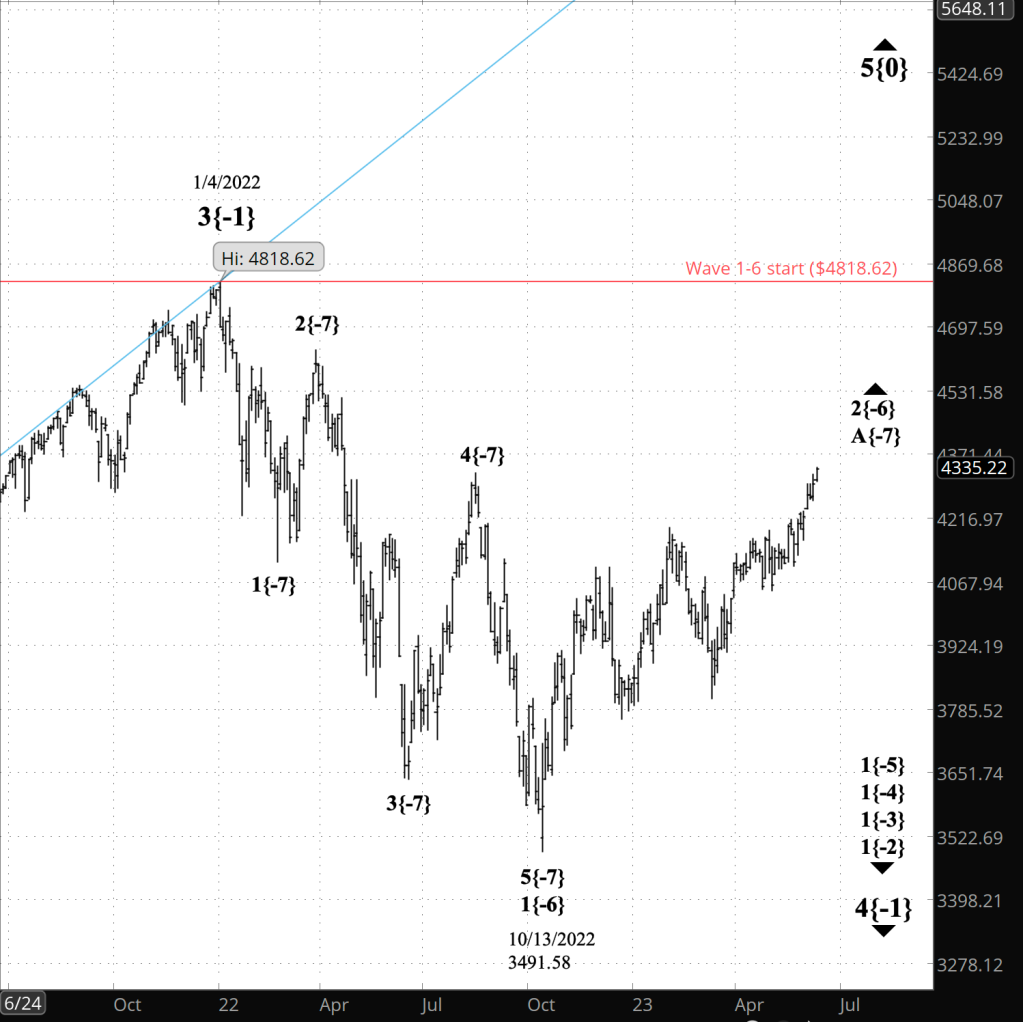
Half an hour before the closing bell. The S&P 500 futures rose slightly higher during the session, into the 4380s so far. The rise brought the 2nd wave upward correction to a 61.8% Fibonacci retracement of the downtrending 1st wave that preceded it. The neighborhood of 61.8% is in my experience a common ending point for a price movement. The preceding downtrend, wave 1{-6}, began on January 4, 2022 from 4808.25. The present upward correction, wave 2{-6}, began on October 13, 2022 from 3502.

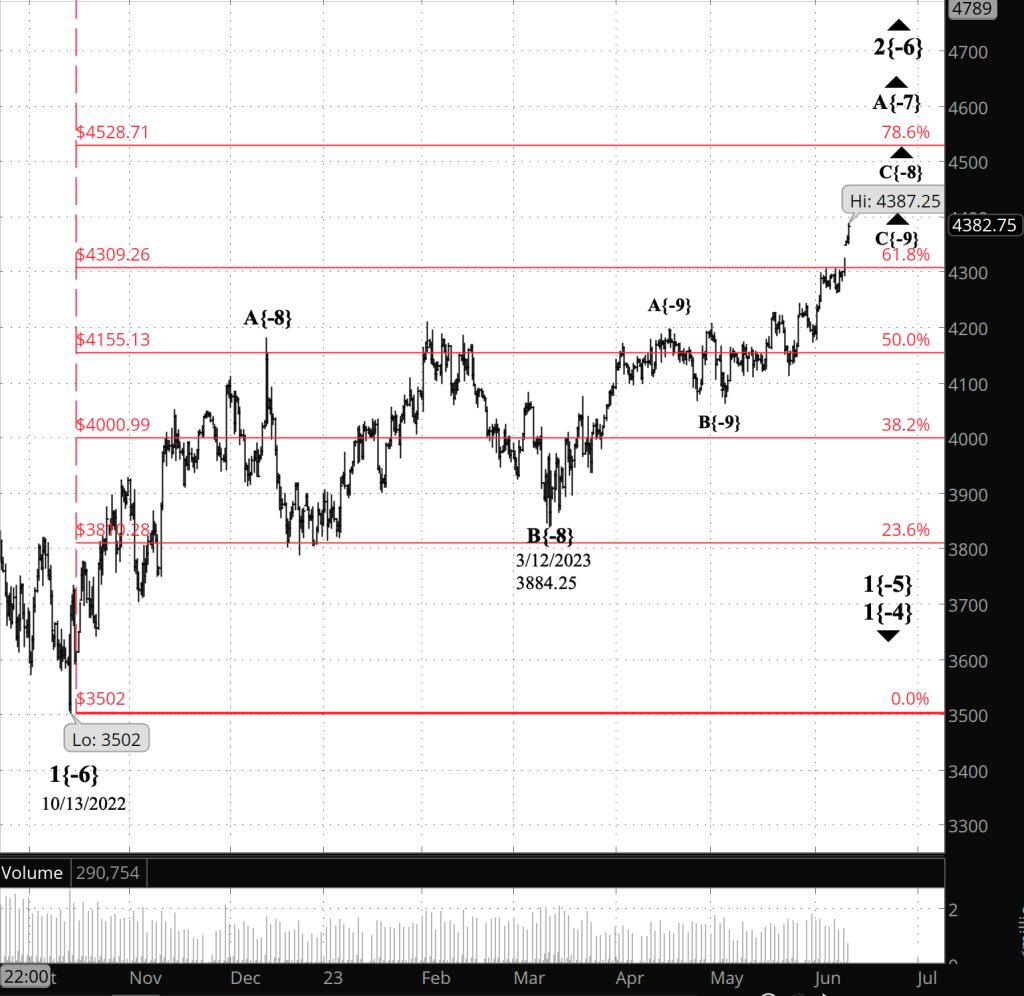
There’s no change in the analysis. This morning’s chart labeled the price of the starting point of the upward correction incorrectly, and I’ve fixed that. I’ve also added a Fibonacci retracement ladder, in red, to the futures chart and have updated both charts to show the price movements during the session.

9:35 a.m. New York time

New to Elliott wave theory? The topic of today’s Trader’s Notebook requires extensive use of Elliott wave terminology. See the “Reading the chart” section, below, for guidance on how to read the jargon, both in the text and on the chart.

What’s happening now? The S&P 500 E-mini futures gapped up by 45 points when trading resumed overnight, and continued to rise, moving above the upper limit described in earlier analyses. The rise, a 2nd wave, has so far retraced 63% of the preceding decline, a 1st wave.

The map no longer fits the territory — the analysis no longer matches the chart — and so I’ve revised the analysis.

What does it mean? The new analysis moves everything up one degree. What had been wave 2{-7} has become wave 2{-6}, which began on October 13, 2022. The new parent wave is wave 1{-5}, which began on January 4, 2022.

The reanalysis sets new upper limits, based on a rule of Elliott wave theory that says a 2nd wave never reaches beyond the beginning of the preceding 1st wave.

The new upper limit is the beginning of wave 1{-6}. The wave 2{-6} upper limit of the S&P 500 futures was raised from the old limit, 4327.50, to the new one, 4808.25, and the S&P 500 index limit was raised from 4325.28 to 4818.62.

When wave 2{-6} is complete, it will be followed by a powerful downward correction, wave 3{-6}.

Reading the chart. I’m posting two charts today. The upper chart is of the S&P 500 index and shows the entirety of the decline from January 4, 2022, the beginning of a major downtrend that will be with us for some time to come. This chart gives context to the detailed chart below it, which shows the upward correction, now underway, that began on October 13, 2022. For a near-term view of the former analysis, see the futures chart posted last Friday, June 9. For a broader context, see the index chart posted on June 5.

Price movements — waves – – in Elliott wave analysis are labeled with numbers within trending waves and letters with corrective waves. The subscripts — numbers in curly brackets — designate the wave’s degree, which, in Elliott wave analysis, means the relative position of a wave within the larger and smaller structures that make up the chart. R.N. Elliott, who in the 1930s developed the form of analysis that bears his name, viewed the chart as a complex structure of smaller waves nested within larger waves, which in turn are nested within still larger waves. In mathematics it’s called a fractal structure, where at every scale the pattern is similar to the others.

What are the alternatives? When revisions of the analysis become necessary, it is almost always a question of the degree of a wave. Waves don’t come with introductory lapel buttons saying, “Hi! My degree is…” The way to determine a degree is to figure out what previous degree’s size the present wave seems to match. There’s a lot of ambiguity, and very little certainty. This revision took what had been labeled wave 2{-7} and moved it up a degree, to wave 2{-6}, and made the other adjustments required by that new analysis.

The same ambiguity that applied to the earlier analysis also applies to this one. I’ve taken a guess that the degree is {-6}. It could eventually turn out to be another degree.

[S&P 500 index at 3:30 p.m., 1-day bars, with volume]

[S&P 500 E-mini futures at 3:30 p.m., 8-hour bars, with volume]

What does Elliott wave theory say? Here are the waves that underly the revised analyses.

Principal analysis:

  • An upward correction, wave 2{-6}, began on October 13, 2022 and is underway.
  • The correction’s first subwave, wave A{-7}, is underway and will have five subwaves.
  • Wave A{-7} at present is in its 3rd subwave, wave C{-8}.
  • Wave 2{-6}, when complete, will be followed by a powerful downtrend, wave 3{-6}.

We Are Here.

These are the waves currently in progress under my principal analysis. Each line on the list shows the wave number, with the subscript in curly brackets, the traditional degree name, the starting date, the starting price of the S&P 500 E-mini futures, and the direction of the wave.

  • S&P 500 Index:
  • 5{+3} Supercycle, 7/8/1932, 4.40 (up)
  • 5{+2} Cycle, 12/9/1974, 60.96 (up)
  • 5{+1} Primary, 3/6/2009, 666.79 (up)
  • 5{0} Intermediate, 12/26/2018, 2346.58 (up)
  • S&P 500 Futures and index:
  • 4{-1} Minor, 1/4/2022, 4808.25 (down) (futures), 4818.62 (down) (index)
  • S&P 500 Futures:
  • 1{-2} Minute, 1/4/2022, 4808.25 (down)
  • 1{-3} Minuette, 1/4/2022, 4808.25 (down)
  • 1{-4} Subminuette, 1/4/2022, 4808.25 (down)
  • 1{-5} Micro, 1/4/2022, 4808.25 (down)
  • 2{-6} Minuscule, 10/13/2022, 3577.75 (up)

Learning and other resources. Elliott wave analysis provides context, not prophecy. As the 20th century semanticist Alfred Korzybski put it in his book Science and Sanity (1933), “The map is not the territory … The only usefulness of a map depends on similarity of structure between the empirical world and the map.” And I would add, in the ever-changing markets, we can judge that similarity of structure only after the fact.

See the menu page Analytical Methods for a rundown on where to go for information on Elliott wave analysis.

By Tim Bovee, Portland, Oregon, June 12, 2023

Disclaimer

Tim Bovee, Private Trader tracks the analysis and trades of a private trader for his own accounts. Nothing in this blog constitutes a recommendation to buy or sell stocks, options or any other financial instrument. The only purpose of this blog is to provide education and entertainment.

No trader is ever 100 percent successful in his or her trades. Trading in the stock and option markets is risky and uncertain. Each trader must make trading decisions for his or her own account, and take responsibility for the consequences.

License
Creative Commons License

All content on Tim Bovee, Private Trader by Timothy K. Bovee is licensed under a Creative Commons Attribution-ShareAlike 4.0 International License.

Based on a work at www.timbovee.com.
Trader’s Notebook

3:30 p.m. New York time

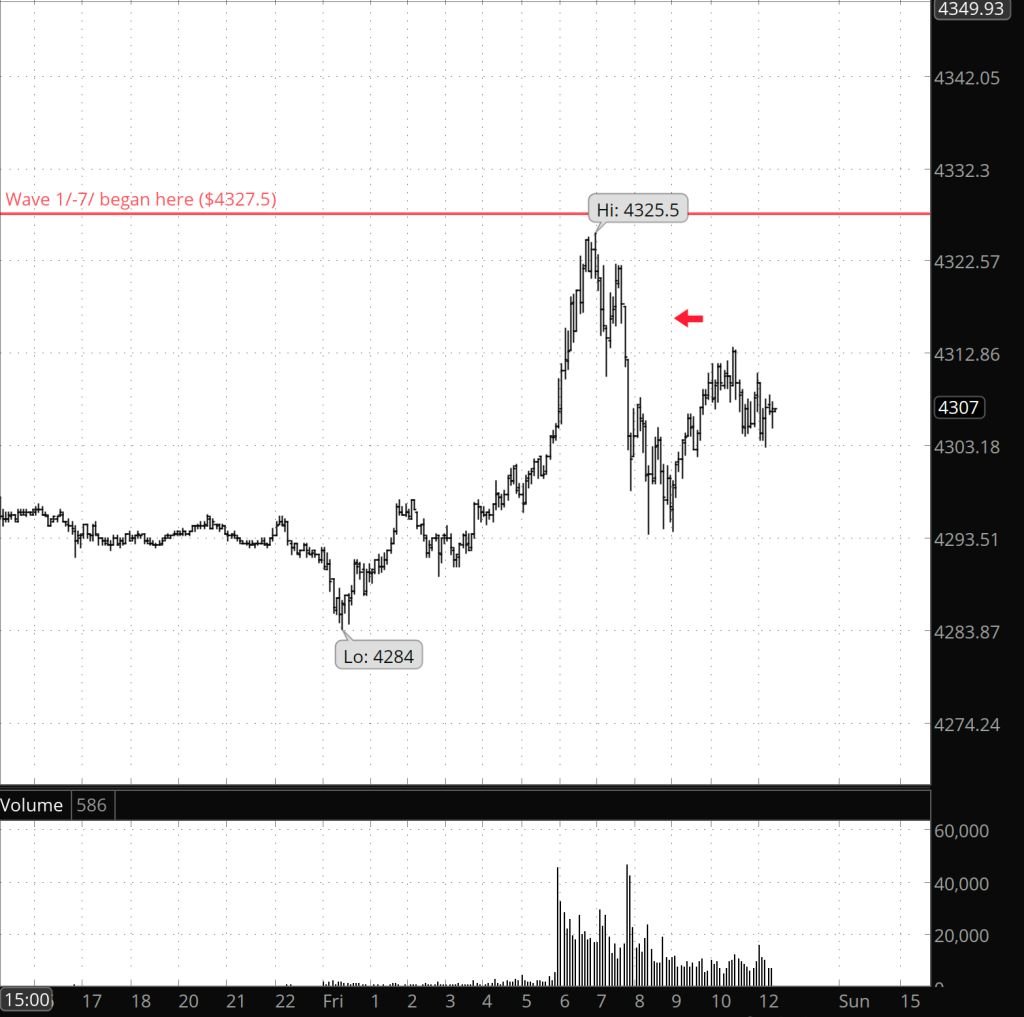
Half an hour before the closing bell. The upward correction that began on October 13, 2022 from 3577.75 may have ended today, at 4325.50 on the S&P 500 futures, two points below the maximum level for that 2nd wave correction under the rules of Elliott wave analysis.

However, two points isn’t nothing, and it is possible that there will be a final push that will move a bit past that high.

I’m leaning toward the scenario that sees the 2nd wave correction as complete, but I’m keeping the chart labeled according to this morning’s analysis, because it’s equally probable that the final push up alternative will play out. It’s a decision based on caution.

One argument in favor of today’s high being the correction’s end is the wave pattern that has followed the peak: A clear five waves down of small degree, the pattern seen in a trending wave, which implies that the parent wave a number of degrees larger is the 3rd wave downtrend following the correction.

The following chart of today’s price movements shows the pattern, pointed to by a red arrow.

[S&P 500 E-mini futures at 3:30 p.m., 5-minute bars, with volume]

9:35 a.m. New York time

What’s happening now? The S&P 500 E-mini futures rose overnight, traveling from the 4280s to, by the opening bell, 4310 and above.

What does it mean? The price exceeded the prior high in the upward correction, 4305.75, set on June 6. The upward correction that began last fall continues and is very close to its end. At this point, every new high in the correction could be it’s end.

Under the rules of Elliott wave analysis, the correction, a 2nd wave, cannot exceed the starting price of the preceding 1st wave, 4327.50, shown on the chart as a horizontal red line. If the price does rise above that even, then the analysis will no longer match the reality of the chart, and I’ll do a reanalysis.

What is the alternative? The correction may form a compound structure. The end of the present corrective pattern won’t complete the correction. Instead, it will be followed by a declining connecting wave and then a second corrective pattern. Compound corrections can be formed from as many as three corrective patterns. If this alternative happens, it will delay the start of the downtrend.

[S&P 500 E-mini futures at 3:30 p.m., 30-minute bars, with volume]

What does Elliott wave theory say? Here are the waves that underly the analyses.

Principal analysis:

  • An upward correction, wave 2{-7}, began on October 13, 2022 and is underway.
  • The correction’s first subwave, wave A{-8}, had five subwaves, meaning the correction is taking the form of a Zigzag
  • Wave 2{-7} is in its final subwave wave, C{-8}, which began on March 13, 2023.
  • Wave C{-7} is in its final subwave, wave E{-9}.
  • Internally, wave E{-9} is in its final subwave, E{10}, which is also in its final subwave, E{-11}, which in turn is in its final subwave, E{-12}.
  • The end of wave E{-12} will cascade up the wave degrees, marking the end of waves E{-10}, E{-9}, C{-8} and of the correction, wave 2{-7}.
  • Downtrending wave 3{-7} will follow the end of the correction and will carry the price a significant distance below present levels.

Alternative analysis, compound correction:

  • The end of wave C{-8} may won’t be the end of the wave 2{-7} correction.
  • Wave 2{-7} will form a compound structure and wave C{-8} ends the first corrective pattern.
  • Wave C{-8} will be followed by a declining connector, wave X{-8}, and then by a second corrective pattern.

Reading the chart. Price movements — waves – – in Elliott wave analysis are labeled with numbers within trending waves and letters with corrective waves. The subscripts — numbers in curly brackets — designate the wave’s degree, which, in Elliott wave analysis, means the relative position of a wave within the larger and smaller structures that make up the chart. R.N. Elliott, who in the 1930s developed the form of analysis that bears his name, viewed the chart as a complex structure of smaller waves nested within larger waves, which in turn are nested within still larger waves. In mathematics it’s called a fractal structure, where at every scale the pattern is similar to the others.

We Are Here.

These are the waves currently in progress under my principal analysis. Each line on the list shows the wave number, with the subscript in curly brackets, the traditional degree name, the starting date, the starting price of the S&P 500 E-mini futures, and the direction of the wave.

  • S&P 500 Index:
  • 5{+3} Supercycle, 7/8/1932, 4.40 (up)
  • 5{+2} Cycle, 12/9/1974, 60.96 (up)
  • 5{+1} Primary, 3/6/2009, 666.79 (up)
  • 5{0} Intermediate, 12/26/2018, 2346.58 (up)
  • S&P 500 Futures and index:
  • 4{-1} Minor, 1/4/2022, 4808.25 (down) (futures), 4818.62 (down) (index)
  • S&P 500 Futures:
  • 1{-2} Minute, 1/4/2022, 4808.25 (down)
  • 1{-3} Minuette, 1/4/2022, 4808.25 (down)
  • 1{-4} Subminuette, 1/4/2022, 4808.25 (down)
  • 1{-5} Micro, 1/4/2022, 4808.25 (down)
  • 3{-6} Submicro, 8/16/2022, 4327.50 (down)
  • 2{-7} Minuscule, 10/13/2022, 3577.75 (up)

Learning and other resources. Elliott wave analysis provides context, not prophecy. As the 20th century semanticist Alfred Korzybski put it in his book Science and Sanity (1933), “The map is not the territory … The only usefulness of a map depends on similarity of structure between the empirical world and the map.” And I would add, in the ever-changing markets, we can judge that similarity of structure only after the fact.

See the menu page Analytical Methods for a rundown on where to go for information on Elliott wave analysis.

By Tim Bovee, Portland, Oregon, June 9, 2023

Disclaimer

Tim Bovee, Private Trader tracks the analysis and trades of a private trader for his own accounts. Nothing in this blog constitutes a recommendation to buy or sell stocks, options or any other financial instrument. The only purpose of this blog is to provide education and entertainment.

No trader is ever 100 percent successful in his or her trades. Trading in the stock and option markets is risky and uncertain. Each trader must make trading decisions for his or her own account, and take responsibility for the consequences.

License
Creative Commons License

All content on Tim Bovee, Private Trader by Timothy K. Bovee is licensed under a Creative Commons Attribution-ShareAlike 4.0 International License.

Based on a work at www.timbovee.com.
Trader’s Notebook

3:30 p.m. New York time

Half an hour before the closing bell. The S&P 500 futures rose into the high 4290s during the session, remaining below the upward correction high of 4305.75, reached on June 5. This morning’s analysis stands unchanged. I’ve updated the chart.

9:35 a.m. New York time

What’s happening now? The S&P 500 E-mini futures swung within the 4260s and the 4270s overnight.

What does it mean? The present upward correction, now in its 238th day, continues and is nearing its end. It will be followed by a power downtrend. This is unchanged from principal analysis that has been with us for quite some time.

What are the alternatives? There are two.

Alternative #1, correction has ended: The correction may have ended at the present high point, 4305.75.

Alternative #2, compound correction: The correction may form a compound structure. The end of the present corrective pattern won’t complete the correction. Instead, it will be followed by a declining connecting wave and then a second corrective pattern. Compound corrections can be formed from as many as three corrective patterns. If this alternative happens, it will delay the start of the downtrend.

[S&P 500 E-mini futures at 3:30 p.m., 25-minute bars, with volume]

What does Elliott wave theory say? Here are the waves that underly the analyses.

Principal analysis:

  • An upward correction, wave 2{-7}, began on October 13, 2022 and is underway.
  • The correction’s first subwave, wave A{-8}, had five subwaves, meaning the correction is taking the form of a Zigzag
  • Wave 2{-7} is in its final subwave wave, C{-8}, which began on March 13, 2023.
  • Wave C{-7} is in its final subwave, wave E{-9}.
  • Internally, wave E{-9} is in its final subwave, E{10}, which is also in its final subwave, E{-11}, which in turn is in its final subwave, E{-12}.
  • The end of wave E{-12} will cascade up the wave degrees, marking the end of waves E{-10}, E{-9}, C{-8} and of the correction, wave 2{-7}.
  • Downtrending wave 3{-7} will follow the end of the correction and will carry the price a significant distance below present levels.

Alternative #1, correction has ended:

  • Wave E{-11} may have ended at the May 5 high, 4305.75, the present high point in the correction, and if it did, then the correction, wave 2{-7}, also ended at that point.
  • Under this scenario, wave 3{-7}, a powerful downtrend, is taking its first steps.

Alternative analysis #2, compound correction:

  • The end of wave C{-8} may won’t be the end of the wave 2{-7} correction.
  • Wave 2{-7} will form a compound structure and wave C{-8} ends the first corrective pattern.
  • Wave C{-8} will be followed by a declining connector, wave X{-8}, and then by a second corrective pattern.

Reading the chart. Price movements — waves – – in Elliott wave analysis are labeled with numbers within trending waves and letters with corrective waves. The subscripts — numbers in curly brackets — designate the wave’s degree, which, in Elliott wave analysis, means the relative position of a wave within the larger and smaller structures that make up the chart. R.N. Elliott, who in the 1930s developed the form of analysis that bears his name, viewed the chart as a complex structure of smaller waves nested within larger waves, which in turn are nested within still larger waves. In mathematics it’s called a fractal structure, where at every scale the pattern is similar to the others.

We Are Here.

These are the waves currently in progress under my principal analysis. Each line on the list shows the wave number, with the subscript in curly brackets, the traditional degree name, the starting date, the starting price of the S&P 500 E-mini futures, and the direction of the wave.

  • S&P 500 Index:
  • 5{+3} Supercycle, 7/8/1932, 4.40 (up)
  • 5{+2} Cycle, 12/9/1974, 60.96 (up)
  • 5{+1} Primary, 3/6/2009, 666.79 (up)
  • 5{0} Intermediate, 12/26/2018, 2346.58 (up)
  • S&P 500 Futures and index:
  • 4{-1} Minor, 1/4/2022, 4808.25 (down) (futures), 4818.62 (down) (index)
  • S&P 500 Futures:
  • 1{-2} Minute, 1/4/2022, 4808.25 (down)
  • 1{-3} Minuette, 1/4/2022, 4808.25 (down)
  • 1{-4} Subminuette, 1/4/2022, 4808.25 (down)
  • 1{-5} Micro, 1/4/2022, 4808.25 (down)
  • 3{-6} Submicro, 8/16/2022, 4327.50 (down)
  • 2{-7} Minuscule, 10/13/2022, 3577.75 (up)

Learning and other resources. Elliott wave analysis provides context, not prophecy. As the 20th century semanticist Alfred Korzybski put it in his book Science and Sanity (1933), “The map is not the territory … The only usefulness of a map depends on similarity of structure between the empirical world and the map.” And I would add, in the ever-changing markets, we can judge that similarity of structure only after the fact.

See the menu page Analytical Methods for a rundown on where to go for information on Elliott wave analysis.

By Tim Bovee, Portland, Oregon, June 8, 2023

Disclaimer

Tim Bovee, Private Trader tracks the analysis and trades of a private trader for his own accounts. Nothing in this blog constitutes a recommendation to buy or sell stocks, options or any other financial instrument. The only purpose of this blog is to provide education and entertainment.

No trader is ever 100 percent successful in his or her trades. Trading in the stock and option markets is risky and uncertain. Each trader must make trading decisions for his or her own account, and take responsibility for the consequences.

License
Creative Commons License

All content on Tim Bovee, Private Trader by Timothy K. Bovee is licensed under a Creative Commons Attribution-ShareAlike 4.0 International License.

Based on a work at www.timbovee.com.