Trader’s Notebook: S&P 500

3:30 p.m. New York time

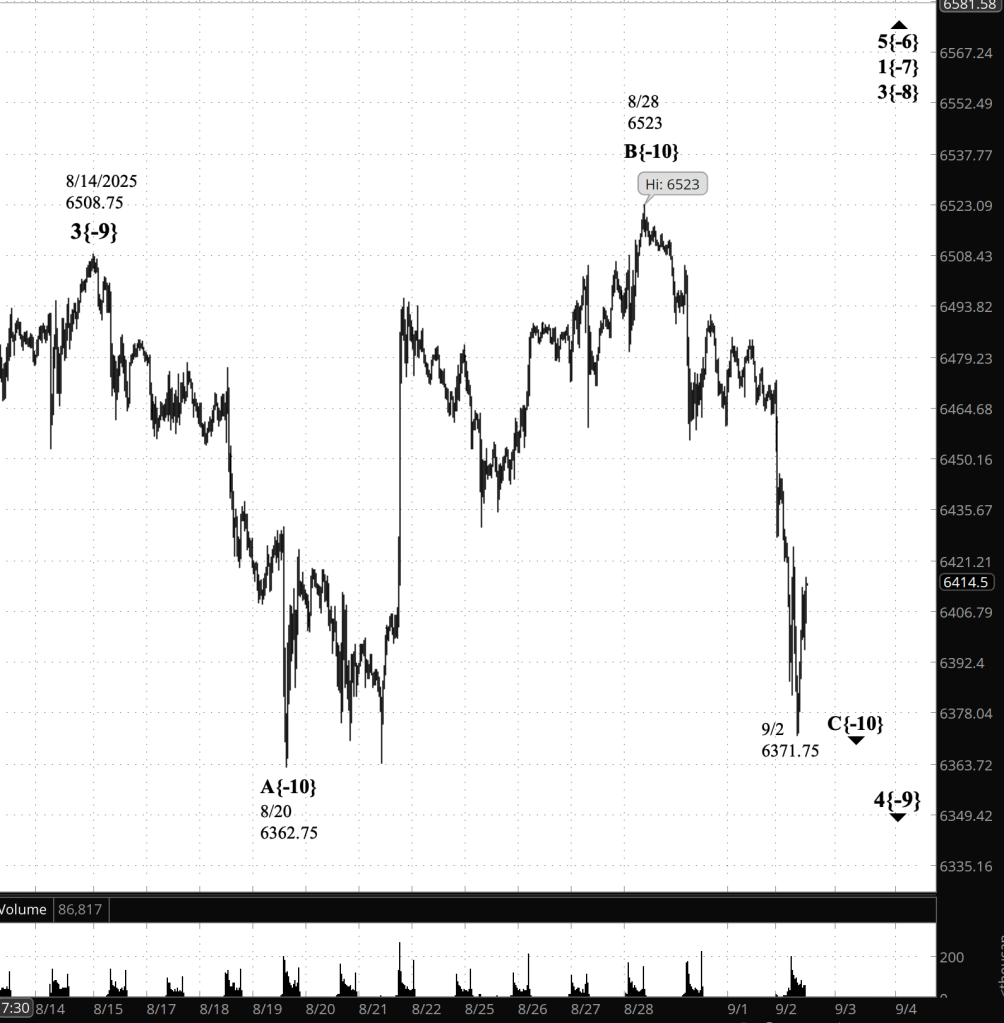
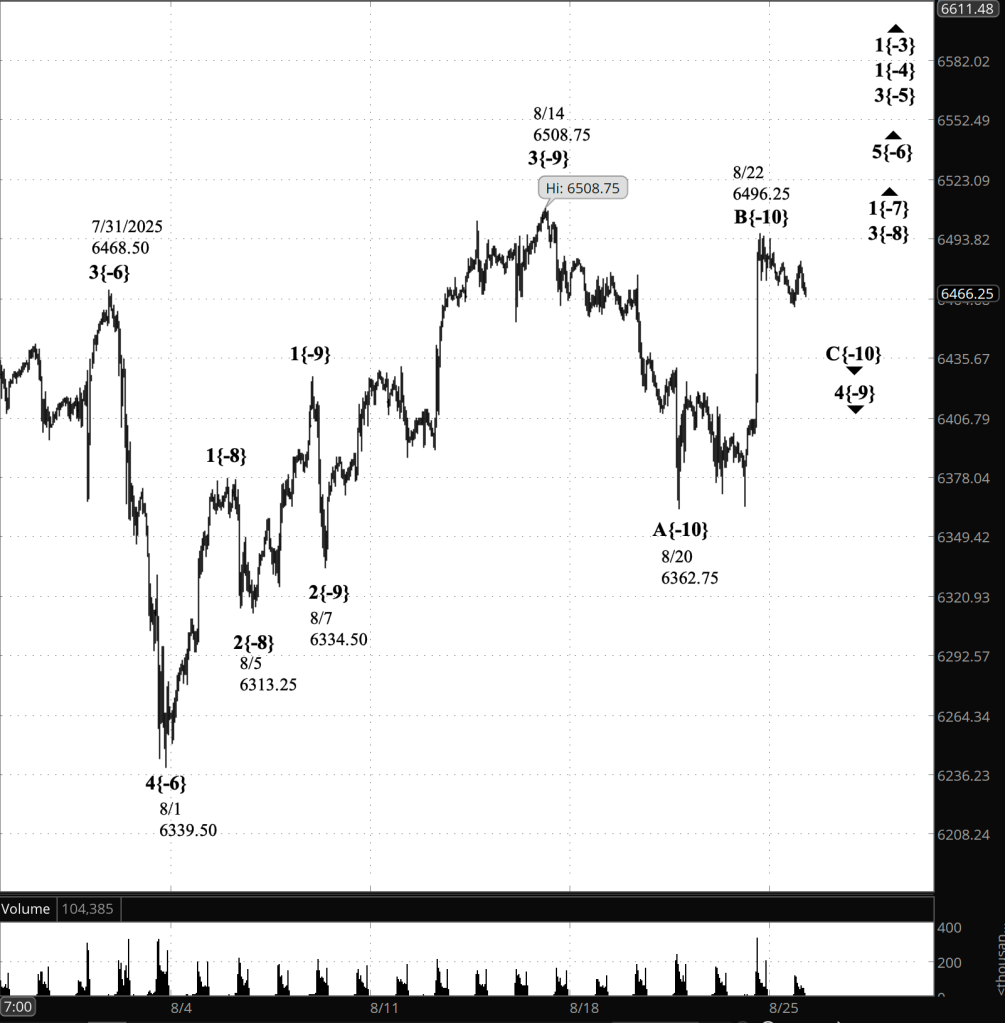
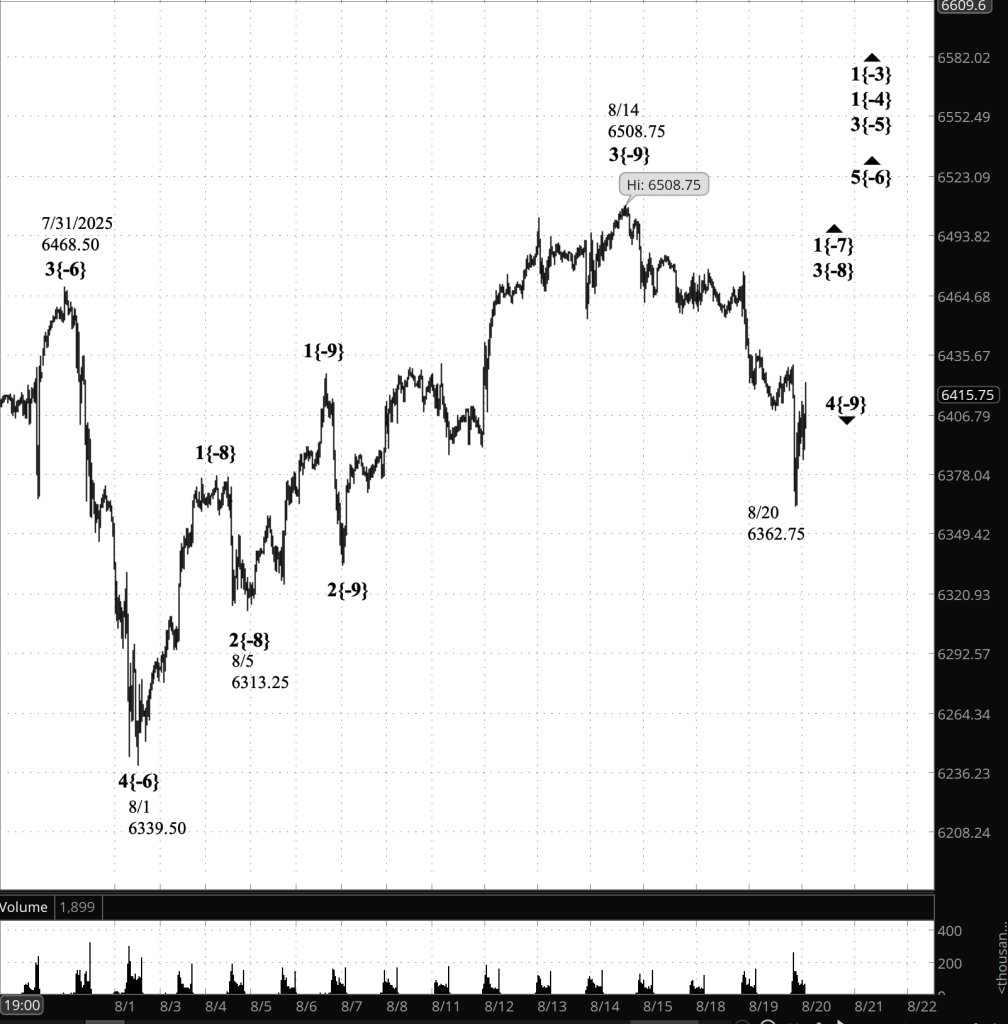
Half an hour before the closing bell. The S&P 500 futures rose during the session, from 6391.50 into the 6410s.

Elliott Wave Theory: The low at the opening of the session was the end of the 4th-wave downward correction that began on July 23 and the beginning of the uptrending 5th wave. The smaller 5th wave is the final subwave of a 5th wave one degree larger, which in turn is the final subwave within a still larger 3rd wave.

9:35 a.m. New York time.

What’s happening now. The S&P 500 E-mini futures fell slightly overnight after peaking at the session close on July 23.

What does it mean? Elliott Wave Theory sees the decline as a 4th-wave downward correction with a larger uptrendng 5th wave. Wave 4 will soon be followed the 5th and final subwave within wave 5.

The end of the smaller 5th wave will also be the end of the larger 5th wave, and of a still larger 3rd wave, which will be followed by a relatively large 4th-wave downward correction.

[S&P 500 E-mini futures at 3:30 p.m., 25-minute bars, with volume] 

Waves Now Underway

[Updated to reflect the end of wave 4{-16) and the start of wave 5{-16} during the session.]

These are the waves currently in progress under my principal analysis. Each line on the list shows the wave number, with the subscript in curly brackets, the traditional degree name, the starting date, the starting price of the S&P 500 E-mini futures, and the direction of the wave.

  • S&P 500 Index:
  • 5{+3} Supercycle, 7/8/1932, 4.40 (up)
  • 5{+2} Cycle, 12/9/1974, 60.96 (up)
  • 5{+1} Primary, 3/6/2009, 666.79 (up)
  • 5{0} Intermediate, 2/11/2016, 1810.10 (up)
  • 3{-1} Minor, 3/23/2020, 2191.36 (up)
  • 5{-2} Minute, 4/7/2025, 4832 (up)
  • S&P 500 Futures
  • 1{-3} Minuette, 4/7/2025, 4832 (up)
  • 1{-4} Subminuette, 4/7/2025, 4832 (up)
  • 1{-5} Micro, 4/7/2025, 4832 (up)
  • 3{-6} Submicro, 4/24/2025, 5260 (up)
  • 5{-7} Minuscule, 4/25/2025, 5550 (up)
  • 5{-8} (unnamed), 5/7/2025, 5596 (up)
  • 5{-9} (unnamed), 5/23/2025, 5756.50 (up)
  • 5{-10} (unnamed), 6/22/2025, 5959 (up)
  • 5{-11} (unnamed), 6/27/2025, 6183.25 (up)
  • 3{-12} (unnamed), 6/30/2025, 6224 (up)
  • 5{-13} (unnamed), 7/14/2025, 6529.75 (up)
  • 5{-14} (unnamed), 7/16/2025, 6241 (up)
  • 3{-15} (unnamed), 7/16/2025, 6288.25 (up)
  • 5{-16} (unnamed), 7/24/2025, 6391.50 (up)

Reading the chart. Price movements — waves – – in Elliott Wave Theory analysis are labeled with numbers within trending waves and letters with corrective waves. The subscripts — numbers in curly brackets — designate the wave’s degree, which, in Elliott Wave analysis, means the relative position of a wave within the larger and smaller structures that make up the chart. R.N. Elliott, who in the 1930s developed the form of analysis that bears his name, viewed the chart as a complex structure of smaller waves nested within larger waves, which in turn are nested within still larger waves. In mathematics it’s called a fractal structure, where at every scale the pattern is similar to the others.

Learning and other resources. Elliott Wave analysis provides context, not prophecy. As the 20th century semanticist Alfred Korzybski put it in his book Science and Sanity (1933), “The map is not the territory … The only usefulness of a map depends on similarity of structure between the empirical world and the map.” And I would add, in the ever-changing markets, we can judge that similarity of structure only after the fact.

See the menu page Analytical Methods for a rundown on where to go for information on Elliott Wave analysis.

By Tim Bovee, Portland, Oregon, July 24, 2025

Disclaimer

Tim Bovee, Private Trader tracks the analysis and trades of a private trader for his own accounts. Nothing in this blog constitutes a recommendation to buy or sell stocks, options or any other financial instrument. The only purpose of this blog is to provide education and entertainment.

No trader is ever 100 percent successful in his or her trades. Trading in the stock and option markets is risky and uncertain. Each trader must make trading decisions for his or her own account, and take responsibility for the consequences.

All content on Tim Bovee, Private Trader by Timothy K. Bovee is licensed under a Creative Commons Attribution-ShareAlike 4.0 International License.

License

Based on a work at www.timbovee.com.

Trader’s Notebook: S&P 500

3:30 p.m. New York time

Half an hour befoe the closing bell.The S&P 500 futures continued to rise during the session, so far reaching a peak of 6393.75.

Elliott Wave Theory: The uptrending 5th wave that began on July 22 continues.

How high can wave 5 go? If typical, it’s likely to end between 6421 and 6435. It’s an estimate, not precision forecast, like most such things in Elliiott Wave Theory.

9:35 a.m. New York time.

What’s happening now. The S&P 500 E-mini futures rose overnight, from the 6340s to the 6370s.

What does it mean? The overnight high so far has been 6376.75. In terms of Elliott Wave Theory, that analysis provides a degree of verification that the 4th-wave downward correction ended on July 22 and wave 5 began its rise.

That verification price is significant because it was the peak of rising wave B within wave 4.

On the other hand, upon reaching that peak the price fell slightly, giving the analysis a degree of ambiguity. If the price moves firmly above 6374, that will give the wave 5 scenario greater clarity.

In any case, wave 5 has already carried the price to a higher high, and more upside lies ahead. When wave 5 is complete, it will also mark the end of the parent 3rd wave and the beginning of a larger 4th wave, which will give the futures a degree of downside that we haven’t seen of late.

[S&P 500 E-mini futures at 3:30 p.m., 20-minute bars, with volume] 

Waves Now Underway

These are the waves currently in progress under my principal analysis. Each line on the list shows the wave number, with the subscript in curly brackets, the traditional degree name, the starting date, the starting price of the S&P 500 E-mini futures, and the direction of the wave.

  • S&P 500 Index:
  • 5{+3} Supercycle, 7/8/1932, 4.40 (up)
  • 5{+2} Cycle, 12/9/1974, 60.96 (up)
  • 5{+1} Primary, 3/6/2009, 666.79 (up)
  • 5{0} Intermediate, 2/11/2016, 1810.10 (up)
  • 3{-1} Minor, 3/23/2020, 2191.36 (up)
  • 5{-2} Minute, 4/7/2025, 4832 (up)
  • S&P 500 Futures
  • 1{-3} Minuette, 4/7/2025, 4832 (up)
  • 1{-4} Subminuette, 4/7/2025, 4832 (up)
  • 1{-5} Micro, 4/7/2025, 4832 (up)
  • 3{-6} Submicro, 4/24/2025, 5260 (up)
  • 5{-7} Minuscule, 4/25/2025, 5550 (up)
  • 5{-8} (unnamed), 5/7/2025, 5596 (up)
  • 5{-9} (unnamed), 5/23/2025, 5756.50 (up)
  • 5{-10} (unnamed), 6/22/2025, 5959 (up)
  • 5{-11} (unnamed), 6/27/2025, 6183.25 (up)
  • 3{-12} (unnamed), 6/30/2025, 6224 (up)
  • 5{-13} (unnamed), 7/14/2025, 6529.75 (up)
  • 5{-14} (unnamed), 7/16/2025, 6241 (up)
  • 3{-15} (unnamed), 7/16/2025, 6288.25 (up)
  • 5{-16} (unnamed), 7/22/2025, 6318.75 (up)

Reading the chart. Price movements — waves – – in Elliott Wave Theory analysis are labeled with numbers within trending waves and letters with corrective waves. The subscripts — numbers in curly brackets — designate the wave’s degree, which, in Elliott Wave analysis, means the relative position of a wave within the larger and smaller structures that make up the chart. R.N. Elliott, who in the 1930s developed the form of analysis that bears his name, viewed the chart as a complex structure of smaller waves nested within larger waves, which in turn are nested within still larger waves. In mathematics it’s called a fractal structure, where at every scale the pattern is similar to the others.

Learning and other resources. Elliott Wave analysis provides context, not prophecy. As the 20th century semanticist Alfred Korzybski put it in his book Science and Sanity (1933), “The map is not the territory … The only usefulness of a map depends on similarity of structure between the empirical world and the map.” And I would add, in the ever-changing markets, we can judge that similarity of structure only after the fact.

See the menu page Analytical Methods for a rundown on where to go for information on Elliott Wave analysis.

By Tim Bovee, Portland, Oregon, July 23, 2025

Disclaimer

Tim Bovee, Private Trader tracks the analysis and trades of a private trader for his own accounts. Nothing in this blog constitutes a recommendation to buy or sell stocks, options or any other financial instrument. The only purpose of this blog is to provide education and entertainment.

No trader is ever 100 percent successful in his or her trades. Trading in the stock and option markets is risky and uncertain. Each trader must make trading decisions for his or her own account, and take responsibility for the consequences.

All content on Tim Bovee, Private Trader by Timothy K. Bovee is licensed under a Creative Commons Attribution-ShareAlike 4.0 International License.

License

Based on a work at www.timbovee.com.

Trader’s Notebook: S&P 500

3:30 p.m. New York time

Half an hour before the closing bell. After falling into the 6310s early in the session, the S&P 500 futures rose, reaching into the 6350s.

Elliott Wave Theory: Once bitten twice shy.

For this morning’s analysis, I saw at the futures’ rise and concluded that wave 4 was over and wave 5 had begun, a nicely done piece of work if I do say so myself. It lasted until the opening bell when, as the echo faded, the price reversed and fell sharply.

I quickly had to redo the analysis and managed to file on time, although it was one of the shorter analyses I’ve ever done.

And now it’s late in the session, and the futures have reversed from their fall and begun to rise again.

The rise is now tracing it’s 5th subwave. So what’s going on?

I’ve changed the chart — yet again to show that wave 5 has begun from the session low. I think wave 5 is the more likely bet, but I fully realize that wave 4 continues is also a significan likelihood.

How each is confirmed:

  • If the price rises to 6374 and above, then the wave 5 scenario gains credence.
  • If the price drops to 6334 and lower, then the wave 4 scenario gains credence.

So, this afternoon’s choice: Principal analysis: Wave 5. Alternative analysis: Wave 4.

9:35 a.m. New York time.

What’s happening now. The S&P 500 E-mini futures rose from the overnight low, 6335.25, so far reaching into the 6340s and then dropped at the opening bell.

What does it mean? The downtrending 4th-wave correction continues and is nearing its end.

[S&P 500 E-mini futures at 3:30 p.m., 15-minute bars, with volume] 

Waves Now Underway

These are the waves currently in progress under my principal analysis. Each line on the list shows the wave number, with the subscript in curly brackets, the traditional degree name, the starting date, the starting price of the S&P 500 E-mini futures, and the direction of the wave.

  • S&P 500 Index:
  • 5{+3} Supercycle, 7/8/1932, 4.40 (up)
  • 5{+2} Cycle, 12/9/1974, 60.96 (up)
  • 5{+1} Primary, 3/6/2009, 666.79 (up)
  • 5{0} Intermediate, 2/11/2016, 1810.10 (up)
  • 3{-1} Minor, 3/23/2020, 2191.36 (up)
  • 5{-2} Minute, 4/7/2025, 4832 (up)
  • S&P 500 Futures
  • 1{-3} Minuette, 4/7/2025, 4832 (up)
  • 1{-4} Subminuette, 4/7/2025, 4832 (up)
  • 1{-5} Micro, 4/7/2025, 4832 (up)
  • 3{-6} Submicro, 4/24/2025, 5260 (up)
  • 5{-7} Minuscule, 4/25/2025, 5550 (up)
  • 5{-8} (unnamed), 5/7/2025, 5596 (up)
  • 5{-9} (unnamed), 5/23/2025, 5756.50 (up)
  • 5{-10} (unnamed), 6/22/2025, 5959 (up)
  • 5{-11} (unnamed), 6/27/2025, 6183.25 (up)
  • 3{-12} (unnamed), 6/30/2025, 6224 (up)
  • 5{-13} (unnamed), 7/14/2025, 6529.75 (up)
  • 5{-14} (unnamed), 7/16/2025, 6241 (up)
  • 3{-15} (unnamed), 7/16/2025, 6288.25 (up)
  • 5{-16} (unnamed), 7/22/2025, 6318.75 (up)

Reading the chart. Price movements — waves – – in Elliott Wave Theory analysis are labeled with numbers within trending waves and letters with corrective waves. The subscripts — numbers in curly brackets — designate the wave’s degree, which, in Elliott Wave analysis, means the relative position of a wave within the larger and smaller structures that make up the chart. R.N. Elliott, who in the 1930s developed the form of analysis that bears his name, viewed the chart as a complex structure of smaller waves nested within larger waves, which in turn are nested within still larger waves. In mathematics it’s called a fractal structure, where at every scale the pattern is similar to the others.

Learning and other resources. Elliott Wave analysis provides context, not prophecy. As the 20th century semanticist Alfred Korzybski put it in his book Science and Sanity (1933), “The map is not the territory … The only usefulness of a map depends on similarity of structure between the empirical world and the map.” And I would add, in the ever-changing markets, we can judge that similarity of structure only after the fact.

See the menu page Analytical Methods for a rundown on where to go for information on Elliott Wave analysis.

By Tim Bovee, Portland, Oregon, July 22, 2025

Disclaimer

Tim Bovee, Private Trader tracks the analysis and trades of a private trader for his own accounts. Nothing in this blog constitutes a recommendation to buy or sell stocks, options or any other financial instrument. The only purpose of this blog is to provide education and entertainment.

No trader is ever 100 percent successful in his or her trades. Trading in the stock and option markets is risky and uncertain. Each trader must make trading decisions for his or her own account, and take responsibility for the consequences.

All content on Tim Bovee, Private Trader by Timothy K. Bovee is licensed under a Creative Commons Attribution-ShareAlike 4.0 International License.

License

Based on a work at www.timbovee.com.

Trader’s Notebook: S&P 500

3:30 p.m. New York time

Half an hour before the closing bell. The S&P 500 futures continued to fal during the session, so far reaching into the 6340s. Wave C within wave 5 continues.

9:35 a.m. New York time.

What’s happening now. The S&P 500 E-mini futures worked its way upward, slightly, into the 6350s after trading resumed overnight, and then reversed, so far reaching into the 6330s.

What does it mean? Elliott Wave Theory analysis suggests that the overnight peak was the end of the middle subwave, wave B , within a 4th-wave downward correction. The decline that followed is the start of the final subwave, wave C.

An uptrending 5th-wave will follow, likely carrying the price to new heights.

[S&P 500 E-mini futures at 3:30 p.m., 15-minute bars, with volume] 

Waves Now Underway

These are the waves currently in progress under my principal analysis. Each line on the list shows the wave number, with the subscript in curly brackets, the traditional degree name, the starting date, the starting price of the S&P 500 E-mini futures, and the direction of the wave.

  • S&P 500 Index:
  • 5{+3} Supercycle, 7/8/1932, 4.40 (up)
  • 5{+2} Cycle, 12/9/1974, 60.96 (up)
  • 5{+1} Primary, 3/6/2009, 666.79 (up)
  • 5{0} Intermediate, 2/11/2016, 1810.10 (up)
  • 3{-1} Minor, 3/23/2020, 2191.36 (up)
  • 5{-2} Minute, 4/7/2025, 4832 (up)
  • S&P 500 Futures
  • 1{-3} Minuette, 4/7/2025, 4832 (up)
  • 1{-4} Subminuette, 4/7/2025, 4832 (up)
  • 1{-5} Micro, 4/7/2025, 4832 (up)
  • 3{-6} Submicro, 4/24/2025, 5260 (up)
  • 5{-7} Minuscule, 4/25/2025, 5550 (up)
  • 5{-8} (unnamed), 5/7/2025, 5596 (up)
  • 5{-9} (unnamed), 5/23/2025, 5756.50 (up)
  • 5{-10} (unnamed), 6/22/2025, 5959 (up)
  • 5{-11} (unnamed), 6/27/2025, 6183.25 (up)
  • 3{-12} (unnamed), 6/30/2025, 6224 (up)
  • 5{-13} (unnamed), 7/14/2025, 6529.75 (up)
  • 5{-14} (unnamed), 7/16/2025, 6241 (up)
  • 3{-15} (unnamed), 7/16/2025, 6288.25 (up)
  • 4{-16} (unnamed), 7/17/2025, 6357 (down)
  • C{-17} (unnamed), 7/21/2025, 6354.50 (down)

Reading the chart. Price movements — waves – – in Elliott Wave Theory analysis are labeled with numbers within trending waves and letters with corrective waves. The subscripts — numbers in curly brackets — designate the wave’s degree, which, in Elliott Wave analysis, means the relative position of a wave within the larger and smaller structures that make up the chart. R.N. Elliott, who in the 1930s developed the form of analysis that bears his name, viewed the chart as a complex structure of smaller waves nested within larger waves, which in turn are nested within still larger waves. In mathematics it’s called a fractal structure, where at every scale the pattern is similar to the others.

Learning and other resources. Elliott Wave analysis provides context, not prophecy. As the 20th century semanticist Alfred Korzybski put it in his book Science and Sanity (1933), “The map is not the territory … The only usefulness of a map depends on similarity of structure between the empirical world and the map.” And I would add, in the ever-changing markets, we can judge that similarity of structure only after the fact.

See the menu page Analytical Methods for a rundown on where to go for information on Elliott Wave analysis.

By Tim Bovee, Portland, Oregon, July 21, 2025

Disclaimer

Tim Bovee, Private Trader tracks the analysis and trades of a private trader for his own accounts. Nothing in this blog constitutes a recommendation to buy or sell stocks, options or any other financial instrument. The only purpose of this blog is to provide education and entertainment.

No trader is ever 100 percent successful in his or her trades. Trading in the stock and option markets is risky and uncertain. Each trader must make trading decisions for his or her own account, and take responsibility for the consequences.

All content on Tim Bovee, Private Trader by Timothy K. Bovee is licensed under a Creative Commons Attribution-ShareAlike 4.0 International License.

License

Based on a work at www.timbovee.com.

Trader’s Notebook: S&P 500

3:30 p.m. New York time

Half an hour before the closing bell. The S&P 500 futures fell during the session, continuing a decline that began on July 17.

Elliott Wave Theory: The decline is part of an uptrending 5th wave that began on July 16. Internally, that 5th wave is in its 3rd subwave and within that, in a degree smaller 3rd subwave.

The labelling on the chart gives a wave number followed by a subscript in curly bracket’s showing the waves distance in degrees from Intermediate degree. From smallest wave to largest, we are presently in wave 4{-16} within wave 3{-15} within wave 5{-14}, the rise that began on July 16.

Wave 4{-16} will be followed by rising wave 5{-16}, whose end will also be the end of wave 3{-15} and the beginning of a downward correction, wave 4{-15}.

9:35 a.m. New York time.

What’s happening now. The S&P 500 E-mini futures rose to 6357 overnight, retreated to the 6330s, and then began to rise again.

What does it mean? Elliott Wave Theory: The overnight rise, the 5th wave that began on July 16, brought the wave close to its 1.618 Fibonacci retracement of the preceding 3rd wave. That retracement level often marks the end of a movement, or at the least a pause.

The retracement is greater than 1x wave 3 and therefore is in extension. The next potential extension levels for wave 5 are:

  • 2.000, or 6407.50
  • 2.236, or 6427.13
  • 2.618, or 6458.96

[S&P 500 E-mini futures at 3:30 p.m., 35-minute bars, with volume] 

Waves Now Underway

These are the waves currently in progress under my principal analysis. Each line on the list shows the wave number, with the subscript in curly brackets, the traditional degree name, the starting date, the starting price of the S&P 500 E-mini futures, and the direction of the wave.

  • S&P 500 Index:
  • 5{+3} Supercycle, 7/8/1932, 4.40 (up)
  • 5{+2} Cycle, 12/9/1974, 60.96 (up)
  • 5{+1} Primary, 3/6/2009, 666.79 (up)
  • 5{0} Intermediate, 2/11/2016, 1810.10 (up)
  • 3{-1} Minor, 3/23/2020, 2191.36 (up)
  • 5{-2} Minute, 4/7/2025, 4832 (up)
  • S&P 500 Futures
  • 1{-3} Minuette, 4/7/2025, 4832 (up)
  • 1{-4} Subminuette, 4/7/2025, 4832 (up)
  • 1{-5} Micro, 4/7/2025, 4832 (up)
  • 3{-6} Submicro, 4/24/2025, 5260 (up)
  • 5{-7} Minuscule, 4/25/2025, 5550 (up)
  • 5{-8} (unnamed), 5/7/2025, 5596 (up)
  • 5{-9} (unnamed), 5/23/2025, 5756.50 (up)
  • 5{-10} (unnamed), 6/22/2025, 5959 (up)
  • 5{-11} (unnamed), 6/27/2025, 6183.25 (up)
  • 3{-12} (unnamed), 6/30/2025, 6224 (up)
  • 5{-13} (unnamed), 7/14/2025, 6529.75 (up)
  • 5{-14} (unnamed), 7/16/2025, 6241 (up)
  • 3{-15} (unnamed), 7/16/2025, 6288.25 (up)
  • 4{-16} (unnamed), 7/17/2025, 6357 (down)

Reading the chart. Price movements — waves – – in Elliott Wave Theory analysis are labeled with numbers within trending waves and letters with corrective waves. The subscripts — numbers in curly brackets — designate the wave’s degree, which, in Elliott Wave analysis, means the relative position of a wave within the larger and smaller structures that make up the chart. R.N. Elliott, who in the 1930s developed the form of analysis that bears his name, viewed the chart as a complex structure of smaller waves nested within larger waves, which in turn are nested within still larger waves. In mathematics it’s called a fractal structure, where at every scale the pattern is similar to the others.

Learning and other resources. Elliott Wave analysis provides context, not prophecy. As the 20th century semanticist Alfred Korzybski put it in his book Science and Sanity (1933), “The map is not the territory … The only usefulness of a map depends on similarity of structure between the empirical world and the map.” And I would add, in the ever-changing markets, we can judge that similarity of structure only after the fact.

See the menu page Analytical Methods for a rundown on where to go for information on Elliott Wave analysis.

By Tim Bovee, Portland, Oregon, July 18, 2025

Disclaimer

Tim Bovee, Private Trader tracks the analysis and trades of a private trader for his own accounts. Nothing in this blog constitutes a recommendation to buy or sell stocks, options or any other financial instrument. The only purpose of this blog is to provide education and entertainment.

No trader is ever 100 percent successful in his or her trades. Trading in the stock and option markets is risky and uncertain. Each trader must make trading decisions for his or her own account, and take responsibility for the consequences.

All content on Tim Bovee, Private Trader by Timothy K. Bovee is licensed under a Creative Commons Attribution-ShareAlike 4.0 International License.

License

Based on a work at www.timbovee.com.

Trader’s Notebook: S&P 500

3:30 p.m. New York time

Half an hour before the closing bell. The S&P 500 futures continued to climb during the session, so far reaching into the 6340s.

Elliott Wave Theory: Wave 5 has been underway since July 16 and it has reached beyond the 1.272 Fibonacci retracement level of wave 3. The next likely stopping point is the 1.618 retracement level, at

From the form the rise has taken, it seems likely to me that more upside lies ahead. Using the nomenclature on the chart, where the wave number is followed by a subscript in brackets noting the wave’s distance in degrees from Intermediate degree, I see wave 5{-14}, which began on July 16, as being in its 3rd subwave, wave 3{-15}, which in turn is in its 3rd subwave, wave 3{-16}. We’re down to near microscopic waves at this point.

Anyhow, bottom line, there’s time to go until we correct.

9:35 a.m. New York time.

What’s happening now. The S&P 500 E-mini futures rose overnight from the 6280s to the 6320s.

What does it mean? In the terminology of Elliott Wave Theory, uptrending wave 5 continues. It began on July 16 and is a subwave of a larger wave 5, which began on July 14.

Applying the Fibonacci retracements of the prior wave 3, here are the likely endpoints for wave 5.

  • Same as wave 3: 6316.75
  • 1.272 times the length of wave 3: Just below 6338
  • 1.618 times the length of wave 3: Just below 6366

As is often the case in Elliott Wave Theory analysis, these are estimates. Fifth waves, famously, are quite capable of surprises.

The end of the smaller wave 5 will also be the end of the larger wave 5 and of its parent wave 3, which will be followed by a 4th-wave downward correction larger by two degrees than the most recent 4th wave we’ve experienced, the one ending on July 16.

[S&P 500 E-mini futures at 9:35 a.m., 35-minute bars, with volume] 

Waves Now Underway

These are the waves currently in progress under my principal analysis. Each line on the list shows the wave number, with the subscript in curly brackets, the traditional degree name, the starting date, the starting price of the S&P 500 E-mini futures, and the direction of the wave.

  • S&P 500 Index:
  • 5{+3} Supercycle, 7/8/1932, 4.40 (up)
  • 5{+2} Cycle, 12/9/1974, 60.96 (up)
  • 5{+1} Primary, 3/6/2009, 666.79 (up)
  • 5{0} Intermediate, 2/11/2016, 1810.10 (up)
  • 3{-1} Minor, 3/23/2020, 2191.36 (up)
  • 5{-2} Minute, 4/7/2025, 4832 (up)
  • S&P 500 Futures
  • 1{-3} Minuette, 4/7/2025, 4832 (up)
  • 1{-4} Subminuette, 4/7/2025, 4832 (up)
  • 1{-5} Micro, 4/7/2025, 4832 (up)
  • 3{-6} Submicro, 4/24/2025, 5260 (up)
  • 5{-7} Minuscule, 4/25/2025, 5550 (up)
  • 5{-8} (unnamed), 5/7/2025, 5596 (up)
  • 5{-9} (unnamed), 5/23/2025, 5756.50 (up)
  • 5{-10} (unnamed), 6/22/2025, 5959 (up)
  • 5{-11} (unnamed), 6/27/2025, 6183.25 (up)
  • 3{-12} (unnamed), 6/30/2025, 6224 (up)
  • 5{-13} (unnamed), 7/14/2025, 6529.75 (up)
  • 5{-14} (unnamed), 7/16/2025, 6241 (up)

Reading the chart. Price movements — waves – – in Elliott Wave Theory analysis are labeled with numbers within trending waves and letters with corrective waves. The subscripts — numbers in curly brackets — designate the wave’s degree, which, in Elliott Wave analysis, means the relative position of a wave within the larger and smaller structures that make up the chart. R.N. Elliott, who in the 1930s developed the form of analysis that bears his name, viewed the chart as a complex structure of smaller waves nested within larger waves, which in turn are nested within still larger waves. In mathematics it’s called a fractal structure, where at every scale the pattern is similar to the others.

Learning and other resources. Elliott Wave analysis provides context, not prophecy. As the 20th century semanticist Alfred Korzybski put it in his book Science and Sanity (1933), “The map is not the territory … The only usefulness of a map depends on similarity of structure between the empirical world and the map.” And I would add, in the ever-changing markets, we can judge that similarity of structure only after the fact.

See the menu page Analytical Methods for a rundown on where to go for information on Elliott Wave analysis.

By Tim Bovee, Portland, Oregon, July 17, 2025

Disclaimer

Tim Bovee, Private Trader tracks the analysis and trades of a private trader for his own accounts. Nothing in this blog constitutes a recommendation to buy or sell stocks, options or any other financial instrument. The only purpose of this blog is to provide education and entertainment.

No trader is ever 100 percent successful in his or her trades. Trading in the stock and option markets is risky and uncertain. Each trader must make trading decisions for his or her own account, and take responsibility for the consequences.

All content on Tim Bovee, Private Trader by Timothy K. Bovee is licensed under a Creative Commons Attribution-ShareAlike 4.0 International License.

License

Based on a work at www.timbovee.com.

Trader’s Notebook: S&P 500

3:30 p.m. New York time

Half an hour before the closing bell. The S&P 500 futures fell sharply midway through the session, perhaps in response to news reports that President Trump has signed a letter firing Federal Reserve Chair Jerome Powell. Although there is a letter, Powell has not yet been fired. After reaching 6241, the futures immediately returned to thir prior level in the 6280s and 6290s.

The decline gave wave 4 temporary new life, stretching its end point to 6241. That was wave 5’s starting point, and the uptrending wave is still underway.

9:35 a.m. New York time.

What’s happening now. The S&P 500 E-mini futures continued to fall overnight, reaching 6257.75 and the reversing.

What does it mean? Elliott Wave Theory analysis sees the decline as wave 4, a correction with in a larger uptrending 5th wave. The rise that followed is the 1st subwave of a smaller wave 5, which is in turn a subwave of the larger wave 5.

When the smaller 5th wave ends, it will also be the end of the larger 5th wave and of a still larger 3rd wave, which began on June 30 and is the parent wave of both.

A larger 4th-wave downward correction than we’ve seen for awhile will then begin.

[S&P 500 E-mini futures at 3:30 p.m., 30-minute bars, with volume] 

Waves Now Underway

[Updated to match the afternoon analysis.]

These are the waves currently in progress under my principal analysis. Each line on the list shows the wave number, with the subscript in curly brackets, the traditional degree name, the starting date, the starting price of the S&P 500 E-mini futures, and the direction of the wave.

  • S&P 500 Index:
  • 5{+3} Supercycle, 7/8/1932, 4.40 (up)
  • 5{+2} Cycle, 12/9/1974, 60.96 (up)
  • 5{+1} Primary, 3/6/2009, 666.79 (up)
  • 5{0} Intermediate, 2/11/2016, 1810.10 (up)
  • 3{-1} Minor, 3/23/2020, 2191.36 (up)
  • 5{-2} Minute, 4/7/2025, 4832 (up)
  • S&P 500 Futures
  • 1{-3} Minuette, 4/7/2025, 4832 (up)
  • 1{-4} Subminuette, 4/7/2025, 4832 (up)
  • 1{-5} Micro, 4/7/2025, 4832 (up)
  • 3{-6} Submicro, 4/24/2025, 5260 (up)
  • 5{-7} Minuscule, 4/25/2025, 5550 (up)
  • 5{-8} (unnamed), 5/7/2025, 5596 (up)
  • 5{-9} (unnamed), 5/23/2025, 5756.50 (up)
  • 5{-10} (unnamed), 6/22/2025, 5959 (up)
  • 5{-11} (unnamed), 6/27/2025, 6183.25 (up)
  • 3{-12} (unnamed), 6/30/2025, 6224 (up)
  • 5{-13} (unnamed), 7/14/2025, 6529.75 (up)
  • 5{-14} (unnamed), 7/16/2025, 6241 (up)

Reading the chart. Price movements — waves – – in Elliott Wave Theory analysis are labeled with numbers within trending waves and letters with corrective waves. The subscripts — numbers in curly brackets — designate the wave’s degree, which, in Elliott Wave analysis, means the relative position of a wave within the larger and smaller structures that make up the chart. R.N. Elliott, who in the 1930s developed the form of analysis that bears his name, viewed the chart as a complex structure of smaller waves nested within larger waves, which in turn are nested within still larger waves. In mathematics it’s called a fractal structure, where at every scale the pattern is similar to the others.

Learning and other resources. Elliott Wave analysis provides context, not prophecy. As the 20th century semanticist Alfred Korzybski put it in his book Science and Sanity (1933), “The map is not the territory … The only usefulness of a map depends on similarity of structure between the empirical world and the map.” And I would add, in the ever-changing markets, we can judge that similarity of structure only after the fact.

See the menu page Analytical Methods for a rundown on where to go for information on Elliott Wave analysis.

By Tim Bovee, Portland, Oregon, July 16, 2025

Disclaimer

Tim Bovee, Private Trader tracks the analysis and trades of a private trader for his own accounts. Nothing in this blog constitutes a recommendation to buy or sell stocks, options or any other financial instrument. The only purpose of this blog is to provide education and entertainment.

No trader is ever 100 percent successful in his or her trades. Trading in the stock and option markets is risky and uncertain. Each trader must make trading decisions for his or her own account, and take responsibility for the consequences.

All content on Tim Bovee, Private Trader by Timothy K. Bovee is licensed under a Creative Commons Attribution-ShareAlike 4.0 International License.

License

Based on a work at www.timbovee.com.

The Latest Inflation Report: A Brief Essay

After reading the media reports, I’ve done my style of analysis on the Consumer Price Index. I don’t care so much  about the annual numbers. Twelve months ago, it was a different world. So I look at an average of the last three months change in inflation. But I don’t analyze the overall number — the headline number. There’s too much variation for that to be meaningful. Instead, I look at the report’s accompanying table that gives detailed list of 330 items. Of those items, 218 rose, or 66%; 39 fell, or 12%; and 73 were unchanged, 22%.

The highest inflation metric increase was +4.43 on electronic equipment. No surprise, with the large Chinese involvement in electronic device manufacture and the degree of tariffs imposed on that country by the present administration. The lowest was 7.16 on (drumroll) eggs. Also no surprise. The increase in egg prices was caused by a virus that devastated our chicken population. The sick chickens died. The healthy chickens are back to laying eggs. Anyone who tries to tell you that it was economic mismanagement is lying. It was a natural disaster. A chicken Covid or Black Death, so to speak.

All in all, as a stock and options trading who wins and loses, in part, because of the economy, this is not a happy picture. My plan: Pinch my pennies and lay low while the storm washes in.

By Tim Bovee, Portland, Oregon, July 15, 2025

Disclaimer

Tim Bovee, Private Trader tracks the analysis and trades of a private trader for his own accounts. Nothing in this blog constitutes a recommendation to buy or sell stocks, options or any other financial instrument. The only purpose of this blog is to provide education and entertainment.

No trader is ever 100 percent successful in his or her trades. Trading in the stock and option markets is risky and uncertain. Each trader must make trading decisions for his or her own account, and take responsibility for the consequences.

All content on Tim Bovee, Private Trader by Timothy K. Bovee is licensed under a Creative Commons Attribution-ShareAlike 4.0 International License.

License

Based on a work at www.timbovee.com.

Trader’s Notebook: S&P 500

3:30 p.m. New York time

Half an hour before the closing bell. The S&P 500 futures fell a bit lower during the session. Elliott Wave Theory: For the present I’ve retained this morning’s analysis: Wave 5 within a larger wave 5 within a still larger wave 3 is underway. The previous wave 4 has fallen sufficiently to match its location within the larger 5th wave and to show similarity in size and duration, more or less, with other waves of similar degree. If there is a sharper move deeper to the downside, then I’ll revert the analysis to 4th wave.

9:35 a.m. New York time.

What’s happening now. The S&P 500 E-mini futures rose 15 points, to 6343, in two minutes after the Consumer Price Index report for June It then settled back and resumed its course through the 6330s.

What does it mean?  Elliott Wave Theory analysis, when applied to the chart, sees the 5th wave that began on July 14 as already being its 5th and final subwave. Fishing for the end of the 5th wav has always been a tricky sport. The moment I think wave 5 is over, it reverses and rises some more.

That’s where things stand now. So I’ve retained the count that sees wave 5 as still being underway. My confirmation rule of thumb is, If the price declines to the end of the preceding 4th-wave downward correction — 6300.75 — then I’ll consider wave 5 to have ended at the previous high, and with it, the parent 3rd wave.

Once that occurs, it will be the start of another, larger 4th-wave downward correction.

[S&P 500 E-mini futures at 3:30 p.m., 30-minute bars, with volume] 

Waves Now Underway

These are the waves currently in progress under my principal analysis. Each line on the list shows the wave number, with the subscript in curly brackets, the traditional degree name, the starting date, the starting price of the S&P 500 E-mini futures, and the direction of the wave.

  • S&P 500 Index:
  • 5{+3} Supercycle, 7/8/1932, 4.40 (up)
  • 5{+2} Cycle, 12/9/1974, 60.96 (up)
  • 5{+1} Primary, 3/6/2009, 666.79 (up)
  • 5{0} Intermediate, 2/11/2016, 1810.10 (up)
  • 3{-1} Minor, 3/23/2020, 2191.36 (up)
  • 5{-2} Minute, 4/7/2025, 4832 (up)
  • S&P 500 Futures
  • 1{-3} Minuette, 4/7/2025, 4832 (up)
  • 1{-4} Subminuette, 4/7/2025, 4832 (up)
  • 1{-5} Micro, 4/7/2025, 4832 (up)
  • 3{-6} Submicro, 4/24/2025, 5260 (up)
  • 5{-7} Minuscule, 4/25/2025, 5550 (up)
  • 5{-8} (unnamed), 5/7/2025, 5596 (up)
  • 5{-9} (unnamed), 5/23/2025, 5756.50 (up)
  • 5{-10} (unnamed), 6/22/2025, 5959 (up)
  • 5{-11} (unnamed), 6/27/2025, 6183.25 (up)
  • 3{-12} (unnamed), 6/30/2025, 6224 (up)
  • 5{-13} (unnamed), 7/14/2025, 6529.75 (up)

Reading the chart. Price movements — waves – – in Elliott Wave Theory analysis are labeled with numbers within trending waves and letters with corrective waves. The subscripts — numbers in curly brackets — designate the wave’s degree, which, in Elliott Wave analysis, means the relative position of a wave within the larger and smaller structures that make up the chart. R.N. Elliott, who in the 1930s developed the form of analysis that bears his name, viewed the chart as a complex structure of smaller waves nested within larger waves, which in turn are nested within still larger waves. In mathematics it’s called a fractal structure, where at every scale the pattern is similar to the others.

Learning and other resources. Elliott Wave analysis provides context, not prophecy. As the 20th century semanticist Alfred Korzybski put it in his book Science and Sanity (1933), “The map is not the territory … The only usefulness of a map depends on similarity of structure between the empirical world and the map.” And I would add, in the ever-changing markets, we can judge that similarity of structure only after the fact.

See the menu page Analytical Methods for a rundown on where to go for information on Elliott Wave analysis.

By Tim Bovee, Portland, Oregon, July 15, 2025

Disclaimer

Tim Bovee, Private Trader tracks the analysis and trades of a private trader for his own accounts. Nothing in this blog constitutes a recommendation to buy or sell stocks, options or any other financial instrument. The only purpose of this blog is to provide education and entertainment.

No trader is ever 100 percent successful in his or her trades. Trading in the stock and option markets is risky and uncertain. Each trader must make trading decisions for his or her own account, and take responsibility for the consequences.

All content on Tim Bovee, Private Trader by Timothy K. Bovee is licensed under a Creative Commons Attribution-ShareAlike 4.0 International License.

License

Based on a work at www.timbovee.com.

Trader’s Notebook: S&P 500

3:30 p.m. New York time

Half an hour before the closing bell. That analysis this morning? The one below on this page? Forget about it.

The S&P 500 futures turned up up during the session, rising to so far to 6315, which is above the end point of wave B by a few dollars. In a Zigzag correction, a C-wave cannot exceed wave B’s highest price, under the rules of Elliott Wave Theory.

So what’s really happening? Wave C ended today at 6259.75. At that point, the parent wave, a 4th-wave downward correction that began on July 10, also ended. Wave 5 began and is in its early waves.

Bottom line: The bearish decline has over and the bullish rise has begun.

Fifth waves have quirky souls. Sometimes they remain below the end of the preceding 4th wave, a condition called “truncation”. Sometimes they reach above the 4th wave and end at a level not dissimilar to other waves in the group. And sometimes they rise an incredible amount, a condition called “extension”.

Which type is this 5th wave? No way to know at this point. To overuse a fine old cliche, Time will tell.

9:35 a.m. New York time.

What’s happening now. The S&P 500 E-mini futures opened the week overnight with a gap to the downside of 20 points and then continued to fall, rising slightly as the opening bell approached.

What does it mean?  Elliott Wave Theory analysis: Wave C, the final subwave of the 4th-wave downward correction that began on July 10, is underway.

Based on Fibonacci retracement levels, wave C at a minimum is likely to reach 6276.75 at a minimum. This would be the length of the preceding wave A.

Sometimes C waves go farther. A retracement of 1.272 times the A-wave would bring the price down to 6260.78.

And a retracement of 1.618 times the A wave would bring wave C down to 6240.44.

[S&P 500 E-mini futures at 3:30.m., 40-minute bars, with volume] 

Waves Now Underway

[Updated for the afternoon analysis.]

These are the waves currently in progress under my principal analysis. Each line on the list shows the wave number, with the subscript in curly brackets, the traditional degree name, the starting date, the starting price of the S&P 500 E-mini futures, and the direction of the wave.

  • S&P 500 Index:
  • 5{+3} Supercycle, 7/8/1932, 4.40 (up)
  • 5{+2} Cycle, 12/9/1974, 60.96 (up)
  • 5{+1} Primary, 3/6/2009, 666.79 (up)
  • 5{0} Intermediate, 2/11/2016, 1810.10 (up)
  • 3{-1} Minor, 3/23/2020, 2191.36 (up)
  • 5{-2} Minute, 4/7/2025, 4832 (up)
  • S&P 500 Futures
  • 1{-3} Minuette, 4/7/2025, 4832 (up)
  • 1{-4} Subminuette, 4/7/2025, 4832 (up)
  • 1{-5} Micro, 4/7/2025, 4832 (up)
  • 3{-6} Submicro, 4/24/2025, 5260 (up)
  • 5{-7} Minuscule, 4/25/2025, 5550 (up)
  • 5{-8} (unnamed), 5/7/2025, 5596 (up)
  • 5{-9} (unnamed), 5/23/2025, 5756.50 (up)
  • 5{-10} (unnamed), 6/22/2025, 5959 (up)
  • 5{-11} (unnamed), 6/27/2025, 6183.25 (up)
  • 3{-12} (unnamed), 6/30/2025, 6224 (up)
  • 5{-13} (unnamed), 7/14/2025, 6529.75 (up)

Reading the chart. Price movements — waves – – in Elliott Wave Theory analysis are labeled with numbers within trending waves and letters with corrective waves. The subscripts — numbers in curly brackets — designate the wave’s degree, which, in Elliott Wave analysis, means the relative position of a wave within the larger and smaller structures that make up the chart. R.N. Elliott, who in the 1930s developed the form of analysis that bears his name, viewed the chart as a complex structure of smaller waves nested within larger waves, which in turn are nested within still larger waves. In mathematics it’s called a fractal structure, where at every scale the pattern is similar to the others.

Learning and other resources. Elliott Wave analysis provides context, not prophecy. As the 20th century semanticist Alfred Korzybski put it in his book Science and Sanity (1933), “The map is not the territory … The only usefulness of a map depends on similarity of structure between the empirical world and the map.” And I would add, in the ever-changing markets, we can judge that similarity of structure only after the fact.

See the menu page Analytical Methods for a rundown on where to go for information on Elliott Wave analysis.

By Tim Bovee, Portland, Oregon, July 14, 2025

Disclaimer

Tim Bovee, Private Trader tracks the analysis and trades of a private trader for his own accounts. Nothing in this blog constitutes a recommendation to buy or sell stocks, options or any other financial instrument. The only purpose of this blog is to provide education and entertainment.

No trader is ever 100 percent successful in his or her trades. Trading in the stock and option markets is risky and uncertain. Each trader must make trading decisions for his or her own account, and take responsibility for the consequences.

All content on Tim Bovee, Private Trader by Timothy K. Bovee is licensed under a Creative Commons Attribution-ShareAlike 4.0 International License.

License

Based on a work at www.timbovee.com.