Trader’s Notebook: S&P 500

3:30 p.m. New York time

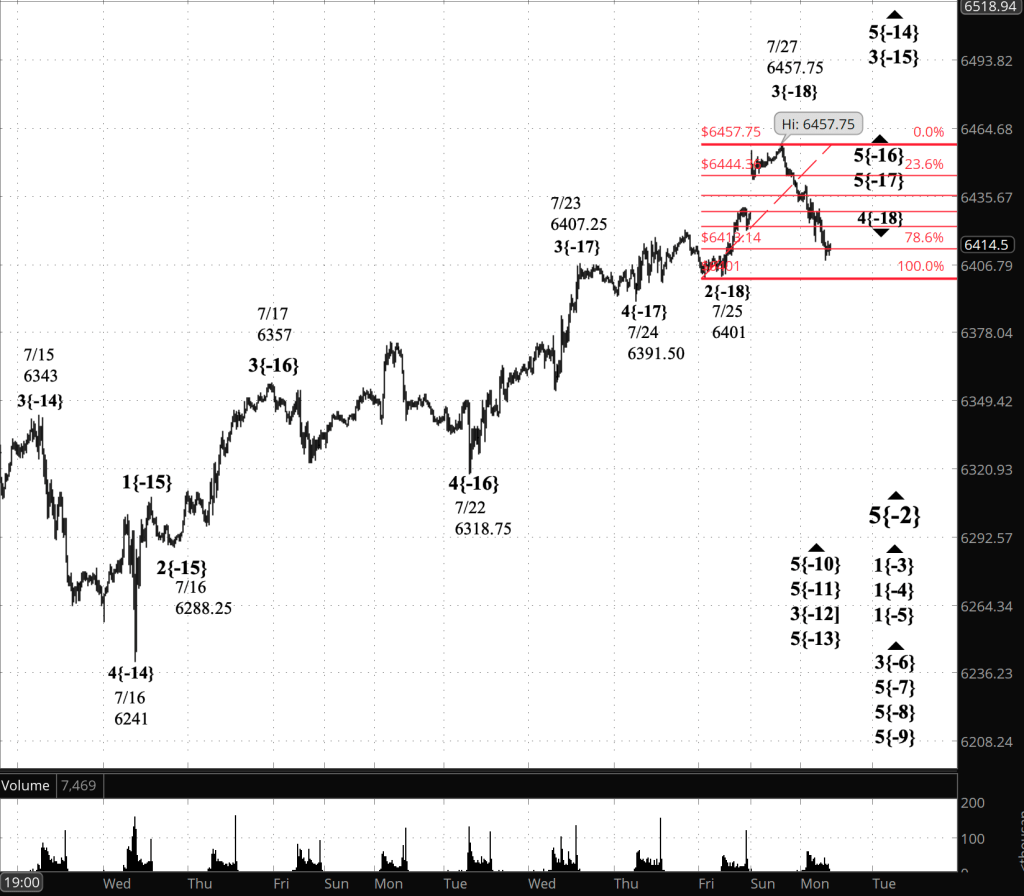
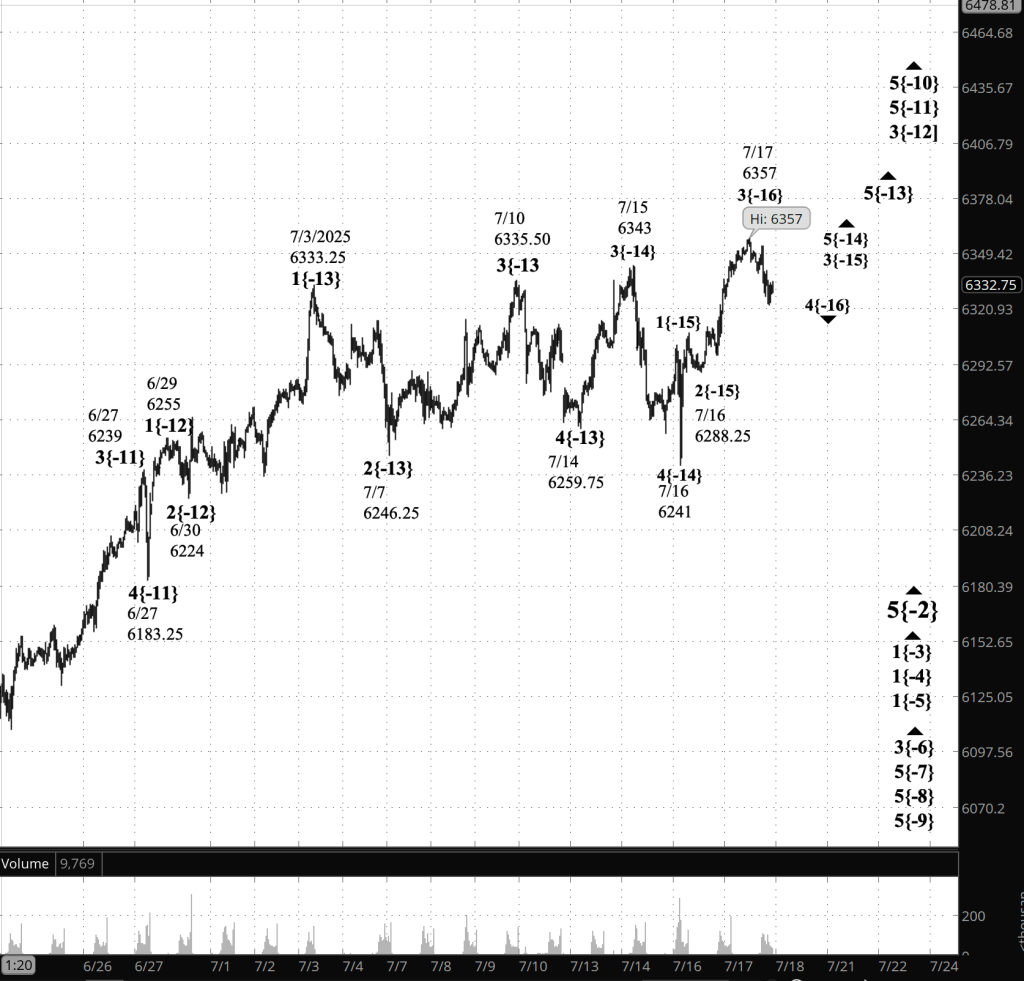
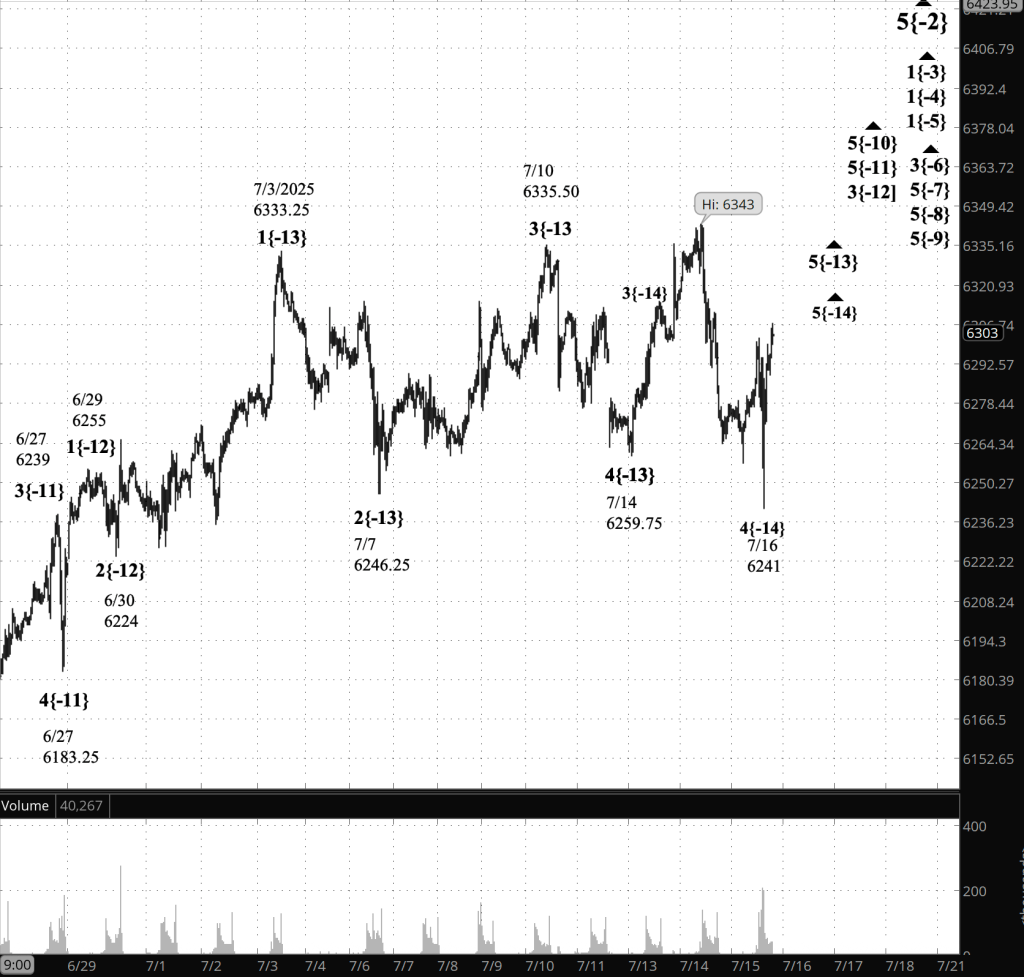
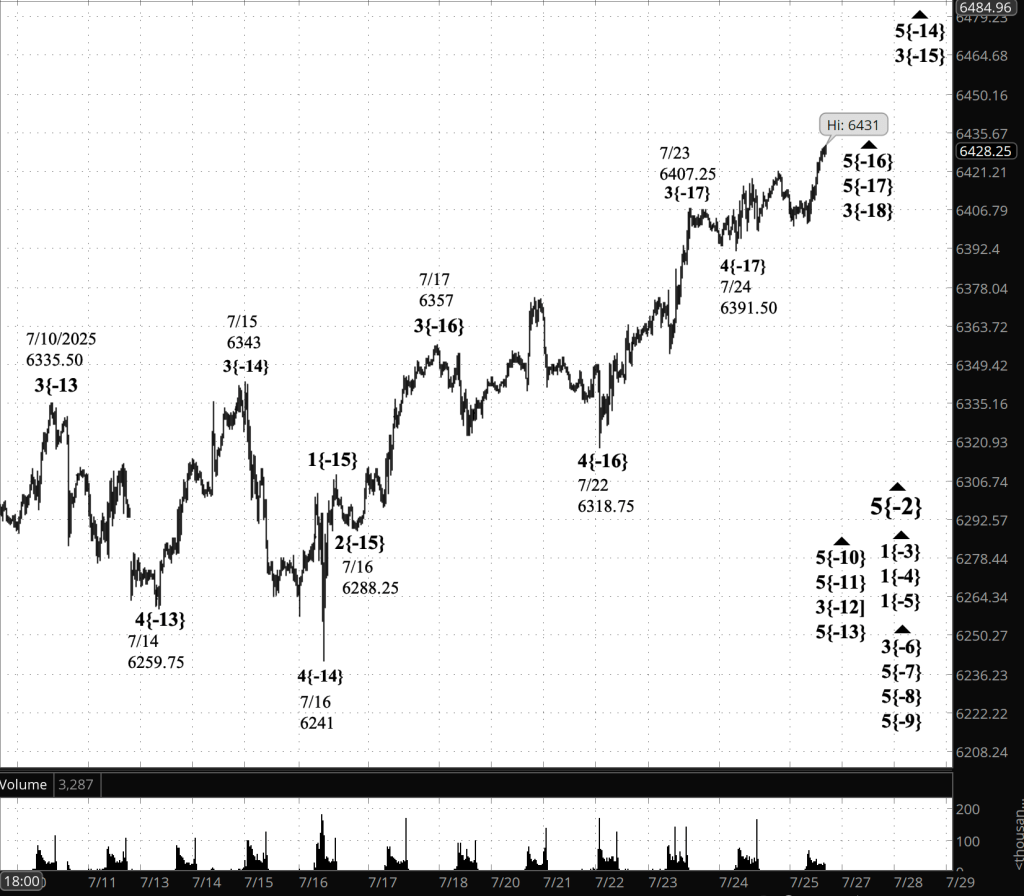
Half an hour until the closing bell. The S&P 500 futures began to rise overnight and kept it up during the session, reaching a high today so far of 6050.

Elliott Wave Theory: The declining C-wave that began on June 11, is a subwave of a 4th-wave downward correction. Wave C if typical will have three subwaves. It finished the first of them, wave A, overnight, and the rise that followed, wave B, may have ended with the session high. It’s ambiguous, and on the chart the principal analysis sees wave B as ongoing. A firm reversal to the downside would lend credence to wave B having already ended.

The chart at this point resembles a bowl of alphabet soup. Here are the wave groups as they appear on the chart, with the wave’s number of desgrees distant from Intermediate degree indicated after the wave number in curly brackets.

Big to small: Declining wave {4-11} is in its final subwave, declining wave C{-12}, which in turn in in its middle subwave, rising wave B{-13}.

9:35 a.m. New York time.

What’s happening now. The S&P 500 E-mini futures fell overnight, reaching as low as the 5980s as the session’s opening bell approached.

What does it mean? The decline confirmed the correctness of yesterday’s session close Elliott Wave Theory analysis: The final subwave, wave C, within a larger downward correction, wave 4, begun.

Here’s what to expect. As is often the case, expectations are the same as guarantees

In form, the 4th-wave downwrd correction is a Flat, meaning that wave A had three subwaves. The C wave in a Flat typically ranges from the about the size as the A wave up to 1.68 times the A-wave’s size.

From there, it’s simple math.

Note that S&P 500 futures are priced in 25-cent increments, so while the math can produce results in one-cent increments. In real life, we have to round the results to the nearest quarter.

  • Wave A was a shorty, $96 long.
  • Wave C began at 6024.75
  • Subtract wave A’s length from wave C’s beginning, 6024.75 – 96, and we have a minimum length for wave C of 5928.96. Round it to 5939.
  • The low so far in wave C is 5987.75, so by this analysis wave C has about $50 to go before reaching below the end of wave A, 5928.75.

Then there’s the maximum expectation. Here’s the math:

  • Take the length of wave A, $96, and multiply it by 1.69. The maximum expected length of wave C is $161.28
  • Wave C began at 6024.75
  • Subtract the expected length, 6024.75 – 161.28, and we get a maximum target of 5863.47. Round it to 5863.50
  • Subtractr the expected price from the end point of wave A, 5928,75 – 5863.47, and we get $65.28 below the end of wave B.

How long will wave C take? Impossible to say with confidence. Wave A ended on the day it began. Wave B dragged on for six days. Wave C is now in its second day. The best we can do is take a guess on that meager data.

[S&P 500 E-mini futures at 3:30 p.m., 35-minute bars, with volume] 

Elliott Wave Theory wave labels. Each wave listed on the charts has two components: A wave number, and a subscript in curly brackets that place the wave’s position in the fractal strucutre in relationship to Intermediate degree. The present Intermediate degree, wave 5{0}, began its rise on February 11, 2016 from 1810.10 and is still underway.

The waves referred to on the chart are as follows.

Principal analysis: Upward correction wave 5{-2} is underway and within it is working through a nested series of initial subwaves, wave 1{-3} down to wave 1{-5}. One degree lower, rising wave 3{-6} is underway and is in its final subwave, wave 5{-7},

Within wave 5{-7}, uptrending wave 5{-8} is in its final stage, uptrending wave 5{-9}.

Within wave 5{-9}, its middle subwave, wave 3{-10}, is underway. Internally, wave 3{-10} is in its next to the last subwave, wave 4{-11}, a downward correction that began from 6016.50.

Wave 4{-11} is in its final subwave, declining wave C{-12}.

Waves Now Underway

These are the waves currently in progress under my principal analysis. Each line on the list shows the wave number, with the subscript in curly brackets, the traditional degree name, the starting date, the starting price of the S&P 500 E-mini futures, and the direction of the wave.

  • S&P 500 Index:
  • 5{+3} Supercycle, 7/8/1932, 4.40 (up)
  • 5{+2} Cycle, 12/9/1974, 60.96 (up)
  • 5{+1} Primary, 3/6/2009, 666.79 (up)
  • 5{0} Intermediate, 2/11/2016, 1810.10 (up)
  • 3{-1} Minor, 3/23/2020, 2191.36 (up)
  • 5{-2} Minute, 4/7/2025, 4832 (up)
  • S&P 500 Futures
  • 1{-3} Minuette, 4/7/2025, 4832 (up)
  • 1{-4} Subminuette, 4/7/2025, 4832 (up)
  • 1{-5} Micro, 4/7/2025, 4832 (up)
  • 3{-6} Submicro, 4/21/2025, 4832 (up)

Reading the chart. Price movements — waves – – in Elliott Wave Theory analysis are labeled with numbers within trending waves and letters with corrective waves. The subscripts — numbers in curly brackets — designate the wave’s degree, which, in Elliott Wave analysis, means the relative position of a wave within the larger and smaller structures that make up the chart. R.N. Elliott, who in the 1930s developed the form of analysis that bears his name, viewed the chart as a complex structure of smaller waves nested within larger waves, which in turn are nested within still larger waves. In mathematics it’s called a fractal structure, where at every scale the pattern is similar to the others.

Learning and other resources. Elliott Wave analysis provides context, not prophecy. As the 20th century semanticist Alfred Korzybski put it in his book Science and Sanity (1933), “The map is not the territory … The only usefulness of a map depends on similarity of structure between the empirical world and the map.” And I would add, in the ever-changing markets, we can judge that similarity of structure only after the fact.

See the menu page Analytical Methods for a rundown on where to go for information on Elliott Wave analysis.

By Tim Bovee, Portland, Oregon, June 12, 2025

Disclaimer

Tim Bovee, Private Trader tracks the analysis and trades of a private trader for his own accounts. Nothing in this blog constitutes a recommendation to buy or sell stocks, options or any other financial instrument. The only purpose of this blog is to provide education and entertainment.

No trader is ever 100 percent successful in his or her trades. Trading in the stock and option markets is risky and uncertain. Each trader must make trading decisions for his or her own account, and take responsibility for the consequences.

License

All content on Tim Bovee, Private Trader by Timothy K. Bovee is licensed under a Creative Commons Attribution-ShareAlike 4.0 International License.

Based on a work at www.timbovee.com.
Trader’s Notebook: S&P 500

3:30 p.m. New York time

Half an hour beofre the closing bell. The S&P 500 futures fell after a high of 6074.75 at the session’s beginning, so far reaching 6006.24

Elliott Wave Theory: The decline has covered enough ground to designate the early high as the end of rising wave B within the 4th-wave downward correction that began on June 5, and the beginning of declining wave C, the final subwave of the correction, if the correction is typical. More to come in tomorrow morning’s analysis.

[S&P 500 E-mini futures at 3:30 p.m., 35-minute bars, with volume] 

9:35 a.m. New York time.

Note: I’ve left this morning’s work as it was when wave B was underway, allowing an easy comparison with the new analysis, wave C is underway.

What’s happening now. The S&P 500 E-mini futures rose sharply, from 6042 to 6073.50, in the first minute after the government’s CPI-u inflation report was published and then returned to the 6040s

What does it mean? Viewed through the lens of Elliott Wave Theory, the rise was confirmation that wave B is still underway. It is the middle subwave of a 4th-wave downward correction that began on June 5 from 5929.75.

B waves typically have three subwaves. Frankly, this B wave is such a scribble that I can’t say with confidence which subwave of it we’re in. Wave B has retraced the preceding A wave several times over, and so it seems likely that wave B is experiencing its last hoorah as it approaches its end.

Declining wave C will follow, if typical carrying the price below 6,000, and, when complete, will most likely mark the end of its parent, wave 4, and the beginning of an uptrending 5th-wave. Most Flat corrections have three subwaves. Some stretch out to six or nine subwaves, each separated by what some call an X-wave.

[S&P 500 E-mini futures at 9:35 a.m., 35-minute bars, with volume] 

Elliott Wave Theory wave labels. Each wave listed on the charts has two components: A wave number, and a subscript in curly brackets that place the wave’s position in the fractal strucutre in relationship to Intermediate degree. The present Intermediate degree, wave 5{0}, began its rise on February 11, 2016 from 1810.10 and is still underway.

The waves referred to on the chart are as follows.

Principal analysis: Upward correction wave 5{-2} is underway and within it is working through a nested series of initial subwaves, wave 1{-3} down to wave 1{-5}. One degree lower, rising wave 3{-6} is underway and is in its final subwave, wave 5{-7},

Within wave 5{-7}, uptrending wave 5{-8} is in its final stage, uptrending wave 5{-9}.

Within wave 5{-9}, its middle subwave, wave 3{-10}, is underway. Internally, wave 3{-10} is in its 4th subwave, wave 4{-11}, a downward correction that began from 6016.50.

Wave 4{-11} is in its 2nd subwave, rising wave B{-12}.

Waves Now Underway

These are the waves currently in progress under my principal analysis. Each line on the list shows the wave number, with the subscript in curly brackets, the traditional degree name, the starting date, the starting price of the S&P 500 E-mini futures, and the direction of the wave.

  • S&P 500 Index:
  • 5{+3} Supercycle, 7/8/1932, 4.40 (up)
  • 5{+2} Cycle, 12/9/1974, 60.96 (up)
  • 5{+1} Primary, 3/6/2009, 666.79 (up)
  • 5{0} Intermediate, 2/11/2016, 1810.10 (up)
  • 3{-1} Minor, 3/23/2020, 2191.36 (up)
  • 5{-2} Minute, 4/7/2025, 4832 (up)
  • S&P 500 Futures
  • 1{-3} Minuette, 4/7/2025, 4832 (up)
  • 1{-4} Subminuette, 4/7/2025, 4832 (up)
  • 1{-5} Micro, 4/7/2025, 4832 (up)
  • 3{-6} Submicro, 4/21/2025, 4832 (up)

Reading the chart. Price movements — waves – – in Elliott Wave Theory analysis are labeled with numbers within trending waves and letters with corrective waves. The subscripts — numbers in curly brackets — designate the wave’s degree, which, in Elliott Wave analysis, means the relative position of a wave within the larger and smaller structures that make up the chart. R.N. Elliott, who in the 1930s developed the form of analysis that bears his name, viewed the chart as a complex structure of smaller waves nested within larger waves, which in turn are nested within still larger waves. In mathematics it’s called a fractal structure, where at every scale the pattern is similar to the others.

Learning and other resources. Elliott Wave analysis provides context, not prophecy. As the 20th century semanticist Alfred Korzybski put it in his book Science and Sanity (1933), “The map is not the territory … The only usefulness of a map depends on similarity of structure between the empirical world and the map.” And I would add, in the ever-changing markets, we can judge that similarity of structure only after the fact.

See the menu page Analytical Methods for a rundown on where to go for information on Elliott Wave analysis.

By Tim Bovee, Portland, Oregon, June 11, 2025

Disclaimer

Tim Bovee, Private Trader tracks the analysis and trades of a private trader for his own accounts. Nothing in this blog constitutes a recommendation to buy or sell stocks, options or any other financial instrument. The only purpose of this blog is to provide education and entertainment.

No trader is ever 100 percent successful in his or her trades. Trading in the stock and option markets is risky and uncertain. Each trader must make trading decisions for his or her own account, and take responsibility for the consequences.

License

All content on Tim Bovee, Private Trader by Timothy K. Bovee is licensed under a Creative Commons Attribution-ShareAlike 4.0 International License.

Based on a work at www.timbovee.com.

Trader’s Notebook: S&P 500

3:30 p.m. New York time

Half an hour before the closing bell. The S&P 500 futures reached a high of 6049.50 during the rise that began on June 5.

Elliott Wave Theory: The rise is wave B, the middle subwave within 4th-wave downward correction that began on May 3.

9:35 a.m. New York time.

What’s happening now. The S&P 500 E-mini futures rose to 6040.75, fell to 5991.75, and then rose again, tracing a sideways pattern.

What does it mean? Our Elliott Wave Theory analysis yesterday left the chart where it has been for almost a week. Rising wave B within the 4th-wave downward correction continues and so far has reached a peak of 6040.75.

The B wave when complete will have traced through three subwaves. Wave B is the middle wave. If squint, I can see the rise from June 6 to June 9 as containing three subwaves, although the middle subwave seems overly short and the first subwave preternaturally long.

So for the moment I’m sticking with the B-wave-continues conclusion as principal analysis. A rise above 6040.75 would confirm it. A continued decline would lend credence to an alternative analysis, that wave B ended on June 9 and declining wave C is underway.

[S&P 500 E-mini futures at 3:30 p.m., 35-minute bars, with volume] 

Elliott Wave Theory wave labels. Each wave listed on the charts has two components: A wave number, and a subscript in curly brackets that place the wave’s position in the fractal strucutre in relationship to Intermediate degree. The present Intermediate degree, wave 5{0}, began its rise on February 11, 2016 from 1810.10 and is still underway.

The waves referred to on the chart are as follows.

Principal analysis: Upward correction wave 5{-2} is underway and within it is working through a nested series of initial subwaves, wave 1{-3} down to wave 1{-5}. One degree lower, rising wave 3{-6} is underway and is in its final subwave, wave 5{-7},

Within wave 5{-7}, uptrending wave 5{-8} is in its final stage, uptrending wave 5{-9}.

Within wave 5{-9}, its middle subwave, wave 3{-10}, is underway. Internally, wave 3{-10} is in its 4th subwave, wave 4{-11}, a downward correction that began from 6016.50.

Wave 4{-11} is in its 2nd subwave, rising wave B{-12}.

Waves Now Underway

These are the waves currently in progress under my principal analysis. Each line on the list shows the wave number, with the subscript in curly brackets, the traditional degree name, the starting date, the starting price of the S&P 500 E-mini futures, and the direction of the wave.

  • S&P 500 Index:
  • 5{+3} Supercycle, 7/8/1932, 4.40 (up)
  • 5{+2} Cycle, 12/9/1974, 60.96 (up)
  • 5{+1} Primary, 3/6/2009, 666.79 (up)
  • 5{0} Intermediate, 2/11/2016, 1810.10 (up)
  • 3{-1} Minor, 3/23/2020, 2191.36 (up)
  • 5{-2} Minute, 4/7/2025, 4832 (up)
  • S&P 500 Futures
  • 1{-3} Minuette, 4/7/2025, 4832 (up)
  • 1{-4} Subminuette, 4/7/2025, 4832 (up)
  • 1{-5} Micro, 4/7/2025, 4832 (up)
  • 3{-6} Submicro, 4/21/2025, 4832 (up)

Reading the chart. Price movements — waves – – in Elliott Wave Theory analysis are labeled with numbers within trending waves and letters with corrective waves. The subscripts — numbers in curly brackets — designate the wave’s degree, which, in Elliott Wave analysis, means the relative position of a wave within the larger and smaller structures that make up the chart. R.N. Elliott, who in the 1930s developed the form of analysis that bears his name, viewed the chart as a complex structure of smaller waves nested within larger waves, which in turn are nested within still larger waves. In mathematics it’s called a fractal structure, where at every scale the pattern is similar to the others.

Learning and other resources. Elliott Wave analysis provides context, not prophecy. As the 20th century semanticist Alfred Korzybski put it in his book Science and Sanity (1933), “The map is not the territory … The only usefulness of a map depends on similarity of structure between the empirical world and the map.” And I would add, in the ever-changing markets, we can judge that similarity of structure only after the fact.

See the menu page Analytical Methods for a rundown on where to go for information on Elliott Wave analysis.

By Tim Bovee, Portland, Oregon, June 10, 2025

Disclaimer

Tim Bovee, Private Trader tracks the analysis and trades of a private trader for his own accounts. Nothing in this blog constitutes a recommendation to buy or sell stocks, options or any other financial instrument. The only purpose of this blog is to provide education and entertainment.

No trader is ever 100 percent successful in his or her trades. Trading in the stock and option markets is risky and uncertain. Each trader must make trading decisions for his or her own account, and take responsibility for the consequences.

License

All content on Tim Bovee, Private Trader by Timothy K. Bovee is licensed under a Creative Commons Attribution-ShareAlike 4.0 International License.

Based on a work at www.timbovee.com.

Trader’s Notebook: S&P 500

3:30 p.m. New York time

Half an hour before the closing bell. As the closing bell drew near, the S&P 500 futures resolved the ambiguity discussed in this morning’s analysis.,

Rising wave B within the 4th-wave downward correction that began on June 5 from 6016.50 is underway. Wave C has not yet begun.

The ambiguity was erased about an hour and a half before the session end when the price moved above the June 5th starting point of the correction and its initial subwave, declining wave A.

The correction is a Flat, meaning wave C under the rules is free to exceed the start of the preceding A wave. If it were a Zigzag pattern, the rise would violate a rule of Elliott Wave Theory, but such was not the case.

9:35 a.m. New York time.

What’s happening now. The S&P 500 E-mini futures traded narrowly after trading resumed overnight, opening in the 6010s, dropping in to the 5990s, and the rising to with 25 cents of 6020.

What does it mean? Elliott Wave Theory: The futures, in wave B of a 4th-wave downward correction, closed the week by retracing 100% of previous A wave, which began its decline on June 5 from 6016.50 and spenr the overnight trading failing to break through that level.

A compelling alternative analysis, marked on the chart in red, sees wave B as having ended on June 6 and declining wave C as having begun from that point, 6025. If the price breaks above 6025, then wave B is still underway. If the price stays below 6025 and continues to decline, then wave C is underway. If it is typical, it will likely end somewhere between the 5930s and the 5870s.

All of this was written before the opening bell, when the price fell rapidly below 6004, lending greater credence to the alternative analysis.

[S&P 500 E-mini futures at 3:30 p.m., 35-minute bars, with volume] 

Elliott Wave Theory wave labels. Each wave listed on the charts has two components: A wave number, and a subscript in curly brackets that place the wave’s position in the fractal strucutre in relationship to Intermediate degree. The present Intermediate degree, wave 5{0}, began its rise on February 11, 2016 from 1810.10 and is still underway.

The waves referred to on the chart are as follows.

Principal analysis: Upward correction wave 5{-2} is underway and within it is working through a nested series of initial subwaves, wave 1{-3} down to wave 1{-5}. One degree lower, rising wave 3{-6} is underway and is in its final subwave, wave 5{-7},

Within wave 5{-7}, uptrending wave 5{-8} is in its final stage, uptrending wave 5{-9}.

Within wave 5{-9}, its middle subwave, wave 3{-10}, is underway. Internally, wave 3{-10} is in its 4th subwave, wave 4{-11}, a downward correction that began from 6016.50.

Wave 4{-11} is in its 2nd subwave, rising wave B{-12}.

Waves Now Underway

These are the waves currently in progress under my principal analysis. Each line on the list shows the wave number, with the subscript in curly brackets, the traditional degree name, the starting date, the starting price of the S&P 500 E-mini futures, and the direction of the wave.

  • S&P 500 Index:
  • 5{+3} Supercycle, 7/8/1932, 4.40 (up)
  • 5{+2} Cycle, 12/9/1974, 60.96 (up)
  • 5{+1} Primary, 3/6/2009, 666.79 (up)
  • 5{0} Intermediate, 2/11/2016, 1810.10 (up)
  • 3{-1} Minor, 3/23/2020, 2191.36 (up)
  • 5{-2} Minute, 4/7/2025, 4832 (up)
  • S&P 500 Futures
  • 1{-3} Minuette, 4/7/2025, 4832 (up)
  • 1{-4} Subminuette, 4/7/2025, 4832 (up)
  • 1{-5} Micro, 4/7/2025, 4832 (up)
  • 3{-6} Submicro, 4/21/2025, 4832 (up)

Reading the chart. Price movements — waves – – in Elliott Wave Theory analysis are labeled with numbers within trending waves and letters with corrective waves. The subscripts — numbers in curly brackets — designate the wave’s degree, which, in Elliott Wave analysis, means the relative position of a wave within the larger and smaller structures that make up the chart. R.N. Elliott, who in the 1930s developed the form of analysis that bears his name, viewed the chart as a complex structure of smaller waves nested within larger waves, which in turn are nested within still larger waves. In mathematics it’s called a fractal structure, where at every scale the pattern is similar to the others.

Learning and other resources. Elliott Wave analysis provides context, not prophecy. As the 20th century semanticist Alfred Korzybski put it in his book Science and Sanity (1933), “The map is not the territory … The only usefulness of a map depends on similarity of structure between the empirical world and the map.” And I would add, in the ever-changing markets, we can judge that similarity of structure only after the fact.

See the menu page Analytical Methods for a rundown on where to go for information on Elliott Wave analysis.

By Tim Bovee, Portland, Oregon, June 9, 2025

Disclaimer

Tim Bovee, Private Trader tracks the analysis and trades of a private trader for his own accounts. Nothing in this blog constitutes a recommendation to buy or sell stocks, options or any other financial instrument. The only purpose of this blog is to provide education and entertainment.

No trader is ever 100 percent successful in his or her trades. Trading in the stock and option markets is risky and uncertain. Each trader must make trading decisions for his or her own account, and take responsibility for the consequences.

License

All content on Tim Bovee, Private Trader by Timothy K. Bovee is licensed under a Creative Commons Attribution-ShareAlike 4.0 International License.

Based on a work at www.timbovee.com.

Trader’s Notebook: S&P 500

3:30 p.m. New York time

Half an hour before the closing bell. The S&P 500 futures pierced the 100% retracement level, at 6008, twice during the session. See the Fibonacci ladder in red. Elliott Wave Theory: Rising wave B within the 4th-wave downward correction has met and exceeded a rule of EWT: A B wave in a Flat type correction must retrace at least 90% of the preceding wave A.

Questions that lie ahead: How much higher will wave B rise? How much lower will the next subwave, wave C, go?

9:35 a.m. New York time.

What’s happening now. The S&P 500 E-mini futures rose in a minute from the 5970s into the 5990s when the federal government’s Employment Situation Report was released, an hour before the opening bell. The price rose further, to 6007, seconds before the opening bell sounded.

What does it mean? Having applied Elliott Wave Theory analysis, I’ve concluded that the rise that began overnight is the 2nd subwave — rising wave B — of the downward correction — wave 4 — that began on June 5.

The preceding subwave, declining wave A, has three subwaves, meaning that the 4th wave correction is taking the form of a Flat. Under the rules of Elliott Wave Theory, a Flat form must retrace at least 90% of the prior A wave and can move beyond the A-wave’s starting point, which is 6016.50 in this case.

I placed a Fibonacci ladder on the chart in red, as an aid to tracing the B-wave’s retracement of the A-wave. So far wave B has retraced 78.6% of wave A, a Fibonacci number. A 90% retracement will carry the price up to 6007.75. The price reached 6007 seconds before the opening bell sounded.

Wave B will be followed by declining wave C, with five subwaves. When wave C is complete, it will also be the end of its parent wave 4 and the beginning of an uptrending 5th wave.

[S&P 500 E-mini futures at 3:30 p.m., 35-minute bars, with volume] 

Elliott Wave Theory wave labels. Each wave listed on the charts has two components: A wave number, and a subscript in curly brackets that place the wave’s position in the fractal strucutre in relationship to Intermediate degree. The present Intermediate degree, wave 5{0}, began its rise on February 11, 2016 from 1810.10 and is still underway.

The waves referred to on the chart are as follows.

Principal analysis: Upward correction wave 5{-2} is underway and within it is working through a nested series of initial subwaves, wave 1{-3} down to wave 1{-5}. One degree lower, rising wave 3{-6} is underway and is in its final subwave, wave 5{-7},

Within wave 5{-7}, uptrending wave 5{-8} is in its final stage, uptrending wave 5{-9}.

Within wave 5{-9}, its middle subwave, wave 3{-10}, is underway. Internally, wave 3{-10} is in its 4th subwave, wave 4{-11}, a downward correction that began from 6016.50.

Wave 4{-11} is in its 2nd subwave, rising wave B{-12}.

Waves Now Underway

These are the waves currently in progress under my principal analysis. Each line on the list shows the wave number, with the subscript in curly brackets, the traditional degree name, the starting date, the starting price of the S&P 500 E-mini futures, and the direction of the wave.

  • S&P 500 Index:
  • 5{+3} Supercycle, 7/8/1932, 4.40 (up)
  • 5{+2} Cycle, 12/9/1974, 60.96 (up)
  • 5{+1} Primary, 3/6/2009, 666.79 (up)
  • 5{0} Intermediate, 2/11/2016, 1810.10 (up)
  • 3{-1} Minor, 3/23/2020, 2191.36 (up)
  • 5{-2} Minute, 4/7/2025, 4832 (up)
  • S&P 500 Futures
  • 1{-3} Minuette, 4/7/2025, 4832 (up)
  • 1{-4} Subminuette, 4/7/2025, 4832 (up)
  • 1{-5} Micro, 4/7/2025, 4832 (up)
  • 3{-6} Submicro, 4/21/2025, 4832 (up)

Reading the chart. Price movements — waves – – in Elliott Wave Theory analysis are labeled with numbers within trending waves and letters with corrective waves. The subscripts — numbers in curly brackets — designate the wave’s degree, which, in Elliott Wave analysis, means the relative position of a wave within the larger and smaller structures that make up the chart. R.N. Elliott, who in the 1930s developed the form of analysis that bears his name, viewed the chart as a complex structure of smaller waves nested within larger waves, which in turn are nested within still larger waves. In mathematics it’s called a fractal structure, where at every scale the pattern is similar to the others.

Learning and other resources. Elliott Wave analysis provides context, not prophecy. As the 20th century semanticist Alfred Korzybski put it in his book Science and Sanity (1933), “The map is not the territory … The only usefulness of a map depends on similarity of structure between the empirical world and the map.” And I would add, in the ever-changing markets, we can judge that similarity of structure only after the fact.

See the menu page Analytical Methods for a rundown on where to go for information on Elliott Wave analysis.

By Tim Bovee, Portland, Oregon, June 6, 2025

Disclaimer

Tim Bovee, Private Trader tracks the analysis and trades of a private trader for his own accounts. Nothing in this blog constitutes a recommendation to buy or sell stocks, options or any other financial instrument. The only purpose of this blog is to provide education and entertainment.

No trader is ever 100 percent successful in his or her trades. Trading in the stock and option markets is risky and uncertain. Each trader must make trading decisions for his or her own account, and take responsibility for the consequences.

License

All content on Tim Bovee, Private Trader by Timothy K. Bovee is licensed under a Creative Commons Attribution-ShareAlike 4.0 International License.

Based on a work at www.timbovee.com

Trader’s Notebook: S&P 500

3:30 p.m. New York time

Half an hour before the closing bell...

Overview:
Half an hour before the closing bell, the S&P 500 futures show a reversal of earlier momentum. While this morning’s analysis considered the possibility that a 5th wave was underway, today’s session has shown otherwise: wave 4{-11} is still active, and the 5th wave has not yet begun.

Context:
The market’s push and pull today seems driven by anticipation of the federal Employment Situation Report, which will be released tomorrow at 8:30 a.m. New York time — an hour before the U.S. market opens. The report is likely to generate considerable price movement as investor sentiment — the psychological force central to Elliott Wave Theory — responds to uncertainty and economic implications.

The federal government’s Employment Situation Report will be released at 8:30 a.m. New York time, an hour before the session’s opening bell, likely inspiring much of the movement as the public mood — the core power behind Elliott Wave Theory — tries to cope with the uncertainty.

What changed?

Using the chart’s labeling system: This morning’s wave 3{-11} has been extended to today’s high, where it ended. This morning’s wave 4{-11} has shrunk by moving it to a later beginning.

9:35 a.m. New York time.

What’s happening now. The S&P 500 E-mini futures fell briefly, down to 5971, when three economic reports were released simultaneously at 8:30 p.m. New York time: Initial Jobless Claims, the U.S. Trade Deficit and U.S. Productivity. Fifteen minutes later, the price rose sharply, reaching 6016.50 and, in the process, breezing past the May 29 high, 6008. The price then declined to the 5980s, retracing much of hte rice.

What does it mean? I’ve moved the chart closer in to show the entirety of the ongoing 5th wave that, when Elliiott Wave Theory is applied, began on May 23.

The difficulty of the chart lies in the length of the first two waves within the 5th wave that began on April 23. That period marked by extreme movements after President Trump on April 2 announced a program of international tariffs. So chart from April into May shows movement that is out of line with the norm. It was only on May 30 that the Elliott Wave movements returned to normal.

The present rise, which began May 30, is the 3rd subwave within the 5th wave that began on May 24.

[S&P 500 E-mini futures at 3:30 p.m., 30-minute bars, with volume] 

Elliott Wave Theory wave labels. Each wave listed on the charts has two components: A wave number, and a subscript in curly brackets that place the wave’s position in the fractal strucutre in relationship to Intermediate degree. The present Intermediate degree, wave 5{0}, began its rise on February 11, 2016 from 1810.10 and is still underway.

The waves referred to on the chart are as follows.

Principal analysis: Upward correction wave 5{-2} is underway and within it is working through a nested series of initial subwaves, wave 1{-3} down to wave 1{-5}. One degree lower, rising wave 3{-6} is underway and is in its final subwave, wave 5{-7},

Within wave 5{-7}, uptrending wave 5{-8} is in its final stage, uptrending wave 5{-9}.

Within wave 5{-9}, its middle subwave, wave 3{-10}, is underway. Internally, wave 3{-10} is in its 4th subwave, wave 4{-11}, a downward correction that began from 6016.50.

Waves Now Underway

These are the waves currently in progress under my principal analysis. Each line on the list shows the wave number, with the subscript in curly brackets, the traditional degree name, the starting date, the starting price of the S&P 500 E-mini futures, and the direction of the wave.

  • S&P 500 Index:
  • 5{+3} Supercycle, 7/8/1932, 4.40 (up)
  • 5{+2} Cycle, 12/9/1974, 60.96 (up)
  • 5{+1} Primary, 3/6/2009, 666.79 (up)
  • 5{0} Intermediate, 2/11/2016, 1810.10 (up)
  • 3{-1} Minor, 3/23/2020, 2191.36 (up)
  • 5{-2} Minute, 4/7/2025, 4832 (up)
  • S&P 500 Futures
  • 1{-3} Minuette, 4/7/2025, 4832 (up)
  • 1{-4} Subminuette, 4/7/2025, 4832 (up)
  • 1{-5} Micro, 4/7/2025, 4832 (up)
  • 3{-6} Submicro, 4/21/2025, 4832 (up)

Reading the chart. Price movements — waves – – in Elliott Wave Theory analysis are labeled with numbers within trending waves and letters with corrective waves. The subscripts — numbers in curly brackets — designate the wave’s degree, which, in Elliott Wave analysis, means the relative position of a wave within the larger and smaller structures that make up the chart. R.N. Elliott, who in the 1930s developed the form of analysis that bears his name, viewed the chart as a complex structure of smaller waves nested within larger waves, which in turn are nested within still larger waves. In mathematics it’s called a fractal structure, where at every scale the pattern is similar to the others.

Learning and other resources. Elliott Wave analysis provides context, not prophecy. As the 20th century semanticist Alfred Korzybski put it in his book Science and Sanity (1933), “The map is not the territory … The only usefulness of a map depends on similarity of structure between the empirical world and the map.” And I would add, in the ever-changing markets, we can judge that similarity of structure only after the fact.

See the menu page Analytical Methods for a rundown on where to go for information on Elliott Wave analysis.

By Tim Bovee, Portland, Oregon, June 5, 2025

Disclaimer

Tim Bovee, Private Trader tracks the analysis and trades of a private trader for his own accounts. Nothing in this blog constitutes a recommendation to buy or sell stocks, options or any other financial instrument. The only purpose of this blog is to provide education and entertainment.

No trader is ever 100 percent successful in his or her trades. Trading in the stock and option markets is risky and uncertain. Each trader must make trading decisions for his or her own account, and take responsibility for the consequences.

License

All content on Tim Bovee, Private Trader by Timothy K. Bovee is licensed under a Creative Commons Attribution-ShareAlike 4.0 International License.

Based on a work at www.timbovee.com

Trader’s Notebook: S&P 500

3:30 p.m. New York time

Half an hour before the closing bell. The S&P 500 futures zigzagged sideways from the 5970s to the 5990s during the session. The pause, when Elliott Wave Theory is applied, is a 4th-wave downward within a 3rd wave that in turn is the middle segment of an uptrending 5th-wave that began on began on May 23.

Using the numbering system on the chart, the pause in today’s session is wave 4{-11} within wave 3{-10} within wave 5{-9}. See the “Elliott Wave Theory Wave Labels” section below.

Wave 4{-11} will be followed by an uptrending 5th wave, both within wave 3{-10}

9:35 a.m. New York time.

What’s happening now. The S&P 500 E-mini futures reached a high overnight of 5996.25 and then fell sharply into the 5970s as the opening bell drew near. The fall coincided with the release of the ADP National Employment report, a private-sector report providng a sneak preview of the government’s Employment Situation Report, which will be released next Friday. The price then rose at the opening bell.

What does it mean? My Elliott Wave Theory analysis posted near the session close saw the day’s rise as evidence that the downward 4th-wave correction had ended on May 23 and an uptrending 5th-wave had begun. The sharp decline overnight was shallow and leaves that analysis intact: Wave 5 is rising and could carry the price as high as 6070 if the 5th wave is the same length as the preceding 1st wave, as high as 6215 if it is 1.68 times, a Fibonacci level, the length of the 1st wave

[S&P 500 E-mini futures at 3:30 p.m., 100-minute bars, with volume] 

Elliott Wave Theory wave labels. Each wave listed on the charts has two components: A wave number, and a subscript in curly brackets that place the wave’s position in the fractal strucutre in relationship to Intermediate degree. The present Intermediate degree, wave 5{0}, began its rise on February 11, 2016 from 1810.10 and is still underway.

The waves referred to on the chart are as follows.

Principal analysis: Upward correction wave 5{-2} is underway and within it is working through a nested series of initial subwaves, wave 1{-3} down to wave 1{-5}. One degree lower, rising wave 3{-6} is underway and is in its final subwave, wave 5{-7},

Within wave 5{-7}, uptrending wave 5{-8} is in its final stage, uptrending wave 5{-9}.

Within wave 5{-9}, its middle subwave, wave 3{-10}, appears to be underway. The whole rise that began on May 23 may turn out to be a subwave of wave 1{-10}, with wave 5{-10} still in the future.

Waves Now Underway

These are the waves currently in progress under my principal analysis. Each line on the list shows the wave number, with the subscript in curly brackets, the traditional degree name, the starting date, the starting price of the S&P 500 E-mini futures, and the direction of the wave.

  • S&P 500 Index:
  • 5{+3} Supercycle, 7/8/1932, 4.40 (up)
  • 5{+2} Cycle, 12/9/1974, 60.96 (up)
  • 5{+1} Primary, 3/6/2009, 666.79 (up)
  • 5{0} Intermediate, 2/11/2016, 1810.10 (up)
  • 3{-1} Minor, 3/23/2020, 2191.36 (up)
  • 5{-2} Minute, 4/7/2025, 4832 (up)
  • S&P 500 Futures
  • 1{-3} Minuette, 4/7/2025, 4832 (up)
  • 1{-4} Subminuette, 4/7/2025, 4832 (up)
  • 1{-5} Micro, 4/7/2025, 4832 (up)
  • 3{-6} Submicro, 4/21/2025, 4832 (up)

Reading the chart. Price movements — waves – – in Elliott Wave Theory analysis are labeled with numbers within trending waves and letters with corrective waves. The subscripts — numbers in curly brackets — designate the wave’s degree, which, in Elliott Wave analysis, means the relative position of a wave within the larger and smaller structures that make up the chart. R.N. Elliott, who in the 1930s developed the form of analysis that bears his name, viewed the chart as a complex structure of smaller waves nested within larger waves, which in turn are nested within still larger waves. In mathematics it’s called a fractal structure, where at every scale the pattern is similar to the others.

Learning and other resources. Elliott Wave analysis provides context, not prophecy. As the 20th century semanticist Alfred Korzybski put it in his book Science and Sanity (1933), “The map is not the territory … The only usefulness of a map depends on similarity of structure between the empirical world and the map.” And I would add, in the ever-changing markets, we can judge that similarity of structure only after the fact.

See the menu page Analytical Methods for a rundown on where to go for information on Elliott Wave analysis.

By Tim Bovee, Portland, Oregon, June 4, 2025

Disclaimer

Tim Bovee, Private Trader tracks the analysis and trades of a private trader for his own accounts. Nothing in this blog constitutes a recommendation to buy or sell stocks, options or any other financial instrument. The only purpose of this blog is to provide education and entertainment.

No trader is ever 100 percent successful in his or her trades. Trading in the stock and option markets is risky and uncertain. Each trader must make trading decisions for his or her own account, and take responsibility for the consequences.

License

All content on Tim Bovee, Private Trader by Timothy K. Bovee is licensed under a Creative Commons Attribution-ShareAlike 4.0 International License.

Based on a work at www.timbovee.com

Trader’s Notebook: S&P 500

3:30 p.m.New York time

Half an hour before the closing bell. The S&P 500 futures rose during the session, reaching 5991.25 and then retreatng slightly. The rise put the price close to 6008, the starting point of the the 4th-wave downward correction

The rise put the price close enough to that level, which is confirmation that the 5th wave is now underway, that I’ve made that scenario the principal analysis, and altered the chart to conform,.

Here’s the wave lineup under the new Principal Analysis: Upward correction wave 5{-2} is underway and within it is working through a nested series of initial subwaves, wave 1{-3} down to wave 1{-5}. One degree lower, rising wave 3{-6} is underway and is in its final subwave, wave 5{-7},

Within wave 5{-7}, uptrending wave 5{-8} is in its final stage, uptrending wave 5{-9}.

Within wave 5{-9}, its initial subwave, wave 3{-10}, is probably what’s underway, unless it’s a strange 2nd wave.

9:35 a.m. New York time.

What’s happening now. The S&P 500 E-mini futures initiall fell overnight, from the 5940s to sligtly below 5910, and then rose back into the 5940s, remaining below the early overnight high.

What does it mean? In yesterday’s analysis I ran through the ambiguity that has been with the futures since last week, and I refer the reader to the “What does it mean?” section in that edition of Trader’s Notebook.

Simple version: Either downtrending wave 4 is n its final subwave (black labels), wave C, or wave 4 ended on May 23 and wave 5 began and is underway today (red labels).

I’ve kept the 4th-wave scenario as my prncipal analysis. What could change that decision? A break above 6008, the end of wave 1 in the 5th-wave scenario. If the price turns and resumes its decline, then the 4th-wave scenario remains the most likely scenario.

How low will wave 4 go? At a minimum, I would expect wave C to be the length of wave A within the 4th wave, which would carry the price down to the low 5600s.

How high will wave t5 go? At a minimum, I would expect it to reach into the 5990s at a minimum, with a length equal to the preceding 1st wave.

How will it play out? Time will tell.

[S&P 500 E-mini futures at 3:30 p.m., 90-minute bars, with volume] 

Elliott Wave Theory wave labels. Each wave listed on the charts has two components: A wave number, and a subscript in curly brackets that place the wave’s position in the fractal strucutre in relationship to Intermediate degree. The present Intermediate degree, wave 5{0}, began its rise on February 11, 2016 from 1810.10 and is still underway.

The waves referred to on the chart are as follows.

Principal analysis: Upward correction wave 5{-2} is underway and within it is working through a nested series of initial subwaves, wave 1{-3} down to wave 1{-5}. One degree lower, rising wave 3{-6} is underway and is in its final subwave, wave 5{-7},

Within wave 5{-7}, uptrending wave 5{-8} is in its next-to-the-last stage, a downward correction, wave 4{-9}.

Within wave 4{-9}, its initial subwave, wave C{-10}, is underway. An alternative analysis sees wave 5{-10} as having ended at today’s overnight decline, ending wave C{-10} and wave 4{-9} and beginning uptrending wave 5{-9}, the final subwave within wave 5{-8}. Wave 5{-9} in this scenario is now in iwave 2{-10}, its second subwave out of five.

Waves Now Underway

These are the waves currently in progress under my principal analysis. Each line on the list shows the wave number, with the subscript in curly brackets, the traditional degree name, the starting date, the starting price of the S&P 500 E-mini futures, and the direction of the wave.

  • S&P 500 Index:
  • 5{+3} Supercycle, 7/8/1932, 4.40 (up)
  • 5{+2} Cycle, 12/9/1974, 60.96 (up)
  • 5{+1} Primary, 3/6/2009, 666.79 (up)
  • 5{0} Intermediate, 2/11/2016, 1810.10 (up)
  • 3{-1} Minor, 3/23/2020, 2191.36 (up)
  • 5{-2} Minute, 4/7/2025, 4832 (up)
  • S&P 500 Futures
  • 1{-3} Minuette, 4/7/2025, 4832 (up)
  • 1{-4} Subminuette, 4/7/2025, 4832 (up)
  • 1{-5} Micro, 4/7/2025, 4832 (up)
  • 3{-6} Submicro, 4/21/2025, 4832 (up)

Reading the chart. Price movements — waves – – in Elliott Wave Theory analysis are labeled with numbers within trending waves and letters with corrective waves. The subscripts — numbers in curly brackets — designate the wave’s degree, which, in Elliott Wave analysis, means the relative position of a wave within the larger and smaller structures that make up the chart. R.N. Elliott, who in the 1930s developed the form of analysis that bears his name, viewed the chart as a complex structure of smaller waves nested within larger waves, which in turn are nested within still larger waves. In mathematics it’s called a fractal structure, where at every scale the pattern is similar to the others.

Learning and other resources. Elliott Wave analysis provides context, not prophecy. As the 20th century semanticist Alfred Korzybski put it in his book Science and Sanity (1933), “The map is not the territory … The only usefulness of a map depends on similarity of structure between the empirical world and the map.” And I would add, in the ever-changing markets, we can judge that similarity of structure only after the fact.

See the menu page Analytical Methods for a rundown on where to go for information on Elliott Wave analysis.

By Tim Bovee, Portland, Oregon, June 3, 2025

Disclaimer

Tim Bovee, Private Trader tracks the analysis and trades of a private trader for his own accounts. Nothing in this blog constitutes a recommendation to buy or sell stocks, options or any other financial instrument. The only purpose of this blog is to provide education and entertainment.

No trader is ever 100 percent successful in his or her trades. Trading in the stock and option markets is risky and uncertain. Each trader must make trading decisions for his or her own account, and take responsibility for the consequences.

License

All content on Tim Bovee, Private Trader by Timothy K. Bovee is licensed under a Creative Commons Attribution-ShareAlike 4.0 International License.

Based on a work at www.timbovee.com

Trader’s Notebook: S&P 500

3:30 p.m. New York time

Half an hour before the closing bell. The S&P 500 futures continued to rise during the session, into the 5940s.

Elliott wave Theory: The higher the price rises, the more likely it is that wave 5 is underway, with 6008 being where that alternative scenario is a certainty.

9:35 a.m. New York time.

What’s happening now. The S&P 500 E-mini futures fell after trading resumed overnight, from slightly above 5909.25 down to the 5860s, and then retraced back to 5900 as the opening bell drew nearer.

What does it mean? Elliott Wave Theory analysis sees the the declne that began on May 29 as the final subwave, wave C, within a 4th-wave downward correction that began on May 19.

Maybe. It’s also possible to see the rise as the second subwave, wave 2, within a 5th-wave uptrend that began on May 23, following a 4th-wave downward correction that begqn on May 19 and ended on May 23.

We’re waiting for confirmation either way, If the wave continues to fall starts to approached the end of wave A, 5756.50, cthen the scenario that has 4th wave correction still under and inn wave C gains credence. If the price reverses some distance away from the end of wave A, then the uptrending 5th-wave scenario gains credence.

I’ve marked both possiblities on the chart, the 4th-wave-correction-continues principal analysis in black, and the 5th-wave-uptrend-correction-continues auxiliary analysis in red,.

If moments of ambiguity are your cup of tea, then you’ve got to love Elliott Wave Theory.

[S&P 500 E-mini futures at 3:30 p.m., 90-minute bars, with volume] 

Elliott Wave Theory wave labels. Each wave listed on the charts has two components: A wave number, and a subscript in curly brackets that place the wave’s position in the fractal strucutre in relationship to Intermediate degree. The present Intermediate degree, wave 5{0}, began its rise on February 11, 2016 from 1810.10 and is still underway.

The waves referred to on the chart are as follows.

Principal analysis: Upward correction wave 5{-2} is underway and within it is working through a nested series of initial subwaves, wave 1{-3} down to wave 1{-5}. One degree lower, rising wave 3{-6} is underway and is in its final subwave, wave 5{-7},

Within wave 5{-7}, uptrending wave 5{-8} is in its next-to-the-last stage, a downward correction, wave 4{-9}.

Within wave 4{-9}, its initial subwave, wave C{-10}, is underway. An alternative analysis sees wave 5{-10} as having ended at today’s overnight decline, ending wave C{-10} and wave 4{-9} and beginning uptrending wave 5{-9}, the final subwave within wave 5{-8}. Wave 5{-9} in this scenario is now in iwave 2{-10}, its second subwave out of five.

Waves Now Underway

These are the waves currently in progress under my principal analysis. Each line on the list shows the wave number, with the subscript in curly brackets, the traditional degree name, the starting date, the starting price of the S&P 500 E-mini futures, and the direction of the wave.

  • S&P 500 Index:
  • 5{+3} Supercycle, 7/8/1932, 4.40 (up)
  • 5{+2} Cycle, 12/9/1974, 60.96 (up)
  • 5{+1} Primary, 3/6/2009, 666.79 (up)
  • 5{0} Intermediate, 2/11/2016, 1810.10 (up)
  • 3{-1} Minor, 3/23/2020, 2191.36 (up)
  • 5{-2} Minute, 4/7/2025, 4832 (up)
  • S&P 500 Futures
  • 1{-3} Minuette, 4/7/2025, 4832 (up)
  • 1{-4} Subminuette, 4/7/2025, 4832 (up)
  • 1{-5} Micro, 4/7/2025, 4832 (up)
  • 3{-6} Submicro, 4/21/2025, 4832 (up)

Reading the chart. Price movements — waves – – in Elliott Wave Theory analysis are labeled with numbers within trending waves and letters with corrective waves. The subscripts — numbers in curly brackets — designate the wave’s degree, which, in Elliott Wave analysis, means the relative position of a wave within the larger and smaller structures that make up the chart. R.N. Elliott, who in the 1930s developed the form of analysis that bears his name, viewed the chart as a complex structure of smaller waves nested within larger waves, which in turn are nested within still larger waves. In mathematics it’s called a fractal structure, where at every scale the pattern is similar to the others.

Learning and other resources. Elliott Wave analysis provides context, not prophecy. As the 20th century semanticist Alfred Korzybski put it in his book Science and Sanity (1933), “The map is not the territory … The only usefulness of a map depends on similarity of structure between the empirical world and the map.” And I would add, in the ever-changing markets, we can judge that similarity of structure only after the fact.

See the menu page Analytical Methods for a rundown on where to go for information on Elliott Wave analysis.

By Tim Bovee, Portland, Oregon, June 2, 2025

Disclaimer

Tim Bovee, Private Trader tracks the analysis and trades of a private trader for his own accounts. Nothing in this blog constitutes a recommendation to buy or sell stocks, options or any other financial instrument. The only purpose of this blog is to provide education and entertainment.

No trader is ever 100 percent successful in his or her trades. Trading in the stock and option markets is risky and uncertain. Each trader must make trading decisions for his or her own account, and take responsibility for the consequences.

License

All content on Tim Bovee, Private Trader by Timothy K. Bovee is licensed under a Creative Commons Attribution-ShareAlike 4.0 International License.

Based on a work at www.timbovee.com

Trader’s Notebook: S&P 500

3:30 p.m. New York time

Half an hour before the opening bell. The S&P 500 futures remained slightly above 5900 as the closing bell approached. Elliott Wave Theory: I’m staying with this morning’s principal analysis — the wave-4-continues scenario — while remaining mindful of the alternative analysis — the wave-5-has-begun scenario — while searching out confirming evidence that the 5th wave truly is underway.

9:35 a.m. New York

What’s happening now. The S&P 500 E-mini futures fell sharply overnight as the opening bell approached. The declne coincided with the release of two economic reports: the Personal Income and Outlays report, and Personal Income Expenditures. The price began to drop from 5921.50, reversed from 5876.50, and retraced back to 5907.

What does it mean? When analyzed using Elliott Wave Theory, the chart shows five waves between the May 29 high of 6908 and the overnight low of 5876.50, sufficient to label the entire decline from that high as wave C, the final subwave of the 4th-wave downward correction that began on May 19.

At question is whether the overnight low marks the completion of the final subwave — a declining n5th wave — within wave C or a upward pause within the continuing 5th-wave decline.

For the moment, lacking evidence to the contrary, I’m retaining the analysis that considers declining wave 5 to still be underway.

If the alternative analysis, considering declining wave 5 to have ended at the overnight low, that will also be the end of the parent wave, the 4th-wave downward correction, and the beginning of an uptrending 5th wave the same degree as wave 4. That larger wave 5 will be the final subwave of its parent, a still larger 5th wave that began on May 7 from 5596.

[S&P 500 E-mini futures at 3:30 p.m., 85-minute bars, with volume] 

Elliott Wave Theory wave labels. Each wave listed on the charts has two components: A wave number, and a subscript in curly brackets that place the wave’s position in the fractal strucutre in relationship to Intermediate degree. The present Intermediate degree, wave 5{0}, began its rise on February 11, 2016 from 1810.10 and is still underway.

The waves referred to on the chart are as follows.

Principal analysis: Upward correction wave 5{-2} is underway and within it is working through a nested series of initial subwaves, wave 1{-3} down to wave 1{-5}. One degree lower, rising wave 3{-6} is underway and is in its final subwave, wave 5{-7},

Within wave 5{-7}, uptrending wave 5{-8} is in its next-to-the-last stage, a downward correction, wave 4{-9}.

Within wave 4{-9}, its initial subwave, wave C{-10}, is underway. An alternative analysis sees wave 5{-10} as having ended at today’s overnight decline, ending wave C{-10} and wave 4{-9} and beginning uptrending wave 5{-9}, the final subwave within wave 5{-8}.

Waves Now Underway

These are the waves currently in progress under my principal analysis. Each line on the list shows the wave number, with the subscript in curly brackets, the traditional degree name, the starting date, the starting price of the S&P 500 E-mini futures, and the direction of the wave.

  • S&P 500 Index:
  • 5{+3} Supercycle, 7/8/1932, 4.40 (up)
  • 5{+2} Cycle, 12/9/1974, 60.96 (up)
  • 5{+1} Primary, 3/6/2009, 666.79 (up)
  • 5{0} Intermediate, 2/11/2016, 1810.10 (up)
  • 3{-1} Minor, 3/23/2020, 2191.36 (up)
  • 5{-2} Minute, 4/7/2025, 4832 (up)
  • S&P 500 Futures
  • 1{-3} Minuette, 4/7/2025, 4832 (up)
  • 1{-4} Subminuette, 4/7/2025, 4832 (up)
  • 1{-5} Micro, 4/7/2025, 4832 (up)
  • 3{-6} Submicro, 4/21/2025, 4832 (up)

Reading the chart. Price movements — waves – – in Elliott Wave Theory analysis are labeled with numbers within trending waves and letters with corrective waves. The subscripts — numbers in curly brackets — designate the wave’s degree, which, in Elliott Wave analysis, means the relative position of a wave within the larger and smaller structures that make up the chart. R.N. Elliott, who in the 1930s developed the form of analysis that bears his name, viewed the chart as a complex structure of smaller waves nested within larger waves, which in turn are nested within still larger waves. In mathematics it’s called a fractal structure, where at every scale the pattern is similar to the others.

Learning and other resources. Elliott Wave analysis provides context, not prophecy. As the 20th century semanticist Alfred Korzybski put it in his book Science and Sanity (1933), “The map is not the territory … The only usefulness of a map depends on similarity of structure between the empirical world and the map.” And I would add, in the ever-changing markets, we can judge that similarity of structure only after the fact.

See the menu page Analytical Methods for a rundown on where to go for information on Elliott Wave analysis.

By Tim Bovee, Portland, Oregon, May 30, 2025

Disclaimer

Tim Bovee, Private Trader tracks the analysis and trades of a private trader for his own accounts. Nothing in this blog constitutes a recommendation to buy or sell stocks, options or any other financial instrument. The only purpose of this blog is to provide education and entertainment.

No trader is ever 100 percent successful in his or her trades. Trading in the stock and option markets is risky and uncertain. Each trader must make trading decisions for his or her own account, and take responsibility for the consequences.

License

All content on Tim Bovee, Private Trader by Timothy K. Bovee is licensed under a Creative Commons Attribution-ShareAlike 4.0 International License.

Based on a work at www.timbovee.com