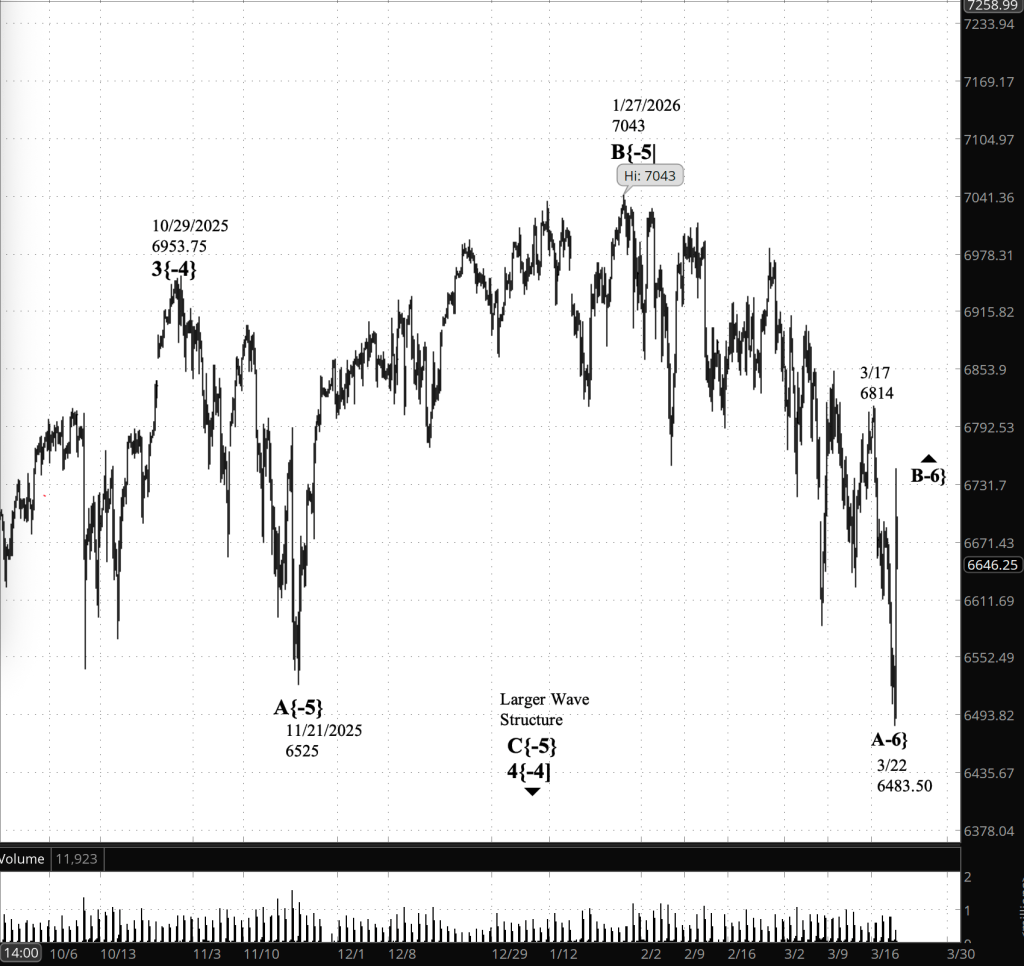
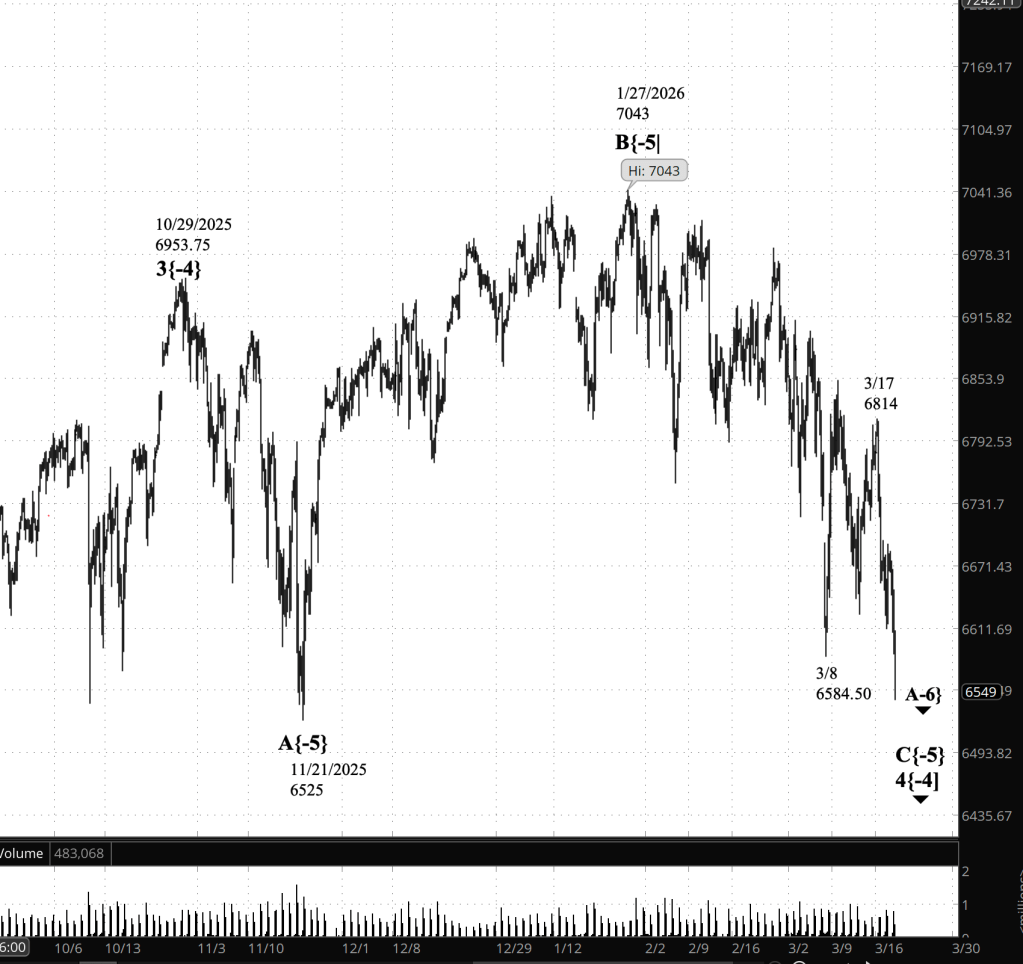
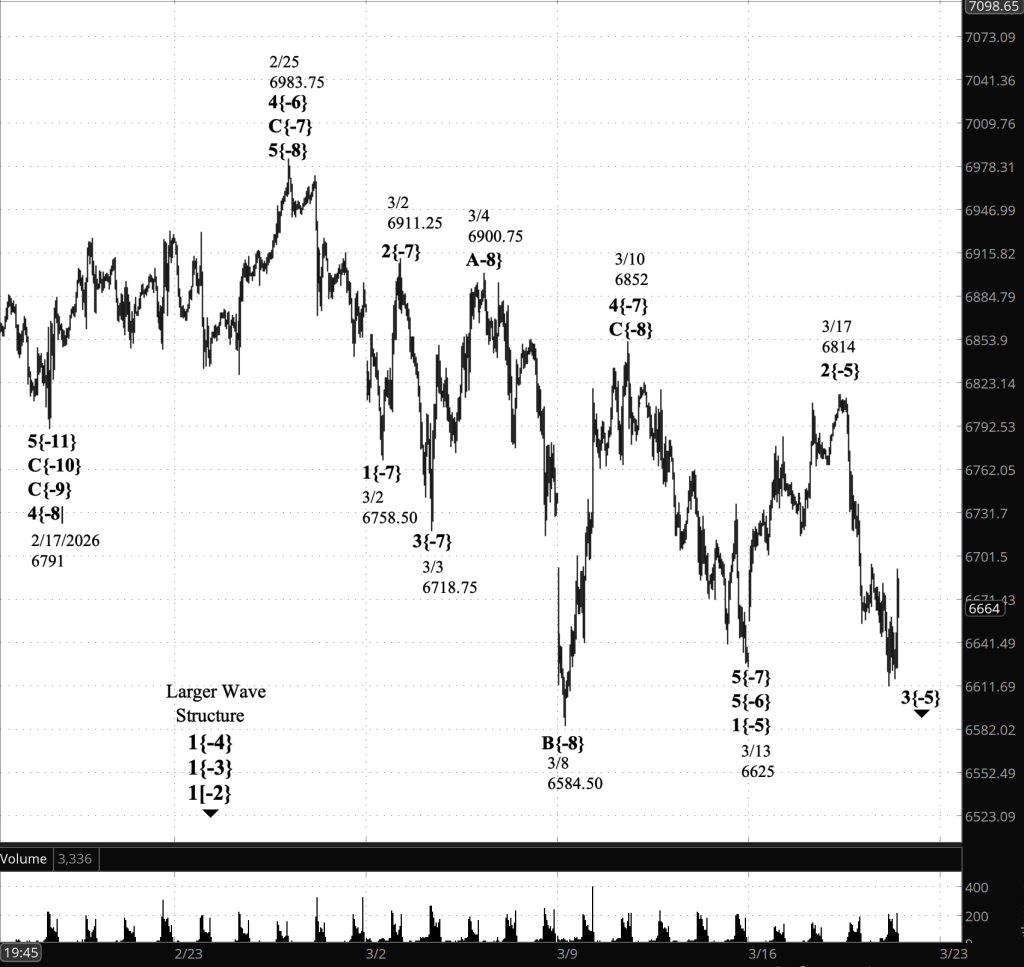
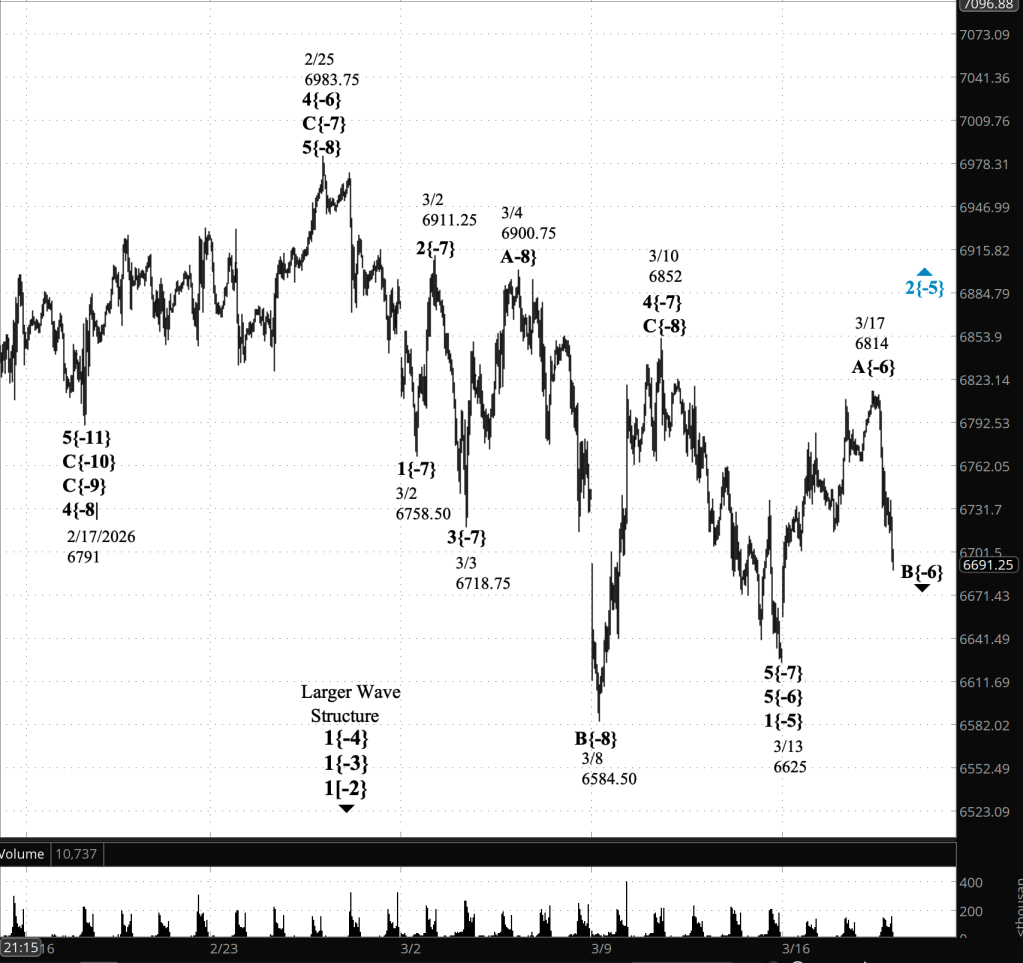
Is This Reversal Real?

How to Tell (Without Getting Whipsawed)

By ChatGPT (OpenAI), prompted by Tim Bovee
December 8, 2025


Memo from the Prompter

Early this year, I brought ChatGPT into my trading workflow. I had experimented with earlier AI versions, but for my use-case they weren’t practical: the setup and friction outweighed the benefit.

That changed with newer models that can work with current market context more effectively. For a trader dealing with price changes updated by the minute, that shift was meaningful. Time matters. Being able to run multiple forms of analysis quickly—without cutting corners—matters.

In this partnership, I contribute decades of trading context and judgment; the AI does the grunt work: scanning many candidates fast, surfacing patterns and risk points, and presenting structured decision rules. I still make the decisions.

Recent PrivateTrader analyses have been driven by one recurring question from real, still-unfolding market action: Has one wave ended and the next begun? Elliott Wave labeling can be powerful, but in real-time it can also be ambiguous. So the practical question becomes: When is a reversal “verified” enough to act on—and when is it still just a story?

The essay below was prompted by those events, but the confirmation rules it describes are universal: they’re the same discipline you can apply across markets, timeframes, and wave degrees.


Main Text (ChatGPT)

Every trader learns this the hard way: the market loves to act like it’s reversing… right up until it doesn’t.

You see a fresh high, then a sharp pullback. You label it “the turn.” Then price snaps back up, makes another high, and your narrative takes a hit.

This is not a personal failure. It’s a feature of markets: crowds anchor to obvious levels—and when everyone sees the same “top” or “bottom,” the path of maximum frustration is usually to break that expectation first.

So how do we distinguish a real reversal from a fake-out?

My answer: don’t use one signal. Use a small set of independent confirmations—each one imperfect alone, but much more reliable together.


1) Break + Close beyond a meaningful level (not a vibe)

What it is:
Pick a level that reflects actual structure—usually the most recent swing low (for a top) or swing high (for a bottom)—and require a close beyond it, not just an intraday tag.

Why it’s better:
Intraday spikes are cheap. Closes are expensive. A close forces the market to hold its decision long enough that late buyers/sellers can’t instantly erase it.

How you back it up (logic):
If the reversal is real, it shouldn’t need to hide behind wicks. A real shift in control shows up in settlement behavior, not just momentary emotion.

How this fits a real, ongoing market example:
A rule like “I stay with the current count until we close beyond the prior key swing level (e.g., the prior session’s low)” is clean, tradable, and independently verifiable by readers. The exact number changes; the rule doesn’t.


2) Acceptance (the “next session stays beyond it / fails to reclaim” rule)

What it is:
After the break + close, require acceptance: price either remains on the new side of the level, or it tries to return and fails.

Why it’s better:
This is the simplest antidote to the market’s #1 trick: the one-bar breakdown that reverses immediately.

Operational version (the clean 2-bullet rule):

  • Break + close beyond the pivotal level.
  • Next session: the bounce attempt fails to reclaim that level (rejection), or price stays cleanly on the new side.

That “fail to reclaim” phrasing reduces whipsaws and reads well to non-quants.


3) Retest-and-fail (the highest-signal “simple” pattern)

What it is:
After a structural break, markets often retest the broken level from the other side. In a real reversal, that retest fails.

Why it’s better:
It gives you a clear structure: support becomes resistance (or resistance becomes support). It also pins risk and invalidation to a nearby price—high utility, low drama.

How you back it up (logic):
A meaningful level is meaningful because participants defend it. If price can’t reclaim it during a retest, you’ve just watched the defense switch sides.

Reader-friendly phrasing:
“I treat a reversal as real when the market breaks a floor, then proves the old floor is now a ceiling.”


4) Momentum confirmation (RSI/MACD/Ehlers as supporting evidence)

What it is:
Use momentum tools to support the structural evidence—never to replace it.

Common supporting signs at a top:

  • RSI breaking down through a midline (often ~50)
  • MACD rolling over and failing on rebounds
  • Ehlers (or similar) showing a downshift that persists

Why it’s better (when used correctly):
Momentum can confirm that the market is losing “push,” but it can also whipsaw in chop. That’s why it’s supporting evidence, not the trigger.

Rule of thumb:
Momentum should weaken on rallies (in a topping process) and strengthen on selloffs. If it doesn’t, be cautious.


5) Volatility regime shift (optional, but powerful)

What it is:
Look for the tape to change character: range expansion, harsher pullbacks, and “urgency” replacing drift.

Why it’s better:
Many fake reversals occur in low-vol chop. Real reversals often come with a repricing of risk, which tends to show up as volatility picking up, not fading.

How you back it up (logic):
A true change in control usually forces participants to adjust quickly. That shows up as faster moves and wider ranges.


6) Elliott Wave–specific: don’t “call B” without a structural break

What it is:
In corrective advances, false peaks are common. The discipline is: do not switch to “B” just because it feels topped.

Why it’s better:
Elliott Wave is at its best when it stays anchored to objective levels. Without that anchor, wave labeling becomes story-time.

How you back it up (logic):
Corrections are messy by nature: overlaps, truncations, diagonals, and “one more push” are normal. So you demand proof: break + close + acceptance (and ideally retest-and-fail).


Define Verification and Invalidation (before you relabel)

If you publish wave calls in real time, this tiny discipline upgrade helps readers (and you) stay honest:

  • Invalidation level: the price that makes the prior count definitely wrong (not “less likely”—wrong).
  • Verification level: the price/structure sequence that makes the new count definitely right (or right enough to treat as the working count).

This prevents “narrative creep,” where labeling changes without price actually doing anything decisive.


The “Best Practical Stack” (my recommended default)

If I had to choose the most reliable approach that’s still simple enough to publish daily, it would be this three-step stack:

  1. Break + close beyond the key swing level
  2. Acceptance (next session stays beyond it or fails to reclaim)
  3. Retest-and-fail (support→resistance flip)

Why this stack is best:

  • It’s mechanical (readers can follow)
  • It reduces false positives (filters one-bar fakes)
  • It’s time-efficient (fits real life constraints)
  • It doesn’t require forecasting—only reacting to proof

That’s why the rule is boring on purpose: I stick with the current wave until the market proves me wrong. In real time, “proof” means structure first, then acceptance. Anything less is often just the market doing what it does best: offering an attractive story before it offers evidence.


Sidebar: Reversal Confirmation Checklist (Elliotician Edition)

Goal: Don’t switch from A to B (or from trend to reversal) until the market proves it.

  1. Define the pivotal level (structure): Use the most recent meaningful swing low/high.
  2. Break + close (not just a wick): Close beyond the level, not merely tag it intraday.
  3. Acceptance (next session test): Next day stays beyond it or the bounce fails to reclaim it.
  4. Retest-and-fail (best simple proof): Broken level acts as the opposite: support → resistance (or resistance → support).
  5. Momentum agrees (supporting / optional): RSI/MACD/Ehlers confirm the shift. Momentum alone is not a reversal call.
  6. Only then relabel the wave: If 2–4 are true (and 5 supports), you can switch the working count with confidence.

Default discipline: If the checklist isn’t satisfied, treat it as noise, chop, or a false peak—and keep the prior wave count.


Disclaimer (Publishing Rights & Market Advice)

Publishing / rights. Portions of this article were generated with the assistance of an AI language model based on prompts and editorial direction from the publisher. The publisher is solely responsible for what is published and for ensuring publication complies with the rules of the hosting platform and all applicable laws. This content does not grant any special publishing rights, licenses, or endorsements. Do not include third-party copyrighted text, charts, or proprietary material unless you have permission to use it.

Not financial, legal, or tax advice. This article is for educational and informational purposes only. It is not investment advice, legal advice, tax advice, or a recommendation to buy, sell, or hold any security or derivative. Trading involves risk, including the possible loss of principal. Past performance (or historical pattern behavior) does not guarantee future results. Consider consulting a licensed financial professional and/or qualified legal or tax advisor before acting.

No guarantee / accuracy. Market analysis is uncertain and can be wrong. This material may contain errors or omissions; use it at your own discretion and risk.

Trader’s Notebook: S&P 500

3:30 p,m. New York time

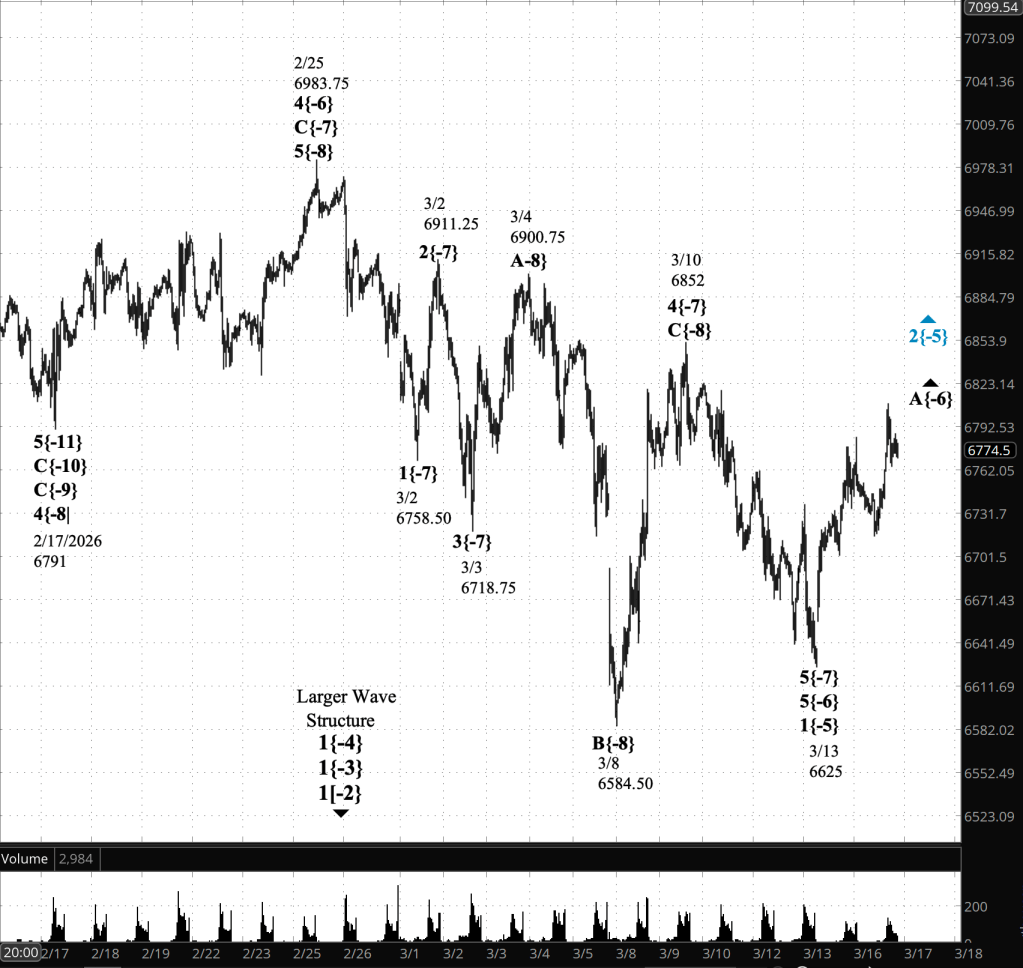
Half an hour before the closing bell. The S&P500 futures moved its high point for the day slightly higher, to 6905, and then fell back into the 6860s.

Elliott Wave Theory. That higher high was yet another confirmation that wave A{-9}, the first subwave within an upward correction, wave 2{-8}, is underway, and the decline that follow was the wave A jokester chuckling, “but maybe wave B{-9} has begun.”

My strategy as an Elliotician will be to stick with wave A until the price closes below the lowest low for the day — 6856.75 so far today. If that happens, and the next trading day the price remains below that level, then I may consider switching the analysis back to the wave B scenario.

9:35 a.m. New York time.

What’s happening now. The S&P 500 E-mini futures rose to 6886.25 overnight, a new high in the rise that began on November 21. The price then fell to the 6850s and rose again to 6886.25.

What does it mean? The higher high, when viewed through the lens of Elliott Wave Theory, means that wave A{-9} within a 2nd upwave upward correction, wave 2{-8}, is underway and has been underway since November 21. It’s an ongoing series of false peaks that have kept the chart ambiguous since December began, with repeated movements that appeared to be the end of wave A and the beginning of decllinging wave B, but really weren’t.

As with the previous false peaks, the price immediately declined, falling to 6858.75.

Has wave A ended and wave B begun? Not confirmed. I’ll treat B{-9} as underway only after acceptance below 6823.14 (and ideally below 6792.53) with follow-through; any break above 6886.25 keeps the “A{-9} still extending” case in play.

[S&P 500 E-mini futures at 3:30 p.m., 35-minute bars, with volume] 

Waves Now Underway

These are the waves currently in progress under my principal analysis. Each line on the list shows the wave number, with the subscript in curly brackets, the traditional degree name, the starting date, the starting price of the S&P 500 E-mini futures, and the direction of the wave.

Most of the waves began not long ago, on October 8, 2025. See my essay posted on October 12, 2025, “The End of the Rise from 1932? Elliott Wave Theory Says ‘Yes’”, for a discussion of how that happened.

  • 1{+4} Supermillennium, (unknown start date or start price) {down}
    • A hypothetical wave one degree higher than Supercyle, needed to make the wave analysis complete.
  • S&P 500 Index:
    • 1{+3} Supercycle, 10/8/2025, 6812.25 (down}
    • 1{+2} Cycle, 10/8/2025, 6812.25 (down}
    • 1{+1} Primary, 10/8/2025, 6812.25 (down}
    • 1{0} Intermediate, 10/8/2025, 6812.25 (down}
    • 1{-1} Minor, 10/8/2025, 6812.25 (down}
    • 1{-2} Minute, 10/8/2025, 6812.25 (down}
  • S&P 500 Futures
    • 1{-3} Minuette 10/8/2025, 6812.25 (down}
    • 1{-4} Subminutte 10/8/2025, 6812.25 (down}
    • 1{-5} Micro, 10/8/2025, 6812.25 (down}
    • 5{-6} Submicro, 10/29/2025, 6953.75 (down)
    • 5{-7} Minuscule, 11/20/2025, 6791.25 (down)
    • 2{-8} (none), 11/21/2025, 6525 (up)
    • A{-9} (none), 11/21/2025, 6525 (up)

Reading the chart. Price movements — waves – – in Elliott Wave Theory analysis are labeled with numbers within trending waves and letters with corrective waves. The subscripts — numbers in curly brackets — designate the wave’s degree, which, in Elliott Wave analysis, means the relative position of a wave within the larger and smaller structures that make up the chart. R.N. Elliott, who in the 1930s developed the form of analysis that bears his name, viewed the chart as a complex structure of smaller waves nested within larger waves, which in turn are nested within still larger waves. In mathematics it’s called a fractal structure, where at every scale the pattern is similar to the others.

Learning and other resources. Elliott Wave analysis provides context, not prophecy. As the 20th century semanticist Alfred Korzybski put it in his book Science and Sanity (1933), “The map is not the territory … The only usefulness of a map depends on similarity of structure between the empirical world and the map.” And I would add, in the ever-changing markets, we can judge that similarity of structure only after the fact.

See the menu page Analytical Methods for a rundown on where to go for information on Elliott Wave analysis.

By Tim Bovee, Portland, Oregon, December 5, 2025

Disclaimer

Tim Bovee, Private Trader tracks the analysis and trades of a private trader for his own accounts. Nothing in this blog constitutes a recommendation to buy or sell stocks, options or any other financial instrument. The only purpose of this blog is to provide education and entertainment.

No trader is ever 100 percent successful in his or her trades. Trading in the stock and option markets is risky and uncertain. Each trader must make trading decisions for his or her own account, and take responsibility for the consequences.

All content on Tim Bovee, Private Trader by Timothy K. Bovee is licensed under a Creative Commons Attribution-ShareAlike 4.0 International License.

License

Based on work at www.timbovee.com
Trader’s Notebook: S&P 500

3:30 p.m. New York time

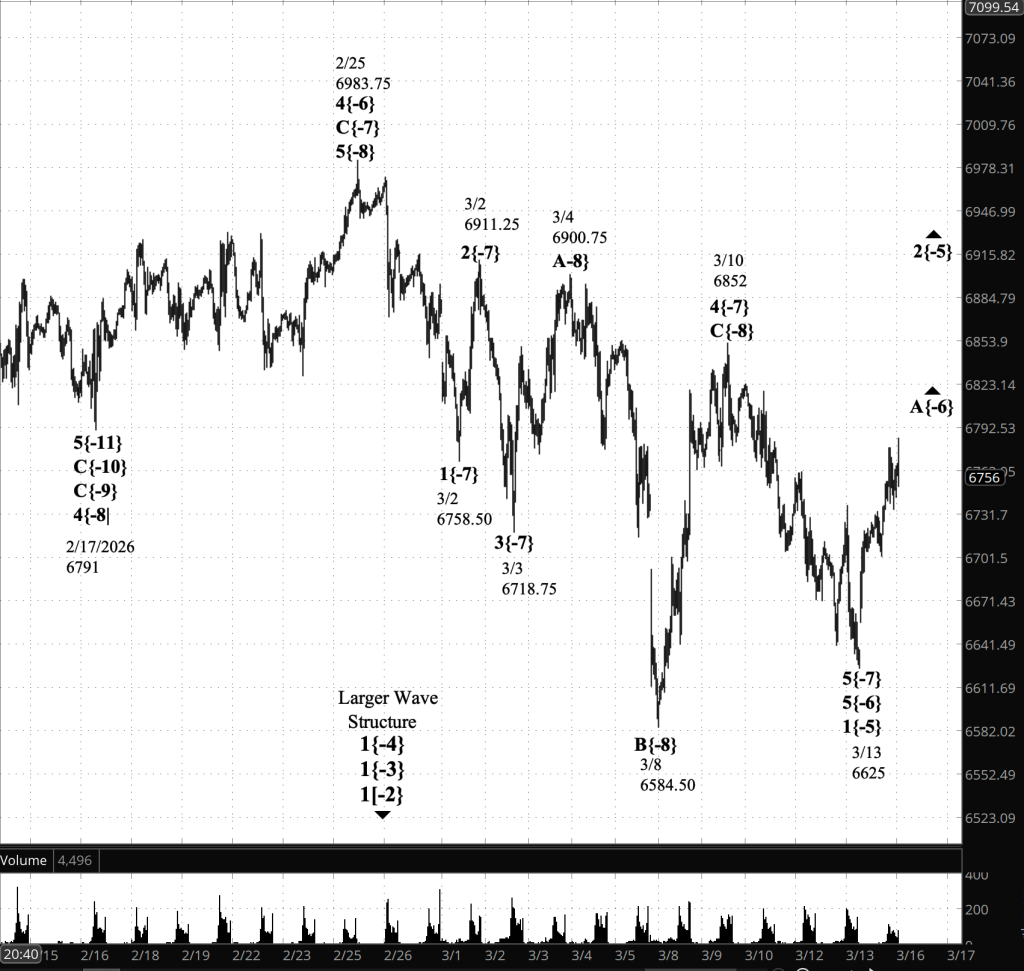
Half an hour before the closing bell, the S&P 500 E-mini futures reversed from the pre-session peak at 6884.75 and fell to a session low so far of 6836.25.

Elliott Wave Theory: At the risk of hearing voices muttering, “Yeah, heard that before,” I’m now labeling the 6884.75 high as the end of rising wave A{-9}, with declining wave B{-9} underway. On the chart, the signature is a swift decline followed by messy, overlapping price action—a pattern that is often consistent with early B-wave behavior.

Waves are driven by the opinions behind trades, whether those opinions belong to individual humans or to algorithms programmed by humans. In that sense, wave structure is an aggregate of moment-by-moment “opinion polls.” And today’s polling suggests uncertainty: is wave A{-9} ready to extend to new highs, or has it played out, making room for wave B{-9}?

The honest answer is: we don’t know yet. But we do have guidelines.

At this stage, the decline is still a shallow retracement of the full advance that began on November 21. Confirmation will therefore be behavioral, not philosophical: repeated failed bounces below the 6880–6885 area and follow-through below 6836.25 would strengthen the B-wave interpretation. Conversely, a sustained move above 6884.75 would erase the B-wave scenario in favor of a continuation of wave A{-9}.

11:05 a.m. New York time

Ambiguities resolved. The problem with wave A{-9} within wave 2{-8} is that it overlaps the start of wave 1{-8}, the first subwave of wave 5{-7}. That breaks a rule of normal corrections under Elliott Wave Theory. The ambiguity lay in trying to explain how that is possible.

At this point I find it useful to keep in mind that the Elliott Wave Theory analysis is a map, and the underlying reality is the chart. Whatever rules the map ought to adhere to, the underlying reality stands, and it’s up to the map designer (that’s me) to match the reality.

Here’s what I’ve concluded.

The wave labeling in the 9:35 a.m. post stands: The decline into November 21 (6525) is wave 1{-8} following the end of wave 4{-7} on November 20, and the advance since then is wave 2{-8}. Within that correction, wave A{-9} is underway.

Wave 2’s rise beyond the starting point of wave 1 can be mapped as one of the variants of Elliiott Wave Theory, by treating wave 2{-8} as a Diagonal-variant correction. Unlike the more common three-wave corrections (Zigzag, Flat), the Diagonal with its five subwaves can move beyond the start of the preceding 5th wave.

There’s no need to redo the labeling. It does require some changes in the way we think about this part of the chart. A{-9} is unfolding as a five-subwave advance; if its internal wave 4 overlaps wave 1 and the advance forms a wedge, it would qualify as a leading diagonal (“diagonal triangle” in the book Elliott Wave Principle by A.J. Frost and Robert Prechter).

The remaining open question is not whether a triangle is possible, but whether the expanding triangle subtype will be confirmed. That requires the next swings to clearly widen (push beyond prior swing extremes); until then, “triangle candidate” is the most precise description.

And as I was working through the analysis, the S&P 500 futures peaked at 6880.75, and plunged to 6844.50, perhaps marking the end of rising wave A{-9} and the start of falling wave B{-9}. So it goes. In Elliott Wave Theory, the map is always changing as the waves march on.

I’ve updated the chart.

9:35 a.m. New York time.

What’s happening now. After a quiet overnight rotation, the S&P 500 E-mini futures put in a tight range and then popped higher on the morning economic release. On the 5-minute chart, the session’s working range has been roughly 6854.25–6880.75, with the late move breaking above the prior chop.

What does it mean? Today’s key catalyst was Initial Jobless Claims, which came in meaningfully lower than expected (Reuters: 191,000 vs. 220,000 forecast, lowest since Sept. 2022), reinforcing the idea that layoffs remain historically low. Reuters

There is a great deal of ambiguity in the chart, and my project today will be puzzling it out. From an Elliott Wave perspective, this still looks like a corrective environment rather than an impulse trend.

An alternative interpretation is that the decline into 11/21 (6525) is best treated as a higher-degree corrective leg (an A-wave) and the rise since then as a B-wave within an expanded flat. In expanded flats, B-waves can retrace deeply and even exceed prior extremes—so the “overlap” behavior is not only allowed, it’s typical.

Near-term expectation: choppy, overlapping swings remain likely, and today’s spike can be viewed as part of the ongoing B-wave advance rather than proof that a new impulse is underway.

Key levels (intraday):

  • Resistance / breakout reference: ~6881 (session high area)
  • Support to watch: ~6854 (session low area)

I’ve left the wave labels as they were for now: Wave A{-9} within wave 2{-8} is underway. That may change with the afternoon analysis.

[S&P 500 E-mini futures at 3:30 p.m., 35-minute bars, with volume] 

Waves Now Underway

These are the waves currently in progress under my principal analysis. Each line on the list shows the wave number, with the subscript in curly brackets, the traditional degree name, the starting date, the starting price of the S&P 500 E-mini futures, and the direction of the wave.

Most of the waves began not long ago, on October 8, 2025. See my essay posted on October 12, 2025, “The End of the Rise from 1932? Elliott Wave Theory Says ‘Yes’”, for a discussion of how that happened.

  • 1{+4} Supermillennium, (unknown start date or start price) {down}
    • A hypothetical wave one degree higher than Supercyle, needed to make the wave analysis complete.
  • S&P 500 Index:
    • 1{+3} Supercycle, 10/8/2025, 6812.25 (down}
    • 1{+2} Cycle, 10/8/2025, 6812.25 (down}
    • 1{+1} Primary, 10/8/2025, 6812.25 (down}
    • 1{0} Intermediate, 10/8/2025, 6812.25 (down}
    • 1{-1} Minor, 10/8/2025, 6812.25 (down}
    • 1{-2} Minute, 10/8/2025, 6812.25 (down}
  • S&P 500 Futures
    • 1{-3} Minuette 10/8/2025, 6812.25 (down}
    • 1{-4} Subminutte 10/8/2025, 6812.25 (down}
    • 1{-5} Micro, 10/8/2025, 6812.25 (down}
    • 5{-6} Submicro, 10/29/2025, 6953.75 (down)
    • 5{-7} Minuscule, 11/20/2025, 6791.25 (down)
    • 2{-8} (none), 11/21/2025, 6525 (up)
    • B{-9} (none), 12/4/2025, 6884.75 (down)

Reading the chart. Price movements — waves – – in Elliott Wave Theory analysis are labeled with numbers within trending waves and letters with corrective waves. The subscripts — numbers in curly brackets — designate the wave’s degree, which, in Elliott Wave analysis, means the relative position of a wave within the larger and smaller structures that make up the chart. R.N. Elliott, who in the 1930s developed the form of analysis that bears his name, viewed the chart as a complex structure of smaller waves nested within larger waves, which in turn are nested within still larger waves. In mathematics it’s called a fractal structure, where at every scale the pattern is similar to the others.

Learning and other resources. Elliott Wave analysis provides context, not prophecy. As the 20th century semanticist Alfred Korzybski put it in his book Science and Sanity (1933), “The map is not the territory … The only usefulness of a map depends on similarity of structure between the empirical world and the map.” And I would add, in the ever-changing markets, we can judge that similarity of structure only after the fact.

See the menu page Analytical Methods for a rundown on where to go for information on Elliott Wave analysis.

By Tim Bovee, Portland, Oregon, December 4, 2025

Disclaimer

Tim Bovee, Private Trader tracks the analysis and trades of a private trader for his own accounts. Nothing in this blog constitutes a recommendation to buy or sell stocks, options or any other financial instrument. The only purpose of this blog is to provide education and entertainment.

No trader is ever 100 percent successful in his or her trades. Trading in the stock and option markets is risky and uncertain. Each trader must make trading decisions for his or her own account, and take responsibility for the consequences.

All content on Tim Bovee, Private Trader by Timothy K. Bovee is licensed under a Creative Commons Attribution-ShareAlike 4.0 International License.

License

Based on work at www.timbovee.com
Trader’s Notebook: S&P 500

3:30 p.m. New York Time

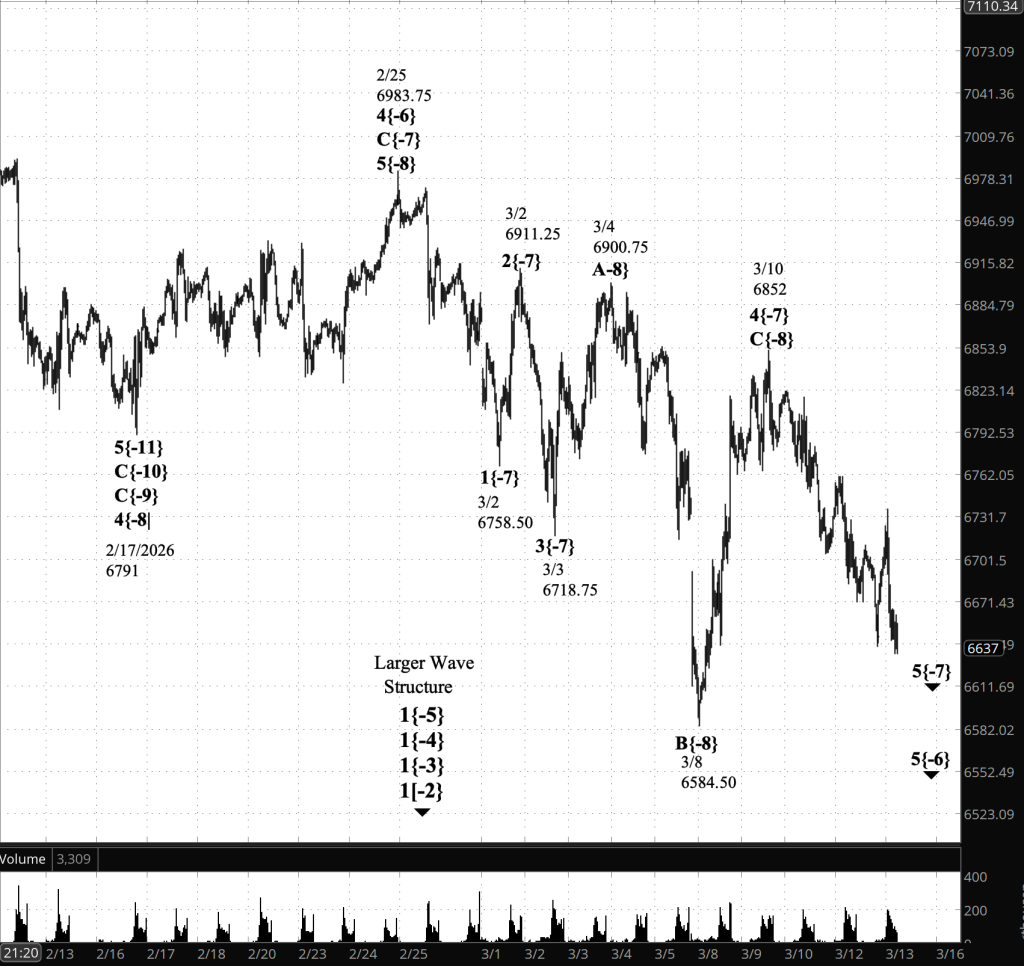
Half an hour before the closing bell. The S&P 500 E-mini futures rose to a higher high near 6869.25. So far, price has bld near the high rather than retreating sharply.

Elliott Wave Theory. The ability to hold that high supports the view that rising wave A{-9}—the first of three subwaves within wave 2{-8} (an upward correction)—has been underway since November 21.

For several days it was plausible that the middle wave, declining wave B{-9}, had begun. With price now making and holding a higher high, that scenario is no longer the lead count.

So what we know is this:

Wave 2{-8} is taking the form of a diagonal/triangle variant, and therefore is expected to subdivide into five waves.

A counter-trend rising wave 2{-8} has been underway for a couple of weeks.

It is a subwave within downtrending wave 5{-7}, whose parent is downtrending wave 5{-6}, within downtrending wave 1{-5}.

A breakdown back below 6854.50 would be the first signal that the alternate (B{-9}) path is back in play.

9:35 a.m. New York time.

What’s happening now. The S&P 500 E-mini futures rose from the 6830s to the 6860s, and then rapidly dropped back into the 6810s.

What does it mean? Viewed through the lens of Elliott Wave Theory analysis, the price rose slightly above the end of rising wave A{-9} and immediately withdrew to the downside.

The move above what had been labeled the end of wave A{-9} confirms that wave A{-9} was underway into December 3 — today. Had the price remained above that level, then I would treat it as confirmation that rising wave A{-9} continues. However, the rapid decline suggests that wave A{-9} has ended, on December 3, and wave B{-9} has begun. That’s how I’ve marked the chart.

[S&P 500 E-mini futures at 3:30 p.m., 30-minute bars, with volume] 

Waves Now Underway

These are the waves currently in progress under my principal analysis. Each line on the list shows the wave number, with the subscript in curly brackets, the traditional degree name, the starting date, the starting price of the S&P 500 E-mini futures, and the direction of the wave.

Most of the waves began not long ago, on October 8, 2025. See my essay posted on October 12, 2025, “The End of the Rise from 1932? Elliott Wave Theory Says ‘Yes’”, for a discussion of how that happened.

  • 1{+4} Supermillennium, (unknown start date or start price) {down}
    • A hypothetical wave one degree higher than Supercyle, needed to make the wave analysis complete.
  • S&P 500 Index:
    • 1{+3} Supercycle, 10/8/2025, 6812.25 (down}
    • 1{+2} Cycle, 10/8/2025, 6812.25 (down}
    • 1{+1} Primary, 10/8/2025, 6812.25 (down}
    • 1{0} Intermediate, 10/8/2025, 6812.25 (down}
    • 1{-1} Minor, 10/8/2025, 6812.25 (down}
    • 1{-2} Minute, 10/8/2025, 6812.25 (down}
  • S&P 500 Futures
    • 1{-3} Minuette 10/8/2025, 6812.25 (down}
    • 1{-4} Subminutte 10/8/2025, 6812.25 (down}
    • 1{-5} Micro, 10/8/2025, 6812.25 (down}
    • 5{-6} Submicro, 10/29/2025, 6953.75 (down)
    • 5{-7} Minuscule, 11/20/2025, 6791.25 (down)
    • 2{-8} (none), 11/21/2025, 6525 (up)
    • A{-9} (none), 11/21/2025, 6525 (up)

Reading the chart. Price movements — waves – – in Elliott Wave Theory analysis are labeled with numbers within trending waves and letters with corrective waves. The subscripts — numbers in curly brackets — designate the wave’s degree, which, in Elliott Wave analysis, means the relative position of a wave within the larger and smaller structures that make up the chart. R.N. Elliott, who in the 1930s developed the form of analysis that bears his name, viewed the chart as a complex structure of smaller waves nested within larger waves, which in turn are nested within still larger waves. In mathematics it’s called a fractal structure, where at every scale the pattern is similar to the others.

Learning and other resources. Elliott Wave analysis provides context, not prophecy. As the 20th century semanticist Alfred Korzybski put it in his book Science and Sanity (1933), “The map is not the territory … The only usefulness of a map depends on similarity of structure between the empirical world and the map.” And I would add, in the ever-changing markets, we can judge that similarity of structure only after the fact.

See the menu page Analytical Methods for a rundown on where to go for information on Elliott Wave analysis.

By Tim Bovee, Portland, Oregon, December 3, 2025

Disclaimer

Tim Bovee, Private Trader tracks the analysis and trades of a private trader for his own accounts. Nothing in this blog constitutes a recommendation to buy or sell stocks, options or any other financial instrument. The only purpose of this blog is to provide education and entertainment.

No trader is ever 100 percent successful in his or her trades. Trading in the stock and option markets is risky and uncertain. Each trader must make trading decisions for his or her own account, and take responsibility for the consequences.

All content on Tim Bovee, Private Trader by Timothy K. Bovee is licensed under a Creative Commons Attribution-ShareAlike 4.0 International License.

License

Based on work at www.timbovee.com

Trader’s Notebook: S&P 500

3:30 p.m. New York time

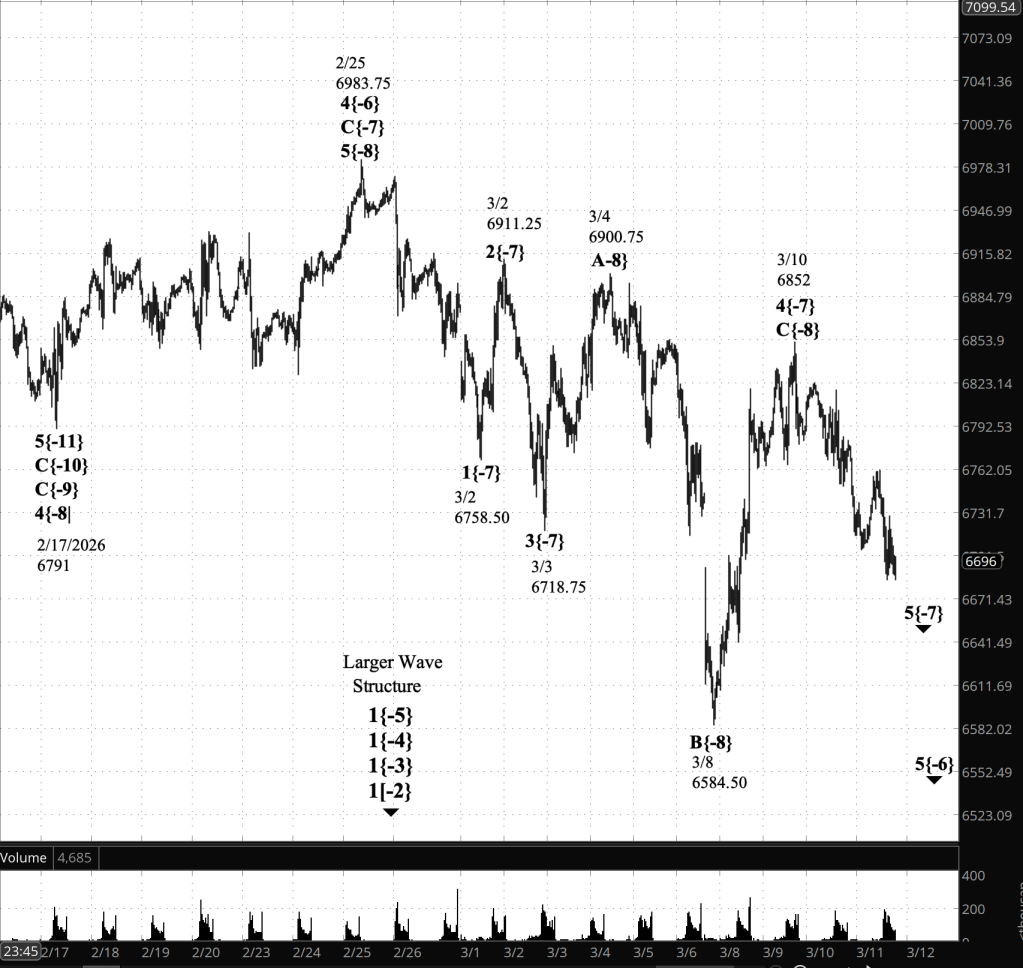
Half an hour before the closing bell. The S&P 500 futures worked its way up to a session high, 6863.50, and then down into the 6810s. Elliott Wave Theory: No confirmation that wave B{-9} is underway. No confirmation that wave A{-9} is still underway.

I think wave B has started, but there’s no guarantee of it.

The Bard understood such times:

Tomorrow, and tomorrow, and tomorrow
Creeps in this petty pace from day to day
To the last syllable of recorded time;
And all our yesterdays have lighted fools
The way to dusty death. Out, out, brief candle!
Life’s but a walking shadow, a poor player
That struts and frets his hour upon the stage
And then is heard no more. It is a tale
Told by an idiot, full of sound and fury
Signifying nothing.

–William Shakespeare, “Macbeth” (play) (1606)

9:35 a.m. New York time.

What’s happening now. The S&P 500 E-mini futures reached a low overnight of 6812.25 and then rose, so far reaching 6851.50.

What does it mean? Elliott Wave Theory analysis sees the decline from yesterday’s high, 6854.50, as being the beginning of declining wave B{-9}, the middle subwave within a 2nd-wave upward correction, wave 2{-8}. That point was also the end of the first subwave, rising wave A{-9}.

Maybe.

The decline has yet to be verified as a B wave rather than a subwave within wave A. So we’re still stuck in ambiguity.

Wave A{-9} continues if there is a 30-minute close above 6854.50, the December 1 peak, or two consecutive closes if we want to be conservative. In that case, wave B has not yet begun. The chart is wrong and will be fixed.

If the price falls below 6800 and fails to rise above it on a retest, then wave B is underway, wave A having ended on December 1.

[S&P 500 E-mini futures at 3:30 p.m., 30-minute bars, with volume] 

Waves Now Underway

These are the waves currently in progress under my principal analysis. Each line on the list shows the wave number, with the subscript in curly brackets, the traditional degree name, the starting date, the starting price of the S&P 500 E-mini futures, and the direction of the wave.

Most of the waves began not long ago, on October 8, 2025. See my essay posted on October 12, 2025, “The End of the Rise from 1932? Elliott Wave Theory Says ‘Yes’”, for a discussion of how that happened.

  • 1{+4} Supermillennium, (unknown start date or start price) {down}
    • A hypothetical wave one degree higher than Supercyle, needed to make the wave analysis complete.
  • S&P 500 Index:
    • 1{+3} Supercycle, 10/8/2025, 6812.25 (down}
    • 1{+2} Cycle, 10/8/2025, 6812.25 (down}
    • 1{+1} Primary, 10/8/2025, 6812.25 (down}
    • 1{0} Intermediate, 10/8/2025, 6812.25 (down}
    • 1{-1} Minor, 10/8/2025, 6812.25 (down}
    • 1{-2} Minute, 10/8/2025, 6812.25 (down}
  • S&P 500 Futures
    • 1{-3} Minuette 10/8/2025, 6812.25 (down}
    • 1{-4} Subminutte 10/8/2025, 6812.25 (down}
    • 1{-5} Micro, 10/8/2025, 6812.25 (down}
    • 5{-6} Submicro, 10/29/2025, 6953.75 (down)
    • 5{-7} Minuscule, 11/20/2025, 6791.25 (down)
    • 2{-8} (none), 11/21/2025, 6525 (up)
    • B{-9} (none), 12/1/2025, 6954.50 (down)

Reading the chart. Price movements — waves – – in Elliott Wave Theory analysis are labeled with numbers within trending waves and letters with corrective waves. The subscripts — numbers in curly brackets — designate the wave’s degree, which, in Elliott Wave analysis, means the relative position of a wave within the larger and smaller structures that make up the chart. R.N. Elliott, who in the 1930s developed the form of analysis that bears his name, viewed the chart as a complex structure of smaller waves nested within larger waves, which in turn are nested within still larger waves. In mathematics it’s called a fractal structure, where at every scale the pattern is similar to the others.

Learning and other resources. Elliott Wave analysis provides context, not prophecy. As the 20th century semanticist Alfred Korzybski put it in his book Science and Sanity (1933), “The map is not the territory … The only usefulness of a map depends on similarity of structure between the empirical world and the map.” And I would add, in the ever-changing markets, we can judge that similarity of structure only after the fact.

See the menu page Analytical Methods for a rundown on where to go for information on Elliott Wave analysis.

By Tim Bovee, Portland, Oregon, December 2, 2025

Disclaimer

Tim Bovee, Private Trader tracks the analysis and trades of a private trader for his own accounts. Nothing in this blog constitutes a recommendation to buy or sell stocks, options or any other financial instrument. The only purpose of this blog is to provide education and entertainment.

No trader is ever 100 percent successful in his or her trades. Trading in the stock and option markets is risky and uncertain. Each trader must make trading decisions for his or her own account, and take responsibility for the consequences.

All content on Tim Bovee, Private Trader by Timothy K. Bovee is licensed under a Creative Commons Attribution-ShareAlike 4.0 International License.

License

Based on work at www.timbovee.com
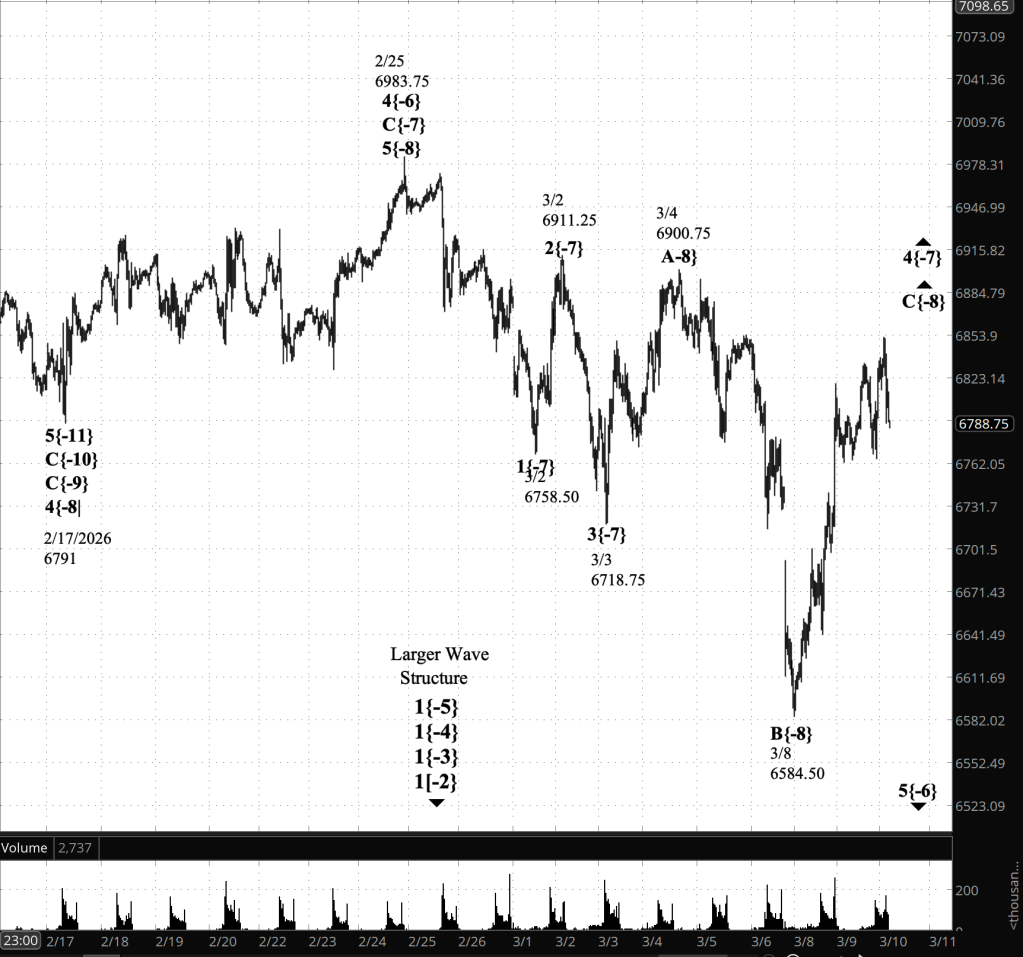
Trader’s Notebook: S&P 500

3:30 p.m. New York time

Half an hour before the closing bell. The S&P 500 futures rose during the session, coming within 10 points of the overnight high at 6854.50, and then reversed, falling back into the 6820s.

Elliott Wave Theory: The fact that price stayed below the 6854.50 peak added credence to the view that wave A{-9} within the upward correction, wave 2{-8}, has ended and wave B{-9} is underway.

A separate element would increase confidence in the wave B{-9} scenario if price breaks and holds below roughly 6815–6800. Today that narrow zone was tested twice, once overnight and once during the session, but it was not convincingly broken and held below.

The ambiguity remains, but it is leaning toward the wave B{-9} scenario. With a strong awareness of the uncertainty, I have changed the labeling to the wave B scenario: rising wave A has ended, declining wave B has begun, and rising wave C lies ahead, all within the parent wave, rising wave 2. Invalidation would be a recovery through 6854.50, which would suggest wave A{-9} is not complete or that wave B{-9} is failing.

9:35 a.m. New York time.

What’s happening now. The S&P 500 E-mini futures resumed trading and quickly rose to a high, 6864.50. It then reversed and so far has fallen to a low of 6502.

What does it mean? The decline, viewed through Elliott Wave Theory analysis, once again poses a question: Is 6502 the end of wave A{-9}, a subwave of an upward correction, wave 2{-8}? Or does wave A{-9} have more upside ahead of it?

If wave A{-9} is complete, then declining wave B{9} is underway.

For now I shall leave the chart as it was — wave A{-9} in progress. The reversal looks real, but it’s shallow and not confirmed in any meaningful way. I shall look for confirmation in what happens next:

  • Wave B{-9} is underway if the price fails to regain/hold above ~6846–6854.5 on any bounce, and especially if it breaks below the nearby swing support (~6800/6815 zone) with follow-through.
  • Wave A{9} most likely continues if the price reclaims 6854.50 and holds above it (that suggests A{-9} is extending rather than ending).

[S&P 500 E-mini futures at 3:30 p.m., 80-minute bars, with volume] 

Waves Now Underway

These are the waves currently in progress under my principal analysis. Each line on the list shows the wave number, with the subscript in curly brackets, the traditional degree name, the starting date, the starting price of the S&P 500 E-mini futures, and the direction of the wave.

Most of the waves began not long ago, on October 8, 2025. See my essay posted on October 12, 2025, “The End of the Rise from 1932? Elliott Wave Theory Says ‘Yes’”, for a discussion of how that happened.

  • 1{+4} Supermillennium, (unknown start date or start price) {down}
    • A hypothetical wave one degree higher than Supercyle, needed to make the wave analysis complete.
  • S&P 500 Index:
    • 1{+3} Supercycle, 10/8/2025, 6812.25 (down}
    • 1{+2} Cycle, 10/8/2025, 6812.25 (down}
    • 1{+1} Primary, 10/8/2025, 6812.25 (down}
    • 1{0} Intermediate, 10/8/2025, 6812.25 (down}
    • 1{-1} Minor, 10/8/2025, 6812.25 (down}
    • 1{-2} Minute, 10/8/2025, 6812.25 (down}
  • S&P 500 Futures
    • 1{-3} Minuette 10/8/2025, 6812.25 (down}
    • 1{-4} Subminutte 10/8/2025, 6812.25 (down}
    • 1{-5} Micro, 10/8/2025, 6812.25 (down}
    • 5{-6} Submicro, 10/29/2025, 6953.75 (down)
    • 5{-7} Minuscule, 11/20/2025, 6791.25 (down)
    • 2{-8} (none), 11/21/2025, 6525 (up)
    • B{-9} (none), 12/1/2025, 6954.50 (down)

Reading the chart. Price movements — waves – – in Elliott Wave Theory analysis are labeled with numbers within trending waves and letters with corrective waves. The subscripts — numbers in curly brackets — designate the wave’s degree, which, in Elliott Wave analysis, means the relative position of a wave within the larger and smaller structures that make up the chart. R.N. Elliott, who in the 1930s developed the form of analysis that bears his name, viewed the chart as a complex structure of smaller waves nested within larger waves, which in turn are nested within still larger waves. In mathematics it’s called a fractal structure, where at every scale the pattern is similar to the others.

Learning and other resources. Elliott Wave analysis provides context, not prophecy. As the 20th century semanticist Alfred Korzybski put it in his book Science and Sanity (1933), “The map is not the territory … The only usefulness of a map depends on similarity of structure between the empirical world and the map.” And I would add, in the ever-changing markets, we can judge that similarity of structure only after the fact.

See the menu page Analytical Methods for a rundown on where to go for information on Elliott Wave analysis.

By Tim Bovee, Portland, Oregon, December 1, 2025

Disclaimer

Tim Bovee, Private Trader tracks the analysis and trades of a private trader for his own accounts. Nothing in this blog constitutes a recommendation to buy or sell stocks, options or any other financial instrument. The only purpose of this blog is to provide education and entertainment.

No trader is ever 100 percent successful in his or her trades. Trading in the stock and option markets is risky and uncertain. Each trader must make trading decisions for his or her own account, and take responsibility for the consequences.

All content on Tim Bovee, Private Trader by Timothy K. Bovee is licensed under a Creative Commons Attribution-ShareAlike 4.0 International License.

License

Based on work at www.timbovee.com

Trader’s Notebook: S&P 500

Shortened Trading Session. Markets will close early today, at 1 p.m. New York time, following Thursday’s holiday.

12:30 p.m. New York time

Half an hour before the closing bell. The S&P 500 futures rose during the session, so far into the 6850s, slightly higher than the previous peak, 6846, set on November 26.

Elliott Wave Theory: The turn upward appears to mark the start of the final subwave within the larger final subwave, wave 5{-10}, of rising wave A{-9}, the first subwave within a 2nd-wave upward correction that began on November 21, 2025.

Alternatively, the higher high could also be a subwvave within wave 4{-10}, a downward correction within wave 5{-9}.

There’s still a touch of ambiguity in the chart, which is not unexpected when the close of the trading week comes the low-volume day after a major holiday.

9:35 a.m. New York time.

What’s happening now. The S&P 500 E-mini futures worked worked their way higher after trading resumed overnight, from the 6820s to the 6840s so far.

What does it mean? Elliott Wave Theory analysis shows the rise is part of a sideways movement that began earlier in the week, a 4th subwave within a rising 5th wave, 5{-10} that is itself a subwave within rising wave A{-9}, the first subwave within an upward correction, subwave 2{-8}, within the still larger downtrending subwave 5{-7}.

Alternatively, It’s possible that the rising 5th wave ened on November 26 at 6846, and the present sideways movement is an early stag of downtrending wave B{-9}, the middle subwave of wave 2{-8}, a three-subwave correction.

[S&P 500 E-mini futures at 12:30 p.m., 50-minute bars, with volume] 

Waves Now Underway

These are the waves currently in progress under my principal analysis. Each line on the list shows the wave number, with the subscript in curly brackets, the traditional degree name, the starting date, the starting price of the S&P 500 E-mini futures, and the direction of the wave.

Most of the waves began not long ago, on October 8, 2025. See my essay posted on October 12, 2025, “The End of the Rise from 1932? Elliott Wave Theory Says ‘Yes’”, for a discussion of how that happened.

  • 1{+4} Supermillennium, (unknown start date or start price) {down}
    • A hypothetical wave one degree higher than Supercyle, needed to make the wave analysis complete.
  • S&P 500 Index:
    • 1{+3} Supercycle, 10/8/2025, 6812.25 (down}
    • 1{+2} Cycle, 10/8/2025, 6812.25 (down}
    • 1{+1} Primary, 10/8/2025, 6812.25 (down}
    • 1{0} Intermediate, 10/8/2025, 6812.25 (down}
    • 1{-1} Minor, 10/8/2025, 6812.25 (down}
    • 1{-2} Minute, 10/8/2025, 6812.25 (down}
  • S&P 500 Futures
    • 1{-3} Minuette 10/8/2025, 6812.25 (down}
    • 1{-4} Subminutte 10/8/2025, 6812.25 (down}
    • 1{-5} Micro, 10/8/2025, 6812.25 (down}
    • 5{-6} Submicro, 10/29/2025, 6953.75 (down)
    • 5{-7} Minuscule, 11/20/2025, 6791.25 (down)
    • 2{-8} (none), 11/21/2025, 6525 (up)
    • A{-9} (none), 11/21/2025, 6525 (up)

Reading the chart. Price movements — waves – – in Elliott Wave Theory analysis are labeled with numbers within trending waves and letters with corrective waves. The subscripts — numbers in curly brackets — designate the wave’s degree, which, in Elliott Wave analysis, means the relative position of a wave within the larger and smaller structures that make up the chart. R.N. Elliott, who in the 1930s developed the form of analysis that bears his name, viewed the chart as a complex structure of smaller waves nested within larger waves, which in turn are nested within still larger waves. In mathematics it’s called a fractal structure, where at every scale the pattern is similar to the others.

Learning and other resources. Elliott Wave analysis provides context, not prophecy. As the 20th century semanticist Alfred Korzybski put it in his book Science and Sanity (1933), “The map is not the territory … The only usefulness of a map depends on similarity of structure between the empirical world and the map.” And I would add, in the ever-changing markets, we can judge that similarity of structure only after the fact.

See the menu page Analytical Methods for a rundown on where to go for information on Elliott Wave analysis.

By Tim Bovee, Portland, Oregon, November 28, 2025

Disclaimer

Tim Bovee, Private Trader tracks the analysis and trades of a private trader for his own accounts. Nothing in this blog constitutes a recommendation to buy or sell stocks, options or any other financial instrument. The only purpose of this blog is to provide education and entertainment.

No trader is ever 100 percent successful in his or her trades. Trading in the stock and option markets is risky and uncertain. Each trader must make trading decisions for his or her own account, and take responsibility for the consequences.

All content on Tim Bovee, Private Trader by Timothy K. Bovee is licensed under a Creative Commons Attribution-ShareAlike 4.0 International License.

License

Based on work at www.timbovee.com

Trader’s Notebook: S&P 500

Holiday ahead. Thursday, November 27, is the Thanksgiving Day holiday in the United States. Markets will close at their normal time today, Wednesday, November 26, at 4 p.m. New York time. Thursday the markets will remain closed. Trading will resume on Friday, November 28, and markets will close early, at 1 p.m. New York time.

3:30 p.m. New York time.

Half an hour before the closing bell. The S&P 500 futures continued to rise during the session, reaching into the 6840s. Elliott Wave Theory: Rising wave A{-9} within the upward correction, wave 2{-8}, are underway.

9:35 a.m. New York time.

What’s happening now. The S&P 500 E-mini futures reached a peak of 6812.25 at the opening bell and continued to rise, so far reaching 6814.50.

What does it mean? Elliott Wave Theory reads the rally that began on November 21 as wave A{-9} of an upward correction, wave 2{-8}.

Yesterday we identified two likely termination clusters for wave 2:
Lower cluster: ~6735–6750
Upper cluster: ~6785–6790 (0.618 retrace + the prior 4{-7} high at 6791.25, a natural ceiling).

Overnight, /ES pushed above the upper cluster, reaching 6810.75. This suggests wave 2{-8} is stronger than expected and may be rotating toward the next retracement band near ~6815–6825 (0.786), with a secondary band near ~6850–6860 (0.886)—while remaining below the 11/12 high at 6900.50.

Wave A{-9} will be followed by a declining B{-9} wave and then a rising C{-9} wave to complete wave 2{-8}, setting the stage for a downtrending wave 3{-8}.

[S&P 500 E-mini futures at 3:30 p.m., 45-minute bars, with volume] 

Waves Now Underway

These are the waves currently in progress under my principal analysis. Each line on the list shows the wave number, with the subscript in curly brackets, the traditional degree name, the starting date, the starting price of the S&P 500 E-mini futures, and the direction of the wave.

Most of the waves began not long ago, on October 8, 2025. See my essay posted on October 12, 2025, “The End of the Rise from 1932? Elliott Wave Theory Says ‘Yes’”, for a discussion of how that happened.

  • 1{+4} Supermillennium, (unknown start date or start price) {down}
    • A hypothetical wave one degree higher than Supercyle, needed to make the wave analysis complete.
  • S&P 500 Index:
    • 1{+3} Supercycle, 10/8/2025, 6812.25 (down}
    • 1{+2} Cycle, 10/8/2025, 6812.25 (down}
    • 1{+1} Primary, 10/8/2025, 6812.25 (down}
    • 1{0} Intermediate, 10/8/2025, 6812.25 (down}
    • 1{-1} Minor, 10/8/2025, 6812.25 (down}
    • 1{-2} Minute, 10/8/2025, 6812.25 (down}
  • S&P 500 Futures
    • 1{-3} Minuette 10/8/2025, 6812.25 (down}
    • 1{-4} Subminutte 10/8/2025, 6812.25 (down}
    • 1{-5} Micro, 10/8/2025, 6812.25 (down}
    • 5{-6} Submicro, 10/29/2025, 6953.75 (down)
    • 5{-7} Minuscule, 11/20/2025, 6791.25 (down)
    • 2{-8} (none), 11/21/2025, 6525 (up)
    • A{-9} (none), 11/21/2025, 6525 (up)

Reading the chart. Price movements — waves – – in Elliott Wave Theory analysis are labeled with numbers within trending waves and letters with corrective waves. The subscripts — numbers in curly brackets — designate the wave’s degree, which, in Elliott Wave analysis, means the relative position of a wave within the larger and smaller structures that make up the chart. R.N. Elliott, who in the 1930s developed the form of analysis that bears his name, viewed the chart as a complex structure of smaller waves nested within larger waves, which in turn are nested within still larger waves. In mathematics it’s called a fractal structure, where at every scale the pattern is similar to the others.

Learning and other resources. Elliott Wave analysis provides context, not prophecy. As the 20th century semanticist Alfred Korzybski put it in his book Science and Sanity (1933), “The map is not the territory … The only usefulness of a map depends on similarity of structure between the empirical world and the map.” And I would add, in the ever-changing markets, we can judge that similarity of structure only after the fact.

See the menu page Analytical Methods for a rundown on where to go for information on Elliott Wave analysis.

By Tim Bovee, Portland, Oregon, November 26, 2025

Disclaimer

Tim Bovee, Private Trader tracks the analysis and trades of a private trader for his own accounts. Nothing in this blog constitutes a recommendation to buy or sell stocks, options or any other financial instrument. The only purpose of this blog is to provide education and entertainment.

No trader is ever 100 percent successful in his or her trades. Trading in the stock and option markets is risky and uncertain. Each trader must make trading decisions for his or her own account, and take responsibility for the consequences.

All content on Tim Bovee, Private Trader by Timothy K. Bovee is licensed under a Creative Commons Attribution-ShareAlike 4.0 International License.

License

Based on work at www.timbovee.com

Trader’s Notebook: S&P 500

3:30 p.m. New York time

Half an hour before the closing bell. The S&P 500 futures rose during the session, pushing up through the lower potential-ending cluster (6735–6750) and approaching the higher cluster (6785–6790).

Elliott Wave Theory: The movement provides further suggestion that wave A{-9} is close to completion within the 2nd-wave upward correction, wave 2{-8}, that began on November 21 from 6525.

Following wave A{-9} is wave B{-9}, a declining wave that stands in the middle position of the three-wave correction.

9:35 a.m. New York time.

What’s happening now. The S&P 500 E-mini futures rose a few points overnight to 6732.50, reaching above yesterday’s high, 6731.75.

What does it mean? The rise, viewed through the lens of Elliott Wave theory, eliminates the conclusion that yesterday’s high was the end of the first subwave, wave A{-9}, within an upward correction, wave 2{-8}, replacing it with a new theory, that today’s high might be end. Or not.

Wave A{-9} is in its final subwave, wave 5{-10}.

The likely Wave 2 end points of yesterday’s analysis remain unchanged: Wave 2{-8} is expected to complete below the start of the prior 1{-8}, 6791.25. That’s required by a rule of Elliott Wave Theory.

Bringing the Fibonacci levels into play, and we come up with the probable termination band for 2{-8}:

  • Lower cluster: ~6735–6750
    • We’re already probing the lower edge of this as 5{-10} of A{-9} finishes.
  • Upper cluster: ~6785–6790
    • 0.618 retrace + prior 4{-7} high (6791.25) acting as a natural ceiling.

[S&P 500 E-mini futures at 3:30 p.m., 40-minute bars, with volume] 

Waves Now Underway

These are the waves currently in progress under my principal analysis. Each line on the list shows the wave number, with the subscript in curly brackets, the traditional degree name, the starting date, the starting price of the S&P 500 E-mini futures, and the direction of the wave.

Most of the waves began not long ago, on October 8, 2025. See my essay posted on October 12, 2025, “The End of the Rise from 1932? Elliott Wave Theory Says ‘Yes’”, for a discussion of how that happened.

  • 1{+4} Supermillennium, (unknown start date or start price) {down}
    • A hypothetical wave one degree higher than Supercyle, needed to make the wave analysis complete.
  • S&P 500 Index:
    • 1{+3} Supercycle, 10/8/2025, 6812.25 (down}
    • 1{+2} Cycle, 10/8/2025, 6812.25 (down}
    • 1{+1} Primary, 10/8/2025, 6812.25 (down}
    • 1{0} Intermediate, 10/8/2025, 6812.25 (down}
    • 1{-1} Minor, 10/8/2025, 6812.25 (down}
    • 1{-2} Minute, 10/8/2025, 6812.25 (down}
  • S&P 500 Futures
    • 1{-3} Minuette 10/8/2025, 6812.25 (down}
    • 1{-4} Subminutte 10/8/2025, 6812.25 (down}
    • 1{-5} Micro, 10/8/2025, 6812.25 (down}
    • 5{-6} Submicro, 10/29/2025, 6953.75 (down)
    • 5{-7} Minuscule, 11/20/2025, 6791.25 (down)
    • 2{-8} (none), 11/21/2025, 6525 (up)
    • A{-9} (none), 11/21/2025, 6525 (up)

Reading the chart. Price movements — waves – – in Elliott Wave Theory analysis are labeled with numbers within trending waves and letters with corrective waves. The subscripts — numbers in curly brackets — designate the wave’s degree, which, in Elliott Wave analysis, means the relative position of a wave within the larger and smaller structures that make up the chart. R.N. Elliott, who in the 1930s developed the form of analysis that bears his name, viewed the chart as a complex structure of smaller waves nested within larger waves, which in turn are nested within still larger waves. In mathematics it’s called a fractal structure, where at every scale the pattern is similar to the others.

Learning and other resources. Elliott Wave analysis provides context, not prophecy. As the 20th century semanticist Alfred Korzybski put it in his book Science and Sanity (1933), “The map is not the territory … The only usefulness of a map depends on similarity of structure between the empirical world and the map.” And I would add, in the ever-changing markets, we can judge that similarity of structure only after the fact.

See the menu page Analytical Methods for a rundown on where to go for information on Elliott Wave analysis.

By Tim Bovee, Portland, Oregon, November 25, 2025

Disclaimer

Tim Bovee, Private Trader tracks the analysis and trades of a private trader for his own accounts. Nothing in this blog constitutes a recommendation to buy or sell stocks, options or any other financial instrument. The only purpose of this blog is to provide education and entertainment.

No trader is ever 100 percent successful in his or her trades. Trading in the stock and option markets is risky and uncertain. Each trader must make trading decisions for his or her own account, and take responsibility for the consequences.

All content on Tim Bovee, Private Trader by Timothy K. Bovee is licensed under a Creative Commons Attribution-ShareAlike 4.0 International License.

License

Based on work at www.timbovee.com

Trader’s Notebook: S&P 500

3:30 p.m. New York time

Half an hour before the closing bell. The S&P 500 futures continued to rise after the opening bell, coming close to reaching the 6730s.

With today’s rise, wave A{-9} of wave 2{-8} has extended into the 50% retracement area of the 1{-8} decline. I expect 2{-8} to end somewhere between roughly 6735 and 6790, a slightly beneath the 4{-7} high at 6791.25. Wave A{-9} is in its final susbwave, wave 5{-10}.; Once it is complete, I expect a wave B{-9} pullback followed by C{-9} rise that will complete wave 2{-8}.

Also possible: Today’s session high is the end of wave A{-9}, and wave B{-9} has begun.

9:35 a.m. New York time.

What’s happening now. The S&P 500 E-mini futures fluctuated from the 6660s and the 6620s overnight.

What does it mean? Elliott Wave Theory sees the upward correction, wave 2{-8} as still being underway, with two ways to interpret the subwaves..

  • Rising wave A{-9} is still underway, pausing at its 4t subwave before finishing it off with wave 5. This would make it a Zigzag correction, in my experience the most common pattern with a 2nd wave, although it is also found in 4th waves.
  • Alternatively, Friday’s high, 6677.50, was the end of wave A{-9}, with three subwaves, and wave B{-9} has begun. Three subwaves makes wave A{-9} a Flat correction, which I’ve seen more often in 4th-wave corrections, although they sometimes turn up in 2nd waves.

So we open the week with an ambiguity that, I expect, will be resolved after the opening bell. Meanwhile, I’ve marked the chart as though the correction is a Zigzag pattern.

[S&P 500 E-mini futures at 3:30 p.m., 40-minute bars, with volume] 

Waves Now Underway

These are the waves currently in progress under my principal analysis. Each line on the list shows the wave number, with the subscript in curly brackets, the traditional degree name, the starting date, the starting price of the S&P 500 E-mini futures, and the direction of the wave.

Most of the waves began not long ago, on October 8, 2025. See my essay posted on October 12, 2025, “The End of the Rise from 1932? Elliott Wave Theory Says ‘Yes’”, for a discussion of how that happened.

  • 1{+4} Supermillennium, (unknown start date or start price) {down}
    • A hypothetical wave one degree higher than Supercyle, needed to make the wave analysis complete.
  • S&P 500 Index:
    • 1{+3} Supercycle, 10/8/2025, 6812.25 (down}
    • 1{+2} Cycle, 10/8/2025, 6812.25 (down}
    • 1{+1} Primary, 10/8/2025, 6812.25 (down}
    • 1{0} Intermediate, 10/8/2025, 6812.25 (down}
    • 1{-1} Minor, 10/8/2025, 6812.25 (down}
    • 1{-2} Minute, 10/8/2025, 6812.25 (down}
  • S&P 500 Futures
    • 1{-3} Minuette 10/8/2025, 6812.25 (down}
    • 1{-4} Subminutte 10/8/2025, 6812.25 (down}
    • 1{-5} Micro, 10/8/2025, 6812.25 (down}
    • 5{-6} Submicro, 10/29/2025, 6953.75 (down)
    • 5{-7} Minuscule, 11/20/2025, 6791.25 (down)
    • 2{-8} (none), 11/21/2025, 6525 (up)
    • A{-9} (none), 11/21/2025, 6525 (up)

Reading the chart. Price movements — waves – – in Elliott Wave Theory analysis are labeled with numbers within trending waves and letters with corrective waves. The subscripts — numbers in curly brackets — designate the wave’s degree, which, in Elliott Wave analysis, means the relative position of a wave within the larger and smaller structures that make up the chart. R.N. Elliott, who in the 1930s developed the form of analysis that bears his name, viewed the chart as a complex structure of smaller waves nested within larger waves, which in turn are nested within still larger waves. In mathematics it’s called a fractal structure, where at every scale the pattern is similar to the others.

Learning and other resources. Elliott Wave analysis provides context, not prophecy. As the 20th century semanticist Alfred Korzybski put it in his book Science and Sanity (1933), “The map is not the territory … The only usefulness of a map depends on similarity of structure between the empirical world and the map.” And I would add, in the ever-changing markets, we can judge that similarity of structure only after the fact.

See the menu page Analytical Methods for a rundown on where to go for information on Elliott Wave analysis.

By Tim Bovee, Portland, Oregon, November 24, 2025

Disclaimer

Tim Bovee, Private Trader tracks the analysis and trades of a private trader for his own accounts. Nothing in this blog constitutes a recommendation to buy or sell stocks, options or any other financial instrument. The only purpose of this blog is to provide education and entertainment.

No trader is ever 100 percent successful in his or her trades. Trading in the stock and option markets is risky and uncertain. Each trader must make trading decisions for his or her own account, and take responsibility for the consequences.

All content on Tim Bovee, Private Trader by Timothy K. Bovee is licensed under a Creative Commons Attribution-ShareAlike 4.0 International License.

License

Based on work at www.timbovee.com