GDX Analysis

VanEck Vectors Gold Miners ETF  (GDX)

Update 10/16/2019I exited my short iron condor position on GDX for 51.1% of maximum potential profit. The exit debit was $0.22, which is $0.23 below the $0.45 credit received at entry, with shares trading at $26.50, down nine cents from the entry level.

GDX traded sideways in a $2 range during the lifespan of the position. Implied volatility was 50.0% at exit, down 22.9 points from the entry level.

Shares fell by 0.3% over 15 days, or a -8% annual rate. The options position produced a 104.6% return for a +2,544% annual rate.


I have entered a short iron condor spread on GDX, using options that trade for the last time 45 days hence, on November 15. The premium is a $0.45 credit and the stock at the time of entry was priced at $27.17.

The profit zone for this position is between $30.45 on the upside and $22.45 on the downside.

The implied volatility rank (IVR) stands at 72.9%.

Premium: $0.45 Expire OTM
GDX-iron condor Strike Odds Delta
Long 33.00 95.0% 6
Break-even 30.45 90.0% 12
Short 30.00 85.0% 18
Puts
Short 24.00 82.0% 16
Break-even 22.45 88.0% 10.5
Long 22.00 94.0% 5

The premium is 18.0% of the width of the position’s wings.

The profit zone covers a 12.1% move to the upside and a 21.0% move to the downside of the entry price, for total coverage of 33.1%

The risk/reward ratio is 4.6:1, with maximum risk of $205 and maximum reward of $45 per contract.

By Tim Bovee, Portland, Oregon, October 1, 2019

Read More »

Live: Tuesday, Oct. 1, 2019

2:50 p.m. New York time

XBI Analysis posted.

And that’s a wrap for the November setup, with six short iron condor positions, on GDX, IWM, TLT, XBI, XLY and XOP. Management day will be October 25, which is 21 days prior to expiration, the day on which I sell all remaining profitable positions. Expiration is November 15.

2:20 p.m. New York time

XOP Analysis posted.

2 p.m. New York time

I’ve posted XLY Analysis after the adjusting the order in order to get a fill. Note that the short put strike was moved a dollar lower to accomodate a price change after I entered the order.

1:30 p.m. New York time

I’ve posted IWM Analysis after my short iron condor entry order was filled.

12:30 p.m. New York time

And as the final entry order of the day, a short iron condor on XBI, structured +p62 -p67 -c83 +c88, with an ask of a $1.08 credit.

12:15 p.m. New York time

I’ve placed an entry order for a short iron condor on IWM, structured as +128p -138p -160c +164c, asking for a $1.20 credit.

11:10 a.m. New York time

TLT Analysis posted after my short iron condor order was filled at the asking price.

10:55 a.m. New York time

Entry order for a short iron condor on TLT placed. The structured is +p17 -p19 -c25 +c27, with a credit ask of $0.39.

10:40 a.m. New York time

I’ve placed an entry order for a short iron condor on TLT, structured as +p32 -p36 -c51 +c57. The credit ask is $0.82.

10:20 a.m. New York time

GDX Analysis posted after my short iron condor order was filled.

10:10 a.m. New York time

I’ve placed an entry order for a short iron condor on XLY, structured as +p105 -p112 -c126 +c129, asking for a credit of $0.94.

10 a.m. New York time

Today is entry day for my options trading, 45 days prior to expiration of the November 15, 2019 monthlies. In describing the structure of each short iron condor order, I’ll prefix long options with a + and short with a -, each followed “p” for put or “c” for call, and the strike price.

I’ve placed my first entry order, for GDX, structured as +p22 -p24 -c30 +c33. My asking price is $0.45. No fill as of yet.

By Tim Bovee, Portland, Oregon, October 1, 2019

Read More »

Live: Friday, Sept. 27, 2019

1:50 p.m. New York time

I’ve updated XOP Analysis with results.

1:30 p.m. New York time

I’ve updated GLD Analysis with results.

12:50 p.m. New York time

I’ve exited GLD for a $1.54 debit, or 3.1% of maximum potential profit. An update with results is on its way.

This was the last of my OCT options holdings. Next step is set up for the NOV options positions, all of them short iron condors expiring November 15. I’ll be entering those positions on Tuesday, October 1, which is 45 days prior to expiration.

9:45 a.m. New York time

This is management day for my OCT options, 21 days before expiration, the day when I exit all profitable positions, however small that profit might be.

I’ve exited XOP for a $0.35 debit, or 20.5% of maximum potential profit. I shall update the analysis with results later this morning.

My other holding GLD, dropped slightly below the short put strike price, moving the position into loss territory. I’ll keep a close watch on it today and exit if it moves back to profit.

By Tim Bovee, Portland, Oregon, September 27, 2019

Read More »

Live: Thursday, Sept. 26, 2019

11:50 a.m. New York time

I shall spend much of October in Japan, a time zone that poses challenges to a U.S.-baed traveler: The opening bell rings at 10:30 p.m. and the closing bell, at 5 a.m. Not exactly my preferred schedule.

The schedule doesn’t pose much of a problem to my options trading. I’ll be entering my November options positions three days before my departure, and since I know my exit point — 50% of maximum potential profit — I’ll set good-till-cancelled exit orders and let them sit until management day, 21 days before expiration. I’ll still be in Japan on that day, so I’ll stay up late, make the exits, and write up the results during the next day, which will be at night in the U.S.

The managed shares positions require more intensive management, preferably during the market day. I’ve solved that by shutting down the five positions — BOTZ, EPI, EWL, GDXJ and UNG — replacing them with REITs that will be going ex-dividend soon — OHI, NRZ and STWD. All have 100% buy ratings from Morningstar.

The managed shares plans hasn’t been producing a profit over and all — positions tend to be nickel-and-dimed with losses — so I’ll use some of my time abroad thinking about a better way to handle the long shares portion of my holdings.

While abroad, as is the case when I’m home, I’ll post when I have something to say, rather than posting daily just to maintain a presence.

By Tim Bovee, Portland, Oregon, September 26, 2019

Read More »

Monday, Sept. 23, 2019

11:45 a.m. New York time

My options reach the 21st day prior to expiration on Friday, and on that day I shall exit the profitable positions and retain the losers, but under my sudden death rules. The see options trading rules here.

Among my managed shares, XLV proved to be a head fake. I entered it on a buy signal on Friday and it gave a sell signal on Monday. I’ve replaced with GDXJ, the highest beta of the gold ETFs, all of which gave buy signals today.

By Tim Bovee, Portland, Oregon, September 23, 2019

Read More »

Live: Friday, Sept. 20, 2019

2:30 p.m. New York time

I’ve updated XLY Analysis with results.

2:05 p.m. New York time

Managed shares: UAE out on a sell signal, replaced by EPI.

1:50 p.m. New York time

My XLY short iron condor exit order was filled at $0.57, two cents better than my limit, with shares going for $121.03. I’ll update the analysis shortly.

12:55 p.m. New York time

My XLY short iron condor position has come close to its exit point — 50% of maximum potential profit — and I have entered an exit order at $0.59. The position is presently trading at $0.61. No fill yet.

10:05 a.m. New York time

In my managed shares portfolio, XLP showed a sell signal on the directional movement index. I replaced it with XLV.

Two of the stocks underlying short iron condor positions went ex-dividend today. None of my XLY or XOP options was assigned.

By Tim Bovee, Portland, Oregon, September 20, 2019

Read More »

Live: Thursday, Sept. 19, 2019

12:40 p.m. New York time

In my managed shares portfolio, CANE produced a sell signal on the directional movement index, and I replaced it with EWL, which tracks Swiss stocks.

Two of my short iron condor holdings go ex-dividend on Friday. XLY is out-of-the-money for both short calls and puts and so is unlikely to be assigned. XOP is out-of-the-money by only 7 cents as of this writing and will bear close watching up to the closing bell. I judge XOP to have a greater risk of assignment that XLY, but not a huge risk.

Rather that go through a full write-up on my experimental earnings plays, as I did with FDX, I’ve pulled together a spreadsheet that I’ll use to track hypothetical earnings plays on all of the stocks that meet my liquidity standards. The spreadsheet is on Google Sheets and can be accessed here.

By Tim Bovee, Portland, Oregon, September 19, 2019

Read More »

Live: Wednesday, Sept. 18, 2019

3:25 p.m. New York time

In my managed shares portfolio, EWM moved to a sell signal on the directional movement indicator and I exited, replacing it with XLP, consumer staples.

sym slot # entry $/share sector
BOTZ 1 19.32 robotics
CANE 2 6.55 commodity-sugar
XLP 3 60.66 consumer staples
UNG 4 19.17 energy
UAE 5 14.18 int-uae

1:55 p.m. New York time

Looking ahead to the next potential earnings plays, I have three highly liquid prospects on the list.

  • DRI, trade today today, is a pass. It has a 53% buy rating from Morningstar, but only three stars, one start short of my standard. It has a neutral 3 rank from Zacks, with a negative earnings surprise predictor of -1.30.
  • INFO, trade date Sept. 24, is also a pass, with a 59% buy rating from Morningstar but only two stars. Zacks gives it a neutral 3 rank and no surprise on the ESP (0.0%)
  • NKE, trade date Sept. 24, is a candidate for a paper trade. It has a buy rank of 75% and four stars from Morningstar, which are excellent, but a bearish 4 rank from Zacks, despite a +2.82% ESP. Again, paper only. I want to see what that ESP produces on the chart with these very mixed metrics.

11:25 a.m. New York time

I’ve updated my FDX paper-trade analysis with results.

10 a.m. New York time

XOP returned to its profit zone this morning, barely, and is no longer considered to be an at-risk trade.

FDX, as expected, dropped sharply after the company failed to meet analysts’ consensus forecast. My shares paper trade fell and I, hypothetically, exited the position for a loss. The paper options position remains within the profit zone, meaning it can be expected to be profitable at expiration. I shall update the paper trade analysis later this morning.

By Tim Bovee, Portland, Oregon, September 18, 2019

Read More »

Experimental: FDX Analysis

FedEx Corp. (FDX)

Update 9/18/2019As expected from the Zacks earnings surprise prediction (ESP) indicator, FDX failed to meet analysts’ consensus expectation, coming in 5.8% below the mark. The price fell sharply at the open. What does that mean for our paper trades?

Under my evolving rules for earnings plays, the shares trade after the announcement came under the same rules as my ETF-focused managed shares trades. The directional movement index (DMI) gave a sell signal at the open. I hypothetically exited for a loss four minutes after the opening bell, for $152.17, a $20.23 loss.. The DMI, below, immediately turned bearish.
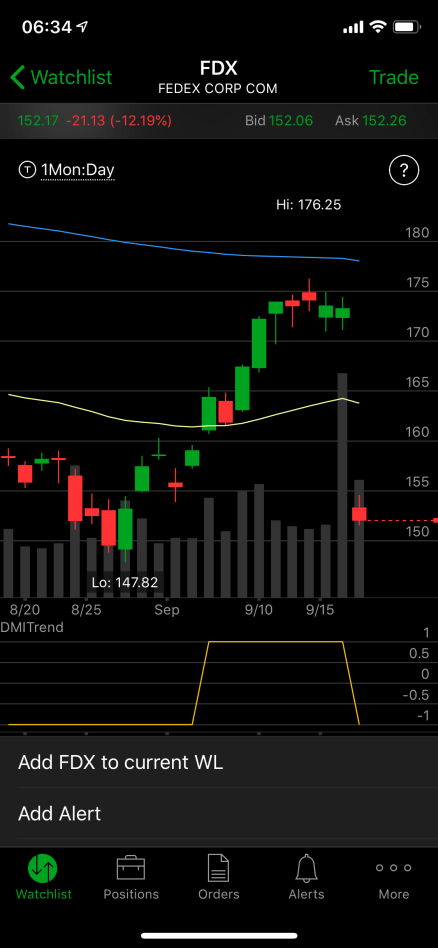
FDX_20190918

At that price, FDX stood $1.58 below the profit zone of my short bull put spread position. After the earnings announcement, the position would come under the same rules as my iron condor. The decline had placed FDX far enough out that it would take 7.65 days to return to the profit zone at the present rate of change. Therefore, the rules would mandate an exit.

In constructing the short spread I had used the same techniques as I use with my iron condors, placing the short strike at around delta 20 and the long at around delta 6. Given the magnitude of the movement, it wasn’t enough.

So I exited that paper trade as well, hypothetically four minutes after the opening bell, for $5.38, or a $4.13 loss.

Shares fell by 11.7% percent over one day, for a -4,283% annual rate. The options position produced a -76.8% loss for a -28,020% annual rate.

Bottom line: The quality of the signals used for trading matters. In this case, the Zacks ESP signal was crucial, and the Zacks rank at 3 was neutral, a sharp contrast to Morningstar’s positive assessment.

I’ll make some more paper trades, next time in alignment with all the signals, and see how things work out.


This is a PAPER TRADE, an experiment whether a strategy I have in mind will work as an earnings play. The symbol that I’ll use for this experiment is FDX, which publishes earnings after the closing bell today, Tuesday, September 17, 2019.

It’s actually two experiments. I’ll look at it both as a short bull put options spread, and also as a long shares trade. The options are leveraged, and so have the prospect of a larger win with a larger, although limited, loss. The share have no leverage, a prospect of less of a win, but also a small loss, although it can, however unlikely, result in a total loss of all that was put in the position if the price goes down to zero. As always in the markets, risk begets reward, Risk is the Mother of Profit.

A stock is a prospect for an earnings play if it meets these criteria from two separate analytical houses. I use Morningstar and require a buy rating of 50% or greater and a four star or better rating overall. I also used Zacks and require a rank of 3 or better and an expected surprise prediction (ESP) of neutral or positive (zero or greater).

Those analytical systems are just the ones I use. There’s nothing magical about them. Other analysts or even a flip of coin can work in selecting an earnings play, although the results will no doubt vary depending upon what we choose.

FDX, as it turns out, is fine on the Morningstar side: A 70% buy rating and four shiny stars. And it starts out fine on the Zacks side, with a rating of 3. However, the ESP has moved into negative territory (-1.26%), disqualifying it from a trade.

Despite FDX being set up for failure on one metric, lets try the paper trades and see how they work out.

The analysis below is for a paper trade. I put no money at risk.

I have (hypothetically) entered a short bull put spread on FDX, using options that trade for the last time 31 days hence, on October 18. The premium is a 3.34 credit and the stock at the time of entry was priced at $172.40.

The profit zone for this position is unlimited on the upside and at $151.66 on the downside.

The implied volatility rank (IVR) stands at 56%.

Premium: $1.25 Expire OTM
FDX-bull put spread Strike Odds Delta
Puts
Long 140.00 95.0% 4
Break-even 153.75 89.0% 10
Short 155.00 83.0% 15

The profit zone covers a 10.8% move to the downside of the entry price.

The risk/reward ratio is 11:1, with maximum risk of $1,375 and maximum reward of $125 per contract.


And that’s the options paper trade. For the shares paper trade, I’ll use an entry debit of $172.40. I shall track both trades through their lifespans.

By Tim Bovee, Portland, Oregon, September 17, 2019

Read More »

Live: Tuesday, Sept. 17, 2019

12:55 p.m. New York time

I’ve posted a hypothetical trade — a paper trade — on FDX to toy with the idea of how best to do earnings plays. The truth of the stock market is that usually, not a lot happens until the approach of an earnings release, and then traders start positioning, causing the price to move, until earnings day, when there is a random quantum leap in one direction or another, or no leap at all. Earnings day is a coin toss, but coin tosses can be profitable.

11:15 a.m. New York time

XOP remains beyond the profit zone of my short iron condor position, but has moved closer to the upper boundary. At the current rate of change it would only take 0.35 days to return to the profit zone.

We are 31 days left before the options expire, and 10 days before I manage the winners — currently only XLY — and move to the sudden-death phase remaining positions — GLD and XOP.

By Tim Bovee, Portland, Oregon, September 17, 2019

Read More »