Trader’s Notebook: S&P 500

Protecting against inflation. Friday was a market holiday in the United States, a fact had forgotten into I jumped out of bed at 5 a.m. Portland, Oregon time, prepared to analyze, only to discover that no one was trading. So I wrote an essay, called “About Value“, that explained my thinking about how to protect my funds from being devalued through inflation.

One result of that holiday writing is that I’m adding gold to my daily analyses, gold being the premier hedge to inflation. It will named Trader’s Notebook: Gold, and will focus on the the gold futures (symbol: GC). My long-running S&P 500 index analyses, focusing on the S&P500 E-mini futures (symbol: ES), has been renamed Trader’s Notebook: S&P 500. Look for the first edition during the session.

3:30 p.m. New York time

Half an hour before the closing bell. The S&P 500 futures continued to decline, reaching into the 5120s, as the middle subwave, wave 3, of the downtrending 5th wave that began on April 17 from 5371.25 continues.

On the chart, the waves labeled wave 3{-13} within downtrending wave 5{-12}.

Wave 3{-13} will be followed by an upward correcrion, wave 4{-13}, and then another downtrending wave 5{-13}, which bring wave 5{-12} to a close, along with its parent, wave C{-11}, and its grandparent, wave B{-10}, all declining waves.

Each will be followed by a rising wave.

9:35 a.m. New York time

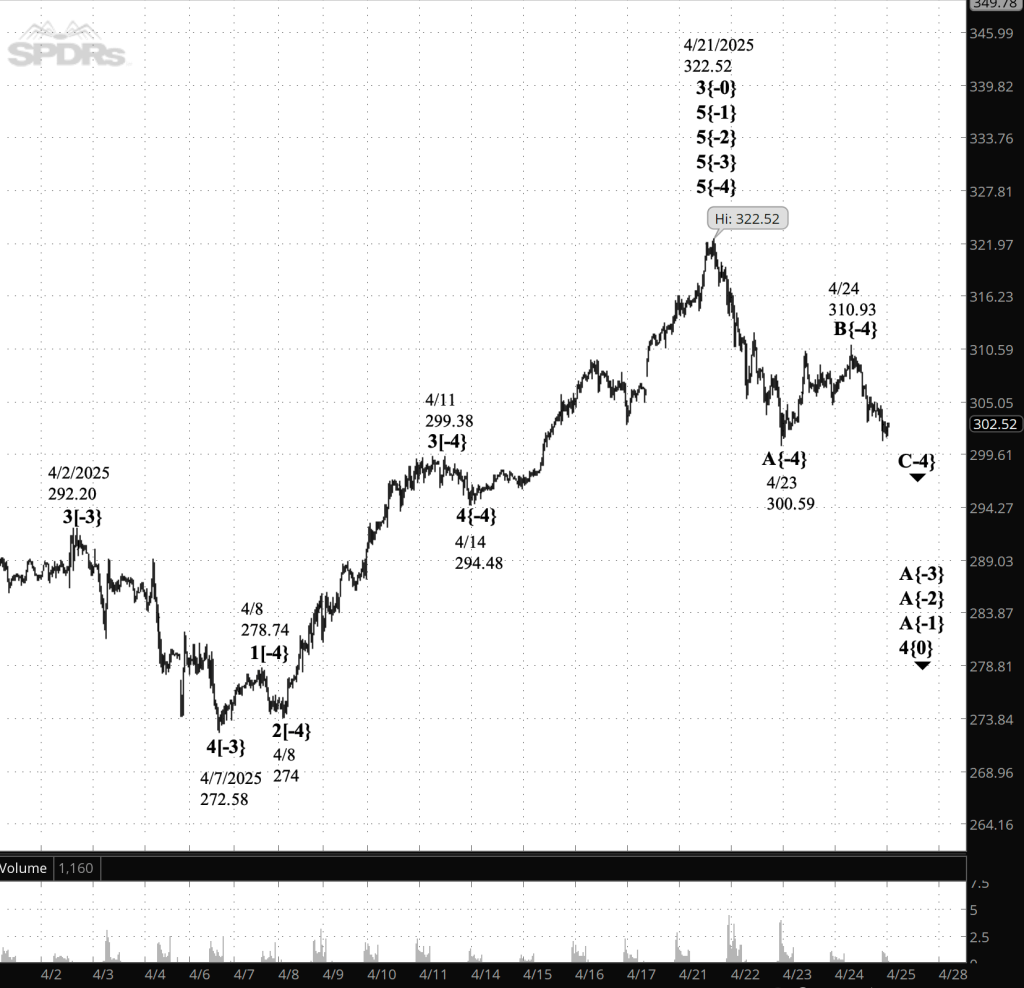
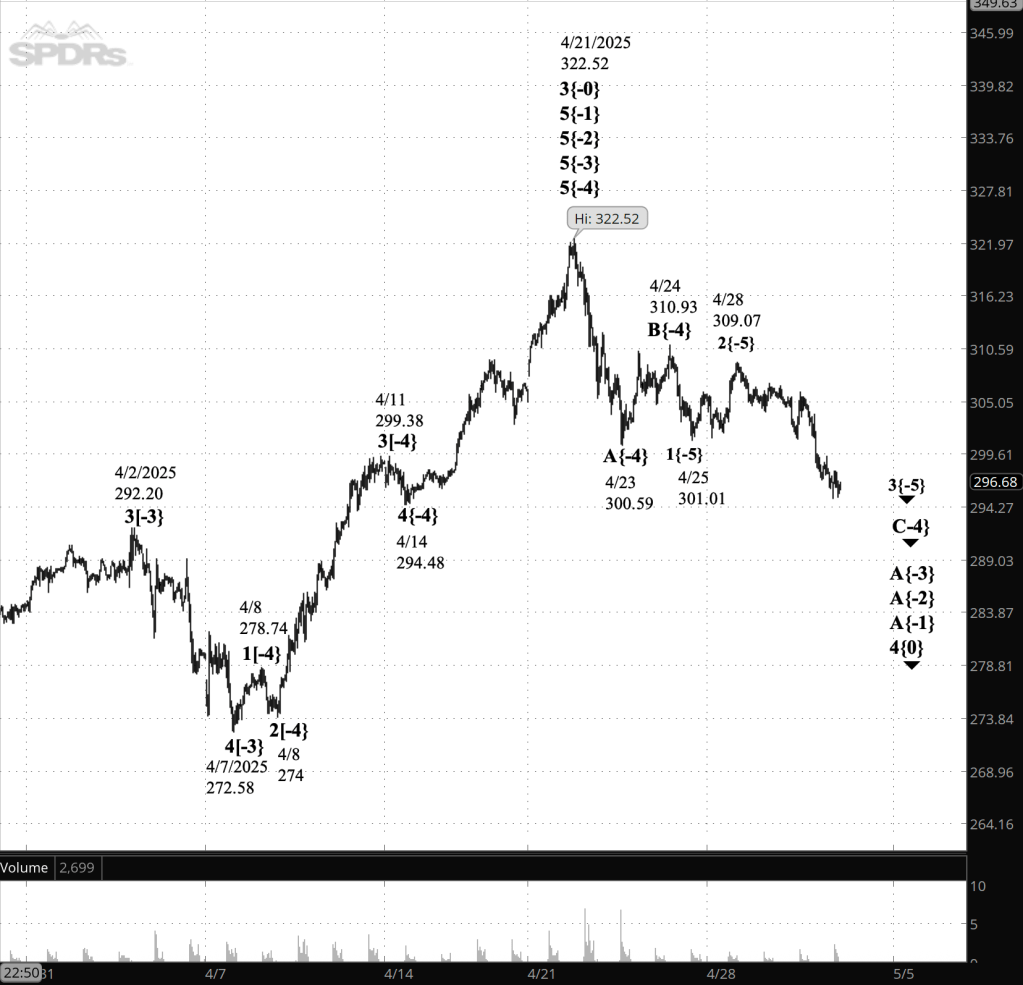
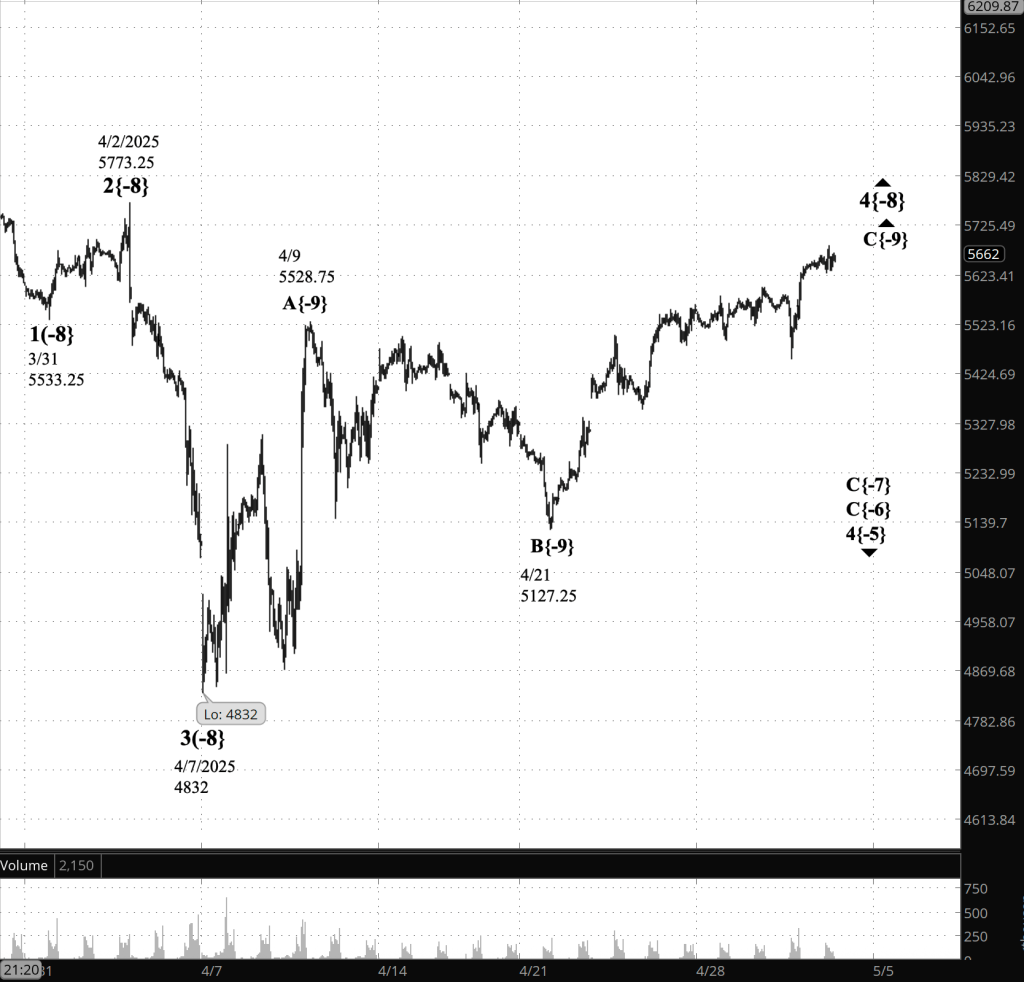
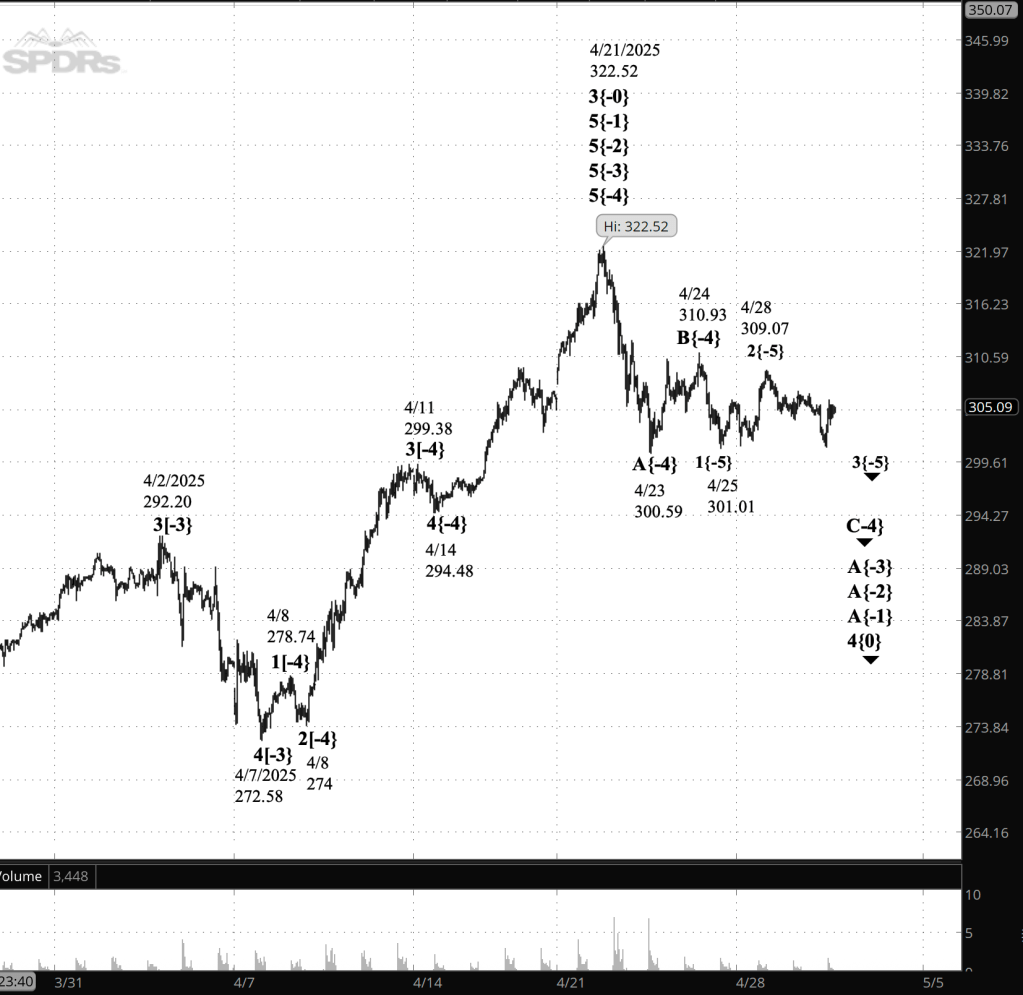
What’s happening now. The S&P 500 E-mini futures declined after trading resumed overnight, from 5306.75 down to the 5230s, and then rose again.

What does it mean? The decline is a downtrending 5th wave that began on April 17 from 5371.25. The 5th wave is a subwave of a C wave that began on April 15 from 5485. Encompassing it all is a 2nd-wave upward correction that began on April 10 from 5146.75, subwave of a larger downtrending 5th wave that began on April 9 from 5528.75.

[S&P 500 E-mini futures at 3:30 p.m, 25-minute bars, with volume]

 Elliott Wave Theory wave labels. Each wave listed on the charts has two components: A wave number, and a subscript in curly brackets that place the wave’s position in the fractal strucutre in relationship to Intermediate degree. The present Intermediate degree, wave 5{0}, began its rise on February 11, 2016 from 1810.10 and is still underway.

The waves referred to above are as follows. Downtrending wave 5{-8} is underway, a subwave of wave C{-7}, also declining, which in turn is a subwave of declining wave C{-6}, with both C waves encompassed by declining wave 4{-5}, which began on December 16, 2024.

Within wave 5{-8}, the second subwave, rising wave 2{-9} is underway and is in declining wave B{-10}.

Wave B{-10} is in its final subwave, wave C{-11}, which in turn is in its final subwave, wave 5{-12}.

Long-term Waves

These are the waves currently in progress under my principal analysis. Each line on the list shows the wave number, with the subscript in curly brackets, the traditional degree name, the starting date, the starting price of the S&P 500 E-mini futures, and the direction of the wave.

  • S&P 500 Index:
  • 5{+3} Supercycle, 7/8/1932, 4.40 (up)
  • 5{+2} Cycle, 12/9/1974, 60.96 (up)
  • 5{+1} Primary, 3/6/2009, 666.79 (up)
  • 5{0} Intermediate, 2/11/2016, 1810.10 (up)
  • 3{-1} Minor, 3/23/2020, 2191.36 (up)
  • 3{-2} Minute, 10/13/2022, 3491.58 (up)
  • S&P 500 Futures
  • 5{-3} Minuette, 4/18/2024, 4963.50 (up)
  • 3{-4} Subminuette, 8/7/2024, 5182 (up)
  • 4{-5} Micro, 12/16/2024, 6163.75 (down)
  • C{-6} Submicro, 2/19/2025, 6166.50 (down)
  • C{-7} Minuscule, 3/25/2025, 5835 (down)
  • 5{-8} (no name), 3/9/2025, 5528.75 (down)

Reading the chart. Price movements — waves – – in Elliott Wave Theory analysis are labeled with numbers within trending waves and letters with corrective waves. The subscripts — numbers in curly brackets — designate the wave’s degree, which, in Elliott Wave analysis, means the relative position of a wave within the larger and smaller structures that make up the chart. R.N. Elliott, who in the 1930s developed the form of analysis that bears his name, viewed the chart as a complex structure of smaller waves nested within larger waves, which in turn are nested within still larger waves. In mathematics it’s called a fractal structure, where at every scale the pattern is similar to the others.

Learning and other resources. Elliott Wave analysis provides context, not prophecy. As the 20th century semanticist Alfred Korzybski put it in his book Science and Sanity (1933), “The map is not the territory … The only usefulness of a map depends on similarity of structure between the empirical world and the map.” And I would add, in the ever-changing markets, we can judge that similarity of structure only after the fact.

See the menu page Analytical Methods for a rundown on where to go for information on Elliott Wave analysis.

By Tim Bovee, Portland, Oregon, April 21, 2025

Disclaimer

Tim Bovee, Private Trader tracks the analysis and trades of a private trader for his own accounts. Nothing in this blog constitutes a recommendation to buy or sell stocks, options or any other financial instrument. The only purpose of this blog is to provide education and entertainment.

No trader is ever 100 percent successful in his or her trades. Trading in the stock and option markets is risky and uncertain. Each trader must make trading decisions for his or her own account, and take responsibility for the consequences.

License

All content on Tim Bovee, Private Trader by Timothy K. Bovee is licensed under a Creative Commons Attribution-ShareAlike 4.0 International License.

Based on a work at www.timbovee.com
About Value

By Tim Bovee, April 18, 2025

I first learned about the impermanence of value on August 15, 1971, at the age of 25. I had just returned from Phu Cat Air Base in Vietnam, the final posting of my service in the Air Force during the war, and was staying with my parents in their Norman, Oklahoma home until I could get my feet on the ground.

It was not a great time to be job hunting. The last recession had ended the prior November, and I was in college again, finishing up my Bachelor’s Degree studies that had been interrupted by a draft notice from President Lyndon Johnson. Also, Mom and Dad seemed happy to have me as a house guest for a while. So I was hopeful, certain that I could wrap up my schooling and start building a career.

I was shocked to run across my Dad, sitting at his desk, sadly looking at a dollar bill. Dad was a certified public accountant and often discussed ins and outs of money. I understood some of it, and rest flew past me, as it often does when you’re 20-something.

“It’s worthless,” he said, shaking his head sadly. “It’s not worth the paper it’s printed on.” For all of his life since his war, World War II, and for all of mine since birth, a paper dollar was something that could be exchanged for gold at the rate of $35 per ounce.

But on that day, Dad sadly explained, President Nixon had changed the rules. A dollar no longer gained its value from gold, but from the full faith and credit of the United States government. He said that “full faith and credit” phrase with a hint of sarcasm in his voice.

A large part of that “full faith and credit” had been in place since 1913: The United States Federal Reserve. With the end of the gold standard, it was the Fed that played a big role in determining the value of dollar, by setting the Federal Funds rate of interest, the percentage banks could charge one another for overnight loans.

The Fed was an independent body, beyond the reach of any politician. And gradually, through periods of inflation and disinflation, we came to trust the “full faith and credit” dollar as being as good as our trust in the Federal Reserve.

Now, decades later, I see history repeating itself—only louder and riskier.

On April 17, 2025, President Trump posted a statement on Truth Social bashing the Fed chair, Jerome Powell, for his caution against the Federal Open Market Committee lowering U.S interest rates, contrary to the European Central Bank’s lowering its rates for the seventh time.

“‘Too Late’ Jerome Powell of the Fed, who is always TOO LATE AND WRONG, yesterday issued a report which was another, and typical, complete ‘mess!’ Oil prices are down, groceries (even eggs!) are down, and the USA is getting RICH ON TARIFFS. Too Late should have lowered Interest Rates, like the ECB, long ago, but he should certainly lower them now.”

And then came his Nixon moment, when he wrote, “Powell’s termination cannot come fast enough!”

With those words, Trump planted his flag on the Fed. Powell’s term expires in May, 2026. If he is forced out earlier, the full faith and credit buttressing the dollar will no longer reside with the Federal Reserve but with the Trump White House.

I trade a lot. Stocks and options. I’ve done so for decades. and one lesson I’ve learned is that I can’t change what happens. My only choice is to adapt, trade smarter, and hope to live to trade another day. And with Trump’s words, like my father before me, I quickly swung into adaptation mode.

The question: How do I best protect that which is mine if there is no longer an independent agency keeping the value of the dollar on a steady course. The enemy of value is inflation, and the dollars I have in my wallet or in the bank or on my credit card, in my future salary or my future Social Security payments, are vulnerable to inflation.

The money needs to go elsewhere.

To protect what I’ve built, I turned to tools my father never had: AI, data modeling, and decades of trading experience.

Dad in 1971 relied on his years of study and practice to protect his funds. In 2025, I have access to brilliant devices that seemingly have access to all the knowledge in the world, available and personalized for my needs at a moment’s notice.

Here’s a table of assets and how they are likely to fare in the new “faithless and creditless” economy, from OpenAI’s ChatGPT-4o:

Asset Class / VehicleProsConsConfidence in Safety
Short-Term U.S. TreasuriesStill backed by U.S. government; low risk; liquidVulnerable to inflation if Fed mismanages rates⭐⭐⭐⭐ (High, short-term)
Series I Savings BondsAdjusts for inflation; U.S.-backedAnnual purchase limit; interest penalty if cashed early⭐⭐⭐⭐ (High)
Gold (GLD ETF or physical)Hedge vs. currency debasement; centuries of valueVolatile short-term; no income; risk of regulation⭐⭐⭐⭐ (High for core holding)
Commodities (e.g., DBC ETF)Real assets; often rise with inflationCyclical; may not track CPI closely; higher volatility⭐⭐⭐ (Medium-High)
Foreign Currency / Intl BondsReduces dollar dependenceCurrency/geopolitical risk; less transparent⭐⭐⭐ (Medium)
Hard Assets (land, real estate)Tangible; income-producing; inflation hedgeIlliquid; management burden; property rights risk⭐⭐⭐⭐ (High if secure)
TIPS (Inflation-Protected Bonds)Inflation-adjusted principalMay lag real inflation; complex taxes⭐⭐⭐ (Medium-High)
Dividend-Aristocrat StocksReliable cash flow; pricing power; defensiveStill equity risk; exposed if dollar weakens⭐⭐ (Medium)
Bitcoin / CryptoDecentralized; immune to central banksHighly volatile; regulatory threats; uncertain in crises⭐⭐ (Low-Medium)
Foreign Bank AccountsDiversification from U.S. banking systemComplex reporting; possible access issues⭐⭐ (Medium)
Cash (USD)Liquid; good for emergenciesLoses value under inflation; banking system risk⭐⭐ (Low-Medium)

My plan, initially, is to move my 90-day Treasury bills to gold, in the form of the exchange-traded fund GLD, trading in and out to avoid risk. Entering and exiting trades is free these days — no fees — so the money is fully available. I’ll invest as usual, using options as having a greater profit. I own a series I U.S. Savings Bond that I’ll continue to hold. And I’ll continue to branch out into other holdings of Medium to High safety as circumstances warrant.

I also have a whole-life insurance policy. I’ve been so impressed by its performance that I asked the AI to rank it separately. Here’s what ChatGPT-4o wrote:

RiskLevelWhy
Solvency RiskVery LowThe issuing company is investment-grade and well-diversified. Regulators monitor solvency ratios.
Inflation Eroding ValueModerateThe real value of both the cash surrender value and death benefit could shrink.
Currency Devaluation (USD)ModerateIf USD weakens sharply, your policy retains nominal value but loses purchasing power.
Policy Rule ChangesVery LowU.S. insurance law changes slowly; no expected legal shifts to affect your contract.

And that’s my plan. Everyone’s holdings are different. Preferences differ. Risk tolerances vary. But one thing is always true: no one likes to lose money.. In my view, if we end up in a society where money has no basis, not even an imaginary one like “full faith and credit” of the government, then it won’t be worth the data bits of the electronic form in which most money exists today. At best, it will be the basis for a future guarantee for currency someday. At worst, it will be a sad memory of what was a great store of value in its time.

Trader’s Notebook

9:25 a.m. New York time

What’s happening now. Today is a market holiday in the United States. (Yes, I forgot and awoke at 5 a.m. my local Portland, Oregon time, ready to analyze). My next Elliott Wave Theory analysis will be on Monday, April 21.

[S&P 500 E-mini futures April 17 close, 15-minute bars, with volume]

How I’ll spend my day. President Trump’s remarks that Fed Chair Jerome Powell’s termination “can’t come soon enough” leads me to think that now is a good time to consider ways to ramp up the protection of my cash, and I’ll write about that at some point today. Abnormal times require abnormal measures.

Elliott Wave Theory wave labels. Each wave listed on the charts has two components: A wave number, and a subscript in curly brackets that place the wave’s position in the fractal strucutre in relationship to Intermediate degree. The present Intermediate degree, wave 5{0}, began its rise on February 11, 2016 from 1810.10 and is still underway.

The waves referred to above are as follows. Downtrending wave 5{-8} is underway, a subwave of wave C{-7}, also declining, which in turn is a subwave of declining wave C{-6}, with both C waves encompassed by declining wave 4{-5}, which began on December 16, 2024.

Within wave 5{-8}, the second subwave, rising wave 2{-9} is underway and is in declining wave B{-10}.

Wave B{-10} is in its final subwave, waver C{-11}, which in turn is in its final subwave, wave 5{-12}.

Long-term Waves

These are the waves currently in progress under my principal analysis. Each line on the list shows the wave number, with the subscript in curly brackets, the traditional degree name, the starting date, the starting price of the S&P 500 E-mini futures, and the direction of the wave.

  • S&P 500 Index:
  • 5{+3} Supercycle, 7/8/1932, 4.40 (up)
  • 5{+2} Cycle, 12/9/1974, 60.96 (up)
  • 5{+1} Primary, 3/6/2009, 666.79 (up)
  • 5{0} Intermediate, 2/11/2016, 1810.10 (up)
  • 3{-1} Minor, 3/23/2020, 2191.36 (up)
  • 3{-2} Minute, 10/13/2022, 3491.58 (up)
  • S&P 500 Futures
  • 5{-3} Minuette, 4/18/2024, 4963.50 (up)
  • 3{-4} Subminuette, 8/7/2024, 5182 (up)
  • 4{-5} Micro, 12/16/2024, 6163.75 (down)
  • C{-6} Submicro, 2/19/2025, 6166.50 (down)
  • C{-7} Minuscule, 3/25/2025, 5835 (down)
  • 5{-8} (no name), 3/9/2025, 5528.75 (down)

Reading the chart. Price movements — waves – – in Elliott Wave Theory analysis are labeled with numbers within trending waves and letters with corrective waves. The subscripts — numbers in curly brackets — designate the wave’s degree, which, in Elliott Wave analysis, means the relative position of a wave within the larger and smaller structures that make up the chart. R.N. Elliott, who in the 1930s developed the form of analysis that bears his name, viewed the chart as a complex structure of smaller waves nested within larger waves, which in turn are nested within still larger waves. In mathematics it’s called a fractal structure, where at every scale the pattern is similar to the others.

Learning and other resources. Elliott Wave analysis provides context, not prophecy. As the 20th century semanticist Alfred Korzybski put it in his book Science and Sanity (1933), “The map is not the territory … The only usefulness of a map depends on similarity of structure between the empirical world and the map.” And I would add, in the ever-changing markets, we can judge that similarity of structure only after the fact.

See the menu page Analytical Methods for a rundown on where to go for information on Elliott Wave analysis.

By Tim Bovee, Portland, Oregon, April 18 2025

Disclaimer

Tim Bovee, Private Trader tracks the analysis and trades of a private trader for his own accounts. Nothing in this blog constitutes a recommendation to buy or sell stocks, options or any other financial instrument. The only purpose of this blog is to provide education and entertainment.

No trader is ever 100 percent successful in his or her trades. Trading in the stock and option markets is risky and uncertain. Each trader must make trading decisions for his or her own account, and take responsibility for the consequences.

License

All content on Tim Bovee, Private Trader by Timothy K. Bovee is licensed under a Creative Commons Attribution-ShareAlike 4.0 International License.

Based on a work at www.timbovee.com
Trader’s Notebook

3:30 p.m. New York time

Half an hour before the closing bell. The S&P 500 futures rose during much of the session, reaching 5359, slightly below the overnight high, 5371.25.

Elliott Wave Theory: The 2nd wave upward correction that began on April 10 continues.

9:35 a.m. New York time

What’s happening now. The S&P 500 E-mini futures rose to 5371.25 overnight and then retreated to the 5310s as the opening bell approached.

What does it mean? I’ve moved the chart closer to allow for greater detail in the Elliott Wave Theory analysis. The chart now shows the downtrending 5th wave that began on April 9.

In yesterday afternoon’s analysis there was some ambiguity about the middle subwave, wave B, of the 2nd-wave upward correction within wave 5. That ambiguity has been resolved. Waved 2 is a simple correction, not a complex one, and is now working through its endgame.

Rising wave C, a subwave of wave 2, will following. When complete, the wave 3 within the 5th wave will begin, carrying the price lower.

[S&P 500 E-mini futures at 3:30 p.m, 15-minute bars, with volume]

 Elliott Wave Theory wave labels. Each wave listed on the charts has two components: A wave number, and a subscript in curly brackets that place the wave’s position in the fractal strucutre in relationship to Intermediate degree. The present Intermediate degree, wave 5{0}, began its rise on February 11, 2016 from 1810.10 and is still underway.

The waves referred to above are as follows. Downtrending wave 5{-8} is underway, a subwave of wave C{-7}, also declining, which in turn is a subwave of declining wave C{-6}, with both C waves encompassed by declining wave 4{-5}, which began on December 16, 2024.

Within wave 5{-8}, the second subwave, rising wave 2{-9} is underway and is in declining wave B{-10}.

Wave B{-10} is in its final subwave, waver C{-11}, which in turn is in its final subwave, wave 5{-12}.

Long-term Waves

These are the waves currently in progress under my principal analysis. Each line on the list shows the wave number, with the subscript in curly brackets, the traditional degree name, the starting date, the starting price of the S&P 500 E-mini futures, and the direction of the wave.

  • S&P 500 Index:
  • 5{+3} Supercycle, 7/8/1932, 4.40 (up)
  • 5{+2} Cycle, 12/9/1974, 60.96 (up)
  • 5{+1} Primary, 3/6/2009, 666.79 (up)
  • 5{0} Intermediate, 2/11/2016, 1810.10 (up)
  • 3{-1} Minor, 3/23/2020, 2191.36 (up)
  • 3{-2} Minute, 10/13/2022, 3491.58 (up)
  • S&P 500 Futures
  • 5{-3} Minuette, 4/18/2024, 4963.50 (up)
  • 3{-4} Subminuette, 8/7/2024, 5182 (up)
  • 4{-5} Micro, 12/16/2024, 6163.75 (down)
  • C{-6} Submicro, 2/19/2025, 6166.50 (down)
  • C{-7} Minuscule, 3/25/2025, 5835 (down)
  • 5{-8} (no name), 3/9/2025, 5528.75 (down)

Reading the chart. Price movements — waves – – in Elliott Wave Theory analysis are labeled with numbers within trending waves and letters with corrective waves. The subscripts — numbers in curly brackets — designate the wave’s degree, which, in Elliott Wave analysis, means the relative position of a wave within the larger and smaller structures that make up the chart. R.N. Elliott, who in the 1930s developed the form of analysis that bears his name, viewed the chart as a complex structure of smaller waves nested within larger waves, which in turn are nested within still larger waves. In mathematics it’s called a fractal structure, where at every scale the pattern is similar to the others.

Learning and other resources. Elliott Wave analysis provides context, not prophecy. As the 20th century semanticist Alfred Korzybski put it in his book Science and Sanity (1933), “The map is not the territory … The only usefulness of a map depends on similarity of structure between the empirical world and the map.” And I would add, in the ever-changing markets, we can judge that similarity of structure only after the fact.

See the menu page Analytical Methods for a rundown on where to go for information on Elliott Wave analysis.

By Tim Bovee, Portland, Oregon, April 17, 2025

Disclaimer

Tim Bovee, Private Trader tracks the analysis and trades of a private trader for his own accounts. Nothing in this blog constitutes a recommendation to buy or sell stocks, options or any other financial instrument. The only purpose of this blog is to provide education and entertainment.

No trader is ever 100 percent successful in his or her trades. Trading in the stock and option markets is risky and uncertain. Each trader must make trading decisions for his or her own account, and take responsibility for the consequences.

License

All content on Tim Bovee, Private Trader by Timothy K. Bovee is licensed under a Creative Commons Attribution-ShareAlike 4.0 International License.

Based on a work at www.timbovee.com
Trader’s Notebook

3:30 p.m. New York time

Half an hour before the closing bell. The S&P 500 futures fell during the session. Elliott Wave Theory: The B wave within the 2nd-wave upward correction that began on April 10 picked up the pace.

An ambiguity on the chart. The B wave seems to be in its 5th subwave. B waves should have three subwaves under the rules of Elliott Wave Theory.

It’s possible that wave B is taking a complex form. I’ll be keeping a close eye on that.

9:35 a.m. New York time

What’s happening now. The S&P 500 E-mini futures rose sharply overnight, from 5340 to 5425, and then dropped back, continuing to trace the same narrow range it has traveled for a day.

What does it mean? Elliott Wave Theory analysis shows the price remains in the falling middle subwave, wave B, of a 2nd-wave upward corrrecrion within downtrending wave 5 that began on April 9.

A rising final subwave, wave C, will bring the wave 2 upward correction to a close. A downtrending 3rd wave will follow, typically the most powerful wave within a trend.

The parent wave, downtrending wave 5, will if typical drop into the neighborhood of the end of the proceeding 3rd wave, 4832 on April 7.

That’s a tendency, not a guarantee. Wave 5 may come up short by a significant amount, or it might continue past the end of wave 3 by a significant amount.

[S&P 500 E-mini futures at 3:30 p.m, 30-minute bars, with volume]

 Elliott Wave Theory wave labels. Each wave listed on the charts has two components: A wave number, and a subscript in curly brackets that place the wave’s position in the fractal strucutre in relationship to Intermediate degree. The present Intermediate degree, wave 5{0}, began its rise on February 11, 2016 from 1810.10 and is still underway.

The waves referred to above are as follows. Downtrending wave 5{-8} is underway, a subwave of wave C{-7}, also declining, which in turn is a subwave of declining wave C{-6}, with both C waves encompassed by declining wave 4{-5}, which began on December 16, 2024.

Within wave 5{-8}, the second subwave, rising wave 2{-9} is underway and is in declining wave B{-10}.

Long-term Waves

These are the waves currently in progress under my principal analysis. Each line on the list shows the wave number, with the subscript in curly brackets, the traditional degree name, the starting date, the starting price of the S&P 500 E-mini futures, and the direction of the wave.

  • S&P 500 Index:
  • 5{+3} Supercycle, 7/8/1932, 4.40 (up)
  • 5{+2} Cycle, 12/9/1974, 60.96 (up)
  • 5{+1} Primary, 3/6/2009, 666.79 (up)
  • 5{0} Intermediate, 2/11/2016, 1810.10 (up)
  • 3{-1} Minor, 3/23/2020, 2191.36 (up)
  • 3{-2} Minute, 10/13/2022, 3491.58 (up)
  • S&P 500 Futures
  • 5{-3} Minuette, 4/18/2024, 4963.50 (up)
  • 3{-4} Subminuette, 8/7/2024, 5182 (up)
  • 4{-5} Micro, 12/16/2024, 6163.75 (down)
  • C{-6} Submicro, 2/19/2025, 6166.50 (down)
  • C{-7} Minuscule, 3/25/2025, 5835 (down)
  • 5{-8} (no name), 3/9/2025, 5528.75 (down)

Reading the chart. Price movements — waves – – in Elliott Wave Theory analysis are labeled with numbers within trending waves and letters with corrective waves. The subscripts — numbers in curly brackets — designate the wave’s degree, which, in Elliott Wave analysis, means the relative position of a wave within the larger and smaller structures that make up the chart. R.N. Elliott, who in the 1930s developed the form of analysis that bears his name, viewed the chart as a complex structure of smaller waves nested within larger waves, which in turn are nested within still larger waves. In mathematics it’s called a fractal structure, where at every scale the pattern is similar to the others.

Learning and other resources. Elliott Wave analysis provides context, not prophecy. As the 20th century semanticist Alfred Korzybski put it in his book Science and Sanity (1933), “The map is not the territory … The only usefulness of a map depends on similarity of structure between the empirical world and the map.” And I would add, in the ever-changing markets, we can judge that similarity of structure only after the fact.

See the menu page Analytical Methods for a rundown on where to go for information on Elliott Wave analysis.

By Tim Bovee, Portland, Oregon, April 16, 2025

Disclaimer

Tim Bovee, Private Trader tracks the analysis and trades of a private trader for his own accounts. Nothing in this blog constitutes a recommendation to buy or sell stocks, options or any other financial instrument. The only purpose of this blog is to provide education and entertainment.

No trader is ever 100 percent successful in his or her trades. Trading in the stock and option markets is risky and uncertain. Each trader must make trading decisions for his or her own account, and take responsibility for the consequences.

License

All content on Tim Bovee, Private Trader by Timothy K. Bovee is licensed under a Creative Commons Attribution-ShareAlike 4.0 International License.

Based on a work at www.timbovee.com
Trader’s Notebook

3:30 p.m. New York time

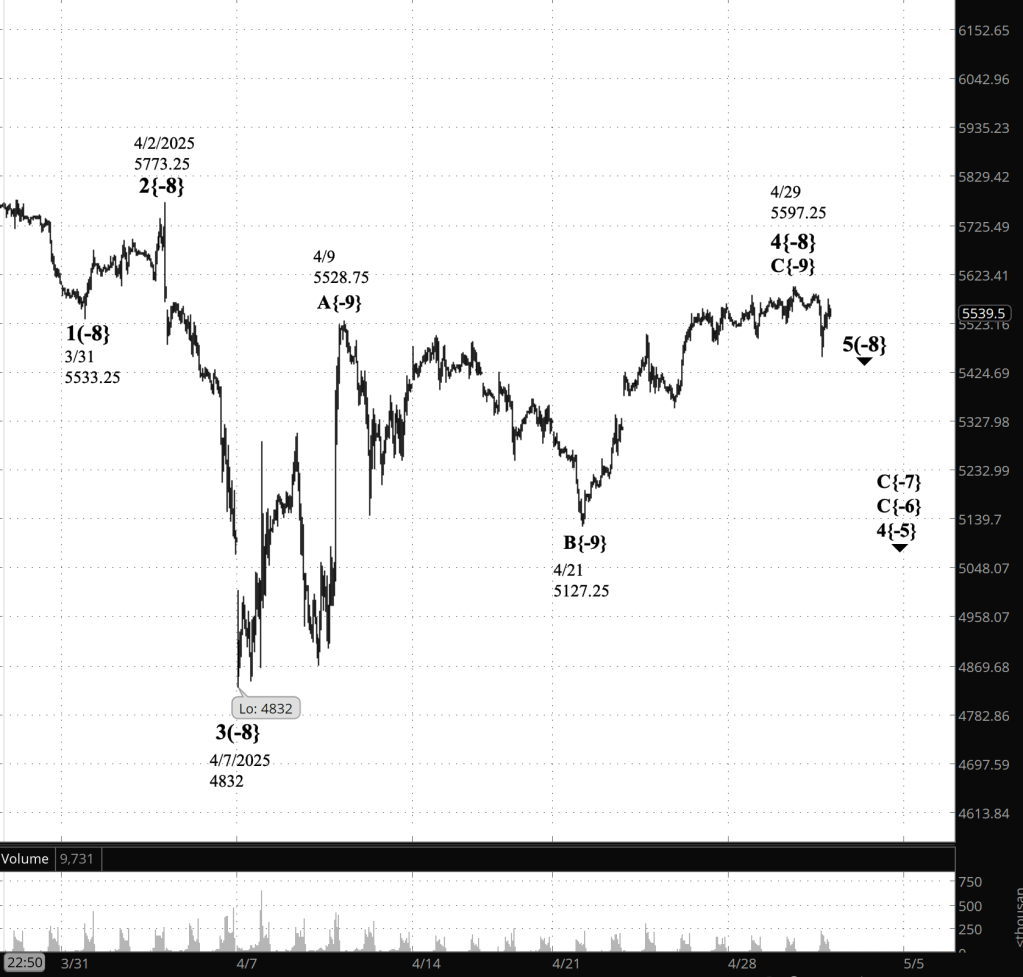
Half an hour before the closing bell. The S&P 500 futures has traded in a narrow range during the session.

The lack of movement in Elliott Wave Theory means no change in the analysis. Now underway: Declining wave B within a 2nd-wave upward correction within a downtrending 5th wave.

9:35 a.m. New York time

What’s happening now. The S&P 500 E-mini futures continued to work their way downward from the April 14 peak, 5497.75, reaching the 5410s as the open bell approached.

What does it mean? The Elliott Wave Theory question at the opening bell is the nature of the April 14 peak the end of the wave 2 upward correction that began on April 10? Or is it the end of the correction’s initial subwave, wave A? Or is the rise that began on April 10 still underway?

Based mainly on proportionality, I’ve marked the chart to show the April 14 high as the end of wave A in the upward correction, the first subwave. Under this scenario, declining wave B is now underway, and will be followed by rising wave C, which will carry wave 2 to its end.

The 2nd-wave correction is part of a declining 5th wave that negan on April 9. When wave 2 is complete, downtrending wave 3 will begin, typically the the most powerful wave within a trend.

That’s the scenario I’ve selected. The other scenarios are equally possible. Time will tell.

[S&P 500 E-mini futures at 3:30 p.m, 30-minute bars, with volume]

 Elliott Wave Theory wave labels. Each wave listed on the charts has two components: A wave number, and a subscript in curly brackets that place the wave’s position in the fractal strucutre in relationship to Intermediate degree. The present Intermediate degree, wave 5{0}, began its rise on February 11, 2016 from 1810.10 and is still underway.

The waves referred to above are as follows. Downtrending wave 5{-8} is underway, a subwave of wave C{-7}, also declining, which in turn is a subwave of declining wave C{-6}, with both C waves encompassed by declining wave 4{-5}, which began on December 16, 2024.

Within wave 5{-8}, the second subwave, rising wave 2{-9} is underway and is in declining wave B{-10}.

Long-term Waves

These are the waves currently in progress under my principal analysis. Each line on the list shows the wave number, with the subscript in curly brackets, the traditional degree name, the starting date, the starting price of the S&P 500 E-mini futures, and the direction of the wave.

  • S&P 500 Index:
  • 5{+3} Supercycle, 7/8/1932, 4.40 (up)
  • 5{+2} Cycle, 12/9/1974, 60.96 (up)
  • 5{+1} Primary, 3/6/2009, 666.79 (up)
  • 5{0} Intermediate, 2/11/2016, 1810.10 (up)
  • 3{-1} Minor, 3/23/2020, 2191.36 (up)
  • 3{-2} Minute, 10/13/2022, 3491.58 (up)
  • S&P 500 Futures
  • 5{-3} Minuette, 4/18/2024, 4963.50 (up)
  • 3{-4} Subminuette, 8/7/2024, 5182 (up)
  • 4{-5} Micro, 12/16/2024, 6163.75 (down)
  • C{-6} Submicro, 2/19/2025, 6166.50 (down)
  • C{-7} Minuscule, 3/25/2025, 5835 (down)
  • 5{-8} (no name), 3/9/2025, 5528.75 (down)

Reading the chart. Price movements — waves – – in Elliott Wave Theory analysis are labeled with numbers within trending waves and letters with corrective waves. The subscripts — numbers in curly brackets — designate the wave’s degree, which, in Elliott Wave analysis, means the relative position of a wave within the larger and smaller structures that make up the chart. R.N. Elliott, who in the 1930s developed the form of analysis that bears his name, viewed the chart as a complex structure of smaller waves nested within larger waves, which in turn are nested within still larger waves. In mathematics it’s called a fractal structure, where at every scale the pattern is similar to the others.

Learning and other resources. Elliott Wave analysis provides context, not prophecy. As the 20th century semanticist Alfred Korzybski put it in his book Science and Sanity (1933), “The map is not the territory … The only usefulness of a map depends on similarity of structure between the empirical world and the map.” And I would add, in the ever-changing markets, we can judge that similarity of structure only after the fact.

See the menu page Analytical Methods for a rundown on where to go for information on Elliott Wave analysis.

By Tim Bovee, Portland, Oregon, April 15, 2025

Disclaimer

Tim Bovee, Private Trader tracks the analysis and trades of a private trader for his own accounts. Nothing in this blog constitutes a recommendation to buy or sell stocks, options or any other financial instrument. The only purpose of this blog is to provide education and entertainment.

No trader is ever 100 percent successful in his or her trades. Trading in the stock and option markets is risky and uncertain. Each trader must make trading decisions for his or her own account, and take responsibility for the consequences.

License

All content on Tim Bovee, Private Trader by Timothy K. Bovee is licensed under a Creative Commons Attribution-ShareAlike 4.0 International License.

Based on a work at www.timbovee.com
Trader’s Notebook

3:30 p.m. New York time

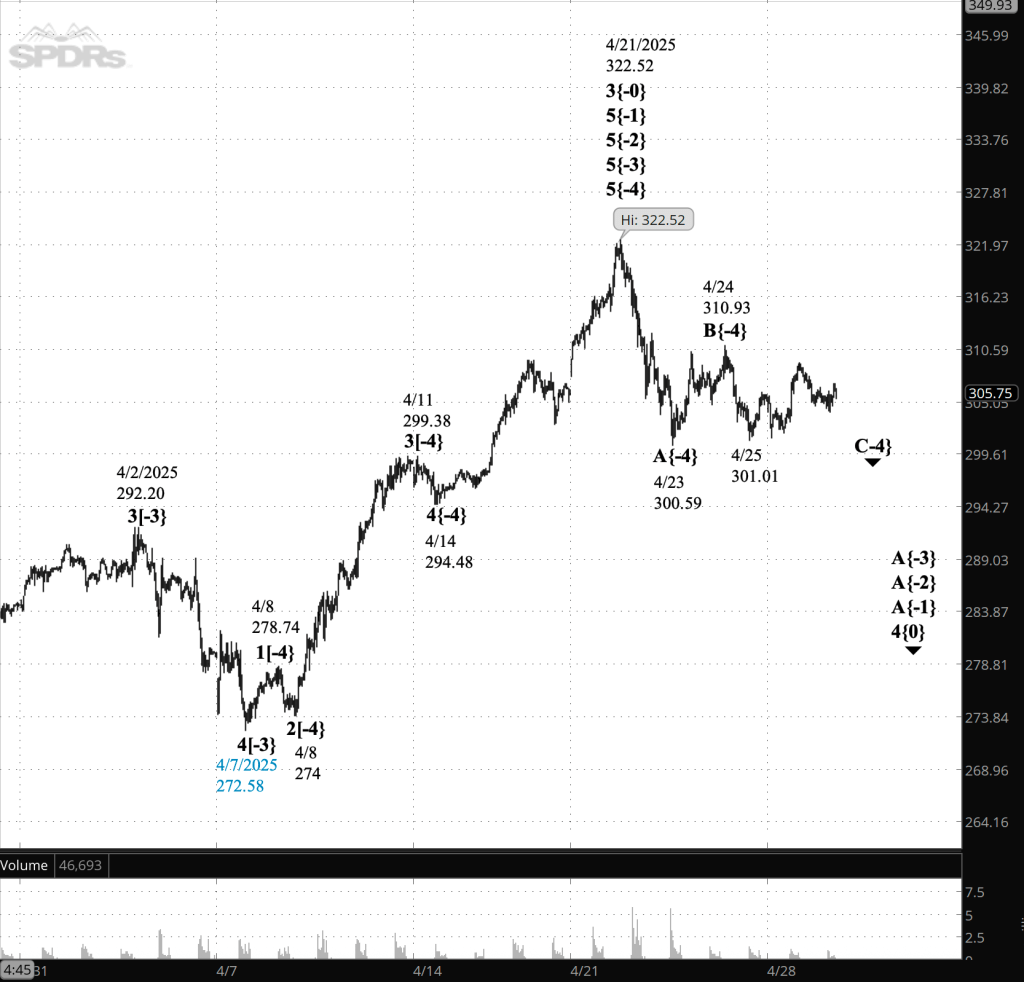
Half an hour before the closing bell. The S&P 500 futures fell during the session, reaching into the 5390s before reclaiming a portion of the decline.

All in all, the movements were quite small. Applying Elliott Wave Theory analysis, I saw nothing large enough to signal a significant change: Wave 2, an upward correction, continues. It is a subwave of a larger downtrending 5th wave.

9:35 a.m. New York time

What’s happening now. The S&P 500 E-mini futures resumed trading in the 5470s, dropped sharply into the 5410s, and then overnight worked its way back into the 5490s.

What does it mean? The continuation of last week’s rise, in terms of Elliott Wave Theory analysis, sees the 2nd-wave upward correvtion that began on April 10 as continuing.

When wave 2 is complete, downtrendng wave 3 will begin. Both waves are subwave of downtrending 5th wave that began on April 9 from 5528.75.

Quite often, 5th waves will finish below the startng point of wave 3, sometimes significantly below . But not always. Wave 5 is a quirky beast that also comes up short, failing to reach the end of wave 3 in a pattern called truncation, or far beyond that end point, called extension.

At this point there is not even a hint of whih pattern this wave 5 might follow.

Wave 5 is the final subwave of declining wave C, which began on March 25 from 5835. The end of wave 5 will also be the end of wave C, and also of its parent wave, a larger wave C that began on February 19 from 6166.50.

And encompassing all is a months-long falling 4th wave that began on December 16, 2024 from 6163.75.

[S&P 500 E-mini futures at 3:30 p.m, 30-minute bars, with volume]

 Elliott Wave Theory wave labels. Each wave listed on the charts has two components: A wave number, and a subscript in curly brackets that place the wave’s position in the fractal strucutre in relationship to Intermediate degree. The present Intermediate degree, wave 5{0}, began its rise on February 11, 2016 from 1810.10 and is still underway.

The waves referred to above are as follows. Downtrending wave 5{-8} is underway, a subwave of wave C{-7}, also declining, which in turn is a subwave of declining wave C{-6}, with both C waves encompassed by declining wave 4{-5}, which began on December 16, 2024.

Within wave 5{-8}, the second subwave, rising wave 2{-9} is underway.

Long-term Waves

These are the waves currently in progress under my principal analysis. Each line on the list shows the wave number, with the subscript in curly brackets, the traditional degree name, the starting date, the starting price of the S&P 500 E-mini futures, and the direction of the wave.

  • S&P 500 Index:
  • 5{+3} Supercycle, 7/8/1932, 4.40 (up)
  • 5{+2} Cycle, 12/9/1974, 60.96 (up)
  • 5{+1} Primary, 3/6/2009, 666.79 (up)
  • 5{0} Intermediate, 2/11/2016, 1810.10 (up)
  • 3{-1} Minor, 3/23/2020, 2191.36 (up)
  • 3{-2} Minute, 10/13/2022, 3491.58 (up)
  • S&P 500 Futures
  • 5{-3} Minuette, 4/18/2024, 4963.50 (up)
  • 3{-4} Subminuette, 8/7/2024, 5182 (up)
  • 4{-5} Micro, 12/16/2024, 6163.75 (down)
  • C{-6} Submicro, 2/19/2025, 6166.50 (down)
  • C{-7} Minuscule, 3/25/2025, 5835 (down)
  • 5{-8} (no name), 3/9/2025, 5528.75 (down)

Reading the chart. Price movements — waves – – in Elliott Wave Theory analysis are labeled with numbers within trending waves and letters with corrective waves. The subscripts — numbers in curly brackets — designate the wave’s degree, which, in Elliott Wave analysis, means the relative position of a wave within the larger and smaller structures that make up the chart. R.N. Elliott, who in the 1930s developed the form of analysis that bears his name, viewed the chart as a complex structure of smaller waves nested within larger waves, which in turn are nested within still larger waves. In mathematics it’s called a fractal structure, where at every scale the pattern is similar to the others.

Learning and other resources. Elliott Wave analysis provides context, not prophecy. As the 20th century semanticist Alfred Korzybski put it in his book Science and Sanity (1933), “The map is not the territory … The only usefulness of a map depends on similarity of structure between the empirical world and the map.” And I would add, in the ever-changing markets, we can judge that similarity of structure only after the fact.

See the menu page Analytical Methods for a rundown on where to go for information on Elliott Wave analysis.

By Tim Bovee, Portland, Oregon, April 14, 2025

Disclaimer

Tim Bovee, Private Trader tracks the analysis and trades of a private trader for his own accounts. Nothing in this blog constitutes a recommendation to buy or sell stocks, options or any other financial instrument. The only purpose of this blog is to provide education and entertainment.

No trader is ever 100 percent successful in his or her trades. Trading in the stock and option markets is risky and uncertain. Each trader must make trading decisions for his or her own account, and take responsibility for the consequences.

License

All content on Tim Bovee, Private Trader by Timothy K. Bovee is licensed under a Creative Commons Attribution-ShareAlike 4.0 International License.

Based on a work at www.timbovee.com
Trader’s Notebook

3:30 p.m. New York time

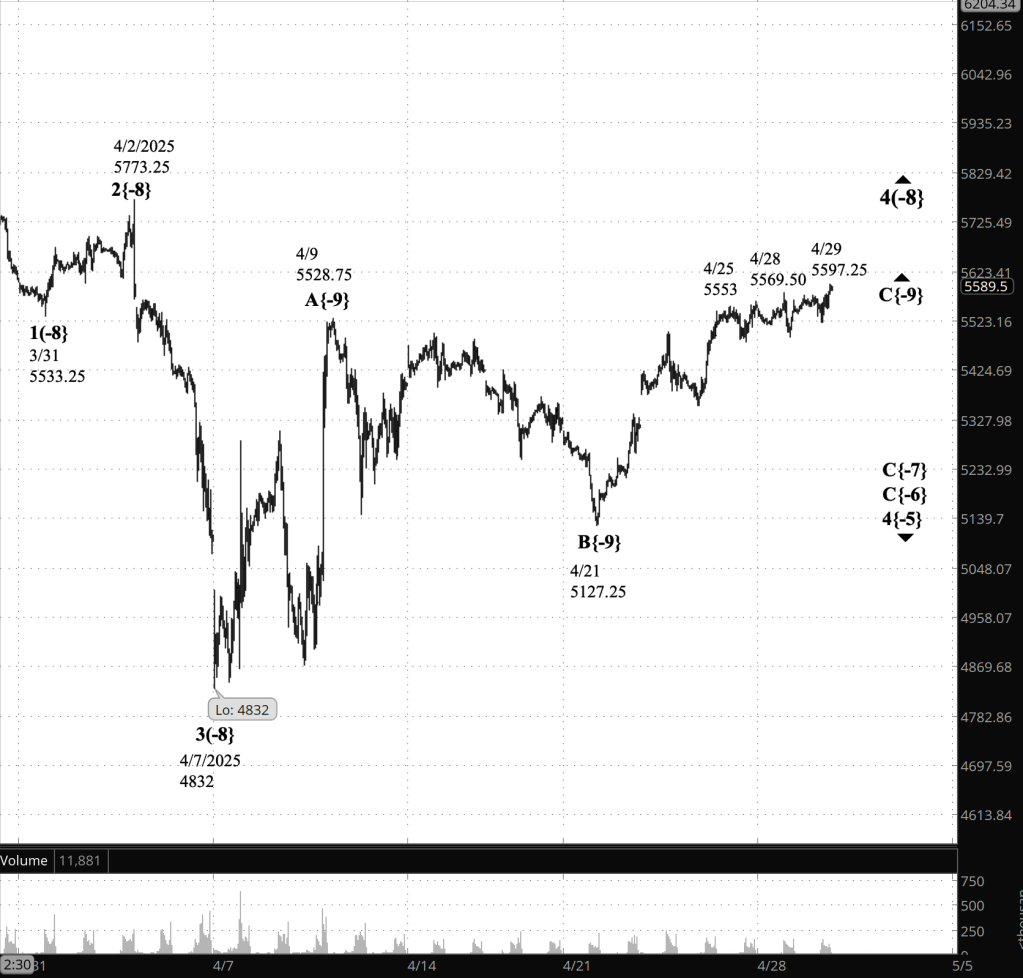
Half an hour before the closing bell. The S&P 500 futures rose during the session, reaching 5418.25 and then pulling back slightly.

Map of a corretion. The movement is part of a 2nd wave upward correction that began on March 10 from 5146.75. The price today has so far risen to a peak, 5418.25.

Elliott Wave Theory maps it like this:

  • The first subwave of the correction, rising wave A, is nearing completion.
  • Wave A is on its 5th subwave, meaning it is taking the form of a Zigzag.
  • When wave 5 is complete, wave A will also be complete, and declining wave B will begin.
  • It is possible that wave A ended at today’s peak. If so, the subsequent decline is the initial subwave of falling wave B.

Here is a chart showing the upward correction and its subwaves.

[S&P 500 E-mini futures at 3:20 p.m, 3-minute bars, with volume]

9:35 a.m. New York time

What’s happening now. The S&P 500 E-mini futures rose overnight. amid a larger downtrend that began on April 9.

What does it mean? The downtrend, in Elliott Wave Theory, is a 5th wave, the final wave within two C waves, one larger than the other, all working through their journeys within a 4th-wave downward correction that began on December 16, 2024.

The 5th wave has completed its first subwave and is now in its 2nd-wave upward correction. Afterward, it will resume its decline in subwave 3, typically the most powerful wae in a trend.

The rule of Elliott Wave Theory governing 2nd waves states that wave 2 cannot move beyond the start of the preceding wave 1. The 1st wave within wave 5 began on April 9 from 5528.75, and that’s the upper limit for the present wave 2. If it moves higher than that, then it’s back the drawing board for a fresh analysis.

[S&P 500 E-mini futures at 3:30 p.m, 30-minute bars, with volume]

 Elliott Wave Theory wave labels. Each wave listed on the charts has two components: A wave number, and a subscript in curly brackets that place the wave’s position in the fractal strucutre in relationship to Intermediate degree. The present Intermediate degree, wave 5{0}, began its rise on February 11, 2016 from 1810.10 and is still underway.

The waves referred to above are as follows. Downtrending wave 5{-8} is underway, a subwave of wave C{-7}, also declining, which in turn is a subwave of declining wave C{-6}, with both C waves encompassed by declining wave 4{-5}, which began on December 16, 2024.

Within wave 5{-8}, the second subwave, rising wave 2{-9} is underway.

Long-term Waves

These are the waves currently in progress under my principal analysis. Each line on the list shows the wave number, with the subscript in curly brackets, the traditional degree name, the starting date, the starting price of the S&P 500 E-mini futures, and the direction of the wave.

  • S&P 500 Index:
  • 5{+3} Supercycle, 7/8/1932, 4.40 (up)
  • 5{+2} Cycle, 12/9/1974, 60.96 (up)
  • 5{+1} Primary, 3/6/2009, 666.79 (up)
  • 5{0} Intermediate, 2/11/2016, 1810.10 (up)
  • 3{-1} Minor, 3/23/2020, 2191.36 (up)
  • 3{-2} Minute, 10/13/2022, 3491.58 (up)
  • S&P 500 Futures
  • 5{-3} Minuette, 4/18/2024, 4963.50 (up)
  • 3{-4} Subminuette, 8/7/2024, 5182 (up)
  • 4{-5} Micro, 12/16/2024, 6163.75 (down)
  • C{-6} Submicro, 2/19/2025, 6166.50 (down)
  • C{-7} Minuscule, 3/25/2025, 5835 (down)
  • 5{-8} (no name), 3/9/2025, 5528.75 (down)

Reading the chart. Price movements — waves – – in Elliott Wave Theory analysis are labeled with numbers within trending waves and letters with corrective waves. The subscripts — numbers in curly brackets — designate the wave’s degree, which, in Elliott Wave analysis, means the relative position of a wave within the larger and smaller structures that make up the chart. R.N. Elliott, who in the 1930s developed the form of analysis that bears his name, viewed the chart as a complex structure of smaller waves nested within larger waves, which in turn are nested within still larger waves. In mathematics it’s called a fractal structure, where at every scale the pattern is similar to the others.

Learning and other resources. Elliott Wave analysis provides context, not prophecy. As the 20th century semanticist Alfred Korzybski put it in his book Science and Sanity (1933), “The map is not the territory … The only usefulness of a map depends on similarity of structure between the empirical world and the map.” And I would add, in the ever-changing markets, we can judge that similarity of structure only after the fact.

See the menu page Analytical Methods for a rundown on where to go for information on Elliott Wave analysis.

By Tim Bovee, Portland, Oregon, April 11, 2025

Disclaimer

Tim Bovee, Private Trader tracks the analysis and trades of a private trader for his own accounts. Nothing in this blog constitutes a recommendation to buy or sell stocks, options or any other financial instrument. The only purpose of this blog is to provide education and entertainment.

No trader is ever 100 percent successful in his or her trades. Trading in the stock and option markets is risky and uncertain. Each trader must make trading decisions for his or her own account, and take responsibility for the consequences.

License

All content on Tim Bovee, Private Trader by Timothy K. Bovee is licensed under a Creative Commons Attribution-ShareAlike 4.0 International License.

Based on a work at www.timbovee.com

Trader’s Notebook

3:30 p.m. New York time

Half an hour before the closing bell. The S&P 500 futures fell into the 5140s during the session and then began to rise.

Elliott Wave Theory. The 5-wave decline is the initial subwave, wave 1, within the downtrending wave 5 that began on April 9. The subsequent rise, still underway, is wave 2.

9:35 a.m. New York time

What’s happening now. The S&P 500 E-mini futures fell overnight, momentarily rising slightly following release of the Consumer Price Index data for March. The declne rapidly resumed.

What does it mean? My analysis using Elliott Wave Theory sees the decline as marking the end of the 4th-wave upward correction that began on April 7. A downtrending 5th wave began on April 9 from 5528.75.

No one will be surprised when I say that there are ambiguities. The 4th wave within the rise lacks clarity, such is is the power of the upward push. However, it is consistent with a 4th wave, and that means the final subwave, wave 5, must follow under the rules of Elliott Wave Theory. Nonetheless, if the price reduces and moved abovr 5528.75, then the 4th-wave upward correction is still underway.

[S&P 500 E-mini futures at 3:30 p.m, 30-minute bars, with volume]

 Elliott Wave Theory wave labels. Each wave listed on the charts has two components: A wave number, and a subscript in curly brackets that place the wave’s position in the fractal strucutre in relationship to Intermediate degree. The present Intermediate degree, wave 5{0}, began its rise on February 11, 2016 from 1810.10 and is still underway.

The waves referred to above are as follows. Downtrending wave 5{-8} is underway, a subwave of wave C{-7}, also declining, which in turn is a subwave of declining wave C{-6}, with both C waves encompassed by declining wave 4{-5}, which began on December 16, 2024.

Within wave C{-9}, the final subwave within wave 4{-8}, I count a clear corrective wave, wave 4{-10}, which means that the subsequent rise is wave 5{-10}, the final wave within wave C{-9}.

Long-term Waves

These are the waves currently in progress under my principal analysis. Each line on the list shows the wave number, with the subscript in curly brackets, the traditional degree name, the starting date, the starting price of the S&P 500 E-mini futures, and the direction of the wave.

  • S&P 500 Index:
  • 5{+3} Supercycle, 7/8/1932, 4.40 (up)
  • 5{+2} Cycle, 12/9/1974, 60.96 (up)
  • 5{+1} Primary, 3/6/2009, 666.79 (up)
  • 5{0} Intermediate, 2/11/2016, 1810.10 (up)
  • 3{-1} Minor, 3/23/2020, 2191.36 (up)
  • 3{-2} Minute, 10/13/2022, 3491.58 (up)
  • S&P 500 Futures
  • 5{-3} Minuette, 4/18/2024, 4963.50 (up)
  • 3{-4} Subminuette, 8/7/2024, 5182 (up)
  • 4{-5} Micro, 12/16/2024, 6163.75 (down)
  • C{-6} Submicro, 2/19/2025, 6166.50 (down)
  • C{-7} Minuscule, 3/25/2025, 5835 (down)

Reading the chart. Price movements — waves – – in Elliott Wave Theory analysis are labeled with numbers within trending waves and letters with corrective waves. The subscripts — numbers in curly brackets — designate the wave’s degree, which, in Elliott Wave analysis, means the relative position of a wave within the larger and smaller structures that make up the chart. R.N. Elliott, who in the 1930s developed the form of analysis that bears his name, viewed the chart as a complex structure of smaller waves nested within larger waves, which in turn are nested within still larger waves. In mathematics it’s called a fractal structure, where at every scale the pattern is similar to the others.

Learning and other resources. Elliott Wave analysis provides context, not prophecy. As the 20th century semanticist Alfred Korzybski put it in his book Science and Sanity (1933), “The map is not the territory … The only usefulness of a map depends on similarity of structure between the empirical world and the map.” And I would add, in the ever-changing markets, we can judge that similarity of structure only after the fact.

See the menu page Analytical Methods for a rundown on where to go for information on Elliott Wave analysis.

By Tim Bovee, Portland, Oregon, April 10, 2025

Disclaimer

Tim Bovee, Private Trader tracks the analysis and trades of a private trader for his own accounts. Nothing in this blog constitutes a recommendation to buy or sell stocks, options or any other financial instrument. The only purpose of this blog is to provide education and entertainment.

No trader is ever 100 percent successful in his or her trades. Trading in the stock and option markets is risky and uncertain. Each trader must make trading decisions for his or her own account, and take responsibility for the consequences.

License

All content on Tim Bovee, Private Trader by Timothy K. Bovee is licensed under a Creative Commons Attribution-ShareAlike 4.0 International License.

Based on a work at www.timbovee.com
Trader’s Notebook

3:30 p.m. New York time

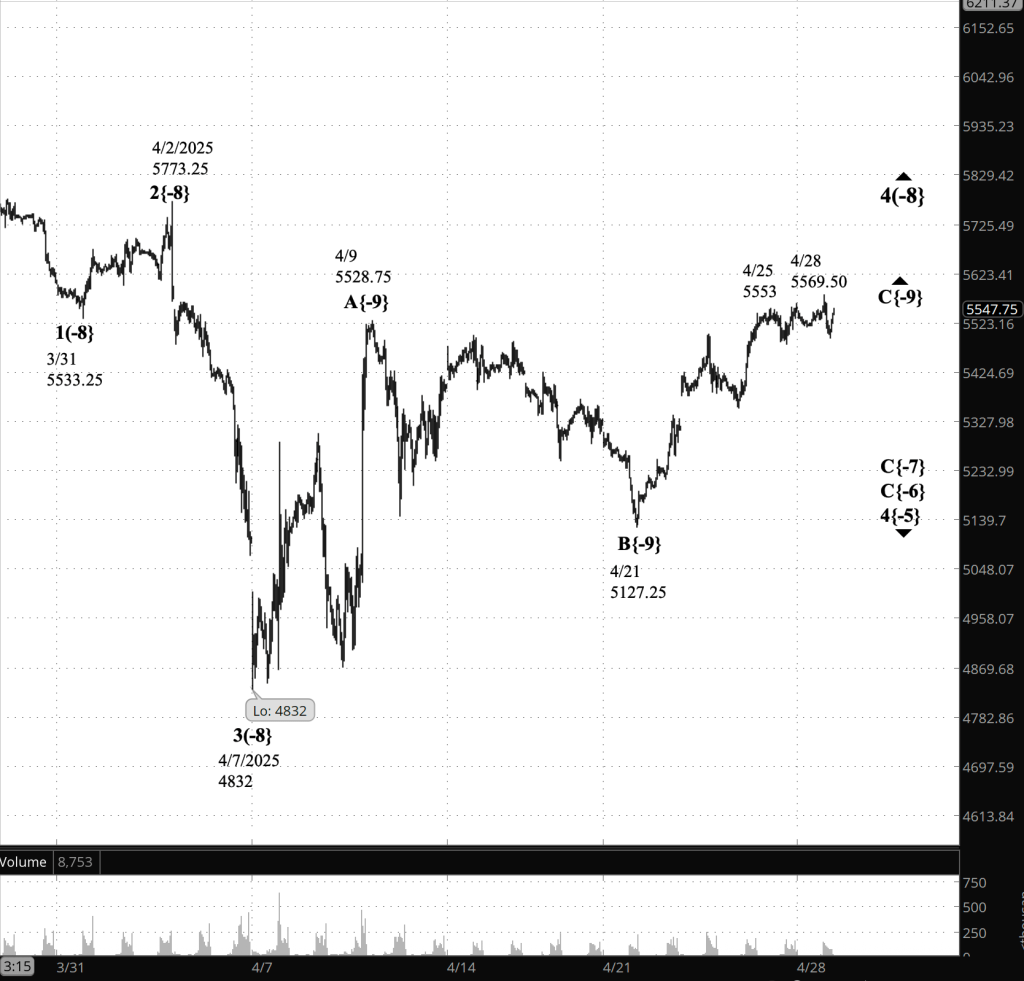
Half an hour before the closing bell. The S&P 500 futures rose sharply during the session as President Trump lowered the reciprocal tariffs levied against many nations in the world from 25% to 10%, a temporary move lasting 90 days. He also raised the tariffs levied on China from 104% to 125%

Elliott Wave Theory. The sudden rise marked the end of declining wave B, the middle subwave a 4th-wave rising correction, and the beginning of the final subwave, wave C. The C wave rapidly rose from 5025 and so far as reached into the 5450s.

When the C wave is complete, it will also be the end of the parent 4th-wave upward correction. A downtrending 5th-wave will follow. Fifth waves are quirky, but it could well reach down into the 4640s or 4650s, below the April 7 low, 4832, that ended the preceding 3rd wave.

The waves as numbered in the chart: Wave C{-9} began its rise today and will complete rising wave 4{-8}. Downtrending wave 5{-8} wil following, moving below the endpoint of wave 3{-8}, on April 7.

9:35 a.m. New York time

What’s happening now. The S&P 500 E-mini futures rose back to the 23.6% Fibonacci retracement level as the upward correction that began on April 7 continues.

What does it mean? Elliott Wave Theory sees the correction as a 4th wave, a break in the downward movement that began on March 25. That decline is a subwave within an even larger correction, wave C within wave 4. That larger 4th wave began on December 16, 2024 from 6163.75.

Returning to the smaller upward correction, the 4th wave that began on March 25. The first subwave, rising wave A, had three subwaves. That tells us that the correction is taking the form of a Flat.

That has implications for Wave B, which in a Flat must retrace at least 90% of wave A, which covered 473.25 beginning to end. Wave B began its decline from 5305.25, the end of wave A, and has reached a low point so far of 4871.75, having covered 433.50. The calculation is the length of wave B so far divided by the length of wave A, total: 433.50 / 473.25 = 0.91.

So wave B has met its requirement, having covered 91% of wave A. It might go farther, it might even go below the start of wave A. Or it might fall short. No matter. It has met the 90% rule and is a proper B wave in a Flat.

[S&P 500 E-mini futures at 3:30 p.m, 25-minute bars, with volume]

 Elliott Wave Theory wave labels. Each wave listed on the charts has two components: A wave number, and a subscript in curly brackets that place the wave’s position in the fractal strucutre in relationship to Intermediate degree. The present Intermediate degree, wave 5{0}, began its rise on February 11, 2016 from 1810.10 and is still underway.

The waves referred to above are as follows. Rising wave 4{-8} is underway, a subwave of wave C{-7}, also declining, which in turn is a subwave of declining wave C{-6}, with both C waves encompassed by declining wave 4{-5}, which began on December 16, 2024.

Within wave 4{-8}, wave B{-9} is underway and has retraced more than 90% of wave A{-9}.

Long-term Waves

These are the waves currently in progress under my principal analysis. Each line on the list shows the wave number, with the subscript in curly brackets, the traditional degree name, the starting date, the starting price of the S&P 500 E-mini futures, and the direction of the wave.

  • S&P 500 Index:
  • 5{+3} Supercycle, 7/8/1932, 4.40 (up)
  • 5{+2} Cycle, 12/9/1974, 60.96 (up)
  • 5{+1} Primary, 3/6/2009, 666.79 (up)
  • 5{0} Intermediate, 2/11/2016, 1810.10 (up)
  • 3{-1} Minor, 3/23/2020, 2191.36 (up)
  • 3{-2} Minute, 10/13/2022, 3491.58 (up)
  • S&P 500 Futures
  • 5{-3} Minuette, 4/18/2024, 4963.50 (up)
  • 3{-4} Subminuette, 8/7/2024, 5182 (up)
  • 4{-5} Micro, 12/16/2024, 6163.75 (down)
  • C{-6} Submicro, 2/19/2025, 6166.50 (down)
  • C{-7} Minuscule, 3/25/2025, 5835 (down)

Reading the chart. Price movements — waves – – in Elliott Wave Theory analysis are labeled with numbers within trending waves and letters with corrective waves. The subscripts — numbers in curly brackets — designate the wave’s degree, which, in Elliott Wave analysis, means the relative position of a wave within the larger and smaller structures that make up the chart. R.N. Elliott, who in the 1930s developed the form of analysis that bears his name, viewed the chart as a complex structure of smaller waves nested within larger waves, which in turn are nested within still larger waves. In mathematics it’s called a fractal structure, where at every scale the pattern is similar to the others.

Learning and other resources. Elliott Wave analysis provides context, not prophecy. As the 20th century semanticist Alfred Korzybski put it in his book Science and Sanity (1933), “The map is not the territory … The only usefulness of a map depends on similarity of structure between the empirical world and the map.” And I would add, in the ever-changing markets, we can judge that similarity of structure only after the fact.

See the menu page Analytical Methods for a rundown on where to go for information on Elliott Wave analysis.

By Tim Bovee, Portland, Oregon, April 9, 2025

Disclaimer

Tim Bovee, Private Trader tracks the analysis and trades of a private trader for his own accounts. Nothing in this blog constitutes a recommendation to buy or sell stocks, options or any other financial instrument. The only purpose of this blog is to provide education and entertainment.

No trader is ever 100 percent successful in his or her trades. Trading in the stock and option markets is risky and uncertain. Each trader must make trading decisions for his or her own account, and take responsibility for the consequences.

License

All content on Tim Bovee, Private Trader by Timothy K. Bovee is licensed under a Creative Commons Attribution-ShareAlike 4.0 International License.

Based on a work at www.timbovee.com