Trader’s Notebook

3:30 p.m. New York time

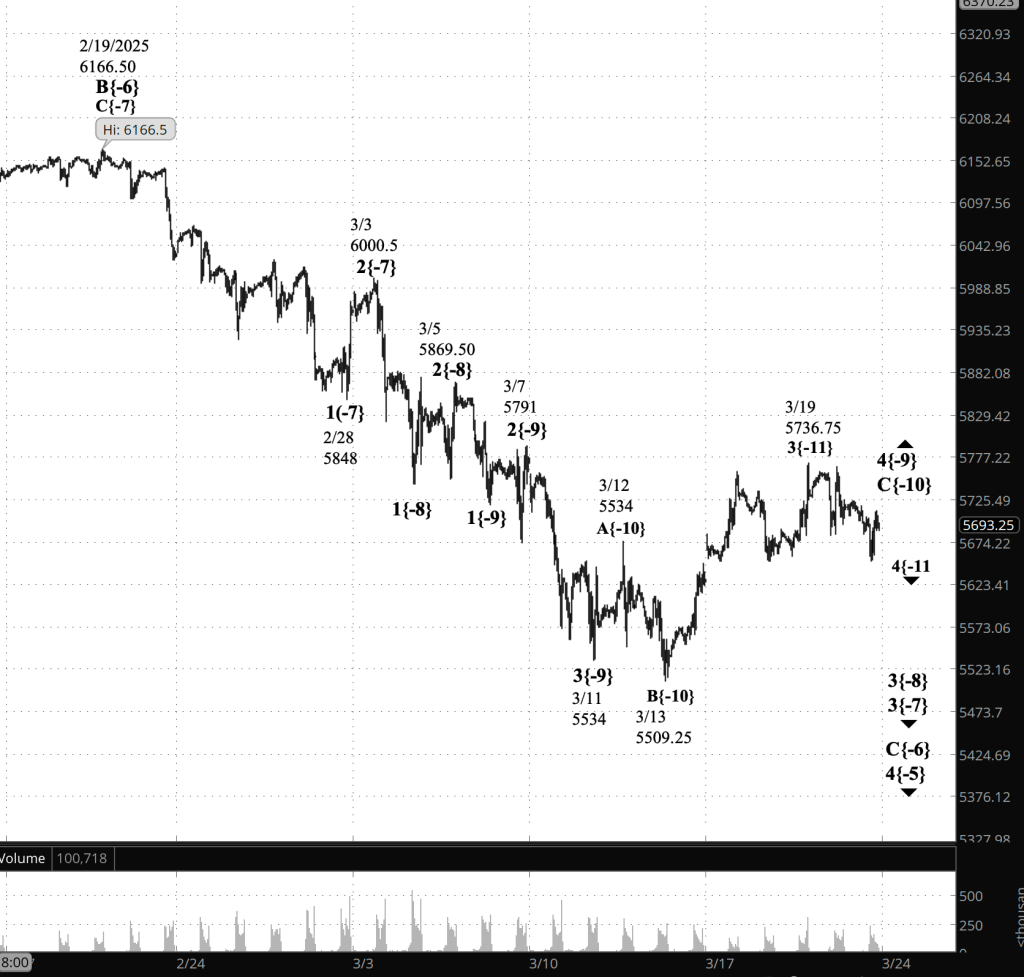
Half an hour before the closing bell. The S&P 500 futures peaked at 6023.75 early in the session and then declined into the 5940s. Elliott Wave Theory: The wave 3 vs. wave 5 ambiguity continues.

9:35 a.m. New York time

What’s happening now? The S&P 500 E-mini futures rose from the 5570s to slightly above 6000 overnight.

What does it mean? I’ve moved the chart in for a closer view of Elliott Wave Theory waves B and C within the 4th-wave downward correction that began December 16.

How far along is wave C? At first glance, it is in its final subwave, wave 5{-7} on the chart. But that seems rather shallow, and it’s possible count it as being in its middle subwave, wave 3{-7}.

It’s impossible to know for certain, and so I did a “this or that” label — wave 3 or wave 5.

[S&P 500 E-mini futures at 3:30 p.m., 110-minute bars, with volume]

What is another alternative? It’s possible that what I’ve labeled as a simple correction is in fact a compound correction. A simple correction — a Flat or a Zigzag — has a single three-wave corrective pattern within it. A compound correction has two or three corrective patterns, each separated from the next by an X-wave, a connector that sets the stage for the next corrective pattern.

What does Elliott Wave Theory say? Here are the waves that underlie the morning’s analyses as they appeared on the chart.

Principal Analysis:

  • Wave C{-6} within wave 4{-5} is underway.

Long-term Waves.

These are the waves currently in progress under my principal analysis. Each line on the list shows the wave number, with the subscript in curly brackets, the traditional degree name, the starting date, the starting price of the S&P 500 E-mini futures, and the direction of the wave. This list has been revised to reflect the revised Principal Analysis.

  • S&P 500 Index:
  • 5{+3} Supercycle, 7/8/1932, 4.40 (up)
  • 5{+2} Cycle, 12/9/1974, 60.96 (up)
  • 5{+1} Primary, 3/6/2009, 666.79 (up)
  • 5{0} Intermediate, 2/11/2016, 1810.10 (up)
  • 3{-1} Minor, 3/23/2020, 2191.36 (up)
  • 3{-2} Minute, 10/13/2022, 3491.58 (up)
  • S&P 500 Futures
  • 5{-3} Minuette, 4/18/2024, 4963.50 (up)
  • 3{-4} Subminuette, 8/7/2024, 5182 (up)
  • 4{-5} Micro, 12/16/2025, 6163.75 (down)
  • C{-6} Submicro, 2/19/2025, 6166.50 (down)

Reading the chart. Price movements — waves – – in Elliott Wave Theory analysis are labeled with numbers within trending waves and letters with corrective waves. The subscripts — numbers in curly brackets — designate the wave’s degree, which, in Elliott Wave analysis, means the relative position of a wave within the larger and smaller structures that make up the chart. R.N. Elliott, who in the 1930s developed the form of analysis that bears his name, viewed the chart as a complex structure of smaller waves nested within larger waves, which in turn are nested within still larger waves. In mathematics it’s called a fractal structure, where at every scale the pattern is similar to the others.

Learning and other resources. Elliott Wave analysis provides context, not prophecy. As the 20th century semanticist Alfred Korzybski put it in his book Science and Sanity (1933), “The map is not the territory … The only usefulness of a map depends on similarity of structure between the empirical world and the map.” And I would add, in the ever-changing markets, we can judge that similarity of structure only after the fact.

See the menu page Analytical Methods for a rundown on where to go for information on Elliott Wave analysis.

By Tim Bovee, Portland, Oregon, February 26, 2025

Disclaimer

Tim Bovee, Private Trader tracks the analysis and trades of a private trader for his own accounts. Nothing in this blog constitutes a recommendation to buy or sell stocks, options or any other financial instrument. The only purpose of this blog is to provide education and entertainment.

No trader is ever 100 percent successful in his or her trades. Trading in the stock and option markets is risky and uncertain. Each trader must make trading decisions for his or her own account, and take responsibility for the consequences.

License

All content on Tim Bovee, Private Trader by Timothy K. Bovee is licensed under a Creative Commons Attribution-ShareAlike 4.0 International License.

Based on a work at www.timbovee.com
Trader’s Notebook

3:30 p.m. New York time

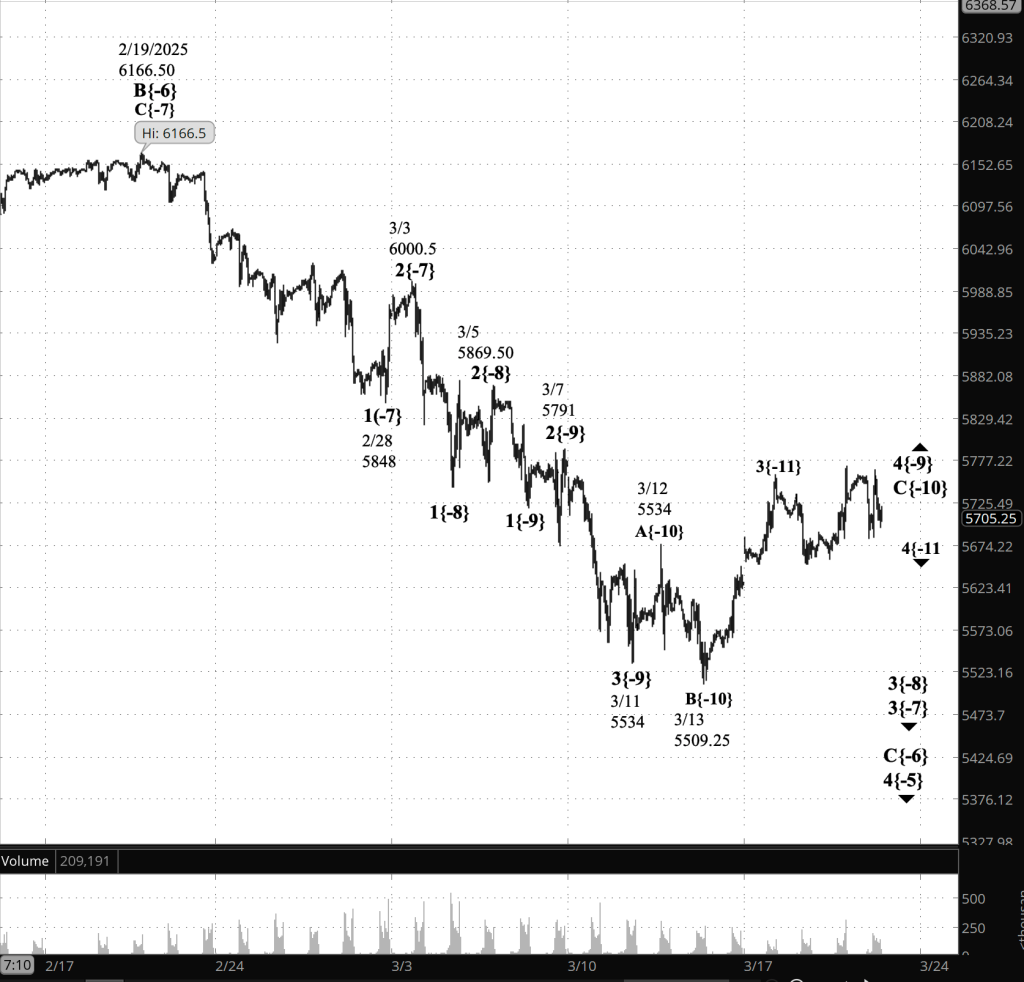
Half an hour before the closing bell. The S&P 500 futures fell during the session, reaching into the 5920s.

Elliott Wave Theory: The final subwave, wave C, within a 4th-wave downward correction that began on December 16, 2024, continues.

9:35 a.m. New York time

What’s happening now? The S&P 500 E-mini futures traded within a narrow range overnight, from the 6010s down to the 5970s.

What does it mean? Elliott Wave Theory interprets this movement as a pause in a downtrending final subwave, wave C, within a 4th-wave downward correction that began on December 16, 2024, from 6163.75.

[S&P 500 E-mini futures at 3:30 p.m., 110-minute bars, with volume]

What is the alternative? It’s possible that what I’ve labeled as a simple correction is in fact a compound correction. A simple correction — a Flat or a Zigzag — has a single three-wave corrective pattern within it. A compound correction has two or three corrective patterns, each separated from the next by an X-wave, a connector that sets the stage for the next corrective pattern.

What does Elliott Wave Theory say? Here are the waves that underlie the morning’s analyses as they appeared on the chart.

Principal Analysis:

  • Wave C{-6} within wave 4{-5} is underway.

Alternative Analysis:

  • The same as the Principal analysis, except wave C{-6} is the final subwave of the second corrective pattern in a compound correction.

Long-term Waves.

These are the waves currently in progress under my principal analysis. Each line on the list shows the wave number, with the subscript in curly brackets, the traditional degree name, the starting date, the starting price of the S&P 500 E-mini futures, and the direction of the wave. This list has been revised to reflect the revised Principal Analysis.

  • S&P 500 Index:
  • 5{+3} Supercycle, 7/8/1932, 4.40 (up)
  • 5{+2} Cycle, 12/9/1974, 60.96 (up)
  • 5{+1} Primary, 3/6/2009, 666.79 (up)
  • 5{0} Intermediate, 2/11/2016, 1810.10 (up)
  • 3{-1} Minor, 3/23/2020, 2191.36 (up)
  • 3{-2} Minute, 10/13/2022, 3491.58 (up)
  • S&P 500 Futures
  • 5{-3} Minuette, 4/18/2024, 4963.50 (up)
  • 3{-4} Subminuette, 8/7/2024, 5182 (up)
  • 5{-5} Micro, 1/13/2025, 5809 (up)
  • C{-6} Submicro, 2/19/2025, 6166.60 (down)

Reading the chart. Price movements — waves – – in Elliott Wave Theory analysis are labeled with numbers within trending waves and letters with corrective waves. The subscripts — numbers in curly brackets — designate the wave’s degree, which, in Elliott Wave analysis, means the relative position of a wave within the larger and smaller structures that make up the chart. R.N. Elliott, who in the 1930s developed the form of analysis that bears his name, viewed the chart as a complex structure of smaller waves nested within larger waves, which in turn are nested within still larger waves. In mathematics it’s called a fractal structure, where at every scale the pattern is similar to the others.

Learning and other resources. Elliott Wave analysis provides context, not prophecy. As the 20th century semanticist Alfred Korzybski put it in his book Science and Sanity (1933), “The map is not the territory … The only usefulness of a map depends on similarity of structure between the empirical world and the map.” And I would add, in the ever-changing markets, we can judge that similarity of structure only after the fact.

See the menu page Analytical Methods for a rundown on where to go for information on Elliott Wave analysis.

By Tim Bovee, Portland, Oregon, February 25, 2025

Disclaimer

Tim Bovee, Private Trader tracks the analysis and trades of a private trader for his own accounts. Nothing in this blog constitutes a recommendation to buy or sell stocks, options or any other financial instrument. The only purpose of this blog is to provide education and entertainment.

No trader is ever 100 percent successful in his or her trades. Trading in the stock and option markets is risky and uncertain. Each trader must make trading decisions for his or her own account, and take responsibility for the consequences.

License

All content on Tim Bovee, Private Trader by Timothy K. Bovee is licensed under a Creative Commons Attribution-ShareAlike 4.0 International License.

Based on a work at www.timbovee.com
Trader’s Notebook

3:30 p.m. New York time

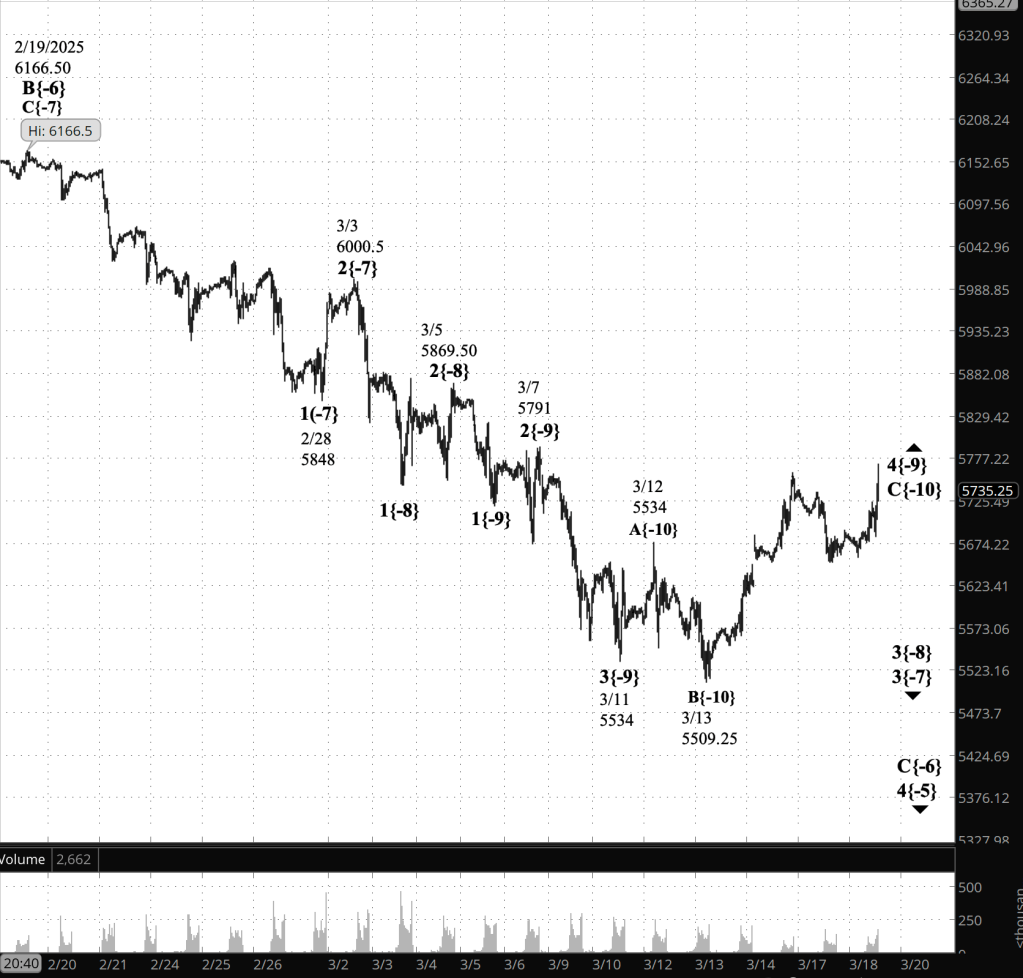
Half an hour before the closing bell. Based on what we’ve seen so far, I’ve updated the chart with the beginnings of a revised analysis. This is a tentative analysis — call it a Principal Analysis Light.

The basis of it is that a larger 4th-wave downward correction that began on December 16, 2024 from 6163.75. It is labeled wave 4{-5} on the chart. The February 19 peak was slightly above that level, and that works, of the corrective pattern has taken the form of a Flat, where Wave A has three subwaves, B has three, and C has five (3-3-5).

The revised chart:

[S&P 500 E-mini futures at 3:30 p.m., 110-minute bars, with volume]

1:05 p.m. New York time

The rest of the story. In this discussion I’ll use the wave labels as they appear on the chart. Each wave has a number, followed by a subscript in curly brackets that indicates the wave’s position in the fractal structure of the chart. The subscript is the number of levels between the wave and the Intermediate degree. The ongoing wave of Intermediate degree is wave 5{0}, which began on February 11, 2016.

At this point, there are several possible ways to view the Elliott Wave Theory chart.

The price continued to fall early in the session, eventually reaching 5994.50. That means wave 4{-9} overlapped the other corrective wave in an impulse pattern, wave 2{-7}. That’s not supposed to happen. So, another reworking of the map so that it matches the terrain.

The 6020.75 level, the end of wave 1{-7}, broke the bullish wave count that was this morning’s principal analysis.

The next significant level is 5936.50, the February 2 start of rising wave 3{-6}. If the price rebounds and moves above that level, then it’s possible that we’re looking at a Triangle correction of some sort.

If the price breaks and stays below 5936.50, then the wave 4{-5} correction never ended. That correction began on December 16, 2024.

I’ve made the minimal fix, removing the wave 5{-9} degree and restoring wave 4{-9}. For the rest, we’ll have to wait and see.

9:35 a.m. New York time

What’s happening now? The S&P 500 E-mini futures worked its way higher after trading resumed overnight, reaching into the 6060s as it recovered a bit more from the decline that began on February 19.

What does it mean? Elliott Wave Theory labels the decline as a low-degree 4th wave downward correction. Its downward journey has three subwaves, meaning that it was the corrective structure called a Flat.

By that count, the 4th wave has ended and rising wave 5 has begun and most likely will carry the price back up into the 6160s and perhaps much higher.

That’s the principal analysis. However, there is another scenario…

[S&P 500 E-mini futures at 1:05 p.m., 110-minute bars, with volume]

What is the alternative? The 4th-wave downward correction may have ended at the February 20 low, 6102.75, as the principal analysis has it. Or that might have only been the end of the first subwave, wave A, within the correction. I’ve chosen the 5th-wave scenario as my principal analysis, and the ongoing 4th wave as my alternative analysis.

What does Elliott Wave Theory say? Here are the waves that underlie the morning’s analyses as they appeared on the chart. See the new chart, above, in the 3:30 p.m. post, along with explanation. The following analyses waves are no longer valid but they are being retained today to allow for comparison.

Principal Analysis:

  • Wave 4{-9}, a downward correction, ended at the February 21 low, and rising wave 5{-9} now underway. Both waves are subwaves of wave 1{-8}, which in turn is a subwave of wave 3{-7}.

Alternative Analysis:

  • Wave A{-10}, the first subwave within wave 4{-9}, ended on February 20 and rising wave B{-10} has begun.

Long-term Waves.

These are the waves currently in progress under my principal analysis. Each line on the list shows the wave number, with the subscript in curly brackets, the traditional degree name, the starting date, the starting price of the S&P 500 E-mini futures, and the direction of the wave. This list has been revised to reflect the revised Principal Analysis.

  • S&P 500 Index:
  • 5{+3} Supercycle, 7/8/1932, 4.40 (up)
  • 5{+2} Cycle, 12/9/1974, 60.96 (up)
  • 5{+1} Primary, 3/6/2009, 666.79 (up)
  • 5{0} Intermediate, 2/11/2016, 1810.10 (up)
  • 3{-1} Minor, 3/23/2020, 2191.36 (up)
  • 3{-2} Minute, 10/13/2022, 3491.58 (up)
  • S&P 500 Futures
  • 5{-3} Minuette, 4/18/2024, 4963.50 (up)
  • 3{-4} Subminuette, 8/7/2024, 5182 (up)
  • 5{-5} Micro, 1/13/2025, 5809 (up)
  • C{-6} Submicro, 2/19/2025, 6166.60 (down)

Reading the chart. Price movements — waves – – in Elliott Wave Theory analysis are labeled with numbers within trending waves and letters with corrective waves. The subscripts — numbers in curly brackets — designate the wave’s degree, which, in Elliott Wave analysis, means the relative position of a wave within the larger and smaller structures that make up the chart. R.N. Elliott, who in the 1930s developed the form of analysis that bears his name, viewed the chart as a complex structure of smaller waves nested within larger waves, which in turn are nested within still larger waves. In mathematics it’s called a fractal structure, where at every scale the pattern is similar to the others.

Learning and other resources. Elliott Wave analysis provides context, not prophecy. As the 20th century semanticist Alfred Korzybski put it in his book Science and Sanity (1933), “The map is not the territory … The only usefulness of a map depends on similarity of structure between the empirical world and the map.” And I would add, in the ever-changing markets, we can judge that similarity of structure only after the fact.

See the menu page Analytical Methods for a rundown on where to go for information on Elliott Wave analysis.

By Tim Bovee, Portland, Oregon, February 24, 2025

Disclaimer

Tim Bovee, Private Trader tracks the analysis and trades of a private trader for his own accounts. Nothing in this blog constitutes a recommendation to buy or sell stocks, options or any other financial instrument. The only purpose of this blog is to provide education and entertainment.

No trader is ever 100 percent successful in his or her trades. Trading in the stock and option markets is risky and uncertain. Each trader must make trading decisions for his or her own account, and take responsibility for the consequences.

License

All content on Tim Bovee, Private Trader by Timothy K. Bovee is licensed under a Creative Commons Attribution-ShareAlike 4.0 International License.

Based on a work at www.timbovee.com
Trader’s Notebook

3:30 p.m. New York time

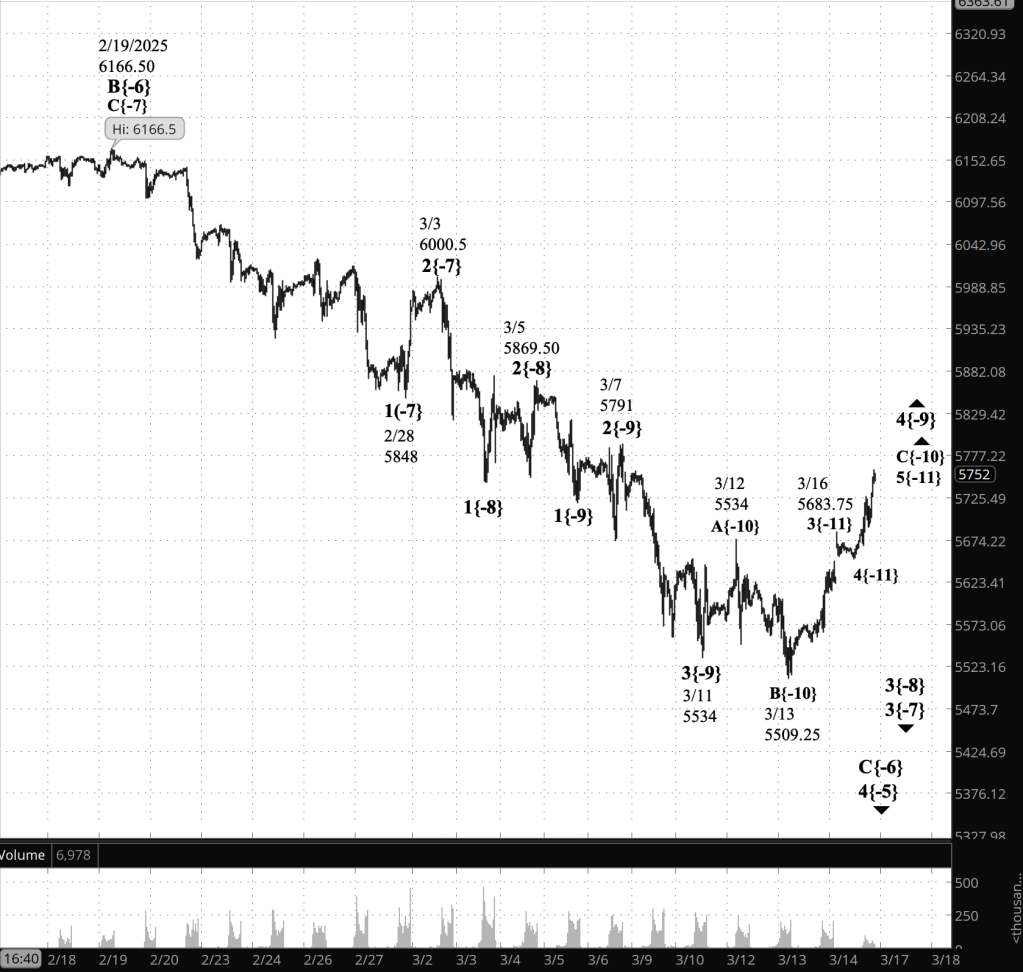
Half an hour before the closing bell. The S&P 500 futures began to fall at the opening bell and has continued to fall during the session, so far reaching 6024.50.

Elliott Wave Theory: The decline is a 4th-wave downward correction began on February 19 from 6166.50. Most 4th waves that I’ve analyzed have tended to be more moderate, retracing on a third or so of the preceding 3rd wave.

This 4th wave has moved beyond the starting point of the 3rd wave and is coming close to dropping below the starting point of the preceding 1st wave. That breaks a rule of Elliott Wave Theory and requires a reanalysis, possibly of everything since the February 2 low.

But not yet. The 4th wave hasn’t broken the rule yet and may reverse to the upside before it does so.

9:35 a.m. New York time

What’s happening now? The S&P 500 E-mini futures fell to 6127.25 overnight and then rose into the 6140s as the opening bell approached. As the bell sounded, the price drop sharply into the 6120s

What does it mean? Now underway in terms of Elliott Wave Theory: The 4th-wave downward correction, a subwave of a 1st wave that began on February 12, which in turn is a subwave of a still larger 3rd wave that also began on that date.

[S&P 500 E-mini futures at 3:30 p.m., 110-minute bars, with volume]

What are the alternatives? The 4th-wave downward correction may have ended at the February 20 low, 6102.75, or that might have only been the end of the first subwave, wave A, within the correction. I’ve chosen the wave A scenario as my principal analysis, and the completed 4th wave as my alternative analysis.

What does Elliott wave theory say? Here are the waves that underly the analyses as they appear on the chart.

Principal Analysis:

  • Wave 4{-9}, a downward correction now underway, is a subwave of wave 1{-8}, which is turn is a subwave of wave 3{-7}.

Alternative Analysis:

  • Wave 4{-9} ended on February 20 and rising wave 5{-9} has begun.

Long-term Waves.

These are the waves currently in progress under my principal analysis. Each line on the list shows the wave number, with the subscript in curly brackets, the traditional degree name, the starting date, the starting price of the S&P 500 E-mini futures, and the direction of the wave.

  • S&P 500 Index:
  • 5{+3} Supercycle, 7/8/1932, 4.40 (up)
  • 5{+2} Cycle, 12/9/1974, 60.96 (up)
  • 5{+1} Primary, 3/6/2009, 666.79 (up)
  • 5{0} Intermediate, 2/11/2016, 1810.10 (up)
  • 3{-1} Minor, 3/23/2020, 2191.36 (up)
  • 3{-2} Minute, 10/13/2022, 3491.58 (up)
  • S&P 500 Futures
  • 5{-3} Minuette, 4/18/2024, 4963.50 (up)
  • 3{-4} Subminuette, 8/7/2024, 5182 (up)
  • 5{-5} Micro, 1/13/2025, 5809 (up)
  • 3{-6} Submicro, 2/2/2025, 5936.50 (up)
  • 3{-7} Minuscule, 2/12/2025, 6120.75 (up)
  • 1{-8} (unnamed), 2/12/2025, 6120.75 (up)
  • 4{-9} (unnamed), 2/19/2025, 6166.50 (down)

Correction. The 10-year chart published on February 20 listed the {-1} degree wave now underway as wave 5{-1}. It is wave 3{-1}.

Reading the chart. Price movements — waves – – in Elliott wave analysis are labeled with numbers within trending waves and letters with corrective waves. The subscripts — numbers in curly brackets — designate the wave’s degree, which, in Elliott wave analysis, means the relative position of a wave within the larger and smaller structures that make up the chart. R.N. Elliott, who in the 1930s developed the form of analysis that bears his name, viewed the chart as a complex structure of smaller waves nested within larger waves, which in turn are nested within still larger waves. In mathematics it’s called a fractal structure, where at every scale the pattern is similar to the others.

Learning and other resources. Elliott wave analysis provides context, not prophecy. As the 20th century semanticist Alfred Korzybski put it in his book Science and Sanity (1933), “The map is not the territory … The only usefulness of a map depends on similarity of structure between the empirical world and the map.” And I would add, in the ever-changing markets, we can judge that similarity of structure only after the fact.

See the menu page Analytical Methods for a rundown on where to go for information on Elliott wave analysis.

By Tim Bovee, Portland, Oregon, February 21, 2025

Disclaimer

Tim Bovee, Private Trader tracks the analysis and trades of a private trader for his own accounts. Nothing in this blog constitutes a recommendation to buy or sell stocks, options or any other financial instrument. The only purpose of this blog is to provide education and entertainment.

No trader is ever 100 percent successful in his or her trades. Trading in the stock and option markets is risky and uncertain. Each trader must make trading decisions for his or her own account, and take responsibility for the consequences.

License

All content on Tim Bovee, Private Trader by Timothy K. Bovee is licensed under a Creative Commons Attribution-ShareAlike 4.0 International License.

Based on a work at www.timbovee.com

Trader’s Notebook

3:30 p.m. New York time

Half an hour before the closing bell. The S&P 500 futures reached a low of 6102.75 half an hour into the session, and then rose back into the 6130s.

I’ve added a more detailed Elliott Wave Theory mark-up on the chart focusing on price movements from December 16, 2024. This morning I included three charts, from a 10-year monstrosity down to one covering the past few months. It’s that third chart, the one furthest down, that has been updated.

Bottom line: A low-degree 4th-wave downward correction is underway, within an uptrending 1st wave that began on February 12. That 1st wave is a subwave of a rising 3rd wave that began on February 2.

9:35 a.m. New York time

What’s happening now? The S&P 500 E-mini futures fell slightly overnight, from the 6150s to the 6140s.

What does it mean? A rule of Elliott Wave Theory was violated during yesterday’s session: A 4th-wave upward correction rose higher than the December 16, 2024 peak, which by the analysis up to yesterday had marked the end of a large number of 5th waves.

The beauty of Elliott Wave Theory is that when the count no longer matches the reality of the chart — when the wave labels are wrong — the analyst knows it immediately. And since the chart is always right, the analysis must be changed.

In looking at the new reality, the new terrain, it seemed to me that there were a couple of options. The bullish option would see the December 16, 2024 high as being a step within an ongoing rise. To fix that would mean going back to 2020 and modifying the wave count. An alternative bearish option would have been to retain the December peak as the end of a major rise, and to postulate a complex corrective form that would explain away the rule violation.

The bullish option seemed more straightforward, and as I recounted waves from a few years ago, it became clear that the bullish revision would be in accord with the Rules of Elliott. And that bullish revision is what we see today.

Could it be wrong? Maybe. No Elliott Wave Theory analysis is 100% certain. If it turns out to not match the reality of the chart, we’ll all know it, and for my analysis, I’ll fix it

The following series of charts begins with a big view of the S&P 500 index from the 2020s onward, then a closer view of the S&P 500 futures, and then a still closer view, also of the futures.

[S&P 500 index 2/19/2025 close, monthly bars]

[S&P 500 E-mini futures, 2/19/2024 close, 12-hour bars, with volume]

[S&P 500 E-mini futures at 3:30 p.m., 110-minute bars, with volume]

What are the alternatives? This reanalysis is still a work in progress, and will be stretching into the weekend. I wouldn’t be surprised if I discovered changes that need to be made.

What does Elliott wave theory say?  The waves that underlie the analyses will be available later There’s much revision to done.:

Long-term Waves.

Not yet available. Revision underway.

Reading the chart. Price movements — waves – – in Elliott wave analysis are labeled with numbers within trending waves and letters with corrective waves. The subscripts — numbers in curly brackets — designate the wave’s degree, which, in Elliott wave analysis, means the relative position of a wave within the larger and smaller structures that make up the chart. R.N. Elliott, who in the 1930s developed the form of analysis that bears his name, viewed the chart as a complex structure of smaller waves nested within larger waves, which in turn are nested within still larger waves. In mathematics it’s called a fractal structure, where at every scale the pattern is similar to the others.

Learning and other resources. Elliott wave analysis provides context, not prophecy. As the 20th century semanticist Alfred Korzybski put it in his book Science and Sanity (1933), “The map is not the territory … The only usefulness of a map depends on similarity of structure between the empirical world and the map.” And I would add, in the ever-changing markets, we can judge that similarity of structure only after the fact.

See the menu page Analytical Methods for a rundown on where to go for information on Elliott wave analysis.

By Tim Bovee, Portland, Oregon, February 20, 2025

Disclaimer

Tim Bovee, Private Trader tracks the analysis and trades of a private trader for his own accounts. Nothing in this blog constitutes a recommendation to buy or sell stocks, options or any other financial instrument. The only purpose of this blog is to provide education and entertainment.

No trader is ever 100 percent successful in his or her trades. Trading in the stock and option markets is risky and uncertain. Each trader must make trading decisions for his or her own account, and take responsibility for the consequences.

License

All content on Tim Bovee, Private Trader by Timothy K. Bovee is licensed under a Creative Commons Attribution-ShareAlike 4.0 International License.

Based on a work at www.timbovee.com
Trader’s Notebook

5:30 p.m. New York time

Sneak Preview. I’ve been working for hours to put together the new analysis. The S&P 500 futures breaking an Elliott Wave Theory rule, which scrapped the prior analysis, turns out to have implications stretching back several years.

Details when I post at 6:35 a.m. New York time tomorrow. Meanwhile, a sneak preview of the new futures chart.

[S&P 500 E-mini futures at 5:30 p.m., 12-hour bars, with volume]

3:30 p.m. New York time

Half an hour before the opening bell. Perhaps a better section title would be…

The end of the chart as we know it. The S&P 500 futures have reached a high so far during the session of 6166.50.

Here’s a preliminary assessment:

  • Under the formerly valid chart, breaking past the 5th wave endpoint is a violation of the rules of Elliott Wave Theory.
  • Three possibilities: The wave count was incorrect, the supposed top was not the final high, or a more complex corrective structure is unfolding.

I’ve updated the chart, with a big label saying it is no longer the principal analysis. Look for a new analysis in tomorrow morning’s post.

This morning’s analysis is no longer valid. The wave lists are no longer valid. And the “What are the alternatives” section now has a world-class alternative that will be implemented.

9:35 a.m. New York time

What’s happening now? The S&P 500 E-mini futures fell overnight, from the 6150s to the 6130s.

What does it mean? The Elliott Wave Theory analysis sees the fall as a subwave correction within the rising 3rd wave that began on February 12.

Wave 3, when complete, will be followed by a 4th-wave downward correction and then a rising 5th wave, which will bring to an end the final subwave, wave C, of a larger 4th-wave upward correction that began on January 13.

A downtrending 5th wave will follow, potentially carrying the price below 5800, and possibly significantly lower.

[S&P 500 E-mini futures at 3:30 p.m., 105-minute bars, with volume]

What are the alternatives? None visible at present. As always, they will arise.

What does Elliott wave theory say? Here are the waves that underlie the analyses.

Principal Analysis:

  • Rising wave 5{0} is underway. It is a wave of Intermediate degree that began in December 2018.
  • It is in its final subwave, wave 5{-1}.
  • Within wave 5{-1}, rising waves 5{-2}, 5{-3} and 5{-4} are underway, as is wave 5{-5}.
  • Wave 5{-5} is in its initial subwave, wave 1{-6}, which in turn is in its middle subwave, wave 3{-7}.
  • Wave 4{-7} is in its initial subwave, which is uptrending wave A{-8}, if wave 4{-7} is a Flat structure, with three subwaves, or wave 1{-8} if it is a Zigzag structure, with five subwaves. (I’ll assume Flat as the list continues, since that’s more common within 4th waves)
  • Wave A{-8} is in its initial subwave, wave 1{-9}, as are waves 1{-10}, 1{-11}, 1{-12}, and 1{-13}.
  • Wave 1{-14}, an upward correction and is in its first subwave, wave 3{-15}.
  • Wave 3{-15} is in its second subwave, rising wave 4{-16}, an upward correction
  • Wave 4{-16} is in its final subwave, rising wave C{-17}, which is in its middle subwave, rising wave 3{-18}.

Long-term Waves.

These are the waves currently in progress under my principal analysis. Each line on the list shows the wave number, with the subscript in curly brackets, the traditional degree name, the starting date, the starting price of the S&P 500 E-mini futures, and the direction of the wave. (Updated with today’s reanalysis.)

  • S&P 500 Index:
  • 5{+3} Supercycle, 7/8/1932, 4.40 (up)
  • 5{+2} Cycle, 12/9/1974, 60.96 (up)
  • 5{+1} Primary, 3/6/2009, 666.79 (up)
  • 5{0} Intermediate, 12/26/2018, 2346.58 (up)
  • S&P 500 Futures
  • 5{-1} Minor, 10/27/2023, 4127.25 (up)
  • 3{-2} Minute, 10/27/23, 4127.75 (up)
  • 3{-3} Minuette, 10/27/23, 4127.75 (up)
  • 5{-4} Subminuette, 4/18/2024, 4963.50 (up)
  • 5{-5} Micro, 8/5/2024, 5120 (up)
  • 1{-6} Submicro, 8/5/2024, 5120 (up)
  • 4{-7} Minuscule, 12/16/2024, 6163.75 (down)
  • A{-8} (unnamed), 12/16/2024, 6163.75 (down)
  • 1{-9} (unnamed), 12/16/2024, 6163.75 (down)
  • 1{-10} (unnamed), 12/16/2024, 6163.75 (down)
  • 1{-11} (unnamed), 12/16/2024, 6163.75 (down)
  • 1{-12} (unnamed), 12/16/2024, 6163.75 (down)
  • 1{-13} (unnamed), 12/16/2024, 6163.75 (down)
  • 1{-14} (unnamed), 1/13/2025, 5809.25 (down)
  • 3{-15} (unnamed), 1/13/2025, 5809.25 (down)
  • 4{-16} (unnamed), 1/13/2025, 5809.25 (up)
  • C{-17} (unnamed), 2/7/2025, 5935.50 (up)
  • 3{-18} (unnamed), 2/12/2025, 6020.75 (up)

Reading the chart. Price movements — waves – – in Elliott wave analysis are labeled with numbers within trending waves and letters with corrective waves. The subscripts — numbers in curly brackets — designate the wave’s degree, which, in Elliott wave analysis, means the relative position of a wave within the larger and smaller structures that make up the chart. R.N. Elliott, who in the 1930s developed the form of analysis that bears his name, viewed the chart as a complex structure of smaller waves nested within larger waves, which in turn are nested within still larger waves. In mathematics it’s called a fractal structure, where at every scale the pattern is similar to the others.

Learning and other resources. Elliott wave analysis provides context, not prophecy. As the 20th century semanticist Alfred Korzybski put it in his book Science and Sanity (1933), “The map is not the territory … The only usefulness of a map depends on similarity of structure between the empirical world and the map.” And I would add, in the ever-changing markets, we can judge that similarity of structure only after the fact.

See the menu page Analytical Methods for a rundown on where to go for information on Elliott wave analysis.

By Tim Bovee, Portland, Oregon, February 19, 2025

Disclaimer

Tim Bovee, Private Trader tracks the analysis and trades of a private trader for his own accounts. Nothing in this blog constitutes a recommendation to buy or sell stocks, options or any other financial instrument. The only purpose of this blog is to provide education and entertainment.

No trader is ever 100 percent successful in his or her trades. Trading in the stock and option markets is risky and uncertain. Each trader must make trading decisions for his or her own account, and take responsibility for the consequences.

License

All content on Tim Bovee, Private Trader by Timothy K. Bovee is licensed under a Creative Commons Attribution-ShareAlike 4.0 International License.

Based on a work at www.timbovee.com
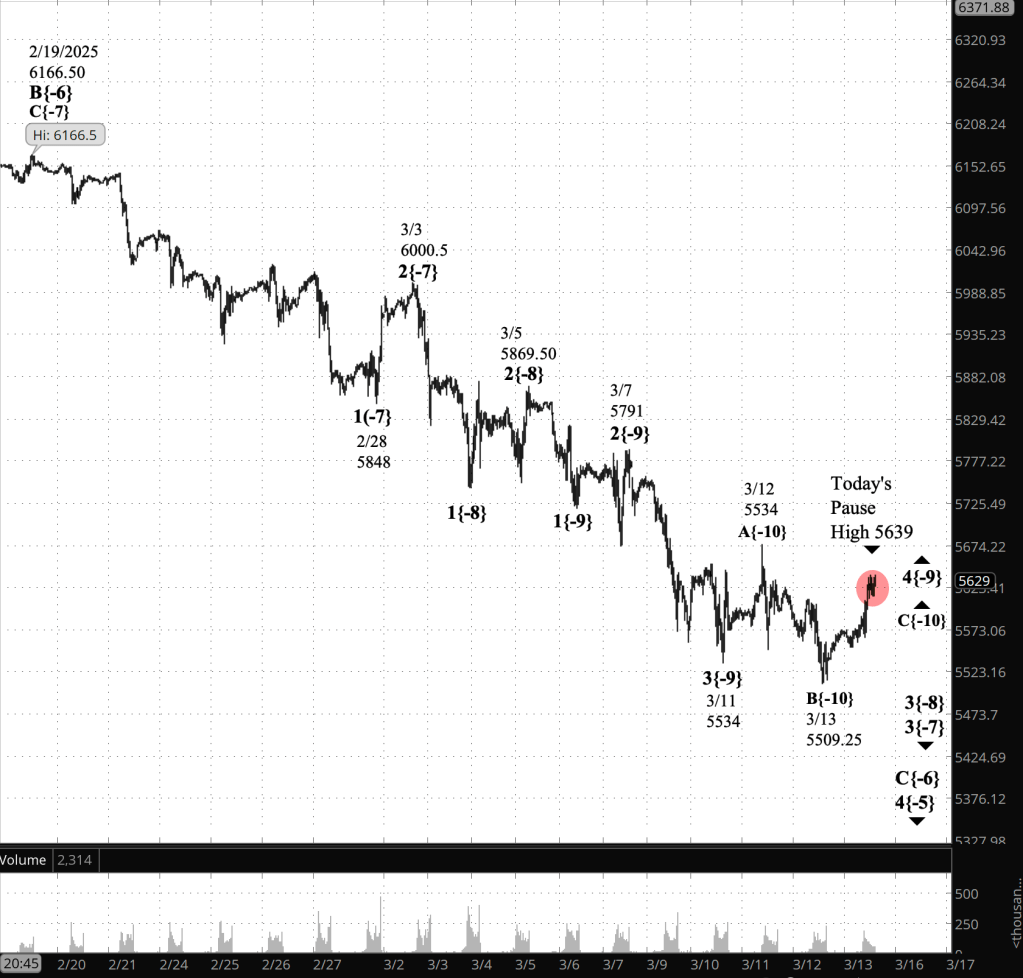
Trader’s Notebook

3:30 p.m. New York time

Half an hour before the closing bell. The S&P 500 fell during the session, so far reaching a bit below 6120.

The decline at this point appears to be a subwave within rising wave 3, which began on February 12 from 6020.75. Wave 3 is in turn a subwave of a rising C wave, the final wave of a 4th-wave upward correction that began on January 13.

9:35 a.m. New York time

What’s happening now? The S&P 500 E-mini futures rose after trading resumed overnight, from 6137 into the 6150s. Minutes before the opening bell, the price dropped sharply into the 6130s.

What does it mean? Elliott Wave Theory: The 4th-wave upward correction continues, as has been the case since it began on January 13. Within that rise, however, things have changed.

A revision of the chart.

Regular readers will recall that a week ago, in the January 11 edition of Trader’s Notebook, I spotted an ambiguity in the count. I described it this way: “Should the 1st-wave endpoint on February 2 instead be labeled as the parent C-wave endpoint, bringing to an end the B wave that is one degree higher in the fractal chain of the chart and the beginning of a rising C wave.”

Subsequent price movements left the ambiguity unresolved. However, the labeling increasingly put the chart out of balance, with waves of the same degree becoming disproportional to each other.

Over the weekend, I dived into the chart, and decided it was time to change the labelling. The alternative analysis had become more likely than the principal analysis. Today’s chart is the product of that renumbering.

The wave labelling system

In this discussion I’ll refer to waves the way they are labelled on the chart: A wave number followed by a subscript in curly brackets show how many degrees from Intermediate Degree within the fractal structure of the chart that particular wave stands. For example, the upward correction is wave 4{-16}, which is 16 degrees lower than Intermediate. A wave larger than Intermediate will have a positive number in the brackets.

The new analysis

The present Intermediate wave is rising wave 5{0}. It began on December 26, 2018 from 2346.58 on the S&P 500 futures. All of the changes are at a relatively small level, within rising wave 4{-16}.

Here’s what has changed. The locations and dates are the endpoints of the waves.

  • Wave 1{-19} to wave C{-18}, on February 2 at 5948.
  • That change means that the parent wave, falling wave B{-17}, ended at that point and rising wave C{-17} began.
  • The subwaves within the rise that began on February 2 have been raised by one degree, from {-19} to {-18}.

That means that the waves now underway are, from smaller to larger, rising wave 3{-18} within rising wave C{-17} within rising wave 4{-16}.

These changes restore proportionality to the chart and highlight the upward movement as the key directional characteristic at present.

What next? When wave C{-17} is complete, it will also be the end of the upward correction, wave 4{-16}, and the beginning of falling wave 5{-16}. The parent wave, falling wave 3{-15}, began on December 26, 2024, from 6107.50.

Fifth waves generally fall below the end of the preceding 3rd wave — wave 3{-16} at this point. If that’s the case here, then we can expect wave 5{-16} to drop below 5809.25. Some 5th waves are truncated and remain above the end of the preceding 3rd wave.

However far it drops, the end of wave 5{-16} will be the end of wave 3{-15} and the beginning of a large upward correction, wave 4{-15}.

[S&P 500 E-mini futures at 3:30 p.m., 105-minute bars, with volume]

What are the alternatives? The changes have wiped the slate clean of ambiguities for the moment. They will develop, without a doubt, with the passage of time.

What does Elliott wave theory say? Here are the waves that underlie the analyses.

Principal Analysis:

  • Rising wave 5{0} is underway. It is a wave of Intermediate degree that began in December 2018.
  • It is in its final subwave, wave 5{-1}.
  • Within wave 5{-1}, rising waves 5{-2}, 5{-3} and 5{-4} are underway, as is wave 5{-5}.
  • Wave 5{-5} is in its initial subwave, wave 1{-6}, which in turn is in its middle subwave, wave 3{-7}.
  • Wave 4{-7} is in its initial subwave, which is uptrending wave A{-8}, if wave 4{-7} is a Flat structure, with three subwaves, or wave 1{-8} if it is a Zigzag structure, with five subwaves. (I’ll assume Flat as the list continues, since that’s more common within 4th waves)
  • Wave A{-8} is in its initial subwave, wave 1{-9}, as are waves 1{-10}, 1{-11}, 1{-12}, and 1{-13}.
  • Wave 1{-14}, an upward correction and is in its first subwave, wave 3{-15}.
  • Wave 3{-15} is in its second subwave, rising wave 4{-16}, an upward correction
  • Wave 4{-16} is in its final subwave, rising wave C{-17}, which is in its middle subwave, rising wave 3{-18}.

Long-term Waves.

These are the waves currently in progress under my principal analysis. Each line on the list shows the wave number, with the subscript in curly brackets, the traditional degree name, the starting date, the starting price of the S&P 500 E-mini futures, and the direction of the wave. (Updated with today’s reanalysis.)

  • S&P 500 Index:
  • 5{+3} Supercycle, 7/8/1932, 4.40 (up)
  • 5{+2} Cycle, 12/9/1974, 60.96 (up)
  • 5{+1} Primary, 3/6/2009, 666.79 (up)
  • 5{0} Intermediate, 12/26/2018, 2346.58 (up)
  • S&P 500 Futures
  • 5{-1} Minor, 10/27/2023, 4127.25 (up)
  • 3{-2} Minute, 10/27/23, 4127.75 (up)
  • 3{-3} Minuette, 10/27/23, 4127.75 (up)
  • 5{-4} Subminuette, 4/18/2024, 4963.50 (up)
  • 5{-5} Micro, 8/5/2024, 5120 (up)
  • 1{-6} Submicro, 8/5/2024, 5120 (up)
  • 4{-7} Minuscule, 12/16/2024, 6163.75 (down)
  • A{-8} (unnamed), 12/16/2024, 6163.75 (down)
  • 1{-9} (unnamed), 12/16/2024, 6163.75 (down)
  • 1{-10} (unnamed), 12/16/2024, 6163.75 (down)
  • 1{-11} (unnamed), 12/16/2024, 6163.75 (down)
  • 1{-12} (unnamed), 12/16/2024, 6163.75 (down)
  • 1{-13} (unnamed), 12/16/2024, 6163.75 (down)
  • 1{-14} (unnamed), 1/13/2025, 5809.25 (down)
  • 3{-15} (unnamed), 1/13/2025, 5809.25 (down)
  • 4{-16} (unnamed), 1/13/2025, 5809.25 (up)
  • C{-17} (unnamed), 2/7/2025, 5935.50 (up)
  • 3{-18} (unnamed), 2/12/2025, 6020.75 (up)

Reading the chart. Price movements — waves – – in Elliott wave analysis are labeled with numbers within trending waves and letters with corrective waves. The subscripts — numbers in curly brackets — designate the wave’s degree, which, in Elliott wave analysis, means the relative position of a wave within the larger and smaller structures that make up the chart. R.N. Elliott, who in the 1930s developed the form of analysis that bears his name, viewed the chart as a complex structure of smaller waves nested within larger waves, which in turn are nested within still larger waves. In mathematics it’s called a fractal structure, where at every scale the pattern is similar to the others.

Learning and other resources. Elliott wave analysis provides context, not prophecy. As the 20th century semanticist Alfred Korzybski put it in his book Science and Sanity (1933), “The map is not the territory … The only usefulness of a map depends on similarity of structure between the empirical world and the map.” And I would add, in the ever-changing markets, we can judge that similarity of structure only after the fact.

See the menu page Analytical Methods for a rundown on where to go for information on Elliott wave analysis.

By Tim Bovee, Portland, Oregon, February 18, 2025

Disclaimer

Tim Bovee, Private Trader tracks the analysis and trades of a private trader for his own accounts. Nothing in this blog constitutes a recommendation to buy or sell stocks, options or any other financial instrument. The only purpose of this blog is to provide education and entertainment.

No trader is ever 100 percent successful in his or her trades. Trading in the stock and option markets is risky and uncertain. Each trader must make trading decisions for his or her own account, and take responsibility for the consequences.

License

All content on Tim Bovee, Private Trader by Timothy K. Bovee is licensed under a Creative Commons Attribution-ShareAlike 4.0 International License.

Based on a work at www.timbovee.com
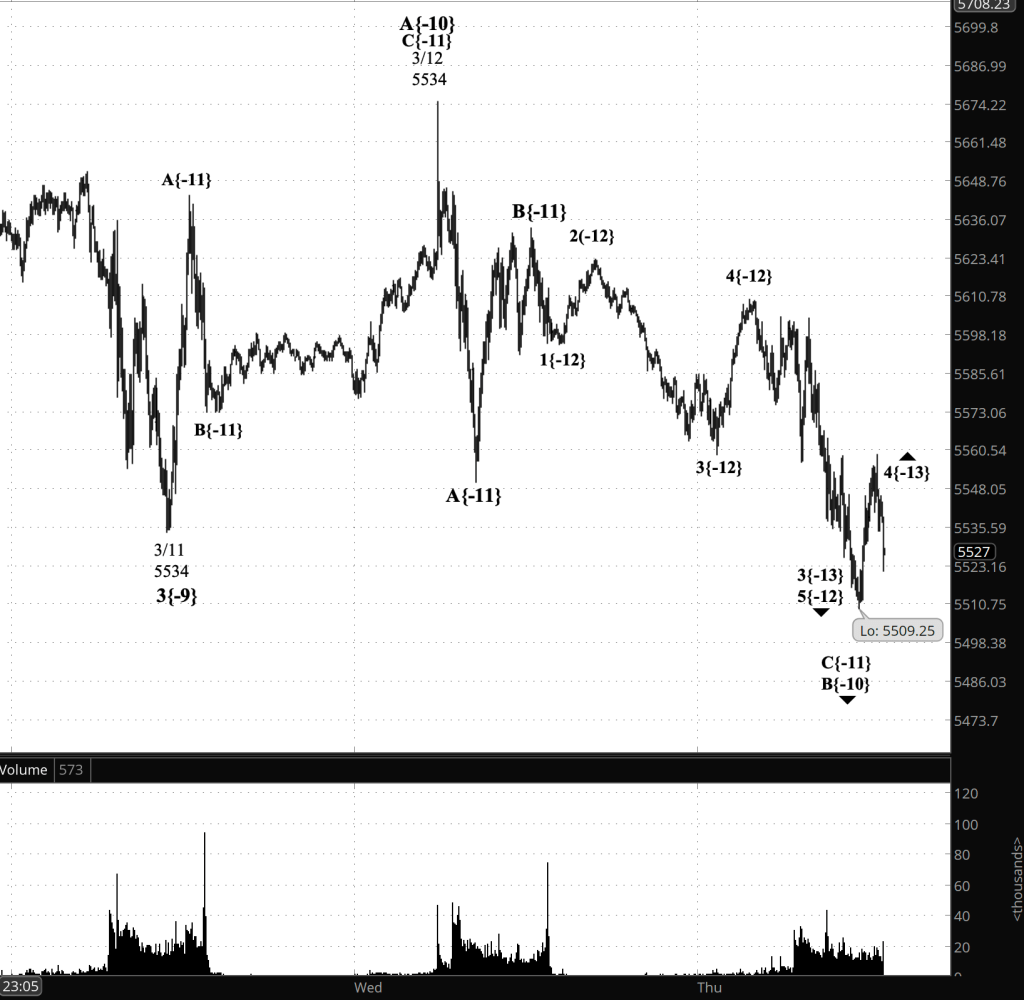
Trader’s Notebook

Holiday note: U.S. markets will be closed on Monday, February 17, for Presidents Day. Trading will resume on Tuesday.

3:30 p.m. New York time

Half an hour before the closing bell. The S&P 500 futures dithered in a narrow range, from the 6120s to the 6140s, in a session that went nowhere. This morning’s analysis stands unchanged, and the accompanying ambiguity, unresolved.

9:35 a.m. New York time

What’s happening now? The S&P 500 E-mini futures rose overnight, to 6146.75, and then declined into the 6120s.

What does it mean? Elliott Wave Theory: The rise, wave C within a larger B wave, came within $1 of the end of the preceding A wave and remained below the December 16, 2024 peak, 6163.75.

No rules of Elliott Wave Theory were broken. There are other reasons to think that the alternative scenario, discussed below in the “What are the alternatives?” section, is better fit. The man reason is that the as labelled is disproportionate to other waves of the same degree within the fractal structure of the chart.

it’s all very subjective, and I’m inclined at present to stick the principal analysis, while keeping a close watch for price patterns that would push the decision in favor of the alternative.

At present: Declining ave 3{-19} within falling wave C{-18} within falling wave B{-17}, the middle subwave of three within the 4th-wave upward correction that began on January 13.

I’ve retained the Fibonacci ladder on the chart. The overnight peak moved below the 23.6% Fibonacci retracement level. If the principal analysis is correct, the 3rd wave should return to its decline, perhaps reaching into the 5900s. If the alternative analysis is correct, the price will turn, breaking above 6147.75, the peak of wave B.

If it breaks above 6163.75, the December 24, 2024 peak, then all of the analysis from that day forward will require reanalysis to match the new reality.

[S&P 500 E-mini futures at 3:30 p.m., 105-minute bars, with volume]

What are the alternatives? Should the 1st-wave endpoint, wave 1{-19}, on February 2 instead be labeled as the parent wave C{-18} endpoint, bringing to an end the B{-17} wave that is one degree higher in the fractal chain of the chart and the beginning of a rising wave C{-17wave. All of this is happening within the wave 4{-16} upward correction that began on January 13. The rising C wave, if it is in fact underway, the final subwave of that correction.

If the price moves above 6123.25, the high of rising wave 2{-19} in the principal analysis, then I would switch to an alternative scenario: Wave B ended on February 2.

What does Elliott wave theory say? Here are the waves that underlie the analyses.

Principal Analysis:

  • Rising wave 5{0} is underway. It is a wave of Intermediate degree that began in December 2018.
  • It is in its final subwave, wave 5{-1}.
  • Within wave 5{-1}, rising waves 5{-2}, 5{-3} and 5{-4} are underway, as is wave 5{-5}.
  • Wave 5{-5} is in its initial subwave, wave 1{-6}, which in turn is in its middle subwave, wave 3{-7}.
  • Wave 4{-7} is in its initial subwave, which is uptrending wave A{-8}, if wave 4{-7} is a Flat structure, with three subwaves, or wave 1{-8} if it is a Zigzag structure, with five subwaves. (I’ll assume Flat as the list continues, since that’s more common within 4th waves)
  • Wave A{-8} is in its initial subwave, wave 1{-9}, as are waves 1{-10}, 1{-11}, 1{-12}, and 1{-13}.
  • Wave 1{-14}, an upward correction and is in its first subwave, wave 3{-15}.
  • Wave 3{-15} is in its second subwave, rising wave 4{-16}, an upward correction
  • Wave 4{-16} is in its middle subwave, descending wave B{-17}, which is in its middle subwave, rising wave B{-18}
  • Declining wave C{-19}, the final subwave of wave B{-18}, has begun.

Long-term Waves.

These are the waves currently in progress under my principal analysis. Each line on the list shows the wave number, with the subscript in curly brackets, the traditional degree name, the starting date, the starting price of the S&P 500 E-mini futures, and the direction of the wave. (Updated with today’s reanalysis.)

  • S&P 500 Index:
  • 5{+3} Supercycle, 7/8/1932, 4.40 (up)
  • 5{+2} Cycle, 12/9/1974, 60.96 (up)
  • 5{+1} Primary, 3/6/2009, 666.79 (up)
  • 5{0} Intermediate, 12/26/2018, 2346.58 (up)
  • S&P 500 Futures
  • 5{-1} Minor, 10/27/2023, 4127.25 (up)
  • 3{-2} Minute, 10/27/23, 4127.75 (up)
  • 3{-3} Minuette, 10/27/23, 4127.75 (up)
  • 5{-4} Subminuette, 4/18/2024, 4963.50 (up)
  • 5{-5} Micro, 8/5/2024, 5120 (up)
  • 1{-6} Submicro, 8/5/2024, 5120 (up)
  • 4{-7} Minuscule, 12/16/2024, 6163.75 (down)
  • A{-8} (unnamed), 12/16/2024, 6163.75 (down)
  • 1{-9} (unnamed), 12/16/2024, 6163.75 (down)
  • 1{-10} (unnamed), 12/16/2024, 6163.75 (down)
  • 1{-11} (unnamed), 12/16/2024, 6163.75 (down)
  • 1{-12} (unnamed), 12/16/2024, 6163.75 (down)
  • 1{-13} (unnamed), 12/16/2024, 6163.75 (down)
  • 1{-14} (unnamed), 1/13/2025, 5809.25 (down)
  • 3{-15} (unnamed), 1/13/2025, 5809.25 (down)
  • 4{-16} (unnamed), 1/13/2025, 5809.25 (up)
  • B{-17} (unnamed), 1/24/2025, 6162.25 (down)
  • C{-18} (unnamed), 1/31/2025, 6147.75 (down)
  • B{-18} (unnamed), 1/27/2025, 5948 (up)
  • C{-19} (unnamed), 2/7/2025, 5935.5 (down)

Reading the chart. Price movements — waves – – in Elliott wave analysis are labeled with numbers within trending waves and letters with corrective waves. The subscripts — numbers in curly brackets — designate the wave’s degree, which, in Elliott wave analysis, means the relative position of a wave within the larger and smaller structures that make up the chart. R.N. Elliott, who in the 1930s developed the form of analysis that bears his name, viewed the chart as a complex structure of smaller waves nested within larger waves, which in turn are nested within still larger waves. In mathematics it’s called a fractal structure, where at every scale the pattern is similar to the others.

Learning and other resources. Elliott wave analysis provides context, not prophecy. As the 20th century semanticist Alfred Korzybski put it in his book Science and Sanity (1933), “The map is not the territory … The only usefulness of a map depends on similarity of structure between the empirical world and the map.” And I would add, in the ever-changing markets, we can judge that similarity of structure only after the fact.

See the menu page Analytical Methods for a rundown on where to go for information on Elliott wave analysis.

By Tim Bovee, Portland, Oregon, February 14, 2025

Disclaimer

Tim Bovee, Private Trader tracks the analysis and trades of a private trader for his own accounts. Nothing in this blog constitutes a recommendation to buy or sell stocks, options or any other financial instrument. The only purpose of this blog is to provide education and entertainment.

No trader is ever 100 percent successful in his or her trades. Trading in the stock and option markets is risky and uncertain. Each trader must make trading decisions for his or her own account, and take responsibility for the consequences.

License

All content on Tim Bovee, Private Trader by Timothy K. Bovee is licensed under a Creative Commons Attribution-ShareAlike 4.0 International License.

Based on a work at www.timbovee.com
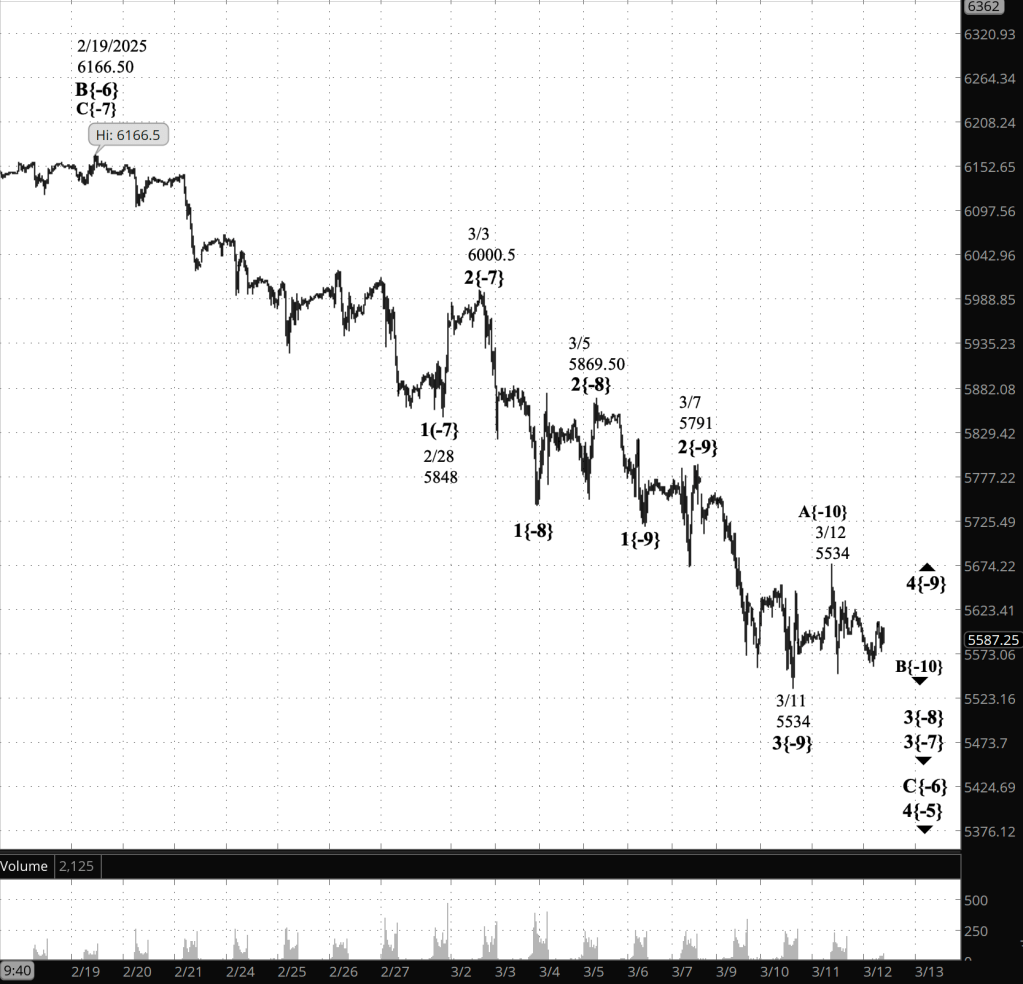
Trader’s Notebook

3:30 p.m. New York time

Half an hour before the closing bell. The S&P 500 futures rose during the session, from the 6070s at the opening bell into the 6130s as the closing bell approached.

Elliott Wave Theory: The rise, part of a falling 3rd wave that began on February 7, moved above the end of the preceding 2nd wave. Which is within rules of the Theory. No foul, no harm.

In discussing alternative counts (see the “What are the alternatives” section below), I’ve said that if the 3rd wave moved above the end of the 2nd wave, I’d start getting nervous about the analysis. It did move above that point — 6123.25 — up to 6135.50, so I’m now officially nervous.

I’ll look at the matter again on Friday, maybe even ponder it over the weekend, and make a call on Monday, for sure.

It’s charts like this one that cause me to shake my head gently and mutter to myself, “Isn’t ambiguity fun.”

9:35 a.m. New York time

What’s happening now? The S&P 500 E-mini futures overnight continued to fluctuate between two Fibonacci retracement levels, 50% and 38.2% (on the chart in red).

What does it mean? In Ellioitt Wave Theory analysis, the movement is a 2nd-wave upward correction within a downtrending 3rd-wave that began on February 7.

Above that, we get into corrections: The 3rd wave is a subwave of a larger wave C that began on January 31, the final subwave of a still larger wave B that began on January 24.

It’s all part of a 4th-wave downward correction that began on January 13.

[S&P 500 E-mini futures at 9:35 a.m., 55-minute bars, with volume]

What are the alternatives? Should the 1st-wave endpoint, wave 1{-19}, on February 2 instead be labeled as the parent wave C{-18} endpoint, bringing to an end the B{-17} wave that is one degree higher in the fractal chain of the chart and the beginning of a rising wave C{-17wave. All of this is happening within the wave 4{-16} upward correction that began on January 13. The rising C wave, if it is in fact underway, the final subwave of that correction.

If the price moves above 6123.25, the high of rising wave 2{-19} in the principal analysis, then I would switch to an alternative scenario: Wave B ended on February 2.

What does Elliott wave theory say? Here are the waves that underlie the analyses.

Principal Analysis:

  • Rising wave 5{0} is underway. It is a wave of Intermediate degree that began in December 2018.
  • It is in its final subwave, wave 5{-1}.
  • Within wave 5{-1}, rising waves 5{-2}, 5{-3} and 5{-4} are underway, as is wave 5{-5}.
  • Wave 5{-5} is in its initial subwave, wave 1{-6}, which in turn is in its middle subwave, wave 3{-7}.
  • Wave 4{-7} is in its initial subwave, which is uptrending wave A{-8}, if wave 4{-7} is a Flat structure, with three subwaves, or wave 1{-8} if it is a Zigzag structure, with five subwaves. (I’ll assume Flat as the list continues, since that’s more common within 4th waves)
  • Wave A{-8} is in its initial subwave, wave 1{-9}, as are waves 1{-10}, 1{-11}, 1{-12}, and 1{-13}.
  • Wave 1{-14}, an upward correction and is in its first subwave, wave 3{-15}.
  • Wave 3{-15} is in its second subwave, rising wave 4{-16}, an upward correction
  • Wave 4{-16} is in its middle subwave, descending wave B{-17}, which is in its middle subwave, rising wave B{-18}
  • Declining wave C{-19}, the final subwave of wave B{-18}, has begun.

Long-term Waves.

These are the waves currently in progress under my principal analysis. Each line on the list shows the wave number, with the subscript in curly brackets, the traditional degree name, the starting date, the starting price of the S&P 500 E-mini futures, and the direction of the wave. (Updated with today’s reanalysis.)

  • S&P 500 Index:
  • 5{+3} Supercycle, 7/8/1932, 4.40 (up)
  • 5{+2} Cycle, 12/9/1974, 60.96 (up)
  • 5{+1} Primary, 3/6/2009, 666.79 (up)
  • 5{0} Intermediate, 12/26/2018, 2346.58 (up)
  • S&P 500 Futures
  • 5{-1} Minor, 10/27/2023, 4127.25 (up)
  • 3{-2} Minute, 10/27/23, 4127.75 (up)
  • 3{-3} Minuette, 10/27/23, 4127.75 (up)
  • 5{-4} Subminuette, 4/18/2024, 4963.50 (up)
  • 5{-5} Micro, 8/5/2024, 5120 (up)
  • 1{-6} Submicro, 8/5/2024, 5120 (up)
  • 4{-7} Minuscule, 12/16/2024, 6163.75 (down)
  • A{-8} (unnamed), 12/16/2024, 6163.75 (down)
  • 1{-9} (unnamed), 12/16/2024, 6163.75 (down)
  • 1{-10} (unnamed), 12/16/2024, 6163.75 (down)
  • 1{-11} (unnamed), 12/16/2024, 6163.75 (down)
  • 1{-12} (unnamed), 12/16/2024, 6163.75 (down)
  • 1{-13} (unnamed), 12/16/2024, 6163.75 (down)
  • 1{-14} (unnamed), 1/13/2025, 5809.25 (down)
  • 3{-15} (unnamed), 1/13/2025, 5809.25 (down)
  • 4{-16} (unnamed), 1/13/2025, 5809.25 (up)
  • B{-17} (unnamed), 1/24/2025, 6162.25 (down)
  • C{-18} (unnamed), 1/31/2025, 6147.75 (down)
  • B{-18} (unnamed), 1/27/2025, 5948 (up)
  • C{-19} (unnamed), 2/7/2025, 5935.5 (down)

Reading the chart. Price movements — waves – – in Elliott wave analysis are labeled with numbers within trending waves and letters with corrective waves. The subscripts — numbers in curly brackets — designate the wave’s degree, which, in Elliott wave analysis, means the relative position of a wave within the larger and smaller structures that make up the chart. R.N. Elliott, who in the 1930s developed the form of analysis that bears his name, viewed the chart as a complex structure of smaller waves nested within larger waves, which in turn are nested within still larger waves. In mathematics it’s called a fractal structure, where at every scale the pattern is similar to the others.

Learning and other resources. Elliott wave analysis provides context, not prophecy. As the 20th century semanticist Alfred Korzybski put it in his book Science and Sanity (1933), “The map is not the territory … The only usefulness of a map depends on similarity of structure between the empirical world and the map.” And I would add, in the ever-changing markets, we can judge that similarity of structure only after the fact.

See the menu page Analytical Methods for a rundown on where to go for information on Elliott wave analysis.

By Tim Bovee, Portland, Oregon, February 13, 2025

Disclaimer

Tim Bovee, Private Trader tracks the analysis and trades of a private trader for his own accounts. Nothing in this blog constitutes a recommendation to buy or sell stocks, options or any other financial instrument. The only purpose of this blog is to provide education and entertainment.

No trader is ever 100 percent successful in his or her trades. Trading in the stock and option markets is risky and uncertain. Each trader must make trading decisions for his or her own account, and take responsibility for the consequences.

License

All content on Tim Bovee, Private Trader by Timothy K. Bovee is licensed under a Creative Commons Attribution-ShareAlike 4.0 International License.

Based on a work at www.timbovee.com

Trader’s Notebook

3:30 p.m. New York time

Half an hour before the closing bell. The S&P 500 futures rose during the session, pausing at 3080, the 38.2% Fibonacci retracement level. It’s as though this morning’s drama with the higher than expected inflation report became a distant, not so fond memory before the session intended.

Elliott Wave Theory: And where are we now? About where we were before the inflation report. The 38.2% retracement level was where the price was stuck before the inflation announcement, and 38.2 is where it is as the closing bell approaches.

A small declining 3rd wave with a larger declining C wave within a still larger falling B wave within a 4th-wave upward correction that began on January 13 continues.

9:35 a.m. New York time

What’s happening now? The S&P 500 E-mini futures dropped 65 points in a minuter after the Bureau of Labor Statistics announced that inflation was worse that expected in January, from 6098 down to 6093.50. It then worked its way lower over the next few minutes to the 6020s.

What does it mean? The decline, as viewed through the lens of Elliott Wave Theory, was the expected resumption of the decline of the 3rd wave that began on February 7. The 3rd wave is the middle subwave with a declining C wave that began on January 31.

The C wave, when complete, will be the end of the larger declining B wave that began on January 24.

The waves on the chart have numbers and letters, each followed by a subsvript in curly brackets that shows how many degrees the wave is, within the fractal structure of the chart, from Intermediate degree. The present Intermediate degree, wave 5{0}, began in December 2018. On this chart, the waves are all smaller than Intermediate degree, so the numbers in brackets are negative.

The 3rd wave that fell sharply overnight is wave 3{-19} within declining wave C{-18}. Both are within wave B{-17}, the middle subwave of an upward correction that began on January 11, wave 4{-16}.

The decline carried the price down to the 61.8% Fibnacci retracement of the preceding A{-17} wave, typically a stopping point and sometimes a reversal point. The Fibonacci retracement ladder is shown on the chart in red.

[S&P 500 E-mini futures at 3:30 p.m., 55-minute bars, with volume]

What are the alternatives? The ambiguity has not been resolved. Should the 1st-wave endpoint, wave 1{-19}, on February 2 instead be labeled as the parent wave C{-18} endpoint, bringing to an end the B{-17} wave that is one degree higher in the fractal chain of the chart and the beginning of a rising wave C{-17wave. All of this is happening within the wave 4{-16} upward correction that began on January 13. The rising C wave, if it is in fact underway, the final subwave of that correction.

If the price moves above 6123.25, the high of rising wave 2{-19} in the principal analysis, then I would switch to an alternative scenario: Wave B ended on February 2. The price showed a sharp decline today without having moved above 6123.25, so by that criterion a re-analysis hasn’t been triggered.

What does Elliott wave theory say? Here are the waves that underlie the analyses.

Principal Analysis:

  • Rising wave 5{0} is underway. It is a wave of Intermediate degree that began in December 2018.
  • It is in its final subwave, wave 5{-1}.
  • Within wave 5{-1}, rising waves 5{-2}, 5{-3} and 5{-4} are underway, as is wave 5{-5}.
  • Wave 5{-5} is in its initial subwave, wave 1{-6}, which in turn is in its middle subwave, wave 3{-7}.
  • Wave 4{-7} is in its initial subwave, which is uptrending wave A{-8}, if wave 4{-7} is a Flat structure, with three subwaves, or wave 1{-8} if it is a Zigzag structure, with five subwaves. (I’ll assume Flat as the list continues, since that’s more common within 4th waves)
  • Wave A{-8} is in its initial subwave, wave 1{-9}, as are waves 1{-10}, 1{-11}, 1{-12}, and 1{-13}.
  • Wave 1{-14}, an upward correction and is in its first subwave, wave 3{-15}.
  • Wave 3{-15} is in its second subwave, rising wave 4{-16}, an upward correction
  • Wave 4{-16} is in its middle subwave, descending wave B{-17}, which is in its middle subwave, rising wave B{-18}
  • Declining wave C{-19}, the final subwave of wave B{-18}, has begun.

Long-term Waves.

These are the waves currently in progress under my principal analysis. Each line on the list shows the wave number, with the subscript in curly brackets, the traditional degree name, the starting date, the starting price of the S&P 500 E-mini futures, and the direction of the wave. (Updated with today’s reanalysis.)

  • S&P 500 Index:
  • 5{+3} Supercycle, 7/8/1932, 4.40 (up)
  • 5{+2} Cycle, 12/9/1974, 60.96 (up)
  • 5{+1} Primary, 3/6/2009, 666.79 (up)
  • 5{0} Intermediate, 12/26/2018, 2346.58 (up)
  • S&P 500 Futures
  • 5{-1} Minor, 10/27/2023, 4127.25 (up)
  • 3{-2} Minute, 10/27/23, 4127.75 (up)
  • 3{-3} Minuette, 10/27/23, 4127.75 (up)
  • 5{-4} Subminuette, 4/18/2024, 4963.50 (up)
  • 5{-5} Micro, 8/5/2024, 5120 (up)
  • 1{-6} Submicro, 8/5/2024, 5120 (up)
  • 4{-7} Minuscule, 12/16/2024, 6163.75 (down)
  • A{-8} (unnamed), 12/16/2024, 6163.75 (down)
  • 1{-9} (unnamed), 12/16/2024, 6163.75 (down)
  • 1{-10} (unnamed), 12/16/2024, 6163.75 (down)
  • 1{-11} (unnamed), 12/16/2024, 6163.75 (down)
  • 1{-12} (unnamed), 12/16/2024, 6163.75 (down)
  • 1{-13} (unnamed), 12/16/2024, 6163.75 (down)
  • 1{-14} (unnamed), 1/13/2025, 5809.25 (down)
  • 3{-15} (unnamed), 1/13/2025, 5809.25 (down)
  • 4{-16} (unnamed), 1/13/2025, 5809.25 (up)
  • B{-17} (unnamed), 1/24/2025, 6162.25 (down)
  • C{-18} (unnamed), 1/31/2025, 6147.75 (down)
  • B{-18} (unnamed), 1/27/2025, 5948 (up)
  • C{-19} (unnamed), 2/7/2025, 5935.5 (down)

Reading the chart. Price movements — waves – – in Elliott wave analysis are labeled with numbers within trending waves and letters with corrective waves. The subscripts — numbers in curly brackets — designate the wave’s degree, which, in Elliott wave analysis, means the relative position of a wave within the larger and smaller structures that make up the chart. R.N. Elliott, who in the 1930s developed the form of analysis that bears his name, viewed the chart as a complex structure of smaller waves nested within larger waves, which in turn are nested within still larger waves. In mathematics it’s called a fractal structure, where at every scale the pattern is similar to the others.

Learning and other resources. Elliott wave analysis provides context, not prophecy. As the 20th century semanticist Alfred Korzybski put it in his book Science and Sanity (1933), “The map is not the territory … The only usefulness of a map depends on similarity of structure between the empirical world and the map.” And I would add, in the ever-changing markets, we can judge that similarity of structure only after the fact.

See the menu page Analytical Methods for a rundown on where to go for information on Elliott wave analysis.

By Tim Bovee, Portland, Oregon, February 12, 2025

Disclaimer

Tim Bovee, Private Trader tracks the analysis and trades of a private trader for his own accounts. Nothing in this blog constitutes a recommendation to buy or sell stocks, options or any other financial instrument. The only purpose of this blog is to provide education and entertainment.

No trader is ever 100 percent successful in his or her trades. Trading in the stock and option markets is risky and uncertain. Each trader must make trading decisions for his or her own account, and take responsibility for the consequences.

License

All content on Tim Bovee, Private Trader by Timothy K. Bovee is licensed under a Creative Commons Attribution-ShareAlike 4.0 International License.

Based on a work at www.timbovee.com