Trader’s Notebook

3:30 p.m. New York time

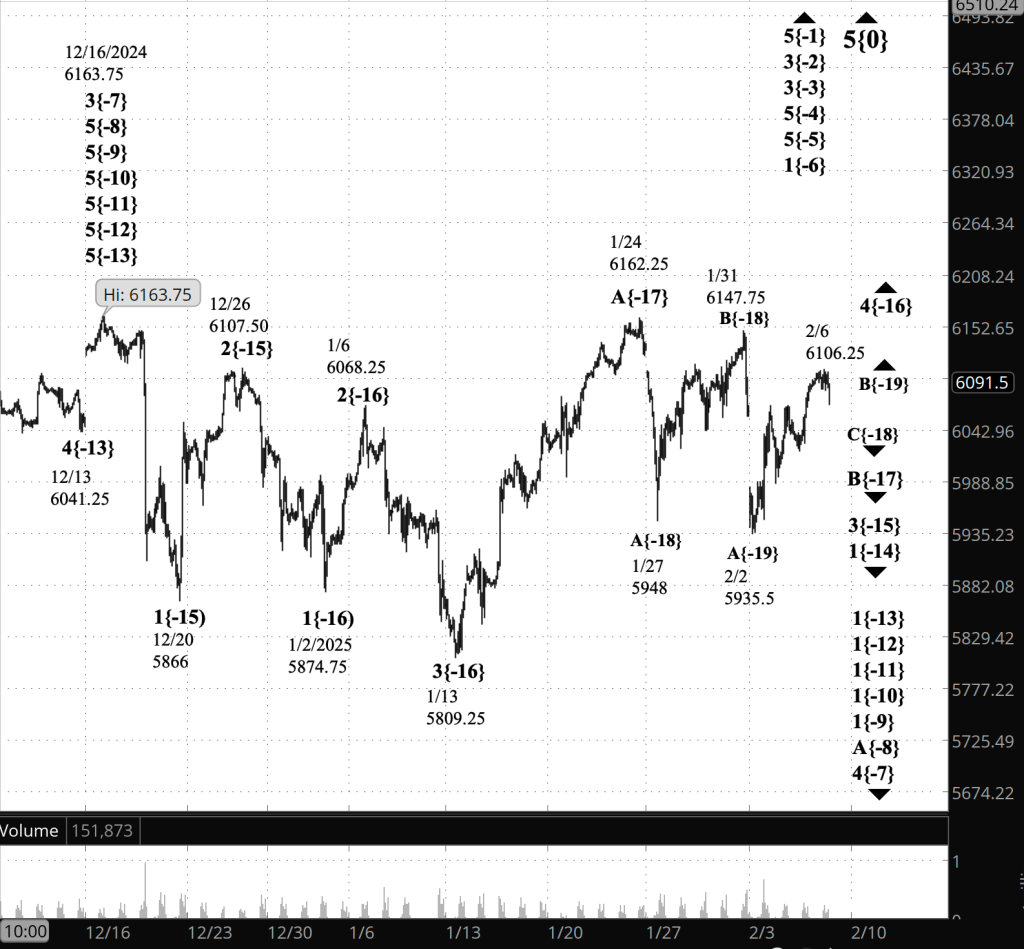
Half an hour before the closing bell. The S&P 500 futures continued to rise during the session, reaching 6000 as the closing bell approached.

Elliott Wave Theory: The 4th-wave upward correction that began on January 13 continues and is in its 3rd subwave.

9:35 a.m. New York time

What’s happening now? The S&P 500 E-mini futures traded close to a straight sideways line overnight until an hour before the opening bell. At that point, the latest Consumer Price Index, a measure of inflation, was released. The price rose from the 5901.25 to 25 cents below 5980 in the span of a minute, and stayed in the upper part of the range thereafter.

What does it mean? Elliott Wave Theory analysis places the price in the 4th-wave upward correction that began on January 13, a subwave of the downtrendng 5th wave that began on January 6. Within the correction. The rise from mid-January shows three clear subwaves, waves A, B and C or possibly waves 1, 2 and 3.

The uncertainty lies in understandng what follows wave C. There are alternatives.

What are the alternatives? Which alternative is correct depends upon the form being taken by the parent wave 4.

If it’s a Zigzag, wave 4 will have five subwaves, and the present wave 3 will be followed before two more waves before the correction is complete.

If it’s a Flat, wave 4 will have three subwaves, and the present wave C will be the final subwave within the correction.

Wave 4 corrections tend to be Flats, but not always. So the question is up in the air and as the 3rd subwave ends will create a bit of confusion.

Whichever the form, a rule of Elliott Wave Theory says that a 4th wave cannot move beyond the end of wave 1. In this case, that level is 6004. If it does cross that line, then its not really a 4th wave and the analysis will be redone.

[S&P 500 E-mini futures at 3:30 p.m., 50-minute bars, with volume]

What does Elliott wave theory say? Here are the waves that underly the analyses.

Principal Analysis:

  • .Rising wave 5{0} is underway. It is a wave of Intermediate degree that began in December 2018.
  • It is in its final subwave, wave 5{-1}.
  • Within wave 5{-1}, rising waves 5{-2}, 5{-3} and 5{-4} are underway, as is wave 5{-5}.
  • Wave 5{-5} is in its initial subwave, wave 1{-6}, which in turn is in its middle subwave, wave 3{-7}.
  • Wave 4{-7} is in its initial; subwave, which is uptrending wave A{-8}, if wave 4{-7} is a Flat structure, with three subwaves, or wave 1{-8} if it is a Zigzag structure, with five subwaves. (I’ll assume Flat as the list continues, since that’s more common within 4th waves)
  • Wave A{-8} is in its intial subwave, wave 1{-9}, as are waves 1{-10}, 1{-11}, 1{-12}, 1{-13} and 1{-14}.
  • Wave 5{-15} is presently underway and is declining. Within it, wave 4{-16} is rising and is in its 3rd subwave.

Long-term Waves.

These are the waves currently in progress under my principal analysis. Each line on the list shows the wave number, with the subscript in curly brackets, the traditional degree name, the starting date, the starting price of the S&P 500 E-mini futures, and the direction of the wave.

  • S&P 500 Index:
  • 5{+3} Supercycle, 7/8/1932, 4.40 (up)
  • 5{+2} Cycle, 12/9/1974, 60.96 (up)
  • 5{+1} Primary, 3/6/2009, 666.79 (up)
  • 5{0} Intermediate, 12/26/2018, 2346.58 (up)
  • S&P 500 Futures
  • 5{-1} Minor, 10/27/2023, 4127.25 (up)
  • 3{-2} Minute, 10/27/23, 4127.75 (up)
  • 3{-3} Minuette, 10/27/23, 4127.75 (up)
  • 5{-4} Subminuette, 4/18/2024, 4963.50 (up)
  • 5{-5} Micro, 8/5/2024, 5120 (up)
  • 1{-6} Submicro, 8/5/2024, 5120 (up)
  • 4{-7} Minuscule, 12/16/2024, 6163.75 (down)
  • A{-8} (unnamed), 12/16/2024, 6163.75 (down)
  • 1{-9} (unnamed), 12/16/2024, 6163.75 (down)
  • 1{-10} (unnamed), 12/16/2024, 6163.75 (down)
  • 1{-11} (unnamed), 12/16/2024, 6163.75 (down)
  • 1{-12} (unnamed), 12/16/2024, 6163.75 (down)
  • 1{-13} (unnamed), 12/16/2024, 6163.75 (down)
  • 1{-14} (unnamed), 12/16/2024, 6163.75 (down)
  • 5{-15} (unnamed), 1/6/2025, 6068.25 (down)

Reading the chart. Price movements — waves – – in Elliott wave analysis are labeled with numbers within trending waves and letters with corrective waves. The subscripts — numbers in curly brackets — designate the wave’s degree, which, in Elliott wave analysis, means the relative position of a wave within the larger and smaller structures that make up the chart. R.N. Elliott, who in the 1930s developed the form of analysis that bears his name, viewed the chart as a complex structure of smaller waves nested within larger waves, which in turn are nested within still larger waves. In mathematics it’s called a fractal structure, where at every scale the pattern is similar to the others.

Learning and other resources. Elliott wave analysis provides context, not prophecy. As the 20th century semanticist Alfred Korzybski put it in his book Science and Sanity (1933), “The map is not the territory … The only usefulness of a map depends on similarity of structure between the empirical world and the map.” And I would add, in the ever-changing markets, we can judge that similarity of structure only after the fact.

See the menu page Analytical Methods for a rundown on where to go for information on Elliott wave analysis.

By Tim Bovee, Portland, Oregon, January 15, 2025

Disclaimer

Tim Bovee, Private Trader tracks the analysis and trades of a private trader for his own accounts. Nothing in this blog constitutes a recommendation to buy or sell stocks, options or any other financial instrument. The only purpose of this blog is to provide education and entertainment.

No trader is ever 100 percent successful in his or her trades. Trading in the stock and option markets is risky and uncertain. Each trader must make trading decisions for his or her own account, and take responsibility for the consequences.

License
Creative Commons License

All content on Tim Bovee, Private Trader by Timothy K. Bovee is licensed under a Creative Commons Attribution-ShareAlike 4.0 International License.

Based on a work at www.timbovee.com.

Trader’s Notebook

3:30 p.m. New York time

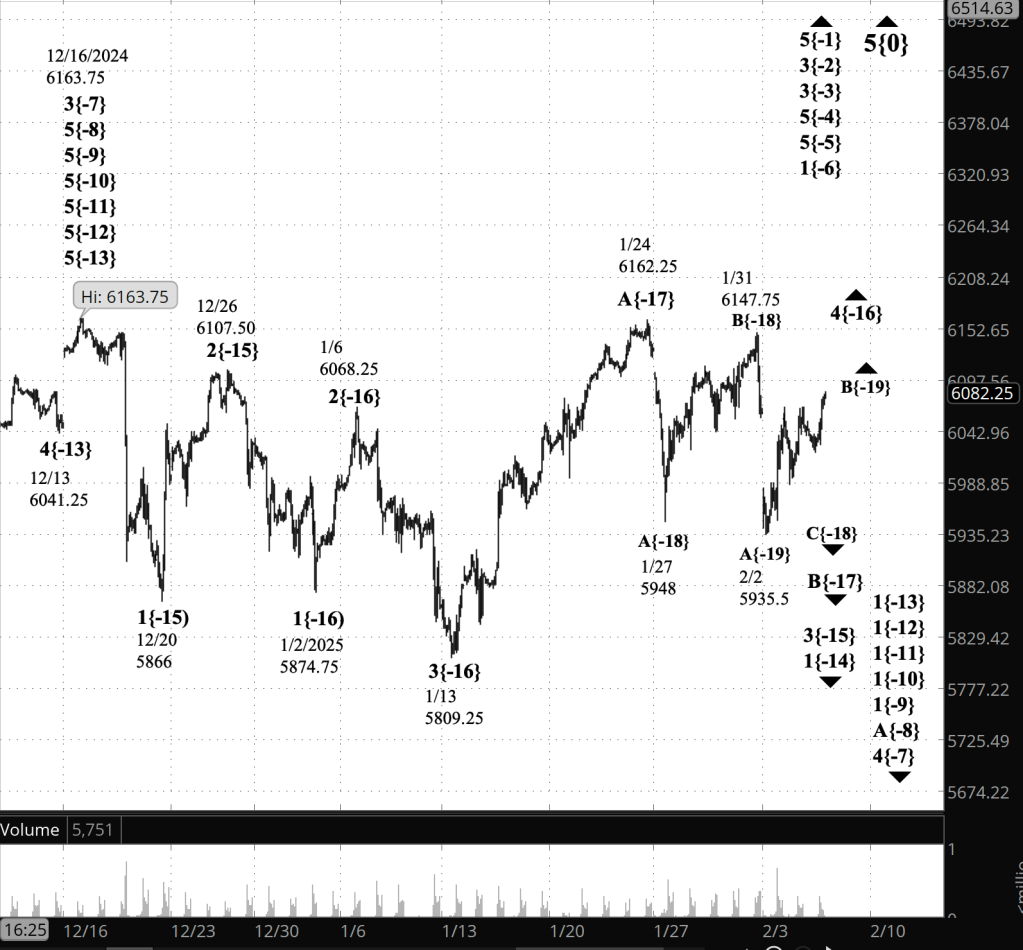
Half an hour before the closing bell. The S&P 500 futures traded narrowly during the session. Elliott Wave Theory: The 4th-wave upward correction that began on January 13 continues.

9:35 a.m. New York time

What’s happening now? The S&P 500 E-mini futures fell overnight until an hour before the opening bell, rising sharply with the announcement of Producer Price Index inflation numbers for December. The rise carried the price from 5874.50 to 5918.50 in the span of a minute. Afterward, the price drifted back to the 5890s.

What does it mean? Elliott Wave Theory analysis counts the overnight movements as subwaves of a 4th-wave upward correction that began on January 13. The correction is a subwave of a downtrending 5th wave that began on January 6.

[S&P 500 E-mini futures at 3:30 p.m., 50-minute bars, with volume]

What are the alternatives? None at present. They will develop.

What does Elliott wave theory say? Here are the waves that underly the analyses.

Principal Analysis:

  • Rising wave 5{0} is underway. It is a wave of Intermediate degree that began in December 2018.
  • It is in its final subwave, wave 5{-1}.
  • Within wave 5{-1}, rising waves 5{-2}, 5{-3} and 5{-4} are underway, as is wave 5{-5}.
  • Wave 5{-5} is in its initial subwave, wave 1{-6}, which in turn is in its middle subwave, wave 3{-7}.
  • Wave 4{-7} is in its initial; subwave, which is uptrending wave A{-8}, if wave 4{-7} is a Flat structure, with three subwaves, or wave 1{-8} if it is a Zigzag structure, with five subwaves. (I’ll assume Flat as the list continues, since that’s more common within 4th waves)
  • Wave A{-8} is in its intial subwave, wave 1{-9}, as are waves 1{-10}, 1{-11}, 1{-12}, 1{-13} and 1{-14}.
  • Wave 5{-15} is presently underway and is declining.

Long-term Waves.

These are the waves currently in progress under my principal analysis. Each line on the list shows the wave number, with the subscript in curly brackets, the traditional degree name, the starting date, the starting price of the S&P 500 E-mini futures, and the direction of the wave.

  • S&P 500 Index:
  • 5{+3} Supercycle, 7/8/1932, 4.40 (up)
  • 5{+2} Cycle, 12/9/1974, 60.96 (up)
  • 5{+1} Primary, 3/6/2009, 666.79 (up)
  • 5{0} Intermediate, 12/26/2018, 2346.58 (up)
  • S&P 500 Futures
  • 5{-1} Minor, 10/27/2023, 4127.25 (up)
  • 3{-2} Minute, 10/27/23, 4127.75 (up)
  • 3{-3} Minuette, 10/27/23, 4127.75 (up)
  • 5{-4} Subminuette, 4/18/2024, 4963.50 (up)
  • 5{-5} Micro, 8/5/2024, 5120 (up)
  • 1{-6} Submicro, 8/5/2024, 5120 (up)
  • 4{-7} Minuscule, 12/16/2024, 6163.75 (down)
  • A{-8} (unnamed), 12/16/2024, 6163.75 (down)
  • 1{-9} (unnamed), 12/16/2024, 6163.75 (down)
  • 1{-10} (unnamed), 12/16/2024, 6163.75 (down)
  • 1{-11} (unnamed), 12/16/2024, 6163.75 (down)
  • 1{-12} (unnamed), 12/16/2024, 6163.75 (down)
  • 1{-13} (unnamed), 12/16/2024, 6163.75 (down)
  • 1{-14} (unnamed), 12/16/2024, 6163.75 (down)
  • 5{-15} (unnamed), 1/6/2025, 6068.25 (down)

Reading the chart. Price movements — waves – – in Elliott wave analysis are labeled with numbers within trending waves and letters with corrective waves. The subscripts — numbers in curly brackets — designate the wave’s degree, which, in Elliott wave analysis, means the relative position of a wave within the larger and smaller structures that make up the chart. R.N. Elliott, who in the 1930s developed the form of analysis that bears his name, viewed the chart as a complex structure of smaller waves nested within larger waves, which in turn are nested within still larger waves. In mathematics it’s called a fractal structure, where at every scale the pattern is similar to the others.

Learning and other resources. Elliott wave analysis provides context, not prophecy. As the 20th century semanticist Alfred Korzybski put it in his book Science and Sanity (1933), “The map is not the territory … The only usefulness of a map depends on similarity of structure between the empirical world and the map.” And I would add, in the ever-changing markets, we can judge that similarity of structure only after the fact.

See the menu page Analytical Methods for a rundown on where to go for information on Elliott wave analysis.

By Tim Bovee, Portland, Oregon, January 14, 2025

Disclaimer

Tim Bovee, Private Trader tracks the analysis and trades of a private trader for his own accounts. Nothing in this blog constitutes a recommendation to buy or sell stocks, options or any other financial instrument. The only purpose of this blog is to provide education and entertainment.

No trader is ever 100 percent successful in his or her trades. Trading in the stock and option markets is risky and uncertain. Each trader must make trading decisions for his or her own account, and take responsibility for the consequences.

License
Creative Commons License

All content on Tim Bovee, Private Trader by Timothy K. Bovee is licensed under a Creative Commons Attribution-ShareAlike 4.0 International License.

Based on a work at www.timbovee.com.
Trader’s Notebook

3:30 p.m. New York time

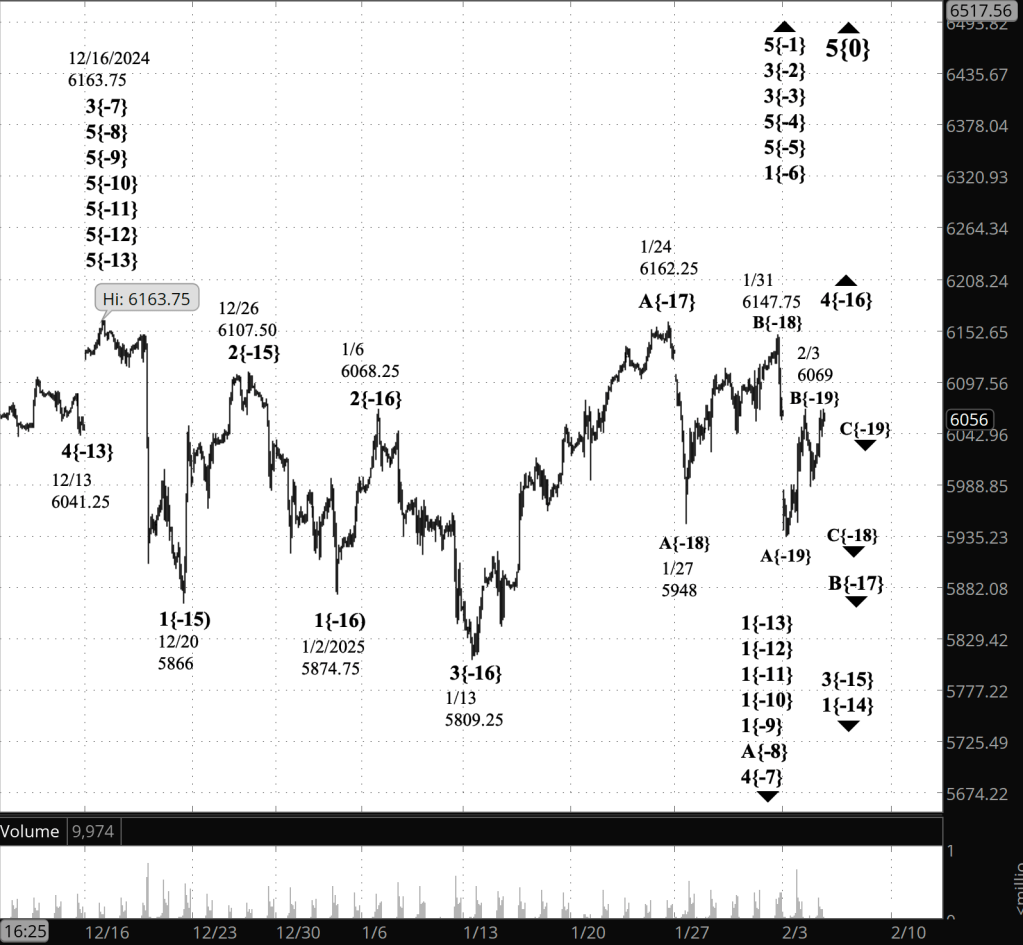
Half an hour before the closing bell. The S&P 500 futures reversed at the overnight low, 5809, and rose back into the the 5870s. Elliott Wave Theory: The move is a 4th-wave upward correction within 5th-wave downtrend that began on January 6.

When the correction is complete, a final dowtrending impulse wave will carry the 5th to its end. At that point, the parent 1st wave, which began on December 16 from 6163.75, will also end, and a 2nd-wave upward correction will begin.

9:35 a.m. New York time

What’s happening now? The S&P 500 E-mini futures continued their decline overnight, from the 5860s to slightly above 5800.

What does it mean? Elliott Wave Theory analysis finds that the decline from mid-December’s significant market top continues and is now in its fnal subwave.

The reversal occurred on December 16, 2024 from 6163.75. Note the wave labels at that point on the chart. Six nested 5th waves of increasing degree all came to an end at that moment, and the next tick six tested 1st waves began, subwaves within a 4th-wave downward correction.

This is the season when market pundits display their expectations for the 2025 markets. The chart below displays mine, insofar as the S&P 500 futures continue to reflect the the broader market.

It is a very bearish picture. Not a quick crash and recovery like we saw at the outset of the Covid-19 Pandemic, but a long-lasting downward trend worthy of the monicker “Hard Times”.

But the truth of the markets is that even bearish times have uptrending waves interspersed with the declines. There in lies the beauty of the markets: There is always, ALWAYS, an opportunity to win and equally, an opportunity to lose.

[S&P 500 E-mini futures at 3:30 p.m., 50-minute bars, with volume]

What are the alternatives? None are apparent at this point. They will surely develop, as they always do.

What does Elliott wave theory say? Here are the waves that underly the analyses.

Principal Analysis:

  • .Rising wave 5{0} is underway. It is a wave of Intermediate degree that began in December 2018.
  • It is in its final subwave, wave 5{-1}.
  • Within wave 5{-1}, rising waves 5{-2}, 5{-3} and 5{-4} are underway, as is wave 5{-5}.
  • Wave 5{-5} is in its initial subwave, wave 1{-6}, which in turn is in its middle subwave, wave 3{-7}.
  • Wave 4{-7} is in its initial; subwave, which is uptrending wave A{-8}, if wave 4{-7} is a Flat structure, with three subwaves, or wave 1{-8} if it is a Zigzag structure, with five subwaves. (I’ll assume Flat as the list continues, since that’s more common within 4th waves)
  • Wave A{-8} is in its intial subwave, wave 1{-9}, as are waves 1{-10}, 1{-11}, 1{-12}, 1{-13} and 1{-14}.
  • Wave 5{-15} is presently underway and is declining.

Long-term Waves.

These are the waves currently in progress under my principal analysis. Each line on the list shows the wave number, with the subscript in curly brackets, the traditional degree name, the starting date, the starting price of the S&P 500 E-mini futures, and the direction of the wave.

  • S&P 500 Index:
  • 5{+3} Supercycle, 7/8/1932, 4.40 (up)
  • 5{+2} Cycle, 12/9/1974, 60.96 (up)
  • 5{+1} Primary, 3/6/2009, 666.79 (up)
  • 5{0} Intermediate, 12/26/2018, 2346.58 (up)
  • S&P 500 Futures
  • 5{-1} Minor, 10/27/2023, 4127.25 (up)
  • 3{-2} Minute, 10/27/23, 4127.75 (up)
  • 3{-3} Minuette, 10/27/23, 4127.75 (up)
  • 5{-4} Subminuette, 4/18/2024, 4963.50 (up)
  • 5{-5} Micro, 8/5/2024, 5120 (up)
  • 1{-6} Submicro, 8/5/2024, 5120 (up)
  • 4{-7} Minuscule, 12/16/2024, 6163.75 (down)
  • A{-8} (unnamed), 12/16/2024, 6163.75 (down)
  • 1{-9} (unnamed), 12/16/2024, 6163.75 (down)
  • 1{-10} (unnamed), 12/16/2024, 6163.75 (down)
  • 1{-11} (unnamed), 12/16/2024, 6163.75 (down)
  • 1{-12} (unnamed), 12/16/2024, 6163.75 (down)
  • 1{-13} (unnamed), 12/16/2024, 6163.75 (down)
  • 1{-14} (unnamed), 12/16/2024, 6163.75 (down)
  • 5{-15} (unnamed), 1/6/2025, 6068.25 (down)

Reading the chart. Price movements — waves – – in Elliott wave analysis are labeled with numbers within trending waves and letters with corrective waves. The subscripts — numbers in curly brackets — designate the wave’s degree, which, in Elliott wave analysis, means the relative position of a wave within the larger and smaller structures that make up the chart. R.N. Elliott, who in the 1930s developed the form of analysis that bears his name, viewed the chart as a complex structure of smaller waves nested within larger waves, which in turn are nested within still larger waves. In mathematics it’s called a fractal structure, where at every scale the pattern is similar to the others.

Learning and other resources. Elliott wave analysis provides context, not prophecy. As the 20th century semanticist Alfred Korzybski put it in his book Science and Sanity (1933), “The map is not the territory … The only usefulness of a map depends on similarity of structure between the empirical world and the map.” And I would add, in the ever-changing markets, we can judge that similarity of structure only after the fact.

See the menu page Analytical Methods for a rundown on where to go for information on Elliott wave analysis.

By Tim Bovee, Portland, Oregon, January 13, 2025

Disclaimer

Tim Bovee, Private Trader tracks the analysis and trades of a private trader for his own accounts. Nothing in this blog constitutes a recommendation to buy or sell stocks, options or any other financial instrument. The only purpose of this blog is to provide education and entertainment.

No trader is ever 100 percent successful in his or her trades. Trading in the stock and option markets is risky and uncertain. Each trader must make trading decisions for his or her own account, and take responsibility for the consequences.

License
Creative Commons License

All content on Tim Bovee, Private Trader by Timothy K. Bovee is licensed under a Creative Commons Attribution-ShareAlike 4.0 International License.

Based on a work at www.timbovee.com.
Trader’s Notebook

3:30 p.m. New York time

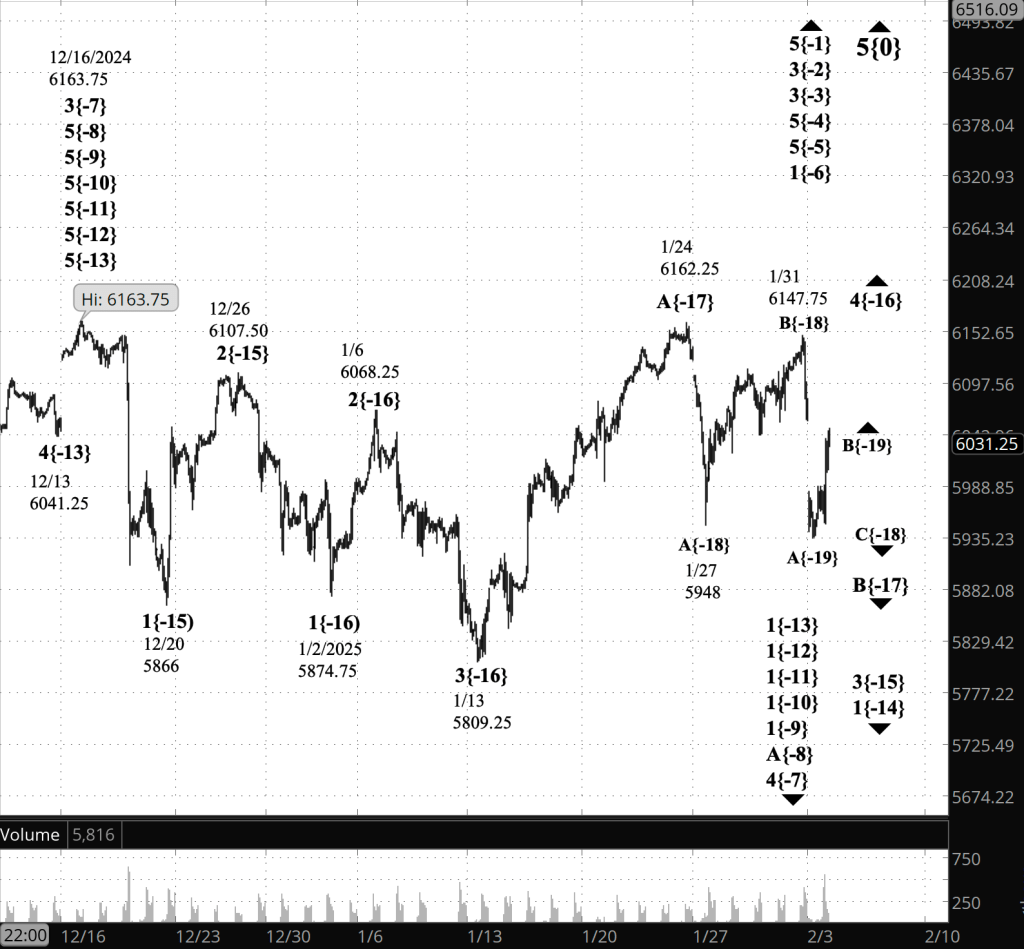
Half an hour before the closing bell. The S&P 500 futures rose during the session from the 5840s to slightly above 5900 and began to drift downward. The downtrending 5th wave that began on January 6 from 6068.25 continues and in in its middle subwave, wave 3.

1:25 p.m. New York time

Reanalysis of the chart from mid-December to mid-January. That sort of large reanalysis is what I said would happen if the price dropped below 5866, the end of the previous 1st wave. The price dropped below that level during the middle of session. Here’s the result.

What has changed? The problem was a rule that says 4th waves can’t move beyond the end of the 1st wave that came before it. When that rule was broken, as it was today, then the solution is to redo the count so as to get rid of the 4th wave.

Each wave on the chart has a wave number or letter, followed by a subscript in curly brackets containing a number showing the wave’s distance in degrees from Intermediate degree within the fractal structure of the chart. A positive number is degrees larger then the Intermediate degree. The present Intermediate degree, wave 5{0}, began in December 2018/

I achieved that solution by pushing the 4th-wave upward correction up a degree down, so that what had been the A{-15} wave, the correction’s first subwave, became the entire wave 4{-15} correction, ending on January 6 at 6008.25.

That change then transformed the ensuing decline, which had been wave B {-15}, the middle subwave of the correction, into wave 5{-14}, the downtrending 5th wave that follows the correction.

Problem solved. The implication of the change is that we a longer immediately ahead than we when the the old version, the B wave. For my trades, I shall consider it to be a strengthening of the bearish indicator that has been with us since the January 6 peak.

I have retained this morning’s chart for comparison with the revised chart, which is here:

[S&P 500 E-mini futures at 3:30 p.m., 45-minute bars, with volume]


The analysis and chart below the line are part of this morning’s analysis, which has been replaced by the new principal analysis described above. The wave lists, below, have been be updated with the analysis.

9:35 a.m. New York time

What’s happening now? The S&P 500 E-mini futures fell sharply, from the 5950s to the 5880s, after the Bureau of Labor Statistics reported a 256,000 increase in jobs. Unemployment held steady at 4.1%

What does it mean? The decline knocked out yesterday’s principal Elliott Wave Theory analysis, instead confirming the alternative analysis: The middle subwave, declining wave B, within a 4th-wave upward correction that began on January 2.

Wave B will be followed by a rising C wave, the final wave within the 4th-wave correction. When the C wave is compete, bringing the correctian to an end, A downtrending 5th wave will begin.

Under the rules of Elliott Wave Theory, the B wave cannot move below the start of the preceding wave 1, the declining wave that preceded the upward correction. That 1st wave ended on December 20, 2024, at 5866. If the price should drop that low while the correction is undeerway, then the entire analysis since December 16, 2024 gets tossed and a new analysis takes its place.

[Outdated: S&P 500 E-mini futures at 9:35 a.m., 45-minute bars, with volume]

What are the alternatives?

The B subwave problem that plagued both of yesterday’s possibilities, principal and alternative, continues. B waves in either of the most common corrective patterns — Zigzag and Flat — have three subwaves. The subwaves I’m seeing on the chart number five.

What does Elliott wave theory say? Here are the waves that underly the analyses.

Principal Analysis:

Updated with the 1:25 p.m. New York timeanalysis.

  • .Rising wave 5{0} is underway. It is a wave of Intermediate degree that began in December 2018.
  • It is in its final subwave, wave 5{-1}.
  • Within wave 5{-1}, rising waves 5{-2}, 5{-3} and 5{-4} are underway, as is wave 5{-5}.
  • Wave 5{-5} is in its initial subwave, wave 1{-6}, which in turn is in its middle subwave, wave 3{-7}.
  • Wave 4{-7} is in its initial; subwave, which is uptrending wave A{-8}, if wave 4{-7} is a Flat structure, with three subwaves, or wave 1{-8} if it is a Zigzag structure, with five subwaves. (I’ll assume Flat as the list continues, since that’s more common within 4th waves)
  • Wave A{-8} is in its intial subwave, wave 1{-9}, as are waves 1{-10}, 1{-11}, 1{-12}, 1{-13} and 1{-14}.
  • Wave 5{-16} is presently underway and is declining.

Long-term Waves.

Updated with the 1:25 p.m. New York time analysis.

These are the waves currently in progress under my principal analysis. Each line on the list shows the wave number, with the subscript in curly brackets, the traditional degree name, the starting date, the starting price of the S&P 500 E-mini futures, and the direction of the wave.

  • S&P 500 Index:
  • 5{+3} Supercycle, 7/8/1932, 4.40 (up)
  • 5{+2} Cycle, 12/9/1974, 60.96 (up)
  • 5{+1} Primary, 3/6/2009, 666.79 (up)
  • 5{0} Intermediate, 12/26/2018, 2346.58 (up)
  • S&P 500 Futures
  • 5{-1} Minor, 10/27/2023, 4127.25 (up)
  • 3{-2} Minute, 10/27/23, 4127.75 (up)
  • 3{-3} Minuette, 10/27/23, 4127.75 (up)
  • 5{-4} Subminuette, 4/18/2024, 4963.50 (up)
  • 5{-5} Micro, 8/5/2024, 5120 (up)
  • 1{-6} Submicro, 8/5/2024, 5120 (up)
  • 4{-7} Minuscule, 12/16/2024, 6163.75 (down)
  • A{-8} (unnamed), 12/16/2024, 6163.75 (down)
  • 1{-9} (unnamed), 12/16/2024, 6163.75 (down)
  • 1{-10} (unnamed), 12/16/2024, 6163.75 (down)
  • 1{-11} (unnamed), 12/16/2024, 6163.75 (down)
  • 1{-12} (unnamed), 12/16/2024, 6163.75 (down)
  • 1{-13} (unnamed), 12/16/2024, 6163.75 (down)
  • 1{-14} (unnamed), 12/16/2024, 6163.75 (down)
  • 5{-15} (unnamed), 1/6/2025, 6068.25 (down)

Reading the chart. Price movements — waves – – in Elliott wave analysis are labeled with numbers within trending waves and letters with corrective waves. The subscripts — numbers in curly brackets — designate the wave’s degree, which, in Elliott wave analysis, means the relative position of a wave within the larger and smaller structures that make up the chart. R.N. Elliott, who in the 1930s developed the form of analysis that bears his name, viewed the chart as a complex structure of smaller waves nested within larger waves, which in turn are nested within still larger waves. In mathematics it’s called a fractal structure, where at every scale the pattern is similar to the others.

Learning and other resources. Elliott wave analysis provides context, not prophecy. As the 20th century semanticist Alfred Korzybski put it in his book Science and Sanity (1933), “The map is not the territory … The only usefulness of a map depends on similarity of structure between the empirical world and the map.” And I would add, in the ever-changing markets, we can judge that similarity of structure only after the fact.

See the menu page Analytical Methods for a rundown on where to go for information on Elliott wave analysis.

By Tim Bovee, Portland, Oregon, January 10, 2025

Disclaimer

Tim Bovee, Private Trader tracks the analysis and trades of a private trader for his own accounts. Nothing in this blog constitutes a recommendation to buy or sell stocks, options or any other financial instrument. The only purpose of this blog is to provide education and entertainment.

No trader is ever 100 percent successful in his or her trades. Trading in the stock and option markets is risky and uncertain. Each trader must make trading decisions for his or her own account, and take responsibility for the consequences.

License
Creative Commons License

All content on Tim Bovee, Private Trader by Timothy K. Bovee is licensed under a Creative Commons Attribution-ShareAlike 4.0 International License.

Based on a work at www.timbovee.com.
Trader’s Notebook

U.S. stock and option markets will be closed on Thursday to honor President Jimmy Carter, who held office from 1977 to 1981 and who died on December 29 at the age of 100. Bond markets will close at 2 p.m., and futures markets will trade as usual. Having posted my morning analysis at of the S&P 500 E-mini futures at 9:35 a.m., and shall post my afternoon analysis at 3:30 p.m., both New York time.

And what appears to have happened is the futures stopped trading at 9:30 a.m., when the opening bell normally rings. If trading doesn’t resume, then this will be the only analysis today, and the regular shedule will resume on Friday.

9:35 a.m. New York time

What’s happening now? The S&P 500 E-mini futures fluctuated sideways overnight, from the 5920s to the 5950s.

What does it mean? In Elliott Wave Theory, the B-wave — the middle subwave in the common three-wave corrections — has three still smaller subwaves. As of yesterday’s analyses it wave B appeared to have five subwaves, creating some ambiguities and an alternative analysis. All of this is happening within the 4th-wave upward correction that began on January 2.

[S&P 500 E-mini futures at 9:35 a.m., 45-minute bars, with volume]

What are the alternatives? There were severals ways of explaining the incorrect five subwaves, which I listed in yesterday’s post. The overnight trading may have resolved the ambiguities, in the simplest manner possible, and I’ve labeled the chart accordingly. Under the new principal analysis, wave B ended on January 8 at 5917. The subsequent rise is an early stage of wave C.

If the price reverses and falls below 5917, then this principal analysis is incorrect and will be revised.

What does Elliott wave theory say? Here are the waves that underly the analyses.

Principal Analysis:

  • .Rising wave 5{0} is underway. It is a wave of Intermediate degree that began in December 2018.
  • It is in its final subwave, wave 5{-1}.
  • Within wave 5{-1}, rising waves 5{-2}, 5{-3} and 5{-4} are underway, as is wave 5{-5}.
  • Wave 5{-5} is in its initial subwave, wave 1{-6}, which in turn is in its middle subwave, wave 3{-7}.
  • Wave 4{-7} is in its initial; subwave, uptrending wave A{-8}.
  • Wave 1{-8} is in its initial subwave, wave 1{-9}, which is in its final subwave, uptrending wave 5{-10}.
  • Wave 1{-10} is in its initial subwave, as are waves 1{-11}, 1{-12}, and 1{-13}.
  • Wave 4{-14} is presently underway and is rising. It is in its final subwave, rising wave C{-15}.

Long-term Waves.

These are the waves currently in progress under my principal analysis. Each line on the list shows the wave number, with the subscript in curly brackets, the traditional degree name, the starting date, the starting price of the S&P 500 E-mini futures, and the direction of the wave.

  • S&P 500 Index:
  • 5{+3} Supercycle, 7/8/1932, 4.40 (up)
  • 5{+2} Cycle, 12/9/1974, 60.96 (up)
  • 5{+1} Primary, 3/6/2009, 666.79 (up)
  • 5{0} Intermediate, 12/26/2018, 2346.58 (up)
  • S&P 500 Futures
  • 5{-1} Minor, 10/27/2023, 4127.25 (up)
  • 3{-2} Minute, 10/27/23, 4127.75 (up)
  • 3{-3} Minuette, 10/27/23, 4127.75 (up)
  • 5{-4} Subminuette, 4/18/2024, 4963.50 (up)
  • 5{-5} Micro, 8/5/2024, 5120 (up)
  • 1{-6} Submicro, 8/5/2024, 5120 (up)
  • 4{-7} Minuscule, 12/16/2024, 6163.75 (down)
  • A{-8} (unnamed), 12/16/2024, 6163.75 (down)
  • 1{-9} (unnamed), 12/16/2024, 6163.75 (down)
  • 1{-10} (unnamed), 12/16/2024, 6163.75 (down)
  • 1{-11} (unnamed), 12/16/2024, 6163.75 (down)
  • 1{-12} (unnamed), 12/16/2024, 6163.75 (down)
  • 1{-13} (unnamed), 12/16/2024, 6163.75 (down)
  • 4[-14} (unnamed), 1/2/20255874.75 (up)
  • C{-15} (unnamed), 1/8/2025, 5817 (up)

Reading the chart. Price movements — waves – – in Elliott wave analysis are labeled with numbers within trending waves and letters with corrective waves. The subscripts — numbers in curly brackets — designate the wave’s degree, which, in Elliott wave analysis, means the relative position of a wave within the larger and smaller structures that make up the chart. R.N. Elliott, who in the 1930s developed the form of analysis that bears his name, viewed the chart as a complex structure of smaller waves nested within larger waves, which in turn are nested within still larger waves. In mathematics it’s called a fractal structure, where at every scale the pattern is similar to the others.

Learning and other resources. Elliott wave analysis provides context, not prophecy. As the 20th century semanticist Alfred Korzybski put it in his book Science and Sanity (1933), “The map is not the territory … The only usefulness of a map depends on similarity of structure between the empirical world and the map.” And I would add, in the ever-changing markets, we can judge that similarity of structure only after the fact.

See the menu page Analytical Methods for a rundown on where to go for information on Elliott wave analysis.

By Tim Bovee, Portland, Oregon, January 9, 2025

Disclaimer

Tim Bovee, Private Trader tracks the analysis and trades of a private trader for his own accounts. Nothing in this blog constitutes a recommendation to buy or sell stocks, options or any other financial instrument. The only purpose of this blog is to provide education and entertainment.

No trader is ever 100 percent successful in his or her trades. Trading in the stock and option markets is risky and uncertain. Each trader must make trading decisions for his or her own account, and take responsibility for the consequences.

License
Creative Commons License

All content on Tim Bovee, Private Trader by Timothy K. Bovee is licensed under a Creative Commons Attribution-ShareAlike 4.0 International License.

Based on a work at www.timbovee.com.
Trader’s Notebook

U.S. stock and option markets will be closed on Thursday to honor President Jimmy Carter, who held office from 1977 to 1981 and who died on December 29 at the age of 100. Bond markets will close at 2 p.m., and futures markets will trade as usual. I shall post my analyses at of the S&P 500 E-mini futures at 9:35 a.m. and at 3:30 p.m. New York time.

3:30 p.m. New York time

Half an hour before the closing bell. The S&P 500 futures rose during the session back into the 5970s. The ambiguous Elliott Wave Theory pattern from this morning continues, within the wave B subwave within a declining 4th-wave correction\. The structure of the B wave suggests that either the B wave is taking a less common form, or the wave movement has been ambiguous enough to produce an error in the count.

9:35 a.m. New York time

What’s happening now? The S&P 500 E-mini futures drifted slightly higher overnight, to 5975, and then fell sharply into the 5970s. The price rose again after the ADP Employment Report, a sneak preview of the government’s Employment situation report on Friday, found that fewer jobs had been added than expected.

What does it mean? In line with the Elliott Wave Theory pattern that has been developing since January 2, the decline is a continuation of the middle subwave, wave B, within a 4th-wave upward correction. That correction, in turn, is part of a downtrending 1st wave that began on December 16.

But there’s a problem. B waves in such corrections have three subwaves.

What are the alternatives? So what’s going on here? Some possibilities:

Diagonal Wave (Leading or Ending):

  • The five subwaves could represent a diagonal structure. If this is an ending diagonal, it could suggest a termination of the correction at this wave degree.
  • If it is a leading diagonal, it might imply that the B wave is morphing into something more complex, such as a larger wave C{-15} starting soon.

Part of a Flat Correction:

  • If Wave B{-15} is within a flat correction, it might develop into an irregular or expanded flat where wave B exceeds the start of wave A and wave C will move in the opposite direction.
  • In this case, the five-wave pattern would still fit within the corrective context but may reflect a “running” or “expanded” flat.

Complex Correction:

  • Wave B{-15} may belong to a complex corrective wave structure such as a combination (e.g., W-X-Y) or a triangle, which could sometimes give the illusion of a five-wave pattern.

And there may be some other possibilities.

As is so often the case in Elliott Wave Analysis, time will tell. In the meantime, I’ve retained the labeling but have added a question mark after the wave B{-15} label.

[S&P 500 E-mini futures at 3:30 p.m., 45-minute bars, with volume]

What does Elliott wave theory say? Here are the waves that underly the analyses.

Principal Analysis:

  • .Rising wave 5{0} is underway. It is a wave of Intermediate degree that began in December 2018.
  • It is in its final subwave, wave 5{-1}.
  • Within wave 5{-1}, rising waves 5{-2}, 5{-3} and 5{-4} are underway, as is wave 5{-5}.
  • Wave 5{-5} is in its initial subwave, wave 1{-6}, which in turn is in its middle subwave, wave 3{-7}.
  • Wave 4{-7} is in its initial; subwave, uptrending wave A{-8}.
  • Wave 1{-8} is in its initial subwave, wave 1{-9}, which is in its final subwave, uptrending wave 5{-10}.
  • Wave 1{-10} is in its initial subwave, as are waves 1{-11}, 1{-12}, and 1{-13}.
  • Wave 4{-14} is presently underway and is rising.

Long-term Waves.

These are the waves currently in progress under my principal analysis. Each line on the list shows the wave number, with the subscript in curly brackets, the traditional degree name, the starting date, the starting price of the S&P 500 E-mini futures, and the direction of the wave.

  • S&P 500 Index:
  • 5{+3} Supercycle, 7/8/1932, 4.40 (up)
  • 5{+2} Cycle, 12/9/1974, 60.96 (up)
  • 5{+1} Primary, 3/6/2009, 666.79 (up)
  • 5{0} Intermediate, 12/26/2018, 2346.58 (up)
  • S&P 500 Futures
  • 5{-1} Minor, 10/27/2023, 4127.25 (up)
  • 3{-2} Minute, 10/27/23, 4127.75 (up)
  • 3{-3} Minuette, 10/27/23, 4127.75 (up)
  • 5{-4} Subminuette, 4/18/2024, 4963.50 (up)
  • 5{-5} Micro, 8/5/2024, 5120 (up)
  • 1{-6} Submicro, 8/5/2024, 5120 (up)
  • 4{-7} Minuscule, 12/16/2024, 6163.75 (down)
  • A{-8} (unnamed), 12/16/2024, 6163.75 (down)
  • 1{-9} (unnamed), 12/16/2024, 6163.75 (down)
  • 1{-10} (unnamed), 12/16/2024, 6163.75 (down)
  • 1{-11} (unnamed), 12/16/2024, 6163.75 (down)
  • 1{-12} (unnamed), 12/16/2024, 6163.75 (down)
  • 1{-13} (unnamed), 12/16/2024, 6163.75 (down)
  • 4[-14} (unnamed), 1/2/20255874.75 (up)

Reading the chart. Price movements — waves – – in Elliott wave analysis are labeled with numbers within trending waves and letters with corrective waves. The subscripts — numbers in curly brackets — designate the wave’s degree, which, in Elliott wave analysis, means the relative position of a wave within the larger and smaller structures that make up the chart. R.N. Elliott, who in the 1930s developed the form of analysis that bears his name, viewed the chart as a complex structure of smaller waves nested within larger waves, which in turn are nested within still larger waves. In mathematics it’s called a fractal structure, where at every scale the pattern is similar to the others.

Learning and other resources. Elliott wave analysis provides context, not prophecy. As the 20th century semanticist Alfred Korzybski put it in his book Science and Sanity (1933), “The map is not the territory … The only usefulness of a map depends on similarity of structure between the empirical world and the map.” And I would add, in the ever-changing markets, we can judge that similarity of structure only after the fact.

See the menu page Analytical Methods for a rundown on where to go for information on Elliott wave analysis.

By Tim Bovee, Portland, Oregon, January 8, 2025

Disclaimer

Tim Bovee, Private Trader tracks the analysis and trades of a private trader for his own accounts. Nothing in this blog constitutes a recommendation to buy or sell stocks, options or any other financial instrument. The only purpose of this blog is to provide education and entertainment.

No trader is ever 100 percent successful in his or her trades. Trading in the stock and option markets is risky and uncertain. Each trader must make trading decisions for his or her own account, and take responsibility for the consequences.

License
Creative Commons License

All content on Tim Bovee, Private Trader by Timothy K. Bovee is licensed under a Creative Commons Attribution-ShareAlike 4.0 International License.

Based on a work at www.timbovee.com.
Trader’s Notebook

3:30 p.m. New York time

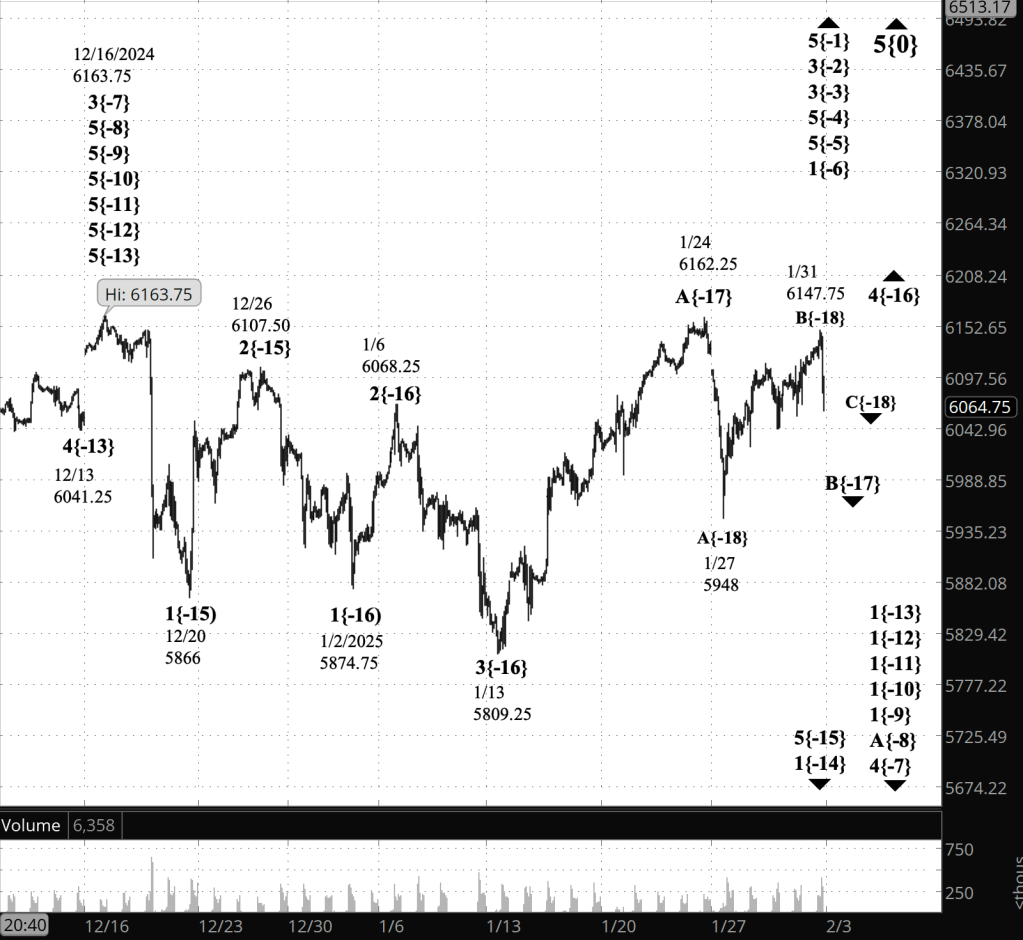
Half an hour before the closing bell. The S&P 500 futures continued to decline during the session, reaching into the 5950s.

Declining wave B within the 4th-wave upward correction continues. The correction began on January 2 and the B wave, on January 6.

9:35 a.m. New York time

What’s happening now? The S&P 500 E-mini futures rose overnight, from 6007 into the 6040s as the opening bell sounded.

What does it mean? The rise is a subwave, wave B, within the larger wave that is part of a 4th-wave upward correction. Rising wave A, the initial subwave of the upward correction, reached in the 6060s.

Declining wave B, the middle subwave down into the low 6000s, where it has fluctuated within a narrow range, a movement consistent with the three subwaves within wave B.

Next up, rising wave C, which will complete the three-wave corrective pattern within wave 4.

A falling wave 5 will follow, the final subwave within the parent wave of all of this trading, declining wave 1, part of a series of nested 1st waves that began on December 16, 2024 and six degrees in fractal structure of the chart. One degree higher is a much larger declining 4th wave underway.

Thanks the long store. The short story? Think down.

[For some unknown reason I had trouble posting the chart. Turns out it was a cable issue. I’ve found a workaround, and here’s the chart, bright and shiny and 15-minutes late.]

[S&P 500 E-mini futures at 3:30 p.m., 30-minute bars, with volume]

What are the alternatives?

What does Elliott wave theory say? Here are the waves that underly the analyses.

Principal Analysis:

  • .Rising wave 5{0} is underway. It is a wave of Intermediate degree that began in December 2018.
  • It is in its final subwave, wave 5{-1}.
  • Within wave 5{-1}, rising waves 5{-2}, 5{-3} and 5{-4} are underway, as is wave 5{-5}.
  • Wave 5{-5} is in its initial subwave, wave 1{-6}, which in turn is in its middle subwave, wave 3{-7}.
  • Wave 4{-7} is in its initial; subwave, uptrending wave A{-8}.
  • Wave 1{-8} is in its initial subwave, wave 1{-9}, which is in its final subwave, uptrending wave 5{-10}.
  • Wave 1{-10} is in its initial subwave, as are waves 1{-11}, 1{-12}, and 1{-13}.
  • Wave 4{-14} is presently underway and is in a declining subwave, wave B{-15}.

Long-term Waves.

These are the waves currently in progress under my principal analysis. Each line on the list shows the wave number, with the subscript in curly brackets, the traditional degree name, the starting date, the starting price of the S&P 500 E-mini futures, and the direction of the wave.

  • S&P 500 Index:
  • 5{+3} Supercycle, 7/8/1932, 4.40 (up)
  • 5{+2} Cycle, 12/9/1974, 60.96 (up)
  • 5{+1} Primary, 3/6/2009, 666.79 (up)
  • 5{0} Intermediate, 12/26/2018, 2346.58 (up)
  • S&P 500 Futures
  • 5{-1} Minor, 10/27/2023, 4127.25 (up)
  • 3{-2} Minute, 10/27/23, 4127.75 (up)
  • 3{-3} Minuette, 10/27/23, 4127.75 (up)
  • 5{-4} Subminuette, 4/18/2024, 4963.50 (up)
  • 5{-5} Micro, 8/5/2024, 5120 (up)
  • 1{-6} Submicro, 8/5/2024, 5120 (up)
  • 4{-7} Minuscule, 12/16/2024, 6163.75 (down)
  • A{-8} (unnamed), 12/16/2024, 6163.75 (down)
  • 1{-9} (unnamed), 12/16/2024, 6163.75 (down)
  • 1{-10} (unnamed), 12/16/2024, 6163.75 (down)
  • 1{-11} (unnamed), 12/16/2024, 6163.75 (down)
  • 1{-12} (unnamed), 12/16/2024, 6163.75 (down)
  • 1{-13} (unnamed), 12/16/2024, 6163.75 (down)
  • 4[-14} (unnamed), 1/2/20255874.75 (up)

Reading the chart. Price movements — waves – – in Elliott wave analysis are labeled with numbers within trending waves and letters with corrective waves. The subscripts — numbers in curly brackets — designate the wave’s degree, which, in Elliott wave analysis, means the relative position of a wave within the larger and smaller structures that make up the chart. R.N. Elliott, who in the 1930s developed the form of analysis that bears his name, viewed the chart as a complex structure of smaller waves nested within larger waves, which in turn are nested within still larger waves. In mathematics it’s called a fractal structure, where at every scale the pattern is similar to the others.

Learning and other resources. Elliott wave analysis provides context, not prophecy. As the 20th century semanticist Alfred Korzybski put it in his book Science and Sanity (1933), “The map is not the territory … The only usefulness of a map depends on similarity of structure between the empirical world and the map.” And I would add, in the ever-changing markets, we can judge that similarity of structure only after the fact.

See the menu page Analytical Methods for a rundown on where to go for information on Elliott wave analysis.

By Tim Bovee, Portland, Oregon, January 7, 2025

Disclaimer

Tim Bovee, Private Trader tracks the analysis and trades of a private trader for his own accounts. Nothing in this blog constitutes a recommendation to buy or sell stocks, options or any other financial instrument. The only purpose of this blog is to provide education and entertainment.

No trader is ever 100 percent successful in his or her trades. Trading in the stock and option markets is risky and uncertain. Each trader must make trading decisions for his or her own account, and take responsibility for the consequences.

License
Creative Commons License

All content on Tim Bovee, Private Trader by Timothy K. Bovee is licensed under a Creative Commons Attribution-ShareAlike 4.0 International License.

Based on a work at www.timbovee.com.

Trader’s Notebook

3:30 p.m. New York time

Half an hour before the closing bell. The S&P 500 futures peaked, at 6068.25, in the mid-morning of the session and then began to decline, so reaching the 6020s.

Elliott Wave Theory: I’ve designated today’s peak as the end of rising wave A within the 4th-wave upward correction that began on January 22, and the beginning of declining wave B, the middle of three subwaves. A final subwave, wave C, will follow wave B and typically will reach beyond the wave B peak.

11:45 a.m. New York time

What’s happening now? The S&P 500 E-mini futures rose overnight from 5980.75 and continued to rise for first two hours of the session, with only a single slight dip to the downside. So far the price has reached into the 6060s as the rise continues.

What does it mean? Elliott Wave Theory: The 4th wave, an upward correction, began on January 2 from 5874.75 and is in its first subwave, wave A. The preceding 2nd wave began on December 20, 2024 and ended on December 26, making the length of the wave six days. Wave 4 is presently in its fourth day.

A 4th wave tends to be of the Flat pattern, with wave A having three subwaves. The other common pattern, often seen in 2nd waves, has five subwaves within wave A.

In this 4th wave, Wave A is in its 5th subwave, making it a Zigzag.

What are the alternatives? It’s possible to count the rise from December 20 to December 26 as the A wave within wave 2, rather than as wave 2 in its entirety. That would make the present rise from January 2 as the third and final subwave within wave 2.

If that were the case, the placement of the waves within the factal structure of the chart, would require a major revision.

[S&P 500 E-mini futures at 12 p.m., 30-minute bars, with volume]

What does Elliott wave theory say? Here are the waves that underly the analyses.

Principal Analysis:

  • .Rising wave 5{0} is underway. It is a wave of Intermediate degree that began in December 2018.
  • It is in its final subwave, wave 5{-1}.
  • Within wave 5{-1}, rising waves 5{-2}, 5{-3} and 5{-4} are underway, as is wave 5{-5}.
  • Wave 5{-5} is in its initial subwave, wave 1{-6}, which in turn is in its middle subwave, wave 3{-7}.
  • Wave 4{-7} is in its initial; subwave, uptrending wave A{-8}.
  • Wave 1{-8} is in its initial subwave, wave 1{-9}, which is in its final subwave, uptrending wave 5{-10}.
  • Wave 1{-10} is in its initial subwave, as are waves 1{-11}, 1{-12}, and 1{-13}.
  • Wave 4{-14} is presently underway and is rising.

Long-term Waves.

These are the waves currently in progress under my principal analysis. Each line on the list shows the wave number, with the subscript in curly brackets, the traditional degree name, the starting date, the starting price of the S&P 500 E-mini futures, and the direction of the wave.

  • S&P 500 Index:
  • 5{+3} Supercycle, 7/8/1932, 4.40 (up)
  • 5{+2} Cycle, 12/9/1974, 60.96 (up)
  • 5{+1} Primary, 3/6/2009, 666.79 (up)
  • 5{0} Intermediate, 12/26/2018, 2346.58 (up)
  • S&P 500 Futures
  • 5{-1} Minor, 10/27/2023, 4127.25 (up)
  • 3{-2} Minute, 10/27/23, 4127.75 (up)
  • 3{-3} Minuette, 10/27/23, 4127.75 (up)
  • 5{-4} Subminuette, 4/18/2024, 4963.50 (up)
  • 5{-5} Micro, 8/5/2024, 5120 (up)
  • 1{-6} Submicro, 8/5/2024, 5120 (up)
  • 4{-7} Minuscule, 12/16/2024, 6163.75 (down)
  • A{-8} (unnamed), 12/16/2024, 6163.75 (down)
  • 1{-9} (unnamed), 12/16/2024, 6163.75 (down)
  • 1{-10} (unnamed), 12/16/2024, 6163.75 (down)
  • 1{-11} (unnamed), 12/16/2024, 6163.75 (down)
  • 1{-12} (unnamed), 12/16/2024, 6163.75 (down)
  • 1{-13} (unnamed), 12/16/2024, 6163.75 (down)
  • 4[-14} (unnamed), 1/2/20255874.75 (up)

Reading the chart. Price movements — waves – – in Elliott wave analysis are labeled with numbers within trending waves and letters with corrective waves. The subscripts — numbers in curly brackets — designate the wave’s degree, which, in Elliott wave analysis, means the relative position of a wave within the larger and smaller structures that make up the chart. R.N. Elliott, who in the 1930s developed the form of analysis that bears his name, viewed the chart as a complex structure of smaller waves nested within larger waves, which in turn are nested within still larger waves. In mathematics it’s called a fractal structure, where at every scale the pattern is similar to the others.

Learning and other resources. Elliott wave analysis provides context, not prophecy. As the 20th century semanticist Alfred Korzybski put it in his book Science and Sanity (1933), “The map is not the territory … The only usefulness of a map depends on similarity of structure between the empirical world and the map.” And I would add, in the ever-changing markets, we can judge that similarity of structure only after the fact.

See the menu page Analytical Methods for a rundown on where to go for information on Elliott wave analysis.

By Tim Bovee, Portland, Oregon, January 6, 2025

Disclaimer

Tim Bovee, Private Trader tracks the analysis and trades of a private trader for his own accounts. Nothing in this blog constitutes a recommendation to buy or sell stocks, options or any other financial instrument. The only purpose of this blog is to provide education and entertainment.

No trader is ever 100 percent successful in his or her trades. Trading in the stock and option markets is risky and uncertain. Each trader must make trading decisions for his or her own account, and take responsibility for the consequences.

License
Creative Commons License

All content on Tim Bovee, Private Trader by Timothy K. Bovee is licensed under a Creative Commons Attribution-ShareAlike 4.0 International License.

Based on a work at www.timbovee.com.
Trader’s Notebook

3:30 p.m. New York time

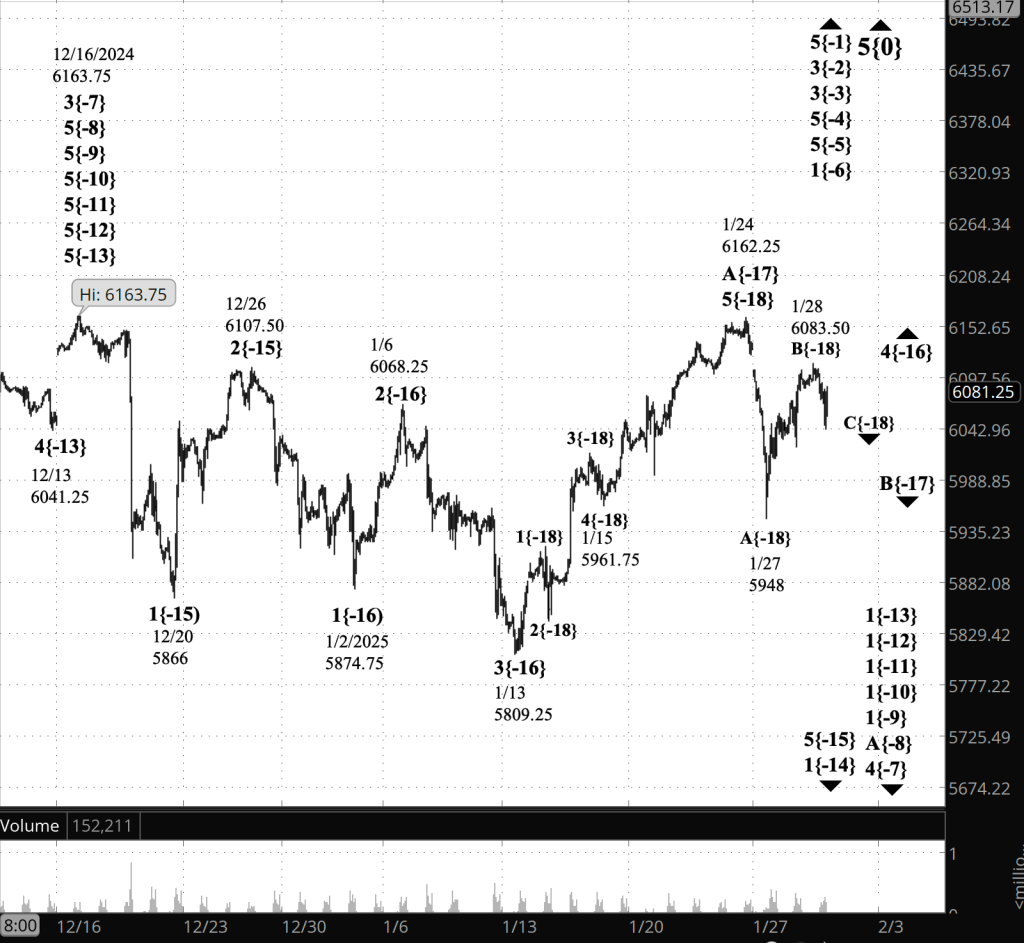
Half an hour before the closing bell. The S&P 500 rose during the session, reaching into the 5990s.

The extent of the rise since January 2 suggests that a 4th-wave upward correction has begun. It seems slightly odd to have the impulse wave declining and the corrective wave rising, but that’s where we have been since the peak on December 16, which marked the end of a very deep series of 5th waves ending a large 3rd wave and beginning a large 4th-wave downward correction that contains a large number of impulse subwaves, each nested within the next larger wave.

How does that work? Remember that the A wave of a correction contains five or three subwaves, depending upon whether the structure is a Zigzag or a Flat. If a Zigzag, then those A wave contains a series of impulse waves, a five-wave structure trending upward, and each of those subwaves contains smaller subwave structure — five waves, three of which contain even smaller subwave structures.

Bottom line: It will take some time for us all, myself included, to become accustomed to the reality of this major-downturn.

9:35 a.m. New York time

What’s happening now? The S&P 500 E-mini futures traded sideways overnight, for the most part fluctuating between the 5920s and the 5950s.

What does it mean? Elliott Wave Theory analysis sees yesterday’s switch from a rise to a sideways trend as being the start a corrective subwave as the downtrending 3rd wave that began on December 26, 2024 has reached its end.

[S&P 500 E-mini futures at 3:30 p.m., 30-minute bars, with volume]

What are the alternatives? There are ambiguities within the 1st-wave’s subwaves but the larger wave count is clear.

What does Elliott wave theory say? Here are the waves that underly the analyses.

Principal Analysis:

  • Rising wave 5{0} is underway. It is a wave of Intermediate degree that began in December 2018.
  • It is in its final subwave, wave 5{-1}.
  • Within wave 5{-1}, rising waves 5{-2}, 5{-3} and 5{-4} are underway, as is wave 5{-5}.
  • Wave 5{-5} is in its initial subwave, wave 1{-6}, which in turn is in its middle subwave, wave 3{-7}.
  • Wave 4{-7} is in its initial; subwave, uptrending wave A{-8}.
  • Wave 1{-8} is in its initial subwave, wave 1{-9}, which is in its final subwave, uptrending wave 5{-10}.
  • Wave 1{-10} is in its initial subwave, as are waves 1{-11}, 1{-12}, and 1{-13}.
  • Wave 4{-14} is presently underway and is rising

Long-term Waves.

These are the waves currently in progress under my principal analysis. Each line on the list shows the wave number, with the subscript in curly brackets, the traditional degree name, the starting date, the starting price of the S&P 500 E-mini futures, and the direction of the wave.

  • S&P 500 Index:
  • 5{+3} Supercycle, 7/8/1932, 4.40 (up)
  • 5{+2} Cycle, 12/9/1974, 60.96 (up)
  • 5{+1} Primary, 3/6/2009, 666.79 (up)
  • 5{0} Intermediate, 12/26/2018, 2346.58 (up)
  • S&P 500 Futures
  • 5{-1} Minor, 10/27/2023, 4127.25 (up)
  • 3{-2} Minute, 10/27/23, 4127.75 (up)
  • 3{-3} Minuette, 10/27/23, 4127.75 (up)
  • 5{-4} Subminuette, 4/18/2024, 4963.50 (up)
  • 5{-5} Micro, 8/5/2024, 5120 (up)
  • 1{-6} Submicro, 8/5/2024, 5120 (up)
  • 4{-7} Minuscule, 12/16/2024, 6163.75 (down)
  • A{-8} (unnamed), 12/16/2024, 6163.75 (down)
  • 1{-9} (unnamed), 12/16/2024, 6163.75 (down)
  • 1{-10} (unnamed), 12/16/2024, 6163.75 (down)
  • 1{-11} (unnamed), 12/16/2024, 6163.75 (down)
  • 1{-12} (unnamed), 12/16/2024, 6163.75 (down)
  • 1{-13} (unnamed), 12/16/2024, 6163.75 (down)
  • 4[-14} (unnamed), 1/2/20245874.75 (up)

Reading the chart. Price movements — waves – – in Elliott wave analysis are labeled with numbers within trending waves and letters with corrective waves. The subscripts — numbers in curly brackets — designate the wave’s degree, which, in Elliott wave analysis, means the relative position of a wave within the larger and smaller structures that make up the chart. R.N. Elliott, who in the 1930s developed the form of analysis that bears his name, viewed the chart as a complex structure of smaller waves nested within larger waves, which in turn are nested within still larger waves. In mathematics it’s called a fractal structure, where at every scale the pattern is similar to the others.

Learning and other resources. Elliott wave analysis provides context, not prophecy. As the 20th century semanticist Alfred Korzybski put it in his book Science and Sanity (1933), “The map is not the territory … The only usefulness of a map depends on similarity of structure between the empirical world and the map.” And I would add, in the ever-changing markets, we can judge that similarity of structure only after the fact.

See the menu page Analytical Methods for a rundown on where to go for information on Elliott wave analysis.

By Tim Bovee, Portland, Oregon, January 3, 2025

Disclaimer

Tim Bovee, Private Trader tracks the analysis and trades of a private trader for his own accounts. Nothing in this blog constitutes a recommendation to buy or sell stocks, options or any other financial instrument. The only purpose of this blog is to provide education and entertainment.

No trader is ever 100 percent successful in his or her trades. Trading in the stock and option markets is risky and uncertain. Each trader must make trading decisions for his or her own account, and take responsibility for the consequences.

License
Creative Commons License

All content on Tim Bovee, Private Trader by Timothy K. Bovee is licensed under a Creative Commons Attribution-ShareAlike 4.0 International License.

Based on a work at www.timbovee.com.
Trader’s Notebook

3:30 p.m. New York time

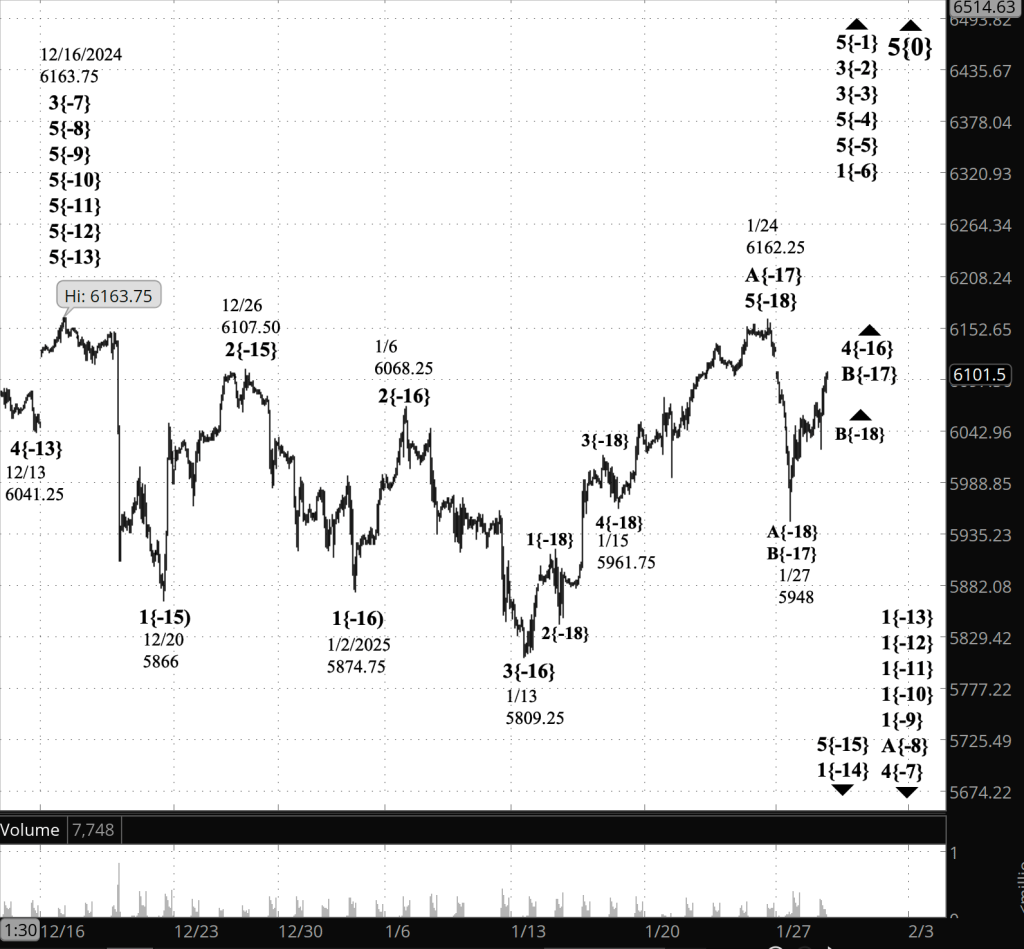
Half an hour before the closing bell. The S&P 500 futures fell during the session, reaching into the 5870s. Elliott Wave Theory: The price remained above the end of the preceding downtrending 1st wave on December 20 — just barely. If the price falls below that endpoint, 5866, it will confirm this morning’s principal analysis, that sees the 3rd-wave downtrend as having begun December 26 2024.

If the price stays above that level, then the alternative analysis may well stand a chance; the 2nd-wave upward correction may still be underway.

9:35 a.m. New York time

What’s happening now? The S&P 500 E-mini futures rose gently after trading resumed overnight, from the 5910s to the 5990s and the reversed.

What does it mean? It depends. For my principal analysis using Elliott Wave Theory, I’ve labeled the rising 2nd-wave correction since the the December 16, 2024 peak as having ended on December 26. The declne that followed is the middle subwave — wave 3 — within a larger declining 1st wave. There is an alternative. See “What are the alternatives” below.

Whichever alternatve we choose, what is clear s that the December 16 peak marked a significant turning point covering seven degrees within the fractal structure of the chart, marking the end of wave 3 of the Minuscule degree, to use the traditional naming structure and the beginning of wave 4.

What are the alternatives? It is possible to see the December 26 reversal as the end of wave A within the 2nd-wave upward correction and the decline as wave B, the middle wave of the correction. A decline below the end of the preceding 1st wave would knock out the alternative analysis and confirm the principal analysis.

[S&P 500 E-mini futures at 3:30 p.m., 30-minute bars, with volume]

What does Elliott wave theory say? Here are the waves that underly the analyses.

Principal Analysis:

  • Rising wave 5{0} is underway. It is a wave of Intermediate degree that began in December 2018.
  • It is in its final subwave, wave 5{-1}.
  • Within wave 5{-1}, rising waves 5{-2}, 5{-3} and 5{-4} are underway, as is wave 5{-5}.
  • Wave 5{-5} is in its initial subwave, wave 1{-6}, which in turn is in its middle subwave, wave 3{-7}.
  • Wave 4{-7} is in its initial; subwave, uptrending wave A{-8}.
  • Wave 1{-8} is in its initial subwave, wave 1{-9}, which is in its final subwave, uptrending wave 5{-10}.
  • Wave 1{-10} is in its initial subwave, as are waves 1{-11}, 1{-12}, and 1{-13}.
  • Wave 3{-14} is presently underway and is declining

Alternative Analysis:

  • Wave 1{-10} is in its initial subwave, as are waves 1{-11}, 1{-12}, and 1{-13}.
  • Wave 2{-14} is presently underway and is in its decling wave B{-15}

Long-term Waves.

These are the waves currently in progress under my principal analysis. Each line on the list shows the wave number, with the subscript in curly brackets, the traditional degree name, the starting date, the starting price of the S&P 500 E-mini futures, and the direction of the wave.

  • S&P 500 Index:
  • 5{+3} Supercycle, 7/8/1932, 4.40 (up)
  • 5{+2} Cycle, 12/9/1974, 60.96 (up)
  • 5{+1} Primary, 3/6/2009, 666.79 (up)
  • 5{0} Intermediate, 12/26/2018, 2346.58 (up)
  • S&P 500 Futures
  • 5{-1} Minor, 10/27/2023, 4127.25 (up)
  • 3{-2} Minute, 10/27/23, 4127.75 (up)
  • 3{-3} Minuette, 10/27/23, 4127.75 (up)
  • 5{-4} Subminuette, 4/18/2024, 4963.50 (up)
  • 5{-5} Micro, 8/5/2024, 5120 (up)
  • 1{-6} Submicro, 8/5/2024, 5120 (up)
  • 4{-7} Minuscule, 12/16/2024, 6163.75 (down)
  • A{-8} (unnamed), 12/16/2024, 6163.75 (down)
  • 1{-9} (unnamed), 12/16/2024, 6163.75 (down)
  • 1{-10} (unnamed), 12/16/2024, 6163.75 (down)
  • 1{-11} (unnamed), 12/16/2024, 6163.75 (down)
  • 1{-12} (unnamed), 12/16/2024, 6163.75 (down)
  • 1{-13} (unnamed), 12/16/2024, 6163.75 (down)
  • 3[-14} (unnamed), 12/26/20245866 (down)

Reading the chart. Price movements — waves – – in Elliott wave analysis are labeled with numbers within trending waves and letters with corrective waves. The subscripts — numbers in curly brackets — designate the wave’s degree, which, in Elliott wave analysis, means the relative position of a wave within the larger and smaller structures that make up the chart. R.N. Elliott, who in the 1930s developed the form of analysis that bears his name, viewed the chart as a complex structure of smaller waves nested within larger waves, which in turn are nested within still larger waves. In mathematics it’s called a fractal structure, where at every scale the pattern is similar to the others.

Learning and other resources. Elliott wave analysis provides context, not prophecy. As the 20th century semanticist Alfred Korzybski put it in his book Science and Sanity (1933), “The map is not the territory … The only usefulness of a map depends on similarity of structure between the empirical world and the map.” And I would add, in the ever-changing markets, we can judge that similarity of structure only after the fact.

See the menu page Analytical Methods for a rundown on where to go for information on Elliott wave analysis.

By Tim Bovee, Portland, Oregon, January 2, 2025

Disclaimer

Tim Bovee, Private Trader tracks the analysis and trades of a private trader for his own accounts. Nothing in this blog constitutes a recommendation to buy or sell stocks, options or any other financial instrument. The only purpose of this blog is to provide education and entertainment.

No trader is ever 100 percent successful in his or her trades. Trading in the stock and option markets is risky and uncertain. Each trader must make trading decisions for his or her own account, and take responsibility for the consequences.

License
Creative Commons License

All content on Tim Bovee, Private Trader by Timothy K. Bovee is licensed under a Creative Commons Attribution-ShareAlike 4.0 International License.

Based on a work at www.timbovee.com.