Trader’s Notebook

3:30 p.m. New York time

Half an hour before the closing bell. The S&P 500 futures traded rangebound, having fallen to 6117 and then rising, remaining below the overnight peak.

The 2nd-wave downward correction that began overnight continues, part of the 5th-wave uptrend that began on December 13.

9:35 a.m. New York time

What’s happening now? The S&P 500 E-mini futures peaked overnight at 6152.75 and declined.

What does it mean? In Elliott Wave Theory, this peak marks the end of the initial subwave, rising wave 1, within the 5th-wave uptrend that began on December 13, and the beginning of the next subwave, declining wave 2.

The Case of the Missing 3rd Wave. The opening gap when trading resumed after the weekend presents an interesting problem. Wave 1 covered a distance proportional to other 1st waves of the same degree. The five subwaves within wave 1 are visible, despite being minuscule. The 3rd subwave for the most part is in the gap. The 3rd subwave, under the theory’s rules, must have five subwaves. Not this one.

The analysis assumes that the missing 3rd wave is there, a ghost wave of sorts, because that’s a way under Elliott Wave Theory’s rules for the chart to make sense. We see over time whether or not it really does make sense.

What’s next? The 5th wave will work through its five subwaves. The fun will start when it ends.

On the chart, I label each wave with a number followed by a number in bracket’s showing the wave’s position in the fractal structure of the price patterns as fractal degrees’ distance from Intermediate degree. The present Intermediate degree wave is wave 5{0}, which began in December 2018.

The present 5th wave is ave 5{-13}. It’s parent wave, wave 5{-12}, is also a 5th wave, as are the encompassing waves, each one degree larger than the one before, all the way up to wave 5{-8}, whose parent wave is wave 3{-7}.

The end of wave 5{-13} will instantly cascade up the fractal structure, and all of the 5th waves up to wave 5{-8}. Wave 3{-7} will also end, and a 4th-wave downward correction will begin.

Wave 3{-7} began on August 7 and has been in progress for four months and 10 days, giving some indication of the magnitude of the 4th wave that will follow.

[S&P 500 E-mini futures at 3:30 p.m., hourly bars, with volume]

What are the alternatives? Discussed above in the missing 3rd wave section.

What does Elliott wave theory say? Here are the waves that underly the analyses.

Principal Analysis:

  • .Rising wave 5{0} is underway. It is a wave of Intermediate degree that began in December 2018.
  • It is in its final subwave, wave 5{-1}.
  • Within wave 5{-1}, rising waves 5{-2}, 5{-3} and 5{-4} are underway, as is wave 5{-5}.
  • Wave 5{-5} is in its initial subwave, wave 1{-6}, which in turn is in its middle subwave, wave 3{-7}.
  • Wave 3{-7} is in its final; subwave, uptrending wave 5{-8}.
  • Wave 5{-8} is in its final subwave, wave 5{-9}, which is in its final subwave, uptrending wave 5{-10}.
  • Wave 5{-10} is in its final subwave, wave 5{-11}, which appears to have completed its middle subwave, wave 3{-12}.
  • Rising Wave 5{-13} is now underway and is in its second subwave, wave 2{-14}.

Long-term Waves.

These are the waves currently in progress under my principal analysis. Each line on the list shows the wave number, with the subscript in curly brackets, the traditional degree name, the starting date, the starting price of the S&P 500 E-mini futures, and the direction of the wave.

  • S&P 500 Index:
  • 5{+3} Supercycle, 7/8/1932, 4.40 (up)
  • 5{+2} Cycle, 12/9/1974, 60.96 (up)
  • 5{+1} Primary, 3/6/2009, 666.79 (up)
  • 5{0} Intermediate, 12/26/2018, 2346.58 (up)
  • S&P 500 Futures
  • 5{-1} Minor, 10/27/2023, 4127.25 (up)
  • 3{-2} Minute, 10/27/23, 4127.75 (up)
  • 3{-3} Minuette, 10/27/23, 4127.75 (up)
  • 5{-4} Subminuette, 4/18/2024, 4963.50 (up)
  • 5{-5} Micro, 8/5/2024, 5120 (up)
  • 1{-6} Submicro, 8/5/2024, 5120 (up)
  • 3{-7} Minuscule, 8/7/2024, 5182 (up)
  • 5{-8} (unnamed), 9/6/2024, 5394 (up)
  • 5{-9} (unnamed), 10/2/2024, 5724 (up)
  • 5{-10} (unnamed), 11/4/2024, 5824.25 (up)
  • 5{-11} (unnamed), 11/19/2024, 5933 (up)
  • 5{-12} (unnamed), 11/27/2024, 6000.25 (up)
  • 5{-13} (unnamed), 12/13/2024, 6041.25 (up)

Reading the chart. Price movements — waves – – in Elliott wave analysis are labeled with numbers within trending waves and letters with corrective waves. The subscripts — numbers in curly brackets — designate the wave’s degree, which, in Elliott wave analysis, means the relative position of a wave within the larger and smaller structures that make up the chart. R.N. Elliott, who in the 1930s developed the form of analysis that bears his name, viewed the chart as a complex structure of smaller waves nested within larger waves, which in turn are nested within still larger waves. In mathematics it’s called a fractal structure, where at every scale the pattern is similar to the others.

Learning and other resources. Elliott wave analysis provides context, not prophecy. As the 20th century semanticist Alfred Korzybski put it in his book Science and Sanity (1933), “The map is not the territory … The only usefulness of a map depends on similarity of structure between the empirical world and the map.” And I would add, in the ever-changing markets, we can judge that similarity of structure only after the fact.

See the menu page Analytical Methods for a rundown on where to go for information on Elliott wave analysis.

By Tim Bovee, Portland, Oregon, December 17, 2024

Disclaimer

Tim Bovee, Private Trader tracks the analysis and trades of a private trader for his own accounts. Nothing in this blog constitutes a recommendation to buy or sell stocks, options or any other financial instrument. The only purpose of this blog is to provide education and entertainment.

No trader is ever 100 percent successful in his or her trades. Trading in the stock and option markets is risky and uncertain. Each trader must make trading decisions for his or her own account, and take responsibility for the consequences.

License
Creative Commons License

All content on Tim Bovee, Private Trader by Timothy K. Bovee is licensed under a Creative Commons Attribution-ShareAlike 4.0 International License.

Based on a work at www.timbovee.com.

Trader’s Notebook

3:30 p.m. New York time

Half an hour before the closing bell. The S&P 500 futures continued to rise during the session, reaching into the 6160s. The 5th-wave uptrend that began on December 13 continues. The further it goes, the less likely this morning’s alternatives.

9:35 a.m. New York time

What’s happening now? When trading the S&P 500 E-mini futures overnight, the price gapped up by 1.2%, moving the price to an all-time high in the history of the market. Last week’s closing was 6051.36. This week’s opening was 6125.50. As the opening bell drew near the price had reached the 6140s in a gentle rise.

What does it mean? The straightforward approach to the Elliott Wave Theory analysis is to consider the 6041.25 low on December 13 to be the end of the 4th-wave downward correction that began on December 6 and the beginning of the wave 5 uptrend that follows.

That’s perfectly in line with the theory and violates no rules.

The problem comes with the 4th-wave’s final wave: It doesn’t have a sufficient number of subwwaves.

With the exception of Triangle patterns, corrections come in two varieties: Zigzags and Flats. The two types are similar in structure. However, they differ in the number of subwaves in their initial wave. Wave A in a Zigzag has five subwaves; in a Flat, three subwaves. Both have two subwaves in wave B and five subwaves in wave C.

And wave C is the problem. In a straightforward reading, it was in its 3rd subwave when the upward gap occurred, too few waves to have reached completion.

Where do we go from here?

There are several ways for an analyst to handle this.

First, charts to always have perfect clarity. They’re messy, so perhaps there are five subwaves but two of them are too small to see clearly.

Second, Triangles have three subwaves internally. Perhaps wave 4 is developing into some sort of Triangle, Could be. We’ll have to see what develops.

Third, perhaps the 5th wave is taking the form of a Triangle. Again, could be.

I’ve taken the straightforward approach: Wave 4 has ended and wave 5 has begun.

[S&P 500 E-mini futures at 3:30 p.m., hourly bars, with volume]

What are the alternatives? See the discussion above for a description of the major ambiguity in wave 4 and perhaps in wave 5..

What does Elliott wave theory say? Here are the waves that underly the analyses.

Principal Analysis:

  • Rising wave 5{0} is underway. It is a wave of Intermediate degree that began in December 2018.
  • It is in its final subwave, wave 5{-1}.
  • Within wave 5{-1}, rising waves 5{-2}, 5{-3} and 5{-4} are underway, as is wave 5{-5}.
  • Wave 5{-5} is in its initial subwave, wave 1{-6}, which in turn is in its middle subwave, wave 3{-7}.
  • Wave 3{-7} is in its final; subwave, uptrending wave 5{-8}.
  • Wave 5{-8} is in its final subwave, wave 5{-9}, which is in its final subwave, uptrending wave 5{-10}.
  • Wave 5{-10} is in its final subwave, wave 5{-11}, which appears to have completed its middle subwave, wave 3{-12}.
  • Rising Wave 5{-13} is now underway and is in its early stages.

Long-term Waves.

  • S&P 500 Index:
  • 5{+3} Supercycle, 7/8/1932, 4.40 (up)
  • 5{+2} Cycle, 12/9/1974, 60.96 (up)
  • 5{+1} Primary, 3/6/2009, 666.79 (up)
  • 5{0} Intermediate, 12/26/2018, 2346.58 (up)
  • S&P 500 Futures
  • 5{-1} Minor, 10/27/2023, 4127.25 (up)
  • 3{-2} Minute, 10/27/23, 4127.75 (up)
  • 3{-3} Minuette, 10/27/23, 4127.75 (up)
  • 5{-4} Subminuette, 4/18/2024, 4963.50 (up)
  • 5{-5} Micro, 8/5/2024, 5120 (up)
  • 1{-6} Submicro, 8/5/2024, 5120 (up)
  • 3{-7} Minuscule, 8/7/2024, 5182 (up)
  • 5{-8} (unnamed), 9/6/2024, 5394 (up)
  • 5{-9} (unnamed), 10/2/2024, 5724 (up)
  • 5{-10} (unnamed), 11/4/2024, 5824.25 (up)
  • 5{-11} (unnamed), 11/19/2024, 5933 (up)
  • 5{-12} (unnamed), 11/27/2024, 6000.25 (up)
  • 5{-13} (unnamed), 12/13/2024, 6041.25 (up)

Reading the chart. Price movements — waves – – in Elliott wave analysis are labeled with numbers within trending waves and letters with corrective waves. The subscripts — numbers in curly brackets — designate the wave’s degree, which, in Elliott wave analysis, means the relative position of a wave within the larger and smaller structures that make up the chart. R.N. Elliott, who in the 1930s developed the form of analysis that bears his name, viewed the chart as a complex structure of smaller waves nested within larger waves, which in turn are nested within still larger waves. In mathematics it’s called a fractal structure, where at every scale the pattern is similar to the others.

Learning and other resources. Elliott wave analysis provides context, not prophecy. As the 20th century semanticist Alfred Korzybski put it in his book Science and Sanity (1933), “The map is not the territory … The only usefulness of a map depends on similarity of structure between the empirical world and the map.” And I would add, in the ever-changing markets, we can judge that similarity of structure only after the fact.

See the menu page Analytical Methods for a rundown on where to go for information on Elliott wave analysis.

By Tim Bovee, Portland, Oregon, December 16, 2024

Disclaimer

Tim Bovee, Private Trader tracks the analysis and trades of a private trader for his own accounts. Nothing in this blog constitutes a recommendation to buy or sell stocks, options or any other financial instrument. The only purpose of this blog is to provide education and entertainment.

No trader is ever 100 percent successful in his or her trades. Trading in the stock and option markets is risky and uncertain. Each trader must make trading decisions for his or her own account, and take responsibility for the consequences.

License
Creative Commons License

All content on Tim Bovee, Private Trader by Timothy K. Bovee is licensed under a Creative Commons Attribution-ShareAlike 4.0 International License.

Based on a work at www.timbovee.com.

Trader’s Notebook

3:30 p.m. New York time

Half an hour before the closing bell. The S&P 500 futures fell during the session.

Elliott Wave Theory: The decline appears to be the final subwave within the larger C wave within the 4th-wave downward correction that began on December 6. The subwave began on December 11 and is a smaller C wave. It will have five subwaves at completion and appears to be in its middle subwave.

9:35 a.m. New York time

What’s happening now? The S&P 500 E-mini futures rose overnight, from the 6060s to the 6080s.

What does it mean? Elliott Wave Theory sees the rise as part of the middle subwave within a larger subwave — both are rising B waves — within the 4th wave downward correction that began on December 6.

When the smaller B wave is complete, it will also be the end of the larger B wave, which will be followed by a five-subwave decline, wave C, which will bring the 4th-wave downward correction to a close

An uptrending wave 5 will follow.

[S&P 500 E-mini futures at 3:30 p.m., 57-minute bars, with volume]

What are the alternatives? None apparent at present. As always, ambiguities will develop.

What does Elliott wave theory say? Here are the waves that underly the analyses.

Principal Analysis:

  • .Rising wave 5{0} is underway. It is a wave of Intermediate degree that began in December 2018.
  • It is in its final subwave, wave 5{-1}.
  • Within wave 5{-1}, rising waves 5{-2}, 5{-3} and 5{-4} are underway, as is wave 5{-5}.
  • Wave 5{-5} is in its initial subwave, wave 1{-6}, which in turn is in its middle subwave, wave 3{-7}.
  • Wave 3{-7} is in its final; subwave, uptrending wave 5{-8}.
  • Wave 5{-8} is in its final subwave, wave 5{-9}, which is in its final subwave, uptrending wave 5{-10}.
  • Wave 5{-10} is in its final subwave, wave 5{-11}, which appears to have completed its middle subwave, wave 3{-12}.
  • Wave 4{-13} is now underway and is in its final subwave, falling wave C{-14}

Long-term Waves.

These are the waves currently in progress under my principal analysis. Each line on the list shows the wave number, with the subscript in curly brackets, the traditional degree name, the starting date, the starting price of the S&P 500 E-mini futures, and the direction of the wave.

  • S&P 500 Index:
  • 5{+3} Supercycle, 7/8/1932, 4.40 (up)
  • 5{+2} Cycle, 12/9/1974, 60.96 (up)
  • 5{+1} Primary, 3/6/2009, 666.79 (up)
  • 5{0} Intermediate, 12/26/2018, 2346.58 (up)
  • S&P 500 Futures
  • 5{-1} Minor, 10/27/2023, 4127.25 (up)
  • 3{-2} Minute, 10/27/23, 4127.75 (up)
  • 3{-3} Minuette, 10/27/23, 4127.75 (up)
  • 5{-4} Subminuette, 4/18/2024, 4963.50 (up)
  • 5{-5} Micro, 8/5/2024, 5120 (up)
  • 1{-6} Submicro, 8/5/2024, 5120 (up)
  • 3{-7} Minuscule, 8/7/2024, 5182 (up)
  • 5{-8} (unnamed), 9/6/2024, 5394 (up)
  • 5{-9} (unnamed), 10/2/2024, 5724 (up)
  • 5{-10} (unnamed), 11/4/2024, 5824.25 (up)
  • 5{-11} (unnamed), 11/19/2024, 5933 (up)
  • 5{-12} (unnamed), 11/27/2024, 6000.25 (up)
  • 4{-13} (unnamed), 12/6/2024, 6111 (down)

Reading the chart. Price movements — waves – – in Elliott wave analysis are labeled with numbers within trending waves and letters with corrective waves. The subscripts — numbers in curly brackets — designate the wave’s degree, which, in Elliott wave analysis, means the relative position of a wave within the larger and smaller structures that make up the chart. R.N. Elliott, who in the 1930s developed the form of analysis that bears his name, viewed the chart as a complex structure of smaller waves nested within larger waves, which in turn are nested within still larger waves. In mathematics it’s called a fractal structure, where at every scale the pattern is similar to the others.

Learning and other resources. Elliott wave analysis provides context, not prophecy. As the 20th century semanticist Alfred Korzybski put it in his book Science and Sanity (1933), “The map is not the territory … The only usefulness of a map depends on similarity of structure between the empirical world and the map.” And I would add, in the ever-changing markets, we can judge that similarity of structure only after the fact.

See the menu page Analytical Methods for a rundown on where to go for information on Elliott wave analysis.

By Tim Bovee, Portland, Oregon, December 13, 2024

Disclaimer

Tim Bovee, Private Trader tracks the analysis and trades of a private trader for his own accounts. Nothing in this blog constitutes a recommendation to buy or sell stocks, options or any other financial instrument. The only purpose of this blog is to provide education and entertainment.

No trader is ever 100 percent successful in his or her trades. Trading in the stock and option markets is risky and uncertain. Each trader must make trading decisions for his or her own account, and take responsibility for the consequences.

License
Creative Commons License

All content on Tim Bovee, Private Trader by Timothy K. Bovee is licensed under a Creative Commons Attribution-ShareAlike 4.0 International License.

Based on a work at www.timbovee.com.
Trader’s Notebook

3:30 p.m. New York time

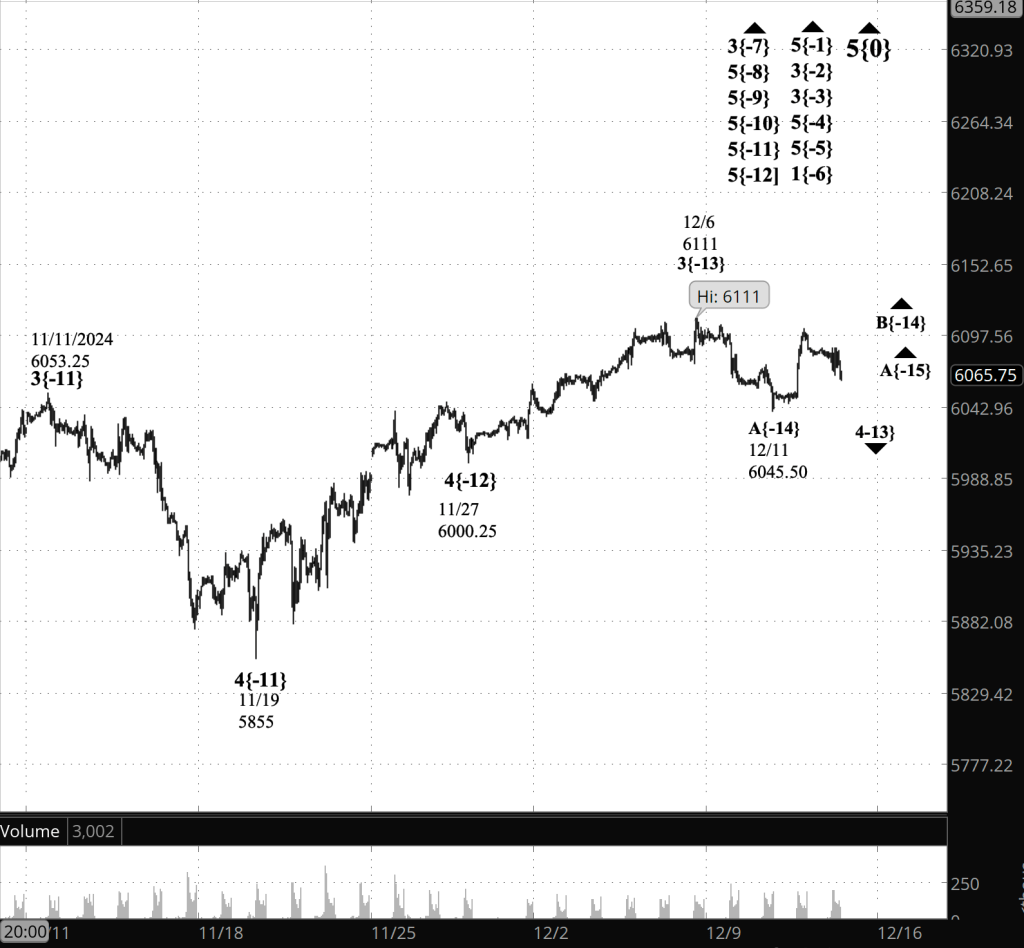
Half an hour before the closing bell. The S&P 500 futures has fallen during the session, from the 6080s into the 6060s so far.

Elliott Wave Theory The larger rising B wave within the 4th-wave downward correction that began on December 6 continues and is in its initial subwave, the smaller rising wave A. The further the price falls, the more it strengthens the case for the alternative analysis, that the smaller rising wave A ended on December 11 and declining smaller wave B began.

9:35 a.m. New York time

What’s happening now? The S&P 500 E-mini futures whipsawed as the opening bell approached, ending on the movement on the downside. The drama coincided with the release of the Producer Price Index and the weekly Initial Jobless Claims report.

What does it mean? The reversal downward, when Elliott Wave Theory is applied, marks a downward correction within the initial subwave, wave A, of a larger 4th-wave downward correction that began on December 6.

[S&P 500 E-mini futures at 3:30 p.m., 55-minute bars, with volume]

What are the alternatives? It’s possible that the overnight decline was the start of the middle wave within the larger wave B that began on December 11.

What does Elliott wave theory say? Here are the waves that underly the analyses.

Principal Analysis:

  • .Rising wave 5{0} is underway. It is a wave of Intermediate degree that began in December 2018.
  • It is in its final subwave, wave 5{-1}.
  • Within wave 5{-1}, rising waves 5{-2}, 5{-3} and 5{-4} are underway, as is wave 5{-5}.
  • Wave 5{-5} is in its initial subwave, wave 1{-6}, which in turn is in its middle subwave, wave 3{-7}.
  • Wave 3{-7} is in its final; subwave, uptrending wave 5{-8}.
  • Wave 5{-8} is in its final subwave, wave 5{-9}, which is in its final subwave, uptrending wave 5{-10}.
  • Wave 5{-10} is in its final subwave, wave 5{-11}, which appears to have completed its middle subwave, wave 3{-12}.
  • Wave 4{-13} is now underway and is in its middle subwave, rising wave B{-14}
  • Wave B{-14} is in its initial subwave, wave A{-15}.

Alternative Analysis:

  • Wave B{-14} is in its middle subwave, falling wave B{-15}.

Long-term Waves.

These are the waves currently in progress under my principal analysis. Each line on the list shows the wave number, with the subscript in curly brackets, the traditional degree name, the starting date, the starting price of the S&P 500 E-mini futures, and the direction of the wave.

  • S&P 500 Index:
  • 5{+3} Supercycle, 7/8/1932, 4.40 (up)
  • 5{+2} Cycle, 12/9/1974, 60.96 (up)
  • 5{+1} Primary, 3/6/2009, 666.79 (up)
  • 5{0} Intermediate, 12/26/2018, 2346.58 (up)
  • S&P 500 Futures
  • 5{-1} Minor, 10/27/2023, 4127.25 (up)
  • 3{-2} Minute, 10/27/23, 4127.75 (up)
  • 3{-3} Minuette, 10/27/23, 4127.75 (up)
  • 5{-4} Subminuette, 4/18/2024, 4963.50 (up)
  • 5{-5} Micro, 8/5/2024, 5120 (up)
  • 1{-6} Submicro, 8/5/2024, 5120 (up)
  • 3{-7} Minuscule, 8/7/2024, 5182 (up)
  • 5{-8} (unnamed), 9/6/2024, 5394 (up)
  • 5{-9} (unnamed), 10/2/2024, 5724 (up)
  • 5{-10} (unnamed), 11/4/2024, 5824.25 (up)
  • 5{-11} (unnamed), 11/19/2024, 5933 (up)
  • 5{-12} (unnamed), 11/27/2024, 6000.25 (up)
  • 4{-13} (unnamed), 12/6/2024, 6111 (down)

Reading the chart. Price movements — waves – – in Elliott wave analysis are labeled with numbers within trending waves and letters with corrective waves. The subscripts — numbers in curly brackets — designate the wave’s degree, which, in Elliott wave analysis, means the relative position of a wave within the larger and smaller structures that make up the chart. R.N. Elliott, who in the 1930s developed the form of analysis that bears his name, viewed the chart as a complex structure of smaller waves nested within larger waves, which in turn are nested within still larger waves. In mathematics it’s called a fractal structure, where at every scale the pattern is similar to the others.

Learning and other resources. Elliott wave analysis provides context, not prophecy. As the 20th century semanticist Alfred Korzybski put it in his book Science and Sanity (1933), “The map is not the territory … The only usefulness of a map depends on similarity of structure between the empirical world and the map.” And I would add, in the ever-changing markets, we can judge that similarity of structure only after the fact.

See the menu page Analytical Methods for a rundown on where to go for information on Elliott wave analysis.

By Tim Bovee, Portland, Oregon, December 12, 2024

Disclaimer

Tim Bovee, Private Trader tracks the analysis and trades of a private trader for his own accounts. Nothing in this blog constitutes a recommendation to buy or sell stocks, options or any other financial instrument. The only purpose of this blog is to provide education and entertainment.

No trader is ever 100 percent successful in his or her trades. Trading in the stock and option markets is risky and uncertain. Each trader must make trading decisions for his or her own account, and take responsibility for the consequences.

License
Creative Commons License

All content on Tim Bovee, Private Trader by Timothy K. Bovee is licensed under a Creative Commons Attribution-ShareAlike 4.0 International License.

Based on a work at www.timbovee.com.

Trader’s Notebook

3:30 p.m. New York time

Half an hour before the closing bell. The S&P 500 futures continued to rise during the session, reaching 6102.50 before moderating its pace.

In this morning’s Elliott Wave Theory analysis, there was some ambiguity over whether rising wave B in the ongoing 4th-wave downward correction had in face begun, or whether declining wave A was underway. The power of the rise erased the ambiguity. Wave B, the middle wave of the correction that began on January 6, is definitely in progress.

9:35 a.m. New York time

What’s happening now? The S&P 500 E-mini futures reached a low of 6045.50 during overnight trading, amidst what was a very narrow sideways movements. The price then rose into the 6070s after the Consumer Price Index for November report put the inflation rate at 0.3% after four months in a row of 0.2% rises. The annual rate over the past year has been been a net 2.7%

The Federal Open Market Committee meets next week, on December 17-18, to decide whether or not to raise the interest rates.

What does it mean? Under the current Elliott Wave Theory analysis, the sudden rise marked the start of the rising 2nd subwave — wave B — within a 4th-wave downward correction that began on December 6 from 6111.

When wave B is complete, it will be followed by a falling C wave, which will complete the corrective pattern. A rising 5th wave will follow.

[S&P 500 E-mini futures at 3:30 p.m., 55-minute bars, with volume]

What are the alternatives? As is almost always the case when bottom fishing, there are ambiguities. If the price reverses and continues its fall to below the 6145.50 level, then the A wave is still underway and wave B has not yet begun. [A sharp rise in price during the session has removed the ambiguities. The principal analysis stands.]

What does Elliott wave theory say? Here are the waves that underly the analyses.

Principal Analysis:

  • Rising wave 5{0} is underway. It is a wave of Intermediate degree that began in December 2018.
  • It is in its final subwave, wave 5{-1}.
  • Within wave 5{-1}, rising waves 5{-2}, 5{-3} and 5{-4} are underway, as is wave 5{-5}.
  • Wave 5{-5} is in its initial subwave, wave 1{-6}, which in turn is in its middle subwave, wave 3{-7}.
  • Wave 3{-7} is in its final; subwave, uptrending wave 5{-8}.
  • Wave 5{-8} is in its final subwave, wave 5{-9}, which is in its final subwave, uptrending wave 5{-10}.
  • Wave 5{-10} is in its final subwave, wave 5{-11}, which appears to have completed its middle subwave, wave 3{-12}.
  • Wave 4{-13} is now underway and is in its middle subwave, rising wave B{-14}.

Alternative Analysis: [No longer possible, according to the afternoon analysis.]

  • Wave 4{-13} is now underway and is in its initial subwave, falling wave A{-14}.

Long-term Waves.

These are the waves currently in progress under my principal analysis. Each line on the list shows the wave number, with the subscript in curly brackets, the traditional degree name, the starting date, the starting price of the S&P 500 E-mini futures, and the direction of the wave.

  • S&P 500 Index:
  • 5{+3} Supercycle, 7/8/1932, 4.40 (up)
  • 5{+2} Cycle, 12/9/1974, 60.96 (up)
  • 5{+1} Primary, 3/6/2009, 666.79 (up)
  • 5{0} Intermediate, 12/26/2018, 2346.58 (up)
  • S&P 500 Futures
  • 5{-1} Minor, 10/27/2023, 4127.25 (up)
  • 3{-2} Minute, 10/27/23, 4127.75 (up)
  • 3{-3} Minuette, 10/27/23, 4127.75 (up)
  • 5{-4} Subminuette, 4/18/2024, 4963.50 (up)
  • 5{-5} Micro, 8/5/2024, 5120 (up)
  • 1{-6} Submicro, 8/5/2024, 5120 (up)
  • 3{-7} Minuscule, 8/7/2024, 5182 (up)
  • 5{-8} (unnamed), 9/6/2024, 5394 (up)
  • 5{-9} (unnamed), 10/2/2024, 5724 (up)
  • 5{-10} (unnamed), 11/4/2024, 5824.25 (up)
  • 5{-11} (unnamed), 11/19/2024, 5933 (up)
  • 5{-12} (unnamed), 11/27/2024, 6000.25 (up)
  • 4{-13} (unnamed), 12/6/2024, 6111 (down)

Reading the chart. Price movements — waves – – in Elliott wave analysis are labeled with numbers within trending waves and letters with corrective waves. The subscripts — numbers in curly brackets — designate the wave’s degree, which, in Elliott wave analysis, means the relative position of a wave within the larger and smaller structures that make up the chart. R.N. Elliott, who in the 1930s developed the form of analysis that bears his name, viewed the chart as a complex structure of smaller waves nested within larger waves, which in turn are nested within still larger waves. In mathematics it’s called a fractal structure, where at every scale the pattern is similar to the others.

Learning and other resources. Elliott wave analysis provides context, not prophecy. As the 20th century semanticist Alfred Korzybski put it in his book Science and Sanity (1933), “The map is not the territory … The only usefulness of a map depends on similarity of structure between the empirical world and the map.” And I would add, in the ever-changing markets, we can judge that similarity of structure only after the fact.

See the menu page Analytical Methods for a rundown on where to go for information on Elliott wave analysis.

By Tim Bovee, Portland, Oregon, December 11, 2024

Disclaimer

Tim Bovee, Private Trader tracks the analysis and trades of a private trader for his own accounts. Nothing in this blog constitutes a recommendation to buy or sell stocks, options or any other financial instrument. The only purpose of this blog is to provide education and entertainment.

No trader is ever 100 percent successful in his or her trades. Trading in the stock and option markets is risky and uncertain. Each trader must make trading decisions for his or her own account, and take responsibility for the consequences.

License
Creative Commons License

All content on Tim Bovee, Private Trader by Timothy K. Bovee is licensed under a Creative Commons Attribution-ShareAlike 4.0 International License.

Based on a work at www.timbovee.com.

Trader’s Notebook

3:30 p.m. New York time

Half an hour before the closing bell. The S&P 500 futures continued to fall. Elliott Wave Theory: The alternative analysis from this morning has prevailed. Wave A continues within the 4th-wave downward correction that began on December 6.

9:35 a.m. New York time

What’s happening now? The S&P 500 E-mini futures slid sleepily to a low overnight in the 6050s and then rose rapidly into the 6070s.

What does it mean? Elliott Wave Theory analysis sees the rise as the start of the 3rd subwave — wave B — within a 4th-wave downward correction that began on December 6. The correction, in turn, is the next-to-the-last uptrend within a 5th-wave uptrend that began on November 17.

[S&P 500 E-mini futures at 3:30 p.m., 55-minute bars, with volume]

What are the alternatives? It’s possible that the price will quickly reverse and fall further to the downside as wave A continues its downward course before reversing and beginning wave B. Trading during the session is likely to resolve the amiguity.

What does Elliott wave theory say? Here are the waves that underly the analyses.

Principal Analysis: [Revised to match the alternative analysis]

  • Rising wave 5{0} is underway. It is a wave of Intermediate degree that began in December 2018.
  • It is in its final subwave, wave 5{-1}.
  • Within wave 5{-1}, rising waves 5{-2}, 5{-3} and 5{-4} are underway, as is wave 5{-5}.
  • Wave 5{-5} is in its initial subwave, wave 1{-6}, which in turn is in its middle subwave, wave 3{-7}.
  • Wave 3{-7} is in its final; subwave, uptrending wave 5{-8}.
  • Wave 5{-8} is in its final subwave, wave 5{-9}, which is in its final subwave, uptrending wave 5{-10}.
  • Wave 5{-10} is in its final subwave, wave 5{-11}, which appears to have completed its middle subwave, wave 3{-12}.
  • Wave 4{-13} is now underway and is in the latter stages its initial subwave, falling wave A{-14}.

Long-term Waves.

These are the waves currently in progress under my principal analysis. Each line on the list shows the wave number, with the subscript in curly brackets, the traditional degree name, the starting date, the starting price of the S&P 500 E-mini futures, and the direction of the wave.

  • S&P 500 Index:
  • 5{+3} Supercycle, 7/8/1932, 4.40 (up)
  • 5{+2} Cycle, 12/9/1974, 60.96 (up)
  • 5{+1} Primary, 3/6/2009, 666.79 (up)
  • 5{0} Intermediate, 12/26/2018, 2346.58 (up)
  • S&P 500 Futures
  • 5{-1} Minor, 10/27/2023, 4127.25 (up)
  • 3{-2} Minute, 10/27/23, 4127.75 (up)
  • 3{-3} Minuette, 10/27/23, 4127.75 (up)
  • 5{-4} Subminuette, 4/18/2024, 4963.50 (up)
  • 5{-5} Micro, 8/5/2024, 5120 (up)
  • 1{-6} Submicro, 8/5/2024, 5120 (up)
  • 3{-7} Minuscule, 8/7/2024, 5182 (up)
  • 5{-8} (unnamed), 9/6/2024, 5394 (up)
  • 5{-9} (unnamed), 10/2/2024, 5724 (up)
  • 5{-10} (unnamed), 11/4/2024, 5824.25 (up)
  • 5{-11} (unnamed), 11/19/2024, 5933 (up)
  • 5{-12} (unnamed), 11/27/2024, 6000.25 (up)
  • 4{-13} (unnamed), 12/6/2024, 6111 (down)

Reading the chart. Price movements — waves – – in Elliott wave analysis are labeled with numbers within trending waves and letters with corrective waves. The subscripts — numbers in curly brackets — designate the wave’s degree, which, in Elliott wave analysis, means the relative position of a wave within the larger and smaller structures that make up the chart. R.N. Elliott, who in the 1930s developed the form of analysis that bears his name, viewed the chart as a complex structure of smaller waves nested within larger waves, which in turn are nested within still larger waves. In mathematics it’s called a fractal structure, where at every scale the pattern is similar to the others.

Learning and other resources. Elliott wave analysis provides context, not prophecy. As the 20th century semanticist Alfred Korzybski put it in his book Science and Sanity (1933), “The map is not the territory … The only usefulness of a map depends on similarity of structure between the empirical world and the map.” And I would add, in the ever-changing markets, we can judge that similarity of structure only after the fact.

See the menu page Analytical Methods for a rundown on where to go for information on Elliott wave analysis.

By Tim Bovee, Portland, Oregon, December 10, 2024

Disclaimer

Tim Bovee, Private Trader tracks the analysis and trades of a private trader for his own accounts. Nothing in this blog constitutes a recommendation to buy or sell stocks, options or any other financial instrument. The only purpose of this blog is to provide education and entertainment.

No trader is ever 100 percent successful in his or her trades. Trading in the stock and option markets is risky and uncertain. Each trader must make trading decisions for his or her own account, and take responsibility for the consequences.

License
Creative Commons License

All content on Tim Bovee, Private Trader by Timothy K. Bovee is licensed under a Creative Commons Attribution-ShareAlike 4.0 International License.

Based on a work at www.timbovee.com.

Trader’s Notebook

3:30 p.m. New York time

Half an hour before the closing bell. The S&P 500 futures continued to fall during the session, reaching into the 5060s as the closing bell approached.

The length of decline triggered a reanalysis favorable to this morning’s alternative Elliott Wave Theory analysis. The December 6 peak at 6111 was the end of a 3rd wave, and the decline that has followed is a 4th-wave downward correction that is in its initial subwave, wave A.

This morning’s analysis stands with the exception of those smaller waves.

9:35 a.m. New York time

What’s happening now? The S&P 500 E-mini futures swung between 6105.75 and 6088.50 after trading resumed overnight. The price remained below the high point of the rise that began on November 19 from 5855..

What does it mean? Elliott Wave Theory analysis sees the rise as part of a 5th-wave uptrend that is well advanced — 5th waves three degrees down to the small rise that began on December 6 from 6093.75, and 5th waves three degrees up to the much larger uptrend that began on September 6 from 5394.

The waves on the chart are labeled with an Elliott Wave number followed by a subscript in curly brackets that shows the wave’s relation, in the fractal structure of the chart, to the present wave of Intermediate degree, wave 5{0}, which began on December 26, 2018.

When the smallest of the 5th waves labeled on the chart, wave 5{-14}, is complete, it will cascade through the fractal structure, simultaneously ending each of those larger 5th waves, up to wave 5{-8}.

It will also be the end of the larger wave encompassing all of those 5th waves, a rising 3rd wave, wave 3{-7}, which began on August 7 from 5182. From that point, when the 5th waves and the 3rd wave have simultaneously ended, a large 4th-wave downward correction, wave 4{-7}, will begin.

[S&P 500 E-mini futures at 3:30 p.m., 50-minute bars, with volume]

What are the alternatives? It’s possible that the starting point of the end point of wave 4 on December 6 is one degree smaller. Under this scenario, the decline was the A wave within the preceding 4th wave, which means the rise is wave B within the corrective wave, with wave C yet to come.

What does Elliott wave theory say? Here are the waves that underly the analyses.

Principal Analysis:

  • .Rising wave 5{0} is underway. It is a wave of Intermediate degree that began in December 2018.
  • It is in its final subwave, wave 5{-1}.
  • Within wave 5{-1}, rising waves 5{-2}, 5{-3} and 5{-4} are underway, as is wave 5{-5}.
  • Wave 5{-5} is in its initial subwave, wave 1{-6}, which in turn is in its middle subwave, wave 3{-7}.
  • Wave 3{-7} is in its final; subwave, uptrending wave 5{-8}.
  • Wave 5{-8} is in its final subwave, wave 5{-9}, which is in its final subwave, uptrending wave 5{-10}.
  • Wave 5{-10} is in its final subwave, wave 5{-11}, which appears to have completed its middle subwave, wave 3{-12}.
  • Wave 4{-13} is now underway and is in its initial subwave, wave A{-14}.

Alternative Analysis: [A version of this was moved up to Principal Analysis in the after release, placing the small-lineup as wave A{-15} within wave 4{-14} within wave 5{-12}.]

  • Wave 5{-13} is now underway and is in its next-to-the-last subwave, wave 4{-14}, which in turn is in wave B{-15}.

Long-term Waves.

These are the waves currently in progress under my principal analysis. Each line on the list shows the wave number, with the subscript in curly brackets, the traditional degree name, the starting date, the starting price of the S&P 500 E-mini futures, and the direction of the wave.

  • S&P 500 Index:
  • 5{+3} Supercycle, 7/8/1932, 4.40 (up)
  • 5{+2} Cycle, 12/9/1974, 60.96 (up)
  • 5{+1} Primary, 3/6/2009, 666.79 (up)
  • 5{0} Intermediate, 12/26/2018, 2346.58 (up)
  • S&P 500 Futures
  • 5{-1} Minor, 10/27/2023, 4127.25 (up)
  • 3{-2} Minute, 10/27/23, 4127.75 (up)
  • 3{-3} Minuette, 10/27/23, 4127.75 (up)
  • 5{-4} Subminuette, 4/18/2024, 4963.50 (up)
  • 5{-5} Micro, 8/5/2024, 5120 (up)
  • 1{-6} Submicro, 8/5/2024, 5120 (up)
  • 3{-7} Minuscule, 8/7/2024, 5182 (up)
  • 5{-8} (unnamed), 9/6/2024, 5394 (up)
  • 5{-9} (unnamed), 10/2/2024, 5724 (up)
  • 5{-10} (unnamed), 11/4/2024, 5824.25 (up)
  • 5{-11} (unnamed), 11/19/2024, 5933 (up)
  • 5{-12} (unnamed), 11/27/2024, 6000.25 (up)

Reading the chart. Price movements — waves – – in Elliott wave analysis are labeled with numbers within trending waves and letters with corrective waves. The subscripts — numbers in curly brackets — designate the wave’s degree, which, in Elliott wave analysis, means the relative position of a wave within the larger and smaller structures that make up the chart. R.N. Elliott, who in the 1930s developed the form of analysis that bears his name, viewed the chart as a complex structure of smaller waves nested within larger waves, which in turn are nested within still larger waves. In mathematics it’s called a fractal structure, where at every scale the pattern is similar to the others.

Learning and other resources. Elliott wave analysis provides context, not prophecy. As the 20th century semanticist Alfred Korzybski put it in his book Science and Sanity (1933), “The map is not the territory … The only usefulness of a map depends on similarity of structure between the empirical world and the map.” And I would add, in the ever-changing markets, we can judge that similarity of structure only after the fact.

See the menu page Analytical Methods for a rundown on where to go for information on Elliott wave analysis.

By Tim Bovee, Portland, Oregon, December 9, 2024

Disclaimer

Tim Bovee, Private Trader tracks the analysis and trades of a private trader for his own accounts. Nothing in this blog constitutes a recommendation to buy or sell stocks, options or any other financial instrument. The only purpose of this blog is to provide education and entertainment.

No trader is ever 100 percent successful in his or her trades. Trading in the stock and option markets is risky and uncertain. Each trader must make trading decisions for his or her own account, and take responsibility for the consequences.

License
Creative Commons License

All content on Tim Bovee, Private Trader by Timothy K. Bovee is licensed under a Creative Commons Attribution-ShareAlike 4.0 International License.

Based on a work at www.timbovee.com.
Trader’s Notebook

3:30 p.m. New York time

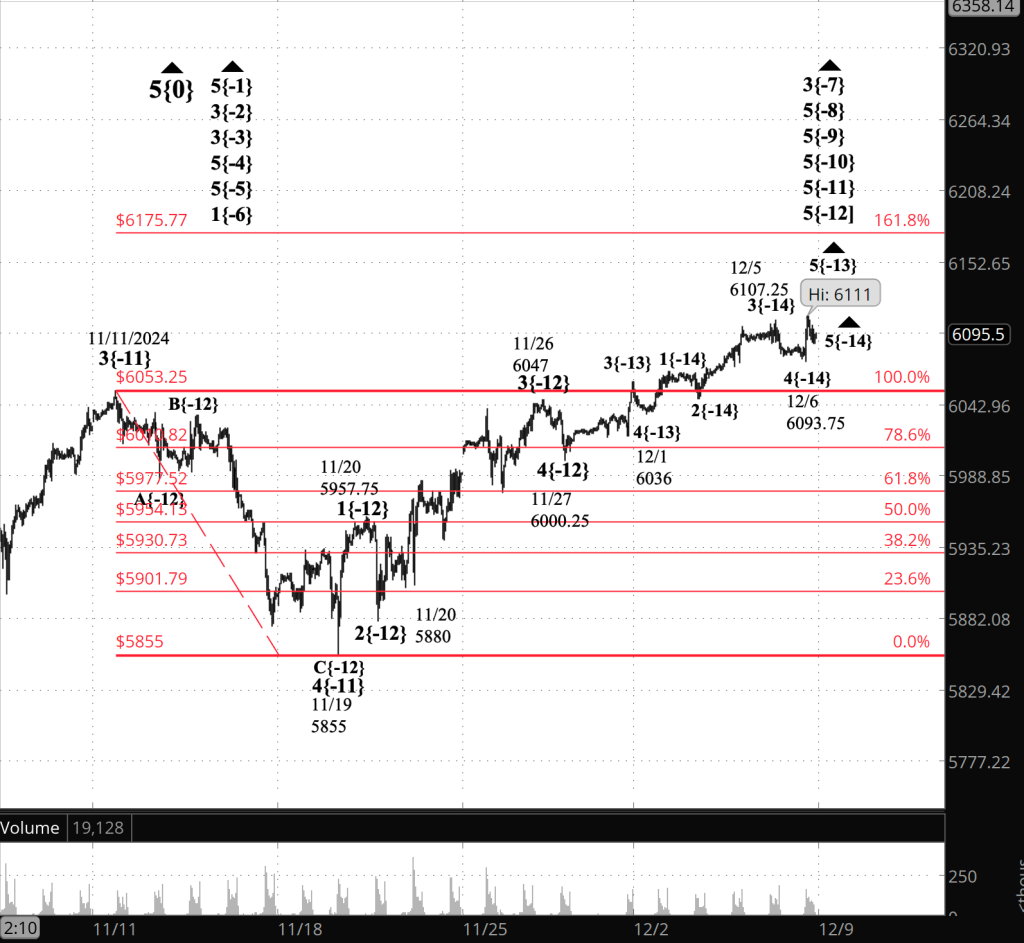
Half an hour before the closing bell. The S&P 500 futures reached a session high of 6111 and then retreated to the 6090s.

The Elliott Wave Theory analysis remains caught in a conundrum: Are the rise and decline subwaves within the rising 5th wave that began today? Or are they subwaves within the 4th-wave downward correction that began on December 5?

Given the brevity of these waves within the fractal structure of the chart, we will almost certainly get an answer next week.

9:35 a.m. New York time

What’s happening now? The S&P 500 E-mini futures rose sharply overnight after the Bureau of Labor Statistics published the November unemployment rate, 4.2%, up from 4.1% a month earlier and from 3.7% a year earlier. The price rise carried the price from 6076 to 6100.75. It then fell slightly but remained on the higher side of the range.

What does it mean? Elliott Wave Theory sees the rise as a 5th and final subwave within the uptrending 5th wave that began on December 1.

[S&P 500 E-mini futures at 3:30 p.m., 50-minute bars, with volume]

What are the alternatives? It’s possible that the starting point of the end point of wave 4 on December 6 is one degree smaller. Under this scenario, the decline was the A wave within the preceding 4th wave, which means the rise is wave B within the corrective wave, with wave C yet to come.

What does Elliott wave theory say? Here are the waves that underly the analyses.

Principal Analysis:

  • .Rising wave 5{0} is underway. It is a wave of Intermediate degree that began in December 2018.
  • It is in its final subwave, wave 5{-1}.
  • Within wave 5{-1}, rising waves 5{-2}, 5{-3} and 5{-4} are underway, as is wave 5{-5}.
  • Wave 5{-5} is in its initial subwave, wave 1{-6}, which in turn is in its middle subwave, wave 3{-7}.
  • Wave 3{-7} is in its final; subwave, uptrending wave 5{-8}.
  • Wave 5{-8} is in its final subwave, wave 5{-9}, which is in its final subwave, uptrending wave 5{-10}.
  • Wave 5{-10} is in its final subwave, wave 5{-11}, which appears to have completed its middle subwave, wave 3{-12}, within wave 5{-13}.
  • Wave 5{-13} is now underway and is in its final subwave, wave 5{-14}

Alternative Analysis:

  • Wave 5{-13} is now underway and is in its next-to-the-last subwave, wave 4{-14}, which in turn is in wave B{-15}.

Long-term Waves.

These are the waves currently in progress under my principal analysis. Each line on the list shows the wave number, with the subscript in curly brackets, the traditional degree name, the starting date, the starting price of the S&P 500 E-mini futures, and the direction of the wave.

  • S&P 500 Index:
  • 5{+3} Supercycle, 7/8/1932, 4.40 (up)
  • 5{+2} Cycle, 12/9/1974, 60.96 (up)
  • 5{+1} Primary, 3/6/2009, 666.79 (up)
  • 5{0} Intermediate, 12/26/2018, 2346.58 (up)
  • S&P 500 Futures
  • 5{-1} Minor, 10/27/2023, 4127.25 (up)
  • 3{-2} Minute, 10/27/23, 4127.75 (up)
  • 3{-3} Minuette, 10/27/23, 4127.75 (up)
  • 5{-4} Subminuette, 4/18/2024, 4963.50 (up)
  • 5{-5} Micro, 8/5/2024, 5120 (up)
  • 1{-6} Submicro, 8/5/2024, 5120 (up)
  • 3{-7} Minuscule, 8/7/2024, 5182 (up)
  • 5{-8} (unnamed), 9/6/2024, 5394 (up)
  • 5{-9} (unnamed), 10/2/2024, 5724 (up)
  • 5{-10} (unnamed), 11/4/2024, 5824.25 (up)
  • 5{-11} (unnamed), 11/19/2024, 5933 (up)
  • 5{-12} (unnamed), 11/27/2024, 6000.25 (up)
  • 5{-13} (unnamed), 12/1/2024, 6036 (up)

Reading the chart. Price movements — waves – – in Elliott wave analysis are labeled with numbers within trending waves and letters with corrective waves. The subscripts — numbers in curly brackets — designate the wave’s degree, which, in Elliott wave analysis, means the relative position of a wave within the larger and smaller structures that make up the chart. R.N. Elliott, who in the 1930s developed the form of analysis that bears his name, viewed the chart as a complex structure of smaller waves nested within larger waves, which in turn are nested within still larger waves. In mathematics it’s called a fractal structure, where at every scale the pattern is similar to the others.

Learning and other resources. Elliott wave analysis provides context, not prophecy. As the 20th century semanticist Alfred Korzybski put it in his book Science and Sanity (1933), “The map is not the territory … The only usefulness of a map depends on similarity of structure between the empirical world and the map.” And I would add, in the ever-changing markets, we can judge that similarity of structure only after the fact.

See the menu page Analytical Methods for a rundown on where to go for information on Elliott wave analysis.

By Tim Bovee, Portland, Oregon, December ?, 2024

Disclaimer

Tim Bovee, Private Trader tracks the analysis and trades of a private trader for his own accounts. Nothing in this blog constitutes a recommendation to buy or sell stocks, options or any other financial instrument. The only purpose of this blog is to provide education and entertainment.

No trader is ever 100 percent successful in his or her trades. Trading in the stock and option markets is risky and uncertain. Each trader must make trading decisions for his or her own account, and take responsibility for the consequences.

License
Creative Commons License

All content on Tim Bovee, Private Trader by Timothy K. Bovee is licensed under a Creative Commons Attribution-ShareAlike 4.0 International License.

Based on a work at www.timbovee.com.

Trader’s Notebook

3:30 p.m. New York time

Half an hour before the closing bell. The S&P 500 futures rose during the session, to 6107.25, reaching above the high attained the prior day. Clearly the price is searching for a top, launching persuasive reversals that turn out not to amount to much.

Under this afternoon’s Elliott Wave Theory analysis, the 5th wave that began on December 1 is still its middle subwave — wave 3. I’ve redone the chart to conform.

9:35 a.m. New York time

What’s happening now? The S&P 500 E-mini futures peaked on December 4 at 6102.25 shortly before the session ended and then swung into a sideways movement that continued overnight.

What does it mean? The sideways movement is a 4th-wave downward correction, the next-to-the-last subwave of the 5th-wave uptrend that began on December 1 from 6000.25.

The correction will be followed by a low-degree 5th-wave uptrend, the final subwave of the rise that began on December 1.

Waves within waves. Waves of the chart are labeled with the wave number followed by a subscript in curly brackets showing the wave’s position in the fractal structure of the chart relative to the Intermediate Degree. The present intermediate degree is wave 5{0}, which began on December 26, 2018. A stock’s movement is always structured as waves within waves, small waves within larger waves that are in turrn subwaves of even larger waves.

Here are the present waves as labeled on the chart.

The December 4 peak, 6102.25, is the end of wave 3{-14} and the start of wave 4{-14} within wave 5{-13}, which began on December 1.

Wave 5{-13} is the smallest of a series of nested 5th waves, up to wave 5{-8}, which in turn is nested within wave 3{-7}.

Wave 4{-14} will be followed by wave 5{-14}. When wave 5{-14} ends, it will simultaneously be the end of wave 5{-13} and the whole series of nested 5th waves up to wave 5{-8}, and also the end of wave 3{-7).

A relatively large downward correction, wave 4{-7}, will ensue.

[S&P 500 E-mini futures at 3:30 p.m., 45-minute bars, with volume]

What are the alternatives? The wave structure has clarified, resolving yesterday’s alternative. There are at present no ambiguities.

What does Elliott wave theory say? Here are the waves that underly the analyses.

Principal Analysis:

  • .Rising wave 5{0} is underway. It is a wave of Intermediate degree that began in December 2018.
  • It is in its final subwave, wave 5{-1}.
  • Within wave 5{-1}, rising waves 5{-2}, 5{-3} and 5{-4} are underway, as is wave 5{-5}.
  • Wave 5{-5} is in its initial subwave, wave 1{-6}, which in turn is in its middle subwave, wave 3{-7}.
  • Wave 3{-7} is in its final; subwave, uptrending wave 5{-8}.
  • Wave 5{-8} is in its final subwave, wave 5{-9}, which is in its final subwave, uptrending wave 5{-10}.
  • Wave 5{-10} is in its final subwave, wave 5{-11}, which appears to have completed its middle subwave, wave 3{-12}, within wave 5{-13}.
  • Wave 5{-13} is now underway and is in its middle subwave, wave 3{-14}

Long-term Waves.

These are the waves currently in progress under my principal analysis. Each line on the list shows the wave number, with the subscript in curly brackets, the traditional degree name, the starting date, the starting price of the S&P 500 E-mini futures, and the direction of the wave.

  • S&P 500 Index:
  • 5{+3} Supercycle, 7/8/1932, 4.40 (up)
  • 5{+2} Cycle, 12/9/1974, 60.96 (up)
  • 5{+1} Primary, 3/6/2009, 666.79 (up)
  • 5{0} Intermediate, 12/26/2018, 2346.58 (up)
  • S&P 500 Futures
  • 5{-1} Minor, 10/27/2023, 4127.25 (up)
  • 3{-2} Minute, 10/27/23, 4127.75 (up)
  • 3{-3} Minuette, 10/27/23, 4127.75 (up)
  • 5{-4} Subminuette, 4/18/2024, 4963.50 (up)
  • 5{-5} Micro, 8/5/2024, 5120 (up)
  • 1{-6} Submicro, 8/5/2024, 5120 (up)
  • 3{-7} Minuscule, 8/7/2024, 5182 (up)
  • 5{-8} (unnamed), 9/6/2024, 5394 (up)
  • 5{-9} (unnamed), 10/2/2024, 5724 (up)
  • 5{-10} (unnamed), 11/4/2024, 5824.25 (up)
  • 5{-11} (unnamed), 11/19/2024, 5933 (up)
  • 5{-12} (unnamed), 11/27/2024, 6000.25 (up)
  • 5{-13} (unnamed), 12/1/2024, 6036 (up)

Reading the chart. Price movements — waves – – in Elliott wave analysis are labeled with numbers within trending waves and letters with corrective waves. The subscripts — numbers in curly brackets — designate the wave’s degree, which, in Elliott wave analysis, means the relative position of a wave within the larger and smaller structures that make up the chart. R.N. Elliott, who in the 1930s developed the form of analysis that bears his name, viewed the chart as a complex structure of smaller waves nested within larger waves, which in turn are nested within still larger waves. In mathematics it’s called a fractal structure, where at every scale the pattern is similar to the others.

Learning and other resources. Elliott wave analysis provides context, not prophecy. As the 20th century semanticist Alfred Korzybski put it in his book Science and Sanity (1933), “The map is not the territory … The only usefulness of a map depends on similarity of structure between the empirical world and the map.” And I would add, in the ever-changing markets, we can judge that similarity of structure only after the fact.

See the menu page Analytical Methods for a rundown on where to go for information on Elliott wave analysis.

By Tim Bovee, Portland, Oregon, December 5, 2024

Disclaimer

Tim Bovee, Private Trader tracks the analysis and trades of a private trader for his own accounts. Nothing in this blog constitutes a recommendation to buy or sell stocks, options or any other financial instrument. The only purpose of this blog is to provide education and entertainment.

No trader is ever 100 percent successful in his or her trades. Trading in the stock and option markets is risky and uncertain. Each trader must make trading decisions for his or her own account, and take responsibility for the consequences.

License
Creative Commons License

All content on Tim Bovee, Private Trader by Timothy K. Bovee is licensed under a Creative Commons Attribution-ShareAlike 4.0 International License.

Based on a work at www.timbovee.com.
Trader’s Notebook

3:30 p.m. New York time

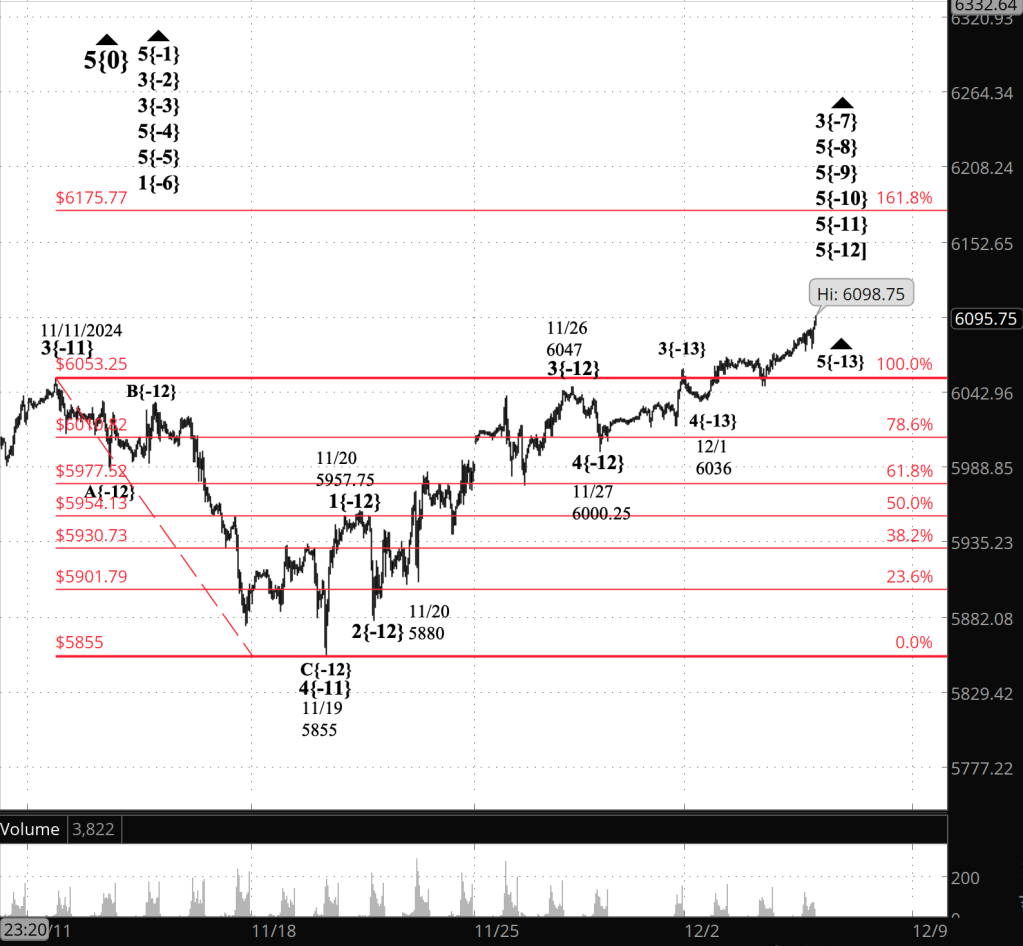
Half an hour before the closing bell. The S&P 500 futures continued to rise during the session, coming close to 6100.

A series of six 5th waves, each larger than the one before, are drawing close to a simultaneous end. The smallest of them began on December 1 from 6036.

9:35 a.m. New York time

What’s happening now? The S&P 500 rose steadily overnight, from the 6060s to the 6080s.

What does it mean? Based on Elliott Wave Theory analysis, I’ve concluded that the uptrending 5th wave that began on November 27 from 6000.25 is now in its 5th and final subwave. That subwave began on December 1 from 6036.

What is an alternative? The subwave structure within that rising 5th wave lacks clarity. It’s possible that the rise is the middle subwave, wave 3.

What lies ahead? Fifth wave are endings, and a glance at waves further up the fractal structure of the chart show plenty of endings, five, to be precise, followed by a six, which is a 3rd wave. When the present 5th wave that began on December 1 ends, the five larger subwaves and the 3rd wave will also end. A 4th-wave downtrend will begin, at the same degree as the 3rd wave, which began on August 7 from 5182.

[S&P 500 E-mini futures at 3:30 p.m., 40-minute bars, with volume]

What does Elliott wave theory say? Here are the waves that underly the analyses.

Principal Analysis:

  • Rising wave 5{0} is underway. It is a wave of Intermediate degree that began in December 2018.
  • It is in its final subwave, wave 5{-1}.
  • Within wave 5{-1}, rising waves 5{-2}, 5{-3} and 5{-4} are underway, as is wave 5{-5}.
  • Wave 5{-5} is in its initial subwave, wave 1{-6}, which in turn is in its middle subwave, wave 3{-7}.
  • Wave 3{-7} is in its final; subwave, uptrending wave 5{-8}.
  • Wave 5{-8} is in its final subwave, wave 5{-9}, which is in its final subwave, uptrending wave 5{-10}.
  • Wave 5{-10} is in its final subwave, wave 5{-11}, which appears to have completed its middle subwave, wave 3{-12}, within wave 5{-13}.
  • Wave 5{-12} is now underway and is in its final subwave, wave 5{-13}

Alternative Analysis:

  • Wave 5{-12} is now underway and is in its middle subwave, wave 3{-13}

Long-term Waves.

These are the waves currently in progress under my principal analysis. Each line on the list shows the wave number, with the subscript in curly brackets, the traditional degree name, the starting date, the starting price of the S&P 500 E-mini futures, and the direction of the wave.

  • S&P 500 Index:
  • 5{+3} Supercycle, 7/8/1932, 4.40 (up)
  • 5{+2} Cycle, 12/9/1974, 60.96 (up)
  • 5{+1} Primary, 3/6/2009, 666.79 (up)
  • 5{0} Intermediate, 12/26/2018, 2346.58 (up)
  • S&P 500 Futures
  • 5{-1} Minor, 10/27/2023, 4127.25 (up)
  • 3{-2} Minute, 10/27/23, 4127.75 (up)
  • 3{-3} Minuette, 10/27/23, 4127.75 (up)
  • 5{-4} Subminuette, 4/18/2024, 4963.50 (up)
  • 5{-5} Micro, 8/5/2024, 5120 (up)
  • 1{-6} Submicro, 8/5/2024, 5120 (up)
  • 3{-7} Minuscule, 8/7/2024, 5182 (up)
  • 5{-8} (unnamed), 9/6/2024, 5394 (up)
  • 5{-9} (unnamed), 10/2/2024, 5724 (up)
  • 5{-10} (unnamed), 11/4/2024, 5824.25 (up)
  • 5{-11} (unnamed), 11/19/2024, 5933 (up)
  • 5{-12} (unnamed), 11/27/2024, 6000.25 (up)
  • 5{-13} (unnamed), 12/1/2024, 6036 (up)

Reading the chart. Price movements — waves – – in Elliott wave analysis are labeled with numbers within trending waves and letters with corrective waves. The subscripts — numbers in curly brackets — designate the wave’s degree, which, in Elliott wave analysis, means the relative position of a wave within the larger and smaller structures that make up the chart. R.N. Elliott, who in the 1930s developed the form of analysis that bears his name, viewed the chart as a complex structure of smaller waves nested within larger waves, which in turn are nested within still larger waves. In mathematics it’s called a fractal structure, where at every scale the pattern is similar to the others.

Learning and other resources. Elliott wave analysis provides context, not prophecy. As the 20th century semanticist Alfred Korzybski put it in his book Science and Sanity (1933), “The map is not the territory … The only usefulness of a map depends on similarity of structure between the empirical world and the map.” And I would add, in the ever-changing markets, we can judge that similarity of structure only after the fact.

See the menu page Analytical Methods for a rundown on where to go for information on Elliott wave analysis.

By Tim Bovee, Portland, Oregon, December 4, 2024

Disclaimer

Tim Bovee, Private Trader tracks the analysis and trades of a private trader for his own accounts. Nothing in this blog constitutes a recommendation to buy or sell stocks, options or any other financial instrument. The only purpose of this blog is to provide education and entertainment.

No trader is ever 100 percent successful in his or her trades. Trading in the stock and option markets is risky and uncertain. Each trader must make trading decisions for his or her own account, and take responsibility for the consequences.

License
Creative Commons License

All content on Tim Bovee, Private Trader by Timothy K. Bovee is licensed under a Creative Commons Attribution-ShareAlike 4.0 International License.

Based on a work at www.timbovee.com.