Trader’s Notebook

3:30 p.m. New York time

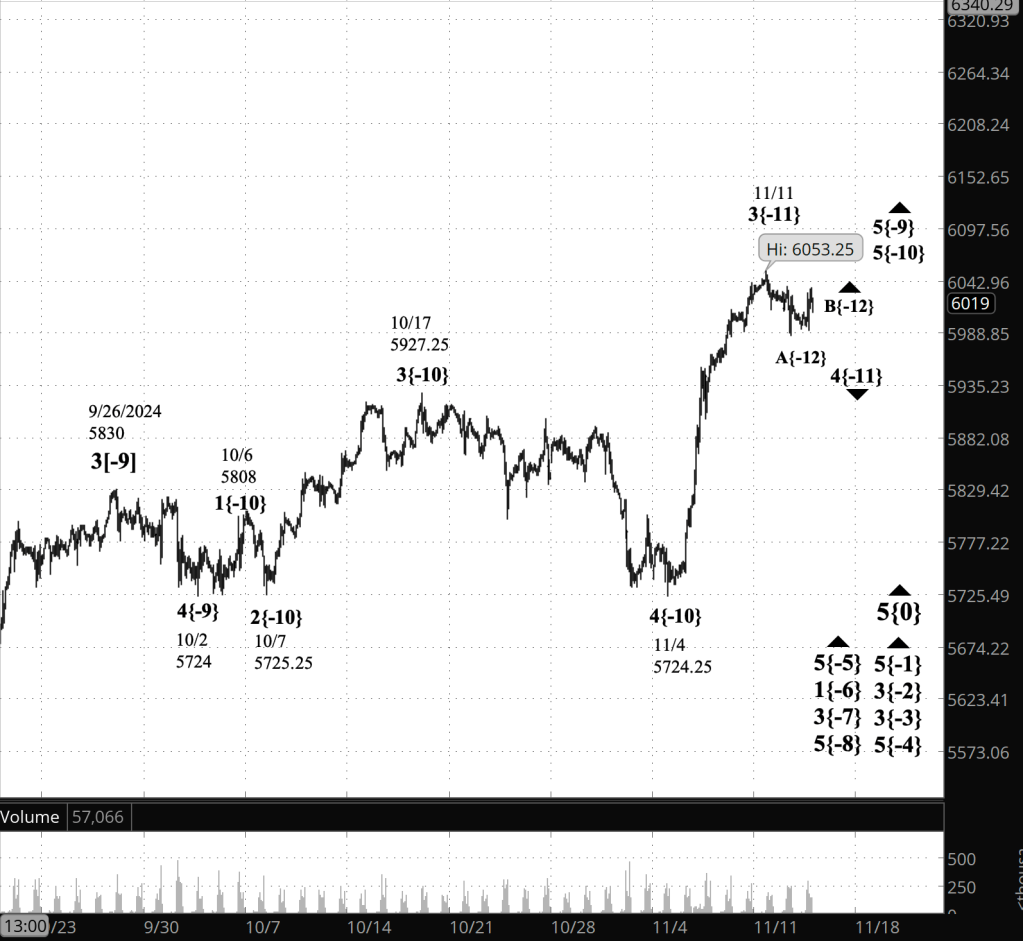
Half an hour before the closing bell. The S&P 500 futures fell into the 5970s during the session.

Elliott Wave Theory: The decline confirmed that the 4th-wave downward correction that began on November 11 is in its last subwave, wave C.

9:35 a.m. New York time

What’s happening now? The S&P 500 E-mini futures rose overnight, from 6004 to the 6020s, dropping slightly as the opening bell approached coincident with the release of the Producer Price Index.

What does it mean? The Elliott Wave structure of the chart remains little changed. The 4th-wave downward correction that began on November 4 continues. It’s middle subwave, wave B, may have ended on November 11 at 6035.25, and if so, the final subwave, wave C, is underway. A C wave has five subwaves and appears to be in its final wave, wave 5.

In any case, once wave C is complete, it will be the end of the corrective pattern. At that point, one of two possibilities will happen.

If the 4th-wave correction takes the most common form — a single corrective pattern — then the end of wave C will be the end if its parent wave, wave 4, and a 5th-wave uptrend will begin.

If the correction takes a compound form, wave C will be followed by a connector wave, and then a second corrective pattern, and then possibly a third, delaying the start of the 5th-wave uptrend.

[S&P 500 E-mini futures at 3:30 p.m., 90-minute bars, with volume]

What are the alternatives? None at present, beyond of the question of whether the 4th-wave correction has completed its wave B subwave.

What does Elliott wave theory say? Here are the waves that underly the analyses.

Principal Analysis:

  • .Rising wave 5{0} is underway. It is a wave of Intermediate degree that began in December 2018.
  • It is in its final subwave, wave 5{-1}.
  • Within wave 5{-1}, rising waves 5{-2}, 5{-3} and 5{-4} are underway, as is wave 5{-5}.
  • Wave 5{-5} is in its initial subwave, wave 1{-6}, which in turn is in its middle subwave, wave 3{-7}.
  • Wave 3{-7} is in its final; subwave, uptrending wave 5{-8}.
  • Wave 5{-8} is in its final subwave, wave 5{-9}, which is in its final subwave, uptrending wave 5{-10}.
  • Wave 5{-10} is in wave 4{-11}, its next-to-the-last wave, which in turn is in wave C{-12}, its 3rd and final subwave.

Long-term Waves.

These are the waves currently in progress under my principal analysis. Each line on the list shows the wave number, with the subscript in curly brackets, the traditional degree name, the starting date, the starting price of the S&P 500 E-mini futures, and the direction of the wave.

  • S&P 500 Index:
  • 5{+3} Supercycle, 7/8/1932, 4.40 (up)
  • 5{+2} Cycle, 12/9/1974, 60.96 (up)
  • 5{+1} Primary, 3/6/2009, 666.79 (up)
  • 5{0} Intermediate, 12/26/2018, 2346.58 (up)
  • S&P 500 Futures
  • 5{-1} Minor, 10/27/2023, 4127.25 (up)
  • 3{-2} Minute, 10/27/23, 4127.75 (up)
  • 3{-3} Minuette, 10/27/23, 4127.75 (up)
  • 5{-4} Subminuette, 4/18/2024, 4963.50 (up)
  • 5{-5} Micro, 8/5/2024, 5120 (up)
  • 1{-6} Submicro, 8/5/2024, 5120 (up)
  • 3{-7} Minuscule, 8/7/2024, 5182 (up)
  • 5{-8} (unnamed), 9/6/2024, 5394 (up)
  • 5{-9} (unnamed), 10/2/2024, 5724 (up)
  • 5{-10} (unnamed), 11/4/2024, 5824.25 (up)
  • 4{-11} (unnamed), 11/11/2024, 6053.25 (down)

Reading the chart. Price movements — waves – – in Elliott wave analysis are labeled with numbers within trending waves and letters with corrective waves. The subscripts — numbers in curly brackets — designate the wave’s degree, which, in Elliott wave analysis, means the relative position of a wave within the larger and smaller structures that make up the chart. R.N. Elliott, who in the 1930s developed the form of analysis that bears his name, viewed the chart as a complex structure of smaller waves nested within larger waves, which in turn are nested within still larger waves. In mathematics it’s called a fractal structure, where at every scale the pattern is similar to the others.

Learning and other resources. Elliott wave analysis provides context, not prophecy. As the 20th century semanticist Alfred Korzybski put it in his book Science and Sanity (1933), “The map is not the territory … The only usefulness of a map depends on similarity of structure between the empirical world and the map.” And I would add, in the ever-changing markets, we can judge that similarity of structure only after the fact.

See the menu page Analytical Methods for a rundown on where to go for information on Elliott wave analysis.

By Tim Bovee, Portland, Oregon, November 14, 2024

Disclaimer

Tim Bovee, Private Trader tracks the analysis and trades of a private trader for his own accounts. Nothing in this blog constitutes a recommendation to buy or sell stocks, options or any other financial instrument. The only purpose of this blog is to provide education and entertainment.

No trader is ever 100 percent successful in his or her trades. Trading in the stock and option markets is risky and uncertain. Each trader must make trading decisions for his or her own account, and take responsibility for the consequences.

License
Creative Commons License

All content on Tim Bovee, Private Trader by Timothy K. Bovee is licensed under a Creative Commons Attribution-ShareAlike 4.0 International License.

Based on a work at www.timbovee.com.
Trader’s Notebook

3:30 p.m. New York time

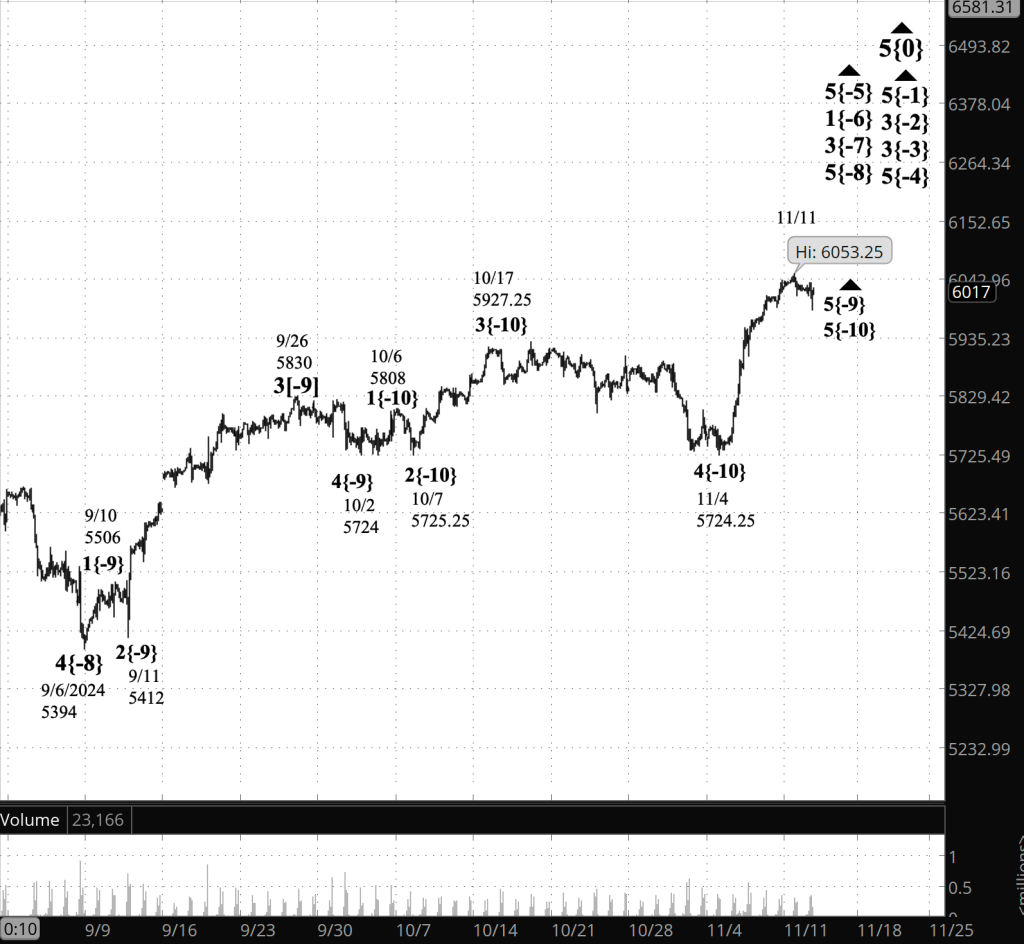
Half an hour before the losing bell. The S&P 500 futures traded between the 5990s and the 6030s during the session.

Elliott Wave Theory analysis: Unchanged. The 4th wave downward correction that began on November 4 continues and is now in it middle subwave, wave B.

9:35 a.m. New York time

What’s happening now? The S&P 500 E-mini futures traded sideways most of overnight, until the Consumer Price Index data for October was released, sending the futures rising from just above 6000 into the 6030s within a span of 10 minutes. The index rose by 0.2%, the same as in the prior two months.

What does it mean? Elliott Wave Theory sees the rise as the middle wave — wave B — within the 4th-wave downward correction that began on October 11. Wave 4 is a subwave of a 5th-wave uptrend that began on November 4.

Each wave on the chart are labelled with its wave number and a subscript in curly brackets show the waves position in the fractal structure of the price movements relative to the Intermediate Degree, which began in December 2018.

As seen on the chart, the rise overnight was rising wave B{-12} within a falling corrective movement, wave 4{-10}.

The subwaves within wave 4{-10} were ambiguous at the outset but became somewhat clearer during the November 12 session as analyzed the afternoon’s Trader’s Notebook. I had analyzed the decline as wave C. Wave B now seems more likely, and it could be that the waves labeled A{-12} and B{-12} on today’s chart will turn out to be waves 1{-13} and 2{-13}, subwaves of wave A{-12}.

So, clarity, yes, but it’s not yet perfectly clear.

[S&P 500 E-mini futures at 3:30 p.m., 90-minute bars, with volume]

What are the alternatives? No ambiguities beyond the subwaves within the 4th-wave downward correction that began on November 11.

What does Elliott wave theory say? Here are the waves that underly the analyses.

Principal Analysis:

  • .Rising wave 5{0} is underway. It is a wave of Intermediate degree that began in December 2018.
  • It is in its final subwave, wave 5{-1}.
  • Within wave 5{-1}, rising waves 5{-2}, 5{-3} and 5{-4} are underway, as is wave 5{-5}.
  • Wave 5{-5} is in its initial subwave, wave 1{-6}, which in turn is in its middle subwave, wave 3{-7}.
  • Wave 3{-7} is in its final; subwave, uptrending wave 5{-8}.
  • Wave 5{-8} is in its final subwave, wave 5{-9}, which is in its final subwave, uptrending wave 5{-10}.
  • Wave 5{-10} is in wave 4{-11}, its next-to-the-last wave, which in turn is in wave B{-12}, its 2nd subwave.

Long-term Waves.

These are the waves currently in progress under my principal analysis. Each line on the list shows the wave number, with the subscript in curly brackets, the traditional degree name, the starting date, the starting price of the S&P 500 E-mini futures, and the direction of the wave.

  • S&P 500 Index:
  • 5{+3} Supercycle, 7/8/1932, 4.40 (up)
  • 5{+2} Cycle, 12/9/1974, 60.96 (up)
  • 5{+1} Primary, 3/6/2009, 666.79 (up)
  • 5{0} Intermediate, 12/26/2018, 2346.58 (up)
  • S&P 500 Futures
  • 5{-1} Minor, 10/27/2023, 4127.25 (up)
  • 3{-2} Minute, 10/27/23, 4127.75 (up)
  • 3{-3} Minuette, 10/27/23, 4127.75 (up)
  • 5{-4} Subminuette, 4/18/2024, 4963.50 (up)
  • 5{-5} Micro, 8/5/2024, 5120 (up)
  • 1{-6} Submicro, 8/5/2024, 5120 (up)
  • 3{-7} Minuscule, 8/7/2024, 5182 (up)
  • 5{-8} (unnamed), 9/6/2024, 5394 (up)
  • 5{-9} (unnamed), 10/2/2024, 5724 (up)
  • 5{-10} (unnamed), 11/4/2024, 5824.25 (up)
  • 4{-11} (unnamed), 11/11/2024, 6053.25 (down)

Reading the chart. Price movements — waves – – in Elliott wave analysis are labeled with numbers within trending waves and letters with corrective waves. The subscripts — numbers in curly brackets — designate the wave’s degree, which, in Elliott wave analysis, means the relative position of a wave within the larger and smaller structures that make up the chart. R.N. Elliott, who in the 1930s developed the form of analysis that bears his name, viewed the chart as a complex structure of smaller waves nested within larger waves, which in turn are nested within still larger waves. In mathematics it’s called a fractal structure, where at every scale the pattern is similar to the others.

Learning and other resources. Elliott wave analysis provides context, not prophecy. As the 20th century semanticist Alfred Korzybski put it in his book Science and Sanity (1933), “The map is not the territory … The only usefulness of a map depends on similarity of structure between the empirical world and the map.” And I would add, in the ever-changing markets, we can judge that similarity of structure only after the fact.

See the menu page Analytical Methods for a rundown on where to go for information on Elliott wave analysis.

By Tim Bovee, Portland, Oregon, November 13, 2024

Disclaimer

Tim Bovee, Private Trader tracks the analysis and trades of a private trader for his own accounts. Nothing in this blog constitutes a recommendation to buy or sell stocks, options or any other financial instrument. The only purpose of this blog is to provide education and entertainment.

No trader is ever 100 percent successful in his or her trades. Trading in the stock and option markets is risky and uncertain. Each trader must make trading decisions for his or her own account, and take responsibility for the consequences.

License
Creative Commons License

All content on Tim Bovee, Private Trader by Timothy K. Bovee is licensed under a Creative Commons Attribution-ShareAlike 4.0 International License.

Based on a work at www.timbovee.com.
Trader’s Notebook

3:30 p.m. New York time

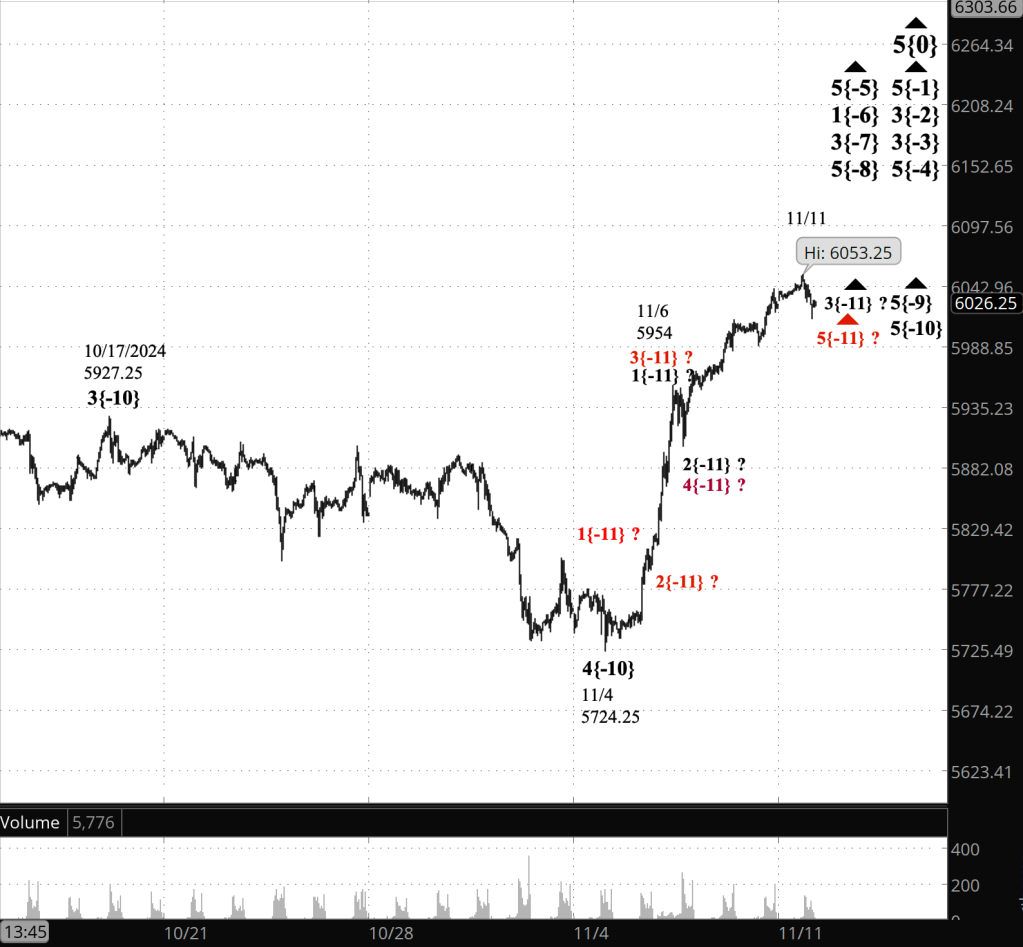
Half an hour before the closing bell. The S&P 500 futures fell during the session, reaching into the 5980s.

Elliott Wave Theory: The decline can be interpreted as the C wave within a downward correction. Given the correction’s distance into the parent 5th wave that began on November 4, it seems most likely to be a 4th-wave correction within the larger 5th-wave uptrend. If the chart plays out that way, then the 3rd wave within the larger 5th ended on November 12, and the 4th wave correction will be followed by a 5th subwave within the larger 5th-wave uptrend.

9:35 a.m. New York time

What’s happening now? The S&P 500 E-mini futures traded sideways overnight, remaining with a 6030s to 6010s range.

What does it mean? Elliott Wave Theory suggests that the 5th-wave uptrend that began on November 4 internally moved into a so-far-shallow downward correction.

When wave 5 is complete, it will also be the end of the two other 5th waves of increasing degree, and the end of a still larger 3rd wave that began on August 7 from 5182. It will be followed by a 4th-wave downward correction considerably larger than what we’ve seen recently.

[S&P 500 E-mini futures at 3:30 p.m., 130-minute bars, with volume]

What are the alternatives? The present 5th-wave uptrend has considerable ambiguity in its internal count, as is often the case with a low-degree rapid rise or fall. I discussed the ambiguities in detail in the November 11 “Trader’s Notebook”.

What does Elliott Wave Theory say? Here are the waves that underly the analyses.

Principal Analysis:

  • .Rising wave 5{0} is underway. It is a wave of Intermediate degree that began in December 2018.
  • It is in its final subwave, wave 5{-1}.
  • Within wave 5{-1}, rising waves 5{-2}, 5{-3} and 5{-4} are underway, as is wave 5{-5}.
  • Wave 5{-5} is in its initial subwave, wave 1{-6}, which in turn is in its middle subwave, wave 3{-7}.
  • Wave 3{-7} is in its final; subwave, uptrending wave 5{-8}.
  • Wave 5{-8} is in its final subwave, wave 5{-9}, which is in its final subwave, uptrending wave 5{-10}.

Long-term Waves.

These are the waves currently in progress under my principal analysis. Each line on the list shows the wave number, with the subscript in curly brackets, the traditional degree name, the starting date, the starting price of the S&P 500 E-mini futures, and the direction of the wave.

  • S&P 500 Index:
  • 5{+3} Supercycle, 7/8/1932, 4.40 (up)
  • 5{+2} Cycle, 12/9/1974, 60.96 (up)
  • 5{+1} Primary, 3/6/2009, 666.79 (up)
  • 5{0} Intermediate, 12/26/2018, 2346.58 (up)
  • S&P 500 Futures
  • 5{-1} Minor, 10/27/2023, 4127.25 (up)
  • 3{-2} Minute, 10/27/23, 4127.75 (up)
  • 3{-3} Minuette, 10/27/23, 4127.75 (up)
  • 5{-4} Subminuette, 4/18/2024, 4963.50 (up)
  • 5{-5} Micro, 8/5/2024, 5120 (up)
  • 1{-6} Submicro, 8/5/2024, 5120 (up)
  • 3{-7} Minuscule, 8/7/2024, 5182 (up)
  • 5{-8} (unnamed), 9/6/2024, 5394 (up)
  • 5{-9} (unnamed), 10/2/2024, 5724 (up)
  • 5{-10} (unnamed), 11/4/2024, 5824.25 (up)

Reading the chart. Price movements — waves – – in Elliott wave analysis are labeled with numbers within trending waves and letters with corrective waves. The subscripts — numbers in curly brackets — designate the wave’s degree, which, in Elliott wave analysis, means the relative position of a wave within the larger and smaller structures that make up the chart. R.N. Elliott, who in the 1930s developed the form of analysis that bears his name, viewed the chart as a complex structure of smaller waves nested within larger waves, which in turn are nested within still larger waves. In mathematics it’s called a fractal structure, where at every scale the pattern is similar to the others.

Learning and other resources. Elliott wave analysis provides context, not prophecy. As the 20th century semanticist Alfred Korzybski put it in his book Science and Sanity (1933), “The map is not the territory … The only usefulness of a map depends on similarity of structure between the empirical world and the map.” And I would add, in the ever-changing markets, we can judge that similarity of structure only after the fact.

See the menu page Analytical Methods for a rundown on where to go for information on Elliott wave analysis.

By Tim Bovee, Portland, Oregon, November 12, 2024

Disclaimer

Tim Bovee, Private Trader tracks the analysis and trades of a private trader for his own accounts. Nothing in this blog constitutes a recommendation to buy or sell stocks, options or any other financial instrument. The only purpose of this blog is to provide education and entertainment.

No trader is ever 100 percent successful in his or her trades. Trading in the stock and option markets is risky and uncertain. Each trader must make trading decisions for his or her own account, and take responsibility for the consequences.

License
Creative Commons License

All content on Tim Bovee, Private Trader by Timothy K. Bovee is licensed under a Creative Commons Attribution-ShareAlike 4.0 International License.

Based on a work at www.timbovee.com.
Trader’s Notebook

Holiday. The bond markets will be closed in the United States today to market the Veterans Day holiday. Stock and options markets will trade as usual.

3:30 p.m. New York time

Half an hour before the closing bell. The S&P 500 futures fell during the session, into the 6010s.

Elliott Wave Theory: The rising 5th wave that began on November 4 continues, as do the ambiguities concerning wave 5 subwaves.

9:35 a.m. New York time

What’s happening now? The S&P 500 E-mini futures rose into the 6050s after trading resumed overnight and then pulled back into the 6040s.

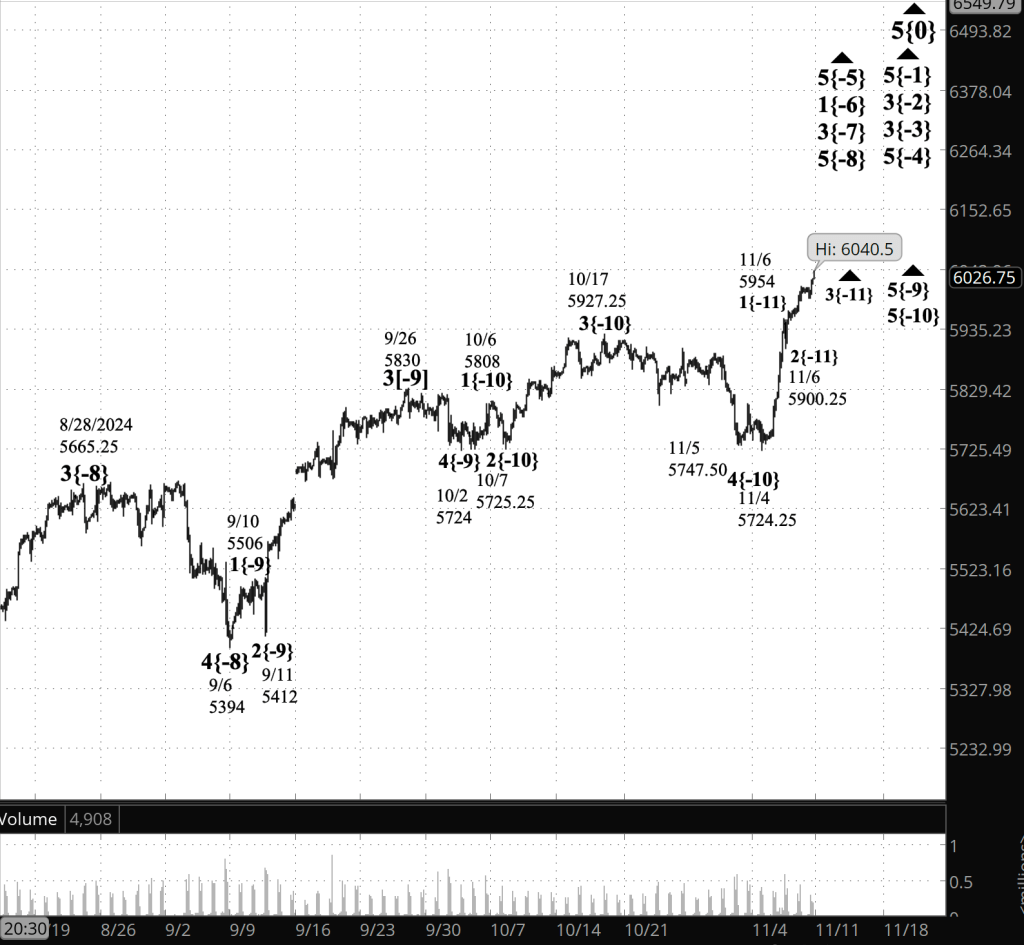
What does it mean? The rising 5th wave that began on November 4 continues, according to Elliott Wave Theory. Within that rise, however, the subwaves are less than clear.

On the chart I’ve put up two sets of labels for subwaves of the 5th-wave rise, one colored black and the other red. The black version looks a bit more likely than the red to me, but honestly, I can’t choose between them.

So at this point I’m considering each to be a principal analysis.

[S&P 500 E-mini futures at 3:30 p.m., 45-minute bars, with volume]

What are the alternatives? None beyond the subwaves of wave 5, discussed above.

What does Elliott wave theory say? Here are the waves that underly the analyses.

Principal Analyses #1 and #2:

  • Rising wave 5{0} is underway. It is a wave of Intermediate degree that began in December 2018.
  • It is in its final subwave, wave 5{-1}.
  • Within wave 5{-1}, rising waves 5{-2}, 5{-3} and 5{-4} are underway, as is wave 5{-5}.
  • Wave 5{-5} is in its initial subwave, wave 1{-6}, which in turn is in its middle subwave, wave 3{-7}.
  • Wave 3{-7} is in its final; subwave, uptrending wave 5{-8}.
  • Wave 5{-8} is in its final subwave, wave 5{-9}, which is in its final subwave, uptrending wave 5{-10}.
  • Within wave 10, the subwaves are either in 3{-11} or 5{-11}. The differing wave counts are colored black and red, respectively.

Long-term Waves.

  • These are the waves currently in progress under my principal analysis. Each line on the list shows the wave number, with the subscript in curly brackets, the traditional degree name, the starting date, the starting price of the S&P 500 E-mini futures, and the direction of the wave.
  • S&P 500 Index:
  • 5{+3} Supercycle, 7/8/1932, 4.40 (up)
  • 5{+2} Cycle, 12/9/1974, 60.96 (up)
  • 5{+1} Primary, 3/6/2009, 666.79 (up)
  • 5{0} Intermediate, 12/26/2018, 2346.58 (up)
  • S&P 500 Futures
  • 5{-1} Minor, 10/27/2023, 4127.25 (up)
  • 3{-2} Minute, 10/27/23, 4127.75 (up)
  • 3{-3} Minuette, 10/27/23, 4127.75 (up)
  • 5{-4} Subminuette, 4/18/2024, 4963.50 (up)
  • 5{-5} Micro, 8/5/2024, 5120 (up)
  • 1{-6} Submicro, 8/5/2024, 5120 (up)
  • 3{-7} Minuscule, 8/7/2024, 5182 (up)
  • 5{-8} (unnamed), 9/6/2024, 5394 (up)
  • 5{-9} (unnamed), 10/2/2024, 5724 (up)
  • 5{-10} (unnamed), 11/4/2024, 5824.25 (up)

Reading the chart. Price movements — waves – – in Elliott wave analysis are labeled with numbers within trending waves and letters with corrective waves. The subscripts — numbers in curly brackets — designate the wave’s degree, which, in Elliott wave analysis, means the relative position of a wave within the larger and smaller structures that make up the chart. R.N. Elliott, who in the 1930s developed the form of analysis that bears his name, viewed the chart as a complex structure of smaller waves nested within larger waves, which in turn are nested within still larger waves. In mathematics it’s called a fractal structure, where at every scale the pattern is similar to the others.

Learning and other resources. Elliott wave analysis provides context, not prophecy. As the 20th century semanticist Alfred Korzybski put it in his book Science and Sanity (1933), “The map is not the territory … The only usefulness of a map depends on similarity of structure between the empirical world and the map.” And I would add, in the ever-changing markets, we can judge that similarity of structure only after the fact.

See the menu page Analytical Methods for a rundown on where to go for information on Elliott wave analysis.

By Tim Bovee, Portland, Oregon, November 11, 2024

Disclaimer

Tim Bovee, Private Trader tracks the analysis and trades of a private trader for his own accounts. Nothing in this blog constitutes a recommendation to buy or sell stocks, options or any other financial instrument. The only purpose of this blog is to provide education and entertainment.

No trader is ever 100 percent successful in his or her trades. Trading in the stock and option markets is risky and uncertain. Each trader must make trading decisions for his or her own account, and take responsibility for the consequences.

License
Creative Commons License

All content on Tim Bovee, Private Trader by Timothy K. Bovee is licensed under a Creative Commons Attribution-ShareAlike 4.0 International License.

Based on a work at www.timbovee.com.
Trader’s Notebook

3:30 p.m. New York time

Half an hour before the closing bell. The S&P 500 futures rose during the session, reaching slightly above 6040.

The middle subwave—wave 3—within the uptrending final subwave—wave 5—is part of a sequence of three 5th waves, each increasing in size. All are subwaves within a larger 3rd wave that began on August 7 at 5182. When the smallest of these 5th waves concludes, it will signal the end of the entire sequence. At the highest degree, this will also mark the completion of the 3rd wave and the beginning of a 4th-wave downward correction.

Shorter version: Expect an uptrend for a while, but keep in mind, no uptrend lasts forever. A correction follows every uptrend.

9:35 a.m. New York time

What’s happening now? The S&P 500 E-mini futures traded sideways for much of the overnight period, dropping from 6010 into the 5990s as the opening bell approached.

What does it mean? According to Elliott Wave Theory, the 5th-wave uptrend that began on November 4 continues to unfold through its early subwaves.

One challenge in Elliott Wave analysis is the difficulty in accurately placing a wave within the fractal structure of the chart. Is the rise since November 4 an unusually long 1st subwave within the 5th-wave uptrend? Or is it a 4th wave within an exceptionally strong 5th-wave rise with poorly delineated subwaves? Or perhaps it is another variation that has yet to come to mind as I ponder the chart, sipping my morning green tea.

One indicator is the length of the 5th wave relative to others of the same degree.

To avoid confusion, I’ll use the wave labeling system from the chart: the wave number and a subscript in curly brackets indicating the wave’s degree relative to the Intermediate degree. The present Intermediate wave is wave 5{0}, which began in December 2018.

The current 5th wave, 5{-10}, has so far covered 288.75 points. The preceding 3rd wave of the same degree, wave 3{-10}, covered 202 points from start to finish.

Moving one degree higher, the ongoing final wave, wave 5{-9}, has covered 289 points. The preceding 3rd wave of that degree, wave 3{-9}, spanned 418 points in total.

Thus, the present uptrending 5th wave, wave 5{-10}, is perfectly in line with the preceding wave of that degree, wave 3{-10}. The 1st wave of the same degree, wave 1{-10}, covered a distance of 84 points.

For my principal analysis, I’m treating the rise as 5{-10} within its 3rd subwave.

[S&P 500 E-mini futures at 3:30 p.m., -minute bars, with volume]

What are the alternatives? The subwave analysis may well change as the 5th wave’s internal structure gains clarity.

What does Elliott wave theory say? Here are the waves that underly the analyses.

Principal Analysis:

  • .Rising wave 5{0} is underway. It is a wave of Intermediate degree that began in December 2018.
  • It is in its final subwave, wave 5{-1}.
  • Within wave 5{-1}, rising waves 5{-2}, 5{-3} and 5{-4} are underway, as is wave 5{-5}.
  • Wave 5{-5} is in its initial subwave, wave 1{-6}, which in turn is in its middle subwave, wave 3{-7}.
  • Wave 3{-7} is in its final; subwave, uptrending wave 5{-8}.
  • Wave 5{-8} is in its final subwave, wave 5{-9}, which is in its final subwave, uptrending wave 5{-10}.

Long-term Waves.

  • These are the waves currently in progress under my principal analysis. Each line on the list shows the wave number, with the subscript in curly brackets, the traditional degree name, the starting date, the starting price of the S&P 500 E-mini futures, and the direction of the wave.
  • S&P 500 Index:
  • 5{+3} Supercycle, 7/8/1932, 4.40 (up)
  • 5{+2} Cycle, 12/9/1974, 60.96 (up)
  • 5{+1} Primary, 3/6/2009, 666.79 (up)
  • 5{0} Intermediate, 12/26/2018, 2346.58 (up)
  • S&P 500 Futures
  • 5{-1} Minor, 10/27/2023, 4127.25 (up)
  • 3{-2} Minute, 10/27/23, 4127.75 (up)
  • 3{-3} Minuette, 10/27/23, 4127.75 (up)
  • 5{-4} Subminuette, 4/18/2024, 4963.50 (up)
  • 5{-5} Micro, 8/5/2024, 5120 (up)
  • 1{-6} Submicro, 8/5/2024, 5120 (up)
  • 3{-7} Minuscule, 8/7/2024, 5182 (up)
  • 5{-8} (unnamed), 9/6/2024, 5394 (up)
  • 5{-9} (unnamed), 10/2/2024, 5724 (up)
  • 5{-10} (unnamed), 11/4/2024, 5824.25 (up)
  • 3{-11} (unnamed), 11/6/2024, 5900.25

Reading the chart. Price movements — waves – – in Elliott wave analysis are labeled with numbers within trending waves and letters with corrective waves. The subscripts — numbers in curly brackets — designate the wave’s degree, which, in Elliott wave analysis, means the relative position of a wave within the larger and smaller structures that make up the chart. R.N. Elliott, who in the 1930s developed the form of analysis that bears his name, viewed the chart as a complex structure of smaller waves nested within larger waves, which in turn are nested within still larger waves. In mathematics it’s called a fractal structure, where at every scale the pattern is similar to the others.

Learning and other resources. Elliott wave analysis provides context, not prophecy. As the 20th century semanticist Alfred Korzybski put it in his book Science and Sanity (1933), “The map is not the territory … The only usefulness of a map depends on similarity of structure between the empirical world and the map.” And I would add, in the ever-changing markets, we can judge that similarity of structure only after the fact.

See the menu page Analytical Methods for a rundown on where to go for information on Elliott wave analysis.

By Tim Bovee, Portland, Oregon, November 8, 2024

Disclaimer

Tim Bovee, Private Trader tracks the analysis and trades of a private trader for his own accounts. Nothing in this blog constitutes a recommendation to buy or sell stocks, options or any other financial instrument. The only purpose of this blog is to provide education and entertainment.

No trader is ever 100 percent successful in his or her trades. Trading in the stock and option markets is risky and uncertain. Each trader must make trading decisions for his or her own account, and take responsibility for the consequences.

License
Creative Commons License

All content on Tim Bovee, Private Trader by Timothy K. Bovee is licensed under a Creative Commons Attribution-ShareAlike 4.0 International License.

Based on a work at www.timbovee.com.

Trader’s Notebook

3:30 p.m. New York time

Half an hour before the closing bell. The S&P 500 futures continued to rise during the session, although at a slower pace, reaching above 6010.

Elliott Wave Theory: The 5th-wave uptrend that began on October 4 continues.

9:35 a.m. New York time

What’s happening now? The S&P 500 E-mini futures continued to rise overnight, reaching into the 5980s.

What does it mean? Elliott Wave Theory interprets the rise since November 4 as a 5th-wave uptrend, the final subwave of a larger uptrend that began on October 2.

The question is: where do wave 5’s internal subwaves stand? The strength of the initial rise left little distinction on the chart between the first two subwaves. What’s visible is a long and rapid ascent that resembles a 3rd wave. A close-up view—using 20-minute bars—shows a hint of subwaves 1 and 2, but they appear messy and lack clarity. A brief and shallow decline on November 6 could indicate a 4th subwave, a downward correction.

Under this analysis, the resumption of the rise would be the final subwave in the sequence.

Given the small internal movements and the rapid progression, I’m reluctant to label the subwaves as belonging directly to the 5th wave that began on November 4. Most likely, they’re one degree lower, possibly subwaves within the 1st wave of the rise.

[S&P 500 E-mini futures at 3:30 p.m., 80-minute bars, with volume]

What are the alternatives? As described above, the internal structure of the rise since November 4 is quite ambiguous. Time will clarify it. Meanwhile, the 5th-wave uptrend, numbered 5{-10}, will be the smallest wave with clarity

What does Elliott wave theory say? Here are the waves that underly the analyses.

Principal Analysis:

  • Rising wave 5{0} is underway. It is a wave of Intermediate degree that began in December 2018.
  • It is in its final subwave, wave 5{-1}.
  • Within wave 5{-1}, rising waves 5{-2}, 5{-3} and 5{-4} are underway, as is wave 5{-5}.
  • Wave 5{-5} is in its initial subwave, wave 1{-6}, which in turn is in its middle subwave, wave 3{-7}.
  • Wave 3{-7} is in its final; subwave, uptrending wave 5{-8}.
  • Wave 5{-8} is in its final subwave, wave 5{-9}, which is in its final subwave, uptrending wave 5{-10}.

Long-term Waves.

These are the waves currently in progress under my principal analysis. Each line on the list shows the wave number, with the subscript in curly brackets, the traditional degree name, the starting date, the starting price of the S&P 500 E-mini futures, and the direction of the wave.

  • S&P 500 Index:
  • 5{+3} Supercycle, 7/8/1932, 4.40 (up)
  • 5{+2} Cycle, 12/9/1974, 60.96 (up)
  • 5{+1} Primary, 3/6/2009, 666.79 (up)
  • 5{0} Intermediate, 12/26/2018, 2346.58 (up)
  • S&P 500 Futures
  • 5{-1} Minor, 10/27/2023, 4127.25 (up)
  • 3{-2} Minute, 10/27/23, 4127.75 (up)
  • 3{-3} Minuette, 10/27/23, 4127.75 (up)
  • 5{-4} Subminuette, 4/18/2024, 4963.50 (up)
  • 5{-5} Micro, 8/5/2024, 5120 (up)
  • 1{-6} Submicro, 8/5/2024, 5120 (up)
  • 3{-7} Minuscule, 8/7/2024, 5182 (up)
  • 5{-8} (unnamed), 9/6/2024, 5394 (up)
  • 5{-9} (unnamed), 10/2/2024, 5724 (up)
  • 5{-10} (unnamed), 11/4/2024, 5824.25 (up)

Reading the chart. Price movements — waves – – in Elliott wave analysis are labeled with numbers within trending waves and letters with corrective waves. The subscripts — numbers in curly brackets — designate the wave’s degree, which, in Elliott wave analysis, means the relative position of a wave within the larger and smaller structures that make up the chart. R.N. Elliott, who in the 1930s developed the form of analysis that bears his name, viewed the chart as a complex structure of smaller waves nested within larger waves, which in turn are nested within still larger waves. In mathematics it’s called a fractal structure, where at every scale the pattern is similar to the others.

Learning and other resources. Elliott wave analysis provides context, not prophecy. As the 20th century semanticist Alfred Korzybski put it in his book Science and Sanity (1933), “The map is not the territory … The only usefulness of a map depends on similarity of structure between the empirical world and the map.” And I would add, in the ever-changing markets, we can judge that similarity of structure only after the fact.

See the menu page Analytical Methods for a rundown on where to go for information on Elliott wave analysis.

By Tim Bovee, Portland, Oregon, November 7, 2024

Disclaimer

Tim Bovee, Private Trader tracks the analysis and trades of a private trader for his own accounts. Nothing in this blog constitutes a recommendation to buy or sell stocks, options or any other financial instrument. The only purpose of this blog is to provide education and entertainment.

No trader is ever 100 percent successful in his or her trades. Trading in the stock and option markets is risky and uncertain. Each trader must make trading decisions for his or her own account, and take responsibility for the consequences.

License
Creative Commons License

All content on Tim Bovee, Private Trader by Timothy K. Bovee is licensed under a Creative Commons Attribution-ShareAlike 4.0 International License.

Based on a work at www.timbovee.com.
Trader’s Notebook

3:30 p.m. New York time

Half an hour before the closing bell. The S&P 500 futures continued to move higher during the session, although at a slower pace than during the prior day’s session and overnight.

Elliott Wave Theory: The 5th-wave uptrend that began on November 4 continues.

9:35 a.m. New York time

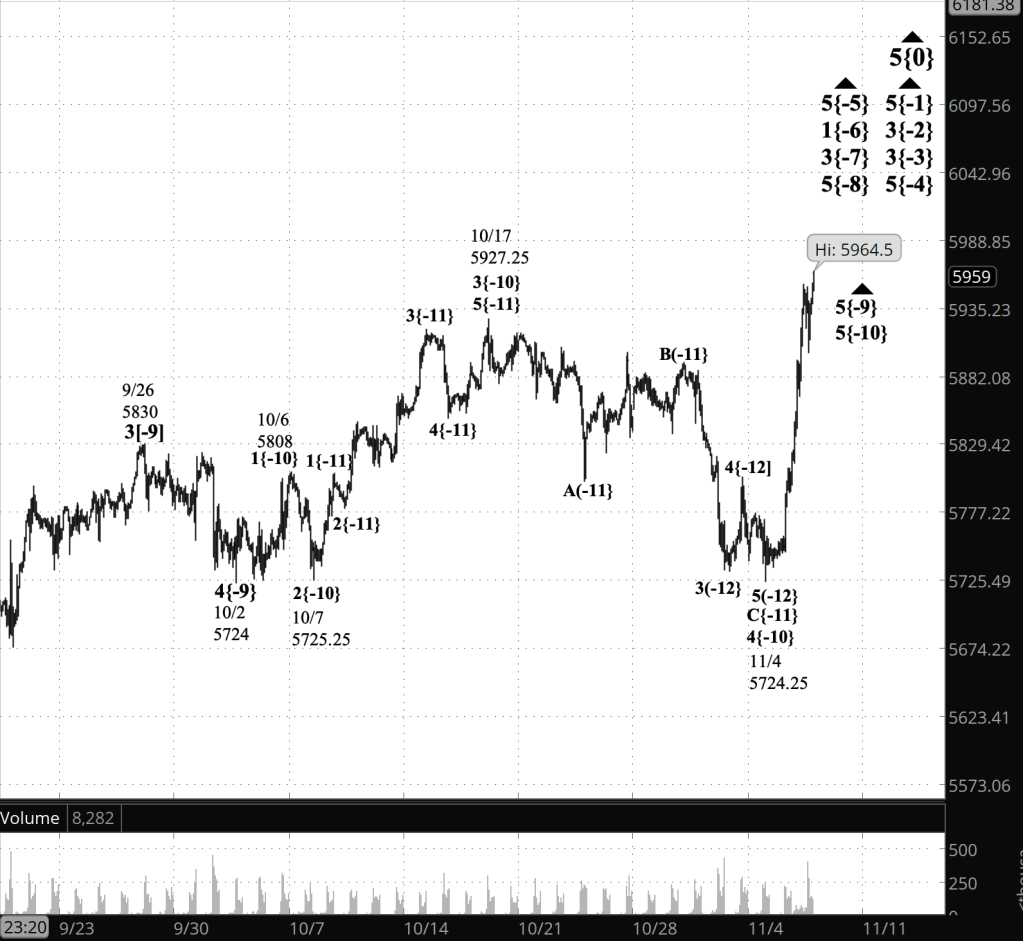
What’s happening now? The S&P 500 E-mini futures continued to rise overnight, reaching into the 5950s.

What does it mean? In yesterday’s analysis, I mentioned potential ambiguities arising from bottom fishing by the 4th-wave downward correction that began on October 17. As it turns out, the bottom fishing took the form of a mighty bounce, with the price rising sharply to a new high.

Today’s Elliott Wave Theory analysis: The 4th-wave correction that began on October 17 ended on November 4 at 5724.35. The 5th wave uptrend that followed began at that point and has so far risen more than 200 points.

This 5th wave has moved beyond the start of the preceding 3rd wave, so it isn’t a truncated wave. It hasn’t yet surged dramatically, and it isn’t extended—though it may or may not reach that status. There’s no way to tell at this point.

When complete, the 5th wave will also mark the end of two additional 5th waves, each a degree higher in the fractal structure of the chart, along with a larger 3rd wave, which began on August 7 from 5182.

A 4th-wave downtrend of significant size will follow, retracing a portion of the distance from the end of the previous 3rd wave back to its starting point at 5182. I’ll be bringing out the Fibonacci ladder to help make sense of that future 4th wave.

[S&P 500 E-mini futures at 3:30.m., 80-minute bars, with volume]

What are the alternatives? None at present.

What does Elliott wave theory say? Here are the waves that underly the analyses.

Principal Analysis:

  • Rising wave 5{0} is underway. It is a wave of Intermediate degree that began in December 2018.
  • It is in its final subwave, wave 5{-1}.
  • Within wave 5{-1}, rising waves 5{-2}, 5{-3} and 5{-4} are underway, as is wave 5{-5}.
  • Wave 5{-5} is in its initial subwave, wave 1{-6}, which in turn is in its middle subwave, wave 3{-7}.
  • Wave 3{-7} is in its final; subwave, uptrending wave 5{-8}.
  • Wave 5{-8} is in its final subwave, wave 5{-9}, which is in its final subwave, uptrending wave 5{-10}.

Long-term Waves.

These are the waves currently in progress under my principal analysis. Each line on the list shows the wave number, with the subscript in curly brackets, the traditional degree name, the starting date, the starting price of the S&P 500 E-mini futures, and the direction of the wave.

  • S&P 500 Index:
  • 5{+3} Supercycle, 7/8/1932, 4.40 (up)
  • 5{+2} Cycle, 12/9/1974, 60.96 (up)
  • 5{+1} Primary, 3/6/2009, 666.79 (up)
  • 5{0} Intermediate, 12/26/2018, 2346.58 (up)
  • S&P 500 Futures
  • 5{-1} Minor, 10/27/2023, 4127.25 (up)
  • 3{-2} Minute, 10/27/23, 4127.75 (up)
  • 3{-3} Minuette, 10/27/23, 4127.75 (up)
  • 5{-4} Subminuette, 4/18/2024, 4963.50 (up)
  • 5{-5} Micro, 8/5/2024, 5120 (up)
  • 1{-6} Submicro, 8/5/2024, 5120 (up)
  • 3{-7} Minuscule, 8/7/2024, 5182 (up)
  • 5{-8} (unnamed), 9/6/2024, 5394 (up)
  • 5{-9} (unnamed), 10/2/2024, 5724 (up)
  • 5{-10} (unnamed), 11/4/2024, 5824.25 (up)

Reading the chart. Price movements — waves – – in Elliott wave analysis are labeled with numbers within trending waves and letters with corrective waves. The subscripts — numbers in curly brackets — designate the wave’s degree, which, in Elliott wave analysis, means the relative position of a wave within the larger and smaller structures that make up the chart. R.N. Elliott, who in the 1930s developed the form of analysis that bears his name, viewed the chart as a complex structure of smaller waves nested within larger waves, which in turn are nested within still larger waves. In mathematics it’s called a fractal structure, where at every scale the pattern is similar to the others.

Learning and other resources. Elliott wave analysis provides context, not prophecy. As the 20th century semanticist Alfred Korzybski put it in his book Science and Sanity (1933), “The map is not the territory … The only usefulness of a map depends on similarity of structure between the empirical world and the map.” And I would add, in the ever-changing markets, we can judge that similarity of structure only after the fact.

See the menu page Analytical Methods for a rundown on where to go for information on Elliott wave analysis.

By Tim Bovee, Portland, Oregon, November 6, 2024

Disclaimer

Tim Bovee, Private Trader tracks the analysis and trades of a private trader for his own accounts. Nothing in this blog constitutes a recommendation to buy or sell stocks, options or any other financial instrument. The only purpose of this blog is to provide education and entertainment.

No trader is ever 100 percent successful in his or her trades. Trading in the stock and option markets is risky and uncertain. Each trader must make trading decisions for his or her own account, and take responsibility for the consequences.

License
Creative Commons License

All content on Tim Bovee, Private Trader by Timothy K. Bovee is licensed under a Creative Commons Attribution-ShareAlike 4.0 International License.

Based on a work at www.timbovee.com.
Trader’s Notebook

3:30 p.m. New York time

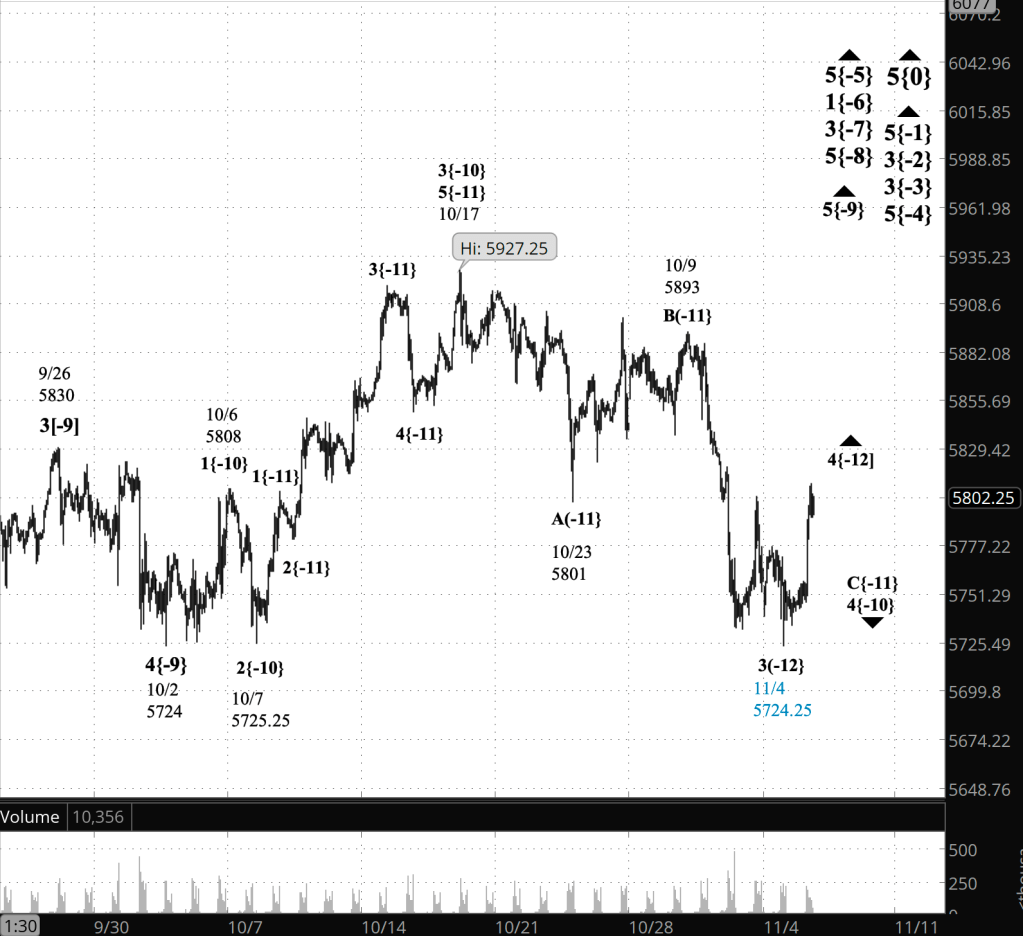
Half an hour before the closing bell. The S&P 500 futures reversed and rose sharply during the session, reaching slightly above 5800.

Elliott Wave Theory: The movement clarified the analysis of the 4th wave upward correction that began on October 31. It has not ended and is still underway.

I’ve updated the chart.

9:35 a.m. New York time

What’s happening now? The S&P 500 E-mini futures rose overnight, from the 5730s into the 5750s.

What does it mean? Elliott Wave Theory sees the rise as a small upward correction within a downtrending 5th wave, the final subwave within wave C, the final wave of the larger 4th-wave downward correction that began on October 17.

When the 5th wave is complete, it will also be the end of wave C and most likely, the end of the 4th-wave correction.

Most corrections have a single three-subwave corrective pattern. Occasionally, a subwave will take a compound form, containing two or three corrective patterns.

ln any case, when wave 4 that began in mid-October from 5927.25 will, at its end, will be followed by an uptrending 5th wave that, in many cases, will reach beyond that 4th wave’s starting point, sometimes coming up short — truncation — or moving further than expected — extension,

The end of the 5th wave will also be the end of two 5th waves, each one degree higher than the one before, and the end of the 3rd wave that encompasses them all. That wave 3 began on August 7 from 5182.

At that 3rd wave’s endpoint, a 4th-wave downward correction will begin, larger than the recent 4th waves we’ve seen.

[S&P 500 E-mini futures at 3:30 p.m., 90-minute bars, with volume]

What are the alternatives? None at present. The next ambiguity to sort through will likely being determining when the 5th wave that began on November 1 has ended, an exercise known as bottom fishing.

What does Elliott wave theory say? Here are the waves that underly the analyses.

Principal Analysis:

  • Rising wave 5{0} is underway. It is a wave of Intermediate degree that began in December 2018.
  • It is in its final subwave, wave 5{-1}.
  • Within wave 5{-1}, rising waves 5{-2}, 5{-3} and 5{-4} are underway, as is wave 5{-5}.
  • Wave 5{-5} is in its initial subwave, wave 1{-6}, which in turn is in its middle subwave, wave 3{-7}.
  • Wave 3{-7} is in its final; subwave, uptrending wave 5{-8}.
  • Wave 5{-8} is in its final subwave, wave 5{-9}, which is in its next-to-the-last subwave, corrective wave 4{-10}, which is in its final subwave, wave C{-11}.
  • Wave C{-11} is in its subwave, wave 5{-12}.

Long-term Waves.

These are the waves currently in progress under my principal analysis. Each line on the list shows the wave number, with the subscript in curly brackets, the traditional degree name, the starting date, the starting price of the S&P 500 E-mini futures, and the direction of the wave.

  • S&P 500 Index:
  • 5{+3} Supercycle, 7/8/1932, 4.40 (up)
  • 5{+2} Cycle, 12/9/1974, 60.96 (up)
  • 5{+1} Primary, 3/6/2009, 666.79 (up)
  • 5{0} Intermediate, 12/26/2018, 2346.58 (up)
  • S&P 500 Futures
  • 5{-1} Minor, 10/27/2023, 4127.25 (up)
  • 3{-2} Minute, 10/27/23, 4127.75 (up)
  • 3{-3} Minuette, 10/27/23, 4127.75 (up)
  • 5{-4} Subminuette, 4/18/2024, 4963.50 (up)
  • 5{-5} Micro, 8/5/2024, 5120 (up)
  • 1{-6} Submicro, 8/5/2024, 5120 (up)
  • 3{-7} Minuscule, 8/7/2024, 5182 (up)
  • 5{-8} (unnamed), 9/6/2024, 5394 (up)
  • 5{-9} (unnamed), 10/2/2024, 5724 (up)
  • 4{-10} (unnamed), 10/17/2024, 5927.25 (down)
  • C{-11} (unnamed), 10/9/2024, 5893 (down)
  • 5{-12} (unnamed), 11/1/2024, 5803.75 (down)

Reading the chart. Price movements — waves – – in Elliott wave analysis are labeled with numbers within trending waves and letters with corrective waves. The subscripts — numbers in curly brackets — designate the wave’s degree, which, in Elliott wave analysis, means the relative position of a wave within the larger and smaller structures that make up the chart. R.N. Elliott, who in the 1930s developed the form of analysis that bears his name, viewed the chart as a complex structure of smaller waves nested within larger waves, which in turn are nested within still larger waves. In mathematics it’s called a fractal structure, where at every scale the pattern is similar to the others.

Learning and other resources. Elliott wave analysis provides context, not prophecy. As the 20th century semanticist Alfred Korzybski put it in his book Science and Sanity (1933), “The map is not the territory … The only usefulness of a map depends on similarity of structure between the empirical world and the map.” And I would add, in the ever-changing markets, we can judge that similarity of structure only after the fact.

See the menu page Analytical Methods for a rundown on where to go for information on Elliott wave analysis.

By Tim Bovee, Portland, Oregon, November 5, 2024

Disclaimer

Tim Bovee, Private Trader tracks the analysis and trades of a private trader for his own accounts. Nothing in this blog constitutes a recommendation to buy or sell stocks, options or any other financial instrument. The only purpose of this blog is to provide education and entertainment.

No trader is ever 100 percent successful in his or her trades. Trading in the stock and option markets is risky and uncertain. Each trader must make trading decisions for his or her own account, and take responsibility for the consequences.

License
Creative Commons License

All content on Tim Bovee, Private Trader by Timothy K. Bovee is licensed under a Creative Commons Attribution-ShareAlike 4.0 International License.

Based on a work at www.timbovee.com.

Trader’s Notebook

3:30 p.m. New York time

Half an hour before the closing bell. In this morning’s analysis I discussed Elliott Wave Theory’s insights into the near-term possible market responses to the November 5 elections outcomes.

This afternoon, I’m going to broaden it out to a long-term analysis, continuing to use the S&P 500 E-mini futures.

At the smallest level this morning, the market has clarified that at rising 4th wave within the falling C wave ended on November 1, and the final subwave within wave C in now underway, a falling 5th wave. When the small 5th wave ends, so will the parent C wave and the 4th-wave downward correction that began on October 17 and contains them all.

So on election day, the S&P 500 and its derivatives will have a downward tendency, but it won’t last long.

At this point, I’m will be using the wave labels as they appear on the chart: A wave number followed by a subscript in curly bracks given the wave’s degree in the fractal , relative to the Intermediate degree 5th wave — wave 5{0} — that began in December 2018. See the ‘Reading the Chart” section below for more detail.

The small 5th wave discussed at the start of this post is wave 5{-12}, a subwave of wave C{-11}, the final subwave of wave 4{-10}. Wave 5{-10} will begin its rise at that point, and Elliott Wave conditions will change..

Afterward, the Elliott Wave conditions change. Wave 4{-10) now approaching its end is two degrees higher than the small wave 5{-12} close to bringing wave 4{-10} to a close. Uptrending wave 5{-10} will follow. The preceding wave 3{-10} ran from October 7 to October 17, covering around 200 points.

The end of wave 5{-10} will trigger a cascade that will cascade through two degrees, ending waves 5{-9} and 5{-8}, and also wave 3{-7}, which began on August 7 from 5182.

A 4th-wave downward correction taking back a portion of gains that covered 1,000 points or so. That’s a significant downtrending movement.

Elliott Wave Theory is filled with ambiguities. While realizing that weakness, I’ve also found that those waves provide some insight into what lies ahead.

I see short-term rising tendency immediately after the election, but it will be short-lived, followed by a significant downtrend.

9:35 a.m. New York time

What’s happening now? The S&P 500 E-mini futures resumed trading by stepping gently into a week that by it’s end had the potential to reveal the nature of the new American future. And also, as a sideshows, the Federal Reserve’s latest on interest rates.

What does it mean? The presidential election, on Tuesday, and the Federal Open Markets Committee’s new rates, on Thursday, both have the potential to be followed by large impact on the markets.

None of us can no for certain how that impact will play out. But with the help of Elliott Wave Theory, we can gain an understanding of the future course of the S&P 500 and its derivatives.

The S&P 500 E-mini futures continue to work through the 4th-wave downward correction that began on October 17. The present subwave is wave C, the final subwave, which in turn is in its next-to-the-subwave, rising wave 4, which is in its descending B wave.

So there’s leeway for a number of immediately directional responses, although the falling 4th-wave correction from mid-October is dominant. That 4th-wave is nearing its end, and a rising 5th-wave will follow, which will carry the price up by a significant amount, by at least around 200 points and most likely higher in the near-term aftermath of the election and Fed events.

But as always, each bullish Elliott Wave is followed by a bear wave, which in turn leads to another bull wave. And each wave has subwaves built by its own bull and bear subwaves.

So what’s future? For the near term it appears to me that an upward response is most likely, but it won’t a simple structure, and we really can’t tell from the chart whether a rise or any movement will be fast or slow, large or small.

[S&P 500 E-mini futures at 3:30 p.m., 70-minute bars, with volume]

What are the alternatives? None at present.

What does Elliott wave theory say? Here are the waves that underly the analyses.

Principal Analysis:

  • Rising wave 5{0} is underway. It is a wave of Intermediate degree that began in December 2018.
  • It is in its final subwave, wave 5{-1}.
  • Within wave 5{-1}, rising waves 5{-2}, 5{-3} and 5{-4} are underway, as is wave 5{-5}.
  • Wave 5{-5} is in its initial subwave, wave 1{-6}, which in turn is in its middle subwave, wave 3{-7}.
  • Wave 3{-7} is in its final; subwave, uptrending wave 5{-8}.
  • Wave 5{-8} is in its final subwave, wave 5{-9}, which is in its next-to-the-last subwave, corrective wave 4{-10}, which is in its final subwave, wave C{-11}.
  • Wave C{-11} is in its next-to-the-last subwave, wave 4{-12}.

Long-term Waves.

These are the waves currently in progress under my principal analysis. Each line on the list shows the wave number, with the subscript in curly brackets, the traditional degree name, the starting date, the starting price of the S&P 500 E-mini futures, and the direction of the wave.

  • S&P 500 Index:
  • 5{+3} Supercycle, 7/8/1932, 4.40 (up)
  • 5{+2} Cycle, 12/9/1974, 60.96 (up)
  • 5{+1} Primary, 3/6/2009, 666.79 (up)
  • 5{0} Intermediate, 12/26/2018, 2346.58 (up)
  • S&P 500 Futures
  • 5{-1} Minor, 10/27/2023, 4127.25 (up)
  • 3{-2} Minute, 10/27/23, 4127.75 (up)
  • 3{-3} Minuette, 10/27/23, 4127.75 (up)
  • 5{-4} Subminuette, 4/18/2024, 4963.50 (up)
  • 5{-5} Micro, 8/5/2024, 5120 (up)
  • 1{-6} Submicro, 8/5/2024, 5120 (up)
  • 3{-7} Minuscule, 8/7/2024, 5182 (up)
  • 5{-8} (unnamed), 9/6/2024, 5394 (up)
  • 5{-9} (unnamed), 10/2/2024, 5724 (up)
  • 4{-10} (unnamed), 10/17/2024, 5927.25 (down)

Reading the chart. Price movements — waves – – in Elliott wave analysis are labeled with numbers within trending waves and letters with corrective waves. The subscripts — numbers in curly brackets — designate the wave’s degree, which, in Elliott wave analysis, means the relative position of a wave within the larger and smaller structures that make up the chart. R.N. Elliott, who in the 1930s developed the form of analysis that bears his name, viewed the chart as a complex structure of smaller waves nested within larger waves, which in turn are nested within still larger waves. In mathematics it’s called a fractal structure, where at every scale the pattern is similar to the others.

Learning and other resources. Elliott wave analysis provides context, not prophecy. As the 20th century semanticist Alfred Korzybski put it in his book Science and Sanity (1933), “The map is not the territory … The only usefulness of a map depends on similarity of structure between the empirical world and the map.” And I would add, in the ever-changing markets, we can judge that similarity of structure only after the fact.

See the menu page Analytical Methods for a rundown on where to go for information on Elliott wave analysis.

By Tim Bovee, Portland, Oregon, November 4, 2024

Disclaimer

Tim Bovee, Private Trader tracks the analysis and trades of a private trader for his own accounts. Nothing in this blog constitutes a recommendation to buy or sell stocks, options or any other financial instrument. The only purpose of this blog is to provide education and entertainment.

No trader is ever 100 percent successful in his or her trades. Trading in the stock and option markets is risky and uncertain. Each trader must make trading decisions for his or her own account, and take responsibility for the consequences.

License
Creative Commons License

All content on Tim Bovee, Private Trader by Timothy K. Bovee is licensed under a Creative Commons Attribution-ShareAlike 4.0 International License.

Based on a work at www.timbovee.com.

Trader’s Notebook

3:30 p.m. New York time

Half an hour before the closing bell. The S&P 500 futures continued to rise during the session, reaching above 5800.

Elliott Wave Theory: Wave C within the 4th-wave downward correction that began on October 17 continues to work through its next-to-the-last subwave, rising wave 4, which will be followed by declining wave 5 and the end of wave C.

Wave 4 will have three subwaves. The first, a smaller degree rising wave A, appears to have ended during the session. If that proves the case, then a smaller degree falling wave B is underway.

9:35 a.m. New York time

What’s happening now? The S&P 500 E-mini futures rose overnight from the 5330s, peaking so far in the 5390s with the release of the unemployment figures for October, 4.1%, unchanged from the month before.

What does it mean? Applying Elliott Wave Theory: The 4th-wave downward correction that began on October 17 continues. If typical, it is in its final subwave, wave C, which in turn appears to be in its next-to-the-last subwave, rising wave 4.

[S&P 500 E-mini futures at 3:30 p.m., 70-minute bars, with volume]

What are the alternatives? None at present. As always, they will develop.

What does Elliott wave theory say? Here are the waves that underly the analyses.

Principal Analysis:

  • Rising wave 5{0} is underway. It is a wave of Intermediate degree that began in December 2018.
  • It is in its final subwave, wave 5{-1}.
  • Within wave 5{-1}, rising waves 5{-2}, 5{-3} and 5{-4} are underway, as is wave 5{-5}.
  • Wave 5{-5} is in its initial subwave, wave 1{-6}, which in turn is in its middle subwave, wave 3{-7}.
  • Wave 3{-7} is in its final; subwave, uptrending wave 5{-8}.
  • Wave 5{-8} is in its final subwave, wave 5{-9}, which is in its next-to-the-last subwave, corrective wave 4{-10}, which is in its final subwave, wave C{-11}.
  • Wave C{-11} is in its next-to-the-last subwave, wave 4{-12}.

Long-term Waves.

These are the waves currently in progress under my principal analysis. Each line on the list shows the wave number, with the subscript in curly brackets, the traditional degree name, the starting date, the starting price of the S&P 500 E-mini futures, and the direction of the wave.

  • S&P 500 Index:
  • 5{+3} Supercycle, 7/8/1932, 4.40 (up)
  • 5{+2} Cycle, 12/9/1974, 60.96 (up)
  • 5{+1} Primary, 3/6/2009, 666.79 (up)
  • 5{0} Intermediate, 12/26/2018, 2346.58 (up)
  • S&P 500 Futures
  • 5{-1} Minor, 10/27/2023, 4127.25 (up)
  • 3{-2} Minute, 10/27/23, 4127.75 (up)
  • 3{-3} Minuette, 10/27/23, 4127.75 (up)
  • 5{-4} Subminuette, 4/18/2024, 4963.50 (up)
  • 5{-5} Micro, 8/5/2024, 5120 (up)
  • 1{-6} Submicro, 8/5/2024, 5120 (up)
  • 3{-7} Minuscule, 8/7/2024, 5182 (up)
  • 5{-8} (unnamed), 9/6/2024, 5394 (up)
  • 5{-9} (unnamed), 10/2/2024, 5724 (up)
  • 4{-10} (unnamed), 10/17/2024, 5927.25 (down)

Reading the chart. Price movements — waves – – in Elliott wave analysis are labeled with numbers within trending waves and letters with corrective waves. The subscripts — numbers in curly brackets — designate the wave’s degree, which, in Elliott wave analysis, means the relative position of a wave within the larger and smaller structures that make up the chart. R.N. Elliott, who in the 1930s developed the form of analysis that bears his name, viewed the chart as a complex structure of smaller waves nested within larger waves, which in turn are nested within still larger waves. In mathematics it’s called a fractal structure, where at every scale the pattern is similar to the others.

Learning and other resources. Elliott wave analysis provides context, not prophecy. As the 20th century semanticist Alfred Korzybski put it in his book Science and Sanity (1933), “The map is not the territory … The only usefulness of a map depends on similarity of structure between the empirical world and the map.” And I would add, in the ever-changing markets, we can judge that similarity of structure only after the fact.

See the menu page Analytical Methods for a rundown on where to go for information on Elliott wave analysis.

By Tim Bovee, Portland, Oregon, November 1, 2024

Disclaimer

Tim Bovee, Private Trader tracks the analysis and trades of a private trader for his own accounts. Nothing in this blog constitutes a recommendation to buy or sell stocks, options or any other financial instrument. The only purpose of this blog is to provide education and entertainment.

No trader is ever 100 percent successful in his or her trades. Trading in the stock and option markets is risky and uncertain. Each trader must make trading decisions for his or her own account, and take responsibility for the consequences.

License
Creative Commons License

All content on Tim Bovee, Private Trader by Timothy K. Bovee is licensed under a Creative Commons Attribution-ShareAlike 4.0 International License.

Based on a work at www.timbovee.com.