Trader’s Notebook

3:30 p.m. New York time

Half an hour before the closing bell. The S&P 500 futures continued their rapid fall, from the overnight peak of 5157.75 into the 5060s.

The falling middle subwave, wave B, within the rising middle subwave, also wave B, within the 4th-wave downward correction that began February 12 continues.

At the present moment the chart is a collection of smaller corrective waves within larger corrective waves. From the biggest to the smallest, with wave numbers and degrees as they appear on the chart: Wave 4{-2} is a declining correction. It’s middle subwave, rising wave B{-3}, like all B waves is counter the direction of its parent wave. Wave B{-4}, being a B wave, is also running contrary to the direction of its parent wave structure. And the smallest wave in the batch, declining wave A{-5}, is like all A waves running in the direction of the parent wave structure.

I’ve updated the chart.

2:45 p.m. New York time

A Trade. I exited my short Iron Fly on SPY for a 30.2% loss, on expiration day, one day after entry. I’ve updated the trade analysis with full results and also a discussion of how the trade went.

9:35 a.m. New York time

What’s happening now? The S&P 500 E-mini futures declined overnight from yesterday’s session peak — 5157.75 reached on March 4, returning to the 5110s.

What does it mean? The peak and reversal ended the first leg of the first subwave within the downward correction that began on February 12.

In the Elliott Wave Theory discussion that follows I’ll use the wave labels that appear on the chart below: The wave number, followed by a subscript, in curly brackets, describing where the wave stands in the fractal structure of the chart. I’ve chosen designations that place the wave in relation to the Intermediate degree, the name R.N. Elliott, the developer of the theory that bears his name, gave to one of the larger degrees.

Since December 2018, a 5th wave of Intermediate degree has been underway, taking the form of an expanding Diagonal Triangle. Its chart label is wave 5{0}. Waves with negative subscripts are of small degrees, at this point all are subwaves of wave 5{0}. See the “Reading the chart” section below for more on Elliott Waves.

The wave that just ended is wave C{-5}. Its parent, wave A{-4}, also ended. Both waves lie within wave A{-3}, the first subwave of wave 4{-2}, the downward correction that began on February 12.

With the end of rising wave A{-4}, declining wave B{-4} has begun, the middle subwave within the wave B{-3}, the middle subwave of wave 4{-2}. All of that is happening within wave 5{-1}, an uptrending wave that began on October 13, 2022.

When falling wave B{-4} is complete, perhaps in a week or so, rising wave C{-4} will follow, completing the parent, rising wave B{-3} and beginning declinging wave C{-3}, the final subwave of the wave 4{-2} downward correction.s

For the present, the 4th-wave correction defines the main downward trend of the, although at that level, counter-trend corrections lasting weeks can give the impression that the trend has reversed.

The red line on the chart shows what may be the upper boundary of the wave 4{-2} price target range, although there are often exceptions that either fail to reach the target range or overshoot it.

What are the alternatives? As is often the case in Elliott Wave Analysis, there is some ambiguity about the degree designations. For example, is wave B{-3} really a {-3} degree, or should it be labeled {-4}? Only the passage of time can provide a definite answer, often in retrospect. Meanwhile, i’ll continue to use to degree labelling that seems consistent with the progress of the chart, and will change it when it is proven wrong by developments on the chart.
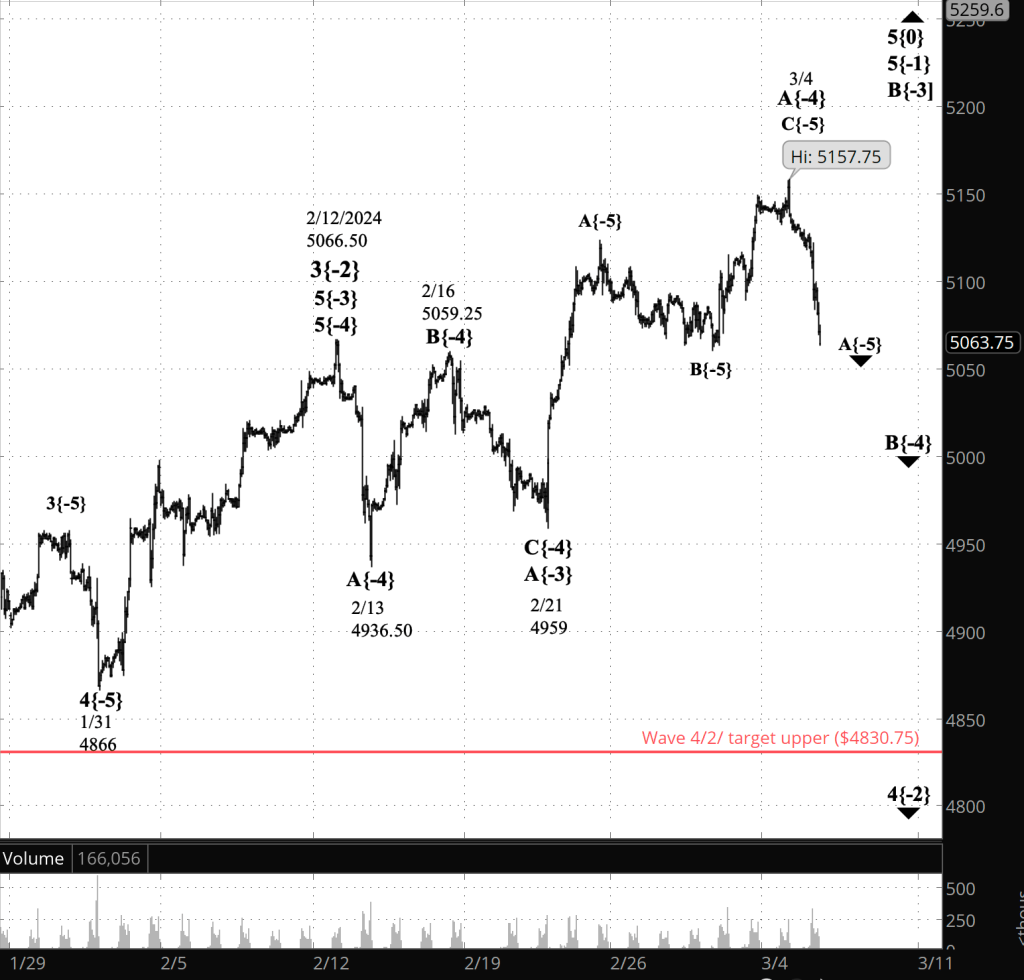
[S&P 500 E-mini futures at 3:30 p.m., 1-hour bars, with volume]

What does Elliott wave theory say? Here are the waves that underly the analyses.

Principal Analysis:

  • Wave 5{0}, an expanding Diagonal Triangle, began on December 26, 2018.
  • Within it, an uptrend, wave 5{-1}, began on October 13, 2022 and is underway.
  • Wave 5{-1} is the parent wave of a downward correction, wave 4{-2}, that began on February 12, 2024.
  • Wave 4{-2} is in its second subwave, wave B{-3}, which in turn is in wave B{-4}, its middle subwave.
  • Wave B{-4} is in its initial subwave, wave A{-5}.

We Are Here.

These are the waves currently in progress under my principal analysis. Each line on the list shows the wave number, with the subscript in curly brackets, the traditional degree name, the starting date, the starting price of the S&P 500 E-mini futures, and the direction of the wave.

  • S&P 500 Index:
  • 5{+3} Supercycle, 7/8/1932, 4.40 (up)
  • 5{+2} Cycle, 12/9/1974, 60.96 (up)
  • 5{+1} Primary, 3/6/2009, 666.79 (up)
  • 5{0} Intermediate, 12/26/2018, 2346.58 (up)
  • S&P 500 Futures and index:
  • 5{-1} Minor, 10/13/2022, 3502 (up) (futures), 3491.58 (up) (index)
  • S&P 500 Futures:
  • 4{-2} Minute, 2/12/2024, 5066.50 (down)
  • B{-3} Minuette, 2/21/2024, 4959 (up)

Reading the chart. Price movements — waves – – in Elliott wave analysis are labeled with numbers within trending waves and letters with corrective waves. The subscripts — numbers in curly brackets — designate the wave’s degree, which, in Elliott wave analysis, means the relative position of a wave within the larger and smaller structures that make up the chart. R.N. Elliott, who in the 1930s developed the form of analysis that bears his name, viewed the chart as a complex structure of smaller waves nested within larger waves, which in turn are nested within still larger waves. In mathematics it’s called a fractal structure, where at every scale the pattern is similar to the others.

Learning and other resources. Elliott wave analysis provides context, not prophecy. As the 20th century semanticist Alfred Korzybski put it in his book Science and Sanity (1933), “The map is not the territory … The only usefulness of a map depends on similarity of structure between the empirical world and the map.” And I would add, in the ever-changing markets, we can judge that similarity of structure only after the fact.

See the menu page Analytical Methods for a rundown on where to go for information on Elliott wave analysis.

By Tim Bovee, Portland, Oregon, March 5, 2024

Disclaimer

Tim Bovee, Private Trader tracks the analysis and trades of a private trader for his own accounts. Nothing in this blog constitutes a recommendation to buy or sell stocks, options or any other financial instrument. The only purpose of this blog is to provide education and entertainment.

No trader is ever 100 percent successful in his or her trades. Trading in the stock and option markets is risky and uncertain. Each trader must make trading decisions for his or her own account, and take responsibility for the consequences.

License
Creative Commons License

All content on Tim Bovee, Private Trader by Timothy K. Bovee is licensed under a Creative Commons Attribution-ShareAlike 4.0 International License.

Based on a work at www.timbovee.com.

Options Trades 3/4/2024: SPY

Symbols traded: SPY, short Iron Fly (1DTE)

I entered a short Iron Fly position on SPY with the intention of exiting the next day, which is expiration day. Overnight the S&P 500 fell sharply, moving the trade into losing territory.

Just after the opening bell I sold the short bull put spread that was the in-the-money half of the Iron Fly, a move that mitigated the loss, since the price kept falling during the session. I allowed the out-of-the-money bear call spread, the remaining half of the Iron Fly, to expire with no value.

This update assumes the calls will remain out of the money to during the final hour of the session, which has not yet ended. If that proves not to be the case, I’ll post a revision.

SPY short Iron Fly

LOT:10ENTRY DATE:3/4/2024
MANAGEMENT:3/5/2024EXPIRATION:3/5/2024
DAYS HELD:1

Entry and Exit

METRICENTRYEXITCHANGECHANGE %ANNUALIZED CHANGE %
Options premium$ 1.62$ (2.11)$ (0.49)-30.2%-10980%
Stock price$ 512.73$ 510.19$ (2.54)-0.5%-181%
Impllied Volatility Rate11.514.93.4
Days to expiration1

The structure of the position

STRUCTURESTRIKEODDS EXPIRE OTMDELTAIN PRICEOUT PRICENET PRICE
Calls
Long515.0079.0%21$ (0.33)$ –$ (0.33)
Break-even514.6265.5%33.5
Short513.0052.0%46$ 1.01$ –$ 1.01
Puts
Short513.0047.0%54$ 1.21$ (2.91)$ (1.70)
Break-even511.6265.0%35.5
Long510.0083.0%17$ (0.27)$ 0.80$ 0.53
======
`NET TOTAL:$ (0.49)

Risk and Reward

Per contract:
Reward162.00
Risk88.00
R/R Ratio (n:1)0.5

By Tim Bovee, Portland, Oregon, March 4-5, 2024

Disclaimer

Tim Bovee, Private Trader tracks the analysis and trades of a private trader for his own accounts. Nothing in this blog constitutes a recommendation to buy or sell stocks, options or any other financial instrument. The only purpose of this blog is to provide education and entertainment.

No trader is ever 100 percent successful in his or her trades. Trading in the stock and option markets is risky and uncertain. Each trader must make trading decisions for his or her own account, and take responsibility for the consequences.

License
Creative Commons License

All content on Tim Bovee, Private Trader by Timothy K. Bovee is licensed under a Creative Commons Attribution-ShareAlike 4.0 International License.

Based on a work at www.timbovee.com.

Trader’s Notebook

3:30 p.m. New York time

Half an hour before the closing bell. The S&P 500 futures resumed their rise during the session, reaching into the 5150s. The low-degree C wave discussed in this morning’s analysis is underway. The alternative analysis, that wave C ended at the March 1 high, is off the table.

I’ve updated the chart.

2:05 p.m. New York time

Trades. I exited a short Iron Fly position on XSP, which I entered on a Friday and held over the weekend, exiting on Monday — expiration day — shortly after the opening bell for a 36.4% profit. My goal was a 25% return or better. I’ve updated the trade analysis with full results.

I entered a short Iron Fly position on SPY, one day before expiration, with the intent of exiting the next day with a return of 25% or better. I’ve posted a trade analysis.

9:35 a.m. New York time

What’s happening now? The S&P 500 E-mini futures resumed trading in the 5140s overnight and worked lower into the 5130s.

What does it mean? Elliott Wave Theory sees the rising middle subwave, wave B, of a 4th-wave downward correction that began on February 12 continues and is nearing the end of its first subwave, a rising A wave.

Within that smaller A wave is a still smaller rising C wave, now underway.

What are the alternatives? That smaller rising C wave may have ended at the March 1 peak, 5149.25. Time will tell. [Note: Invalidated by price movements during the session.]

That red line on the chart. A 4th wave tends to end within the range of the 4th subwave within the preceding 3rd wave of the same degree. The red line marks the upper boundary of that targrt range.

[S&P 500 E-mini futures at 3:30 p.m., 1-hour bars, with volume]

What does Elliott wave theory say? Here are the waves that underly the analyses.

Principal Analysis:

  • Wave 5{0}, an expanding Diagonal Triangle, began on December 26, 2018.
  • Within it, an uptrend, wave 5{-1}, began on October 13, 2022 and is underway.
  • Wave 5{-1} is the parent wave of a downward correction, wave 4{-2}, that began on February 12, 2024.
  • Wave 4{-2} is in its second subwave, wave B{-3}, which in turn is in wave A{-4}, its initial subwave.
  • Wave A{-4} is in its final subwave, wave C{-5}.

We Are Here.

These are the waves currently in progress under my principal analysis. Each line on the list shows the wave number, with the subscript in curly brackets, the traditional degree name, the starting date, the starting price of the S&P 500 E-mini futures, and the direction of the wave.

  • S&P 500 Index:
  • 5{+3} Supercycle, 7/8/1932, 4.40 (up)
  • 5{+2} Cycle, 12/9/1974, 60.96 (up)
  • 5{+1} Primary, 3/6/2009, 666.79 (up)
  • 5{0} Intermediate, 12/26/2018, 2346.58 (up)
  • S&P 500 Futures and index:
  • 5{-1} Minor, 10/13/2022, 3502 (up) (futures), 3491.58 (up) (index)
  • S&P 500 Futures:
  • 4{-2} Minute, 2/12/2024, 5066.50 (down)
  • B{-3} Minuette, 2/21/2024, 4959 (up)

Reading the chart. Price movements — waves – – in Elliott wave analysis are labeled with numbers within trending waves and letters with corrective waves. The subscripts — numbers in curly brackets — designate the wave’s degree, which, in Elliott wave analysis, means the relative position of a wave within the larger and smaller structures that make up the chart. R.N. Elliott, who in the 1930s developed the form of analysis that bears his name, viewed the chart as a complex structure of smaller waves nested within larger waves, which in turn are nested within still larger waves. In mathematics it’s called a fractal structure, where at every scale the pattern is similar to the others.

Learning and other resources. Elliott wave analysis provides context, not prophecy. As the 20th century semanticist Alfred Korzybski put it in his book Science and Sanity (1933), “The map is not the territory … The only usefulness of a map depends on similarity of structure between the empirical world and the map.” And I would add, in the ever-changing markets, we can judge that similarity of structure only after the fact.

See the menu page Analytical Methods for a rundown on where to go for information on Elliott wave analysis.

By Tim Bovee, Portland, Oregon, March 4, 2024

Disclaimer

Tim Bovee, Private Trader tracks the analysis and trades of a private trader for his own accounts. Nothing in this blog constitutes a recommendation to buy or sell stocks, options or any other financial instrument. The only purpose of this blog is to provide education and entertainment.

No trader is ever 100 percent successful in his or her trades. Trading in the stock and option markets is risky and uncertain. Each trader must make trading decisions for his or her own account, and take responsibility for the consequences.

License
Creative Commons License

All content on Tim Bovee, Private Trader by Timothy K. Bovee is licensed under a Creative Commons Attribution-ShareAlike 4.0 International License.

Based on a work at www.timbovee.com.

Options Trades 3/1/2024: XSP

Symbols traded: XSP, short Iron Fly (3DTE)

I entered a short Iron Fly position on XSP, which tracks the S&P 500, on a Friday and exited the next Monday, shortly after the opening bell, for a 36.4% profit. My profit goal was 25%.

XSP short Iron Fly

LOT:7ENTRY DATE:3/1/2024
MANAGEMENT:3/4/2024EXPIRATION:3/4/2024
DAYS HELD:3

Entry and Exit

METRICENTRYEXITCHANGECHANGE %ANNUALIZED CHANGE %
Options premium$ 1.91$ (1.40)$ 0.5136.4%4408%
Stock price$ 513.26$ 512.95$ (0.31)-0.1%-7%
Impllied Volatility Rate10.412.11.7
Days to expiration30

The structure of the position

STRUCTURESTRIKEODDS EXPIRE OTMDELTAIN PRICEOUT PRICENET PRICE
Calls
Long516.0078.0%20$ (0.35)$ 0.05$ (0.30)
Break-even514.9161.0%36.5
Short513.0044.0%53$ 1.45$ (0.71)$ 0.74
Puts
Short513.0054.0%47$ 1.16$ (0.83)$ 0.33
Break-even511.9168.5%32.5
Long510.0083.0%18$ (0.35)$ 0.09$ (0.26)
======
`NET TOTAL:$ 0.51

Risk and Reward

Per contract:
Reward191.00
Risk109.00
R/R Ratio (n:1)0.6

By Tim Bovee, Portland, Oregon, March 1, 4, 2024

Disclaimer

Tim Bovee, Private Trader tracks the analysis and trades of a private trader for his own accounts. Nothing in this blog constitutes a recommendation to buy or sell stocks, options or any other financial instrument. The only purpose of this blog is to provide education and entertainment.

No trader is ever 100 percent successful in his or her trades. Trading in the stock and option markets is risky and uncertain. Each trader must make trading decisions for his or her own account, and take responsibility for the consequences.

License
Creative Commons License

All content on Tim Bovee, Private Trader by Timothy K. Bovee is licensed under a Creative Commons Attribution-ShareAlike 4.0 International License.

Based on a work at www.timbovee.com.
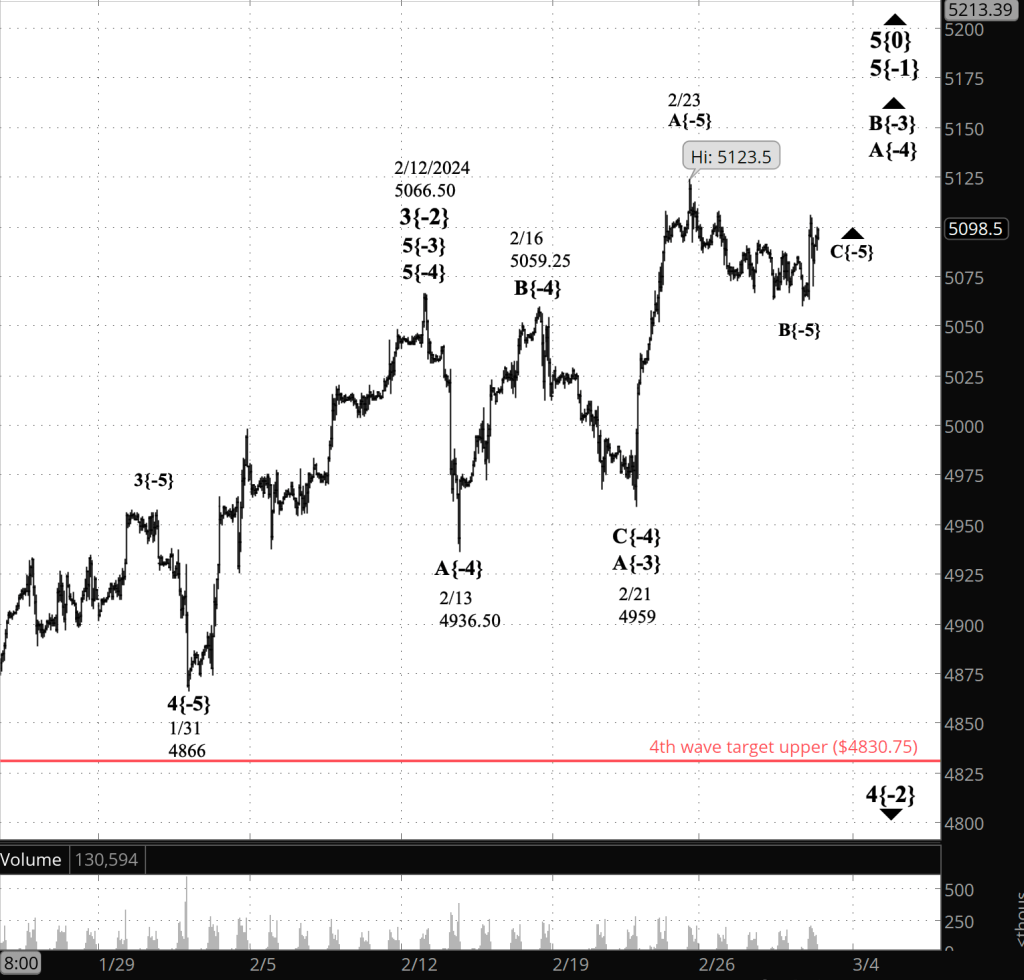
Trader’s Notebook

3:30 p.m. New York time

Half an hour before the closing bell. The S&P 500 futures has so far risen into the 5140s during the session, as a series of rising corrective subwaves continued within a 4th-wave downward correction. Elliott Wave Theory: Wave C{-5} within wave A{-4} within wave B{-3} continue, all subwaves of increasing size within wave 4{-2}, the downward correction that began on February 12.

I’ve updated the upper chart, which shows a close-up view of the 4th wave and its subwaves.

2:30 p.m. New York time

Trades. I’ve exited the two 1DTE short Iron Fly positions I entered on Thursday, on SPY and XLE. SPY returned a 9% profit, and XLE, a 6.7% profit. I’ve updated the trade analyses with full results. XLE still has two out-of-the-money options on the table. If they were to move in the money prior to expiration, they would be exercised and the results would change.

I exited previous 1DTE trades shortly after the opening bell on expiration day. With these trades, I tried jumping in later, about halfway into the session. The result was a series of individual option exits that ended up producing a profit overall. Had I exited at the opening bell, each would have shown a loss.

I entered a short Iron Fly position on XSP today. It expires on Monday and at entry is 3DTE. I’ve posted an analysis of the trade and plan to follow the same exit procedures as I did with SPY and XLE.

9:35 a.m. New York time

What’s happening now? The S&P 500 E-mini futures fell from the 5110s to the 5080s overnight and then retraced a portion of the decline as the opening bell approached.

What does it mean? The downward correction that began on February 12 continues, working through its middle subwave, and one wave lower, the middle subwave’s initial subwave. At the lowest level I’m tracking, that initial subwave is in its final subwave.

The collection of Elliott waves is shown on the chart with a wave number and a subscript, in curly brackets, designating the wave’s position within the fractal structure of the chart, showing the distance from wave 5{0}, the expanding Diagonal Triangle that began on December 26, 2018 that encompasses all that has happened since.

See the “Reading the chart” section below for more on the fractal structure.

Turning now to the nomenclature of Elliott Wave Theory.

The upper chart shows the downward correction, wave 4{-2}, in its entirety. That correction is in its middle subwave, wave B{-3}, which in turn is in its initial subwave, wave A{-4}. At the lowest level that I’m tracking is rising wave C{-5}, the final subwave within wave A{-4}.

The horizontal red line on this chart shows the upper boundary of wave 4{-2}’s target range.

The lower chart shows the expanding Diagonal Triangle, wave 5{0}, in its entirety. At this level everything happening in the upprt chart is a very small, barely visible line. And yet, in keeping with Elliott Wave Theory, both charts together show a single structure, carrying us seamlessly from years down to days.

Wave 5{0} on the upper chart is the final wave of an uptrend. The Diagonal Triangle part means that each wave swings wider than the one that came before it. Wave 5{0} is in its final subwave, rising wave 5{-1}, which in turn in is a downward correction, wave 4{-2}.

What’s next?

On the upper chart, wave 4{-2} will be followed by rising wave 5{-2}, which will complete wave 5{-1} and its parent, wave 5{0}. Wave 4{-2} still has some distance to go before reaching its end, being in its middle subwave, wave B{-3}. The end of the present wave C{-5} will also be the end of wave A{-4}, which will be followed by a declining wave B{-4}.

On the lower chart, Wave 5{0}. when complete, will also be the end of a series of larger 5th waves, up to wave 5{+3}, which began on July 8, 1932. A long-running downtrend will follow, one that will take decades to complete and that, internally, will have the usual downtrends and uptrends within it, along with corrections in either direction.

What are the alternatives? On both charts there is ambiguity about the degree designations.

[S&P 500 E-mini futures at 3:30 p.m., 1-hour bars, with volume]

[S&P 500 index at 9:35 a.m., 3-day bars

What does Elliott wave theory say? Here are the waves that underly the analyses.

Principal Analysis:

  • Wave 5{0}, an expanding Diagonal Triangle, began on December 26, 2018.
  • Within it, an uptrend, wave 5{-1}, began on October 13, 2022 and is underway.
  • Wave 5{-1} is the parent wave of a downward correction, wave 4{-2}, that began on February 12, 2024.
  • Wave 4{-2} is in its second subwave, wave B{-3}, which in turn is in wave A{-4}, its initial subwave.
  • Wave A{-4} is in its final subwave, wave C{-5}.

We Are Here.

These are the waves currently in progress under my principal analysis. Each line on the list shows the wave number, with the subscript in curly brackets, the traditional degree name, the starting date, the starting price of the S&P 500 E-mini futures, and the direction of the wave.

  • S&P 500 Index:
  • 5{+3} Supercycle, 7/8/1932, 4.40 (up)
  • 5{+2} Cycle, 12/9/1974, 60.96 (up)
  • 5{+1} Primary, 3/6/2009, 666.79 (up)
  • 5{0} Intermediate, 12/26/2018, 2346.58 (up)
  • S&P 500 Futures and index:
  • 5{-1} Minor, 10/13/2022, 3502 (up) (futures), 3491.58 (up) (index)
  • S&P 500 Futures:
  • 4{-2} Minute, 2/12/2024, 5066.50 (down)
  • B{-3} Minuette, 2/21/2024, 4959 (up)

Reading the chart. Price movements — waves – – in Elliott wave analysis are labeled with numbers within trending waves and letters with corrective waves. The subscripts — numbers in curly brackets — designate the wave’s degree, which, in Elliott wave analysis, means the relative position of a wave within the larger and smaller structures that make up the chart. R.N. Elliott, who in the 1930s developed the form of analysis that bears his name, viewed the chart as a complex structure of smaller waves nested within larger waves, which in turn are nested within still larger waves. In mathematics it’s called a fractal structure, where at every scale the pattern is similar to the others.

Learning and other resources. Elliott wave analysis provides context, not prophecy. As the 20th century semanticist Alfred Korzybski put it in his book Science and Sanity (1933), “The map is not the territory … The only usefulness of a map depends on similarity of structure between the empirical world and the map.” And I would add, in the ever-changing markets, we can judge that similarity of structure only after the fact.

See the menu page Analytical Methods for a rundown on where to go for information on Elliott wave analysis.

By Tim Bovee, Portland, Oregon, March 1, 2024

Disclaimer

Tim Bovee, Private Trader tracks the analysis and trades of a private trader for his own accounts. Nothing in this blog constitutes a recommendation to buy or sell stocks, options or any other financial instrument. The only purpose of this blog is to provide education and entertainment.

No trader is ever 100 percent successful in his or her trades. Trading in the stock and option markets is risky and uncertain. Each trader must make trading decisions for his or her own account, and take responsibility for the consequences.

License
Creative Commons License

All content on Tim Bovee, Private Trader by Timothy K. Bovee is licensed under a Creative Commons Attribution-ShareAlike 4.0 International License.

Based on a work at www.timbovee.com.
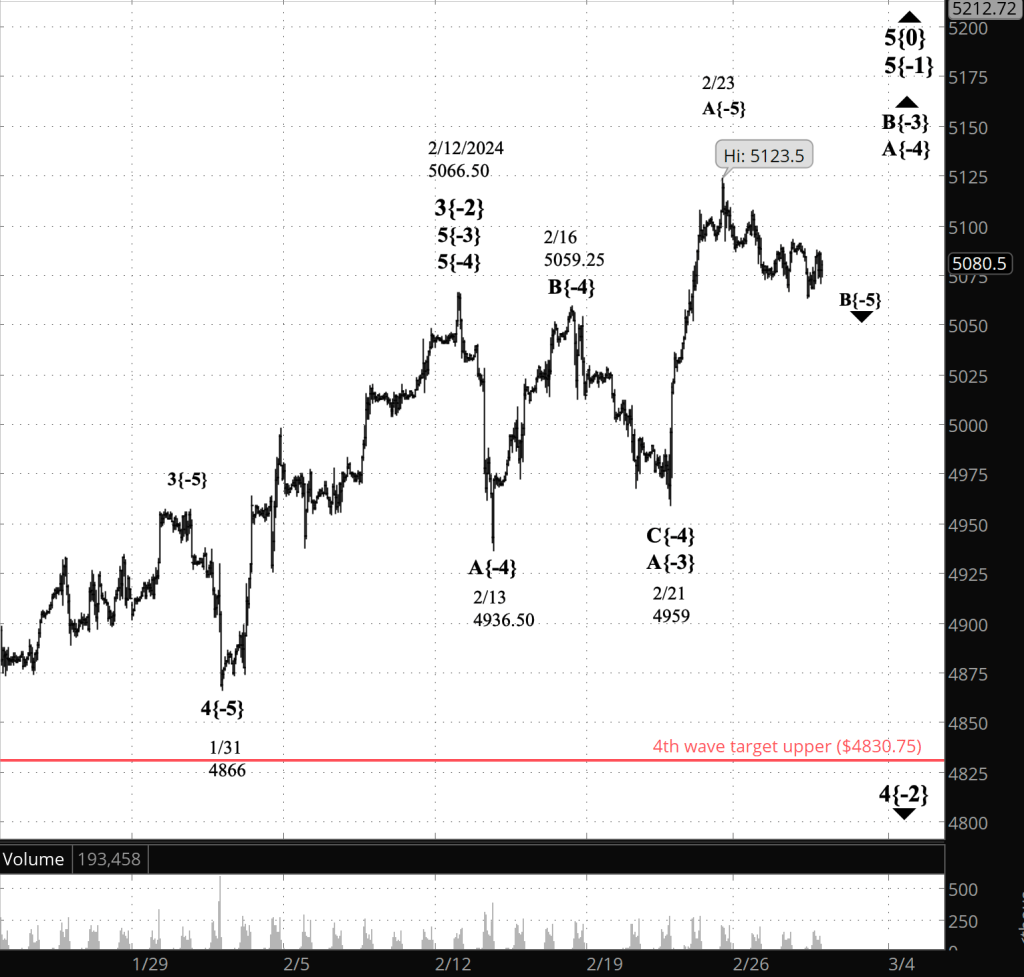
Options Trades 2/29/2024: SPY XLE

Symbols traded: Short Iron Fly on SPY, XLE (1DTE)

With the major economic reports of the week past, and with the markets having returned to lower implied volalaties, I’ve resumed my very short-term trades with a short Iron Fly position on SPY, entered one day before expiratIon. Unlike earlier 1DTE trades, I intend to hold on to the position with the goal of exiting for a 25% profit. In the past I’ve exited at the market open. With this trade I’ll exit at 25% profit or at 1 p.m. New York time, whichever comes first.

I also entered a 1DTE short Iron Fly position on XLE under the same rules. Thursday’s are one day before expiration of many options, which have weeklies and their smallest time frame. That makes XLE available for a 1DTE trade.

I exited SPY entirely on expiration day, selling off legs of the Iron Fly individually, producing a $219 profit for each contract.

SPY short Iron Fly

LOT:9ENTRY DATE:2/29/2024
MANAGEMENT:3/1/2024EXPIRATION:3/1/2024
DAYS HELD:1

Entry and Exit

METRICENTRYEXITCHANGECHANGE %ANNUALIZED CHANGE %
Options premium$ 2.01$ 0.18$ 0.189.0%3251%
Stock price$ 507.70$ 511.00$ 3.300.6%237%
Impllied Volatility Rate10.910.5-0.4
Days to expiration10

The structure of the position

STRUCTURESTRIKEODDS EXPIRE OTMDELTAIN PRICEOUT PRICENET PRICE
Calls
Long511.0082.0%18$ (0.34)$ 1.30$ 0.96
Break-even510.0167.0%33
Short508.0052.0%48$ 1.33$ (3.11)$ (1.78)
Puts
Short508.0052.0%48$ 1.54$ (0.03)$ 1.51
Break-even507.0164.5%35.5
Long505.0077.0%23$ (0.52)$ 0.01$ (0.51)
======
`NET TOTAL:$ 0.18

Risk and Reward

Per contract:
Reward201.00
Risk99.00
R/R Ratio (n:1)0.5

XLE short Iron Fly

LOT:1ENTRY DATE:2/29/2024
MANAGEMENT:3/1/2024EXPIRATION:3/1/2024
DAYS HELD:1

Entry and Exit

METRICENTRYEXITCHANGECHANGE %ANNUALIZED CHANGE %
Options premium$ 0.60$ 0.04$ 0.046.7%2420%
Stock price$ 86.09$ 87.40$ 1.311.5%555%
Impllied Volatility Rate5.37.01.7
Days to expiration10

The structure of the position

STRUCTURESTRIKEODDS EXPIRE OTMDELTAIN PRICEOUT PRICENET PRICE
Calls
Long87.0083.0%18$ (0.10)$ 0.86$ 0.76
Break-even86.6064.5%35.5
Short86.0046.0%53$ 0.43$ (1.42)$ (0.99)
Puts
Short86.0046.0%54$ 0.33$ –$ 0.33
Break-even85.6066.5%33.5
Long85.0087.0%13$ (0.06)$ –$ (0.06)
======
`NET TOTAL:$ 0.04

Risk and Reward

Per contract:
Reward60.00
Risk40.00
R/R Ratio (n:1)0.7

By Tim Bovee, Portland, Oregon, February 29, 2024

Disclaimer

Tim Bovee, Private Trader tracks the analysis and trades of a private trader for his own accounts. Nothing in this blog constitutes a recommendation to buy or sell stocks, options or any other financial instrument. The only purpose of this blog is to provide education and entertainment.

No trader is ever 100 percent successful in his or her trades. Trading in the stock and option markets is risky and uncertain. Each trader must make trading decisions for his or her own account, and take responsibility for the consequences.

License
Creative Commons License

All content on Tim Bovee, Private Trader by Timothy K. Bovee is licensed under a Creative Commons Attribution-ShareAlike 4.0 International License.

Based on a work at www.timbovee.com.
Trader’s Notebook

3:30 p.m. New York time

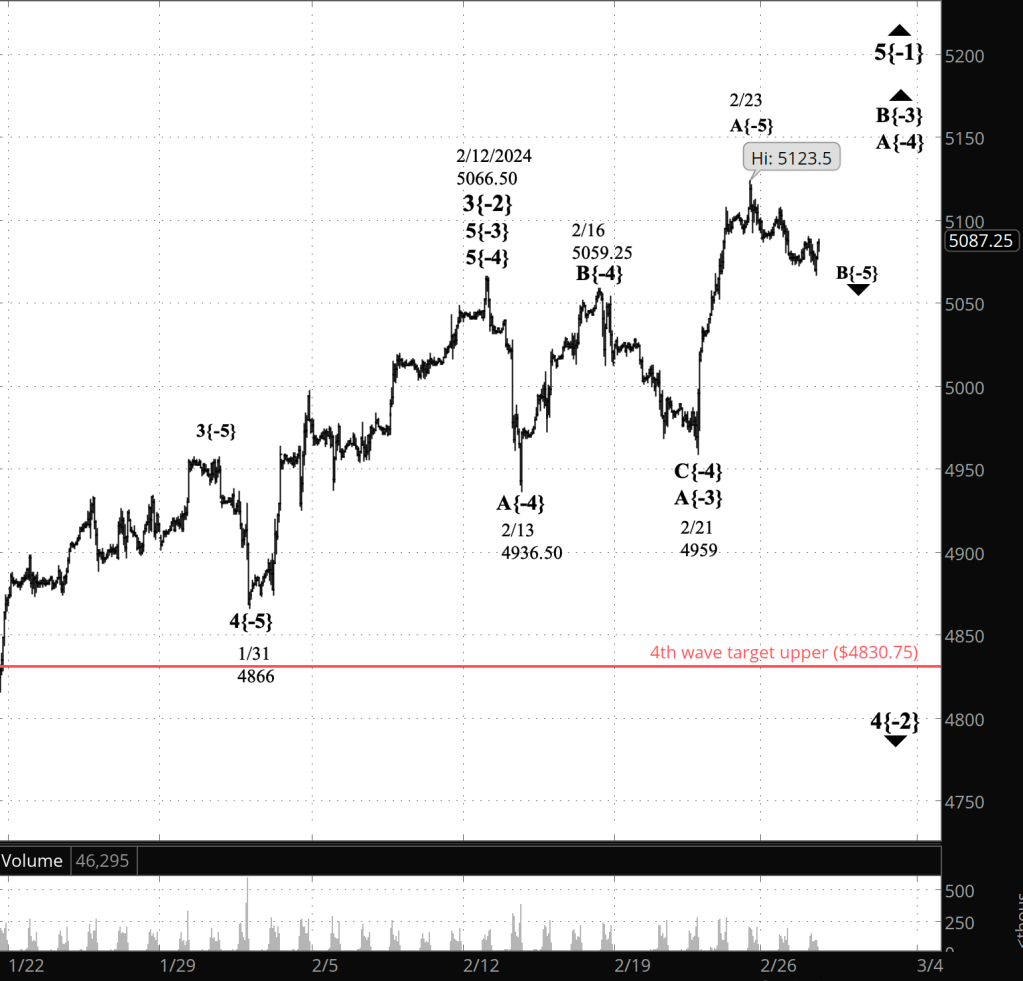
Half an hour before the closing bell. The S&P 500 futures rose to 5105.50 during the session and then retreated into the 5070s. The price remained above the end point of the low-degree B wave, B{-5} on the chart, that was the center of this morning’s discussion.

That the price has remained above that level, 5060, increases the likelihood that this morning’s principal analysis is a correct reading of the Chart: Wave C{-5} within wave A{-4} within wave B{-3} are underway, all within wave 4{-2} downward correction that began on February 12. If the price were to fall below 5060, then the alternative analysis would return to the chart, showing wave B{-5} as still underway.

I’ve updated the chart.

2:10 p.m. New York time

Another Trade. I’ve entered a short iron Fly position on XLE, one day prior to expiration, and have added an analysis of the trade to today’s trading post.

1:30 p.m. New York time

Trade. I’ve entered a short Iron Fly position on SPY, one day before expiration, and have posted an analysis of the trade, in which I discuss a modification to my exit strategy.

9:35 a.m. New York time

What’s happening now? The S&P 500 E-mini futures rose sharply upon the release of the Personal Consumption Expenditure (PCE) price index, reaching above 5100 at the opening bell.

What does it mean? In Elliott Wave Theory, the overnight low, 5060, was the end of a low-degree declining B wave and the start of a rising C wave.

Those small waves are subwaves, three degrees lower, of a 4th-wave downward correction that began on February 12. That 4th wave is working through its rising middle wave, a larger B wave, which in turn is in its rising initial wave, a still larger A wave.

In the labelling on the chart, the smallest wave discussed above, the rising C wave, is wave C{-5}, the subscript in curly brackets being the degree designator, showing the degree’s location relative to an expanding Diagonal Triangle, wave 5{0}, that began in December 2018. See the “Reading the chart” section, below, for more about degrees.

Wave C{-5} is a subwave of wave A{-4}, which in turn is a subwve of wave B{-3}, which in turn is subwave of the downward correction, wave 4{-2}.

Wave C{-5}, when complete, will also be the end of rising wave A{-4}, which will be followed by a declining corrective wave, B{-4}.

What are the alternatives? Whipsaws happen. It’s quite possible that what I’ve labeled as a rising C wave is a subwave of the declining B wave, which is still. On the chart, that would mean that wave B{-5} is still underway and wave C{-5} has not yet begun.

Also, what I’m labelling as degree {-4} could instead be degree {-3}, one degree larger, pushing everything up one in the fractal hierarchy.

[S&P 500 E-mini futures at 3:30 p.m., 1-hour bars, with volume]

What does Elliott wave theory say? Here are the waves that underly the analyses.

Principal Analysis:

  • Wave 5{0}, an expanding Diagonal Triangle, began on December 26, 2018.
  • Within it, an uptrend, wave 5{-1}, began on October 13, 2022 and is underway.
  • Wave 5{-1} is the parent wave of a downward correction, wave 4{-2}, that began on February 12, 2024.
  • Wave 4{-2} is in its second subwave, wave B{-3}, which in turn is in wave A{-4}, its initial subwave.
  • Wave A{-4} is in its final subwave, wave C{-5}.

We Are Here.

These are the waves currently in progress under my principal analysis. Each line on the list shows the wave number, with the subscript in curly brackets, the traditional degree name, the starting date, the starting price of the S&P 500 E-mini futures, and the direction of the wave.

  • S&P 500 Index:
  • 5{+3} Supercycle, 7/8/1932, 4.40 (up)
  • 5{+2} Cycle, 12/9/1974, 60.96 (up)
  • 5{+1} Primary, 3/6/2009, 666.79 (up)
  • 5{0} Intermediate, 12/26/2018, 2346.58 (up)
  • S&P 500 Futures and index:
  • 5{-1} Minor, 10/13/2022, 3502 (up) (futures), 3491.58 (up) (index)
  • S&P 500 Futures:
  • 4{-2} Minute, 2/12/2024, 5066.50 (down)
  • B{-3} Minuette, 2/21/2024, 4959 (up)

Reading the chart. Price movements — waves – – in Elliott wave analysis are labeled with numbers within trending waves and letters with corrective waves. The subscripts — numbers in curly brackets — designate the wave’s degree, which, in Elliott wave analysis, means the relative position of a wave within the larger and smaller structures that make up the chart. R.N. Elliott, who in the 1930s developed the form of analysis that bears his name, viewed the chart as a complex structure of smaller waves nested within larger waves, which in turn are nested within still larger waves. In mathematics it’s called a fractal structure, where at every scale the pattern is similar to the others.

Learning and other resources. Elliott wave analysis provides context, not prophecy. As the 20th century semanticist Alfred Korzybski put it in his book Science and Sanity (1933), “The map is not the territory … The only usefulness of a map depends on similarity of structure between the empirical world and the map.” And I would add, in the ever-changing markets, we can judge that similarity of structure only after the fact.

See the menu page Analytical Methods for a rundown on where to go for information on Elliott wave analysis.

By Tim Bovee, Portland, Oregon, February 29, 2024

Disclaimer

Tim Bovee, Private Trader tracks the analysis and trades of a private trader for his own accounts. Nothing in this blog constitutes a recommendation to buy or sell stocks, options or any other financial instrument. The only purpose of this blog is to provide education and entertainment.

No trader is ever 100 percent successful in his or her trades. Trading in the stock and option markets is risky and uncertain. Each trader must make trading decisions for his or her own account, and take responsibility for the consequences.

License
Creative Commons License

All content on Tim Bovee, Private Trader by Timothy K. Bovee is licensed under a Creative Commons Attribution-ShareAlike 4.0 International License.

Based on a work at www.timbovee.com.
Trader’s Notebook

3:30 p.m. New York time

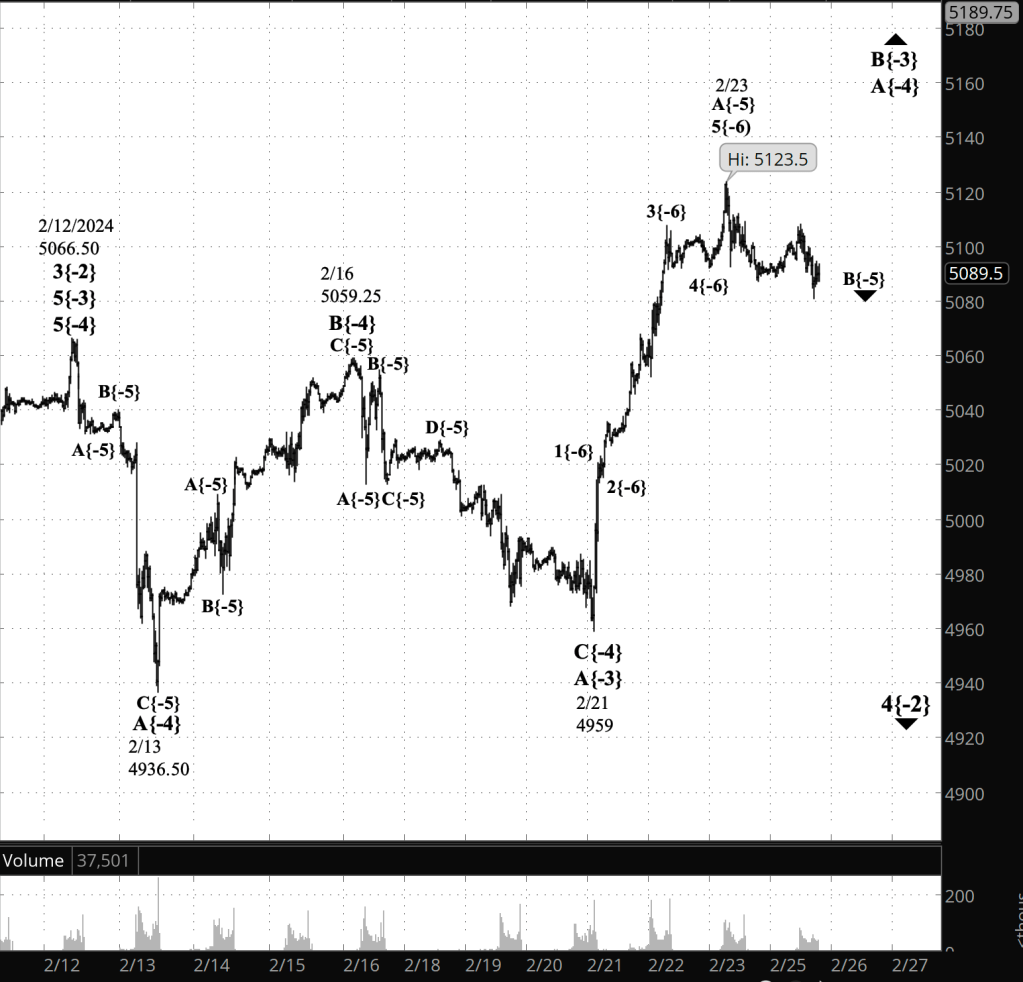
Half an hour before the closing bell. The S&P 500 futures continued to trade narrowly during the session, remaining in the 5070s and 5080s, as the Elliott Wave structure within the 4th wave downward correction that began in mid-February continued to evolve. I’ve updated the chart.

9:35 a.m. New York time

What’s happening now? The S&P 500 E-mini futures fell further overnight, deeper into the 5060s, and then retraced slightly, up into the 5070s..

What does it mean? Elliott Wave Theory describes the chart as showing a small B wave embedded several degrees deep within an a downward correction continues. The correction, a 4th wave, began on February 12 and is in its middle subwave, also a wave B. That larger wave B is in its 1st subwave, wave A, and the small B wave now underway is the first subwave of that wave A.

The small B wave, when complete, will be followed by rising C wave that will complete the parent A wave and begin a larger, B-wave decline.

On the chart, the waves are shown as a wave number and degree designation, a subscript in curly brackets showing the wave’s position within the fractal hierarchy, using the expanding Diagonal Triangle, wave 5{0}, as a base point. The smaller the subscript, the lower down the hierarchy the wave. See “Reading the chart”, below, for more on degrees.

So from the large downward correction to the smallest B wave in yesterday’s disussion, here’s where the chart stands: Now underway, declining wave 4{-2}, rising wave B{-3}, rising wave A{-4}, declining wave B{-5}. All of which is happening within wave 5{0}, an expanding Diagonal Triangle that began on December 26, 2018.

What are the alternatives? What I’m labelling as degree {-4} could instead be degree {-3}, one degree larger, pushing everything up one in the fractal hierarchy. I chose my labeling based on the consistency with the subwaves prior to the 4th-wave upward correction (wave 4{-2}), but consistency is a tendency, not a firm rule, so there’s a lack of certainty.

[S&P 500 E-mini futures at 3:30 p.m., 1-hour bars, with volume]

What does Elliott wave theory say? Here are the waves that underly the analyses.

Principal Analysis:

  • Wave 5{0}, an expanding Diagonal Triangle, began on December 26, 2018.
  • Within it, an uptrend, wave 5{-1}, began on October 13, 2022 and is underway.
  • Wave 5{-1} is the parent wave of a downward correction, wave 4{-2}, that began on February 12, 2024.
  • Wave 4{-2} is in its second subwave, wave B{-3}, which in turn is in wave A{-4}, its initial subwave.
  • Wave A{-4} is in its middle subwave, wave B{-5}.

We Are Here.

These are the waves currently in progress under my principal analysis. Each line on the list shows the wave number, with the subscript in curly brackets, the traditional degree name, the starting date, the starting price of the S&P 500 E-mini futures, and the direction of the wave.

  • S&P 500 Index:
  • 5{+3} Supercycle, 7/8/1932, 4.40 (up)
  • 5{+2} Cycle, 12/9/1974, 60.96 (up)
  • 5{+1} Primary, 3/6/2009, 666.79 (up)
  • 5{0} Intermediate, 12/26/2018, 2346.58 (up)
  • S&P 500 Futures and index:
  • 5{-1} Minor, 10/13/2022, 3502 (up) (futures), 3491.58 (up) (index)
  • S&P 500 Futures:
  • 4{-2} Minute, 2/12/2024, 5066.50 (down)
  • B{-3} Minuette, 2/21/2024, 4959 (up)

Reading the chart. Price movements — waves – – in Elliott wave analysis are labeled with numbers within trending waves and letters with corrective waves. The subscripts — numbers in curly brackets — designate the wave’s degree, which, in Elliott wave analysis, means the relative position of a wave within the larger and smaller structures that make up the chart. R.N. Elliott, who in the 1930s developed the form of analysis that bears his name, viewed the chart as a complex structure of smaller waves nested within larger waves, which in turn are nested within still larger waves. In mathematics it’s called a fractal structure, where at every scale the pattern is similar to the others.

Learning and other resources. Elliott wave analysis provides context, not prophecy. As the 20th century semanticist Alfred Korzybski put it in his book Science and Sanity (1933), “The map is not the territory … The only usefulness of a map depends on similarity of structure between the empirical world and the map.” And I would add, in the ever-changing markets, we can judge that similarity of structure only after the fact.

See the menu page Analytical Methods for a rundown on where to go for information on Elliott wave analysis.

By Tim Bovee, Portland, Oregon, February 28, 2024

Disclaimer

Tim Bovee, Private Trader tracks the analysis and trades of a private trader for his own accounts. Nothing in this blog constitutes a recommendation to buy or sell stocks, options or any other financial instrument. The only purpose of this blog is to provide education and entertainment.

No trader is ever 100 percent successful in his or her trades. Trading in the stock and option markets is risky and uncertain. Each trader must make trading decisions for his or her own account, and take responsibility for the consequences.

License
Creative Commons License

All content on Tim Bovee, Private Trader by Timothy K. Bovee is licensed under a Creative Commons Attribution-ShareAlike 4.0 International License.

Based on a work at www.timbovee.com.

Trader’s Notebook

3:30 p.m. New York time

Half an hour before the closing bell. The S&P 500 futures moved a bit lower during the session, into the 5060s, and then returned to the 5080s, essentially going to nowhere.

The Elliott Wave Analysis is unchanged: The 4th-wave downward correction that began on February 12 continues and is in its second subwave, wave B.

I’ve updated the chart.

9:35 a.m. New York time

What’s happening now? The S&P 500 E-mini futures fluctuated from the 5070s to the 5090s overnight.

What does it mean? Elliott Wave Theory’s view of the chart is that the 4th-wave downward correction that began on February 12 continues. Typically, it will end within the range of subwave 4 within the preceding 3rd wave.

I’ve pulled back the chart for a broader view. The red line at the bottom is the upper boundary of the target price range for wave 4. The lower boundary, not visible, is 4702.

The 4th-wave correction is labeled wave 4[-2} on the chart — the wave number and a degree designator as a subscript in curly brackets showing the wave’s position within the fractal hierarchy of the chart.. See the “Reading the chart” section below for more on the chart’s labeling system.

Wave 4{-2} is in its second subwave, a rising B wave, which in turn is in its first subwav, a rising A wave.

The B wave, labeled wave B{-3} on the chart, is the one I’m keeping an eye on. When its third and final subwave, wave C{-4}, is complete, wave C{-3} will carry the price down in five subwaves.

What are the alternatives? The ambiguity, as is so often the case, likes in the degree designators. What I’m labelling as degree {-4} could instead be degree {-3}, one degree larger, pushing everything up one in the fractal hierarchy. I chose my labeling based on the consistency with the subwaves prior to the 4th-wave upward correction (wave 4{-2}), but consistency is a tendency, not a firm rule, so there’s a lack of certainty.

[S&P 500 E-mini futures at 3:30 p.m., 1-hour bars, with volume]

What does Elliott wave theory say? Here are the waves that underly the analyses.

Principal Analysis:

  • Wave 5{0}, an expanding Diagonal Triangle, began on December 26, 2018.
  • Within it, an uptrend, wave 5{-1}, began on October 13, 2022 and is underway.
  • Wave 5{-1} is the parent wave of a downward correction, wave 4{-2}, that began on February 12, 2024.
  • Wave 4{-2} is in its second subwave, wave B{-3}, which in turn is in wave A{-4}, its initial subwave.
  • Wave A{-4} is in its middle subwave, wave B{-5}.

We Are Here.

These are the waves currently in progress under my principal analysis. Each line on the list shows the wave number, with the subscript in curly brackets, the traditional degree name, the starting date, the starting price of the S&P 500 E-mini futures, and the direction of the wave.

  • S&P 500 Index:
  • 5{+3} Supercycle, 7/8/1932, 4.40 (up)
  • 5{+2} Cycle, 12/9/1974, 60.96 (up)
  • 5{+1} Primary, 3/6/2009, 666.79 (up)
  • 5{0} Intermediate, 12/26/2018, 2346.58 (up)
  • S&P 500 Futures and index:
  • 5{-1} Minor, 10/13/2022, 3502 (up) (futures), 3491.58 (up) (index)
  • S&P 500 Futures:
  • 4{-2} Minute, 2/12/2024, 5066.50 (down)
  • B{-3} Minuette, 2/21/2024, 4959 (up)

Reading the chart. Price movements — waves – – in Elliott wave analysis are labeled with numbers within trending waves and letters with corrective waves. The subscripts — numbers in curly brackets — designate the wave’s degree, which, in Elliott wave analysis, means the relative position of a wave within the larger and smaller structures that make up the chart. R.N. Elliott, who in the 1930s developed the form of analysis that bears his name, viewed the chart as a complex structure of smaller waves nested within larger waves, which in turn are nested within still larger waves. In mathematics it’s called a fractal structure, where at every scale the pattern is similar to the others.

Learning and other resources. Elliott wave analysis provides context, not prophecy. As the 20th century semanticist Alfred Korzybski put it in his book Science and Sanity (1933), “The map is not the territory … The only usefulness of a map depends on similarity of structure between the empirical world and the map.” And I would add, in the ever-changing markets, we can judge that similarity of structure only after the fact.

See the menu page Analytical Methods for a rundown on where to go for information on Elliott wave analysis.

By Tim Bovee, Portland, Oregon, February 27, 2024

Disclaimer

Tim Bovee, Private Trader tracks the analysis and trades of a private trader for his own accounts. Nothing in this blog constitutes a recommendation to buy or sell stocks, options or any other financial instrument. The only purpose of this blog is to provide education and entertainment.

No trader is ever 100 percent successful in his or her trades. Trading in the stock and option markets is risky and uncertain. Each trader must make trading decisions for his or her own account, and take responsibility for the consequences.

License
Creative Commons License

All content on Tim Bovee, Private Trader by Timothy K. Bovee is licensed under a Creative Commons Attribution-ShareAlike 4.0 International License.

Based on a work at www.timbovee.com.

Trader’s Notebook

3:30 p.m. New York time

Half an hour before the closing bell. The S&P 500 futures retraced during the session, back into the 5080s, as the middle subwave, rising wave B, of the 4th-wave downward correction that began in mid-February works through its first subwave, declining wave A.

I’ve updated the chart.

9:35 a.m. New York time

What’s happening now? The S&P 500 E-mini futures kept to to a narrow range after trading resumed overnight, remainiing largely in the 5080s and 5090s after declining slightly at the opening and rising a bit higher, above 5100, as the opening bell approached.

What does it mean? The 4th-wave downward correction that began on February 12 continues. There is some ambiguity regarding where the waves are situated in relation to fractal structure of the chart.

The count that I’ve used has the following structure, working down from wave 4 from the larger subwaves to the smaller and using the degree designations, in curly brackets, as they appear on the chart: Rising wave B{-3}, rising wave A{-4}, declining wave B{-5}.

See the “Reading the chart” section, below, for more on degrees and their labeling.

In any case, rising wave B{-3} will have three subwaves at the {-4} degree. Once the B wave is complete, it will be followed by a declining C wave that will decline significantly, completing the correction.

The 4th-wave correction will in turn be followed by a rising 5th wave of uncertain magnitude.

What are the alternatives? So where’s the ambiguity? What I’m labelling as degree {-4} could instead be degree {-3}, one degree larger, pushing everything up one in the fractal hierarchy. I chose my labeling based on the consistency with the subwaves prior to the 4th-wave upward correction (wave 4{-2}), but consistency is a tendency, not a firm rule, so there’s a lack of certainty.

[S&P 500 E-mini futures at 3:30 p.m., 25-minute bars, with volume]

What does Elliott wave theory say? Here are the waves that underly the analyses.

Principal Analysis:

  • Wave 5{0}, an expanding Diagonal Triangle, began on December 26, 2018.
  • Within it, an uptrend, wave 5{-1}, began on October 13, 2022 and is underway.
  • Wave 5{-1} is the parent wave of a downward correction, wave 4{-2}, that began on February 12, 2024.
  • Wave 4{-2} is in its second subwave, wave B{-3}, which in turn is in wave A{-4}, its initial subwave.
  • Wave A{-4} is in its middle subwave, wave B{-5}.

We Are Here.

These are the waves currently in progress under my principal analysis. Each line on the list shows the wave number, with the subscript in curly brackets, the traditional degree name, the starting date, the starting price of the S&P 500 E-mini futures, and the direction of the wave.

  • S&P 500 Index:
  • 5{+3} Supercycle, 7/8/1932, 4.40 (up)
  • 5{+2} Cycle, 12/9/1974, 60.96 (up)
  • 5{+1} Primary, 3/6/2009, 666.79 (up)
  • 5{0} Intermediate, 12/26/2018, 2346.58 (up)
  • S&P 500 Futures and index:
  • 5{-1} Minor, 10/13/2022, 3502 (up) (futures), 3491.58 (up) (index)
  • S&P 500 Futures:
  • 4{-2} Minute, 2/12/2024, 5066.50 (down)
  • B{-3} Minuette, 2/21/2024, 4959 (up)

Reading the chart. Price movements — waves – – in Elliott wave analysis are labeled with numbers within trending waves and letters with corrective waves. The subscripts — numbers in curly brackets — designate the wave’s degree, which, in Elliott wave analysis, means the relative position of a wave within the larger and smaller structures that make up the chart. R.N. Elliott, who in the 1930s developed the form of analysis that bears his name, viewed the chart as a complex structure of smaller waves nested within larger waves, which in turn are nested within still larger waves. In mathematics it’s called a fractal structure, where at every scale the pattern is similar to the others.

Learning and other resources. Elliott wave analysis provides context, not prophecy. As the 20th century semanticist Alfred Korzybski put it in his book Science and Sanity (1933), “The map is not the territory … The only usefulness of a map depends on similarity of structure between the empirical world and the map.” And I would add, in the ever-changing markets, we can judge that similarity of structure only after the fact.

See the menu page Analytical Methods for a rundown on where to go for information on Elliott wave analysis.

By Tim Bovee, Portland, Oregon, February 26, 2024

Disclaimer

Tim Bovee, Private Trader tracks the analysis and trades of a private trader for his own accounts. Nothing in this blog constitutes a recommendation to buy or sell stocks, options or any other financial instrument. The only purpose of this blog is to provide education and entertainment.

No trader is ever 100 percent successful in his or her trades. Trading in the stock and option markets is risky and uncertain. Each trader must make trading decisions for his or her own account, and take responsibility for the consequences.

License
Creative Commons License

All content on Tim Bovee, Private Trader by Timothy K. Bovee is licensed under a Creative Commons Attribution-ShareAlike 4.0 International License.

Based on a work at www.timbovee.com.