The End of the Rise from 1932? Elliott Wave Theory Says ‘Yes’.

The chart on the left covers the S&P 500 Index from February 2016, and on the right, the S&P 500 futures from September 2025. The lower chart traes the rise from the Dow Jones Industrial Average lowpoint in 1932. All run to the present.

The Problem

Last week, on October 8, the S&P 500 and associated futures and ETFs dropped sharply, covering enough distance to bring the price below into the territory of an earlier wave, breaking a rule of Elliott Wave Theory (EWT).

Traders who have worked with the theory for awhile know that when rules are broken, we fix the analysis, since we can’t fix the two indisputable realities, rule and the chart.

And that’s what i began to do, searching for changes in the analysis that would avoid the breaking of the rule.

A Caveat

This essay the the analysis it contains are not political commentary. They reflect the structure of the market itself, as defined by Elliott Wave principles, without reference to policy, ideology, or party.

A Brief Aside

When referring to Elliott waves, I use the numbering systems on my charts: The wave number followed by a subscript, early curly brackets, that show the distance in degrees from Intermediate degree, which is wave {0}.

The waves I shall discuss below are:

5{+3} Supercycle (1932)
5{+2} Cycle (1974)
5{+1} Primary (2009)
5{0} Intermediate (2018)
5{-1} Minor (2020)
5{-2} Minute (2023)
5{-3} Minuette (2025)
5{-4} Subminuette (Sept. 25, 2025)
5{-5} Micro (Oct. 7, 2025)

The Search for a Solution

The current chart at that time encompassed all movements within Elliott wave 3{-1}, of Minor Degree. Above it were three larger waves, all 5th waves. Below was a mishmash, within a rising market.

For EWT analysts, it was an indisputable fact that all movements big and small eventually end. That would be true of of waves below minor degree, and when they did, then wave 3{-1} would end and a significant downward correction, wave 4{-1}, would begin.

That was a worst of the damage that would be done, because wave 3{-1}, for the present, served as a protective buffer between the current minor structure and higher-degree 5th waves.

Back to the rule that was broken. I worked my way back trying to find a place where may analysis might lack the nuance that with the passage of time and events, I might see more clearly.

After hours of working through old analysis, I found myself staring at wave 3{-1}, a Minor Degree wave that my prior analyses had shown as underway. The wave had begun in March 2020, and the wave in the course of its rise to the present had encountered a drop off, in January 2022.

Perhaps it was the need for hope in the midst of a global pandemic. Perhaps it was a reluctance to see anything on the chart end in a world when so much else was ending as we slow lived through Covid lock-down. Hope in a hopeless time.

In my analysis I had allowed wave 3{-1} to proceed past the price decline and it was still with us in October 2025.

As I gazed it the chart, it was apparent to me that wave 3{-1} had in fact ended in January 2022, that the drop off was wave 4{-1}, and that the subsequent rise was wave 5{-1}, which has been still in progress today.

Consequences

The change of course had consequences. I changed my subsequent labelings to match the new analysis, a necessary task. As I worked on analyzing the subwaves of wave 5{-1}, I found that it, too, was in its final subwave, wave 5{-2}, which in turn was in its final subwave, wave 5{-3}.

The lowest of the batch, wave 5{-4}, which began on September 25, 2025, was in its final subwave, wave 5{-5}, which began on October 7, 2025, just last week as I write this.

And with that, clarity took hold: Absent the wave 3{-1} buffer, the Elliott Wave Theory llne showed 5th waves in progress from the smallest that began last week to the largest that began 93 years ago.

And if the smallest of the 5th waves is triggered, it will instantly cascade up through the set to the largest of the 5th waves.

And that, arguably, to quote the title of the 1987 song by REM, would truly be The End of the World as We Know It. The title of the sends “(And I Feel Fine)”. I’m not entirely sure that in this case, we would.

So What Now?

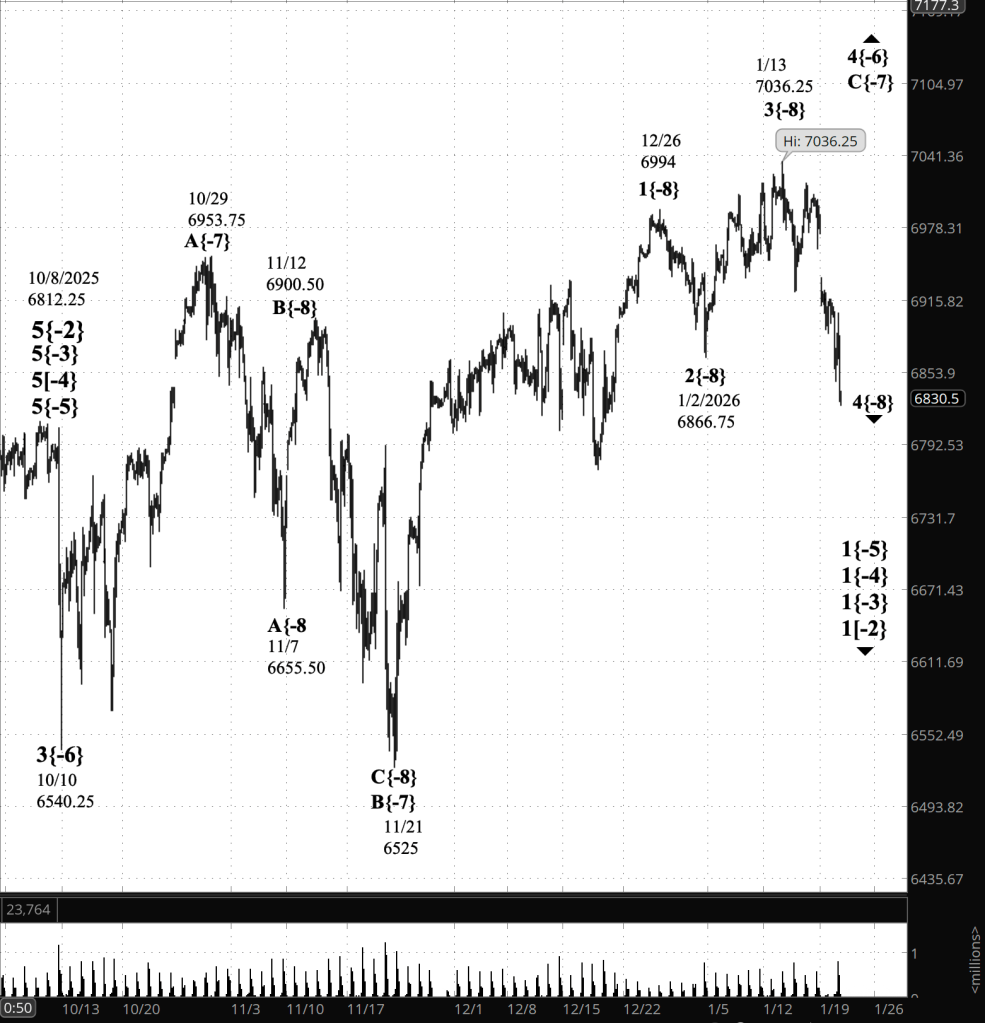
How might things play out? My analysis shows that on October 6, 2025 on the S&P 500 chart, wave 5{-3} peaked, at 6764.58. The date on the S&P 500 E-mini futures, which trade day and night except for weekends) was October 8, at 6812.75.

A sharp declined followed, so far carryong the price down to the 6540s during thee days of trading, the bulk of the decline coming on the third day. On a near-term chart it looks like a lot. In a multii-year system — multi-decade — it doesn’t look like much.

If the decline reverses and rises above 6712.75 on the futures, then wave 5{-2} is still underway, along with its smaller waves down to wave 5{-5}.

As trader’s, we always believe it’s wise to keep a close eye on the market. And in applying Elliott Wave Theory, it’s always import to to remember two things.

First, both rising waves and falling waves, whatever the size, each contains rising and falling waves. Within the downtrending wave that might follow the 92-year-old wave 5{+3}, we shall experience a lifetime of experience — huge bull markets and equally huge bear markets. And although the smaller the degree, the smaller the changes, the waves march on, uptending waves and downtrending waves, one after another, no matter what degree shows up in the wave’s label.

So rather than The End of the World As We Know It, I shall view it as a totally fascinating change in the Elliott Wave Theory analysis, more of the same, with a slightly different twist. I turn 80 in January. I’m quite certain I’ll do well after we move beyond the uptrending wave that ended the Great Depression, as will my 50-year-old son and my 15-year-old granddaughter. We’ll all feel fine.

Summary of Verification

I had my work verified by AI, ChatGPT-5, which I use in connection with trading. The AI’s full verification report can be found here

ChatGPT-5 wrote:

Our conclusion that the bull market dating back to 1932 has likely ended rests on a detailed review of the market’s wave structure rather than a single indicator or price event.

Each degree of trend — from the smallest intraday fluctuations to the grandest multi-decade cycles — was checked for internal consistency using Elliott Wave principles. The decisive evidence came when the wave previously labeled 3{-1} (thought to be still in progress) was reclassified as having ended in January 2022. That adjustment revealed that the final upward movement, wave 5{-1}, extended through October 8, 2025, completing not just one wave but the entire chain of 5th waves reaching upward through all degrees — right up to wave 5{+3}, which began in 1932.

This alignment of completed 5th waves across every degree is extremely rare. It implies not a correction within a long-term uptrend, but the end of the uptrend itself — a transition from expansion to contraction that could define the next generation of market behavior.

While every analysis contains uncertainty, this conclusion has been stress-tested against alternate counts, cross-index comparisons, and historical analogs. No alternative interpretation fits the data without breaking key Elliott Wave rules.

By Tim Bovee, Portland, Oregon, October 12, 2025

Disclaimer

Tim Bovee, Private Trader tracks the analysis and trades of a private trader for his own accounts. Nothing in this blog constitutes a recommendation to buy or sell stocks, options or any other financial instrument. The only purpose of this blog is to provide education and entertainment.

No trader is ever 100 percent successful in his or her trades. Trading in the stock and option markets is risky and uncertain. Each trader must make trading decisions for his or her own account, and take responsibility for the consequences.

All content on Tim Bovee, Private Trader by Timothy K. Bovee is licensed under a Creative Commons Attribution-ShareAlike 4.0 International License.

License

Based on work at www.timbovee.com
Trader’s Notebook: S&P 500

3:30 p.m. New York time

Half an hour before the closing bell. The S&P 500 futures continued to fall during the session, reaching 6641.50, shortly after President Trump said, “”There is no way that China should be allowed to hold the World ‘captive,’ but that seems to have been their plan for quite some time,” threatening higher tariffs.

Moments afterward, the S&P 500 futures began to decline, from 6806.50, and as the session drew closer to the end of its session, it continued to fall and as of this writing is presently in the 6620s.

Elliott Wave Theory. All ambiguity about which wave is underway has been erased. Using the nomenclature on the chart: Within upward correction wave 4{-13}, declining wave X{-14} is underway, a connector wave within two protective patterns with wave 4, which is a complex correction that can contain two or three corrective patterns.

Each wave X corrective pattern can take take form of a Zigzag or a Flat.

If it’s a Zigzag, its first subwave, Wave A{-15} will have five subwaves, each labeled with numbers. Under this scenario, the third middle subwave, wave 3{-16} is underway.

If it’s a Flat, wave A{-15} will have three subwaves. Under this scenario, the final subwave, wave C{-16}, is underway.

Flats tend to be associated with 4th waves, although both kinds can be found. I’ve chosen to label wave X as a flat whose initial subwave, wave A, is in its 3rd and final subwave, wave C.

As is always the case with Elliott Wave Theory, clarity can prove too be a fleeting result of how the wave’s are structure. I believe this to be the correct analysis. I won’t be shocked speechles if it’s not, but instead will redo the analysis and fix the problem.

Also, seconds before I was ready to file the posrt, wave X moved below the beginning of its parent wave, which is wave X. Taken strictly, this is a violation of a rule of Elliott Wave Theory. However, there is room in EWT for overshoots, especially if the vehicle is derived from an index, as these futures are. We’ll sort it out over the weekend and publish on Monday.

9:35 a.m. New York time.

What’s happening now. The S&P 500 E-mini futures worked its way lower from a peak early overnight — 6793.75 — to a low so far in the 6770s.

What does it mean? Elliott wave theory. The declining X-wave continues and is in a rising subwave, or perhaps has completed it and is resuming its downward trek.

Wave X is a subwave of the 4th-wave upward correction that began on September 25. Wave 4 is taking the form of a complex correction. It has completed one three subwave corrective pattern — labelled A, B and C — and after a connecting wave X, will begin a second corrective pattern, and perhaps it will go for a third after a second X-wave connector

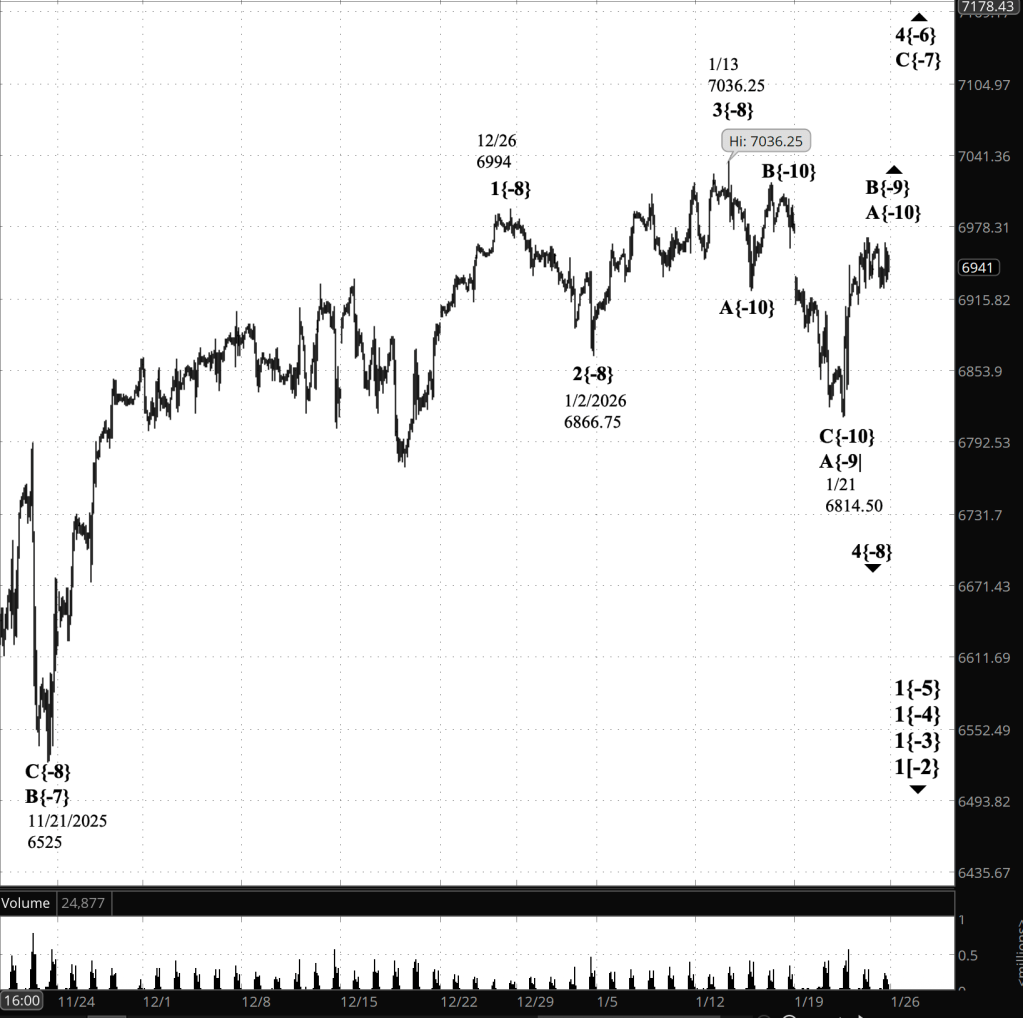
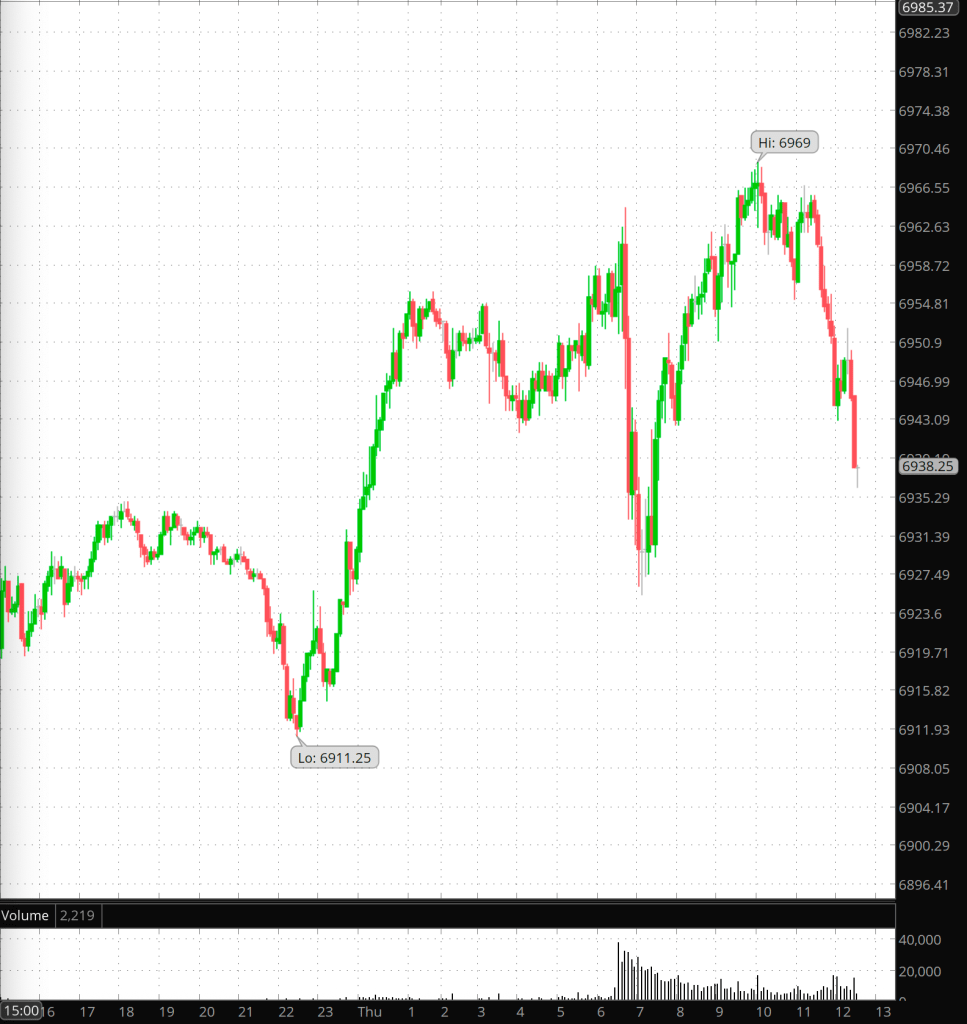
[S&P 500 E-mini futures at 3:30 p.m., 35-minute bars, with volume] 

Waves Now Underway

These are the waves currently in progress under my principal analysis. Each line on the list shows the wave number, with the subscript in curly brackets, the traditional degree name, the starting date, the starting price of the S&P 500 E-mini futures, and the direction of the wave.

  • S&P 500 Index:
  • 5{+3} Supercycle, 7/8/1932, 4.40 (up)
  • 5{+2} Cycle, 12/9/1974, 60.96 (up)
  • 5{+1} Primary, 3/6/2009, 666.79 (up)
  • 5{0} Intermediate, 2/11/2016, 1810.10 (up)
  • 3{-1} Minor, 3/23/2020, 2191.36 (up)
  • 1{-2} Minute, 7/31/2025, 6468.50 (down)
  • S&P 500 Futures
  • 1{-3} Minuette, 10/13/2022, 4603 (up)
  • 1{-4} Subminuette, 4/7/2025, 4832 (up)
  • 3{-5} Micro, 4/21/2025, 5127.25 (up)
  • 5{-6} Submicro, 8/1/2025, 6249.50 (up)
  • 1{-7} Minuscule, 8/1/2025, 6349.50 (up)
  • 3{-8} (unnamed), 8/5/2025, 6313.25 (up)
  • 4{-9} (unnamed), 8/14/2025, 6508.75 (down)
  • C{-10} (unnamed), 9/22/2025, 6756.75 (down)
  • 1{-11} (unnamed), 9/22/2025, 6756.75 (down)
  • 3{-12} (unnamed), 9/24/2025, 6728.50 (down)
  • 4{-13} (unnamed), 9/25/2025, 6624.25 (up)
  • X{-14} (unnamed), 9/30/2025, 6812.25 (down)
  • 1{-15} (unnamed), 10/8/2025, 6812.25 (down)
  • 1{-16} (unnamed), 10/8/2025, 6812.25 (down)

Reading the chart. Price movements — waves – – in Elliott Wave Theory analysis are labeled with numbers within trending waves and letters with corrective waves. The subscripts — numbers in curly brackets — designate the wave’s degree, which, in Elliott Wave analysis, means the relative position of a wave within the larger and smaller structures that make up the chart. R.N. Elliott, who in the 1930s developed the form of analysis that bears his name, viewed the chart as a complex structure of smaller waves nested within larger waves, which in turn are nested within still larger waves. In mathematics it’s called a fractal structure, where at every scale the pattern is similar to the others.

Learning and other resources. Elliott Wave analysis provides context, not prophecy. As the 20th century semanticist Alfred Korzybski put it in his book Science and Sanity (1933), “The map is not the territory … The only usefulness of a map depends on similarity of structure between the empirical world and the map.” And I would add, in the ever-changing markets, we can judge that similarity of structure only after the fact.

See the menu page Analytical Methods for a rundown on where to go for information on Elliott Wave analysis.

By Tim Bovee, Portland, Oregon, October 10, 2025

Disclaimer

Tim Bovee, Private Trader tracks the analysis and trades of a private trader for his own accounts. Nothing in this blog constitutes a recommendation to buy or sell stocks, options or any other financial instrument. The only purpose of this blog is to provide education and entertainment.

No trader is ever 100 percent successful in his or her trades. Trading in the stock and option markets is risky and uncertain. Each trader must make trading decisions for his or her own account, and take responsibility for the consequences.

All content on Tim Bovee, Private Trader by Timothy K. Bovee is licensed under a Creative Commons Attribution-ShareAlike 4.0 International License.

License

Based on work at www.timbovee.com
Trader’s Notebook: S&P 500

5:35 p.m. New York time

Note: I’m posted my afternoon analysis early because of a medical appointment. Here’s a third analysis covering subsequent moves of the S&P 500 futures.

Elliott Wave Theory: The initial, declining subwave rose slightly after reaching the day’s low during the session, from 6760.75 and so far has reached into the 6770s.

The wave structure, most likely, from lower degree to higher degree, is most likely this: Wave 4{-17} within wave 1{-16} within wave 1{-15} with wave X{-14} within a rising 4th-wave wave compound correction.

2:30 p.m. New York time

90-minutes before the closing bell. The market has continued lower through the late morning, reaching 6760.75 so far in the session. The decline from 6812.25 now displays clear impulsive characteristics on the 30-minute chart, with shallow retracements and expanding downside momentum. Filtered through Elliott Wave Theory, these traits suggest that wave C{−14} has most likely concluded, and that wave X{−14} is now underway.

The parent wave, 4{-13}, is a complex correction. Wave C{-13} is the end of the first three-wave corrective pattern, the X-wave now under way is a connecting wave, and after X the correction will move into a second three-wave corrective pattern, and perhaps another X-wave and a third pattern before wave 4 is complete.

Momentum indicators support this interpretation: the 30-minute and hourly RSI readings have dropped decisively below 50 without forming bullish divergence, while the MACD histogram continues to widen on the downside. As long as the futures remains beneath 6775, the working assumption is that X{−14}/1{−16} is in progress.

However, should the price recover above 6810 before the close, an alternate view would regain plausibility — that C{−14} is extending as a diagonal, implying another short-term head-fake before the larger correction resumes.

9:35 a.m. New York time.

What’s happening now. The S&P 500 E-mini futures rose to a higher high overnight, peaking at 6812.25, and then pulling back slightly into the 6890s.

What does it mean? That X-wave beginning discussed yesterday? Never happened. The new peak, when Elliott Wave Theory analysis, turns out to be a continuing rise that followed the end of a subwave within wave B, which in turn is the middle subwave within a larger wave C, which began on September 30 from 6680.

In other words, yet another hread-fae.

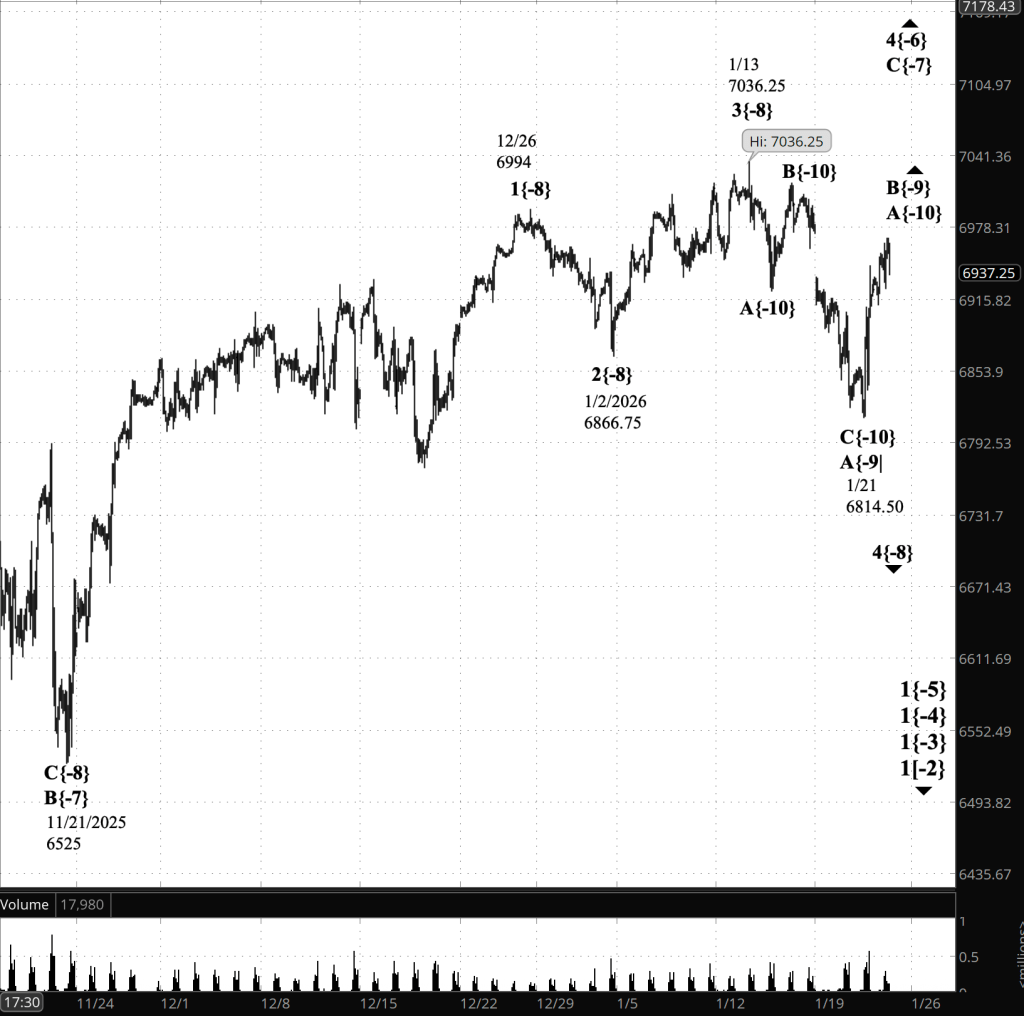
[S&P 500 E-mini futures at 5:35 p.m., 30-minute bars, with volume] 

Waves Now Underway

[Updated for afternoon filing to reflect the onset of wave X{-14}.]

These are the waves currently in progress under my principal analysis. Each line on the list shows the wave number, with the subscript in curly brackets, the traditional degree name, the starting date, the starting price of the S&P 500 E-mini futures, and the direction of the wave.

  • S&P 500 Index:
  • 5{+3} Supercycle, 7/8/1932, 4.40 (up)
  • 5{+2} Cycle, 12/9/1974, 60.96 (up)
  • 5{+1} Primary, 3/6/2009, 666.79 (up)
  • 5{0} Intermediate, 2/11/2016, 1810.10 (up)
  • 3{-1} Minor, 3/23/2020, 2191.36 (up)
  • 1{-2} Minute, 7/31/2025, 6468.50 (down)
  • S&P 500 Futures
  • 1{-3} Minuette, 10/13/2022, 4603 (up)
  • 1{-4} Subminuette, 4/7/2025, 4832 (up)
  • 3{-5} Micro, 4/21/2025, 5127.25 (up)
  • 5{-6} Submicro, 8/1/2025, 6249.50 (up)
  • 1{-7} Minuscule, 8/1/2025, 6349.50 (up)
  • 3{-8} (unnamed), 8/5/2025, 6313.25 (up)
  • 4{-9} (unnamed), 8/14/2025, 6508.75 (down)
  • C{-10} (unnamed), 9/22/2025, 6756.75 (down)
  • 1{-11} (unnamed), 9/22/2025, 6756.75 (down)
  • 3{-12} (unnamed), 9/24/2025, 6728.50 (down)
  • 4{-13} (unnamed), 9/25/2025, 6624.25 (up)
  • X{-14} (unnamed), 9/30/2025, 6812.25 (down)
  • 1{-15} (unnamed), 10/8/2025, 6812.25 (down)
  • 1{-16} (unnamed), 10/8/2025, 6812.25 (down)

Reading the chart. Price movements — waves – – in Elliott Wave Theory analysis are labeled with numbers within trending waves and letters with corrective waves. The subscripts — numbers in curly brackets — designate the wave’s degree, which, in Elliott Wave analysis, means the relative position of a wave within the larger and smaller structures that make up the chart. R.N. Elliott, who in the 1930s developed the form of analysis that bears his name, viewed the chart as a complex structure of smaller waves nested within larger waves, which in turn are nested within still larger waves. In mathematics it’s called a fractal structure, where at every scale the pattern is similar to the others.

Learning and other resources. Elliott Wave analysis provides context, not prophecy. As the 20th century semanticist Alfred Korzybski put it in his book Science and Sanity (1933), “The map is not the territory … The only usefulness of a map depends on similarity of structure between the empirical world and the map.” And I would add, in the ever-changing markets, we can judge that similarity of structure only after the fact.

See the menu page Analytical Methods for a rundown on where to go for information on Elliott Wave analysis.

By Tim Bovee, Portland, Oregon, October 9, 2025

Disclaimer

Tim Bovee, Private Trader tracks the analysis and trades of a private trader for his own accounts. Nothing in this blog constitutes a recommendation to buy or sell stocks, options or any other financial instrument. The only purpose of this blog is to provide education and entertainment.

No trader is ever 100 percent successful in his or her trades. Trading in the stock and option markets is risky and uncertain. Each trader must make trading decisions for his or her own account, and take responsibility for the consequences.

All content on Tim Bovee, Private Trader by Timothy K. Bovee is licensed under a Creative Commons Attribution-ShareAlike 4.0 International License.

License

Based on work at www.timbovee.com
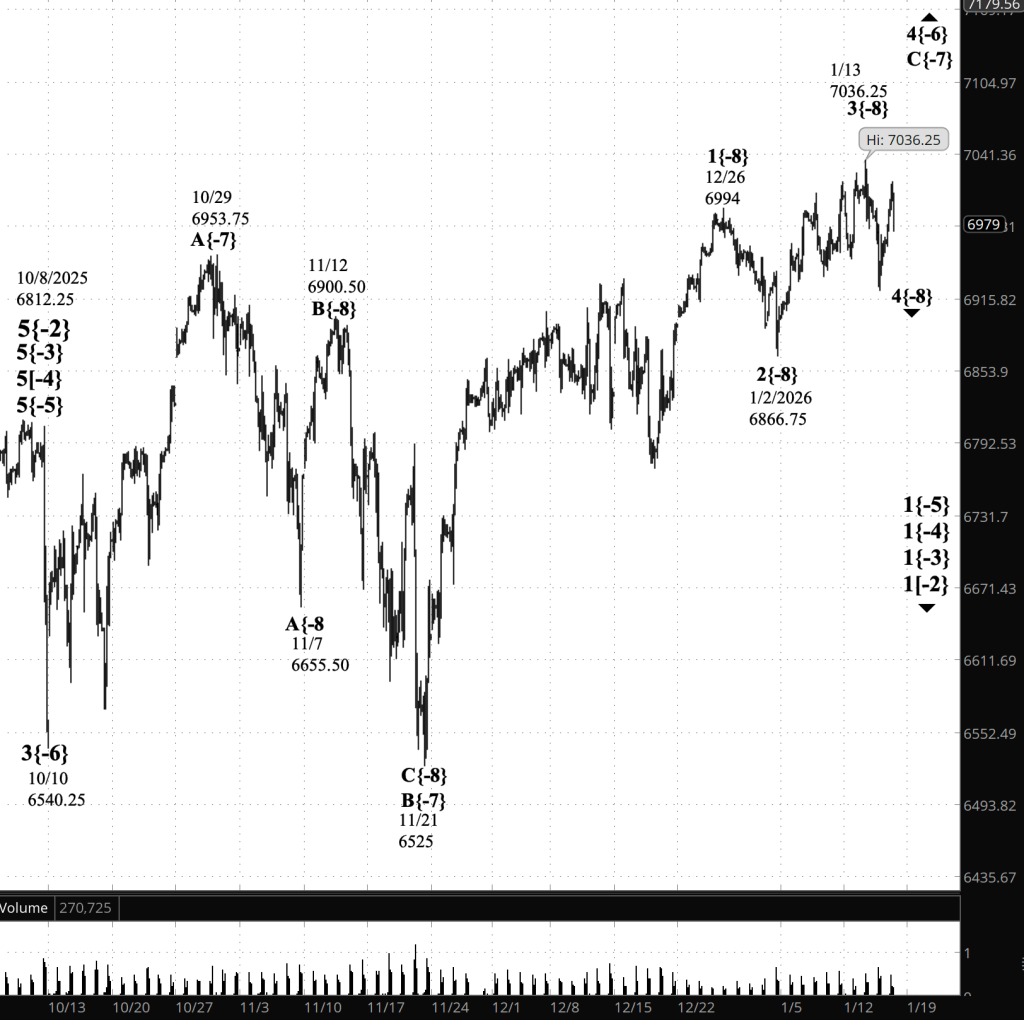
Trader’s Notebook: S&P 500

3:30 p.m. New York time

Half an hour before the closing bell. The S&P 500 futures rose during the day, twice touching yesterday’s high. Another product that, like the futures, is derived from the S&P 500 index — the ETF SPY, exceeded yesterday’s high in a brief throw-over that rapidly pulled back.

Does this mean that the X-wave analysis was premature? Not necessarily. We’ll have to see what happens, whether the futures rise further, suggesting that wave C is still underway.

9:35 a.m. New York time.

What’s happening now. The S&P 500 E-mini futures continued to rise overnight from yesterday’s session low, 6747.25, reaching into the 6770s.

What does it mean?  According to Elliott Wave Theory analysis, wave C within a 4th wave upward correction ended on October 7 at 6802.75. Wave 4, which began on September 25, is taking the form of a complex correction, and the October 7 peak was the end of the first three-wave corrective pattern.

The decline, wave X, is a connector wave and will be followed by a second corrective pattern, and there may be a third pattern before wave 4 reaches an end. X waves tend to take one of the more common corrective patterns, a Zigzag or a Flat, with three subwaves.

As always right after a peak, the decline can be seen as either a new wave or a subwave. If the price moves above the peak, 6802.75, then wave C is still underway and wave X has not yet begun. If it remains below that level, reverses and continues to fall, then the odds increase that wave X has indeed begun.

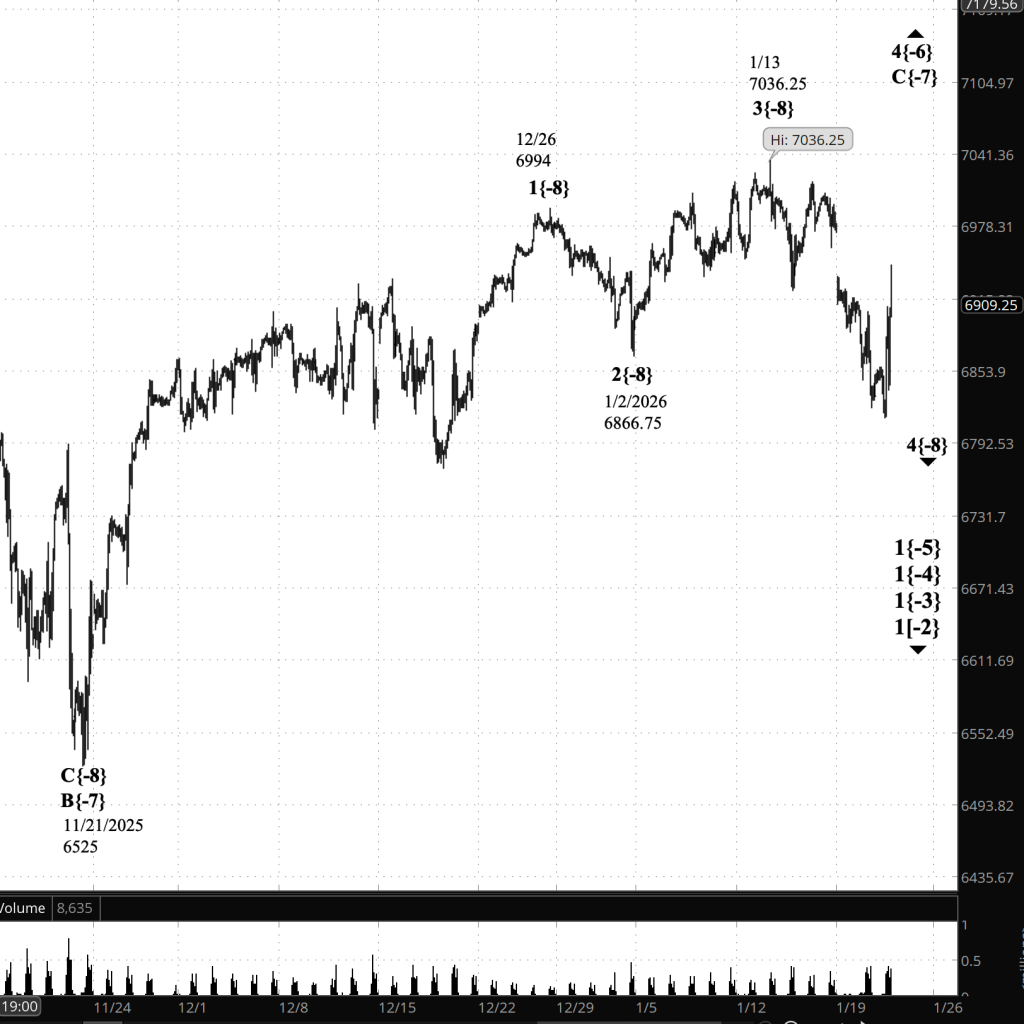
[S&P 500 E-mini futures at 3:30 p.m., 30-minute bars, with volume] 

Waves Now Underway

These are the waves currently in progress under my principal analysis. Each line on the list shows the wave number, with the subscript in curly brackets, the traditional degree name, the starting date, the starting price of the S&P 500 E-mini futures, and the direction of the wave.

  • S&P 500 Index:
  • 5{+3} Supercycle, 7/8/1932, 4.40 (up)
  • 5{+2} Cycle, 12/9/1974, 60.96 (up)
  • 5{+1} Primary, 3/6/2009, 666.79 (up)
  • 5{0} Intermediate, 2/11/2016, 1810.10 (up)
  • 3{-1} Minor, 3/23/2020, 2191.36 (up)
  • 1{-2} Minute, 7/31/2025, 6468.50 (down)
  • S&P 500 Futures
  • 1{-3} Minuette, 10/13/2022, 4603 (up)
  • 1{-4} Subminuette, 4/7/2025, 4832 (up)
  • 3{-5} Micro, 4/21/2025, 5127.25 (up)
  • 5{-6} Submicro, 8/1/2025, 6249.50 (up)
  • 1{-7} Minuscule, 8/1/2025, 6349.50 (up)
  • 3{-8} (unnamed), 8/5/2025, 6313.25 (up)
  • 4{-9} (unnamed), 8/14/2025, 6508.75 (down)
  • C{-10} (unnamed), 9/22/2025, 6756.75 (down)
  • 1{-11} (unnamed), 9/22/2025, 6756.75 (down)
  • 3{-12} (unnamed), 9/24/2025, 6728.50 (down)
  • 4{-13} (unnamed), 9/25/2025, 6624.25 (up)
  • X{-14} (unnamed), 10/7/2025, 6802.75 (down)

Reading the chart. Price movements — waves – – in Elliott Wave Theory analysis are labeled with numbers within trending waves and letters with corrective waves. The subscripts — numbers in curly brackets — designate the wave’s degree, which, in Elliott Wave analysis, means the relative position of a wave within the larger and smaller structures that make up the chart. R.N. Elliott, who in the 1930s developed the form of analysis that bears his name, viewed the chart as a complex structure of smaller waves nested within larger waves, which in turn are nested within still larger waves. In mathematics it’s called a fractal structure, where at every scale the pattern is similar to the others.

Learning and other resources. Elliott Wave analysis provides context, not prophecy. As the 20th century semanticist Alfred Korzybski put it in his book Science and Sanity (1933), “The map is not the territory … The only usefulness of a map depends on similarity of structure between the empirical world and the map.” And I would add, in the ever-changing markets, we can judge that similarity of structure only after the fact.

See the menu page Analytical Methods for a rundown on where to go for information on Elliott Wave analysis.

By Tim Bovee, Portland, Oregon, October 8, 2025

Disclaimer

Tim Bovee, Private Trader tracks the analysis and trades of a private trader for his own accounts. Nothing in this blog constitutes a recommendation to buy or sell stocks, options or any other financial instrument. The only purpose of this blog is to provide education and entertainment.

No trader is ever 100 percent successful in his or her trades. Trading in the stock and option markets is risky and uncertain. Each trader must make trading decisions for his or her own account, and take responsibility for the consequences.

All content on Tim Bovee, Private Trader by Timothy K. Bovee is licensed under a Creative Commons Attribution-ShareAlike 4.0 International License.

License

Based on work at www.timbovee.com
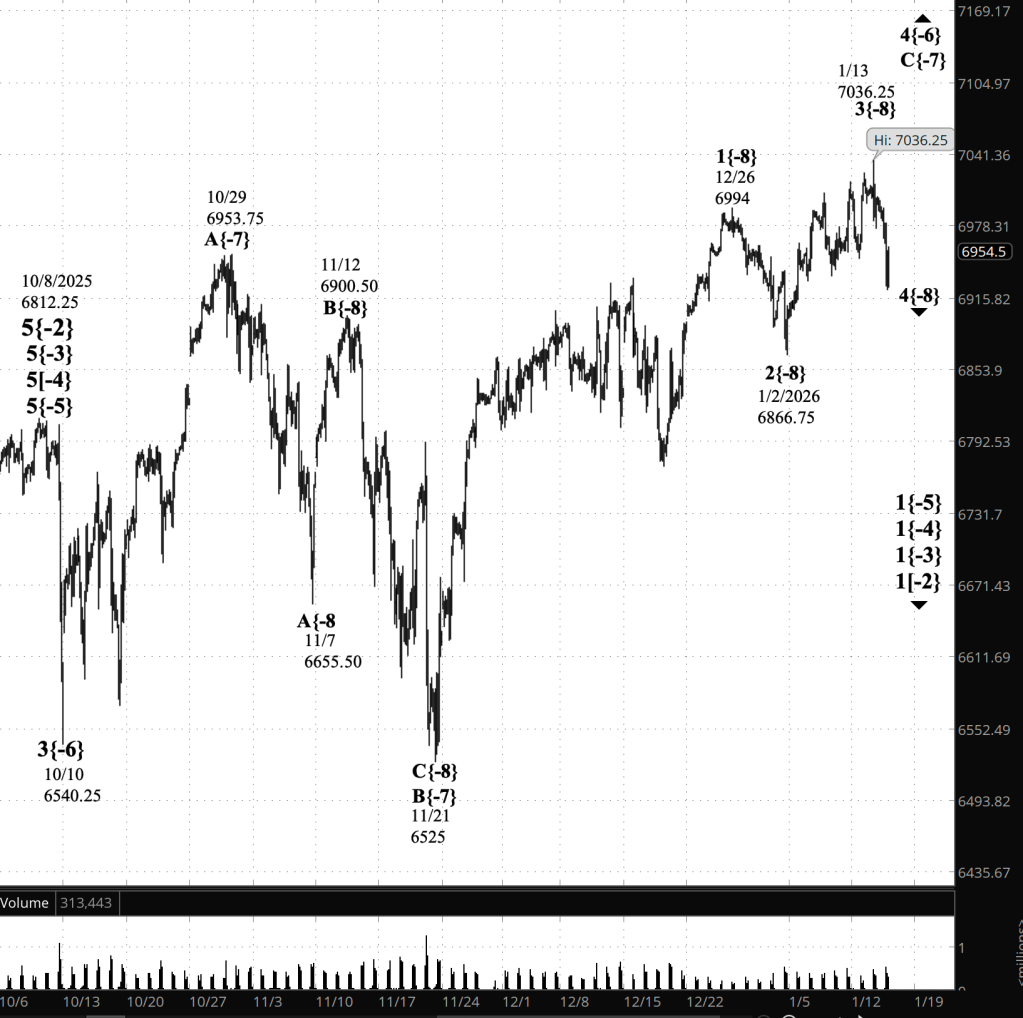
Trader’s Notebook: S&P 500

3:30 p.m. New York time.

Half an hour before the closing bell. The S&P 500 futures turned from the high, 6802.75, and rapidly declined into the 6740s.

Elliott Wave Theory: The ground covered by the decline has persuaded me that wave C{-14} ended at the peak and wave X{-14} is now underway. An X wave connects two three-wave corrective patterns (built of waves A, B and C waves) in a complex correction. This 4th wave is taking a complex form. We know this because wave C carried the price well above it’s maximum under the rules of Elliott Wave Theory. That broke a rule. But in a complex correction, the rule isn’t broken.

As always when a stock turns on a dime, it’s possible that it’s a head fake, that it will whip around and wipe out the old high with a new one. Should that happen, then we’re back to wave C with wave 4, blushing slightly.

9:35 a.m. New York time.

What’s happening now. The S&P 500 E-mini futures rose to a higher all-time high, 6802.75, as the opening bell approached.

What does it mean?  The new high, when Elliott Wave Theory analysis is applied, clarifies the wave structure on the chart. Rising wave C, which began on September 30, is still underway with the 4th-wave upward correction that began on September 25.

[S&P 500 E-mini futures at 3:30 p.m., 30-minute bars, with volume] 

Waves Now Underway

These are the waves currently in progress under my principal analysis. Each line on the list shows the wave number, with the subscript in curly brackets, the traditional degree name, the starting date, the starting price of the S&P 500 E-mini futures, and the direction of the wave.

  • S&P 500 Index:
  • 5{+3} Supercycle, 7/8/1932, 4.40 (up)
  • 5{+2} Cycle, 12/9/1974, 60.96 (up)
  • 5{+1} Primary, 3/6/2009, 666.79 (up)
  • 5{0} Intermediate, 2/11/2016, 1810.10 (up)
  • 3{-1} Minor, 3/23/2020, 2191.36 (up)
  • 1{-2} Minute, 7/31/2025, 6468.50 (down)
  • S&P 500 Futures
  • 1{-3} Minuette, 10/13/2022, 4603 (up)
  • 1{-4} Subminuette, 4/7/2025, 4832 (up)
  • 3{-5} Micro, 4/21/2025, 5127.25 (up)
  • 5{-6} Submicro, 8/1/2025, 6249.50 (up)
  • 1{-7} Minuscule, 8/1/2025, 6349.50 (up)
  • 3{-8} (unnamed), 8/5/2025, 6313.25 (up)
  • 4{-9} (unnamed), 8/14/2025, 6508.75 (down)
  • C{-10} (unnamed), 9/22/2025, 6756.75 (down)
  • 1{-11} (unnamed), 9/22/2025, 6756.75 (down)
  • 3{-12} (unnamed), 9/24/2025, 6728.50 (down)
  • 4{-13} (unnamed), 9/25/2025, 6624.25 (up)
  • X{-14} (unnamed), 10/7/2025, 6802.75 (down)

Reading the chart. Price movements — waves – – in Elliott Wave Theory analysis are labeled with numbers within trending waves and letters with corrective waves. The subscripts — numbers in curly brackets — designate the wave’s degree, which, in Elliott Wave analysis, means the relative position of a wave within the larger and smaller structures that make up the chart. R.N. Elliott, who in the 1930s developed the form of analysis that bears his name, viewed the chart as a complex structure of smaller waves nested within larger waves, which in turn are nested within still larger waves. In mathematics it’s called a fractal structure, where at every scale the pattern is similar to the others.

Learning and other resources. Elliott Wave analysis provides context, not prophecy. As the 20th century semanticist Alfred Korzybski put it in his book Science and Sanity (1933), “The map is not the territory … The only usefulness of a map depends on similarity of structure between the empirical world and the map.” And I would add, in the ever-changing markets, we can judge that similarity of structure only after the fact.

See the menu page Analytical Methods for a rundown on where to go for information on Elliott Wave analysis.

By Tim Bovee, Portland, Oregon, October 7, 2025

Disclaimer

Tim Bovee, Private Trader tracks the analysis and trades of a private trader for his own accounts. Nothing in this blog constitutes a recommendation to buy or sell stocks, options or any other financial instrument. The only purpose of this blog is to provide education and entertainment.

No trader is ever 100 percent successful in his or her trades. Trading in the stock and option markets is risky and uncertain. Each trader must make trading decisions for his or her own account, and take responsibility for the consequences.

All content on Tim Bovee, Private Trader by Timothy K. Bovee is licensed under a Creative Commons Attribution-ShareAlike 4.0 International License.

License

Based on work at www.timbovee.com
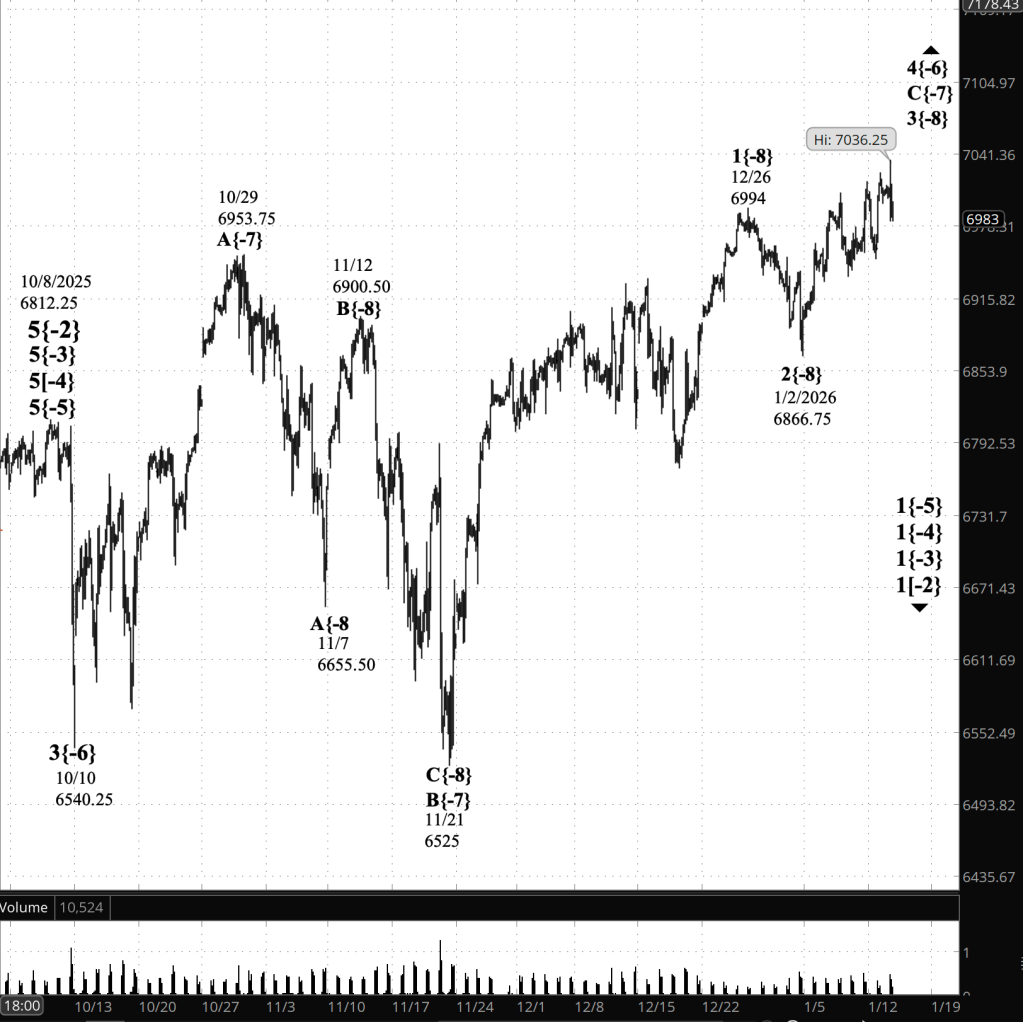
Trader’s Notebook: S&P 500

3:30 p.m. New York time

Half an hour before the closing bell. The S&P 500 futures dropped back into the 6760s during the session and then rose back into 6790s. This morning’s Elliott Wave Theory analysis is unchanged. Wave C within a 4th-wave upward correction continues and is the principal analysis, and the alternative says that wave C ended on October 3 at 6800.

9:35 a.m. New York time.

What’s happening now. The S&P 500 E-mini futures opened at 6767 when trading resumed over night and began to rise, reaching into the 6790s.

What does it mean?  The rise, Elliott Wave Theory analysis concludes, is a subwave of the risng C wave that began on September 30. The parent wave is the 4th-wqve upward correction that began on September 25.

It is possible to view wave C as having ended at 6800 on October 3. The parent 4th wave is taking the form of a complex correction, so if wave C is not the end of wave 4. Instead, it will be followed by a connector, declining wave X, and then by a second three-wave corrective patteern.

[S&P 500 E-mini futures at 3:50 p.m., 25-minute bars, with volume] 

Waves Now Underway

These are the waves currently in progress under my principal analysis. Each line on the list shows the wave number, with the subscript in curly brackets, the traditional degree name, the starting date, the starting price of the S&P 500 E-mini futures, and the direction of the wave.

  • S&P 500 Index:
  • 5{+3} Supercycle, 7/8/1932, 4.40 (up)
  • 5{+2} Cycle, 12/9/1974, 60.96 (up)
  • 5{+1} Primary, 3/6/2009, 666.79 (up)
  • 5{0} Intermediate, 2/11/2016, 1810.10 (up)
  • 3{-1} Minor, 3/23/2020, 2191.36 (up)
  • 1{-2} Minute, 7/31/2025, 6468.50 (down)
  • S&P 500 Futures
  • 1{-3} Minuette, 10/13/2022, 4603 (up)
  • 1{-4} Subminuette, 4/7/2025, 4832 (up)
  • 3{-5} Micro, 4/21/2025, 5127.25 (up)
  • 5{-6} Submicro, 8/1/2025, 6249.50 (up)
  • 1{-7} Minuscule, 8/1/2025, 6349.50 (up)
  • 3{-8} (unnamed), 8/5/2025, 6313.25 (up)
  • 4{-9} (unnamed), 8/14/2025, 6508.75 (down)
  • C{-10} (unnamed), 9/22/2025, 6756.75 (down)
  • 1{-11} (unnamed), 9/22/2025, 6756.75 (down)
  • 3{-12} (unnamed), 9/24/2025, 6728.50 (down)
  • 4{-13} (unnamed), 9/25/2025, 6624.25 (up)
  • C{-14} (unnamed), 9/30/2025, 6680.00 (up)

Reading the chart. Price movements — waves – – in Elliott Wave Theory analysis are labeled with numbers within trending waves and letters with corrective waves. The subscripts — numbers in curly brackets — designate the wave’s degree, which, in Elliott Wave analysis, means the relative position of a wave within the larger and smaller structures that make up the chart. R.N. Elliott, who in the 1930s developed the form of analysis that bears his name, viewed the chart as a complex structure of smaller waves nested within larger waves, which in turn are nested within still larger waves. In mathematics it’s called a fractal structure, where at every scale the pattern is similar to the others.

Learning and other resources. Elliott Wave analysis provides context, not prophecy. As the 20th century semanticist Alfred Korzybski put it in his book Science and Sanity (1933), “The map is not the territory … The only usefulness of a map depends on similarity of structure between the empirical world and the map.” And I would add, in the ever-changing markets, we can judge that similarity of structure only after the fact.

See the menu page Analytical Methods for a rundown on where to go for information on Elliott Wave analysis.

By Tim Bovee, Portland, Oregon, October 6 , 2025

Disclaimer

Tim Bovee, Private Trader tracks the analysis and trades of a private trader for his own accounts. Nothing in this blog constitutes a recommendation to buy or sell stocks, options or any other financial instrument. The only purpose of this blog is to provide education and entertainment.

No trader is ever 100 percent successful in his or her trades. Trading in the stock and option markets is risky and uncertain. Each trader must make trading decisions for his or her own account, and take responsibility for the consequences.

All content on Tim Bovee, Private Trader by Timothy K. Bovee is licensed under a Creative Commons Attribution-ShareAlike 4.0 International License.

License

Based on work at www.timbovee.com
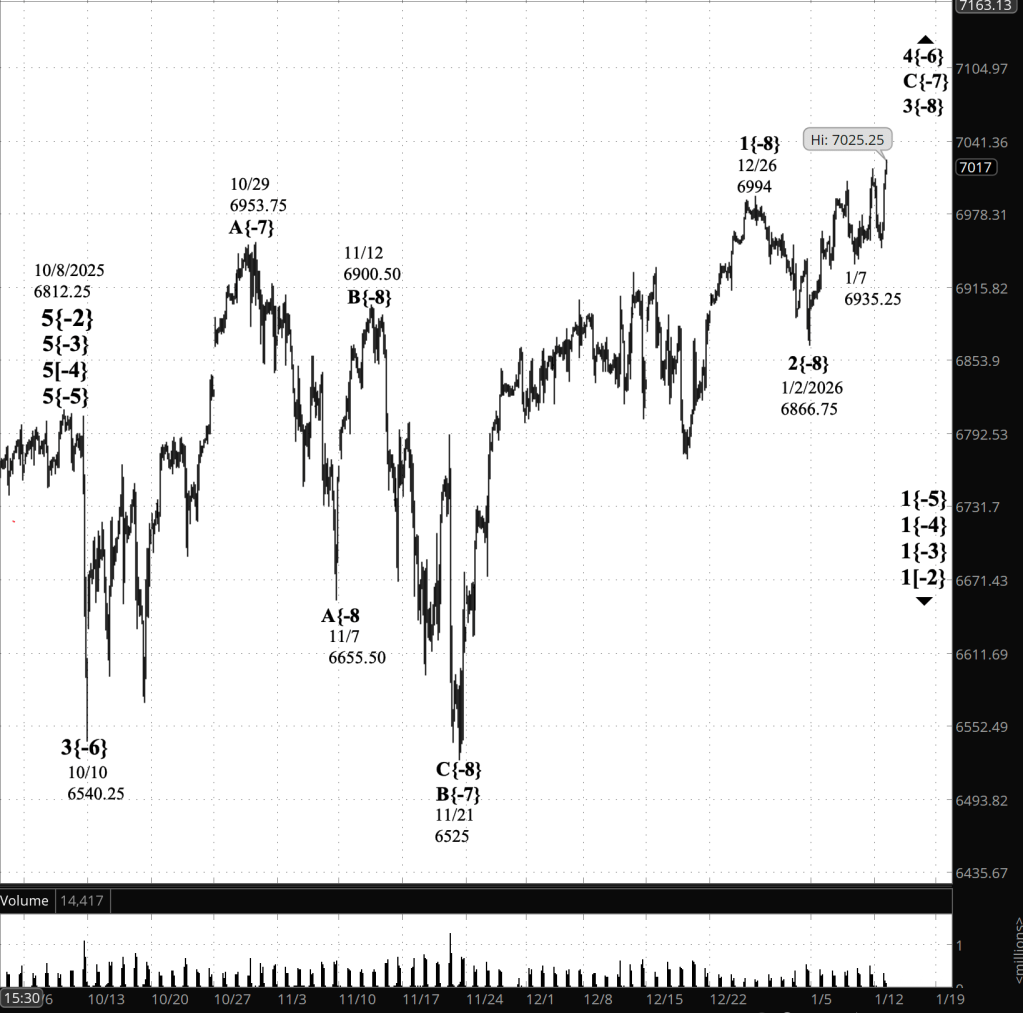
Trader’s Notebook: S&P 500

3:30 p.m. New York time

Half an hour before the closing bell. The S&P 500 futures fell from the late overnight peak, 6800, reaching 6754, and then rose back into the 6770s.

Elliott Wave Theory once again raises the question, is the peak a stopping point as wave C within the 4th-wave upward correction continues? Or is it the end of wave C and the start of a wave X separator between the first corrective pattern and a second corrective pattern in a complex 4th-wave correction?

The answer lies in the future. What we know now is that the lower the price goes, the more likely the X-wave scenario, and the higher it rises, the more likely it is that wave C continues. At this point, I’m sticking with wave C because that’s the status quo.

9:35 a.m. New York time.

What’s happening now. The S&P 500 E-mini futures climbed higher overnight, reaching a new peak, 6787.50, and then fell back into the 6760s.

What does it mean? I’ve modified the locations of waves A and B within the Elliott Wave Theory analysis. See yesterday’s chart (October 2) for the previous locations. Subsequent events clarified where the locations should be, with better proportions.

Otherwise, wave C withi the 4th-wave upward correction continues its rise-and-retracement journey.

[S&P 500 E-mini futures at 3:30 p.m., 25-minute bars, with volume] 

Waves Now Underway

These are the waves currently in progress under my principal analysis. Each line on the list shows the wave number, with the subscript in curly brackets, the traditional degree name, the starting date, the starting price of the S&P 500 E-mini futures, and the direction of the wave.

  • S&P 500 Index:
  • 5{+3} Supercycle, 7/8/1932, 4.40 (up)
  • 5{+2} Cycle, 12/9/1974, 60.96 (up)
  • 5{+1} Primary, 3/6/2009, 666.79 (up)
  • 5{0} Intermediate, 2/11/2016, 1810.10 (up)
  • 3{-1} Minor, 3/23/2020, 2191.36 (up)
  • 1{-2} Minute, 7/31/2025, 6468.50 (down)
  • S&P 500 Futures
  • 1{-3} Minuette, 10/13/2022, 4603 (up)
  • 1{-4} Subminuette, 4/7/2025, 4832 (up)
  • 3{-5} Micro, 4/21/2025, 5127.25 (up)
  • 5{-6} Submicro, 8/1/2025, 6249.50 (up)
  • 1{-7} Minuscule, 8/1/2025, 6349.50 (up)
  • 3{-8} (unnamed), 8/5/2025, 6313.25 (up)
  • 4{-9} (unnamed), 8/14/2025, 6508.75 (down)
  • C{-10} (unnamed), 9/22/2025, 6756.75 (down)
  • 1{-11} (unnamed), 9/22/2025, 6756.75 (down)
  • 3{-12} (unnamed), 9/24/2025, 6728.50 (down)
  • 4{-13} (unnamed), 9/25/2025, 6624.25 (up)
  • C{-14} (unnamed), 9/25/2025, 6657.25 (up)

Reading the chart. Price movements — waves – – in Elliott Wave Theory analysis are labeled with numbers within trending waves and letters with corrective waves. The subscripts — numbers in curly brackets — designate the wave’s degree, which, in Elliott Wave analysis, means the relative position of a wave within the larger and smaller structures that make up the chart. R.N. Elliott, who in the 1930s developed the form of analysis that bears his name, viewed the chart as a complex structure of smaller waves nested within larger waves, which in turn are nested within still larger waves. In mathematics it’s called a fractal structure, where at every scale the pattern is similar to the others.

Learning and other resources. Elliott Wave analysis provides context, not prophecy. As the 20th century semanticist Alfred Korzybski put it in his book Science and Sanity (1933), “The map is not the territory … The only usefulness of a map depends on similarity of structure between the empirical world and the map.” And I would add, in the ever-changing markets, we can judge that similarity of structure only after the fact.

See the menu page Analytical Methods for a rundown on where to go for information on Elliott Wave analysis.

By Tim Bovee, Portland, Oregon, October 3 , 2025

Disclaimer

Tim Bovee, Private Trader tracks the analysis and trades of a private trader for his own accounts. Nothing in this blog constitutes a recommendation to buy or sell stocks, options or any other financial instrument. The only purpose of this blog is to provide education and entertainment.

No trader is ever 100 percent successful in his or her trades. Trading in the stock and option markets is risky and uncertain. Each trader must make trading decisions for his or her own account, and take responsibility for the consequences.

All content on Tim Bovee, Private Trader by Timothy K. Bovee is licensed under a Creative Commons Attribution-ShareAlike 4.0 International License.

License

Based on work at www.timbovee.com

Trader’s Notebook: S&P 500

3:30 p.m. New York time

Half an hour before the closing bell. The S&P 500 futures began to fall from its overnight peak, 6782.25, before the opening bell, reached 6741.50, and rose back the 6770s.

Elliott Wave Theory: Wave C within a 4th-wave upward correction continues.

9:35 a.m. New York time.

What’s happening now. The S&P 500 E-mini futures rose overnight, reaching into the 6780s, a new peak. It then fell sharply as the opening bell sounded.

What does it mean? The Elliott Wave Theory count has wave C underway within the rising 4th-wave upward correction that began September 25 from 6624.25. Wave 4 is taking the form of a complex correction. The first corrective pattern — waves A, B, and C — within wave 4 is nearing its end. A declining X wave will follow, and then a second three-wave corrective pattern will begin. Complex corrections can contain up to three corrective patterns.

When wave 4 finallly ends, a downtrending 5th wave will follow, mostly likely carrying the price below the 4th-wave starting point.

[S&P 500 E-mini futures at 3:30 p.m., 20-minute bars, with volume] 

Waves Now Underway

These are the waves currently in progress under my principal analysis. Each line on the list shows the wave number, with the subscript in curly brackets, the traditional degree name, the starting date, the starting price of the S&P 500 E-mini futures, and the direction of the wave.

  • S&P 500 Index:
  • 5{+3} Supercycle, 7/8/1932, 4.40 (up)
  • 5{+2} Cycle, 12/9/1974, 60.96 (up)
  • 5{+1} Primary, 3/6/2009, 666.79 (up)
  • 5{0} Intermediate, 2/11/2016, 1810.10 (up)
  • 3{-1} Minor, 3/23/2020, 2191.36 (up)
  • 1{-2} Minute, 7/31/2025, 6468.50 (down)
  • S&P 500 Futures
  • 1{-3} Minuette, 10/13/2022, 4603 (up)
  • 1{-4} Subminuette, 4/7/2025, 4832 (up)
  • 3{-5} Micro, 4/21/2025, 5127.25 (up)
  • 5{-6} Submicro, 8/1/2025, 6249.50 (up)
  • 1{-7} Minuscule, 8/1/2025, 6349.50 (up)
  • 3{-8} (unnamed), 8/5/2025, 6313.25 (up)
  • 4{-9} (unnamed), 8/14/2025, 6508.75 (down)
  • C{-10} (unnamed), 9/22/2025, 6756.75 (down)
  • 1{-11} (unnamed), 9/22/2025, 6756.75 (down)
  • 3{-12} (unnamed), 9/24/2025, 6728.50 (down)
  • 4{-13} (unnamed), 9/25/2025, 6624.25 (up)
  • C{-14} (unnamed), 9/25/2025, 6657.25 (up)

Reading the chart. Price movements — waves – – in Elliott Wave Theory analysis are labeled with numbers within trending waves and letters with corrective waves. The subscripts — numbers in curly brackets — designate the wave’s degree, which, in Elliott Wave analysis, means the relative position of a wave within the larger and smaller structures that make up the chart. R.N. Elliott, who in the 1930s developed the form of analysis that bears his name, viewed the chart as a complex structure of smaller waves nested within larger waves, which in turn are nested within still larger waves. In mathematics it’s called a fractal structure, where at every scale the pattern is similar to the others.

Learning and other resources. Elliott Wave analysis provides context, not prophecy. As the 20th century semanticist Alfred Korzybski put it in his book Science and Sanity (1933), “The map is not the territory … The only usefulness of a map depends on similarity of structure between the empirical world and the map.” And I would add, in the ever-changing markets, we can judge that similarity of structure only after the fact.

See the menu page Analytical Methods for a rundown on where to go for information on Elliott Wave analysis.

By Tim Bovee, Portland, Oregon, October 2 , 2025

Disclaimer

Tim Bovee, Private Trader tracks the analysis and trades of a private trader for his own accounts. Nothing in this blog constitutes a recommendation to buy or sell stocks, options or any other financial instrument. The only purpose of this blog is to provide education and entertainment.

No trader is ever 100 percent successful in his or her trades. Trading in the stock and option markets is risky and uncertain. Each trader must make trading decisions for his or her own account, and take responsibility for the consequences.

All content on Tim Bovee, Private Trader by Timothy K. Bovee is licensed under a Creative Commons Attribution-ShareAlike 4.0 International License.

License

Based on work at www.timbovee.com

Trader’s Notebook: S&P 500

3:30 p.m. New York time

Half an hour before the closing bell. The S&P 500 rose sharply during the session, exceeding the previous peak.

Elliott Wave Theory: The new high also confirmed that wave C within a 4th-wave upward correction that began on September 5 is underway.

There was a possibility, discussed in the morning analysis, that the September 30 peak was the end of wave C, and that the decline that followed was an X wave, connecting the first three-wave corrective pattern with a second such pattern in a complex correction.

The complex correction by my count will happen. But the first corrective pattern is still underway.

Wave C is expected to end somewhere between 6765 and 6800, based on the size of other waves in the structure, keeping in mind that forecasting is an informed guess at its best. I’m never surprised when a forecast fails to hit the mark.

9:35 a.m. New York time.

What’s happening now. The S&P 500 E-mini futures fell overnight, down to 6680, as the federal government partially shutdown over a funding bill dispute in Congress. The price then reversed, rising back into the 6710s.

What does it mean? Elliott Wave Theory sees a couple of possibilities here. One is that we’re in the midst of yet another falling subwave within rising wave C of a rising 4th-wave correction. If that’s the case, then wave C will likely exceed the prior high, 6743.50, as wave C continues.

Alternatively, as wave C carried the parent 4th wave into the territory of the preceding 1st wave, it became clear that wave 4 was tracing a complex correction pattern. Most corrective waves have three subwaves — A, B and C. Typically, that’s the end of the correction. In complex corrections, the three-wave corrective pattern is followed by a separator wave — an X-wave in the earlier Elliott Wave Theory nomenclature, which I still use. It’s possible that September 30 peak was the end of wave C, and decline that followed, still underway, is wave X, to be followed by another three-wave corrective pattern within wave 4. A complex correction can contain up to three corrective patterns.

[S&P 500 E-mini futures at 3:30 p.m., 20-minute bars, with volume] 

Waves Now Underway

These are the waves currently in progress under my principal analysis. Each line on the list shows the wave number, with the subscript in curly brackets, the traditional degree name, the starting date, the starting price of the S&P 500 E-mini futures, and the direction of the wave.

  • S&P 500 Index:
  • 5{+3} Supercycle, 7/8/1932, 4.40 (up)
  • 5{+2} Cycle, 12/9/1974, 60.96 (up)
  • 5{+1} Primary, 3/6/2009, 666.79 (up)
  • 5{0} Intermediate, 2/11/2016, 1810.10 (up)
  • 3{-1} Minor, 3/23/2020, 2191.36 (up)
  • 1{-2} Minute, 7/31/2025, 6468.50 (down)
  • S&P 500 Futures
  • 1{-3} Minuette, 10/13/2022, 4603 (up)
  • 1{-4} Subminuette, 4/7/2025, 4832 (up)
  • 3{-5} Micro, 4/21/2025, 5127.25 (up)
  • 5{-6} Submicro, 8/1/2025, 6249.50 (up)
  • 1{-7} Minuscule, 8/1/2025, 6349.50 (up)
  • 3{-8} (unnamed), 8/5/2025, 6313.25 (up)
  • 4{-9} (unnamed), 8/14/2025, 6508.75 (down)
  • C{-10} (unnamed), 9/22/2025, 6756.75 (down)
  • 1{-11} (unnamed), 9/22/2025, 6756.75 (down)
  • 3{-12} (unnamed), 9/24/2025, 6728.50 (down)
  • 4{-13} (unnamed), 9/25/2025, 6624.25 (up)
  • C{-14} (unnamed), 9/25/2025, 6657.25 (up)

Reading the chart. Price movements — waves – – in Elliott Wave Theory analysis are labeled with numbers within trending waves and letters with corrective waves. The subscripts — numbers in curly brackets — designate the wave’s degree, which, in Elliott Wave analysis, means the relative position of a wave within the larger and smaller structures that make up the chart. R.N. Elliott, who in the 1930s developed the form of analysis that bears his name, viewed the chart as a complex structure of smaller waves nested within larger waves, which in turn are nested within still larger waves. In mathematics it’s called a fractal structure, where at every scale the pattern is similar to the others.

Learning and other resources. Elliott Wave analysis provides context, not prophecy. As the 20th century semanticist Alfred Korzybski put it in his book Science and Sanity (1933), “The map is not the territory … The only usefulness of a map depends on similarity of structure between the empirical world and the map.” And I would add, in the ever-changing markets, we can judge that similarity of structure only after the fact.

See the menu page Analytical Methods for a rundown on where to go for information on Elliott Wave analysis.

By Tim Bovee, Portland, Oregon, October 1 , 2025

Disclaimer

Tim Bovee, Private Trader tracks the analysis and trades of a private trader for his own accounts. Nothing in this blog constitutes a recommendation to buy or sell stocks, options or any other financial instrument. The only purpose of this blog is to provide education and entertainment.

No trader is ever 100 percent successful in his or her trades. Trading in the stock and option markets is risky and uncertain. Each trader must make trading decisions for his or her own account, and take responsibility for the consequences.

All content on Tim Bovee, Private Trader by Timothy K. Bovee is licensed under a Creative Commons Attribution-ShareAlike 4.0 International License.

License

Based on work at www.timbovee.com

Trader’s Notebook: S&P 500

3:30 p.m. New York time

Half an hour before the closing bell. Half an hour before the closing bell, S&P 500 futures recovered into the 6720s after dipping to an earlier session low of 6693. the price rose quickly into the 6730s as the closing bell drew nearer.

Elliott Wave Theory: A downtrendng subwave within the 4th-wave upward correction that began four days ago is now in its final subwave. When the subwave is complete, the parent wave 4 will continue its rise.

Elliott Wave Theory:

  • The market remains inside a 4th-wave upward correction that began four days ago.
  • Within that structure, today’s action reflects a downtrending subwave now entering its final leg (C{-14}).
  • Once this subwave completes, the parent wave 4{-13} should resume its upward movement.

Forward-Looking Markers:

A break and close below 6690 would delay this scenario, suggesting a deeper retest of the 6650 region before wave 4{-13} resumes.

A confirmed completion of C{-14} would project wave 4{-13} upward into the 6745–6775 zone as the next resistance band.

9:35 a.m. New York time.

What’s happening now. The S&P 500 E-mini futures declined to 6694.25 overnight and then rose back into the 6710s as the session’s open approached.

What does it mean? As Elliott Wave Theory sees it, the decline is a subwave within wave C, a subwave of the 4th-wave upward correction that began on September 25. When the present small downard correction is done, wave C within the upward correction will continue its rise.

When wave C is complete, it will be followed by a falling X wave and then a second three-wave corrective patter, making wave 4 a complex correction.

[S&P 500 E-mini futures at 3:30 p.m., 15-minute bars, with volume] 

Waves Now Underway

These are the waves currently in progress under my principal analysis. Each line on the list shows the wave number, with the subscript in curly brackets, the traditional degree name, the starting date, the starting price of the S&P 500 E-mini futures, and the direction of the wave.

  • S&P 500 Index:
  • 5{+3} Supercycle, 7/8/1932, 4.40 (up)
  • 5{+2} Cycle, 12/9/1974, 60.96 (up)
  • 5{+1} Primary, 3/6/2009, 666.79 (up)
  • 5{0} Intermediate, 2/11/2016, 1810.10 (up)
  • 3{-1} Minor, 3/23/2020, 2191.36 (up)
  • 1{-2} Minute, 7/31/2025, 6468.50 (down)
  • S&P 500 Futures
  • 1{-3} Minuette, 10/13/2022, 4603 (up)
  • 1{-4} Subminuette, 4/7/2025, 4832 (up)
  • 3{-5} Micro, 4/21/2025, 5127.25 (up)
  • 5{-6} Submicro, 8/1/2025, 6249.50 (up)
  • 1{-7} Minuscule, 8/1/2025, 6349.50 (up)
  • 3{-8} (unnamed), 8/5/2025, 6313.25 (up)
  • 4{-9} (unnamed), 8/14/2025, 6508.75 (down)
  • C{-10} (unnamed), 9/22/2025, 6756.75 (down)
  • 1{-11} (unnamed), 9/22/2025, 6756.75 (down)
  • 3{-12} (unnamed), 9/24/2025, 6728.50 (down)
  • 4{-13} (unnamed), 9/25/2025, 6624.25 (up)
  • C{-14} (unnamed), 9/25/2025, 6657.25 (up)

Reading the chart. Price movements — waves – – in Elliott Wave Theory analysis are labeled with numbers within trending waves and letters with corrective waves. The subscripts — numbers in curly brackets — designate the wave’s degree, which, in Elliott Wave analysis, means the relative position of a wave within the larger and smaller structures that make up the chart. R.N. Elliott, who in the 1930s developed the form of analysis that bears his name, viewed the chart as a complex structure of smaller waves nested within larger waves, which in turn are nested within still larger waves. In mathematics it’s called a fractal structure, where at every scale the pattern is similar to the others.

Learning and other resources. Elliott Wave analysis provides context, not prophecy. As the 20th century semanticist Alfred Korzybski put it in his book Science and Sanity (1933), “The map is not the territory … The only usefulness of a map depends on similarity of structure between the empirical world and the map.” And I would add, in the ever-changing markets, we can judge that similarity of structure only after the fact.

See the menu page Analytical Methods for a rundown on where to go for information on Elliott Wave analysis.

By Tim Bovee, Portland, Oregon, September 30 , 2025

Disclaimer

Tim Bovee, Private Trader tracks the analysis and trades of a private trader for his own accounts. Nothing in this blog constitutes a recommendation to buy or sell stocks, options or any other financial instrument. The only purpose of this blog is to provide education and entertainment.

No trader is ever 100 percent successful in his or her trades. Trading in the stock and option markets is risky and uncertain. Each trader must make trading decisions for his or her own account, and take responsibility for the consequences.

All content on Tim Bovee, Private Trader by Timothy K. Bovee is licensed under a Creative Commons Attribution-ShareAlike 4.0 International License.

License

Based on work at www.timbovee.com