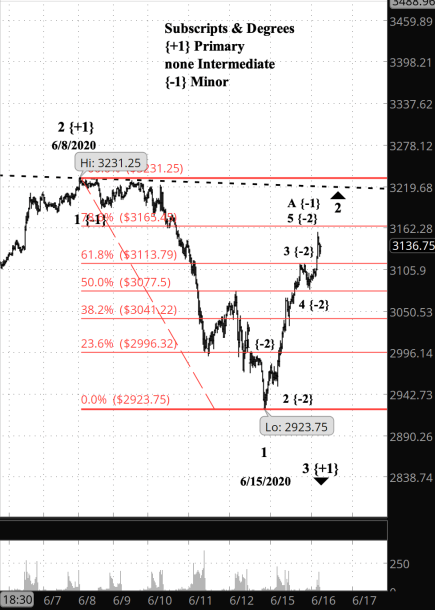
What’s happening now? The S&P 500 E-mini futures continue rising, nearing the 78.6% Fibonacci retracement point. Since the upward correction began on June 15, only yesterday, the price has risen by 8%, to a correction peak so far of 3156.25
What does it mean? Soon, perhaps today, the price will reverse to the downside, the next step in the upward correction, and then will again rise to set a new high within the upward correction, while staying below 3231.25, the price from which the downtrend began.
S&P 500 E-mini futures, 30-minute bars
What does Elliott wave theory say? The S&P 500 is within the 5th subwave of a Minor wave A, the first wave of what is probably going to turn out to be a zigzag pattern. The next step will be three subwaves down, the Minor B wave, to be followed by a 5-wave movement up, the Minor C wave, which in all likelihood will complete Intermediate wave 2 within Primary wave 3. Following Intermediate 2 comes Intermediate wave 3, which will carry the price down to new lows since the June 8 peak.
What is the alternative? A move above 3231.25 would for a rethinking of the count since June 8, when Primary wave 3 began.
What about my trades? I’m out of options and am staying out for now, as I wait for Intermediate wave 3 to begin. I’m holding on to my SDS shares, which move the opposite of the S&P 500, as I wait for the last stages of Intermediate wave 3.
I’ve posted results of today’s exit from my SPY options position.
9:45 a.m. New York time
I have exited my short bear call spreads on SPY for 54% of maximum potential profit and shall update the entry analysis shortly with results.
9:35 a.m. New York time
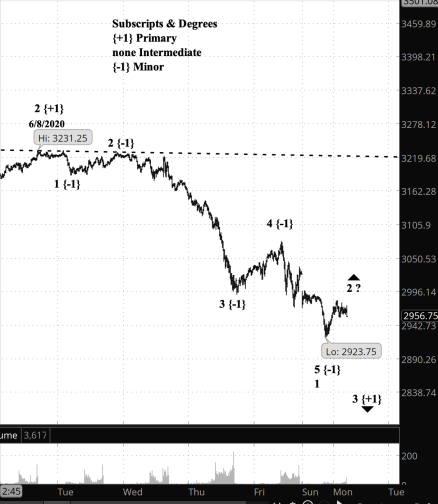
What’s happening now? The S&P 500 E-mini futures continue in their downtrend, which began June 8 at 3231.25. The low so far is 2923.75 this morning before the opening bell.
What does it mean? The meaning at this point is a question: Is the decline nearing an end? How I manage my present options and stock positions depend upon the how that question is answered.
What does Elliott wave theory say? By my count, the index is in Minor wave 5 of Intermediate wave 1 to the downside. Once Intermediate 1 is complete, the next move will be an upward correction, Intermediate wave 2, most likely a zig-zag that could retrace a significant portion of the decline from June 8. All of this is happening within Primary wave 3 to the downside.
Intermediate 1 within Primary wave 3 has so far declined by 9.5% since it began on June 8. Its counterpart, within Primary wave 1, began February 19 and declined by 16%. There’s no rule on how long a 5th wave must be. Minor wave 5 could be nearing completion in the next few days. It could have ended at this morning’s low. It has met all of the requirements of form described in Elliott wave theory.
What is the alternative? … or, Minor wave 5 could extend and cover more ground to the downside before it reverses. There’s no way to tell at this point. And a lot is at stake.
What about my trades? For my short bear call spread options on SPY, the cautious approach counsels exiting now or buying insurance, in the form of a bull put spread, rather than hanging on in the hope of greater profit. Yet, if Minor wave 5 extends downward, I’m leaving a lot of potential profit on the table.
The next wave up, a 2nd wave of Intermediate degree, could retrace as much as 90% of the 1st wave of Intermediate degree, pushing the price back up to the 3100s or the 3200s, with no guarantee of how long it would take for the price to get back down to the 2900s where it is today. Intermediate wave 2 within Primary wave 1 lasted four days, but that came after a particularly energetic decline. I would be surprised if Intermediate 2’s counterpart in the present Primary wave 3 took such a short time.
Basically, it’s a matter of timing. If I exit then I can re-enter with an August expiration at the start of Intermediate wave 3.
My share holdings in SDS have no expiration, of course, so I’ll continue to hold the shares for now.
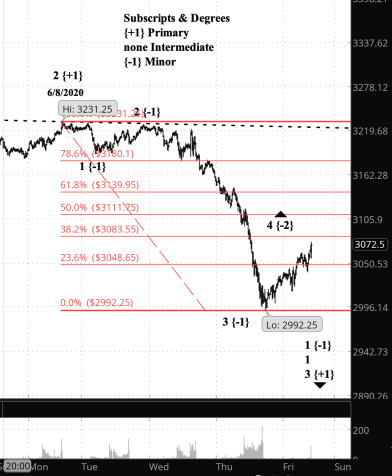
What’s happening now? The S&P 500 E-mini futures declined to 2992.25 at the end of the day Thursday and then bounced back, retracing 24% of the decline that began June 8.
What does it mean? The upward move from late yesterday is a correction within the larger downtrend. Once it is complete, the downtrend will resume with a great deal of power.
S&P 500 E-mini futures 15-minute bars
What does Elliott wave theory say? I’ve moved the wave degrees on yesterday’s chart up one, and it might well change against as Primary wave 3 plays out its downward course. I’ve also superimposed the Fibonacci retracements. The present correction is a 4th wave of Minor degree within the 1st wave of Intermediate degree. Fourth waves tend to be on the shallow side. I’ve seen many halt around the 38.2% Fibonacci level. Often the 4th will end within the 4th subwave wave of the 3rd subwave, which would be a between a 50% and a 61.8% retracement. Neither would be outside the mainstream of 4th waves and would put the price around 3140.
I don’t want to lose sight of the fact that all of this detail is playing out within the 1st Intermediate wave of the 3rd Primary wave. The Primary wave 1, beginning in February, lasted 32 days and declined by 36%. The present Primary wave 3 so far has lasted four days and declined by 7.4%. Within Primary wave 1, Intermediate wave 1 lasted nine days and fell by 16%. As the start of the crash it was exceptionally rapid. Such a decline in the present Intermediate wave 1 would bring the index’s price down to 2687. If Primary wave 3 were to equal Primary 1, then it would drop to below 2008.
We have far more to distance to cover in this downtrend, even at the Primary level, which is a lower degree, considering that that correction stretches all the way up to the Grand Supercycle degree, three levels above Primary.
What is the alternative? I have no alternatives at this point.
What about my trades? Having entered my first options position of Primary wave 3 (and posted an analysis), my next decision is when to enter another. I want at least three days between entries (totally arbitrary), which pushes the decision into next week. My inclination at this point is to wait for the Minor wave 2 correction to the upside within Intermediate wave 3.
I shall hold on to my existing position through the present Minor wave 2 correction.
Update 6/15/2020: I exited my short bear call spread on SPY for 54.5% of maximum potential profit. The debit at exit was $0.30, compared to an entry credit of $0.66, with shares trading at $297.50, down from $309.38 at entry.
SPY declined steadily after I entered the position on June 11, with the implied volatility rank rising to 47%, which is 13.7 points above its entry level.
I made the entry and exit decisions based on Elliott wave analysis. SPY was in the middle of Minor wave 3 within Intermediate wave 1 of Primary wave 3 at the time of entry. At exit it was in Minor wave 5 and possibly nearing an end.
Shares declined by 3.8% over four days for a -13% annual rate. The options position produced a return of 23.3% for a +10,950% annual rate.
I have entered a short bear call spread on SPY, using options that trade for the last time 36 days hence, on July 17. The premium is a $0.66 credit per contract share and the stock at the time of entry was priced at $309.38.
The implied volatility rank (IVR) stands at 33.3%.
Premium:
$0.66
Expire OTM
SPY-bear call spread
Strike
Odds
Delta
Calls
Long
333.00
86.0%
18
Break-even
328.34
84.0%
20
Short
329.00
82.0%
22
The premium is 33% of the width of the position’s wing.
The profit zone covers a 6.1% move to the upside.
The risk/reward ratio is 5.1:1, with maximum risk of $334 and maximum reward of $66 per contract.
I’ve entered a short bear call options spread position on SPY and have posted the analysis.
9:55 a.m. New York time
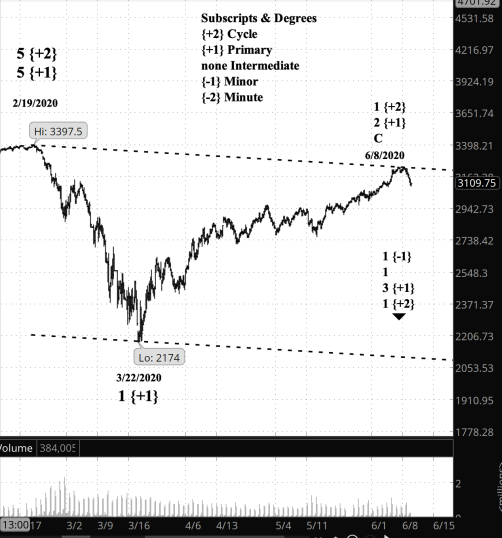
Big picture: What has happened since February, when the market decline began.
S&P 500 E-mini futures, 4-hour bars
9:40 a.m. New York time
What’s happening now? The S&P 500 E-mini futures have begun a major decline, ending a rise that began on March 22. The S&P 500 exchange-traded fund SPY began the day with a -2.4% opening gap. The Relative Strength Index (RSI), which had peaked in overbought territory, at 74.27 on June 8, and at the opening bell stood at 58.44, further evidence that a significant decline has begun.
What does it mean? The decline likely will be the longest and the most energetic downtrend of the bear market that began in February, working its way down within a channel whose lower boundary today stands at about 2090 and in each subsequent day will become lower each subsequent day.
S&P 500 E-mini futures, 1-hour bars
What does Elliott wave theory say? By my analysis Primary wave 2 to the upside ended on June 8, at 3231.25, having retraced 86.4% of Primary wave 1, which began February 19, kicking off what I expect to be a bear market of epic proportion. We are now in Primary wave 3, and so far the chart shows three waves to the downside at a low degree, which I’ve labeled as the Minute wave 3. Whether that’s a degree too high or too low will become apparent as the parent wave, Intermediate 1, traces its course.
What is the alternative? Head fake. Whipsaw. The most frustrating part of trading. It is still possible that we are seeing yet another countertrend correction within uptrending wave 2. If that’s the case, then we have more upside ahead. If the price exceeds 3397.50, then a strict rule of Elliott wave theory — a 2nd wave must not move beyond the start of the preceding 1st wave — has been broken, and the entire count since February must be reassessed. (See my June 8 post for a discussion of how that might go.)
What about my trades? Finally, it’s time to consider re-entry. I held my shares of SDS (an inverse fund based on the S&P 500) through the Primary 2nd wave, and I shall continue to hold them as the 3rd wave decline brings them back to profitability. they I’m waiting for an entry point for options trades. No options are in my account at present. I’m continuing to hold my shares in SDS, which profit when the S&P 500 goes down.
Options are trickier. My ideal entry point is 45 days before expiration. The July 17 monthlies expire in 36 days, 11 earlier than the ideal, and the August 21 monthlies expire in 71 days, or 26 days later than the ideal. So if I were to go today, I would use the July options series, but would space out my contracts to gain some safety through time diversification. My preference is for 10 days either side of the ideal 45 days — 35 to 55 days. So the timing isn’t perfect.
Why a recession? The easy answer to the question is, “Duh. Covid-19, Dummy.” But as is always true in the economy and in life generally, things aren’t always so simple.
Recessions in the U.S. are declared by the National Bureau of Economic Research, a private think-tank. In declaring on Monday that the U.S. has entered a recession in February, the NBER was only saying what everybody already knew.
But that’s only half the story. The NBER does two calculations, a monthly peak of economic activity, based on indicators that are published each month, and a quarterly peak, based on averages of monthly indicators with quarterly indicators added in.
And what’s the biggest quarterly indicator? GDP — the Gross Domestic Product. So while the monthly indicators but the peak of economic activity and the start of the recession in February, in the 1st quarter of this year, after Covid-19 had made its debut, the quarterly calculation places the peak in the 4th quarter of 2019, before Covid-19 had made the leap to humans and begun its rapid spread through the world population.
It means that we were in deep economic trouble, in a recession, before the pandemic began. Politicians will blame the recession on the coronavirus, I have no doubt, but the real cause lies elsewhere.
The conventional wisdom has been that since the pandemic caused the recession, control of Covid-19 will allow for a quick recovery. But if the recession began before Covid-19 existed in humans, then there’s no reason to think it will be any different than past recessions: A slow and painful limping toward recovery.
What’s happening now? The S&P 500 E-mini futures continue to hold near the level of their high two days ago, at 3231.25.
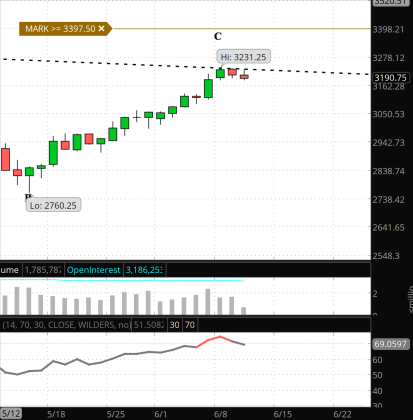
What does it mean? The analysis is unchanged from yesterday. A move above 3397.50 would force a complete rethinking of everything that has happened since February 19. The Relative Strength Indicators (RSI, at the bottom of the chart) has dropped below 70, which indicates that the market is ready to retreat from its overbought level.
S&P 500 E-mini futures, daily chart
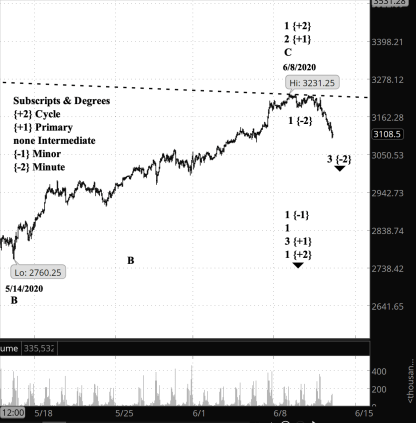
What does Elliott wave theory say? Monday’s peak by my count is (maybe) the end of Intermediate wave C within a Primary wave 2 upward correction. The next wave, Primary 3, will produce a significant decline.
What is the alternative? Two alternatives, really. The index could be still rising in Primary wave 2. Or what I’ve labelled as a major reversal of the rise over the past decades might in be a small correction that will be followed in short order by a resumption of the rise. Primary 2 could have some upside remaining. The second alternative, a minor downward correction rather than the start of a major downtrend, seems very unlikely to me. I don’t buy it.
What’s happening now? The S&P 500 E-mini futures peaked at the end of the trading yesterday, at 3231.25 and then declined slightly.
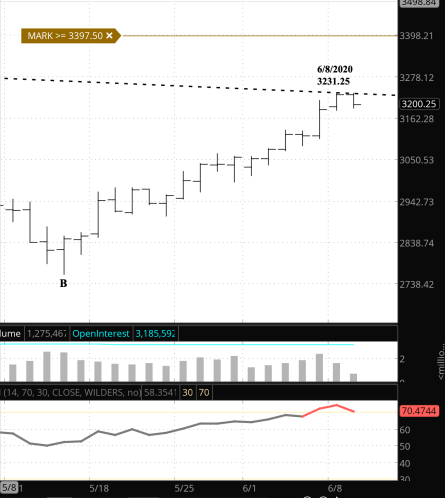
What does it mean? The peak was accompanied by a decline in volume — often a sign that a trend is weakening. Also, the Relative Strength Index (RSI) declined this morning, falling below the 70 mark that divides overbought territory from neutrality for the first time since January 22. RSI is a metric that compares the rising and falling days adjusted for the magnitude of each, and a fall back into neutrality often will presage a significant decline. Certainly the January move did. It has since risen a bit above the 70 mark, but the trend for the daily continues to point down.
S&P 500 E-mini futures, daily bars, with volume and RSI
What does Elliott wave theory say? At the peak we were in the final wave, upward trending Intermediate wave C, of the Primary wave 2 upward correction of downtrending Cycle wave 1, which began on February 19 at 3397.50.
The question now is whether yesterday’s peak marks the end of Intermediate C. The wave has risen 17.1%, which compares favorably with the 19% rise of the prior C wave in this compound correction. And Primary wave 2 has retraced 86.4% of Primary wave 2, about what I would expect from an energetic 2nd wave. Combined with the declining RSI and volume, the evidence makes it plausible, although not certain, that Primary wave 3 has begun.
What is the alternative? The index could certainly reverse and continue rising in a whipsaw of the sort not uncommon in the markets. If it does, then we continue to face the possibility that what is now counted as wave 2 will move beyond the start of wave 1, possibly negating the idea that the rise that began in 1974 is in fact not yet over. I discussed the prospect in detail in Monday’s post.
Little has changed from Friday’s analysis, and so I’m going to take a closer look at the alternative, which would kick in if the index rises above its high of February 19, which was 3397.50 on the E-mini futures. I said in Friday’s analysis that a break above that level would force a “rethinking of the entire analysis since February”. That raises the question, Is such an alternative even possible, within the rules of Elliott wave analysis? That’s the question I hope to answer this morning.
What’s happening now? The S&P 500 E-mini futures on Sunday set a higher high in the rise from March 22, at 3211.50, just one point above the prior high set on Friday.
What does it mean? There’s no clear indicator as to whether the correction of the decline from March is yet complete. So far the movement has retraced 84.8% of the decline.
What does Elliott wave theory say? The retracement is Primary wave 2 within Cycle wave 1, the early stages of a major decline that will eventually erase decades worth of market advance. It will have uptrends and downtrends within it, some of them quite significant, but the overall trend by this analysis will be down in a movement so large that the high school Class of 2020 will be grandparents before the major correction ends.
What is the alternative? If the Primary wave 2 price moves back above the beginning of Primary wave 1, the high set in February of 3397.50, then the whole major end-of-the-world-as-we-know-it crash gets tossed into the trash, and something else is going on. Is that even possible, given the devastating losses we’ve seen in a period that has stretched out to nearly four months?
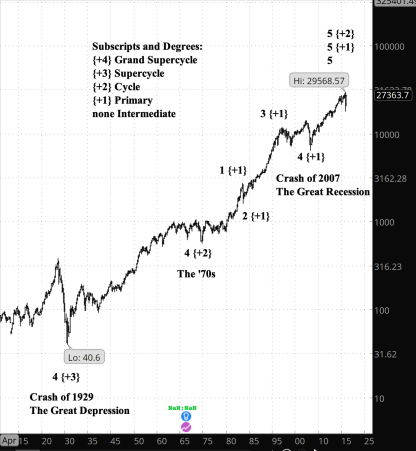
Dow Jones Industrial Average, weekly bars
It turns out that it is possible. The final leg up before the February crash began in 2009, at the low point of the Crash of 2007, which kicked off the Great Recession. On a chart of the Dow Jones Industrial Average, the decline so far is not outsized for a correction within Primary wave 5 of the rise since 2009. The Great Recession crash that ended a Primary wave 4 was bigger. The present decline so far has been in the ballpark of the Crash of ’87, a Primary wave 2 decline, or the downward corrections of the stagflation 1970s. And there’s sufficient ambiguity in the rise since 2009 to count the February peak a 3rd wave rather than a 5th, which would make the decline since February a Primary 4th wave correction.
If the hypothetical 4th wave correction is taking the form of an expanding triangle, then the B wave — the one we’re in now — would be expected to move above beginning of the A wave. The gotcha is that each of the five waves of the expanding triangle would have three subwaves, so I think it would take some creative wave counting to make this scenario work.
The sheer velocity, the power, of the decline in February steers me away from this alternative scenario. I’ll be shocked if the S&P 500 price exceeds 3397.50. But, as we near that point, it’s a possibility we must consider.
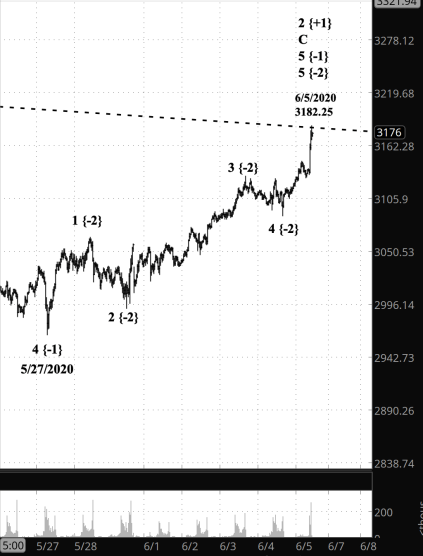
What’s happening now? The S&P 500 E-mini futures continue to make new highs, most recently at 3182.25 in the first half hour after the opening bell.
What does it mean? The final leg up of the upward correction that began on March 22 continues, having retraced more than 80% of the decline that began on February 19.
What does Elliott wave theory say? The index is in Intermediate wave C within Primary wave 2, which is correcting the downward Cycle wave 1, the beginning of a very large decline. I’ve redone my count of the waves internal to C, and they show that C is in its 5th and final wave to the upside, beginning yesterday at the Minute degree within the 5th wave of the Minor degree, which began May 27.
Next move: Primary wave 3 to the downside, carrying the price below 2000.
What is the alternative? A push above 3397.50 would require a rethinking of the entire analysis since February 19. I don’t expect this to happen.
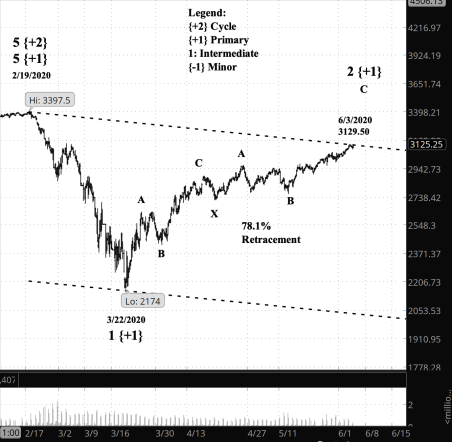
What’s happening now? The S&P 500 E-mini futures yesterday, throughout the day, kept bumping up high for the rise since March 22, pulling back after peaking at 3129.50. In the chart I’ve drawn the channel as though that peak were the end of correction to the upside, but the reality is that I can’t rule out a bit more upside remaining.
What does it mean? The rise has retraced 78.1% of the decline from February 19 to March 22. If there is a more rise remaining, it will be a fairly short movement, stopping short of 3397.50. If 3129.50 is indeed the peak of the rise, then the next move will be down. What I’ll be looking for is a drop that shows some commitment — the short of drop where you look at the chart and without analysis, say, Something has changed. A decline below 2760.25, where the present leg up of the correction, will increase the odds that the correction is over.
By the way, note the volume at the bottom of the chart, how much it has fallen off during the correction, a sign that the energy of the upward movement is fading.
What does Elliott wave theory say? The meaning of the 3129.50 point depends upon how we interpret the internals of the wave that led to that peak: Intermediate wave C within the Primary wave 2 upward correction.
My count yesterday placed index nearing the end of Minute wave 3 within Intermediate C. If that’s correct then there will be a small pullback and then a final Minor wave 5 rise above that prior peak.
What is the alternative? I noted yesterday that I found the wave pattern to be somewhat ambiguous, and that the present position might be well Minor wave 5. If that’s the case, then 3129.50 could indeed mark the end of the Primary wave 2 correction. The resumption of the downtrend, Primary wave 3, will be energetic and without ambiguity as it pushes down to the lower boundary of the channel, almost certainly below 2000.
 Tim Bovee, Private Trader
You must be logged in to post a comment.