Wednesday, November 4, 2020

3:20 p.m. New York time

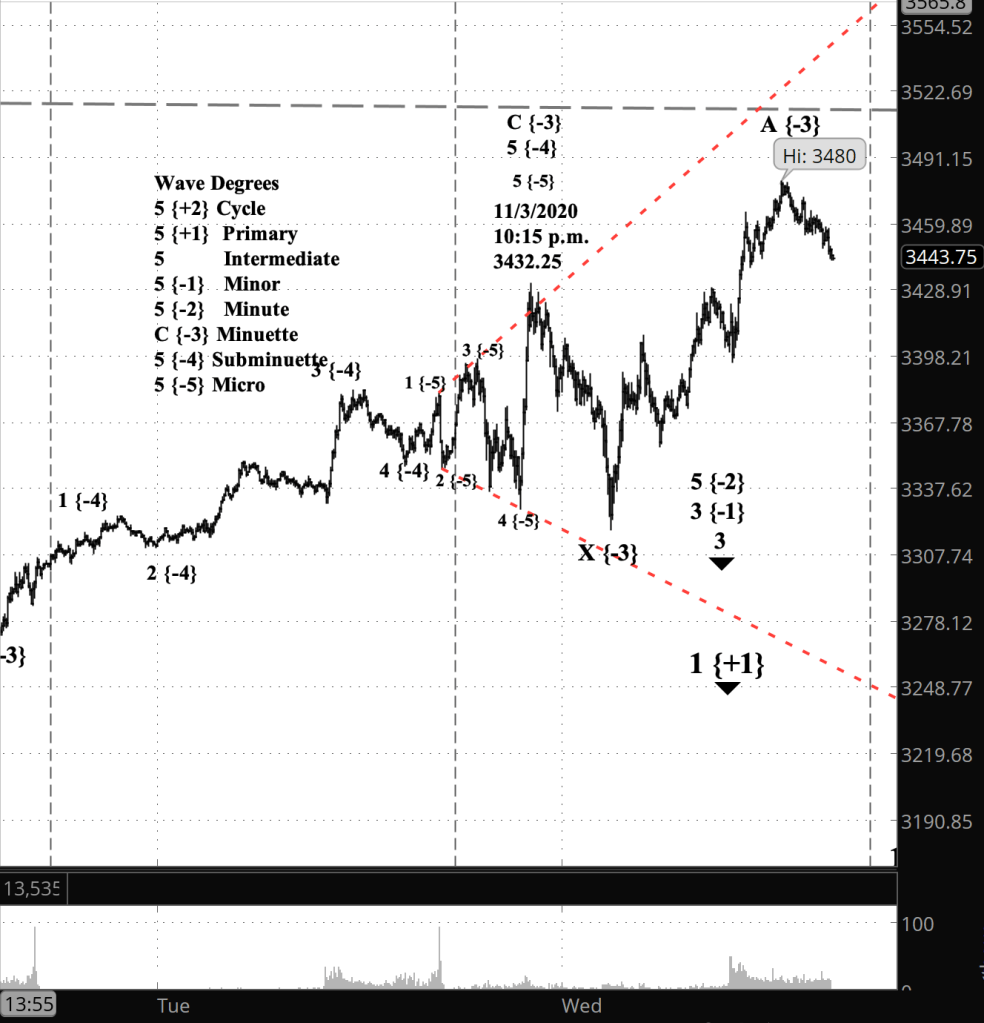
As it turned out, the X-wave alternative proved to be the S&P 500’s pattern. I’ve updated the count, showing today’s rise being an A wave of Minuette degree within a second corrective pattern connected to the first corrective pattern by the overnight decline (X wave of Minuette degree). All of this is happening with a 4th wave of Minute degree.

9:40 a.m. New York time

The futures markets on the major indexes had a dramatic night that commentators excitedly credited to the vast uncertainties in the American presidential election vote count. Elliott wave analysts, on the other hand, calmly marked up their charts, concluding that the drama was nothing more than typical 5th wave triangle pattern, setting up a resumption of the decline that began in February.

What’s happening now? The S&P 500 E-mini futures beginning at 9:30 p.m. underwent a rapid swing that in a couple of hours covered about 100 points each way.

What does it mean? The pattern is typical of the concluding movement in the direction of a larger movement. The swing occurred in an upward movement within an upward correction.

What is the alternative? On the chart I marked last night’s high as the end of the pattern. It’s possible to count the pattern so that an additional high will in fact be the end.
[S&P 500 E-mini futures, 5-minute bars]

What does Elliott wave theory say? The horizontal triangle, marked in red, is the 5th wave of Subminuette degree within the C wave of Minuette degree, both within and marking the end of the 4th wave correction of Minute degree. The ensuing decline will either be the 5th and final wave, of Minute degree, within the declining 3rd wave of Minor degree. Or it could be an X wave of Minute degree, a boundary between two corrective pattern within a compound structure.

My trading strategy. I’m staying away from any new options position until I understand the present decline: Minute 5 is a trade; Minute X is a warning to stay away.

Read More »
Tuesday, November 3, 2020

3:25 p.m. New York time

I’ve updated the chart with half an hour before the closing bell.

9:45 a.m. New York time

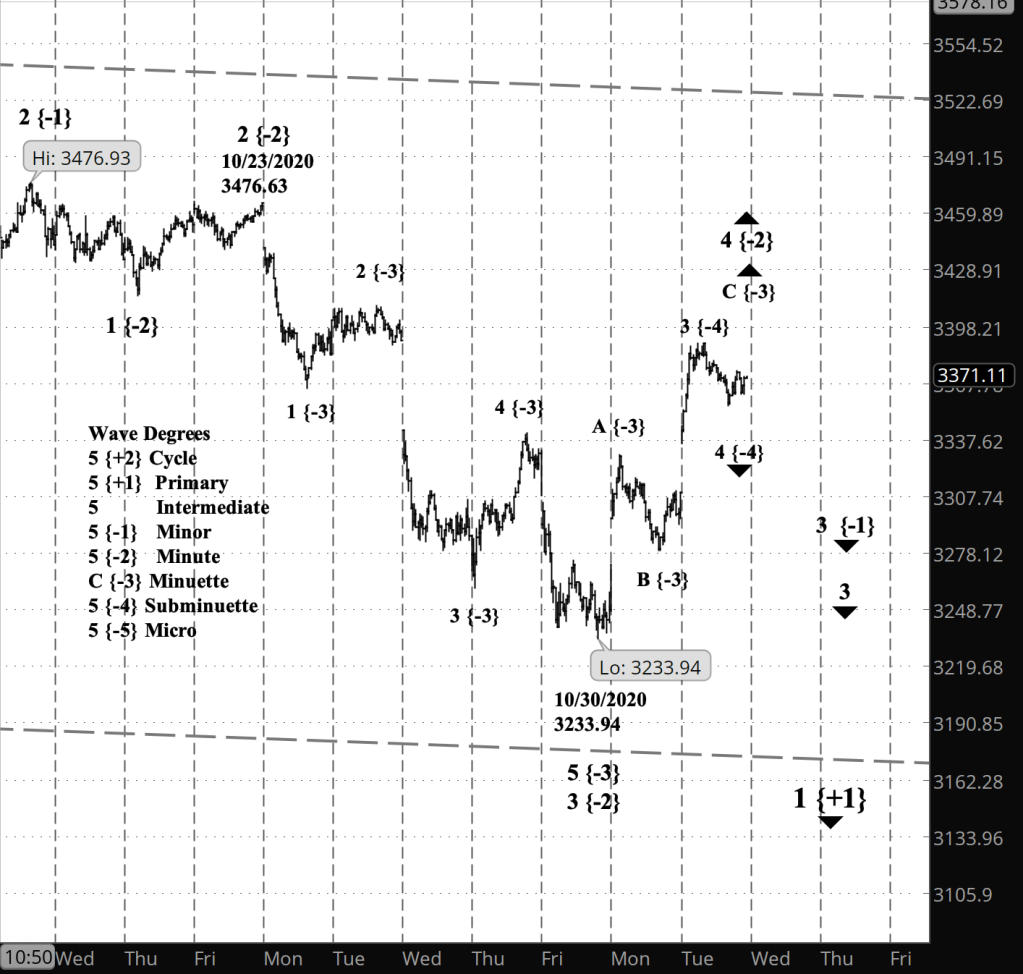
What’s happening now? The S&P 500 index is tracing the third step, an upward movement within a low level upward correction.

What does it mean? Two possibilities. 1) The correction will end with the third step and will resume its downward path. 2) The index will trace a downward boundary movement and then will begin another pattern in a compound correction that will be on the shallow side.

[S&P 500 index, 10-minute bars]

What does Elliott wave theory say? The uptrending correction, wave 4 of Minute degree, has completed two internal waves, A and B of Minuete degree, and has begun rising in wave C.

If the C wave completes the correction, then it we followed by wave 1 of Minuette degree within wave 5 of Minute degree, the fifth wave being the final downward push of the 3rd wave correction of Minor degree.

If the correction turns into a compound movement, stringing several corrective together, then the decline following wave C will be an X wave of Minuette degree, a boundary between two patterns.

The difficulty is that the X wave (= correction continuing) and the 1st wave (= correction over) will initially exactly the same. The X wave will have three internal waves, and the 1st wave will have five internal waves. The truth of which we’re seeing will unfold over time.

My trading strategy. I’m looking to enter a new bear call spread position on one of the funds the tracks the S&P 500 closely, using the options that expire December 18. My preferred entry date for that series is today, November 3. It’s not going to happen. I’ll need to see some indication that the Minute 5th wave decline has begun.

Read More »

Monday, November 2, 2020

10:25 a.m. New York time

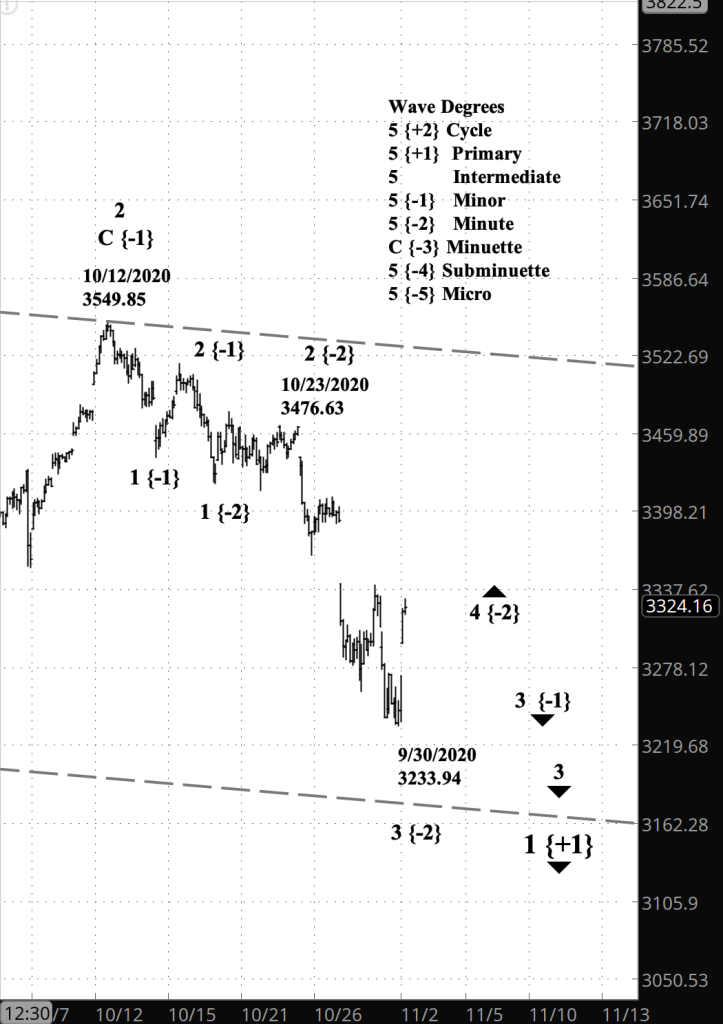
What’s happening now? The S&P 500 index’s low on Friday, October 30, marked the end of the decline from October 23 and the beginning of an upward correction

What does it mean? The decline a bit more than a week, and the position of the correction suggests it will be more of a sideways movement than a quick rush to the higher ground, so probably it the correction will carry into mid-November. The timing is a best guess, so the correction could take a shorter or a longer time to complete. The end wave the correction will be followed by a resumption of the main downward trend that will carry back into the 3200s and below.

What is the alternative? It’s still possible that the decline from October 23 is not yet complete. Based on the look of the chart, it seems unlikely to me.

[S&P 500 index, 45-minute bars]

What does Elliott wave theory say? The October 30 low was the end of wave 3 of Minute degree, and the following wave in its early stage is wave 4 of Minute degree. The Minute 2nd wave was a Zigzag pattern, and Elliott’s rule of alternation says that the 4th wave will be either a Flat or a Triangle. Within Minute 4 the movement is tracing wave A of Minuette degree.

The Minute degree correction is a subwave of wave 3 of Minor degree, which in turn is a subwave of wave 3 of Intermediate degree. All of this is tracing the middle ground of wave 1 of Primary degree, which began on September 2.

My trading strategy. The time taken by the Minute 4th wave correction has implications for my next options play. I exited my short bear all options spread on IWM last Friday, 21 days before its November expiration.

If the chart allows it, the next options position, also a short bear call spreads, will have a December expiration. The optimal entry date will be Tuesday, November 3, with entry possible within a range running from October 27 of last week to November 10, next week.

I don’t trade 4th waves. They have too many variations for confident analysis. They tend to produce surprises. So my target entry is for the end of beginning of Minute wave 5.

I haven’t selected a vehicle yet. Like IWM in my prior trade, the vehicle must have an implied volatility rank of 30 and above. SPY at present meets that requirement, at 35.8%, as does IWM at 40.3% and QQQ at 40.7. All trace similar Elliott wave patterns. Those IV rank can change quickly, so it’s premature to focus on any single symbol at this point.

Read More »