Tuesday, February 2, 2021

3:30 p.m. New York time

Half an hour before the closing bell. The S&P 500 hit a high for the day at midday, of 3835.75 on the E-mini futures, and has remained at close to that level up to the present. I’ve updated the chart below.

1:10 p.m. New York time

I’ve posted an Elliott wave analysis of GME. Fun while it lasted.

11 a.m. New York time

What’s happening now? The S&P 500 E-mini futures continued to rise in overnight trading, exceeding the high of January 28 as it continues an upward correction within the downtrend that began on January 26.

What does it mean? The move above the January 28 high eliminates any probability that the correction has been completed. The present rise is most likely the final wave of the correction. It will be followed by a powerful push to the downside.

What are the alternatives? If the price pushes above 3862.25, the high of January 26, then the downtrend is in fact a correction within the uptrend that began on February 23, 2020.
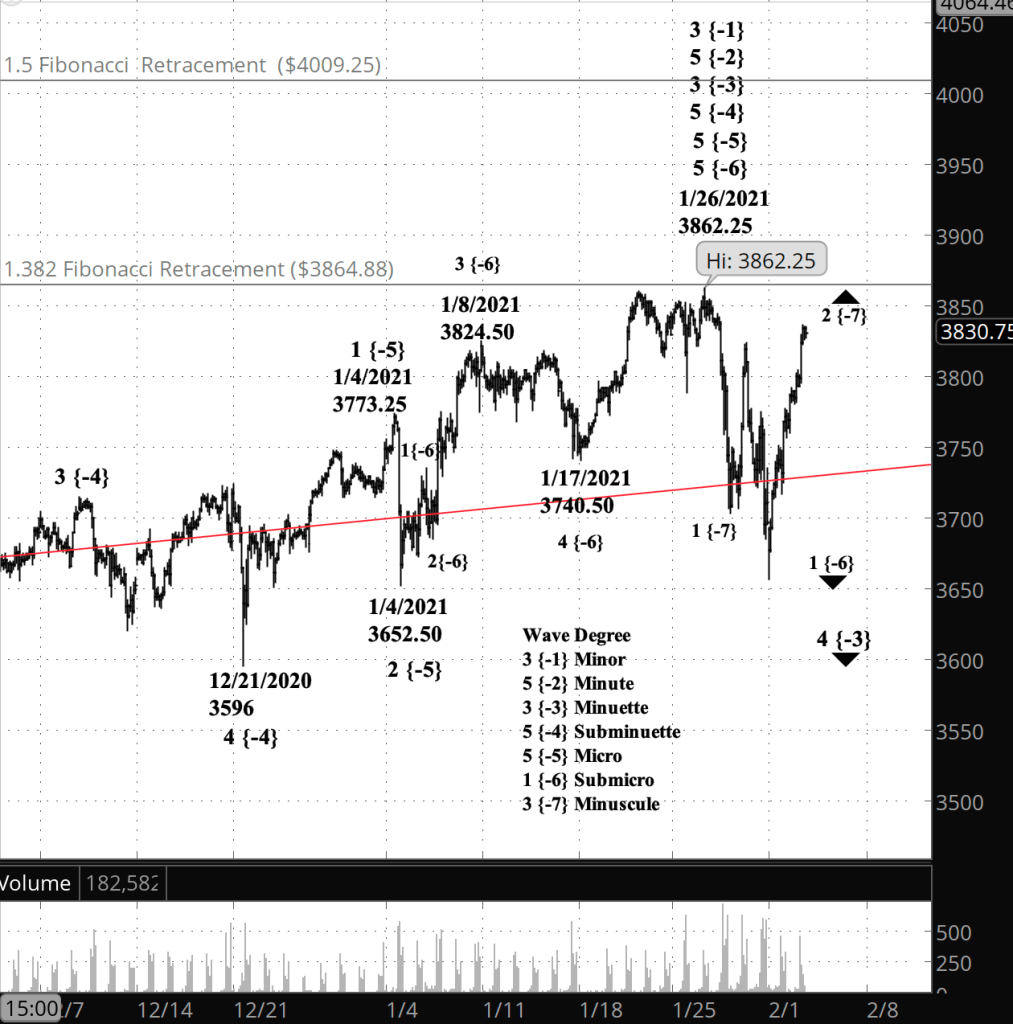
[S&P 500 E-mini futures at 3:30 p.m., 2-hour bars, with volume]

What does Elliott wave theory say? The higher high set in overnight trading is wave C of Subminuscule degree within wave 2 of Minuscule degree. We’re talking very small patterns here, yet in Elliott wave analysis, large patterns are built from increasingly smaller patterns, with all degrees following the same rules.

The end of Minuscule wave 2 will be followed by Minuscule 3 to the downside, which will be powerful enough at that small degree to leave no doubt that the trend is down. This is all happening within Submicro wave 1 and is a part of the much larger wave 4 of Minuette degree.

Read More »
Monday, February 1, 2021

3:30 p.m. New York time

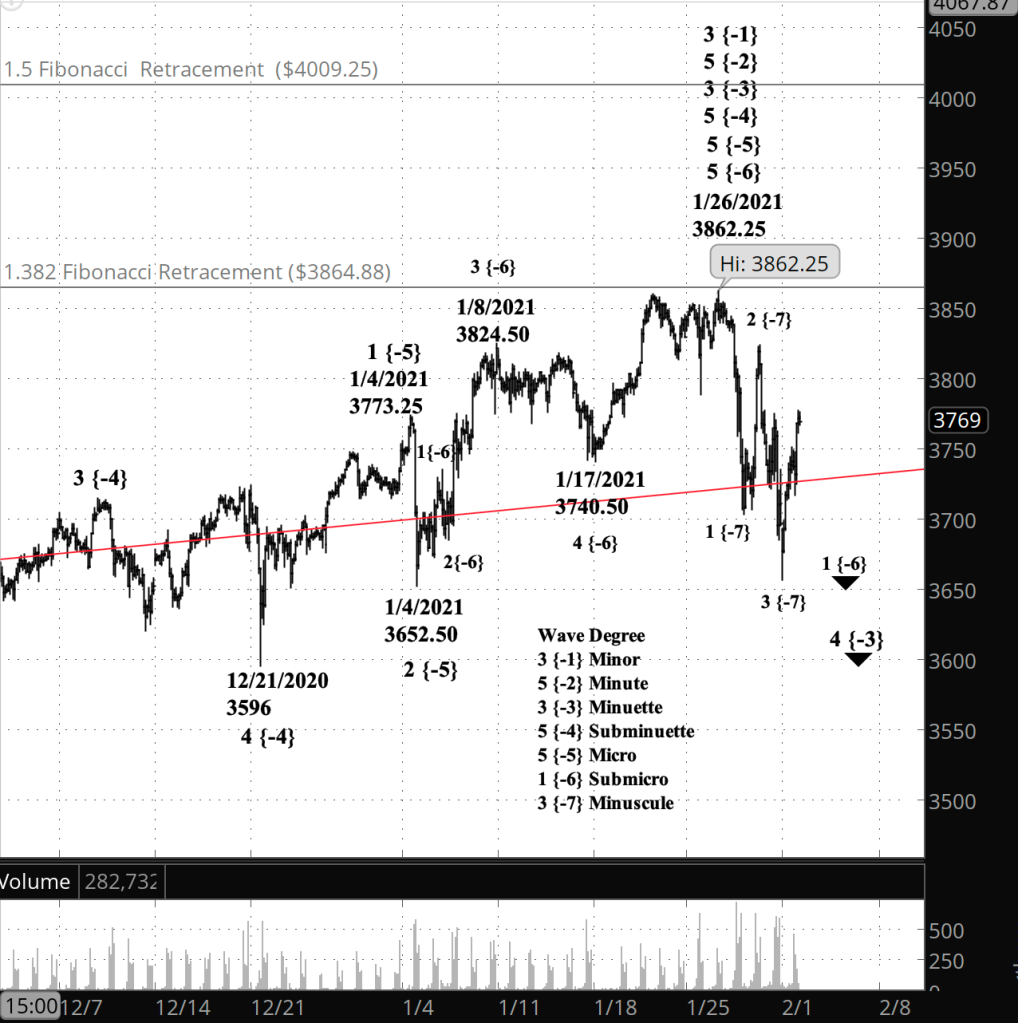
Half an hour before the closing bell. The S&P 500 continued to work through a rising counter-trend correction within the first Submicro degree wave of a downward move that began on January 26. I’ve updated the charts below.

9:50 a.m. New York time

What’s happening now? The S&P 500 E-mini futures continued to work their way lower, in a series of lower highs and lower lows — the classic definition of a downtrend. After reaching a low of 3656.50 in overnight trading, the price retraced upward by 95 points. The decline began on January 26 from 3862.25, which is 5% above the the low so far.

What does it mean? The decline is the beginning of a large-scale downtrend that will eventually work its way down around 2000. But there will be much drama to be seen between now and then.

[S&P 500 E-mini futures at 3:30 p.m., 2-hour bars, with volume]

What does Elliott wave theory say? The downtrend that began on January 26 is wave 1 of Submicro degree. Within Subicro 1, wave 3 of Minuscule degree appears ready to begin its decline after a 2nd wave retracement to the upside.

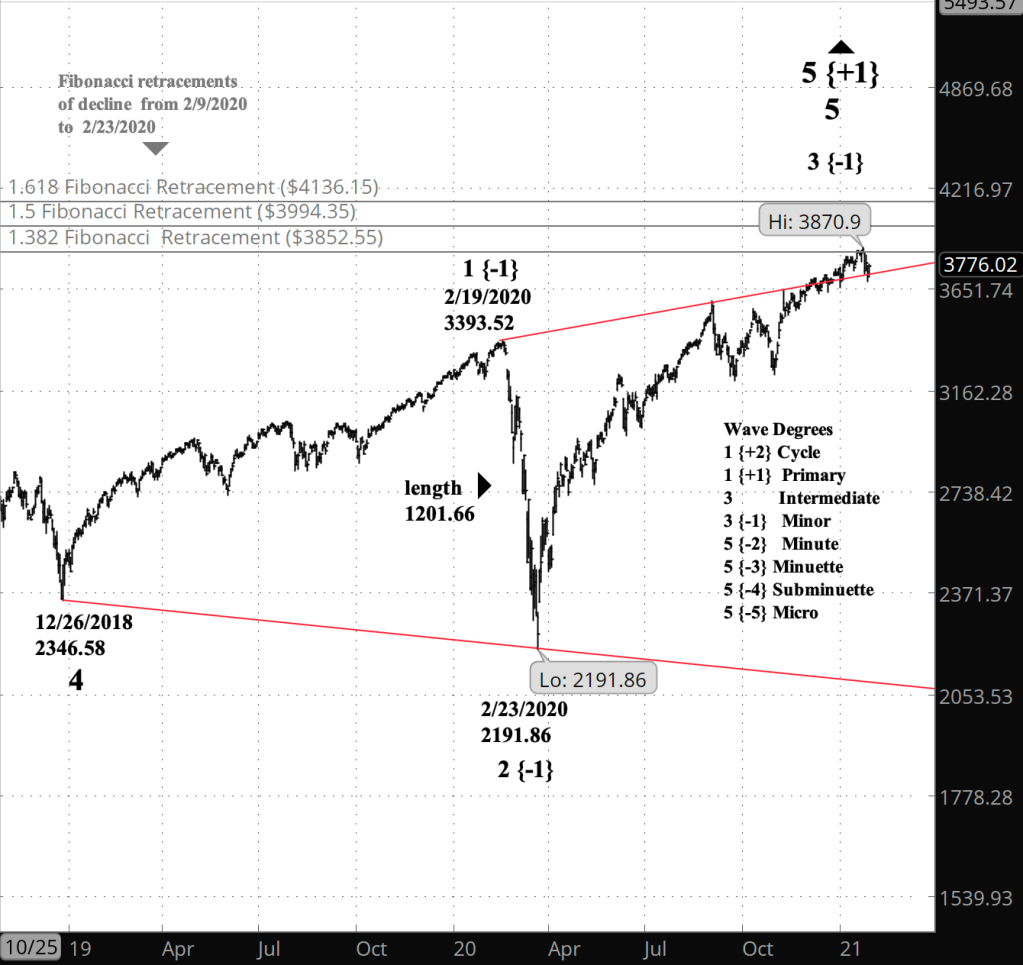
The price has hit the 1.382 Fibonacci retracement of the decline that began on February 19, 2020 and ended four days later, 1,202 points lower. The decline was part of a Diagonal Triangle pattern that began in December 2018. The red line on the chart is the upper boundary of that triangle, and the lower boundary at present is at about 2100.

The rise since February 23, 2020 has been wave 3 of Minor degree, and the decline that began January 26, 2021 is wave 4 of Minor degree. Fourth wave correction tend to be shall in a normal five-wave trend. However, in triangles the price bounces between boundaries set at the beginning of waves 1 and 3 and the beginning of wave 2. The 4th wave in this instance will carry the price a great distance so that reaches or comes close to the lower boundary of the Diagonal Triangle. Here’s a big-view chart that shows the entire S&P 500 index triangle so far.

[S&P 500 index at 3:30 p.m., daily bars]
Read More »