3:30 p.m. New York time
Half an hour before the closing bell. The S&P 500 futures traded slightly lower during much of the session, falling into the 7260s. They then rose sharply into the 7390s after reports that the United States was halting strikes on Iran.
Elliott Wave Theory. By the book, rises increase the odds that wave D{-5} remains underway, and falls increase the odds that wave E{-5} is in progress. However, moves based on changing war plans often appear to lack staying power. I shall continue to give greater weight to economic reports, such as those released today before the opening bell, which were followed by a decline in the futures.
Bottom line: The labeling is unchanged: Declining wave E{-5} remains underway, and that appears to be the most likely interpretation of the chart. However, that conclusion has not yet been verified. It remains possible that rising wave D{-5} will reach a new high, confirming that it is still in progress.
Decision Points. A fall below the overnight low, 7232.25, would strengthen the E{-5} interpretation and bring the futures closer to verification by crossing below the upper boundary of the wave 4{-4} Expanding Triangle. A move below that upper boundary would verify that wave D{-5} has ended and wave E{-5} is underway. A rise above today’s post-news high, 7386.50, would prolong the ambiguity but would not by itself invalidate the E{-5} count. A rise above the June 1 high, 7632.25, would invalidate the present E{-5} count and confirm that wave D{-5} is still underway.
9:35 a.m. New York time
What’s happening now? The S&P 500 E-mini futures began overnight trading by dropping to 7232.25 and then reversing, rising to 7338.75 before pulling back.
What does it mean? Elliott Wave Theory continues to tentatively count the decline that began on June 1 from 7632.25 as wave E{-5}. The lower the futures go, the more likely the E-wave scenario becomes.
Wave E{-5} is the final subwave of wave 4{-4}, a downward correction that began on October 29, 2025. Wave 4{-4} has taken the form of an Expanding Triangle, meaning that each rising subwave rises above the preceding rising subwave, and each falling subwave falls below the preceding falling subwave.
Such triangles can be seen as having expanding boundaries, upper and lower, formed by connecting the peaks of the first two rising subwaves and the lows of the first two falling subwaves.
Sometimes price moves beyond those boundaries, and that is what happened with wave D{-5}, the next-to-the-last subwave within wave 4{-4}. Wave E{-5} remains slightly above the upper boundary. A move below that boundary would verify that rising wave D{-5} has ended and falling wave E{-5} has begun.
Decision Points. A move below the upper boundary of the Expanding Triangle, now near the low 7200s, would verify the E{-5} count. A move below the overnight low, 7232.25, would bring that verification closer. A rise above the overnight high, 7338.75, would not disprove the E-wave count, but would prolong the ambiguity. A rise above the June 1 high, 7632.25, would invalidate the present E{-5} count and show that wave D{-5} was still underway.
The Chart. The chart focuses on wave D{-5} and the wave now underway, wave E(-5}.
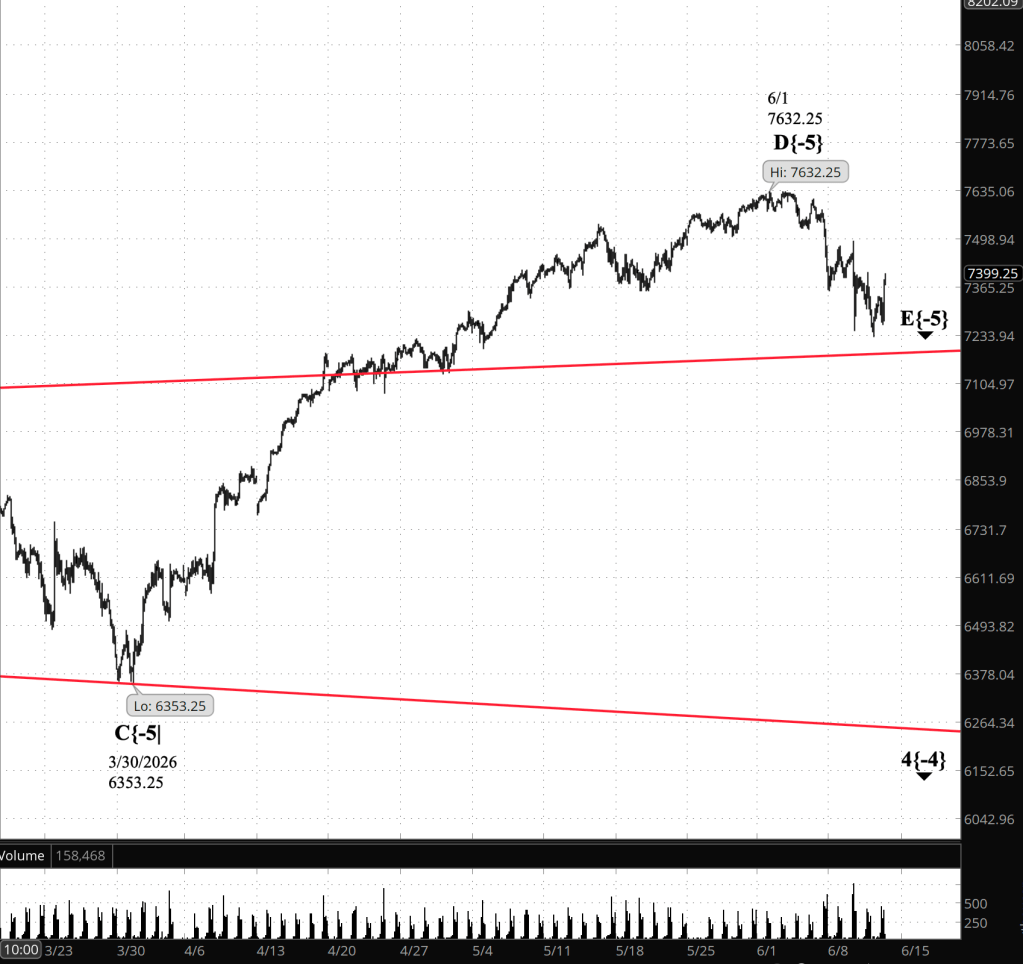
[S&P 500 E-mini futures 3:30 p.m., 2-hour bars with volume]
Waves Now Underway
These are the waves currently in progress under my principal analysis. Each line on the list shows the wave number, with the subscript in curly brackets, the traditional degree name, the starting date, the starting price of the S&P 500 E-mini futures, and the direction of the wave.
- S&P 500 Index:
- 5{+3} Supercycle, 7/8/1932, 4.40 (up)
- 5{+2} Cycle, 12/9/1974, 60.96 (up)
- 5{+1} Primary, 3/6/2009, 666.79 (up)
- 5{0} Intermediate, 2/11/2016, 1810.10 (up)
- 3{-1} Minor, 3/23/2020, 2191.36 (up)
- 1{-2} Minute, 7/31/2025, 6468.50 (down)
- S&P 500 E-mini futures
- 5{-3} Minuette 8/1/2025, 6239.50 (up}
- 4{-4} Subminutte 10/29/2025, 6953.75 (down}
- E{-5} Micro, 6/1/2026, 7632.25 (down}
- A{-6} Submicro, 6/1/2026, 7632.25 (down}
Reading the chart. Price movements — waves – – in Elliott Wave Theory analysis are labeled with numbers within trending waves and letters with corrective waves. The subscripts — numbers in curly brackets — designate the wave’s degree, which, in Elliott Wave analysis, means the relative position of a wave within the larger and smaller structures that make up the chart.R.N. Elliott, who in the 1930s developed the form of analysis that bears his name, viewed the chart as a complex structure of smaller waves nested within larger waves, which in turn are nested within still larger waves. In mathematics it’s called a fractal structure, where at every scale the pattern is similar to the others.
Learning and other resources. Elliott Wave analysis provides context, not prophecy. As the 20th century semanticist Alfred Korzybski put it in his bookScience and Sanity(1933), “Themapis not theterritory… The only usefulness of a map depends on similarity of structure between the empirical world and the map.” And I would add, in the ever-changing markets, we can judge that similarity of structure only after the fact.
See the menu pageAnalytical Methodsfor a rundown on where to go for information on Elliott Wave analysis.
By Tim Bovee, Portland, Oregon, June 11, 2026
Disclaimer
Tim Bovee, Private Trader tracks the analysis and trades of a private trader managing his own accounts. The content reflects my interpretation of market structure, including Elliott Wave Theory and related tools.
Nothing in this blog constitutes a recommendation to buy or sell stocks, options, or any other financial instrument, or to pursue any particular strategy. The purpose of this blog is education and entertainment.
No trader is ever 100 percent successful. Trading in stock and options markets involves risk and uncertainty. Each trader must make decisions for his or her own account and accept full responsibility for the outcomes.
Charts and tools are used to support my personal analysis. Any data displayed is illustrative of that analytical process and is not presented as a source of market data for redistribution.
All content onTim Bovee, Private TraderbyTimothy K. Boveeis licensed under aCreative Commons Attribution-ShareAlike 4.0 International License.
License
Based on work atwww.timbovee.com


You must be logged in to post a comment.