Trader’s Notebook: S&P 500

3:30 p.m. New York time

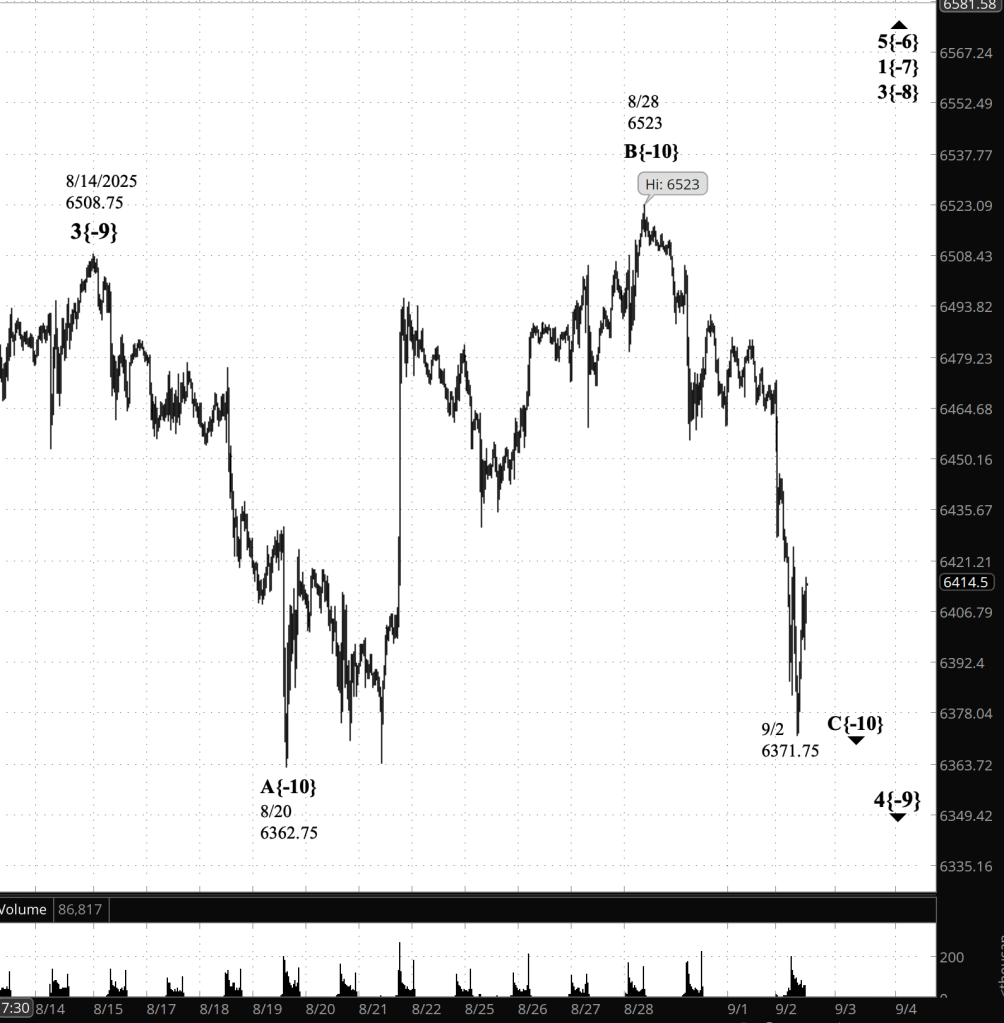
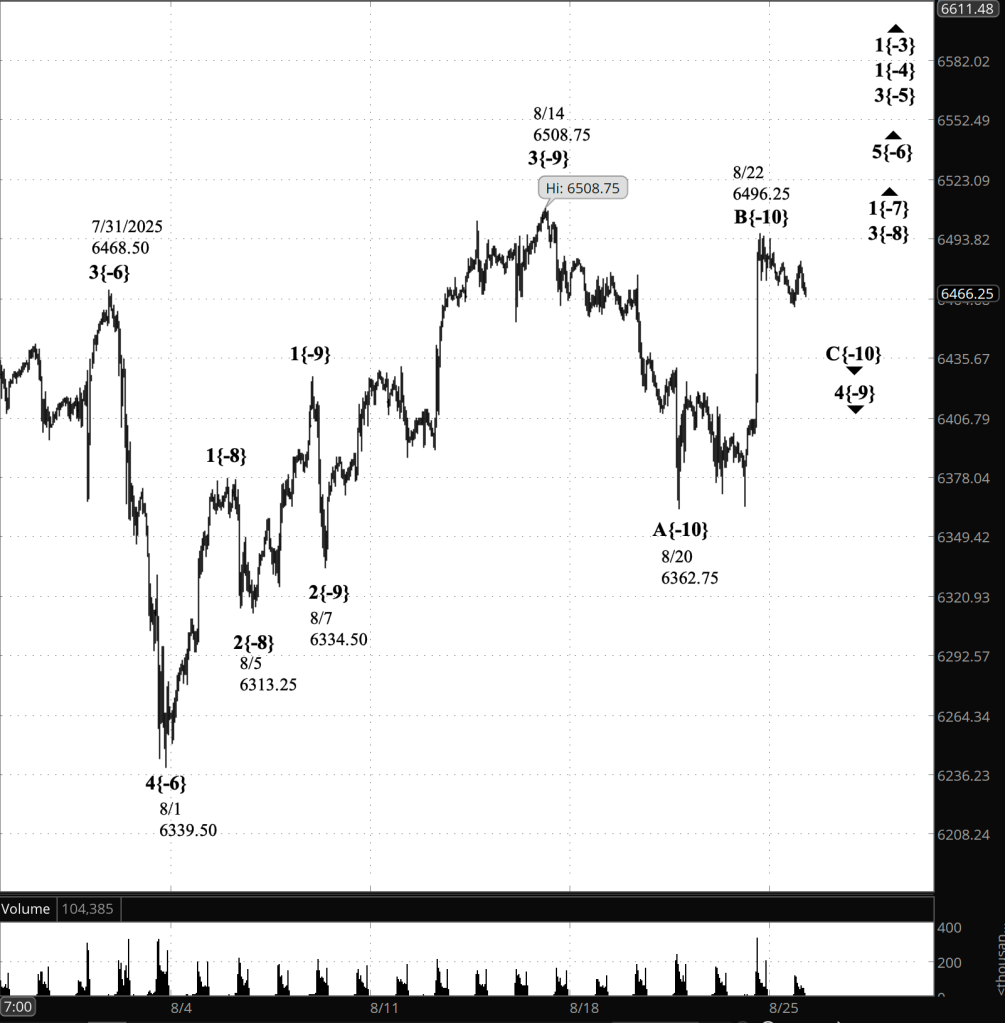
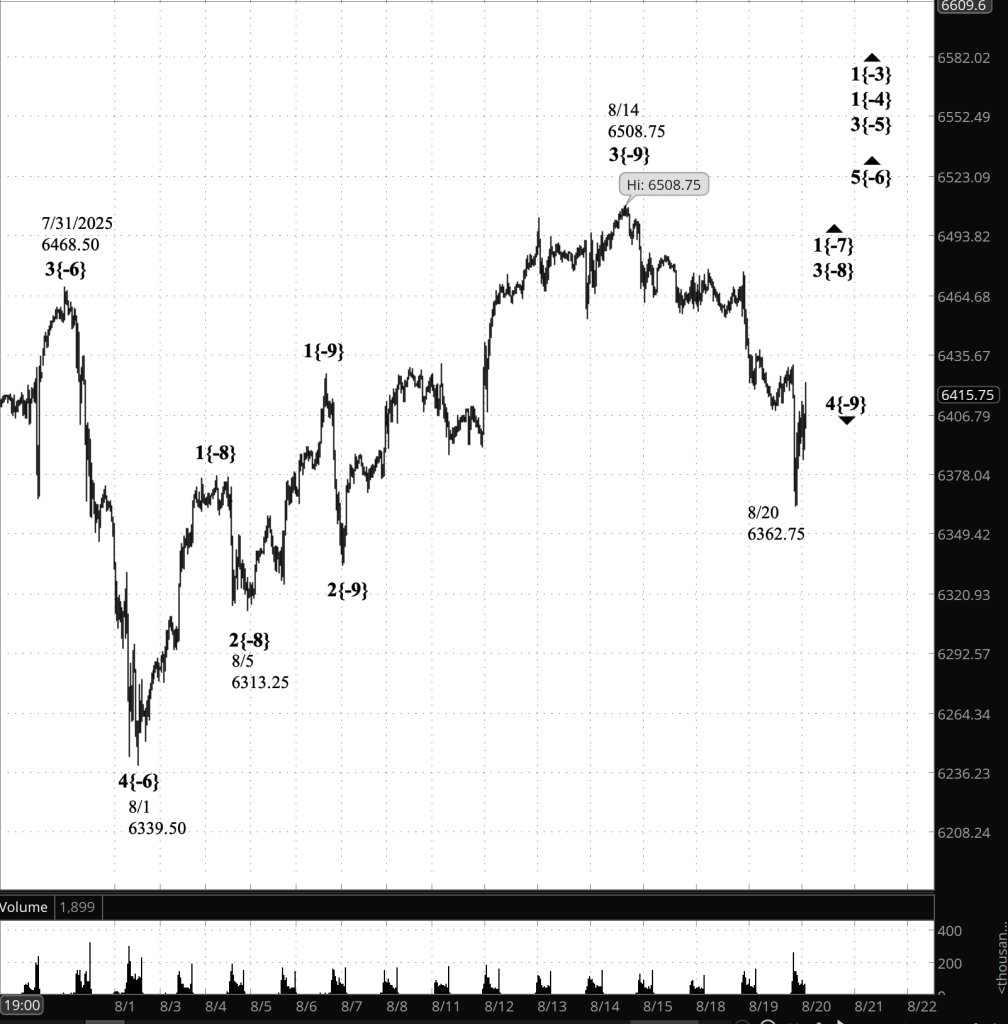
Half an hour before the closing bell. The S&P 500 futures continued to rise during he session, coming within 75 cents of a 100% Fibonacci retracement Elliott Wave Theory has a firm rule that a 2nd wave never moves beyond the start of the preceding 1st wave, at 3848.50. If it does, then it isn’t a 2nd wave that began on August 1. Something else is going on.

There are some hedges that possibly are legitimate way to avoid triggering the, The futures at hand are a derivative S&P 500 index. Moreover, it moves in 25-cent increments. So if the price moves one cent above the 100% retracement level, does that really count as indisputably above? Or is it a tiny rounding error?

Moreover, it’s possible, if I squint real hard, to see the declining 1st wave, the initial subwave of wave A, to actually be waves A, B and C, meaning that the 2nd wave downward correction ended on August 1, and wave 3 began from that point.

At this point, we don’t know for sure and are relying on 20-20 hindsight.

If it beaks above and continues to rise for some distance, then the downward correction ended on August 1 and an uptrending 1st wave may well be underway.

If the price briefly breaks a short distance — 12 cents or less, maybe? — above the start of the preceding 1st wave and then retreats, that lends credence wave B having just ended and wave C having begun, both within wave 2.

9:35 a.m. New York time.

What’s happening now. The S&P 500 E-mini futures traded sideways between the 6390s and the 6410s until an hour before the opening bell, when the release of the Consumer Price Index sent the price on a 7-minute rise into the 6440s. The CPI-U on average rose 0.2 each month, with a high of 0.5 in January and a low of -0.1 in March. When the session began the futures were trading in the 6420s.

What does it mean? In Elliott Wave Theory, the rise was the last leg of the 5th and final subwave within wave A, the first subwave of a 2nd-wave upward correction that began on August 1.

All of this is part of a downward correction two degrees larger that began on July 31 and which is working through its A wave.

When the smaller 2nd wave is complete, a downtrending 3rd wave will follow, then a 4th-wave upward correction and a downtrendng 5th-wave that wil complete the internal structure of the larger 2nd wave and mark the beginning of a rising 3rd wave of the same degree.

[S&P 500 E-mini futures at 3:30 p.m., 30-minute bars, with volume] 

Waves Now Underway

These are the waves currently in progress under my principal analysis. Each line on the list shows the wave number, with the subscript in curly brackets, the traditional degree name, the starting date, the starting price of the S&P 500 E-mini futures, and the direction of the wave.

  • S&P 500 Index:
  • 5{+3} Supercycle, 7/8/1932, 4.40 (up)
  • 5{+2} Cycle, 12/9/1974, 60.96 (up)
  • 5{+1} Primary, 3/6/2009, 666.79 (up)
  • 5{0} Intermediate, 2/11/2016, 1810.10 (up)
  • 3{-1} Minor, 3/23/2020, 2191.36 (up)
  • 1{-2} Minute, 7/31/2025, 6468.50 (down)
  • S&P 500 Futures
  • 2{-3} Minuette, 7/31/2025, 6468.50 (down)
  • A{-4} Subminuette, 7/31/2025, 6468.50 (down)
  • 2{-5} Micro, 8/1/2025, 6239.50 (up)
  • A{-6} Submicro, 8/1/2020, 6239.50 (up)
  • 5{-7} Submicro, 8/11/2025 6387.50 (up)

Reading the chart. Price movements — waves – – in Elliott Wave Theory analysis are labeled with numbers within trending waves and letters with corrective waves. The subscripts — numbers in curly brackets — designate the wave’s degree, which, in Elliott Wave analysis, means the relative position of a wave within the larger and smaller structures that make up the chart. R.N. Elliott, who in the 1930s developed the form of analysis that bears his name, viewed the chart as a complex structure of smaller waves nested within larger waves, which in turn are nested within still larger waves. In mathematics it’s called a fractal structure, where at every scale the pattern is similar to the others.

Learning and other resources. Elliott Wave analysis provides context, not prophecy. As the 20th century semanticist Alfred Korzybski put it in his book Science and Sanity (1933), “The map is not the territory … The only usefulness of a map depends on similarity of structure between the empirical world and the map.” And I would add, in the ever-changing markets, we can judge that similarity of structure only after the fact.

See the menu page Analytical Methods for a rundown on where to go for information on Elliott Wave analysis.

By Tim Bovee, Portland, Oregon, August 12, 2025

Disclaimer

Tim Bovee, Private Trader tracks the analysis and trades of a private trader for his own accounts. Nothing in this blog constitutes a recommendation to buy or sell stocks, options or any other financial instrument. The only purpose of this blog is to provide education and entertainment.

No trader is ever 100 percent successful in his or her trades. Trading in the stock and option markets is risky and uncertain. Each trader must make trading decisions for his or her own account, and take responsibility for the consequences.

All content on Tim Bovee, Private Trader by Timothy K. Bovee is licensed under a Creative Commons Attribution-ShareAlike 4.0 International License.

License

Based on a work at www.timbovee.com.

Trader’s Notebook: S&P 500

3:30 p.m. New York time

Half an hour before the closing bell. The S&P 500 futures inched slightly above the previous peak within the rising 2nd-wave correction that has been underway since August 1, and then swiftly retreated.

Elliott Wave Theory: The new high, on August 11 (today) appears to be the peak of subwave 3 within wave A of the wave 2 correction,although that’s not verified and so is not a certainty. If it the end of the 3rd, then the 4th subwave is now underway.

The 4th subwave, when complete, will be followed by a 5th subwave

9:35 a.m. New York time.

What’s happening now. The S&P 500 E-mini futures continued to bounce around the 6420s after trading resumed overnight

What does it mean? In Elliott Wave Theory, the level of the stall is significant: The 78.6% Fibonacci retracement level, 6419.49. The retracement now underway is an upward correction, wave 2, that began on August 1, in relation to the downtrending 1st wave that began on July 31.

Internally, wave 2 is a subwave of a larger wave A, which began on July 31, a subwave of a still larger 2nd-wave downward correction that began on that date.

The 2nd wave that began on August 1 appears to have completed its 3rd subwave — maybe — and to be beginning its 4th subwave. I suspect that Tuesday’s release of fresh inflation numbers will clarify the correct wave labels.

[S&P 500 E-mini futures at 3:30 p.m., 30-minute bars, with volume] 

Waves Now Underway

These are the waves currently in progress under my principal analysis. Each line on the list shows the wave number, with the subscript in curly brackets, the traditional degree name, the starting date, the starting price of the S&P 500 E-mini futures, and the direction of the wave.

  • S&P 500 Index:
  • 5{+3} Supercycle, 7/8/1932, 4.40 (up)
  • 5{+2} Cycle, 12/9/1974, 60.96 (up)
  • 5{+1} Primary, 3/6/2009, 666.79 (up)
  • 5{0} Intermediate, 2/11/2016, 1810.10 (up)
  • 3{-1} Minor, 3/23/2020, 2191.36 (up)
  • 1{-2} Minute, 7/31/2025, 6468.50 (down)
  • S&P 500 Futures
  • 2{-3} Minuette, 7/31/2025, 6468.50 (down)
  • A{-4} Subminuette, 7/31/2025, 6468.50 (down)
  • 2{-5} Micro, 8/1/2025, 6239.50 (up)
  • A{-6} Submicro, 8/1/2020, 6239.50 (up)
  • 3{-7} Submicro, 8/7/2025 6334.50 (up)

Reading the chart. Price movements — waves – – in Elliott Wave Theory analysis are labeled with numbers within trending waves and letters with corrective waves. The subscripts — numbers in curly brackets — designate the wave’s degree, which, in Elliott Wave analysis, means the relative position of a wave within the larger and smaller structures that make up the chart. R.N. Elliott, who in the 1930s developed the form of analysis that bears his name, viewed the chart as a complex structure of smaller waves nested within larger waves, which in turn are nested within still larger waves. In mathematics it’s called a fractal structure, where at every scale the pattern is similar to the others.

Learning and other resources. Elliott Wave analysis provides context, not prophecy. As the 20th century semanticist Alfred Korzybski put it in his book Science and Sanity (1933), “The map is not the territory … The only usefulness of a map depends on similarity of structure between the empirical world and the map.” And I would add, in the ever-changing markets, we can judge that similarity of structure only after the fact.

See the menu page Analytical Methods for a rundown on where to go for information on Elliott Wave analysis.

By Tim Bovee, Portland, Oregon, August 11, 2025

Disclaimer

Tim Bovee, Private Trader tracks the analysis and trades of a private trader for his own accounts. Nothing in this blog constitutes a recommendation to buy or sell stocks, options or any other financial instrument. The only purpose of this blog is to provide education and entertainment.

No trader is ever 100 percent successful in his or her trades. Trading in the stock and option markets is risky and uncertain. Each trader must make trading decisions for his or her own account, and take responsibility for the consequences.

All content on Tim Bovee, Private Trader by Timothy K. Bovee is licensed under a Creative Commons Attribution-ShareAlike 4.0 International License.

License

Based on a work at www.timbovee.com.

Trader’s Notebook: S&P 500

3:30 p.m. New York time

Half an hour before the closing bell. The S&P 500 futures rose during the session.

Elliott Wave Theory: The price returned to the 78.6% Fibonacci retracement level, as the low-degree 5th wave that began on August 8 from 6334.50. The wave paused around 6419, a bit less than $ below the 3d-wave endpoint.

When wave 5 reaches its end, it will also be the end of its parent, a 2nd-wave upward correction, and the beginning of a 3rd-wave downtrend. All of this is with a larger A-wave, the first subwave of a 2nd-wave downward correction, a major peak at 5468.50 on July 31.

9:35 a.m. New York time.

What’s happening now. The S&P 500 E-mini futures fluctuated from the 6330s to the 6380s overnight.

What does it mean? The range, accordng to Elliott Wave Theory, is around the 61.8% Fibonacci retracement level, as the 2nd=-wave upward correction that began on August 1 continues to work through its 4th subwave, one degree lower.

[S&P 500 E-mini futures at 3:30 p.m., 30-minute bars, with volume] 

Waves Now Underway

These are the waves currently in progress under my principal analysis. Each line on the list shows the wave number, with the subscript in curly brackets, the traditional degree name, the starting date, the starting price of the S&P 500 E-mini futures, and the direction of the wave.

  • S&P 500 Index:
  • 5{+3} Supercycle, 7/8/1932, 4.40 (up)
  • 5{+2} Cycle, 12/9/1974, 60.96 (up)
  • 5{+1} Primary, 3/6/2009, 666.79 (up)
  • 5{0} Intermediate, 2/11/2016, 1810.10 (up)
  • 3{-1} Minor, 3/23/2020, 2191.36 (up)
  • 1{-2} Minute, 7/31/2025, 6468.50 (down)
  • S&P 500 Futures
  • 2{-3} Minuette, 7/31/2025, 6468.50 (down)
  • A{-4} Subminuette, 7/31/2025, 6468.50 (down)
  • 2{-5} Micro, 8/1/2025, 6239.50 (up)
  • 5{-6} Submicro, 8/7/2025 6334.50 (up)

Reading the chart. Price movements — waves – – in Elliott Wave Theory analysis are labeled with numbers within trending waves and letters with corrective waves. The subscripts — numbers in curly brackets — designate the wave’s degree, which, in Elliott Wave analysis, means the relative position of a wave within the larger and smaller structures that make up the chart. R.N. Elliott, who in the 1930s developed the form of analysis that bears his name, viewed the chart as a complex structure of smaller waves nested within larger waves, which in turn are nested within still larger waves. In mathematics it’s called a fractal structure, where at every scale the pattern is similar to the others.

Learning and other resources. Elliott Wave analysis provides context, not prophecy. As the 20th century semanticist Alfred Korzybski put it in his book Science and Sanity (1933), “The map is not the territory … The only usefulness of a map depends on similarity of structure between the empirical world and the map.” And I would add, in the ever-changing markets, we can judge that similarity of structure only after the fact.

See the menu page Analytical Methods for a rundown on where to go for information on Elliott Wave analysis.

By Tim Bovee, Portland, Oregon, August 8, 2025

Disclaimer

Tim Bovee, Private Trader tracks the analysis and trades of a private trader for his own accounts. Nothing in this blog constitutes a recommendation to buy or sell stocks, options or any other financial instrument. The only purpose of this blog is to provide education and entertainment.

No trader is ever 100 percent successful in his or her trades. Trading in the stock and option markets is risky and uncertain. Each trader must make trading decisions for his or her own account, and take responsibility for the consequences.

All content on Tim Bovee, Private Trader by Timothy K. Bovee is licensed under a Creative Commons Attribution-ShareAlike 4.0 International License.

License

Based on a work at www.timbovee.com.

Trader’s Notebook: S&P 500

3:30 p.m. New York time

Half an hour before the opening bell. The S&P 500 futures fell during the session. In Elliott Wave Theory, it completed the 3rd subwave of a 2nd-wave upward correction that began on August 1, reaching the 78.67% Fibonacci retracement level, and then rode the 4th subwave, a downward correction, to just above the 38.2% retracement level.

9:35 a.m. New York time.

What’s happening now. The S&P 500 E-mini futures rose overnight, reaching into the 6420s, and then pulled back.

What does it mean? The rise, as Elliott Wave Theory sees it, is a subwave, wave 3, within a 2nd wave upward correction that began on August 1. That structure, in turn, is part of wave A of a larger 2nd-wave correction, this one declining, that began on July 31.

I’ve overlaid the price movements with a Fibonacci retracement ladder. It shows wave 2 as having retraced 78.6%

As an alternative, it’s possible to read the low of August 1 as being the end of an extremely rapid wave A within the downward correction that began on July 31, meaning that the rise that followed, beginning August 1, is wave B. The B wave is in its 3rd subwave, and if it were to begin a significant decline from this point, that would be verification of the alternative B-wave scenario.

[S&P 500 E-mini futures at 3:30 p.m., 30-minute bars, with volume] 

Reading the chart. Price movements — waves – – in Elliott Wave Theory analysis are labeled with numbers within trending waves and letters with corrective waves. The subscripts — numbers in curly brackets — designate the wave’s degree, which, in Elliott Wave analysis, means the relative position of a wave within the larger and smaller structures that make up the chart. R.N. Elliott, who in the 1930s developed the form of analysis that bears his name, viewed the chart as a complex structure of smaller waves nested within larger waves, which in turn are nested within still larger waves. In mathematics it’s called a fractal structure, where at every scale the pattern is similar to the others.

Learning and other resources. Elliott Wave analysis provides context, not prophecy. As the 20th century semanticist Alfred Korzybski put it in his book Science and Sanity (1933), “The map is not the territory … The only usefulness of a map depends on similarity of structure between the empirical world and the map.” And I would add, in the ever-changing markets, we can judge that similarity of structure only after the fact.

See the menu page Analytical Methods for a rundown on where to go for information on Elliott Wave analysis.

By Tim Bovee, Portland, Oregon, August 7, 2025

Disclaimer

Tim Bovee, Private Trader tracks the analysis and trades of a private trader for his own accounts. Nothing in this blog constitutes a recommendation to buy or sell stocks, options or any other financial instrument. The only purpose of this blog is to provide education and entertainment.

No trader is ever 100 percent successful in his or her trades. Trading in the stock and option markets is risky and uncertain. Each trader must make trading decisions for his or her own account, and take responsibility for the consequences.

All content on Tim Bovee, Private Trader by Timothy K. Bovee is licensed under a Creative Commons Attribution-ShareAlike 4.0 International License.

License

Based on a work at www.timbovee.com.

Trader’s Notebook: S&P 500

3:30 p.m. New York time

Half an hour beforethe closing bell. The S&P 500 futures reversed to the upside during the session, reaching a higher high for the day.

Elliott Wave Theory: The higher high knocked this morning’s analysis — wave 2{-5} on the chart ended and wave 3{-5} has begun — into the trash can of might-have-beens. I’ve adopted a minimalist revision as the new principal count: wave 2{-5} continues and wave 3{-5] has not yet begun..

For minds of a maximalist bent, it is also possible to construct a scenario that has wave 1{-8} as being underway, and I shall give it close look to see if it truly works. Meanwhile, I consider to be an alternative analysis in the making but not quite there yet.

9:35 a.m. New York time.

What’s happening now. The S&P 500 E-mini futures peaked overnight at 6358.25 overnight and then retreated to 6330.

What does it mean? Elliott Wave Theory analysis sees downtrending wave 3, a wave of low degree within the first subwave, wave A, of a 2nd-wave downward correction that began on July 31 from 6468.50. Compared other waves in the structure, I would anticipate wave A to end around 6160 to 6150.

[S&P 500 E-mini futures at 3:30 p.m., 30-minute bars, with volume] 

Reading the chart. Price movements — waves – – in Elliott Wave Theory analysis are labeled with numbers within trending waves and letters with corrective waves. The subscripts — numbers in curly brackets — designate the wave’s degree, which, in Elliott Wave analysis, means the relative position of a wave within the larger and smaller structures that make up the chart. R.N. Elliott, who in the 1930s developed the form of analysis that bears his name, viewed the chart as a complex structure of smaller waves nested within larger waves, which in turn are nested within still larger waves. In mathematics it’s called a fractal structure, where at every scale the pattern is similar to the others.

Learning and other resources. Elliott Wave analysis provides context, not prophecy. As the 20th century semanticist Alfred Korzybski put it in his book Science and Sanity (1933), “The map is not the territory … The only usefulness of a map depends on similarity of structure between the empirical world and the map.” And I would add, in the ever-changing markets, we can judge that similarity of structure only after the fact.

See the menu page Analytical Methods for a rundown on where to go for information on Elliott Wave analysis.

By Tim Bovee, Portland, Oregon, August 6, 2025

Disclaimer

Tim Bovee, Private Trader tracks the analysis and trades of a private trader for his own accounts. Nothing in this blog constitutes a recommendation to buy or sell stocks, options or any other financial instrument. The only purpose of this blog is to provide education and entertainment.

No trader is ever 100 percent successful in his or her trades. Trading in the stock and option markets is risky and uncertain. Each trader must make trading decisions for his or her own account, and take responsibility for the consequences.

All content on Tim Bovee, Private Trader by Timothy K. Bovee is licensed under a Creative Commons Attribution-ShareAlike 4.0 International License.

License

Based on a work at www.timbovee.com.

Trader’s Notebook: S&P 500

3:30 p.m. New York time

Half an hour before the closing bell. The S&P 500 futures reversed during the session. Elliott Wave Theory: Rising wave 2 within the 1st subwave of an A wave within a 2nd-wave downward correction. At this point I expect to end somewhere around 6160 to 6150. A ballpark guess.

9:35 a.m. New York time.

What’s happening now. The S&P 500 E-mini futures zigzagged in a net sideways movement overnight, bouncing between the 6350s and the 6370s.

What does it mean? Elliott Wave Theory analysis sees the pause as being part of a 2nd-wave upward correction within the first subwave, wave A, of a larger 2nd wave downward correction that began on July 31 from 6468.50

As always early on in a movement, the degrees of the subwaves are guesses and may require re-analysis as the movement progresses.

[S&P 500 E-mini futures at 3:30 p.m., 30-minute bars, with volume] 

Reading the chart. Price movements — waves – – in Elliott Wave Theory analysis are labeled with numbers within trending waves and letters with corrective waves. The subscripts — numbers in curly brackets — designate the wave’s degree, which, in Elliott Wave analysis, means the relative position of a wave within the larger and smaller structures that make up the chart. R.N. Elliott, who in the 1930s developed the form of analysis that bears his name, viewed the chart as a complex structure of smaller waves nested within larger waves, which in turn are nested within still larger waves. In mathematics it’s called a fractal structure, where at every scale the pattern is similar to the others.

Learning and other resources. Elliott Wave analysis provides context, not prophecy. As the 20th century semanticist Alfred Korzybski put it in his book Science and Sanity (1933), “The map is not the territory … The only usefulness of a map depends on similarity of structure between the empirical world and the map.” And I would add, in the ever-changing markets, we can judge that similarity of structure only after the fact.

See the menu page Analytical Methods for a rundown on where to go for information on Elliott Wave analysis.

By Tim Bovee, Portland, Oregon, August 5, 2025

Disclaimer

Tim Bovee, Private Trader tracks the analysis and trades of a private trader for his own accounts. Nothing in this blog constitutes a recommendation to buy or sell stocks, options or any other financial instrument. The only purpose of this blog is to provide education and entertainment.

No trader is ever 100 percent successful in his or her trades. Trading in the stock and option markets is risky and uncertain. Each trader must make trading decisions for his or her own account, and take responsibility for the consequences.

All content on Tim Bovee, Private Trader by Timothy K. Bovee is licensed under a Creative Commons Attribution-ShareAlike 4.0 International License.

License

Based on a work at www.timbovee.com.

Trader’s Notebook: S&P 500

3:30 p.m. New York time

More on the chart. The process of eliminating the rule violations brought me back to October 13, 2022, the beginning of wave 3{-2}, making end-point/beginnng-point changes where needed. The goal was to have wave 1{-3} end at the July 31 peak, less than a week ago. That outcome best matched the structure of numerous waves.

On a previous day I mentioned the problem with labeling a new wave early in its journey. Settng the degree of the wave is a guess. Only later is there some clarity, and by then both I and other Elliott Wave analysts I know are deeply involved with the lower-degree details. I took the opportunity to clean out the proliferation of ever smaller waves, and the chart gained in clarity.

But the risk remains. What I’ve numbered as wave 1{-5} within wave A{-4} could well be wave 1{-6} within wave 1{-5} within wave A{-4}. So it begins, and there is no way whatsoever that can be certain which degree is correct. I find it to be the most irritating part of Elliott Wave Theory.

I’ve added a Fibonacci retracement ladder to the close-up chart, below. It shows wave 2{-5} as having stalled at the 50% retracement level.

Half an hour before the closing bell. The S&P 500 futures continued to rise, without the dramatic urgency of the preceding decline, reaching into the 6340s.

9:35 a.m. New York time.

Why has the chart changed? Last week several Elliott Wave Theory rules were broken, and I reached back to reanalyze the labeling in order to solve that problem. The chart posted today reflects those changes.

What’s happening now. The S&P 500 E-mini futures rose slightly as trading resumed overnight, reaching the 6410s from a low of 6233.50.

What does it mean? In my Elliott Wave Theory analysis I’ve labeled wave A{-4} within wave 2{-3} as being underway. The decline is fairly short compared to wave has occured before. I don’t see how wave 2 can be complete. The same goes for wave A, the first subwave of wave A.

So my principal analysis is that wave A continues, having competed its 1st subwave, declining wave 1{-5}. the overnight rise is rising wave 2{-5}, a rising correction within wave A.

Two charts…

The Big Picture:

[S&P 500 E-mini futures at 3:30 p.m., 5-hour bars, with volume] 

A Close-up:

[S&P 500 E-mini futures at 3:30.m., 10-minute bars, with volume] 

Reading the chart. Price movements — waves – – in Elliott Wave Theory analysis are labeled with numbers within trending waves and letters with corrective waves. The subscripts — numbers in curly brackets — designate the wave’s degree, which, in Elliott Wave analysis, means the relative position of a wave within the larger and smaller structures that make up the chart. R.N. Elliott, who in the 1930s developed the form of analysis that bears his name, viewed the chart as a complex structure of smaller waves nested within larger waves, which in turn are nested within still larger waves. In mathematics it’s called a fractal structure, where at every scale the pattern is similar to the others.

Learning and other resources. Elliott Wave analysis provides context, not prophecy. As the 20th century semanticist Alfred Korzybski put it in his book Science and Sanity (1933), “The map is not the territory … The only usefulness of a map depends on similarity of structure between the empirical world and the map.” And I would add, in the ever-changing markets, we can judge that similarity of structure only after the fact.

See the menu page Analytical Methods for a rundown on where to go for information on Elliott Wave analysis.

By Tim Bovee, Portland, Oregon, August 4, 2025

Disclaimer

Tim Bovee, Private Trader tracks the analysis and trades of a private trader for his own accounts. Nothing in this blog constitutes a recommendation to buy or sell stocks, options or any other financial instrument. The only purpose of this blog is to provide education and entertainment.

No trader is ever 100 percent successful in his or her trades. Trading in the stock and option markets is risky and uncertain. Each trader must make trading decisions for his or her own account, and take responsibility for the consequences.

All content on Tim Bovee, Private Trader by Timothy K. Bovee is licensed under a Creative Commons Attribution-ShareAlike 4.0 International License.

License

Based on a work at www.timbovee.com.

Trader’s Notebook: S&P 500

3:30 p.m. New York time

Half an hour before the closing bell. The S&P 500 futures continued to fall during the session, albeit it at a slower rate. The low as of this filing is 6239.50.

Elliott Wave Theory: Wave 4{-15} has moved below the starting point of wave 3{-15} from 6288.25 on July 16.

One firm rule of Elliott is that a 4th wave is that a 4th waves never moves below the preceding 1st wave’s beginning. Wave 1{-15} began on July 16 from 6241. So wave 4{-15} has become a scofflaw, and fixing that problem will be part of the weekend’s reanalysis of the chart.

9:35 a.m. New York time.

What’s happening now. The S&P 500 E-mini futures continued to fall overnight, reaching into the 6280s.

What does it mean? Elliott Wave Theory suggests the possibility that wave A, the first subwave of the declining 4th wave that began on July 31, ended at that low and that wave B has begun. Suggests, but it’s not a certainty. Anyone who works with charts has been stung by a false end-of-wave signal when a declining wave is bottom fishing.

So until we have a greater rise to confirm that wave B underway, I’m retaining the A-wave-underway scenario as the principal analysis, and adding the B-wave-underway scenario as an alternative analysis.

Looking at things more broadly, I think it’s time to perform a reanalysis of the waves that led us to the July 31 peak, which is my normal cautionary practice after a major turning point. It sometimes happens that the degrees get muddled as a larger wave progresses. While the waves themselves are clear, the degrees always run the risk of ambiguity in Elliott Wave Theory. A project for the weekend.

[S&P 500 E-mini futures at 3:30 p.m., 20-minute bars, with volume] 

Waves Now Underway

These are the waves currently in progress under my principal analysis. Each line on the list shows the wave number, with the subscript in curly brackets, the traditional degree name, the starting date, the starting price of the S&P 500 E-mini futures, and the direction of the wave.

  • S&P 500 Index:
  • 5{+3} Supercycle, 7/8/1932, 4.40 (up)
  • 5{+2} Cycle, 12/9/1974, 60.96 (up)
  • 5{+1} Primary, 3/6/2009, 666.79 (up)
  • 5{0} Intermediate, 2/11/2016, 1810.10 (up)
  • 3{-1} Minor, 3/23/2020, 2191.36 (up)
  • 5{-2} Minute, 4/7/2025, 4832 (up)
  • S&P 500 Futures
  • 1{-3} Minuette, 4/7/2025, 4832 (up)
  • 1{-4} Subminuette, 4/7/2025, 4832 (up)
  • 1{-5} Micro, 4/7/2025, 4832 (up)
  • 3{-6} Submicro, 4/24/2025, 5260 (up)
  • 5{-7} Minuscule, 4/25/2025, 5550 (up)
  • 5{-8} (unnamed), 5/7/2025, 5596 (up)
  • 5{-9} (unnamed), 5/23/2025, 5756.50 (up)
  • 5{-10} (unnamed), 6/22/2025, 5959 (up)
  • 5{-11} (unnamed), 6/27/2025, 6183.25 (up)
  • 3{-12} (unnamed), 6/30/2025, 6224 (up)
  • 5{-13} (unnamed), 7/14/2025, 6529.75 (up)
  • 5{-14} (unnamed), 7/16/2025, 6241 (up)
  • 4{-15} (unnamed), 7/31/2025, 6468.50 (down)
  • A{-16} (unnamed}, 7/31/2025, 6488.50 (down)

Reading the chart. Price movements — waves – – in Elliott Wave Theory analysis are labeled with numbers within trending waves and letters with corrective waves. The subscripts — numbers in curly brackets — designate the wave’s degree, which, in Elliott Wave analysis, means the relative position of a wave within the larger and smaller structures that make up the chart. R.N. Elliott, who in the 1930s developed the form of analysis that bears his name, viewed the chart as a complex structure of smaller waves nested within larger waves, which in turn are nested within still larger waves. In mathematics it’s called a fractal structure, where at every scale the pattern is similar to the others.

Learning and other resources. Elliott Wave analysis provides context, not prophecy. As the 20th century semanticist Alfred Korzybski put it in his book Science and Sanity (1933), “The map is not the territory … The only usefulness of a map depends on similarity of structure between the empirical world and the map.” And I would add, in the ever-changing markets, we can judge that similarity of structure only after the fact.

See the menu page Analytical Methods for a rundown on where to go for information on Elliott Wave analysis.

By Tim Bovee, Portland, Oregon, August 1, 2025

Disclaimer

Tim Bovee, Private Trader tracks the analysis and trades of a private trader for his own accounts. Nothing in this blog constitutes a recommendation to buy or sell stocks, options or any other financial instrument. The only purpose of this blog is to provide education and entertainment.

No trader is ever 100 percent successful in his or her trades. Trading in the stock and option markets is risky and uncertain. Each trader must make trading decisions for his or her own account, and take responsibility for the consequences.

All content on Tim Bovee, Private Trader by Timothy K. Bovee is licensed under a Creative Commons Attribution-ShareAlike 4.0 International License.

License

Based on a work at www.timbovee.com.

Trader’s Notebook: S&P 500

3:30 p.m. New York time

Half an hour before the closing bell. The S&P 500 futures continued to decline rapidly and by an hour before the session ends had reached the 6360s

Elliott Wave Theory: That puts the price below the likely range of wave A’s end: 6380 to 6370.

The 2nd subwave, rising wave B, will begin soon. Wave A had five subwaves, which means that the correction is taking the Zigzag pattern. B waves of that pattern tend to retrace 50% to 75% of wave A.

12:50 p.m. New York time

A high-degree correction begins. The S&P 500 futures peaked overnight and the ensing decline picked up speed as the session began. The low point so far is 6402.25.

From this point in the discussion I’ll use the numbering system that appears on the chart: The wave number followed by a degree placement in relation to Intermediate degree, as a subscript in curly brackets. For example, {-15} means 15 degrees below Intermediate degree

Elliott Wave Theory: The price has fallen sufficiently — a 61.8% retracement of wave 5{-18} — to count as validating that the peak price was the end of wave 5{-19}, which we have been tracking. Above that wave are three 5th waves, each one degree higher than the last. They are waves 5{-16}, 5{-17} and 5{-16}.

The next wave one degree larger was wave 3{-15}, which began on July 16 from 6288.25. That wave also met it end today, ushering in wave 4{-15}, a downward correction. That correction is in wave A{-16}.

How low can it go? For wave A{-16}, the downside target is somewhere between 6380 and 6370, based on Fibonacci retracement of the preceding 3rd wave, wave 3{-15}.

There are usually three subwaves in a correction. If that’s the case with wave 4{-15}, then falling wave A{-16} will be followed by rising wave B{-16} and then completed by falling wave C{-16}. For the correction as a whole, the target range of wave 4{-15} is from 6345 to 6315.

The chart has been updated for the 3:30 p.m. New York time analysis.:

[S&P 500 E-mini futures at 3:30 p.m., 20-minute bars, with volume] 

9:35 a.m. New York time.

What’s happening now. The S&P 500 E-mini futures reached an overnight peak of 6468.50 and then pulled back slightly. After the rapid movements with the session, it looks like a return to normalcy.

What does it mean? The sharp rise that began in yesterday’s session, from 6366.75, is anything but normal. Elliott Wave Theory sees it was wave 5, but to make it consistent with other waves of the same degree, I’ve had to mark as the 3rd and 4th subwaves minuscule declines. The decline that began overnight and is still underway is the first break in the rise of significant size, and even it is on the small side relative to the uptrending subwaves.

So am I certain about the structure of the rise? Not in the least. Am I certain that wave 5 is in its 5th subwave, as marked on the chart? Not in the least. Could the rise be an incredibly large 1st wave? I can’t rule it out entirely.

I’m often pounding on the drum of ambiguity, and I’m doing it again today: Ambiguity abounds, and the future, even within the structure of Elliott Wave Theory, is uncertain.

[S&P 500 E-mini futures at 9:35 a.m., 15-minute bars, with volume] 

Waves Now Underway

[Updated to match the revised, afternoon analysis.]

These are the waves currently in progress under my principal analysis. Each line on the list shows the wave number, with the subscript in curly brackets, the traditional degree name, the starting date, the starting price of the S&P 500 E-mini futures, and the direction of the wave.

  • S&P 500 Index:
  • 5{+3} Supercycle, 7/8/1932, 4.40 (up)
  • 5{+2} Cycle, 12/9/1974, 60.96 (up)
  • 5{+1} Primary, 3/6/2009, 666.79 (up)
  • 5{0} Intermediate, 2/11/2016, 1810.10 (up)
  • 3{-1} Minor, 3/23/2020, 2191.36 (up)
  • 5{-2} Minute, 4/7/2025, 4832 (up)
  • S&P 500 Futures
  • 1{-3} Minuette, 4/7/2025, 4832 (up)
  • 1{-4} Subminuette, 4/7/2025, 4832 (up)
  • 1{-5} Micro, 4/7/2025, 4832 (up)
  • 3{-6} Submicro, 4/24/2025, 5260 (up)
  • 5{-7} Minuscule, 4/25/2025, 5550 (up)
  • 5{-8} (unnamed), 5/7/2025, 5596 (up)
  • 5{-9} (unnamed), 5/23/2025, 5756.50 (up)
  • 5{-10} (unnamed), 6/22/2025, 5959 (up)
  • 5{-11} (unnamed), 6/27/2025, 6183.25 (up)
  • 3{-12} (unnamed), 6/30/2025, 6224 (up)
  • 5{-13} (unnamed), 7/14/2025, 6529.75 (up)
  • 5{-14} (unnamed), 7/16/2025, 6241 (up)
  • 4{-15} (unnamed), 7/31/2025, 6468.50 (down)
  • A{-16} (unnamed}, 7/31/2025, 6488.50 (down

Reading the chart. Price movements — waves – – in Elliott Wave Theory analysis are labeled with numbers within trending waves and letters with corrective waves. The subscripts — numbers in curly brackets — designate the wave’s degree, which, in Elliott Wave analysis, means the relative position of a wave within the larger and smaller structures that make up the chart. R.N. Elliott, who in the 1930s developed the form of analysis that bears his name, viewed the chart as a complex structure of smaller waves nested within larger waves, which in turn are nested within still larger waves. In mathematics it’s called a fractal structure, where at every scale the pattern is similar to the others.

Learning and other resources. Elliott Wave analysis provides context, not prophecy. As the 20th century semanticist Alfred Korzybski put it in his book Science and Sanity (1933), “The map is not the territory … The only usefulness of a map depends on similarity of structure between the empirical world and the map.” And I would add, in the ever-changing markets, we can judge that similarity of structure only after the fact.

See the menu page Analytical Methods for a rundown on where to go for information on Elliott Wave analysis.

By Tim Bovee, Portland, Oregon, July 31, 2025

Disclaimer

Tim Bovee, Private Trader tracks the analysis and trades of a private trader for his own accounts. Nothing in this blog constitutes a recommendation to buy or sell stocks, options or any other financial instrument. The only purpose of this blog is to provide education and entertainment.

No trader is ever 100 percent successful in his or her trades. Trading in the stock and option markets is risky and uncertain. Each trader must make trading decisions for his or her own account, and take responsibility for the consequences.

All content on Tim Bovee, Private Trader by Timothy K. Bovee is licensed under a Creative Commons Attribution-ShareAlike 4.0 International License.

License

Based on a work at www.timbovee.com.

Trader’s Notebook: S&P 500

3:30 p.m. New York time

Half an hour before the closing bell. The S&P 500 futures reached a low of 6402.25 in the early hours of the session, rising thereafter until the Federal Open Martket Committee announced its decision to leave the Federal Funds Rate unchanged. The futures fell for 3 minutes from 6424 to 6412.50, and then began to follow a sideways course that peaked at 6420s and fell to the 6410s.

And then, with no visible reason, the price dropped from the 6420 to the 6360s. Perhaps it was a flash-crash, an algorithm gone wrong. Honestly, at this point I have no idea.

Elliott Wave Theory: The rising 4th-wave correction that began on July 29 continued to rise, remaining below the end of the preceding 3rd wave. That’s the principal analysis, same as it was this morning.

The sharp decline less than an hour before the closing bell erased the ambiguity from the chart. Falling wave 5 within falling wave C within the 4th-wave downward correction is underway.

9:35 a.m. New York time.

What’s happening now. The S&P 500 E-mini futures rose overnight, reaching into the 6410s. The Federal Open Market Committee will announce its decision on interest rates at 2 p.m. New York time.

What does it mean? One of the rules of Elliott Wave Theory is that in a three-subwave correction, the 3rd subwave in turn has five subwaves. At present declining wave C is n a 4th-wave upward correction . All of this is happening within a larger 4th-wave downward correction, which ispart of an uptrending 5th wave that began on July 24.

When the 4th subwave within wave C reaches its end, rising wave 5 will begin, carrying wave C to its end, along with its parent, wave 4, and its grand-parent, wave 5.

These are all waves of low degree, so however it plays out, it will all happen quickly.

[S&P 500 E-mini futures at 3:30 p.m., 15-minute bars, with volume] 

Waves Now Underway

These are the waves currently in progress under my principal analysis. Each line on the list shows the wave number, with the subscript in curly brackets, the traditional degree name, the starting date, the starting price of the S&P 500 E-mini futures, and the direction of the wave.

  • S&P 500 Index:
  • 5{+3} Supercycle, 7/8/1932, 4.40 (up)
  • 5{+2} Cycle, 12/9/1974, 60.96 (up)
  • 5{+1} Primary, 3/6/2009, 666.79 (up)
  • 5{0} Intermediate, 2/11/2016, 1810.10 (up)
  • 3{-1} Minor, 3/23/2020, 2191.36 (up)
  • 5{-2} Minute, 4/7/2025, 4832 (up)
  • S&P 500 Futures
  • 1{-3} Minuette, 4/7/2025, 4832 (up)
  • 1{-4} Subminuette, 4/7/2025, 4832 (up)
  • 1{-5} Micro, 4/7/2025, 4832 (up)
  • 3{-6} Submicro, 4/24/2025, 5260 (up)
  • 5{-7} Minuscule, 4/25/2025, 5550 (up)
  • 5{-8} (unnamed), 5/7/2025, 5596 (up)
  • 5{-9} (unnamed), 5/23/2025, 5756.50 (up)
  • 5{-10} (unnamed), 6/22/2025, 5959 (up)
  • 5{-11} (unnamed), 6/27/2025, 6183.25 (up)
  • 3{-12} (unnamed), 6/30/2025, 6224 (up)
  • 5{-13} (unnamed), 7/14/2025, 6529.75 (up)
  • 5{-14} (unnamed), 7/16/2025, 6241 (up)
  • 3{-15} (unnamed), 7/16/2025, 6288.25 (up)
  • 5{-16} (unnamed), 7/22/2025, 6318.75 (up)
  • 5{-17} (unnamed), 7/24/2024, 6391.50 (up)

Reading the chart. Price movements — waves – – in Elliott Wave Theory analysis are labeled with numbers within trending waves and letters with corrective waves. The subscripts — numbers in curly brackets — designate the wave’s degree, which, in Elliott Wave analysis, means the relative position of a wave within the larger and smaller structures that make up the chart. R.N. Elliott, who in the 1930s developed the form of analysis that bears his name, viewed the chart as a complex structure of smaller waves nested within larger waves, which in turn are nested within still larger waves. In mathematics it’s called a fractal structure, where at every scale the pattern is similar to the others.

Learning and other resources. Elliott Wave analysis provides context, not prophecy. As the 20th century semanticist Alfred Korzybski put it in his book Science and Sanity (1933), “The map is not the territory … The only usefulness of a map depends on similarity of structure between the empirical world and the map.” And I would add, in the ever-changing markets, we can judge that similarity of structure only after the fact.

See the menu page Analytical Methods for a rundown on where to go for information on Elliott Wave analysis.

By Tim Bovee, Portland, Oregon, July 30, 2025

Disclaimer

Tim Bovee, Private Trader tracks the analysis and trades of a private trader for his own accounts. Nothing in this blog constitutes a recommendation to buy or sell stocks, options or any other financial instrument. The only purpose of this blog is to provide education and entertainment.

No trader is ever 100 percent successful in his or her trades. Trading in the stock and option markets is risky and uncertain. Each trader must make trading decisions for his or her own account, and take responsibility for the consequences.

All content on Tim Bovee, Private Trader by Timothy K. Bovee is licensed under a Creative Commons Attribution-ShareAlike 4.0 International License.

License

Based on a work at www.timbovee.com.